


 Скачать презентацию Australian participation in KEOPS 1 Science Tom Trull
bd12889c9bb671fdcace64b42024aecb.ppt
- Количество слайдов: 19
 Australian participation in KEOPS: 1. Science Tom Trull, Andrew Bowie, Lisette Robertson (ACE CRC) Brian Griffiths, Leanne Armand (CSIRO) Tom. Trull@utas. edu. au, Andrew. Bowie@utas. edu. au Brian. Griffiths@csiro. au, Leanne. Armand@csiro. au KEOPS workshop, Marseille 2 -3 March 2004
 Overview • Slide 3. List of participants and their research areas • Slide 4. List of major equipment • Slides 5 -17. Brief descriptions of research projects • Slides 18 -19. References cited – available as. pdfs KEOPS workshop, Marseille 2 2 -3 March 2004
 Australian participation • Tom Trull (ACE CRC) • d 13 C-DIC, d 13 C-POC, d 15 N-NO 3, d 15 N-PON • size-fractionated suspended particles, sinking particles • contribution to new/recycled/exported production estimates • Andrew Bowie (ACE CRC) • size-fractionated dissolved and particulate iron, contribution to iron budgets, tracers for aerosol iron inputs • Brian Griffiths (CSIRO) • 14 C primary production, bio-optics, CDOM samples • Leanne Armand (CSIRO) • diatom taxonomy, fluorescent tracers of species-specific silicification • Lisette Robertson (ACE CRC) • trace-metal clean “fish”, pump, and trap deployments; sample processing KEOPS workshop, Marseille 3 2 -3 March 2004
 Australian major equipment • National Facility Trace Metal Clean Laboratory Container • ACE/AAD/CMR Radioisotope Laboratory Container • Trace-metal clean towed “fish” underway sampler • Trace-metal polycarbonate hydrocast samplers (10 x 6 L) • Submersible pump for large volume particle sampling in top 120 m returns 50 L/min to deck via hose, distributed to 5 x 142 mm filter rigs for size fractions (200, 55, 20, 5, 1 microns) - water available to others - Ba, REE, DMSP, POC/234 Th, etc. • Free-drifting surface tethered, Argo-GPS, Mc. Lane 13 -cup sediment trap for sinking particles (trace-metal clean). Particles available to others - Ba, REE, DMSP, POC/234 Th (This replaces the earlier proposed moored sediment trap). KEOPS workshop, Marseille 4 2 -3 March 2004
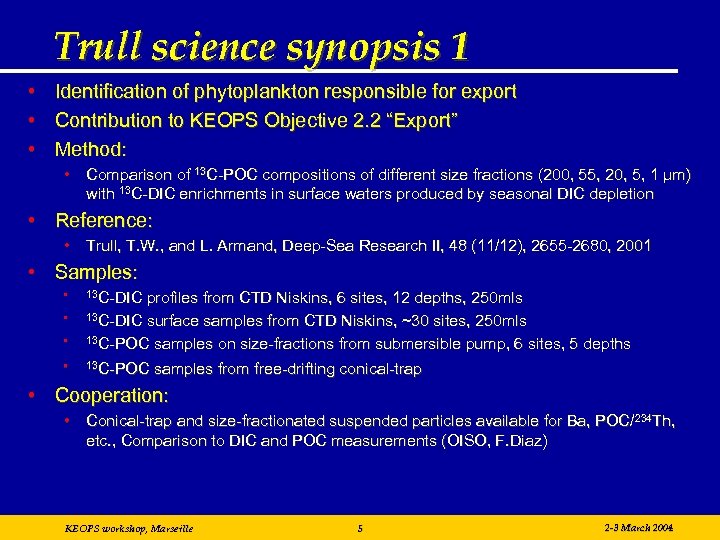 Trull science synopsis 1 • • • Identification of phytoplankton responsible for export Contribution to KEOPS Objective 2. 2 “Export” Method: • Comparison of 13 C-POC compositions of different size fractions (200, 55, 20, 5, 1 µm) with 13 C-DIC enrichments in surface waters produced by seasonal DIC depletion • Reference: • Trull, T. W. , and L. Armand, Deep-Sea Research II, 48 (11/12), 2655 -2680, 2001 • Samples: • • 13 C-DIC profiles from CTD Niskins, 6 sites, 12 depths, 250 mls 13 C-DIC surface samples from CTD Niskins, ~30 sites, 250 mls 13 C-POC samples on size-fractions from submersible pump, 6 sites, 5 depths 13 C-POC samples from free-drifting conical-trap • Cooperation: • Conical-trap and size-fractionated suspended particles available for Ba, POC/234 Th, etc. , Comparison to DIC and POC measurements (OISO, F. Diaz) KEOPS workshop, Marseille 5 2 -3 March 2004
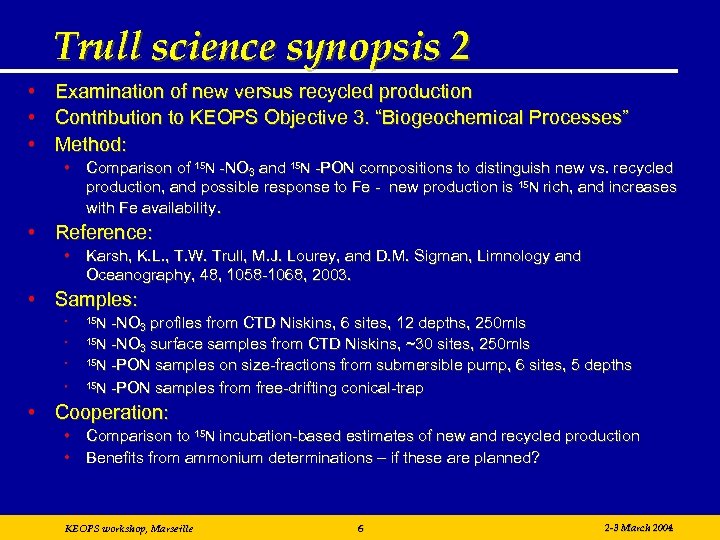 Trull science synopsis 2 • Examination of new versus recycled production • Contribution to KEOPS Objective 3. “Biogeochemical Processes” • Method: • Comparison of 15 N -NO 3 and 15 N -PON compositions to distinguish new vs. recycled production, and possible response to Fe - new production is 15 N rich, and increases with Fe availability. • Reference: • Karsh, K. L. , T. W. Trull, M. J. Lourey, and D. M. Sigman, Limnology and Oceanography, 48, 1058 -1068, 2003. • Samples: • • -NO 3 profiles from CTD Niskins, 6 sites, 12 depths, 250 mls 15 N -NO surface samples from CTD Niskins, ~30 sites, 250 mls 3 15 N -PON samples on size-fractions from submersible pump, 6 sites, 5 depths 15 N -PON samples from free-drifting conical-trap 15 N • Cooperation: • Comparison to 15 N incubation-based estimates of new and recycled production • Benefits from ammonium determinations – if these are planned? KEOPS workshop, Marseille 6 2 -3 March 2004
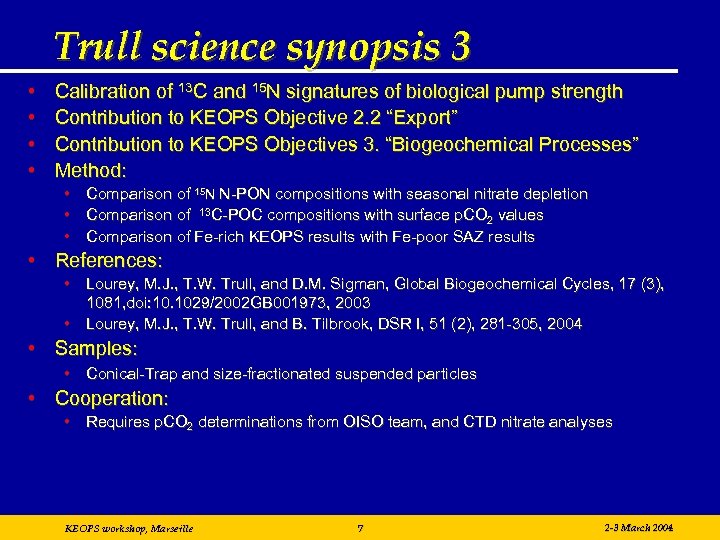 Trull science synopsis 3 • • Calibration of 13 C and 15 N signatures of biological pump strength Contribution to KEOPS Objective 2. 2 “Export” Contribution to KEOPS Objectives 3. “Biogeochemical Processes” Method: • Comparison of 15 N N-PON compositions with seasonal nitrate depletion • Comparison of 13 C-POC compositions with surface p. CO 2 values • Comparison of Fe-rich KEOPS results with Fe-poor SAZ results • References: • Lourey, M. J. , T. W. Trull, and D. M. Sigman, Global Biogeochemical Cycles, 17 (3), 1081, doi: 10. 1029/2002 GB 001973, 2003 • Lourey, M. J. , T. W. Trull, and B. Tilbrook, DSR I, 51 (2), 281 -305, 2004 • Samples: • Conical-Trap and size-fractionated suspended particles • Cooperation: • Requires p. CO 2 determinations from OISO team, and CTD nitrate analyses KEOPS workshop, Marseille 7 2 -3 March 2004
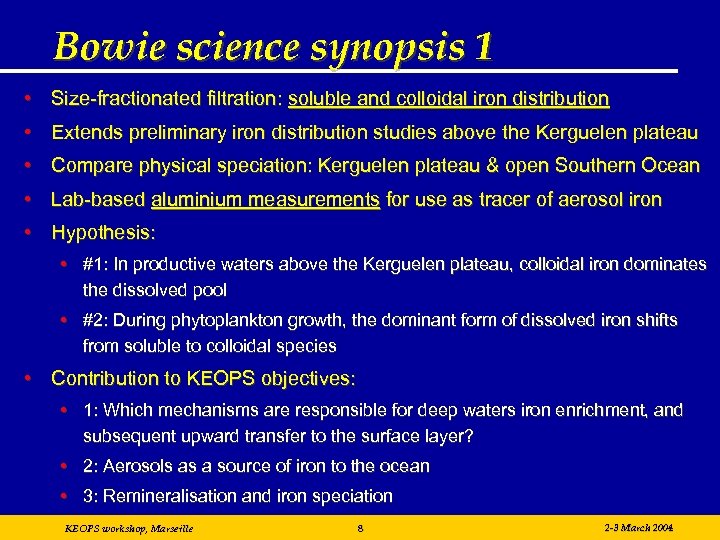 Bowie science synopsis 1 • Size-fractionated filtration: soluble and colloidal iron distribution • Extends preliminary iron distribution studies above the Kerguelen plateau • Compare physical speciation: Kerguelen plateau & open Southern Ocean • Lab-based aluminium measurements for use as tracer of aerosol iron • Hypothesis: • #1: In productive waters above the Kerguelen plateau, colloidal iron dominates the dissolved pool • #2: During phytoplankton growth, the dominant form of dissolved iron shifts from soluble to colloidal species • Contribution to KEOPS objectives: • 1: Which mechanisms are responsible for deep waters iron enrichment, and subsequent upward transfer to the surface layer? • 2: Aerosols as a source of iron to the ocean • 3: Remineralisation and iron speciation KEOPS workshop, Marseille 8 2 -3 March 2004
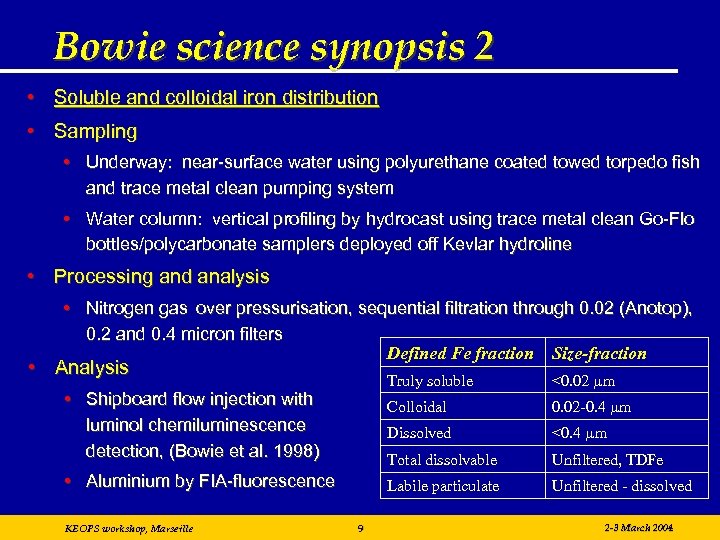 Bowie science synopsis 2 • Soluble and colloidal iron distribution • Sampling • Underway: near-surface water using polyurethane coated towed torpedo fish and trace metal clean pumping system • Water column: vertical profiling by hydrocast using trace metal clean Go-Flo bottles/polycarbonate samplers deployed off Kevlar hydroline • Processing and analysis • Nitrogen gas over pressurisation, sequential filtration through 0. 02 (Anotop), 0. 2 and 0. 4 micron filters Defined Fe fraction Size-fraction • Analysis Truly soluble Colloidal KEOPS workshop, Marseille Unfiltered, TDFe Labile particulate 9 <0. 4 mm Total dissolvable • Aluminium by FIA-fluorescence 0. 02 -0. 4 mm Dissolved • Shipboard flow injection with luminol chemiluminescence detection, (Bowie et al. 1998) <0. 02 mm Unfiltered - dissolved 2 -3 March 2004
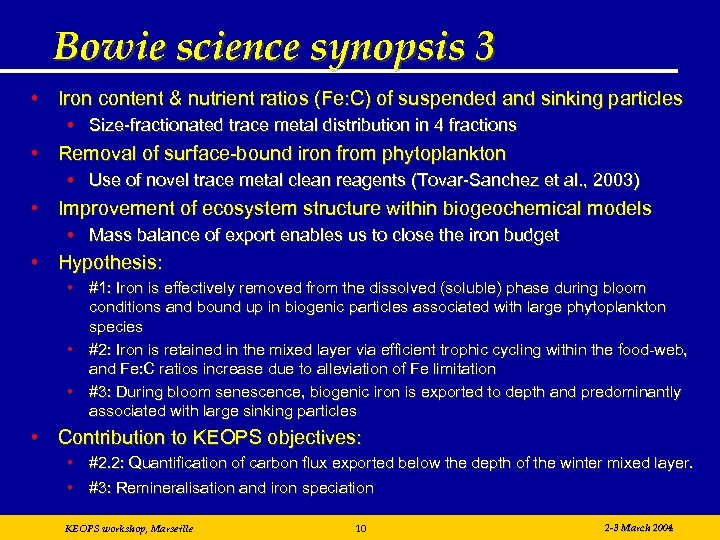 Bowie science synopsis 3 • Iron content & nutrient ratios (Fe: C) of suspended and sinking particles • Size-fractionated trace metal distribution in 4 fractions • Removal of surface-bound iron from phytoplankton • Use of novel trace metal clean reagents (Tovar-Sanchez et al. , 2003) • Improvement of ecosystem structure within biogeochemical models • Mass balance of export enables us to close the iron budget • Hypothesis: • #1: Iron is effectively removed from the dissolved (soluble) phase during bloom conditions and bound up in biogenic particles associated with large phytoplankton species • #2: Iron is retained in the mixed layer via efficient trophic cycling within the food-web, and Fe: C ratios increase due to alleviation of Fe limitation • #3: During bloom senescence, biogenic iron is exported to depth and predominantly associated with large sinking particles • Contribution to KEOPS objectives: • #2. 2: Quantification of carbon flux exported below the depth of the winter mixed layer. • #3: Remineralisation and iron speciation KEOPS workshop, Marseille 10 2 -3 March 2004
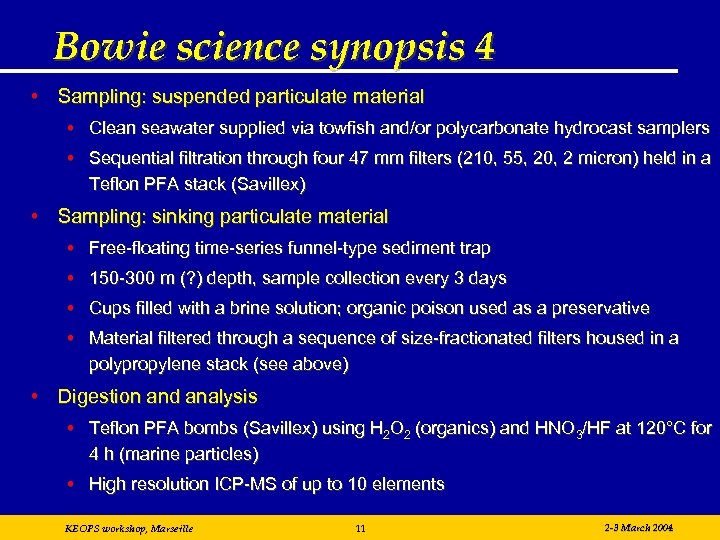 Bowie science synopsis 4 • Sampling: suspended particulate material • Clean seawater supplied via towfish and/or polycarbonate hydrocast samplers • Sequential filtration through four 47 mm filters (210, 55, 20, 2 micron) held in a Teflon PFA stack (Savillex) • Sampling: sinking particulate material • Free-floating time-series funnel-type sediment trap • 150 -300 m (? ) depth, sample collection every 3 days • Cups filled with a brine solution; organic poison used as a preservative • Material filtered through a sequence of size-fractionated filters housed in a polypropylene stack (see above) • Digestion and analysis • Teflon PFA bombs (Savillex) using H 2 O 2 (organics) and HNO 3/HF at 120°C for 4 h (marine particles) • High resolution ICP-MS of up to 10 elements KEOPS workshop, Marseille 11 2 -3 March 2004
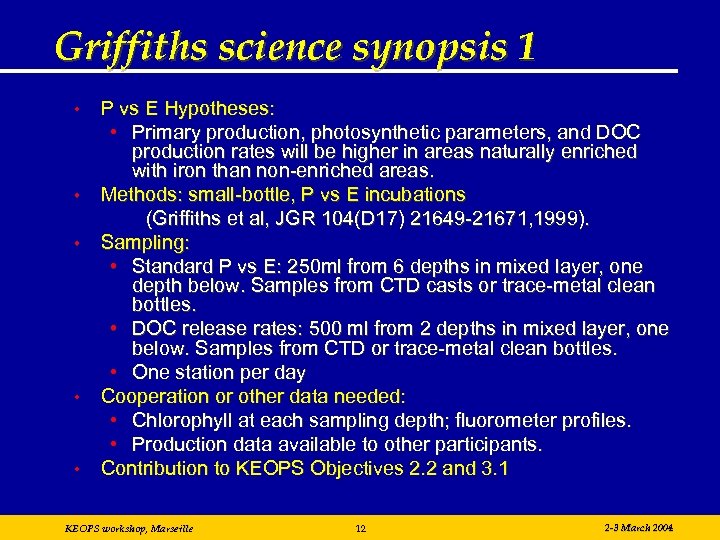 Griffiths science synopsis 1 • • • P vs E Hypotheses: • Primary production, photosynthetic parameters, and DOC production rates will be higher in areas naturally enriched with iron than non-enriched areas. Methods: small-bottle, P vs E incubations (Griffiths et al, JGR 104(D 17) 21649 -21671, 1999). Sampling: • Standard P vs E: 250 ml from 6 depths in mixed layer, one depth below. Samples from CTD casts or trace-metal clean bottles. • DOC release rates: 500 ml from 2 depths in mixed layer, one below. Samples from CTD or trace-metal clean bottles. • One station per day Cooperation or other data needed: • Chlorophyll at each sampling depth; fluorometer profiles. • Production data available to other participants. Contribution to KEOPS Objectives 2. 2 and 3. 1 KEOPS workshop, Marseille 12 2 -3 March 2004
 Griffiths science synopsis 2 • • Measurement: Size-fractionated primary production by simulated in-situ deck incubations. Hypothesis: • Regions with naturally high iron will have higher gross and net primary production, and a higher portion of the primary production in the largest phytoplankton size classes. • Sampling: • Incubations using water from six depths with about 2. 5 litres per depth. • Gross (daytime) and 24 hour production to be measured. • Require water to be taken from CTD cast before dawn. • Need chlorophyll concentration for each depth (fluorometry? ) • Provide deck incubator, but need 5 -10 l minute-1 seawater for cooling. • • Method: Standard JGOFS Protocol Contribution to KEOPS Objectives 2. 2 and 3. 1 KEOPS workshop, Marseille 13 2 -3 March 2004
 Griffiths science synopsis 3 • Nutrient limitation studies • Contrast possible nutrient limitation, particularly silicate, in phytoplankton by measuring the fluorescence response to nutrient addition. • Determine if nutrient limitation is occurring in some of the OBEX incubation studies, or if nutrient limitation has relaxed following amendment treatments (possible collaboration area). • Experimental technique being developed. • Require 25 ml samples from CTD casts or incubation bottles. • Underway Measurements • Distribution of CDOM in surface waters via fluorometry. • Determine contribution of CDOM to remotely sensed chlorophyll-a • Diel patterns in photosynthetic characteristics and fluorescence in surface waters in relation to PAR • More realistic representation of diel patterns in photosynthetic rate in models of primary production. • Sampling: need to be able to put two fluorometers and a Fast repetition-rate fluorometer in-line with thermosalinograph. • Contribution to KEOPS Objective 3. 1 KEOPS workshop, Marseille 14 2 -3 March 2004
 Griffiths science synopsis 4 • Explore factors impacting on primary production models. • Diel patterns in photosynthetic parameters measured by P vs E and Fast repetition-rate fluorometer (FRRF) methods for Pbopt type primary production models. • Determine the contribution of coloured dissolved organic matter (CDOM) to remotely sensed chlorophyll-a. • Measure spectral absorbance of phytoplankton and FRRF methods for input into quantum yield type primary production models. • Sampling • Photosynthetic parameters from 14 C small bottle incubations. • CDOM via continuous underway sampling or 100 ml samples from CTD. • Spectral absorbance: 1 -2 litres at 4 depths in the mixed layer (same depths as P vs E samples). • FRRF profiles on the CTD. • Cooperation • Chlorophyll-a and pigments for the spectral absorbance samples. • Mounting FRRF and battery pack on the CTD rosette • The fraction of primary production in the largest phytoplankton size classes will be greatest in regions of highest iron concentration. • Contribution to KEOPS Objective 2. 2 KEOPS workshop, Marseille 15 2 -3 March 2004
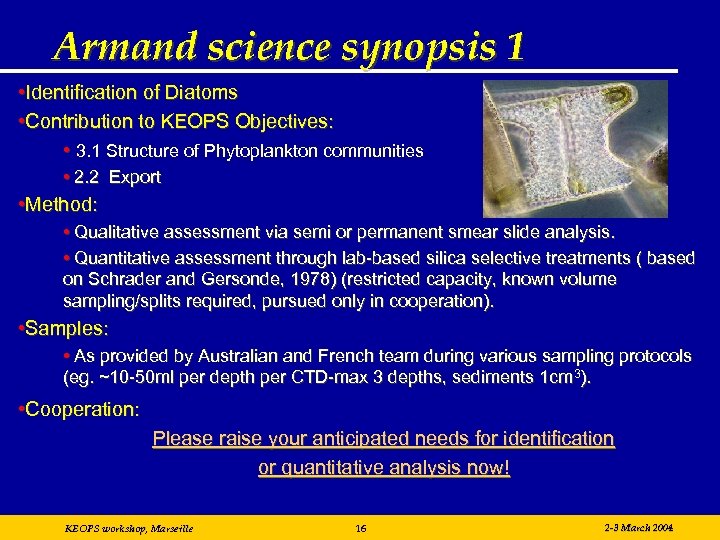 Armand science synopsis 1 • Identification of Diatoms • Contribution to KEOPS Objectives: • 3. 1 Structure of Phytoplankton communities • 2. 2 Export • Method: • Qualitative assessment via semi or permanent smear slide analysis. • Quantitative assessment through lab-based silica selective treatments ( based on Schrader and Gersonde, 1978) (restricted capacity, known volume sampling/splits required, pursued only in cooperation). • Samples: • As provided by Australian and French team during various sampling protocols (eg. ~10 -50 ml per depth per CTD-max 3 depths, sediments 1 cm 3). • Cooperation: Please raise your anticipated needs for identification or quantitative analysis now! KEOPS workshop, Marseille 16 2 -3 March 2004
 Armand science synopsis 2 • Silica Uptake Kinetic Experiments (under the Quéguiner program umbrella) • Contribution to KEOPS Objectives: • 3. 1 Structure of Phytoplankton communities • Method and samples: • Under guidance of B. Quéguiner (LOB) • Cooperation: • Dependent on EU funding. KEOPS workshop, Marseille 17 2 -3 March 2004
 References (available as. pdfs) • Bowie A. R. , Maldonado M. T. , Frew R. D. , Croot P. L. , Achterberg E. P. , Mantoura R. F. C. , Worsfold P. J. , Law C. S. , Boyd P. W. , 2001. The fate of added iron during a mesoscale fertilisation experiment in the Southern Ocean. Deep-Sea Research II 48, 2703 -2743. • Bowie A. R. , Ussher S. J. , Achterberg E. P. , Sedwick P. N. , Worsfold P. J. , 2002. Real-time monitoring of picomolar concentrations of iron(II) in marine waters using automated flow injection chemiluminescence instrumentation. Environmental Science and Technology 36, 4600 -4607. • Bowie A. R. , Whitworth D. J. , Achterberg E. P. , Mantoura R. F. C. , Worsfold P. J. , 2002. Biogeochemistry of Fe and other trace elements (Al, Co, Ni) in the upper Atlantic Ocean. Deep-Sea Research I 49, 605 -636. • Bowie A. R. , Achterberg E. P. , Blain S. , Boyé M. , Croot P. L. , Laan P. , Sarthou G. , de Baar H. J. W. , Worsfold P. J. , 2003. Shipboard analytical intercomparison of dissolved iron in surface waters along a north-south transect of the Atlantic Ocean. Marine Chemistry 84, 19 -34. • Bowie A. R. , Sedwick P. N. , Worsfold P. J. , 2004. Analytical intercomparison between flow injectionchemiluminescence and flow injection-spectrophotometry for the determination of picomolar concentrations of iron in seawater. Limnology and Oceanography: Methods, in press. KEOPS workshop, Marseille 18 2 -3 March 2004
 References (available as. pdfs) • Griffiths, F. B. , T. S. Bates, P. K. Quinn, L. A. Clementson and J. S. Parlsow, Oceanographic context of the First Aerosol Characterisation Experiment (ACE 1): A physical, chemical and biological overview, Journal of Geophysical Research 104 (D 17), 21, 649 -21671, 1999. • Karsh, K. L. , T. W. Trull, M. J. Lourey, and D. M. Sigman, Relationship of nitrogen isotope fractionation to phytoplankton size and iron availability during the Southern Ocean Iron RElease Experiment (SOIREE), Limnology and Oceanography, 48, 1058 -1068, 2003. • Lourey, M. J. , T. W. Trull, and D. M. Sigman, Sensitivity of the d 15 N of surface suspended and deep sinking particulate organic nitrogen to Southern Ocean seasonal nitrate depletion, Global Biogeochemical Cycles, 17 (3), 1081, doi: 10. 1029/2002 GB 001973, 2003. • Lourey, M. J. , T. W. Trull, and B. Tilbrook, Sensitivity of d 13 C of Southern Ocean suspended and sinking organic matter to temperature, nutrient utilisation and atmospheric CO 2, Deep-Sea Research I, 51 (2), 281 -305, 2004. • Trull, T. W. , and L. Armand, Insights into Southern Ocean carbon export from the d 13 C of particles and dissolved inorganic carbon during the SOIREE iron fertilisation experiment, Deep-Sea Research II, 48 (11/12), 2655 -2680, 2001. KEOPS workshop, Marseille 19 2 -3 March 2004