 Скачать презентацию Australian Mains Plug Variants The Table below
aee728aeebab7ed74031179c4923946b.ppt
- Количество слайдов: 16



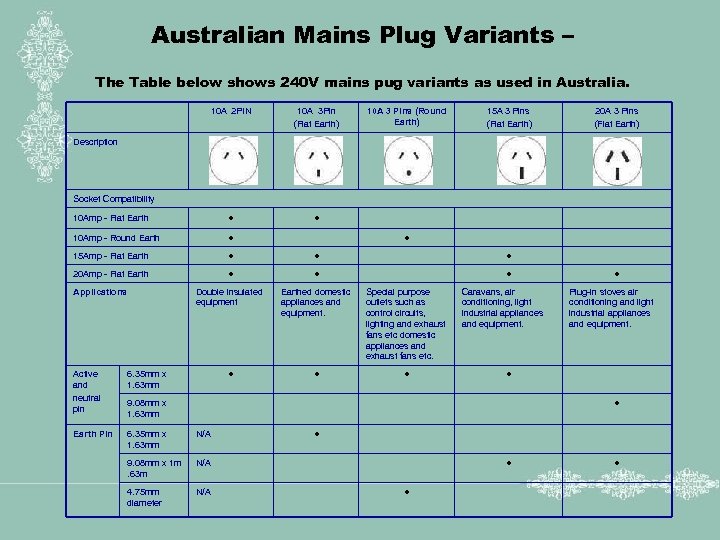
Australian Mains Plug Variants – The Table below shows 240 V mains pug variants as used in Australia. 10 A 2 PIN 10 A 3 Pin (Flat Earth) 10 A 3 Pins (Round Earth) 15 A 3 Pins (Flat Earth) 10 Amp - Flat Earth ● ● 10 Amp - Round Earth ● 15 Amp - Flat Earth ● ● ● 20 Amp - Flat Earth ● ● ● Double insulated equipment Earthed domestic appliances and equipment. Special purpose outlets such as control circuits, lighting and exhaust fans etc domestic appliances and exhaust fans etc. ● ● ● 20 A 3 Pins (Flat Earth) Description Socket Compatibility Applications Active and neutral pin 6. 35 mm x 1. 63 mm Earth Pin 6. 35 mm x 1. 63 mm N/A 9. 08 mm x 1 m . 63 m N/A 4. 75 mm diameter N/A ● Caravans, air conditioning, light industrial appliances and equipment. ● Plug-in stoves air conditioning and light industrial appliances and equipment. ● 9. 08 mm x 1. 63 mm ● ● ●
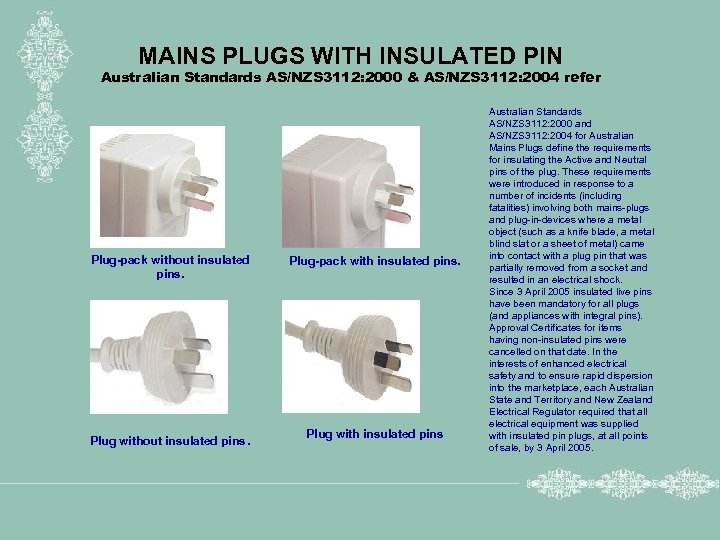
MAINS PLUGS WITH INSULATED PIN Australian Standards AS/NZS 3112: 2000 & AS/NZS 3112: 2004 refer Plug-pack without insulated pins. Plug-pack with insulated pins. Plug without insulated pins. Plug with insulated pins Australian Standards AS/NZS 3112: 2000 and AS/NZS 3112: 2004 for Australian Mains Plugs define the requirements for insulating the Active and Neutral pins of the plug. These requirements were introduced in response to a number of incidents (including fatalities) involving both mains-plugs and plug-in-devices where a metal object (such as a knife blade, a metal blind slat or a sheet of metal) came into contact with a plug pin that was partially removed from a socket and resulted in an electrical shock. Since 3 April 2005 insulated live pins have been mandatory for all plugs (and appliances with integral pins). Approval Certificates for items having non-insulated pins were cancelled on that date. In the interests of enhanced electrical safety and to ensure rapid dispersion into the marketplace, each Australian State and Territory and New Zealand Electrical Regulator required that all electrical equipment was supplied with insulated pin plugs, at all points of sale, by 3 April 2005.
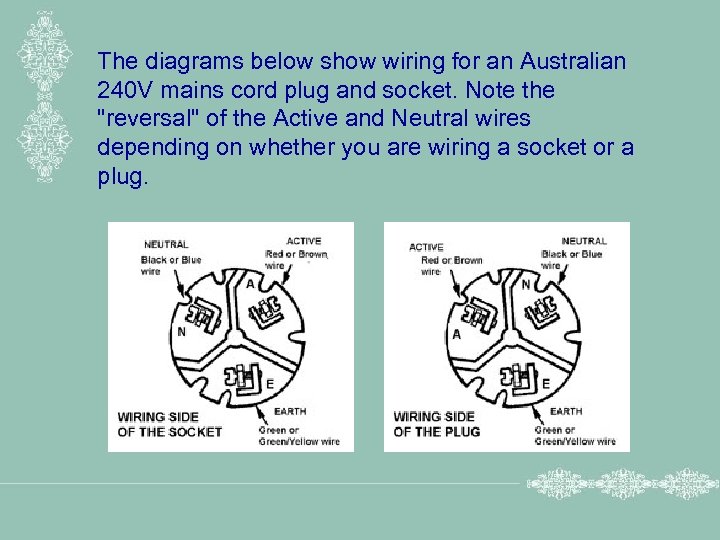
The diagrams below show wiring for an Australian 240 V mains cord plug and socket. Note the "reversal" of the Active and Neutral wires depending on whether you are wiring a socket or a plug.
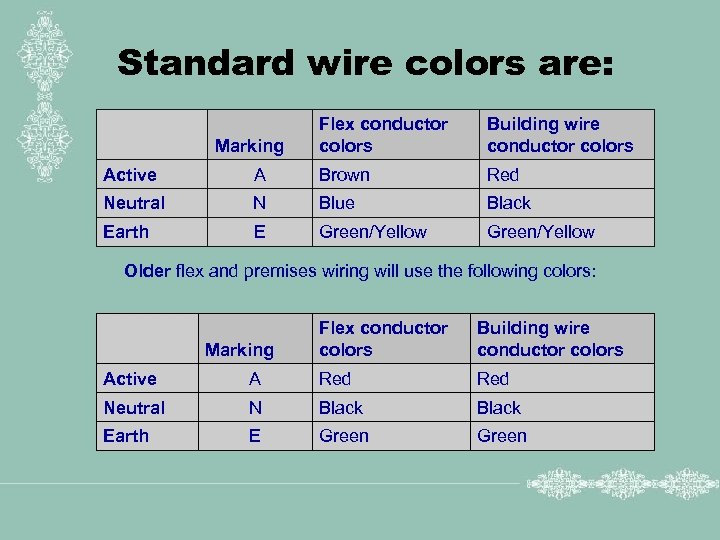
Standard wire colors are: Marking Flex conductor colors Building wire conductor colors Active A Brown Red Neutral N Blue Black Earth E Green/Yellow Older flex and premises wiring will use the following colors: Marking Flex conductor colors Building wire conductor colors Active A Red Neutral N Black Earth E Green
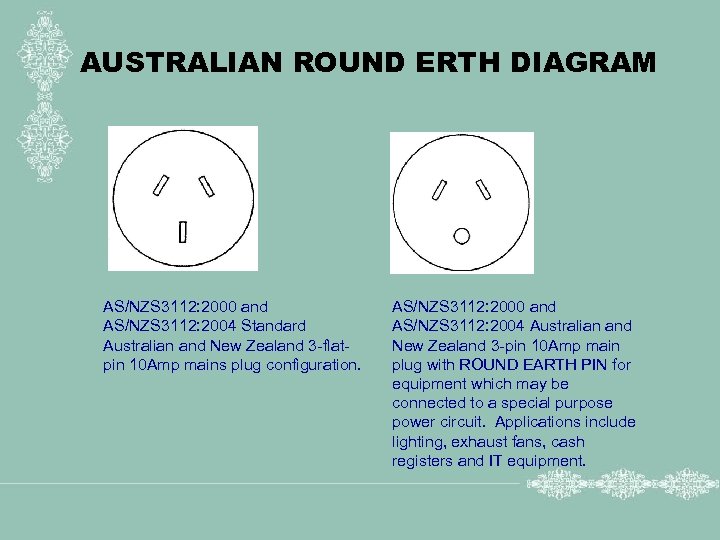
AUSTRALIAN ROUND ERTH DIAGRAM AS/NZS 3112: 2000 and AS/NZS 3112: 2004 Standard Australian and New Zealand 3 -flatpin 10 Amp mains plug configuration. AS/NZS 3112: 2000 and AS/NZS 3112: 2004 Australian and New Zealand 3 -pin 10 Amp main plug with ROUND EARTH PIN for equipment which may be connected to a special purpose power circuit. Applications include lighting, exhaust fans, cash registers and IT equipment.
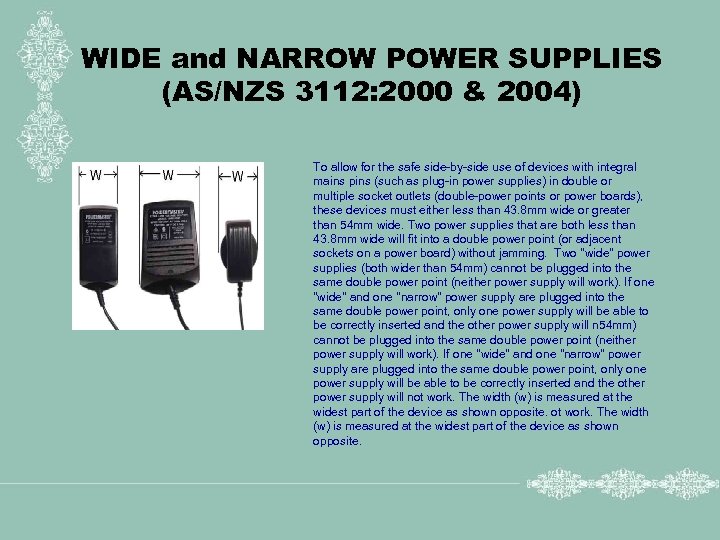
WIDE and NARROW POWER SUPPLIES (AS/NZS 3112: 2000 & 2004) To allow for the safe side-by-side use of devices with integral mains pins (such as plug-in power supplies) in double or multiple socket outlets (double-power points or power boards), these devices must either less than 43. 8 mm wide or greater than 54 mm wide. Two power supplies that are both less than 43. 8 mm wide will fit into a double power point (or adjacent sockets on a power board) without jamming. Two "wide" power supplies (both wider than 54 mm) cannot be plugged into the same double power point (neither power supply will work). If one "wide" and one "narrow" power supply are plugged into the same double power point, only one power supply will be able to be correctly inserted and the other power supply will not work. The width (w) is measured at the widest part of the device as shown opposite.
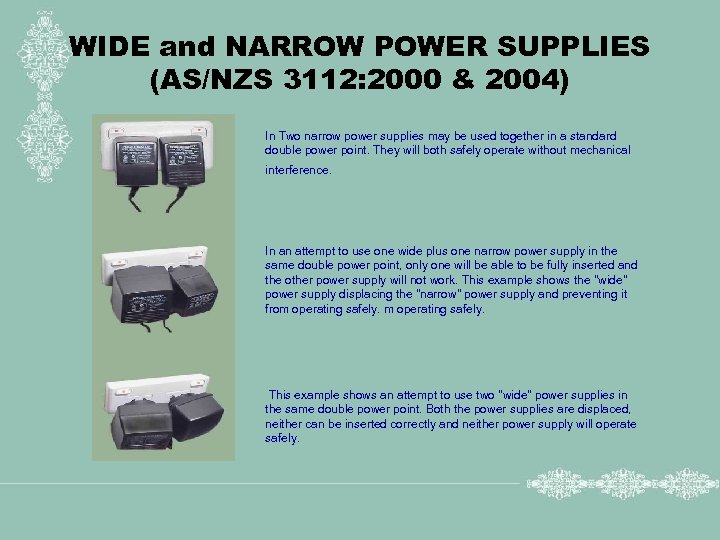
WIDE and NARROW POWER SUPPLIES (AS/NZS 3112: 2000 & 2004) In Two narrow power supplies may be used together in a standard double power point. They will both safely operate without mechanical interference. In an attempt to use one wide plus one narrow power supply in the same double power point, only one will be able to be fully inserted and the other power supply will not work. This example shows the "wide" power supply displacing the "narrow" power supply and preventing it from operating safely. This example shows an attempt to use two "wide" power supplies in the same double power point. Both the power supplies are displaced, neither can be inserted correctly and neither power supply will operate safely.
Approvals, Permits and Compliance The Australian Telecommunications Authority (Austel) were responsible for issuing cabling licences equipment permits and monitoring the conduct of licence and permit holders for all equipment and components connected to the Australian telephone network. The Spectrum Management Agency (SMA) was the Australian Commonwealth statutory agency responsible for the management of radio communications in Australia. On 1 July 1997, the AUSTEL and SMA merged to form the Australian Communications Authority (ACA). On July 1 st 2005, ACA and ABA (Australian Broadcasting Authority) merged to form the ACMA (Australian Communications Media Authority). The ACMA is now responsible for technical regulation, consumer issues and licensing of telecommunications and radio communications in Australia.
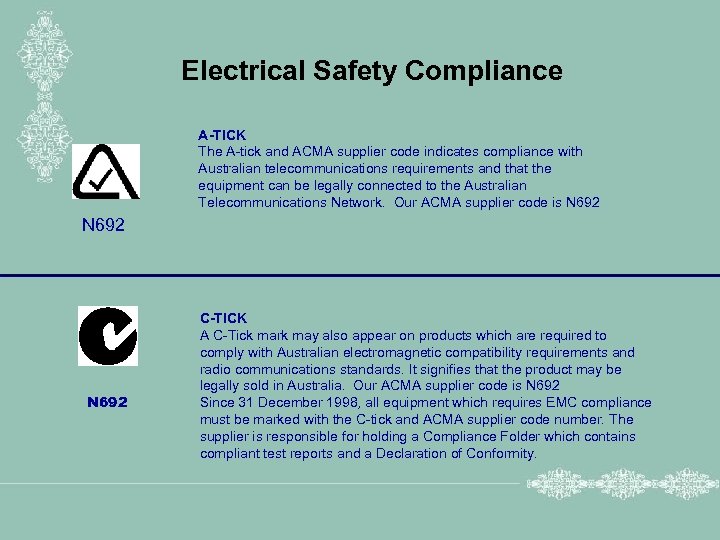
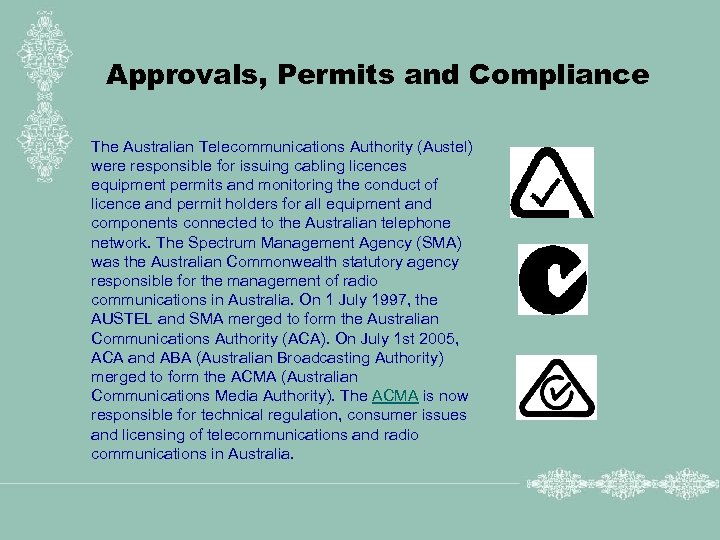
Electrical Safety Compliance A-TICK The A-tick and ACMA supplier code indicates compliance with Australian telecommunications requirements and that the equipment can be legally connected to the Australian Telecommunications Network. Our ACMA supplier code is N 692 N 692 C-TICK A C-Tick mark may also appear on products which are required to comply with Australian electromagnetic compatibility requirements and radio communications standards. It signifies that the product may be legally sold in Australia. Our ACMA supplier code is N 692 Since 31 December 1998, all equipment which requires EMC compliance must be marked with the C-tick and ACMA supplier code number. The supplier is responsible for holding a Compliance Folder which contains compliant test reports and a Declaration of Conformity.
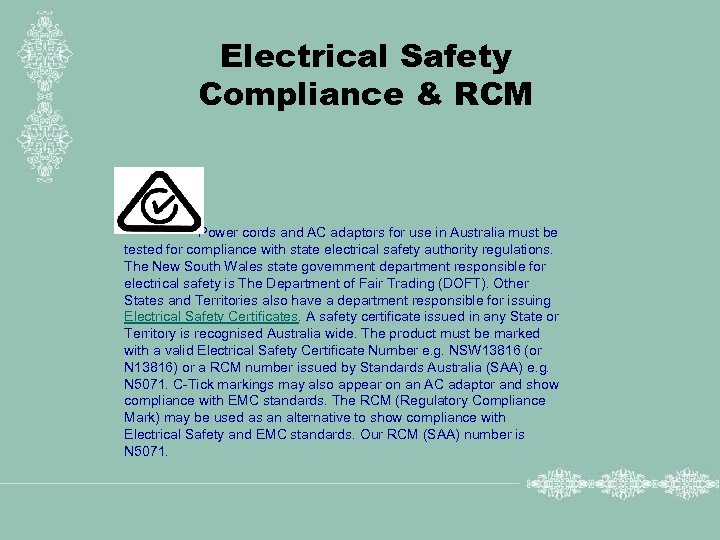
Electrical Safety Compliance & RCM Power cords and AC adaptors for use in Australia must be tested for compliance with state electrical safety authority regulations. The New South Wales state government department responsible for electrical safety is The Department of Fair Trading (DOFT). Other States and Territories also have a department responsible for issuing Electrical Safety Certificates. A safety certificate issued in any State or Territory is recognised Australia wide. The product must be marked with a valid Electrical Safety Certificate Number e. g. NSW 13816 (or N 13816) or a RCM number issued by Standards Australia (SAA) e. g. N 5071. C-Tick markings may also appear on an AC adaptor and show compliance with EMC standards. The RCM (Regulatory Compliance Mark) may be used as an alternative to show compliance with Electrical Safety and EMC standards. Our RCM (SAA) number is N 5071.
Electrical Safety Compliance By interstate agreement and legislation, an electrical safety certificate issued by the appropriate regulatory authority in any State or Territory is recognised by all other States or Territories. Articles approved by a regulatory authority must be identified with a valid Electrical Safety Certificate Number issued by a State or Territory authority. An electrical safety certificate number typically consists of a letter to indicate the State of approval, followed by a number.
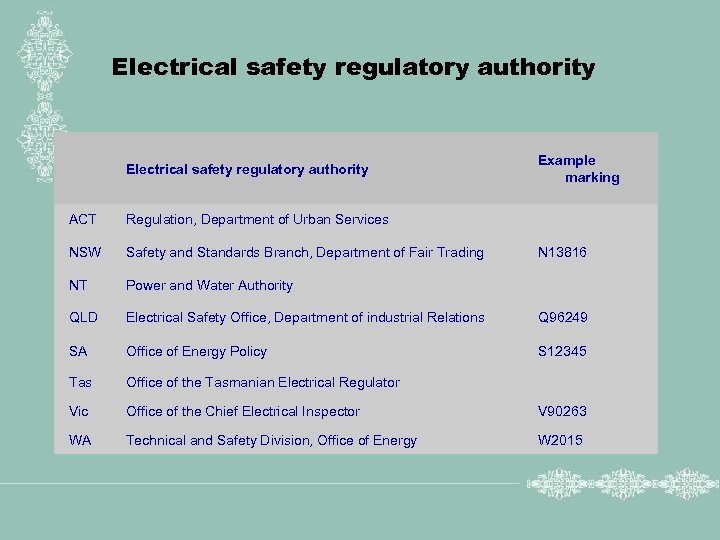
Electrical safety regulatory authority Example marking ACT Regulation, Department of Urban Services NSW Safety and Standards Branch, Department of Fair Trading NT Power and Water Authority QLD Electrical Safety Office, Department of industrial Relations Q 96249 SA Office of Energy Policy S 12345 Tas Office of the Tasmanian Electrical Regulator Vic Office of the Chief Electrical Inspector V 90263 WA Technical and Safety Division, Office of Energy W 2015 N 13816
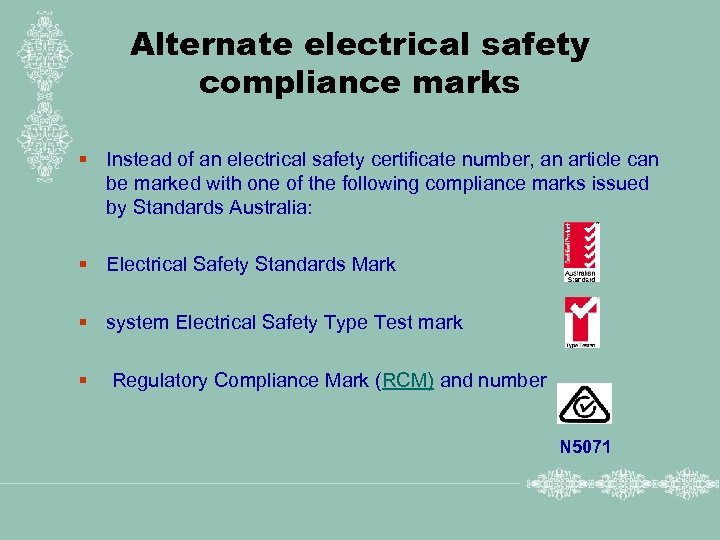
Alternate electrical safety compliance marks § Instead of an electrical safety certificate number, an article can be marked with one of the following compliance marks issued by Standards Australia: § Electrical Safety Standards Mark § system Electrical Safety Type Test mark § Regulatory Compliance Mark (RCM) and number N 5071
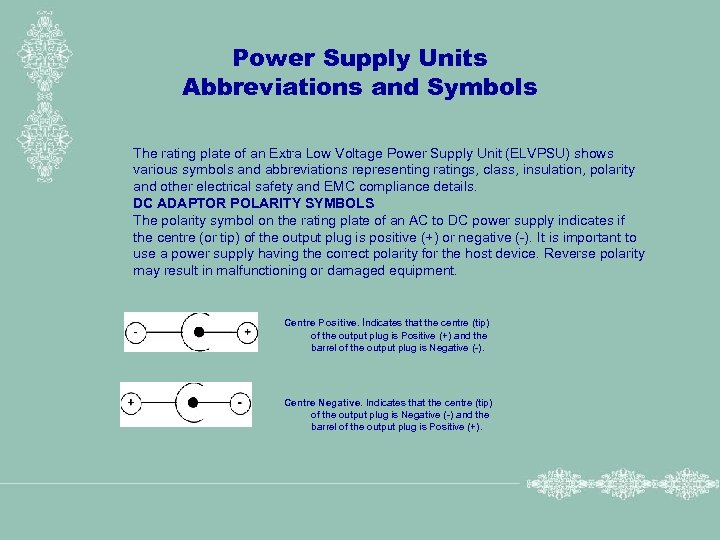
Power Supply Units Abbreviations and Symbols The rating plate of an Extra Low Voltage Power Supply Unit (ELVPSU) shows various symbols and abbreviations representing ratings, class, insulation, polarity and other electrical safety and EMC compliance details. DC ADAPTOR POLARITY SYMBOLS The polarity symbol on the rating plate of an AC to DC power supply indicates if the centre (or tip) of the output plug is positive (+) or negative (-). It is important to use a power supply having the correct polarity for the host device. Reverse polarity may result in malfunctioning or damaged equipment. Centre Positive. Indicates that the centre (tip) of the output plug is Positive (+) and the barrel of the output plug is Negative (-). Centre Negative. Indicates that the centre (tip) of the output plug is Negative (-) and the barrel of the output plug is Positive (+).
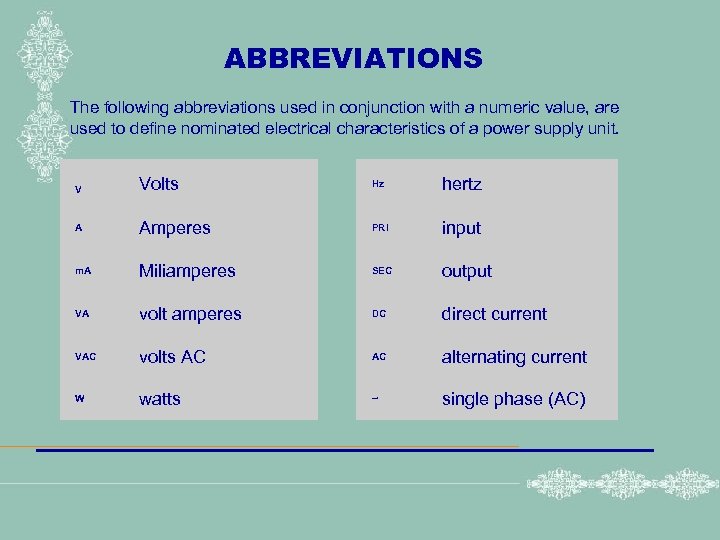
ABBREVIATIONS The following abbreviations used in conjunction with a numeric value, are used to define nominated electrical characteristics of a power supply unit. V Volts Hz hertz A Amperes PRI input m. A Miliamperes SEC output VA volt amperes DC direct current VAC volts AC alternating current W watts ~ single phase (AC)

<< THANKS >> § PREPARED BY: KATTOW § DATE: 2006/6/10
Скачать презентацию Australian Mains Plug Variants The Table below
aee728aeebab7ed74031179c4923946b.ppt