


 Скачать презентацию Australian Geomechanics Society July 2014 DMT SDMT
7ef8ffd894e4865dd1cee4a4406ed998.ppt
- Количество слайдов: 102
 Australian Geomechanics Society July 2014 DMT / SDMT Workshop Frontespizio Flat dilatometer (DMT). Seismic DMT. Main applications and recent developments Silvano Marchetti University of L'Aquila, Italy silvano@marchetti-dmt. it 1
 FROM LAB TO INSITU TESTING In the last decades : massive migration from lab testing to insitu testing. Often today in situ testing is the major part of an investigation. In situ : Fast, economical, reproducible, informative, many data, reduced scatter, cost much less than sampling & testing…. True in SAND : Recovering samples difficult (tailings). Field tests are the state-of-practice. Caution : lab remains fundamental for research 2
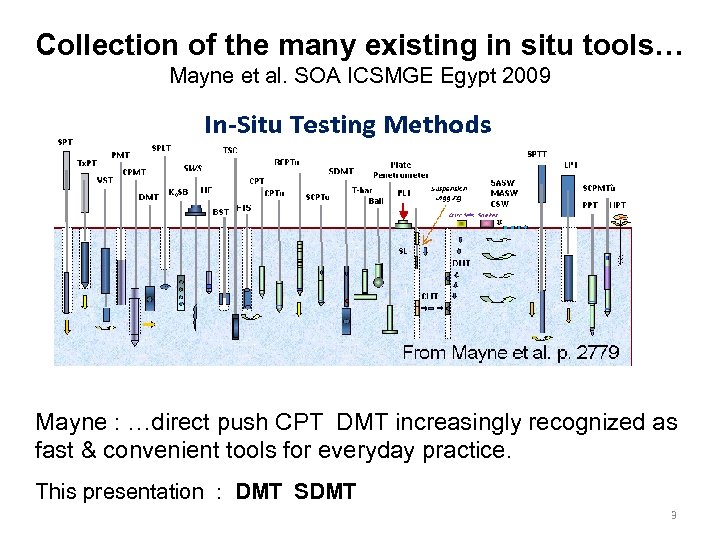 Collection of the many existing in situ tools… Mayne et al. SOA ICSMGE Egypt 2009 Mayne : …direct push CPT DMT increasingly recognized as fast & convenient tools for everyday practice. This presentation : DMT SDMT 3
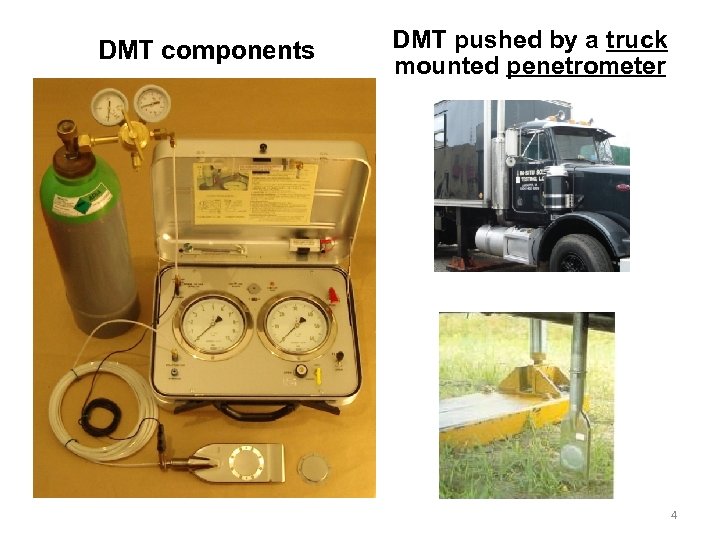 DMT components DMT pushed by a truck mounted penetrometer 4
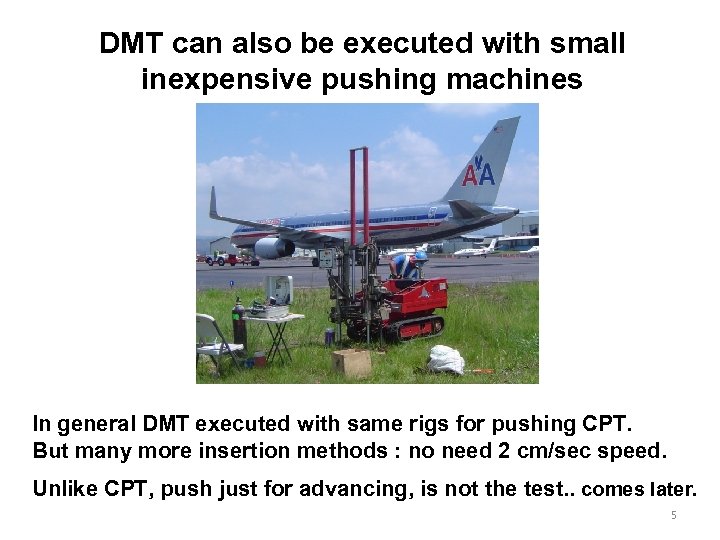 DMT can also be executed with small inexpensive pushing machines In general DMT executed with same rigs for pushing CPT. But many more insertion methods : no need 2 cm/sec speed. Unlike CPT, push just for advancing, is not the test. . comes later. 5
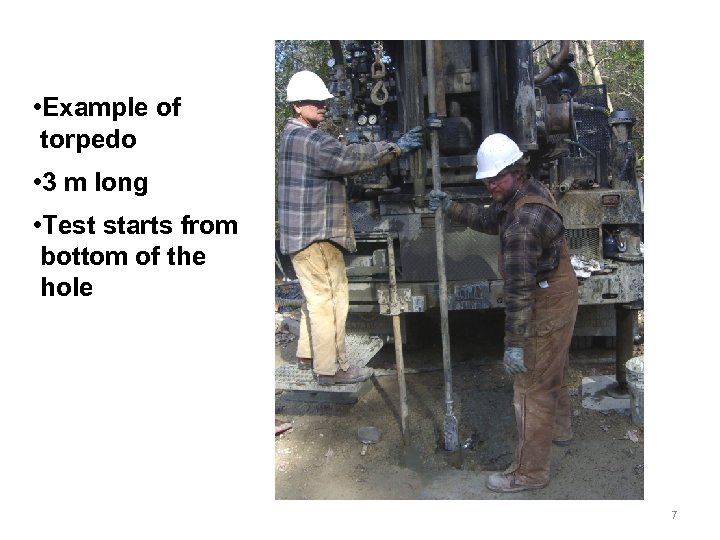 • Example of torpedo • 3 m long • Test starts from bottom of the hole 7
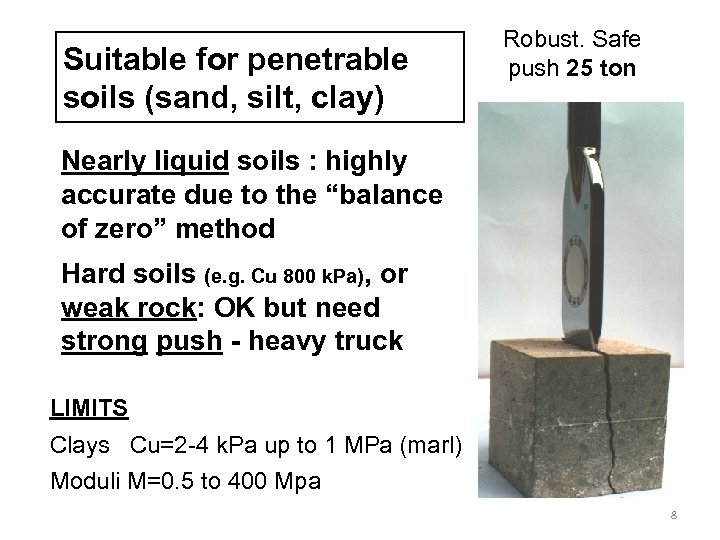 Suitable for penetrable soils (sand, silt, clay) Robust. Safe push 25 ton Nearly liquid soils : highly accurate due to the “balance of zero” method Hard soils (e. g. Cu 800 k. Pa), or weak rock: OK but need strong push - heavy truck LIMITS Clays Cu=2 -4 k. Pa up to 1 MPa (marl) Moduli M=0. 5 to 400 Mpa 8
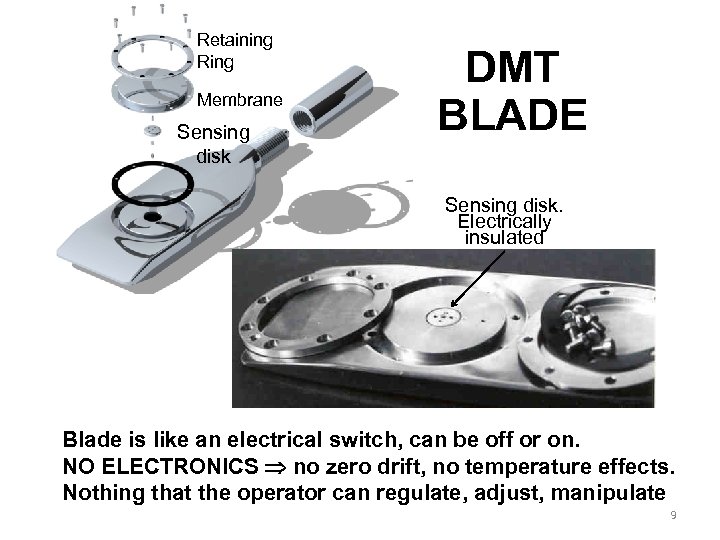 Retaining Ring Membrane Sensing disk DMT BLADE Sensing disk. Electrically insulated Blade is like an electrical switch, can be off or on. NO ELECTRONICS no zero drift, no temperature effects. Nothing that the operator can regulate, adjust, manipulate 9
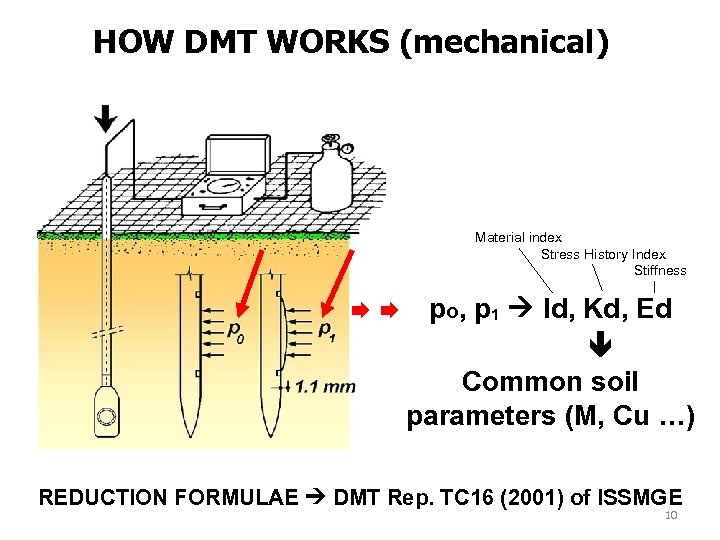 HOW DMT WORKS (mechanical) Material index Stress History Index Stiffness po, p 1 Id, Kd, Ed Common soil parameters (M, Cu …) REDUCTION FORMULAE DMT Rep. TC 16 (2001) of ISSMGE 10
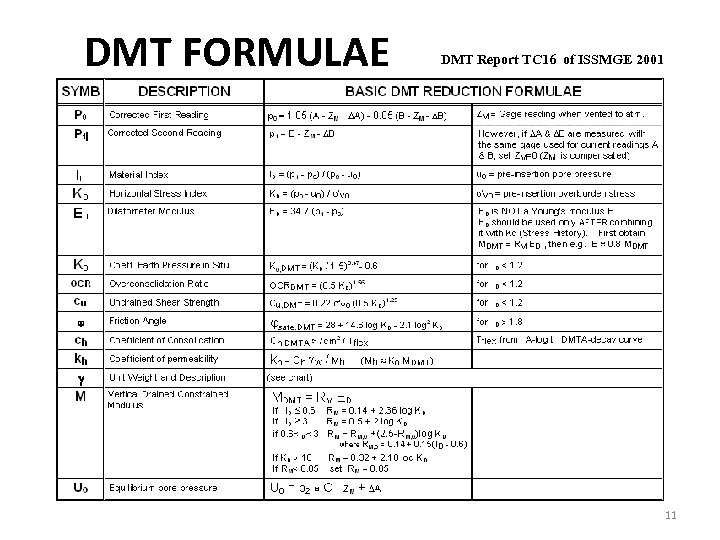 DMT FORMULAE DMT Report TC 16 of ISSMGE 2001 11
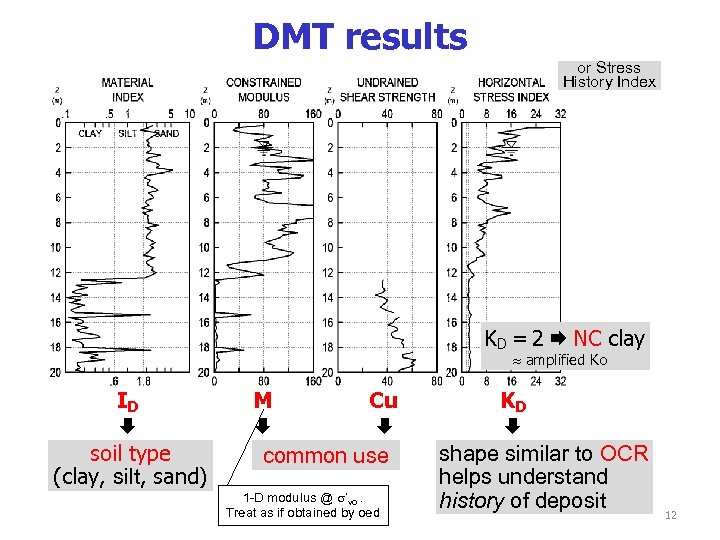 DMT results or Stress History Index KD = 2 NC clay amplified Ko ID soil type (clay, silt, sand) M Cu common use 1 -D modulus @ ’vo. Treat as if obtained by oed KD shape similar to OCR helps understand history of deposit 12
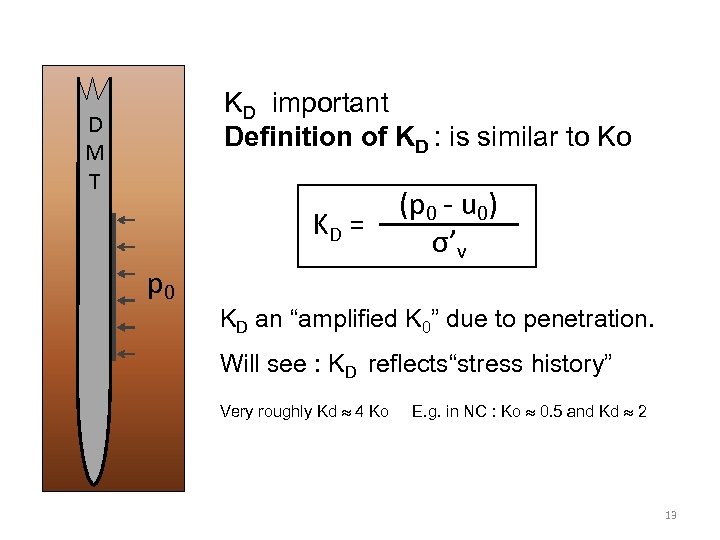 KD important Definition of KD : is similar to Ko D M T KD = p 0 (p 0 - u 0) σ’v KD an “amplified K 0” due to penetration. Will see : KD reflects“stress history” Very roughly Kd 4 Ko E. g. in NC : Ko 0. 5 and Kd 2 13
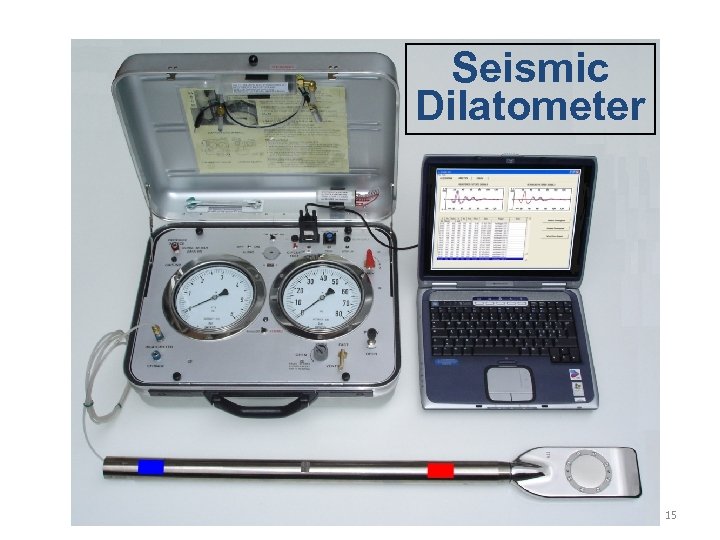
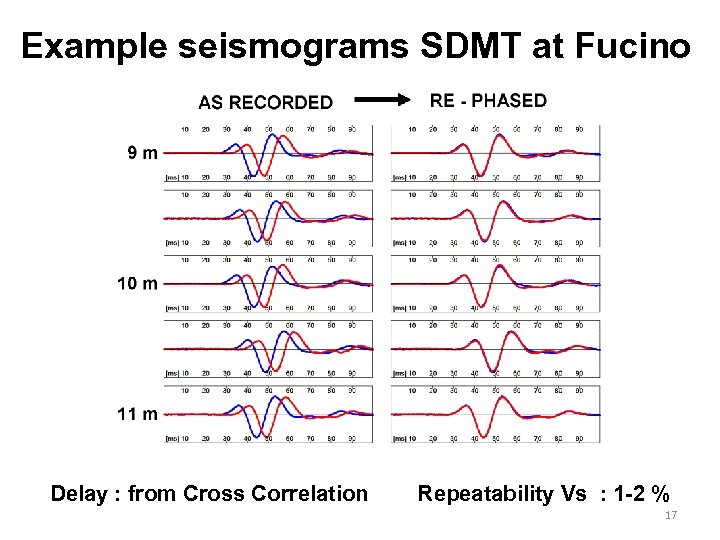
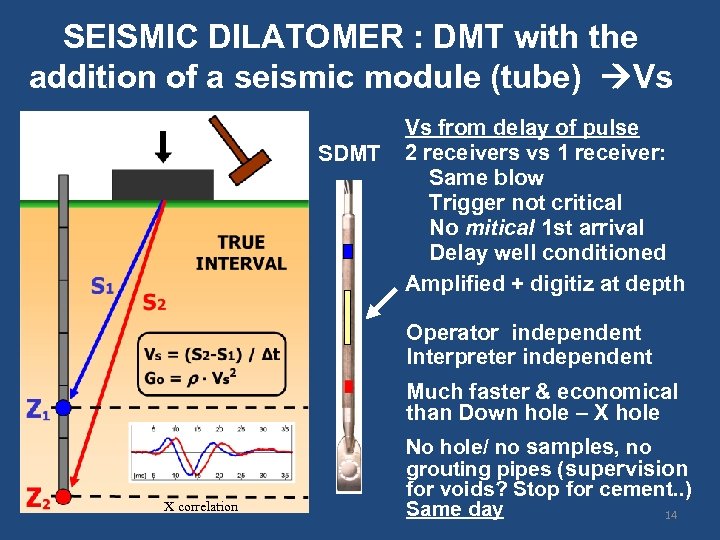 SEISMIC DILATOMER : DMT with the addition of a seismic module (tube) Vs SDMT Vs from delay of pulse 2 receivers vs 1 receiver: Same blow Trigger not critical No mitical 1 st arrival Delay well conditioned Amplified + digitiz at depth Operator independent Interpreter independent Much faster & economical than Down hole – X hole X correlation No hole/ no samples, no grouting pipes (supervision for voids? Stop for cement. . ) Same day 14
 Seismic Dilatometer 15
 16
16
 Example seismograms SDMT at Fucino Delay : from Cross Correlation Repeatability Vs : 1 -2 % 17
 SDMT results repeatability ≈ 1 -2% SHEAR WAVE VELOCITY GO= ρ Vs 2 Vs (m/s) mechanical DMT Seismic DMT Provides considerable information on the site 18
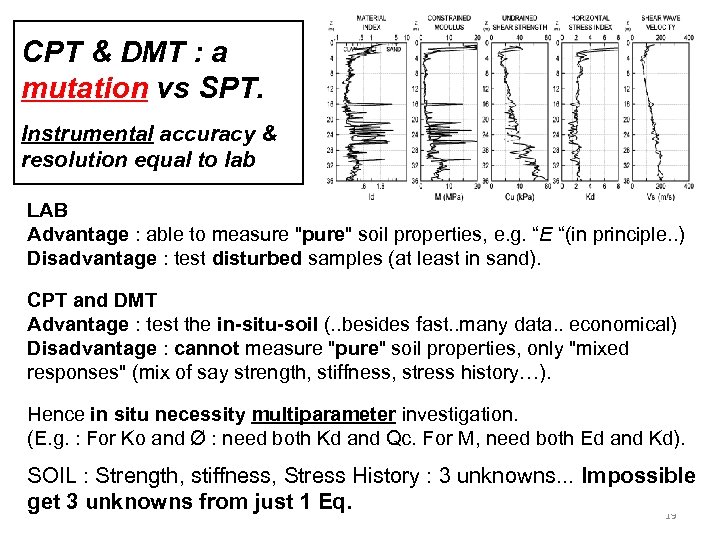 CPT & DMT : a mutation vs SPT. Instrumental accuracy & resolution equal to lab LAB Advantage : able to measure "pure" soil properties, e. g. “E “(in principle. . ) Disadvantage : test disturbed samples (at least in sand). CPT and DMT Advantage : test the in-situ-soil (. . besides fast. . many data. . economical) Disadvantage : cannot measure "pure" soil properties, only "mixed responses" (mix of say strength, stiffness, stress history…). Hence in situ necessity multiparameter investigation. (E. g. : For Ko and Ø : need both Kd and Qc. For M, need both Ed and Kd). SOIL : Strength, stiffness, Stress History : 3 unknowns. . . Impossible get 3 unknowns from just 1 Eq. 19
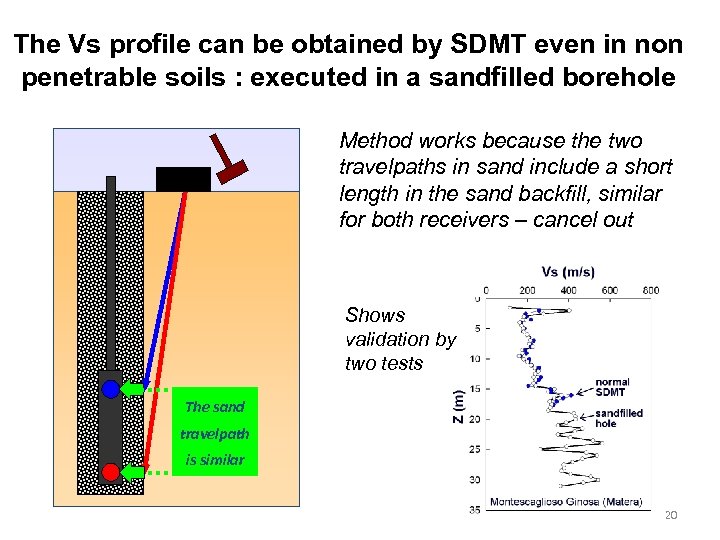 The Vs profile can be obtained by SDMT even in non penetrable soils : executed in a sandfilled borehole Method works because the two travelpaths in sand include a short length in the sand backfill, similar for both receivers – cancel out Shows validation by two tests The sand travelpath is similar 20
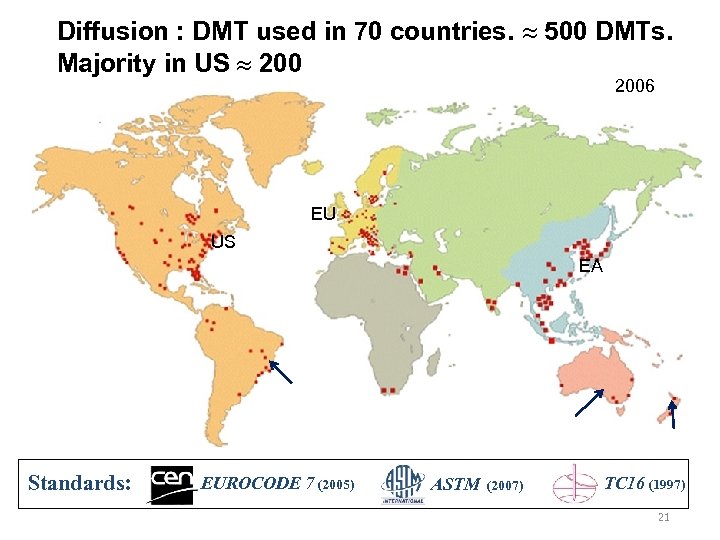 Diffusion : DMT used in 70 countries. 500 DMTs. Majority in US 2006 EU US EA Standards: EUROCODE 7 (2005) ASTM (2007) TC 16 (1997) 21
 Main SDMT applications (details papers) Settlements of shallow foundations Have in common : Liquefability evaluation need of Stress History (by Kd) Compaction control Detecting slip surfaces in OC clay Laterally loaded piles Diaphragm walls : “springs” for design FEM input parameters In situ G- decay curves Seismic design (NTC 08, Eurocode 8) 22
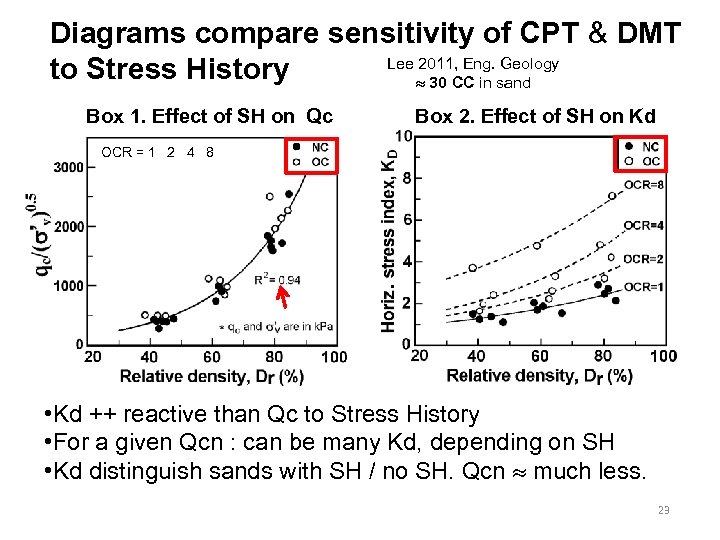 Diagrams compare sensitivity of CPT & DMT Lee 2011, Eng. Geology to Stress History 30 CC in sand Box 1. Effect of SH on Qc Box 2. Effect of SH on Kd OCR = 1 2 4 8 CPT DMT • Kd ++ reactive than Qc to Stress History • For a given Qcn : can be many Kd, depending on SH • Kd distinguish sands with SH / no SH. Qcn much less. 23
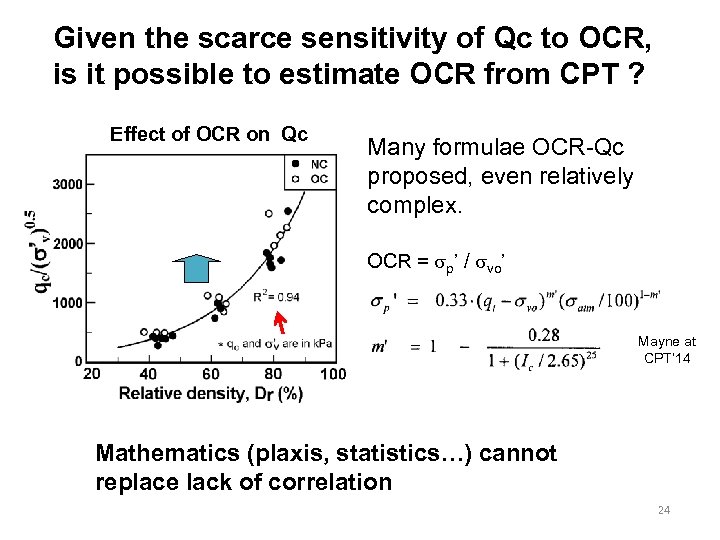 Given the scarce sensitivity of Qc to OCR, is it possible to estimate OCR from CPT ? Effect of OCR on Qc Many formulae OCR-Qc proposed, even relatively complex. OCR = p’ / vo’ Mayne at CPT’ 14 Mathematics (plaxis, statistics…) cannot replace lack of correlation 24
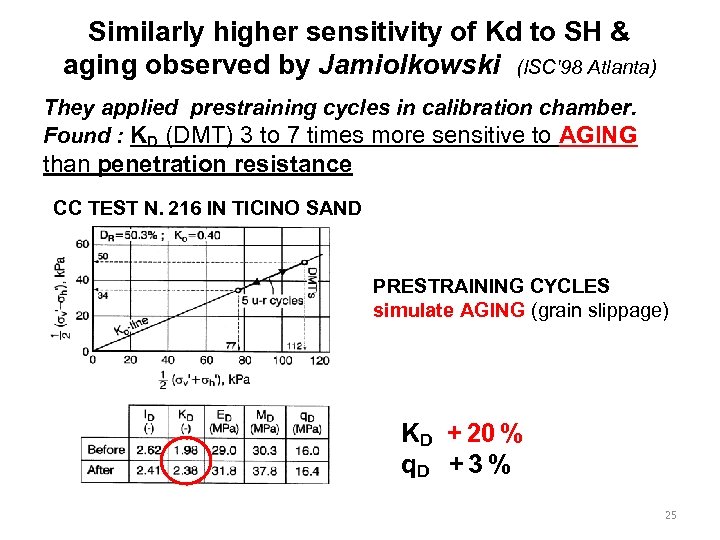 Similarly higher sensitivity of Kd to SH & aging observed by Jamiolkowski (ISC'98 Atlanta) They applied prestraining cycles in calibration chamber. Found : KD (DMT) 3 to 7 times more sensitive to AGING than penetration resistance CC TEST N. 216 IN TICINO SAND PRESTRAINING CYCLES simulate AGING (grain slippage) KD + 20 % q. D + 3 % 25
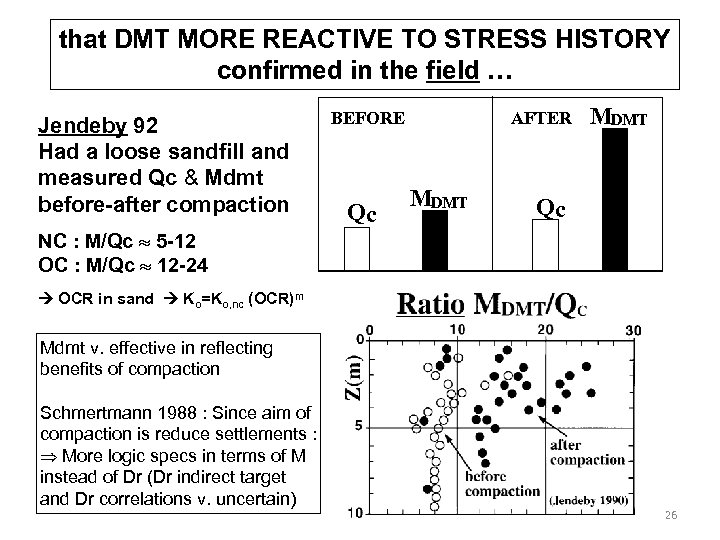 that DMT MORE REACTIVE TO STRESS HISTORY confirmed in the field … Jendeby 92 Had a loose sandfill and measured Qc & Mdmt before-after compaction BEFORE Qc AFTER MDMT Qc NC : M/Qc 5 -12 OC : M/Qc 12 -24 OCR in sand Ko=Ko, nc (OCR)m Mdmt v. effective in reflecting benefits of compaction Schmertmann 1988 : Since aim of compaction is reduce settlements : More logic specs in terms of M instead of Dr (Dr indirect target and Dr correlations v. uncertain) 26
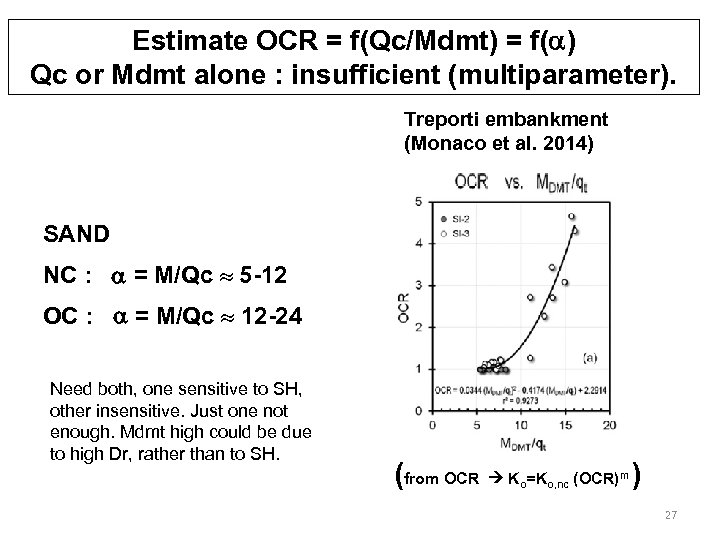 Estimate OCR = f(Qc/Mdmt) = f( ) Qc or Mdmt alone : insufficient (multiparameter). Treporti embankment (Monaco et al. 2014) SAND NC : = M/Qc 5 -12 OC : = M/Qc 12 -24 Need both, one sensitive to SH, other insensitive. Just one not enough. Mdmt high could be due to high Dr, rather than to SH. ( ) from OCR Ko=Ko, nc (OCR)m 27
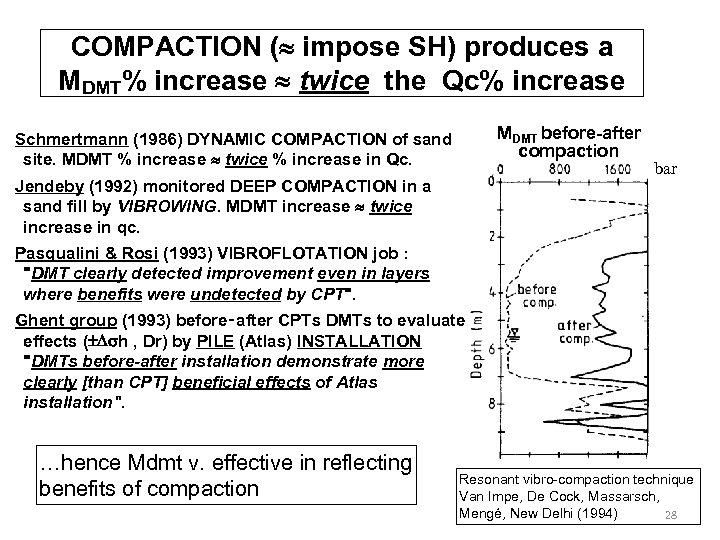 COMPACTION ( impose SH) produces a MDMT% increase twice the Qc% increase MDMT before-after compaction Schmertmann (1986) DYNAMIC COMPACTION of sand site. MDMT % increase twice % increase in Qc. Jendeby (1992) monitored DEEP COMPACTION in a sand fill by VIBROWING. MDMT increase twice increase in qc. bar Pasqualini & Rosi (1993) VIBROFLOTATION job : "DMT clearly detected improvement even in layers where benefits were undetected by CPT". Ghent group (1993) before‑after CPTs DMTs to evaluate effects ( h , Dr) by PILE (Atlas) INSTALLATION "DMTs before-after installation demonstrate more clearly [than CPT] beneficial effects of Atlas installation". …hence Mdmt v. effective in reflecting benefits of compaction Resonant vibro-compaction technique Van Impe, De Cock, Massarsch, Mengé, New Delhi (1994) 28
 …. conclusion : good sensitivity of Kd to Stress History … (SH : OCR overburden, aging, any factor better grain interlocking) Sensitivity to SH important : (1) not many SH tools (2) SH important for settlements and liquefaction Importance of SH to predict Settlements Jamiolkowski (Isopt-1, ‘ 88, 1) : “without Stress History, impossible to select reliable E (or M) from Qc” (also Terzaghi, Leonards, Schmertmann…) Yoshimi (1975) “… the NC sand specimens were six times more compressible than the prestressed sand” hence imperative SH to characterize compressibility of sand Application #1 DMT : predict settlements (operative modulus) MDMT= ED x Rm(Kd, Id) (combines ED with Stress History) 29
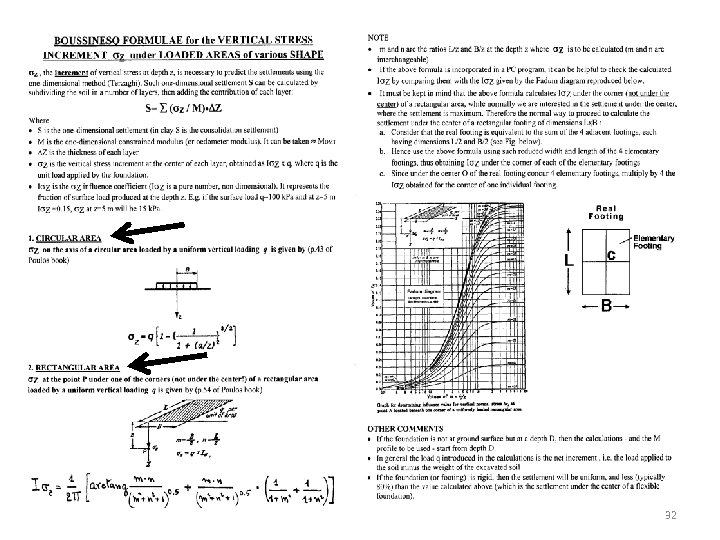
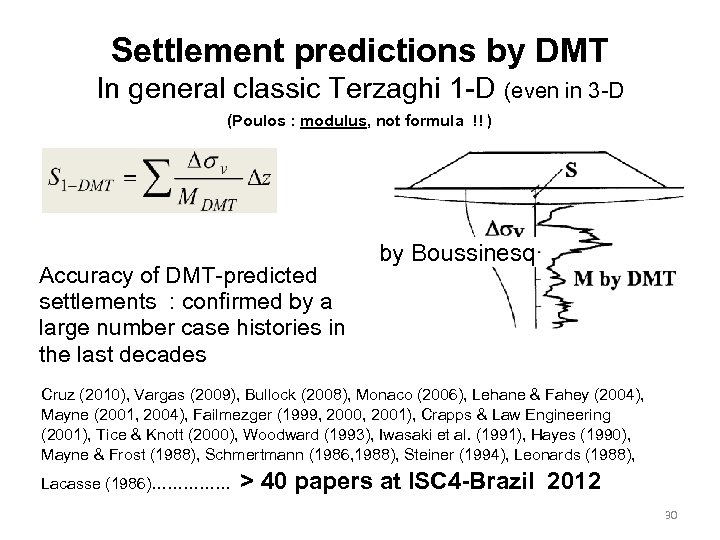 Settlement predictions by DMT In general classic Terzaghi 1 -D (even in 3 -D (Poulos : modulus, not formula !! ) Accuracy of DMT-predicted settlements : confirmed by a large number case histories in the last decades by Boussinesq Cruz (2010), Vargas (2009), Bullock (2008), Monaco (2006), Lehane & Fahey (2004), Mayne (2001, 2004), Failmezger (1999, 2000, 2001), Crapps & Law Engineering (2001), Tice & Knott (2000), Woodward (1993), Iwasaki et al. (1991), Hayes (1990), Mayne & Frost (1988), Schmertmann (1986, 1988), Steiner (1994), Leonards (1988), Lacasse (1986)…………… > 40 papers at ISC 4 -Brazil 2012 30
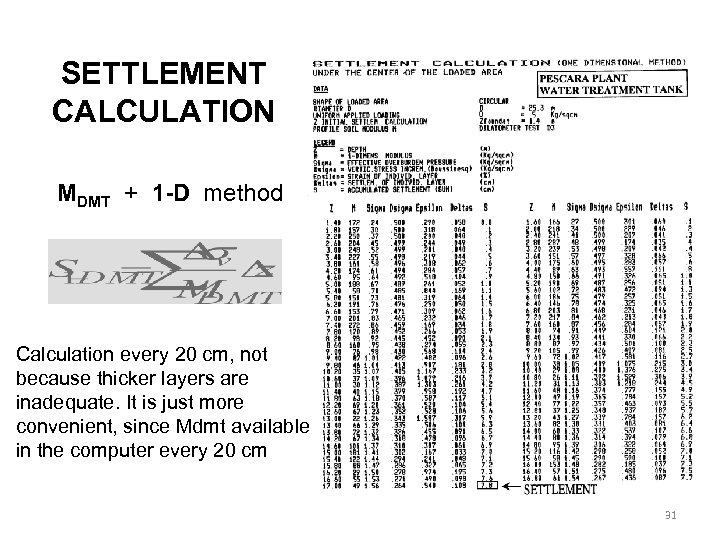 SETTLEMENT CALCULATION MDMT + 1 -D method Calculation every 20 cm, not because thicker layers are inadequate. It is just more convenient, since Mdmt available in the computer every 20 cm 31
 32
32
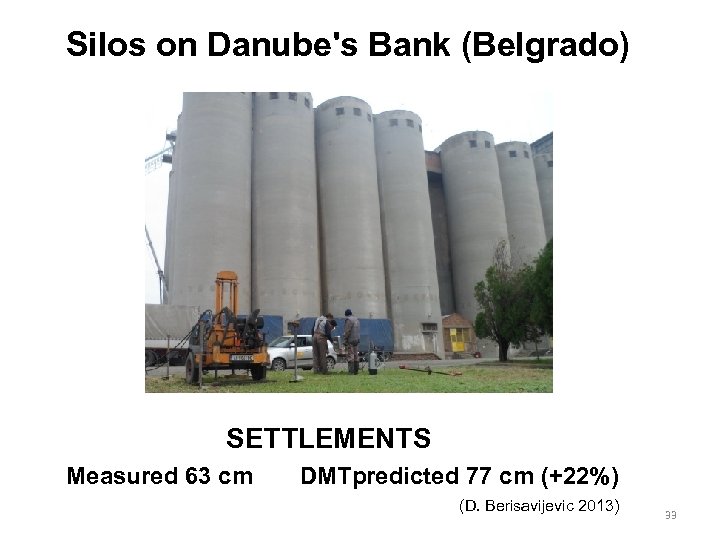 Silos on Danube's Bank (Belgrado) SETTLEMENTS Measured 63 cm DMTpredicted 77 cm (+22%) (D. Berisavijevic 2013) 33
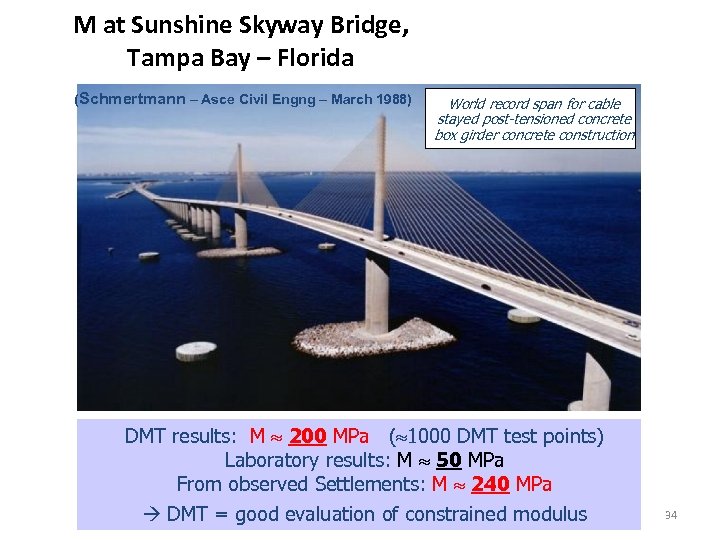 M at Sunshine Skyway Bridge, Tampa Bay – Florida (Schmertmann – Asce Civil Engng – March 1988) World record span for cable stayed post-tensioned concrete box girder concrete construction DMT results: M 200 MPa ( 1000 DMT test points) Laboratory results: M 50 MPa From observed Settlements: M 240 MPa DMT = good evaluation of constrained modulus 34
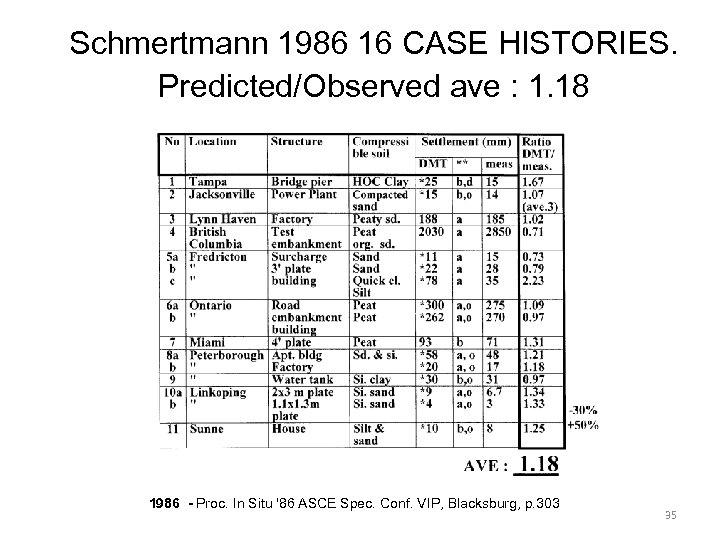 Schmertmann 1986 16 CASE HISTORIES. Predicted/Observed ave : 1. 18 1986 - Proc. In Situ '86 ASCE Spec. Conf. VIP, Blacksburg, p. 303 35
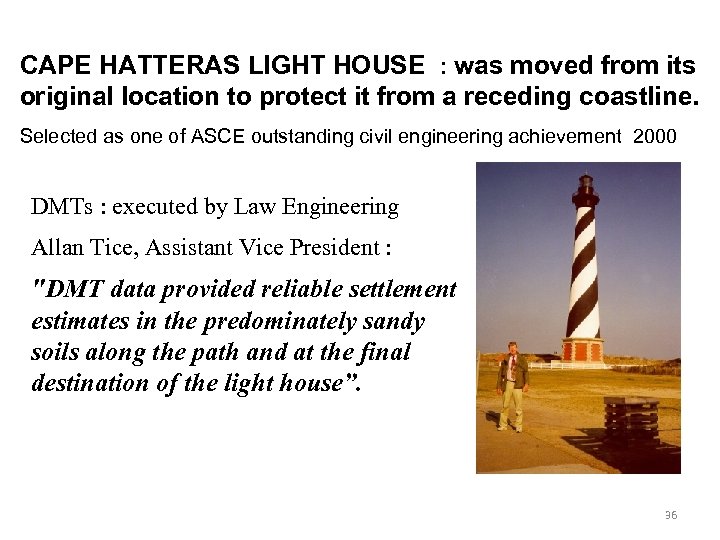 CAPE HATTERAS LIGHT HOUSE : was moved from its original location to protect it from a receding coastline. Selected as one of ASCE outstanding civil engineering achievement 2000 DMTs : executed by Law Engineering Allan Tice, Assistant Vice President : "DMT data provided reliable settlement estimates in the predominately sandy soils along the path and at the final destination of the light house”. 36
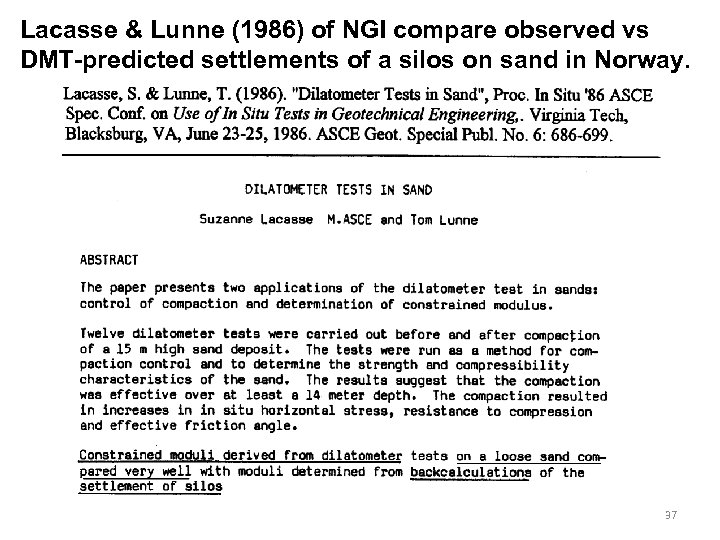 Lacasse & Lunne (1986) of NGI compare observed vs DMT-predicted settlements of a silos on sand in Norway. 37
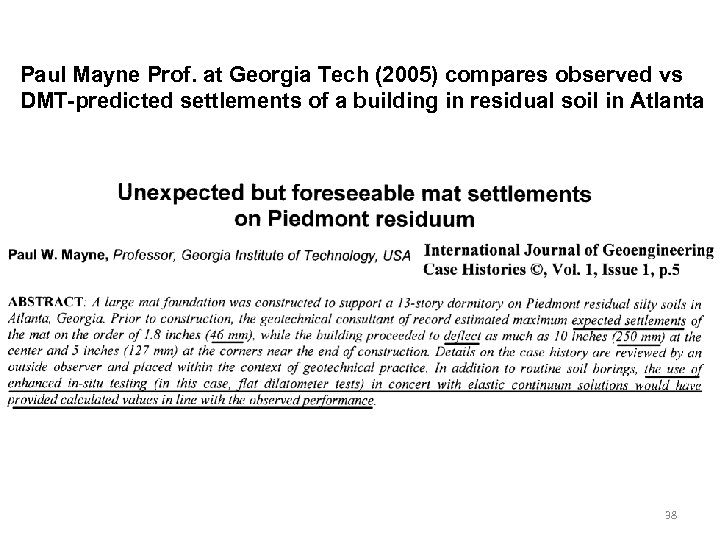 Paul Mayne Prof. at Georgia Tech (2005) compares observed vs DMT-predicted settlements of a building in residual soil in Atlanta 38
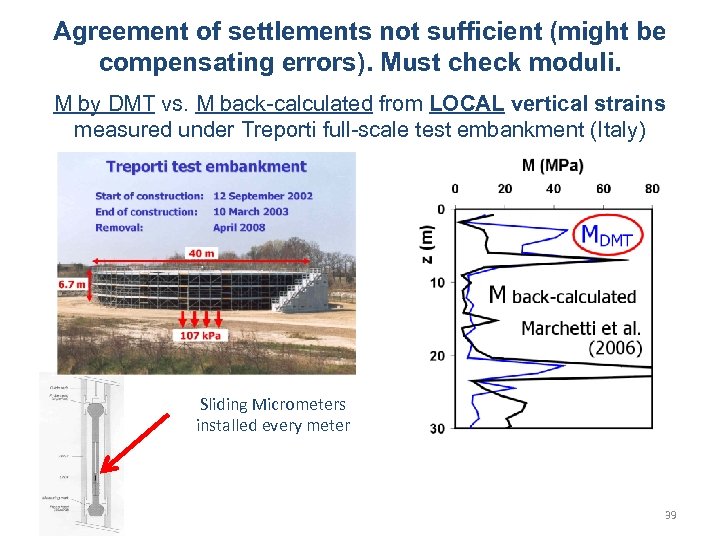 Agreement of settlements not sufficient (might be compensating errors). Must check moduli. M by DMT vs. M back-calculated from LOCAL vertical strains measured under Treporti full-scale test embankment (Italy) Sliding Micrometers installed every meter 39
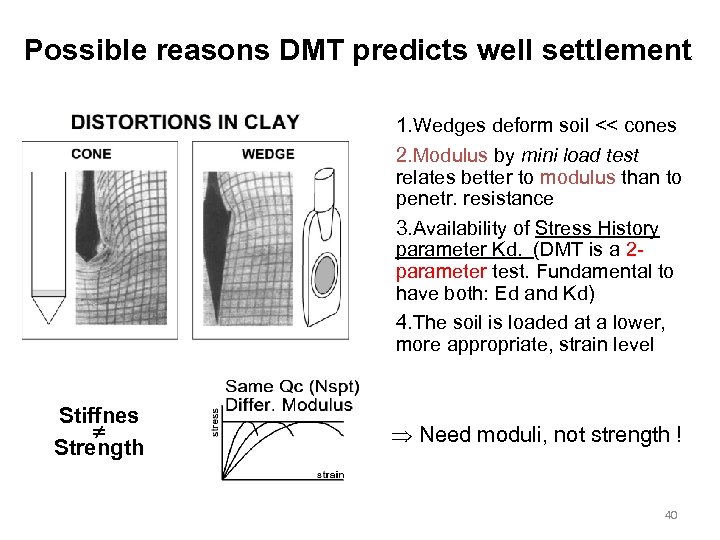 Possible reasons DMT predicts well settlement 1. Wedges deform soil << cones 2. Modulus by mini load test relates better to modulus than to penetr. resistance 3. Availability of Stress History parameter Kd. (DMT is a 2 parameter test. Fundamental to have both: Ed and Kd) 4. The soil is loaded at a lower, more appropriate, strain level Stiffnes Strength Need moduli, not strength ! 40
 Predicting settlements is application # 1 of DMT. • Settlements are important, a key section in all Geotechnical Reports • De Vincenzi (2001) “More and more, today, the factor controlling the design is not the bearing capacity, but the necessity of limiting settlements” 41
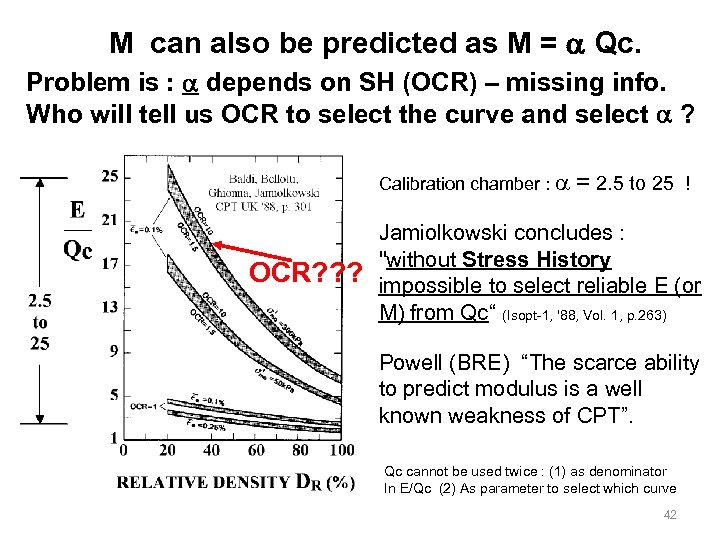 M can also be predicted as M = Qc. Problem is : depends on SH (OCR) – missing info. Who will tell us OCR to select the curve and select ? Calibration chamber : OCR? ? ? = 2. 5 to 25 ! Jamiolkowski concludes : "without Stress History impossible to select reliable E (or M) from Qc“ (Isopt-1, '88, Vol. 1, p. 263) Powell (BRE) “The scarce ability to predict modulus is a well known weakness of CPT”. Qc cannot be used twice : (1) as denominator In E/Qc (2) As parameter to select which curve 42
 Liquefiability evaluations also in need of info on Stress History / Aging • Jamiolkowski et al. (S. Francisco 1985) "Reliable predictions of sand liquefiability. . . require…some new in situ device [other than CPT or SPT], more sensitive to effects of past STRESS-STRAIN HISTORIES” • Leon et al. (ASCE GGE 2006) South Carolina sands. “Ignoring AGING and evaluating CRR from in situ tests insensitive to aging (SPT, CPT, VS) underestimated CRR by a large 60 %” • Salgado et al. (Jnl Asce 1997). “OCR increases liquefaction resistance CRR, but changes negligibly Qcn” 43
 Ignoring Stress History omit a primary parameter. Consequence : CRR predicted by CPT (insensitive to SH) uncertain Is reason of v. cautious recommendations on CRR(CPT) : Robertson & Wride (1998) CRR by CPT adequate for low-risk projects. For high-risk : estimate CRR by more than one method Youd & Idriss 2001 (NCEER Workshops ) use 2 or more tests for a more reliable evaluation of CRR Idriss & Boulanger (2004) the allure of relying on a single approach (e. g. CPT-only) should be avoided … not easy considering that “No lab tests suitable for liquefaction estimation. Only field tests MUST be used (Terzaghi Lecture 2011) “ 44
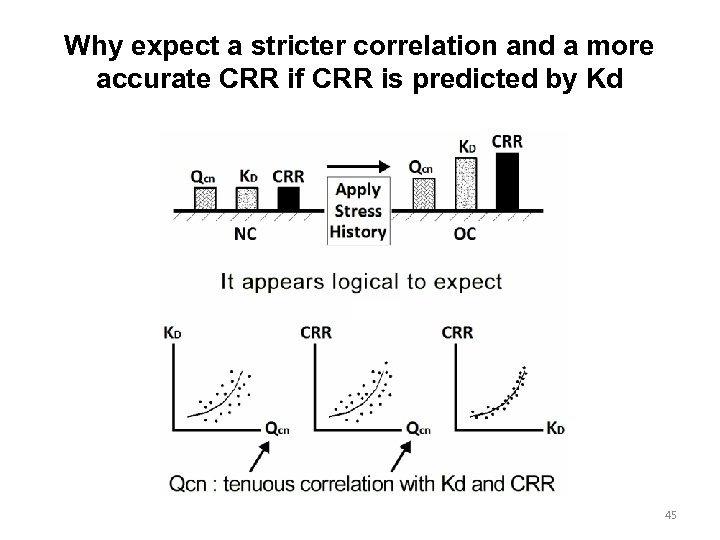 Why expect a stricter correlation and a more accurate CRR if CRR is predicted by Kd 45
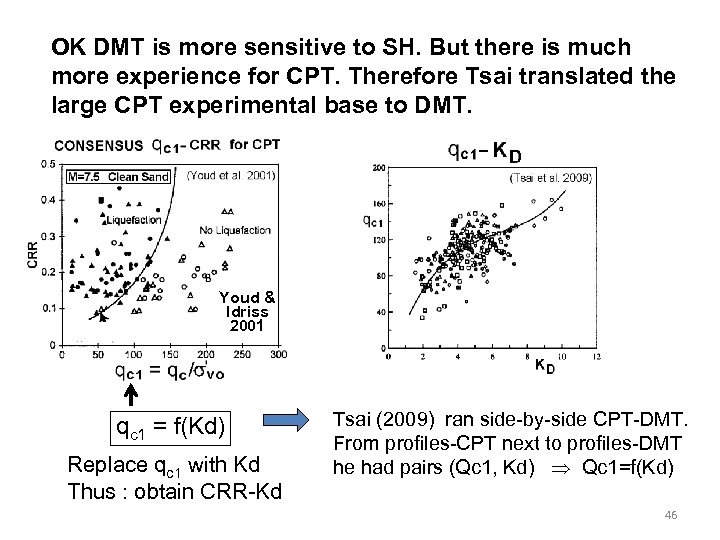 OK DMT is more sensitive to SH. But there is much more experience for CPT. Therefore Tsai translated the large CPT experimental base to DMT. Youd & Idriss 2001 qc 1 = f(Kd) Replace qc 1 with Kd Thus : obtain CRR-Kd Tsai (2009) ran side-by-side CPT-DMT. From profiles-CPT next to profiles-DMT he had pairs (Qc 1, Kd) Qc 1=f(Kd) 46
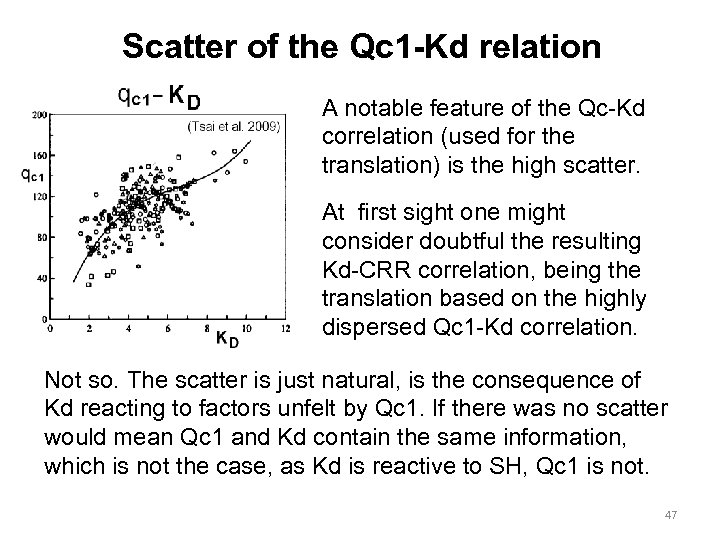 Scatter of the Qc 1 -Kd relation A notable feature of the Qc-Kd correlation (used for the translation) is the high scatter. At first sight one might consider doubtful the resulting Kd-CRR correlation, being the translation based on the highly dispersed Qc 1 -Kd correlation. Not so. The scatter is just natural, is the consequence of Kd reacting to factors unfelt by Qc 1. If there was no scatter would mean Qc 1 and Kd contain the same information, which is not the case, as Kd is reactive to SH, Qc 1 is not. 47
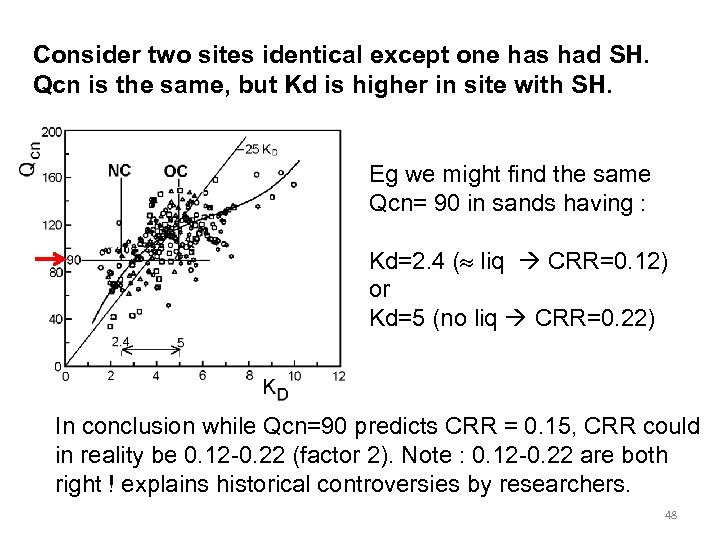 Consider two sites identical except one has had SH. Qcn is the same, but Kd is higher in site with SH. Eg we might find the same Qcn= 90 in sands having : Kd=2. 4 ( liq CRR=0. 12) or Kd=5 (no liq CRR=0. 22) In conclusion while Qcn=90 predicts CRR = 0. 15, CRR could in reality be 0. 12 -0. 22 (factor 2). Note : 0. 12 -0. 22 are both right ! explains historical controversies by researchers. 48
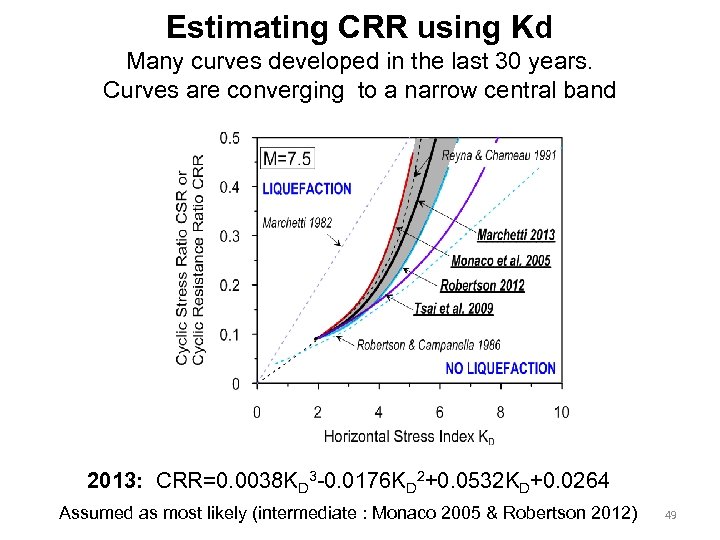 Estimating CRR using Kd Many curves developed in the last 30 years. Curves are converging to a narrow central band 2013: CRR=0. 0038 KD 3 -0. 0176 KD 2+0. 0532 KD+0. 0264 Assumed as most likely (intermediate : Monaco 2005 & Robertson 2012) 49
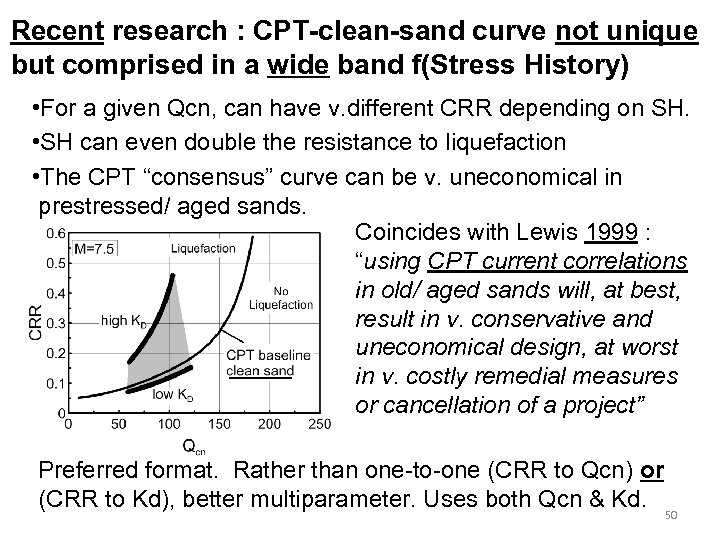 Recent research : CPT-clean-sand curve not unique but comprised in a wide band f(Stress History) • For a given Qcn, can have v. different CRR depending on SH. • SH can even double the resistance to liquefaction • The CPT “consensus” curve can be v. uneconomical in prestressed/ aged sands. Coincides with Lewis 1999 : “using CPT current correlations in old/ aged sands will, at best, result in v. conservative and uneconomical design, at worst in v. costly remedial measures or cancellation of a project” Preferred format. Rather than one-to-one (CRR to Qcn) or (CRR to Kd), better multiparameter. Uses both Qcn & Kd. 50
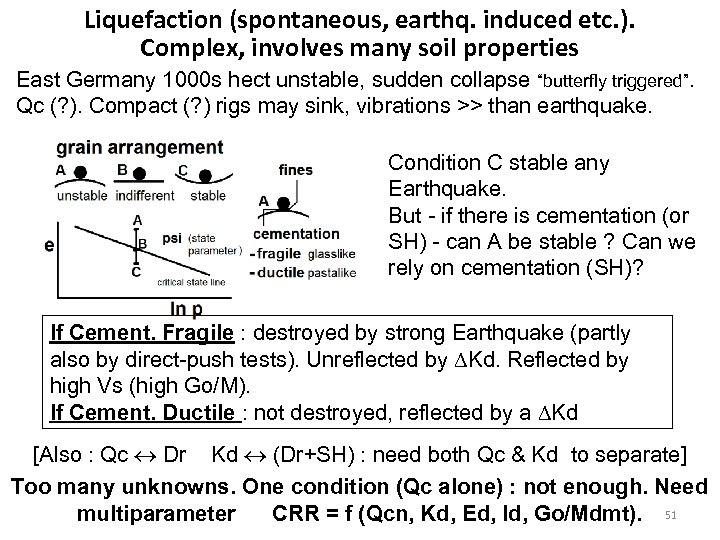 Liquefaction (spontaneous, earthq. induced etc. ). Complex, involves many soil properties East Germany 1000 s hect unstable, sudden collapse “butterfly triggered”. Qc (? ). Compact (? ) rigs may sink, vibrations >> than earthquake. Condition C stable any Earthquake. But - if there is cementation (or SH) - can A be stable ? Can we rely on cementation (SH)? If Cement. Fragile : destroyed by strong Earthquake (partly also by direct-push tests). Unreflected by Kd. Reflected by high Vs (high Go/M). If Cement. Ductile : not destroyed, reflected by a Kd [Also : Qc Dr Kd (Dr+SH) : need both Qc & Kd to separate] Too many unknowns. One condition (Qc alone) : not enough. Need multiparameter CRR = f (Qcn, Kd, Ed, Id, Go/Mdmt). 51
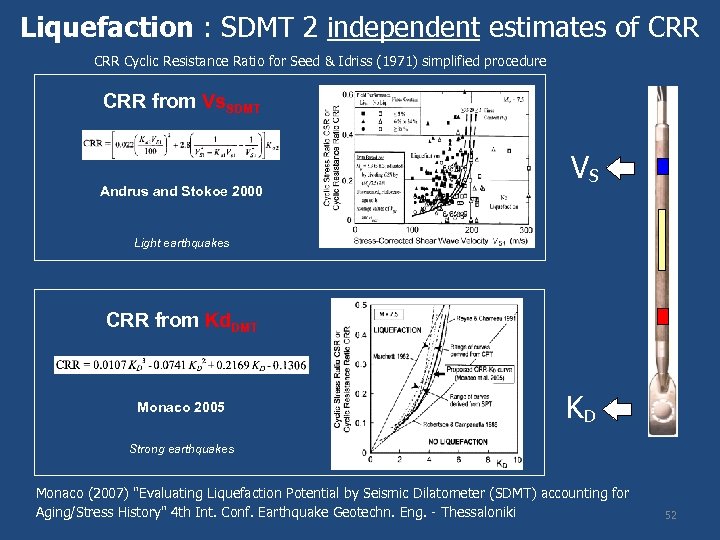 Liquefaction : SDMT 2 independent estimates of CRR Cyclic Resistance Ratio for Seed & Idriss (1971) simplified procedure CRR from Vs. SDMT Andrus and Stokoe 2000 VS Light earthquakes CRR from Kd. DMT Monaco 2005 KD Strong earthquakes Monaco (2007) "Evaluating Liquefaction Potential by Seismic Dilatometer (SDMT) accounting for Aging/Stress History" 4 th Int. Conf. Earthquake Geotechn. Eng. - Thessaloniki 52
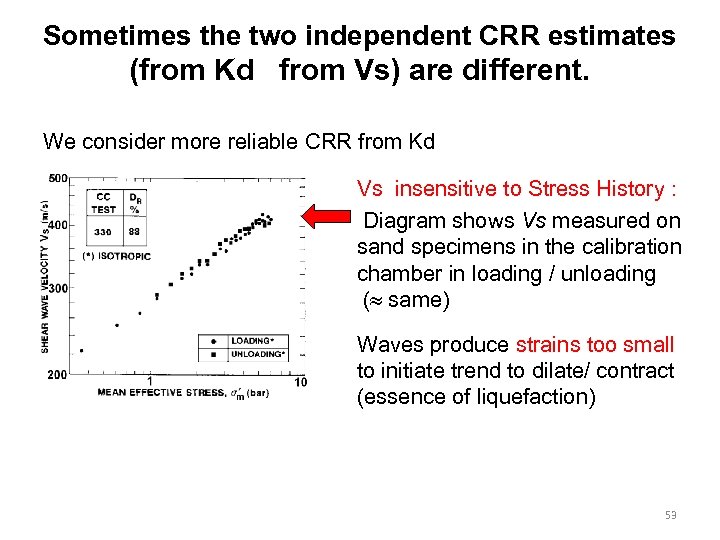 Sometimes the two independent CRR estimates (from Kd from Vs) are different. We consider more reliable CRR from Kd Jamiolkowski 1992 Soils & Foundations Vs insensitive to Stress History : Diagram shows Vs measured on sand specimens in the calibration chamber in loading / unloading ( same) Waves produce strains too small to initiate trend to dilate/ contract (essence of liquefaction) 53
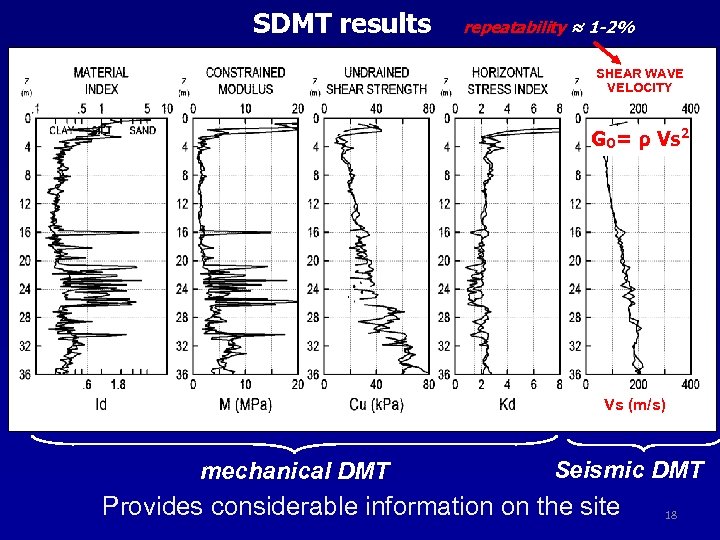
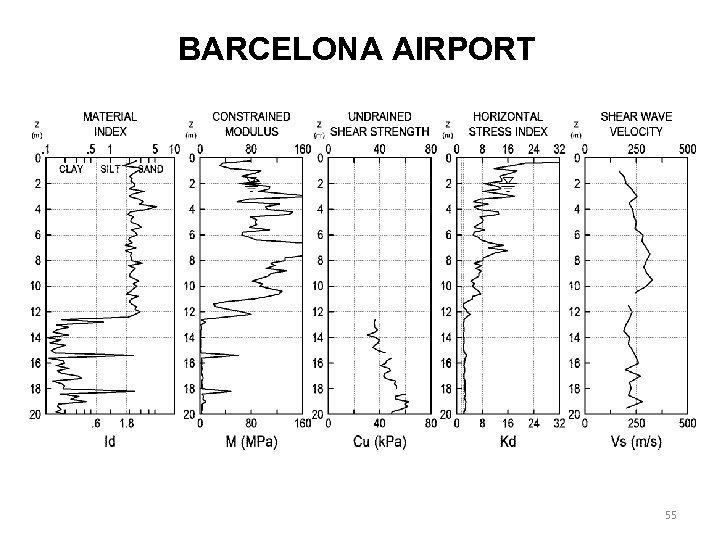
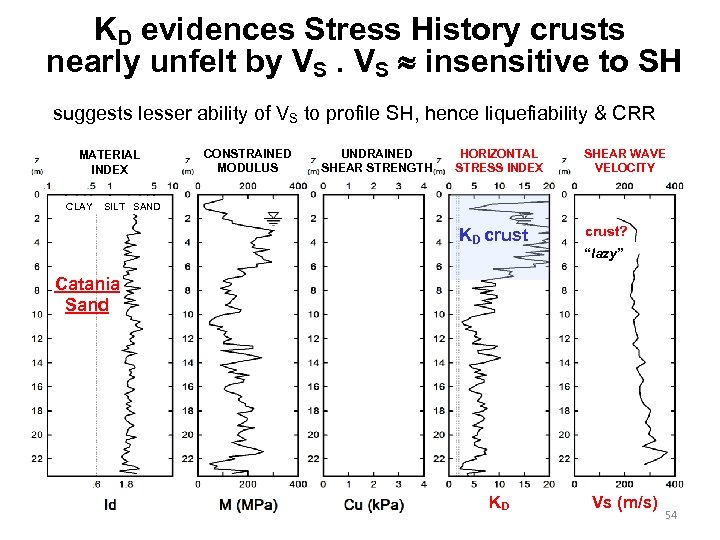 KD evidences Stress History crusts nearly unfelt by VS. VS insensitive to SH suggests lesser ability of VS to profile SH, hence liquefiability & CRR MATERIAL INDEX CLAY CONSTRAINED MODULUS UNDRAINED SHEAR STRENGTH HORIZONTAL STRESS INDEX SHEAR WAVE VELOCITY SILT SAND KD crust? “lazy” Catania Sand KD Vs (m/s) 54
 BARCELONA AIRPORT 55
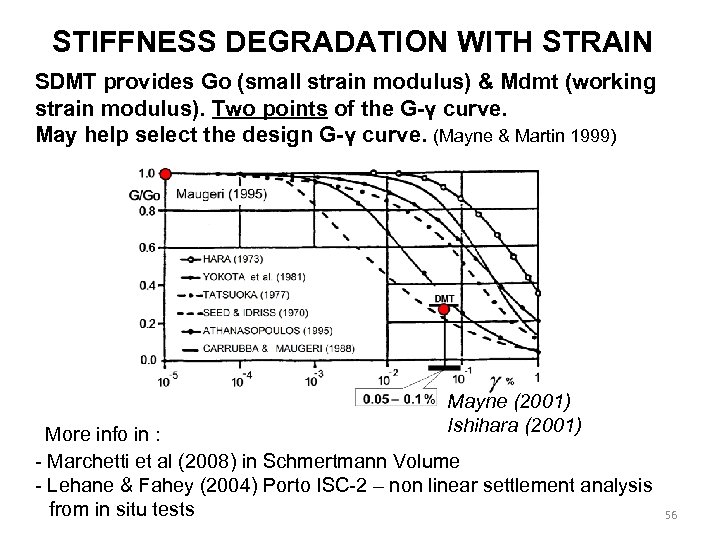 STIFFNESS DEGRADATION WITH STRAIN SDMT provides Go (small strain modulus) & Mdmt (working strain modulus). Two points of the G-γ curve. May help select the design G-γ curve. (Mayne & Martin 1999) Mayne (2001) Ishihara (2001) More info in : - Marchetti et al (2008) in Schmertmann Volume - Lehane & Fahey (2004) Porto ISC-2 – non linear settlement analysis from in situ tests 56
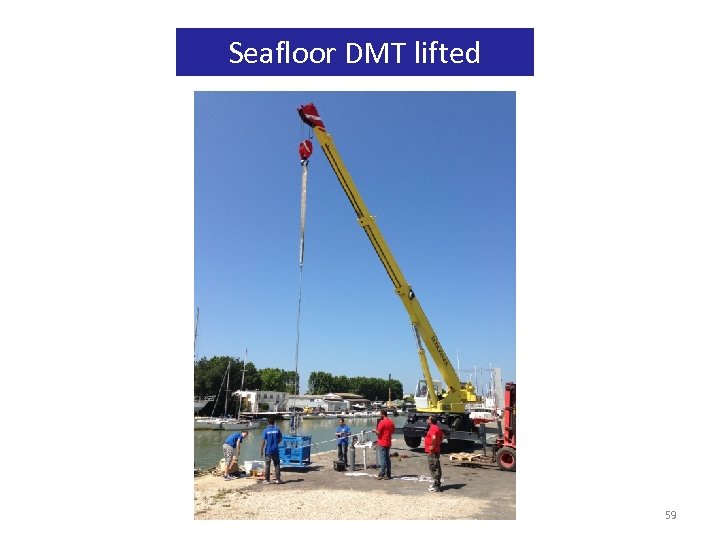
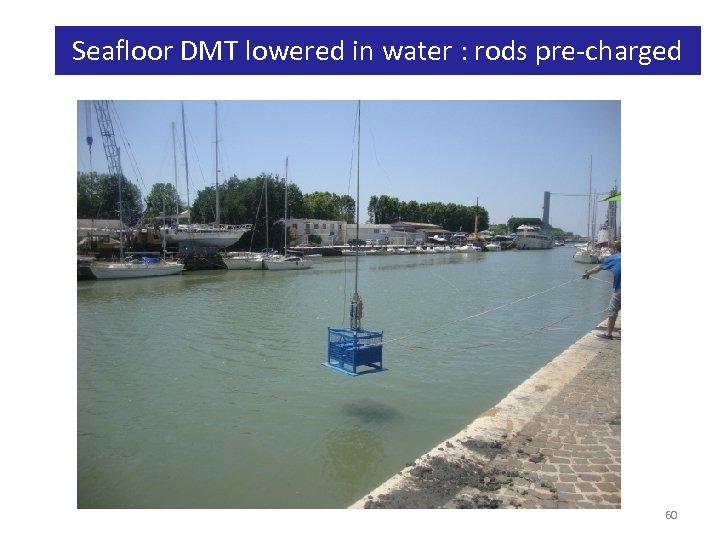
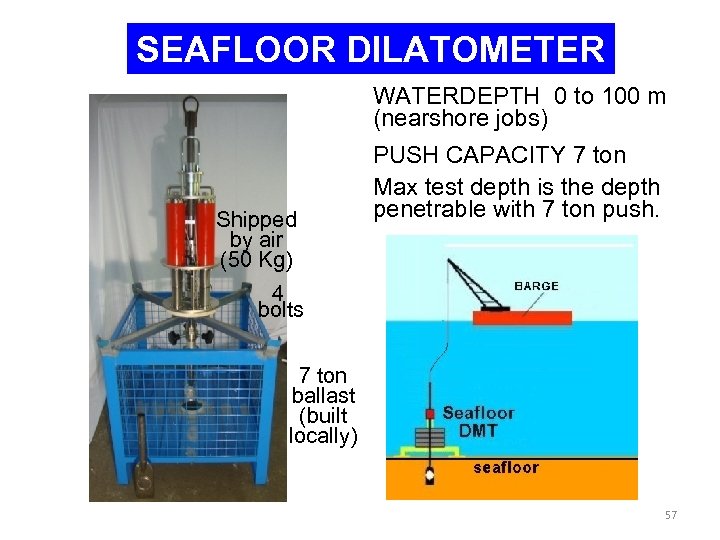 SEAFLOOR DILATOMETER WATERDEPTH 0 to 100 m (nearshore jobs) Shipped by air (50 Kg) PUSH CAPACITY 7 ton Max test depth is the depth penetrable with 7 ton push. 4 bolts 7 ton ballast (built locally) 57
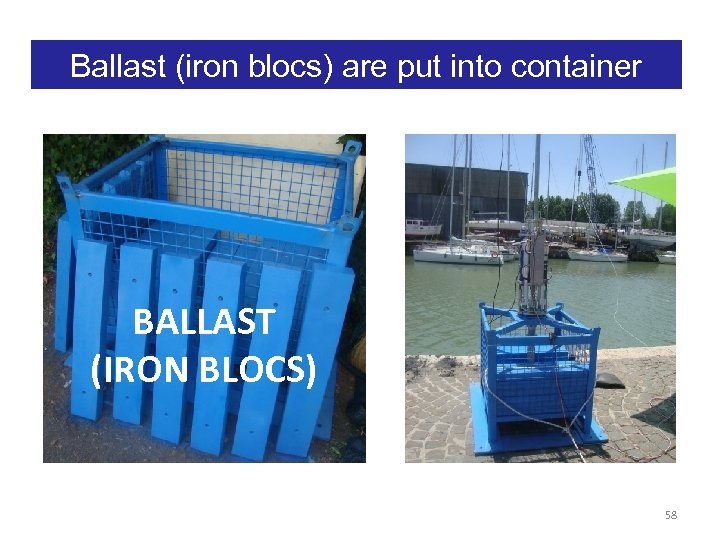 Ballast (iron blocs) are put into container BALLAST (IRON BLOCS) 58
 Seafloor DMT lifted 59
 Seafloor DMT lowered in water : rods pre-charged 60
 First Seafloor DMT test: 13 June 2014 61
 INPUT PARAMETERS FOR PLAXIS (Hard Soil model “HS” - basic input E 50 ref ) 1. Schanz : quartz sand E 50 ref =15 to 75 MPa (loose to very dense sand). In those sands MDMT also in above range (15 -75 MPa). Hence as 1 st approx may adopt E 50 ref MDMT Sometimes FEM parameters are checked by executing load tests. Predicting settlement by DMT may replace (costly) load test. Assume e. g. a uniformely loaded circular area. Do DMT and, using Mdmt, predict settlements. Then predict settlements using the assumed FEM parameters. Verify agreement. Some regulations impose load tests if designer wants to assume >3 in M= Qc. This $ could be saved. A DMT settlement calculation may serve as a “virtual load test”. 62
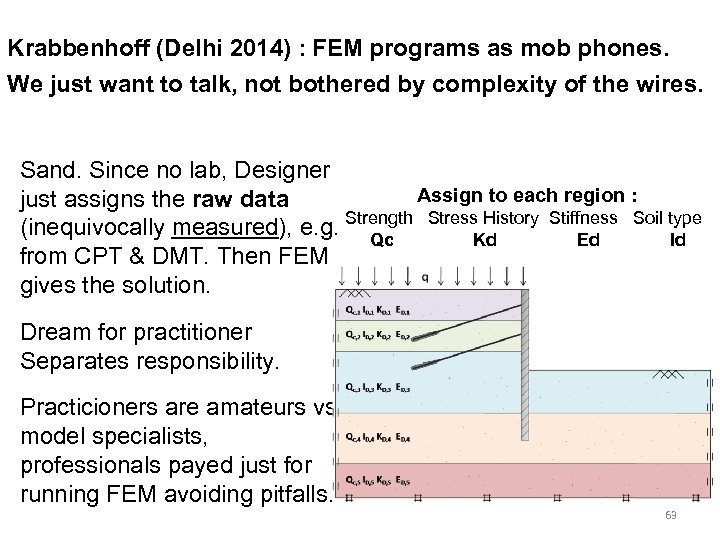 Krabbenhoff (Delhi 2014) : FEM programs as mob phones. We just want to talk, not bothered by complexity of the wires. Sand. Since no lab, Designer Assign to each region : just assigns the raw data (inequivocally measured), e. g. Strength Stress History Stiffness Soil type Qc Kd Ed Id from CPT & DMT. Then FEM gives the solution. Dream for practitioner Separates responsibility. Practicioners are amateurs vs model specialists, professionals payed just for running FEM avoiding pitfalls. 63
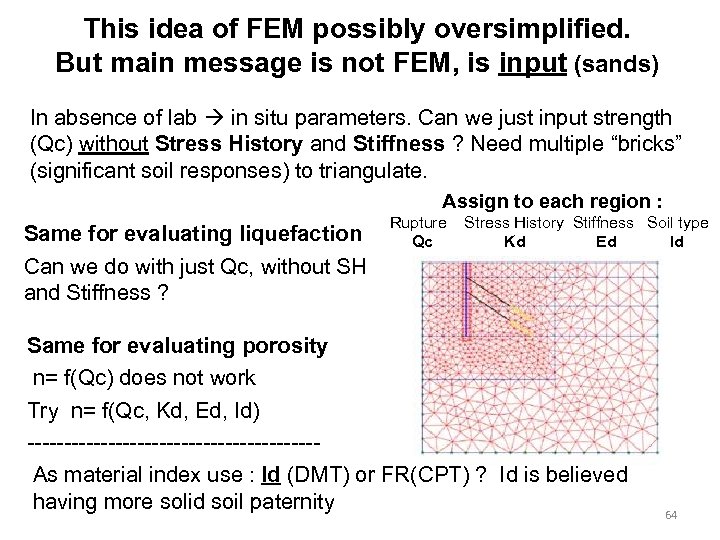 This idea of FEM possibly oversimplified. But main message is not FEM, is input (sands) In absence of lab in situ parameters. Can we just input strength (Qc) without Stress History and Stiffness ? Need multiple “bricks” (significant soil responses) to triangulate. Assign to each region : Same for evaluating liquefaction Can we do with just Qc, without SH and Stiffness ? Rupture Stress History Stiffness Soil type Qc Kd Ed Id Same for evaluating porosity n= f(Qc) does not work Try n= f(Qc, Kd, Ed, Id) --------------------As material index use : Id (DMT) or FR(CPT) ? Id is believed having more solid soil paternity 64
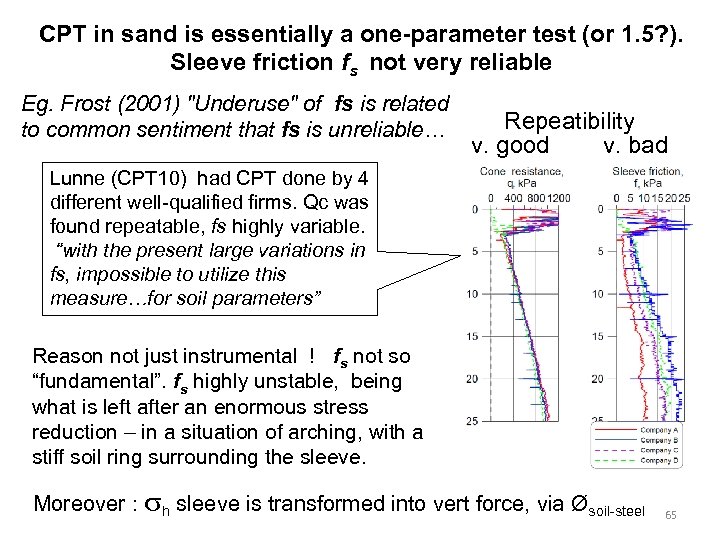 CPT in sand is essentially a one-parameter test (or 1. 5? ). Sleeve friction fs not very reliable Eg. Frost (2001) "Underuse" of fs is related to common sentiment that fs is unreliable… Repeatibility v. good v. bad Lunne (CPT 10) had CPT done by 4 different well-qualified firms. Qc was found repeatable, fs highly variable. “with the present large variations in fs, impossible to utilize this measure…for soil parameters” Reason not just instrumental ! fs not so “fundamental”. fs highly unstable, being what is left after an enormous stress reduction – in a situation of arching, with a stiff soil ring surrounding the sleeve. Moreover : h sleeve is transformed into vert force, via Øsoil-steel 65
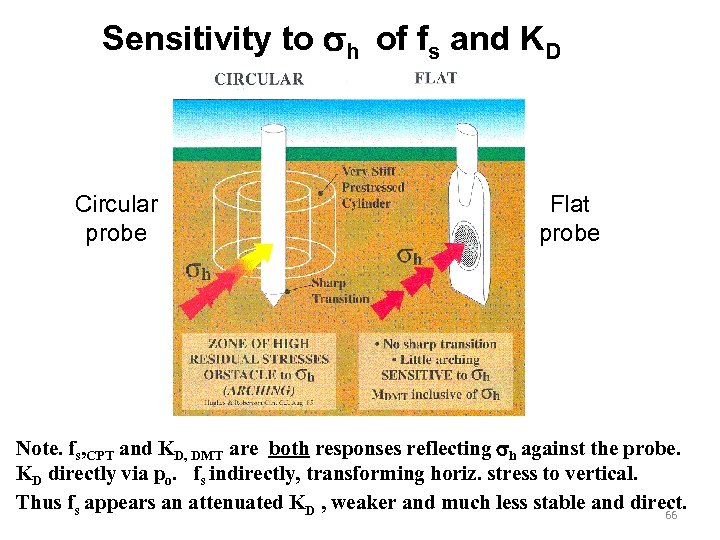 Sensitivity to h of fs and KD Circular probe Flat probe Note. fs, CPT and KD, DMT are both responses reflecting h against the probe. KD directly via po. fs indirectly, transforming horiz. stress to vertical. Thus fs appears an attenuated KD , weaker and much less stable and direct. 66
 (Robertson Jnl Asce Nov 2009) CPT-DMT inter correlations Robertson has formulae for estimating DMT from CPT. V. dispersed in particular Kd from Qcn. Expectable : no way reconstructing Kd sensitive to Stress History from insensitive Qcn. Some researchers study opposite direction : Qc from DMT. Should have +success. Should be easier to predict one parameter from two than viceversa. DMT a genuine two parameter test. In that DMT appears a +informative test. 67
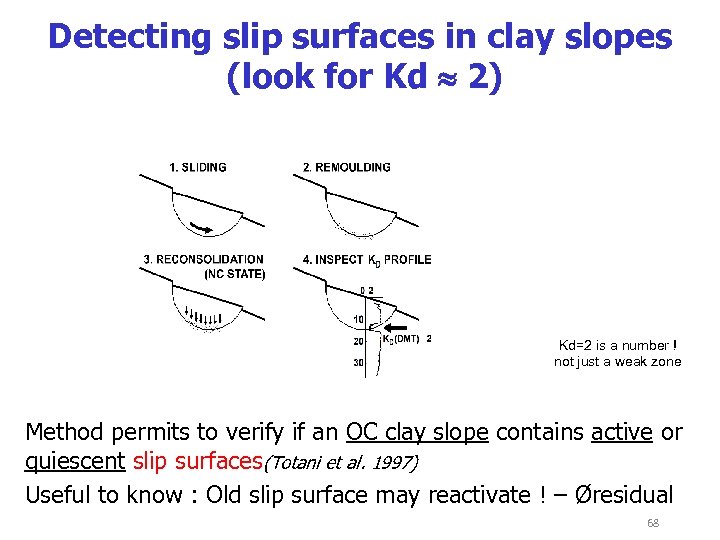 Detecting slip surfaces in clay slopes (look for Kd 2) Kd=2 is a number ! not just a weak zone Method permits to verify if an OC clay slope contains active or quiescent slip surfaces(Totani et al. 1997) Useful to know : Old slip surface may reactivate ! – Øresidual 68
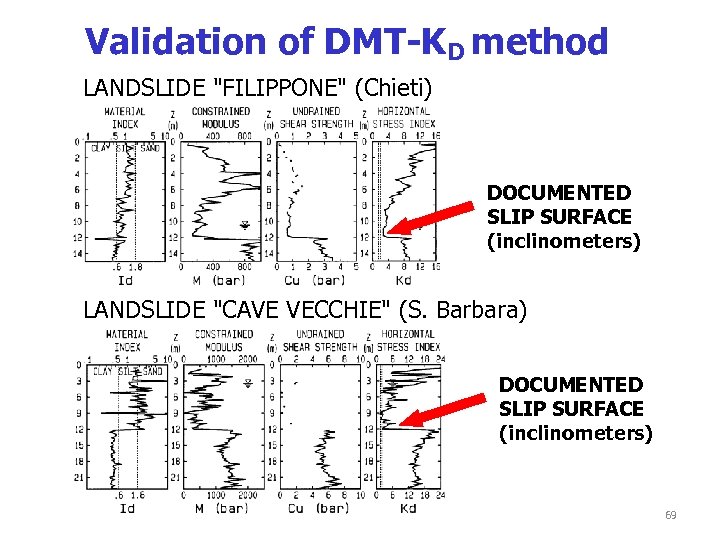 Validation of DMT-KD method LANDSLIDE "FILIPPONE" (Chieti) DOCUMENTED SLIP SURFACE (inclinometers) LANDSLIDE "CAVE VECCHIE" (S. Barbara) DOCUMENTED SLIP SURFACE (inclinometers) 69
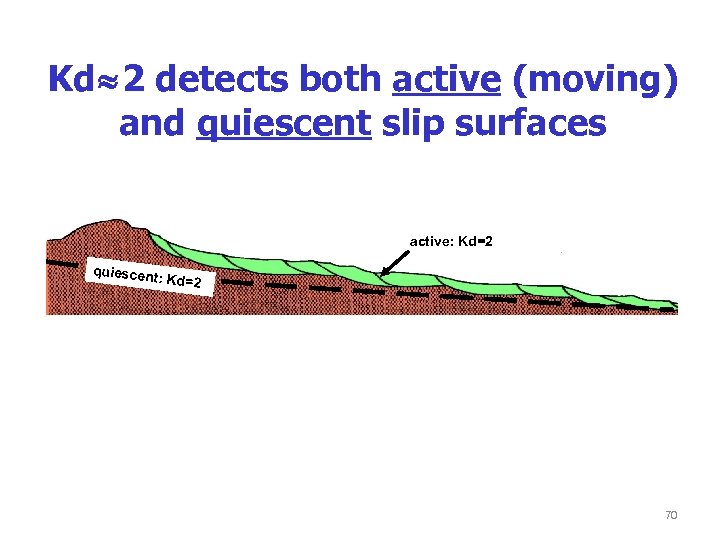 Kd 2 detects both active (moving) and quiescent slip surfaces active: Kd=2 quiescen t: Kd=2 70
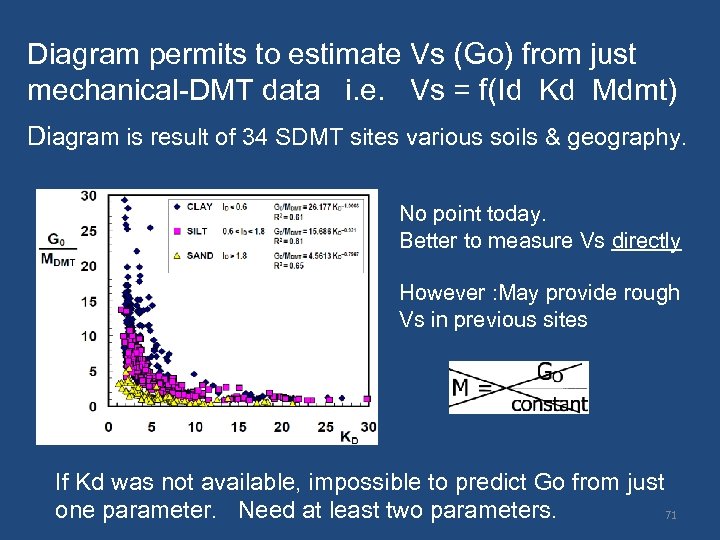 Diagram permits to estimate Vs (Go) from just mechanical-DMT data i. e. Vs = f(Id Kd Mdmt) Diagram is result of 34 SDMT sites various soils & geography. No point today. Better to measure Vs directly However : May provide rough Vs in previous sites If Kd was not available, impossible to predict Go from just one parameter. Need at least two parameters. 71
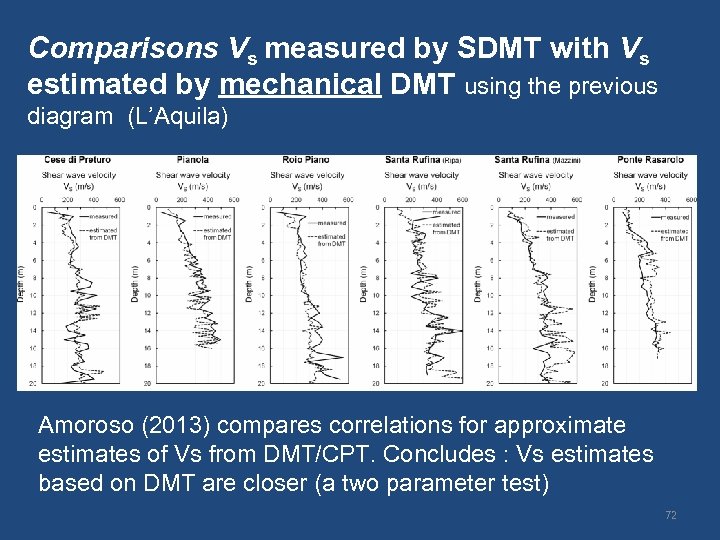 Comparisons Vs measured by SDMT with Vs estimated by mechanical DMT using the previous diagram (L’Aquila) Amoroso (2013) compares correlations for approximate estimates of Vs from DMT/CPT. Concludes : Vs estimates based on DMT are closer (a two parameter test) 72
 OTHER APPLICATIONS 73
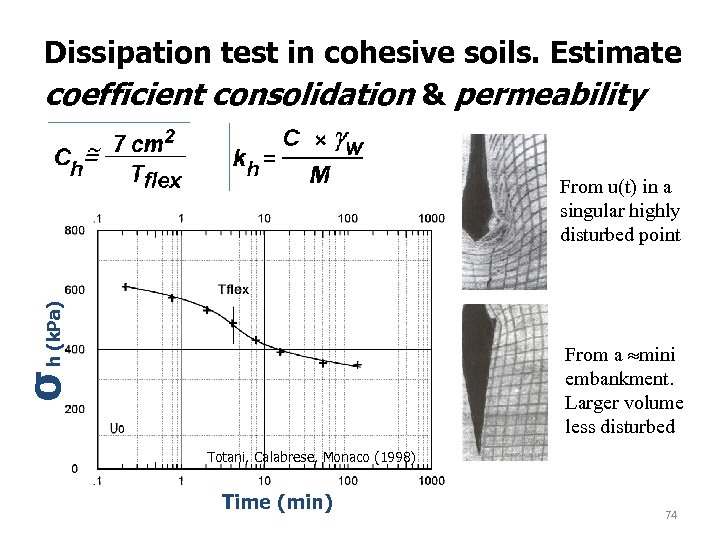 Dissipation test in cohesive soils. Estimate coefficient consolidation & permeability σ h (k. Pa) From u(t) in a singular highly disturbed point From a mini embankment. Larger volume less disturbed Totani, Calabrese, Monaco (1998) Time (min) 74
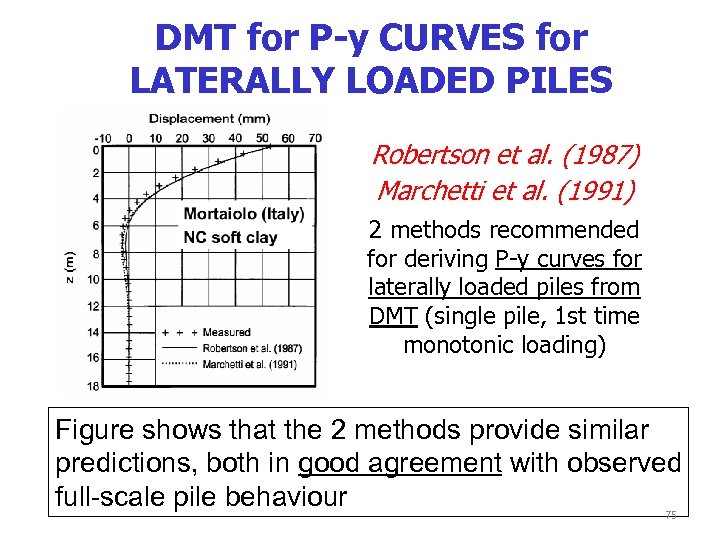 DMT for P-y CURVES for LATERALLY LOADED PILES Robertson et al. (1987) Marchetti et al. (1991) 2 methods recommended for deriving P-y curves for laterally loaded piles from DMT (single pile, 1 st time monotonic loading) Figure shows that the 2 methods provide similar predictions, both in good agreement with observed full-scale pile behaviour 75
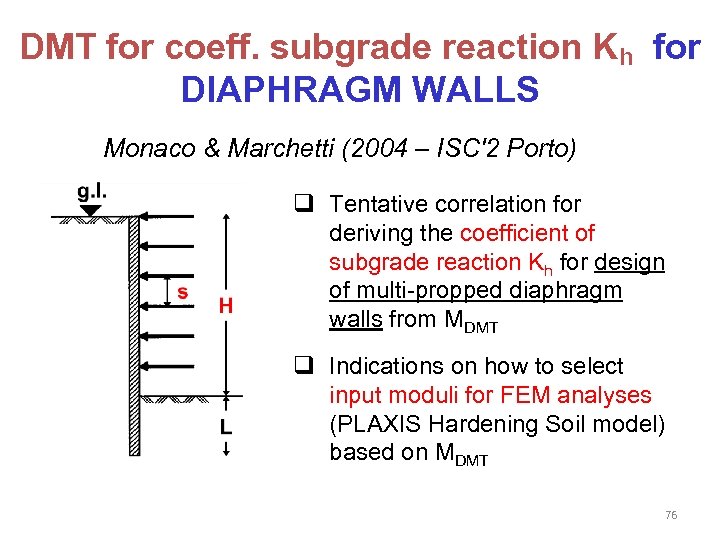 DMT for coeff. subgrade reaction Kh for DIAPHRAGM WALLS Monaco & Marchetti (2004 – ISC'2 Porto) q Tentative correlation for deriving the coefficient of subgrade reaction Kh for design of multi-propped diaphragm walls from MDMT q Indications on how to select input moduli for FEM analyses (PLAXIS Hardening Soil model) based on MDMT 76
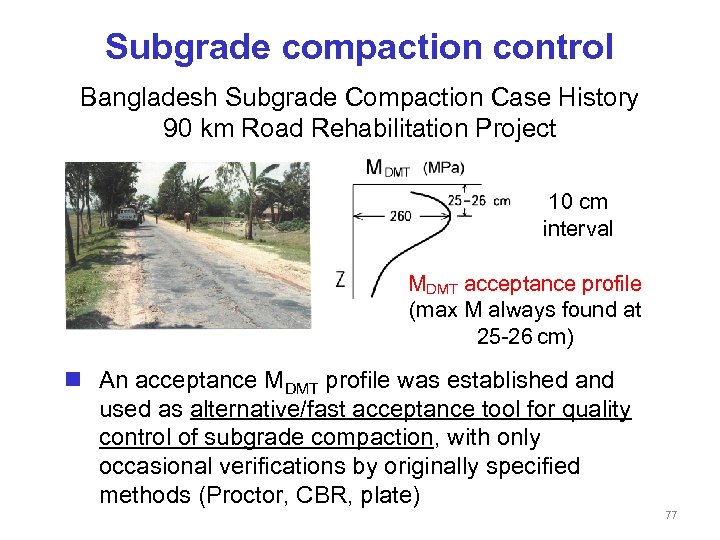 Subgrade compaction control Bangladesh Subgrade Compaction Case History 90 km Road Rehabilitation Project 10 cm interval MDMT acceptance profile (max M always found at 25 -26 cm) An acceptance MDMT profile was established and used as alternative/fast acceptance tool for quality control of subgrade compaction, with only occasional verifications by originally specified methods (Proctor, CBR, plate) 77
 Website: www. marchetti-dmt. it 78
 CONCLUDING REMARKS (1/7) Direct push CPT and DMT are increasingly recognized as fast and convenient tools for everyday investigations. DMT’s Kd has the peculiarity of being sensitive to Stress History, scarcely felt by other tools. Sensitivity to SH is fundamental for good predictions of settlements and of CRR. 79
 PREDICTING SETTLEMENTS (2/7) Countless researchers : without Stress History it is impossible to predict modulus from CPT or SPT. A large number of comparisons confirm DMT predicts well settlement. With DMT no (2 to 20) to guess in M= Qc. DMT correlations guide without subjective choices to M, taking into account soil type (Id) and Stress History (Kd). Similarly for Cu : no Nkt (8 to 25) to guess. 80
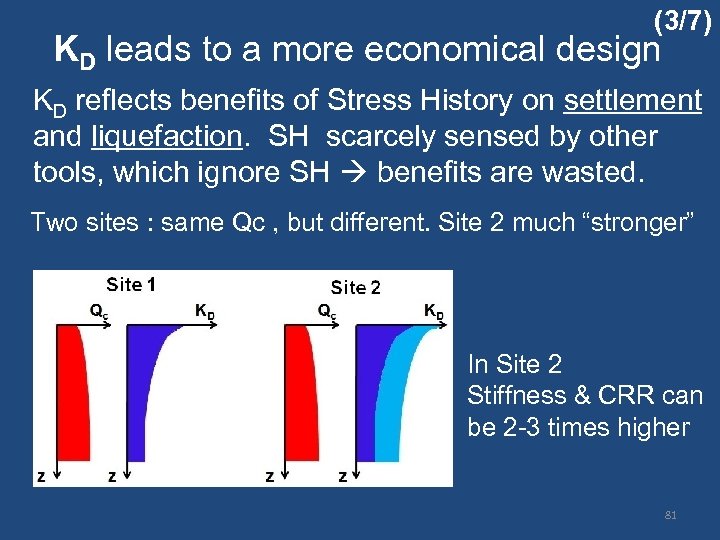 (3/7) KD leads to a more economical design KD reflects benefits of Stress History on settlement and liquefaction. SH scarcely sensed by other tools, which ignore SH benefits are wasted. Two sites : same Qc , but different. Site 2 much “stronger” In Site 2 Stiffness & CRR can be 2 -3 times higher 81
 “CPT costs less than DMT. Is CPT therefore preferable ? ” (4/7) As to pure cost CPT preferable. But info / cost (though Class 1 CPTU when pp neg. ve can take longer and cost more than DMT) A CPT investigation costs less, but remains orphan of capability of providing SOA predictions of settlements. Been : State of Art at CPT 2010 Los Angeles : CPT can easily mislead in terms of soil type, strength and particularly modulus”. Robertson (1986) : Prediction of modulus from Qc can be rather poor, especially for OC soils, with a large potential error. 82
 (5/7) SETTLEMENTS ARE IMPORTANT If we do CPT only : may save in investigation. But if we spend a bit more by doing DMT, predict more accurate settlements, save in design of foundation, where the $ is. Settlements can have important $ consequences (piles/ shallow foundations…). Important jobs cannot do w/o Accurate Settlements more economical design. Info=$. 83
 (6/7) When considering costs : into account With DMT "not many things can go wrong" (no electronics, no deairing, no saturation, no area correction, no glicerine, no wait when negative pp, no classes…). When the reliability of data is doubtful : a big cost. Designer looses time in choosing parameters, gets nervous, increases Fs, often overdesigns). DMT v. easy to run, short training time ( 3 hours) Any operator gets same results. In remote regions : easy to instruct a local technician. No need to leave a highly skilled costly operator. 84
 CONCLUDING REMARK (7/7) Stress History is sometimes considered a gourmet property, as not directly used in calculations as c’ Ø’ Cu … Or of academic interest, to separate elastic/ plastic behaviour… Not so. SH makes the soil much stronger. Can reduce settlements 2 -4 times and can double CRR. Hence SH is a substantial $ resource. Ignoring SH when present wasting $. BUT must be able to distinguish when SH is present / not. Not easily done by CPT or SPT. -------------Multiparameter better than one-to-one correlations. Soil has many unknowns : need multiple responses 85
 3 rd International Conference on the Flat Dilatometer (DMT) Rome 14 th-16 th June 2015 Official web site: www. dmt 15. com Abstracts max 1 page by July 15 th 2014 to: papers@dmt 15. com Contact Info: info@dmt 15. com 86
 END Thank you 87
 Slides for possible discussion 88
 How derive M (drained) from Ed (undrained) ? ? ? Clay. Initial idea (1980) : investigate Ed-Eu. Problem: Eu, lab too dispersed, impossible set up correlations. Hence Ed-M. Link Ed-M presumably weaker, but at least can be tested. NOTE. Ed-M must be a complex function of many variables, among them the Skempton p. p. parameters A & B and anisotropy (E d horizontal, M vertical), which in turn depend on soil type (~represented by Id) and on OCR (~ represented by Kd) some basis to expect at least some degree of correlation Ed -M using Id and Kd as parameters. Final word : real world observation. Large number case histories favourable comparisons measured vs DMT-predicted settlements or Mdmt-Mreference. Lambe et al (Jnl ASCE March 1977 “Foundation Performance of Tower of Pisa” p. 246) : “Drained moduli of saturated clays are typically about one-third to onefourth the undrained values”. Hence a broad connection drained-undrained stiffness already invoked in the past. 89
 Reconstituted sand specimens at same Dr “Testing on sand specimens reconstituted even at exactly the same density is highly questionable” (Ladd 1977). Already known at the time (SOA 1977 Tokyo) Hoeg (2000) showed that… “natural sands had dilative behaviour while reconstituted specimens with the same void ratios were contractive” Hence the need of testing sand in situ 90
 Elusivity of Dr in situ There is no unique mapping Dr=f(Qc). Jefferies – Been ISOPT 1995. Hilton Mines sand at Dr=60% produces the same Qc as Monterey sands at Dr=40% Very difficult estimate Dr in situ unmeasurable Specs in terms of Dr problematic Schmertmann, 1986 in a paper about monitoring compaction : Since objective of compaction: limit settlements…. . more rational specs on Modulus (e. g. Mdmt) than Dr 91
 DMT CORRELATIONS IN NON-TEXTBOOK SOILS (Residual, Unsaturated…) ( Giacheti, Mayne, Chang, Failmezger, Fonseca…) In general The correlations involving pwp (e. g. Cu=…) are generally not applicable. The correlations for estimating moduli/ settlements generally applicable, since DMT is a load test determining a pressure-settlement relation. 92
 OCR and Ko in sand OCR in sands can be evaluated from ratio MDMT /qc = 5 -10 in NC sands MDMT /qc = 12 -24 in OC sands. Ko in sand. See TC 16 DMT Report. A way can be (once estimated OCR) : Ko=Konc OCRm 93
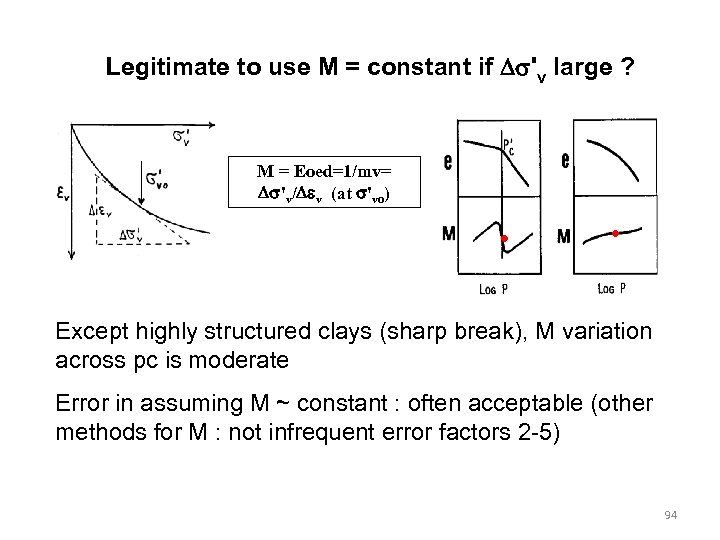 Legitimate to use M = constant if 'v large ? M = Eoed=1/mv= 'v/ v (at 'vo) Except highly structured clays (sharp break), M variation across pc is moderate Error in assuming M ~ constant : often acceptable (other methods for M : not infrequent error factors 2 -5) 94
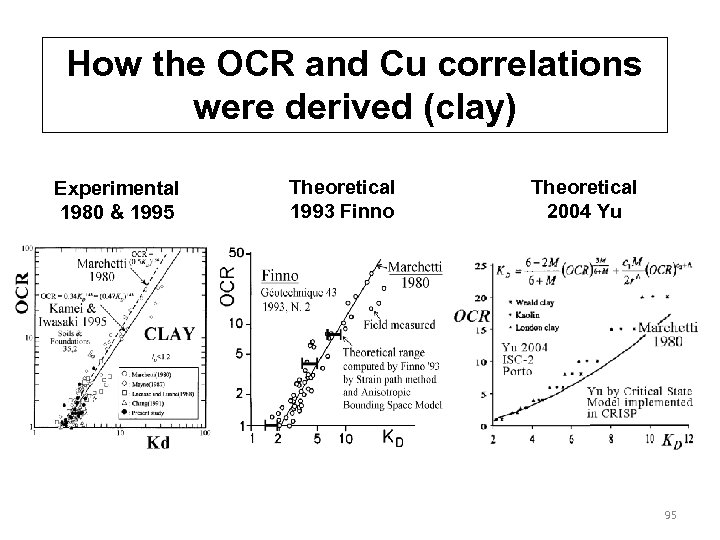 How the OCR and Cu correlations were derived (clay) Theoretical Experimental 1980 & 1995 1993 Finno 2004 Yu 95
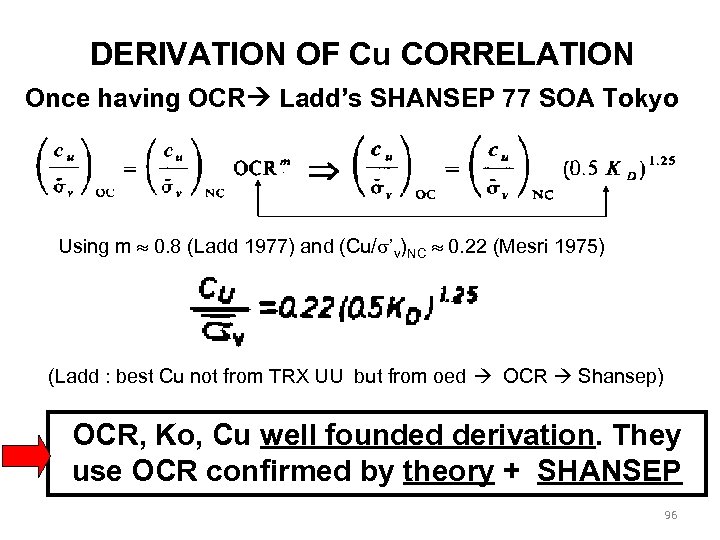 DERIVATION OF Cu CORRELATION Once having OCR Ladd’s SHANSEP 77 SOA Tokyo Using m 0. 8 (Ladd 1977) and (Cu/ ’v)NC 0. 22 (Mesri 1975) (Ladd : best Cu not from TRX UU but from oed OCR Shansep) OCR, Ko, Cu well founded derivation. They use OCR confirmed by theory + SHANSEP 96
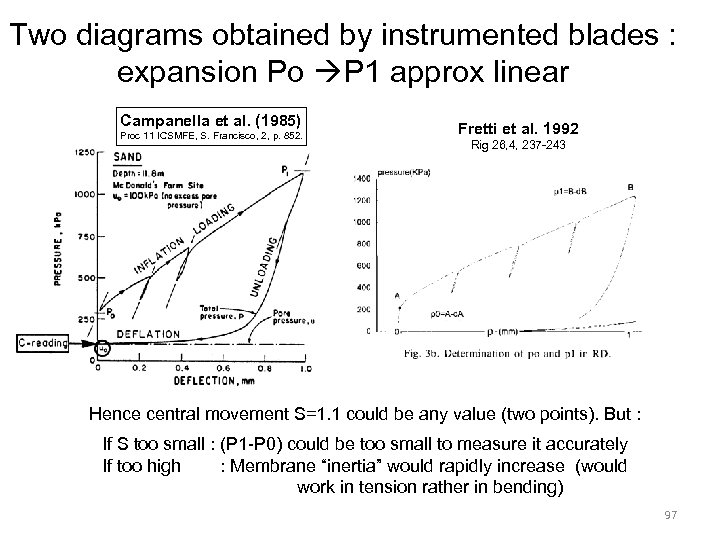 Two diagrams obtained by instrumented blades : expansion Po P 1 approx linear Campanella et al. (1985) Proc 11 ICSMFE, S. Francisco, 2, p. 852. Fretti et al. 1992 Rig 26, 4, 237 -243 Hence central movement S=1. 1 could be any value (two points). But : If S too small : (P 1 -P 0) could be too small to measure it accurately If too high : Membrane “inertia” would rapidly increase (would work in tension rather in bending) 97
 SOIL NEAR SURFACE MAY APPLY PRESSURE NOT ENOUGH FOR CLOSING THE MEMBRANE If soil applies h < A, the membrane will not close. No usual sound upon penetration. Apply depression with the syringe and simply write a negative A value (algebra will take care correctly). Then B. NOTE. While doing Seismic DMT, the membrane must be closed (contact). Hence near surface, if there is no sound, depression must be kept with the syringe, to insure contact. This lack of contact happens frequently near surface if operator has already done a DMT expansion. 98
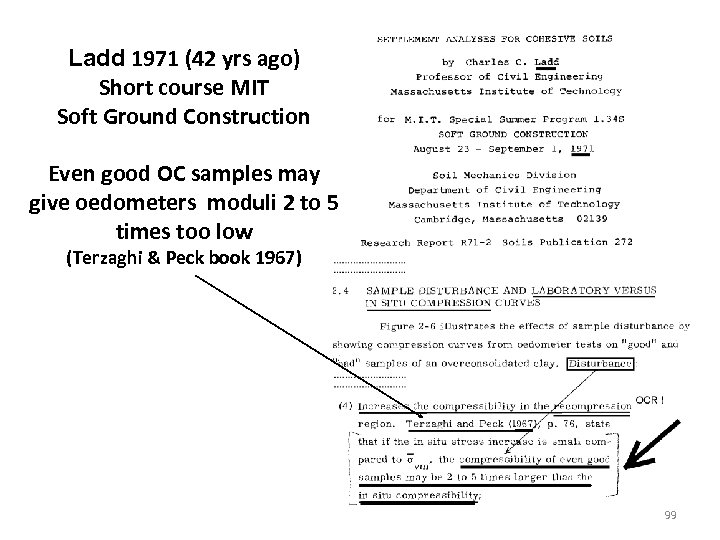 Ladd 1971 (42 yrs ago) Short course MIT Soft Ground Construction Even good OC samples may give oedometers moduli 2 to 5 times too low (Terzaghi & Peck book 1967) 99
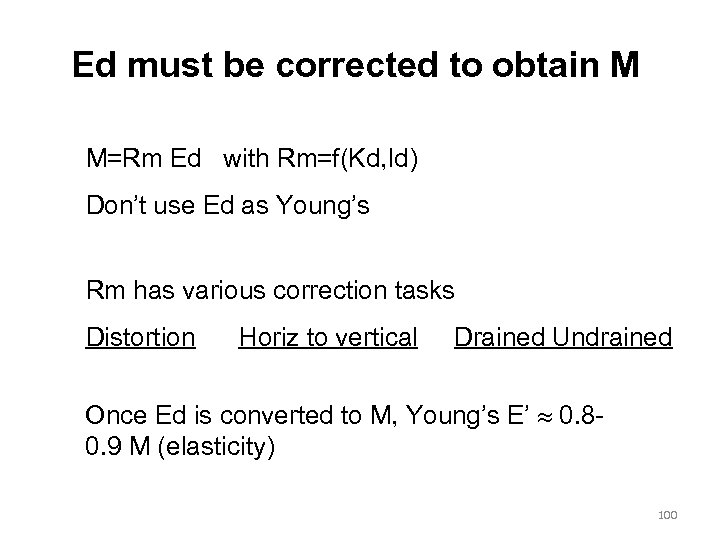 Ed must be corrected to obtain M M=Rm Ed with Rm=f(Kd, Id) Don’t use Ed as Young’s Rm has various correction tasks Distortion Horiz to vertical Drained Undrained Once Ed is converted to M, Young’s E’ 0. 80. 9 M (elasticity) 100
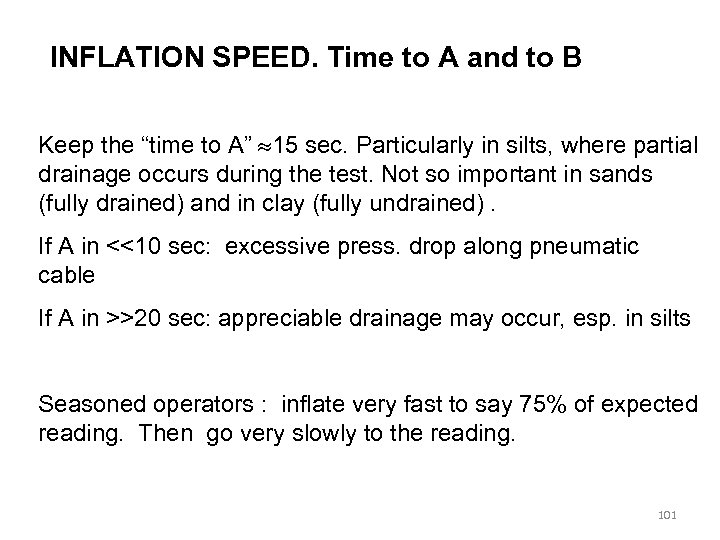 INFLATION SPEED. Time to A and to B Keep the “time to A” 15 sec. Particularly in silts, where partial drainage occurs during the test. Not so important in sands (fully drained) and in clay (fully undrained). If A in <<10 sec: excessive press. drop along pneumatic cable If A in >>20 sec: appreciable drainage may occur, esp. in silts Seasoned operators : inflate very fast to say 75% of expected reading. Then go very slowly to the reading. 101
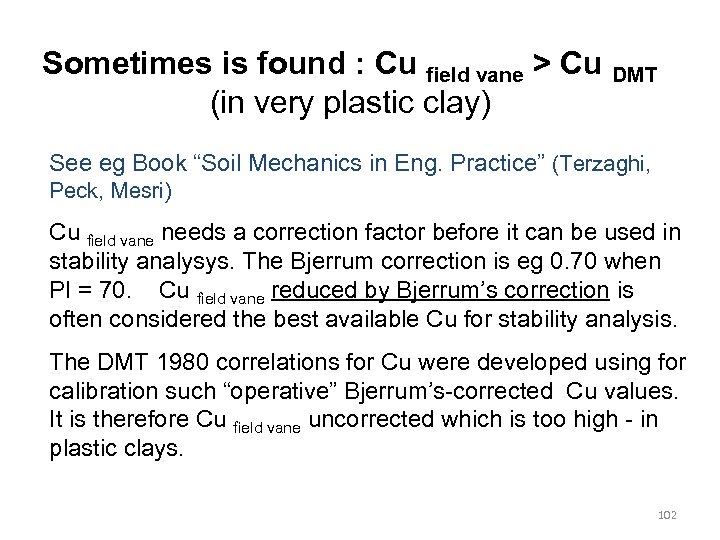 Sometimes is found : Cu field vane > Cu DMT (in very plastic clay) See eg Book “Soil Mechanics in Eng. Practice” (Terzaghi, Peck, Mesri) Cu field vane needs a correction factor before it can be used in stability analysys. The Bjerrum correction is eg 0. 70 when PI = 70. Cu field vane reduced by Bjerrum’s correction is often considered the best available Cu for stability analysis. The DMT 1980 correlations for Cu were developed using for calibration such “operative” Bjerrum’s-corrected Cu values. It is therefore Cu field vane uncorrected which is too high - in plastic clays. 102
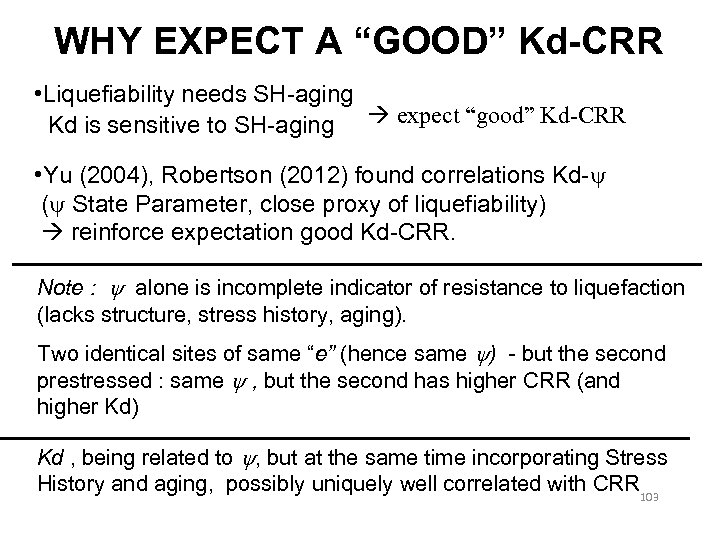 WHY EXPECT A “GOOD” Kd-CRR • Liquefiability needs SH-aging Kd is sensitive to SH-aging expect “good” Kd-CRR • Yu (2004), Robertson (2012) found correlations Kd- ( State Parameter, close proxy of liquefiability) reinforce expectation good Kd-CRR. Note : alone is incomplete indicator of resistance to liquefaction (lacks structure, stress history, aging). Two identical sites of same “e” (hence same ) - but the second prestressed : same , but the second has higher CRR (and higher Kd) Kd , being related to , but at the same time incorporating Stress History and aging, possibly uniquely well correlated with CRR 103