 Скачать презентацию Australian Centre for Environmetrics Developing Risk-based guidelines
495c20e9da4b29c38e995eca97efd869.ppt
- Количество слайдов: 25




Australian Centre for Environmetrics
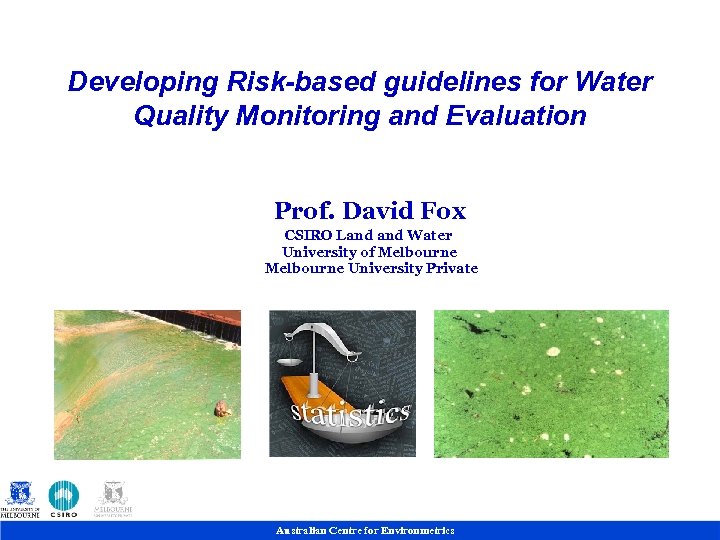
Developing Risk-based guidelines for Water Quality Monitoring and Evaluation Prof. David Fox CSIRO Land Water University of Melbourne University Private Australian Centre for Environmetrics
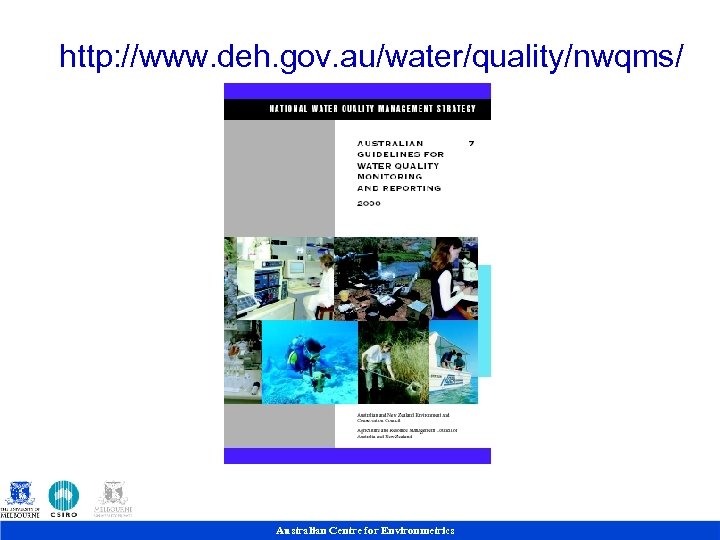
http: //www. deh. gov. au/water/quality/nwqms/ Australian Centre for Environmetrics
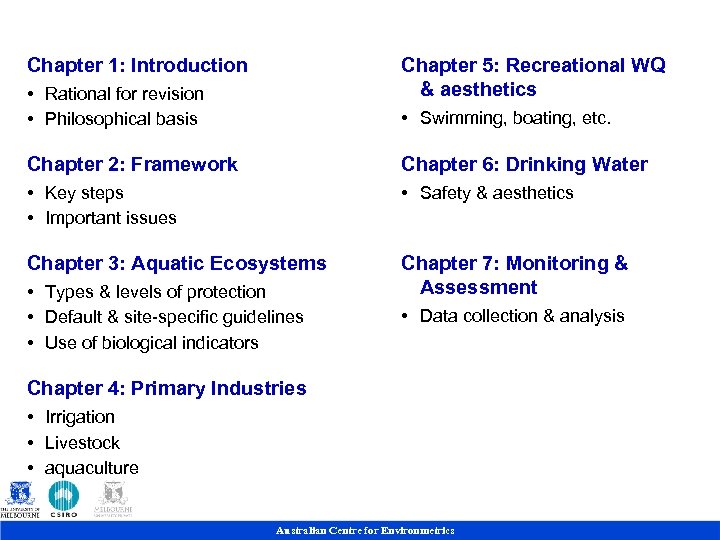
Chapter 1: Introduction Chapter 5: Recreational WQ & aesthetics • Rational for revision • Philosophical basis • Swimming, boating, etc. Chapter 2: Framework Chapter 6: Drinking Water • Key steps • Important issues • Safety & aesthetics Chapter 3: Aquatic Ecosystems Chapter 7: Monitoring & Assessment • Types & levels of protection • Default & site-specific guidelines • Use of biological indicators • Data collection & analysis Chapter 4: Primary Industries • Irrigation • Livestock • aquaculture Australian Centre for Environmetrics
Australian Centre for Environmetrics
Australian Centre for Environmetrics
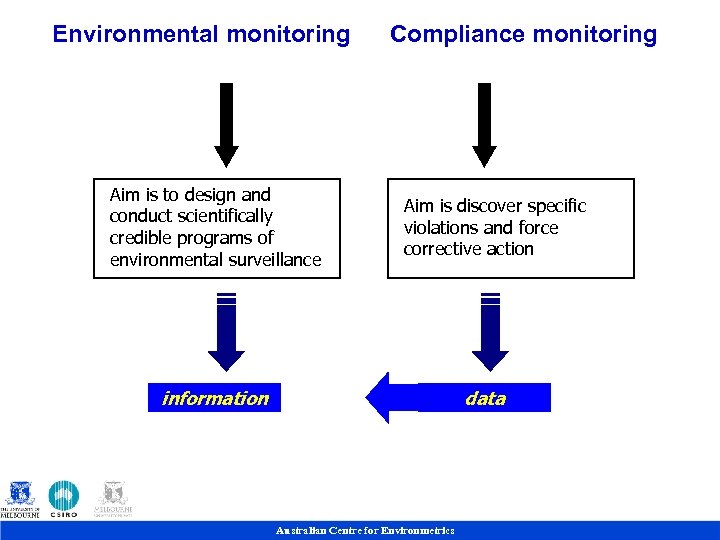
Environmental monitoring Aim is to design and conduct scientifically credible programs of environmental surveillance Compliance monitoring Aim is discover specific violations and force corrective action information data Australian Centre for Environmetrics
Risk-based Approaches Evolution of conventions has a lasting effect on how risk analyses are conducted: • USEPA has set mostly conservative defaults. • US Nuclear Regulatory Commission generally avoids conservative assumptions, recommending that modelers use default values that are close to the central tendency of parameter estimates (Bier 2003). • The Bayesian perspective is that there is a random variable, and the job of the analyst is to characterize how variable it may be. The approaches share a common belief in the epistemic nature of risk: there is a state of nature and the job of the risk analyst is to define it. Australian Centre for Environmetrics
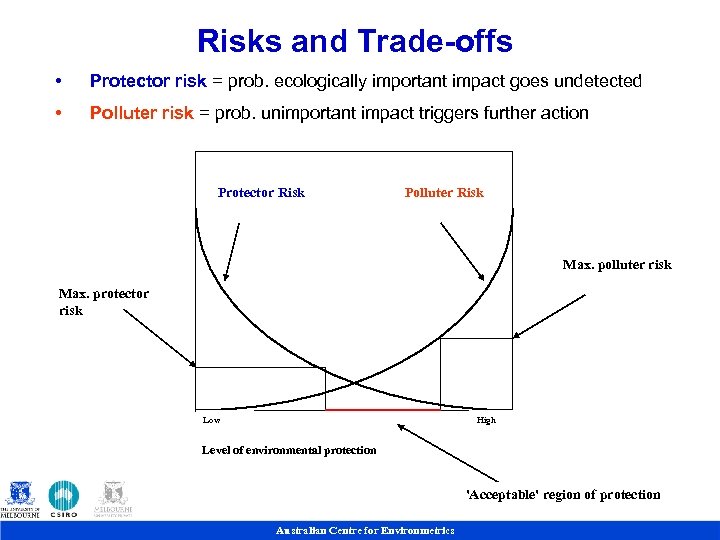
Risks and Trade-offs • • Protector risk = prob. ecologically important impact goes undetected Polluter risk = prob. unimportant impact triggers further action Protector Risk Polluter Risk Max. polluter risk Max. protector risk Low High Level of environmental protection 'Acceptable' region of protection Australian Centre for Environmetrics
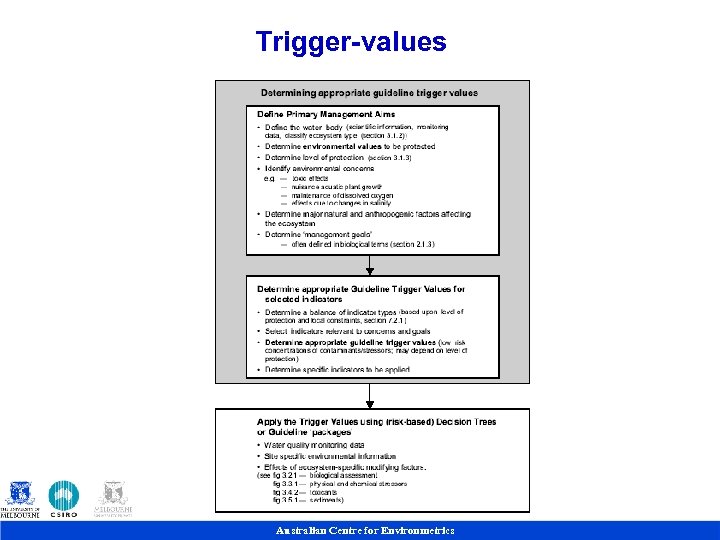
Trigger-values Australian Centre for Environmetrics
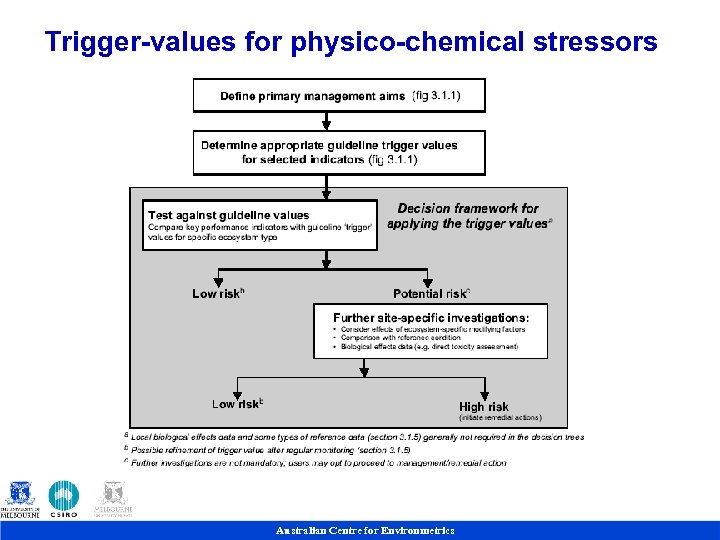
Trigger-values for physico-chemical stressors Australian Centre for Environmetrics
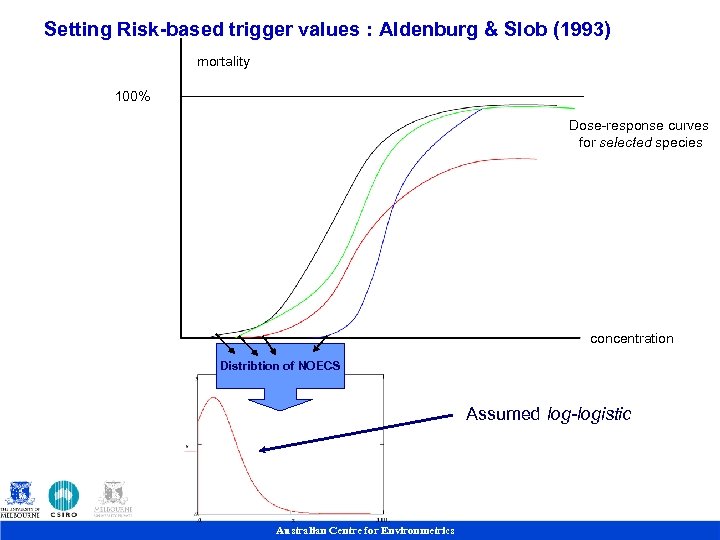
Setting Risk-based trigger values : Aldenburg & Slob (1993) mortality 100% Dose-response curves for selected species concentration Distribtion of NOECS Assumed log-logistic Australian Centre for Environmetrics
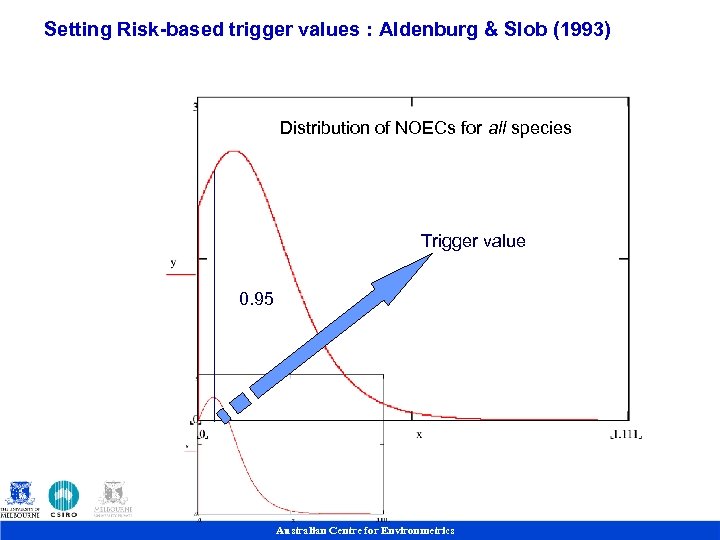
Setting Risk-based trigger values : Aldenburg & Slob (1993) Distribution of NOECs for all species Trigger value 0. 95 Australian Centre for Environmetrics
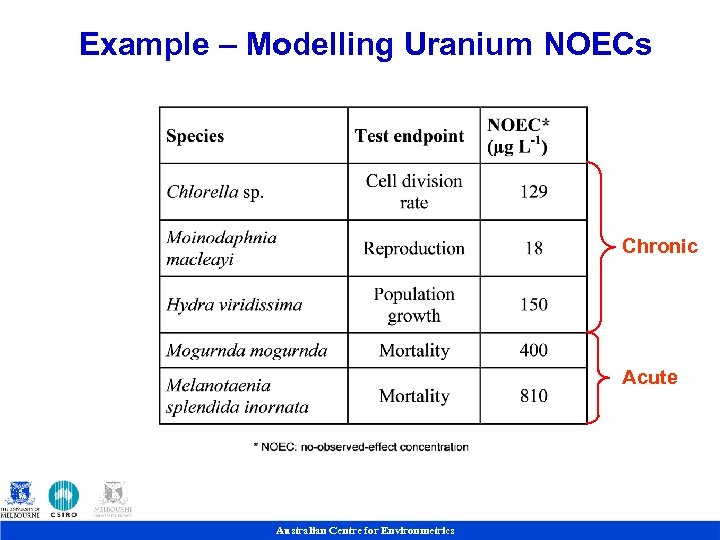
Example – Modelling Uranium NOECs Chronic Acute Australian Centre for Environmetrics
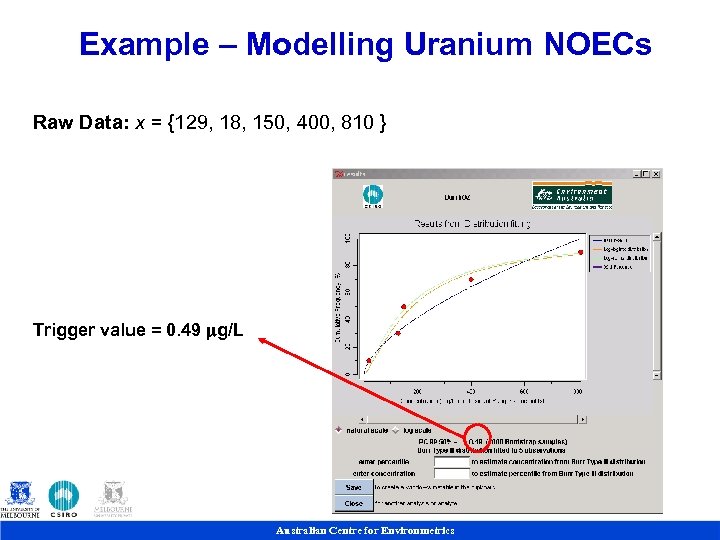
Example – Modelling Uranium NOECs Raw Data: x = {129, 18, 150, 400, 810 } Trigger value = 0. 49 g/L Australian Centre for Environmetrics
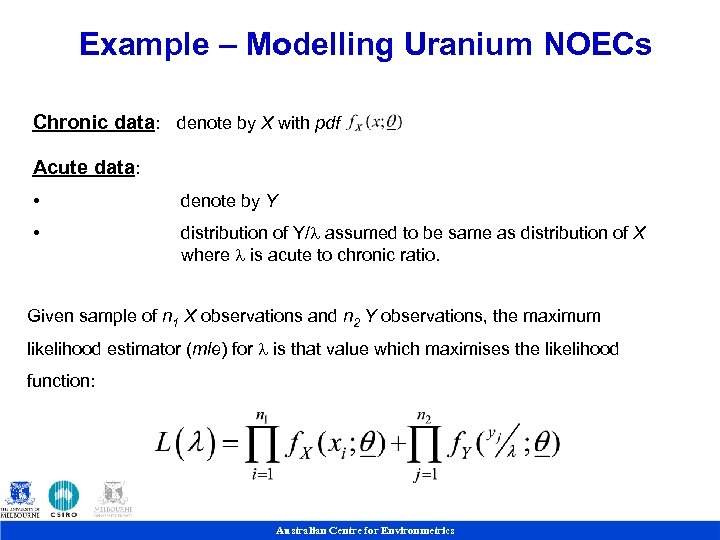
Example – Modelling Uranium NOECs Chronic data: denote by X with pdf Acute data: • denote by Y • distribution of Y/ assumed to be same as distribution of X where is acute to chronic ratio. Given sample of n 1 X observations and n 2 Y observations, the maximum likelihood estimator (mle) for is that value which maximises the likelihood function: Australian Centre for Environmetrics
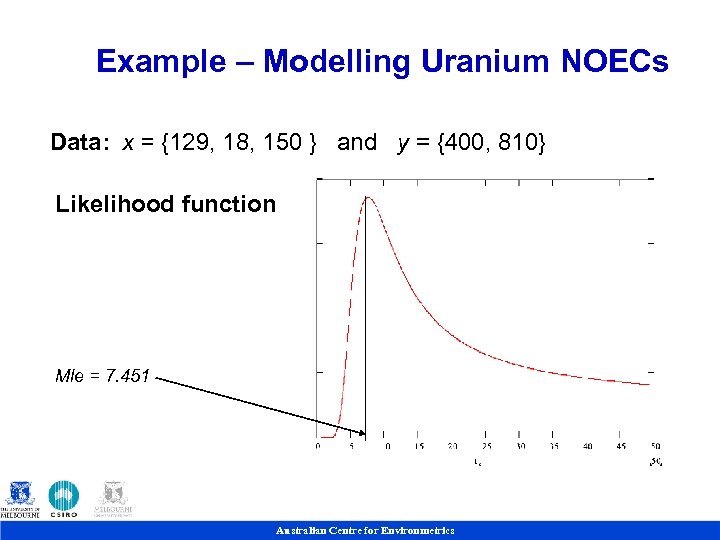
Example – Modelling Uranium NOECs Data: x = {129, 18, 150 } and y = {400, 810} Likelihood function Mle = 7. 451 Australian Centre for Environmetrics
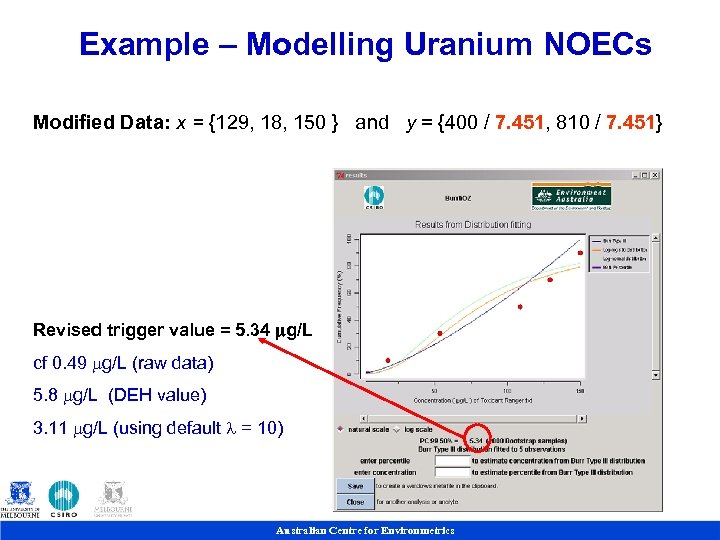
Example – Modelling Uranium NOECs Modified Data: x = {129, 18, 150 } and y = {400 / 7. 451, 810 / 7. 451} Revised trigger value = 5. 34 g/L cf 0. 49 g/L (raw data) 5. 8 g/L (DEH value) 3. 11 g/L (using default = 10) Australian Centre for Environmetrics
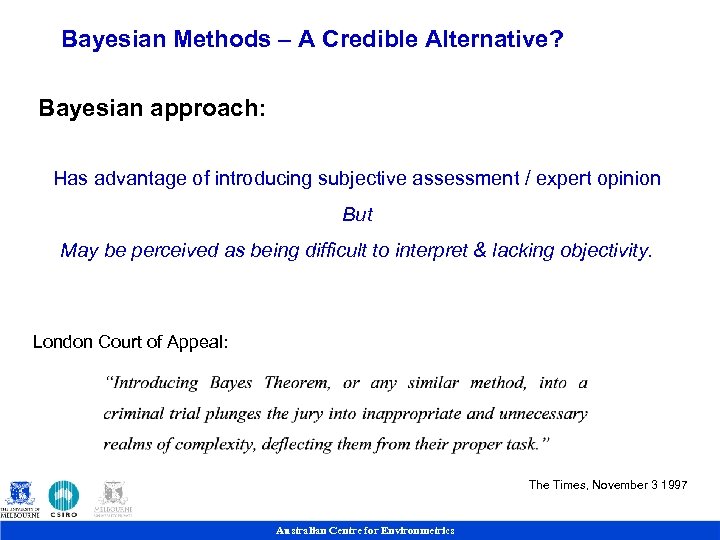
Bayesian Methods – A Credible Alternative? Bayesian approach: Has advantage of introducing subjective assessment / expert opinion But May be perceived as being difficult to interpret & lacking objectivity. London Court of Appeal: The Times, November 3 1997 Australian Centre for Environmetrics
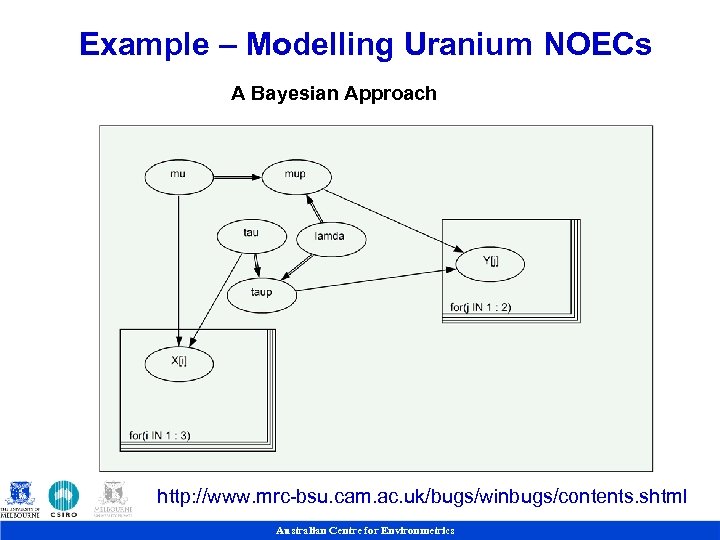
Example – Modelling Uranium NOECs A Bayesian Approach http: //www. mrc-bsu. cam. ac. uk/bugs/winbugs/contents. shtml Australian Centre for Environmetrics
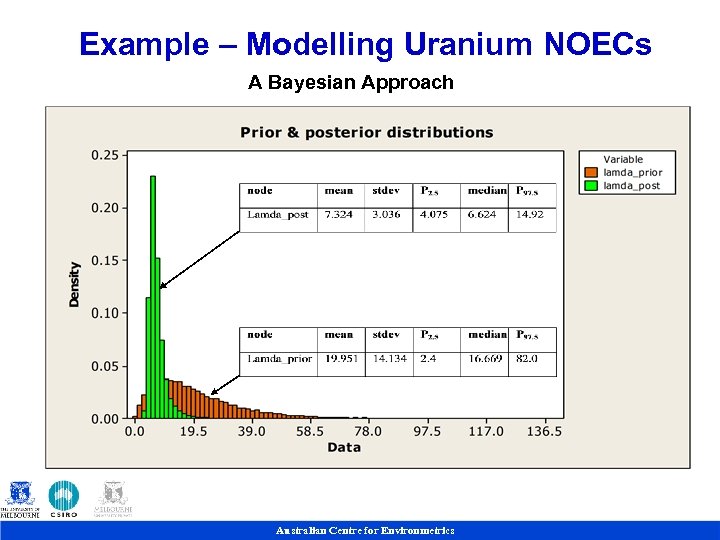
Example – Modelling Uranium NOECs A Bayesian Approach Australian Centre for Environmetrics
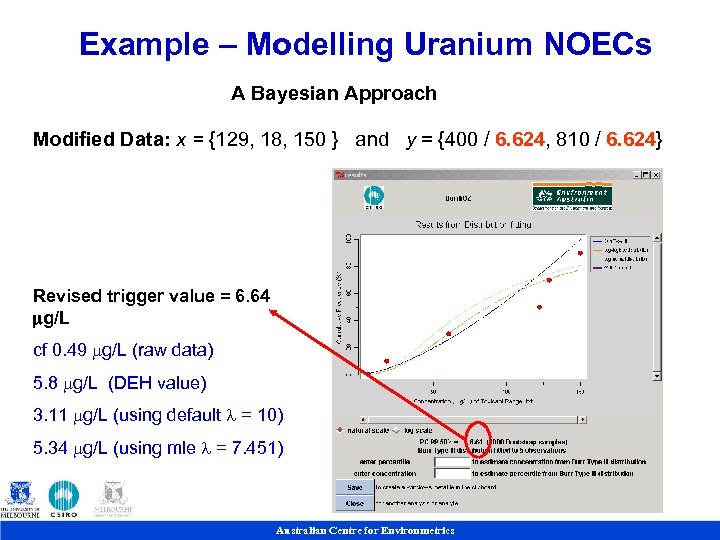
Example – Modelling Uranium NOECs A Bayesian Approach Modified Data: x = {129, 18, 150 } and y = {400 / 6. 624, 810 / 6. 624} Revised trigger value = 6. 64 g/L cf 0. 49 g/L (raw data) 5. 8 g/L (DEH value) 3. 11 g/L (using default = 10) 5. 34 g/L (using mle = 7. 451) Australian Centre for Environmetrics
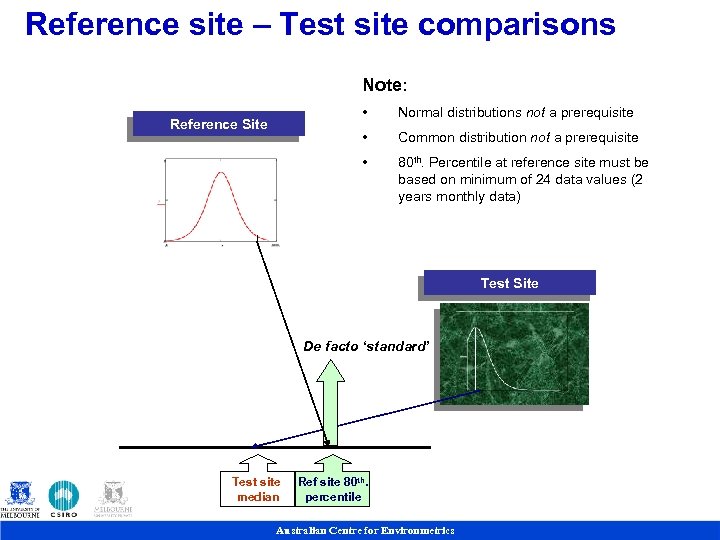
Reference site – Test site comparisons Note: • Normal distributions not a prerequisite • Common distribution not a prerequisite • Reference Site 80 th. Percentile at reference site must be based on minimum of 24 data values (2 years monthly data) Test Site De facto ‘standard’ Test site median Ref site 80 th. percentile Australian Centre for Environmetrics
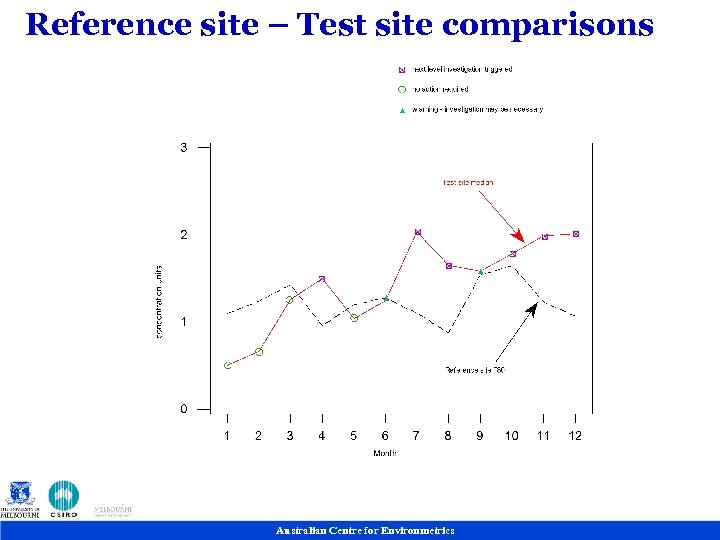
Reference site – Test site comparisons Australian Centre for Environmetrics
Observations & Challenges • Despite early attempts, development and adoption of a ‘standard’ risk metric seems a long way off (never? ); • Bayesian methods are becoming increasingly popular, although acceptance may be hampered by biases and lack of understanding; • More attention needs to be given to appropriate statistical modelling. In particular: - model choice - Parameter estimation - Distributional assumptions - ‘Outlier’ detection and treatment - robust alternatives (GLMs, GAMs, smoothers etc). Australian Centre for Environmetrics
Скачать презентацию Australian Centre for Environmetrics Developing Risk-based guidelines
495c20e9da4b29c38e995eca97efd869.ppt