


 Скачать презентацию Australia s Government Unit 12 Notes Australia s Government
890d9cfcce4fbdf3bc08e593e0ef4d37.ppt
- Количество слайдов: 8
 Australia’s Government Unit 12 Notes
 Australia’s Government • Australia has a federal parliamentary democracy. • There are three key factors that determine Australia’s government: – form of leadership – type of legislature – role of the citizen
 Form of Leadership • Queen Elizabeth II (England) is the head of state. – She does not run the country, but she signs laws, approves elections, and is commander-in-chief of the military. • The prime minister recommends someone to represent the Queen in Australia—the governorgeneral. • The prime minister is the head of the government & has the most political power. – leader of the political party with the most members in the Commonwealth Parliament
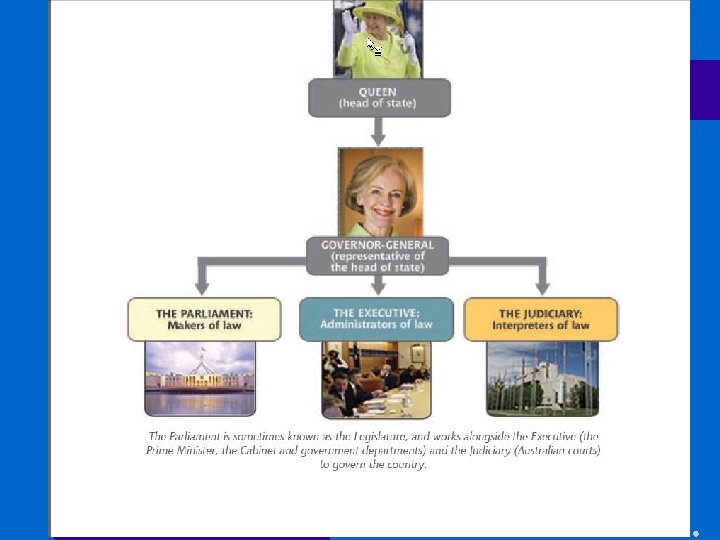
 Type of Legislature • An elected government operates the country. • Every 4 years, citizens who are over 18 vote for members of parliament. • Parliament meets several times a year and makes laws that affect how Australians live. • There are 2 houses of the Commonwealth Parliament: – House of Representatives – Senate
 Type of Legislature • House of Representatives: Australia is divided into areas called electorates; people living in each electorate vote for a person to represent them in parliament. – elected person becomes the MP of the House of Representatives for that area • Senate: people from each state and the 2 territories elect 12 people to be their senators
 Role of the Citizen • democracy: voters choose the lawmakers • Everyone who is 18 or over is required by law to vote. – Citizens can be fined or go to court if they don’t vote. • Citizens vote for MPs -- the leader of the party that gets the most votes becomes the prime minister. • Voters do not vote for the head of state (Queen), the governor-general, or directly for the prime minister.
 Role of the Citizen • Australians enjoy many freedoms. – freedom of religion, speech, job choice, travel, etc. • They can vote for the leaders that make laws and lead the country. • Their level of freedom is similar to what people have in the United Kingdom & the United States.