 Скачать презентацию Australia s Composite Observing System Identifying Future Directions Roger
7faf7372ba505b10532da2a0cc06011b.ppt
- Количество слайдов: 24



Australia’s Composite Observing System: Identifying Future Directions Roger Atkinson and Susan Barrell Australian Bureau of Meteorology 06 Dec 2006 WMO CIMO TECO-2006
Presentation Overview § Orientation: Australia and its Obs System § Drivers for Change § Aims and Key Requirements § Study Tasking § Key Findings and Recommendations § Study Conclusions § Observing System Migration: A Four Stage Strategy 06 Dec 2006 WMO CIMO TECO-2006
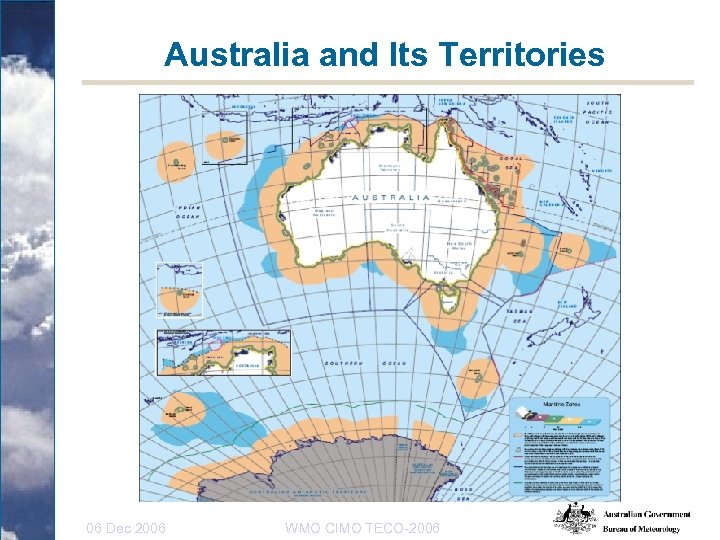
Australia and Its Territories 06 Dec 2006 WMO CIMO TECO-2006
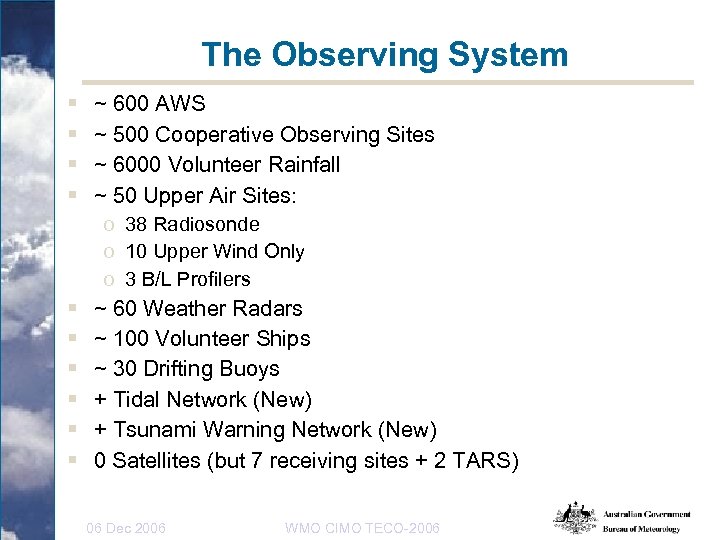
The Observing System § § ~ 600 AWS ~ 500 Cooperative Observing Sites ~ 6000 Volunteer Rainfall ~ 50 Upper Air Sites: o 38 Radiosonde o 10 Upper Wind Only o 3 B/L Profilers § § § ~ 60 Weather Radars ~ 100 Volunteer Ships ~ 30 Drifting Buoys + Tidal Network (New) + Tsunami Warning Network (New) 0 Satellites (but 7 receiving sites + 2 TARS) 06 Dec 2006 WMO CIMO TECO-2006
Drivers for Change § Increasing Pressure on Resources (especially Staff Numbers) § Need for Continually Increasing Efficiency and Accountability § Increasing Demand for Data § Increasing Demand for Service Level Agreements for Data Provision § Increasing OH&S Requirements § Improvements in Automated Technology 06 Dec 2006 WMO CIMO TECO-2006
Basic Observing System Study 2005 Aims: • Identify the observing system necessary for the Bureau of Meteorology to deliver effectively and efficiently on its agreed outputs to Government over the next 5 to 10 years. • Develop end-to-end strategies for delivering that system, including strategies for migrating from existing to specified systems. Key requirements: § Strategic § Pragmatic but thorough § Draw on the work of previous similar studies § Broad, organisation-wide participation 06 Dec 2006 WMO CIMO TECO-2006
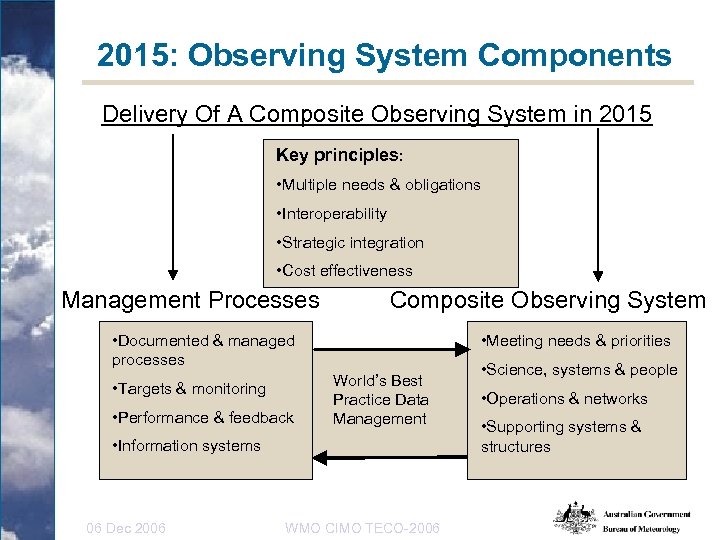
2015: Observing System Components Delivery Of A Composite Observing System in 2015 Key principles: • Multiple needs & obligations • Interoperability • Strategic integration • Cost effectiveness Management Processes Composite Observing System • Documented & managed processes • Targets & monitoring • Performance & feedback • Meeting needs & priorities World’s Best Practice Data Management • Information systems 06 Dec 2006 WMO CIMO TECO-2006 • Science, systems & people • Operations & networks • Supporting systems & structures
Study Tasking 1. Survey of Previous Similar Studies 2. Concept: Bureau Composite Observing System 3. International Requirements for Data 4. National (Service) Requirements for Data 5. Existing Observing System i. Obs. Networks and Programs ii. Quality Management System iii. Equipt. Maintenance and Replacement Strategy iv. Reporting, Communications and Data Management v. Radio Frequency Spectrum Management 06 Dec 2006 WMO CIMO TECO-2006
Study Tasking (continued) 6. Adequacy Assessment i. cf International Requirements ii. cf National Requirements iii. cf Other NMHSs 7. Value Assessment i. Value of Services Provided ii. Data Impact Studies iii. Impact on Service Provision of Previous Changes to the Observing System 06 Dec 2006 WMO CIMO TECO-2006
Study Tasking (continued) 8. Future Requirements, Capabilities and Issues i. Trends in Service Requirements ii. New and Emerging Observing Technology iii. Quality Management System iv. Equipment Maintenance and Replacement v. Data Communications vi. Data Management vii. RF Spectrum Management viii. Use of Shared and/or 3 rd Party Data and Systems 06 Dec 2006 WMO CIMO TECO-2006
Study Tasking (continued) 9. Findings and Recommendations 10. Forward Strategy 06 Dec 2006 WMO CIMO TECO-2006
Key Findings and Recommendations • Need to make more effective and extensive use of satellite information: • Harness the intrinsic information; • Explore if they can supplement/partially replace more traditional surface-based systems. • Need increased effort in visualisation of data • Integration of satellite and in situ data. • Culture change issues: • Increase forecasters’ confidence in a more composite network approach • Reduce reliance on more traditional data sources (manual ‘visual element’ observations and radiosondes). 06 Dec 2006 WMO CIMO TECO-2006
Key Findings and Recommendations (continued) • Need a more structured long-term approach to the evaluation and implementation of new technologies: • Full lifecycle cost must be taken into account, including operation, maintenance and end-of-life replacement. • Next Generation AWS and Metadatabase have identified clear savings and operational efficiencies: • Should proceed on their development and evaluation tracks as soon as possible. • AMDAR program is also in this category: • Needs high-level support for evaluation of humidity sensors and expansion of the national program. 06 Dec 2006 WMO CIMO TECO-2006
Key Findings and Recommendations (continued) • Wind profilers require further evaluation: • Promising partial replacement for Radar Windfinding. • Scope for more automation in the field, but: • Ongoing critical need for annual recruitment and training of Meteorological Observers; • Engineering Services resources must be consistent with the increasing reliance on automated systems. • Need for greater network coverage (surface observations and radar). • Need increased frequency of observations (surface and upper air observations). 06 Dec 2006 WMO CIMO TECO-2006
Key Findings and Recommendations (continued) § Ongoing role for radiosondes: o Strong desire amongst users for restoration of a more extensive 12 Z network; o Future rationalisation may be possible once other sources (satellite soundings, AMDAR profiles, wind profilers, GPS water vapour) are operational. § Need for greater accountability in BCOS operation: o More systematic performance reporting; o Introduction of a formal quality systems. § Need data impact studies for: o Improved network design; o Quantification of impacts from changes in obs coverage. 06 Dec 2006 WMO CIMO TECO-2006
Key Findings and Recommendations (continued) § Need closer adherence to climate monitoring principles: o Especially overlaps with existing systems. § Must overcome key deficiencies in data archival and retrieval. 06 Dec 2006 WMO CIMO TECO-2006
Conclusions § BCOS cannot be adequately maintained and developed over the coming decade within the currently-projected program resource envelope. § Require a significant short to medium term boost in investment to consolidate BCOS performance and enable development and implementation of alternative automated technologies. § A more automated, sustainable BCOS could then be implemented operationally and deliver, in the longer term, significant and ongoing efficiency gains, in particular with regard to the human resource levels. 06 Dec 2006 WMO CIMO TECO-2006
Conclusions (continued) § This new BCOS would be characterised by larger data volumes but reduced ‘raw’ data quality. § Upgraded BCOS quality management system and larger ‘raw’ data volumes: o more optimal utilisation of data; o increased output data quality. § Overall, maintain current BCOS effectiveness despite expected increases in service demand. § Increase in short to medium term resource allocations to be largely repaid through reductions in staffing and infrastructure. § Modest ongoing savings follow once the BCOS stabilises. 06 Dec 2006 WMO CIMO TECO-2006
Migration: A Four Stage Strategy 4 Overlapping Stages: • Stage 1: Consolidate the Existing BCOS; • Stage 2: Implement Overarching and Underpinning Initiatives; • Stage 3: Develop and Test new Technology; • Stage 4: Migrate to a New and Sustainable BCOS Configuration. 06 Dec 2006 WMO CIMO TECO-2006
Stage 1: Consolidation Address significant shortcomings in key areas without making significant changes to the techniques and technology employed within the BCOS. Includes: • Upgrades to satellite data reception, ingestion and applications software; • Immediate restoration of the 12 Z radiosonde program; • Modest changes to surface observations networks; • Restoration of the Atmosphere Watch Program. 06 Dec 2006 WMO CIMO TECO-2006
Stage 2: Underpinning and Overarching Initiatives Indirectly improve BCOS effectiveness and data utilisation, and upgrade the Bureau’s capacity to plan and provide for the BCOS. Includes: • Upgrade the Bureau’s performance, impact and value measurement capabilities; • Improve BCOS quality management and spectrum management; • Upgrade NWP, data display and data storage and retrieval systems; • Develop means of utilising satellite data for climate analysis. 06 Dec 2006 WMO CIMO TECO-2006
Stage 3: Develop and Test New Technology • Further develop satellite applications software; • Develop and trial Next Generation AWS and Data Processing and Dissemination System; • Trial radar wind profilers, lightning sensors, automated evaporimeter, new agrometeorological sensors and other advanced and automated sensors for providing visual element observations; • Test unattended operation of the Autosonde; • Experiment with a redundant sensor model for basic surface quantities; • Investigate needs for further expansion and upgrade of the weather watch radar network; • Investigate scope for multi-tiered networks, and use of third party and/or shared data and systems. 06 Dec 2006 WMO CIMO TECO-2006
Stage 4: BCOS Migration Implement various new technologies (subject to successful development and trialing) as a partial replacement for current manually-intensive technology. Includes: § Expand AMDAR program (including WVSS 2 deployment); § Deploy BL and ST profilers at wind-only upper air sites and some existing radiosonde sites; § Deploy local lightning sensors on all AWS; § Implement various other new technologies in the surface network; § Establish GPS water vapour network, and § Expand upgrade the weather radar network. 06 Dec 2006 WMO CIMO TECO-2006
Thank You R. Atkinson@bom. gov. au 06 Dec 2006 WMO CIMO TECO-2006
Скачать презентацию Australia s Composite Observing System Identifying Future Directions Roger
7faf7372ba505b10532da2a0cc06011b.ppt