

Australia Historical notes about Australia European Colonization The

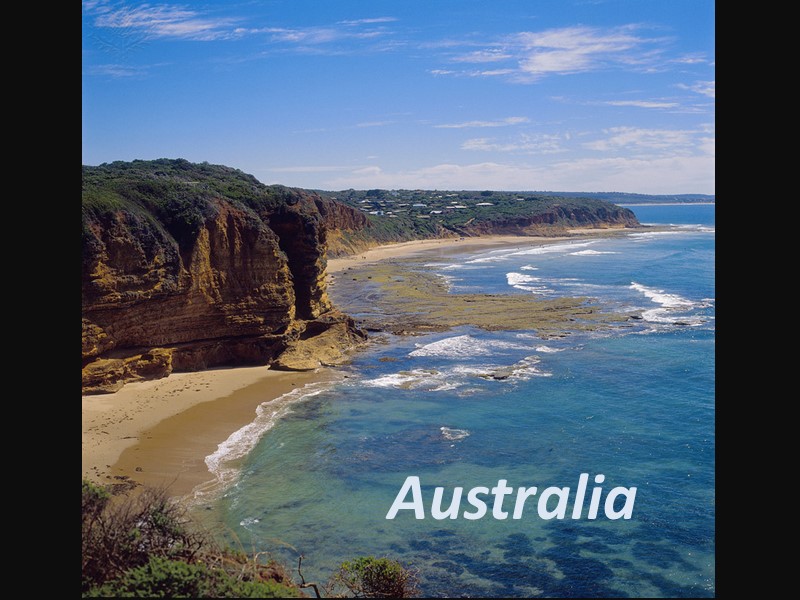
Australia

Historical notes about Australia
European Colonization The first Europeans to see Australia were Dutch explorers in the early 17th century. The Dutch, however, were not generally interested in colonizing the land that looked desert. In the late 18th century the British started the colonization of Australia, at the beginning to create a penal colony (in order to replace the lost American colonies to this end). During the 19th century the British created six separate colonies: New South Wales, Queensland, South Australia, Tasmania, Victoria, and Western Australia. In the 1850s the colonies obtained self-government and started to develop parliamentary institutions.
Toward the union In the last years of the 19th century the colonies initiated talks to unite into a federation. Fiji and New Zealand were originally part of this process, but they decided not to join the federation. In 1901, with the approval of the British House of Commons and the Queen Victoria, the federation was born. The most important reasons for uniting the colonies were a serious economic depression in the 1890s and the need to strengthen Australia to limit foreign influence (especially French and German). Also, there was a burgeoning sense of national pride among the born Australians.
The Constitution of Australia The US Constitution provided the most important model for the new federal constitution, even if other federal constitutions, like the Swiss, were taken into consideration. The US Constitution, among other reasons, was an attractive model because it strongly limited central power (even if later in both US and Australia the federal government steadily increased its power). In 1891, the Attorney-General Andrew Inglis Clark prepared a draft constitution that was later adopted as the constitution of Australia. (In Australia, the Attorney-General is the chief law officer and is responsible for law and justice, law enforcement, national security, and other services).
The Commonwealth of Australia The Constitution of Australia came into force on 1 January 1901, at which time the Commonwealth of Australia came into being. The Constitution created a framework of government with the following features: constitutional monarchy (British and existing colonial models) federalism (United States model) parliamentary, or "responsible", government (British and existing colonial models) separation of powers (US model) direct election to both Houses of Parliament (then a novelty) requirement of a referendum for amendment of the Constitution (Swiss model) very limited guarantees of personal rights (rejection of the US model based on the Bill of Rights) judicial review (US model)
The first federal elections The first federal Parliament was elected in 1901. The voting franchise (right to vote) was decided by each single state. Women for example could vote only in two states, and the aboriginal population got a theoretical suffrage (right to vote) only in two states. (Note: In the UK women obtained suffrage gradually, starting from 1918).
Original party system The parties contesting the election were the Protectionist Party and the Free Trade Party. The Protectionists advocated first of all the protection of local industries through the imposition of tariffs on imported goods. The Free Traders advocated the dismantling of the tariff system; their other policies were not very different from the Protectionists'. No party won a majority, however the incumbent Protectionist government was supported by the Australian Labour Party.
White Australia Both parties supported the policy known as White Australia: the restriction of non-British immigration. After World War II there was a more generous policy toward other white immigrants; but the government policy of limiting non-white immigration was abolished only in the mid-1970s. The immigration policy, however, is still a sensitive issue.
Modern party system Australia has had since the beginning (1901) a multi-party system dominated by two big parties and a few small and relatively unimportant parties. Today the most important parties are the Labour Party and the Liberal Party (that forms a permanent coalition with the National Party of Australia). Since 18 September 2013 the ruling party is the Liberal Party (with the National Party).

Toward Independence (1) In the 1920s, in the British government, there was a widespread opinion that parts of the Empire should enjoy full legislative autonomy. In 1926, the British government issued a policy document known as Balfour Declaration. It stated, of the United Kingdom and the Dominions: "They are autonomous Communities within the British Empire, equal in status, in no way subordinate one to another in any aspect of their domestic or external affairs, though united by a common allegiance to the Crown, and freely associated as members of the British Commonwealth of Nations."
Toward Independence (2) The Declaration accepted the growing political and diplomatic independence of the Dominions. It also recommended that the Governors-general, the representatives of the King who acted for the Crown as de facto head of state in each dominion, should no longer also serve automatically as the representative of the British government in diplomatic relations between the countries. In following years, High Commissioners were gradually appointed, with duties virtually identical to those of an ambassador. The first such British High Commissioner was appointed to Ottawa in 1928.
Statute of Westminster 1931 This policy was incorporated in the Statute of Westminster of December 1931, by which the British parliament renounced any legislative authority over the dominions, except as specifically provided in law. The Statute of Westminster 1931 abolished the supremacy of British laws over colonial laws, but this was limited to the federal legislation. The Parliament of Australia passed the Statute of Westminster Adoption Act of 1942. (A similar adoption act was passed in New Zealand in 1947).
Australia Act 1986 (1) However the Colonial Laws Validity Act 1865, that established the supremacy of British laws over colonial laws, continued to have application in the six Australian States and the Australian Capital Territory until the Australia Act of 1986 came into effect. The Australia Act, among other things, abolished the Colonial Laws Validity Act 1865. (Similar acts were adopted in 1982 for Canada and in 1986 for New Zealand).
Australia Act 1986 (2) The Australia Act is actually two acts passed by both the British and the Australian Parliament. They eliminated the remaining possibilities: for the UK to legislate with effect in Australia, for the UK to be involved in Australian government, and for an appeal from any Australian court to a British court. The Act marks the moment when Australia becomes fully independent from the British government.
The path towards independence In sum, the most important milestones towards independence were: mid-19th century: acquisition of substantial internal self-government by the colonies 1901: establishment of the Commonwealth of Australia 1931: passing of the Statute of Westminster 1986: passing of the Australia Act. Since the Australia Act 1986, the only remaining constitutional link with the United Kingdom is in the person of the monarch.
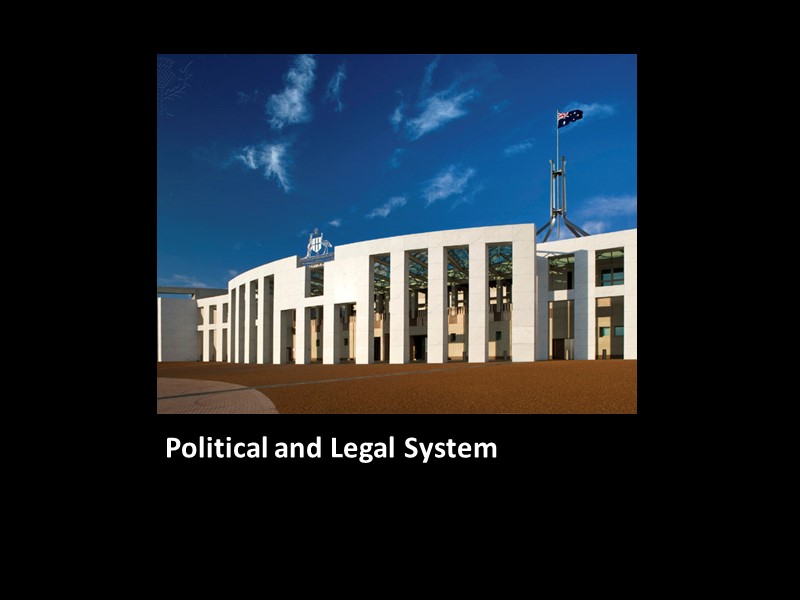
Political and Legal System
Head of state (1) The head of state is currently the Queen Elizabeth II. The role of the Queen, however, was very circumscribed since the Statute of Westminster 1931 and especially through the Australia Act 1986. Today the Queen: appoints (and, in theory, dismisses) a Governor-General on the advice of the Prime Minister performs (by invitation) certain ceremonial functions when she is personally present in Australia.
Head of state (2) In November 1999 there was a referendum in Australia, whether Australia should become a republic: The answer was negative. There is still some debate about the issue of an Australian republic. The current Prime minister of Australia was among the promoters of the referendum.
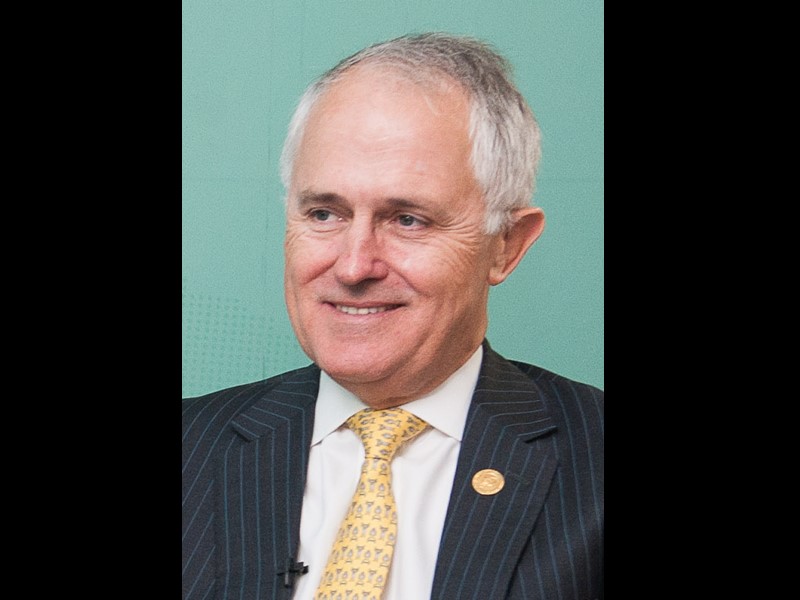
Prime Minister The Prime Minister is the head of government. Following the Westminster system, he/she is the leader of the party that obtains a parliamentary majority at the elections. The federal government of Australia is currently led by the Prime Minister Malcolm Turnbull, of the Australian Liberal Party. The Turnbull government commenced on 15 September 2015. Mr. Turnbull became Prime Minister when Mr. Abbott lost the leadership of their party to Mr. Turnbull.
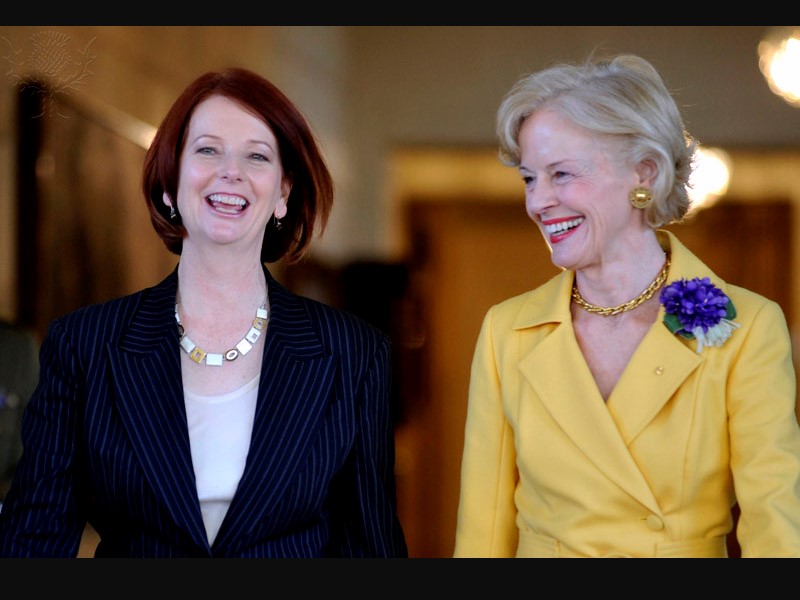
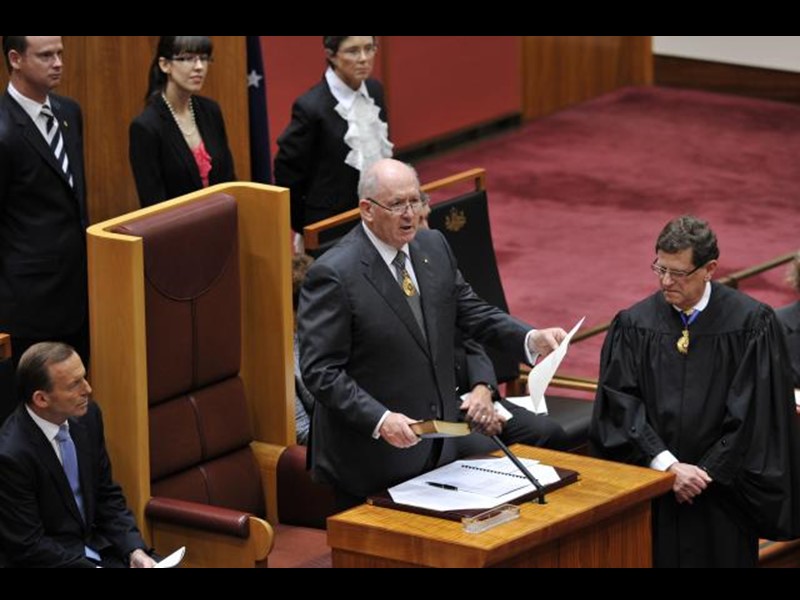
The Governor-General (1) The Governor-General of the Commonwealth of Australia is the representative in Australia of the Australian monarch (currently Queen Elizabeth II). He or she also exercises the supreme executive power of the Commonwealth. The functions and roles of the Governor-General include appointing ambassadors, ministers and judges, giving Royal Assent to legislation, issuing writs for elections and bestowing honors. The Governor-General is President of the Federal Executive Council and Commander-in-Chief of the Australian Defence Force. The current Governor-General of Australia is His Excellency The Honourable Sir Peter Cosgrove AK MC (since 28 March 2014).
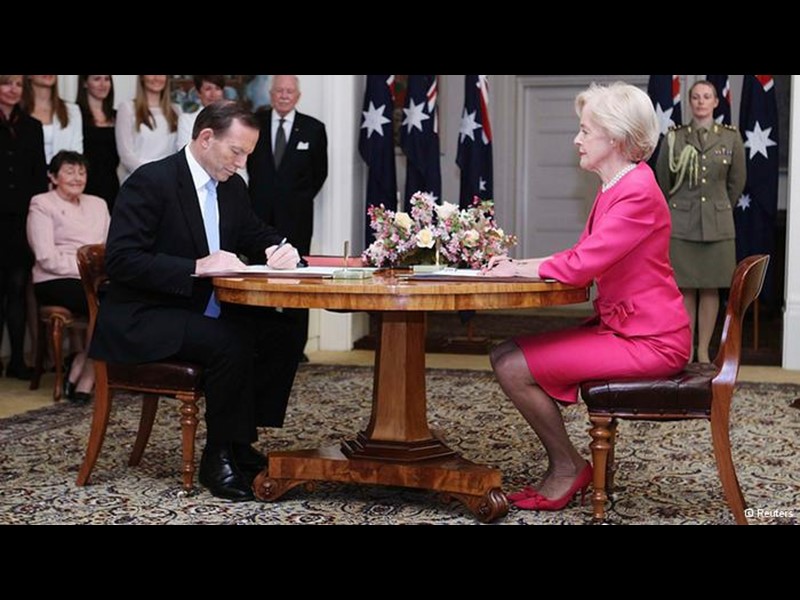
The Governor-General (2) The governor-general is selected by the Prime Minister of Australia, who may consult privately with staff or colleagues, or with the monarch. The Prime Minister then provides the nomination to the monarch. The monarch may, in theory, decline the Prime Minister's advice and ask for another nomination or even appoint a person of his or her own choice, but no such cases have been recorded since 1930. Due to the adoption in 1942 of the Statute of Westminster 1931 and to the formal separation of the crowns of the Dominions, the Queen of Australia is generally bound by constitutional convention to accept the advice of the Australian Prime Minister.
The Parliament (1) The Parliament of Australia consists of the 76-member Senate, the 150-member House of Representatives, and the Queen. Each state has 12 senators, and each territory has two senators, regardless of population. Seats in the House are apportioned by population, but no state can have fewer than five representatives. The majority party (or party coalition) in the House of Representatives forms the government and appoints its leader as Prime Minister, whereupon he or she selects cabinet ministers from both chambers of Parliament.
The Parliament (2) The ministers are accountable to Parliament, which has the right to question them publicly. Both houses of Parliament may initiate ordinary legislative proposals, but all revenue bills must originate in the House. A simple majority is needed to adopt a bill in either house. A bill passed by one house is transmitted to the other for concurrence. If passed by both houses, the bill is submitted to the Governor-General for Royal Assent in the name of the Queen.
The Parliament (3) The Senate is afforded substantial powers by the Australian Constitution, significantly greater than those of Westminster upper houses such as those of the United Kingdom and Canada, and has the power to block legislation originating in the House as well as supply or monetary bills. As such, the Senate has the power to bring down the government. Because legislation must pass successfully through both houses in order to become law, it is possible for disagreements between the House of Representatives and the Senate to hold up the progress of government bills indefinitely. Such deadlocks are resolved under a procedure called a double dissolution election. Such elections are rare because they can pose a significant political risk to any government that chooses to call one. Of the six double dissolution elections that have been held since federation, half have resulted in the fall of a government.

Administrative Divisions Australia is divided into six states (New South Wales, Queensland, South Australia, Tasmania, Victoria, and Western Australia) and two principal self-governing territories (the Australian Capital Territory, which includes the national capital of Canberra, and the Northern Territory). Australia also administers a number of territories and dependencies, including the very large Antarctic Territory, the Ashmore and Cartier Islands, Christmas Island, the Cocos (Keeling) Islands, the Coral Sea Islands, Heard Island and the McDonald Islands, and Norfolk Island. Each state has a Governor, appointed by the Queen, which by convention she does on the advice of the state Premier. Each state but one has a bicameral Parliament.
Law Australian law is based on the English common law. Unlike in India, in Australia the British colonists and the subsequent Australian governments did not recognize any form of indigenous law, because they considered the aboriginal people as too primitive. Only in the early 1990s the Australian judiciary accepted for the first time the possibility of using customary aboriginal law. All of the States and territories of Australia that are self-governing are separate jurisdictions, and have their own system of courts and parliaments. The systems of laws in each state are influential on each other, but not binding.
Justice The High Court of Australia acts as a court of appeal for the country as a whole. The High Court also hears cases about the Australian Constitution. It also has the powers to declare laws unconstitutional (judicial review). There are also federal courts: In 1976, the Family Court of Australia came into existence, exercising jurisdiction mainly under the Family Law Act 1975. In 1977, the Federal Court of Australia came into being, and now exercises jurisdiction in matters of commercial, administrative and industrial law arising under federal legislation. In 2000, a Federal Magistrates' Court was established.
Judicial review Judicial review, adopted by the Constitution of Australia, is the ability of the courts to declare legislation unconstitutional and therefore invalid. Judicial review has its origin in the American experience; It was completely foreign to both British and Australian colonial experience. This power of judicial review of legislation for conformity with the Constitution has been exercised almost exclusively by the High Court of Australia.
 Скачать презентацию Australia Historical notes about Australia European Colonization The
36596-010_australia.ppt
- Количество слайдов: 36