


 Скачать презентацию Australia and Nuclear Energy Power Professor Peter Johnston
7aca6f76c603184b88bd3f1d0dc112ab.ppt
- Количество слайдов: 50
 Australia and Nuclear Energy Power Professor Peter Johnston, RMIT 1
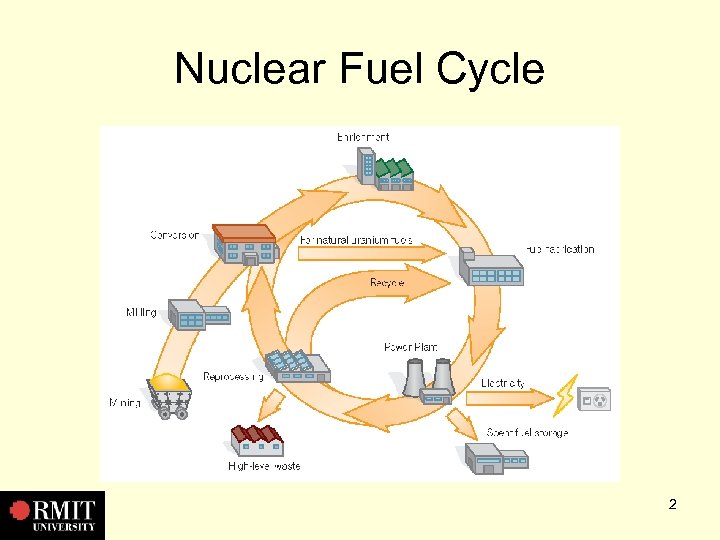 Nuclear Fuel Cycle 2
 Mining and Milling • Uranium is extracted from the ground, removed from the host rock and daughter products • Uranium is made into Uranium Ore Concentrate “Yellowcake” which is a hydrated Uranium Oxide of 80 -95% purity depending on the temperature of calcining the product. • Yellowcake is often green. 3
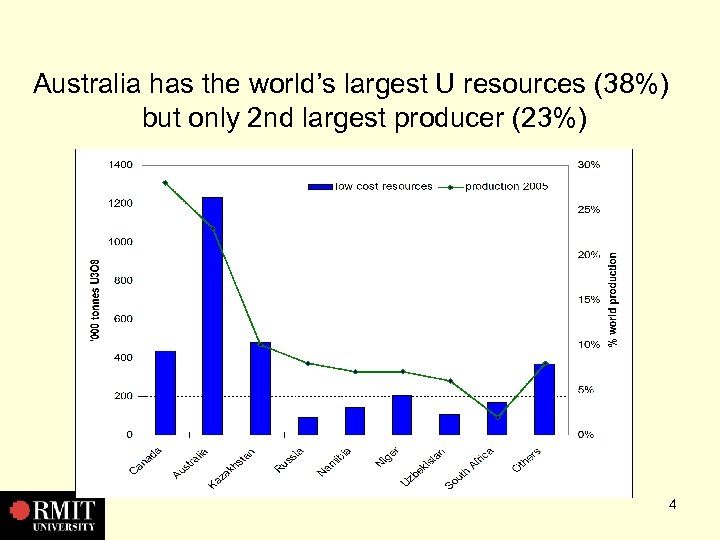 Australia has the world’s largest U resources (38%) but only 2 nd largest producer (23%) 4
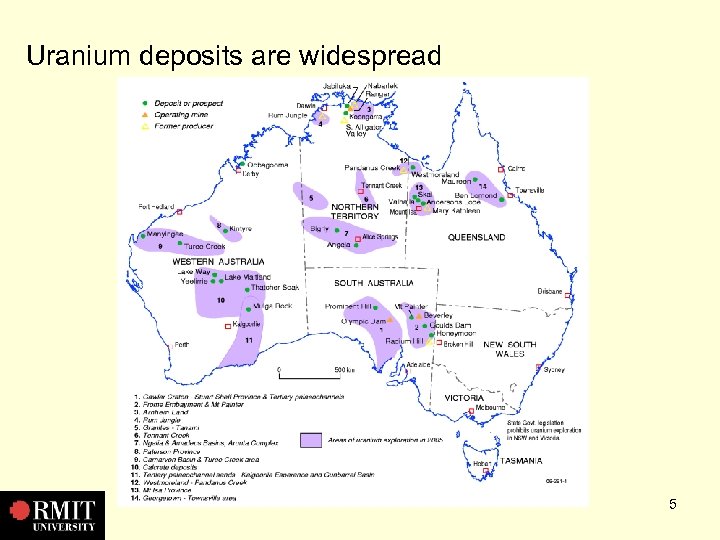 Uranium deposits are widespread 5
 World uranium market outlook • Increasing world demand for uranium Increased NPP duty cycles Power upgrades of some plants Increased plant lifetimes • Uranium price increasing US$10/lb to $86 in 4 years (Jan 21 2008) • U resources are plentiful not expected to constrain development of new nuclear power capacity • Timely opportunity for Australia to increase uranium exports significantly 6
 Downstream value-add: opportunities and challenges • Uranium exports (presently $0. 5 bn) could be transformed into a further $1. 8 bn in value – Conversion, enrichment and fuel fabrication activities • However, the challenges are significant 7
 Conversion to UF 6 and Enrichment • Purification of Uranium Ore Concentrate • Production of UF 6 which is a chemical process involving fluorine. UF 6 becomes a gas at 50˚C • Enrichment takes natural U of 0. 7% U-235 abundance and increases U-235 abundance to approx. 3. 5% typically using centrifuges • USA and France have gaseous diffusion enrichment plants still operating. Centrifuge technology is 50 times more efficient. 8
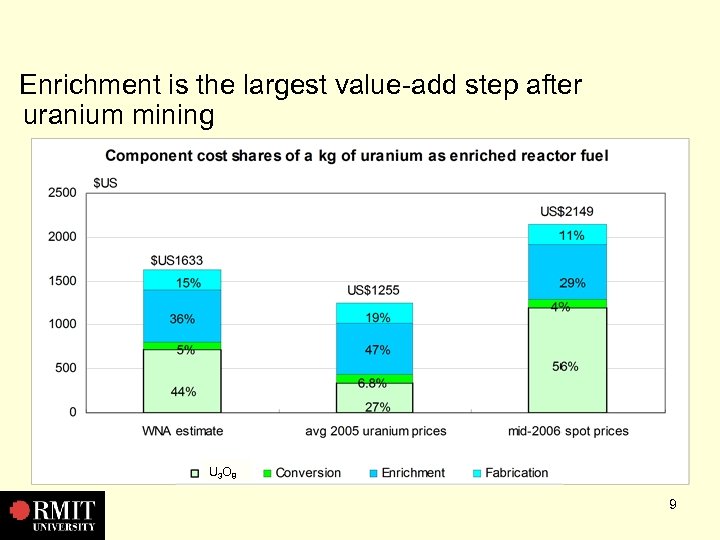 Enrichment is the largest value-add step after uranium mining U 3 O 8 9
 Enrichment challenges • Enrichment market is highly concentrated – small number of suppliers worldwide • High barriers to entry – capital intensive, technology tightly held, trade restrictions, limited access to skill base • Enrichment technology is proliferation sensitive. It is used for civil and weapons purposes 10
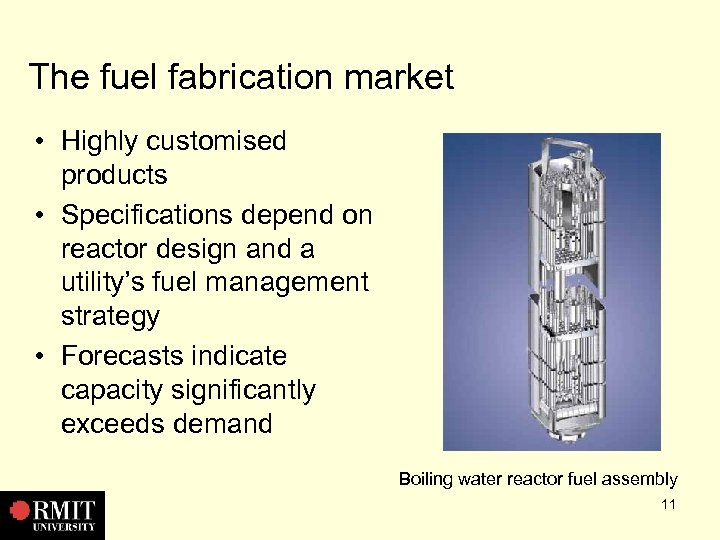 The fuel fabrication market • Highly customised products • Specifications depend on reactor design and a utility’s fuel management strategy • Forecasts indicate capacity significantly exceeds demand Boiling water reactor fuel assembly 11
 Nuclear Power for Australia? • How quickly? • How expensive? • How safe – operations, accidents, proliferation, waste? • Environmental benefits? • Water requirements? 12
 13
13
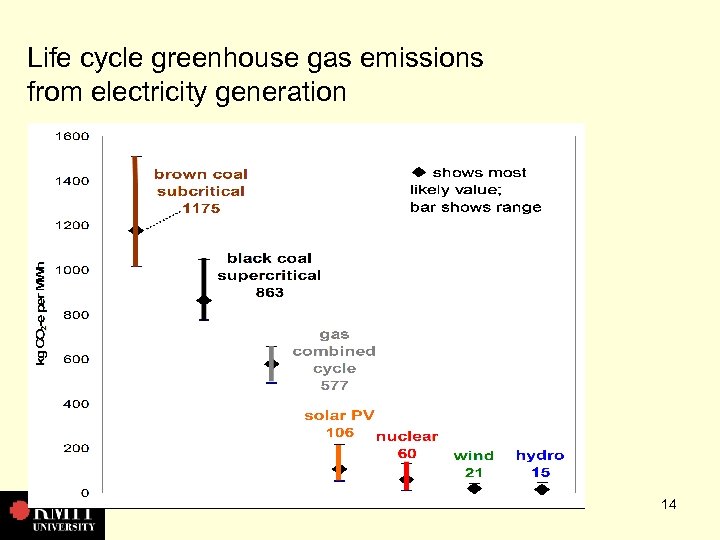 Life cycle greenhouse gas emissions from electricity generation 14
 Ingredients to emissions model • The large range of values for nuclear contributions to greenhouse gas emissions come from: - Concentration of U in ore - Enrichment technology used - Electricity source for enrichment 15
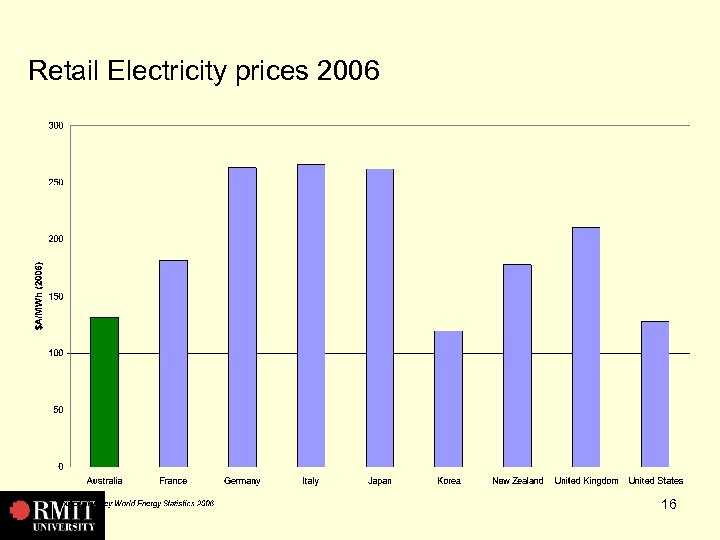 Retail Electricity prices 2006 16
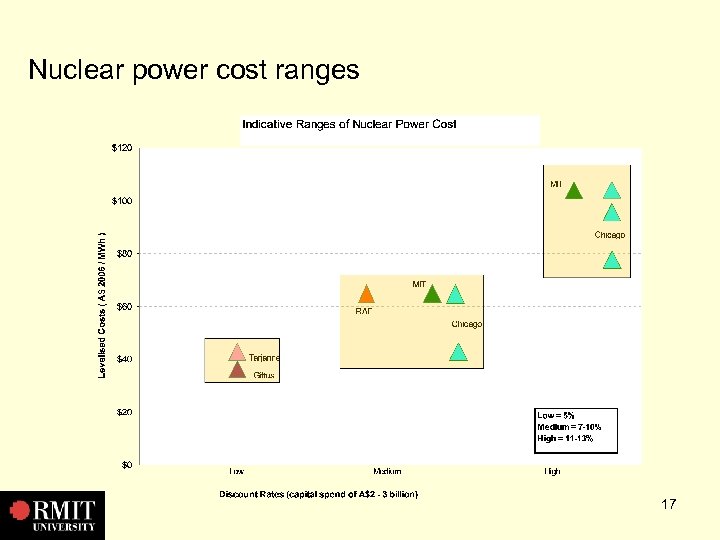 Nuclear power cost ranges 17
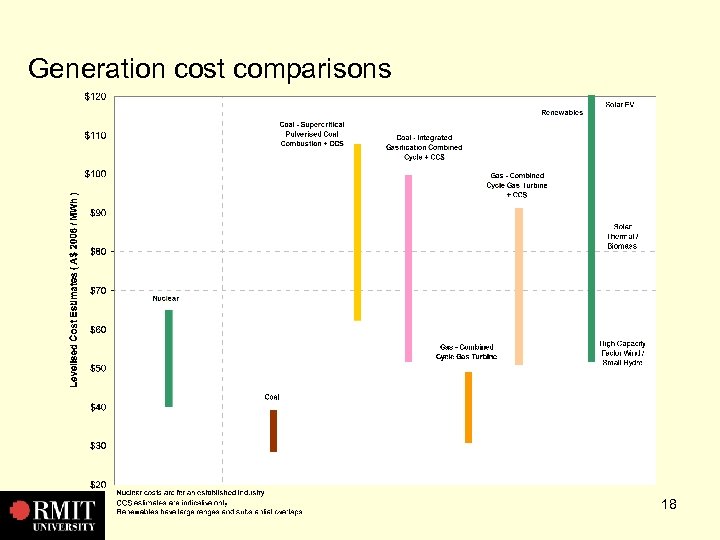 Generation cost comparisons 18
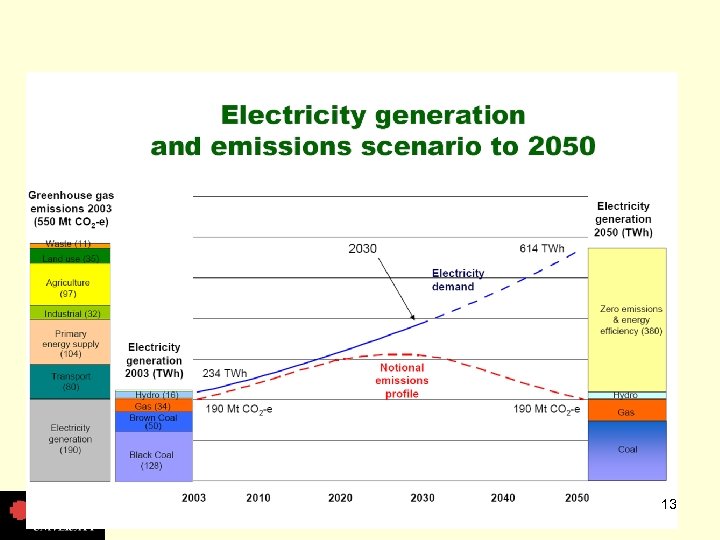
 Generation cost comparisons • Nuclear is least-cost low emission technology (LET) – Renewables, CCS more expensive on average but will have substantial role to play • Nuclear power is internationally proven, least cost option in many countries – Includes waste disposal and decommissioning • Without carbon constraint all LETs to remain uncompetitive • Nuclear power can be competitive with low to moderate emissions price – $15 to $40 /tonne CO 2 -E (ETS € 20 12 Feb 2008) – Competitiveness of other LETs would also improve 19
 Investment in nuclear power • Potential investors in nuclear power in Australia require: – A stable policy environment – A predictable licensing and regulatory regime • Time frame is determined by the timing and nature of this regime. • Best practice is to establish funds to meet waste and decommissioning costs 20
 Nuclear Waste • Key issue is the quantity of waste. • One pellet of NPP fuel (~5 g) yields as much energy as 1 tonne of coal. • The disposal of this fuel pellet generates high level waste, but there are significant quantities of less radioactive waste at the mine site and in the use of uranium, 21
 Low and intermediate waste • Safe disposal demonstrated at many sites across the world, including in Australia • High standard of management of waste at Australia’s current uranium mines 22
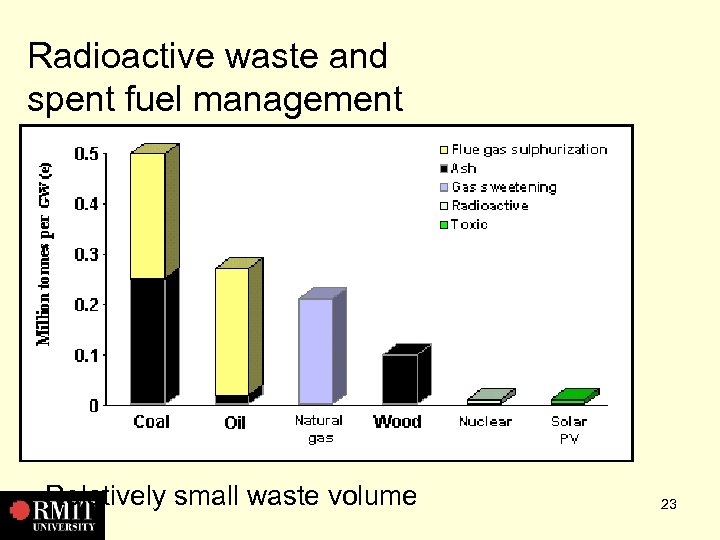 Radioactive waste and spent fuel management • Relatively small waste volume 23
 Reprocessing and high-level waste (HLW) disposal • Reprocessing is technically complex and is unlikely to be attractive for Australia • Technology exists for safe disposal of HLW and spent fuel and is being applied in several countries. No HLW yet to operation. • Areas in Australia are suitable for HLW and spent fuel disposal – not required before 2050 if we adopt nuclear power 24
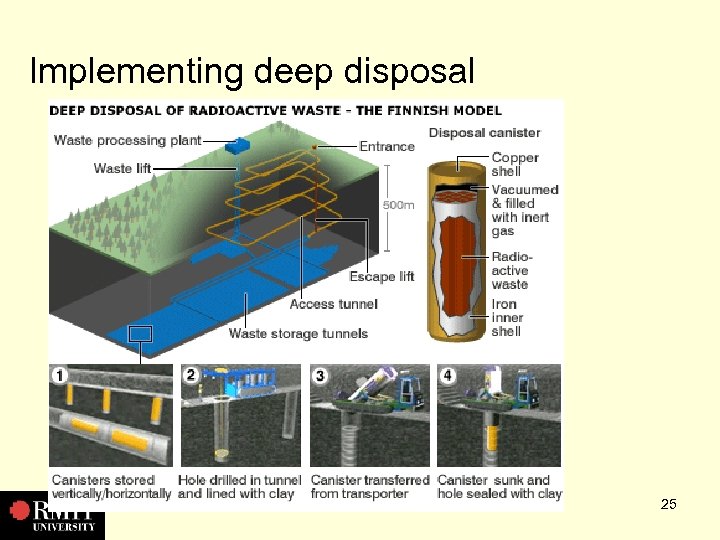 Implementing deep disposal 25
 Why do we think HLW disposal is OK? Natural Analogues • Ore deposits that have been isolated for millions of years • Natural Reactors at Oklo and Bangombé in Gabon. The remnants of nuclear reactors nearly two billion years old were found in the 1970 s. • Oklo by-products are being used today to probe the stability of the fundamental constants over cosmological time-scales and to develop more effective means for disposing of humanmanufactured nuclear waste. 26
 Health and Safety • Operational – construction, operation of the plant and its decommissioning as well as in the mining of uranium, manufacture of fuel and waste processing. • Accidents – rare events of high impact 27
 Operational Health and safety • Nuclear power has fewer health and safety impacts than fossil fuel generation and hydro • Ionising radiation and its health impacts are well understood • Well established international safety standards which are reflected in Australian practice 28
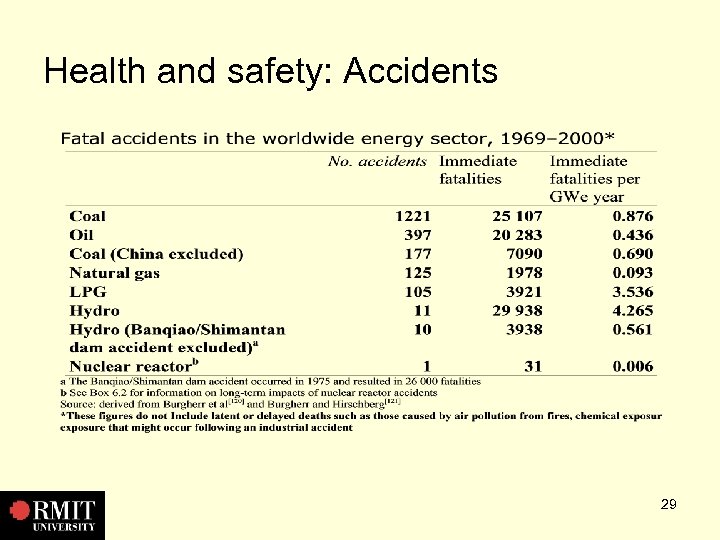 Health and safety: Accidents 29
 Chernobyl • An uncontained steam/chemical explosion and subsequent fire at Chernobyl in 1986 released radioactive gas and dust • Wind dispersed material across Finland, Sweden, and central and southern Europe • People living within a 30 km radius of the plant were relocated— approx 116 000. 30
 Chernobyl – Immediate Casualties • 28 highly exposed reactor staff and emergency workers died from radiation and thermal burns within four months of the accident (160 had radiation sickness. 19 more died by the end of 2004 not necessarily as a result of the accident). • Two other workers were killed in the explosion from injuries unrelated to radiation • One person suffered a fatal heart attack. 31
 Chernobyl Longer-term • > 4000 mostly children or adolescents at the time of the accident, have developed thyroid cancer as a result of the contamination, and fifteen of these had died from the disease by the end of 2002. • Possibly 4000 people in the areas with highest radiation levels may eventually die from cancer caused by radiation exposure. Of the 6. 8 million individuals living further from the explosion, who received a much lower dose, possibly another 5000 may die prematurely as a result of that dose. • The small increase in radiation exposure caused by the accident for the population of Europe and beyond should not be used to estimate future likely possible cancer fatalities. The ICRP states that this approach is not reasonable. • The Chernobyl Forum report in 2006 clearly identifies the extensive societal disruption in the region as the most significant impact resulting from the accident, compounded by the collapse of the Soviet Union in 1989. 32
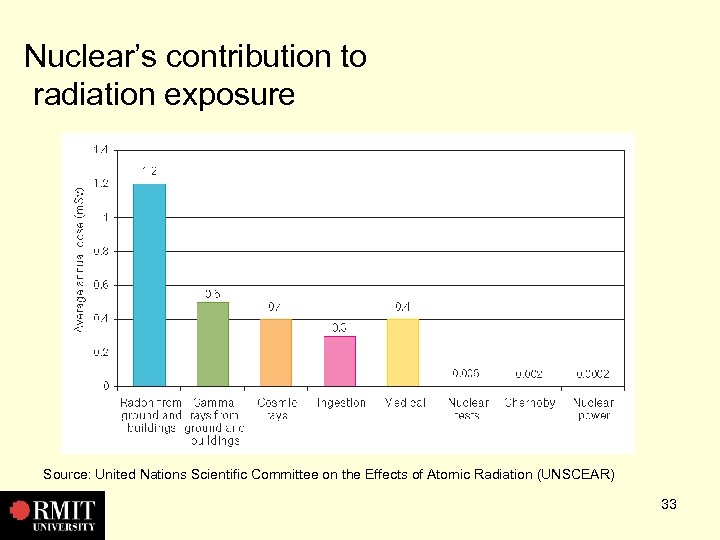 Nuclear’s contribution to radiation exposure Source: United Nations Scientific Committee on the Effects of Atomic Radiation (UNSCEAR) 33
 Non-proliferation • Export of Australian uranium takes place within the international non-proliferation regime • Australia has the most stringent requirements for the supply of uranium • Actual cases of proliferation have involved illegal supply networks, secret nuclear facilities and undeclared materials • An increase in Australian uranium exports would not increase the risk of proliferation 34
 Uranium exports and non-proliferation • The amount of uranium required for a nuclear weapon is relatively small • Uranium is commonplace in the earth’s crust • Any country that wished to develop a weapon need not rely on the import of uranium • The greatest proliferation risk arises from undeclared centrifuge enrichment plants 35
 Nuclear security • Strict physical protection standards apply to nuclear power plants • Studies have found that containment structures at modern power reactors would not be breached by the impact of a large commercial airliner 36
 Water requirements? • NPPs usually use water for cooling as do coalfired power plants. • Current PWRs and BWRs operate at lower temperatures and are therefore less efficient (use slightly more water) • Coal PPs must be located very near the coal deposit. Transport of ore is a major issue. • NPPs can be located remote from ore and often on the coast using seawater. 37
 Other Nuclear Power Systems • • Thorium Fuel Cycle Gen IV Reactor Systems Accelerator Driven Systems Fusion (ITER) 38
 Dan’s Questions • Reactor grade Pu for bombs • Swedish ‘incident’ of 2007 • Earthquake in Japan 39
 Reactor grade Pu for bombs • Reactor grade Pu contains Pu-239 and Pu-240 is similar quantities. • Pu-240 is undesirable in weapons manufacture because of short SF half-life • Certainly a critical assembly could be produced by reactor grade Pu. • US planned a trial in 1962 – I understand it did not proceed. • No state player is likely to use such material because the device could not be reliably stored. 40
 2007 Earthquake at Kashiwazaki Kariwa NPP • 7965 MWe nuclear power plant • Earthquake produces ground accelerations to 0. 68 g at plant – locally 11 killed, 2000 injured • Design criteria was to withstand 0. 27 g • Off-site power fail expected at 0. 25 g • Plants shut down automatically without problem • Radioactivity release – sloshing of water in spent fuel pond and leak through cable penetrations (IAEA judged leak trivial) 41
 scram of the Forsmark unit 1 reactor on 25 July 2006 • Electricity failure caused by the short circuit in the switchyard • Forsmark 1 reactor was scrammed and a number of safety systems were activated • Two of four emergency generators failed to start. This common cause fault resulted in INES level 2 report. • Position of the control rods was unclear due to lack of power supply. 42
 Conclusions • Australia has the opportunity to expand uranium mining. • Enrichment may represent an opportunity for Australia – the business case is not clear. • Regulation needs review and a new regulatory system created if nuclear power is pursued. • Australia must deal with existing and future nuclear waste, but reprocessing and taking other countries waste are unlikely to be attractive • Nuclear Power is the lowest cost low emission technology for baseload power generation. 43
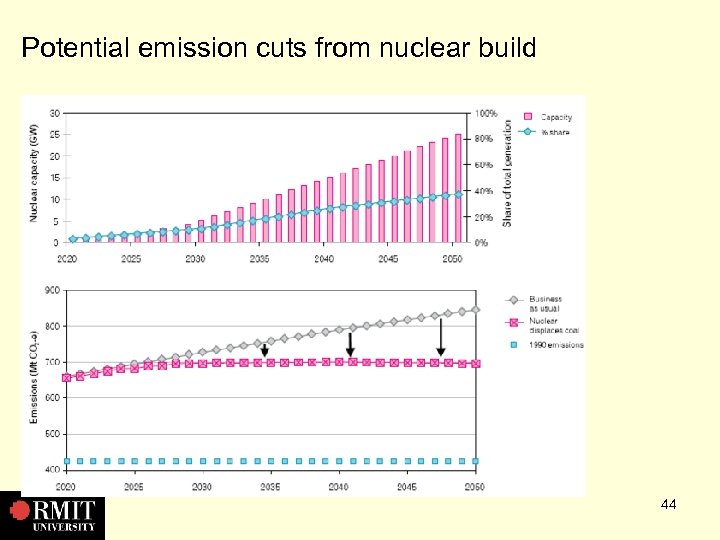 Potential emission cuts from nuclear build 44
 Questions? The UMPNER report is available from the National Library Pandora archive website: http: //pandora. nla. gov. au/tep/66043 45
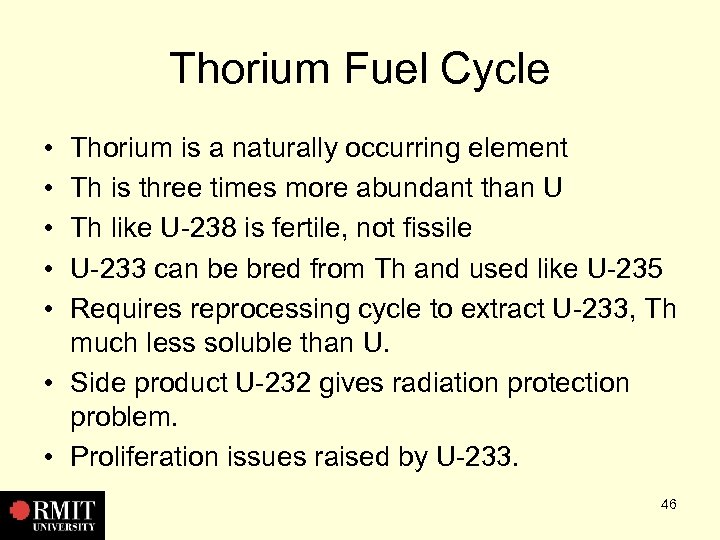 Thorium Fuel Cycle • • • Thorium is a naturally occurring element Th is three times more abundant than U Th like U-238 is fertile, not fissile U-233 can be bred from Th and used like U-235 Requires reprocessing cycle to extract U-233, Th much less soluble than U. • Side product U-232 gives radiation protection problem. • Proliferation issues raised by U-233. 46
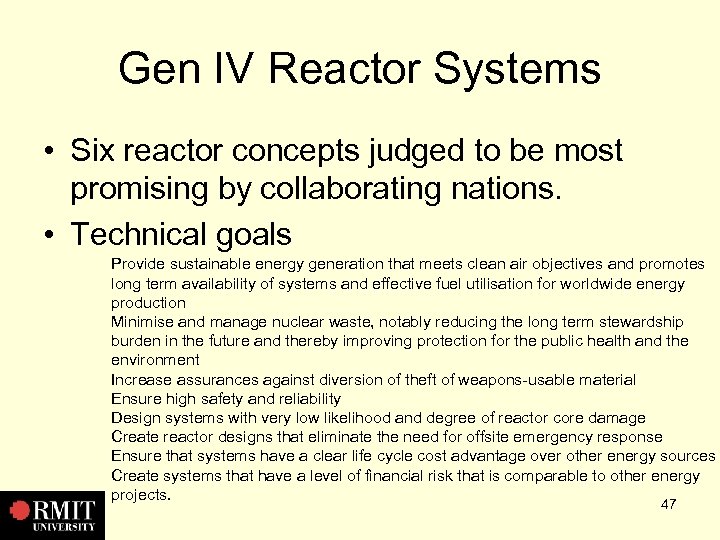 Gen IV Reactor Systems • Six reactor concepts judged to be most promising by collaborating nations. • Technical goals Provide sustainable energy generation that meets clean air objectives and promotes long term availability of systems and effective fuel utilisation for worldwide energy production Minimise and manage nuclear waste, notably reducing the long term stewardship burden in the future and thereby improving protection for the public health and the environment Increase assurances against diversion of theft of weapons-usable material Ensure high safety and reliability Design systems with very low likelihood and degree of reactor core damage Create reactor designs that eliminate the need for offsite emergency response Ensure that systems have a clear life cycle cost advantage over other energy sources Create systems that have a level of financial risk that is comparable to other energy projects. 47
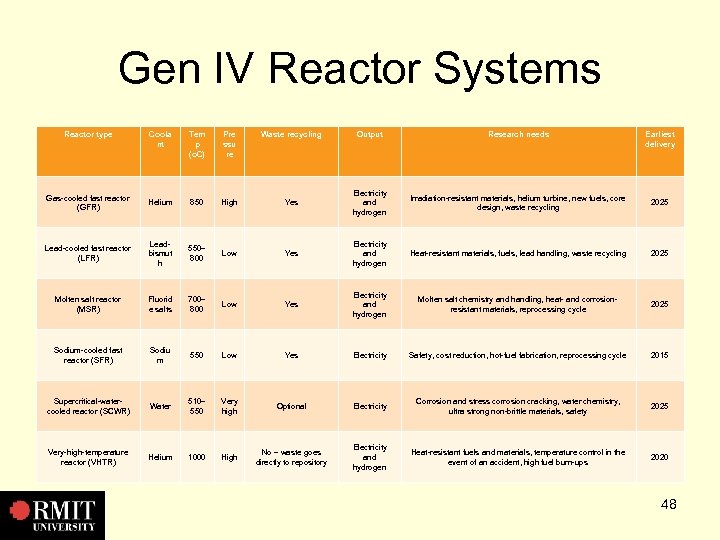 Gen IV Reactor Systems Reactor type Coola nt Tem p (o. C) Pre ssu re Waste recycling Output Research needs Earliest delivery Gas-cooled fast reactor (GFR) Helium 850 High Yes Electricity and hydrogen Irradiation-resistant materials, helium turbine, new fuels, core design, waste recycling 2025 Lead-cooled fast reactor (LFR) Leadbismut h 550– 800 Low Yes Electricity and hydrogen Heat-resistant materials, fuels, lead handling, waste recycling 2025 Molten salt reactor (MSR) Fluorid e salts 700– 800 Low Yes Electricity and hydrogen Molten salt chemistry and handling, heat- and corrosionresistant materials, reprocessing cycle 2025 Sodium-cooled fast reactor (SFR) Sodiu m 550 Low Yes Electricity Safety, cost reduction, hot-fuel fabrication, reprocessing cycle 2015 Supercritical-watercooled reactor (SCWR) Water 510– 550 Very high Optional Electricity Corrosion and stress corrosion cracking, water chemistry, ultra strong non-brittle materials, safety 2025 Very-high-temperature reactor (VHTR) Helium 1000 High No – waste goes directly to repository Electricity and hydrogen Heat-resistant fuels and materials, temperature control in the event of an accident, high fuel burn-ups 2020 48
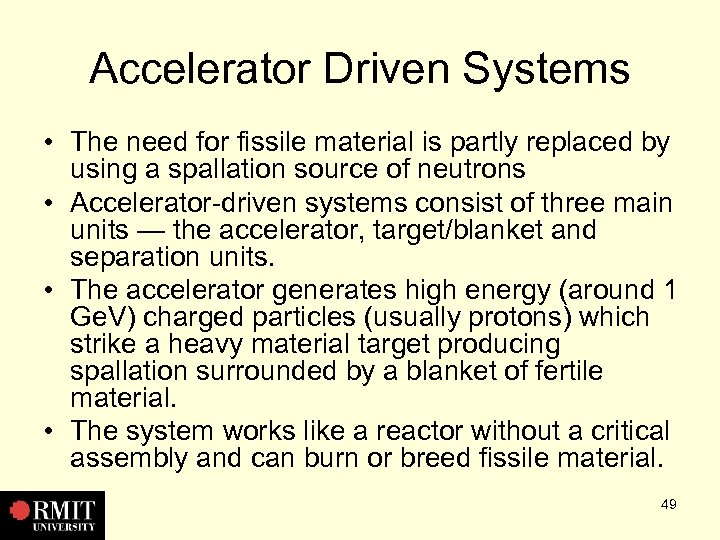 Accelerator Driven Systems • The need for fissile material is partly replaced by using a spallation source of neutrons • Accelerator-driven systems consist of three main units — the accelerator, target/blanket and separation units. • The accelerator generates high energy (around 1 Ge. V) charged particles (usually protons) which strike a heavy material target producing spallation surrounded by a blanket of fertile material. • The system works like a reactor without a critical assembly and can burn or breed fissile material. 49
 Fusion (ITER) • The experimental fusion reactor ITER is a major international research collaboration. • To be built at Cadarache in France • Cost € 10 billion, half to construct the reactor over the next seven years and the remainder to operate it for 20 years and then decommission the facility. • Power 300 MW for up to 30 minutes. 50