


 Скачать презентацию Augustine of Hippo LIFE AND WORKS General
Augustine of Hippo.pptx
- Количество слайдов: 4
 Augustine of Hippo LIFE AND WORKS
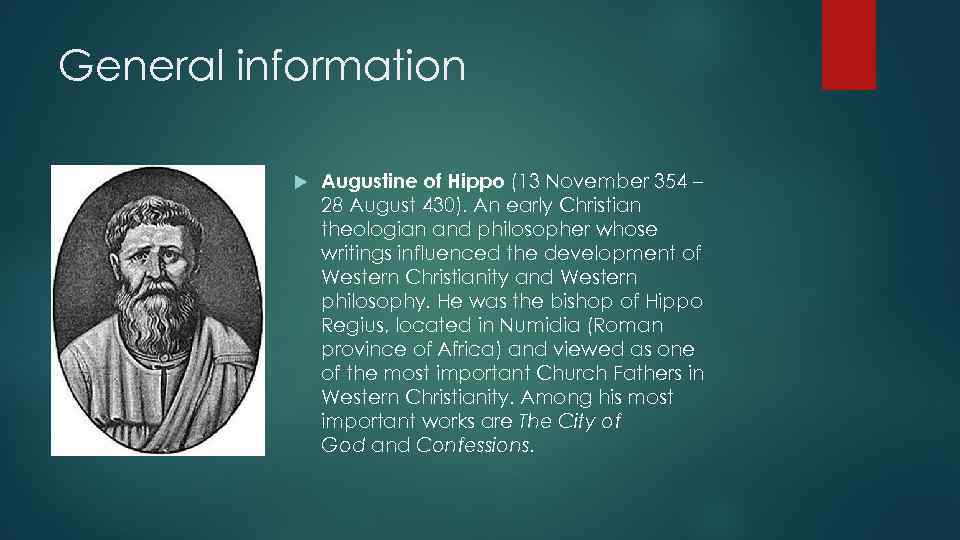 General information Augustine of Hippo (13 November 354 – 28 August 430). An early Christian theologian and philosopher whose writings influenced the development of Western Christianity and Western philosophy. He was the bishop of Hippo Regius, located in Numidia (Roman province of Africa) and viewed as one of the most important Church Fathers in Western Christianity. Among his most important works are The City of God and Confessions.
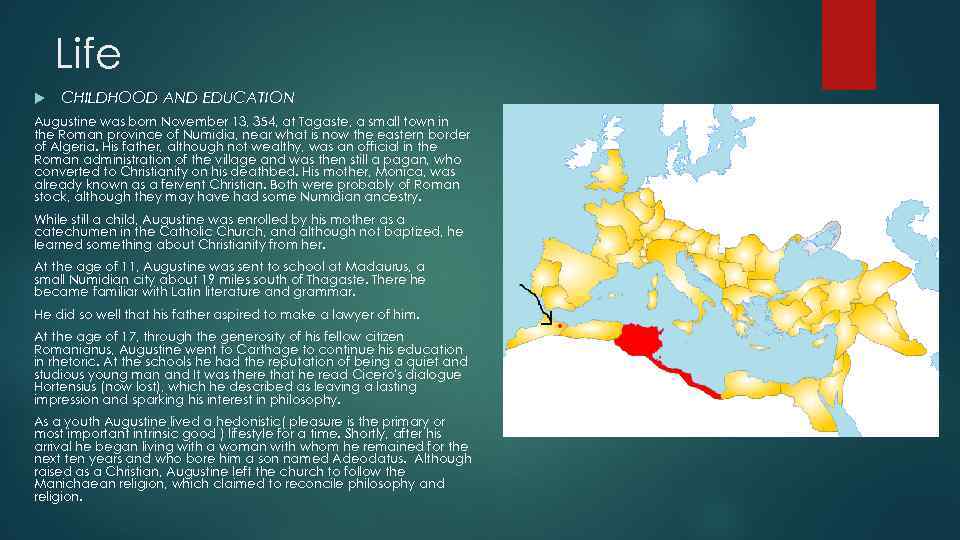 Life CHILDHOOD AND EDUCATION Augustine was born November 13, 354, at Tagaste, a small town in the Roman province of Numidia, near what is now the eastern border of Algeria. His father, although not wealthy, was an official in the Roman administration of the village and was then still a pagan, who converted to Christianity on his deathbed. His mother, Monica, was already known as a fervent Christian. Both were probably of Roman stock, although they may have had some Numidian ancestry. While still a child, Augustine was enrolled by his mother as a catechumen in the Catholic Church, and although not baptized, he learned something about Christianity from her. At the age of 11, Augustine was sent to school at Madaurus, a small Numidian city about 19 miles south of Thagaste. There he became familiar with Latin literature and grammar. He did so well that his father aspired to make a lawyer of him. At the age of 17, through the generosity of his fellow citizen Romanianus, Augustine went to Carthage to continue his education in rhetoric. At the schools he had the reputation of being a quiet and studious young man and It was there that he read Cicero's dialogue Hortensius (now lost), which he described as leaving a lasting impression and sparking his interest in philosophy. As a youth Augustine lived a hedonistic( pleasure is the primary or most important intrinsic good ) lifestyle for a time. Shortly, after his arrival he began living with a woman with whom he remained for the next ten years and who bore him a son named Adeodatus. Although raised as a Christian, Augustine left the church to follow the Manichaean religion, which claimed to reconcile philosophy and religion.
 His first insight into the nature of sin occurred when he and a number of friends stole fruit they did not want from a neighborhood garden. He tells this story in his biography, The Confessions. He remembers that he did not steal the fruit because he was hungry, but because "it was not permitted. "[23] His very nature, he says, was flawed. 'It was foul, and I loved it. I loved my own error—not that for which I erred, but the error itself. " [23] From this incident he concluded the human person is naturally inclined to sin, and in need of the grace of Christ.