


 Скачать презентацию August 22 2001 Traffic and Cost Model for
968489a3701a649d0126fa438d929c85.ppt
- Количество слайдов: 14
 August 22, 2001 Traffic and Cost Model for RPR versus 1 Gb. E and 10 Gb. E Architectures A Carriers’ Carrier Perspective Stevan Plote Director of Technology
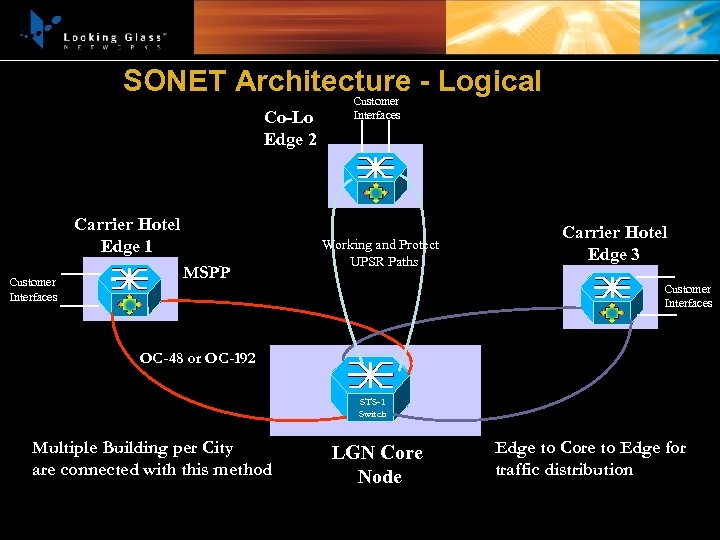 SONET Architecture - Logical Co-Lo Edge 2 Carrier Hotel Edge 1 Customer Interfaces MSPP Customer Interfaces Working and Protect UPSR Paths Carrier Hotel Edge 3 Customer Interfaces OC-48 or OC-192 STS-1 Switch Multiple Building per City are connected with this method LGN Core Node Edge to Core to Edge for traffic distribution
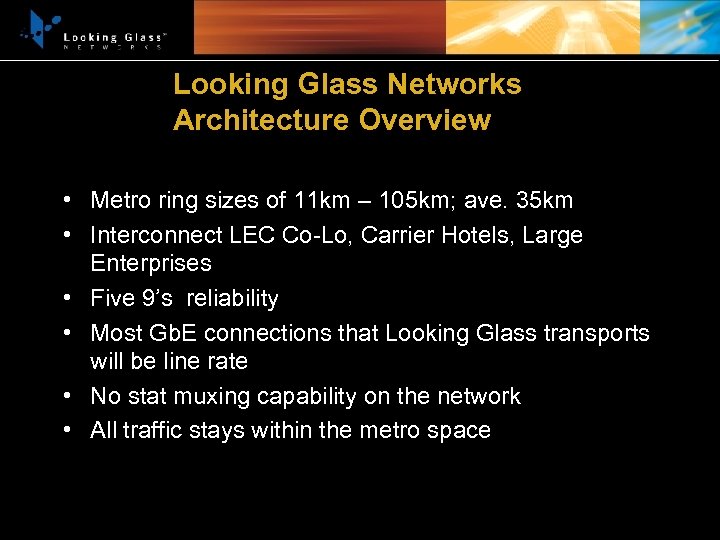 Looking Glass Networks Architecture Overview • Metro ring sizes of 11 km – 105 km; ave. 35 km • Interconnect LEC Co-Lo, Carrier Hotels, Large Enterprises • Five 9’s reliability • Most Gb. E connections that Looking Glass transports will be line rate • No stat muxing capability on the network • All traffic stays within the metro space
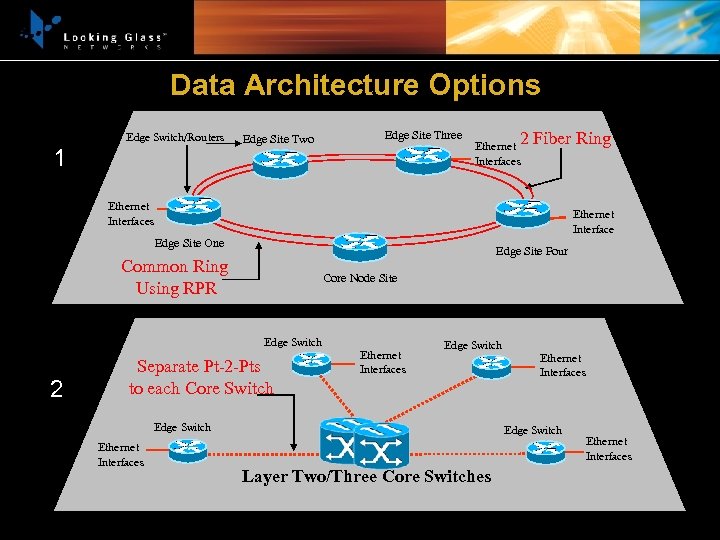 Data Architecture Options Edge Switch/Routers 1 Edge Site Two Edge Site Three Ethernet 2 Interfaces Fiber Ring Ethernet Interfaces Ethernet Interface Edge Site One Edge Site Four Common Ring Using RPR Core Node Site Edge Switch 2 Separate Pt-2 -Pts to each Core Switch Ethernet Interfaces Edge Switch Layer Two/Three Core Switches Ethernet Interfaces
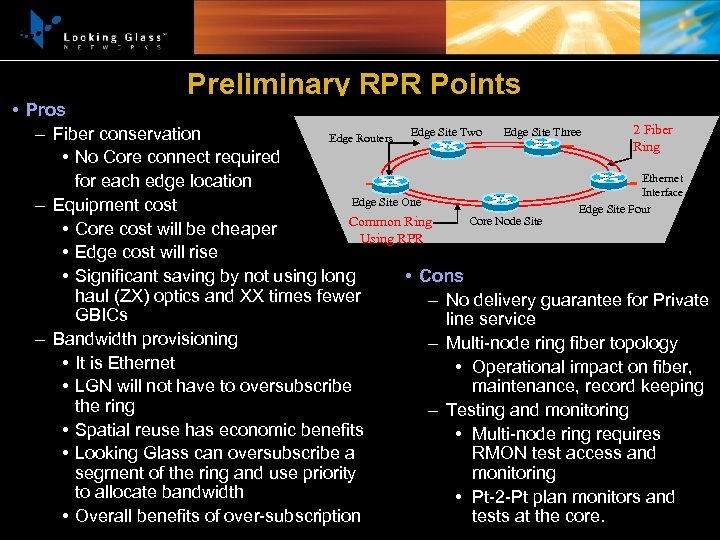 Preliminary RPR Points • Pros 2 Fiber Edge Site Three – Fiber conservation Edge Routers Edge Site Two Ring • No Core connect required Ethernet for each edge location Interface Edge Site One – Equipment cost Edge Site Four Core Node Site Common Ring • Core cost will be cheaper Using RPR • Edge cost will rise • Significant saving by not using long • Cons haul (ZX) optics and XX times fewer – No delivery guarantee for Private GBICs line service – Bandwidth provisioning – Multi-node ring fiber topology • It is Ethernet • Operational impact on fiber, • LGN will not have to oversubscribe maintenance, record keeping the ring – Testing and monitoring • Spatial reuse has economic benefits • Multi-node ring requires • Looking Glass can oversubscribe a RMON test access and segment of the ring and use priority monitoring to allocate bandwidth • Pt-2 -Pt plan monitors and • Overall benefits of over-subscription tests at the core.
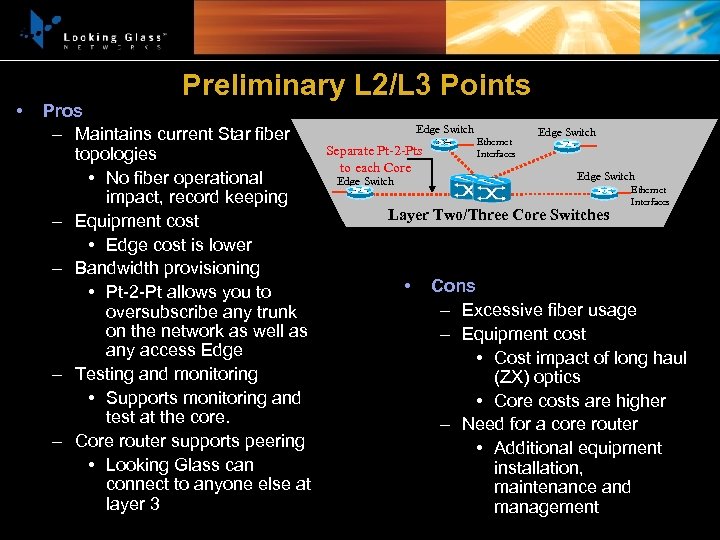 • Preliminary L 2/L 3 Points Pros – Maintains current Star fiber topologies • No fiber operational impact, record keeping – Equipment cost • Edge cost is lower – Bandwidth provisioning • Pt-2 -Pt allows you to oversubscribe any trunk on the network as well as any access Edge – Testing and monitoring • Supports monitoring and test at the core. – Core router supports peering • Looking Glass can connect to anyone else at layer 3 Edge Switch Separate Pt-2 -Pts to each Core Edge Switch Ethernet Interfaces Edge Switch Layer Two/Three Core Switches • Ethernet Interfaces Cons – Excessive fiber usage – Equipment cost • Cost impact of long haul (ZX) optics • Core costs are higher – Need for a core router • Additional equipment installation, maintenance and management
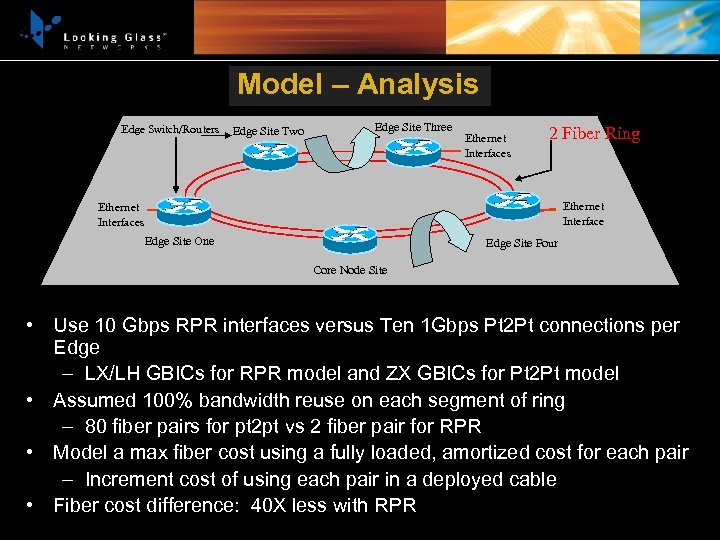 Model – Analysis Edge Switch/Routers Edge Site Two Edge Site Three Ethernet Interfaces 2 Fiber Ring Ethernet Interfaces Edge Site One Edge Site Four Core Node Site • Use 10 Gbps RPR interfaces versus Ten 1 Gbps Pt 2 Pt connections per Edge – LX/LH GBICs for RPR model and ZX GBICs for Pt 2 Pt model • Assumed 100% bandwidth reuse on each segment of ring – 80 fiber pairs for pt 2 pt vs 2 fiber pair for RPR • Model a max fiber cost using a fully loaded, amortized cost for each pair – Increment cost of using each pair in a deployed cable • Fiber cost difference: 40 X less with RPR
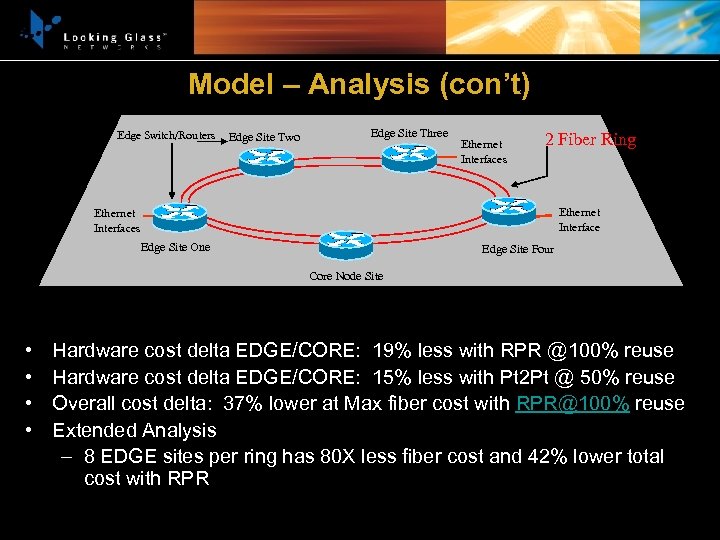 Model – Analysis (con’t) Edge Switch/Routers Edge Site Two Edge Site Three Ethernet Interfaces 2 Fiber Ring Ethernet Interfaces Edge Site One Edge Site Four Core Node Site • • Hardware cost delta EDGE/CORE: 19% less with RPR @100% reuse Hardware cost delta EDGE/CORE: 15% less with Pt 2 Pt @ 50% reuse Overall cost delta: 37% lower at Max fiber cost with RPR@100% reuse Extended Analysis – 8 EDGE sites per ring has 80 X less fiber cost and 42% lower total cost with RPR
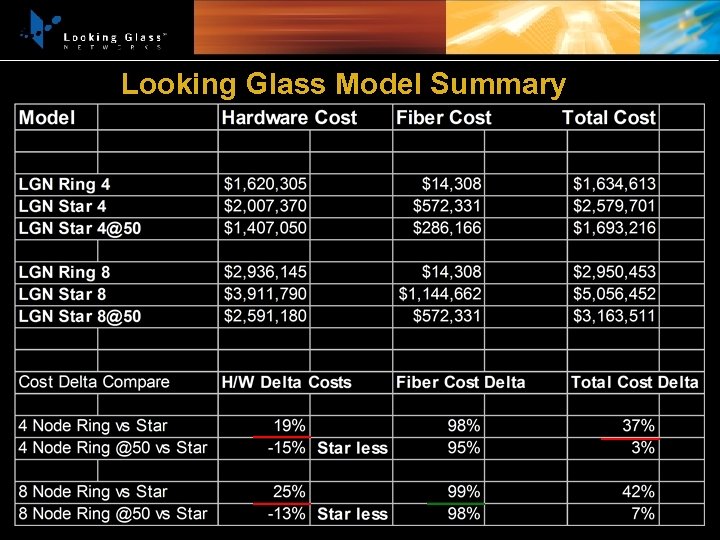 Looking Glass Model Summary
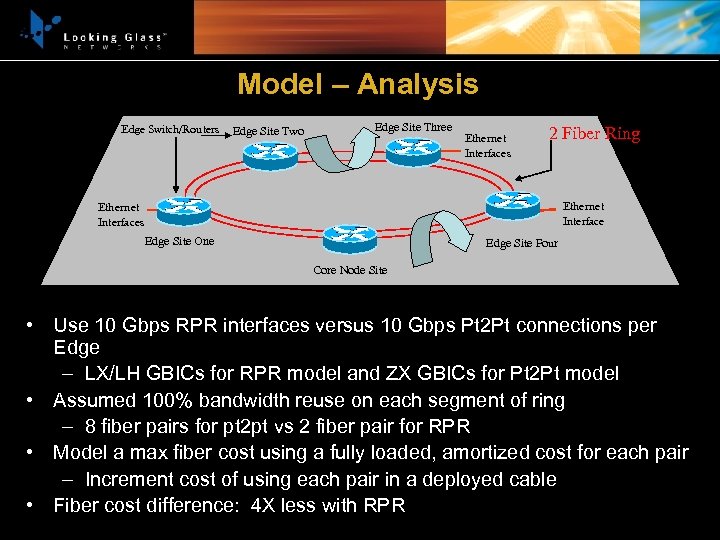 Model – Analysis Edge Switch/Routers Edge Site Two Edge Site Three Ethernet Interfaces 2 Fiber Ring Ethernet Interfaces Edge Site One Edge Site Four Core Node Site • Use 10 Gbps RPR interfaces versus 10 Gbps Pt 2 Pt connections per Edge – LX/LH GBICs for RPR model and ZX GBICs for Pt 2 Pt model • Assumed 100% bandwidth reuse on each segment of ring – 8 fiber pairs for pt 2 pt vs 2 fiber pair for RPR • Model a max fiber cost using a fully loaded, amortized cost for each pair – Increment cost of using each pair in a deployed cable • Fiber cost difference: 4 X less with RPR
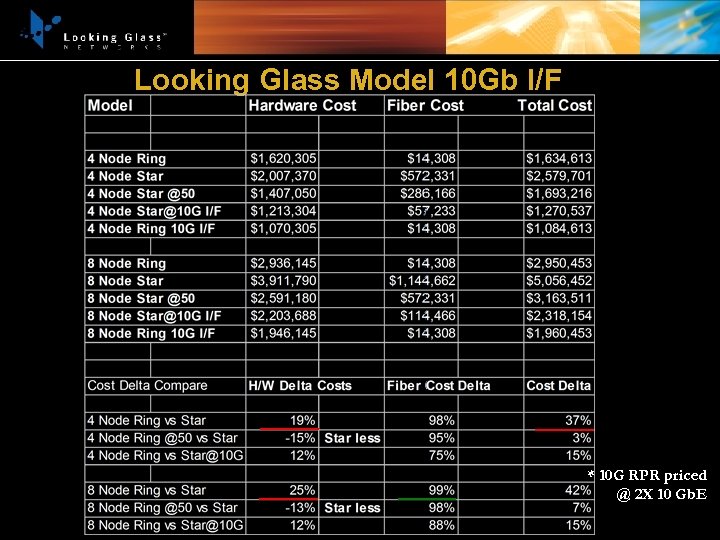 Looking Glass Model 10 Gb I/F * 10 G RPR priced @ 2 X 10 Gb. E
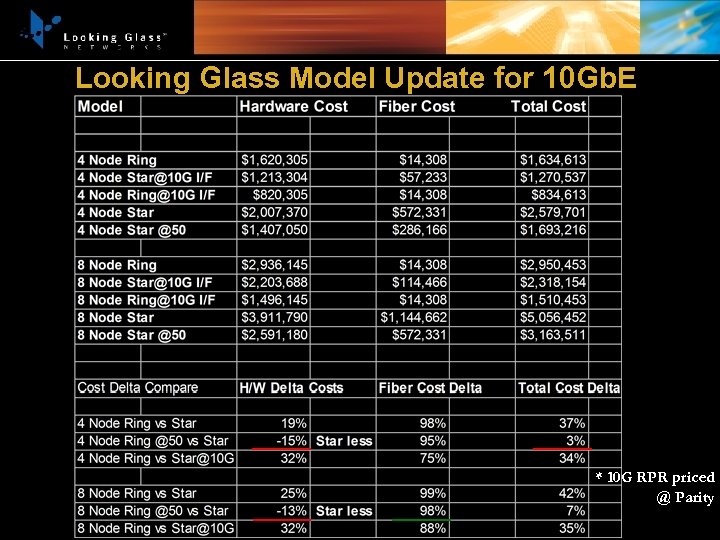 Looking Glass Model Update for 10 Gb. E * 10 G RPR priced @ Parity
 Recommendations • 10 Gb RPR at a Premium to 10 Gb ENET does not win • RPR has to be as cheap as Ethernet. Fiber gain is not a big enough advantage – RPR shows cost advantages vs Pt-to-Pt due to fiber and ZX connectors • At ring bandwidth less than 10 Gbps - RPR does not prove in – Not enough ring bandwidth at 2. 5 Gbps to justify RPR and multiple nodes on a ring; even with bandwidth reuse in a nonoversubscribed ring • Private line traffic reliability has to be proven on RPR – Overlay SONET network for restoration guarantee
 Recommendations (con’t) • As we move to over-subscription models, and if RPR costs more than Ethernet; the cost advantage for RPR shrinks and Carriers should look at Pt-to-Pt – Over-subscription means fewer fibers and ZX connectors in Pt-to-Pt architectures – Higher node counts reduce the probability of 100% spatial reuse on RPR ring; less advantage versus Core switching – RPR reliably guarantees TDM service delivery • Network Management interfaces must support CORBA – Carriers require TMN architectures • Typical EMS layer