


 Скачать презентацию August 21 2017 Total Eclipse Plans of the
b819113acc9fee20ff985c8b1450f3df.ppt
- Количество слайдов: 33
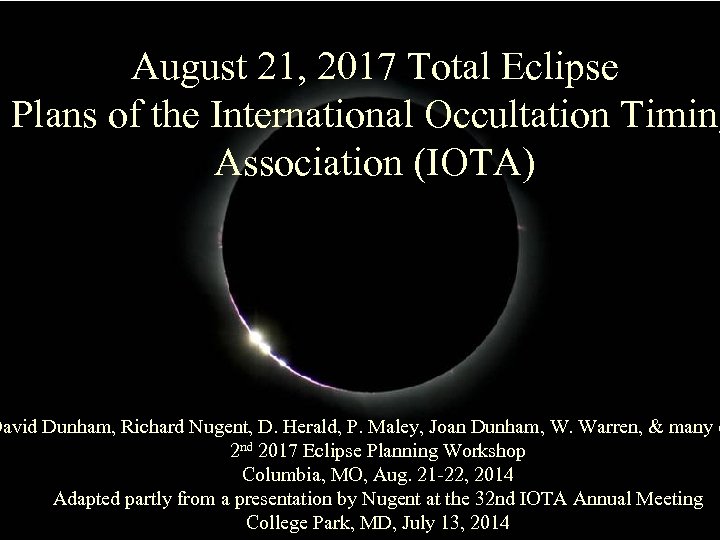 August 21, 2017 Total Eclipse Plans of the International Occultation Timing Association (IOTA) David Dunham, Richard Nugent, D. Herald, P. Maley, Joan Dunham, W. Warren, & many o 2 nd 2017 Eclipse Planning Workshop Columbia, MO, Aug. 21 -22, 2014 Adapted partly from a presentation by Nugent at the 32 nd IOTA Annual Meeting College Park, MD, July 13, 2014
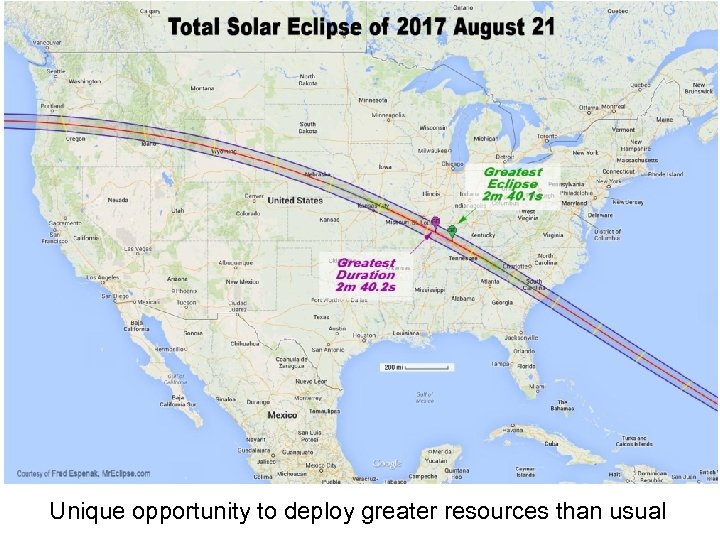 Unique opportunity to deploy greater resources than usual
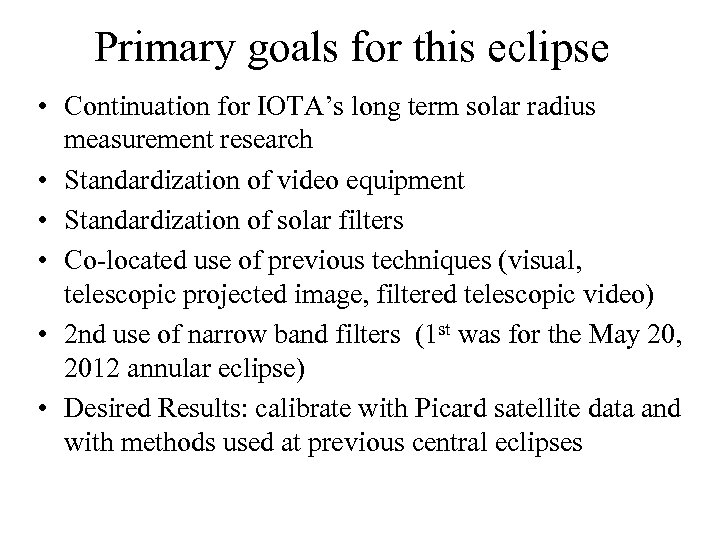 Primary goals for this eclipse • Continuation for IOTA’s long term solar radius measurement research • Standardization of video equipment • Standardization of solar filters • Co-located use of previous techniques (visual, telescopic projected image, filtered telescopic video) • 2 nd use of narrow band filters (1 st was for the May 20, 2012 annular eclipse) • Desired Results: calibrate with Picard satellite data and with methods used at previous central eclipses
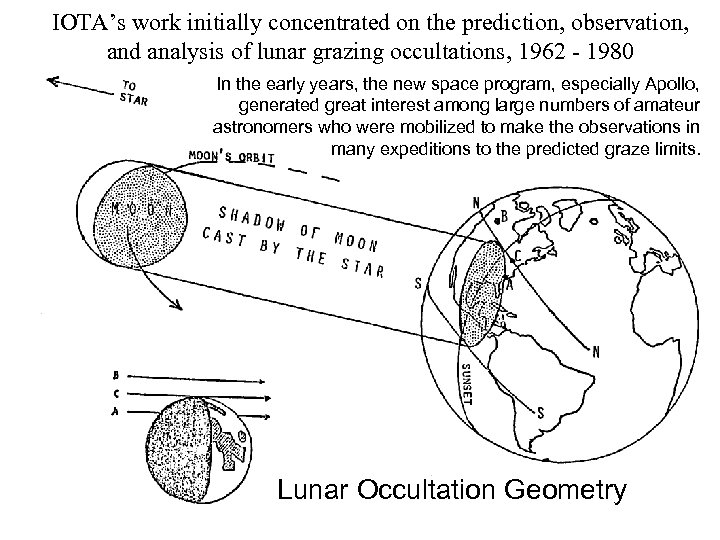 IOTA’s work initially concentrated on the prediction, observation, and analysis of lunar grazing occultations, 1962 - 1980 In the early years, the new space program, especially Apollo, generated great interest among large numbers of amateur astronomers who were mobilized to make the observations in many expeditions to the predicted graze limits. Lunar Occultation Geometry
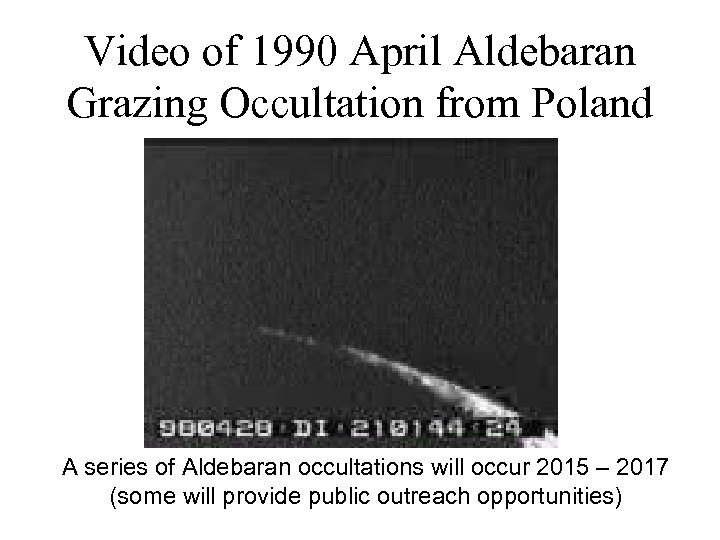 Video of 1990 April Aldebaran Grazing Occultation from Poland A series of Aldebaran occultations will occur 2015 – 2017 (some will provide public outreach opportunities)
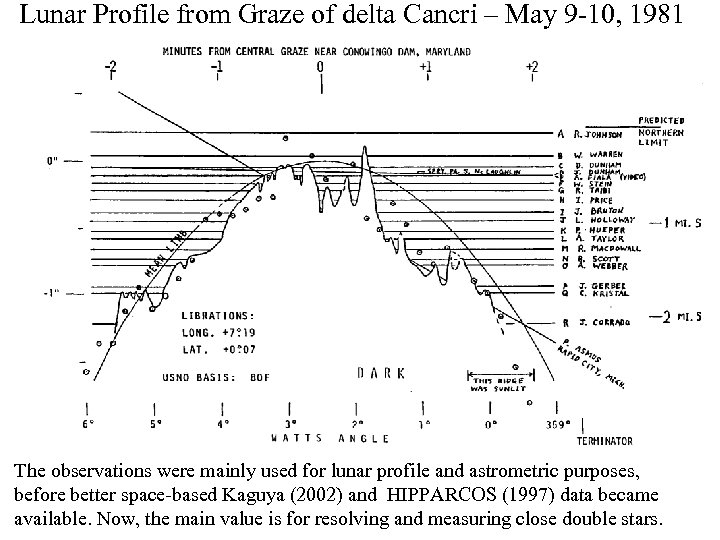 Lunar Profile from Graze of delta Cancri – May 9 -10, 1981 The observations were mainly used for lunar profile and astrometric purposes, before better space-based Kaguya (2002) and HIPPARCOS (1997) data became available. Now, the main value is for resolving and measuring close double stars.
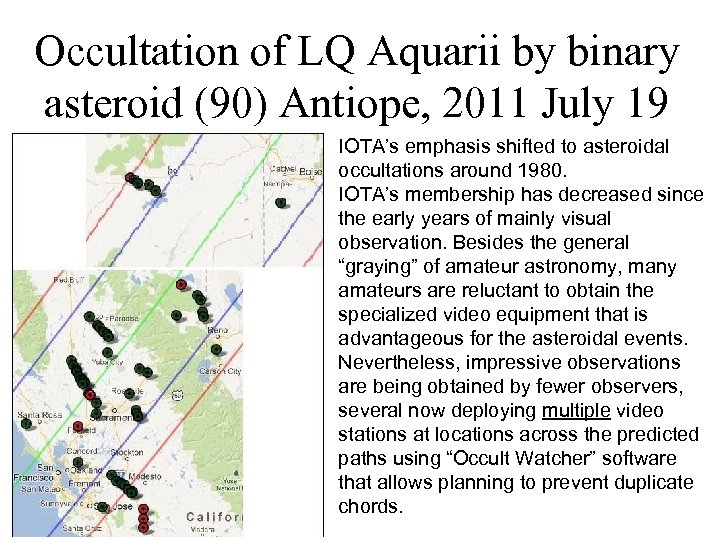 Occultation of LQ Aquarii by binary asteroid (90) Antiope, 2011 July 19 IOTA’s emphasis shifted to asteroidal occultations around 1980. IOTA’s membership has decreased since the early years of mainly visual observation. Besides the general “graying” of amateur astronomy, many amateurs are reluctant to obtain the specialized video equipment that is advantageous for the asteroidal events. Nevertheless, impressive observations are being obtained by fewer observers, several now deploying multiple video stations at locations across the predicted paths using “Occult Watcher” software that allows planning to prevent duplicate chords.
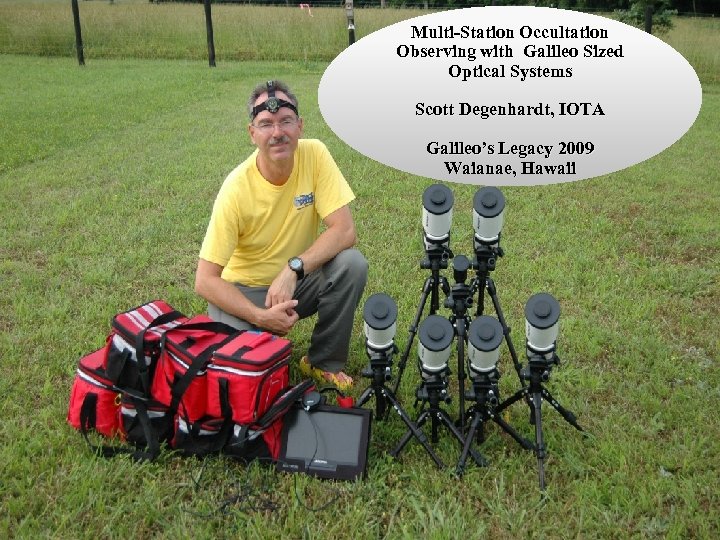 Multi-Station Occultation Observing with Galileo Sized Optical Systems Scott Degenhardt, IOTA Galileo’s Legacy 2009 Waianae, Hawaii
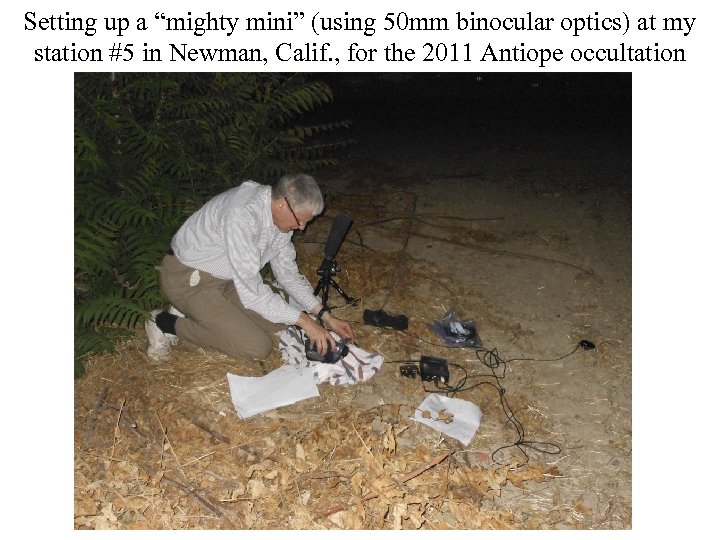 Setting up a “mighty mini” (using 50 mm binocular optics) at my station #5 in Newman, Calif. , for the 2011 Antiope occultation
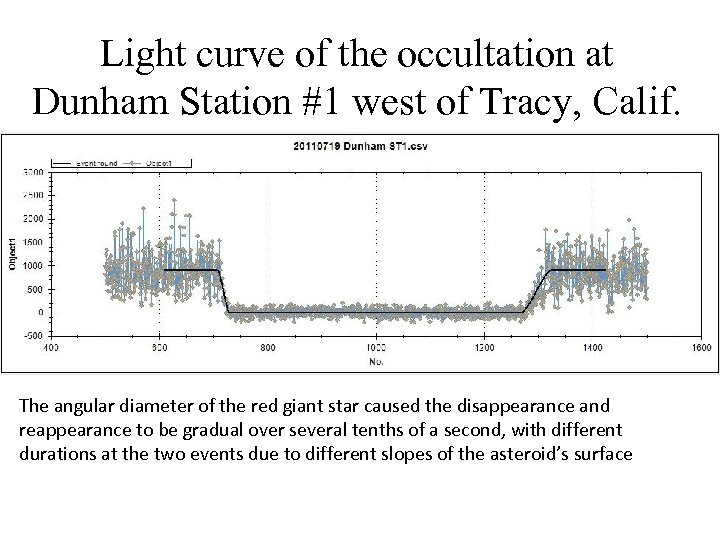 Light curve of the occultation at Dunham Station #1 west of Tracy, Calif. The angular diameter of the red giant star caused the disappearance and reappearance to be gradual over several tenths of a second, with different durations at the two events due to different slopes of the asteroid’s surface
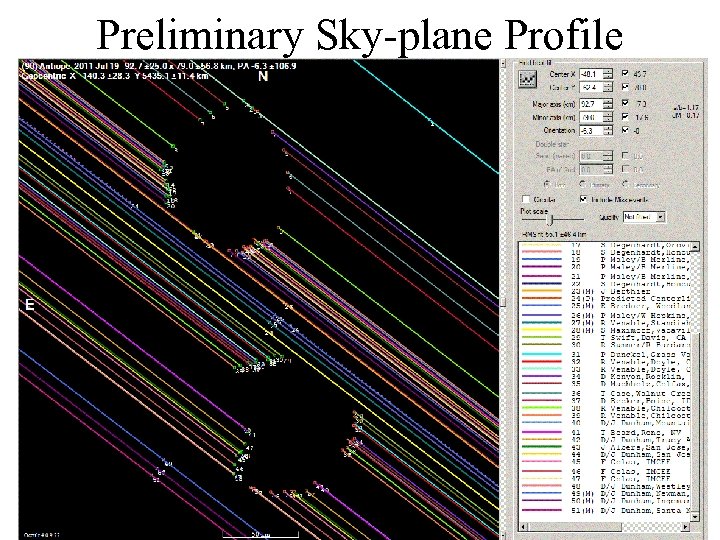 Preliminary Sky-plane Profile

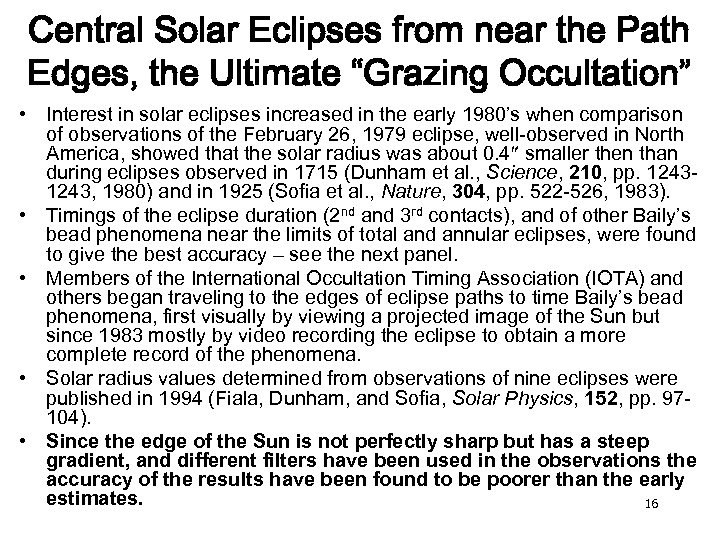 Central Solar Eclipses from near the Path Edges, the Ultimate “Grazing Occultation” • Interest in solar eclipses increased in the early 1980’s when comparison of observations of the February 26, 1979 eclipse, well-observed in North America, showed that the solar radius was about 0. 4 smaller then than during eclipses observed in 1715 (Dunham et al. , Science, 210, pp. 1243, 1980) and in 1925 (Sofia et al. , Nature, 304, pp. 522 -526, 1983). • Timings of the eclipse duration (2 nd and 3 rd contacts), and of other Baily’s bead phenomena near the limits of total and annular eclipses, were found to give the best accuracy – see the next panel. • Members of the International Occultation Timing Association (IOTA) and others began traveling to the edges of eclipse paths to time Baily’s bead phenomena, first visually by viewing a projected image of the Sun but since 1983 mostly by video recording the eclipse to obtain a more complete record of the phenomena. • Solar radius values determined from observations of nine eclipses were published in 1994 (Fiala, Dunham, and Sofia, Solar Physics, 152, pp. 97104). • Since the edge of the Sun is not perfectly sharp but has a steep gradient, and different filters have been used in the observations the accuracy of the results have been found to be poorer than the early estimates. 16
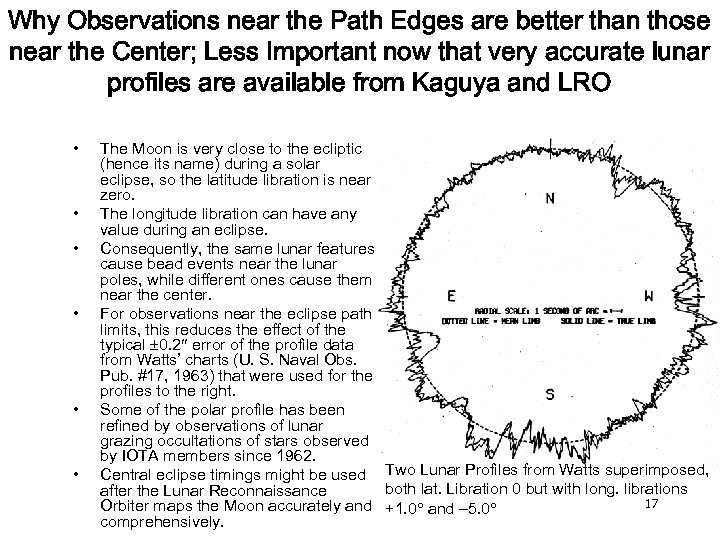 Why Observations near the Path Edges are better than those near the Center; Less Important now that very accurate lunar profiles are available from Kaguya and LRO • • • The Moon is very close to the ecliptic (hence its name) during a solar eclipse, so the latitude libration is near zero. The longitude libration can have any value during an eclipse. Consequently, the same lunar features cause bead events near the lunar poles, while different ones cause them near the center. For observations near the eclipse path limits, this reduces the effect of the typical 0. 2 error of the profile data from Watts’ charts (U. S. Naval Obs. Pub. #17, 1963) that were used for the profiles to the right. Some of the polar profile has been refined by observations of lunar grazing occultations of stars observed by IOTA members since 1962. Central eclipse timings might be used Two Lunar Profiles from Watts superimposed, both lat. Libration 0 but with long. librations after the Lunar Reconnaissance 17 Orbiter maps the Moon accurately and +1. 0 and – 5. 0 comprehensively.
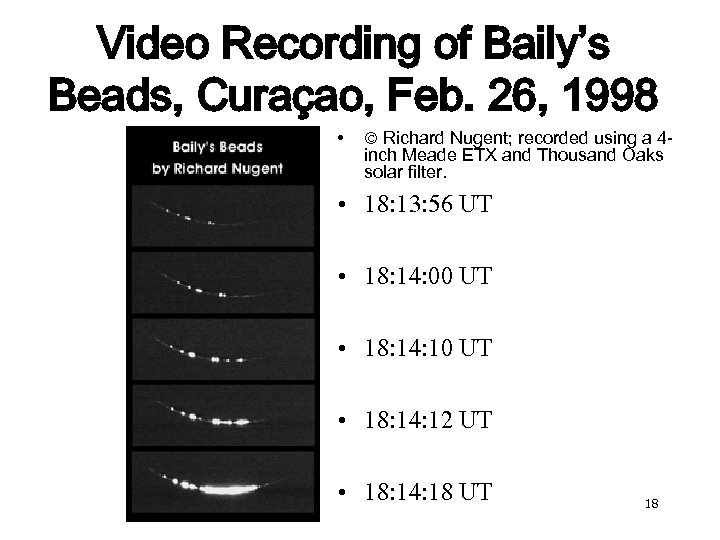 Video Recording of Baily’s Beads, Curaçao, Feb. 26, 1998 • Richard Nugent; recorded using a 4 inch Meade ETX and Thousand Oaks solar filter. • 18: 13: 56 UT • 18: 14: 00 UT • 18: 14: 12 UT • 18: 14: 18 UT 18
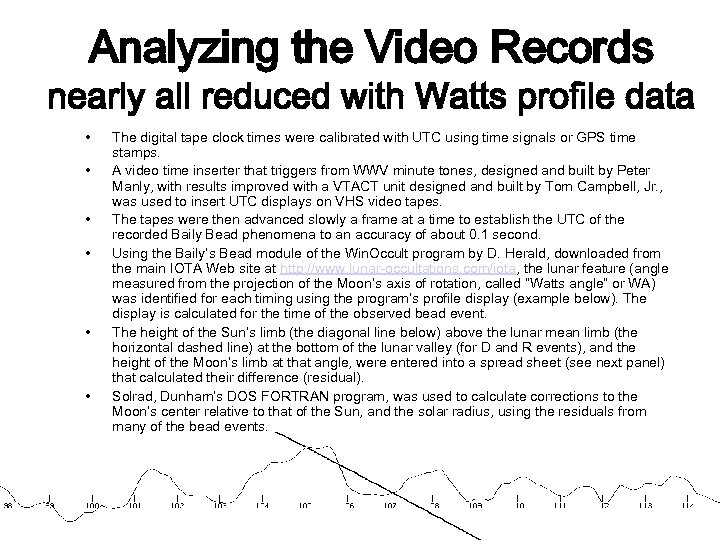 Analyzing the Video Records nearly all reduced with Watts profile data • • • The digital tape clock times were calibrated with UTC using time signals or GPS time stamps. A video time inserter that triggers from WWV minute tones, designed and built by Peter Manly, with results improved with a VTACT unit designed and built by Tom Campbell, Jr. , was used to insert UTC displays on VHS video tapes. The tapes were then advanced slowly a frame at a time to establish the UTC of the recorded Baily Bead phenomena to an accuracy of about 0. 1 second. Using the Baily’s Bead module of the Win. Occult program by D. Herald, downloaded from the main IOTA Web site at http: //www. lunar-occultations. com/iota, the lunar feature (angle measured from the projection of the Moon’s axis of rotation, called “Watts angle” or WA) was identified for each timing using the program’s profile display (example below). The display is calculated for the time of the observed bead event. The height of the Sun’s limb (the diagonal line below) above the lunar mean limb (the horizontal dashed line) at the bottom of the lunar valley (for D and R events), and the height of the Moon’s limb at that angle, were entered into a spread sheet (see next panel) that calculated their difference (residual). Solrad, Dunham’s DOS FORTRAN program, was used to calculate corrections to the Moon’s center relative to that of the Sun, and the solar radius, using the residuals from many of the bead events. 19
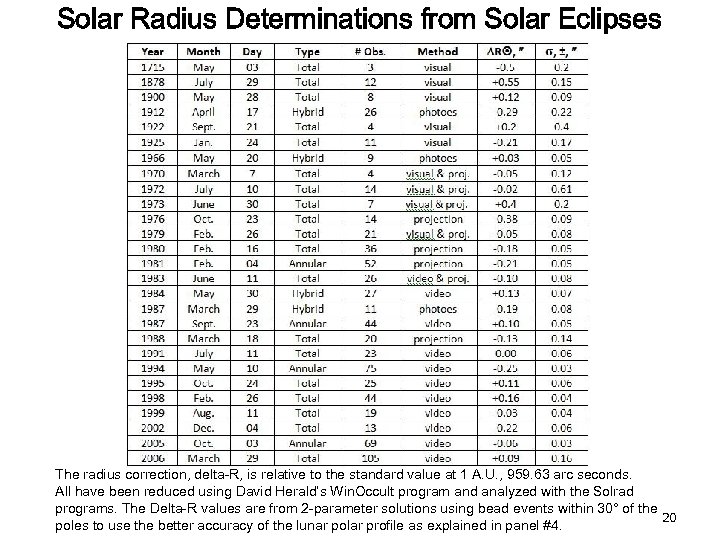 Solar Radius Determinations from Solar Eclipses The radius correction, delta-R, is relative to the standard value at 1 A. U. , 959. 63 arc seconds. All have been reduced using David Herald’s Win. Occult program and analyzed with the Solrad programs. The Delta-R values are from 2 -parameter solutions using bead events within 30° of the 20 poles to use the better accuracy of the lunar polar profile as explained in panel #4.
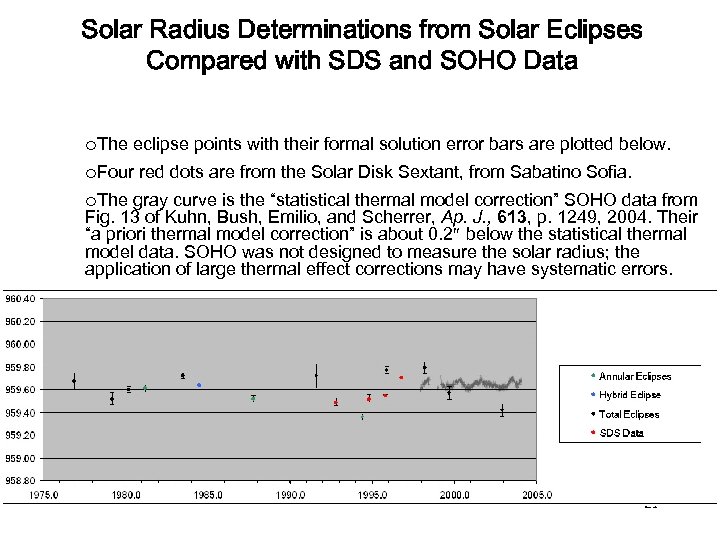 Solar Radius Determinations from Solar Eclipses Compared with SDS and SOHO Data ¡The eclipse points with their formal solution error bars are plotted below. ¡Four red dots are from the Solar Disk Sextant, from Sabatino Sofia. ¡The gray curve is the “statistical thermal model correction” SOHO data from Fig. 13 of Kuhn, Bush, Emilio, and Scherrer, Ap. J. , 613, p. 1249, 2004. Their “a priori thermal model correction” is about 0. 2 below the statistical thermal model data. SOHO was not designed to measure the solar radius; the application of large thermal effect corrections may have systematic errors. 21
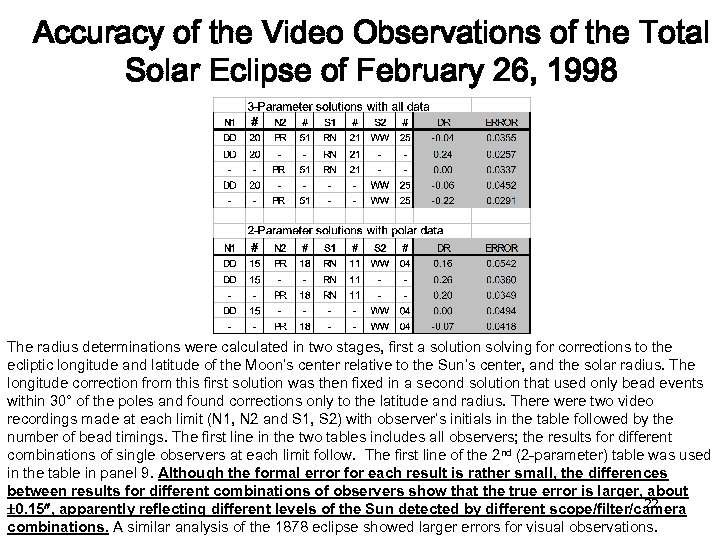 Accuracy of the Video Observations of the Total Solar Eclipse of February 26, 1998 The radius determinations were calculated in two stages, first a solution solving for corrections to the ecliptic longitude and latitude of the Moon’s center relative to the Sun’s center, and the solar radius. The longitude correction from this first solution was then fixed in a second solution that used only bead events within 30° of the poles and found corrections only to the latitude and radius. There were two video recordings made at each limit (N 1, N 2 and S 1, S 2) with observer’s initials in the table followed by the number of bead timings. The first line in the two tables includes all observers; the results for different combinations of single observers at each limit follow. The first line of the 2 nd (2 -parameter) table was used in the table in panel 9. Although the formal error for each result is rather small, the differences between results for different combinations of observers show that the true error is larger, about 22 0. 15 , apparently reflecting different levels of the Sun detected by different scope/filter/camera combinations. A similar analysis of the 1878 eclipse showed larger errors for visual observations.
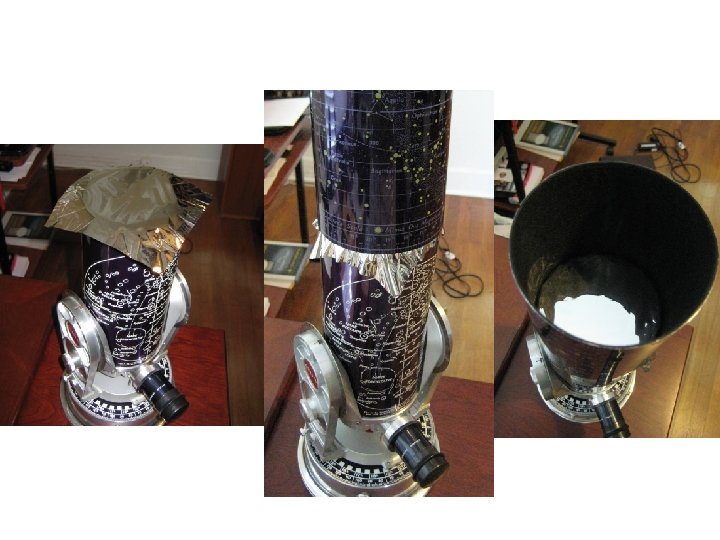
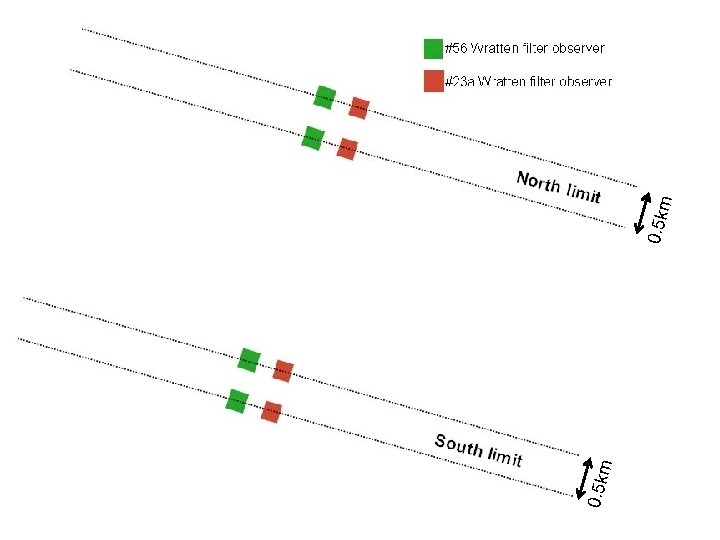
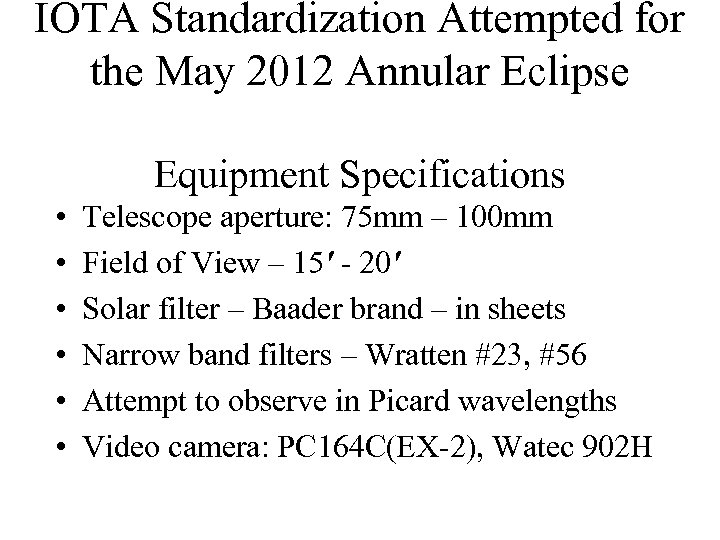 IOTA Standardization Attempted for the May 2012 Annular Eclipse Equipment Specifications • • • Telescope aperture: 75 mm – 100 mm Field of View – 15' - 20' Solar filter – Baader brand – in sheets Narrow band filters – Wratten #23, #56 Attempt to observe in Picard wavelengths Video camera: PC 164 C(EX-2), Watec 902 H
 m 0. 5 k
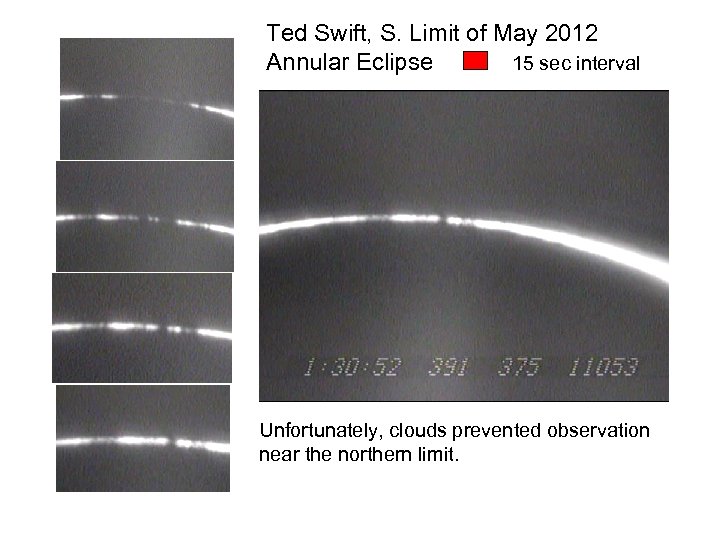 Ted Swift, S. Limit of May 2012 Annular Eclipse 15 sec interval Unfortunately, clouds prevented observation near the northern limit.
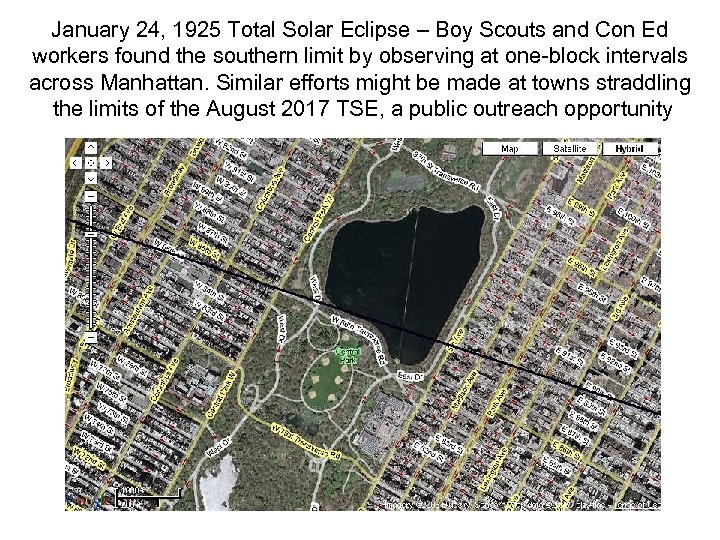 January 24, 1925 Total Solar Eclipse – Boy Scouts and Con Ed workers found the southern limit by observing at one-block intervals across Manhattan. Similar efforts might be made at towns straddling the limits of the August 2017 TSE, a public outreach opportunity
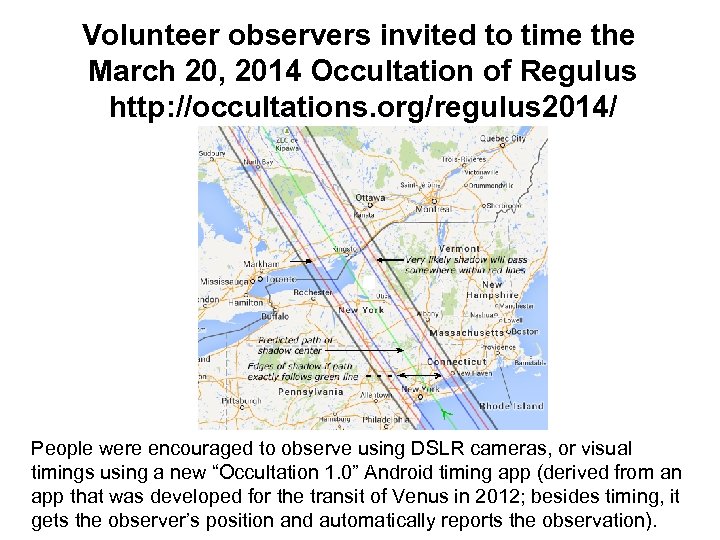 Volunteer observers invited to time the March 20, 2014 Occultation of Regulus http: //occultations. org/regulus 2014/ People were encouraged to observe using DSLR cameras, or visual timings using a new “Occultation 1. 0” Android timing app (derived from an app that was developed for the transit of Venus in 2012; besides timing, it gets the observer’s position and automatically reports the observation).
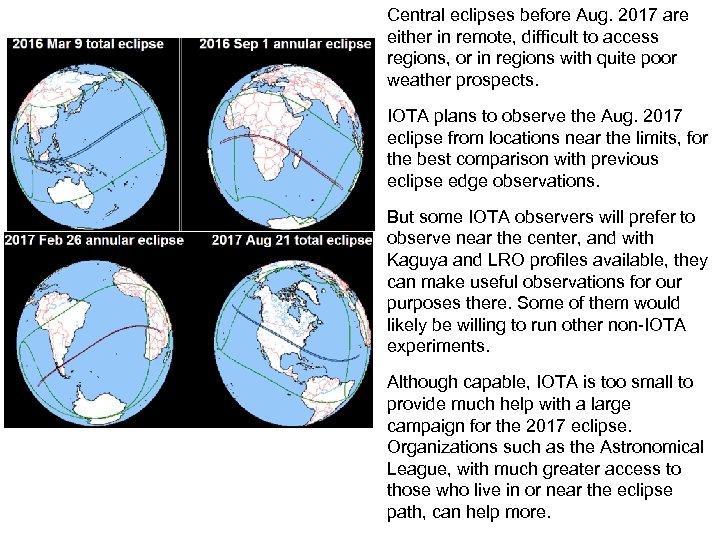 Central eclipses before Aug. 2017 are either in remote, difficult to access regions, or in regions with quite poor weather prospects. IOTA plans to observe the Aug. 2017 eclipse from locations near the limits, for the best comparison with previous eclipse edge observations. But some IOTA observers will prefer to observe near the center, and with Kaguya and LRO profiles available, they can make useful observations for our purposes there. Some of them would likely be willing to run other non-IOTA experiments. Although capable, IOTA is too small to provide much help with a large campaign for the 2017 eclipse. Organizations such as the Astronomical League, with much greater access to those who live in or near the eclipse path, can help more.
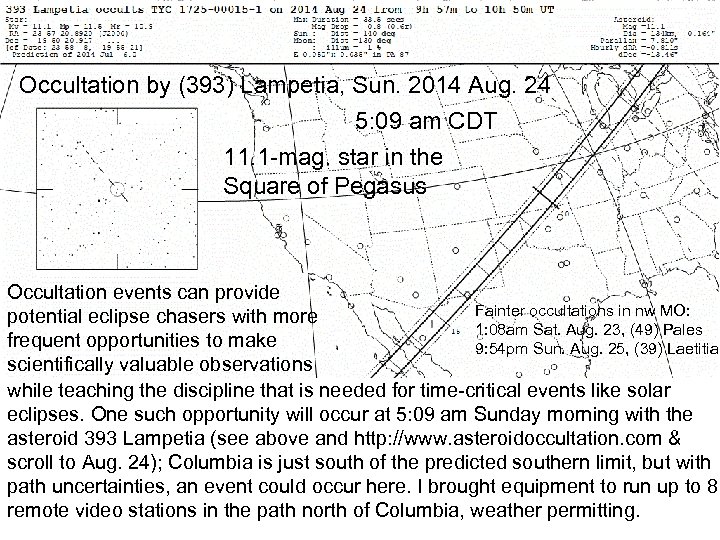 Occultation by (393) Lampetia, Sun. 2014 Aug. 24 5: 09 am CDT 11. 1 -mag. star in the Square of Pegasus Occultation events can provide Fainter occultations in nw MO: potential eclipse chasers with more 1: 08 am Sat. Aug. 23, (49) Pales frequent opportunities to make 9: 54 pm Sun. Aug. 25, (39) Laetitia scientifically valuable observations while teaching the discipline that is needed for time-critical events like solar eclipses. One such opportunity will occur at 5: 09 am Sunday morning with the asteroid 393 Lampetia (see above and http: //www. asteroidoccultation. com & scroll to Aug. 24); Columbia is just south of the predicted southern limit, but with path uncertainties, an event could occur here. I brought equipment to run up to 8 remote video stations in the path north of Columbia, weather permitting.
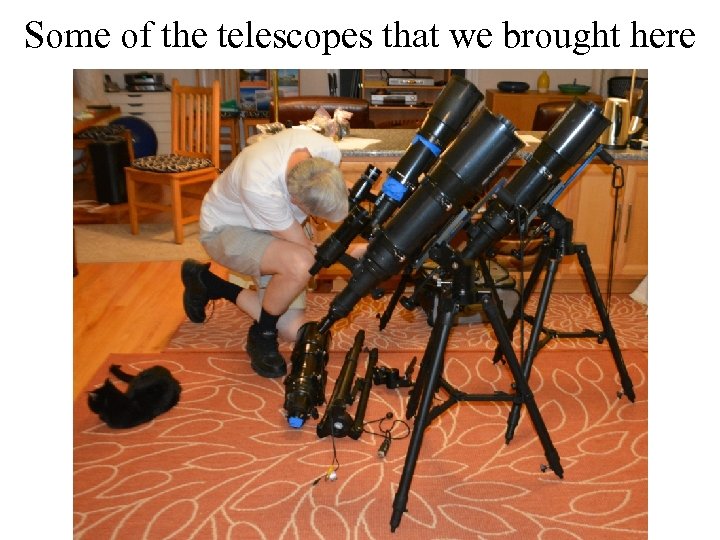 Some of the telescopes that we brought here
 RASC Observer’s Handbook and http: //www. occultations. org After my talk, a video of the 1994 May annular eclipse video by Ken Wilcox was shown; it’s on You. Tube at https: //www. youtube. com/watch? v=JIc. Q 0 z_x. Qlo This and many other eclipse and occultation You. Tube videos are linked to from: http: //www. asteroidoccultation. com/observations/You. Tube. Videos. htm Listed on this web page are, in groups from top to bottom, Lunar Occultation Videos; Asteroidal Occultation Videos; Jupiter/Saturn Satellite Events Miscellaneous Events (most of them are solar eclipse videos made near the edges of total and annular solar eclipse paths)