 Скачать презентацию Auction Theory תכנון מכרזים ומכירות פומביות Topic 7
529e59cd42d511a94fef5505daa63bb4.ppt
- Количество слайдов: 41



Auction Theory תכנון מכרזים ומכירות פומביות Topic 7 – VCG mechanisms 1
Previously… • We studied single-item auctions • Bidders have values vi for an item • A winning bidder gets a utility of ui=vi-pi – A losing bidder pays nothing and get ui=0 2
Previously… • Seller possible goals: – Maximize social welfare (efficiency) • 2 nd-price (Vickrey) auction – Maximize revenue • 2 nd-price auction with a reserve price (Myerson) – For example, reserve-price=1/2 for the unifom distribution on [0, 1] – Reserve price is independent of the number of players. – Optimality assumes a technical assumption on the distributions. • Revenue equivalence 3
Previously … • We saw that in single-item auctions we can maximize efficiency with dominant strategies. • Can this be achieved in other models? 4
Today • This class: Moving from a specific example (single-item auctions) to a more general mechanism design setting. • Main goal: in the presence of incomplete information, design the right incentives such that the efficient outcome will be chosen. 5
Outline 1. Some examples 2. VCG idea – intuition 3. Formal part: 1. Mechanism design model 2. The VCG mechanism 3. Proof: VCG is truthful 4. Roommates example 6
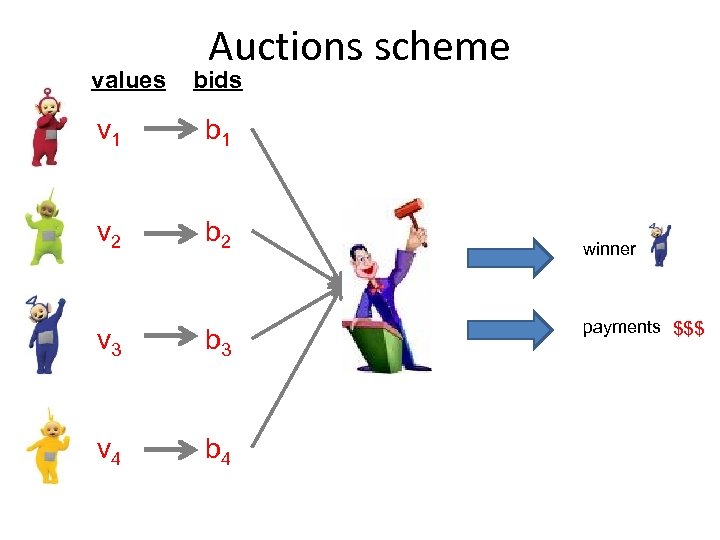
values Auctions scheme bids v 1 b 1 v 2 b 2 v 3 b 3 v 4 b 4 winner payments $$$
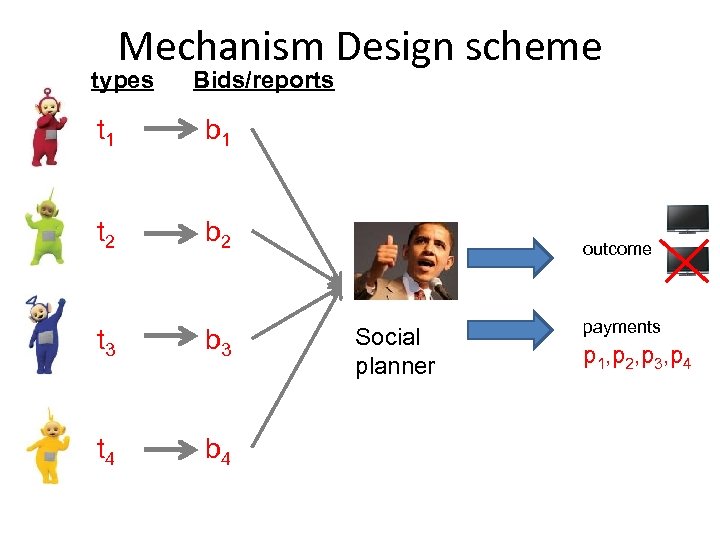
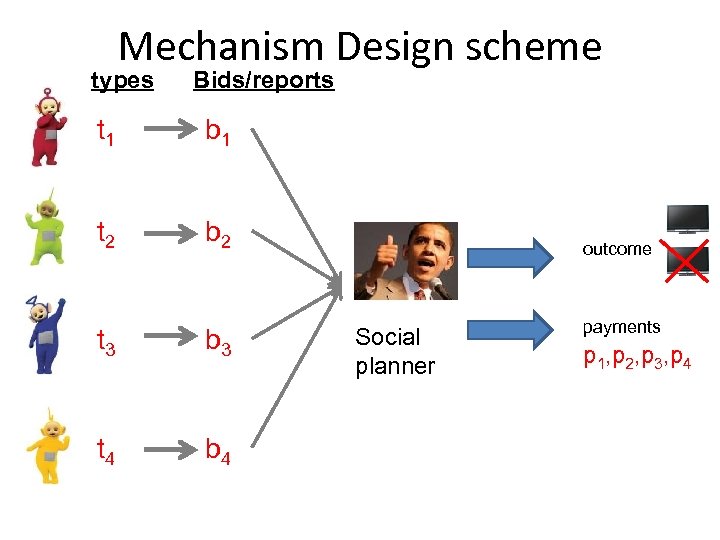
Mechanism Design scheme types Bids/reports t 1 b 1 t 2 b 2 t 3 b 3 t 4 b 4 outcome Social planner payments p 1, p 2, p 3, p 4
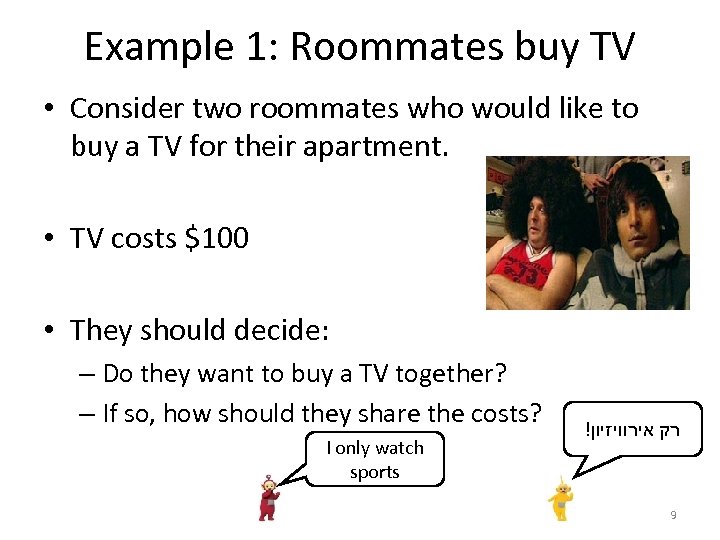
Example 1: Roommates buy TV • Consider two roommates who would like to buy a TV for their apartment. • TV costs $100 • They should decide: – Do they want to buy a TV together? – If so, how should they share the costs? I only watch sports ! רק אירוויזיון 9
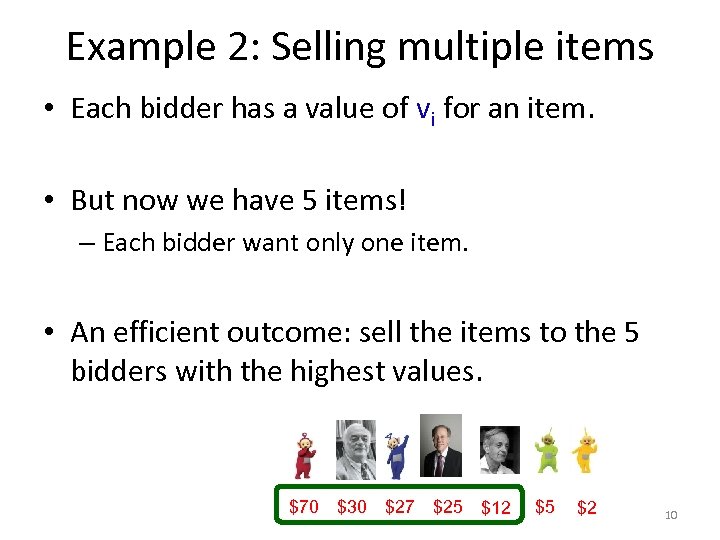
Example 2: Selling multiple items • Each bidder has a value of vi for an item. • But now we have 5 items! – Each bidder want only one item. • An efficient outcome: sell the items to the 5 bidders with the highest values. $70 $30 $27 $25 $12 $5 $2 10
Vickrey-Clarke-Groves (VCG) mechanisms • Goal: implement the efficient outcome in dominant strategies. • A general method to do this: VCG – 2 nd-price auction is a special case • Solution (intuitively): players should pay the “damage” they impose on society. 11
VCG basic idea (cont. ) In more details: • You can maximize efficiency by: – Choosing the efficient outcome (given the bids) – Each player pays his “social cost” (how much his existence hurts the others). pi = Optimal welfare (for the other players) if player i was not participating. Welfare of the other players from the chosen outcome 12
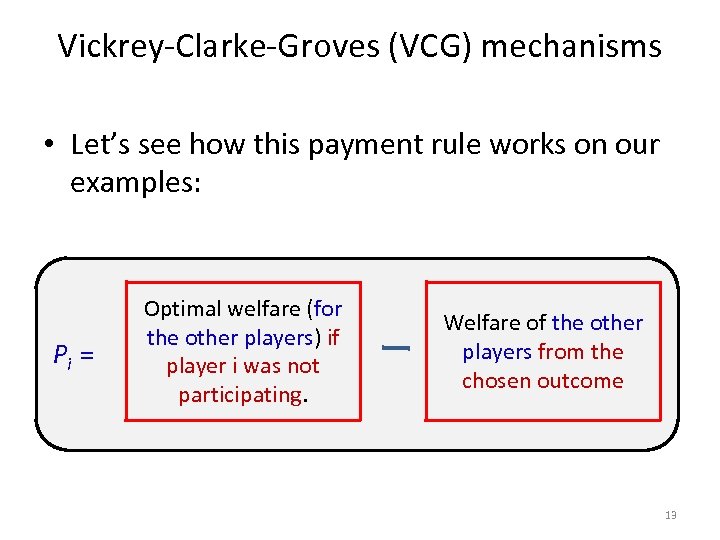
Vickrey-Clarke-Groves (VCG) mechanisms • Let’s see how this payment rule works on our examples: Pi = Optimal welfare (for the other players) if player i was not participating. Welfare of the other players from the chosen outcome 13
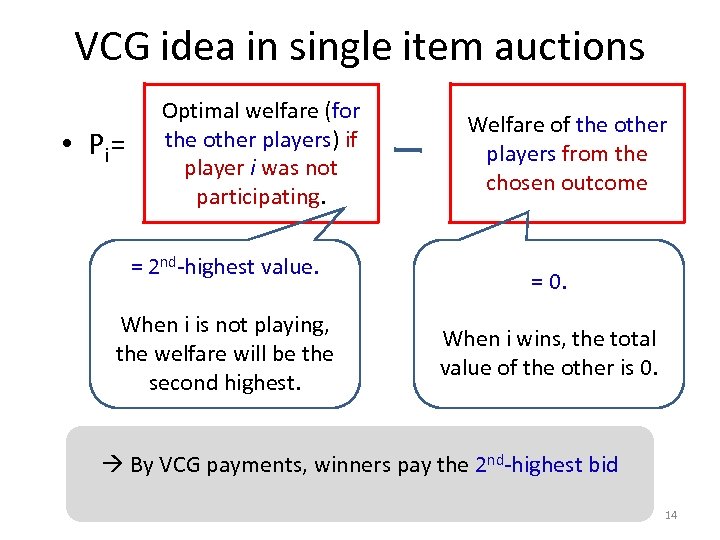
VCG idea in single item auctions • P i= Optimal welfare (for the other players) if player i was not participating. = 2 nd-highest value. When i is not playing, the welfare will be the second highest. Welfare of the other players from the chosen outcome = 0. When i wins, the total value of the other is 0. By VCG payments, winners pay the 2 nd-highest bid 14
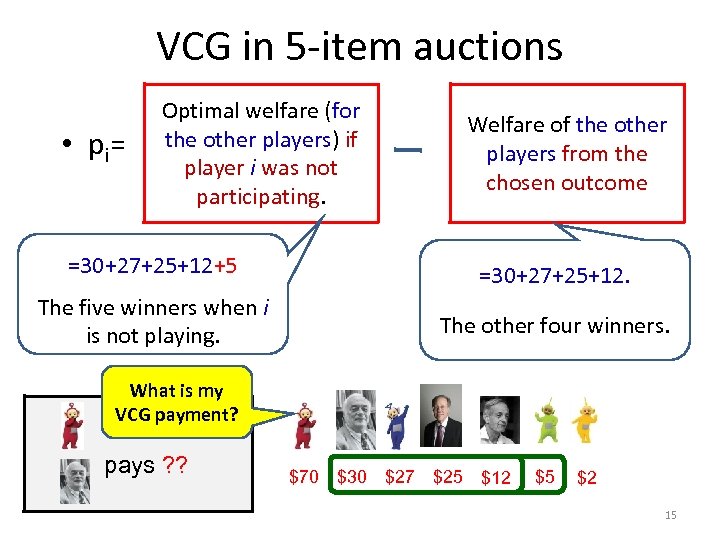
VCG in 5 -item auctions • pi= Optimal welfare (for the other players) if player i was not participating. Welfare of the other players from the chosen outcome =30+27+25+12+5 =30+27+25+12. The five winners when i is not playing. The other four winners. What is my VCG 5 payspayment? pays ? ? $70 $30 $27 $25 $12 $5 $2 15
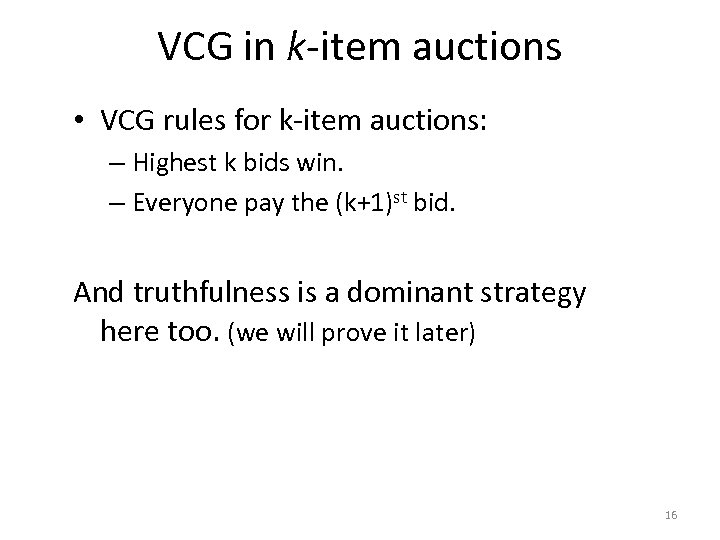
VCG in k-item auctions • VCG rules for k-item auctions: – Highest k bids win. – Everyone pay the (k+1)st bid. And truthfulness is a dominant strategy here too. (we will prove it later) 16
Outline 1. Some examples 2. VCG idea – intuition Formal part: 1. Mechanism design model 2. The VCG mechanism 3. Proof: VCG is truthful 1. VCG: the negative side 17
Mechanism Design scheme types Bids/reports t 1 b 1 t 2 b 2 t 3 b 3 t 4 b 4 outcome Social planner payments p 1, p 2, p 3, p 4
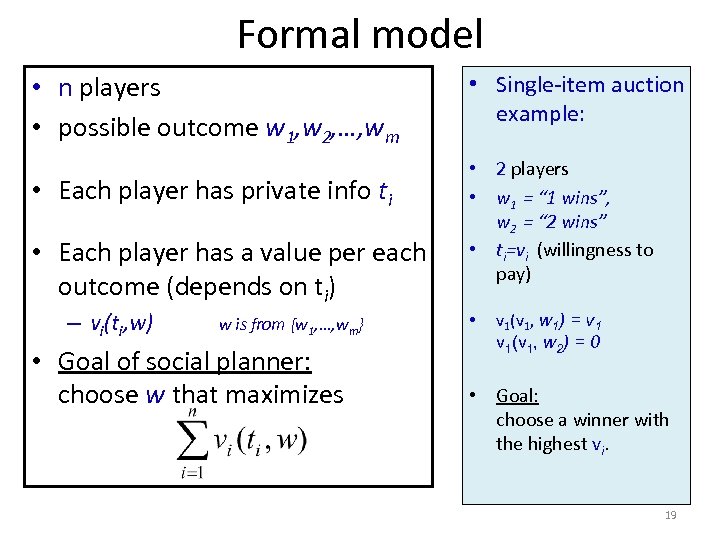
Formal model • n players • possible outcome w 1, w 2, …, wm • Each player has private info ti • Each player has a value per each outcome (depends on ti) – vi(ti, w) w is from {w 1, …, wm} • Goal of social planner: choose w that maximizes • Single-item auction example: • 2 players • w 1 = “ 1 wins”, w 2 = “ 2 wins” • ti=vi (willingness to pay) • v 1(v 1, w 1) = v 1(v 1, w 2) = 0 • Goal: choose a winner with the highest vi. 19
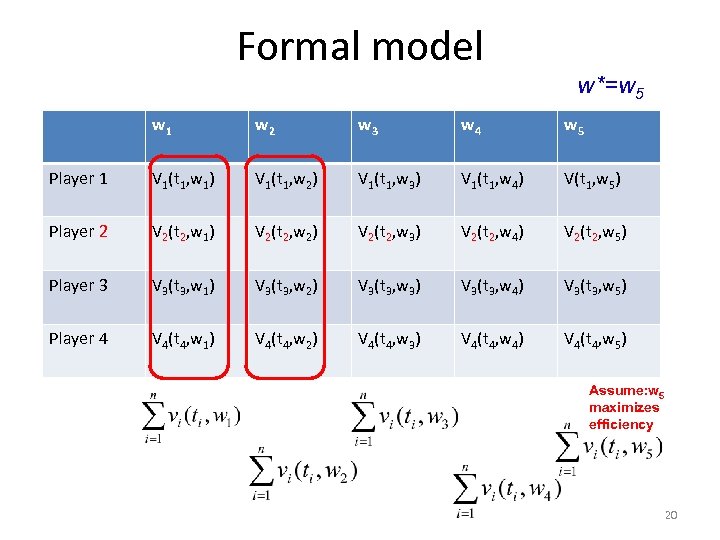
Formal model w*=w 5 w 1 w 2 w 3 w 4 w 5 Player 1 V 1(t 1, w 1) V 1(t 1, w 2) V 1(t 1, w 3) V 1(t 1, w 4) V(t 1, w 5) Player 2 V 2(t 2, w 1) V 2(t 2, w 2) V 2(t 2, w 3) V 2(t 2, w 4) V 2(t 2, w 5) Player 3 V 3(t 3, w 1) V 3(t 3, w 2) V 3(t 3, w 3) V 3(t 3, w 4) V 3(t 3, w 5) Player 4 V 4(t 4, w 1) V 4(t 4, w 2) V 4(t 4, w 3) V 4(t 4, w 4) V 4(t 4, w 5) Assume: w 5 maximizes efficiency 20
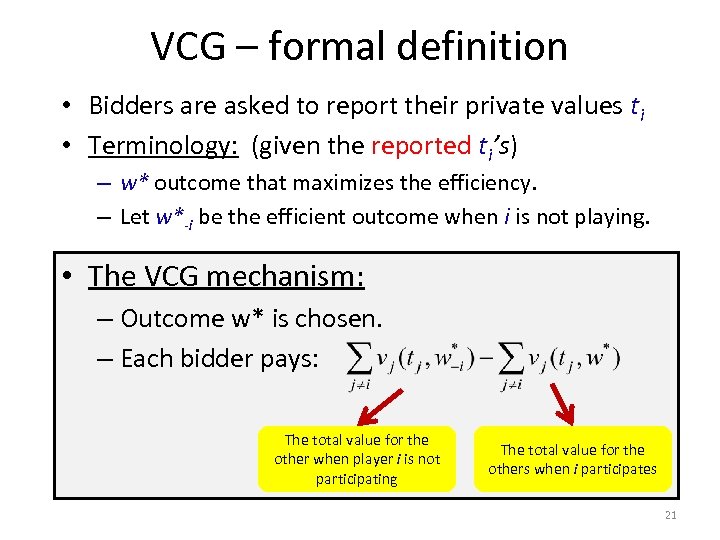
VCG – formal definition • Bidders are asked to report their private values ti • Terminology: (given the reported ti’s) – w* outcome that maximizes the efficiency. – Let w*-i be the efficient outcome when i is not playing. • The VCG mechanism: – Outcome w* is chosen. – Each bidder pays: The total value for the other when player i is not participating The total value for the others when i participates 21
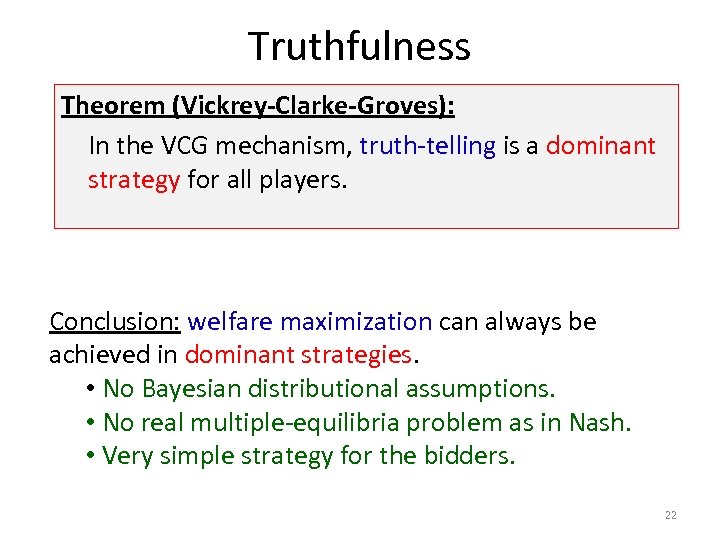
Truthfulness Theorem (Vickrey-Clarke-Groves): In the VCG mechanism, truth-telling is a dominant strategy for all players. Conclusion: welfare maximization can always be achieved in dominant strategies. • No Bayesian distributional assumptions. • No real multiple-equilibria problem as in Nash. • Very simple strategy for the bidders. 22
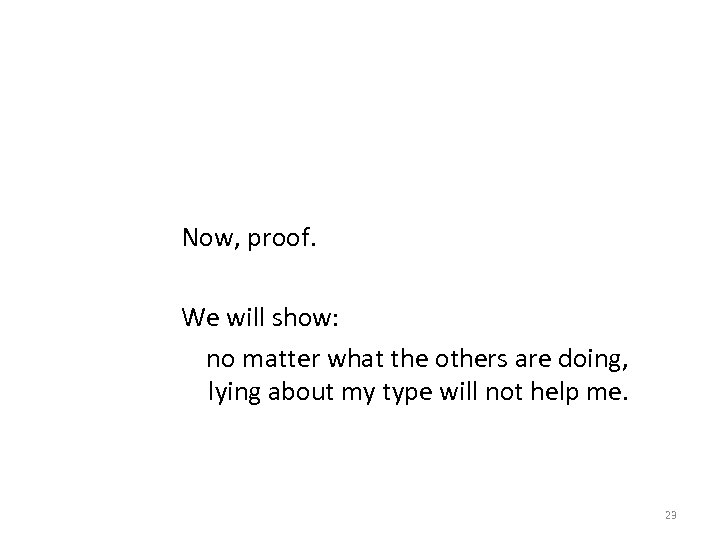
Now, proof. We will show: no matter what the others are doing, lying about my type will not help me. 23
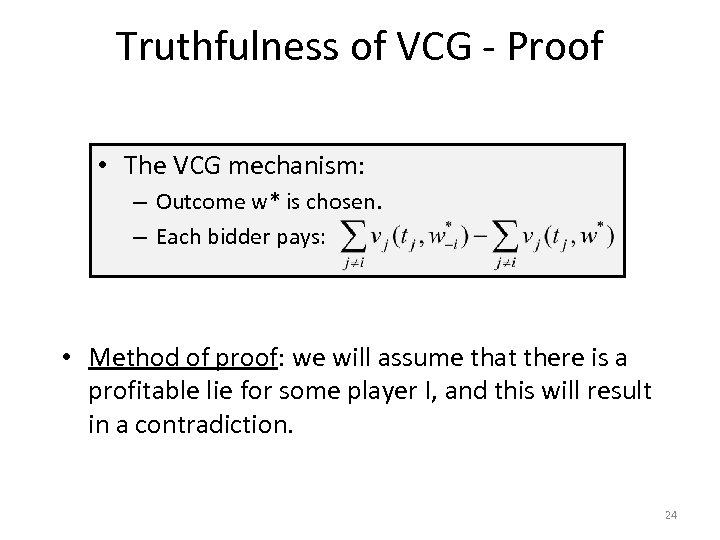
Truthfulness of VCG - Proof • The VCG mechanism: – Outcome w* is chosen. – Each bidder pays: • Method of proof: we will assume that there is a profitable lie for some player I, and this will result in a contradiction. 24
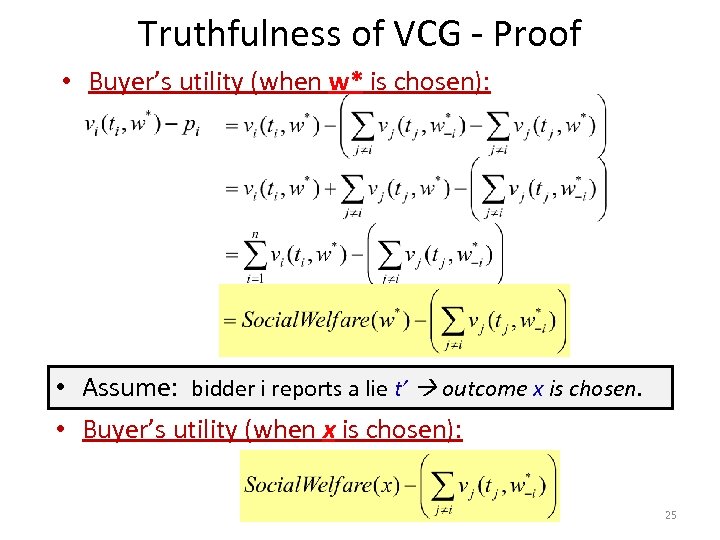
Truthfulness of VCG - Proof • Buyer’s utility (when w* is chosen): • Assume: bidder i reports a lie t’ outcome x is chosen. • Buyer’s utility (when x is chosen): 25
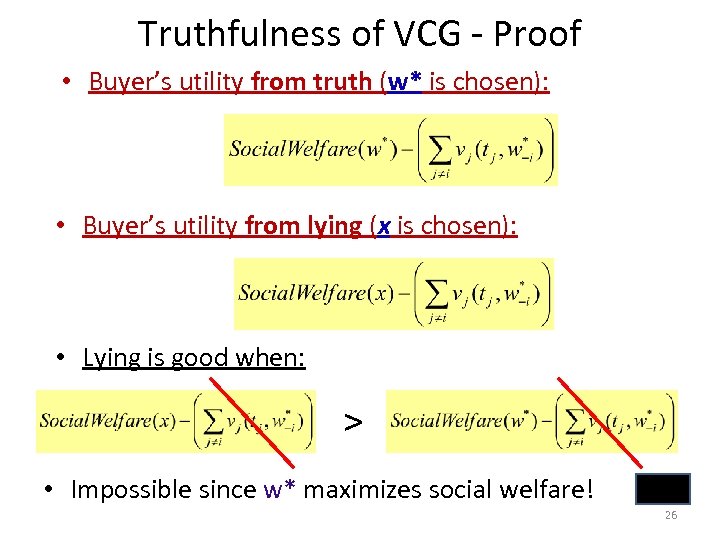
Truthfulness of VCG - Proof • Buyer’s utility from truth (w* is chosen): • Buyer’s utility from lying (x is chosen): • Lying is good when: > • Impossible since w* maximizes social welfare! 26
Truthfulness of VCG - intuition • The trick is actually quite simple: — By lying, players may be able to change the outcome. — But their utility depends not only on the outcome, but also on their payments. — With VCG payments, the utility of each player is the total efficiency. Therefore, players want the efficient outcome to be chosen. Lying my ruin this. 27
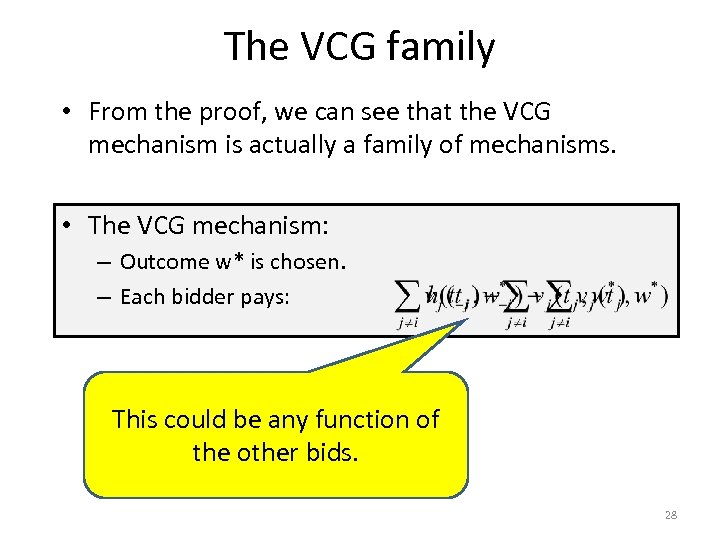
The VCG family • From the proof, we can see that the VCG mechanism is actually a family of mechanisms. • The VCG mechanism: – Outcome w* is chosen. – Each bidder pays: This could be any function of the other bids. 28
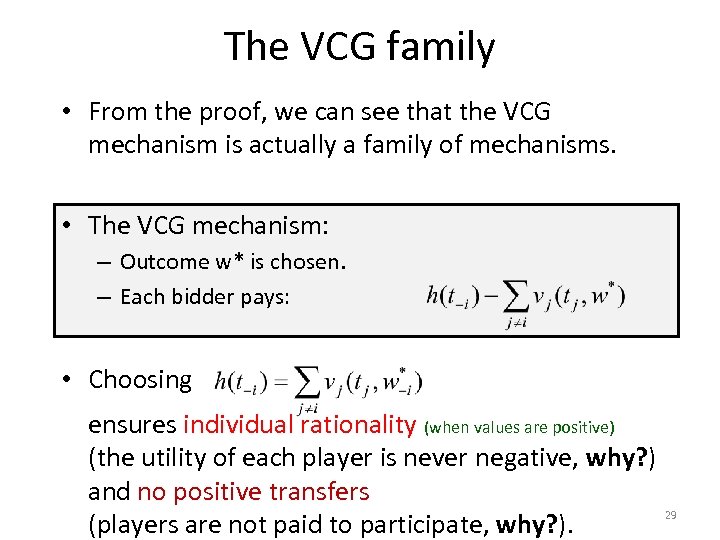
The VCG family • From the proof, we can see that the VCG mechanism is actually a family of mechanisms. • The VCG mechanism: – Outcome w* is chosen. – Each bidder pays: • Choosing ensures individual rationality (when values are positive) (the utility of each player is never negative, why? ) and no positive transfers 29 (players are not paid to participate, why? ).
Single vs. Multi parameter We actually proved before how to implement the efficient outcome: – • • What do VCG mechanisms add? But, this holds for very specific environments: players’ values are single parameter – – • Max{v 1, …. , vn} is a monotone function we know how to construct mechanisms implementing it. That is, can be represented by a single real number (or more formally, an ordered space). We needed the concept of “raising the value of a player” which implicitly implies an ordered space. The VCG mechanism is more general: multiparameter domains. 30
Single vs. Multi parameter (cont. ) • What we learnt in previous classes holds for very specific environments: players’ values are single parameter That is, can be represented by a single real number (or more formally, an ordered space). – • – • Even the interdependent/correlated models. We needed the concept of “raising the value of a player” which implicitly implies an ordered space. The VCG mechanism is more general: multi-parameter domains. – Even if the private value consists of many values (as in multi-unit auctions). 31
Single vs. Multi parameter (cont. ) • From a mechanism design point of view, the difference between single- and multi parameter domains is huge: The single parameter case is well-understood. – • Multi-parameter are mostly still an open problem – • • efficient (Vickrey) auctions, optimal (Myerson) auctions, characterization of implementable social-choice functions. For example, no-one knows what is the optimal (revenue maximal) auctions even for 2 bidders and 2 items. VCG is one of the few general results known for multidimensional domains. – But still, most real problems are multi dimensional. We will consider them in the coming classes. 32
Outline 1. Some examples 2. VCG idea – intuition 3. Formal part: 1. Mechanism design model 2. The VCG mechanism 3. Proof: VCG is truthful 4. Roommates example 33
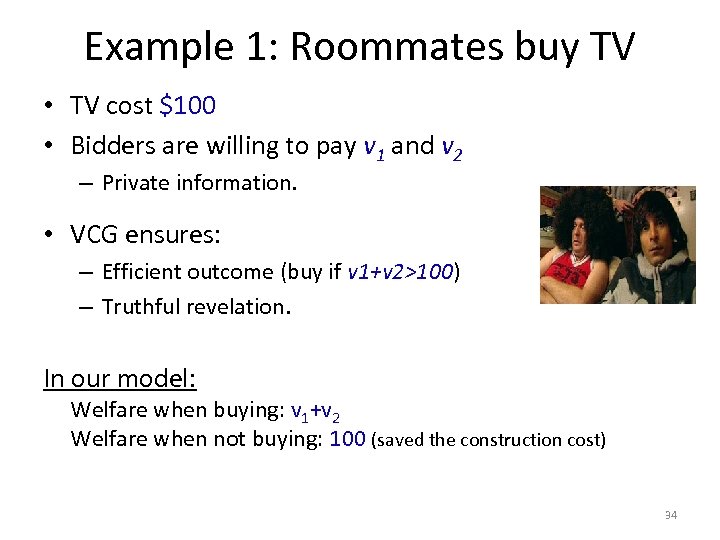
Example 1: Roommates buy TV • TV cost $100 • Bidders are willing to pay v 1 and v 2 – Private information. • VCG ensures: – Efficient outcome (buy if v 1+v 2>100) – Truthful revelation. In our model: Welfare when buying: v 1+v 2 Welfare when not buying: 100 (saved the construction cost) 34
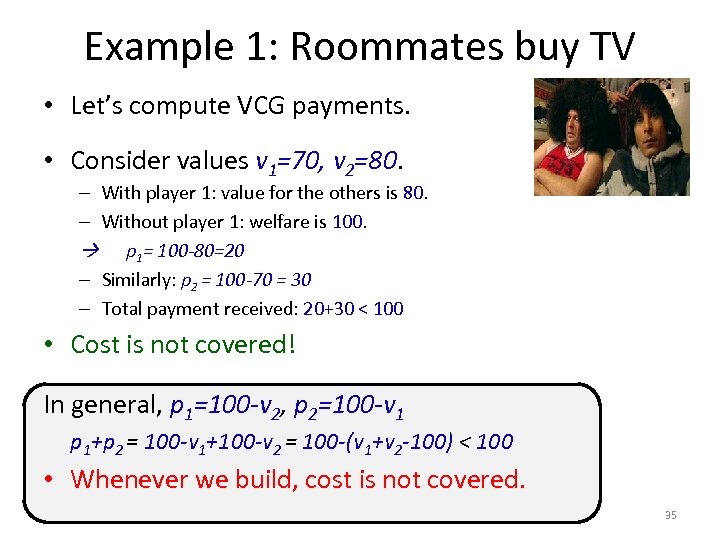
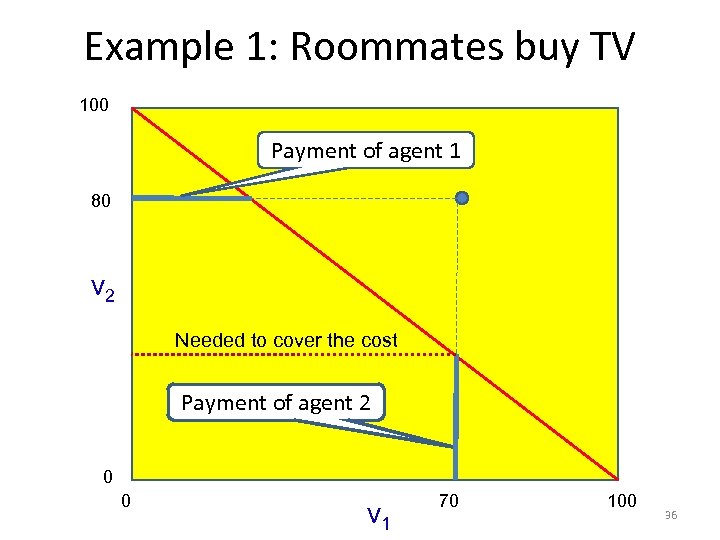
Example 1: Roommates buy TV • Let’s compute VCG payments. • Consider values v 1=70, v 2=80. – With player 1: value for the others is 80. – Without player 1: welfare is 100. p 1= 100 -80=20 – Similarly: p 2 = 100 -70 = 30 – Total payment received: 20+30 < 100 • Cost is not covered! In general, p 1=100 -v 2, p 2=100 -v 1 p 1+p 2 = 100 -v 1+100 -v 2 = 100 -(v 1+v 2 -100) < 100 • Whenever we build, cost is not covered. 35
Example 1: Roommates buy TV 100 Payment of agent 1 80 v 2 Needed to cover the cost Payment of agent 2 0 0 v 1 70 100 36
Example 1: Roommates buy TV Conclusion: in some cases, the VCG mechanism is not budget-balanced. (spends more than it collects from the players. ) This is a real problem! There isn’t much we can do: It can be shown that there is no mechanism that is both efficient and budget balanced. – Even in simple settings: one seller and one buyer with private values. – “Myerson-Satterthwaite theorem” 37
Roommates (cont. ) Now, assume that the values are v 1=110, v 2=130. How much each one pays (in VCG)? 0 Reason: agents do not affect the outcome Players that affect the outcome: pivots. Therefore, the VCG mechanism is also known as the pivot mechanism. 38
Context: Public goods • The roommate problem is knows as the “public good” problem. • Consider a government that wants to build a bridge. – When to build? If the total welfare is greater than the cost. – How the cost is shared? – Efficiency vs. Budget Balance (cannot achieve both). • Another example: cable infrastructure. 39
More problems with VCG • We saw one important flaw of VCG mechanisms: not budget balanced • Other problems with VCG: – Auctions with externalities – Collusions – False name bids – Revenue monotonicity 40
Summary: VCG • Maximizing efficiency is desired in various settings. • We saw: one can always achieve this with (dominant-strategy) equilibrium. – “implementation” • This is the only general goal that is known to be “implementable”. • Pros: No distributional assumptions, strong equilibrium concept, individually rational. • Cons: not budget balanced, prone to other manipulations. 41
Скачать презентацию Auction Theory תכנון מכרזים ומכירות פומביות Topic 7
529e59cd42d511a94fef5505daa63bb4.ppt