


 Скачать презентацию Attitudes to and experience of complementary medicine in
1b09468665ceb26092fc7a409d6ac74f.ppt
- Количество слайдов: 31
 Attitudes to and experience of complementary medicine in Northern Ireland Mc. Donough SM, Devine P, Baxter GD
 Life and Times Survey • Annual survey since 1998 • Monitor the attitudes and behaviour of people in Northern Ireland • Time-series and public record of attitudes and behaviour • Descendent of Northern Ireland Social Attitudes Survey 1989 -1996 • Modular format
 Modules 2005 • Use of and attitudes to complementary and alternative therapies • Community Relations • Political Attitudes • Political Participation • Gender and family roles • Attitudes to minority ethnic people
 Complementary and Alternative Medicines House of Lords Report 2000 • Group I, Group II and Group III therapies • ‘Big 5’ Group I therapies should be provided by the NHS – Acupuncture, chiropractic, homeopathy, osteopathy and herbal medicine • Group II: – aromatherapy; the Alexander Technique; body work therapies, including massage; counseling; stress therapy; hypnotherapy; reflexology and probably shiatsu; meditation and healing.
 Integration of CAM into the NHS • Scarce resources; integration cheaper • GP referral plus • Role for privately-accessed CAM therapists
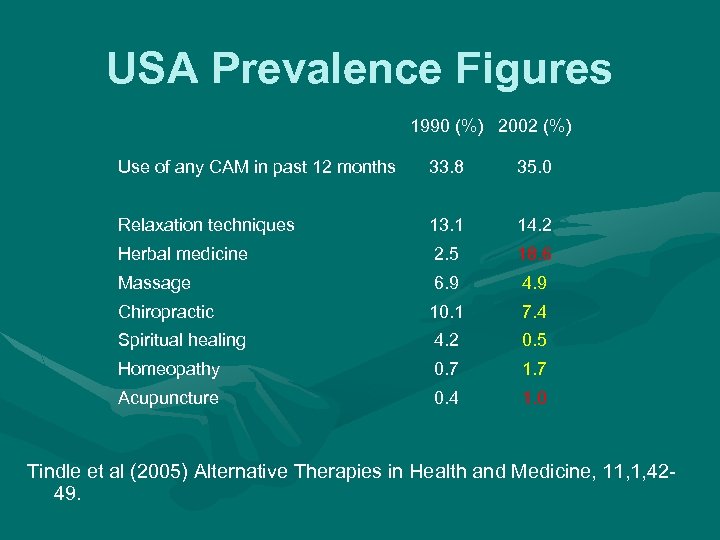 USA Prevalence Figures 1990 (%) 2002 (%) Use of any CAM in past 12 months 33. 8 35. 0 Relaxation techniques 13. 1 14. 2 Herbal medicine 2. 5 18. 6 Massage 6. 9 4. 9 Chiropractic 10. 1 7. 4 Spiritual healing 4. 2 0. 5 Homeopathy 0. 7 1. 7 Acupuncture 0. 4 1. 0 Tindle et al (2005) Alternative Therapies in Health and Medicine, 11, 1, 4249.
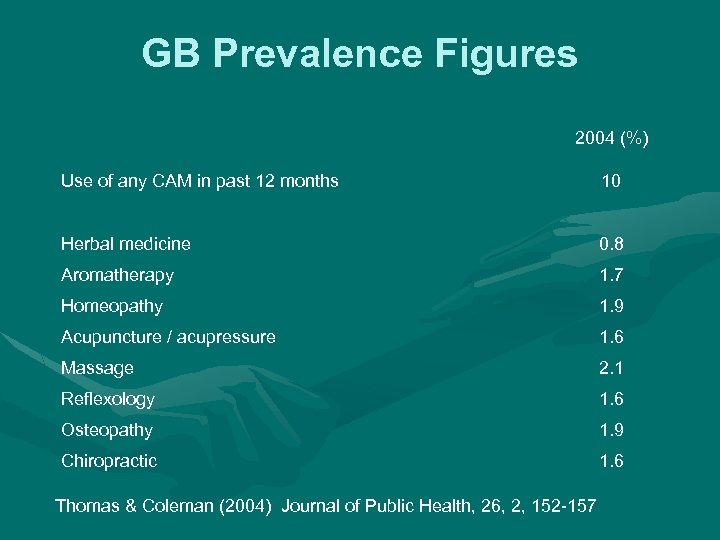 GB Prevalence Figures 2004 (%) Use of any CAM in past 12 months 10 Herbal medicine 0. 8 Aromatherapy 1. 7 Homeopathy 1. 9 Acupuncture / acupressure 1. 6 Massage 2. 1 Reflexology 1. 6 Osteopathy 1. 9 Chiropractic 1. 6 Thomas & Coleman (2004) Journal of Public Health, 26, 2, 152 -157
 Rationale for survey • ‘More detailed quantitative information is required on the levels of CAM use in the United Kingdom, in order to inform the public and healthcare policy-makers and we recommend that suitable national studies be commissioned to obtain this information’. House of Lords Report, 2000 • Levels of Use and Integration?
 Questions • • % CAM use and who? Which therapies are most used? Which practitioners are most consulted? What is the referral route by which people reach therapists or therapies? Reasons for using CAM? Which CAM therapies are most efficacious? Adverse reactions?
 Methodology • • • Sampling frame: Postal Address File Stratified random sample of households One adult aged 18 or over selected at random from each household 1200 achieved responses 61% response rate CAPI
 Ever use/use in 12 months
 Who are most likely to use CAM? *
 Who are most likely to use CAM? *
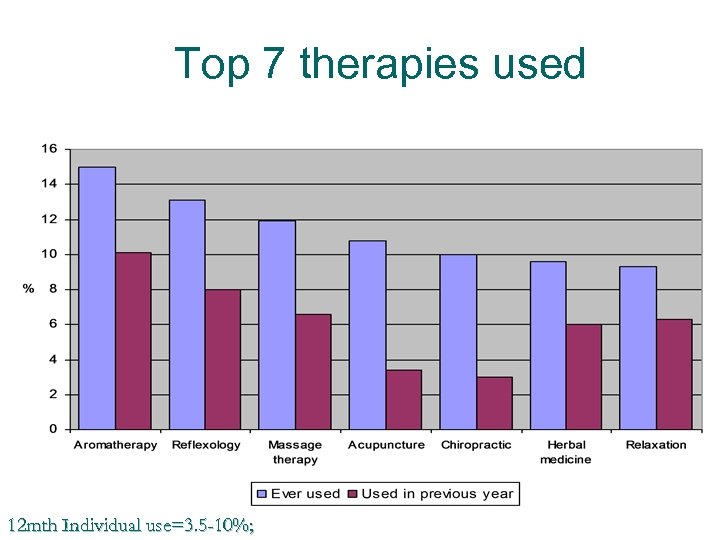 Top 7 therapies used 12 mth Individual use=3. 5 -10%;
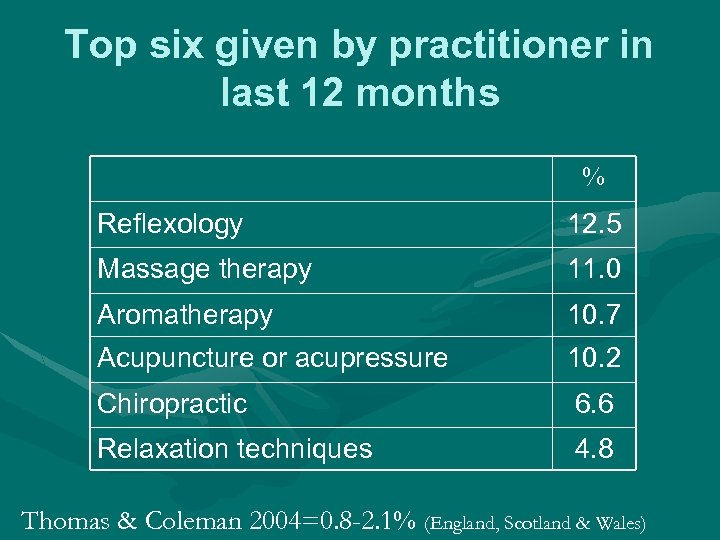 Top six given by practitioner in last 12 months % Reflexology 12. 5 Massage therapy 11. 0 Aromatherapy 10. 7 Acupuncture or acupressure 10. 2 Chiropractic 6. 6 Relaxation techniques 4. 8 Thomas & Coleman 2004=0. 8 -2. 1% (England, Scotland & Wales)
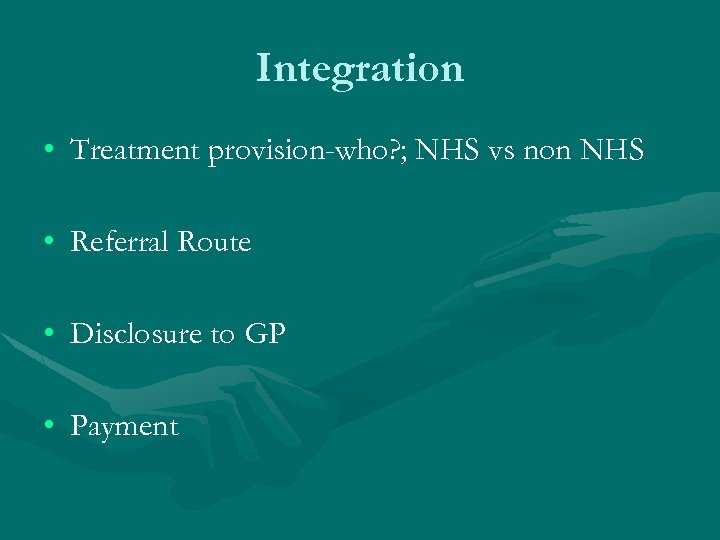 Integration • Treatment provision-who? ; NHS vs non NHS • Referral Route • Disclosure to GP • Payment
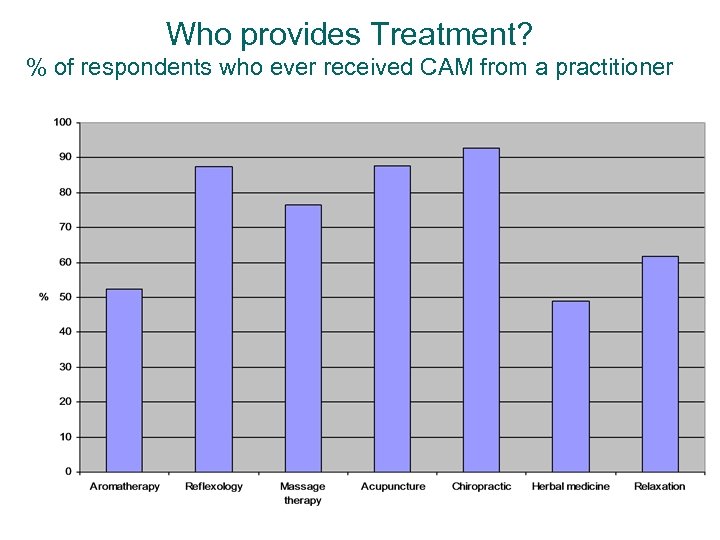 Who provides Treatment? % of respondents who ever received CAM from a practitioner
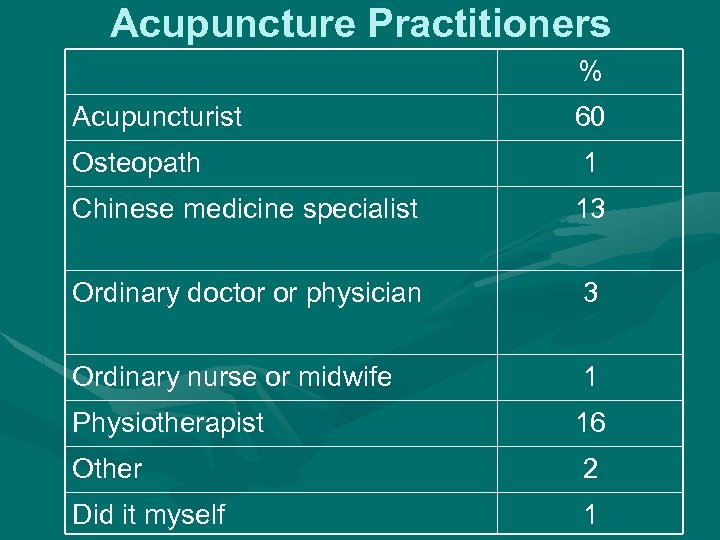 Acupuncture Practitioners % Acupuncturist 60 Osteopath 1 Chinese medicine specialist 13 Ordinary doctor or physician 3 Ordinary nurse or midwife 1 Physiotherapist 16 Other 2 Did it myself 1
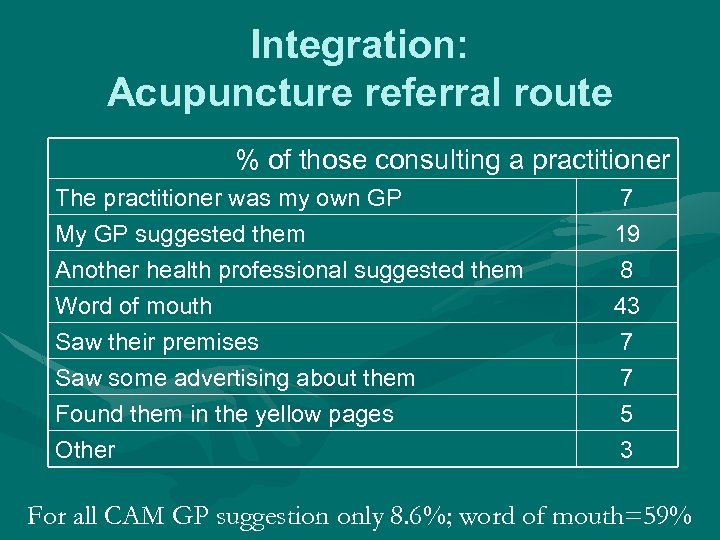 Integration: Acupuncture referral route % of those consulting a practitioner The practitioner was my own GP My GP suggested them Another health professional suggested them Word of mouth Saw their premises Saw some advertising about them Found them in the yellow pages Other 7 19 8 43 7 7 5 3 For all CAM GP suggestion only 8. 6%; word of mouth=59%
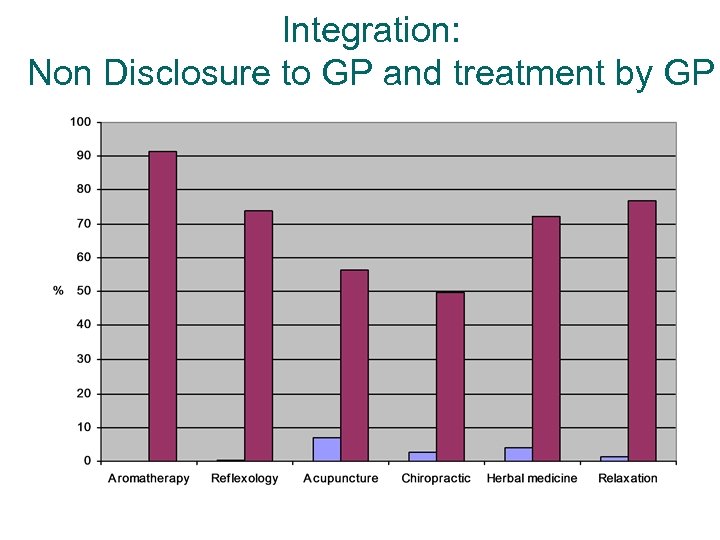 Integration: Non Disclosure to GP and treatment by GP
 What is CAM used for?
 Reasons for receiving therapy * * *
 Types of Health Conditions Number of respondents Arom Reflex Mass Acup Chir Musculoskeletal 20 33 33 67 67 Stress 33 59 59 99 99 Mental health 16 36 36 13 13 Women’s health 5 15 15 5 5 Digestive problems Sleep disorders 1 15 15 7 7 8 4 4 2 2
 CAM for health reasons • 37% because traditional therapy was not helpful • 22% never tried traditional therapy* • 39% using both at the same time * Thomas (2004) 17% no conventional medicine; 74 -62% previously consulted their GP about health problem prior to CAM use (Thomas & Coleman, 2004; Mac. Pherson et al, 2005)
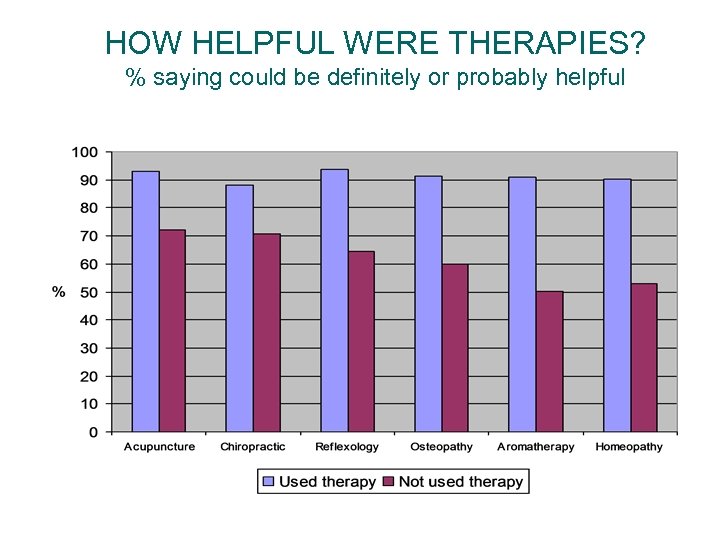 HOW HELPFUL WERE THERAPIES? % saying could be definitely or probably helpful
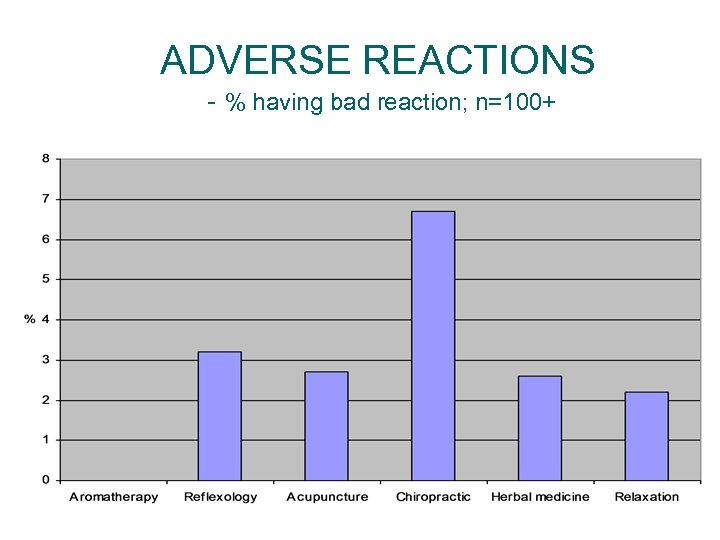 ADVERSE REACTIONS - % having bad reaction; n=100+
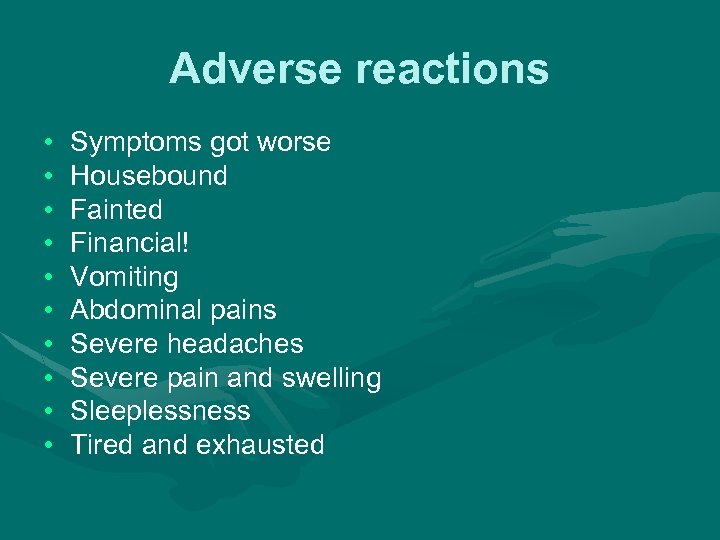 Adverse reactions • • • Symptoms got worse Housebound Fainted Financial! Vomiting Abdominal pains Severe headaches Severe pain and swelling Sleeplessness Tired and exhausted
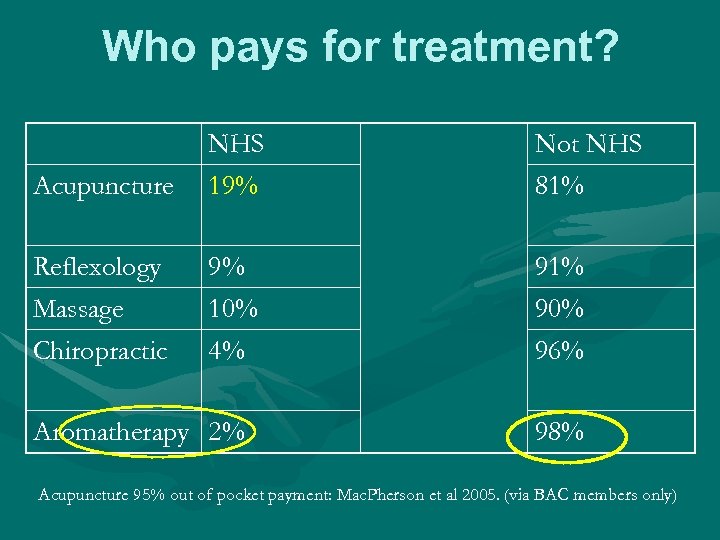 Who pays for treatment? Acupuncture NHS 19% Not NHS 81% Reflexology Massage Chiropractic 9% 10% 4% 91% 90% 96% Aromatherapy 2% 98% Acupuncture 95% out of pocket payment: Mac. Pherson et al 2005. (via BAC members only)
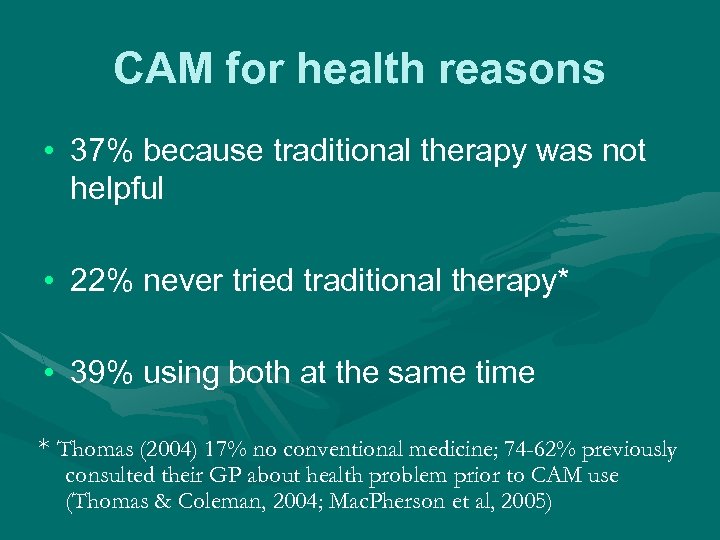
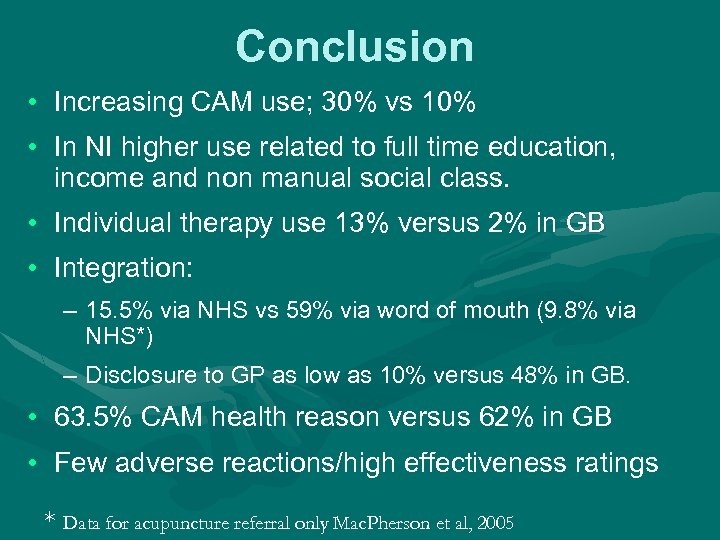 Conclusion • Increasing CAM use; 30% vs 10% • In NI higher use related to full time education, income and non manual social class. • Individual therapy use 13% versus 2% in GB • Integration: – 15. 5% via NHS vs 59% via word of mouth (9. 8% via NHS*) – Disclosure to GP as low as 10% versus 48% in GB. • 63. 5% CAM health reason versus 62% in GB • Few adverse reactions/high effectiveness ratings * Data for acupuncture referral only Mac. Pherson et al, 2005
 Recent Developments Jan 2007 • “Through NHS scheme, GPs will be able to bid resources to enable them to refer patients to CAM therapies, where they feel the patient could bene are confident that the practitioner provides a safe effective service, and it is the patient's wish. " Health Minister Paul Goggins, October 2006
 Summary of questions repeated from 2001 survey • During the last 12 months, have you spent any time at all looking for information or advice about health problems or health issues affecting either you or someone you know? • Thinking about the health problem or health issue which was most important for your, where did you go to find information or advice about this? • Which one of these sources of information or advice was most helpful? • Was the information helpful for diagnosing a health problem? • Was it helpful in treating a health problem?