 Скачать презентацию Attitude towards Opiate Substitution Treatment as a bioethical
a3ed385661db23399af8daa9d0509095.ppt
- Количество слайдов: 46



Attitude towards Opiate Substitution Treatment as a bioethical problem in Russian narcology Prof. Vladimir Mendelevich, MD, Ph. D, Doc. Med. Sci. Kazan State Medical University, Russia Disclosures Dr. Mendelevich has nothing to disclose. Unlabeled/Unapproved Uses Disclosure None
The main questions: Why OST is still prohibited in Russia? What is the reason of an interdiction for introduction of OST in Russia? Why Russian experts ignoring scientific knowledge?
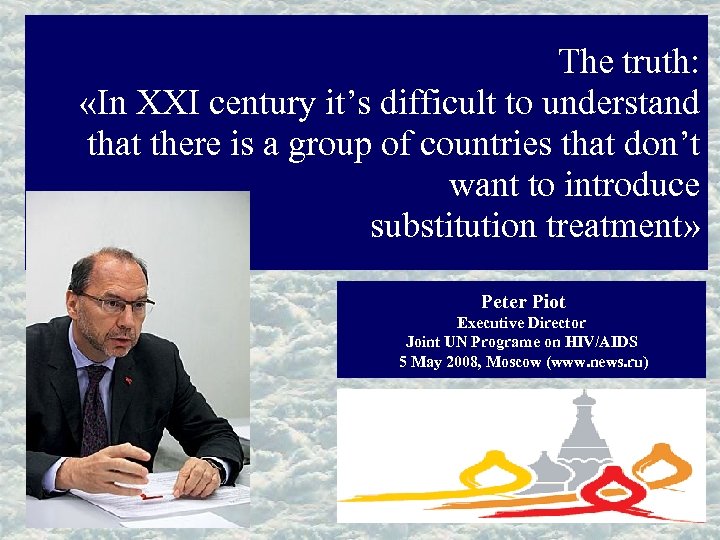
The truth: «In XXI century it’s difficult to understand that there is a group of countries that don’t want to introduce substitution treatment» Peter Piot Executive Director Joint UN Programe on HIV/AIDS 5 May 2008, Moscow (www. news. ru)
Overview A problem context (contemporary situation in Russian narcology) Bioethics aspects of use of opioid analgetics and ban on OST in Russian Federation Biomedical problems in modern narcology The results of sociological research (2009) of bioethical preferences of Russian experts providing drug treatment services
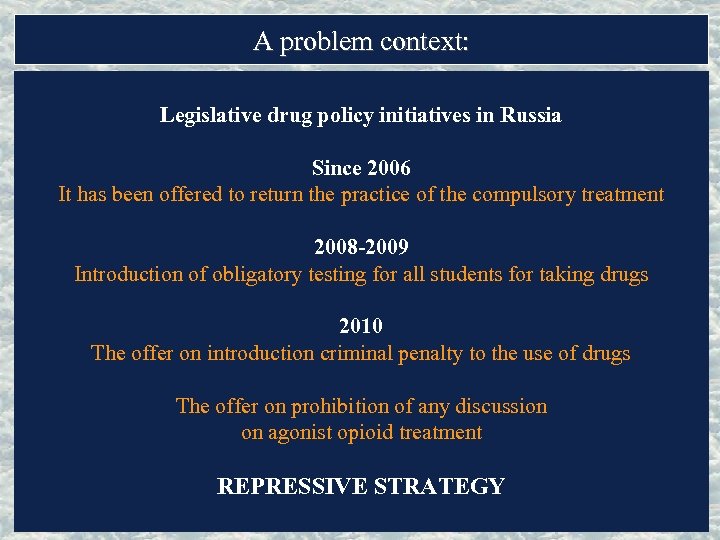
A problem context: Legislative drug policy initiatives in Russia Since 2006 It has been offered to return the practice of the compulsory treatment 2008 -2009 Introduction of obligatory testing for all students for taking drugs 2010 The offer on introduction criminal penalty to the use of drugs The offer on prohibition of any discussion on agonist opioid treatment REPRESSIVE STRATEGY

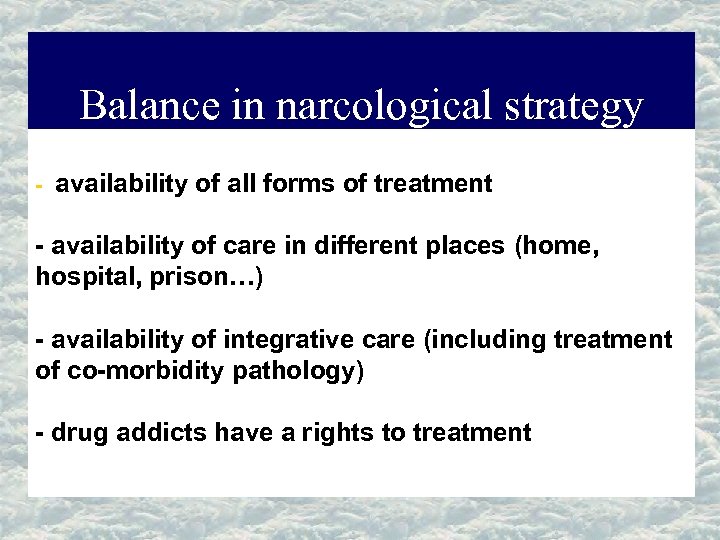
Balance in narcological strategy - availability of all forms of treatment - availability of care in different places (home, hospital, prison…) - availability of integrative care (including treatment of co-morbidity pathology) - drug addicts have a rights to treatment

Balance Liberal
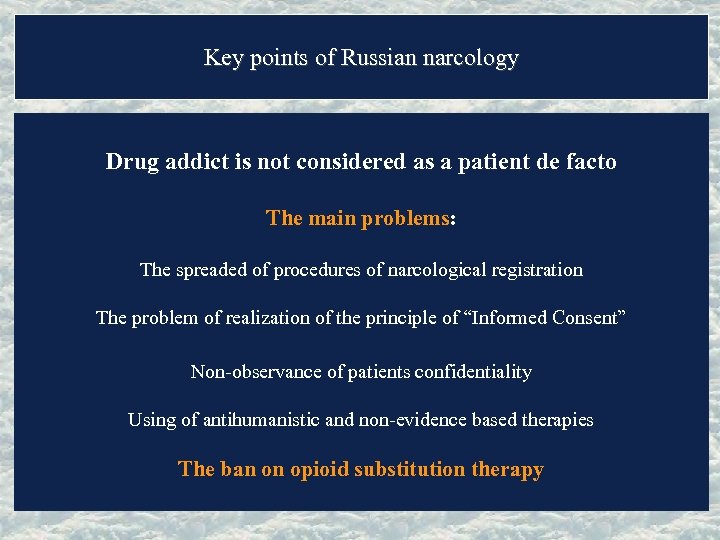
Key points of Russian narcology Drug addict is not considered as a patient de facto The main problems: The spreaded of procedures of narcological registration The problem of realization of the principle of “Informed Consent” Non-observance of patients confidentiality Using of antihumanistic and non-evidence based therapies The ban on opioid substitution therapy
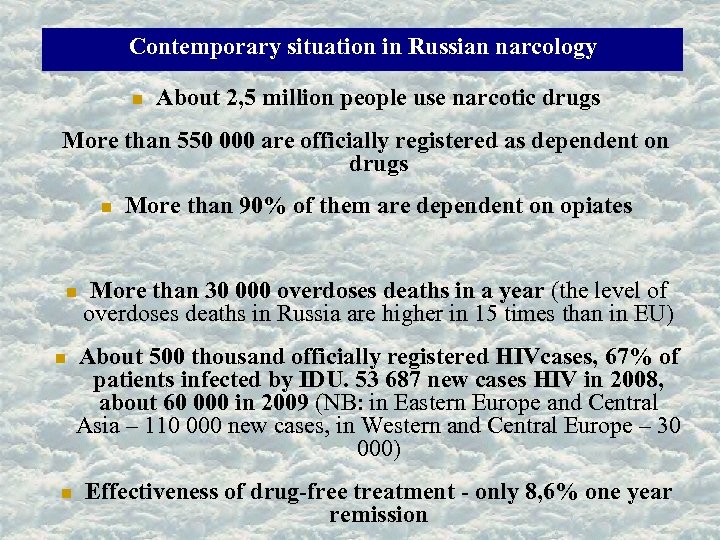
Contemporary situation in Russian narcology About 2, 5 million people use narcotic drugs More than 550 000 are officially registered as dependent on drugs More than 90% of them are dependent on opiates More than 30 000 overdoses deaths in a year (the level of overdoses deaths in Russia are higher in 15 times than in EU) About 500 thousand officially registered HIVcases, 67% of patients infected by IDU. 53 687 new cases HIV in 2008, about 60 000 in 2009 (NB: in Eastern Europe and Central Asia – 110 000 new cases, in Western and Central Europe – 30 000) Effectiveness of drug-free treatment - only 8, 6% one year remission
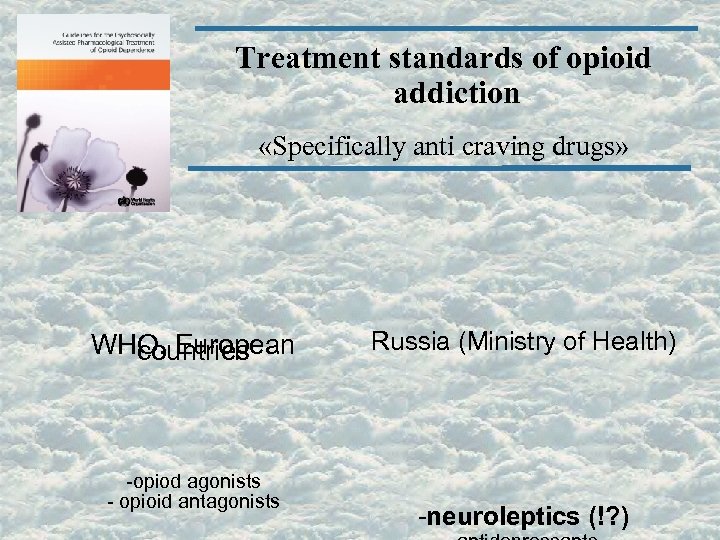
Treatment standards of opioid addiction «Specifically anti craving drugs» WHO, European countries -opiod agonists - opioid antagonists Russia (Ministry of Health) -neuroleptics (!? )
The types of “treatments” used in Russia (“coding”) More than 80% of treatment is a shortterm psychotherapy, co -called “coding” (classical or Ericsonian hypnosis).
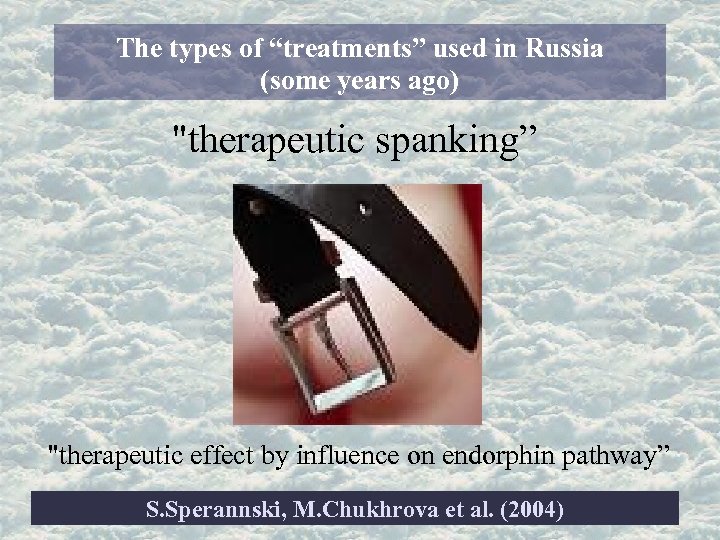
The types of “treatments” used in Russia (some years ago) "therapeutic spanking” "therapeutic effect by influence on endorphin pathway” S. Sperannski, M. Chukhrova et al. (2004)
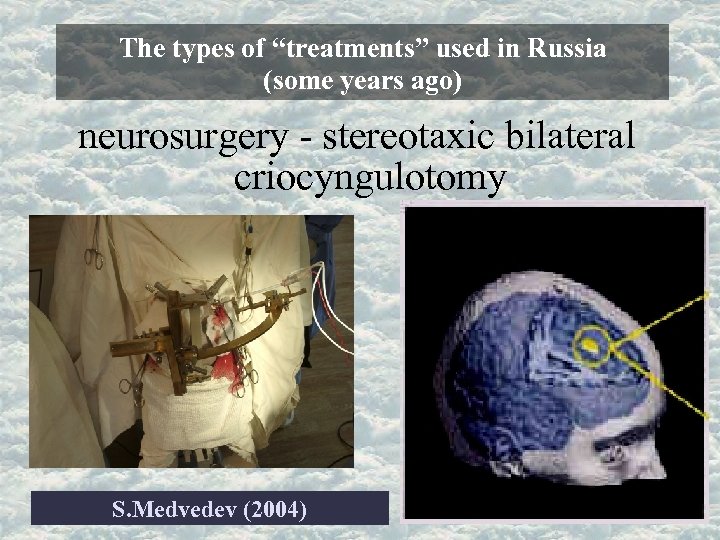
The types of “treatments” used in Russia (some years ago) neurosurgery - stereotaxic bilateral criocyngulotomy S. Medvedev (2004)
Ban on opioid substitution therapy in Russia The Federal Law prohibits “treating drug addiction with substances from List 2” (List № 2 includes buprenorphine, while methadone is in List № 1, and its use is illegal for any medical or scientific purpose).
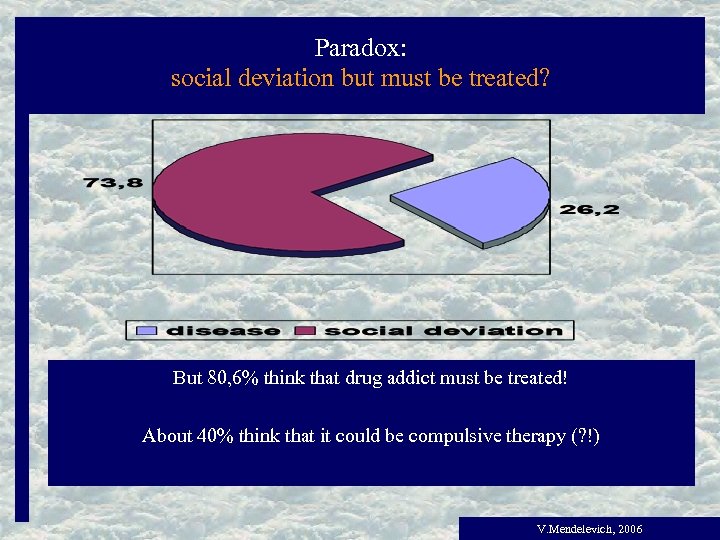
Paradox: social deviation but must be treated? But 80, 6% think that drug addict must be treated! About 40% think that it could be compulsive therapy (? !) V. Mendelevich, 2006
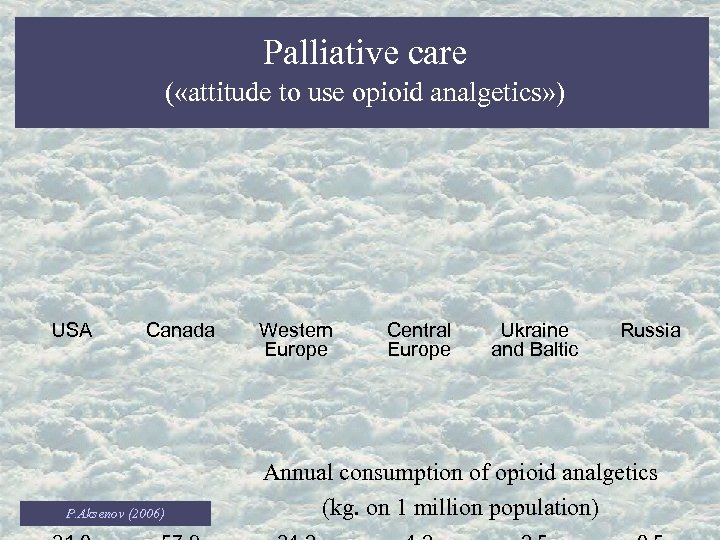
Palliative care ( «attitude to use opioid analgetics» ) USA Canada P. Aksenov (2006) Western Europe Central Europe Ukraine and Baltic Russia Annual consumption of opioid analgetics (kg. on 1 million population)
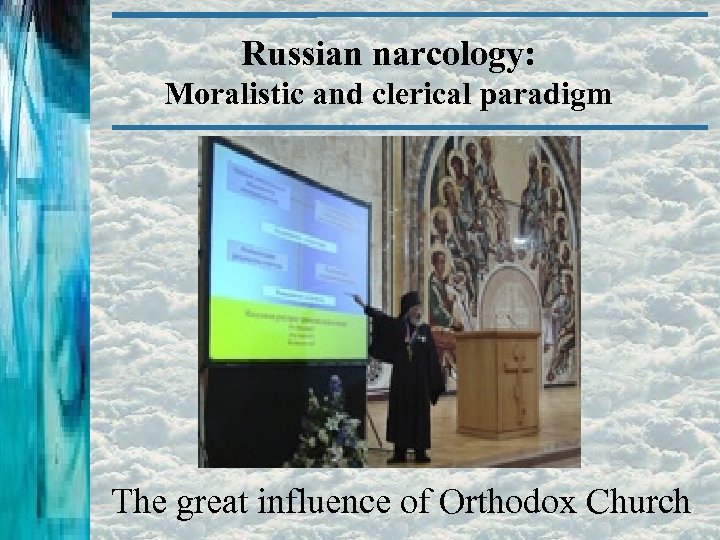
Russian narcology: Moralistic and clerical paradigm The great influence of Orthodox Church
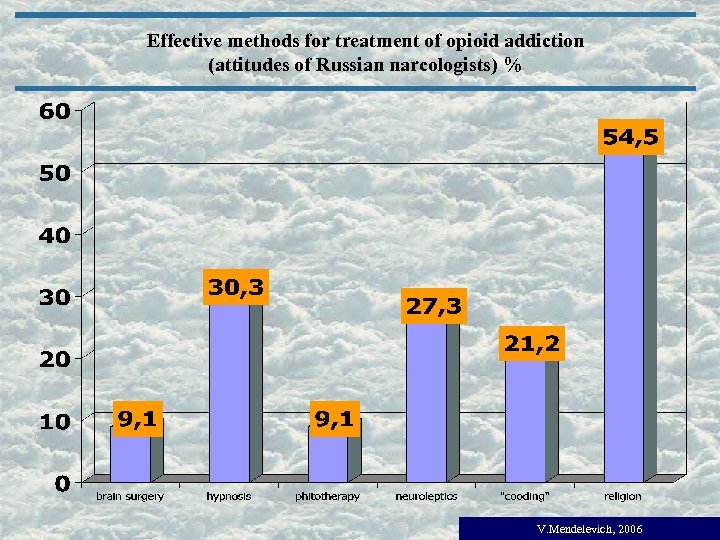
Effective methods for treatment of opioid addiction (attitudes of Russian narcologists) % V. Mendelevich, 2006
Why Russian experts say No to Methadone? There is no easy answer Legal, cultural, ideological and ethical “It is impossible to understand Russia by reason…” Fedor Tutchev (well-know Russian poet) barriers
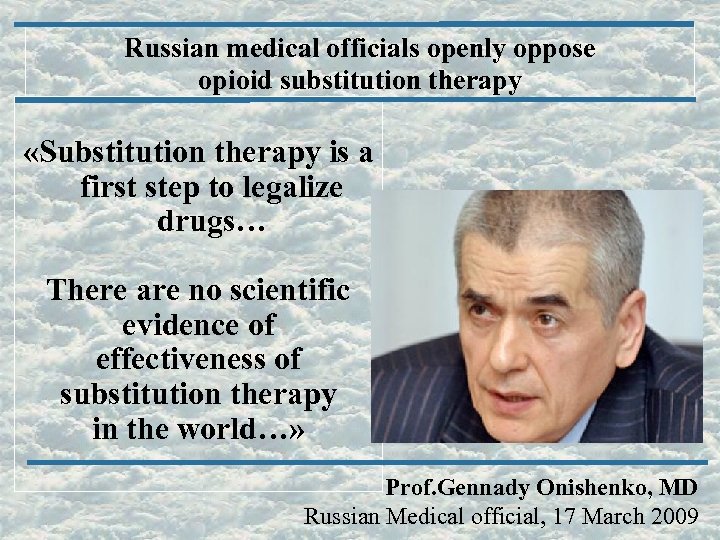
Russian medical officials openly oppose opioid substitution therapy «Substitution therapy is a first step to legalize drugs… There are no scientific evidence of effectiveness of substitution therapy in the world…» Prof. Gennady Onishenko, MD Russian Medical official, 17 March 2009
The main bioethical problem of narcology Medical doctors don’t consider drug addiction (dependence) as a “real illness”, equal to other diseases.
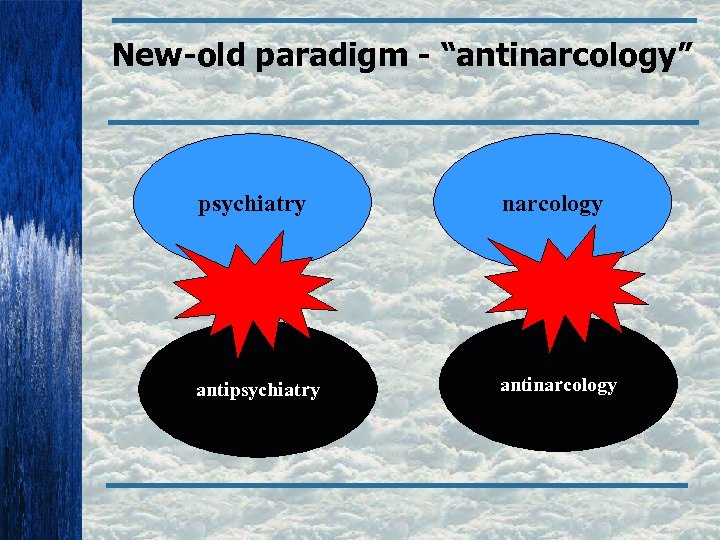
New-old paradigm - “antinarcology” psychiatry narcology antipsychiatry antinarcology
“Some drug addiction treatments are not based on professional ethics” WHO
The main question: Why does narcology (drug addiction treatment) have special point of view on bioethical norms?
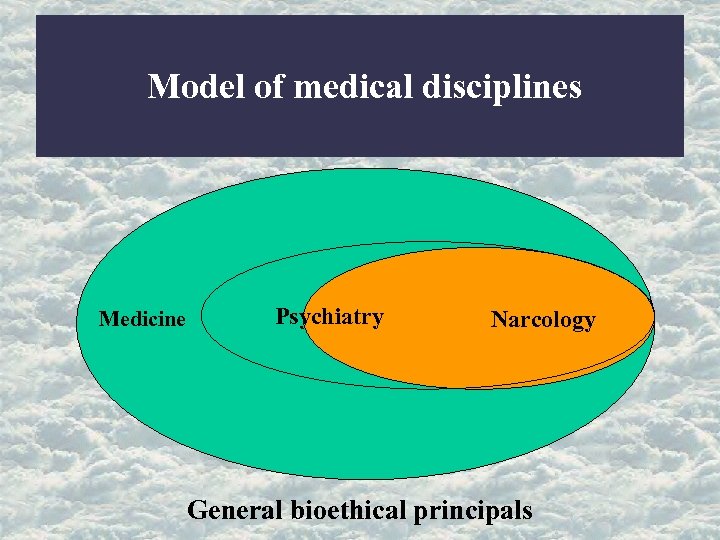
Model of medical disciplines Medicine Psychiatry Narcology General bioethical principals
Areas of bioethical principals - Patients confidentiality Abortion Euthanasia Truth-Telling Sexual contacts with patients Professional affiliations Justice of the distribution of health system - Patient benefit
Biomedical problems of Narcology - The problem of realization of the principle of “Informed Consent” - Drug-free strategy as a rule for making treatment - Neomoralistic approach - Involuntary treatment - Ban on the substitution opioid maintenance therapy
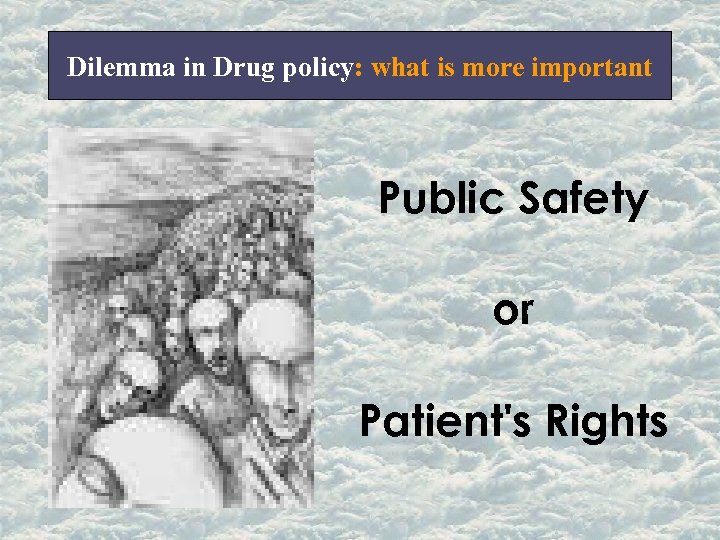
Dilemma in Drug policy: what is more important Public Safety or Patient's Rights
Sociological study (2009) The purpose: the study of bioethical choices of supporters and opponents of AOT (OST). The research group consisted of experts providing drug treatment services (n = 246). 62% - psychiatrists, 15% medical psychologists, 23% - other specialists on drug treatment. Respondents filled out an anonymous questionnaire that consisted of 19 questions concerning various issues in modern bioethics: euthanasia, abortion, cloning, involuntary treatment and testing, surgical changes of sex, placebo-controlled trails, patients confidentiality, patients rights for child-bearing, HR programs
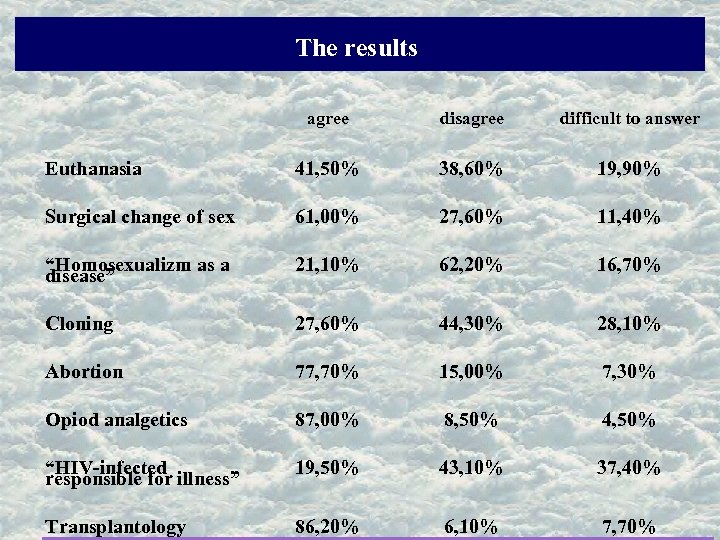
The results agree disagree difficult to answer Euthanasia 41, 50% 38, 60% 19, 90% Surgical change of sex 61, 00% 27, 60% 11, 40% “Homosexualizm as a disease” 21, 10% 62, 20% 16, 70% Cloning 27, 60% 44, 30% 28, 10% Abortion 77, 70% 15, 00% 7, 30% Opiod analgetics 87, 00% 8, 50% 4, 50% “HIV-infected responsible for illness” 19, 50% 43, 10% 37, 40% Transplantology 86, 20% 6, 10% 7, 70%
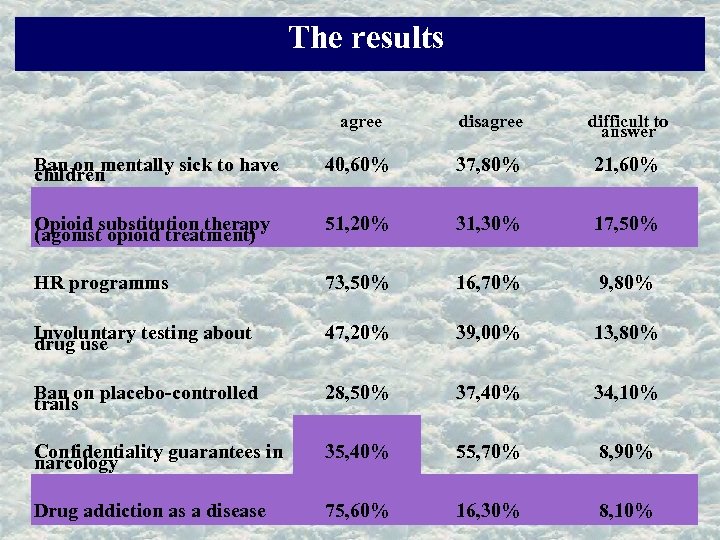
The results agree disagree difficult to answer Ban on mentally sick to have children 40, 60% 37, 80% 21, 60% Opioid substitution therapy (agonist opioid treatment) 51, 20% 31, 30% 17, 50% HR programms 73, 50% 16, 70% 9, 80% Involuntary testing about drug use 47, 20% 39, 00% 13, 80% Ban on placebo-controlled trails 28, 50% 37, 40% 34, 10% Confidentiality guarantees in narcology 35, 40% 55, 70% 8, 90% Drug addiction as a disease 75, 60% 16, 30% 8, 10%
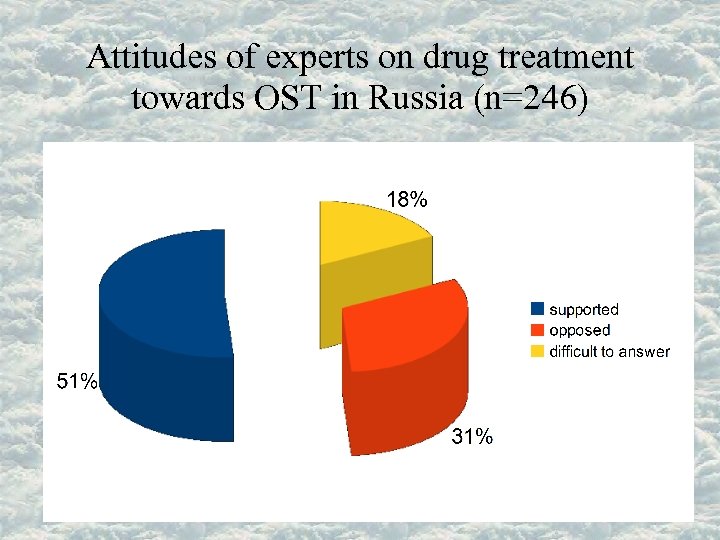
Attitudes of experts on drug treatment towards OST in Russia (n=246)
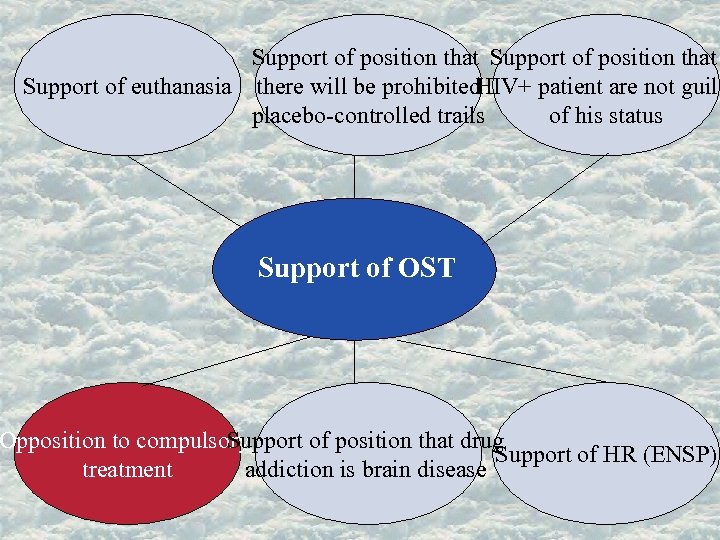
Support of position that Support of euthanasia there will be prohibited HIV+ patient are not guilt placebo-controlled trails of his status Support of OST Opposition to compulsory Support of position that drug Support of HR (ENSP) treatment addiction is brain disease
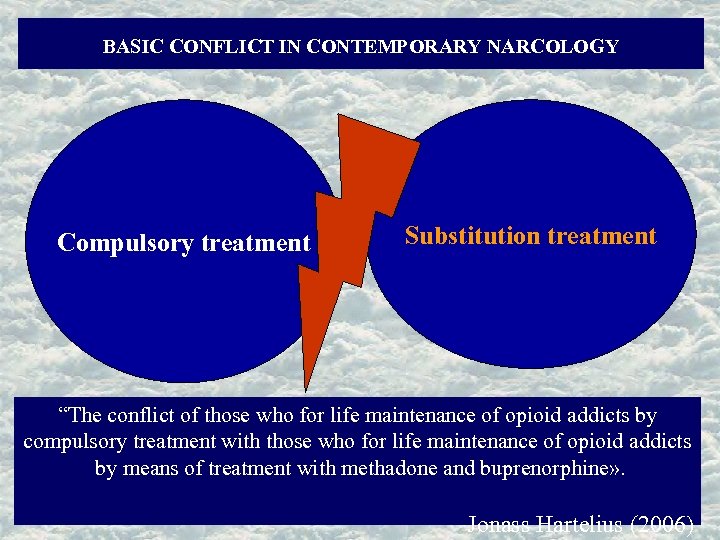
BASIC CONFLICT IN CONTEMPORARY NARCOLOGY Compulsory treatment Substitution treatment “The conflict of those who for life maintenance of opioid addicts by compulsory treatment with those who for life maintenance of opioid addicts by means of treatment with methadone and buprenorphine» . Jonass Hartelius (2006)
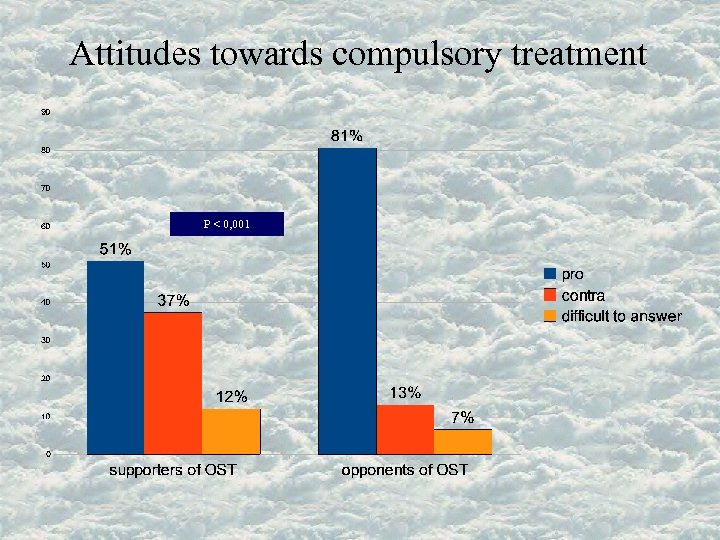
Attitudes towards compulsory treatment P < 0, 001
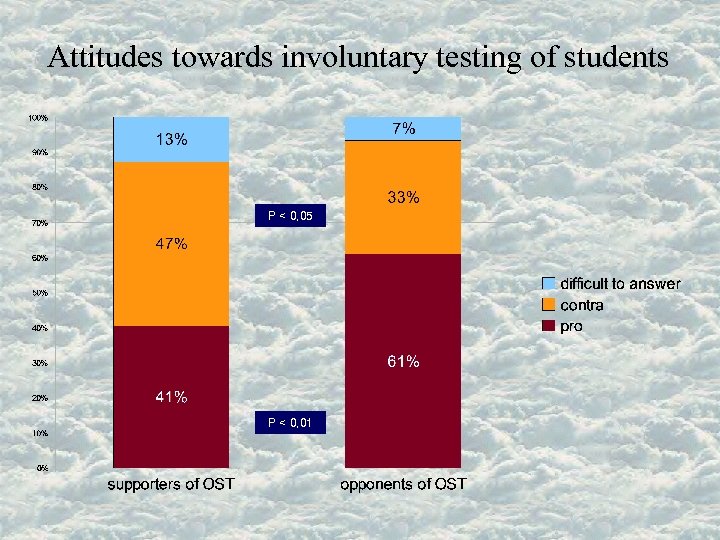
Attitudes towards involuntary testing of students P < 0, 05 P < 0, 01
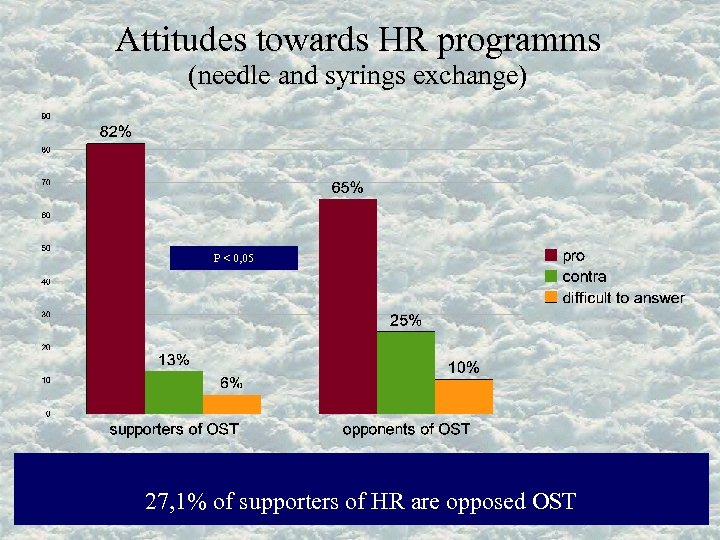
Attitudes towards HR programms (needle and syrings exchange) P < 0, 05 27, 1% of supporters of HR are opposed OST
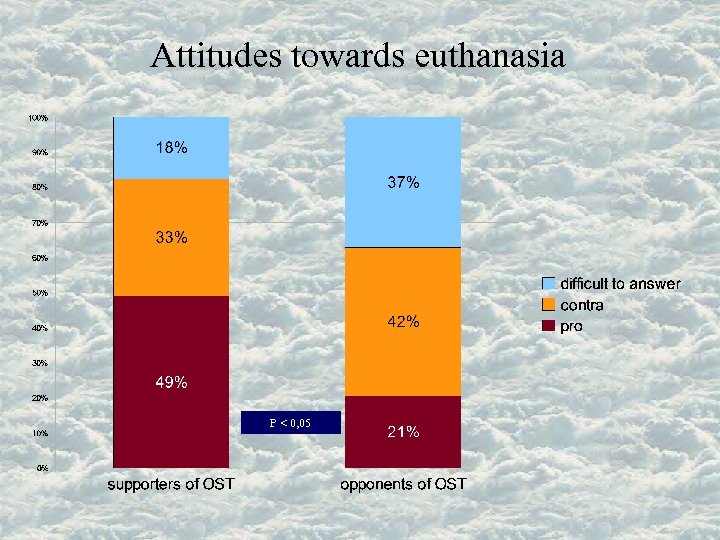
Attitudes towards euthanasia P < 0, 05
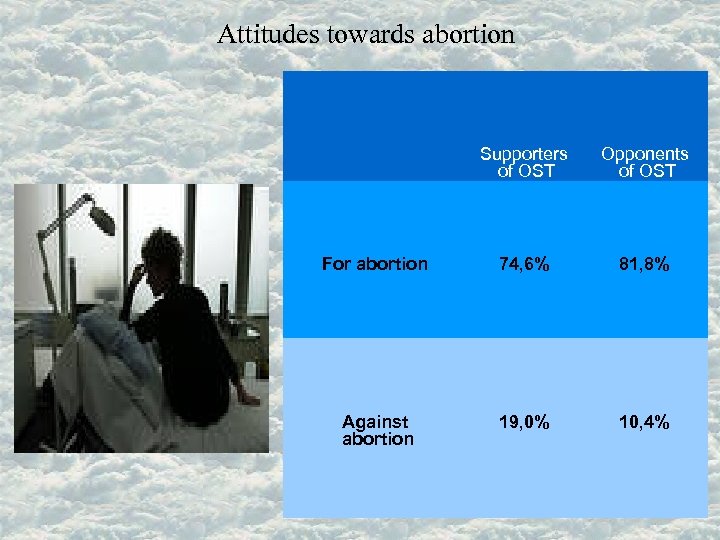
Attitudes towards abortion Supporters of OST Opponents of OST For abortion 74, 6% 81, 8% Against abortion 19, 0% 10, 4%
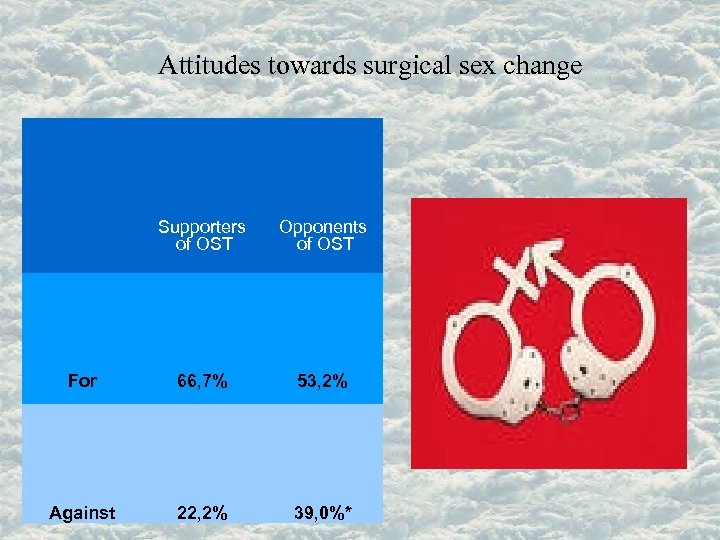
Attitudes towards surgical sex change Supporters of OST Opponents of OST For 66, 7% 53, 2% Against 22, 2% 39, 0%*
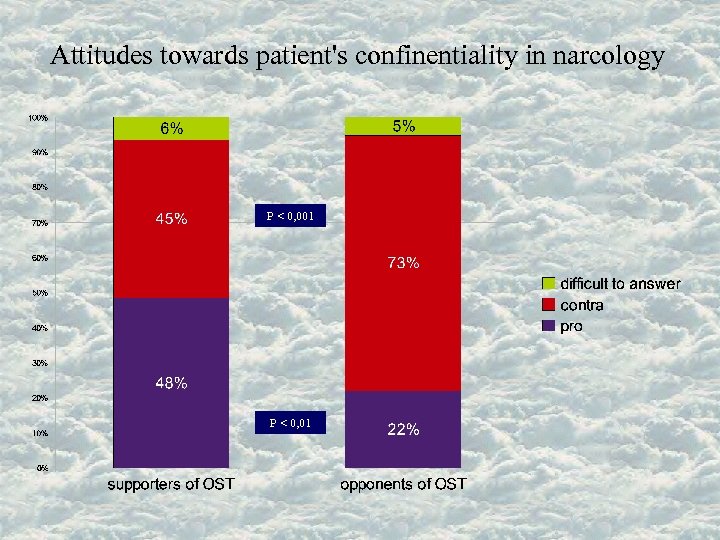
Attitudes towards patient's confinentiality in narcology P < 0, 001 P < 0, 01
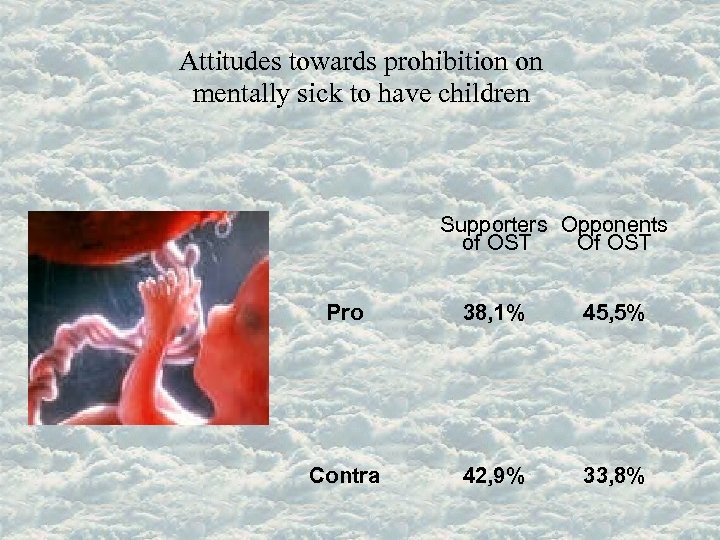
Attitudes towards prohibition on mentally sick to have children Supporters Opponents of OST Of OST Pro 38, 1% 45, 5% Contra 42, 9% 33, 8%
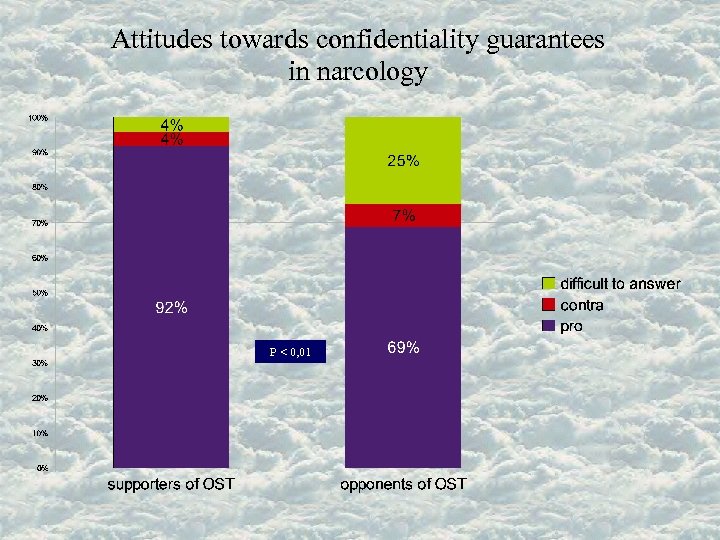
Attitudes towards confidentiality guarantees in narcology P < 0, 01
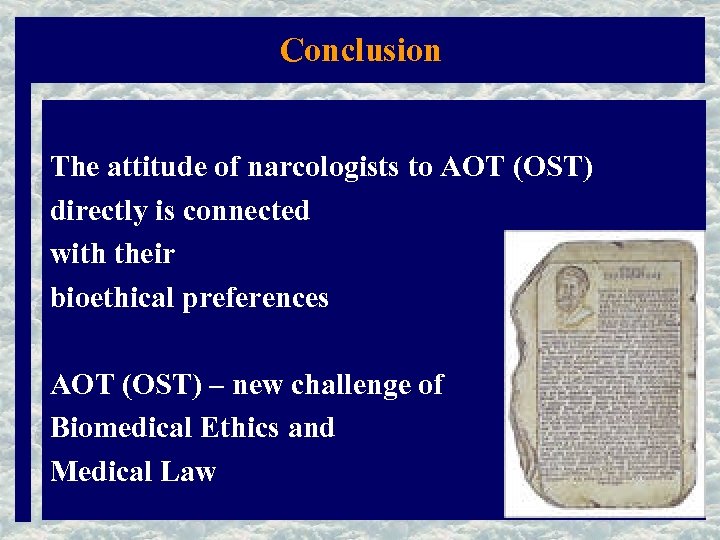
Conclusion The attitude of narcologists to AOT (OST) directly is connected with their bioethical preferences AOT (OST) – new challenge of Biomedical Ethics and Medical Law
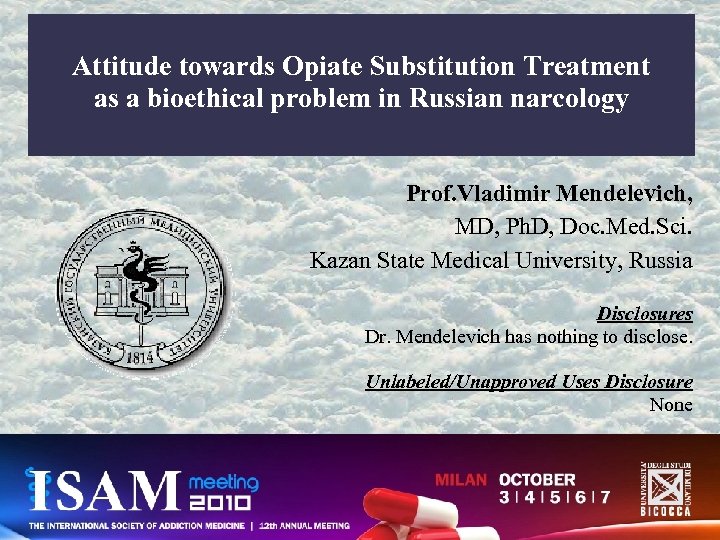
Attitude towards Opiate Substitution Treatment as a bioethical problem in Russian narcology Prof. Vladimir Mendelevich, MD, Ph. D, Doc. Med. Sci. Kazan State Medical University, Russia Disclosures Dr. Mendelevich has nothing to disclose. Unlabeled/Unapproved Uses Disclosure None
Скачать презентацию Attitude towards Opiate Substitution Treatment as a bioethical
a3ed385661db23399af8daa9d0509095.ppt