 Скачать презентацию Attitude Does a little thing make a big
be64c84e029908e839da7b7179217811.ppt
- Количество слайдов: 34



Attitude: Does a little thing make a big difference? An analysis of the Westpac-Melbourne Institute consumer sentiment index and its component indices Danielle Brooker
Outline l l l Significance of consumer sentiment surveys Westpac-Melbourne Institute consumer sentiment survey Recent trends Purpose of the research Methodology Key results
Consumer sentiment l l Link between future and present economic activity Indicators of growth and spending Assist decision making In the context of the global financial crisis, watched closely by economists
Westpac-Melbourne Institute Consumer Sentiment Survey l l l Conducted over a period of four days in the first half of the month 1200 respondents Available three months before release of official economic indicators
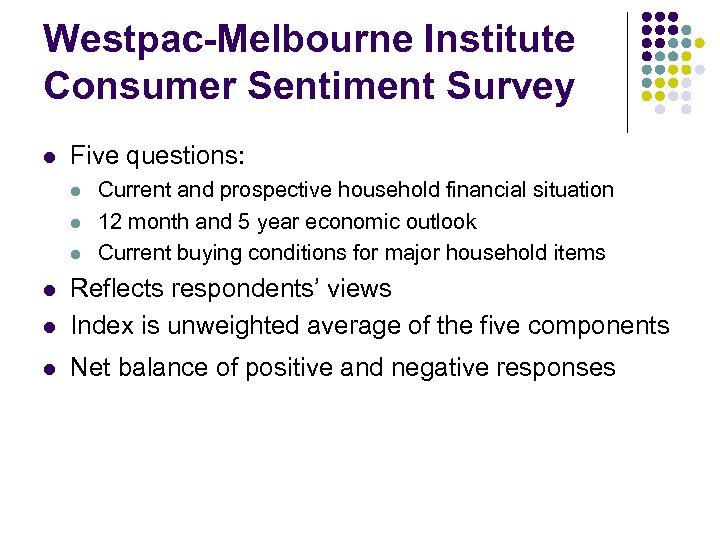
Westpac-Melbourne Institute Consumer Sentiment Survey l Five questions: l l l Current and prospective household financial situation 12 month and 5 year economic outlook Current buying conditions for major household items l Reflects respondents’ views Index is unweighted average of the five components l Net balance of positive and negative responses l
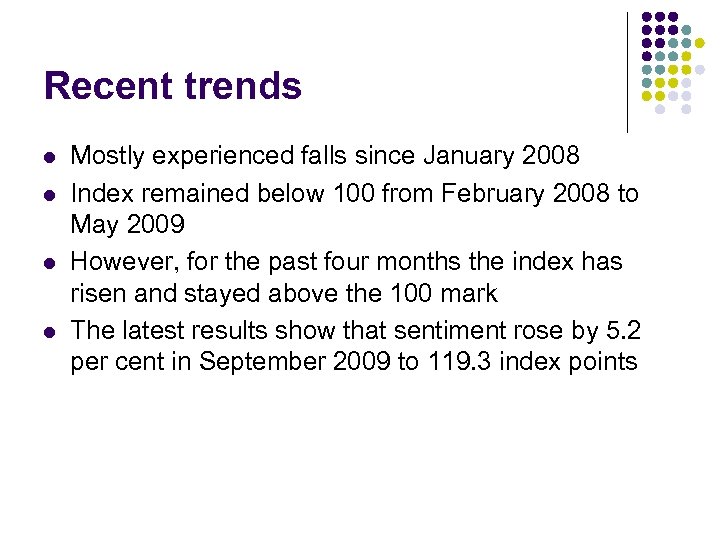
Recent trends l l Mostly experienced falls since January 2008 Index remained below 100 from February 2008 to May 2009 However, for the past four months the index has risen and stayed above the 100 mark The latest results show that sentiment rose by 5. 2 per cent in September 2009 to 119. 3 index points
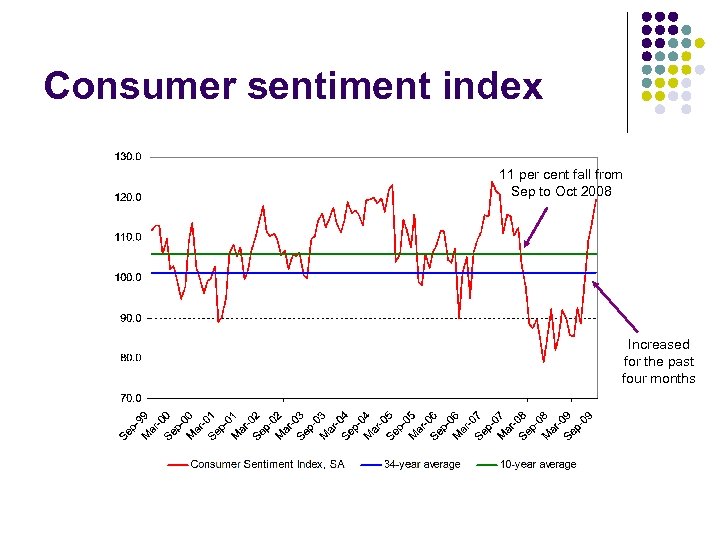
Consumer sentiment index 11 per cent fall from Sep to Oct 2008 Increased for the past four months
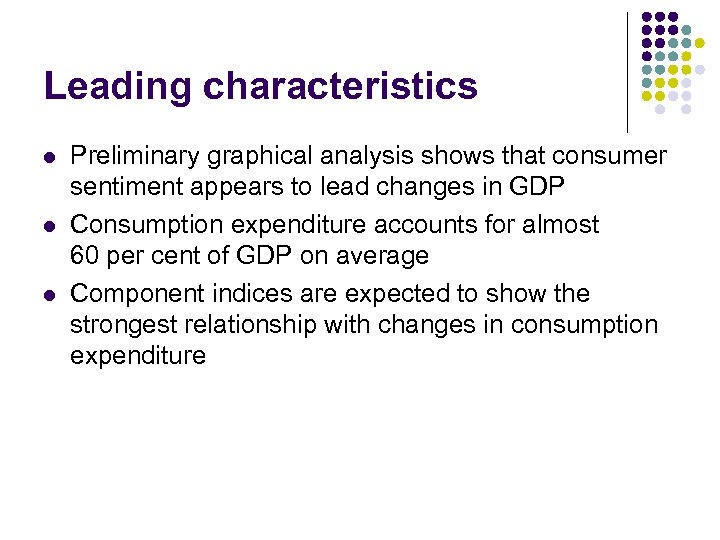
Leading characteristics l l l Preliminary graphical analysis shows that consumer sentiment appears to lead changes in GDP Consumption expenditure accounts for almost 60 per cent of GDP on average Component indices are expected to show the strongest relationship with changes in consumption expenditure
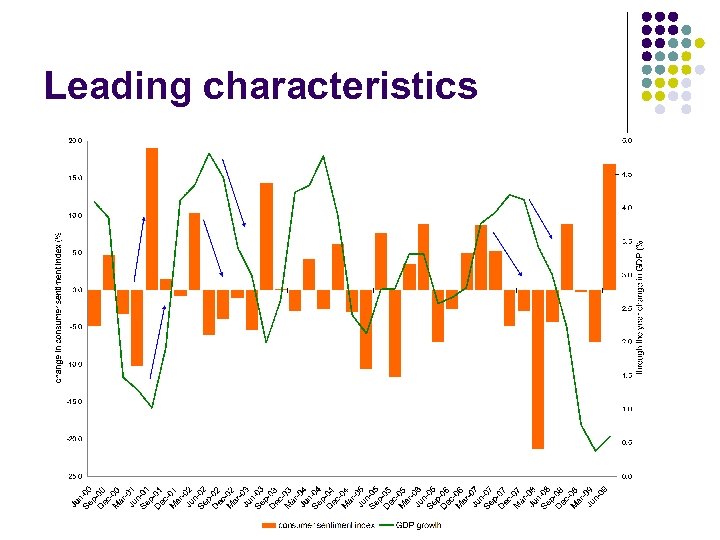
Leading characteristics
Purpose of the research l Analyse extent to which component indices are indicators of economic growth, consumption and other economic variables Identify leading or lagging characteristics l Extends past research l l l Includes most recently available data Initial effects of the global financial crisis
Component indices l l l FIN: Family finances compared to a year ago FIN 12: Family finances for the next 12 months ECON: Economic conditions for the next 5 years ECON 12: Economic conditions for the next 12 months HH: Time to buy household items
Economic indicators l l l Private consumption expenditure Average weekly earnings Disposable income Consumer price index Variable mortgage rates Price return on all ordinaries index Petrol prices House prices GDP Unemployment rate Exchange rate
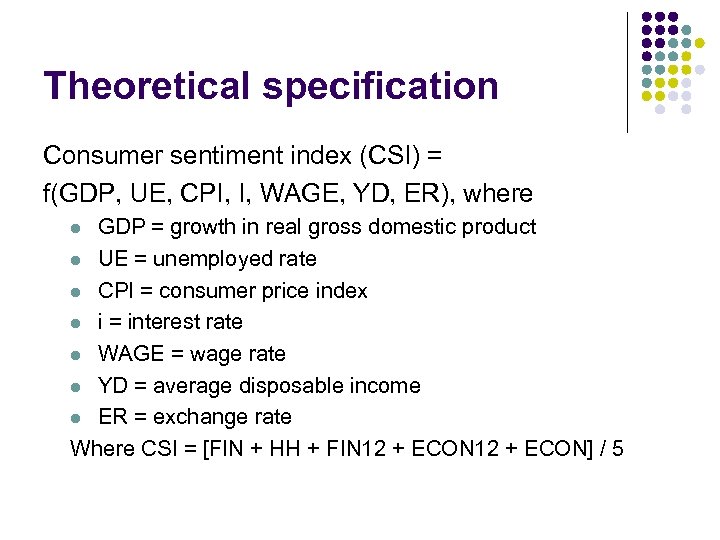
Theoretical specification Consumer sentiment index (CSI) = f(GDP, UE, CPI, I, WAGE, YD, ER), where GDP = growth in real gross domestic product l UE = unemployed rate l CPI = consumer price index l i = interest rate l WAGE = wage rate l YD = average disposable income l ER = exchange rate Where CSI = [FIN + HH + FIN 12 + ECON] / 5 l
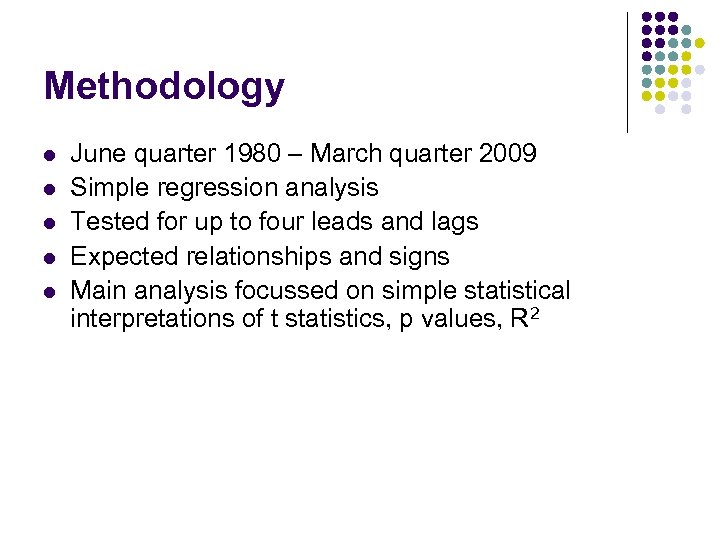
Methodology l l l June quarter 1980 – March quarter 2009 Simple regression analysis Tested for up to four leads and lags Expected relationships and signs Main analysis focussed on simple statistical interpretations of t statistics, p values, R 2
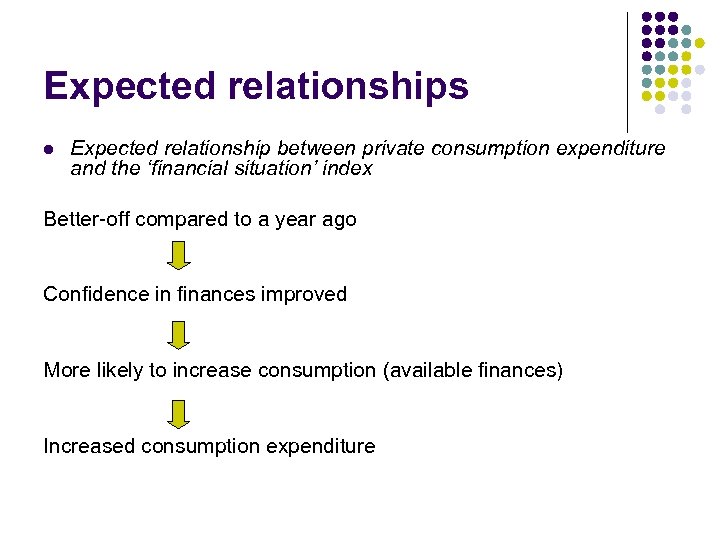
Expected relationships l Expected relationship between private consumption expenditure and the ‘financial situation’ index Better-off compared to a year ago Confidence in finances improved More likely to increase consumption (available finances) Increased consumption expenditure
Results
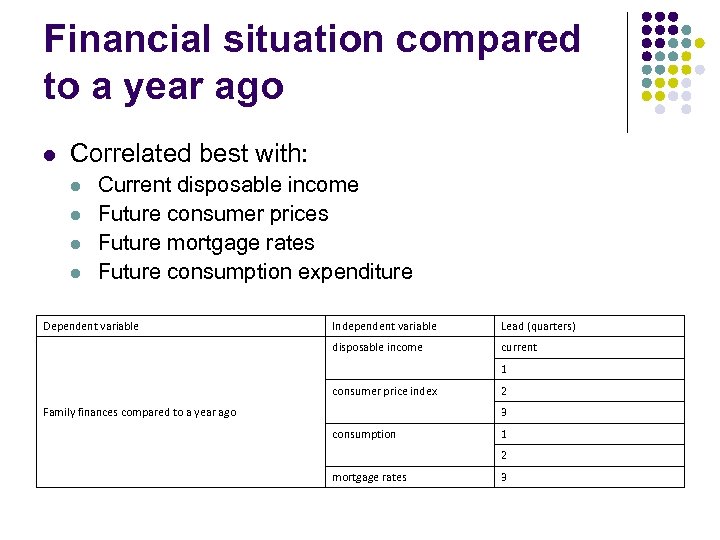
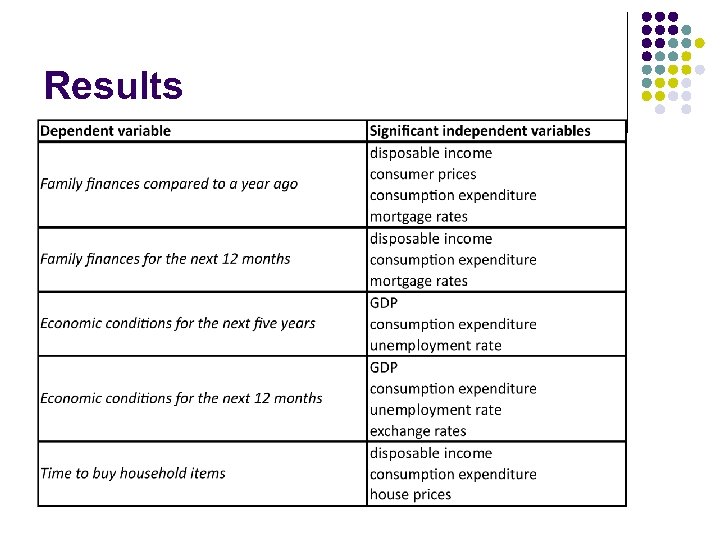
Financial situation compared to a year ago l Correlated best with: l l Current disposable income Future consumer prices Future mortgage rates Future consumption expenditure Dependent variable Lead (quarters) disposable income current 1 consumer price index Family finances compared to a year ago Independent variable 2 3 consumption 1 2 mortgage rates 3
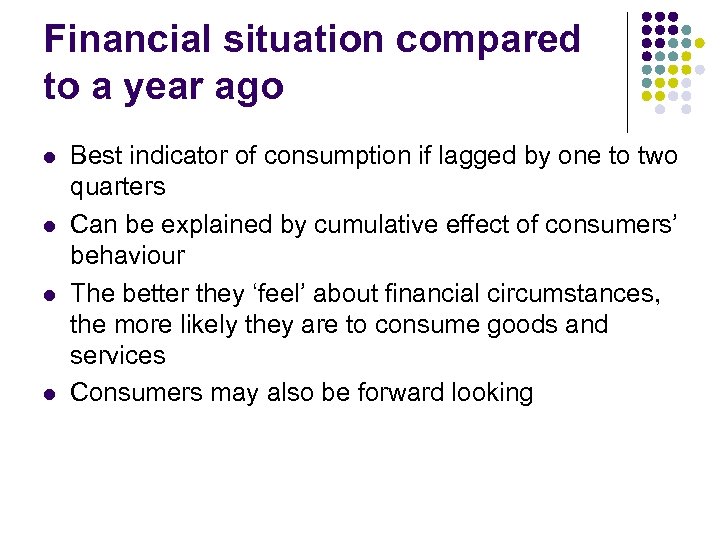
Financial situation compared to a year ago l l Best indicator of consumption if lagged by one to two quarters Can be explained by cumulative effect of consumers’ behaviour The better they ‘feel’ about financial circumstances, the more likely they are to consume goods and services Consumers may also be forward looking
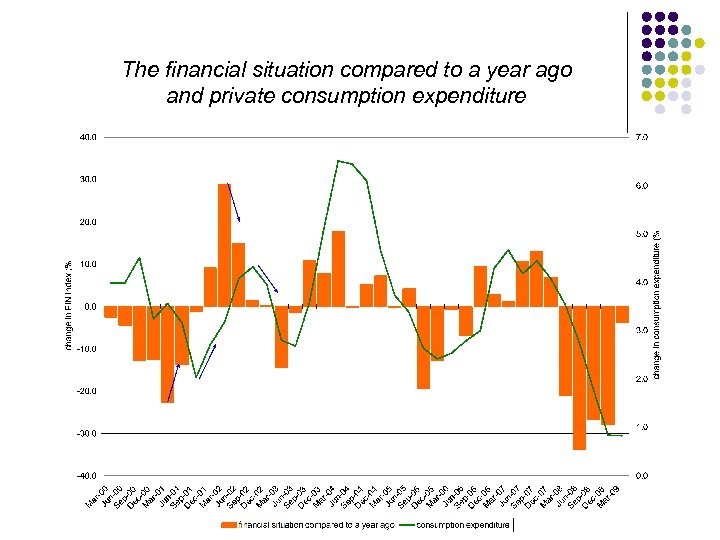
The financial situation compared to a year ago and private consumption expenditure
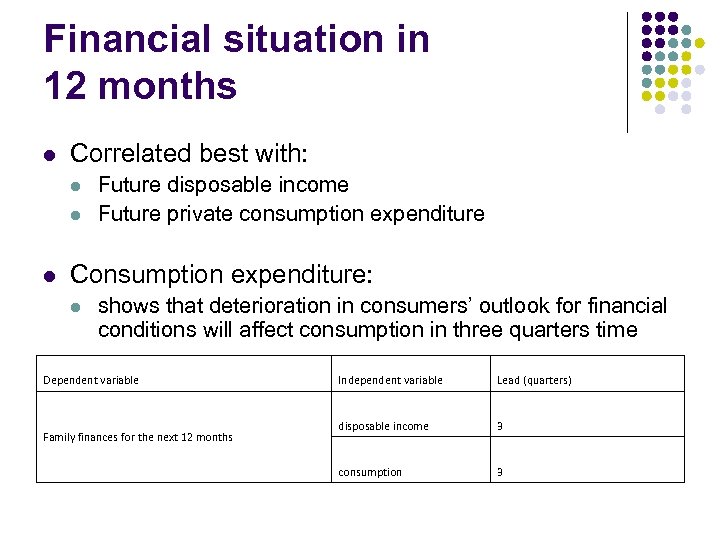
Financial situation in 12 months l Correlated best with: l l l Future disposable income Future private consumption expenditure Consumption expenditure: l shows that deterioration in consumers’ outlook for financial conditions will affect consumption in three quarters time Dependent variable Family finances for the next 12 months Independent variable Lead (quarters) disposable income 3 consumption 3
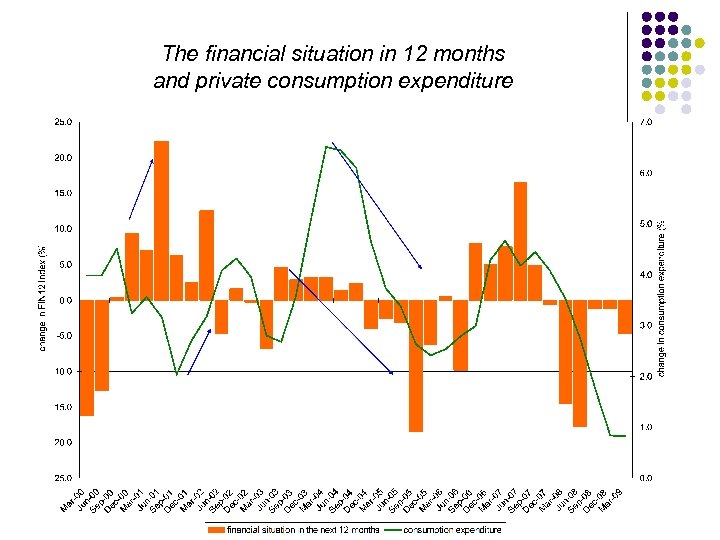
The financial situation in 12 months and private consumption expenditure
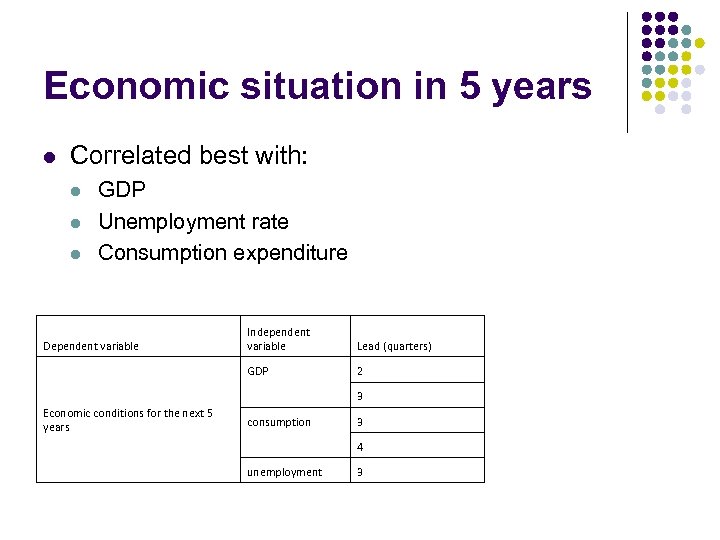
Economic situation in 5 years l Correlated best with: l l l GDP Unemployment rate Consumption expenditure 2 Economic conditions for the next 5 years Lead (quarters) GDP Dependent variable Independent variable 3 consumption 3 4 unemployment 3
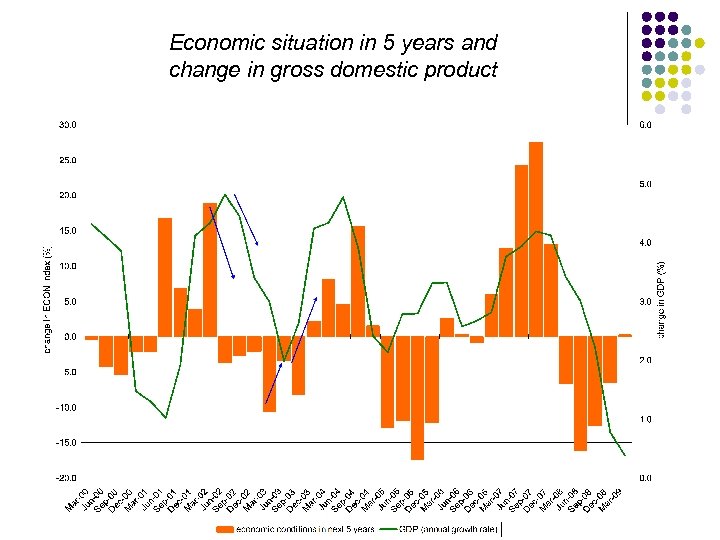
Economic situation in 5 years and change in gross domestic product
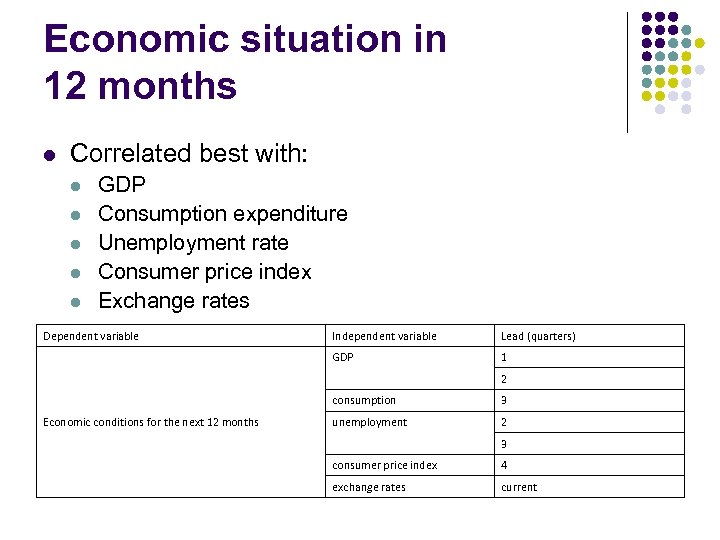
Economic situation in 12 months l Correlated best with: l l l GDP Consumption expenditure Unemployment rate Consumer price index Exchange rates Dependent variable Lead (quarters) GDP 1 2 consumption Economic conditions for the next 12 months Independent variable 3 unemployment 2 3 consumer price index 4 exchange rates current
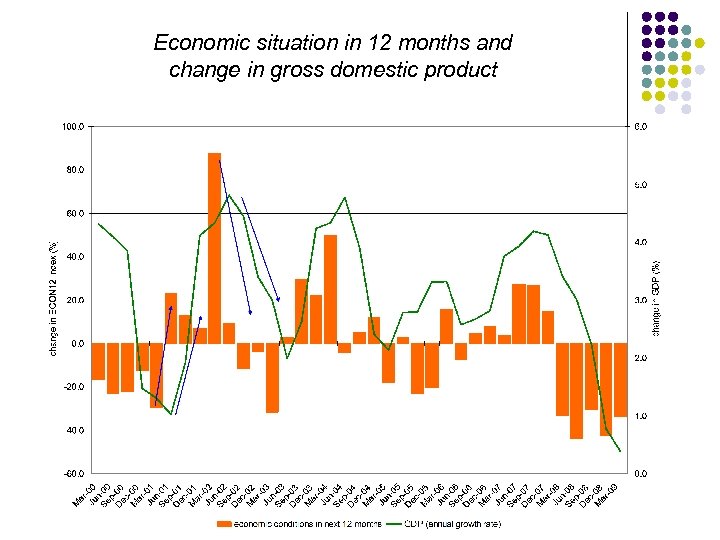
Economic situation in 12 months and change in gross domestic product
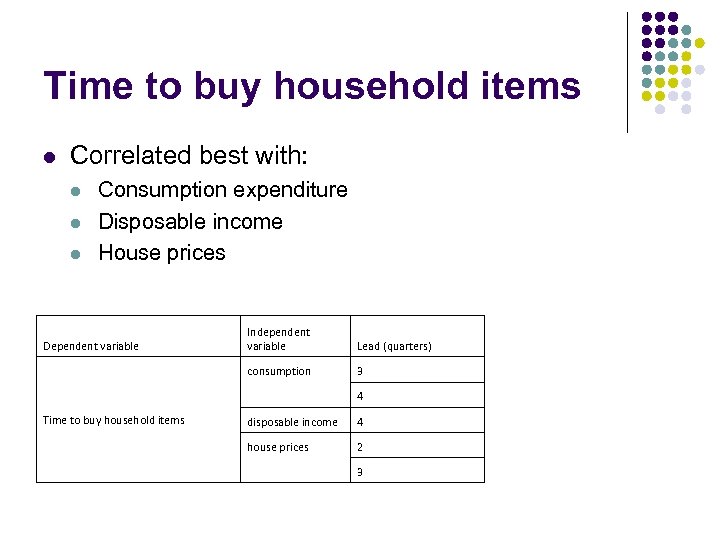
Time to buy household items l Correlated best with: l l l Consumption expenditure Disposable income House prices 3 Time to buy household items Lead (quarters) consumption Dependent variable Independent variable 4 disposable income 4 house prices 2 3
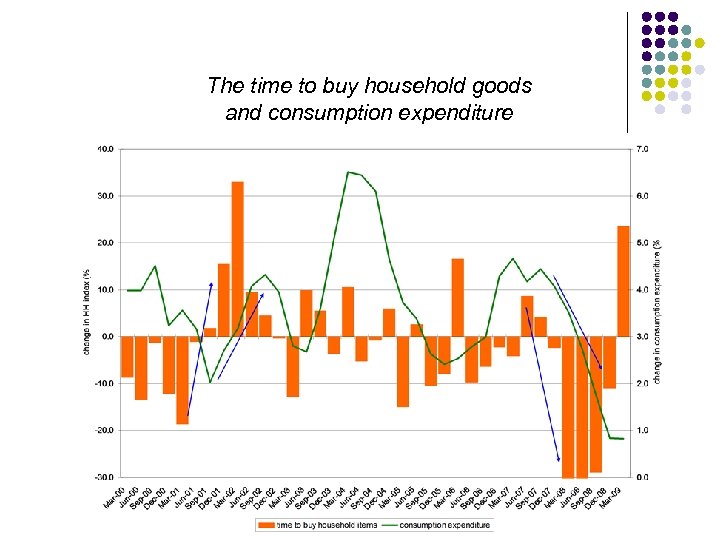
The time to buy household goods and consumption expenditure
Summary l l Component indices provide useful indicators of economic variables Leading characteristics Most significant relationship with consumption expenditure Further research

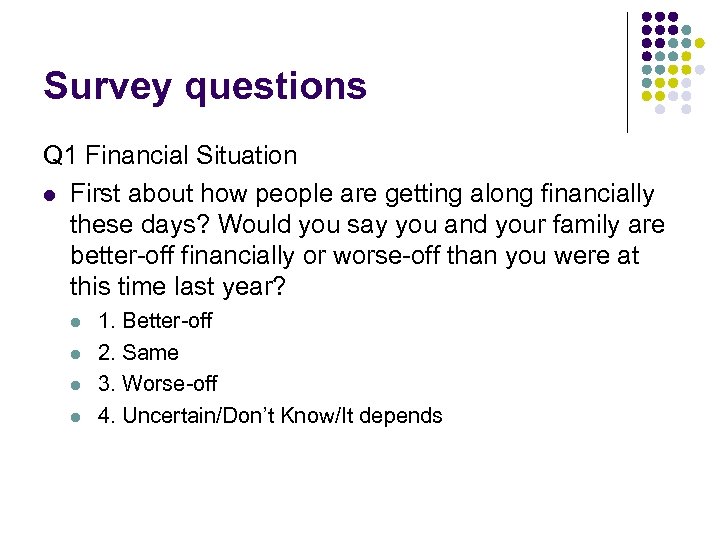
Survey questions Q 1 Financial Situation l First about how people are getting along financially these days? Would you say you and your family are better-off financially or worse-off than you were at this time last year? l l 1. Better-off 2. Same 3. Worse-off 4. Uncertain/Don’t Know/It depends
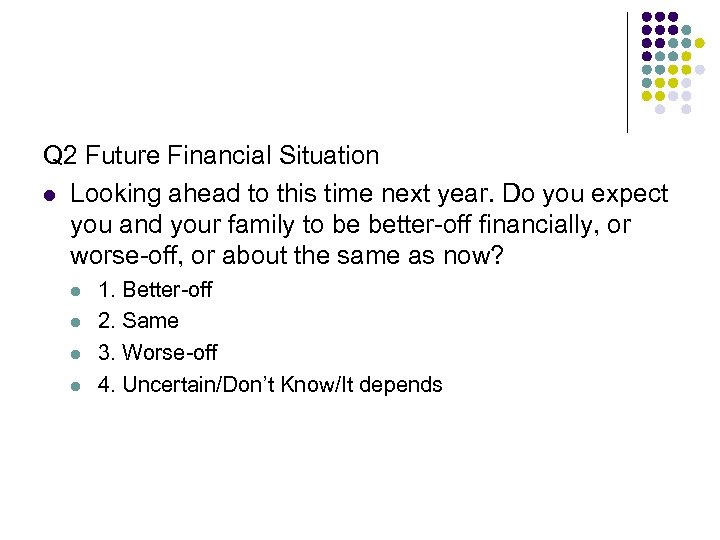
Q 2 Future Financial Situation l Looking ahead to this time next year. Do you expect you and your family to be better-off financially, or worse-off, or about the same as now? l l 1. Better-off 2. Same 3. Worse-off 4. Uncertain/Don’t Know/It depends
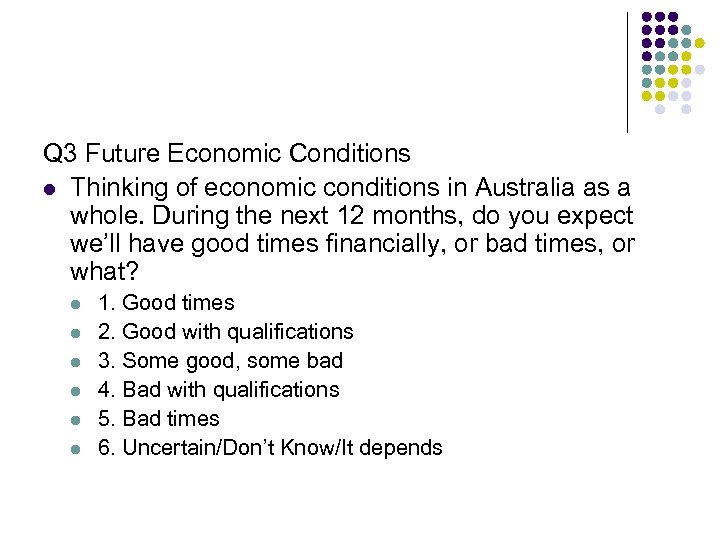
Q 3 Future Economic Conditions l Thinking of economic conditions in Australia as a whole. During the next 12 months, do you expect we’ll have good times financially, or bad times, or what? l l l 1. Good times 2. Good with qualifications 3. Some good, some bad 4. Bad with qualifications 5. Bad times 6. Uncertain/Don’t Know/It depends
![Q 4 Five-Year Economic Forecast [ECON] l Looking ahead, what would you say is](https://present5.com/presentation/be64c84e029908e839da7b7179217811/image-33.jpg "Q 4 Five-Year Economic Forecast [ECON] l Looking ahead, what would you say is")
Q 4 Five-Year Economic Forecast [ECON] l Looking ahead, what would you say is more likely? That in Australia as a whole, we’ll have continuous good times during the next five years or so, or we’ll have some bad times—or what? l l l 1. Continuous good times 2. Good with qualifications 3. Some good, some bad 4. Some bad with qualifications 5. Some bad times 6. Uncertain/Don’t Know/It depends
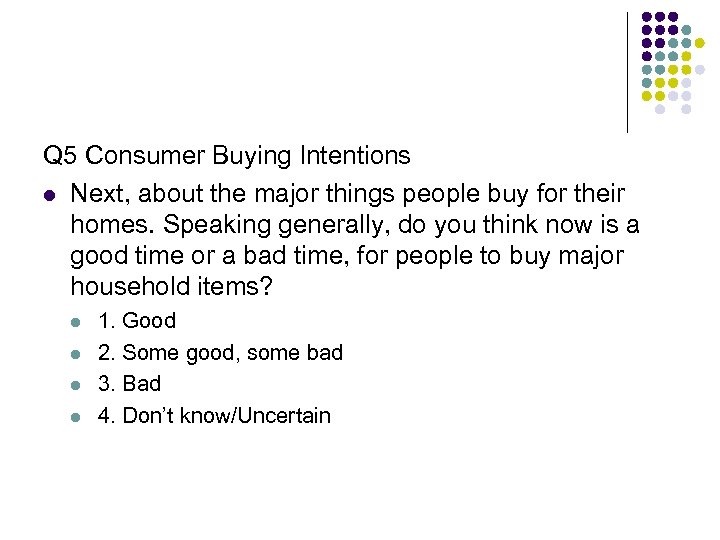
Q 5 Consumer Buying Intentions l Next, about the major things people buy for their homes. Speaking generally, do you think now is a good time or a bad time, for people to buy major household items? l l 1. Good 2. Some good, some bad 3. Bad 4. Don’t know/Uncertain
Скачать презентацию Attitude Does a little thing make a big
be64c84e029908e839da7b7179217811.ppt