


 Скачать презентацию Attitude Determination and Control Dr Andrew Ketsdever MAE
37f8c54b6e7599dbdd80cf4987b062b7.ppt
- Количество слайдов: 42
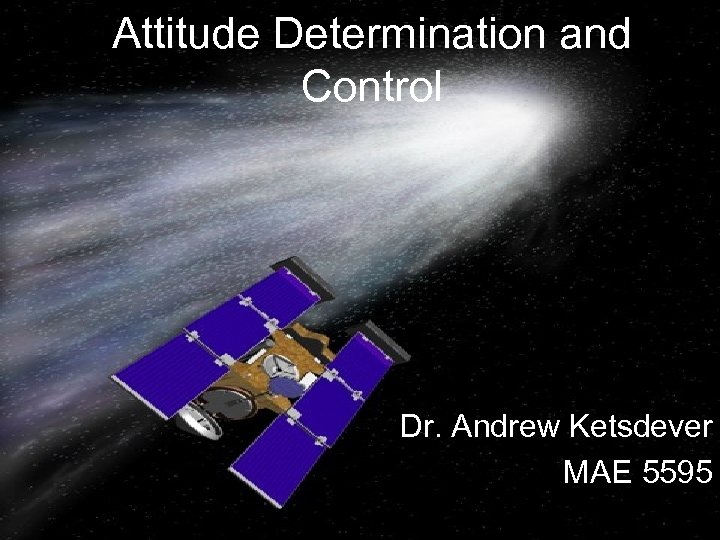 Attitude Determination and Control Dr. Andrew Ketsdever MAE 5595
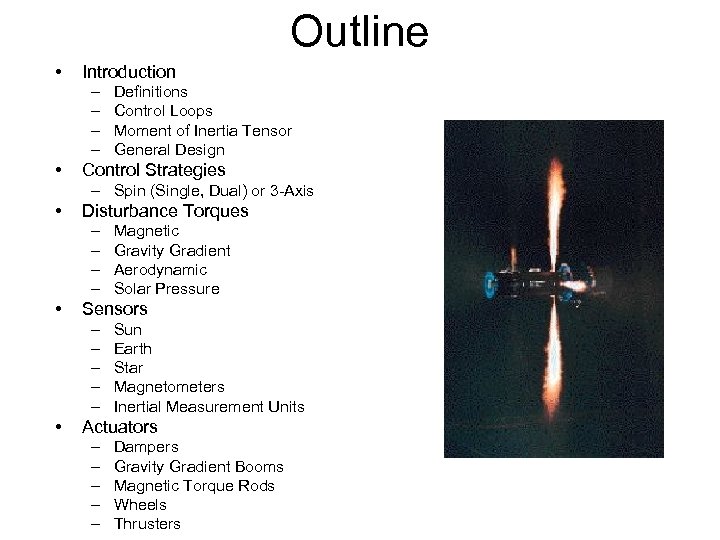 Outline • Introduction – – • Definitions Control Loops Moment of Inertia Tensor General Design Control Strategies – Spin (Single, Dual) or 3 -Axis • Disturbance Torques – – • Sensors – – – • Magnetic Gravity Gradient Aerodynamic Solar Pressure Sun Earth Star Magnetometers Inertial Measurement Units Actuators – – – Dampers Gravity Gradient Booms Magnetic Torque Rods Wheels Thrusters
 INTRODUCTION
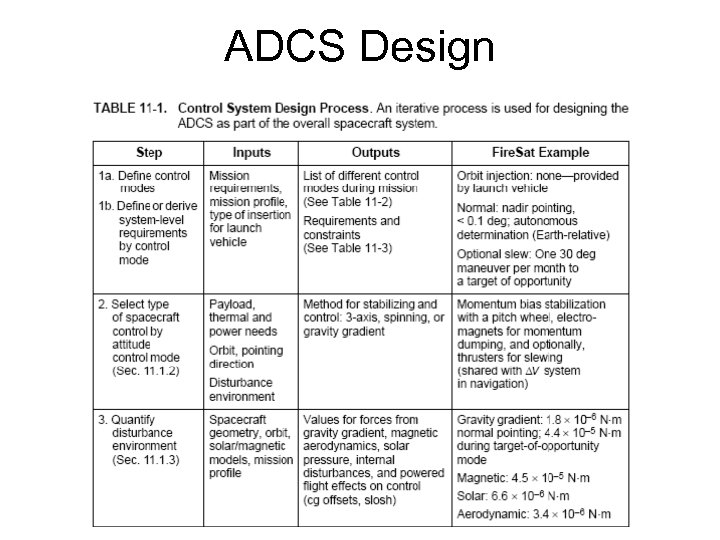
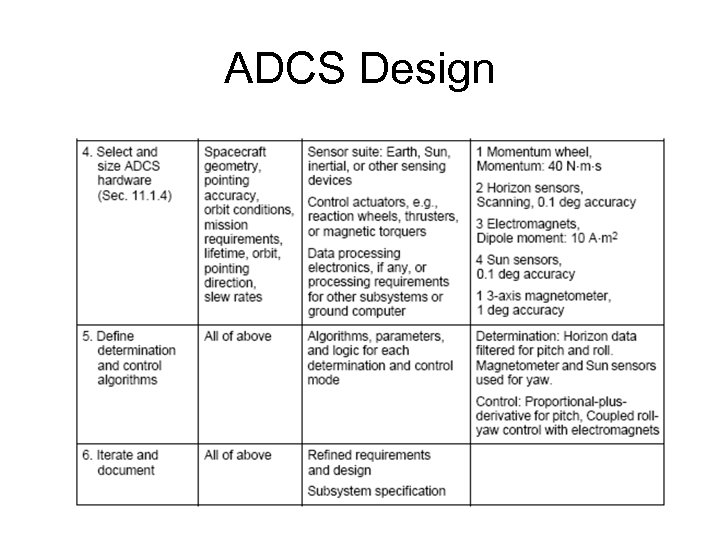
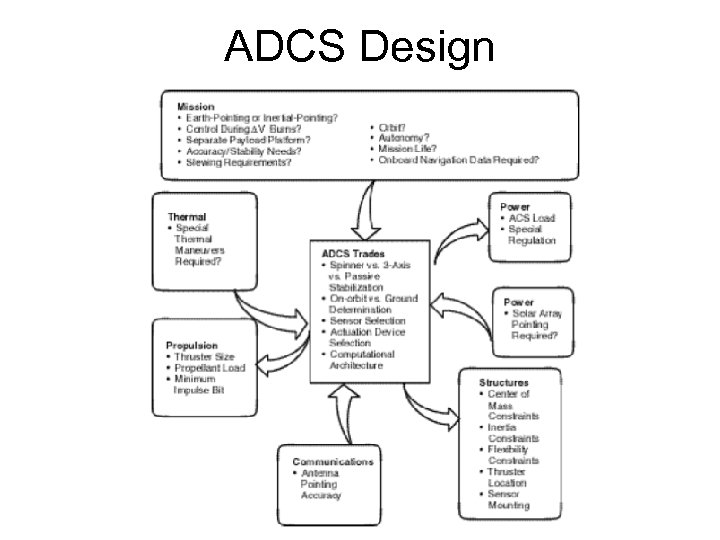
 Introduction • Attitude Determination and Control Subsystem (ADCS) – Stabilizes the vehicle – Orients vehicle in desired directions – Senses the orientation of the vehicle relative to reference (e. g. inertial) points • Determination: Sensors • Control: Actuators • Controls attitude despite external disturbance torques acting on spacecraft
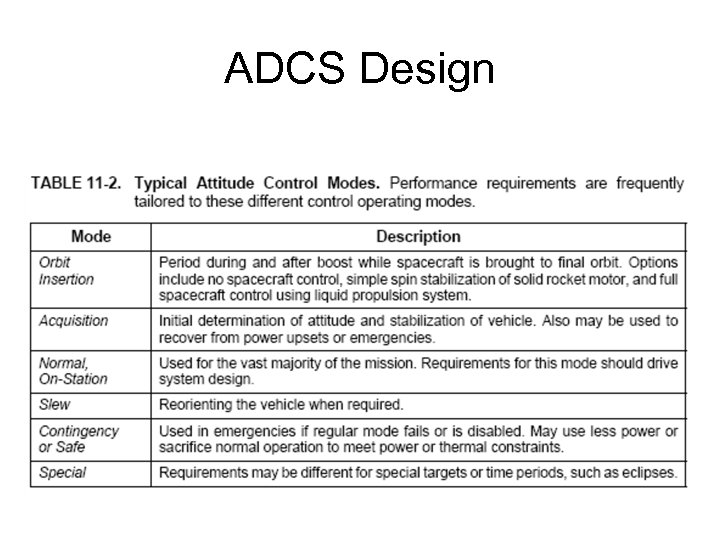
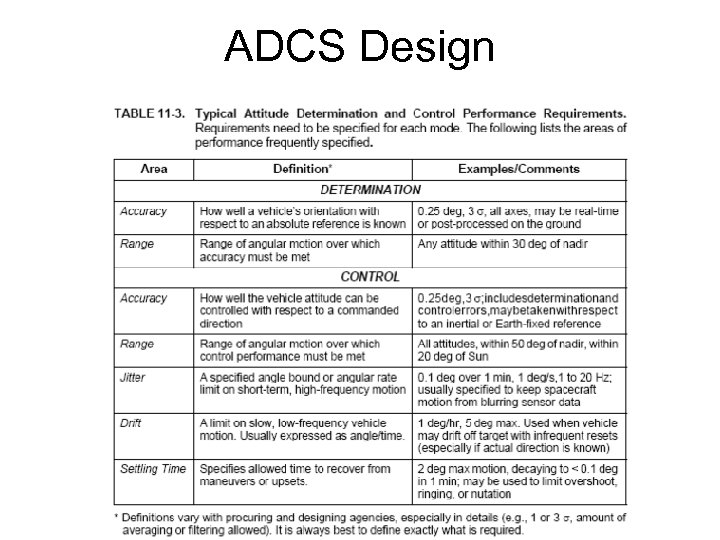
 Introduction • ADCS Design Requirements and Constraints – Pointing Accuracy (Knowledge vs. Control) • Drives Sensor Accuracy Required • Drives Actuator Accuracy Required – – – – Rate Requirements (e. g. Slew) Stationkeeping Requirements Disturbing Environment Mass and Volume Power Reliability Cost and Schedule
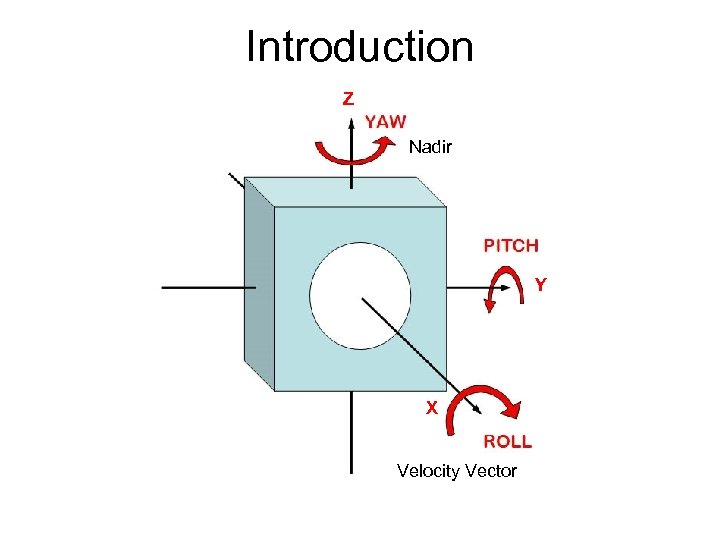 Introduction Z Nadir Y X Velocity Vector
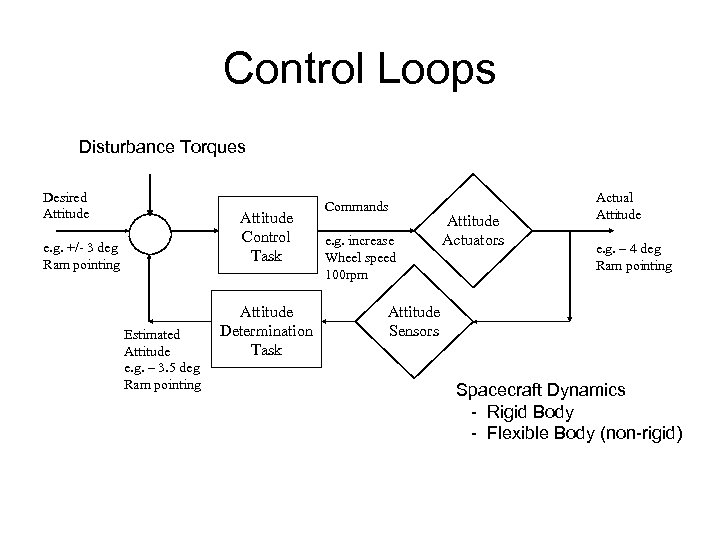 Control Loops Disturbance Torques Desired Attitude Control Task e. g. +/- 3 deg Ram pointing Estimated Attitude e. g. – 3. 5 deg Ram pointing Attitude Determination Task Commands e. g. increase Wheel speed 100 rpm Attitude Actuators Actual Attitude e. g. – 4 deg Ram pointing Attitude Sensors Spacecraft Dynamics - Rigid Body - Flexible Body (non-rigid)
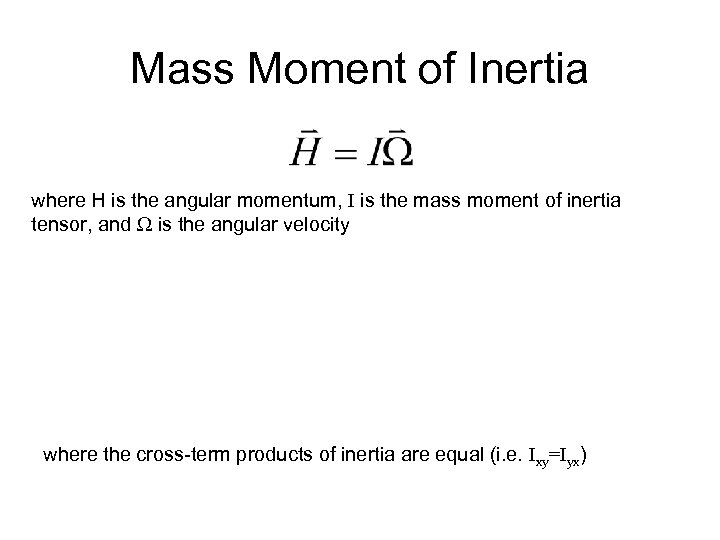 Mass Moment of Inertia where H is the angular momentum, I is the mass moment of inertia tensor, and W is the angular velocity where the cross-term products of inertia are equal (i. e. Ixy=Iyx)
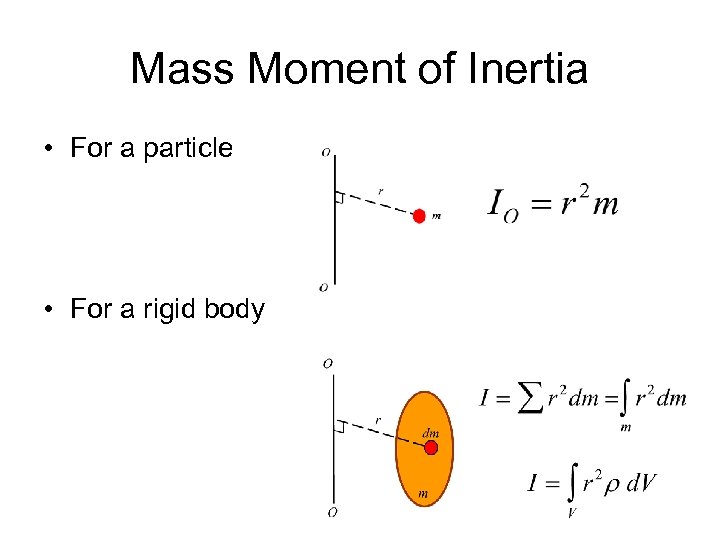 Mass Moment of Inertia • For a particle • For a rigid body
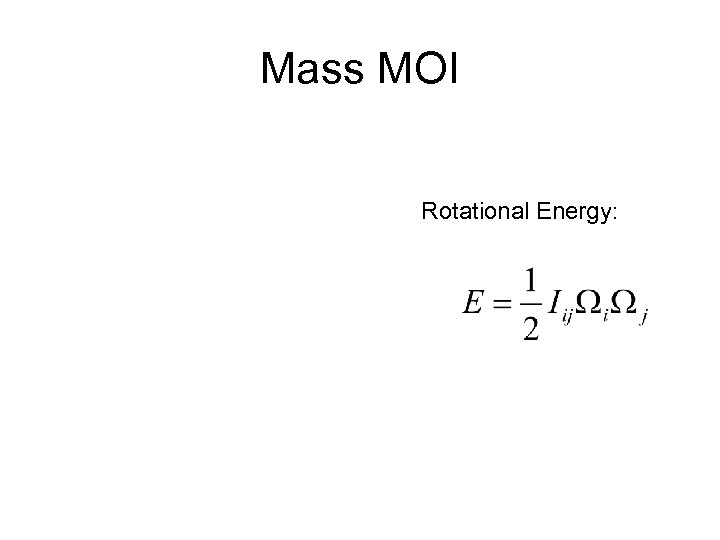 Mass MOI Rotational Energy:
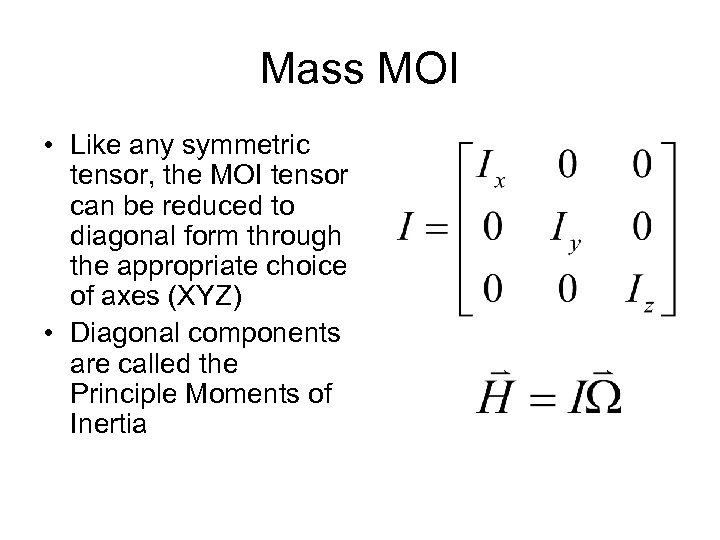 Mass MOI • Like any symmetric tensor, the MOI tensor can be reduced to diagonal form through the appropriate choice of axes (XYZ) • Diagonal components are called the Principle Moments of Inertia
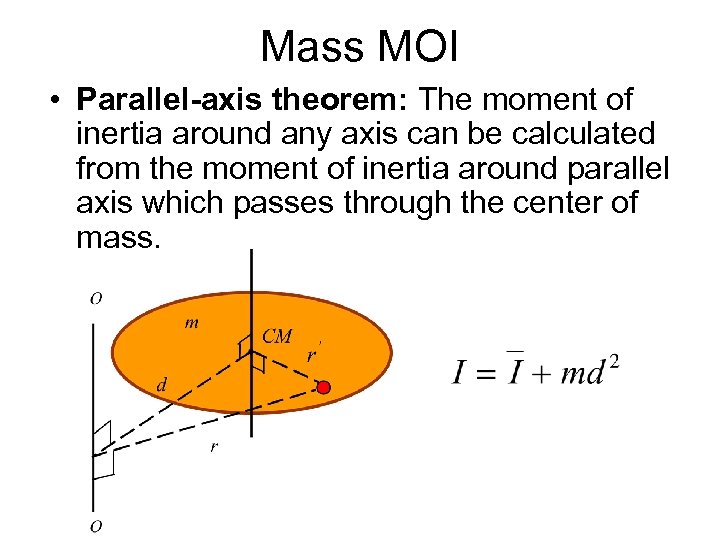 Mass MOI • Parallel-axis theorem: The moment of inertia around any axis can be calculated from the moment of inertia around parallel axis which passes through the center of mass.
 ADCS Design
 ADCS Design
 ADCS Design
 ADCS Design
 ADCS Design
 Control Strategies
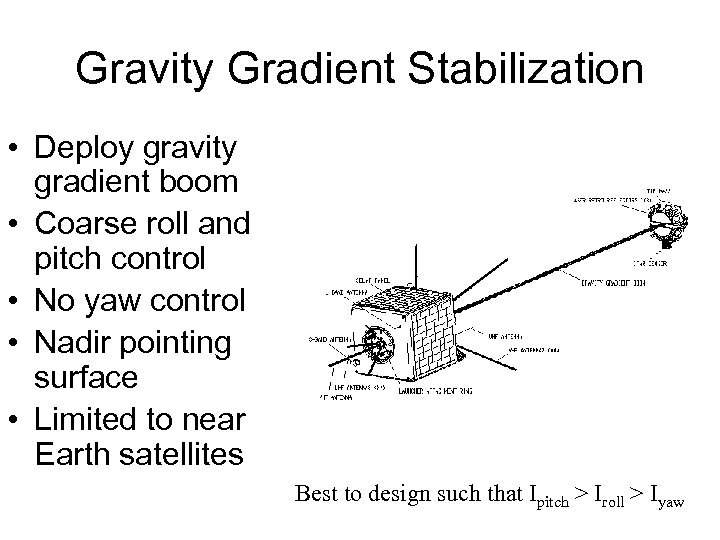 Gravity Gradient Stabilization • Deploy gravity gradient boom • Coarse roll and pitch control • No yaw control • Nadir pointing surface • Limited to near Earth satellites Best to design such that Ipitch > Iroll > Iyaw
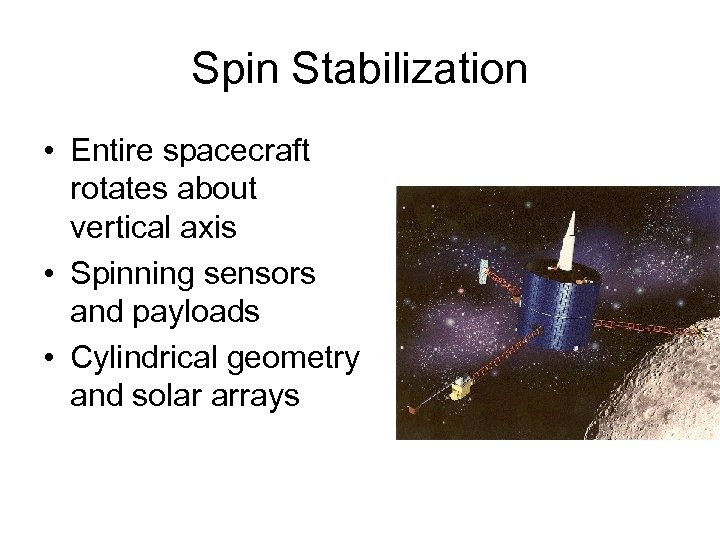 Spin Stabilization • Entire spacecraft rotates about vertical axis • Spinning sensors and payloads • Cylindrical geometry and solar arrays
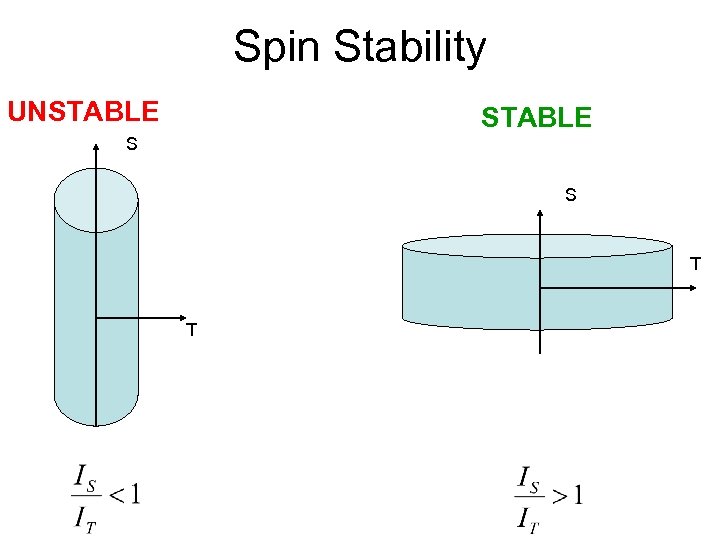 Spin Stability UNSTABLE S S T T
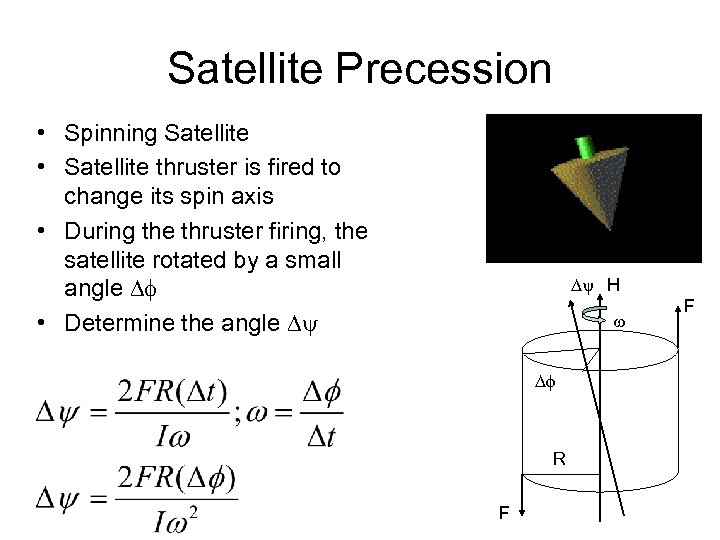 Satellite Precession • Spinning Satellite • Satellite thruster is fired to change its spin axis • During the thruster firing, the satellite rotated by a small angle Df • Determine the angle Dy Dy H w Df R F F
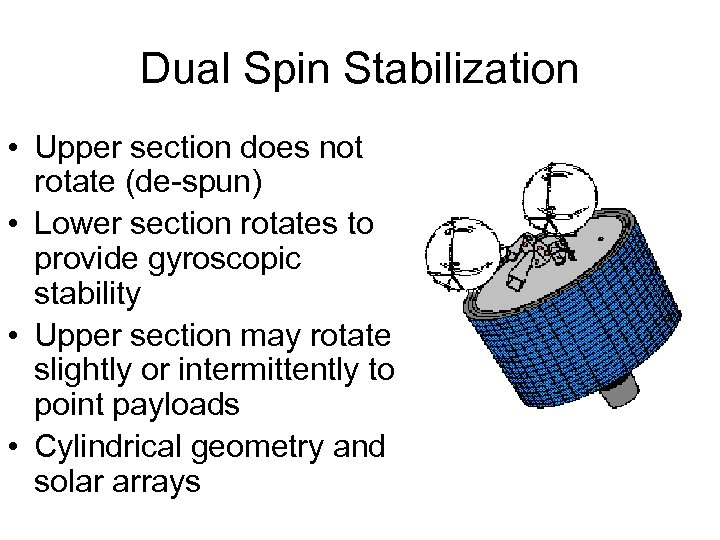 Dual Spin Stabilization • Upper section does not rotate (de-spun) • Lower section rotates to provide gyroscopic stability • Upper section may rotate slightly or intermittently to point payloads • Cylindrical geometry and solar arrays
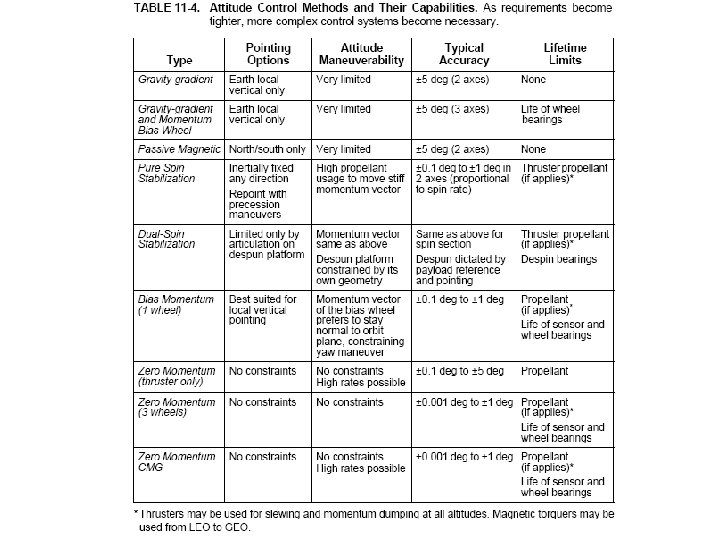
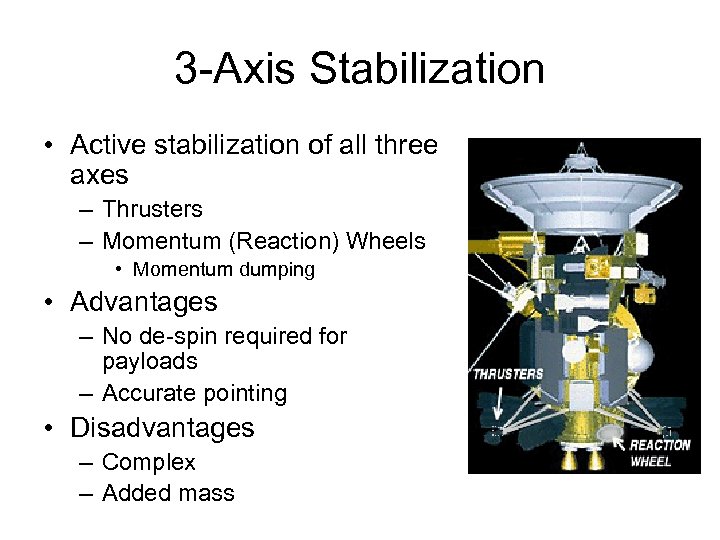 3 -Axis Stabilization • Active stabilization of all three axes – Thrusters – Momentum (Reaction) Wheels • Momentum dumping • Advantages – No de-spin required for payloads – Accurate pointing • Disadvantages – Complex – Added mass
 Disturbance Torques
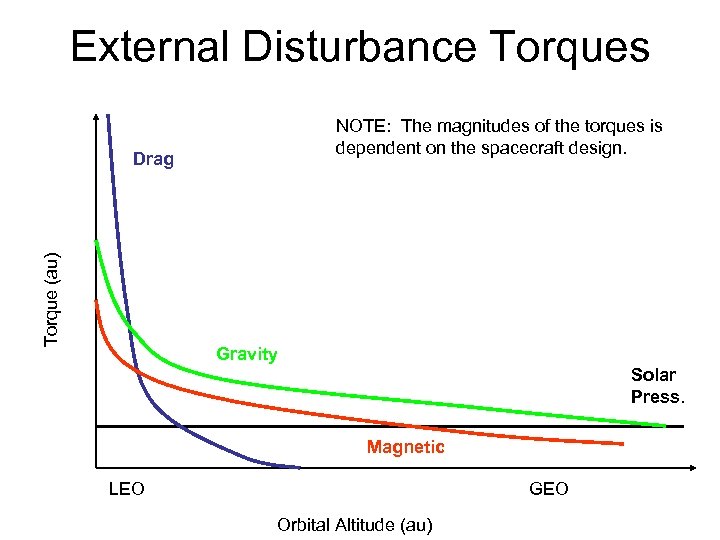 External Disturbance Torques NOTE: The magnitudes of the torques is dependent on the spacecraft design. Torque (au) Drag Gravity Solar Press. Magnetic LEO GEO Orbital Altitude (au)
 Internal Disturbing Torques • Examples – Uncertainty in S/C Center of Gravity (typically 1 -3 cm) – Thruster Misalignment (typically 0. 1° – 0. 5°) – Thruster Mismatch (typically ~5%) – Rotating Machinery – Liquid Sloshing (e. g. propellant) – Flexible structures – Crew Movement
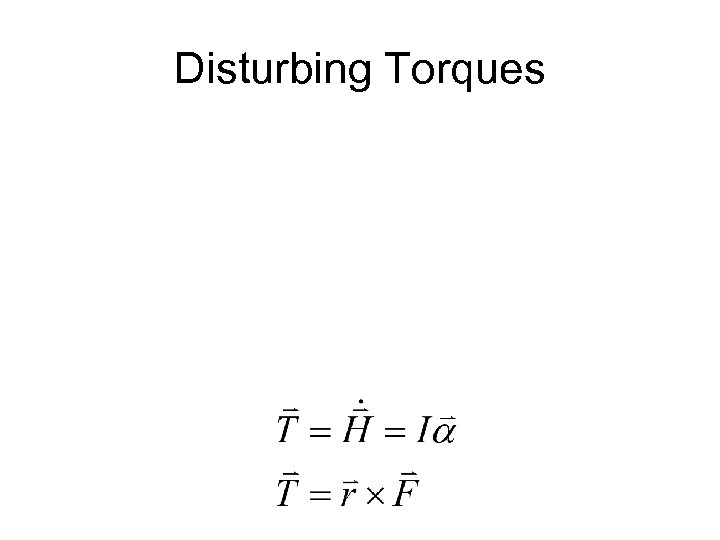 Disturbing Torques
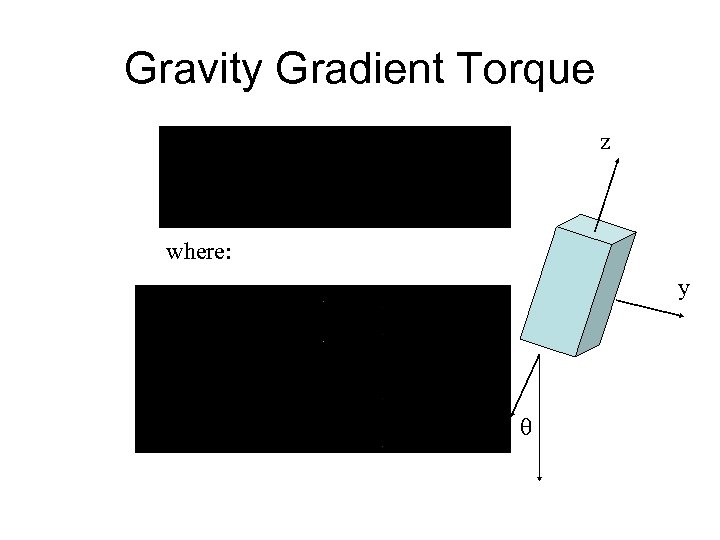 Gravity Gradient Torque z where: y q
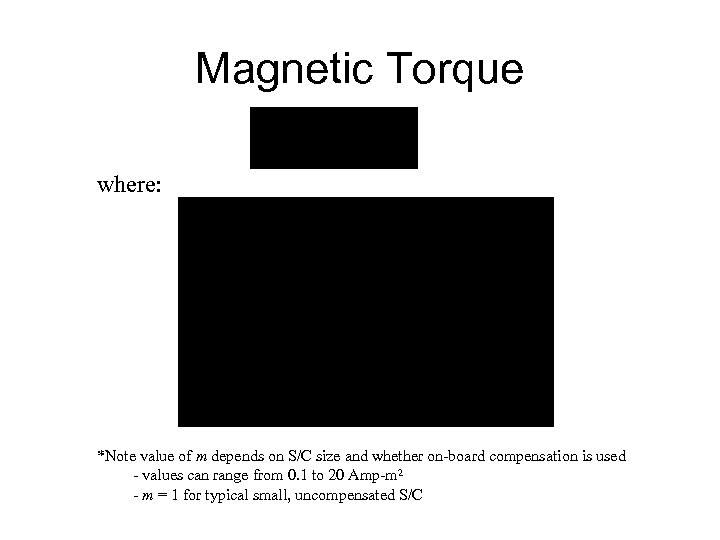 Magnetic Torque where: *Note value of m depends on S/C size and whether on-board compensation is used - values can range from 0. 1 to 20 Amp-m 2 - m = 1 for typical small, uncompensated S/C
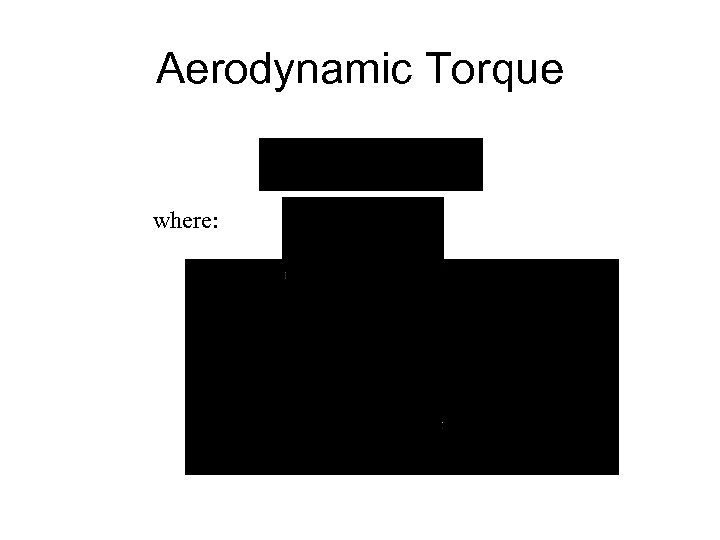 Aerodynamic Torque where:
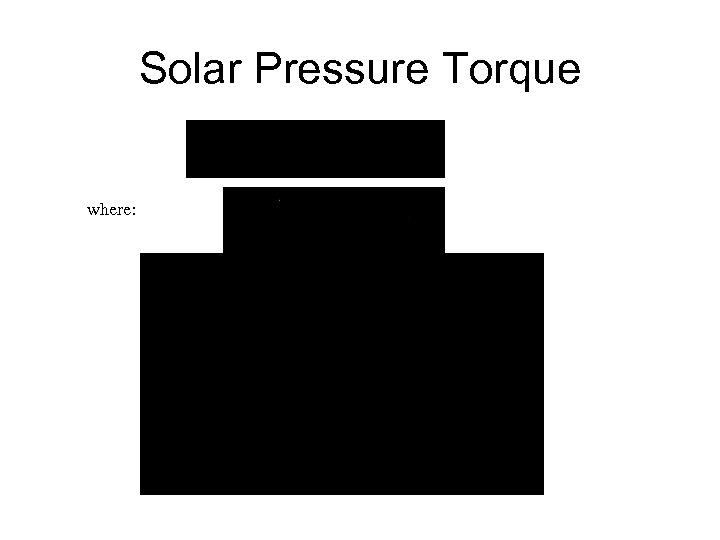 Solar Pressure Torque where:
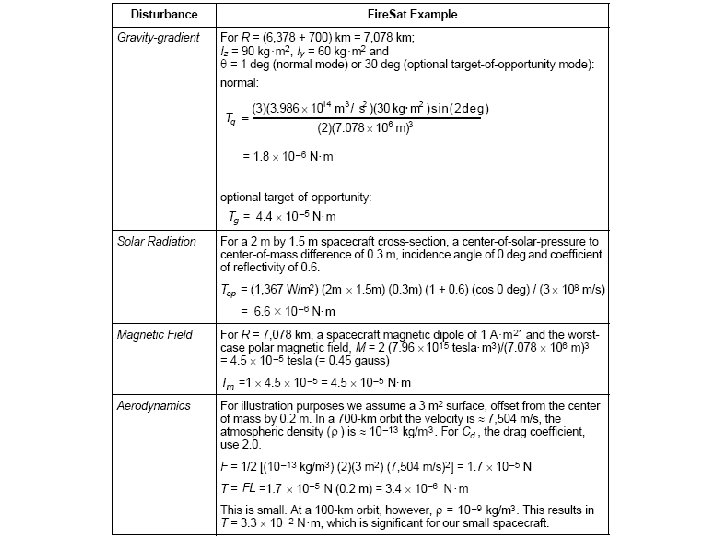 Fire. Sat Example
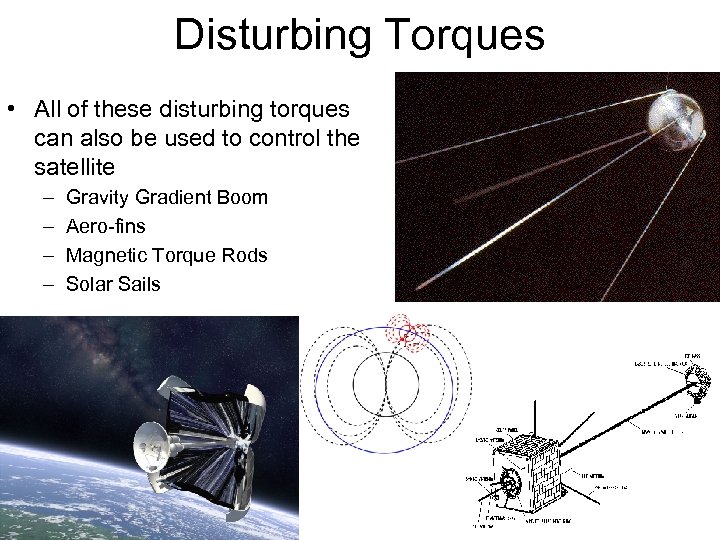 Disturbing Torques • All of these disturbing torques can also be used to control the satellite – – Gravity Gradient Boom Aero-fins Magnetic Torque Rods Solar Sails
 Sensors
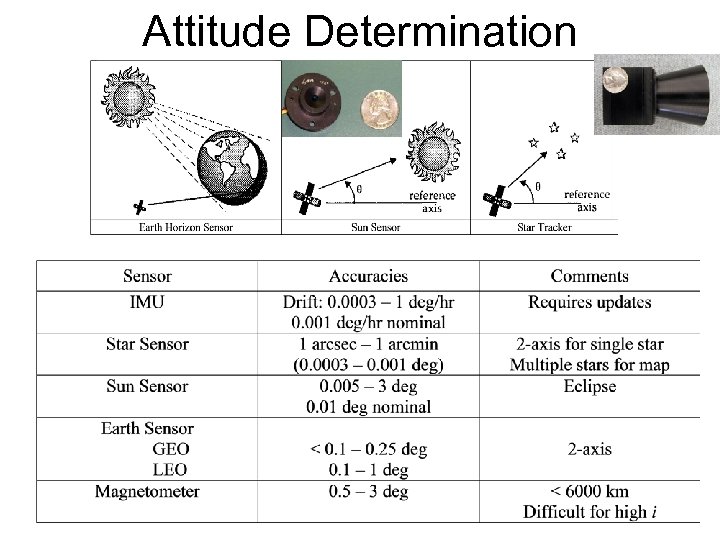
 Attitude Determination • Earth Sensor (horizon sensor) – Use IR to detect boundary between deep space & upper atmosphere – Typically scanning (can also be an actuator) • Sun Sensor • Star Sensor – Scanner: for spinning S/C or on a rotating mount – Tracker/Mapper: for 3 -axis stabilized S/C • Tracker (one star) / Mapper (multiple stars) • Inertial Measurement Unit (IMU) – Rate Gyros (may also include accelerometers) • Magnetometer – Requires magnetic field model stored in computer • Differential GPS
 Attitude Determination
 Actuators
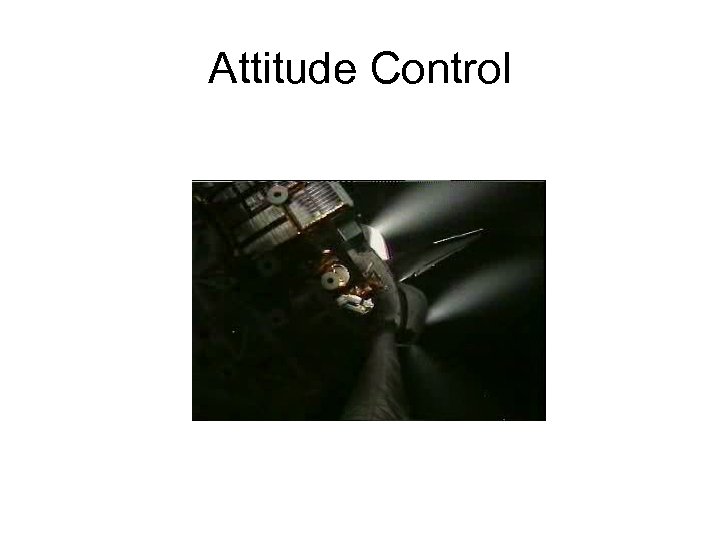
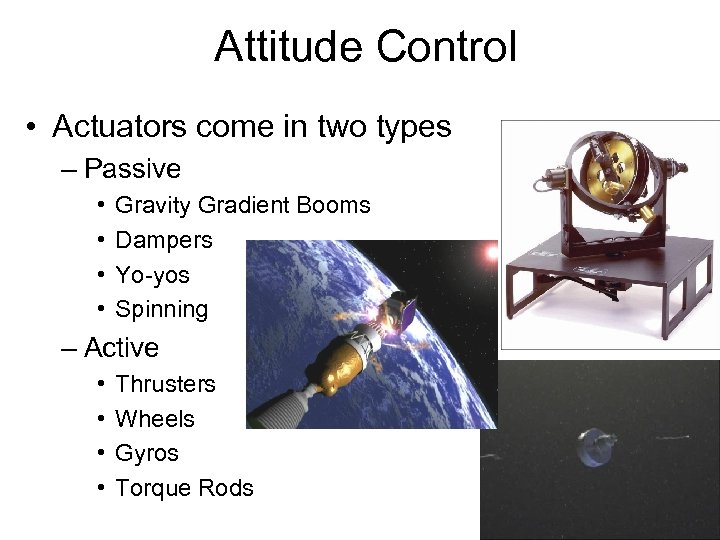 Attitude Control • Actuators come in two types – Passive • • Gravity Gradient Booms Dampers Yo-yos Spinning – Active • • Thrusters Wheels Gyros Torque Rods
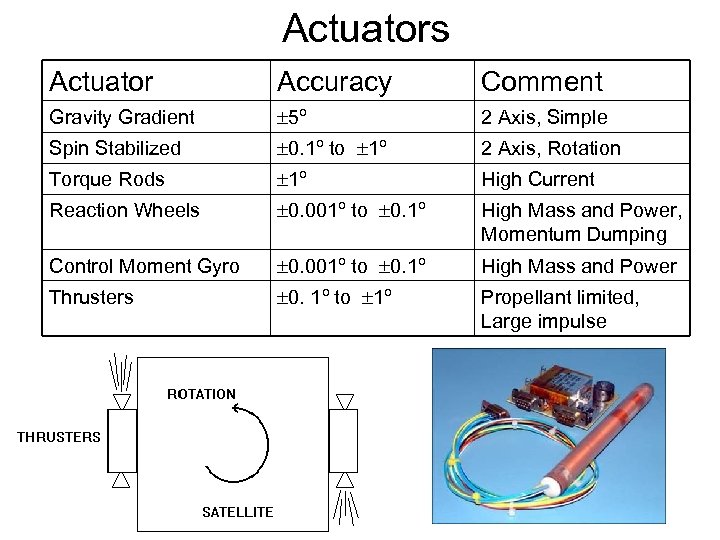 Actuators Actuator Accuracy Comment Gravity Gradient 5º 2 Axis, Simple Spin Stabilized 0. 1º to 1º 2 Axis, Rotation Torque Rods 1º High Current Reaction Wheels 0. 001º to 0. 1º High Mass and Power, Momentum Dumping Control Moment Gyro 0. 001º to 0. 1º High Mass and Power Thrusters 0. 1º to 1º Propellant limited, Large impulse
 Attitude Control