


 Скачать презентацию Attendings Dr Kostacos Dr Niketakis Dr Timko Dr
63f0ee0f8687a92a3509f6b3ad3e064a.ppt
- Количество слайдов: 20
 Attendings Dr. Kostacos, Dr. Niketakis, Dr. Timko. Dr. Wisler, Dr. Romo, Dr. Potter, Dr. Soren, Dr. Pfeffer, Dr. Catallozzi, Dr. Pethe, Sarah Delaney, Dr. Stockwell, Dr. Mc. Cann, Dr. Robbins and Dr. Matiz Residents PGY-3: Cynthia Su, Amy Chirico, Ryan Gise, Nicole Mc. Kinnon, Jennifer Rathe PGY-2: Sona Chauhan, Aliza Alter, Allison Baxterback, Eugene Khandros, Elizabeth Seashore, Saira Siddiqui, Roselle Vittorino, Angela Anderson PGY-1: Chelsey Mitchell Abigail Sage Julia Emanuel Esther Berko Sharon Kook Christina Welsh Danielle Fernandes Candice Maietti Ellis Rochelson, & Julia Conway Audubon Clinic: Putting the ‘home’ in medical home since 2013 And Focusing on Sustainability and Spread in 2015 Nurses Diana, Ernestina, Estella, Jasmine, Sandra, Vicki, and Adora MAs Stacyann, Jessie, Hasse, Ivette, Carmen, and Marilyn PFAs Kecia, Roxann, Vivian, Yajayra, Yoima, Jennifer, Diana, and Crystal Supervisors Alfred Mancebo, Anderson Mercedes, Kim Moore and Evelyn Bunin at the Call Center Audubon QI Project May 20 th, 2015
 What is a medical home? “The Medical Home is the model for 21 st century primary care, with the goal of addressing and integrating high quality health promotion, acute care and chronic condition management in a planned, coordinated and family-centered manner. ”
 Medical Home: Why and How? Benefits Lower costs Mortality Less hospitalizations Less ER visits Better medication adherence Fewer missed school and work days Factors Primary care provider(s) Seen regularly Relationship Knowledge of chronic patient’s health issues and specialists
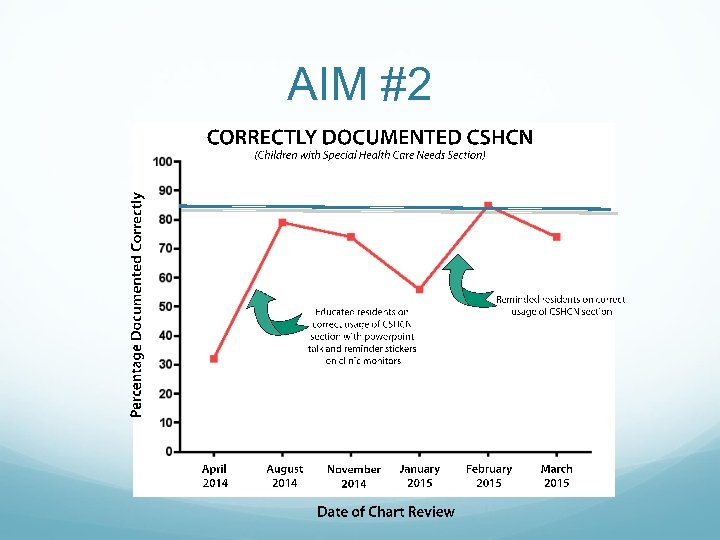
 QI: AIMs AIM #1: Increase the percentage of chronic children being actively transitioned from 40% to 70% by June 2015 AIM #2: Increase the chronic patient documentation in the Children with Special Health Care Needs Section (CSHCN) from 79% to 85% AIM #3: Improve the transition from inpatient to outpatient care
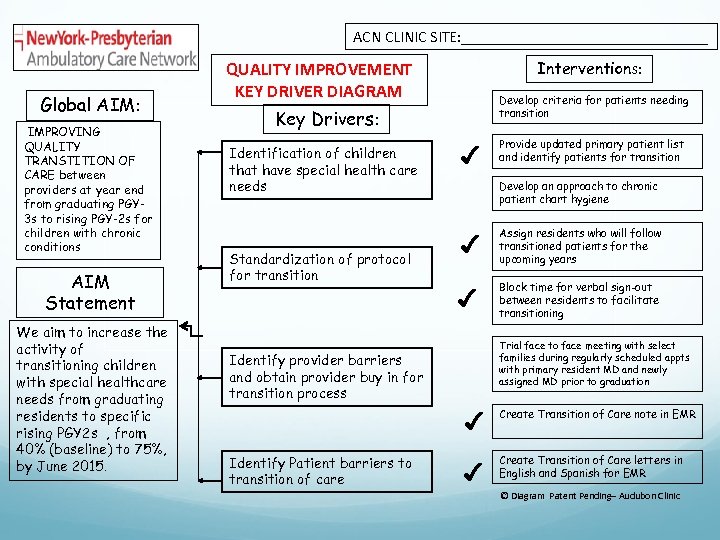 ACN CLINIC SITE: ________________ Global AIM: IMPROVING QUALITY TRANSTITION OF CARE between providers at year end from graduating PGY 3 s to rising PGY-2 s for children with chronic conditions AIM Statement We aim to increase the activity of transitioning children with special healthcare needs from graduating residents to specific rising PGY 2 s , from 40% (baseline) to 75%, by June 2015. Interventions: QUALITY IMPROVEMENT KEY DRIVER DIAGRAM Develop criteria for patients needing transition Key Drivers: Identification of children that have special health care needs Standardization of protocol for transition ✔ Provide updated primary patient list and identify patients for transition Develop an approach to chronic patient chart hygiene ✔ Assign residents who will follow transitioned patients for the upcoming years ✔ Block time for verbal sign-out between residents to facilitate transitioning Trial face to face meeting with select families during regularly scheduled appts with primary resident MD and newly assigned MD prior to graduation Identify provider barriers and obtain provider buy in for transition process ✔ Identify Patient barriers to transition of care Create Transition of Care note in EMR ✔ Create Transition of Care letters in English and Spanish for EMR © Diagram Patent Pending– Audubon Clinic
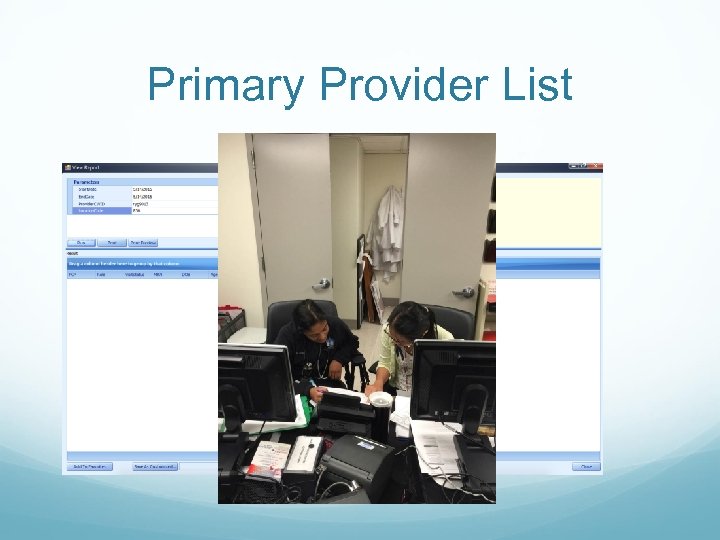 Primary Provider List
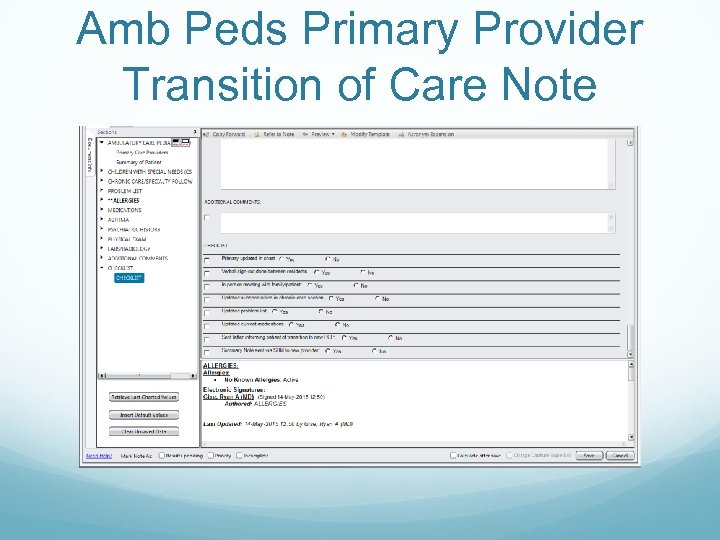 Amb Peds Primary Provider Transition of Care Note
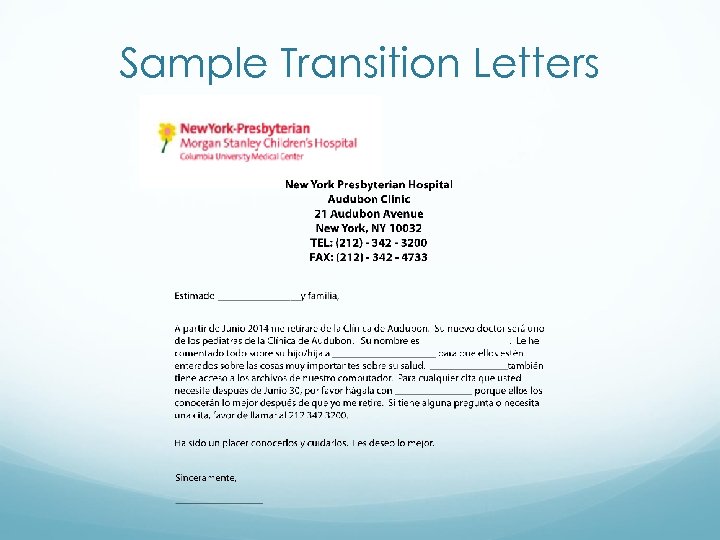
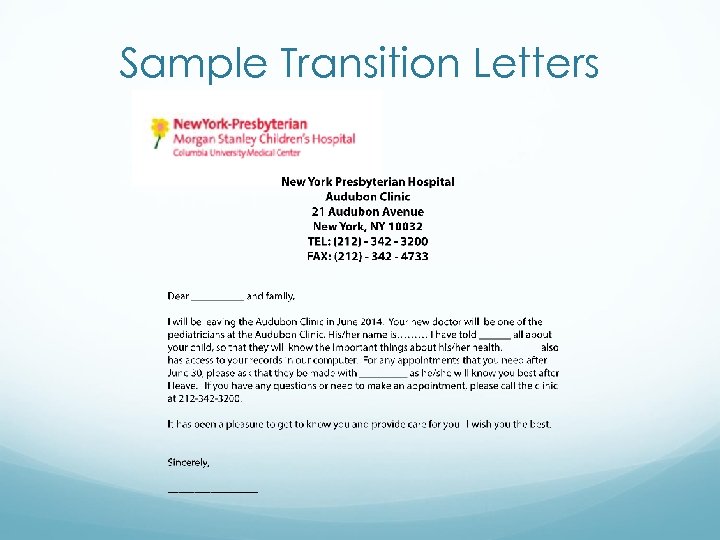 Sample Transition Letters
 Sample Transition Letters
 Survey Results
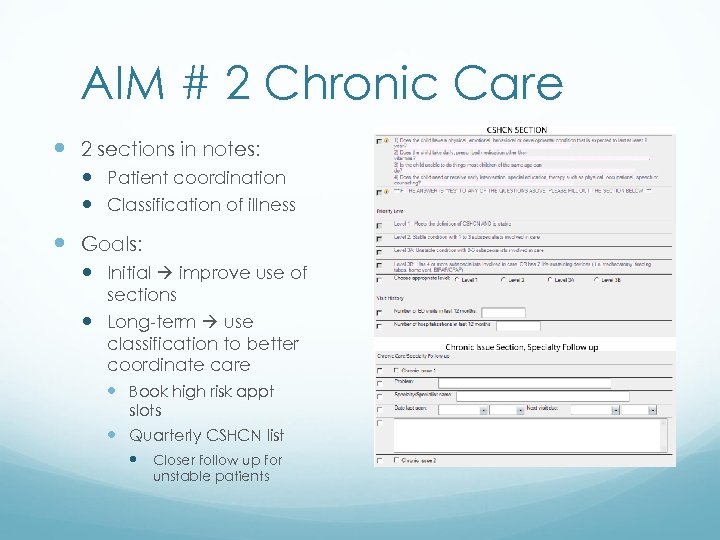 AIM # 2 Chronic Care 2 sections in notes: Patient coordination Classification of illness Goals: Initial improve use of sections Long-term use classification to better coordinate care Book high risk appt slots Quarterly CSHCN list Closer follow up for unstable patients
 AIM #2
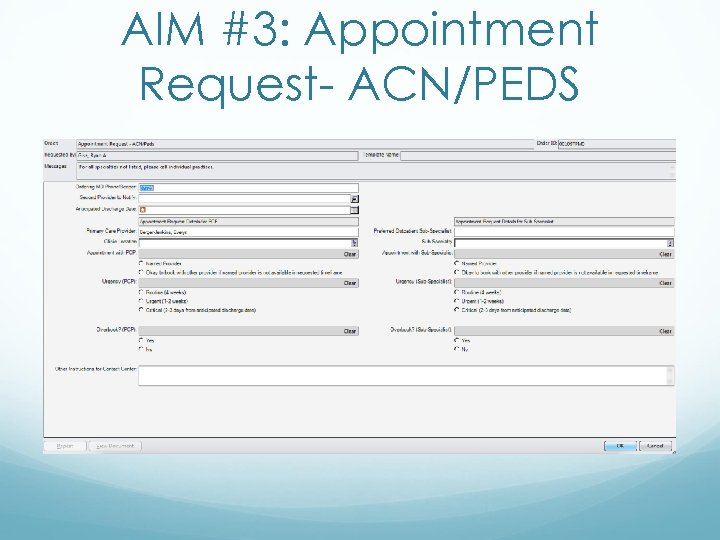 AIM #3: Appointment Request- ACN/PEDS
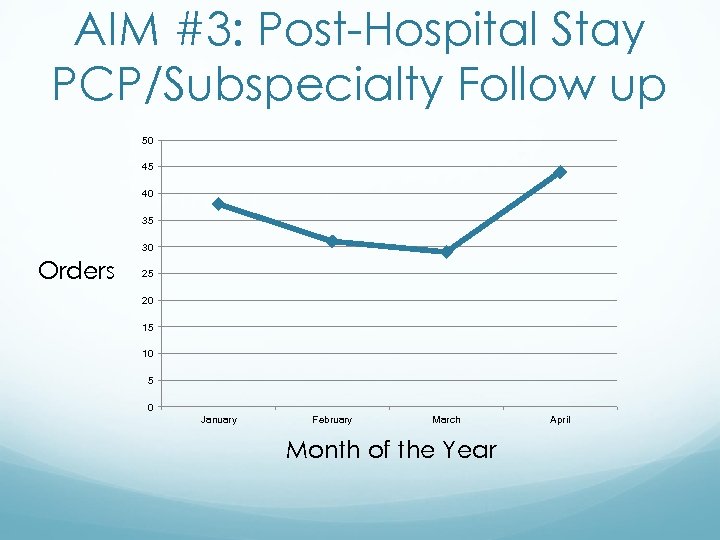 AIM #3: Post-Hospital Stay PCP/Subspecialty Follow up 50 45 40 35 30 Orders 25 20 15 10 5 0 January February March Month of the Year April
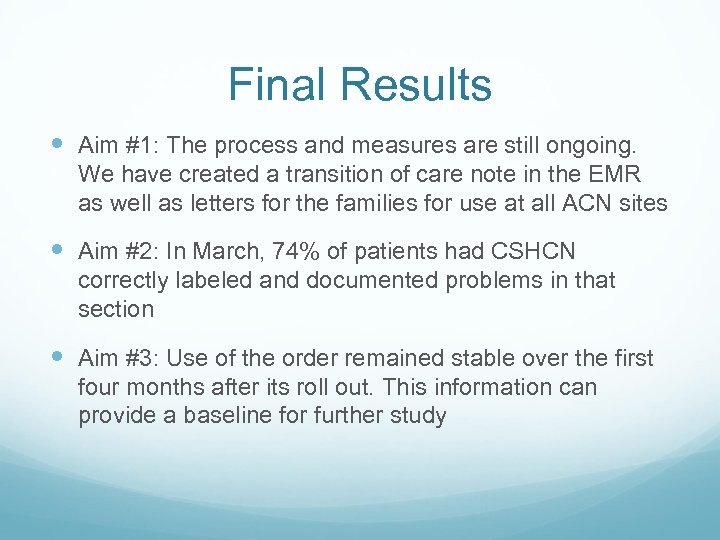 Final Results Aim #1: The process and measures are still ongoing. We have created a transition of care note in the EMR as well as letters for the families for use at all ACN sites Aim #2: In March, 74% of patients had CSHCN correctly labeled and documented problems in that section Aim #3: Use of the order remained stable over the first four months after its roll out. This information can provide a baseline for further study
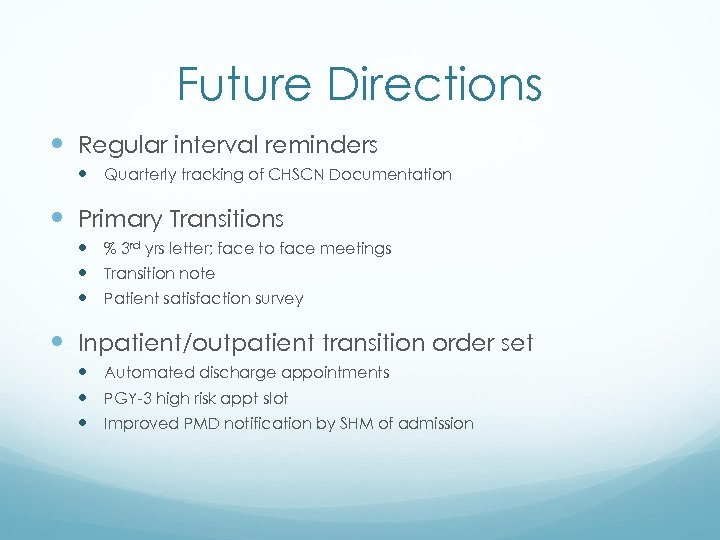 Future Directions Regular interval reminders Quarterly tracking of CHSCN Documentation Primary Transitions % 3 rd yrs letter; face to face meetings Transition note Patient satisfaction survey Inpatient/outpatient transition order set Automated discharge appointments PGY-3 high risk appt slot Improved PMD notification by SHM of admission
 Special Thanks to…. Dr. Laura Robbins and Dr. Adriana Matiz Dr. Teresa Mc. Cann Evelyn Bunin Dr. Jen Rathe New York State Hospital Medical Home Grant And of Course…
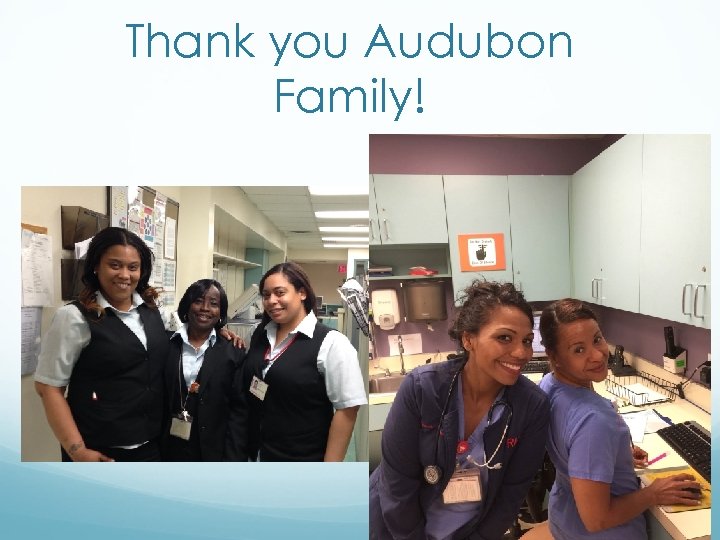 Thank you Audubon Family!
 Now That Is Done…
 References American Academy of Pediatrics; Medical Home Initiatives for Children with Special Needs Project Advisory Committee. The Medical Home. Pediatrics 2002; 110(1): 184 -186. Cooley WC, Mc. Allister JW. Building Medical Homes: Improvement Strategies in Primary Care for Children with Special Health Care Needs. Pediatrics 2004; 113(suppl) 1499 -1506. Homer CJ, et al. A review of the evidence for the medical home for children with special health care needs. Pediatrics 2008; 122(4): e 922 -937. Starfield B, Shi L. The Medical Home, Access to Care, and Insurance: A Review of Evidence. Pediatrics 2004; 113(suppl): 1493 -1498.