


 Скачать презентацию Atsuo Urisu Department of Pediatrics Fujita Health University
111113WAO_SYMPO_Urisu4handout2.ppt
- Количество слайдов: 28
 Atsuo Urisu Department of Pediatrics Fujita Health University Nagoya Japan
 Food Allergy and Atopic Dermatitis in young children
 Guidelines for the Diagnosis and Management of Food Allergy in the United States: Report of the NIAID-Sponsored Expert Panel J Allergy Clin Immunol 2010; 126: S 1 -S 58.
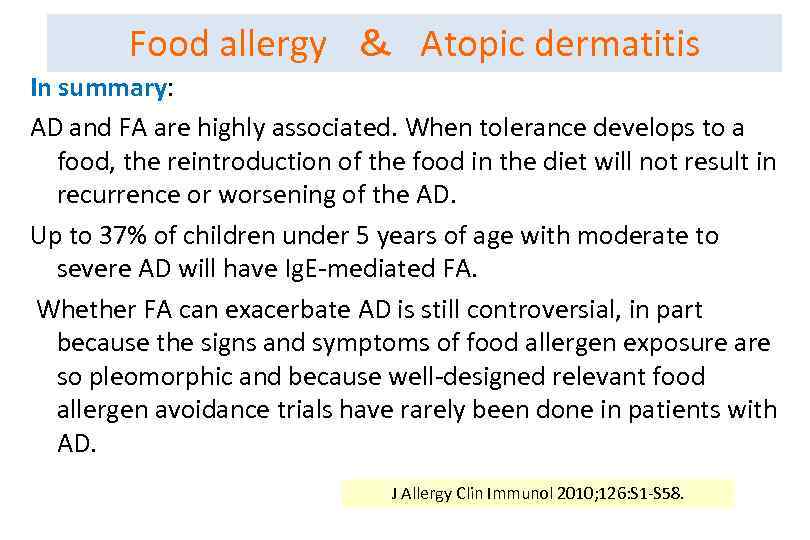 Food allergy & Atopic dermatitis In summary: AD and FA are highly associated. When tolerance develops to a food, the reintroduction of the food in the diet will not result in recurrence or worsening of the AD. Up to 37% of children under 5 years of age with moderate to severe AD will have Ig. E-mediated FA. Whether FA can exacerbate AD is still controversial, in part because the signs and symptoms of food allergen exposure are so pleomorphic and because well-designed relevant food allergen avoidance trials have rarely been done in patients with AD. J Allergy Clin Immunol 2010; 126: S 1 -S 58.
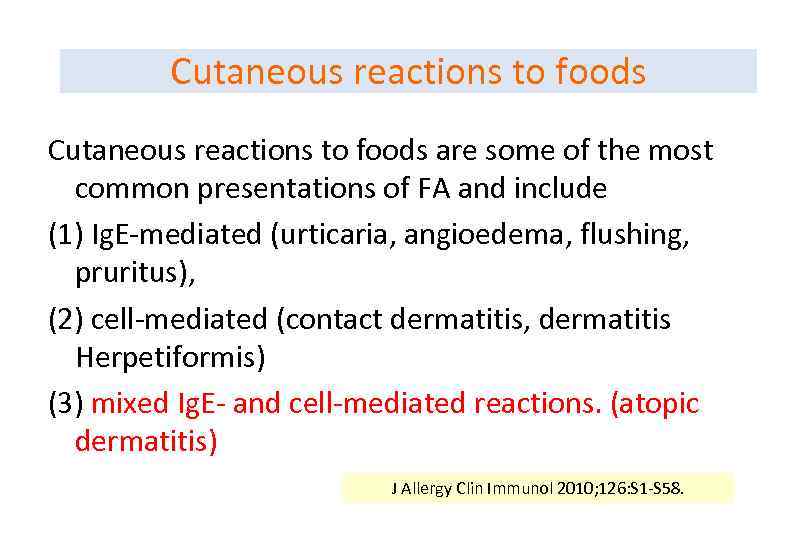 Cutaneous reactions to foods are some of the most common presentations of FA and include (1) Ig. E-mediated (urticaria, angioedema, flushing, pruritus), (2) cell-mediated (contact dermatitis, dermatitis Herpetiformis) (3) mixed Ig. E- and cell-mediated reactions. (atopic dermatitis) J Allergy Clin Immunol 2010; 126: S 1 -S 58.
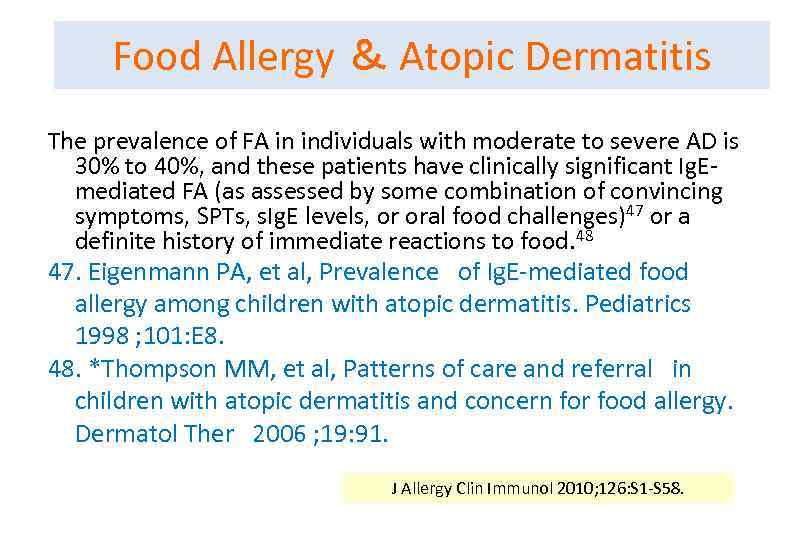 Food Allergy & Atopic Dermatitis The prevalence of FA in individuals with moderate to severe AD is 30% to 40%, and these patients have clinically significant Ig. Emediated FA (as assessed by some combination of convincing symptoms, SPTs, s. Ig. E levels, or oral food challenges)47 or a definite history of immediate reactions to food. 48 47. Eigenmann PA, et al, Prevalence of Ig. E-mediated food allergy among children with atopic dermatitis. Pediatrics 1998 ; 101: E 8. 48. *Thompson MM, et al, Patterns of care and referral in children with atopic dermatitis and concern for food allergy. Dermatol Ther 2006 ; 19: 91. J Allergy Clin Immunol 2010; 126: S 1 -S 58.
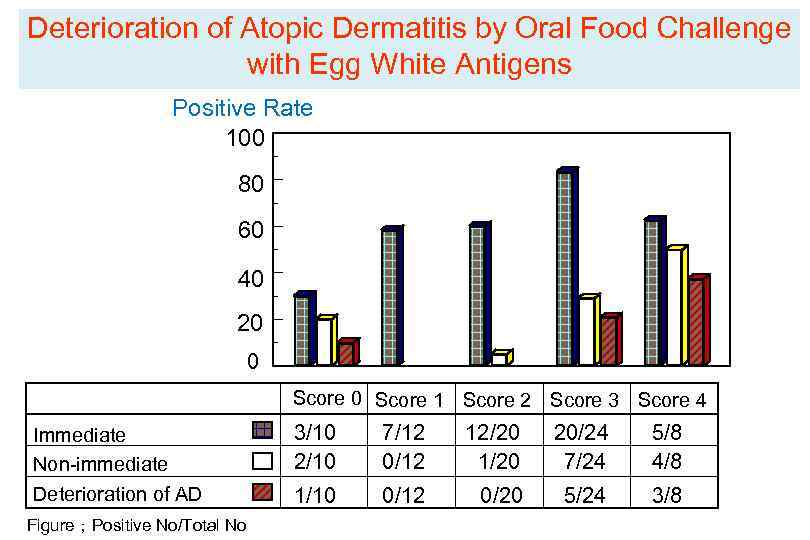 Deterioration of Atopic Dermatitis by Oral Food Challenge with Egg White Antigens Positive Rate 100 80 60 40 20 0 Score 1 Score 2 Score 3 Score 4 Immediate Non-immediate Deterioration of AD Figure;Positive No/Total No 3/10 2/10 7/12 0/12 12/20 1/20 20/24 7/24 5/8 4/8 1/10 0/12 0/20 5/24 3/8
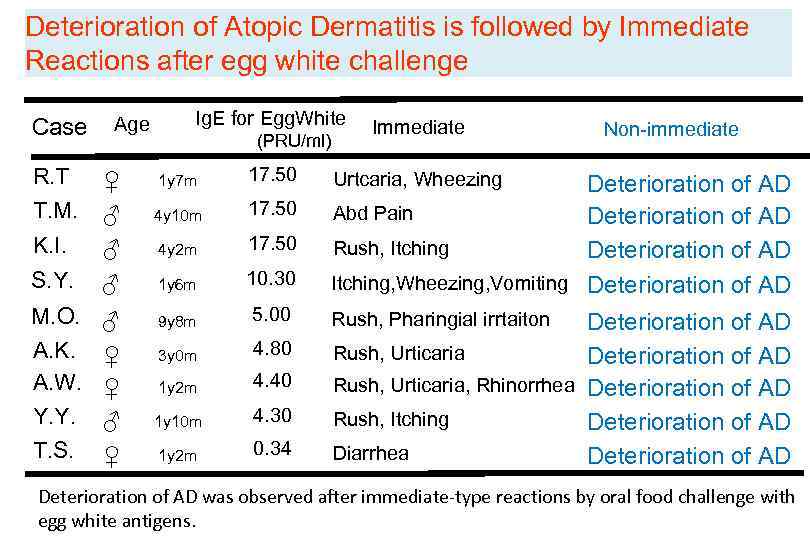 Deterioration of Atopic Dermatitis is followed by Immediate Reactions after egg white challenge Case Age Ig. E for Egg. White (PRU/ml) Immediate Non-immediate R. T T. M. K. I. ♀ ♂ ♂ 1 y 7 m 17. 50 4 y 10 m 17. 50 4 y 2 m 17. 50 S. Y. ♂ 1 y 6 m 10. 30 Deterioration of AD Abd Pain Deterioration of AD Rush, Itching Deterioration of AD Itching, Wheezing, Vomiting Deterioration of AD M. O. A. K. A. W. Y. Y. T. S. ♂ ♀ ♀ ♂ ♀ 9 y 8 m 5. 00 Rush, Pharingial irrtaiton 3 y 0 m 4. 80 1 y 2 m 4. 40 1 y 10 m 4. 30 1 y 2 m 0. 34 Urtcaria, Wheezing Deterioration of AD Rush, Urticaria, Rhinorrhea Deterioration of AD Rush, Itching Deterioration of AD Diarrhea Deterioration of AD was observed after immediate-type reactions by oral food challenge with egg white antigens.
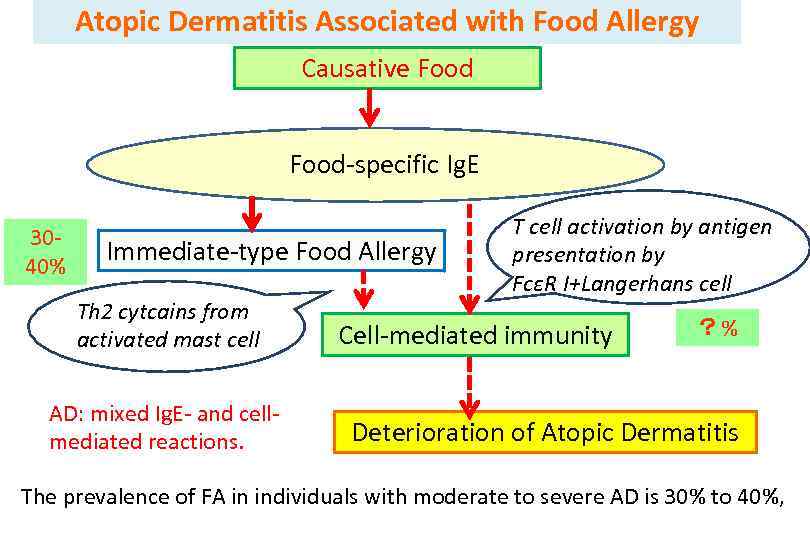 Atopic Dermatitis Associated with Food Allergy Causative Food-specific Ig. E 3040% Immediate-type Food Allergy Th 2 cytcains from activated mast cell AD: mixed Ig. E- and cellmediated reactions. T cell activation by antigen presentation by FcεR I+Langerhans cell Cell-mediated immunity ?% Deterioration of Atopic Dermatitis The prevalence of FA in individuals with moderate to severe AD is 30% to 40%,
 Diagnosis of Egg Allergy
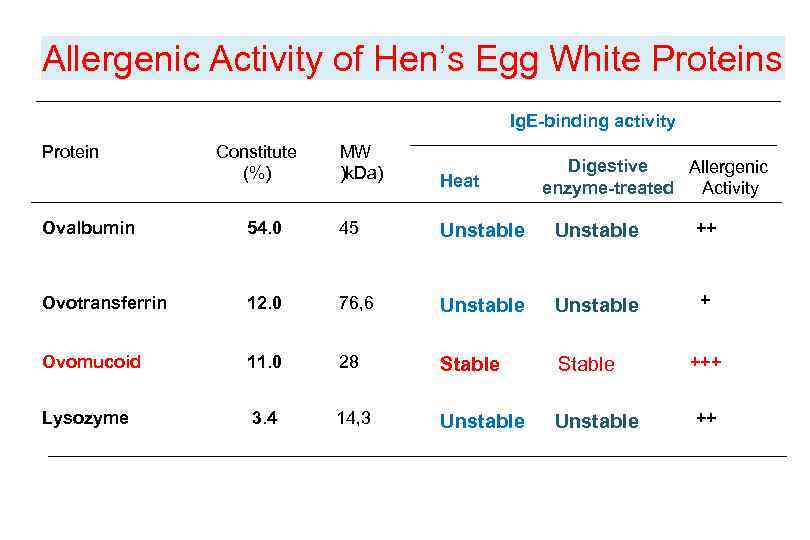 Allergenic Activity of Hen’s Egg White Proteins Ig. E-binding activity Protein Constitute (%) MW )k. Da) Heat Digestive Allergenic enzyme-treated Activity Ovalbumin 54. 0 45 Unstable ++ Ovotransferrin 12. 0 76, 6 Unstable + Ovomucoid 11. 0 28 Stable Lysozyme 3. 4 14, 3 Unstable +++ ++
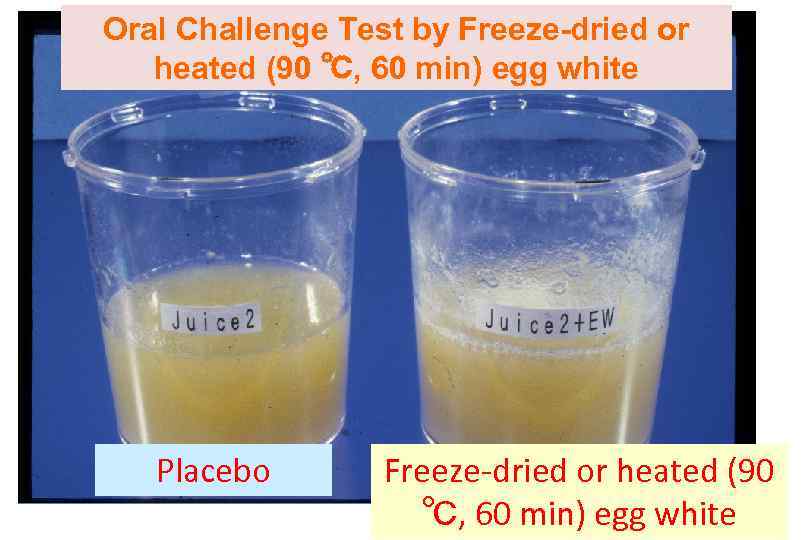 Oral Challenge Test by Freeze-dried or heated (90 ℃, 60 min) egg white Placebo Freeze-dried or heated (90 ℃, 60 min) egg white
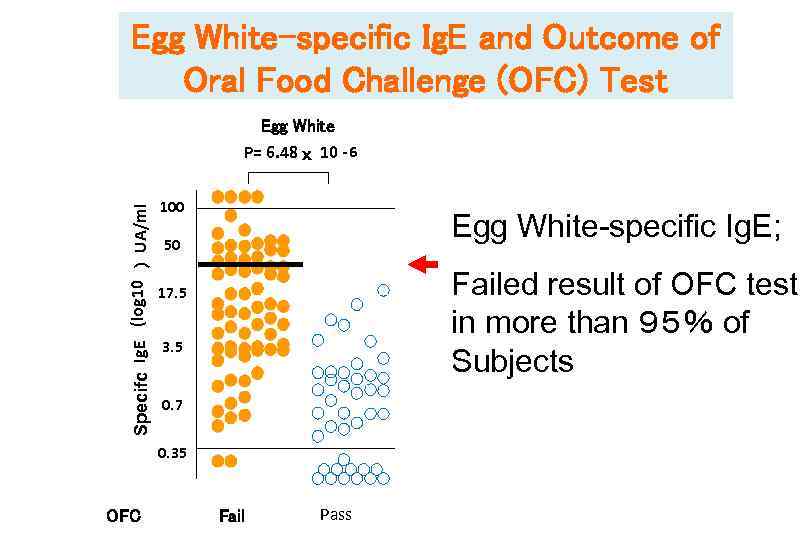 Egg White-specific Ig. E and Outcome of Oral Food Challenge (OFC) Test Specifc Ig. E (log 10 ) UA/ml Egg White P= 6. 48 x 10 -6 100 Egg White-specific Ig. E; 50 Failed result of OFC test in more than 95% of Subjects 17. 5 3. 5 0. 7 0. 35 OFC Fail Pass
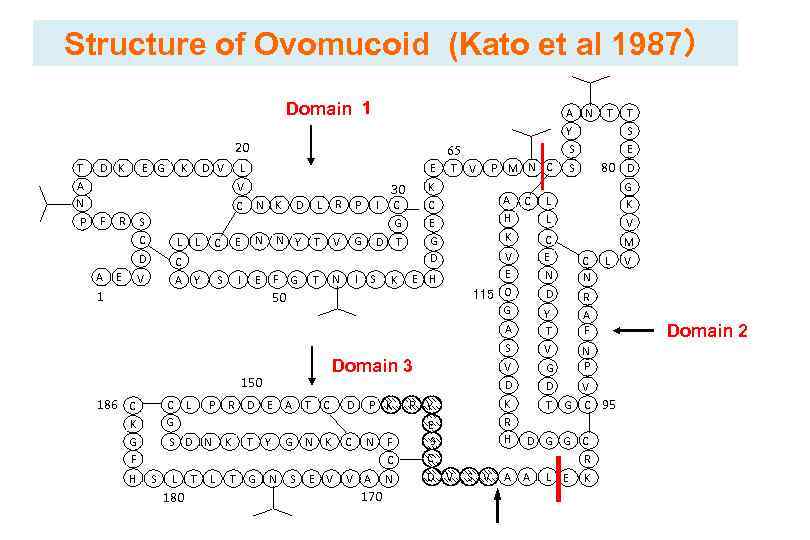 Structure of Ovomucoid (Kato et al 1987) Domain 1 A N T T Y 20 T A N P D K E G K D V L E V F R D R L P I C L D C A L N Y N E C T G V V E T G D D P M N C A H C S C T K 30 G N K C S 65 C K S E S 80 D G K L L V C E V E M E Y S I S R Y T A F S V V G N P D 1 I N T D G F G E 115 O D P Y K T E S C R H C V C N A A N N D V K E H 50 Domain 3 150 186 C C G K G F H L P S D N S L 180 T L R K T D T G E A Y N G S T N C K E V D C P K N V A 170 F V G C D G G C R S V A A L E K L V Domain 2 95
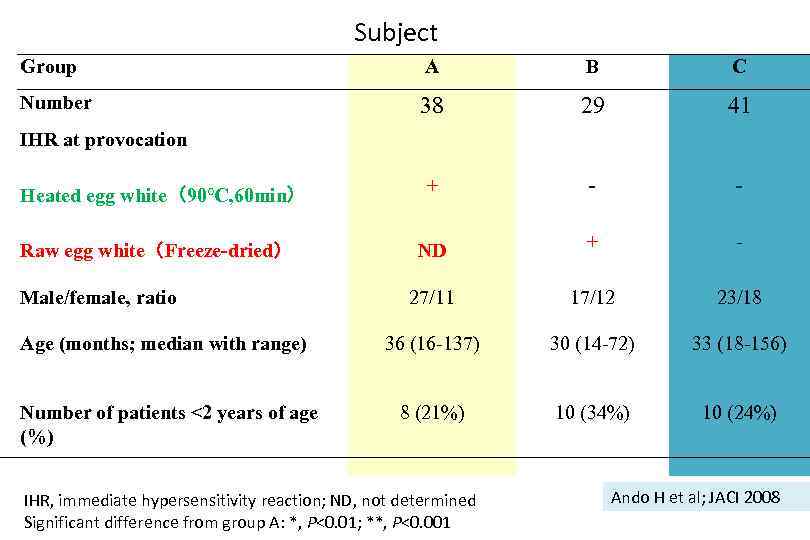 Subject Group A B C Number 38 29 41 + - - ND + - 27/11 17/12 23/18 Age (months; median with range) 36 (16 -137) 30 (14 -72) 33 (18 -156) Number of patients <2 years of age (%) 8 (21%) 10 (34%) 10 (24%) IHR at provocation Heated egg white(90℃, 60 min) Raw egg white(Freeze-dried) Male/female, ratio IHR, immediate hypersensitivity reaction; ND, not determined Significant difference from group A: *, P<0. 01; **, P<0. 001 Ando H et al; JACI 2008
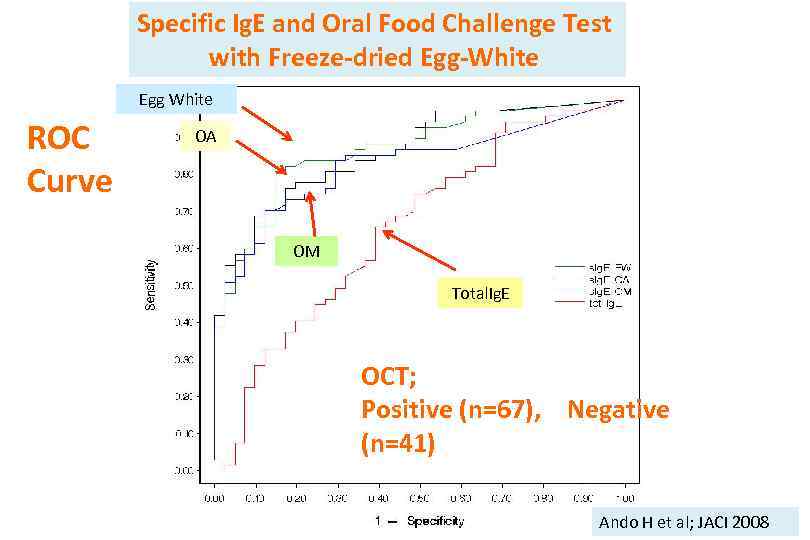 Specific Ig. E and Oral Food Challenge Test with Freeze-dried Egg-White Egg White ROC Curve OA OM Total. Ig. E OCT; Positive (n=67), Negative (n=41) Ando H et al; JACI 2008
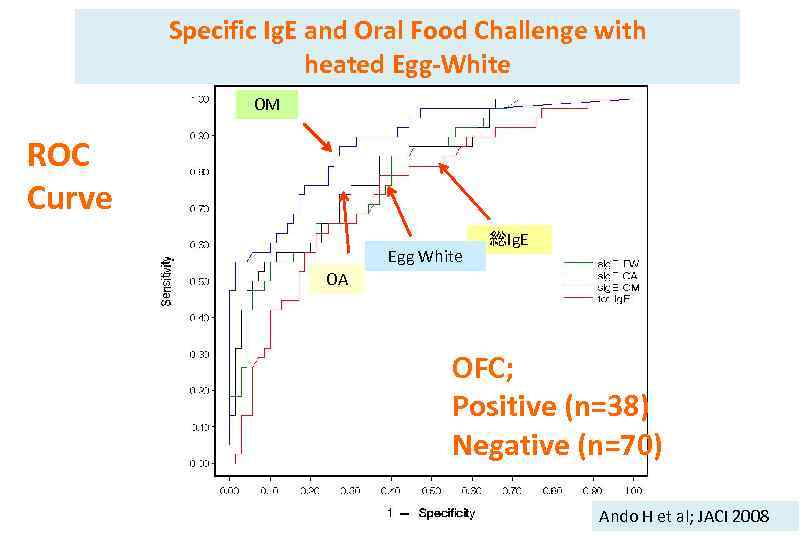 Specific Ig. E and Oral Food Challenge with heated Egg-White OM ROC Curve Egg White 総Ig. E OA OFC; Positive (n=38) Negative (n=70) Ando H et al; JACI 2008
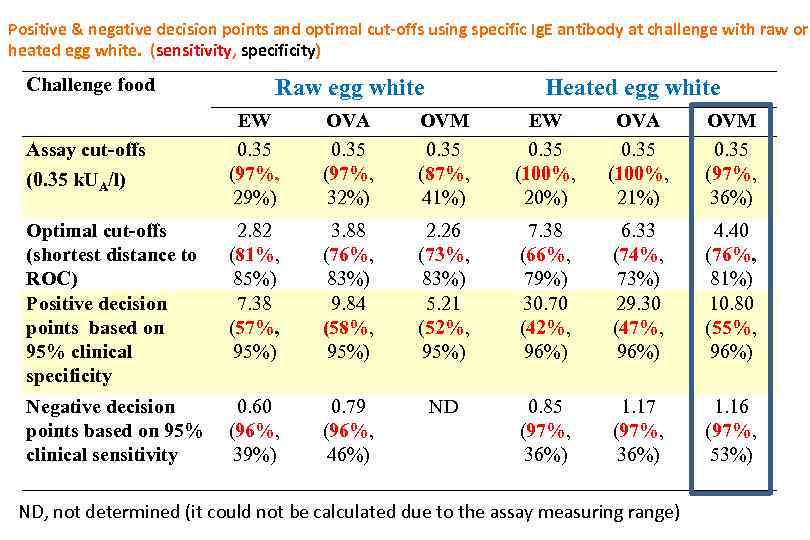 Positive & negative decision points and optimal cut-offs using specific Ig. E antibody at challenge with raw or heated egg white. (sensitivity, specificity) Challenge food Raw egg white Heated egg white EW 0. 35 (97%, 29%) OVA 0. 35 (97%, 32%) OVM 0. 35 (87%, 41%) EW 0. 35 (100%, 20%) OVA 0. 35 (100%, 21%) OVM 0. 35 (97%, 36%) Optimal cut-offs (shortest distance to ROC) Positive decision points based on 95% clinical specificity 2. 82 (81%, 85%) 7. 38 (57%, 95%) 3. 88 (76%, 83%) 9. 84 (58%, 95%) 2. 26 (73%, 83%) 5. 21 (52%, 95%) 7. 38 (66%, 79%) 30. 70 (42%, 96%) 6. 33 (74%, 73%) 29. 30 (47%, 96%) 4. 40 (76%, 81%) 10. 80 (55%, 96%) Negative decision points based on 95% clinical sensitivity 0. 60 (96%, 39%) 0. 79 (96%, 46%) ND 0. 85 (97%, 36%) 1. 17 (97%, 36%) 1. 16 (97%, 53%) Assay cut-offs (0. 35 k. UA/l) ND, not determined (it could not be calculated due to the assay measuring range)
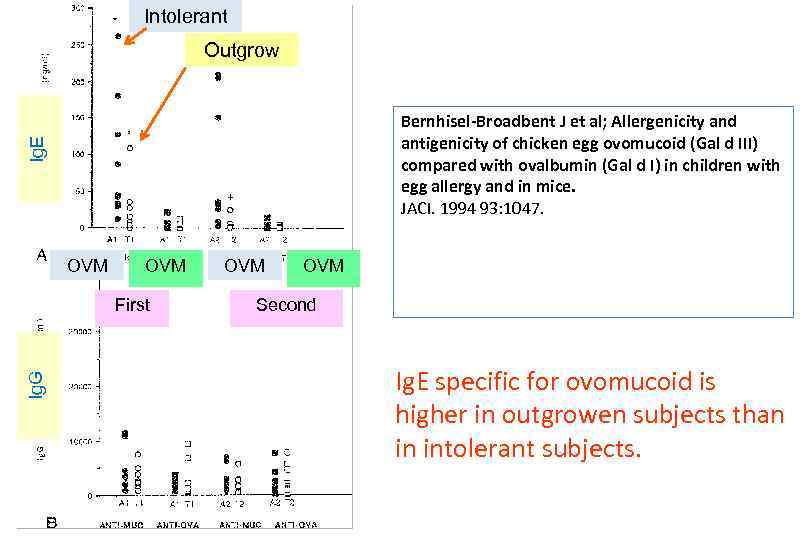 Intolerant Outgrow Ig. E Bernhisel-Broadbent J et al; Allergenicity and antigenicity of chicken egg ovomucoid (Gal d III) compared with ovalbumin (Gal d I) in children with egg allergy and in mice. JACI. 1994 93: 1047. OVM Ig. G First OVM Second Ig. E specific for ovomucoid is higher in outgrowen subjects than in intolerant subjects.
 Urisu A, et al; Clinical significance of Ig. E-binding activity to enzymatic digests of ovomucoid in diagnosis and prediction of outgrow of egg white hypersensitivity, Int Arch Allergy Appl Immunol, 120, 192, 1999
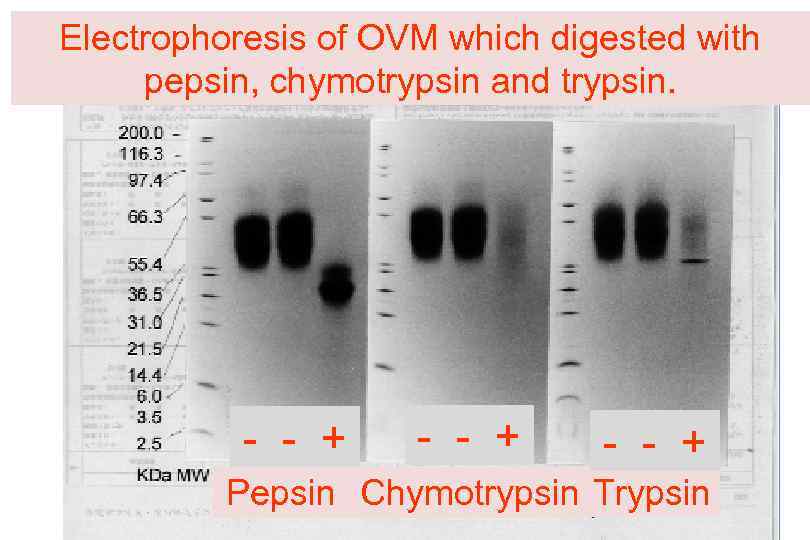 Electrophoresis of OVM which digested with pepsin, chymotrypsin and trypsin. - - + Pepsin Chymotrypsin Trypsin
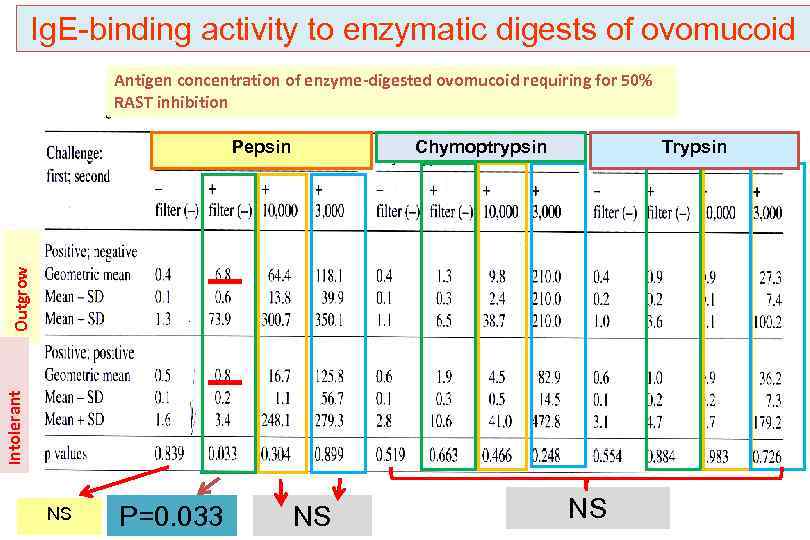 Ig. E-binding activity to enzymatic digests of ovomucoid Antigen concentration of enzyme-digested ovomucoid requiring for 50% RAST inhibition Pepsin Trypsin Intolerant Outgrow Chymoptrypsin NS P=0. 033 NS NS
 24
24
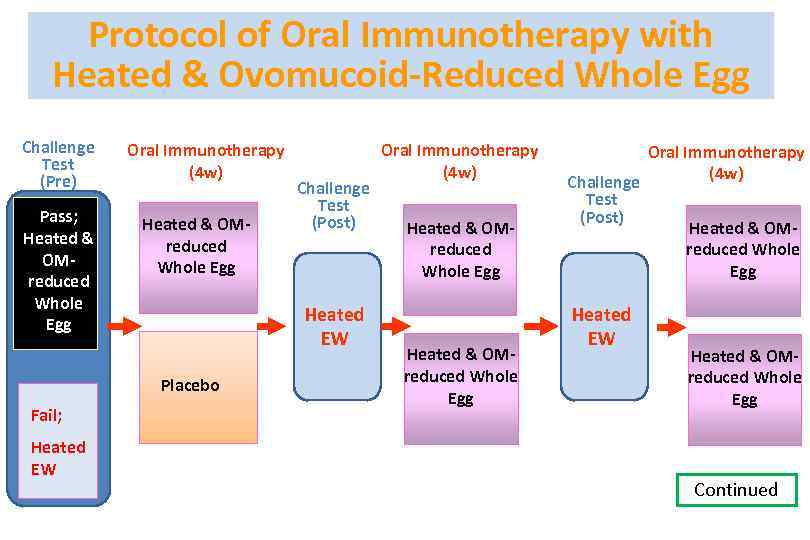 Protocol of Oral Immunotherapy with Heated & Ovomucoid-Reduced Whole Egg Challenge Test (Pre) Pass; Heated & OMreduced Whole Egg Oral Immunotherapy (4 w) Heated & OMreduced Whole Egg Heated EW Placebo Fail; Heated EW Challenge Test (Post) Oral Immunotherapy (4 w) Heated & OMreduced Whole Egg Oral Immunotherapy (4 w) Challenge Test (Post) Heated & OMreduced Whole Egg Heated EW Heated & OMreduced Whole Egg Continued
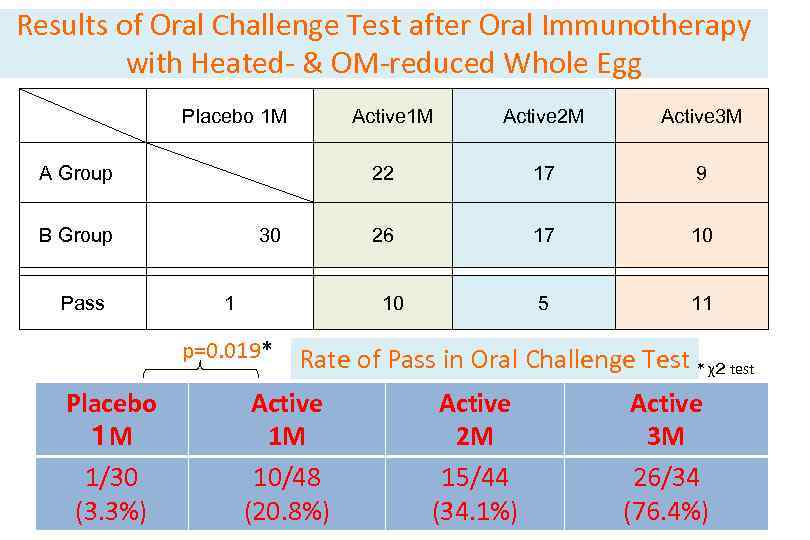 Results of Oral Challenge Test after Oral Immunotherapy with Heated- & OM-reduced Whole Egg Placebo 1 M Active 1 M Active 2 M Active 3 M A Group 22 17 9 B Group 30 26 17 10 Pass 1 10 p=0. 019* Placebo 1M 1/30 (3. 3%) 5 11 Rate of Pass in Oral Challenge Test * χ2 test Active 1 M 10/48 (20. 8%) Active 2 M 15/44 (34. 1%) Active 3 M 26/34 (76. 4%) 26
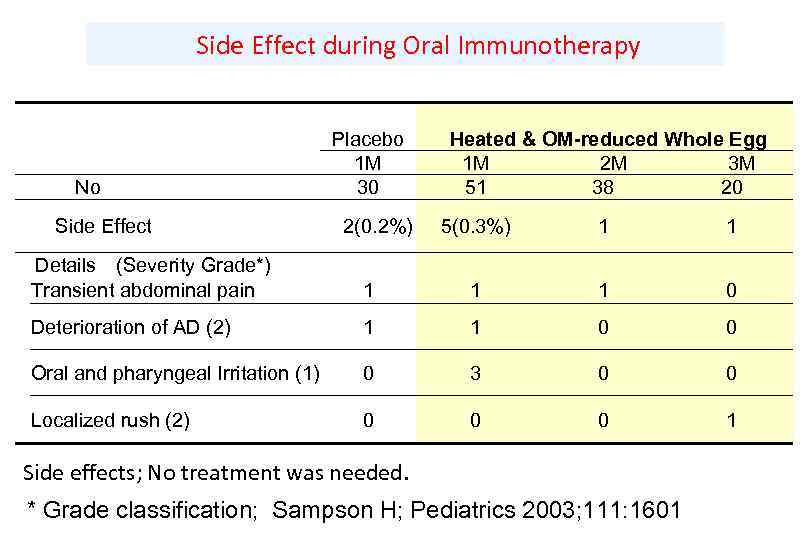 Side Effect during Oral Immunotherapy No Placebo Heated & OM-reduced Whole Egg 1 M 1 M 2 M 3 M 30 51 38 20 2(0. 2%) 5(0. 3%) 1 1 1 0 Deterioration of AD (2) 1 1 0 0 Oral and pharyngeal Irritation (1) 0 3 0 0 Localized rush (2) 0 0 0 1 Side Effect Details (Severity Grade*) Transient abdominal pain Side effects; No treatment was needed. * Grade classification; Sampson H; Pediatrics 2003; 111: 1601
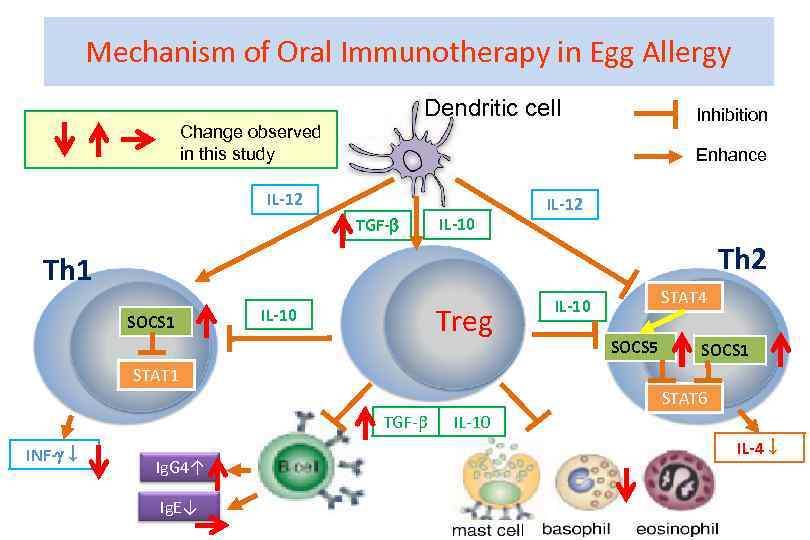 Mechanism of Oral Immunotherapy in Egg Allergy Dendritic cell Inhibition Change observed in this study Enhance IL-12 TGF-b IL-10 IL-12 Th 1 Th 2 SOCS 1 Treg IL-10 STAT 4 IL-10 SOCS 5 Th 2 Th 1 SOCS 1 STAT 6 TGF-b INF-g↓ Ig. G 4↑ Ig. E↓ IL-10 IL-4↓