 Скачать презентацию ATS 351 Lab 7 Precipitation March 7 2006
25ad0d86f4109cdfb1080c01d831e456.ppt
- Количество слайдов: 39



ATS 351 Lab 7 Precipitation March 7, 2006
Droplet Growth by Collision and Coalescence • Growth by condensation alone takes too long • Occurs in clouds with tops warmer than 5°F (-15°C) • Greater the speed of the falling droplet, the more air molecules the drop encounters • Important factors for droplet growth – – High liquid water content within the cloud Strong and consistent updrafts Large range of cloud droplet sizes Thick cloud
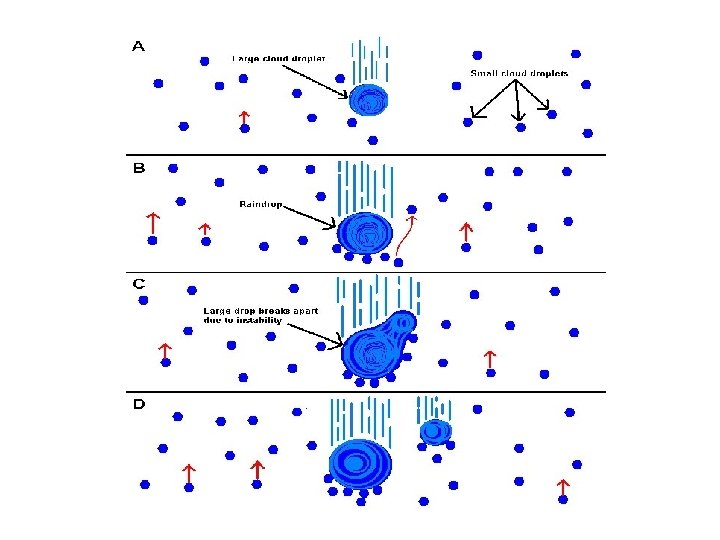
Collision and Coalescence
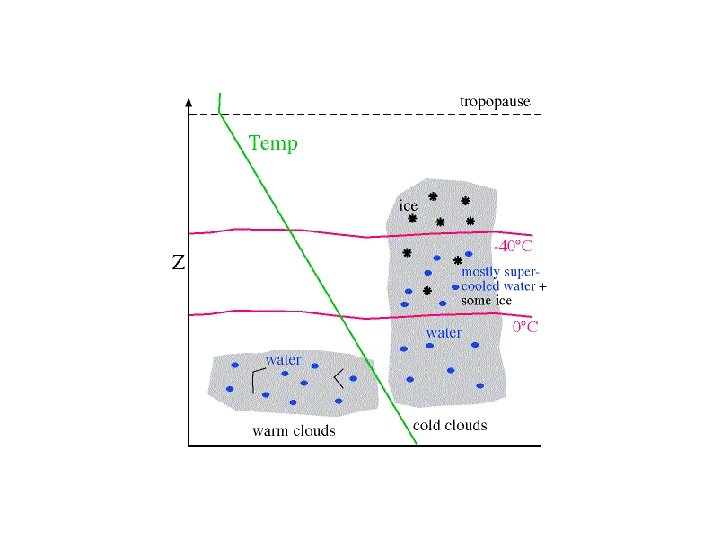
Droplet Growth by the Bergeron process • • • Cold clouds Homogeneous nucleation of ice Vapor deposition Accretion Aggregation
Homogeneous nucleation of ice • Freezing of pure water – Enough molecules in the droplet must join together in a rigid pattern to form an ice embryo – Smaller the amount of pure water, the lower the temperature at which water freezes • Supercooled droplets – Water droplets existing at temperatures below freezing • Homogeneous nucleation (freezing) occurs at temperatures of – 40°C • Vapor deposition – From vapor to solid – Not likely in our atmosphere
Ice nuclei • Ice crystals form in subfreezing air on particles called ice nuclei • Ice nuclei are rare; only one out of 10 million aerosols is an effective ice nuclei • Fewer sources than CCN – Desert and arid regions: silicate particle (dominant) – Clay particles: for temperatures between – 10 and – 20°C – Volcanic emissions – Combustion products – bacteria – IN may be de-activated when exposed to atmospheres with high concentrations of Aitken nuclei produced by industrial processes – Oceans are NOT good sources of IN
IN requirements • Insolubility – If soluble, cannot maintain molecular structure requirement for ice • Size – Must be comparable, or larger than, that of a critical ice embryo (typically 0. 1 microns) • Chemical bond – Must have similar hydrogen bonds to that of ice available at its surface • Crystallographic – Similar lattice structure to that of ice (hexagonal) • Active Site – Pits and steps in their surfaces
Heterogeneous nucleation • Vapor deposition – Direct transfer of water vapor to nucleus • Condensation-freezing Condensation of vapor onto surface, followed by freezing • Immersion – Ice nucleus immersed within a drop • Contact – Collision with supercooled droplets, freezing upon impact
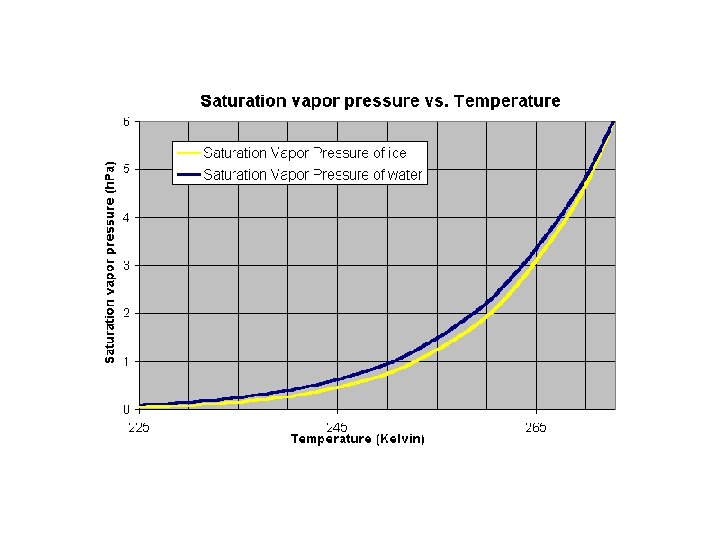
Growth mechanisms • Vapor deposition – Saturation vapor pressure over water greater than over ice – Supercooled liquid droplets more readily evaporate and contribute to the vapor pressure than sublimation from ice – When ice and liquid coexist in cloud, water vapor evaporates from drop and flows toward ice to maintain equilibrium – Ice crystals continuously grow at the water droplet’s expense – The process of precipitation formation in cold clouds by ice crystal diffusional growth at the expense of liquid water droplets is known as Bergeron process
Growth mechanisms • Diffusional growth alone not sufficient for precipitation formation • Accretion – Ice crystals collide with supercooled droplets, which freeze upon impact – Forms graupel – May fracture or split as falls, producing more ice crystals
Growth mechanisms • Aggregation – Collision of ice crystals with each other and sticking together – Clumping of ice crystals referred to as a snowflake
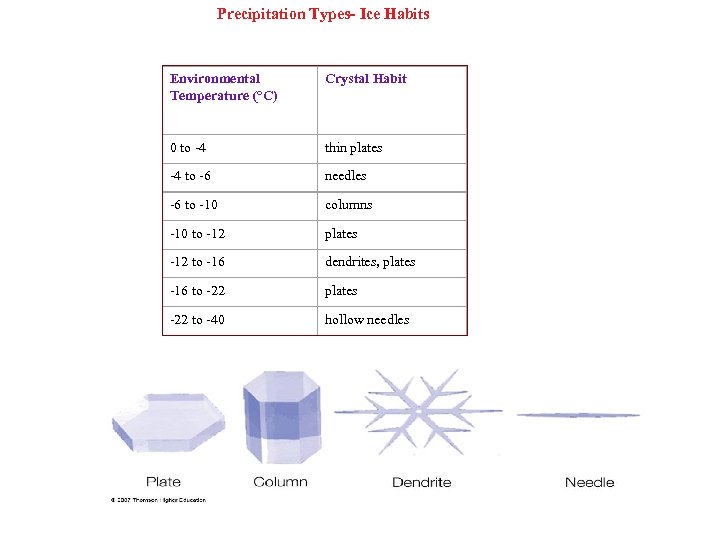
Precipitation Types- Ice Habits Environmental Temperature (°C) 0 to -4 thin plates -4 to -6 needles -6 to -10 columns -10 to -12 plates -12 to -16 dendrites, plates -16 to -22 plates -22 to -40 hollow needles Crystal Habit
Snow • Snowflakes can generally fall 300 m (1000 ft) below the freezing level before completely melting • Dry vs. wet – Moist air slightly above freezing, snowflakes slightly melt forming thin film of water along edges; snowflakes stick together – Extremely cold air with a low moisture content, small, powdery flakes fall
o. F and Snow? 43 • Snow occurs when air temperature above freezing if very dry air • Evaporative cooling can allow a rainy day to change to snowfall • Need a wet-bulb temperature at freezing or below
Graupel • Ice crystals falls through cloud, accumulating supercooled water droplets that freeze upon impact – Creates many tiny air spaces – These air bubbles act to keep the density low and scatter light, making the particle opaque • When ice particle accumulates heavy coating of rime, it’s called graupel
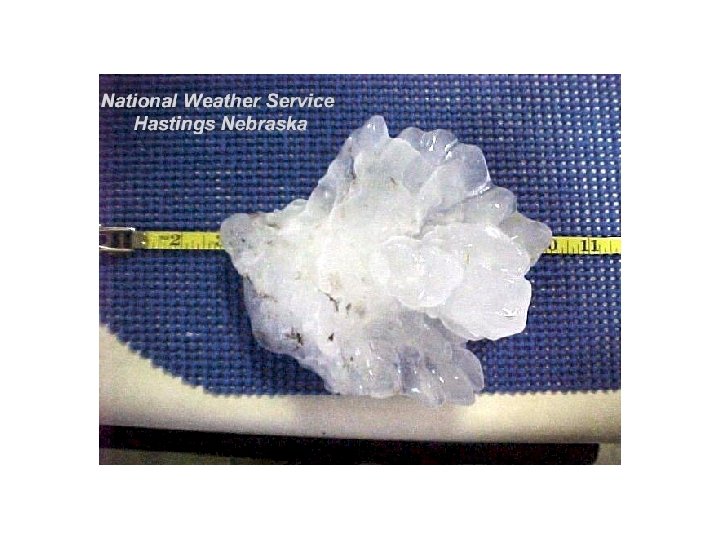
Hail • Hailstones form when either graupel particles or large frozen drops grow by collecting copious amounts of supercooled water • Graupel and hail stones carried upward in cloud by strong updrafts and fall back downward on outer edge of cloud where updraft is weaker • Hail continues to grow and carried into updraft until so large that it eventually falls out bottom of cloud
Hail growth • As hailstone collects supercooled drops which freeze on surface, latent heat released, warming surface of stone • At low growth rates, this heat dissipates into surrounding air, keeping surface of stone well below freezing and all accreted water is frozen • Referred to as dry growth of hailstone
Hail growth • If hailstone collects supercooled drops beyond a critical rate or if the cloud water content is greater than a certain value, latent heat release will warm surface to 0°C • Prevents all accreted water from freezing • Surface of hailstone covered by layer of liquid water • Referred to as wet growth of hailstone
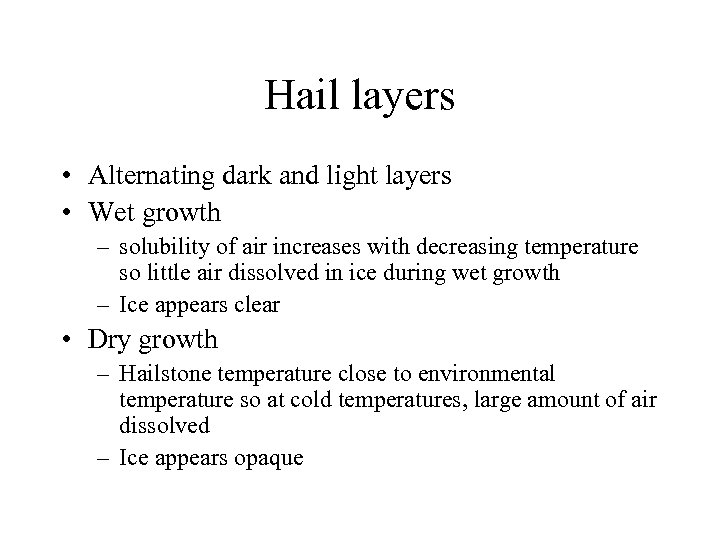
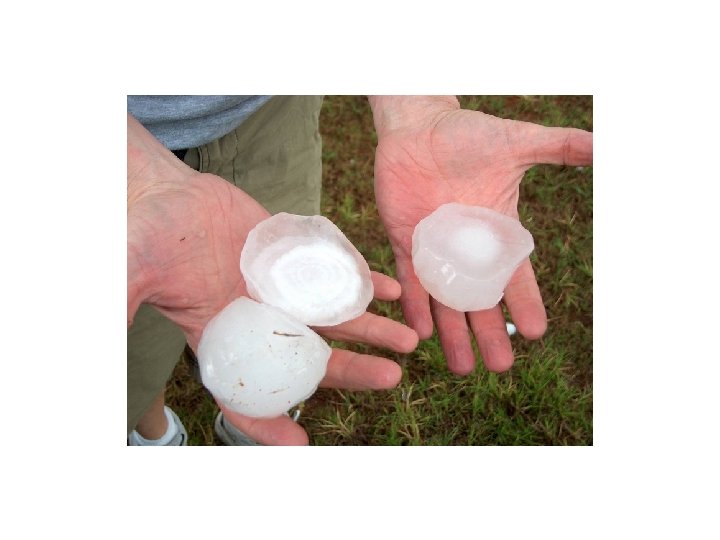
Hail layers • Alternating dark and light layers • Wet growth – solubility of air increases with decreasing temperature so little air dissolved in ice during wet growth – Ice appears clear • Dry growth – Hailstone temperature close to environmental temperature so at cold temperatures, large amount of air dissolved – Ice appears opaque
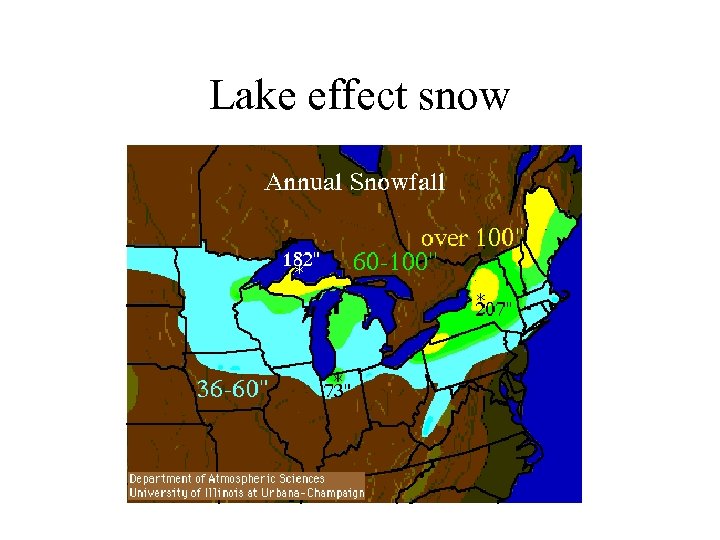
Lake effect snow
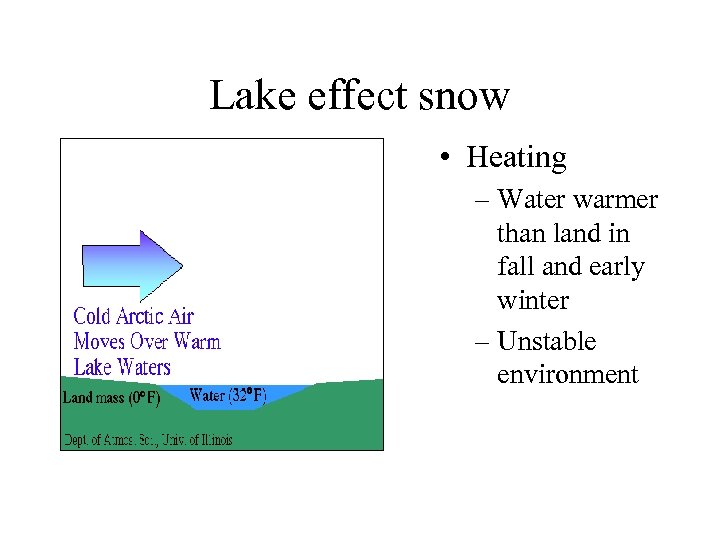
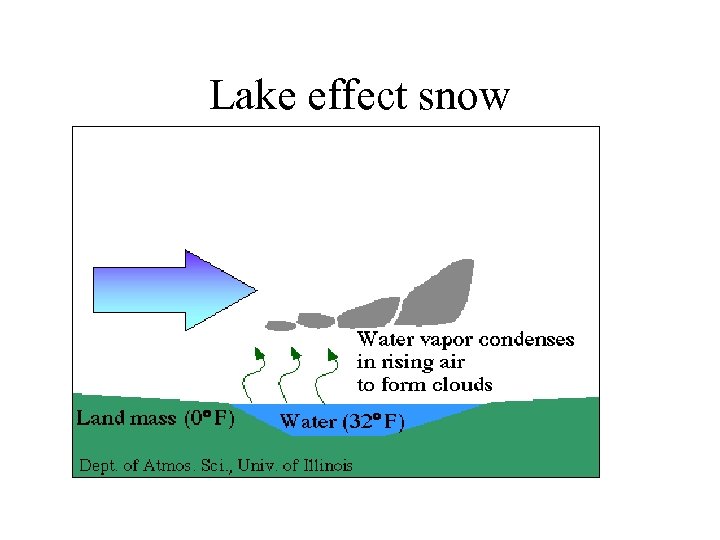
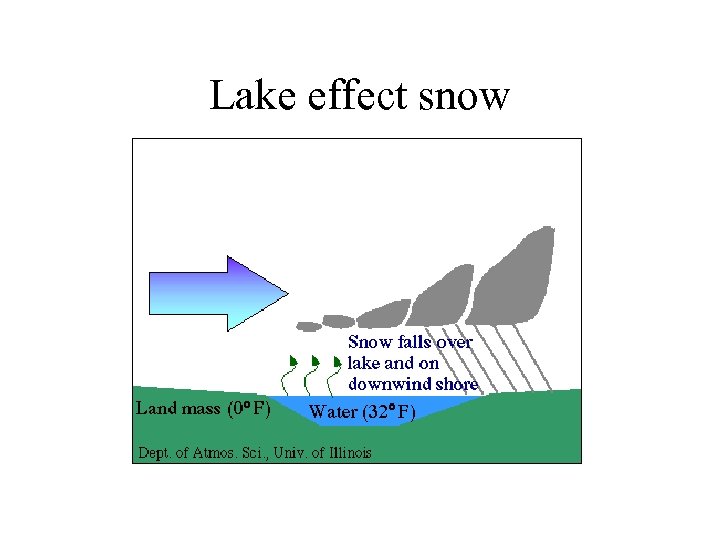
Lake effect snow • Heating – Water warmer than land in fall and early winter – Unstable environment
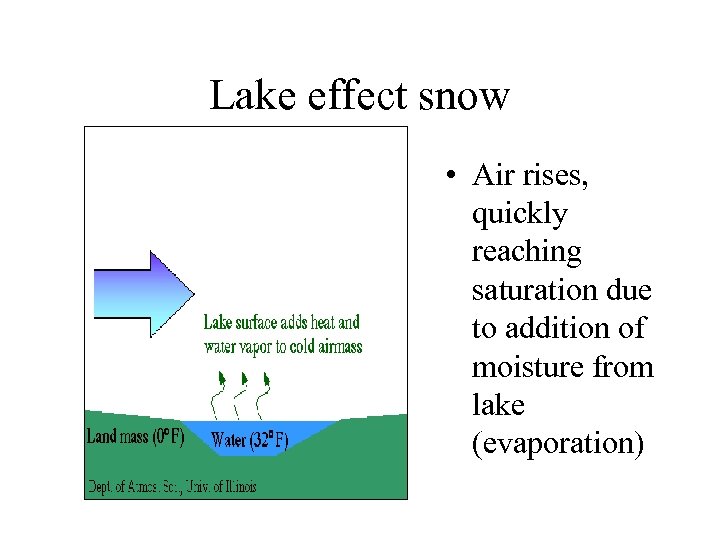
Lake effect snow • Air rises, quickly reaching saturation due to addition of moisture from lake (evaporation)
Lake effect snow
Lake effect snow
Lake effect snow • Wind fetch – Length of trajectory of wind across lake – Greater the distance the wind blows over warm water, the greater the convection • Frictional difference – When wind moves from over water to land, friction slows it down, resulting in surface convergence and lifting • Large-scale forcing – Enhancement of lake-effect snow
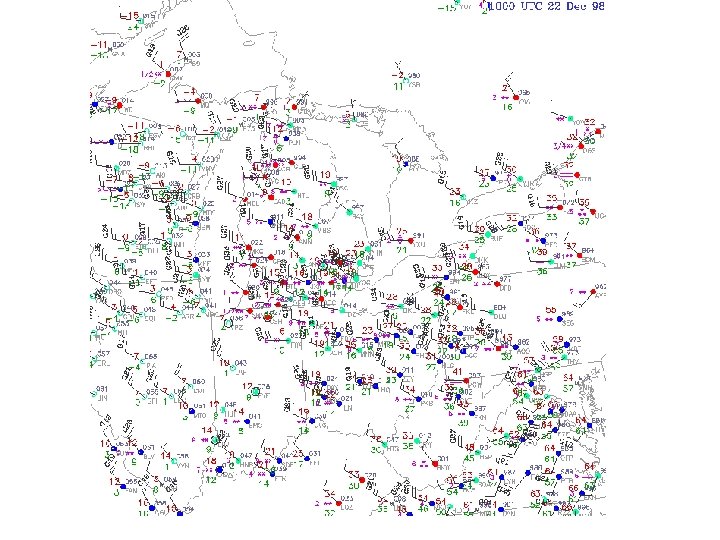
Case study (Dec 1998)
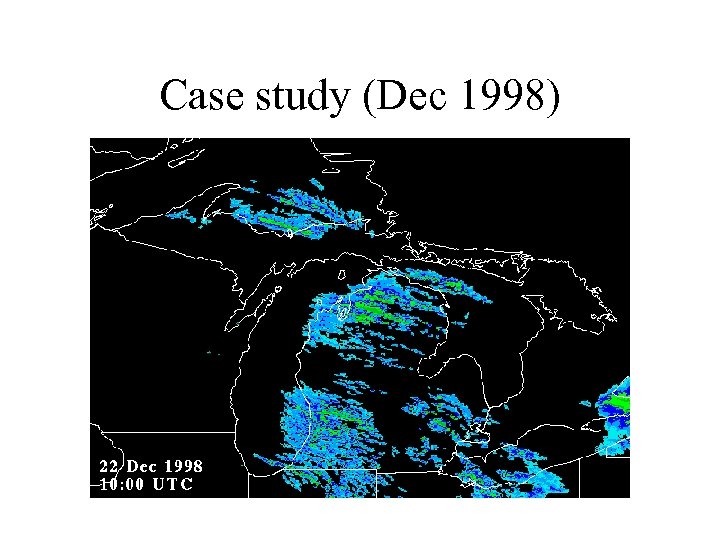
Case study (Dec 1998)
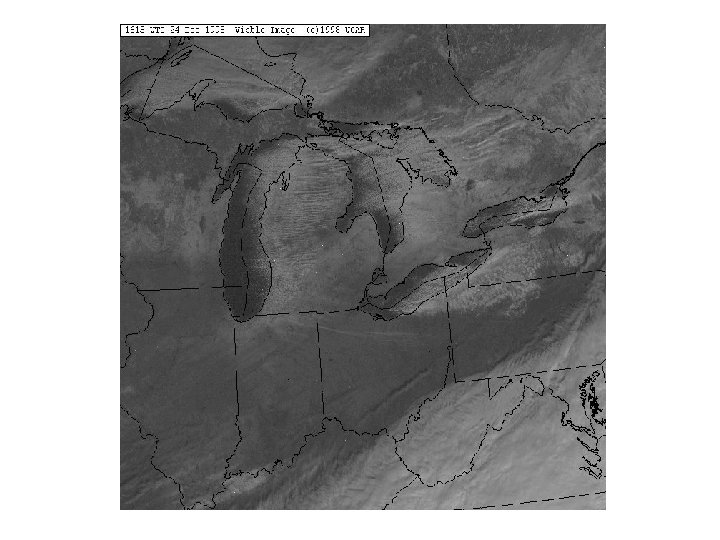
Case study (Dec 1998)
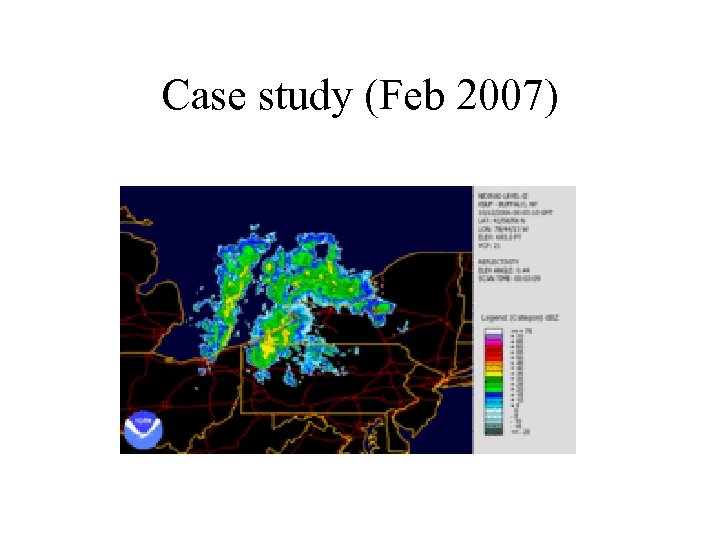
Case study (Feb 2007)
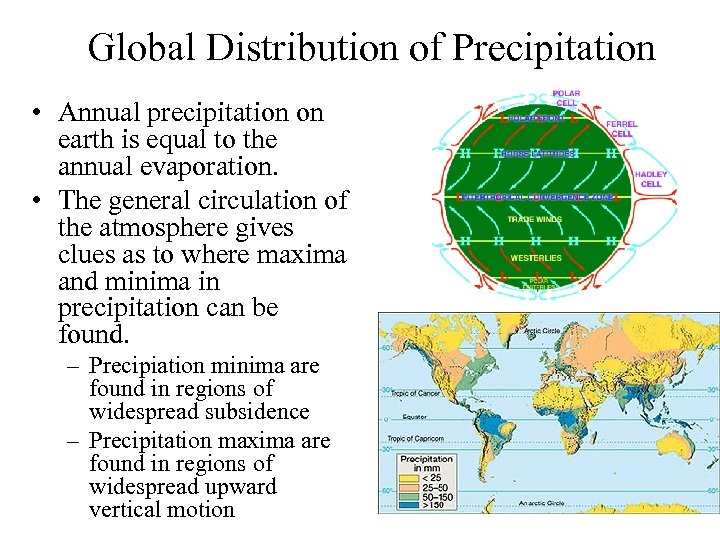
Global Distribution of Precipitation • Annual precipitation on earth is equal to the annual evaporation. • The general circulation of the atmosphere gives clues as to where maxima and minima in precipitation can be found. – Precipiation minima are found in regions of widespread subsidence – Precipitation maxima are found in regions of widespread upward vertical motion
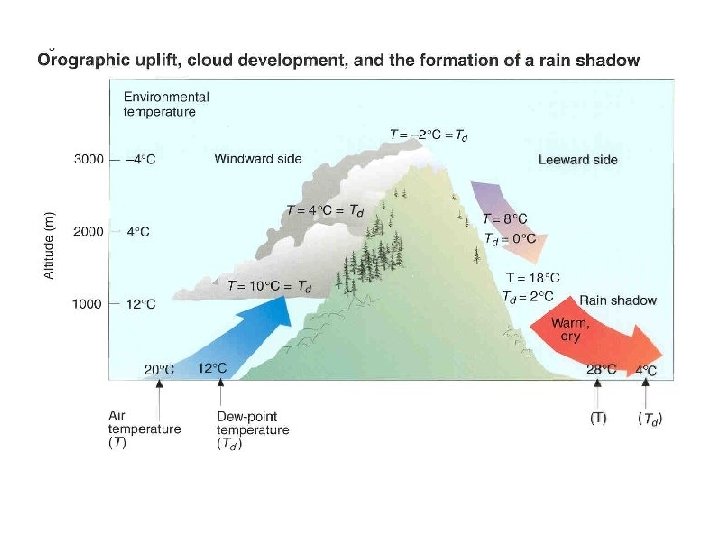
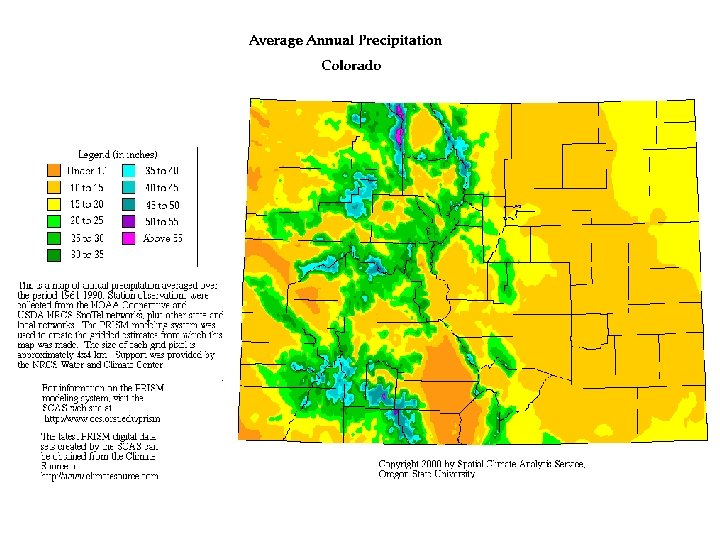
Rain Shadow • A rain shadow is an arid region on the lee side of a mountain range • Caused by the adiabatic cooling and warming of air parcels as they travel over the topography • Why the western slopes in CO receive more snowfall than the eastern slopes.
 Скачать презентацию ATS 351 Lab 7 Precipitation March 7 2006
25ad0d86f4109cdfb1080c01d831e456.ppt