


 Скачать презентацию Atmospheric muons neutrinos in neutrino telescopes
a54e2c19e9e9265f62c9f2c87ec9c335.ppt
- Количество слайдов: 53
 Atmospheric muons & neutrinos in neutrino telescopes • Neutrino oscillations • Muon & neutrino beams • Muons & neutrinos underground Astroteilchenphysik 2009 Tom Gaisser Cosmic rays - 2 1
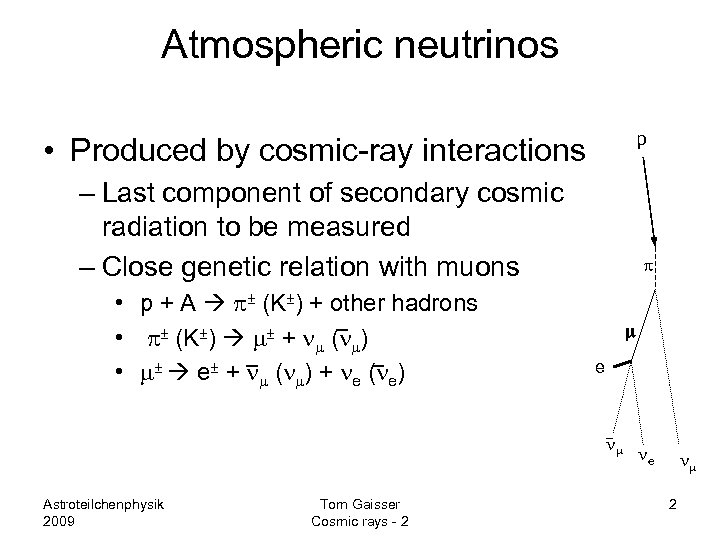 Atmospheric neutrinos p • Produced by cosmic-ray interactions – Last component of secondary cosmic radiation to be measured – Close genetic relation with muons • p + A p± (K±) + other hadrons • p± (K±) m± + nm (nm) • m± e± + nm (nm) + ne (ne) p m e nm Astroteilchenphysik 2009 Tom Gaisser Cosmic rays - 2 ne nm 2
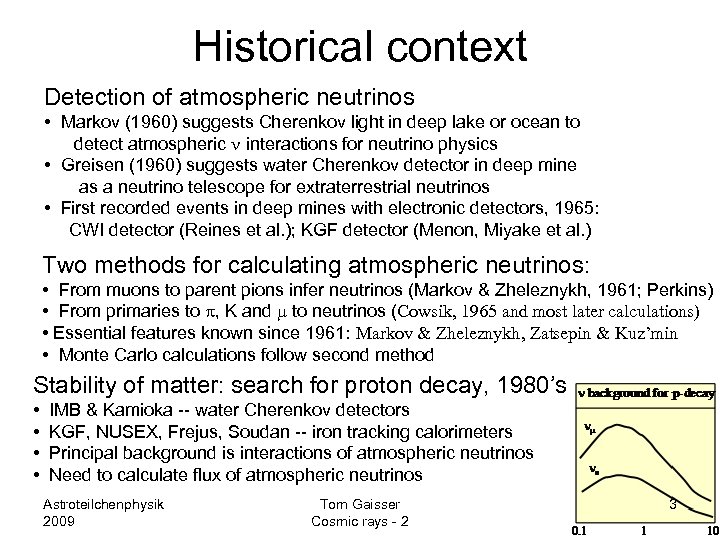 Historical context Detection of atmospheric neutrinos • Markov (1960) suggests Cherenkov light in deep lake or ocean to detect atmospheric n interactions for neutrino physics • Greisen (1960) suggests water Cherenkov detector in deep mine as a neutrino telescope for extraterrestrial neutrinos • First recorded events in deep mines with electronic detectors, 1965: CWI detector (Reines et al. ); KGF detector (Menon, Miyake et al. ) Two methods for calculating atmospheric neutrinos: • From muons to parent pions infer neutrinos (Markov & Zheleznykh, 1961; Perkins) • From primaries to p, K and m to neutrinos (Cowsik, 1965 and most later calculations) • Essential features known since 1961: Markov & Zheleznykh, Zatsepin & Kuz’min • Monte Carlo calculations follow second method Stability of matter: search for proton decay, 1980’s • • IMB & Kamioka -- water Cherenkov detectors KGF, NUSEX, Frejus, Soudan -- iron tracking calorimeters Principal background is interactions of atmospheric neutrinos Need to calculate flux of atmospheric neutrinos Astroteilchenphysik 2009 Tom Gaisser Cosmic rays - 2 3
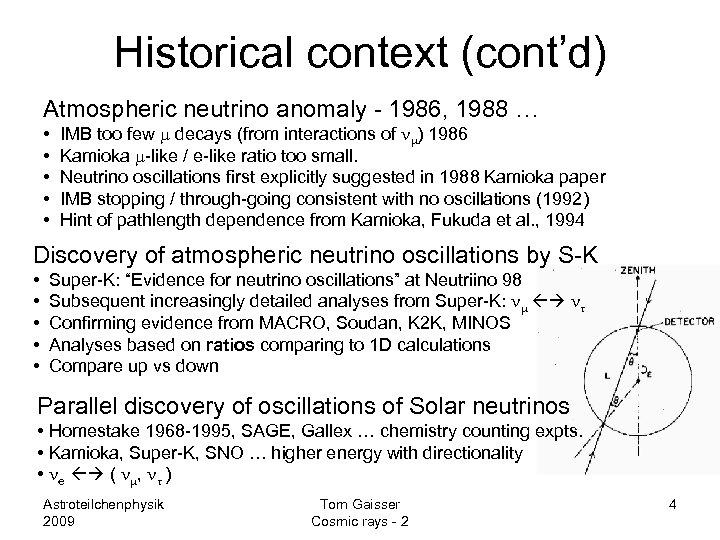 Historical context (cont’d) Atmospheric neutrino anomaly - 1986, 1988 … • • • IMB too few m decays (from interactions of nm) 1986 Kamioka m-like / e-like ratio too small. Neutrino oscillations first explicitly suggested in 1988 Kamioka paper IMB stopping / through-going consistent with no oscillations (1992) Hint of pathlength dependence from Kamioka, Fukuda et al. , 1994 Discovery of atmospheric neutrino oscillations by S-K • • • Super-K: “Evidence for neutrino oscillations” at Neutriino 98 Subsequent increasingly detailed analyses from Super-K: nm nt Confirming evidence from MACRO, Soudan, K 2 K, MINOS Analyses based on ratios comparing to 1 D calculations Compare up vs down Parallel discovery of oscillations of Solar neutrinos • Homestake 1968 -1995, SAGE, Gallex … chemistry counting expts. • Kamioka, Super-K, SNO … higher energy with directionality • ne ( nm, nt ) Astroteilchenphysik 2009 Tom Gaisser Cosmic rays - 2 4
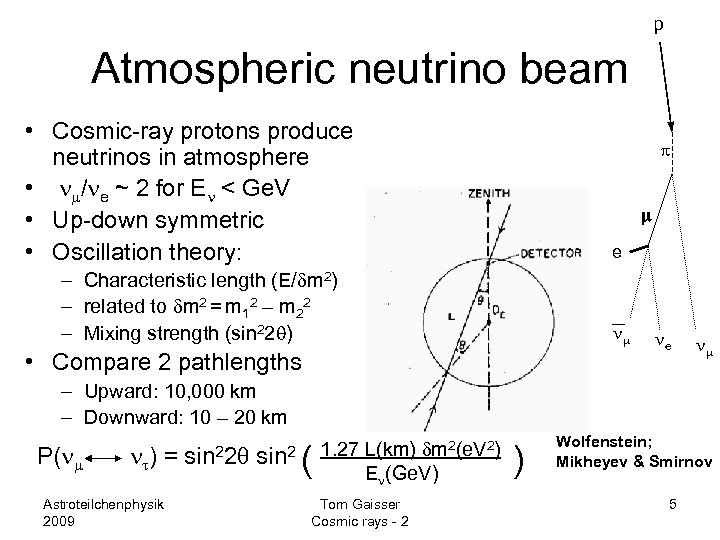 p Atmospheric neutrino beam • Cosmic-ray protons produce neutrinos in atmosphere • nm/ne ~ 2 for En < Ge. V • Up-down symmetric • Oscillation theory: p m e – Characteristic length (E/dm 2) – related to dm 2 = m 12 – m 22 – Mixing strength (sin 22 q) nm • Compare 2 pathlengths ne nm – Upward: 10, 000 km – Downward: 10 – 20 km P(nm n t) = Astroteilchenphysik 2009 sin 22 q sin 2 ( 1. 27 L(km) dm 2(e. V 2) En(Ge. V) Tom Gaisser Cosmic rays - 2 ) Wolfenstein; Mikheyev & Smirnov 5
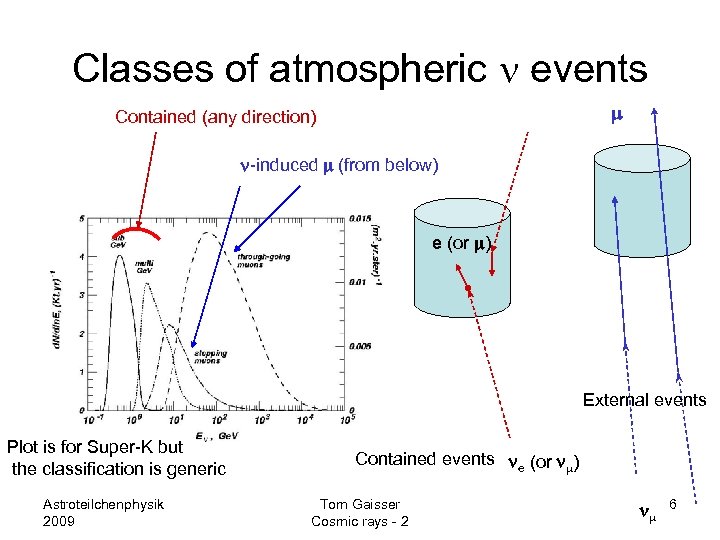 Classes of atmospheric n events m Contained (any direction) n-induced m (from below) e (or m) External events Plot is for Super-K but the classification is generic Astroteilchenphysik 2009 Contained events ne (or nm) Tom Gaisser Cosmic rays - 2 nm 6
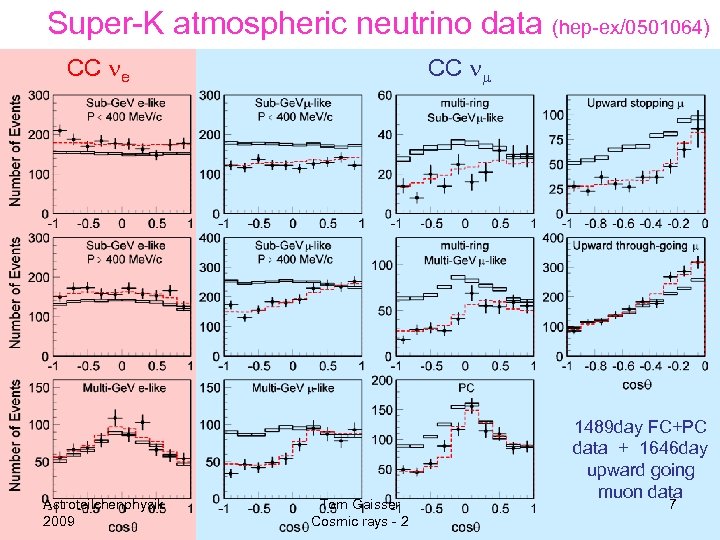 Super-K atmospheric neutrino data (hep-ex/0501064) CC ne Astroteilchenphysik 2009 CC nm Tom Gaisser Cosmic rays - 2 1489 day FC+PC data + 1646 day upward going muon data 7
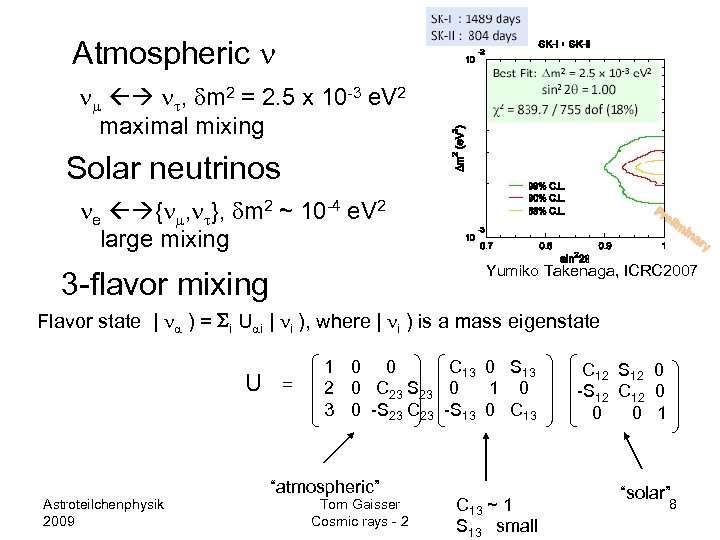 Atmospheric n nm nt, dm 2 = 2. 5 x 10 -3 e. V 2 maximal mixing Solar neutrinos ne {nm, nt}, dm 2 ~ 10 -4 e. V 2 large mixing Yumiko Takenaga, ICRC 2007 3 -flavor mixing Flavor state | na ) = Si Uai | ni ), where | ni ) is a mass eigenstate U Astroteilchenphysik 2009 = 1 0 0 C 13 0 S 13 2 0 C 23 S 23 0 1 0 3 0 -S 23 C 23 -S 13 0 C 13 “atmospheric” Tom Gaisser Cosmic rays - 2 C 13 ~ 1 S 13 small C 12 S 12 0 -S 12 C 12 0 0 0 1 “solar” 8
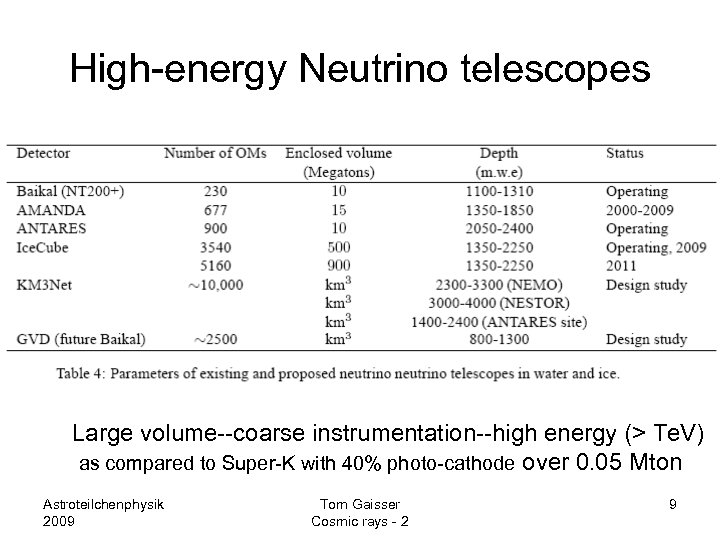 High-energy Neutrino telescopes Large volume--coarse instrumentation--high energy (> Te. V) as compared to Super-K with 40% photo-cathode over 0. 05 Mton Astroteilchenphysik 2009 Tom Gaisser Cosmic rays - 2 9
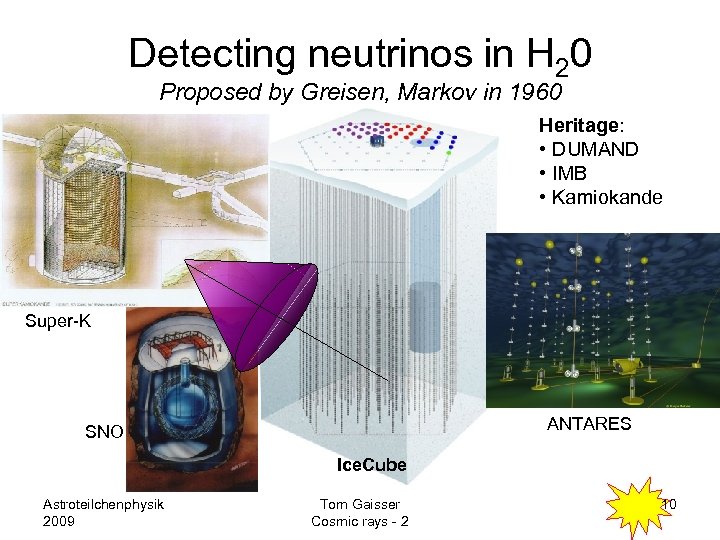 Detecting neutrinos in H 20 Proposed by Greisen, Markov in 1960 Heritage: • DUMAND • IMB • Kamiokande Super-K ANTARES SNO Ice. Cube Astroteilchenphysik 2009 Tom Gaisser Cosmic rays - 2 10
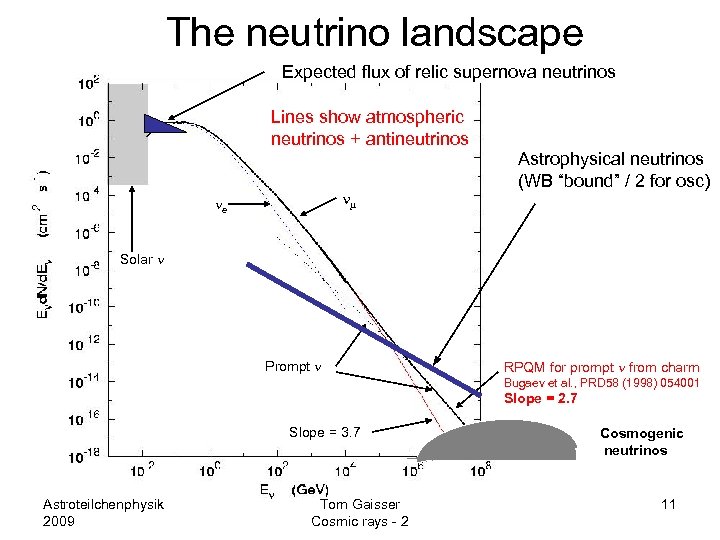 The neutrino landscape Expected flux of relic supernova neutrinos Lines show atmospheric neutrinos + antineutrinos nm ne Astrophysical neutrinos (WB “bound” / 2 for osc) Solar n Prompt n RPQM for prompt n from charm Bugaev et al. , PRD 58 (1998) 054001 Slope = 2. 7 Slope = 3. 7 Astroteilchenphysik 2009 Tom Gaisser Cosmic rays - 2 Cosmogenic neutrinos 11
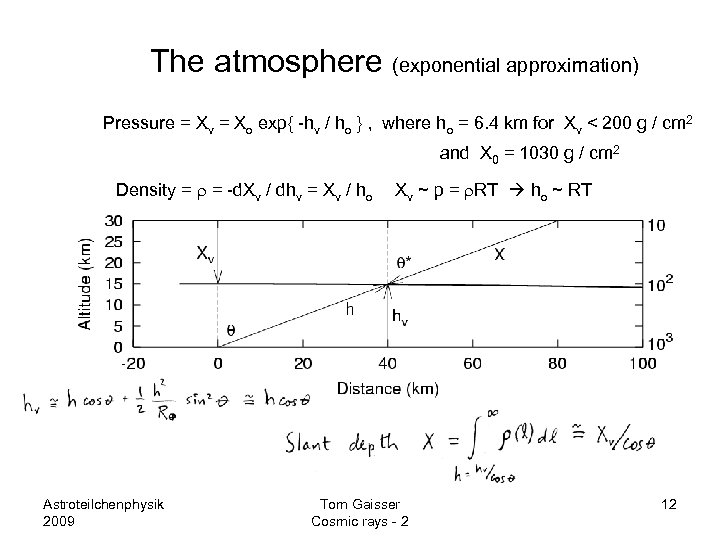 The. The atmosphere (exponential approximation) Pressure = Xv = Xo exp{ -hv / ho } , where ho = 6. 4 km for Xv < 200 g / cm 2 and X 0 = 1030 g / cm 2 Density = r = -d. Xv / dhv = Xv / ho Astroteilchenphysik 2009 Xv ~ p = r. RT ho ~ RT Tom Gaisser Cosmic rays - 2 12
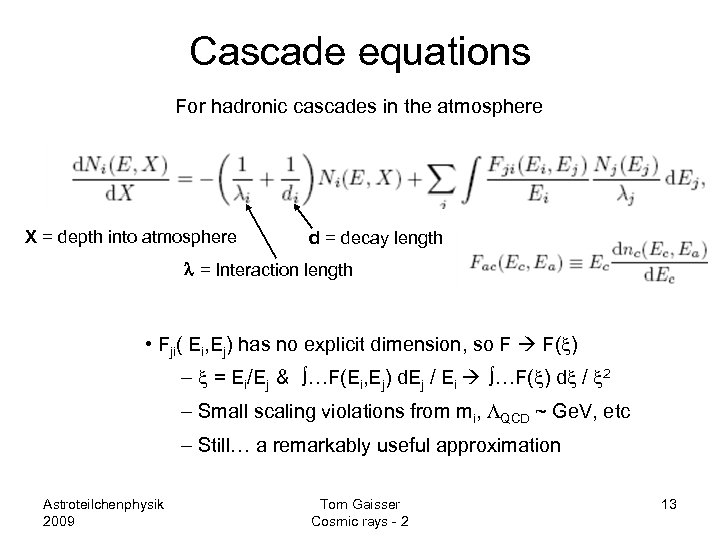 Cascade equations For hadronic cascades in the atmosphere X = depth into atmosphere d = decay length l = Interaction length • Fji( Ei, Ej) has no explicit dimension, so F F(x) – x = Ei/Ej & ∫…F(Ei, Ej) d. Ej / Ei ∫…F(x) dx / x 2 – Small scaling violations from mi, LQCD ~ Ge. V, etc – Still… a remarkably useful approximation Astroteilchenphysik 2009 Tom Gaisser Cosmic rays - 2 13
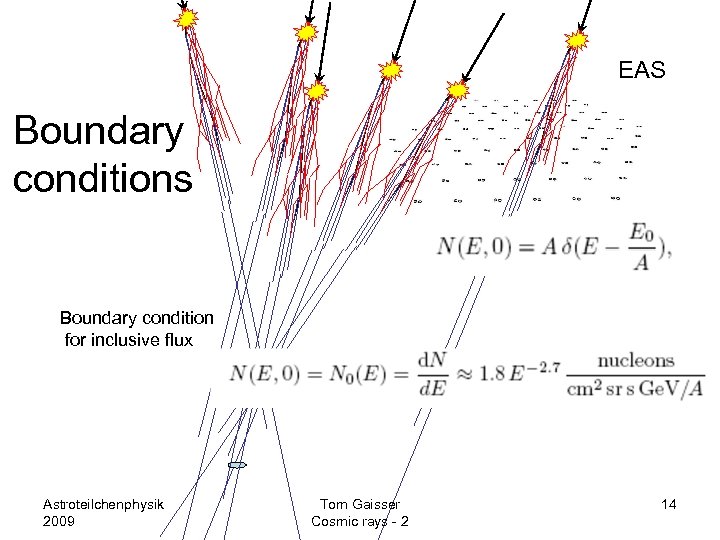 EAS Boundary conditions Boundary condition for inclusive flux Astroteilchenphysik 2009 Tom Gaisser Cosmic rays - 2 14
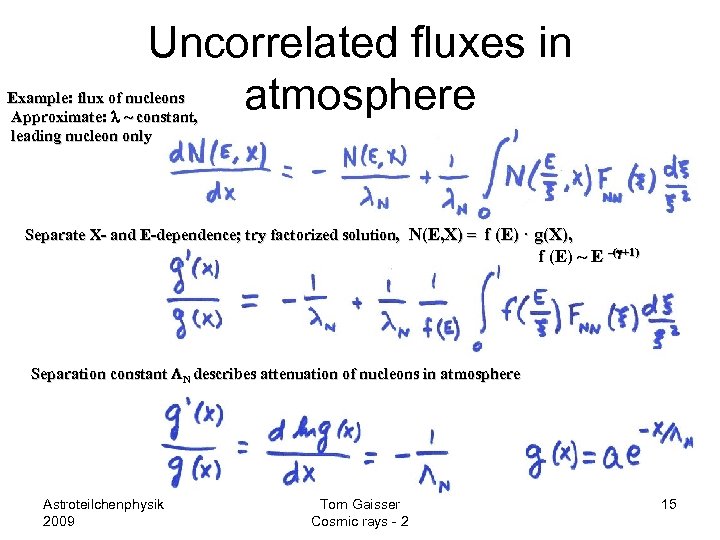 Uncorrelated fluxes in atmosphere Example: flux of nucleons Approximate: l ~ constant, leading nucleon only Separate X- and E-dependence; try factorized solution, N(E, X) = f (E) · g(X), f (E) ~ E –(g+1) Separation constant LN describes attenuation of nucleons in atmosphere Astroteilchenphysik 2009 Tom Gaisser Cosmic rays - 2 15
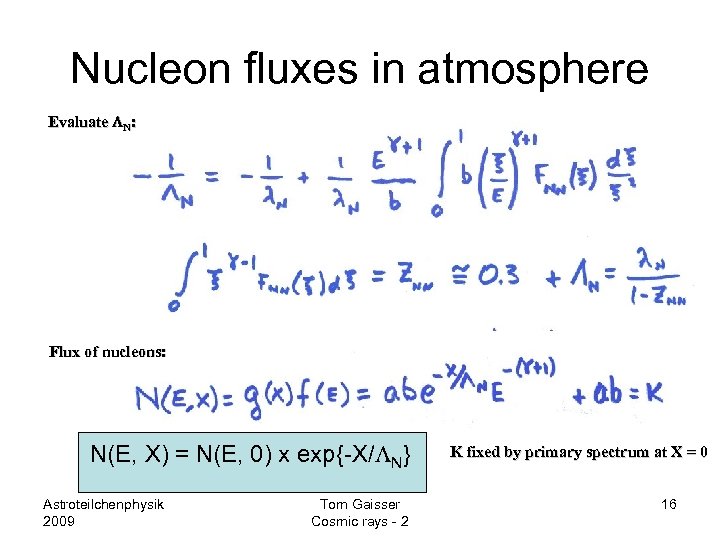 Nucleon fluxes in atmosphere Evaluate LN: Flux of nucleons: N(E, X) = N(E, 0) x exp{-X/LN} Astroteilchenphysik 2009 Tom Gaisser Cosmic rays - 2 K fixed by primary spectrum at X = 0 16
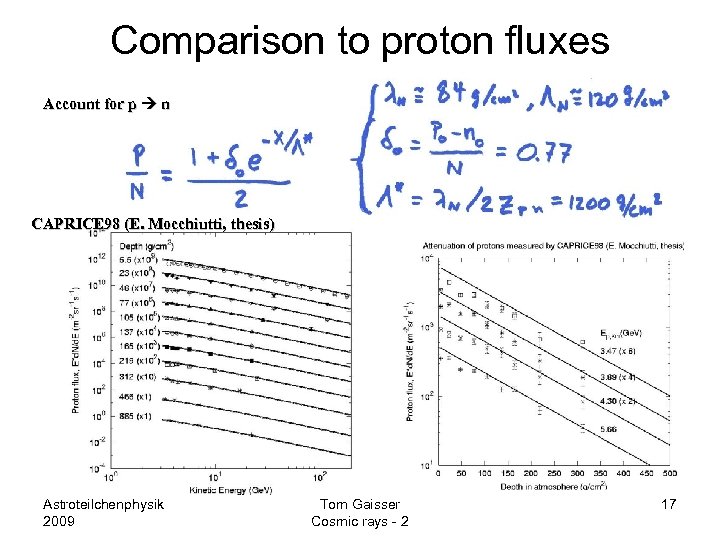 Comparison to proton fluxes Account for p n CAPRICE 98 (E. Mocchiutti, thesis) Astroteilchenphysik 2009 Tom Gaisser Cosmic rays - 2 17
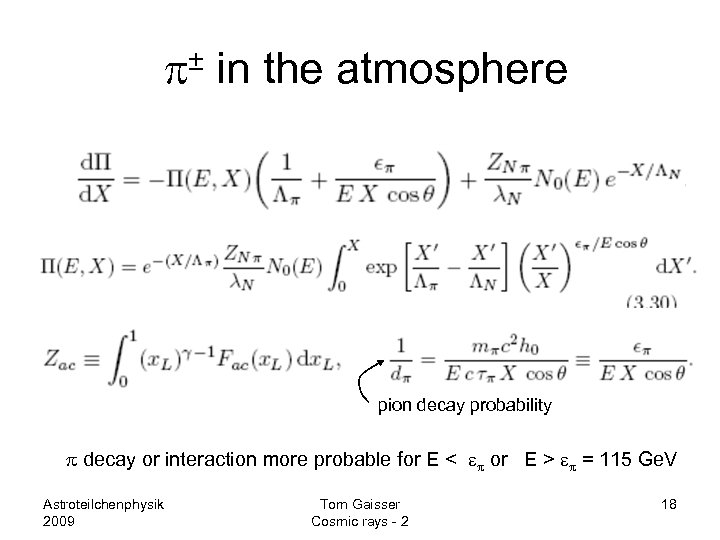 p± in the atmosphere pion decay probability p decay or interaction more probable for E < ep or E > ep = 115 Ge. V Astroteilchenphysik 2009 Tom Gaisser Cosmic rays - 2 18
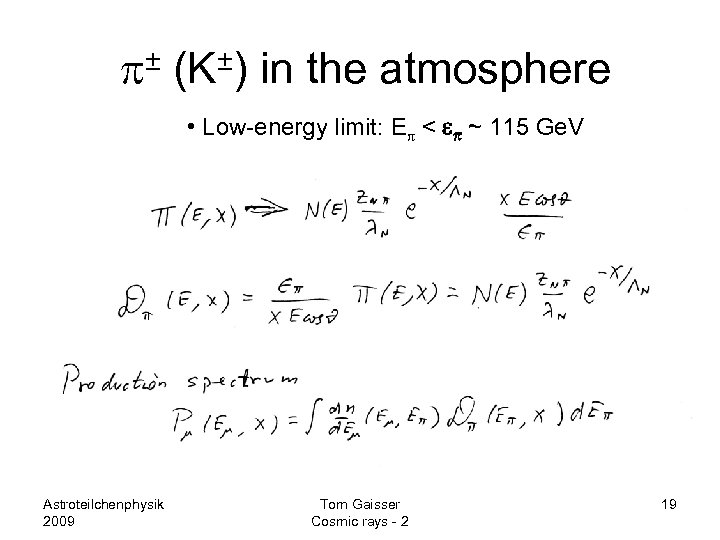 p± (K±) in the atmosphere • Low-energy limit: Ep < ep ~ 115 Ge. V Astroteilchenphysik 2009 Tom Gaisser Cosmic rays - 2 19
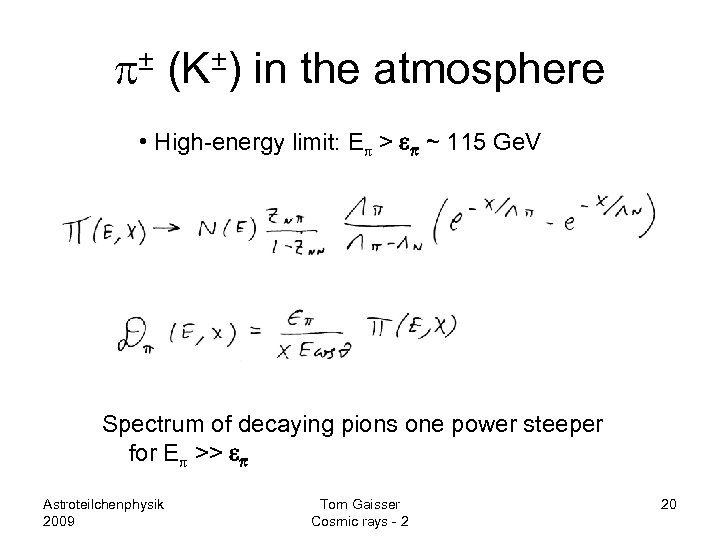 p± (K±) in the atmosphere • High-energy limit: Ep > ep ~ 115 Ge. V Spectrum of decaying pions one power steeper for Ep >> ep Astroteilchenphysik 2009 Tom Gaisser Cosmic rays - 2 20
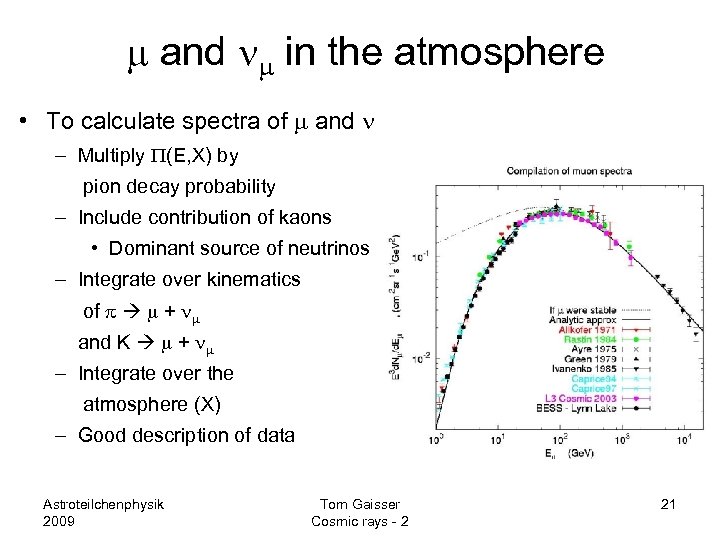 m and nm in the atmosphere • To calculate spectra of m and n – Multiply P(E, X) by pion decay probability – Include contribution of kaons • Dominant source of neutrinos – Integrate over kinematics of p m + nm and K m + nm – Integrate over the atmosphere (X) – Good description of data Astroteilchenphysik 2009 Tom Gaisser Cosmic rays - 2 21
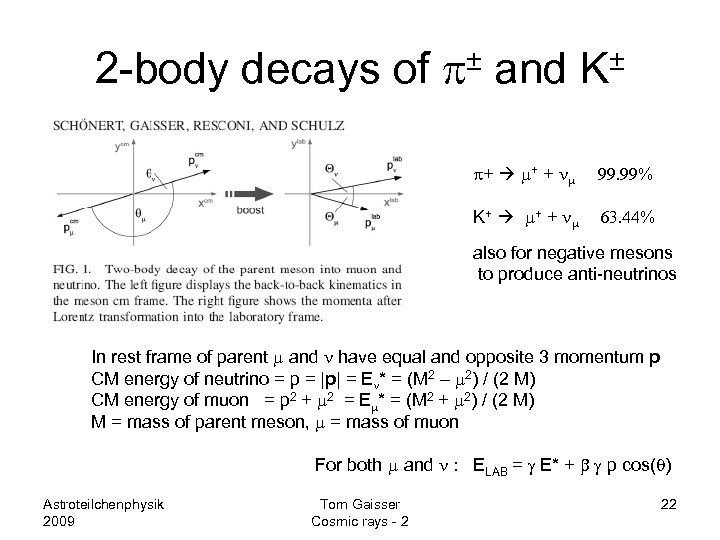 2 -body decays of p± and K± p+ m+ + nm 99. 99% K + m+ + n m 63. 44% also for negative mesons to produce anti-neutrinos In rest frame of parent m and n have equal and opposite 3 momentum p CM energy of neutrino = p = |p| = En* = (M 2 – m 2) / (2 M) CM energy of muon = p 2 + m 2 = Em* = (M 2 + m 2) / (2 M) M = mass of parent meson, m = mass of muon For both m and n : ELAB = g E* + b g p cos(q) Astroteilchenphysik 2009 Tom Gaisser Cosmic rays - 2 22
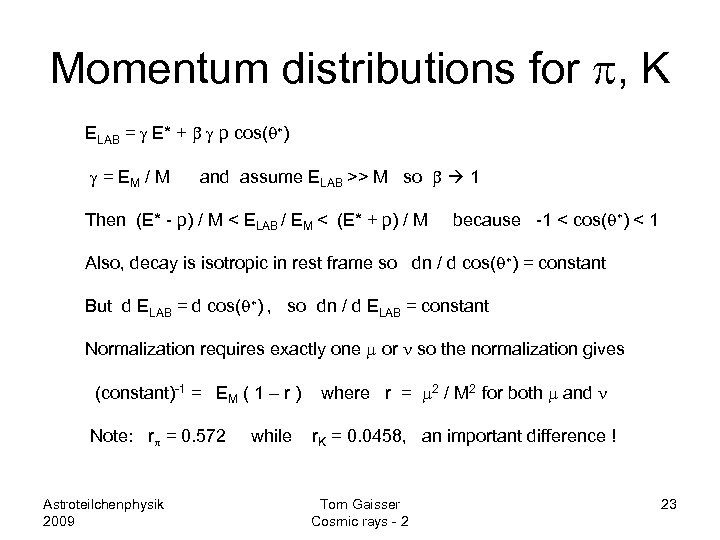 Momentum distributions for p, K ELAB = g E* + b g p cos(q*) g = EM / M and assume ELAB >> M so b 1 Then (E* - p) / M < ELAB / EM < (E* + p) / M because -1 < cos(q*) < 1 Also, decay is isotropic in rest frame so dn / d cos(q*) = constant But d ELAB = d cos(q*) , so dn / d ELAB = constant Normalization requires exactly one m or n so the normalization gives (constant)-1 = EM ( 1 – r ) Note: rp = 0. 572 Astroteilchenphysik 2009 while where r = m 2 / M 2 for both m and n r. K = 0. 0458, an important difference ! Tom Gaisser Cosmic rays - 2 23
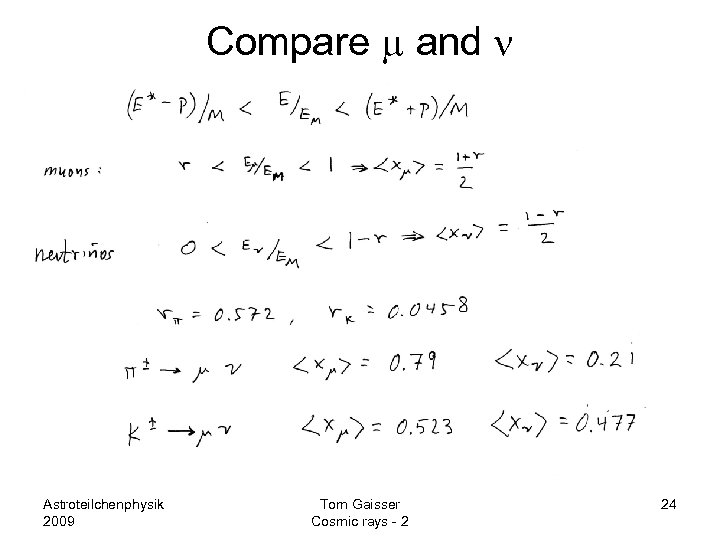 Compare m and n Astroteilchenphysik 2009 Tom Gaisser Cosmic rays - 2 24
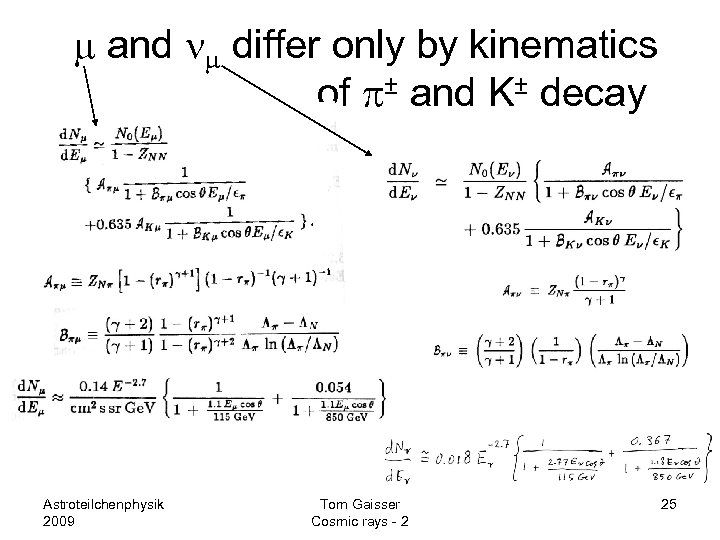 m and nm differ only by kinematics of p± and K± decay Astroteilchenphysik 2009 Tom Gaisser Cosmic rays - 2 25
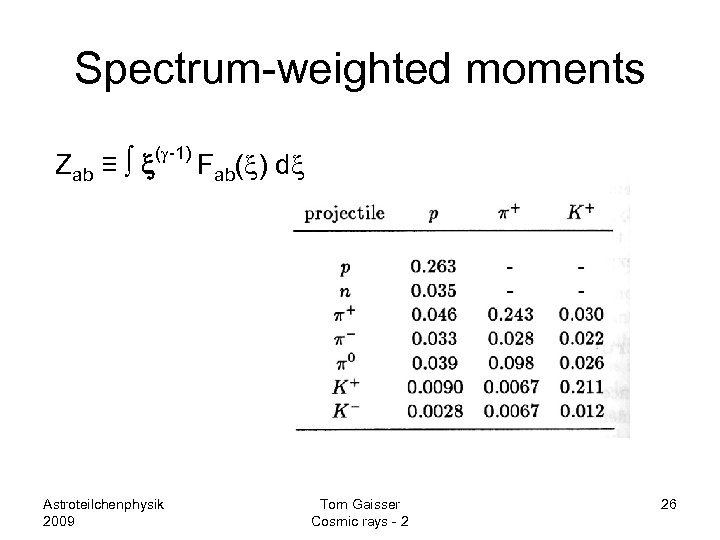 Spectrum-weighted moments Zab ≡ ∫ x (g-1) Astroteilchenphysik 2009 Fab(x) dx Tom Gaisser Cosmic rays - 2 26
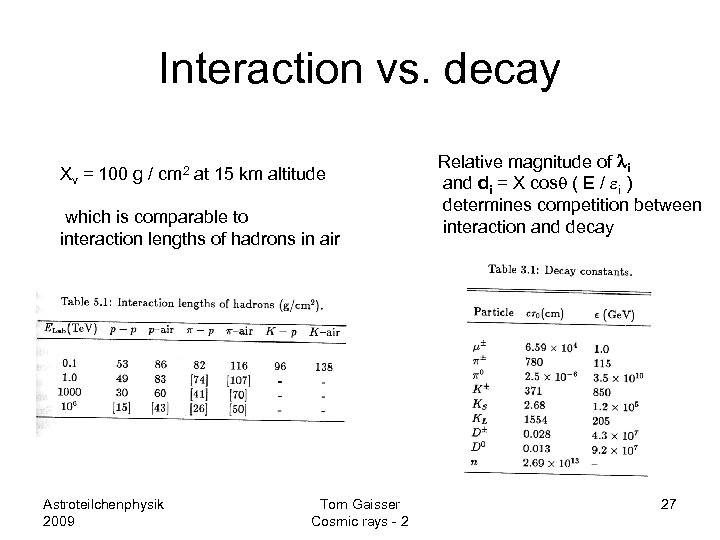 Interaction vs. decay Xv = 100 g / cm 2 at 15 km altitude which is comparable to interaction lengths of hadrons in air Astroteilchenphysik 2009 Tom Gaisser Cosmic rays - 2 Relative magnitude of li and di = X cosq ( E / ei ) determines competition between interaction and decay 27
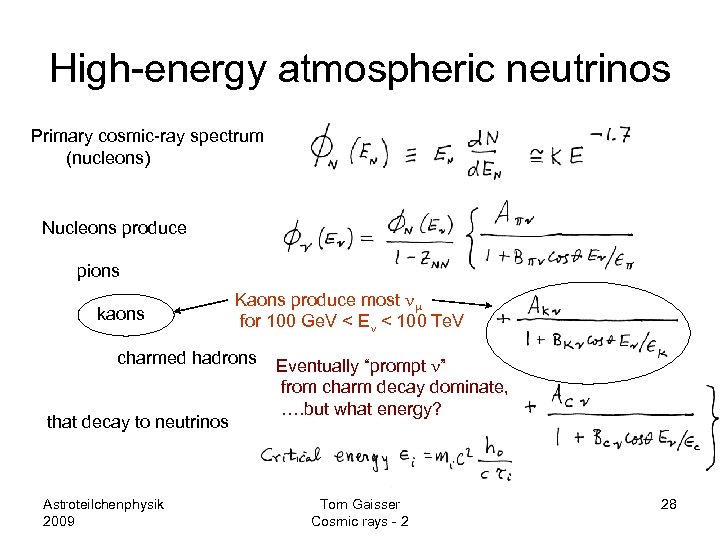 High-energy atmospheric neutrinos Primary cosmic-ray spectrum (nucleons) Nucleons produce pions kaons Kaons produce most nm for 100 Ge. V < En < 100 Te. V charmed hadrons that decay to neutrinos Astroteilchenphysik 2009 Eventually “prompt n” from charm decay dominate, …. but what energy? Tom Gaisser Cosmic rays - 2 28
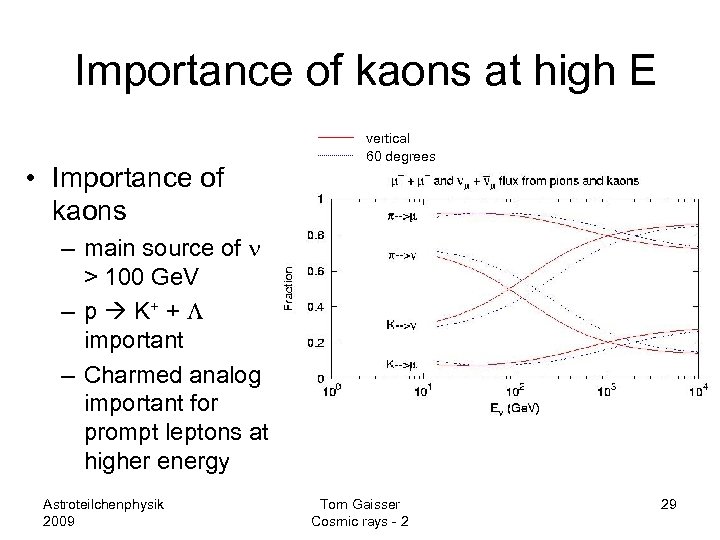 Importance of kaons at high E • Importance of kaons vertical 60 degrees – main source of n > 100 Ge. V – p K+ + L important – Charmed analog important for prompt leptons at higher energy Astroteilchenphysik 2009 Tom Gaisser Cosmic rays - 2 29
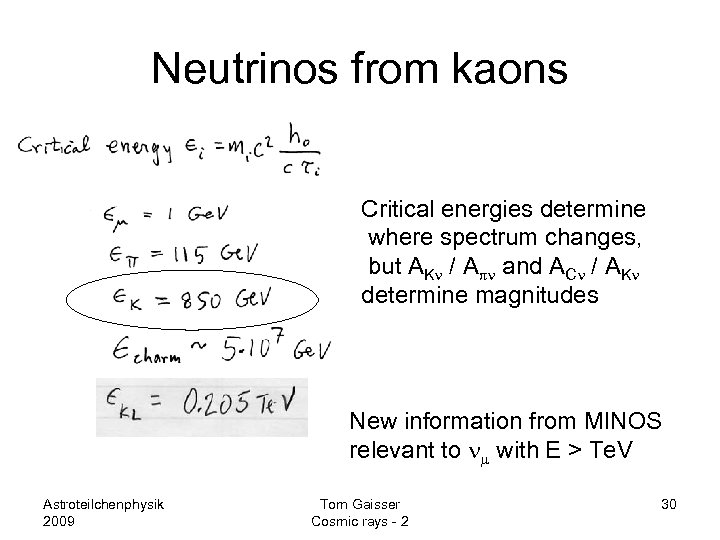 Neutrinos from kaons Critical energies determine where spectrum changes, but AKn / Apn and ACn / AKn determine magnitudes New information from MINOS relevant to nm with E > Te. V Astroteilchenphysik 2009 Tom Gaisser Cosmic rays - 2 30
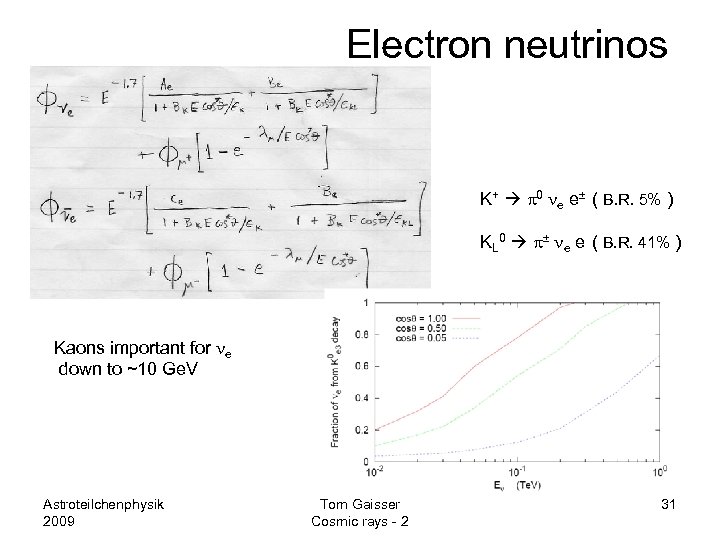 Electron neutrinos K+ p 0 ne e± ( B. R. 5% ) KL 0 p± ne e ( B. R. 41% ) Kaons important for ne down to ~10 Ge. V Astroteilchenphysik 2009 Tom Gaisser Cosmic rays - 2 31
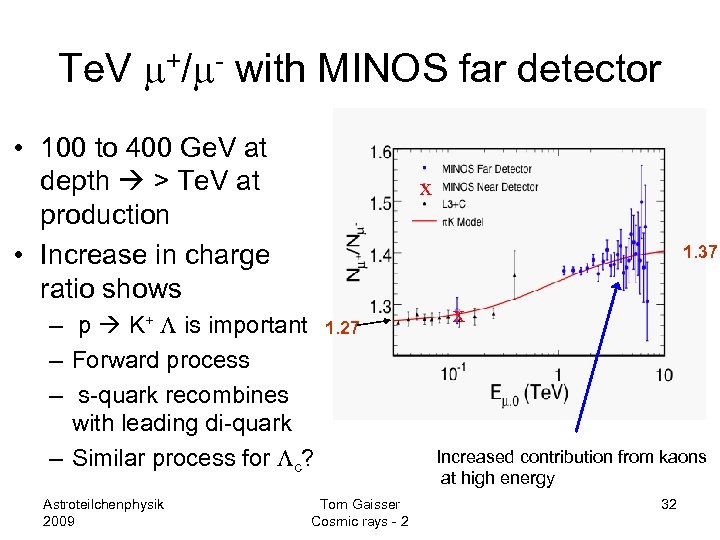 Te. V m+/m- with MINOS far detector • 100 to 400 Ge. V at depth > Te. V at production • Increase in charge ratio shows x 1. 37 – p K+ L is important – Forward process – s-quark recombines with leading di-quark – Similar process for Lc? Astroteilchenphysik 2009 1. 27 Tom Gaisser Cosmic rays - 2 x Increased contribution from kaons at high energy 32
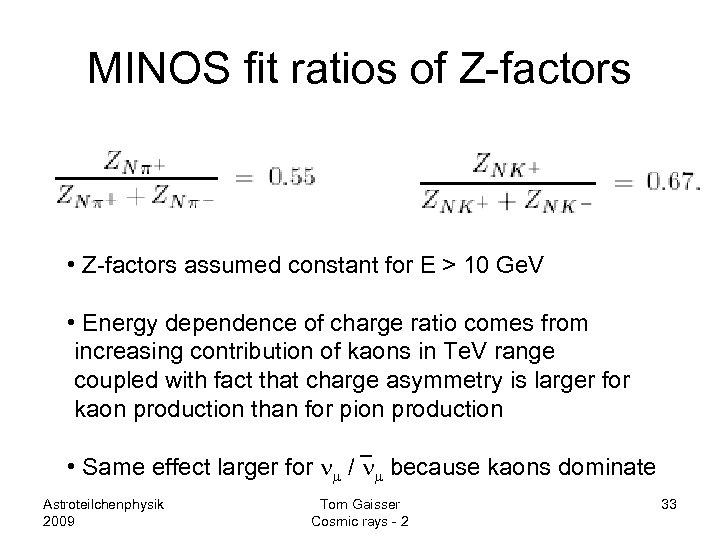 MINOS fit ratios of Z-factors • Z-factors assumed constant for E > 10 Ge. V • Energy dependence of charge ratio comes from increasing contribution of kaons in Te. V range coupled with fact that charge asymmetry is larger for kaon production than for pion production • Same effect larger for nm / nm because kaons dominate Astroteilchenphysik 2009 Tom Gaisser Cosmic rays - 2 33
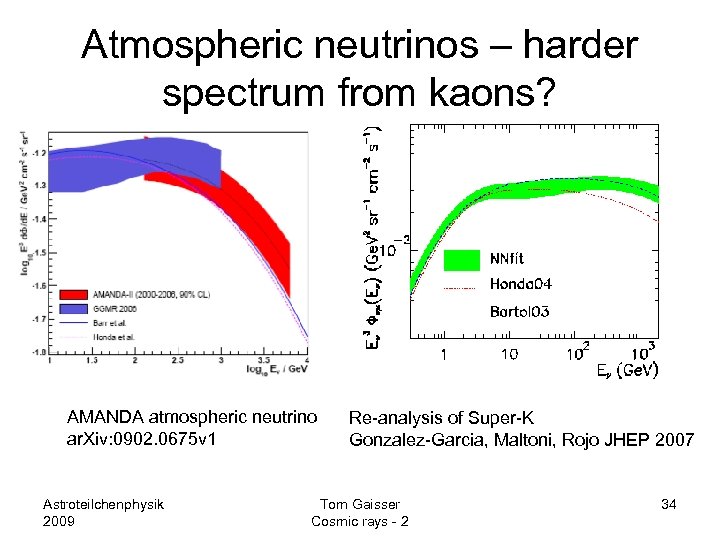 Atmospheric neutrinos – harder spectrum from kaons? AMANDA atmospheric neutrino ar. Xiv: 0902. 0675 v 1 Astroteilchenphysik 2009 Re-analysis of Super-K Gonzalez-Garcia, Maltoni, Rojo JHEP 2007 Tom Gaisser Cosmic rays - 2 34
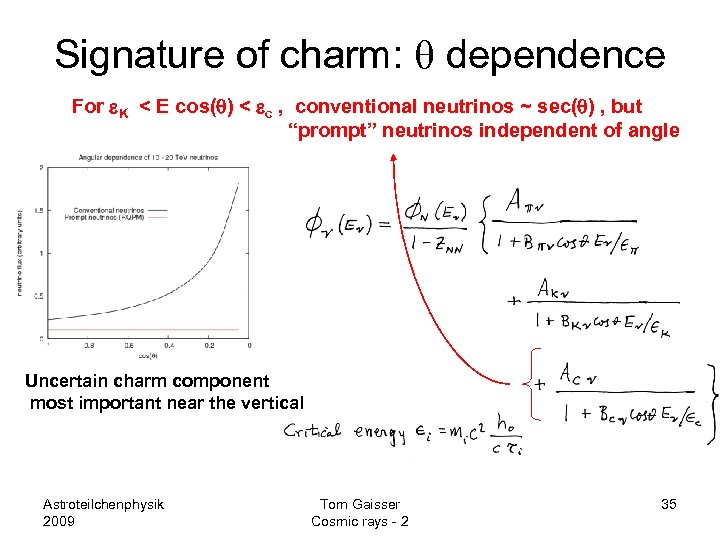 Signature of charm: q dependence For e. K < E cos(q) < ec , conventional neutrinos ~ sec(q) , but “prompt” neutrinos independent of angle Uncertain charm component most important near the vertical Astroteilchenphysik 2009 Tom Gaisser Cosmic rays - 2 35
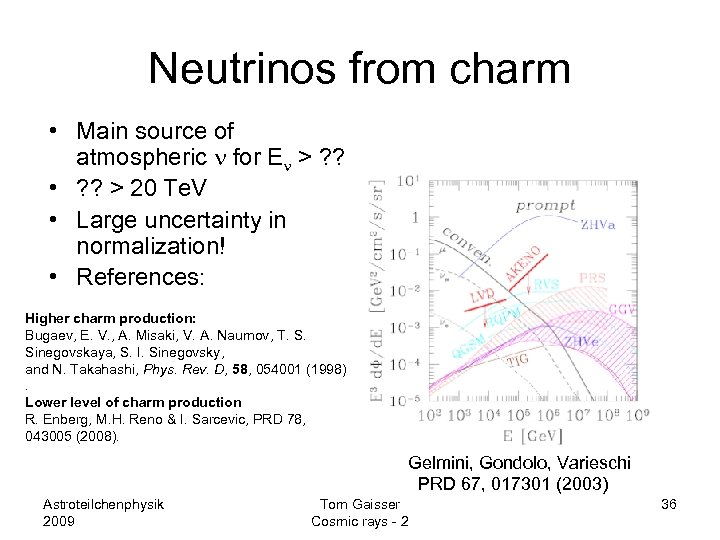 Neutrinos from charm • Main source of atmospheric n for En > ? ? • ? ? > 20 Te. V • Large uncertainty in normalization! • References: Higher charm production: Bugaev, E. V. , A. Misaki, V. A. Naumov, T. S. Sinegovskaya, S. I. Sinegovsky, and N. Takahashi, Phys. Rev. D, 58, 054001 (1998). Lower level of charm production R. Enberg, M. H. Reno & I. Sarcevic, PRD 78, 043005 (2008). Gelmini, Gondolo, Varieschi PRD 67, 017301 (2003) Astroteilchenphysik 2009 Tom Gaisser Cosmic rays - 2 36
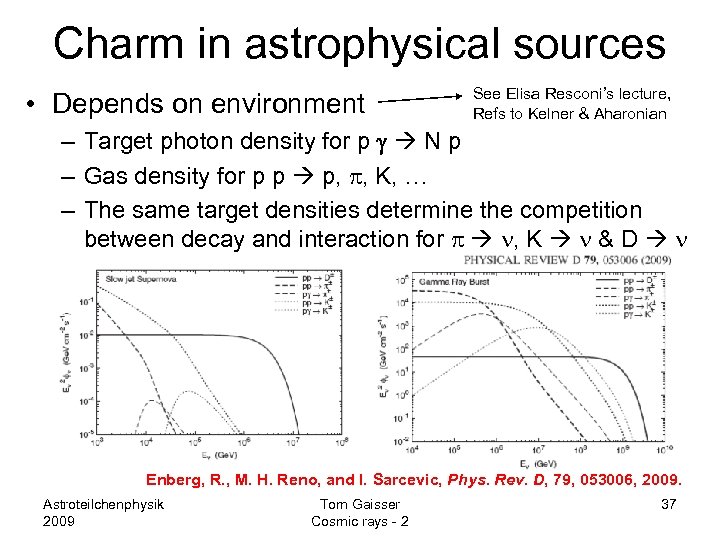 Charm in astrophysical sources • Depends on environment See Elisa Resconi’s lecture, Refs to Kelner & Aharonian – Target photon density for p g N p – Gas density for p p p, p, K, … – The same target densities determine the competition between decay and interaction for p n, K n & D n Enberg, R. , M. H. Reno, and I. Sarcevic, Phys. Rev. D, 79, 053006, 2009. Astroteilchenphysik 2009 Tom Gaisser Cosmic rays - 2 37
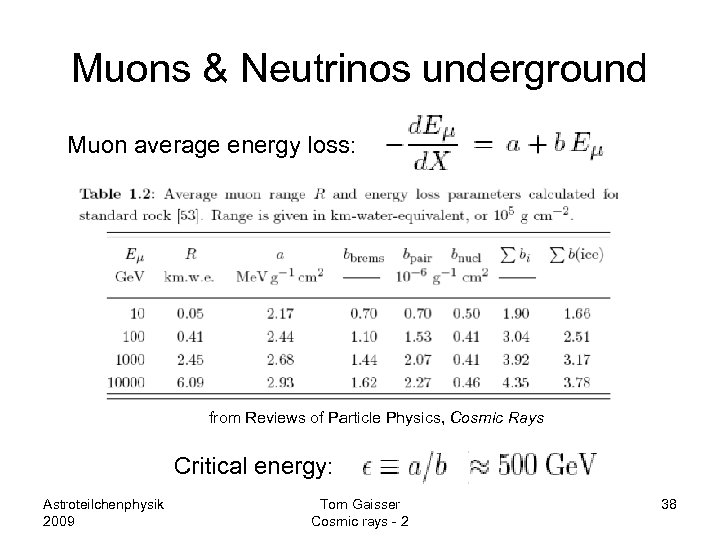 Muons & Neutrinos underground Muon average energy loss: from Reviews of Particle Physics, Cosmic Rays Critical energy: Astroteilchenphysik 2009 Tom Gaisser Cosmic rays - 2 38
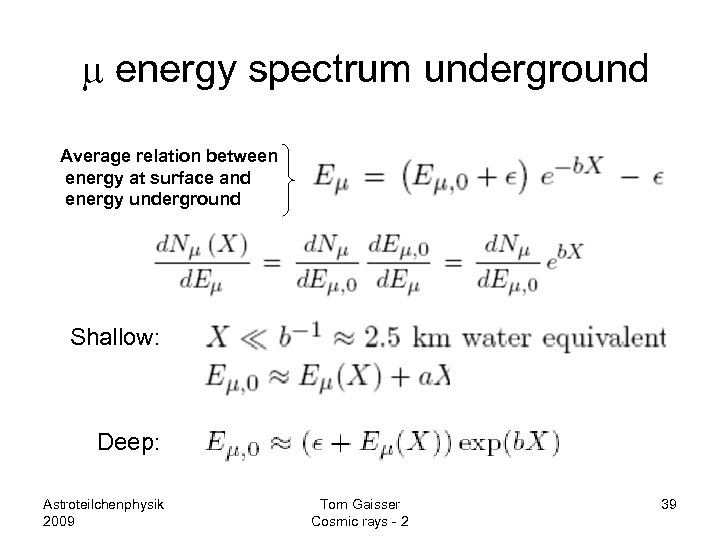 m energy spectrum underground Average relation between energy at surface and energy underground Shallow: Deep: Astroteilchenphysik 2009 Tom Gaisser Cosmic rays - 2 39
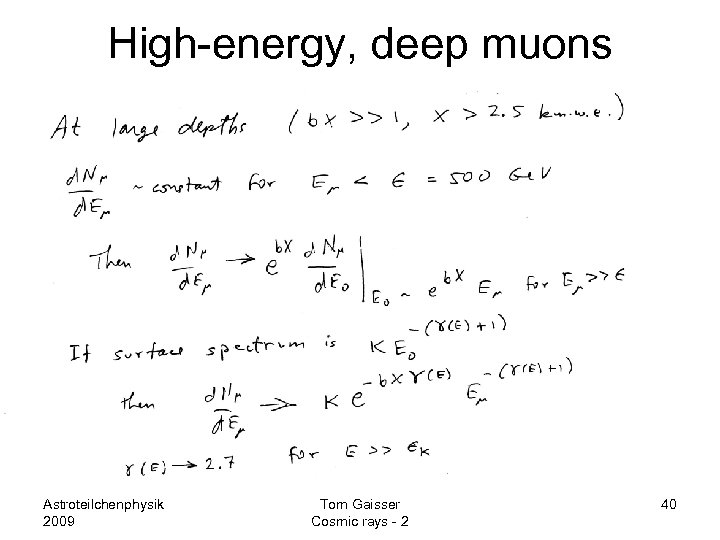 High-energy, deep muons Astroteilchenphysik 2009 Tom Gaisser Cosmic rays - 2 40
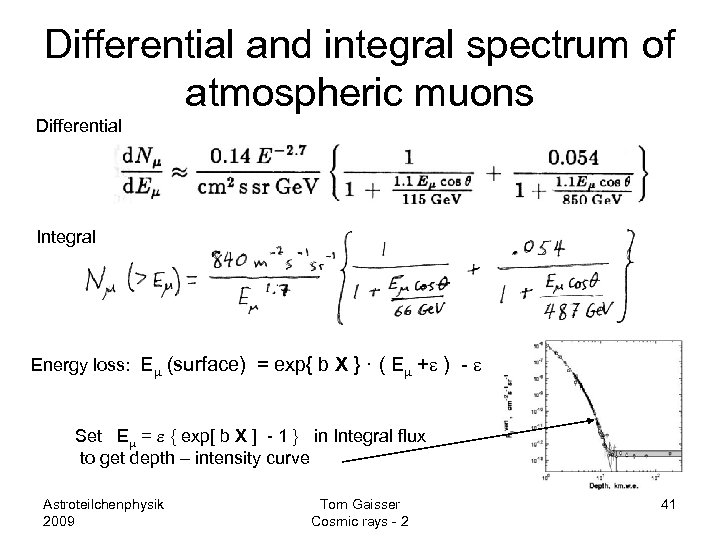 Differential and integral spectrum of atmospheric muons Differential Integral Energy loss: Em (surface) = exp{ b X } · ( Em +e ) - e Set Em = e { exp[ b X ] - 1 } in Integral flux to get depth – intensity curve Astroteilchenphysik 2009 Tom Gaisser Cosmic rays - 2 41
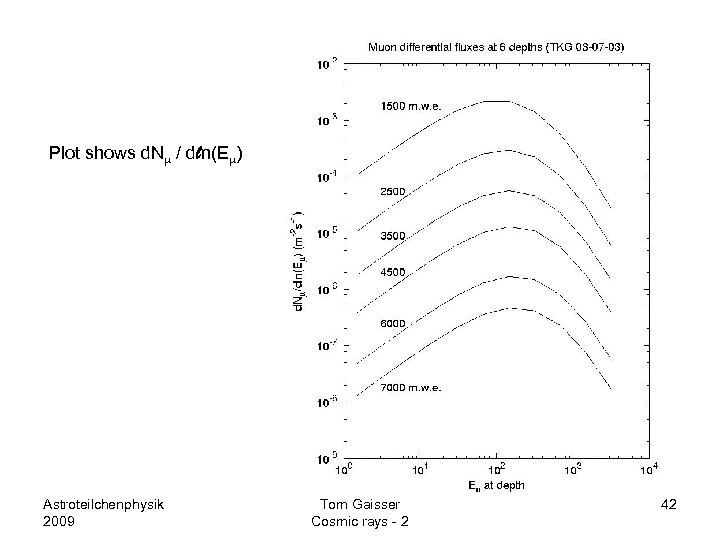 Plot shows d. Nm / dln(Em) Astroteilchenphysik 2009 Tom Gaisser Cosmic rays - 2 42
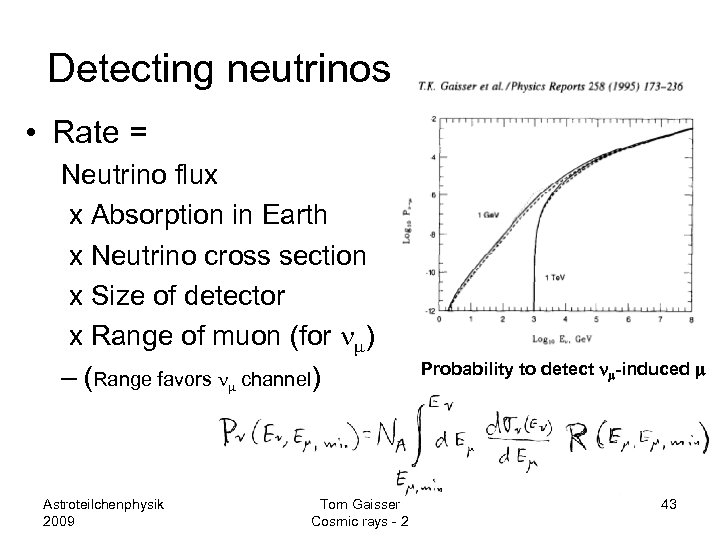 Detecting neutrinos • Rate = Neutrino flux x Absorption in Earth x Neutrino cross section x Size of detector x Range of muon (for nm) – (Range favors nm channel) Astroteilchenphysik 2009 Tom Gaisser Cosmic rays - 2 Probability to detect nm-induced m 43
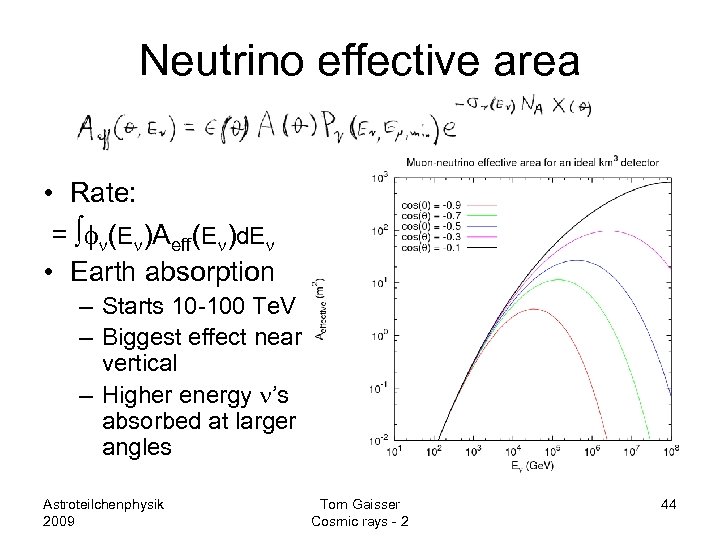 Neutrino effective area • Rate: = ∫fn(En)Aeff(En)d. En • Earth absorption – Starts 10 -100 Te. V – Biggest effect near vertical – Higher energy n’s absorbed at larger angles Astroteilchenphysik 2009 Tom Gaisser Cosmic rays - 2 44
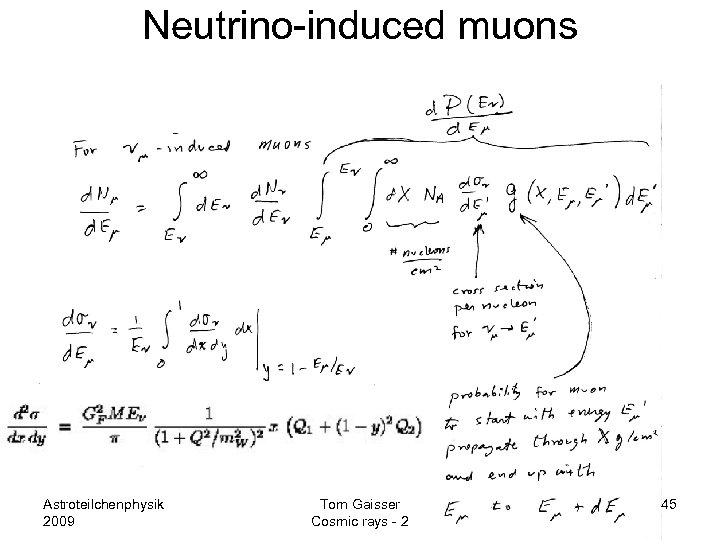 Neutrino-induced muons Astroteilchenphysik 2009 Tom Gaisser Cosmic rays - 2 45
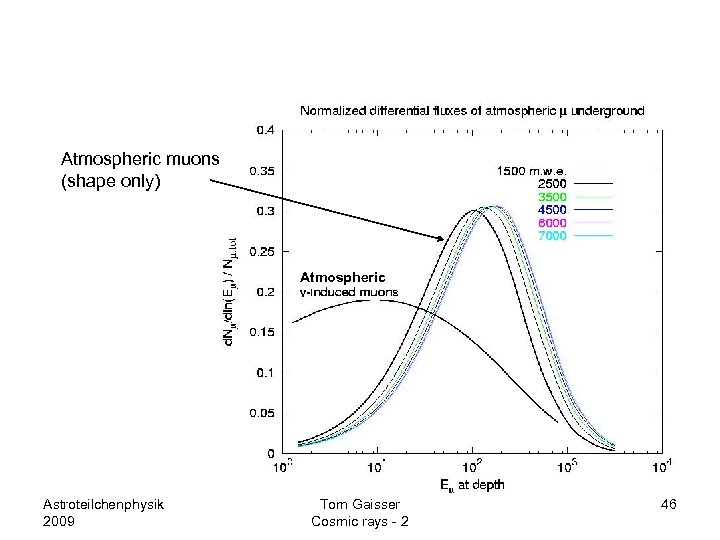 Atmospheric muons (shape only) Atmospheric Astroteilchenphysik 2009 Tom Gaisser Cosmic rays - 2 46
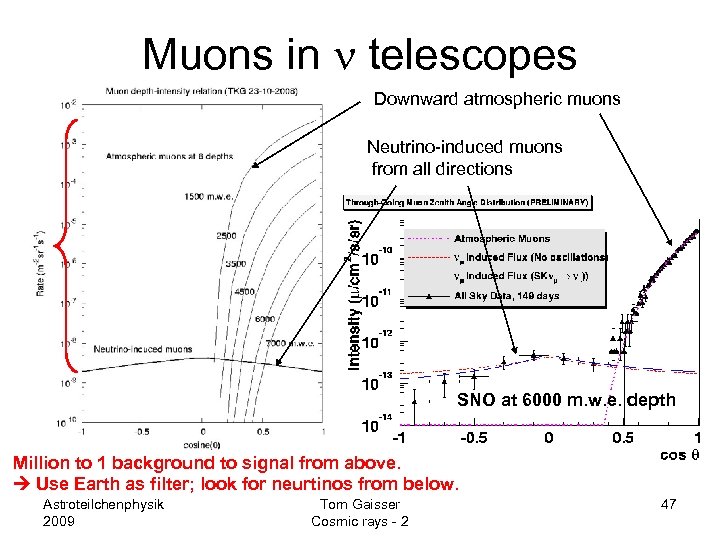 Muons in n telescopes Downward atmospheric muons Neutrino-induced muons from all directions SNO at 6000 m. w. e. depth Million to 1 background to signal from above. Use Earth as filter; look for neurtinos from below. Astroteilchenphysik 2009 Tom Gaisser Cosmic rays - 2 47
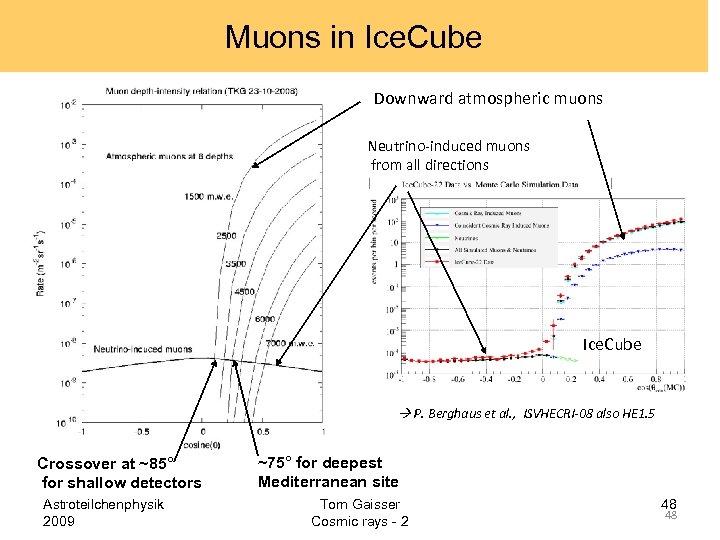 Muons in Ice. Cube Downward atmospheric muons Neutrino-induced muons from all directions Ice. Cube P. Berghaus et al. , ISVHECRI-08 also HE 1. 5 Crossover at ~85° for shallow detectors Astroteilchenphysik 2009 ~75° for deepest Mediterranean site Tom Gaisser Cosmic rays - 2 48 48
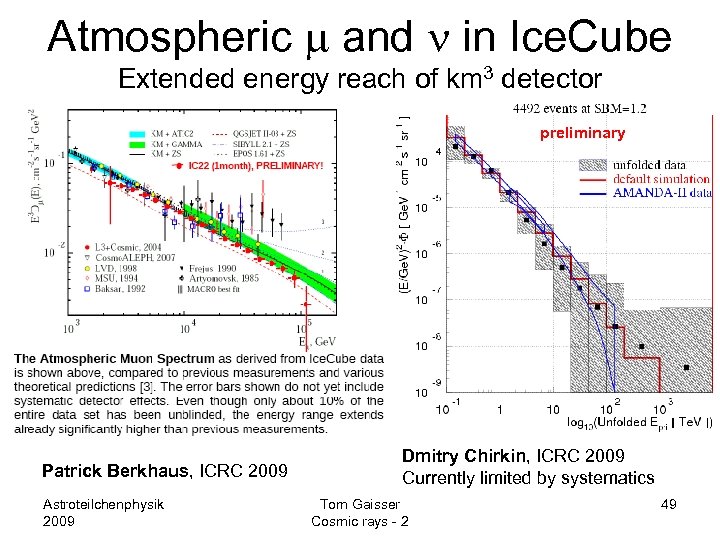 Atmospheric m and n in Ice. Cube Extended energy reach of km 3 detector preliminary Patrick Berkhaus, ICRC 2009 Astroteilchenphysik 2009 Dmitry Chirkin, ICRC 2009 Currently limited by systematics Tom Gaisser Cosmic rays - 2 49
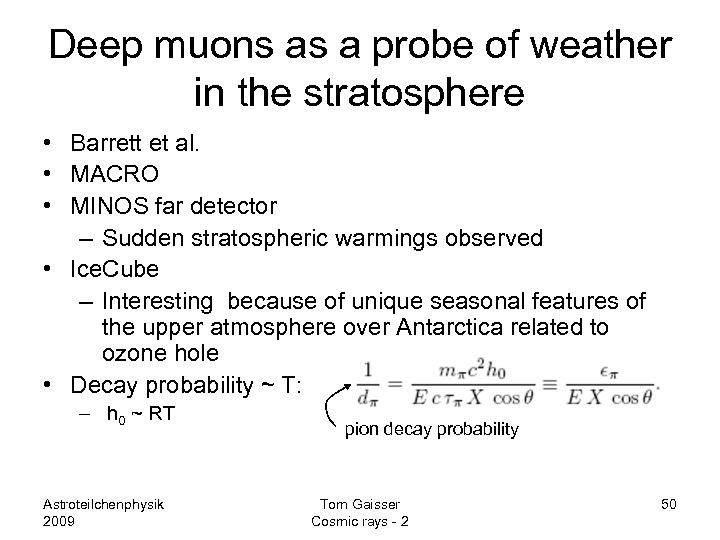 Deep muons as a probe of weather in the stratosphere • Barrett et al. • MACRO • MINOS far detector – Sudden stratospheric warmings observed • Ice. Cube – Interesting because of unique seasonal features of the upper atmosphere over Antarctica related to ozone hole • Decay probability ~ T: – h 0 ~ RT Astroteilchenphysik 2009 pion decay probability Tom Gaisser Cosmic rays - 2 50
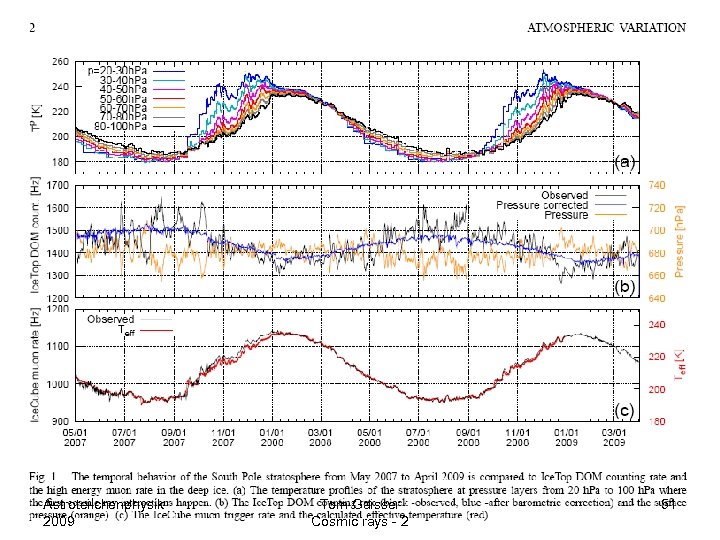 Astroteilchenphysik 2009 Tom Gaisser Cosmic rays - 2 51
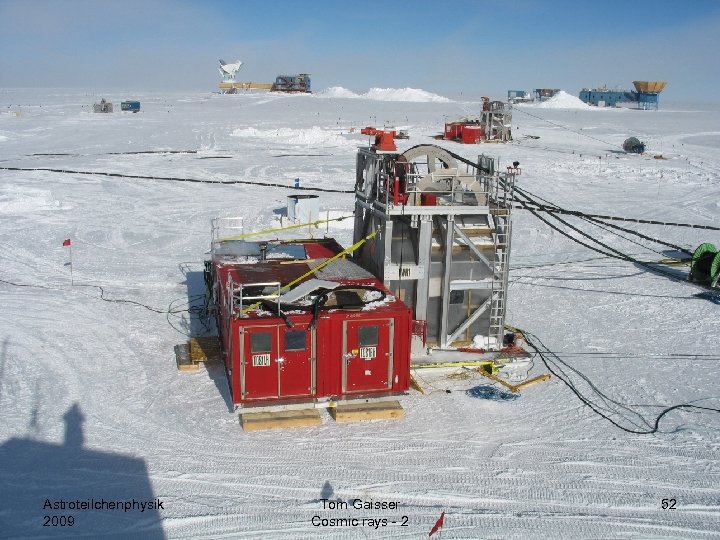 Astroteilchenphysik 2009 Tom Gaisser Cosmic rays - 2 52
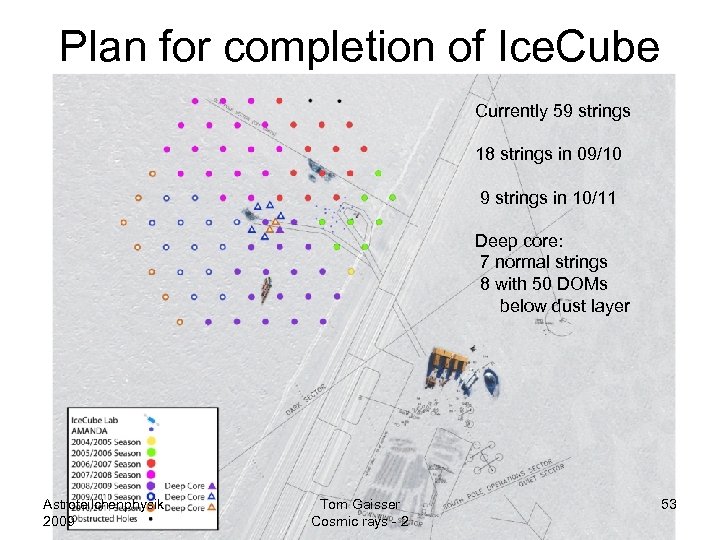 Plan for completion of Ice. Cube Currently 59 strings 18 strings in 09/10 9 strings in 10/11 Deep core: 7 normal strings 8 with 50 DOMs below dust layer Astroteilchenphysik 2009 Tom Gaisser Cosmic rays - 2 53