 Скачать презентацию ATM by YUSUF KURT YEDİTEPE UNIVERSITY Computer Engineering
c0d38d1b04d43bd10d2b6a365d5091a3.ppt
- Количество слайдов: 55



ATM by YUSUF KURT YEDİTEPE UNIVERSITY Computer Engineering Dept. 1
OUTLINE Introduction to ATM Principal Characteristics of ATM Why ATM? ATM Networks and Interfaces How Does ATM Work? ATM Protocol Architecture Physical Layer ATM Adaptation Layer (AAL) IP OVER ATM 2
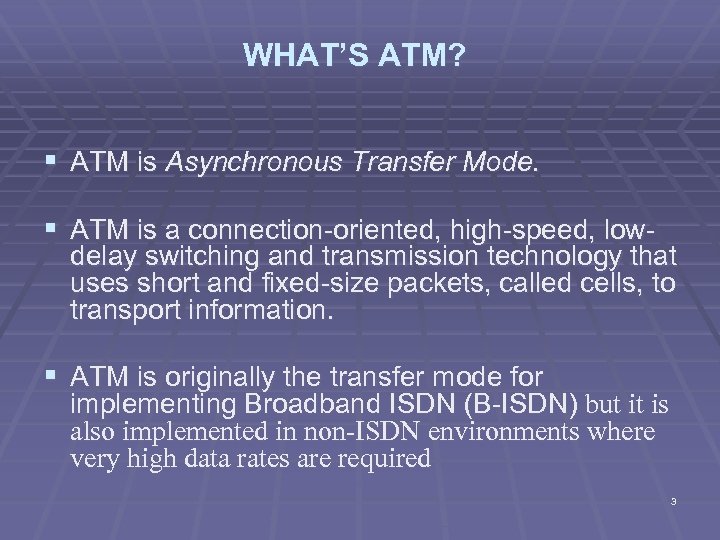
WHAT’S ATM? § ATM is Asynchronous Transfer Mode. § ATM is a connection-oriented, high-speed, low- delay switching and transmission technology that uses short and fixed-size packets, called cells, to transport information. § ATM is originally the transfer mode for implementing Broadband ISDN (B-ISDN) but it is also implemented in non-ISDN environments where very high data rates are required 3
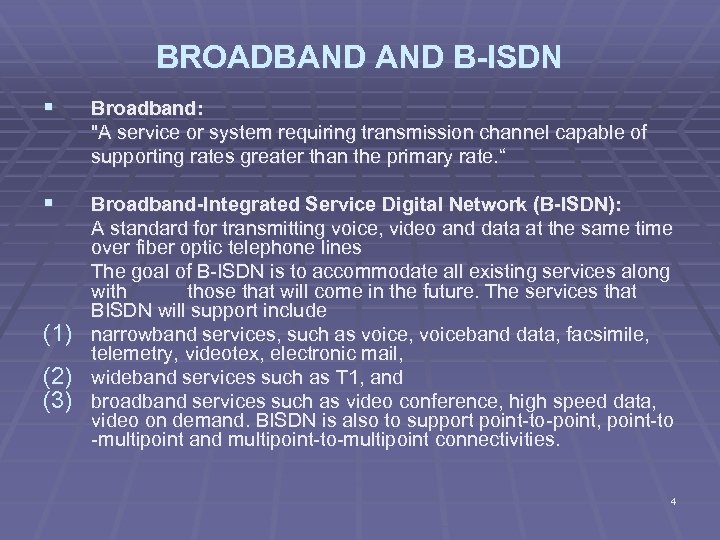
BROADBAND B-ISDN § Broadband: "A service or system requiring transmission channel capable of supporting rates greater than the primary rate. “ § Broadband-Integrated Service Digital Network (B-ISDN): A standard for transmitting voice, video and data at the same time over fiber optic telephone lines The goal of B-ISDN is to accommodate all existing services along with those that will come in the future. The services that BISDN will support include narrowband services, such as voice, voiceband data, facsimile, telemetry, videotex, electronic mail, wideband services such as T 1, and broadband services such as video conference, high speed data, video on demand. BISDN is also to support point-to-point, point-to -multipoint and multipoint-to-multipoint connectivities. (1) (2) (3) 4
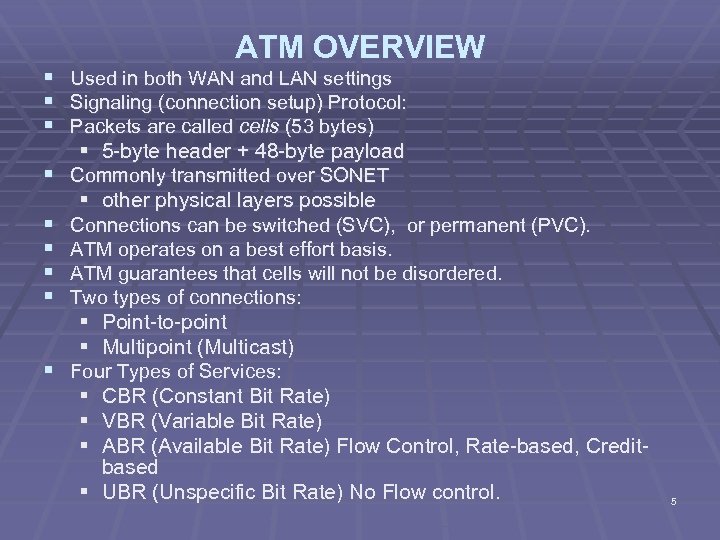
ATM OVERVIEW § Used in both WAN and LAN settings § Signaling (connection setup) Protocol: § Packets are called cells (53 bytes) § 5 -byte header + 48 -byte payload § Commonly transmitted over SONET § § § other physical layers possible Connections can be switched (SVC), or permanent (PVC). ATM operates on a best effort basis. ATM guarantees that cells will not be disordered. Two types of connections: § Point-to-point § Multipoint (Multicast) § Four Types of Services: § CBR (Constant Bit Rate) § VBR (Variable Bit Rate) § ABR (Available Bit Rate) Flow Control, Rate-based, Creditbased § UBR (Unspecific Bit Rate) No Flow control. 5
ATM Characteristics § No error protection or flow control on a link-by-link basis. § ATM operates in a connection-oriented mode. § The header functionality is reduced. § The information field length is relatively small and fixed. § All data types are the same 6
Why ATM? § International standard-based technology (for interoperability) § Low network latency (for voice, video, and real-time applications) § Low variance of delay (for voice and video transmission) § Guaranteed quality of service § High capacity switching (multi-giga bits per second) § Bandwidth flexibility (dynamically assigned to users) 7
Why ATM? (con’t) § Scalability (capacity may be increased on demand) § Medium not shared for ATM LAN (no degradation in performance as traffic load or number of users increases) § Supports a wide range of user access speeds § Appropriate (seamless integration) for LANs, MANs, and WANs § Supports audio, video, imagery, and data traffic (for integrated services) 8
ATM NETWORKS § Public ATM Network: § Provided by public telecommunications carriers (e. g. , AT&T, MCI World. Com, and Sprint) § Interconnects private ATM networks § Interconnects remote non-ATM LANs § Interconnects individual users § Private ATM Network: § Owned by private organizations § Interconnects low speed/shared medium LANs (e. g. , Ethernet, Token Ring, FDDI) as a backbone network § Interconnects individual users as the front-end LAN for high performance or multimedia applications 9
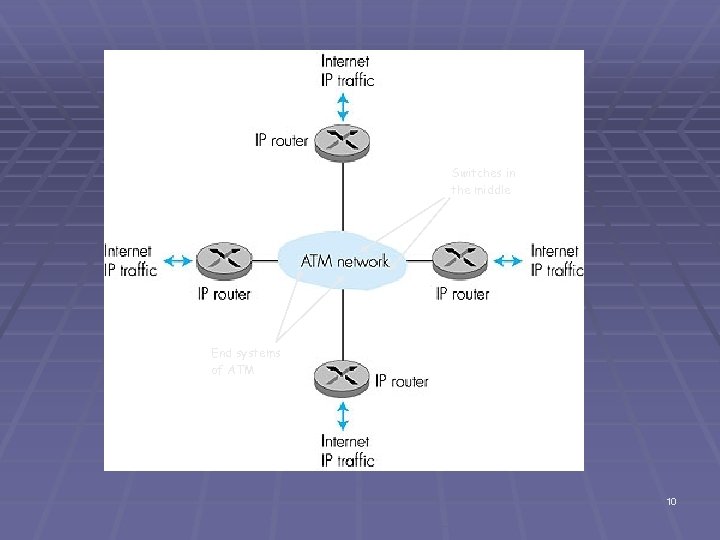
Switches in the middle End systems of ATM 10
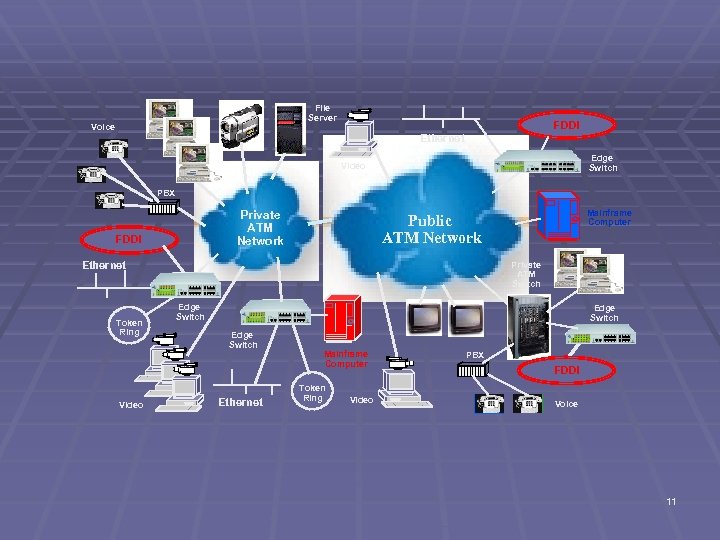
File Server Voice FDDI Ethernet Edge Switch Video PBX Private ATM Network FDDI Ethernet Token Ring Video Mainframe Computer Public ATM Network Private ATM Switch Edge Switch Ethernet Mainframe Computer Token Ring Video PBX FDDI Voice 11
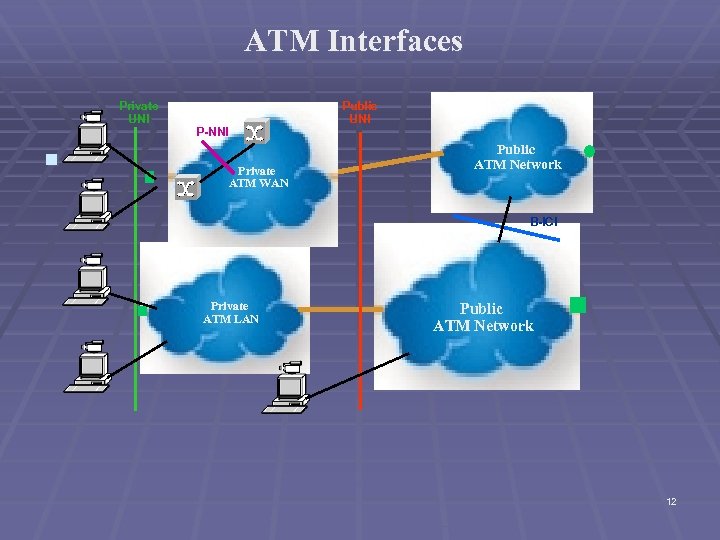
ATM Interfaces Private UNI § P-NNI Private ATM WAN Public UNI Public ATM Network B-ICI Private ATM LAN Public ATM Network 12
How ATM Works? § ATM is connection-oriented -- an end-to-end connection must be established and routing tables setup prior to cell transmission § Once a connection is established, the ATM network will provide endto-end Quality of Service (Qo. S) to the end users § All traffic, whether voice, video, image, or data is divided into 53 -byte cells and routed in sequence across the ATM network § Routing information is carried in the header of each cell § Routing decisions and switching are performed by hardware in ATM switches § Cells are reassembled into voice, video, image, or data at the destination 13
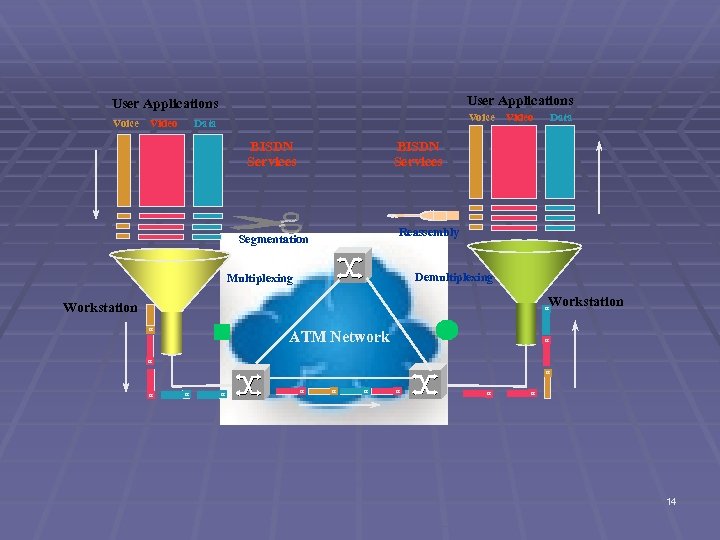
User Applications Voice Video Voice Data BISDN Services Video Data BISDN Services Reassembly Segmentation Demultiplexing Multiplexing Workstation H H ATM Network H H H 14
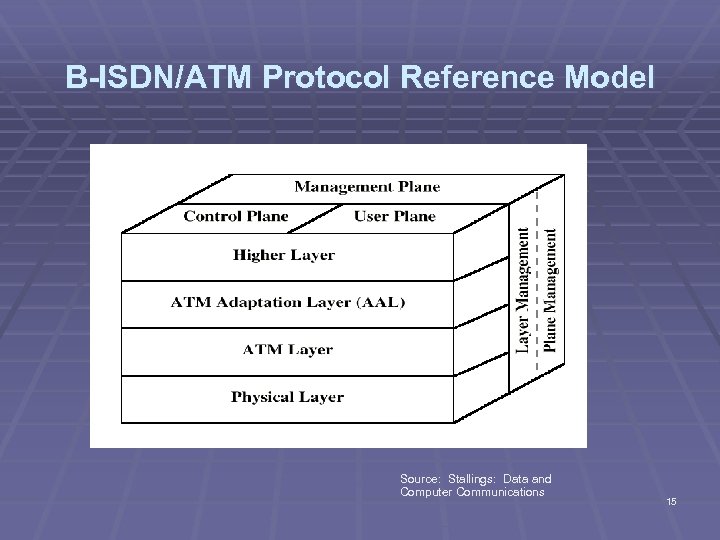
B-ISDN/ATM Protocol Reference Model Source: Stallings: Data and Computer Communications 15
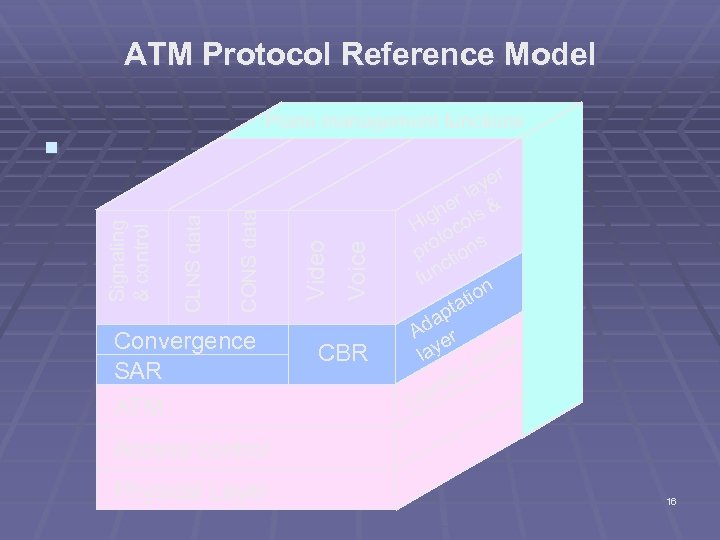
ATM Protocol Reference Model Convergence SAR ATM Voice CONS data CLNS data Signaling & control § Video Plane management functions CBR r ye la er & igh cols H o t s pro tion c un f n tio pta a Ad er e od lay m er f ns Tra Access control Physical Layer 16
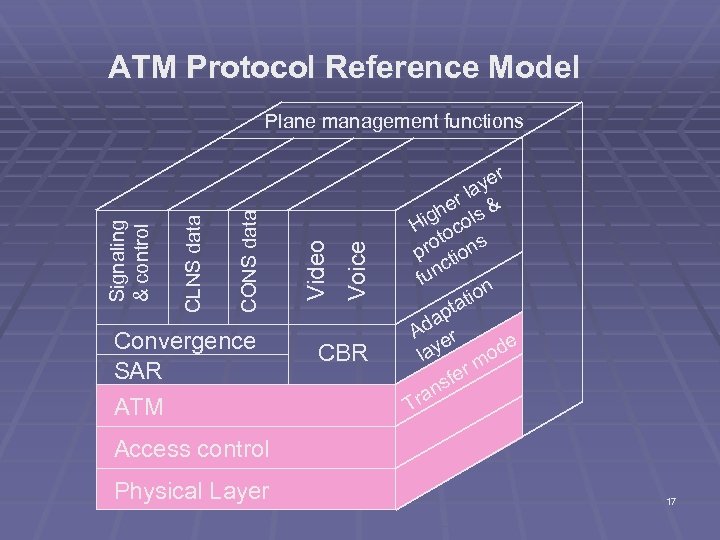
ATM Protocol Reference Model Convergence SAR ATM Voice Video CONS data CLNS data Signaling & control Plane management functions CBR r ye la er & igh cols H o t s pro tion c un f n tio pta a Ad er e od lay m er f ns Tra Access control Physical Layer 17
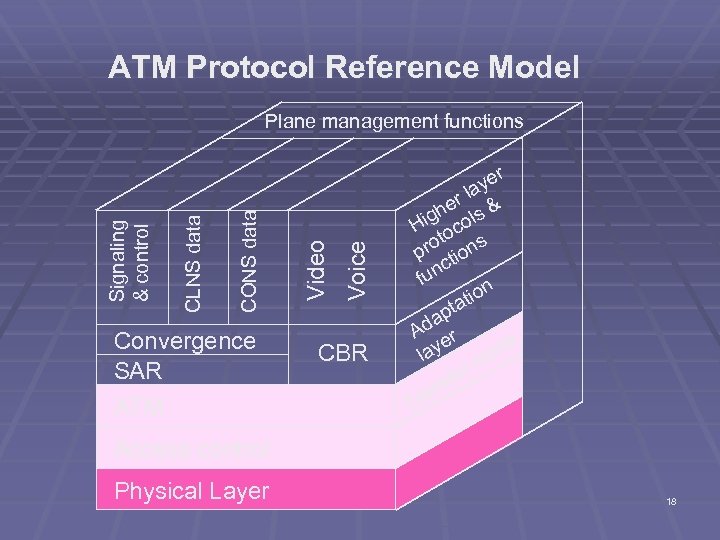
ATM Protocol Reference Model Convergence SAR ATM Voice Video CONS data CLNS data Signaling & control Plane management functions CBR r ye la er & igh cols H o t s pro tion c un f n tio pta a Ad er e od lay m er f ns Tra Access control Physical Layer 18
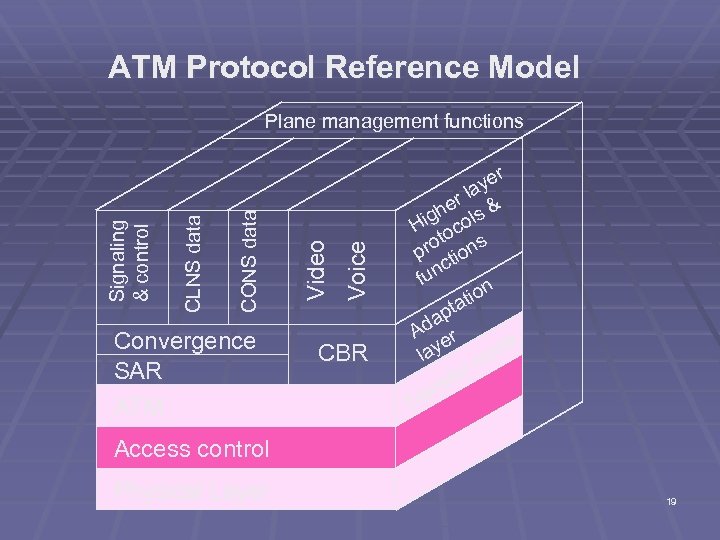
ATM Protocol Reference Model Convergence SAR ATM Voice Video CONS data CLNS data Signaling & control Plane management functions CBR r ye la er & igh cols H o t s pro tion c un f n tio pta a Ad er e od lay m er f ns Tra Access control Physical Layer 19
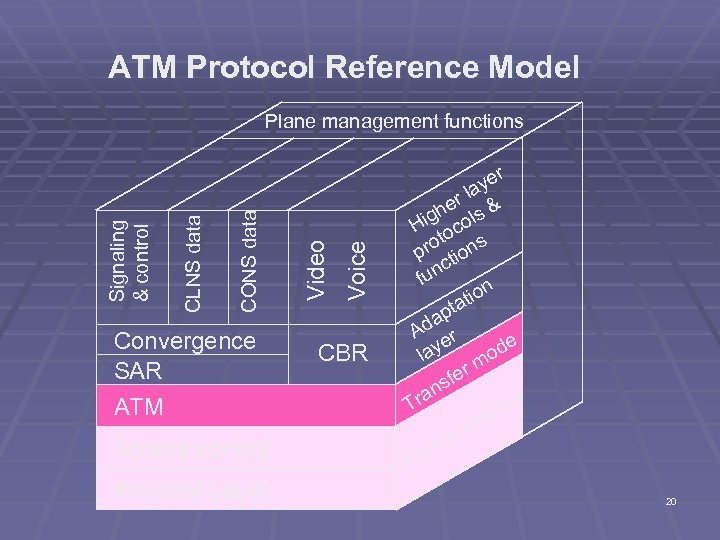
ATM Protocol Reference Model Convergence SAR ATM Voice Video CONS data CLNS data Signaling & control Plane management functions CBR r ye la er & igh cols H o t s pro tion c un f n tio pta a Ad er e od lay m er f ns Tra Access control Physical Layer 20
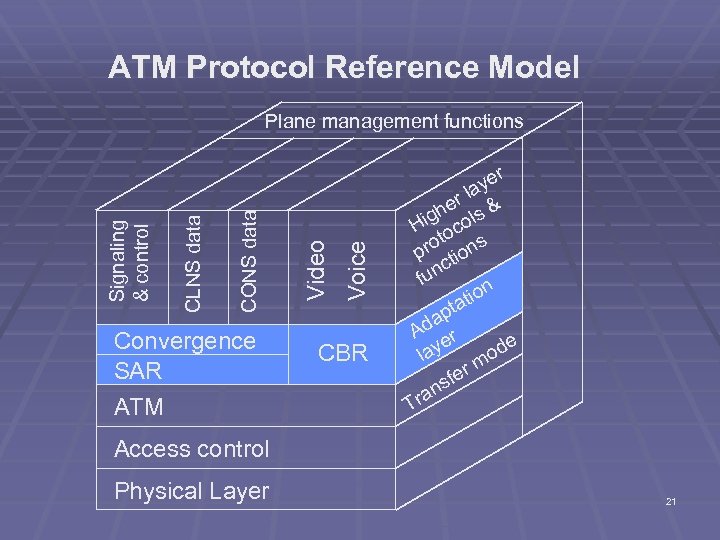
ATM Protocol Reference Model Convergence SAR ATM Voice Video CONS data CLNS data Signaling & control Plane management functions CBR r ye la er & igh cols H o t s pro tion c un f n tio pta a Ad er e od lay m er f ns Tra Access control Physical Layer 21
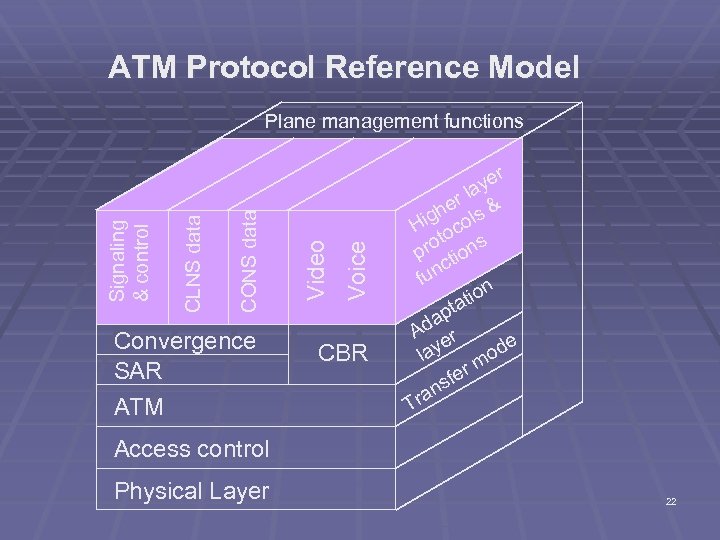
ATM Protocol Reference Model Convergence SAR ATM Voice Video CONS data CLNS data Signaling & control Plane management functions CBR r ye la er & igh cols H o t s pro tion c un f n tio pta a Ad er e od lay m er f ns Tra Access control Physical Layer 22
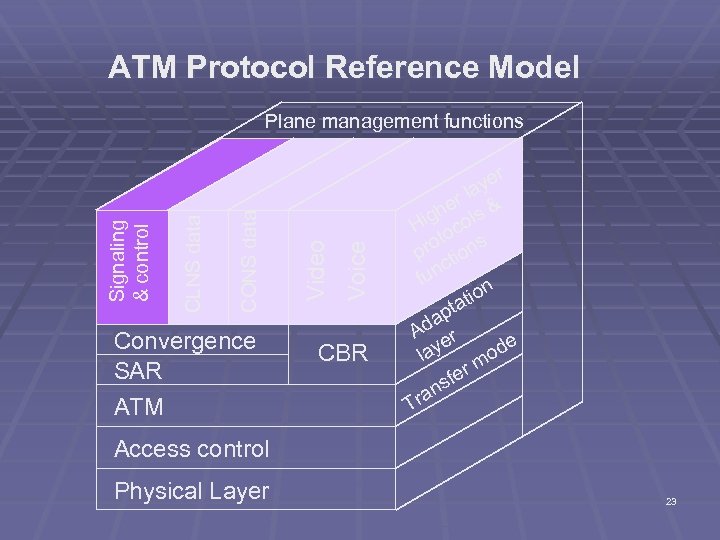
ATM Protocol Reference Model Convergence SAR ATM Voice Video CONS data CLNS data Signaling & control Plane management functions CBR r ye la er & igh cols H o t s pro tion c un f n tio pta a Ad er e od lay m er f ns Tra Access control Physical Layer 23
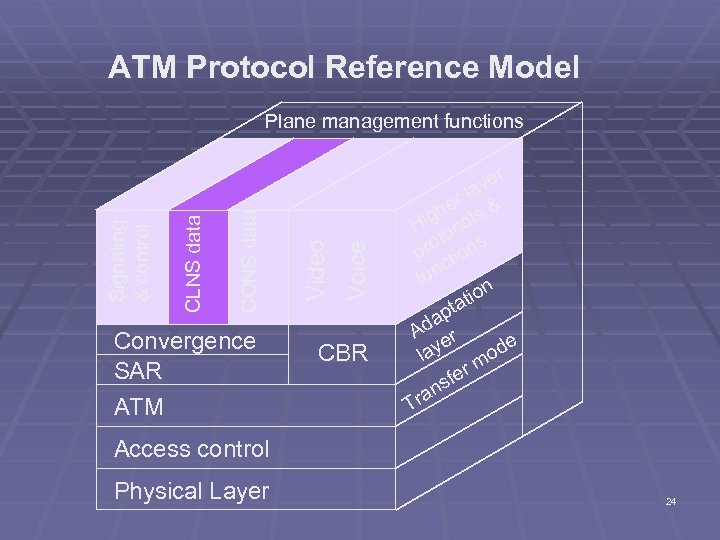
ATM Protocol Reference Model Convergence SAR ATM Voice Video CONS data CLNS data Signaling & control Plane management functions CBR r ye la er & igh cols H o t s pro tion c un f n tio pta a Ad er e od lay m er f ns Tra Access control Physical Layer 24
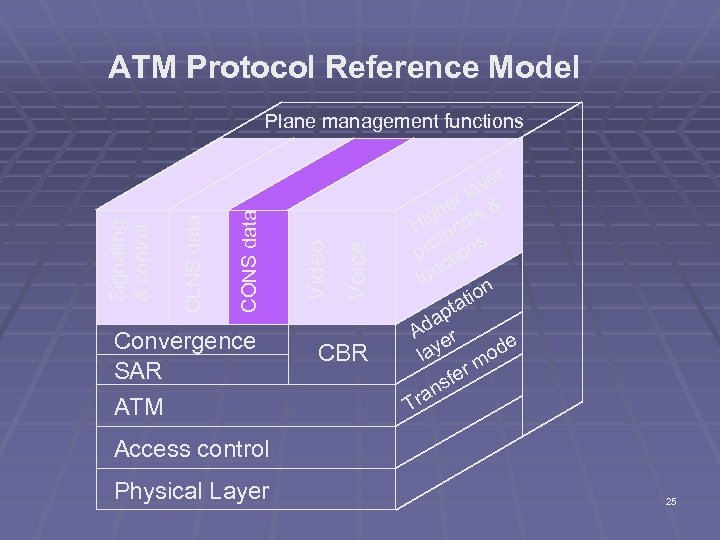
ATM Protocol Reference Model Convergence SAR ATM Voice Video CONS data CLNS data Signaling & control Plane management functions CBR r ye la er & igh cols H o t s pro tion c un f n tio pta a Ad er e od lay m er f ns Tra Access control Physical Layer 25
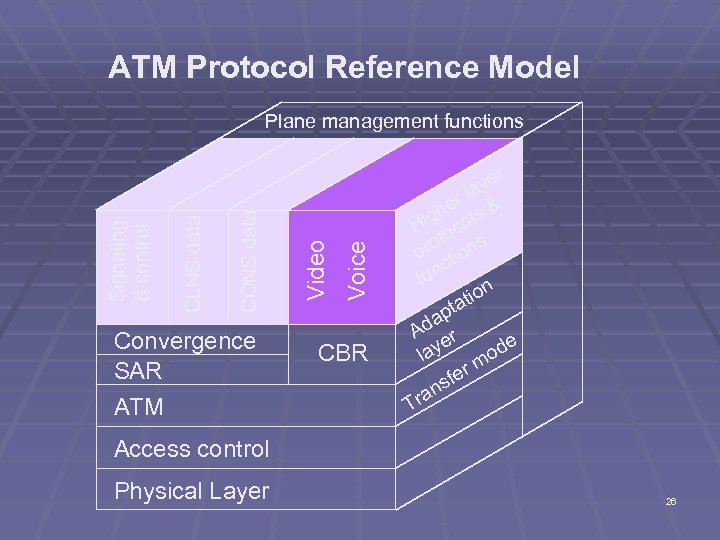
ATM Protocol Reference Model Convergence SAR ATM Voice Video CONS data CLNS data Signaling & control Plane management functions CBR r ye la er & igh cols H o t s pro tion c un f n tio pta a Ad er e od lay m er f ns Tra Access control Physical Layer 26
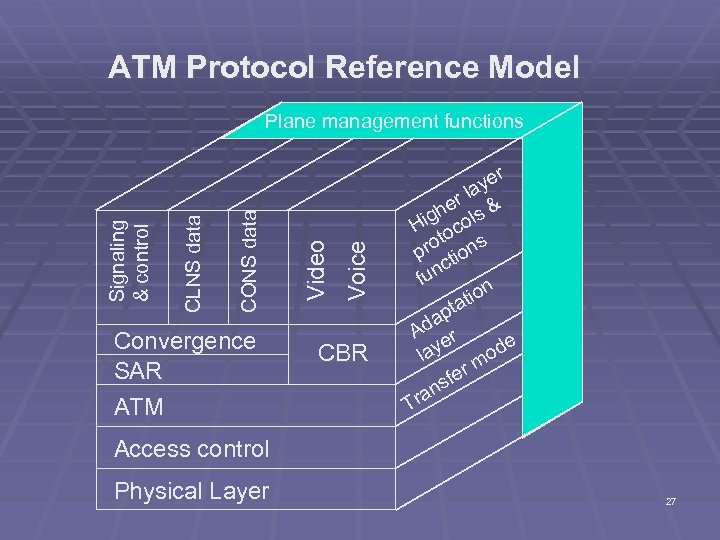
ATM Protocol Reference Model Convergence SAR ATM Voice Video CONS data CLNS data Signaling & control Plane management functions CBR r ye la er & igh cols H o t s pro tion c un f n tio pta a Ad er e od lay m er f ns Tra Access control Physical Layer 27
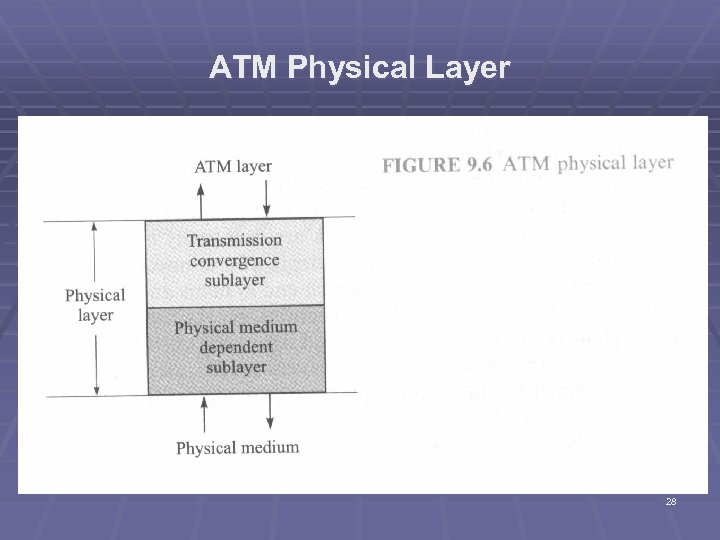
ATM Physical Layer 28
TCS § Transmission Convergence Sublayer (TCS): adapts ATM layer above to PMD sublayer below § § § Header checksum generation: 8 bits CRC Cell delineation With “unstructured” PMD sublayer, transmission of idle cells when no data cells to send 29
Physical Medium Dependent sublayer § Physical Medium Dependent Sublayer: depends on physical medium being used § SONET/SDH: (Synchronous Optical Network / Synchronous Digital Hierarchy) transmission frame structure (like a container carrying bits); § bit synchronization; § bandwidth partitions (TDM); § several speeds: OC 3 = 155. 52 Mbps; OC 12 = 622. 08 Mbps; OC 48 = 2. 45 Gbps, OC 192 = 9. 6 Gbps § TI/T 3: transmission frame structure (old telephone hierarchy): 1. 5 Mbps/ 45 Mbps § unstructured: just cells (busy/idle) 30
ATM LAYER § The ATM layer provides for the transparent transport of fixed sized ATM layer service data units between communicating upper layer entities (e. g. , ATM Adaptation Layer). § An interface between the AAL and the physical layer 31
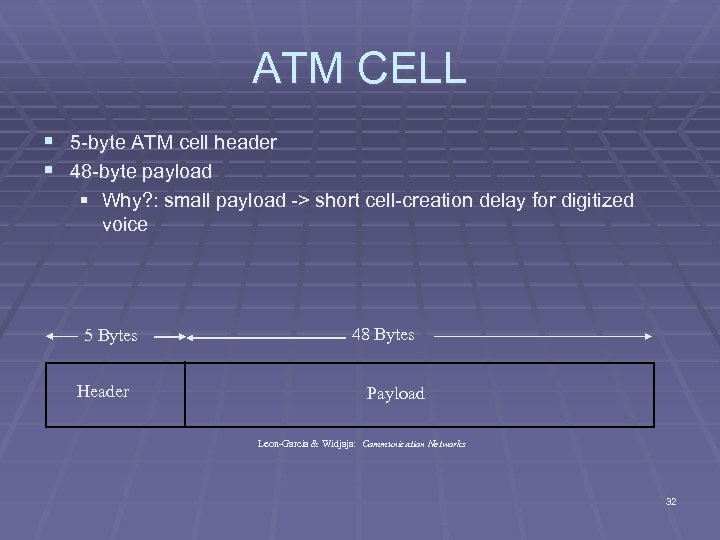
ATM CELL § 5 -byte ATM cell header § 48 -byte payload § Why? : small payload -> short cell-creation delay for digitized voice 5 Bytes Header 48 Bytes Payload Leon-Garcia & Widjaja: Communication Networks 32
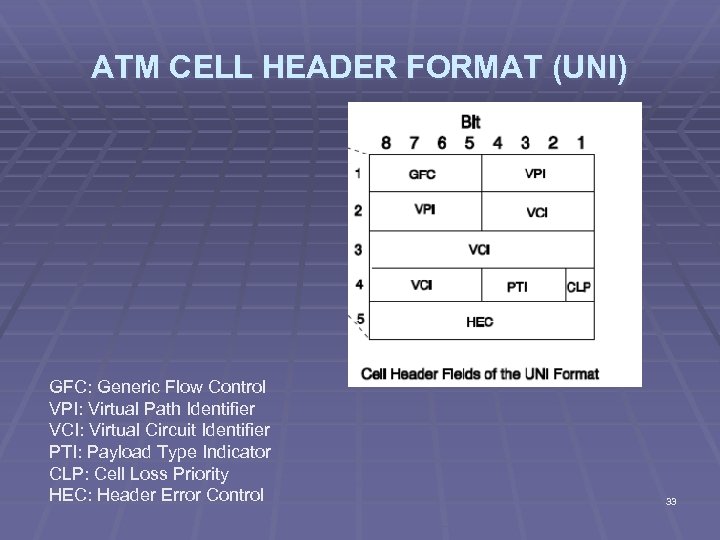
ATM CELL HEADER FORMAT (UNI) GFC: Generic Flow Control VPI: Virtual Path Identifier VCI: Virtual Circuit Identifier PTI: Payload Type Indicator CLP: Cell Loss Priority HEC: Header Error Control 33
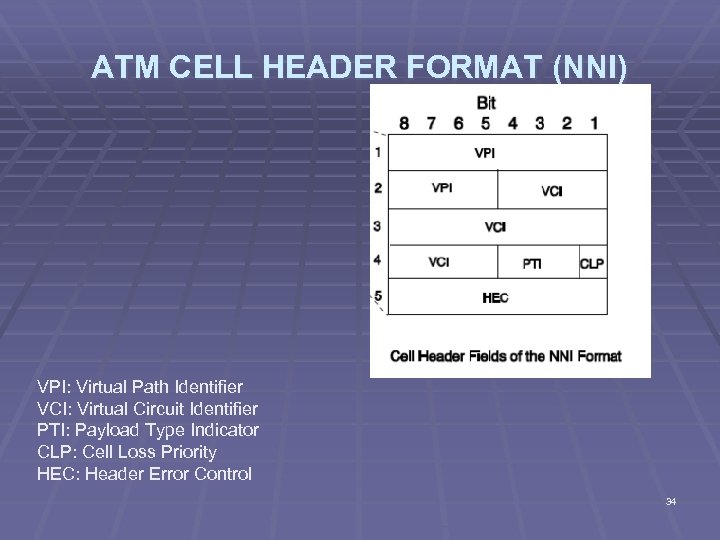
ATM CELL HEADER FORMAT (NNI) VPI: Virtual Path Identifier VCI: Virtual Circuit Identifier PTI: Payload Type Indicator CLP: Cell Loss Priority HEC: Header Error Control 34
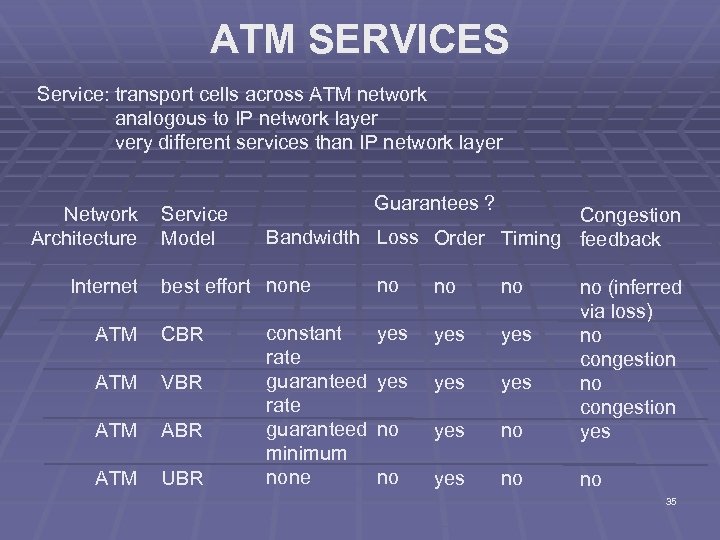
ATM SERVICES Service: transport cells across ATM network analogous to IP network layer very different services than IP network layer Network Architecture Internet Service Model Guarantees ? Congestion Bandwidth Loss Order Timing feedback best effort none ATM CBR ATM VBR ATM ABR ATM UBR constant rate guaranteed minimum none no no no yes yes yes no no (inferred via loss) no congestion yes no no 35
ATM VIRTUAL CIRCUITS § VC transport: cells carried on VC from source to destination § call setup, teardown for each call before data can flow § each packet carries VC identifier (not destination ID) § every switch on source-dest path maintain “state” for each passing connection § link, switch resources (bandwidth, buffers) may be allocated to VC: to get circuit-like perf. § Permanent VCs (PVCs) § long lasting connections § typically: “permanent” route between to IP routers § Switched VCs (SVC): § dynamically set up on per-call basis 36
Virtual Channels § The virtual channel (VC) is the fundamental unit of transport in a B-ISDN. Each ATM cell contains an explicit label in its header to identify the virtual channel. § a Virtual Channel Identifier (VCI) § a Virtual Path Identifier (VPI) § A virtual channel (VC) is a communication channel that provides for the transport of ATM cells between two or more endpoints for information transfer. § A Virtual Channel Identifier (VCI) identifies a particular VC within a particular VP over a UNI or NNI. § A specific value of VCI has no end-to-end meaning. 37
Virtual Paths § A Virtual Path (VP) is a group of Virtual Channels that are carried on the same physical facility and share the same Virtual Path Identifier (VPI) value. § The VP boundaries are delimited by Virtual Path Terminators (VPT). § AT VPTs, both VPI and VCI are processed. § Between VPTs associated with the same VP, only the VPI values are processed (and translated) at ATM network elements. § The VCI values are processed only at VPTs, and are not translated at intermediate ATM network elements. 38
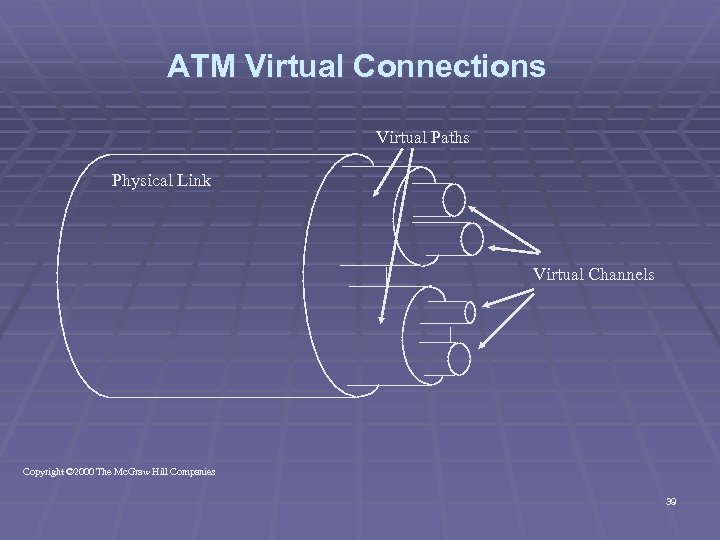
ATM Virtual Connections Virtual Paths Physical Link Virtual Channels Copyright © 2000 The Mc. Graw Hill Companies 39
ATM Layer Functions § Cell multiplexing and switching § Cell rate decoupling § Cell discrimination based on pre-defined VPI/VCI § Quality of Service (Qo. S) § Payload type characterization § Generic flow control § Loss priority indication and Selective cell discarding § Traffic shaping 40
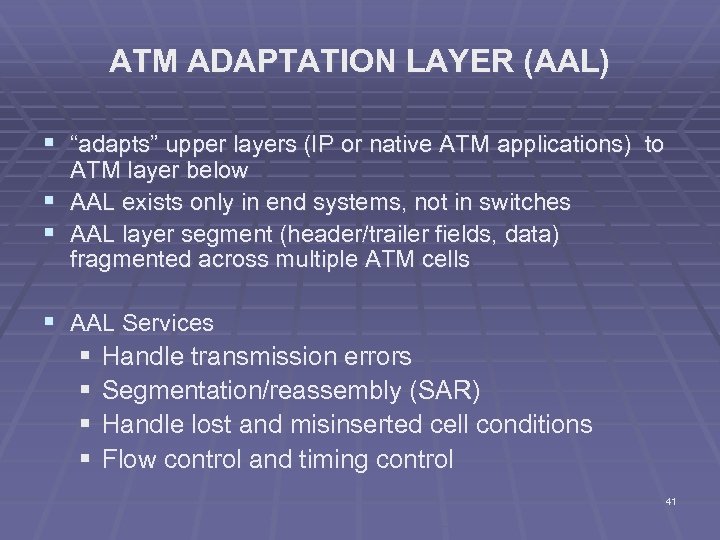
ATM ADAPTATION LAYER (AAL) § “adapts” upper layers (IP or native ATM applications) to ATM layer below § AAL exists only in end systems, not in switches § AAL layer segment (header/trailer fields, data) fragmented across multiple ATM cells § AAL Services § § Handle transmission errors Segmentation/reassembly (SAR) Handle lost and misinserted cell conditions Flow control and timing control 41
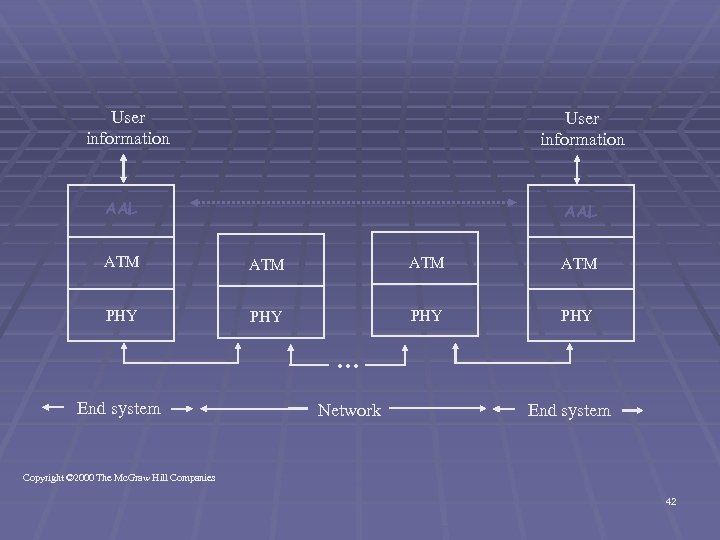
User information AAL ATM ATM PHY PHY … End system Network End system Copyright © 2000 The Mc. Graw Hill Companies 42
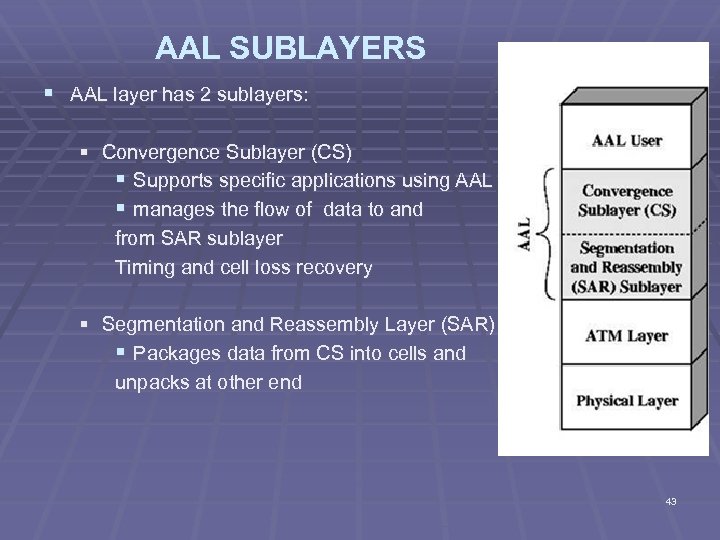
AAL SUBLAYERS § AAL layer has 2 sublayers: § Convergence Sublayer (CS) § Supports specific applications using AAL § manages the flow of data to and from SAR sublayer Timing and cell loss recovery § Segmentation and Reassembly Layer (SAR) § Packages data from CS into cells and unpacks at other end 43
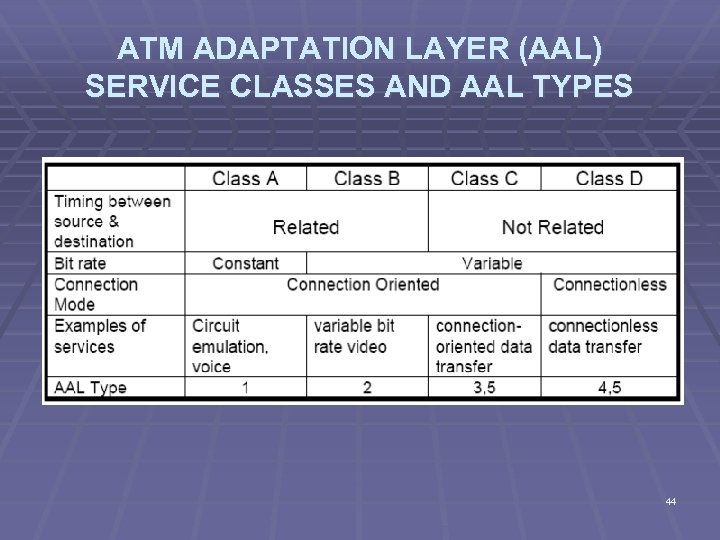
ATM ADAPTATION LAYER (AAL) SERVICE CLASSES AND AAL TYPES 44
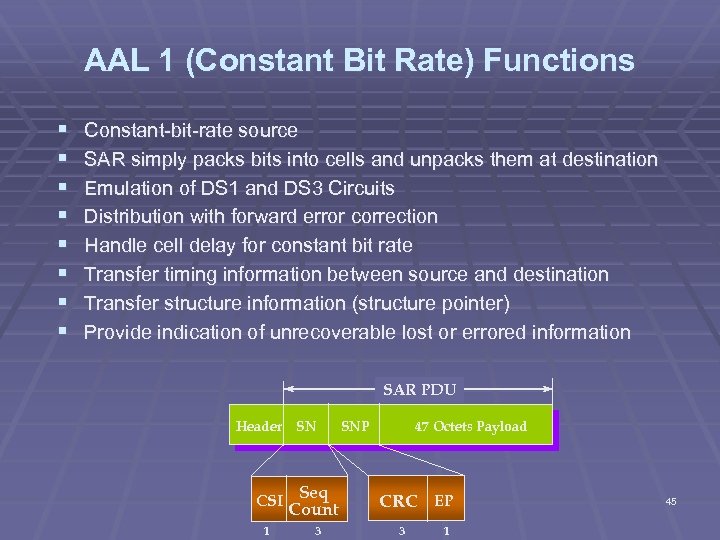
AAL 1 (Constant Bit Rate) Functions § § § § Constant-bit-rate source SAR simply packs bits into cells and unpacks them at destination Emulation of DS 1 and DS 3 Circuits Distribution with forward error correction Handle cell delay for constant bit rate Transfer timing information between source and destination Transfer structure information (structure pointer) Provide indication of unrecoverable lost or errored information SAR PDU Header SN CSI Seq Count 1 3 SNP 47 Octets Payload CRC EP 3 1 45
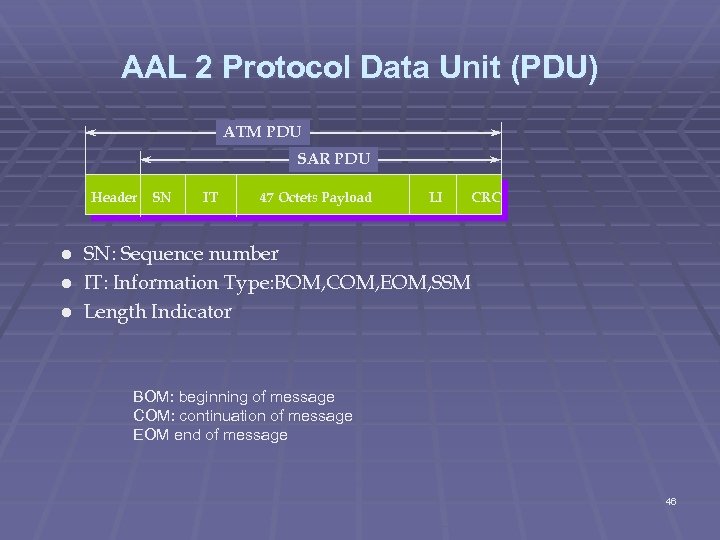
AAL 2 Protocol Data Unit (PDU) ATM PDU SAR PDU Header l l l SN IT 47 Octets Payload LI CRC SN: Sequence number IT: Information Type: BOM, COM, EOM, SSM Length Indicator BOM: beginning of message COM: continuation of message EOM end of message 46
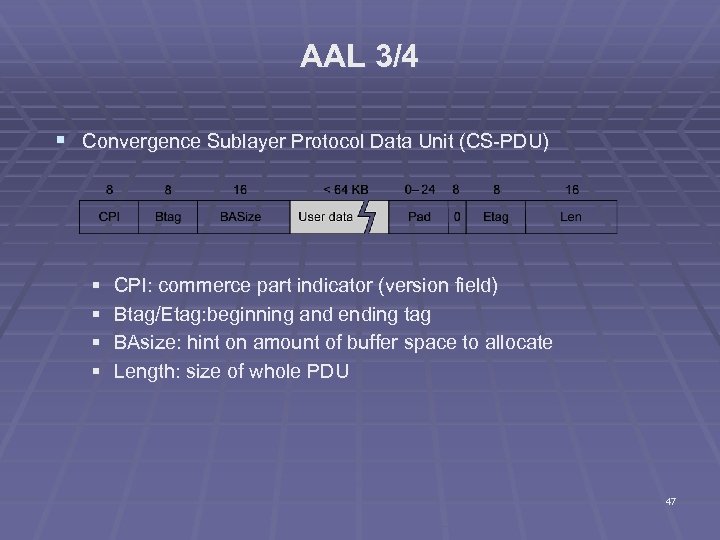
AAL 3/4 § Convergence Sublayer Protocol Data Unit (CS-PDU) § § CPI: commerce part indicator (version field) Btag/Etag: beginning and ending tag BAsize: hint on amount of buffer space to allocate Length: size of whole PDU 47
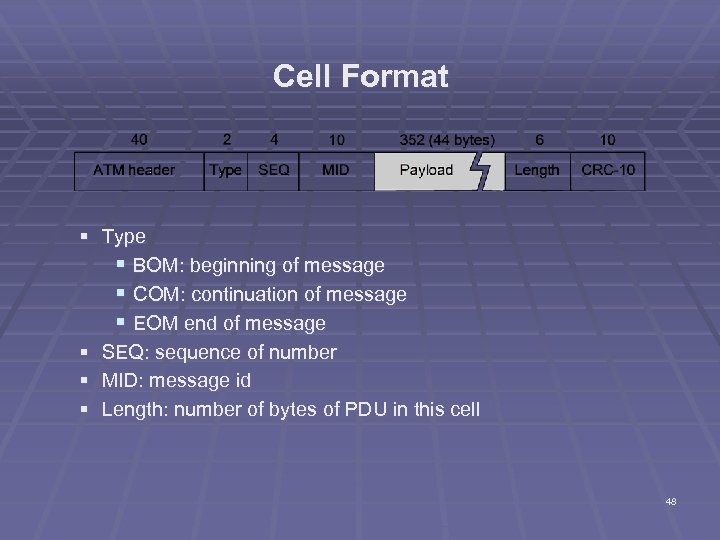
Cell Format § Type § BOM: beginning of message § COM: continuation of message § EOM end of message § SEQ: sequence of number § MID: message id § Length: number of bytes of PDU in this cell 48
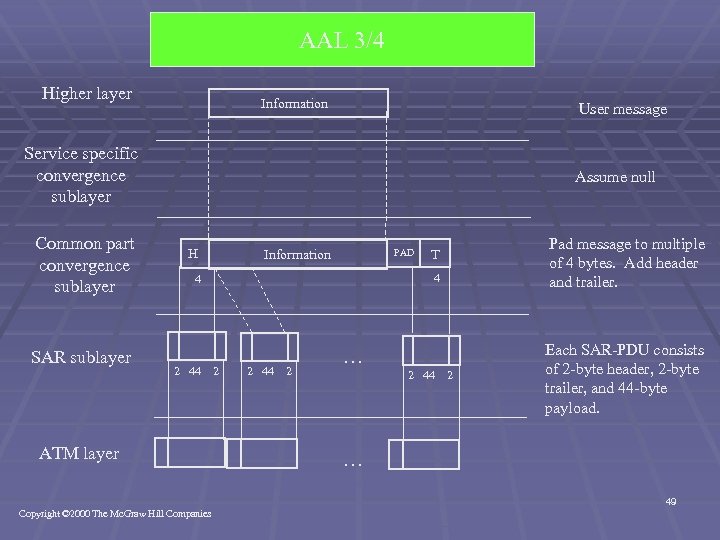
AAL 3/4 Higher layer Information User message Service specific convergence sublayer Common part convergence sublayer SAR sublayer Assume null H Information PAD 4 4 2 44 ATM layer Pad message to multiple of 4 bytes. Add header and trailer. T 2 2 44 2 … 2 44 2 Each SAR-PDU consists of 2 -byte header, 2 -byte trailer, and 44 -byte payload. … 49 Copyright © 2000 The Mc. Graw Hill Companies
AAL 5 PDU Structure § is used to transport IP datagrams over ATM networks. § The Simple and Efficient Adaptation Layer (SEAL), § § § attempts to reduce the complexity and overhead of AAL 3/4. It eliminates most of the overhead of AAL 3/4. AAL 5 comprises a convergence sublayer and a SAR sublayer, although the SAR is essentially null. Streamlined transport for connection oriented protocols § Reduce protocol processing overhead § Reduce transmission overhead § Ensure adaptability to existing transport protocols 50
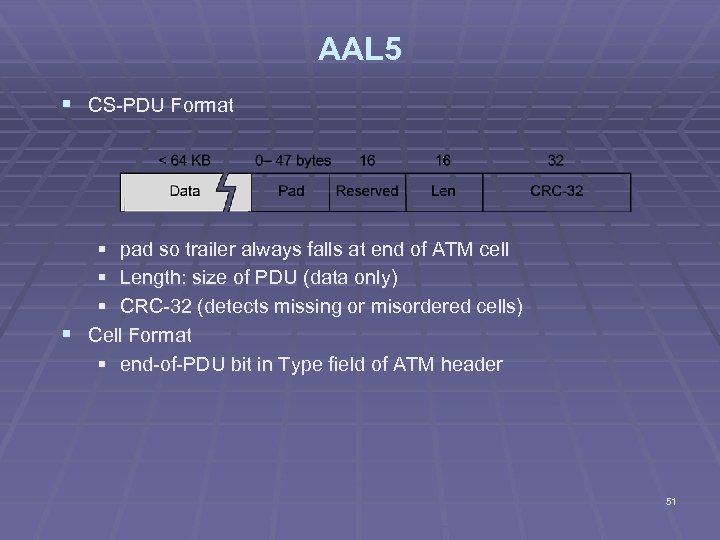
AAL 5 § CS-PDU Format § pad so trailer always falls at end of ATM cell § Length: size of PDU (data only) § CRC-32 (detects missing or misordered cells) § Cell Format § end-of-PDU bit in Type field of ATM header 51
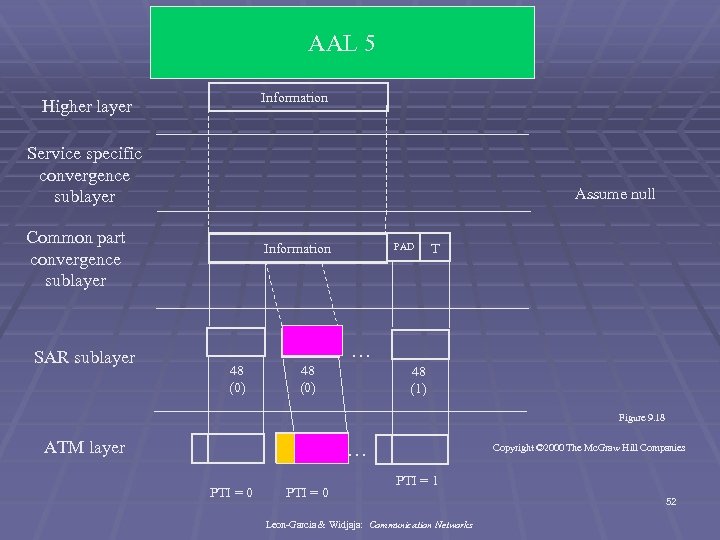
AAL 5 Information Higher layer Service specific convergence sublayer Assume null Common part convergence sublayer SAR sublayer Information PAD T … 48 (0) 48 (1) Figure 9. 18 ATM layer … PTI = 0 Copyright © 2000 The Mc. Graw Hill Companies PTI = 1 Leon-Garcia & Widjaja: Communication Networks 52
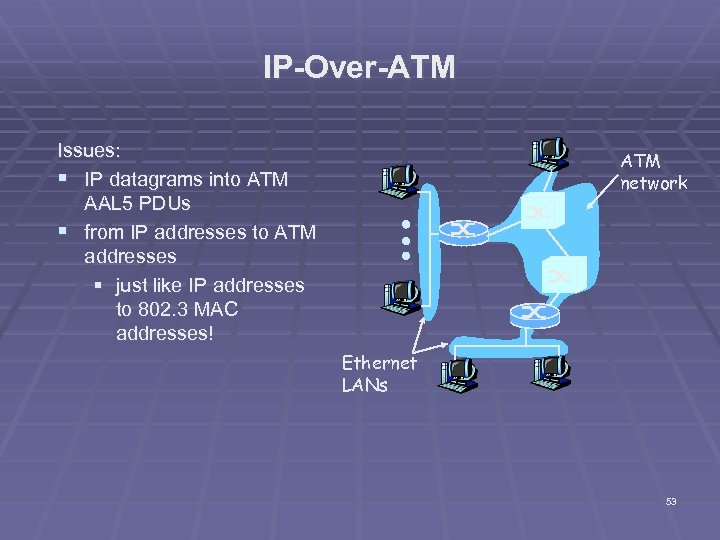
IP-Over-ATM Issues: § IP datagrams into ATM AAL 5 PDUs § from IP addresses to ATM addresses § just like IP addresses to 802. 3 MAC addresses! ATM network Ethernet LANs 53
Datagram Journey in IP-over-ATM Network § at Source Host: § § § IP layer maps between IP, ATM dest address (using ARP) passes datagram to AAL 5 encapsulates data, segments data into cells, passes to ATM layer § ATM network: moves cell along VC to destination § at Destination Host: § AAL 5 reassembles cells into original datagram § if CRC OK, datagram is passed to IP 54

END 55
Скачать презентацию ATM by YUSUF KURT YEDİTEPE UNIVERSITY Computer Engineering
c0d38d1b04d43bd10d2b6a365d5091a3.ppt