


 Скачать презентацию ATLAS Tracker Upgrade UK Workshop Coseners House 8
90d22021639eda93248ce6981a42b534.ppt
- Количество слайдов: 19
 ATLAS Tracker Upgrade UK Workshop Coseners House, 8. 07. 08 Electrical characteristics of un-irradiated ATLAS 07 mini strip sensors A. Chilingarov, Lancaster University A. Chilingarov, ATLAS 07 mini sensors
 Outline 1. Sensors 2. C-V, I-V measurements 3. Punch-through voltages 4. Interstrip resistance 5. Interstrip capacitance 6. Summary 7. Conclusions 2 A. Chilingarov, ATLAS 07 mini sensors
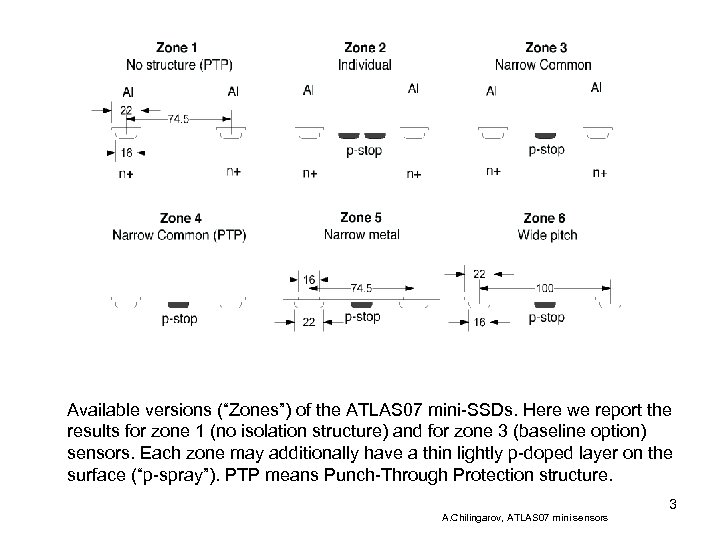 Available versions (“Zones”) of the ATLAS 07 mini-SSDs. Here we report the results for zone 1 (no isolation structure) and for zone 3 (baseline option) sensors. Each zone may additionally have a thin lightly p-doped layer on the surface (“p-spray”). PTP means Punch-Through Protection structure. 3 A. Chilingarov, ATLAS 07 mini sensors
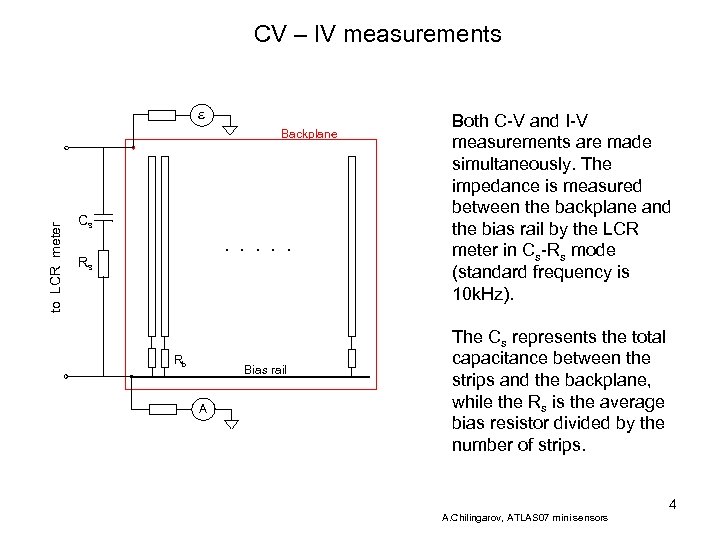 CV – IV measurements e to LCR meter Backplane Cs. . . Rs Rb Bias rail A Both C-V and I-V measurements are made simultaneously. The impedance is measured between the backplane and the bias rail by the LCR meter in Cs-Rs mode (standard frequency is 10 k. Hz). The Cs represents the total capacitance between the strips and the backplane, while the Rs is the average bias resistor divided by the number of strips. 4 A. Chilingarov, ATLAS 07 mini sensors
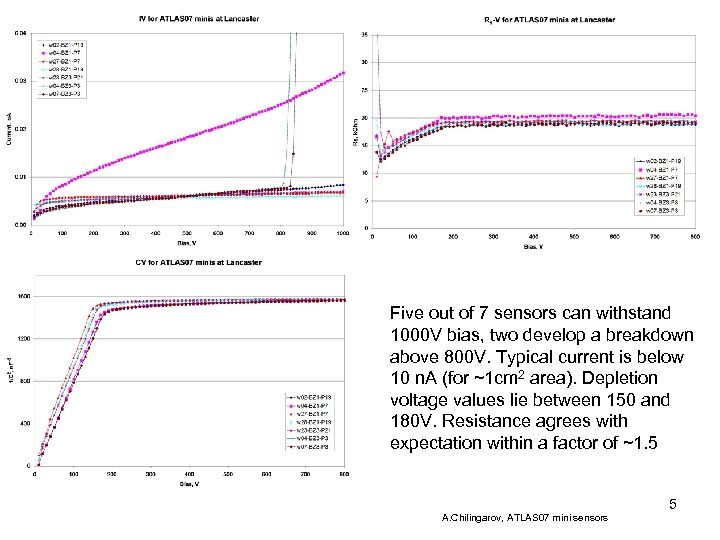 Five out of 7 sensors can withstand 1000 V bias, two develop a breakdown above 800 V. Typical current is below 10 n. A (for ~1 cm 2 area). Depletion voltage values lie between 150 and 180 V. Resistance agrees with expectation within a factor of ~1. 5 5 A. Chilingarov, ATLAS 07 mini sensors
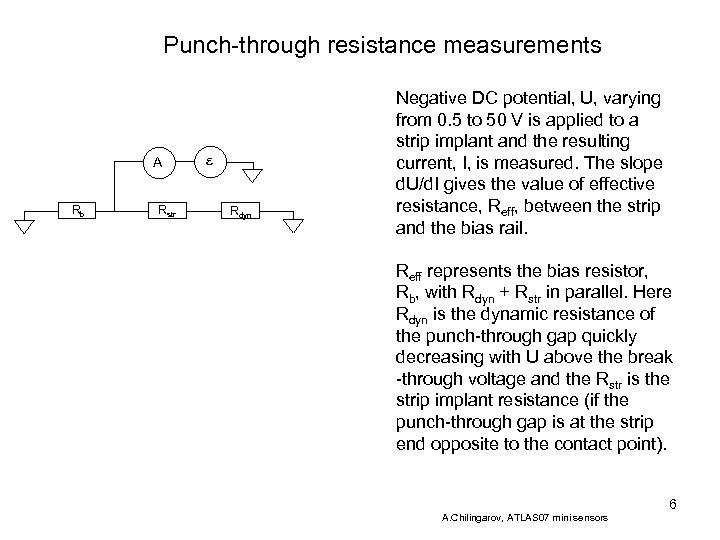 Punch-through resistance measurements A Rb Rstr e Rdyn Negative DC potential, U, varying from 0. 5 to 50 V is applied to a strip implant and the resulting current, I, is measured. The slope d. U/d. I gives the value of effective resistance, Reff, between the strip and the bias rail. Reff represents the bias resistor, Rb, with Rdyn + Rstr in parallel. Here Rdyn is the dynamic resistance of the punch-through gap quickly decreasing with U above the break -through voltage and the Rstr is the strip implant resistance (if the punch-through gap is at the strip end opposite to the contact point). 6 A. Chilingarov, ATLAS 07 mini sensors
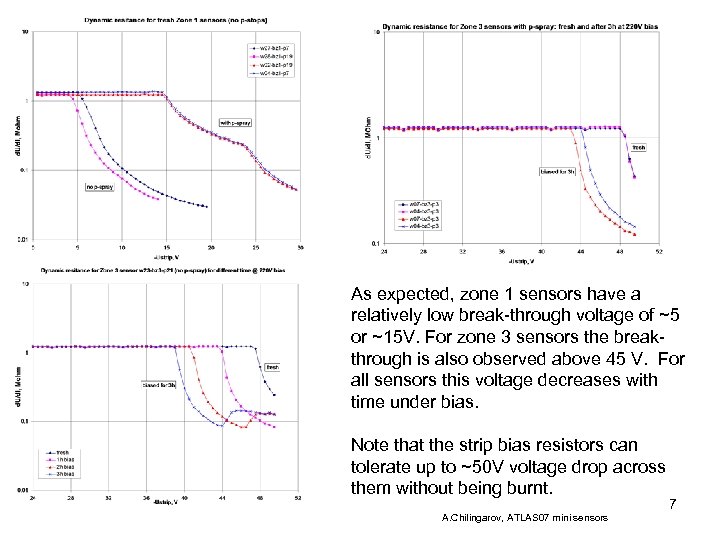 As expected, zone 1 sensors have a relatively low break-through voltage of ~5 or ~15 V. For zone 3 sensors the breakthrough is also observed above 45 V. For all sensors this voltage decreases with time under bias. Note that the strip bias resistors can tolerate up to ~50 V voltage drop across them without being burnt. 7 A. Chilingarov, ATLAS 07 mini sensors
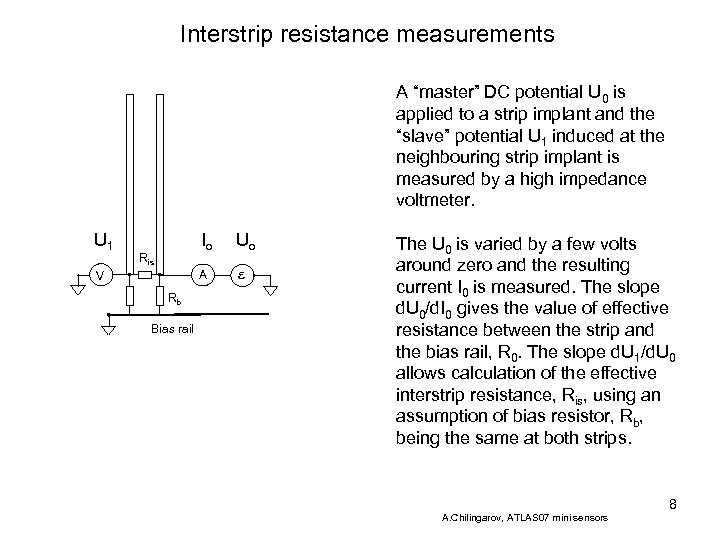 Interstrip resistance measurements A “master” DC potential U 0 is applied to a strip implant and the “slave” potential U 1 induced at the neighbouring strip implant is measured by a high impedance voltmeter. U 1 Io A Ris V Rb Bias rail Uo e The U 0 is varied by a few volts around zero and the resulting current I 0 is measured. The slope d. U 0/d. I 0 gives the value of effective resistance between the strip and the bias rail, R 0. The slope d. U 1/d. U 0 allows calculation of the effective interstrip resistance, Ris, using an assumption of bias resistor, Rb, being the same at both strips. 8 A. Chilingarov, ATLAS 07 mini sensors
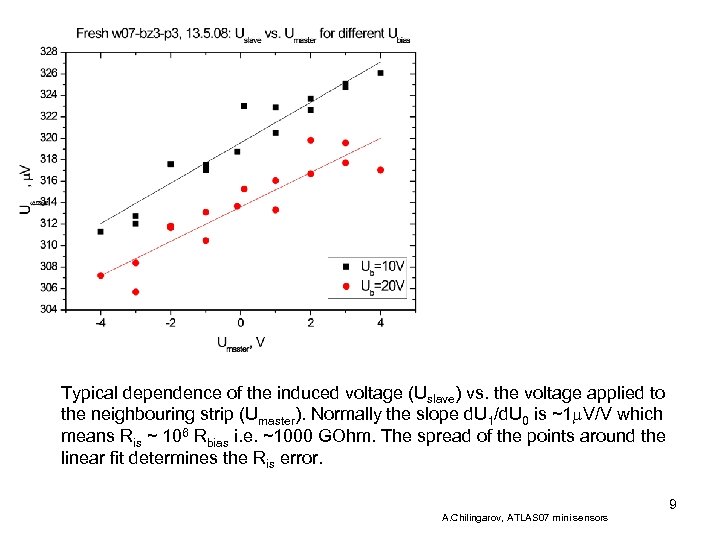 Typical dependence of the induced voltage (Uslave) vs. the voltage applied to the neighbouring strip (Umaster). Normally the slope d. U 1/d. U 0 is ~1 m. V/V which means Ris ~ 106 Rbias i. e. ~1000 GOhm. The spread of the points around the linear fit determines the Ris error. 9 A. Chilingarov, ATLAS 07 mini sensors
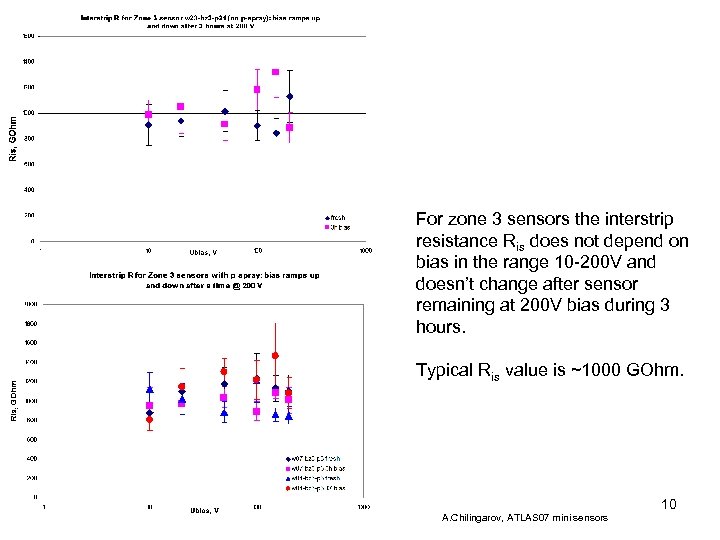 For zone 3 sensors the interstrip resistance Ris does not depend on bias in the range 10 -200 V and doesn’t change after sensor remaining at 200 V bias during 3 hours. Typical Ris value is ~1000 GOhm. 10 A. Chilingarov, ATLAS 07 mini sensors
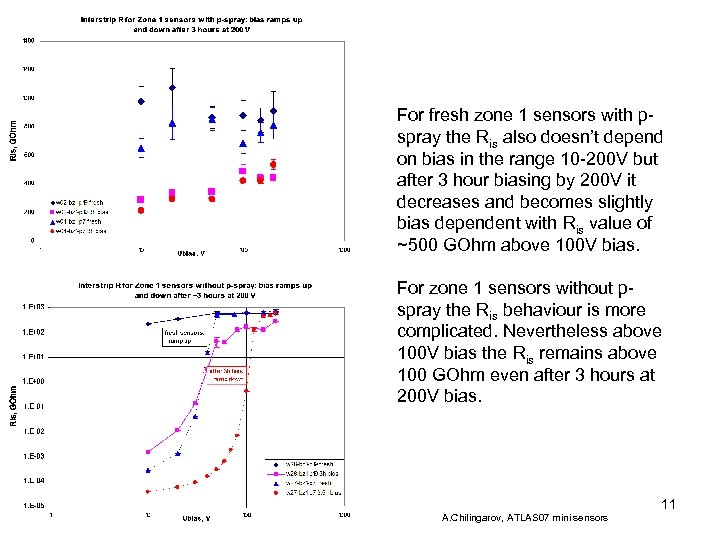 For fresh zone 1 sensors with pspray the Ris also doesn’t depend on bias in the range 10 -200 V but after 3 hour biasing by 200 V it decreases and becomes slightly bias dependent with Ris value of ~500 GOhm above 100 V bias. For zone 1 sensors without pspray the Ris behaviour is more complicated. Nevertheless above 100 V bias the Ris remains above 100 GOhm even after 3 hours at 200 V bias. 11 A. Chilingarov, ATLAS 07 mini sensors
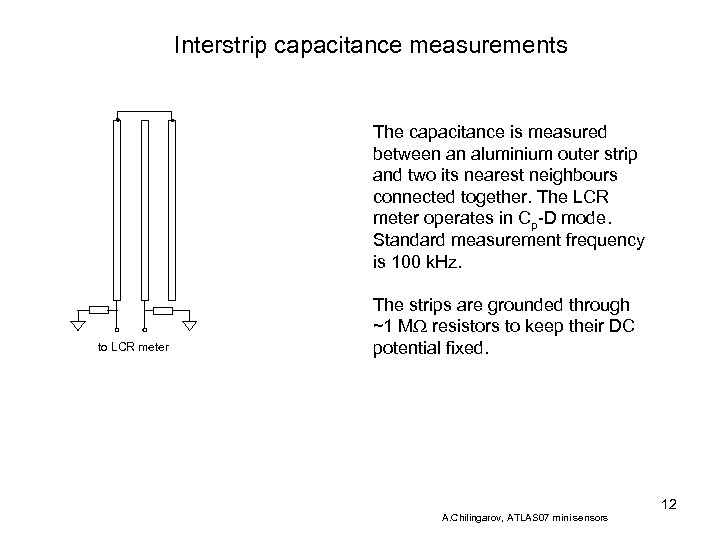 Interstrip capacitance measurements The capacitance is measured between an aluminium outer strip and two its nearest neighbours connected together. The LCR meter operates in Cp-D mode. Standard measurement frequency is 100 k. Hz. to LCR meter The strips are grounded through ~1 MW resistors to keep their DC potential fixed. 12 A. Chilingarov, ATLAS 07 mini sensors
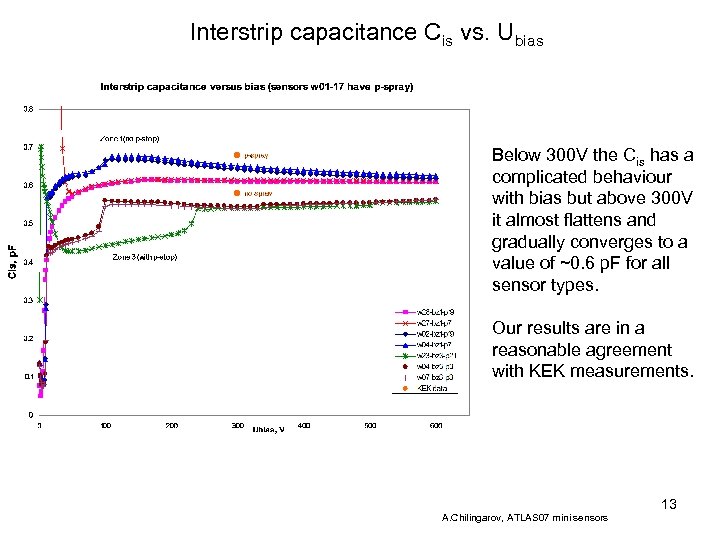 Interstrip capacitance Cis vs. Ubias Below 300 V the Cis has a complicated behaviour with bias but above 300 V it almost flattens and gradually converges to a value of ~0. 6 p. F for all sensor types. Our results are in a reasonable agreement with KEK measurements. 13 A. Chilingarov, ATLAS 07 mini sensors
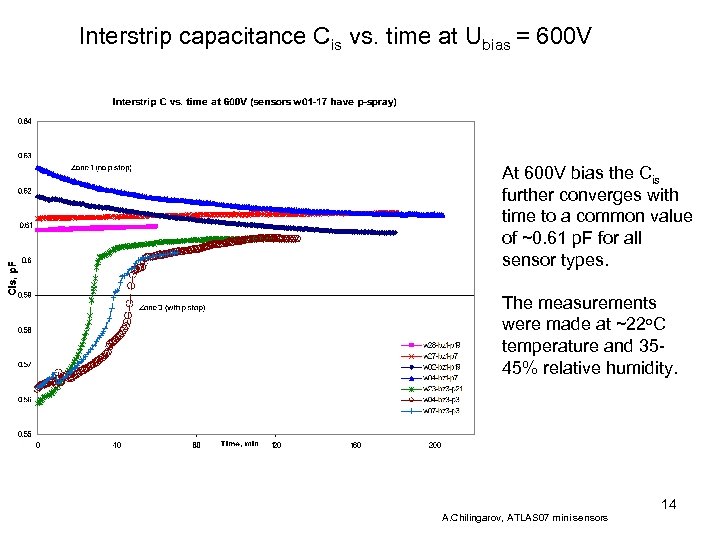 Interstrip capacitance Cis vs. time at Ubias = 600 V At 600 V bias the Cis further converges with time to a common value of ~0. 61 p. F for all sensor types. The measurements were made at ~22 o. C temperature and 3545% relative humidity. 14 A. Chilingarov, ATLAS 07 mini sensors
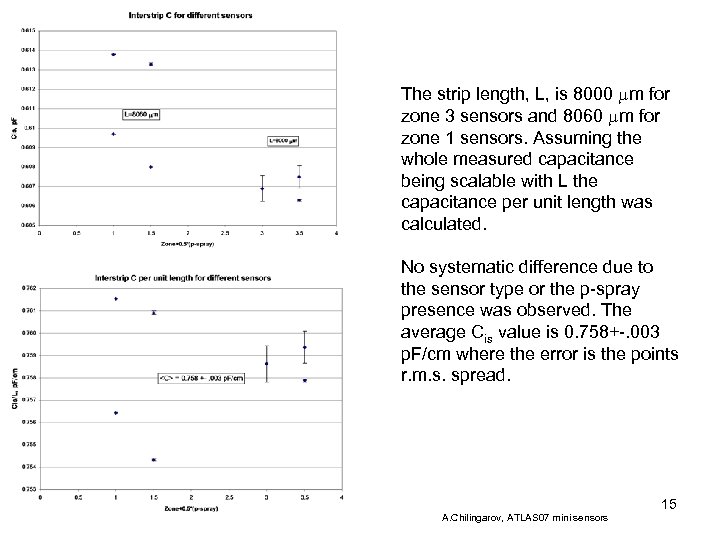 The strip length, L, is 8000 mm for zone 3 sensors and 8060 mm for zone 1 sensors. Assuming the whole measured capacitance being scalable with L the capacitance per unit length was calculated. No systematic difference due to the sensor type or the p-spray presence was observed. The average Cis value is 0. 758+-. 003 p. F/cm where the error is the points r. m. s. spread. 15 A. Chilingarov, ATLAS 07 mini sensors
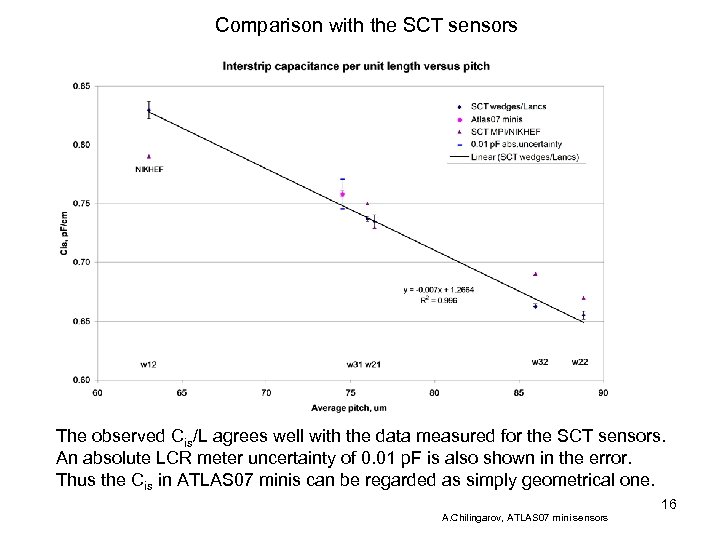 Comparison with the SCT sensors The observed Cis/L agrees well with the data measured for the SCT sensors. An absolute LCR meter uncertainty of 0. 01 p. F is also shown in the error. Thus the Cis in ATLAS 07 minis can be regarded as simply geometrical one. 16 A. Chilingarov, ATLAS 07 mini sensors
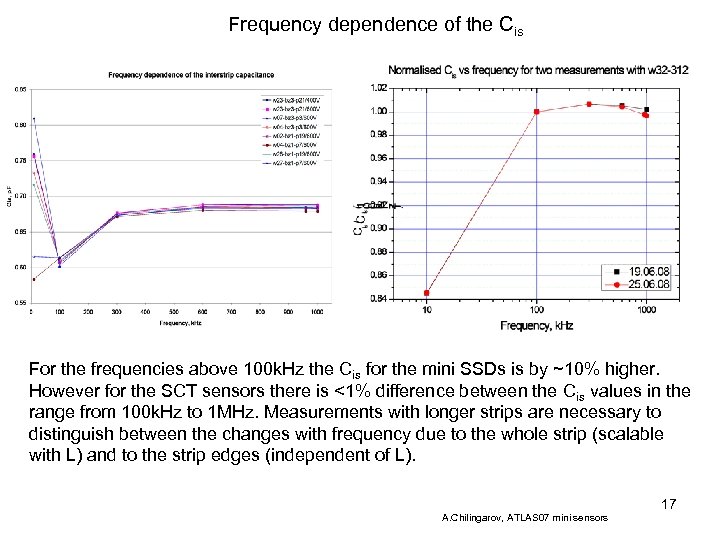 Frequency dependence of the Cis For the frequencies above 100 k. Hz the Cis for the mini SSDs is by ~10% higher. However for the SCT sensors there is <1% difference between the Cis values in the range from 100 k. Hz to 1 MHz. Measurements with longer strips are necessary to distinguish between the changes with frequency due to the whole strip (scalable with L) and to the strip edges (independent of L). 17 A. Chilingarov, ATLAS 07 mini sensors
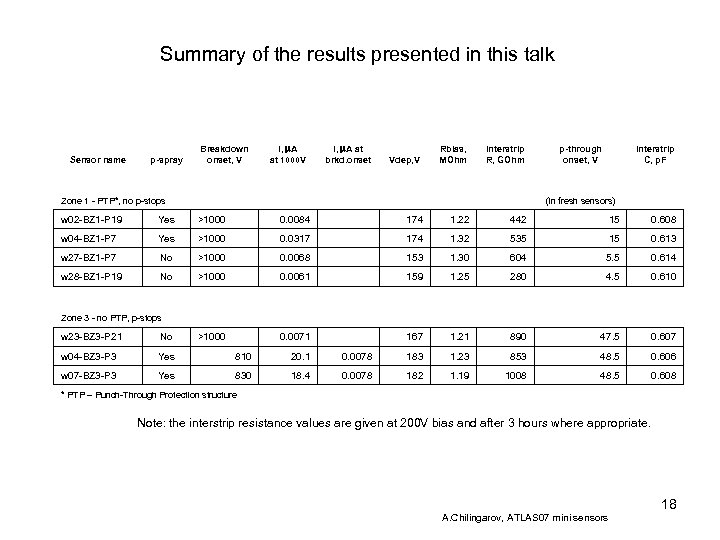 Summary of the results presented in this talk Sensor name p-spray Breakdown onset, V I, m. A at 1000 V I, m. A at brkd. onset Vdep, V Rbias, MOhm Interstrip R, GOhm Zone 1 - PTP*, no p-stops p-through onset, V Interstrip C, p. F (in fresh sensors) w 02 -BZ 1 -P 19 Yes >1000 0. 0084 174 1. 22 442 15 0. 608 w 04 -BZ 1 -P 7 Yes >1000 0. 0317 174 1. 32 535 15 0. 613 w 27 -BZ 1 -P 7 No >1000 0. 0068 153 1. 30 604 5. 5 0. 614 w 28 -BZ 1 -P 19 No >1000 0. 0061 159 1. 25 280 4. 5 0. 610 >1000 0. 0071 167 1. 21 890 47. 5 0. 607 Zone 3 - no PTP, p-stops w 23 -BZ 3 -P 21 No w 04 -BZ 3 -P 3 Yes 810 20. 1 0. 0078 183 1. 23 853 48. 5 0. 606 w 07 -BZ 3 -P 3 Yes 830 18. 4 0. 0078 182 1. 19 1008 48. 5 0. 608 * PTP – Punch-Through Protection structure Note: the interstrip resistance values are given at 200 V bias and after 3 hours where appropriate. 18 A. Chilingarov, ATLAS 07 mini sensors
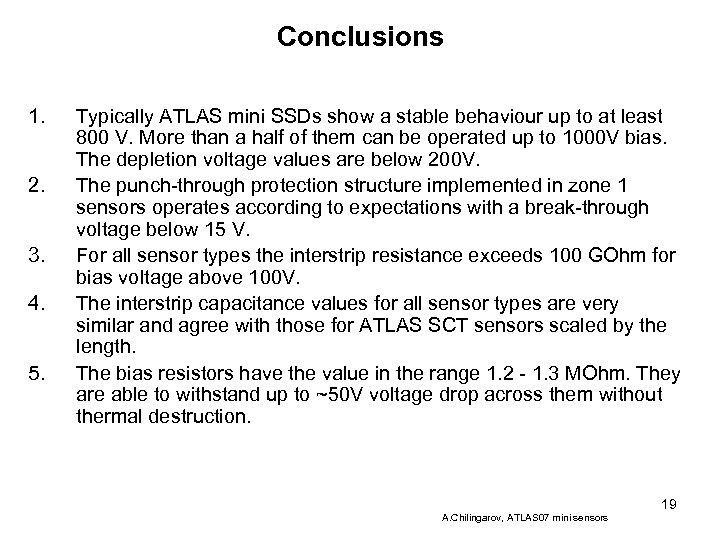 Conclusions 1. 2. 3. 4. 5. Typically ATLAS mini SSDs show a stable behaviour up to at least 800 V. More than a half of them can be operated up to 1000 V bias. The depletion voltage values are below 200 V. The punch-through protection structure implemented in zone 1 sensors operates according to expectations with a break-through voltage below 15 V. For all sensor types the interstrip resistance exceeds 100 GOhm for bias voltage above 100 V. The interstrip capacitance values for all sensor types are very similar and agree with those for ATLAS SCT sensors scaled by the length. The bias resistors have the value in the range 1. 2 - 1. 3 MOhm. They are able to withstand up to ~50 V voltage drop across them without thermal destruction. 19 A. Chilingarov, ATLAS 07 mini sensors