 Скачать презентацию ATLAS H γγ Meeting 20 Mar 2009 New
a95f81468dac85648a021b616afbbf8c.ppt
- Количество слайдов: 14



ATLAS H γγ Meeting, 20 Mar 2009 New Features in Pythia (v 6. 420) New Tunes to LEP data Better Fragmentation Models New Tunes to Tevatron data Better Underlying-Event Models Combined New “Professor” and “Perugia” Tunes Outlook to Pythia 8 Peter Skands Theoretical Physics Dept. , Fermilab Thanks to N. Moggi, R. Field, A. Buckley, H. Hoeth
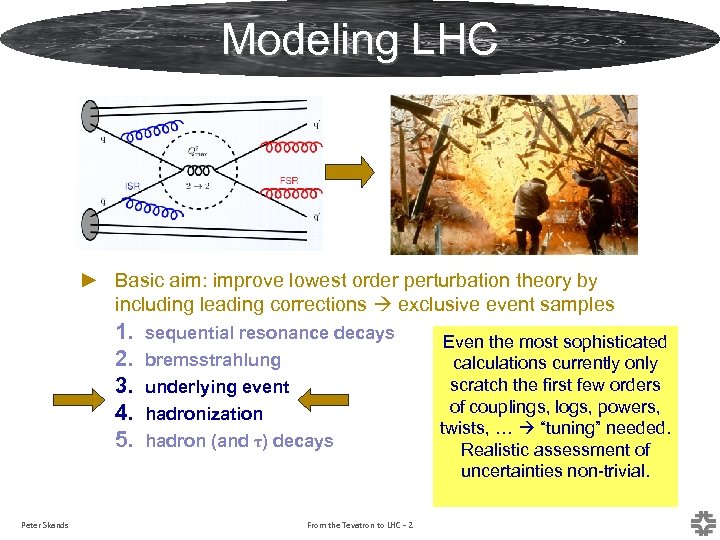
Modeling LHC ► Basic aim: improve lowest order perturbation theory by including leading corrections exclusive event samples 1. 2. 3. 4. 5. Peter Skands sequential resonance decays bremsstrahlung underlying event hadronization hadron (and τ) decays From the Tevatron to LHC - 2 Even the most sophisticated calculations currently only scratch the first few orders of couplings, logs, powers, twists, … “tuning” needed. Realistic assessment of uncertainties non-trivial.
Why Study the “Underlying Event”? ► Solving QCD requires Compromise • Pythia alone contains many different models, + Herwig, + Sherpa … ► Fragmentation / Hadronization • Hadronization can only be studied “in isolation” at LEP § Normal procedure: constrain fragmentation models at LEP and cross fingers § = EXTRAPOLATION • What about in situ constraints on fragmentation!? § Important to verify pion spectra, etc, directly in the experiment § At least for min-bias / UE, but ideally for processes as close as possible to signal ► Feedback to high-p. T physics • Reliable correction procedures • Without reliable models, reliable extrapolations are hard to hope for Experimental input vital to guide construction of theory Peter Skands From the Tevatron to LHC - 3
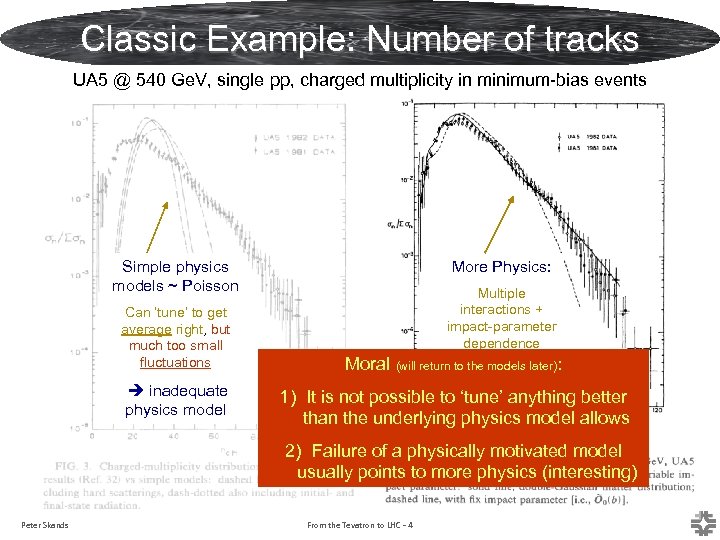
Classic Example: Number of tracks UA 5 @ 540 Ge. V, single pp, charged multiplicity in minimum-bias events Simple physics models ~ Poisson Can ‘tune’ to get average right, but much too small fluctuations inadequate physics model More Physics: Multiple interactions + impact-parameter dependence Moral (will return to the models later): 1) It is not possible to ‘tune’ anything better than the underlying physics model allows 2) Failure of a physically motivated model usually points to more physics (interesting) Peter Skands From the Tevatron to LHC - 4
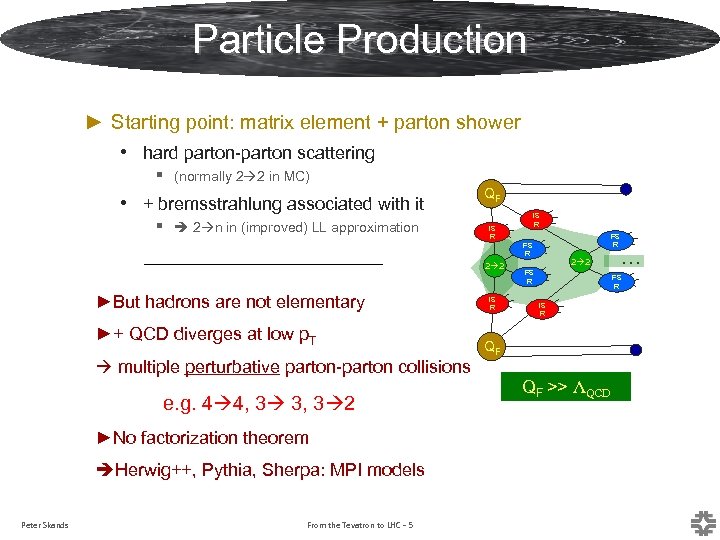
Particle Production ► Starting point: matrix element + parton shower • hard parton-parton scattering § (normally 2 2 in MC) • + bremsstrahlung associated with it § 2 n in (improved) LL approximation QF IS R FS R 2 2 ►But hadrons are not elementary ►+ QCD diverges at low p. T multiple perturbative parton-parton collisions e. g. 4 4, 3 3, 3 2 ►No factorization theorem Herwig++, Pythia, Sherpa: MPI models Peter Skands From the Tevatron to LHC - 5 IS R 2 2 FS R … FS R IS R QF QF >> ΛQCD
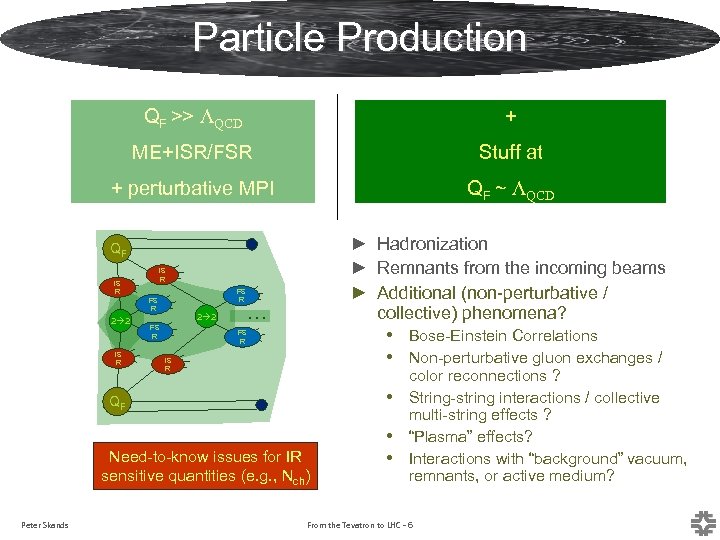
Particle Production QF >> ΛQCD + ME+ISR/FSR Stuff at + perturbative MPI QF ~ ΛQCD ► Hadronization ► Remnants from the incoming beams ► Additional (non-perturbative / collective) phenomena? QF IS R FS R 2 2 IS R 2 2 FS R … • Bose-Einstein Correlations • Non-perturbative gluon exchanges / FS R IS R • QF Need-to-know issues for IR sensitive quantities (e. g. , Nch) Peter Skands • • color reconnections ? String-string interactions / collective multi-string effects ? “Plasma” effects? Interactions with “background” vacuum, remnants, or active medium? From the Tevatron to LHC - 6
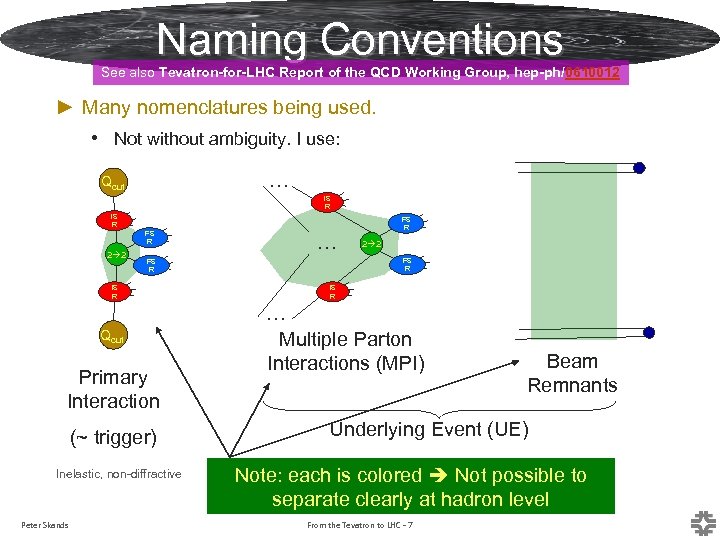
Naming Conventions See also Tevatron-for-LHC Report of the QCD Working Group, hep-ph/0610012 ► Many nomenclatures being used. • Not without ambiguity. I use: … Qcut IS R FS R 2 2 Qcut Primary Interaction (~ trigger) Inelastic, non-diffractive 2 2 FS R IS R Peter Skands … FS R IS R … Multiple Parton Interactions (MPI) Beam Remnants Underlying Event (UE) Note: each is colored Not possible to separate clearly at hadron level From the Tevatron to LHC - 7
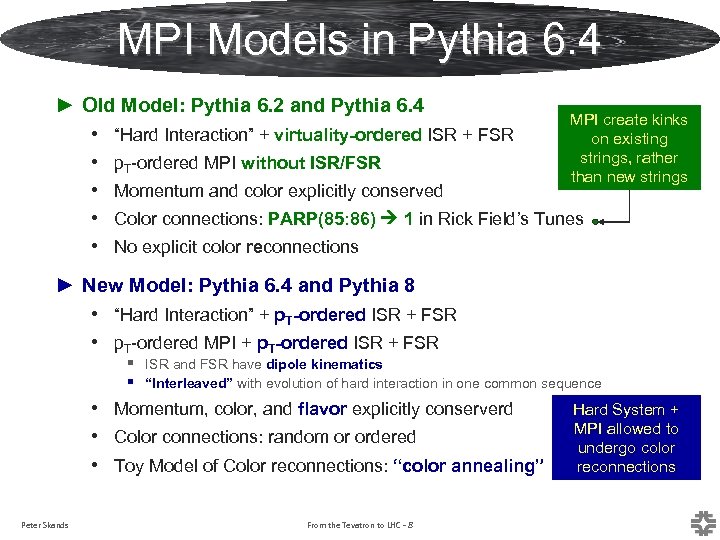
MPI Models in Pythia 6. 4 ► Old Model: Pythia 6. 2 and Pythia 6. 4 • • • “Hard Interaction” + virtuality-ordered ISR + FSR p. T-ordered MPI without ISR/FSR Momentum and color explicitly conserved MPI create kinks on existing strings, rather than new strings Color connections: PARP(85: 86) 1 in Rick Field’s Tunes No explicit color reconnections ► New Model: Pythia 6. 4 and Pythia 8 • “Hard Interaction” + p. T-ordered ISR + FSR • p. T-ordered MPI + p. T-ordered ISR + FSR § ISR and FSR have dipole kinematics § “Interleaved” with evolution of hard interaction in one common sequence • Momentum, color, and flavor explicitly conserverd • Color connections: random or ordered • Toy Model of Color reconnections: “color annealing” Peter Skands From the Tevatron to LHC - 8 Hard System + MPI allowed to undergo color reconnections
Developments in Perugia 2008 ► October 2008: Perugia Workshop http: //www. pg. infn. it/mpi 08/ • Huge model building and tuning efforts by many groups (Herwig, Professor, Pythia, Sherpa, …) ► From Pythia Side: • LEP data revisited better fragmentation tunes • More Tevatron data included better underlying-event tunes • LEP + Tevatron tunes combined: new generation of tunes § Both old-fashioned tuning (Rick Field, me) but now also first set of tunes § § using fully automated approach (“Professor”) Updated tunes available for BOTH new and old MPI models! + Systematic HARD / SOFT / CR / PDF variations (incl LO*) • All included in Pythia 6. 4. 20, available via PYTUNE § See 6. 4. 20 Update Notes for full documentation Peter Skands From the Tevatron to LHC - 9
The New Tunes ► Old Framework • Tune 103: Rick Field’s “old” best Tevatron tune: “DW” • Tune 113: “DW-Pro” § Revamped to include Professor tuning of fragmentation parameters. § Useful to estimate how big difference is between old and new fragmentation tuning • Tune 129: “Pro-Q 2 O” Professor tune of Q 2 -ordered showers and old MPI model § Currently recommended “best” tune of old model. § Includes Professor’s LEP and Tevatron 630 -1800 -1960 tunes. ► New Framework • Tune 320: “Perugia 0” tune of p. T-ordered showers and new MPI § Currently recommended “best” tune of new model § Includes both LEP and Tevatron 630 -1800 -1960 data (+ some UA 5 data) § + also includes Tune 321 – 326: HARD / SOFT / PDF / etc variations • Tune 329: “Pro-p. TO” Professor tune of p. T-ordered model § Alternative to Perugia 0 obtained with fully automated tuning Peter Skands From the Tevatron to LHC - 10
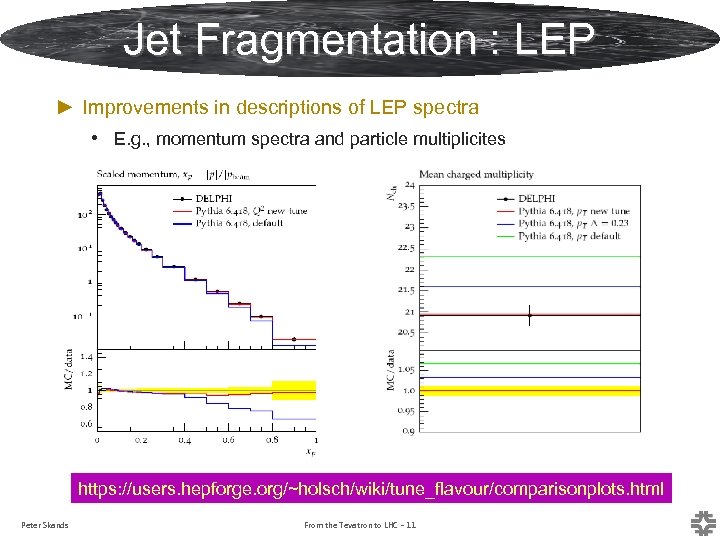
Jet Fragmentation : LEP ► Improvements in descriptions of LEP spectra • E. g. , momentum spectra and particle multiplicites https: //users. hepforge. org/~holsch/wiki/tune_flavour/comparisonplots. html Peter Skands From the Tevatron to LHC - 11
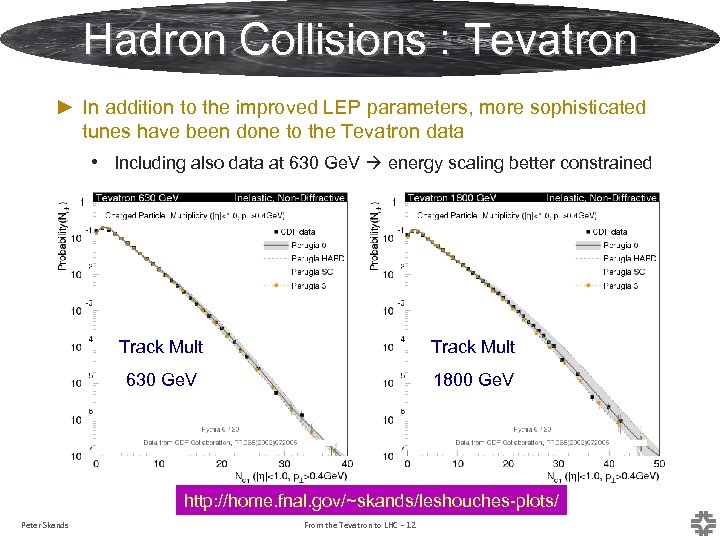
Hadron Collisions : Tevatron ► In addition to the improved LEP parameters, more sophisticated tunes have been done to the Tevatron data • Including also data at 630 Ge. V energy scaling better constrained Track Mult 630 Ge. V 1800 Ge. V http: //home. fnal. gov/~skands/leshouches-plots/ Peter Skands From the Tevatron to LHC - 12
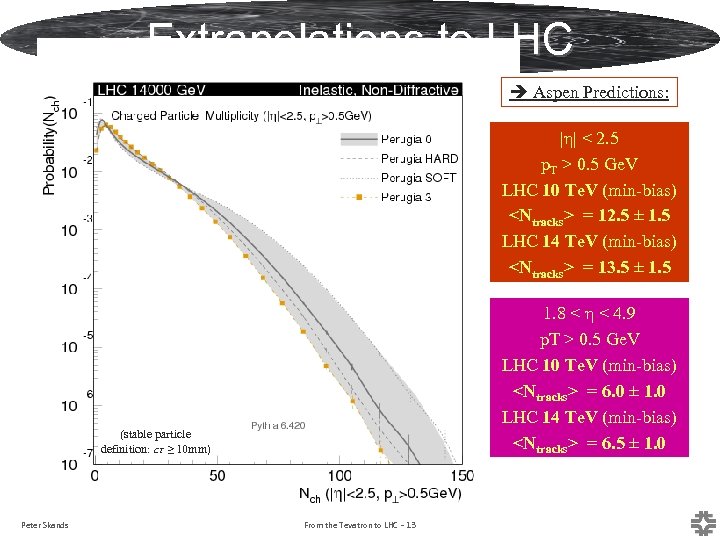
Extrapolations to LHC Aspen Predictions: |η| < 2. 5 p. T > 0. 5 Ge. V LHC 10 Te. V (min-bias) <Ntracks> = 12. 5 ± 1. 5 LHC 14 Te. V (min-bias) <Ntracks> = 13. 5 ± 1. 5 1. 8 < η < 4. 9 p. T > 0. 5 Ge. V LHC 10 Te. V (min-bias) <Ntracks> = 6. 0 ± 1. 0 LHC 14 Te. V (min-bias) <Ntracks> = 6. 5 ± 1. 0 (stable particle definition: cτ ≥ 10 mm) Peter Skands From the Tevatron to LHC - 13
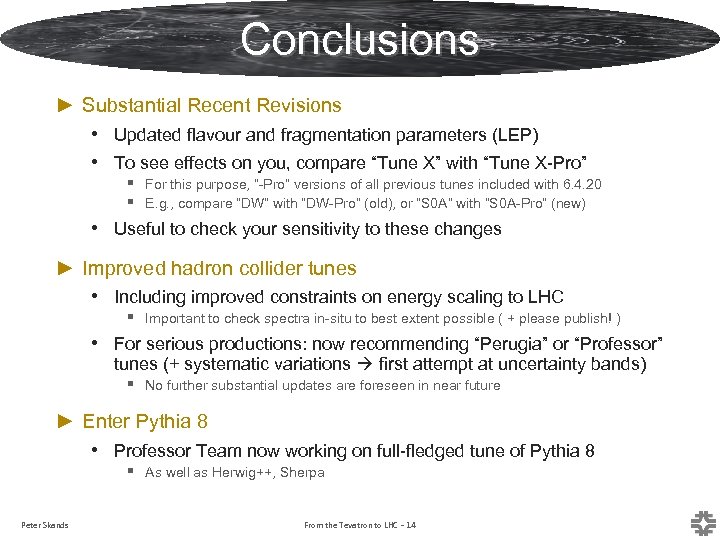
Conclusions ► Substantial Recent Revisions • Updated flavour and fragmentation parameters (LEP) • To see effects on you, compare “Tune X” with “Tune X-Pro” § For this purpose, “-Pro” versions of all previous tunes included with 6. 4. 20 § E. g. , compare “DW” with “DW-Pro” (old), or “S 0 A” with “S 0 A-Pro” (new) • Useful to check your sensitivity to these changes ► Improved hadron collider tunes • Including improved constraints on energy scaling to LHC § Important to check spectra in-situ to best extent possible ( + please publish! ) • For serious productions: now recommending “Perugia” or “Professor” tunes (+ systematic variations first attempt at uncertainty bands) § No further substantial updates are foreseen in near future ► Enter Pythia 8 • Professor Team now working on full-fledged tune of Pythia 8 § As well as Herwig++, Sherpa Peter Skands From the Tevatron to LHC - 14
Скачать презентацию ATLAS H γγ Meeting 20 Mar 2009 New
a95f81468dac85648a021b616afbbf8c.ppt