 Скачать презентацию ATLAS Forward Protons and Trigger Andrew Brandt UT-Arlington
7fe06e89aa29fdaec33bd756d716a509.ppt
- Количество слайдов: 47



ATLAS Forward Protons and Trigger Andrew Brandt (UT-Arlington) • Who am I? B. S. College of William&Mary 1985 PH. D. UCLA/CERN (UA 8 Experiment-discovered hard diffraction) 1992 -1999 Post-doc and Wilson Fellow at Fermilab -Discovered hard color singlet exchange JGJ -1997 PECASE Award for contributions to diffraction -Proposed and built (with collaborators from Brazil) DØ Forward Proton Detector -QCD and Run I Physics Convenor -Trigger Meister, QCDTrigger Board Rep. , Designed Run II Trigger List 1999 -2004 present UTA Assistant Prof 2004 -present Assoc. Prof -OJI, MRI, ARP awards for DØ FPD -2005 started fast timing work (ARP, DOE ADR) -2008 sabbatical on ATLAS • ATLAS Forward Protons • ATLAS Trigger • Miscellaneous related stuff DOE Review Nov. 14, 2008 Arlington, TX
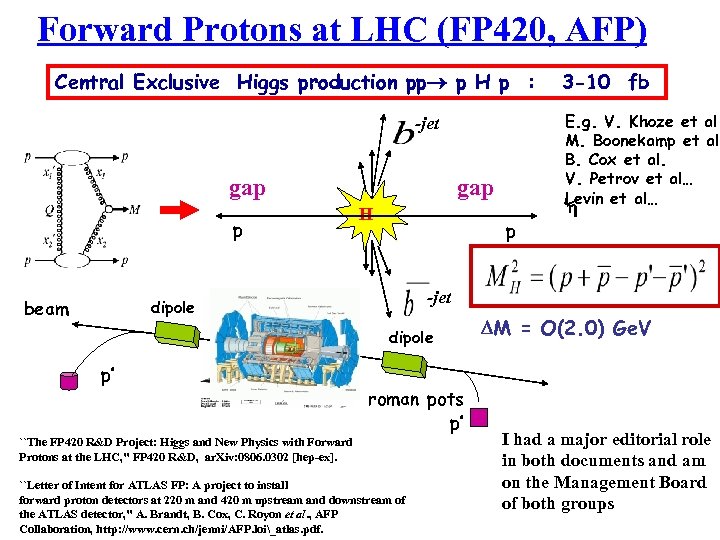
Forward Protons at LHC (FP 420, AFP) Central Exclusive Higgs production pp p H p : E. g. V. Khoze et al M. Boonekamp et al. B. Cox et al. V. Petrov et al… Levin et al… -jet gap p beam gap H p h -jet dipole p’ 3 -10 fb roman pots p’ ``The FP 420 R&D Project: Higgs and New Physics with Forward Protons at the LHC, '' FP 420 R&D, ar. Xiv: 0806. 0302 [hep-ex]. ``Letter of Intent for ATLAS FP: A project to install forward proton detectors at 220 m and 420 m upstream and downstream of the ATLAS detector, '' A. Brandt, B. Cox, C. Royon et al. , AFP Collaboration, http: //www. cern. ch/jenni/AFP. loi_atlas. pdf. M = O(2. 0) Ge. V I had a major editorial role in both documents and am on the Management Board of both groups
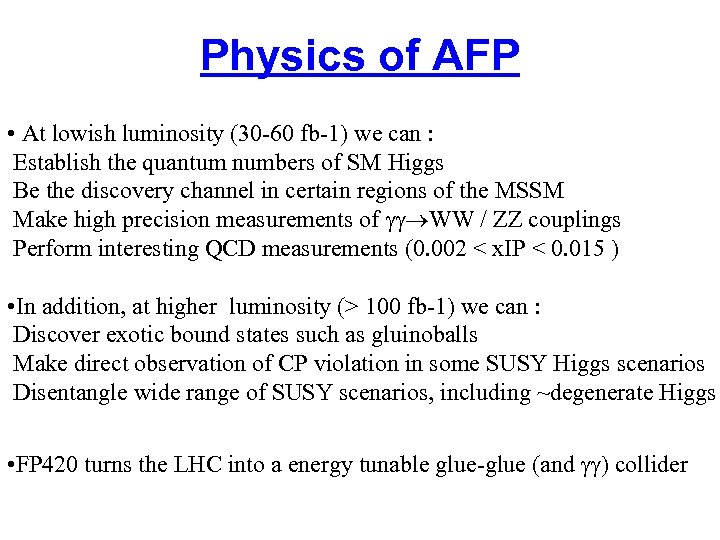
Physics of AFP • At lowish luminosity (30 -60 fb-1) we can : Establish the quantum numbers of SM Higgs Be the discovery channel in certain regions of the MSSM Make high precision measurements of WW / ZZ couplings Perform interesting QCD measurements (0. 002 < x. IP < 0. 015 ) • In addition, at higher luminosity (> 100 fb-1) we can : Discover exotic bound states such as gluinoballs Make direct observation of CP violation in some SUSY Higgs scenarios Disentangle wide range of SUSY scenarios, including ~degenerate Higgs • FP 420 turns the LHC into a energy tunable glue-glue (and ) collider
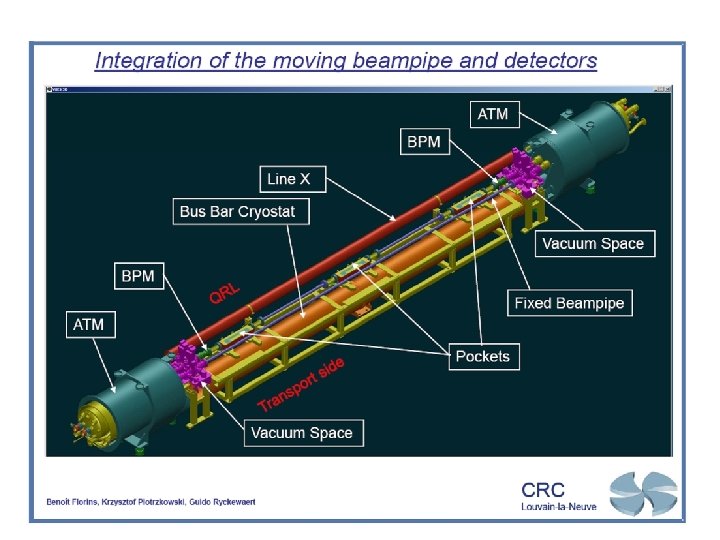
FP 420 Components • Modified Cryostat to create space for detectors and allow detector movement close to the beam • 3 D silicon detector for position measurement (also being developed as a solution for ATLAS upgrade silicon detector due to rad hardness) • Fast TOF counter for pileup rejection
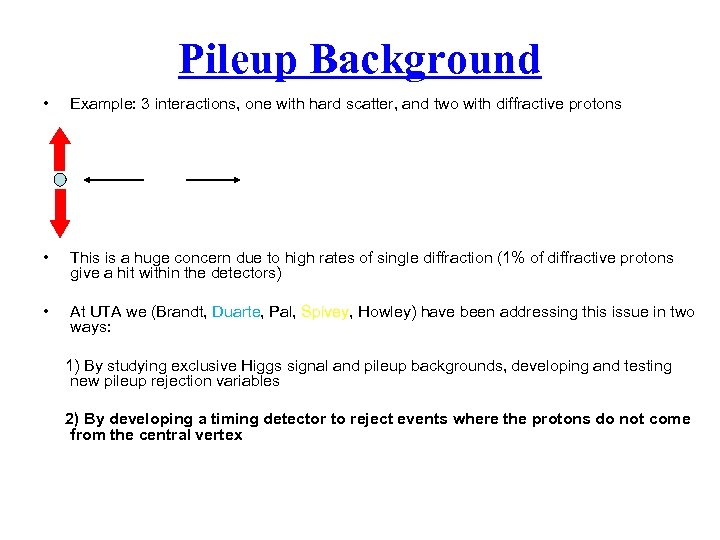
Pileup Background • Example: 3 interactions, one with hard scatter, and two with diffractive protons • This is a huge concern due to high rates of single diffraction (1% of diffractive protons give a hit within the detectors) • At UTA we (Brandt, Duarte, Pal, Spivey, Howley) have been addressing this issue in two ways: 1) By studying exclusive Higgs signal and pileup backgrounds, developing and testing new pileup rejection variables 2) By developing a timing detector to reject events where the protons do not come from the central vertex
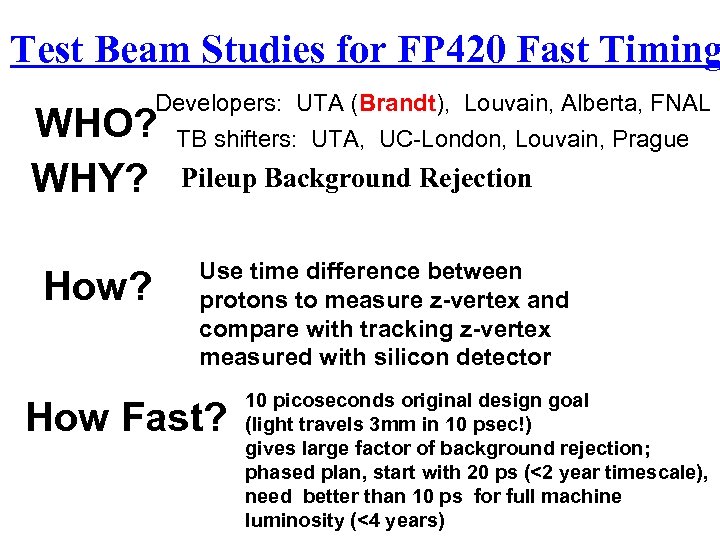
Test Beam Studies for FP 420 Fast Timing Developers: UTA (Brandt), Louvain, Alberta, FNAL TB shifters: UTA, UC-London, Louvain, Prague WHO? WHY? How? Pileup Background Rejection Use time difference between protons to measure z-vertex and compare with tracking z-vertex measured with silicon detector How Fast? 10 picoseconds original design goal (light travels 3 mm in 10 psec!) gives large factor of background rejection; phased plan, start with 20 ps (<2 year timescale), need better than 10 ps for full machine luminosity (<4 years)
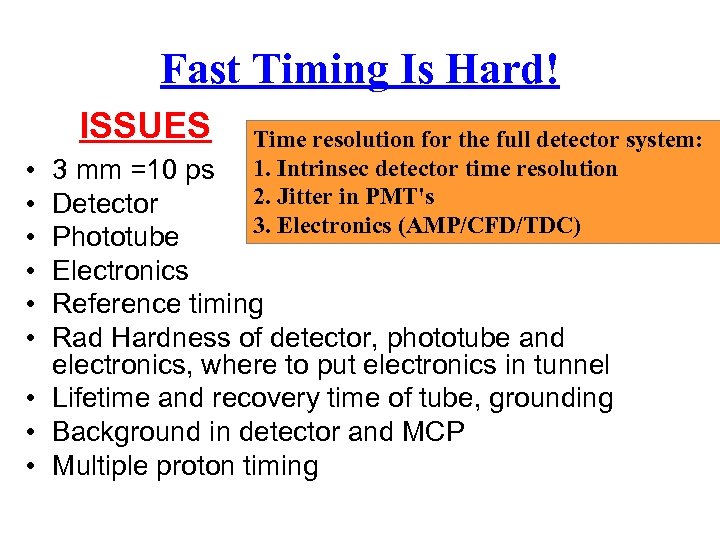
Fast Timing Is Hard! ISSUES • • • Time resolution for the full detector system: 1. Intrinsec detector time resolution 2. Jitter in PMT's 3. Electronics (AMP/CFD/TDC) 3 mm =10 ps Detector Phototube Electronics Reference timing Rad Hardness of detector, phototube and electronics, where to put electronics in tunnel • Lifetime and recovery time of tube, grounding • Background in detector and MCP • Multiple proton timing
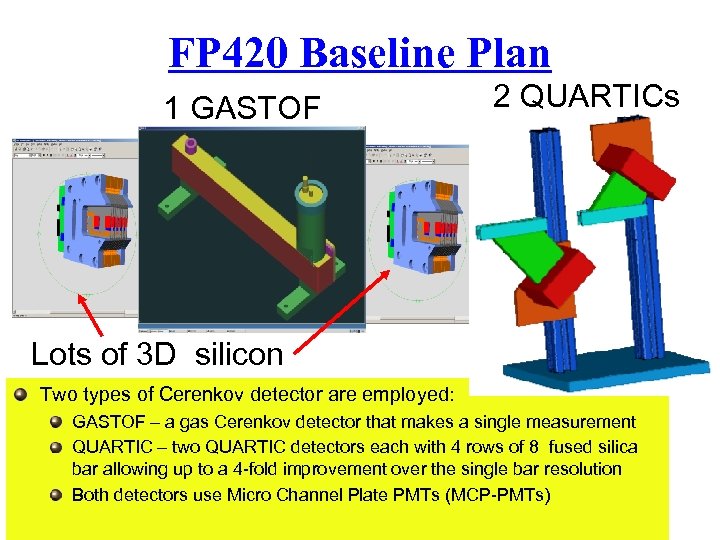
FP 420 Baseline Plan 1 GASTOF 2 QUARTICs Lots of 3 D silicon Two types of Cerenkov detector are employed: GASTOF – a gas Cerenkov detector that makes a single measurement QUARTIC – two QUARTIC detectors each with 4 rows of 8 fused silica bar allowing up to a 4 -fold improvement over the single bar resolution Both detectors use Micro Channel Plate PMTs (MCP-PMTs)
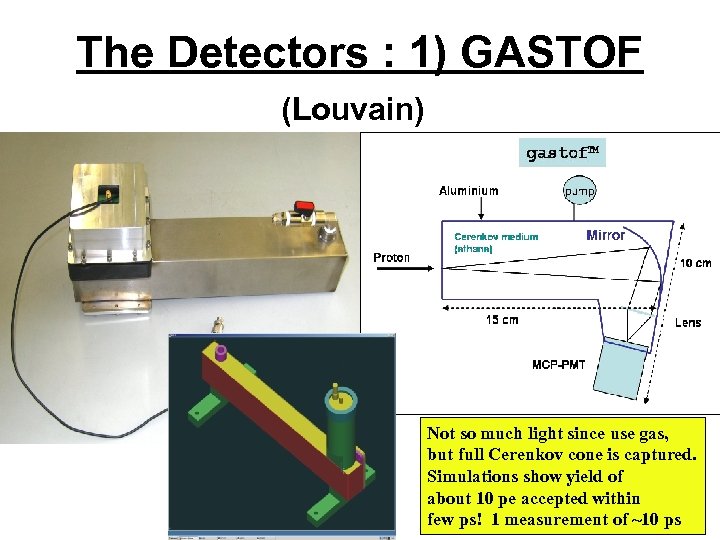
The Detectors : 1) GASTOF (Louvain) Not so much light since use gas, but full Cerenkov cone is captured. Simulations show yield of about 10 pe accepted within few ps! 1 measurement of ~10 ps
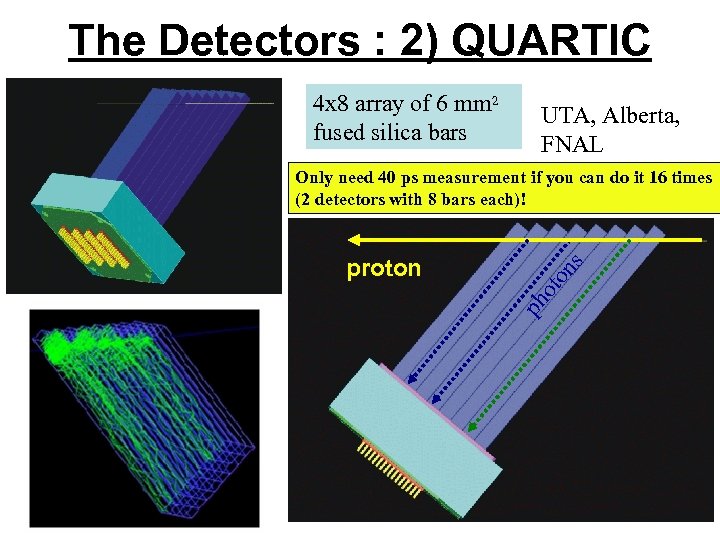
The Detectors : 2) QUARTIC 4 x 8 array of 6 mm 2 fused silica bars UTA, Alberta, FNAL on ot ph proton s Only need 40 ps measurement if you can do it 16 times (2 detectors with 8 bars each)!
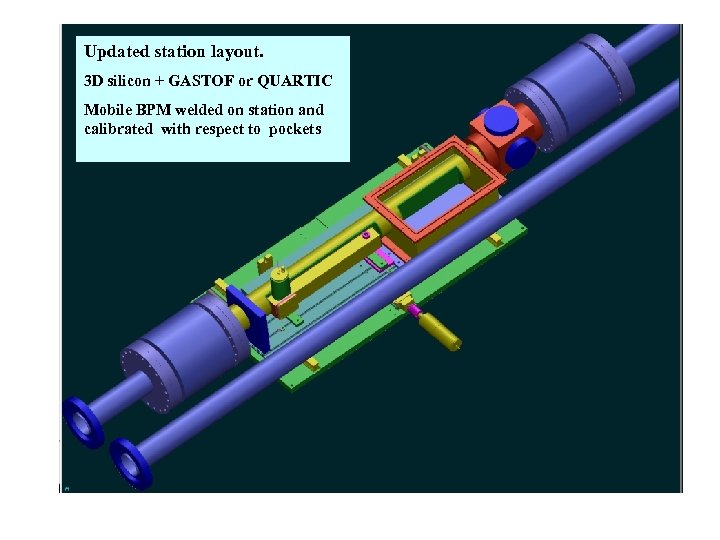
Updated station layout. 3 D silicon + GASTOF or QUARTIC Mobile BPM welded on station and calibrated with respect to pockets
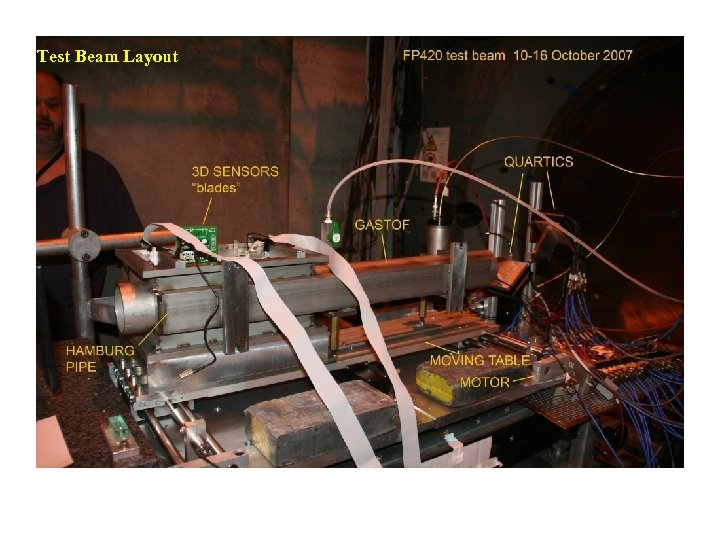
Test Beam Layout
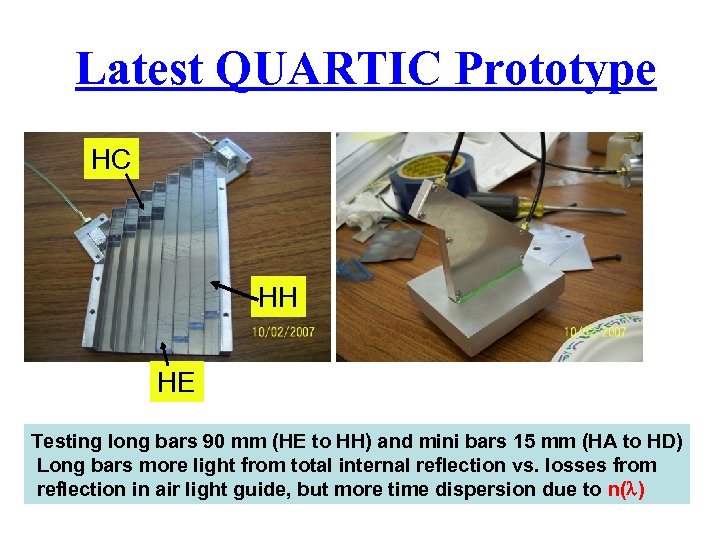
Latest QUARTIC Prototype HC HH HE Testing long bars 90 mm (HE to HH) and mini bars 15 mm (HA to HD) Long bars more light from total internal reflection vs. losses from reflection in air light guide, but more time dispersion due to n( )
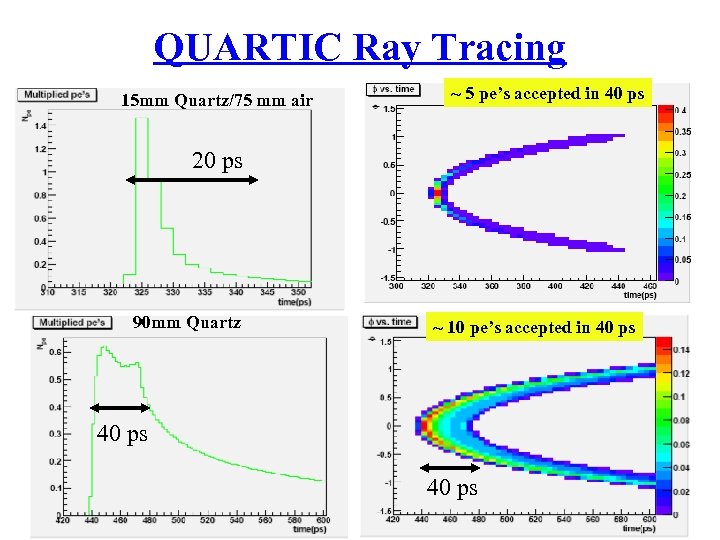
QUARTIC Ray Tracing 15 mm Quartz/75 mm air ~ 5 pe’s accepted in 40 ps 20 ps 90 mm Quartz ~ 10 pe’s accepted in 40 ps
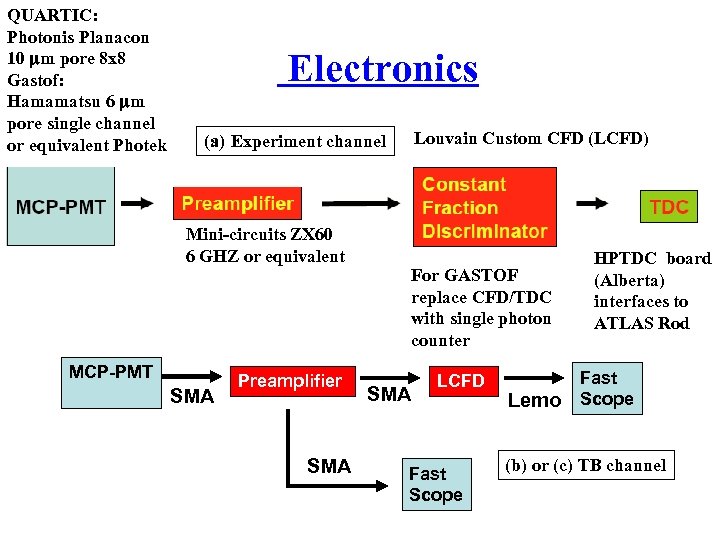
QUARTIC: Photonis Planacon 10 m pore 8 x 8 Gastof: Hamamatsu 6 m pore single channel or equivalent Photek Electronics Louvain Custom CFD (LCFD) (a) Experiment channel Mini-circuits ZX 60 6 GHZ or equivalent MCP-PMT SMA Preamplifier SMA For GASTOF replace CFD/TDC with single photon counter SMA LCFD Fast Scope Lemo HPTDC board (Alberta) interfaces to ATLAS Rod Fast Scope (b) or (c) TB channel
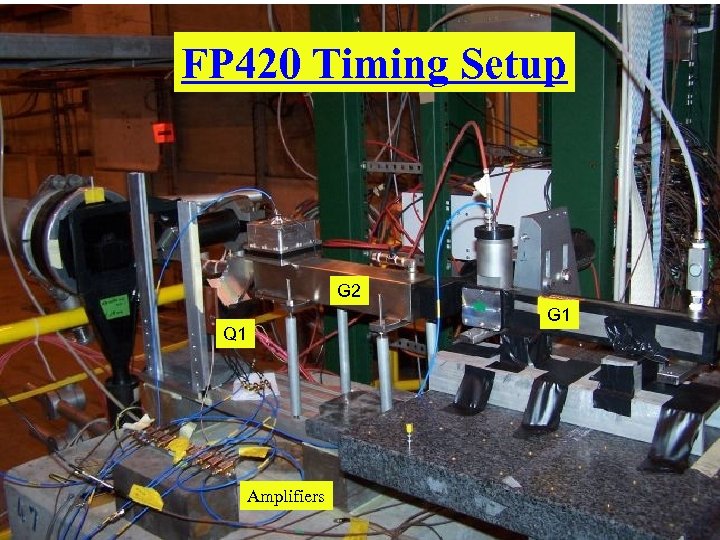
FP 420 Timing Setup G 2 G 1 Q 1 Amplifiers
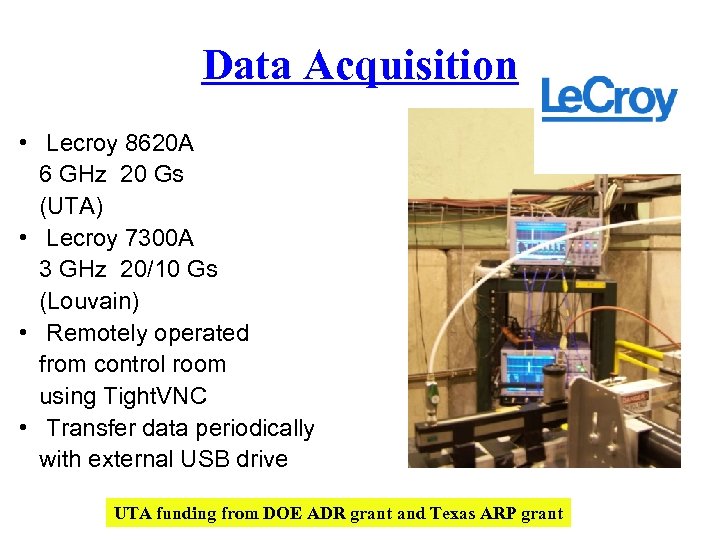
Data Acquisition • Lecroy 8620 A 6 GHz 20 Gs (UTA) • Lecroy 7300 A 3 GHz 20/10 Gs (Louvain) • Remotely operated from control room using Tight. VNC • Transfer data periodically with external USB drive UTA funding from DOE ADR grant and Texas ARP grant
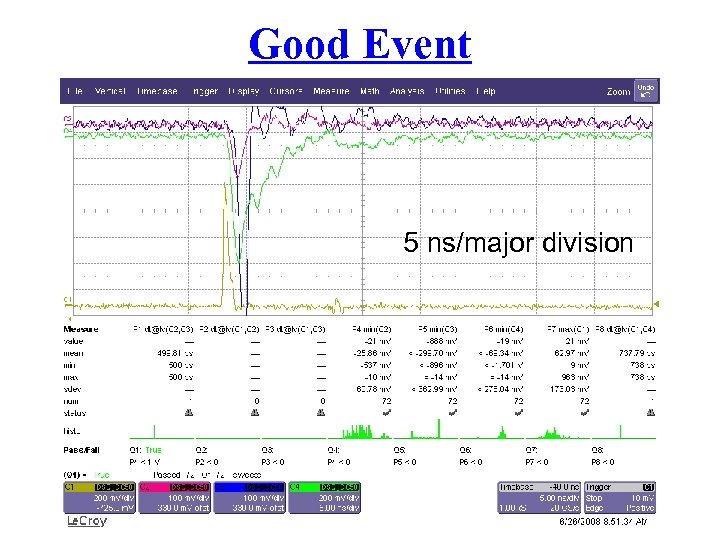
Good Event 5 ns/major division
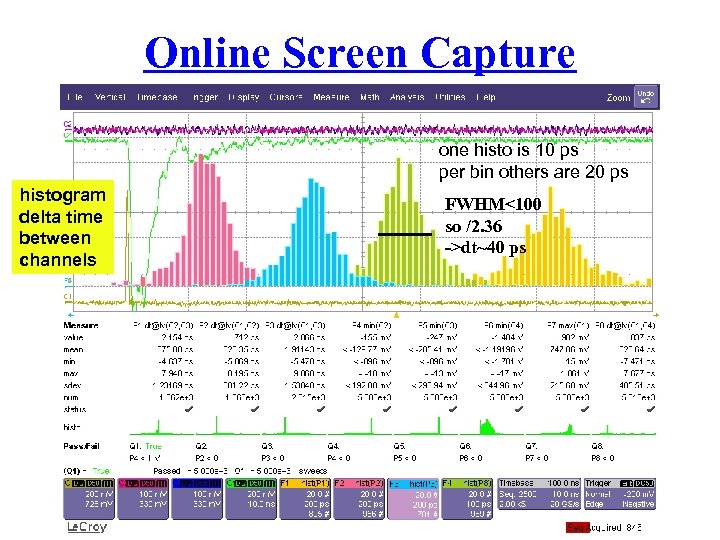
Online Screen Capture one histo is 10 ps per bin others are 20 ps histogram delta time between channels FWHM<100 so /2. 36 ->dt~40 ps
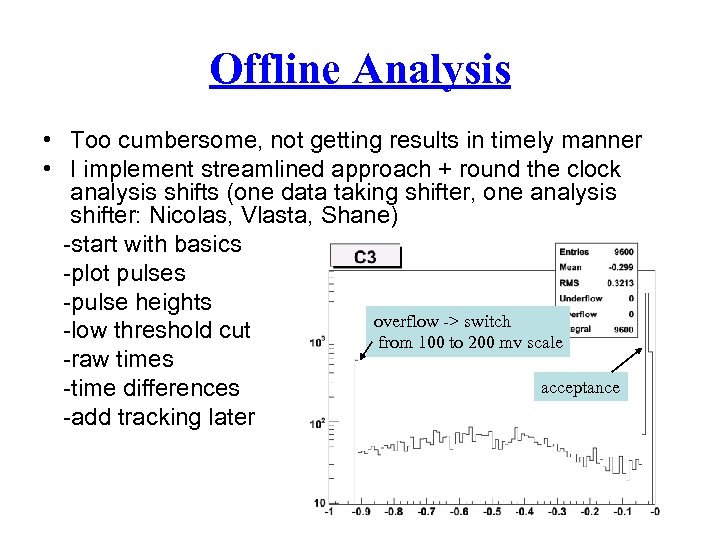
Offline Analysis • Too cumbersome, not getting results in timely manner • I implement streamlined approach + round the clock analysis shifts (one data taking shifter, one analysis shifter: Nicolas, Vlasta, Shane) -start with basics -plot pulses -pulse heights overflow -> switch -low threshold cut from 100 to 200 mv scale -raw times acceptance -time differences -add tracking later
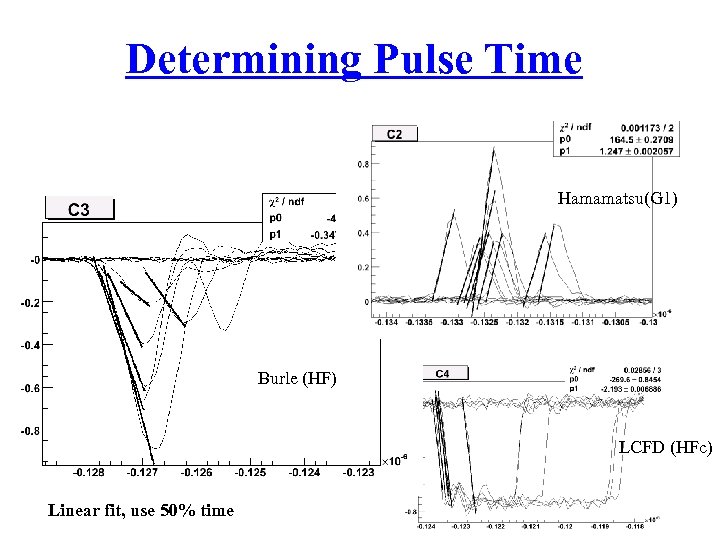
Determining Pulse Time Hamamatsu(G 1) Burle (HF) LCFD (HFc) Linear fit, use 50% time
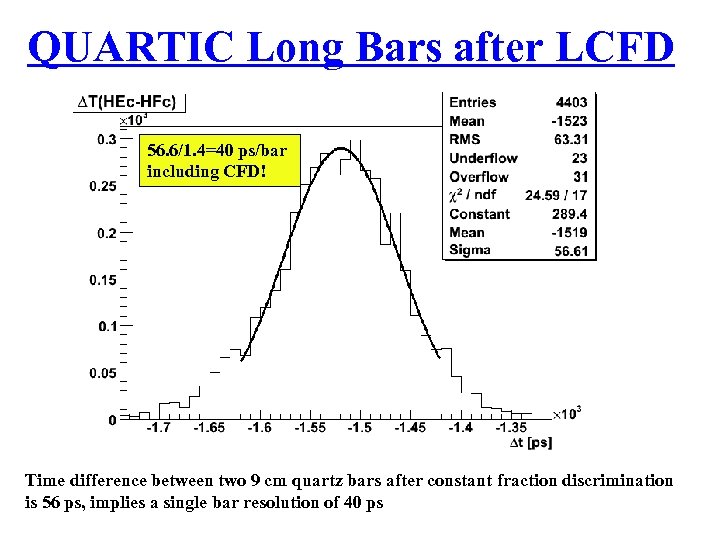
QUARTIC Long Bars after LCFD 56. 6/1. 4=40 ps/bar including CFD! Dt Time difference between two 9 cm quartz bars after constant fraction discrimination is 56 ps, implies a single bar resolution of 40 ps
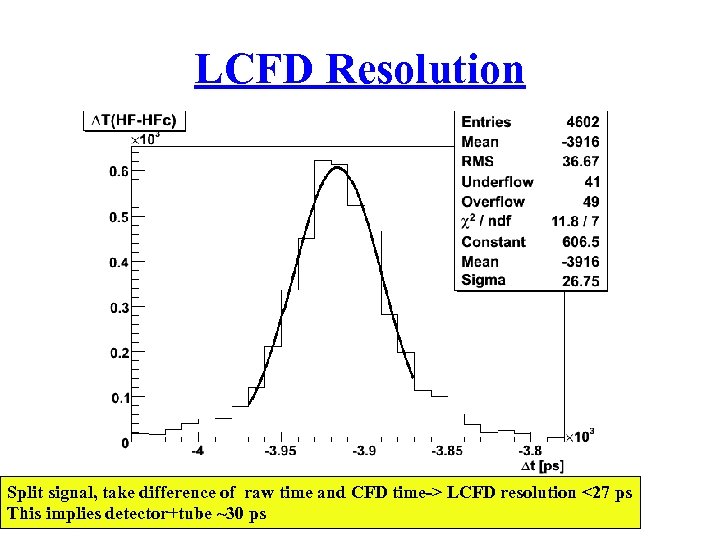
LCFD Resolution Split signal, take difference of raw time and CFD time-> LCFD resolution <27 ps This implies detector+tube ~30 ps
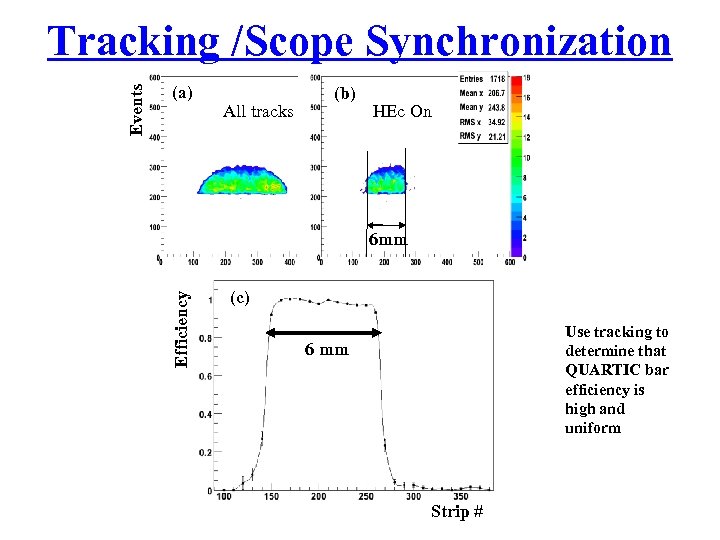
(a) All tracks (b) HEc On 6 mm Efficiency Events Tracking /Scope Synchronization (c) Use tracking to determine that QUARTIC bar efficiency is high and uniform 6 mm Strip #
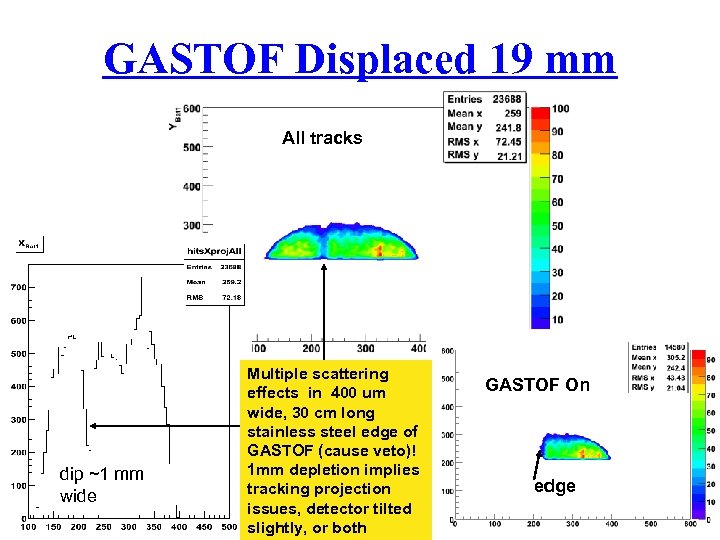
GASTOF Displaced 19 mm All tracks dip ~1 mm wide Multiple scattering effects in 400 um wide, 30 cm long stainless steel edge of GASTOF (cause veto)! 1 mm depletion implies tracking projection issues, detector tilted slightly, or both GASTOF On edge
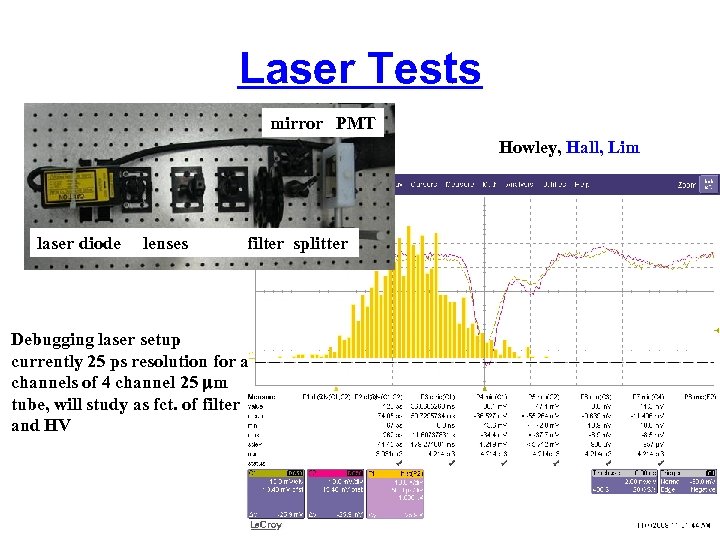
Laser Tests mirror PMT Howley, Hall, Lim laser diode lenses filter splitter Debugging laser setup currently 25 ps resolution for a channels of 4 channel 25 m tube, will study as fct. of filter and HV
ATLAS Forward Proton Summary and Outlook • June TB two weeks of running, tremendous effort • 100+Gb of scope data, sizable fraction synchronized with tracking from Bonn telescope • Demonstrated good data, now finalizing results, plan to write a paper this year • LOI submitted to ATLAS in September • Will need more laser tests, simulation and test beam before design is finalized • Plan to continue tests and help secure ATLAS approval of LOI, build U. S. ATLAS collaboration for Phase 1+2 funding
Sabbatical/Trigger • Major emphasis of Sabbatical was to start new UTA effort on ATLAS trigger (with Sarkisyan+Pal) • Organized Trigger Robustness Workshop • CSC chapter editor • Forward jet commissioning • Minbias Trigger Validation + Low PT tracking • Dijet trigger rates • Diffractive triggers • Chair Trigger Rates group, added to Trigger Coordination Group (continuing responsibility) • Many talks in menu+jet meeting, SM talk, 2 plenary talks, joined Tdaq
Trigger Robustness Workshop was held March 4, 2008 at CERN organized by: Andrew Brandt (UT-Arlington) Ricardo Goncalo (Royal Holloway) Goals: 1) Evaluate ability of trigger system to cope with readout, detector, and beam related problems 2) Generate list of problems and a strategy to address them Successful one day workshop with 25 short talks and lots of discussion Agenda: http: //indico. cern. ch/conference. Other. Views. py? view=standard&conf. Id=29007 Robustness twiki to document progress and follow-up: https: //twiki. cern. ch/twiki/bin/view/Atlas/Trigger. Robustness
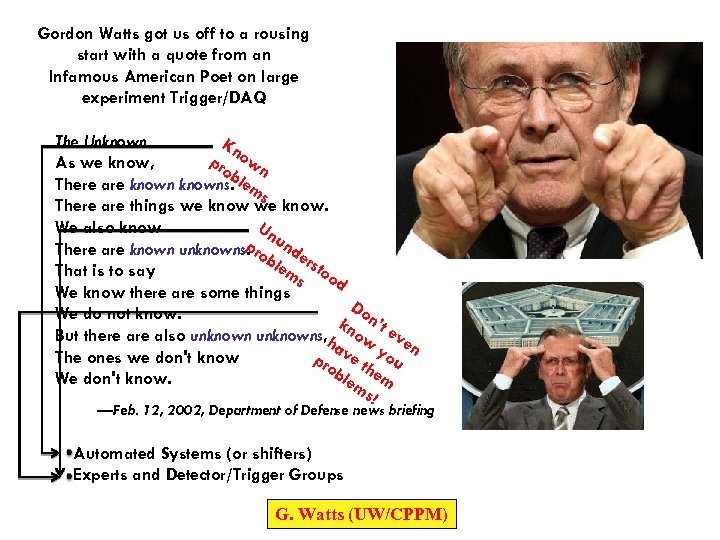
Gordon Watts got us off to a rousing start with a quote from an Infamous American Poet on large experiment Trigger/DAQ The Unknown Kn pro own As we know, b There are knowns. lem s There are things we know. Un We also know p u There are known unknowns. rob nde lem rsto That is to say s od We know there are some things Do We do not know. kn n’t e But there also unknowns, h ow ve a n The ones we don't know pro ve t you ble hem We don't know. ms ! —Feb. 12, 2002, Department of Defense news briefing Automated Systems (or shifters) Experts and Detector/Trigger Groups G. Watts (UW/CPPM)
Beam-related Background • Result: Several slices (muon, MET, jet) showed insensitivity to beam backgrounds using halo (from scattering off tertiary collimator) and beam gas events generated by Alden Stradling (Wisc. /UTA). -Halo events provide low p. T muons but these did not tend to give triggers. Absolute beam gas rates are expected to be very low. -The level of impact on the trigger was consistent with noise in the detector, such that if jet thresholds are at least 10 Ge. V and MET thresholds at least 25 Ge. V, then very little impact on trigger is expected, even if backgrounds were to be much worse than anticipated. -Provided important information to ATLAS beam background WG (of which I was a member) • Follow-up: Encouraging results indicate that beam backgrounds are not likely to be a serious issue for trigger, nevertheless HLT algorithms to recognize unphysical patterns of energy deposition are being developed, should the rates turn out to be unexpectedly large. Generation of larger and more complete data samples should be pursued.
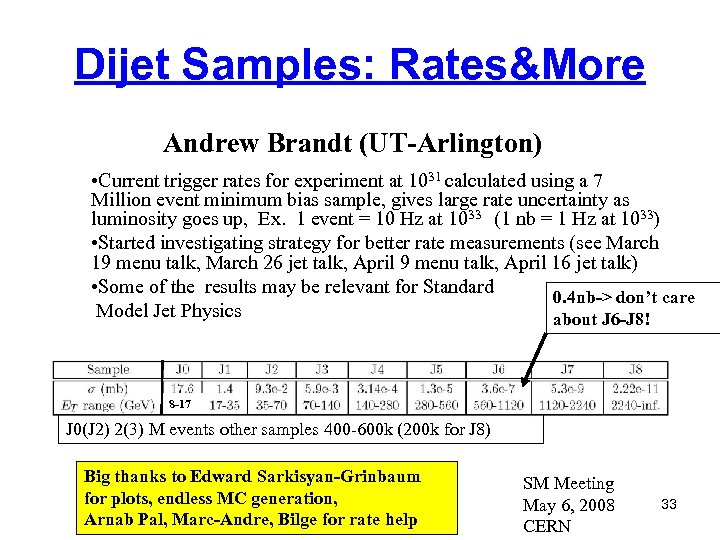
Dijet Samples: Rates&More Andrew Brandt (UT-Arlington) • Current trigger rates for experiment at 1031 calculated using a 7 Million event minimum bias sample, gives large rate uncertainty as luminosity goes up, Ex. 1 event = 10 Hz at 1033 (1 nb = 1 Hz at 1033) • Started investigating strategy for better rate measurements (see March 19 menu talk, March 26 jet talk, April 9 menu talk, April 16 jet talk) • Some of the results may be relevant for Standard 0. 4 nb-> don’t care Model Jet Physics about J 6 -J 8! 8 -17 J 0(J 2) 2(3) M events other samples 400 -600 k (200 k for J 8) Big thanks to Edward Sarkisyan-Grinbaum for plots, endless MC generation, Arnab Pal, Marc-Andre, Bilge for rate help SM Meeting May 6, 2008 CERN 33
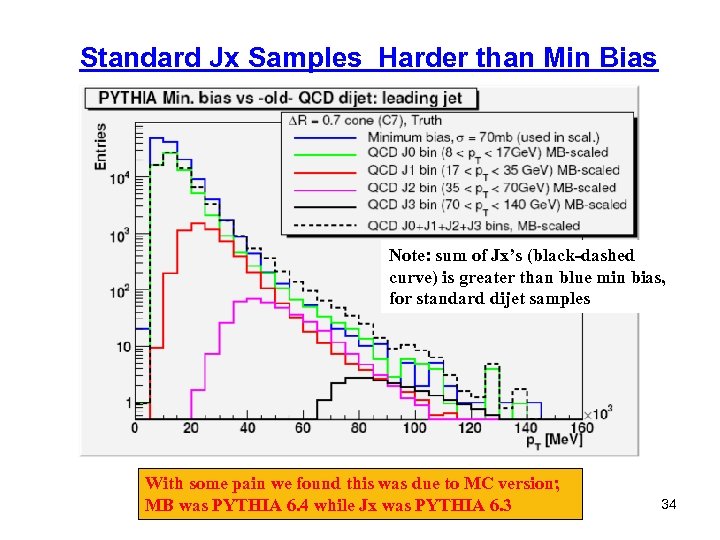
Standard Jx Samples Harder than Min Bias Reco Note: sum of Jx’s (black-dashed curve) is greater than blue min bias, for standard dijet samples Truth With some pain we found this was due to MC version; MB was PYTHIA 6. 4 while Jx was PYTHIA 6. 3 34
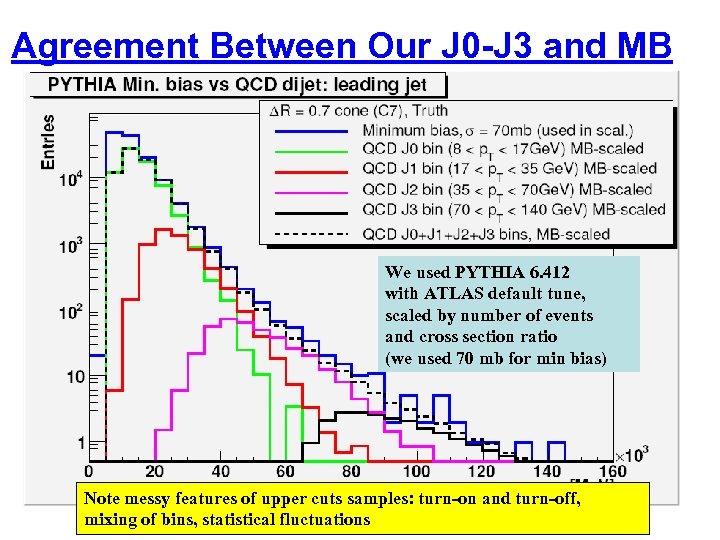
Agreement Between Our J 0 -J 3 and MB We used PYTHIA 6. 412 with ATLAS default tune, scaled by number of events and cross section ratio (we used 70 mb for min bias) Note messy features of upper cuts samples: turn-on and turn-off, mixing of bins, statistical fluctuations 35
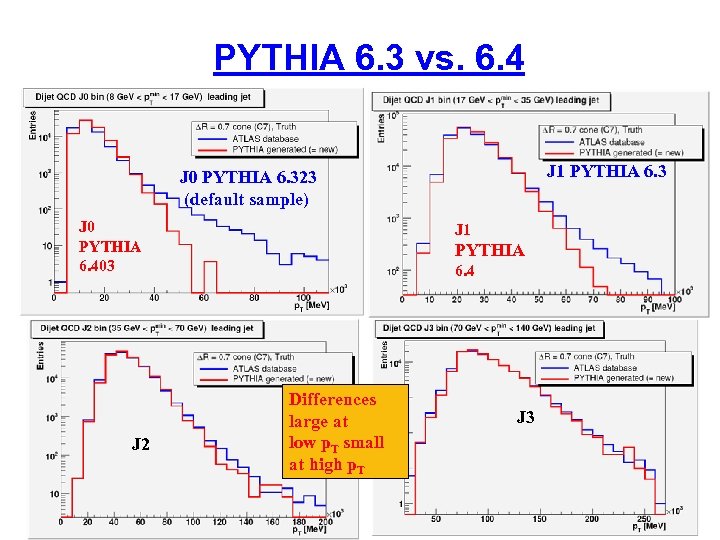
PYTHIA 6. 3 vs. 6. 4 J 1 PYTHIA 6. 3 J 0 PYTHIA 6. 323 (default sample) J 0 PYTHIA 6. 403 J 2 J 1 PYTHIA 6. 4 Differences large at low p. T small at high p. T J 3 36
PYTIA 6. 3 vs. 6. 4 Difference • “Weird” events at high p. T of PYTHIA 6. 3 samples apparently due to new shower model which showers to beam energy cutoff scale instead of hard parton scale. This effect occurs in all bins, but causes most significant problems in low p. T bins since these bins have a big weighting factor and the effects are relatively much more significant for low parton p. T • Although it is not guaranteed that PYTHIA 6. 4 is more correct than 6. 3, it is now the default to have less showering and it seems to make better physics sense (see rates) 37
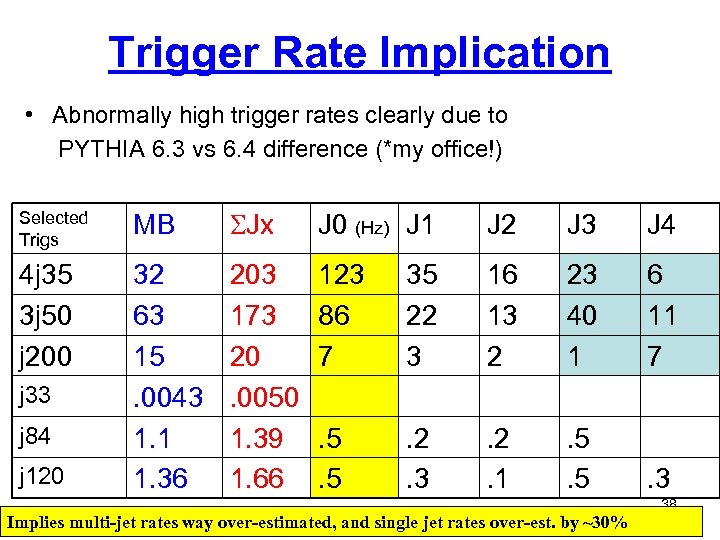
Trigger Rate Implication • Abnormally high trigger rates clearly due to PYTHIA 6. 3 vs 6. 4 difference (*my office!) Selected Trigs MB Jx J 0 (Hz) J 1 J 2 J 3 J 4 4 j 35 3 j 50 j 200 32 63 15. 0043 1. 1 1. 36 203 173 20. 0050 1. 39 1. 66 123 86 7 35 22 3 16 13 2 23 40 1 6 11 7 . 5. 5 . 2. 3 . 2. 1 . 5. 5 . 3 j 33 j 84 j 120 Implies multi-jet rates way over-estimated, and single jet rates over-est. by ~30% 38
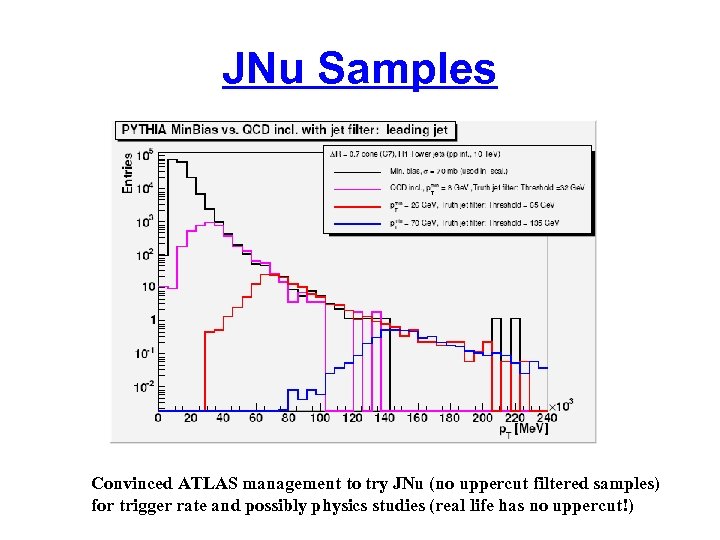
JNu Samples Convinced ATLAS management to try JNu (no uppercut filtered samples) for trigger rate and possibly physics studies (real life has no uppercut!)
Low-p. T Tracking Performance Edward Sarkisyan-Grinbaum (UTA) • ATLAS Performance and Physics Workshop (Nov. 5 -7, 2008) • Tracking Session & Standard Model Meeting • http: //indico. cern. ch/conference. Display. py? conf. Id=41483 • A key ingredient of basic (very) early measurements • Physics interests: early QCD, minbias, diffraction, gaps, jets… • Critical for understanding underlying events, pile-up, precise measurements background • Practical interest: detector, SW comissioning, tuning models
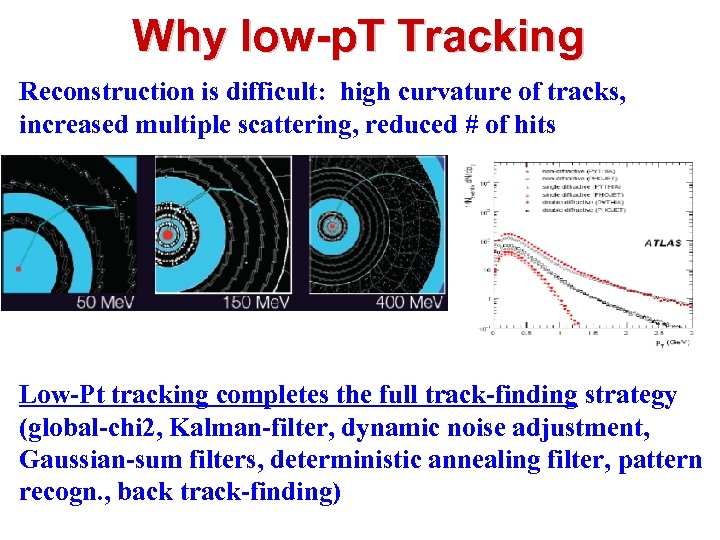
Why low-p. T Tracking Reconstruction is difficult: high curvature of tracks, increased multiple scattering, reduced # of hits Low-Pt tracking completes the full track-finding strategy (global-chi 2, Kalman-filter, dynamic noise adjustment, Gaussian-sum filters, deterministic annealing filter, pattern recogn. , back track-finding)
Subset of Edward’s Current Activity • Efficiency and fake rates studies based on truth matching • Comparison of different physics processes such as Minbias - SD - DD • Studying hits in different tracking sub-detectors • Rerunning GEANT 4 simulations with lower thresholds • Studies to look for secondaries that might be mistaken as primaries (vertex, impact parameter studies) • Minbias Validation • Min bias and gap physics
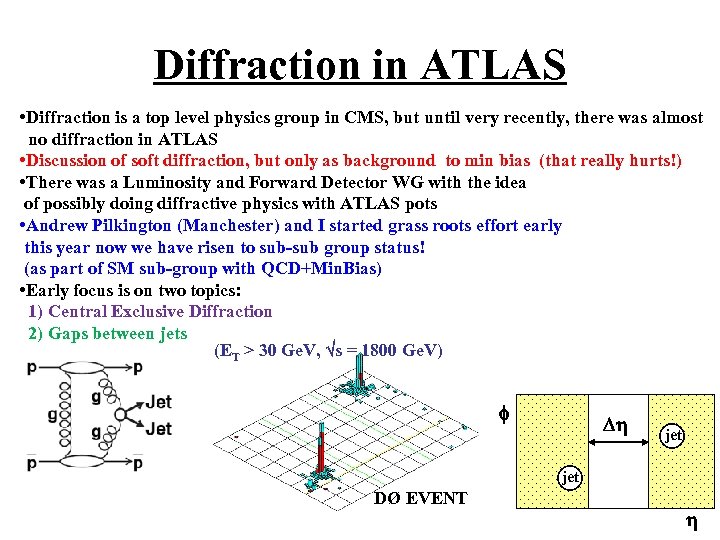
Diffraction in ATLAS • Diffraction is a top level physics group in CMS, but until very recently, there was almost no diffraction in ATLAS • Discussion of soft diffraction, but only as background to min bias (that really hurts!) • There was a Luminosity and Forward Detector WG with the idea of possibly doing diffractive physics with ATLAS pots • Andrew Pilkington (Manchester) and I started grass roots effort early this year now we have risen to sub-sub group status! (as part of SM sub-group with QCD+Min. Bias) • Early focus is on two topics: 1) Central Exclusive Diffraction 2) Gaps between jets (ET > 30 Ge. V, s = 1800 Ge. V) f h jet DØ EVENT 43 h
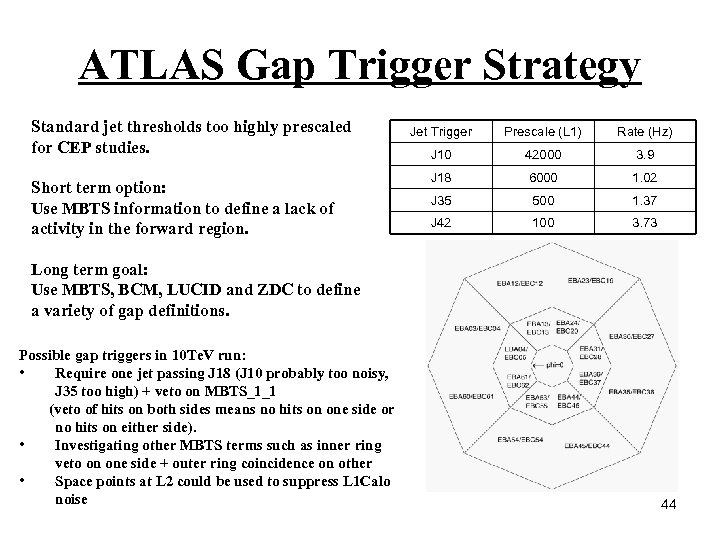
ATLAS Gap Trigger Strategy Standard jet thresholds too highly prescaled for CEP studies. Short term option: Use MBTS information to define a lack of activity in the forward region. Jet Trigger Prescale (L 1) Rate (Hz) J 10 42000 3. 9 J 18 6000 1. 02 J 35 500 1. 37 J 42 100 3. 73 Long term goal: Use MBTS, BCM, LUCID and ZDC to define a variety of gap definitions. Possible gap triggers in 10 Te. V run: • Require one jet passing J 18 (J 10 probably too noisy, J 35 too high) + veto on MBTS_1_1 (veto of hits on both sides means no hits on one side or no hits on either side). • Investigating other MBTS terms such as inner ring veto on one side + outer ring coincidence on other • Space points at L 2 could be used to suppress L 1 Calo noise 44
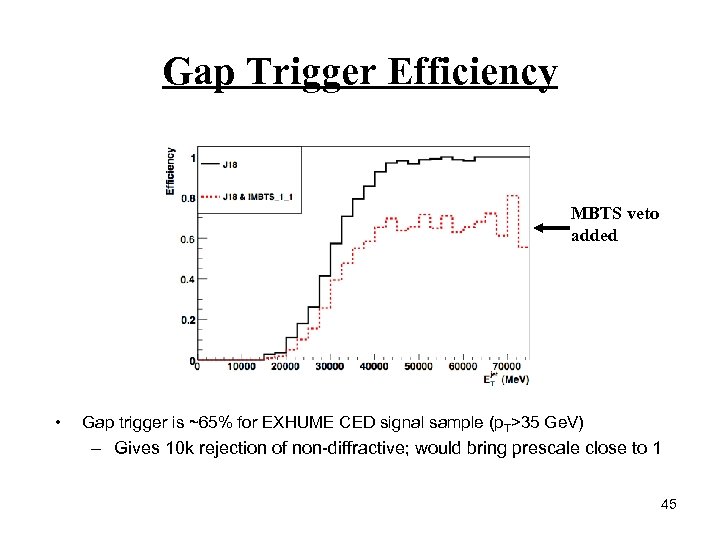
Gap Trigger Efficiency MBTS veto added • Gap trigger is ~65% for EXHUME CED signal sample (p. T>35 Ge. V) – Gives 10 k rejection of non-diffractive; would bring prescale close to 1 45
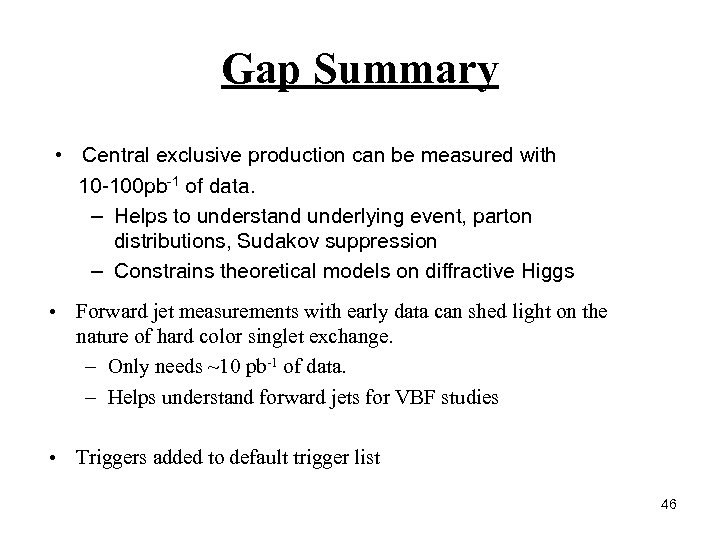
Gap Summary • Central exclusive production can be measured with 10 -100 pb-1 of data. – Helps to understand underlying event, parton distributions, Sudakov suppression – Constrains theoretical models on diffractive Higgs • Forward jet measurements with early data can shed light on the nature of hard color singlet exchange. – Only needs ~10 pb-1 of data. – Helps understand forward jets for VBF studies • Triggers added to default trigger list 46
ATLAS Activities Summary/Outlook • With excellent support from DOE and UTA, I had a very successful sabbatical opening up new trigger areas, some of which I will continue in coming year (especially trigger rates) • Edward also got fully integrated (joined UTA in Feb. ) • Plan to continue with AFP studies and approval • Will pursue project funds for trigger work • Need adequate travel support to allow four trips to CERN + one month in summer to maintain effectiveness in ATLAS
Скачать презентацию ATLAS Forward Protons and Trigger Andrew Brandt UT-Arlington
7fe06e89aa29fdaec33bd756d716a509.ppt