


 Скачать презентацию Atlantic Slop Consortium All-Hands Meeting Harpers Ferry WV
98e81f014e34c07f71fdd3ae6f04bbd9.ppt
- Количество слайдов: 22
 Atlantic Slop Consortium: All-Hands Meeting Harpers Ferry, WV 15 -17 September 2004 Analytical Needs What is Available What is Needed G. P. Patil
 Overall Goals and Objectives Barbara Levinson International Journal of Remote Sensing Special Issue on Remote Sensing and GIS for Ecosystem Analysis n n n EPA ORD Ecosystem Protection Program Provide scientific understanding to measure, model, maintain, and/or restore, at multiple scales, the integrity and sustainability of highly valued ecosystem now and in the future EPA STAR Ea. GLe Program Develop new widely applicable indicators of integrity and sustainability for specific ecological entities and then test their applicability across regions Incorporation of these indicators into long-term monitoring programs is the desired outcome. Penn State Cooperative Wetlands Center
 Barbara Levinson – Continued n n Develop indicators/ procedures useful for evaluating the health/condition for important coastal natural resources, e. g. , lakes, streams, coastal wetlands, etc. Develop indicators, indices, procedures for evaluating the integrated condition of multiple resources/ ecosystem types, e. g. , bird community index reflecting the combined terrestrial and aquatic community within a watershed Develop landscape measures that characterize landscape attributes and serve as quantitative indicators of a range of environmental endpoints, such as, water quality or watershed quality. Develop nested suites of indicators that can both quantify the health/ condition of a resource and identify its primary stressors across a range of scales Penn State Cooperative Wetlands Center
 Atlantic Slope Consortium: A Vision Statement Robert Brooks And Denice Wardrop n Using a universe of watersheds, covering a range of social choices, we ask two questions: · · n How “good” can the environment be, given those social choices? What is the intellectual model of condition within those choices, i. e. , what are the causes of condition and what are the steps for improvement? Accomplish within the group dynamics spirit of : form, storm, reform, norm, perform, and inform (Kent Thornton). Penn State Cooperative Wetlands Center
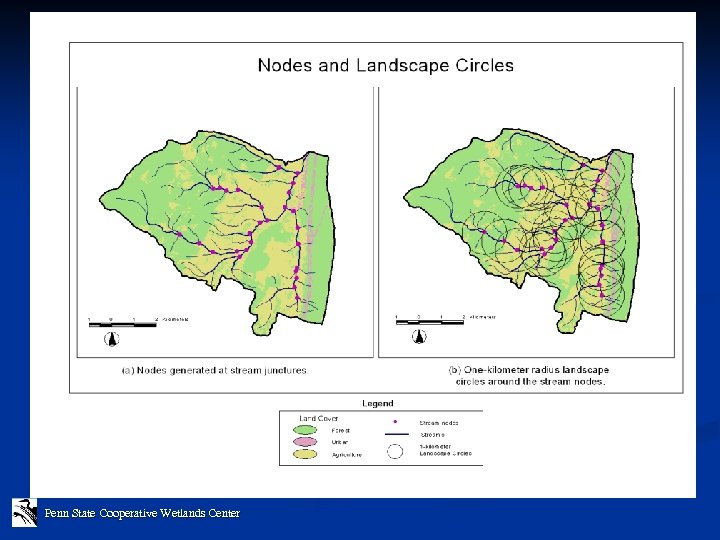
 The Concept of Nodes A circle with landscape properties attributable to a point n Where? At stream convergences n Incorporates description of stream complexity n More circles in areas of complex drainage n Penn State Cooperative Wetlands Center
 Penn State Cooperative Wetlands Center
 Use of Landscape and Land Use Parameters for Classification and Characterization of Watersheds in the Mid-Atlantic across Five Physiographic Provinces D. H. Wardrop, J. A. Bishop, G. P. Patil, W. Myers, M. Easterling, and R. P. Brooks
 Penn State Cooperative Wetlands Center
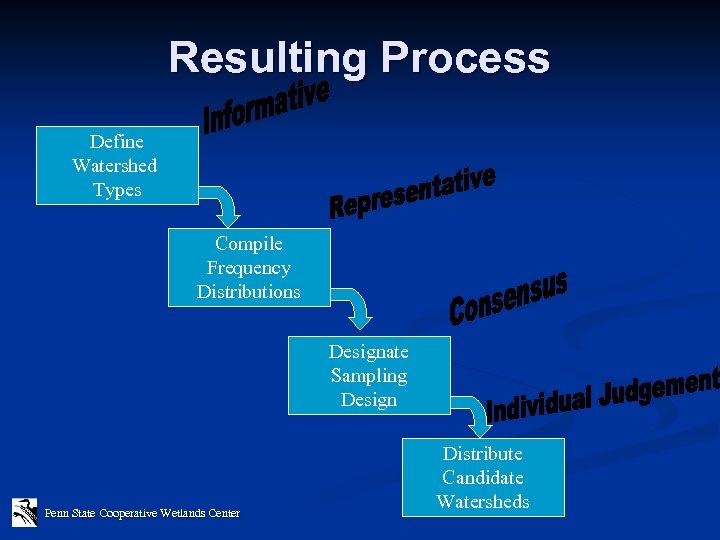 Resulting Process Define Watershed Types Compile Frequency Distributions Designate Sampling Design Penn State Cooperative Wetlands Center Distribute Candidate Watersheds
 Penn State Cooperative Wetlands Center
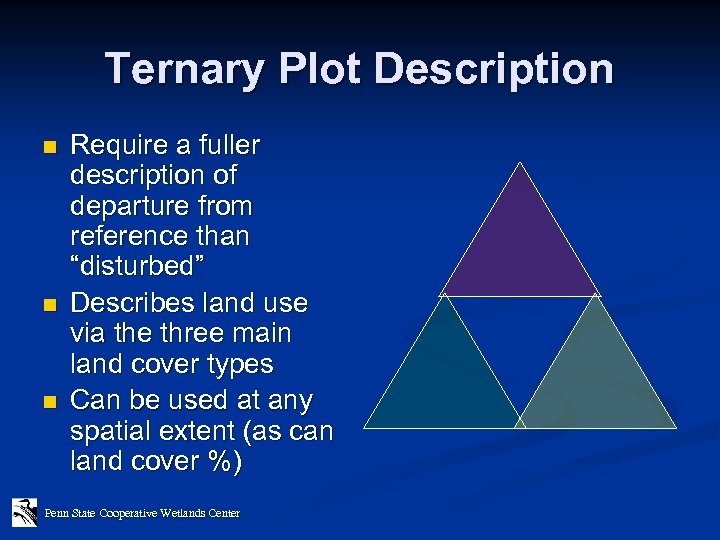 Ternary Plot Description n Require a fuller description of departure from reference than “disturbed” Describes land use via the three main land cover types Can be used at any spatial extent (as can land cover %) Penn State Cooperative Wetlands Center
 Penn State Cooperative Wetlands Center
 Nodal Constellations and Variance Many ways to be a “moderately” disturbed watershed n Addresses disparity of land covers within a watershed; effective distances may be different n Scaling issues can be explored at a future date n Penn State Cooperative Wetlands Center
 Median Slope n n n Rough indicator of connection between land use and aquatic resources Surrogate for ability to produce stress; e. g. , steep slopes have more rapid runoff, minimal contact time for remediation and/or impact Forested watersheds occur on both steep and low slopes, changing amount of stress produced, as well as susceptibility to regional stressors (e. g. , atmospheric deposition) Penn State Cooperative Wetlands Center
 Factors for Classifying Watersheds % Land use (forested, agricultural, urban) in HUC 14 watershed n % Land use (forested, agricultural, urban) in 1 -km radius node n Nodal variance n Median slope n Penn State Cooperative Wetlands Center
 Clustering Analysis should follow vision statement n Clustered first on land uses (social choices) and slope (susceptibility of resource to land use) n “Binned” on research question (many ways to be a mixed watershed) n Other “binning” possible n Penn State Cooperative Wetlands Center
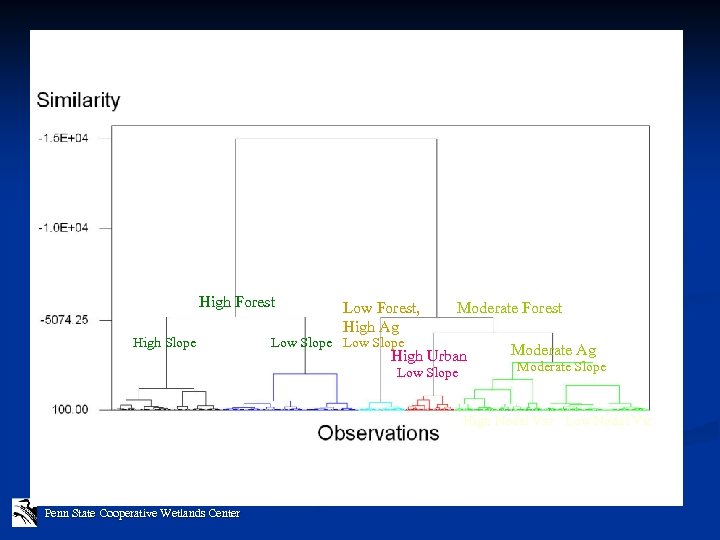 High Forest High Slope Low Forest, High Ag Moderate Forest Low Slope High Urban Low Slope Moderate Ag Moderate Slope High Nodal Var Low Nodal Var Penn State Cooperative Wetlands Center
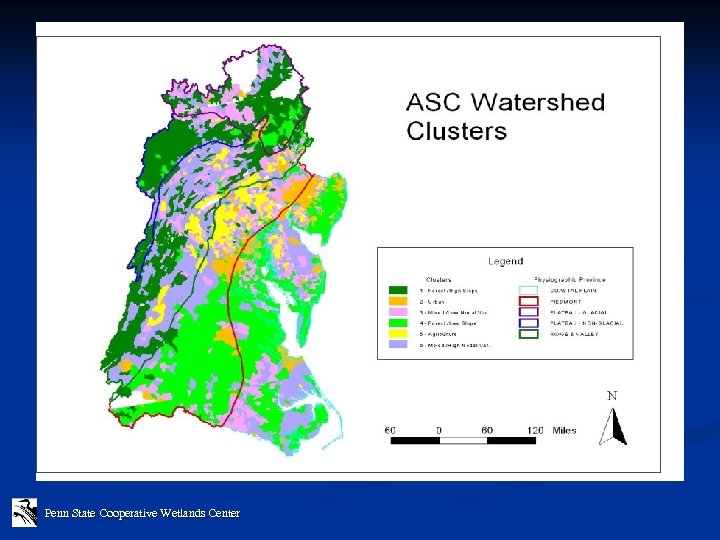
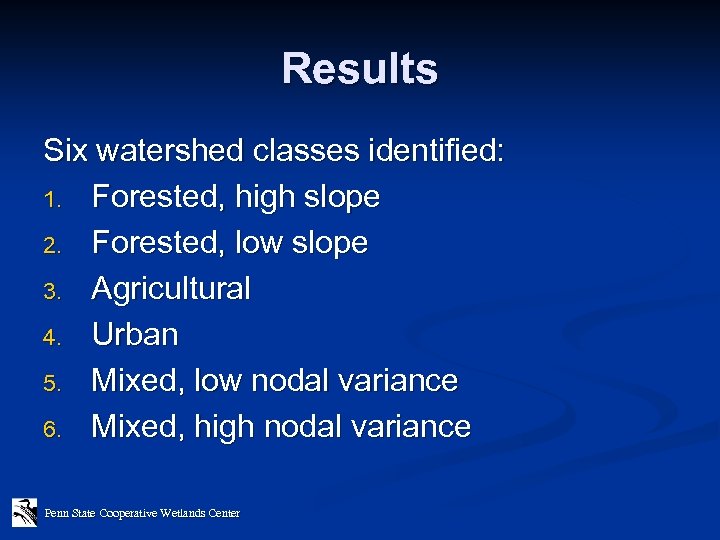 Results Six watershed classes identified: 1. Forested, high slope 2. Forested, low slope 3. Agricultural 4. Urban 5. Mixed, low nodal variance 6. Mixed, high nodal variance Penn State Cooperative Wetlands Center
 Penn State Cooperative Wetlands Center
 Does it agree with process? Informative: Six watershed categories were presented “representing a range of social choices” n Representative: Frequency distributions were evaluated n Consensus: Buy-in at meeting n Individual Judgement: Watersheds were double and triple-picked n Penn State Cooperative Wetlands Center
 Lessons Learned n Be true to the project vision statement! n Future lines of investigation: n How do we articulate historical paths on ternary plots? n Are mixed land cover watersheds with high nodal variance indicative of a lack of planning efforts? Penn State Cooperative Wetlands Center
 Ecohealth Special Issue On Wetland Indicators Guest Editors: Rob Brooks And G P Patil -A Vision For The Special Issuen n n Investigators developing and testing ecological indicators on the condition of coastal or inland wetlands are invited to submit original manuscripts. Papers fostering the integration of condition assessments across various types of aquatic habitats or “waters”, and addressing biological, chemical, and physical dimensions, are encouraged. With this issue, we wish to demonstrate the next generation of ecological indicators is ready for use in wetlands and related habitats. This issue will make a significant contribution to the literature. Final date for receipt of manuscripts-Sep 30 2004 -peer review and editing Oct-Dec 2004, publication in 2005. Penn State Cooperative Wetlands Center