


 Скачать презентацию ATIS Next Generation Networks NGN Framework Requirements and
c7aa588ac1cc028a3087cb2c90705588.ppt
- Количество слайдов: 40
 ATIS Next Generation Networks (NGN) Framework: Requirements and Architecture Alliance for Telecommunications Industry Solutions 1200 G Street, NW Suite 500 Washington, DC 20005 www. atis. org
 Outline • • General Requirements Jim Mc. Eachern, Nortel End User Applications (Use Cases) Network Service Enablers Underlying Network Capabilities • Business Models Driven Req. • US Regulatory Requirements Andrew White, Qwest • Framework Reference Architecture Bhumip Khasnabish, Verizon 4
 ATIS Next Generation Networks (NGN): » General Requirements » End User Applications (Use Cases) » Network Service Enablers » Underlying Network Capabilities 5
 General Requirements • Interconnection • Convergence (fixed / mobile / enterprise) • Access network criteria • Infrastructure evolution & Legacy services • End-to-end transparency • Services guiding principles (for converged networks) 6
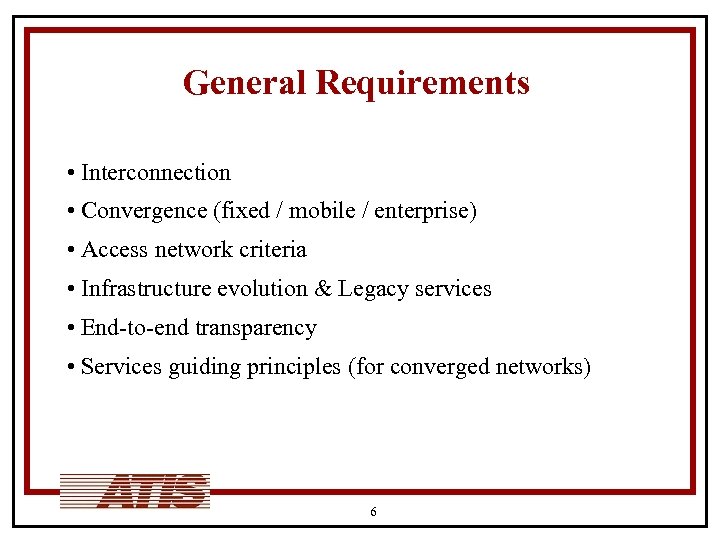
 General Requirements: Interconnection • Specify a packet-based interconnection, suitable for carrier interconnect, that will support: - Security Qo. S Reliability Billing support Service transparency Performance measurements, monitoring, codecs, etc… • Support interconnection between different classes of service providers (e. g. Next Generation Service Providers & Application Service Providers) 7
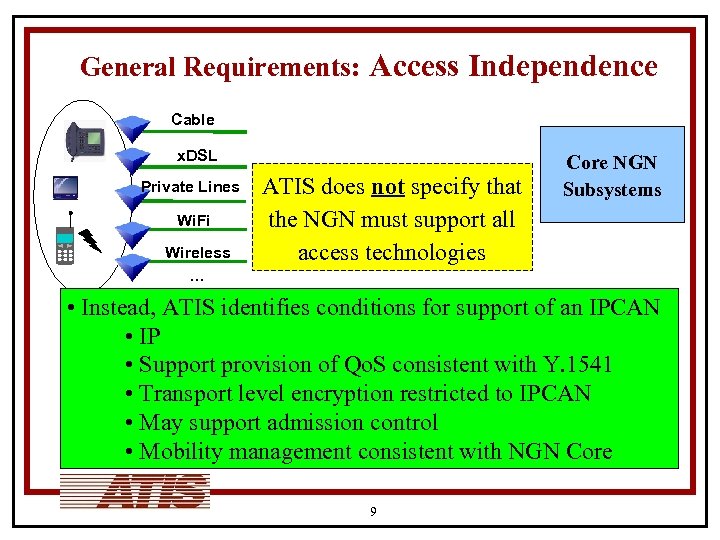 General Requirements: Access Independence Cable x. DSL Private Lines Wi. Fi Wireless … ATIS does not specify that the NGN must support all access technologies Core NGN Subsystems • Instead, ATIS identifies conditions for support of an IPCAN • IP • Support provision of Qo. S consistent with Y. 1541 • Transport level encryption restricted to IPCAN • May support admission control • Mobility management consistent with NGN Core 9
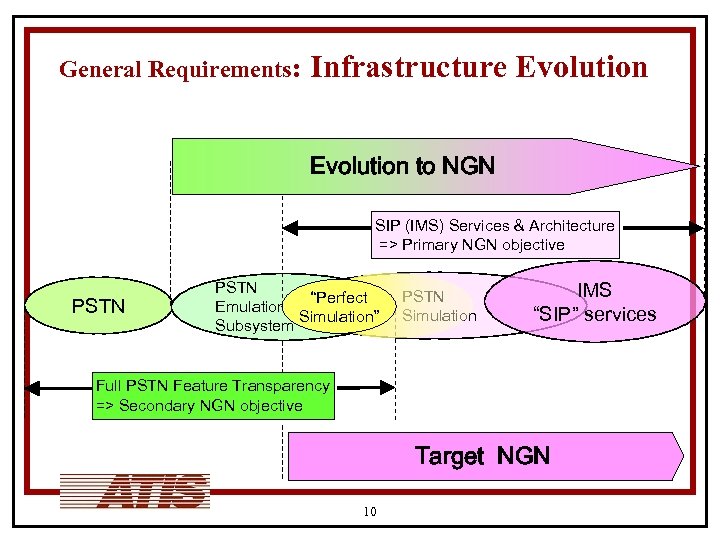 General Requirements: Infrastructure Evolution to NGN SIP (IMS) Services & Architecture => Primary NGN objective PSTN “Perfect Emulation Simulation” Subsystem PSTN Simulation IMS “SIP” services Full PSTN Feature Transparency => Secondary NGN objective Target NGN 10
 General Requirements: Services • End-to-end transparency - Backward compatibility for “best effort Internet” - NGN network services may be incompatible with end-toend transparency • Service environment - Service development independent of network & application protocols - SIP as core signaling protocol - Also support service APIs (e. g. Parlay / OSA) 11
 End User Applications • Selected representative end user services as “use cases” to test and validate NGN requirements. Identified the network service enablers that would be required for application. - Interactive voice - Content-based services / video - Multi-media conferencing - Content sharing - Interactive gaming - Sensor and control networking - Mobility management (wireless / wireline) 12
 Network Service Enablers Network service enablers were defined as networkbased communications services that bring value to consumer applications • Qo. S • Policy • Presence • Personal Profiles • Multicast • Location • ENUM • Communication Context • Media Resource Functions • Media Gateway Functions • Session Management • Nomadism & roaming • Personal Information Mgmt • Content & service discovery • Digital Rights Management 13
 Network Service Enablers: Qo. S • Qo. S has been identified as one of the key Release 1 requirements for NGN - End-to-end - Inter-carrier - Evolve incrementally from existing best-effort networks - Can use complementary techniques • Network Engineering • Traffic Engineering • Packet Scheduling (e. g. Diff Serv) - Access networks likely to need packet scheduling Qo. S mechanisms first 14
 Network Service Enablers: Presence & Personal Profiles • Key capabilities for Release 1 NGN • Endorses the IETF Presence model • Personal profiles & Personal Information Mgmt complement Presence, to link services and enable end-user centric model • Ability to link and unify various identities is a foundation for many other NGN services • End-user centric model will enable significant new service opportunities 15
 Network Service Enablers • Policy - Mechanism to ensure consistent application of network services across various networks and technologies - Consistent policy architecture and protocols required • Media Resource Functions - In legacy networks these were linked to specific services - In the NGN media resources are a generic function - Suitable control mechanism is key 16
 Network Service Enablers • Location - Some services (e. g. E 9 -1 -1) require location information - Location may also be a value-add service - Network determined location is access specific - Location may also be CPE derived (Network validation may be required…) • Content and Service Discovery - Required to support rapid service introduction - Independent of underlying network technology - Discover services based on “interest” (user or device) - Client-server and peer-to-peer 17
 Underlying Network Capabilities • Identifies network capabilities required for NGN, but which applications cannot directly access. - OAM - Security • Authentication • Non repudiation • Etc. - SLA - Network survivability - Service quality measurement - Mechanisms to predict service quality 19
 Security ATIS Security Focus Group has completed a detailed gap analysis and prepared a work plan to address these gaps. Topics addressed include: • Authentication and Authorization - User, device and network entity authentication required for IPCAN, IMS & applications • Integrity - Level required will depend on the application • Confidentiality & Privacy - Essential for NGN capabilities 20
 ATIS Next Generation Networks (NGN): » Business Model Driven Requirements » US Regulatory Requirements 21
 Business Model Requirements Significant revenue generation and cost savings opportunities must justify the substantial investment required to build the NGN. The NGN must facilitate running a business with the efficiency of Walmart. TM and the brand differentiation of Coca-Cola. TM. 22
 Business Drivers • • New Retail Revenue New Wholesale Revenue Cost Reduction for Existing Services Regulatory Requirements 23
 Methods for Success • Customization through User Profile • Transparent Third Party Networks • Seamless Service Delivery Service delivery complicated by increased number of sophisticated interfaces. 24
 User Profile • • Targeted Services Rapid and Flexible Service Creation Integrated OSS/BSS Converged Customer Relationship User-specific, location-agnostic services differentiate product offering. 25
 Third Party Networks • Communications Services work across networks • Application and Content Services work across networks • Architecture must support different types of mobility depending on offering and relationship 26
 Third Party Networks • • Simple end user access & authentication Secure access to profile Consolidated settlement Foreign Network Support for Services – Location, Presence, etc. 27
 Third Party Networks • • Services must adapt to access capabilities Access protocols interwork to the SIP core Qo. S and Security must be maintained End-to-end service may span multiple independent networks 28
 Service Delivery • Blended IT and Telecom Services • Leverage third party information – Location • Support for third party applications • Service creation process should support new blended services 29
 Service Delivery • • • Web-based Self Management Support for third party networks Wide range of CPE Scalable and Reliable Platform Support for NG OSS/BSS 30
 US Regulatory Requirements • National Security & Critical Infrastructure - LAES - ETS • Consumer Requirements - E 9 -1 -1 • Operations Requirements - Number Portability - Number Pooling - Accounting - FCC Rules 31
 ATIS Next Generation Networks (NGN): » Framework Ref. Architecture
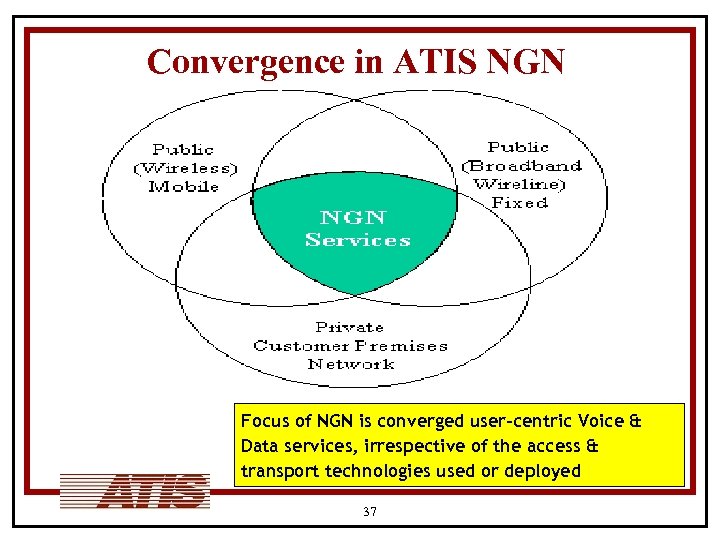 Convergence in ATIS NGN Focus of NGN is converged user-centric Voice & Data services, irrespective of the access & transport technologies used or deployed 37
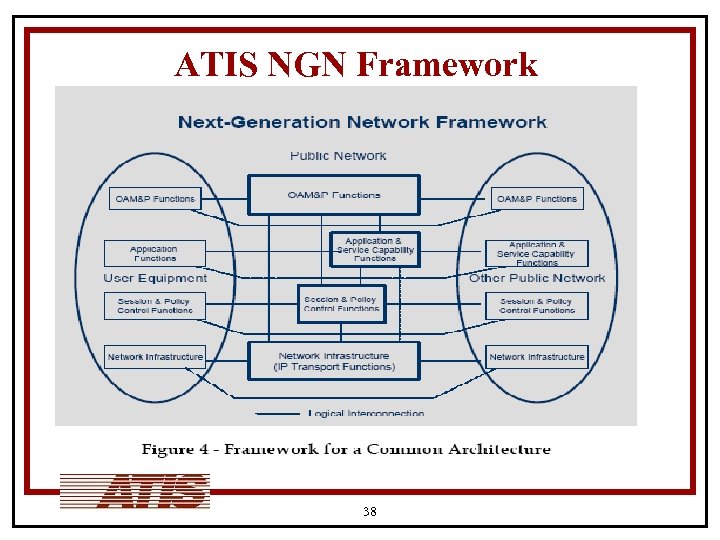 ATIS NGN Framework 38
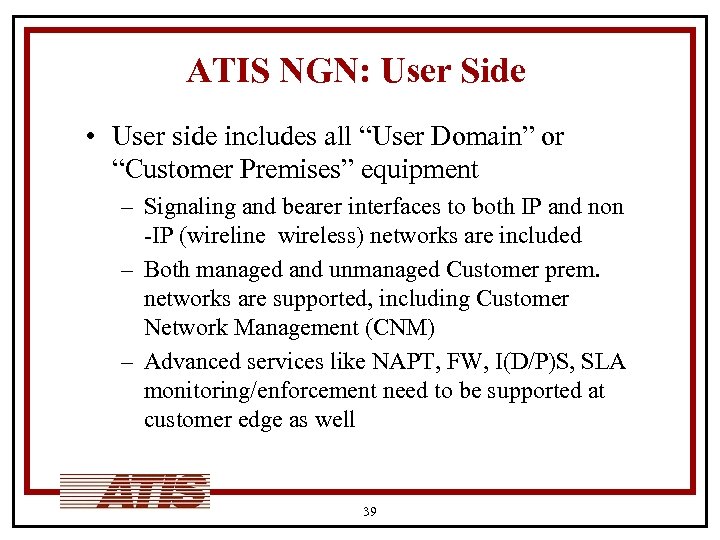 ATIS NGN: User Side • User side includes all “User Domain” or “Customer Premises” equipment – Signaling and bearer interfaces to both IP and non -IP (wireline wireless) networks are included – Both managed and unmanaged Customer prem. networks are supported, including Customer Network Management (CNM) – Advanced services like NAPT, FW, I(D/P)S, SLA monitoring/enforcement need to be supported at customer edge as well 39
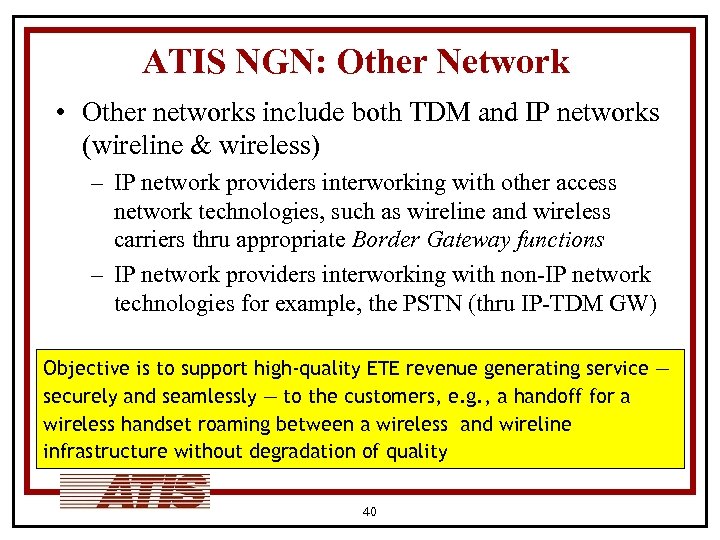 ATIS NGN: Other Network • Other networks include both TDM and IP networks (wireline & wireless) – IP network providers interworking with other access network technologies, such as wireline and wireless carriers thru appropriate Border Gateway functions – IP network providers interworking with non-IP network technologies for example, the PSTN (thru IP-TDM GW) Objective is to support high-quality ETE revenue generating service — securely and seamlessly — to the customers, e. g. , a handoff for a wireless handset roaming between a wireless and wireline infrastructure without degradation of quality 40
 ATIS NGN: Public Network • A FOUR layer FUNCTIONAL model is used • Transport is IP based with appropriate interfaces to User side, Other networks, and upper layer functional entities (FEs) • Session admission, authentication and enforcement of policy are executed via the “Session and Policy” control functions • Value-added and enhanced services are hosted in servers in the “Applications and Service Capability” functions • Service creation, maintenance, and management thru e. g. , Web portals – including FCAPS – are performed via the entities in the OAM&P functions 41
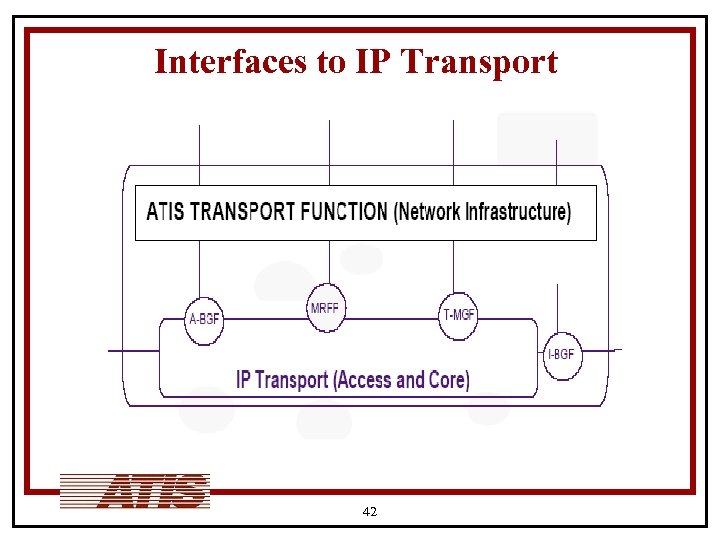 Interfaces to IP Transport 42
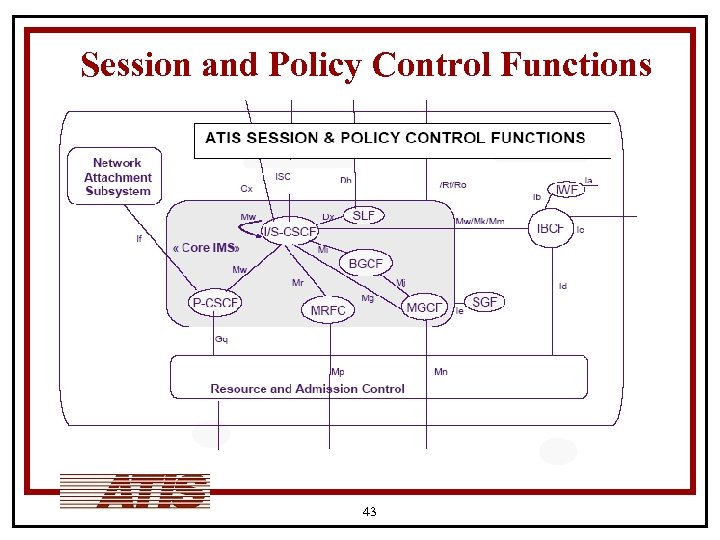 Session and Policy Control Functions 43
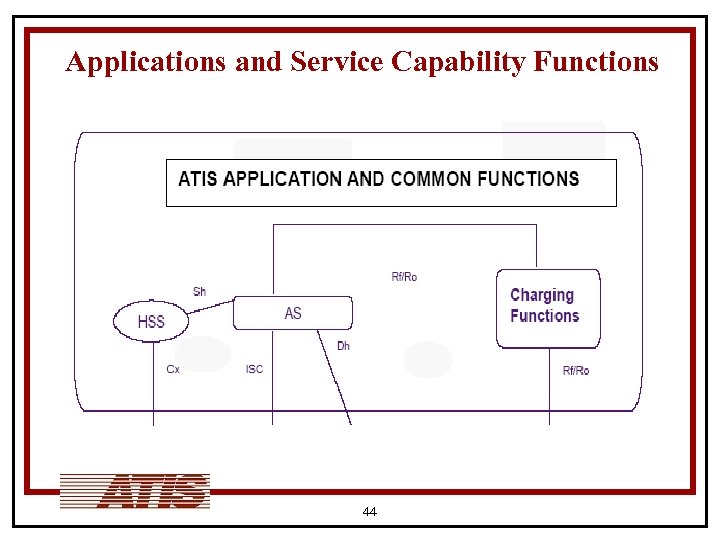 Applications and Service Capability Functions 44
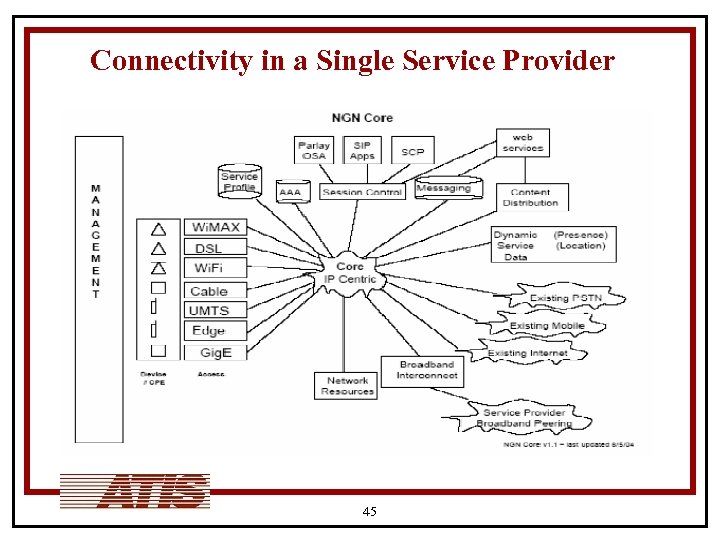 Connectivity in a Single Service Provider 45
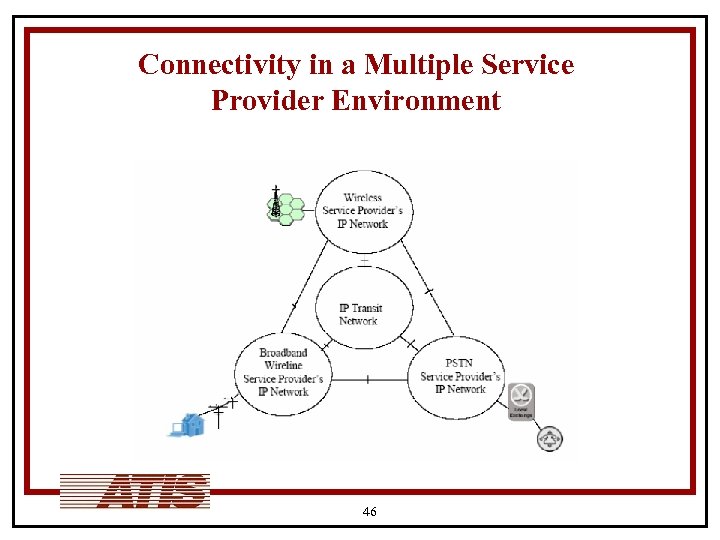 Connectivity in a Multiple Service Provider Environment 46
 Multiple Service Provider Environment: Issues • Multiple administrative and technology domains • Multiple instances of Session policy and Apps & Service capability functions must interwork properly to support high-quality ETE revenue generating service — securely and seamlessly — To the customers – Interworking with legacy signaling & control instances/paradigms is also a must 47
 Conclusion Questions & Answers (Q&A) • The ATIS NGN Framework, Part I is included in the materials for the ATIS & TISPAN Joint Meeting on NGN (i. e. , compact-disk). – also available from ATIS’ web site: http: //www. atis. org • Feedback and comments on the ATIS NGN Framework are welcomed. – Send feedback to: Tim Jeffries, ATIS (tjeffries@atis. org) 48