 Скачать презентацию AT T Labs Performance Implications of Security Protocols Varsha
68edc6c3c8acfd2f2a3a8106be0d4285.ppt
- Количество слайдов: 18



AT&T Labs Performance Implications of Security Protocols Varsha Mainkar Technical Staff Member Network Design & Performance Analysis Advanced Technologies, AT&T Labs Joint Work with Paul Reeser 5 th INFORMS Telecom Conference Boca Raton, 7 March 2000 03/07/00 - TC 2. 2
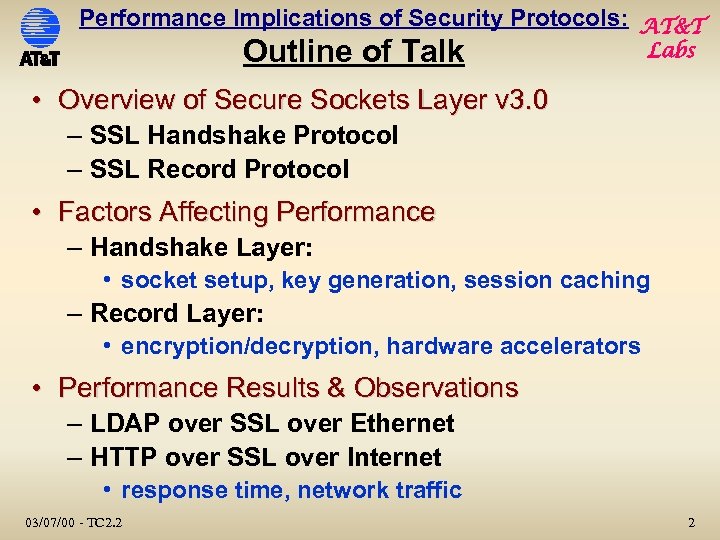
Performance Implications of Security Protocols: AT&T Outline of Talk Labs • Overview of Secure Sockets Layer v 3. 0 – SSL Handshake Protocol – SSL Record Protocol • Factors Affecting Performance – Handshake Layer: • socket setup, key generation, session caching – Record Layer: • encryption/decryption, hardware accelerators • Performance Results & Observations – LDAP over SSL over Ethernet – HTTP over SSL over Internet • response time, network traffic 03/07/00 - TC 2. 2 2
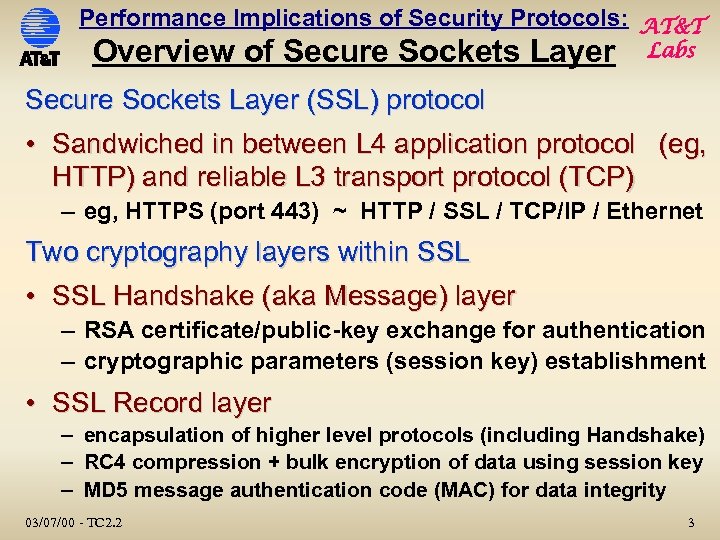
Performance Implications of Security Protocols: AT&T Overview of Secure Sockets Layer Labs Secure Sockets Layer (SSL) protocol • Sandwiched in between L 4 application protocol (eg, HTTP) and reliable L 3 transport protocol (TCP) – eg, HTTPS (port 443) ~ HTTP / SSL / TCP/IP / Ethernet Two cryptography layers within SSL • SSL Handshake (aka Message) layer – RSA certificate/public-key exchange for authentication – cryptographic parameters (session key) establishment • SSL Record layer – encapsulation of higher level protocols (including Handshake) – RC 4 compression + bulk encryption of data using session key – MD 5 message authentication code (MAC) for data integrity 03/07/00 - TC 2. 2 3
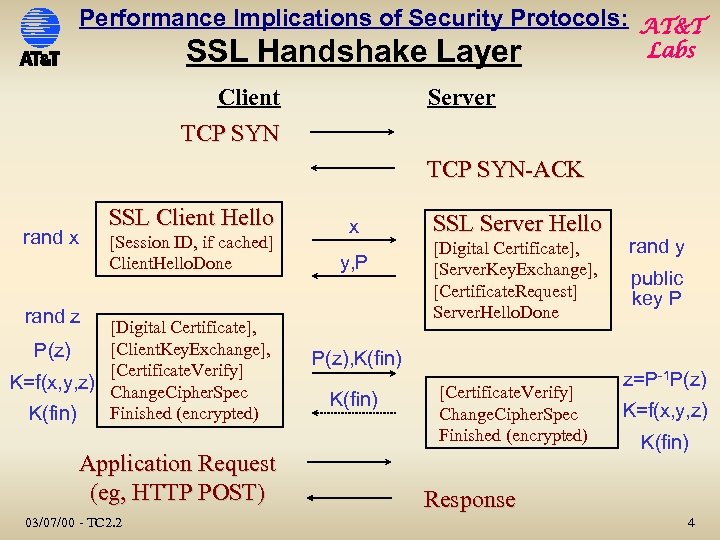
Performance Implications of Security Protocols: AT&T SSL Handshake Layer Client TCP SYN Labs Server TCP SYN-ACK SSL Client Hello rand x [Session ID, if cached] Client. Hello. Done x y, P rand z [Digital Certificate], [Client. Key. Exchange], P(z) [Certificate. Verify] K=f(x, y, z) Change. Cipher. Spec Finished (encrypted) K(fin) Application Request (eg, HTTP POST) 03/07/00 - TC 2. 2 SSL Server Hello [Digital Certificate], [Server. Key. Exchange], [Certificate. Request] Server. Hello. Done P(z), K(fin) [Certificate. Verify] Change. Cipher. Spec Finished (encrypted) rand y public key P z=P-1 P(z) K=f(x, y, z) K(fin) Response 4
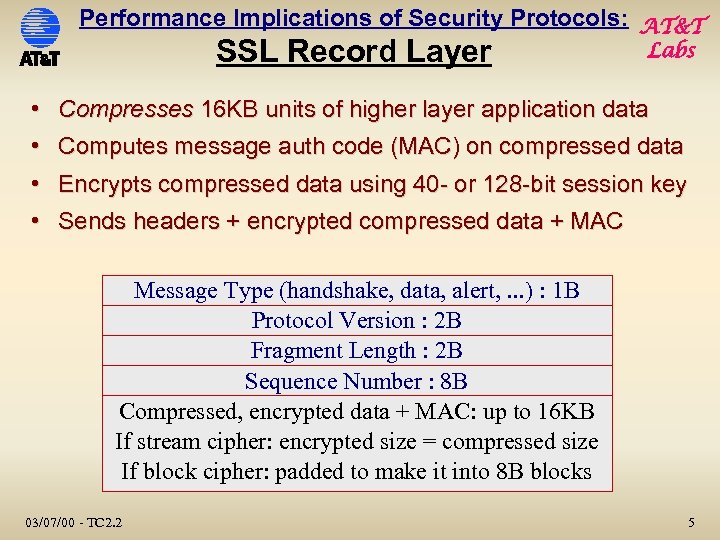
Performance Implications of Security Protocols: AT&T SSL Record Layer Labs • Compresses 16 KB units of higher layer application data • Computes message auth code (MAC) on compressed data • Encrypts compressed data using 40 - or 128 -bit session key • Sends headers + encrypted compressed data + MAC Message Type (handshake, data, alert, . . . ) : 1 B Protocol Version : 2 B Fragment Length : 2 B Sequence Number : 8 B Compressed, encrypted data + MAC: up to 16 KB If stream cipher: encrypted size = compressed size If block cipher: padded to make it into 8 B blocks 03/07/00 - TC 2. 2 5
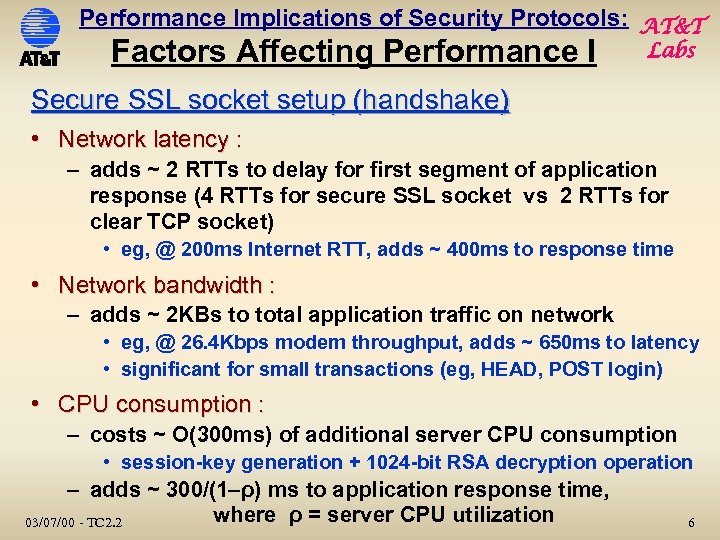
Performance Implications of Security Protocols: AT&T Factors Affecting Performance I Labs Secure SSL socket setup (handshake) • Network latency : – adds ~ 2 RTTs to delay for first segment of application response (4 RTTs for secure SSL socket vs 2 RTTs for clear TCP socket) • eg, @ 200 ms Internet RTT, adds ~ 400 ms to response time • Network bandwidth : – adds ~ 2 KBs to total application traffic on network • eg, @ 26. 4 Kbps modem throughput, adds ~ 650 ms to latency • significant for small transactions (eg, HEAD, POST login) • CPU consumption : – costs ~ O(300 ms) of additional server CPU consumption • session-key generation + 1024 -bit RSA decryption operation – adds ~ 300/(1–ρ) ms to application response time, where ρ = server CPU utilization 03/07/00 - TC 2. 2 6
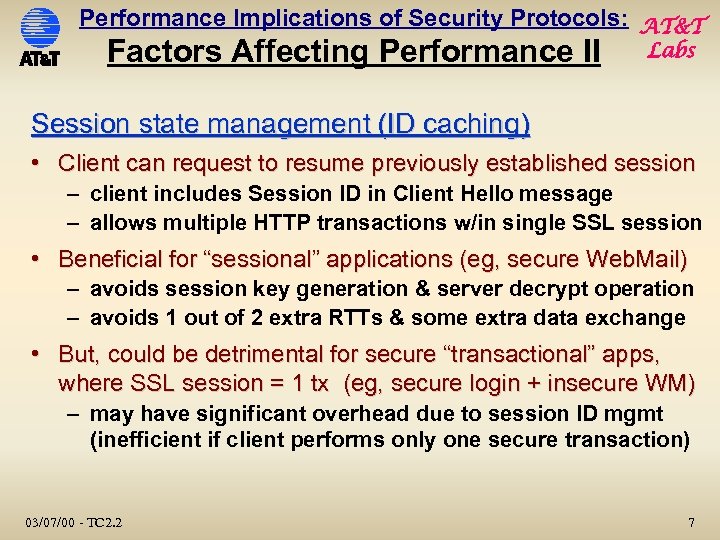
Performance Implications of Security Protocols: AT&T Factors Affecting Performance II Labs Session state management (ID caching) • Client can request to resume previously established session – client includes Session ID in Client Hello message – allows multiple HTTP transactions w/in single SSL session • Beneficial for “sessional” applications (eg, secure Web. Mail) – avoids session key generation & server decrypt operation – avoids 1 out of 2 extra RTTs & some extra data exchange • But, could be detrimental for secure “transactional” apps, where SSL session = 1 tx (eg, secure login + insecure WM) – may have significant overhead due to session ID mgmt (inefficient if client performs only one secure transaction) 03/07/00 - TC 2. 2 7
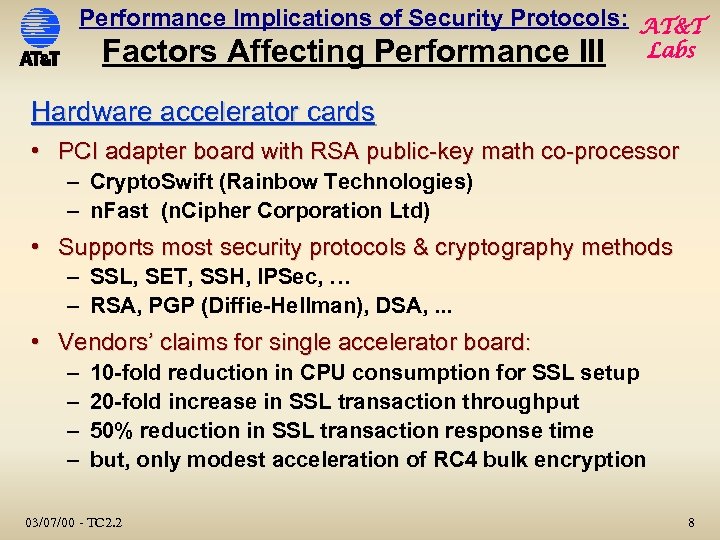
Performance Implications of Security Protocols: AT&T Factors Affecting Performance III Labs Hardware accelerator cards • PCI adapter board with RSA public-key math co-processor – Crypto. Swift (Rainbow Technologies) – n. Fast (n. Cipher Corporation Ltd) • Supports most security protocols & cryptography methods – SSL, SET, SSH, IPSec, … – RSA, PGP (Diffie-Hellman), DSA, . . . • Vendors’ claims for single accelerator board: – – 10 -fold reduction in CPU consumption for SSL setup 20 -fold increase in SSL transaction throughput 50% reduction in SSL transaction response time but, only modest acceleration of RC 4 bulk encryption 03/07/00 - TC 2. 2 8
Performance Implications of Security Protocols: AT&T Factors Affecting Performance IV Labs RC 4 bulk encryption (symmetric key) • 40 -bit (export) vs 128 -bit (domestic) RC 4 session cipher-key – we found little or no impact on response time – re CPU consumption: accelerator vendors claim that “RC 4 only consumes a few percent of your processor” – our results suggest otherwise 03/07/00 - TC 2. 2 9
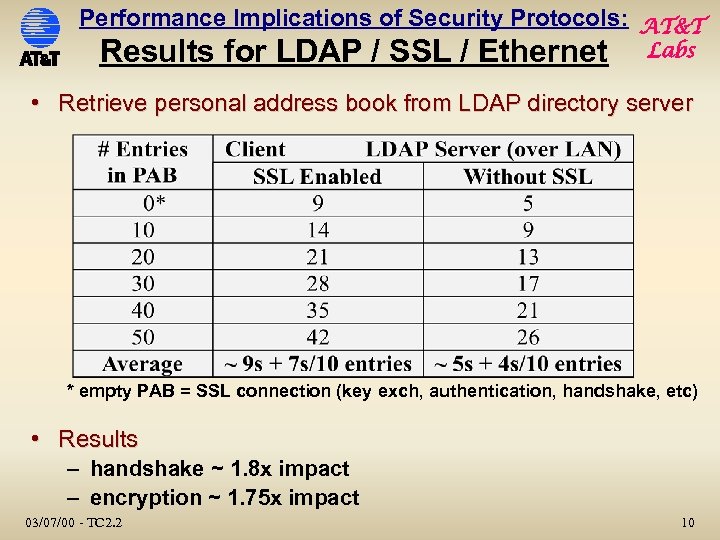
Performance Implications of Security Protocols: AT&T Results for LDAP / SSL / Ethernet Labs • Retrieve personal address book from LDAP directory server * empty PAB = SSL connection (key exch, authentication, handshake, etc) • Results – handshake ~ 1. 8 x impact – encryption ~ 1. 75 x impact 03/07/00 - TC 2. 2 10
Performance Implications of Security Protocols: AT&T Results for HTTP / SSL / Internet Labs Test Configuration • Server : SGI Challenge L (4 194 Mhz CPUs), Irix 6. 5, SSL 3. 0 (128 -bit), Netscape Enterprise 3. 6 • Clients : NT workstation + NT server, Silk Performer 2. 5 • Network : 56 Kbps modem (connecting @ 26. 4 Kbps) “Web. Mail” Transaction Workload • Login (https POST user name + password) – no SSL, SSL – handshake (ID cached), SSL + handshake • Downloads (20 KB, 100 KB, 200 KB, 500 KB, 1 MB ascii files) – no SSL, and SSL – handshake (ID cached) Performance Metrics • client response time, server CPU time, network traffic 03/07/00 - TC 2. 2 11
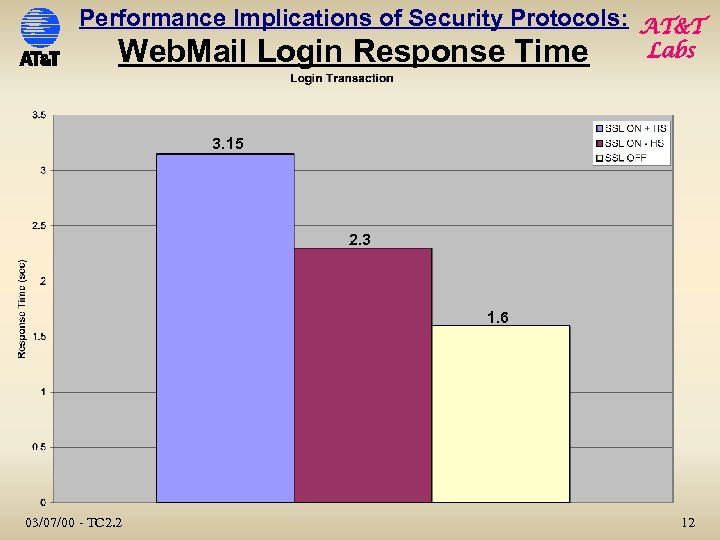
Performance Implications of Security Protocols: AT&T Web. Mail Login Response Time Labs 3. 15 2. 3 1. 6 03/07/00 - TC 2. 2 12
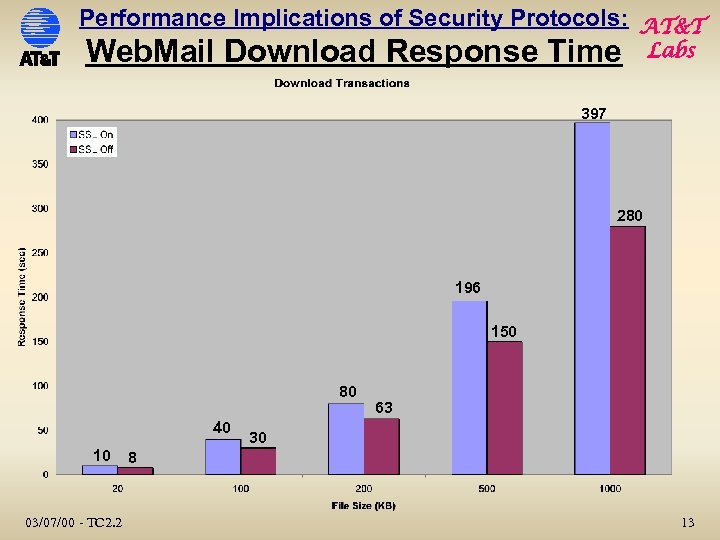
Performance Implications of Security Protocols: AT&T Web. Mail Download Response Time Labs 397 280 196 150 80 40 10 03/07/00 - TC 2. 2 63 30 8 13
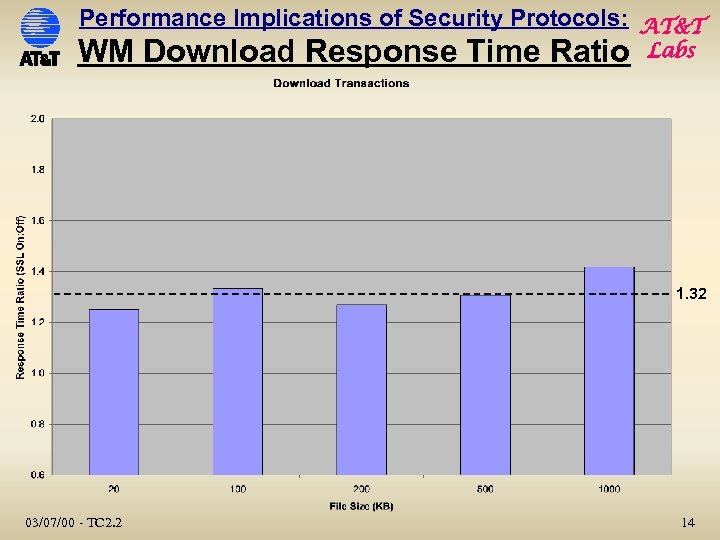
Performance Implications of Security Protocols: AT&T WM Download Response Time Ratio Labs 1. 32 03/07/00 - TC 2. 2 14
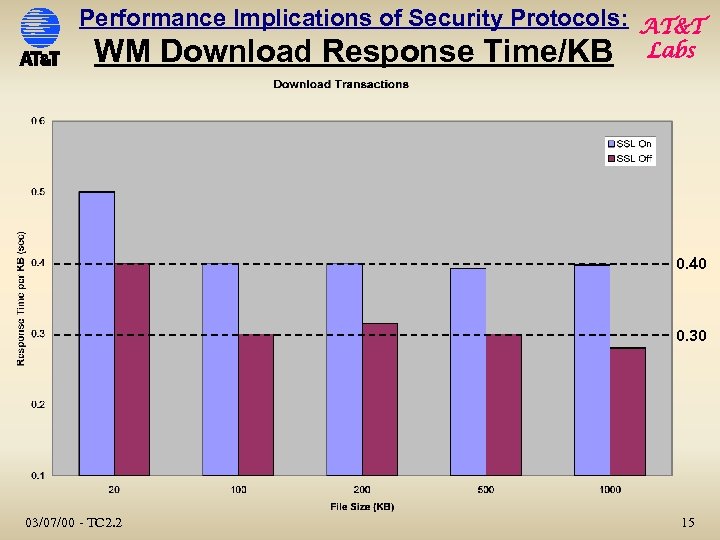
Performance Implications of Security Protocols: AT&T WM Download Response Time/KB Labs 0. 40 0. 30 03/07/00 - TC 2. 2 15
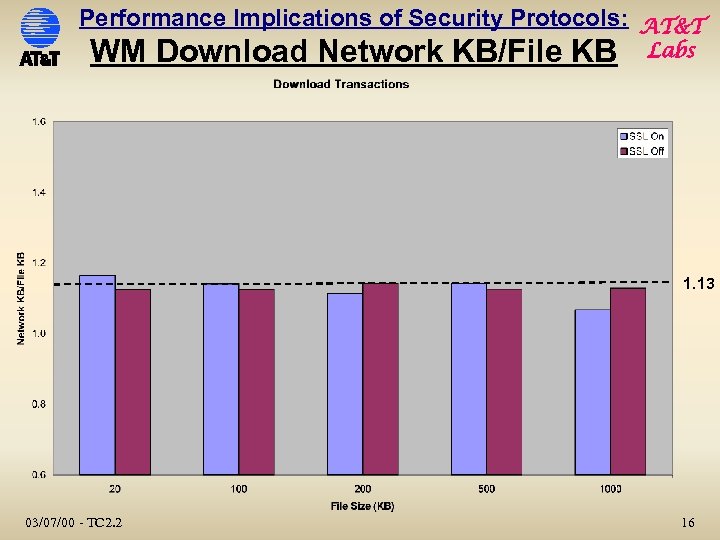
Performance Implications of Security Protocols: AT&T WM Download Network KB/File KB Labs 1. 13 03/07/00 - TC 2. 2 16
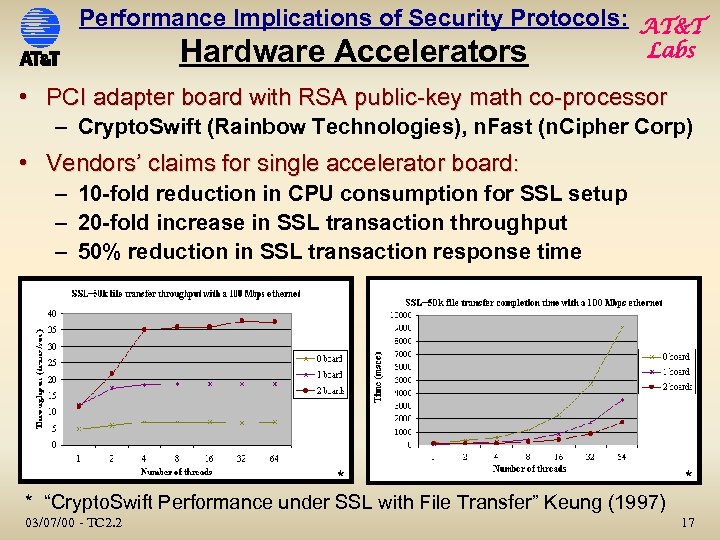
Performance Implications of Security Protocols: AT&T Hardware Accelerators Labs • PCI adapter board with RSA public-key math co-processor – Crypto. Swift (Rainbow Technologies), n. Fast (n. Cipher Corp) • Vendors’ claims for single accelerator board: – 10 -fold reduction in CPU consumption for SSL setup – 20 -fold increase in SSL transaction throughput – 50% reduction in SSL transaction response time * * * “Crypto. Swift Performance under SSL with File Transfer” Keung (1997) 03/07/00 - TC 2. 2 17
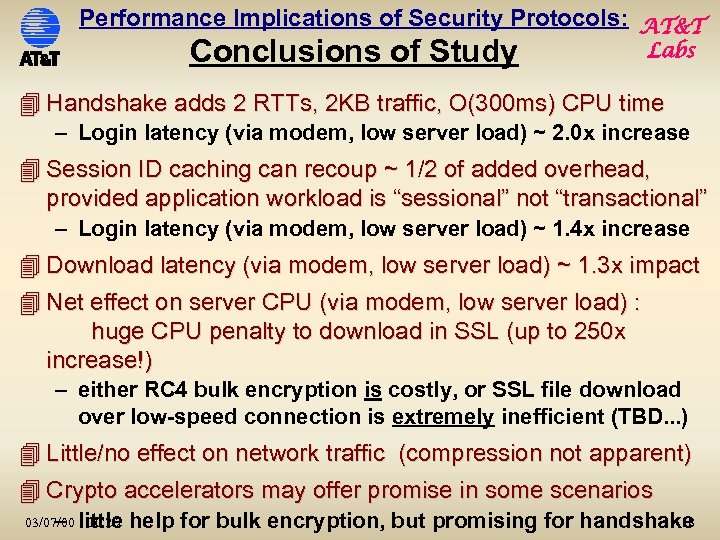
Performance Implications of Security Protocols: AT&T Conclusions of Study Labs 4 Handshake adds 2 RTTs, 2 KB traffic, O(300 ms) CPU time – Login latency (via modem, low server load) ~ 2. 0 x increase 4 Session ID caching can recoup ~ 1/2 of added overhead, provided application workload is “sessional” not “transactional” – Login latency (via modem, low server load) ~ 1. 4 x increase 4 Download latency (via modem, low server load) ~ 1. 3 x impact 4 Net effect on server CPU (via modem, low server load) : huge CPU penalty to download in SSL (up to 250 x increase!) – either RC 4 bulk encryption is costly, or SSL file download over low-speed connection is extremely inefficient (TBD. . . ) 4 Little/no effect on network traffic (compression not apparent) 4 Crypto accelerators may offer promise in some scenarios – 03/07/00 little - TC 2. 2 18 help for bulk encryption, but promising for handshake
Скачать презентацию AT T Labs Performance Implications of Security Protocols Varsha
68edc6c3c8acfd2f2a3a8106be0d4285.ppt