


 Скачать презентацию Asynchronous Learning Getting Your 5 th Hour in
91b68bb76b2dd457b59899dfa9cbd2d1.ppt
- Количество слайдов: 62
 Asynchronous Learning: Getting Your 5 th Hour in Sync Moderator: Linda Regan, MD Panel: Samuel Luber, MD and Michael Wainscott, MD Douglas Char, MD Autumn Graham, MD David Overton, MD and William Fales, MD Matthew Waxman, MD and Tess Klaristenfeld, MD
 RRC Guidelines • Planned Educational Experiences for Residents – 20% can be Individualized Interactive Instruction – Four Criteria must be met: • The program director must monitor all activities for resident participation • There must be faculty supervision • There must be an evaluation component • The activity must be monitored for effectiveness
 Asynchronous in Texas • Dr. Michael Wainscott • Dr. Samuel Luber
 UT Southwestern and UT-Houston • • • Why we are presenting together The “Menu” Approach Asynchronous Offerings Logging Asynchronous Learning Monitoring Asynchronous Learning
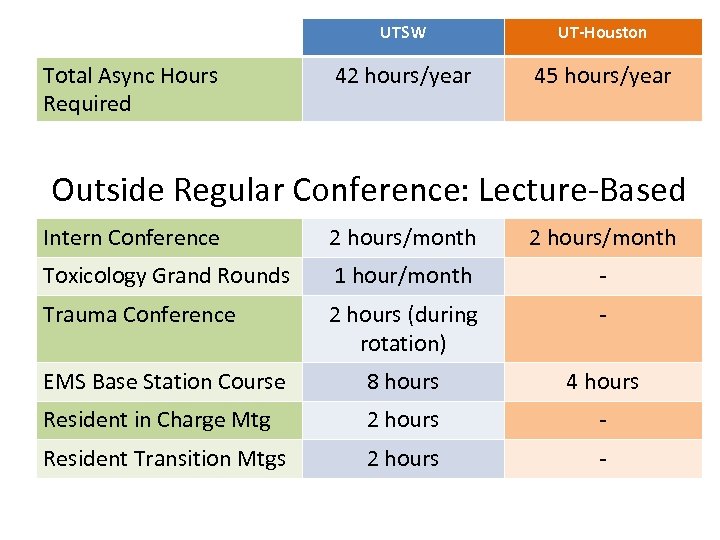 UTSW Total Async Hours Required Lectures 42 hours/year UT-Houston 45 hours/year Outside Regular Conference: Lecture-Based Intern Conference 2 hours/month Toxicology Grand Rounds 1 hour/month - Trauma Conference 2 hours (during rotation) - EMS Base Station Course 8 hours 4 hours Resident in Charge Mtg 2 hours - Resident Transition Mtgs 2 hours -
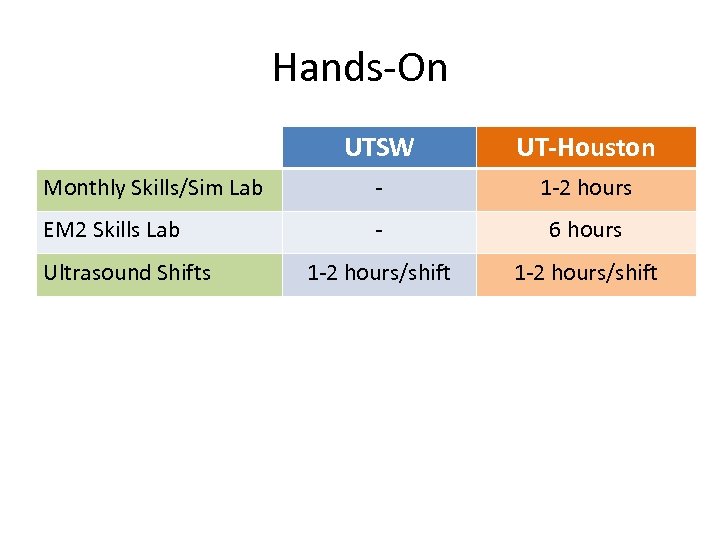 Hands-On UTSW UT-Houston Monthly Skills/Sim Lab - 1 -2 hours EM 2 Skills Lab - 6 hours 1 -2 hours/shift Ultrasound Shifts
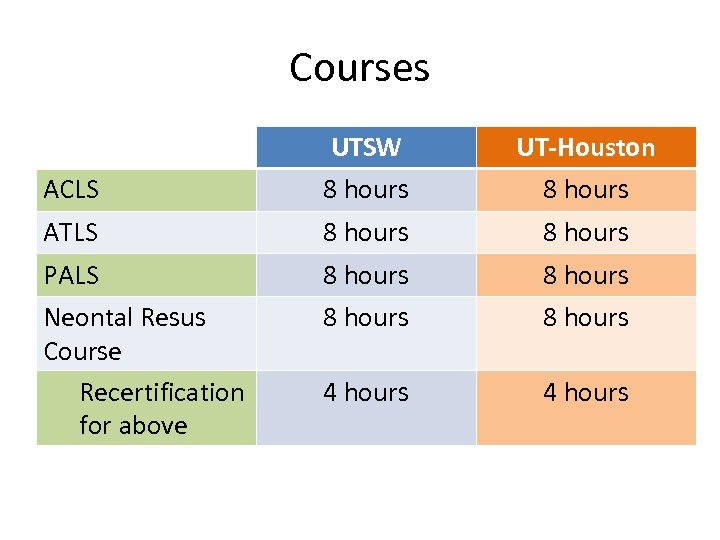 Courses UTSW UT-Houston ACLS 8 hours ATLS 8 hours PALS 8 hours Neontal Resus Course Recertification for above 8 hours 4 hours
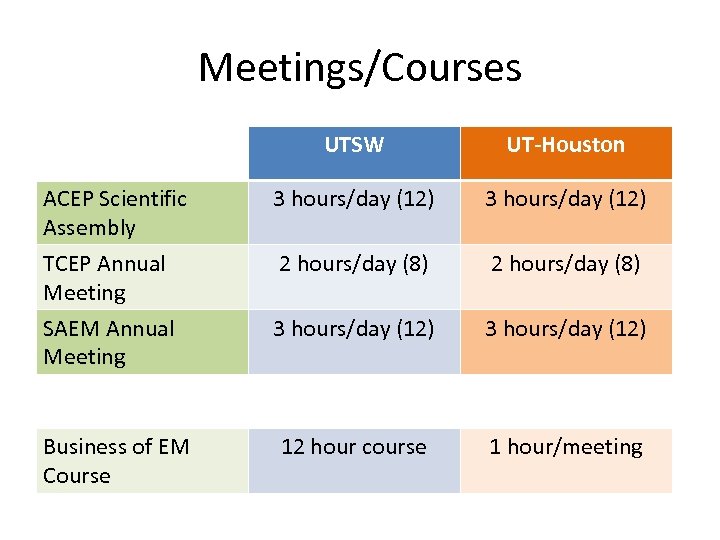 Meetings/Courses UTSW UT-Houston ACEP Scientific Assembly 3 hours/day (12) TCEP Annual Meeting 2 hours/day (8) SAEM Annual Meeting 3 hours/day (12) 12 hour course 1 hour/meeting Business of EM Course
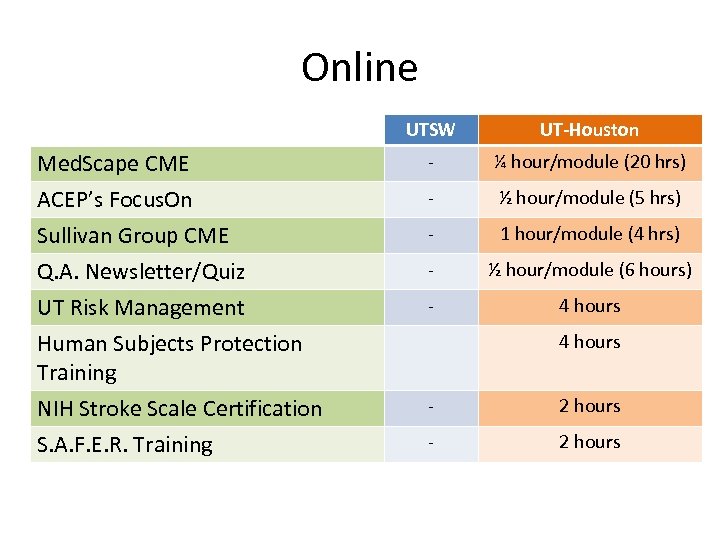 Online UTSW UT-Houston Med. Scape CME - ¼ hour/module (20 hrs) ACEP’s Focus. On Sullivan Group CME Q. A. Newsletter/Quiz UT Risk Management - ½ hour/module (5 hrs) - 1 hour/module (4 hrs) - ½ hour/module (6 hours) - 4 hours Human Subjects Protection Training NIH Stroke Scale Certification S. A. F. E. R. Training 4 hours - 2 hours
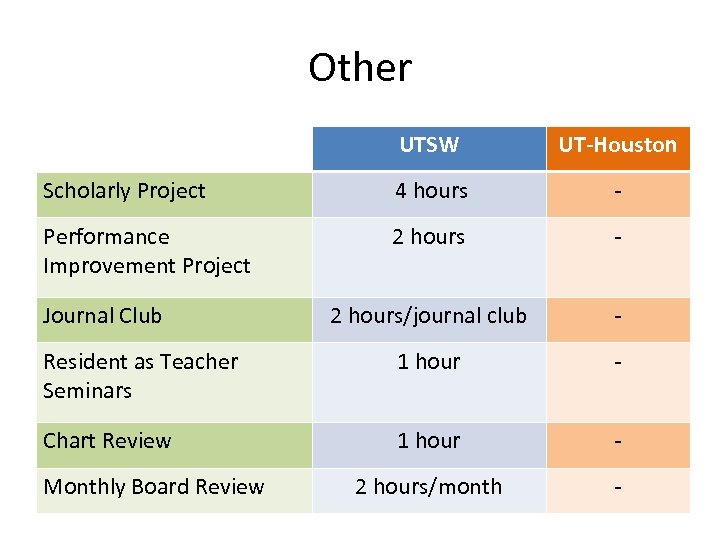 Other UTSW UT-Houston Scholarly Project 4 hours - Performance Improvement Project 2 hours - 2 hours/journal club - Resident as Teacher Seminars 1 hour - Chart Review 1 hour - 2 hours/month - Journal Club Monthly Board Review
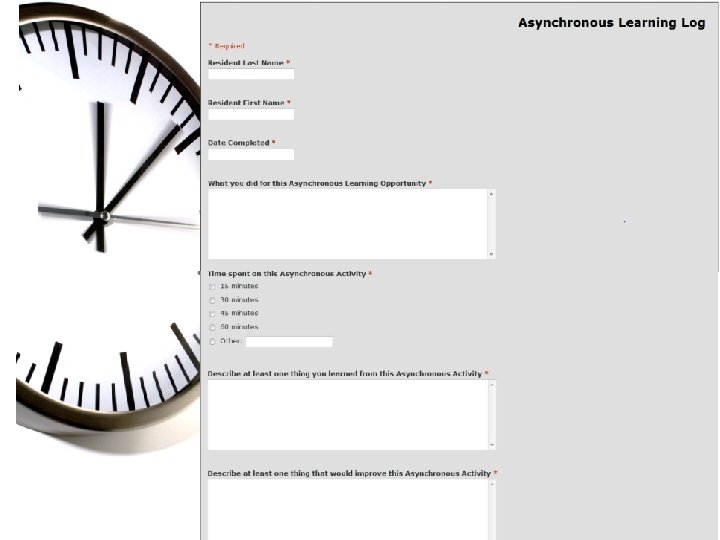
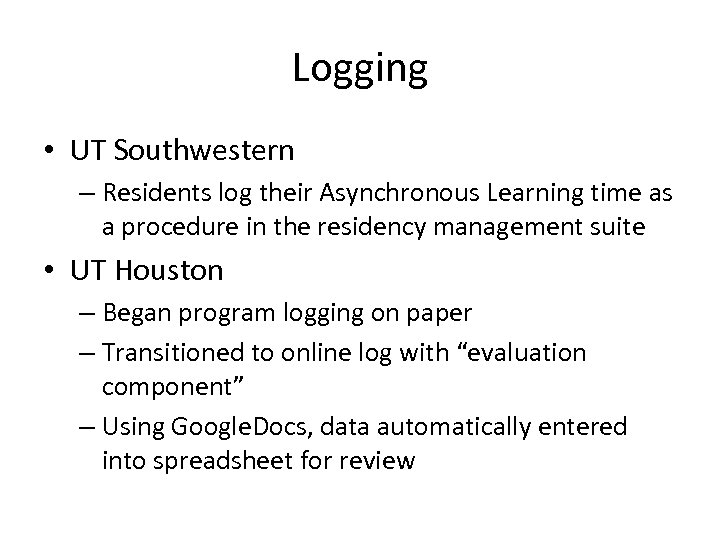 Logging • UT Southwestern – Residents log their Asynchronous Learning time as a procedure in the residency management suite • UT Houston – Began program logging on paper – Transitioned to online log with “evaluation component” – Using Google. Docs, data automatically entered into spreadsheet for review
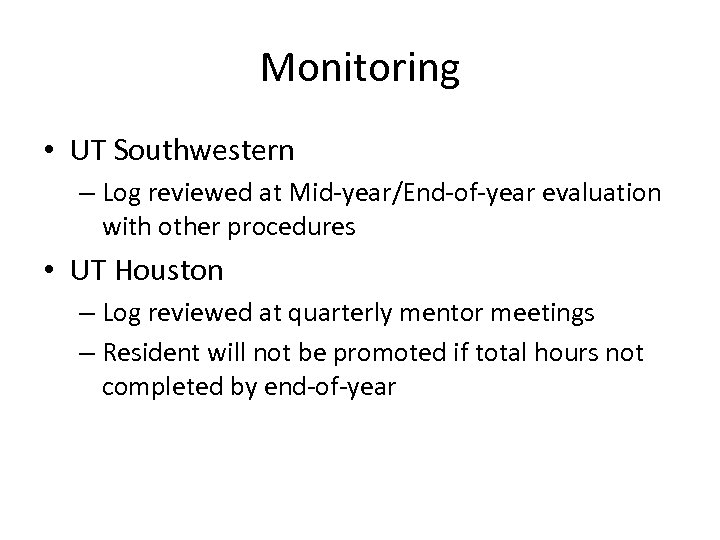 Monitoring • UT Southwestern – Log reviewed at Mid-year/End-of-year evaluation with other procedures • UT Houston – Log reviewed at quarterly mentor meetings – Resident will not be promoted if total hours not completed by end-of-year
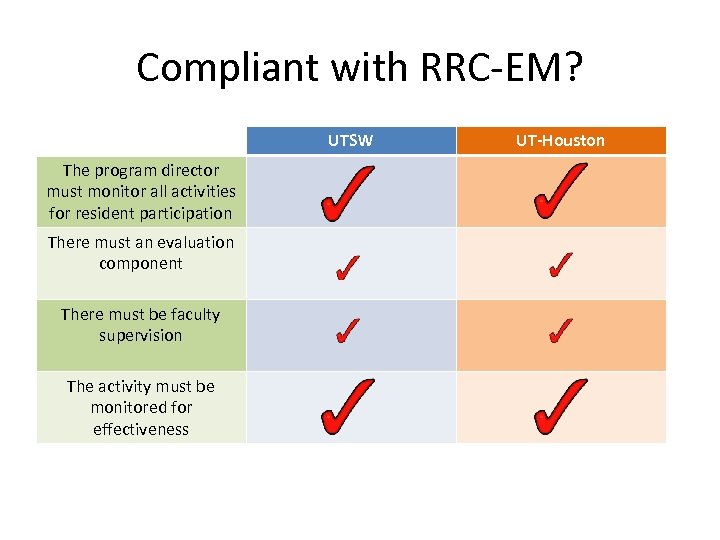 Compliant with RRC-EM? UTSW The program director must monitor all activities for resident participation There must an evaluation component There must be faculty supervision The activity must be monitored for effectiveness UT-Houston
 Questions?
 Asynchronous Education: Fad or Paradigm shift? Douglas M. Char, MD CORD Academic Assembly 2011
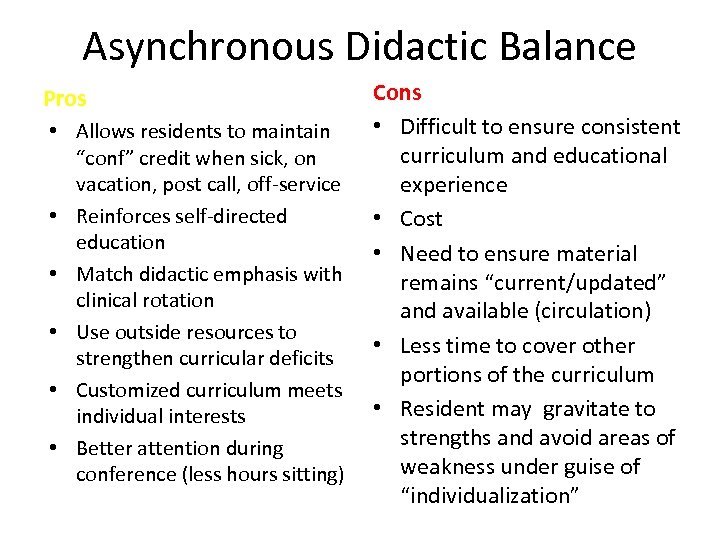 Asynchronous Didactic Balance Pros • Allows residents to maintain “conf” credit when sick, on vacation, post call, off-service • Reinforces self-directed education • Match didactic emphasis with clinical rotation • Use outside resources to strengthen curricular deficits • Customized curriculum meets individual interests • Better attention during conference (less hours sitting) Cons • Difficult to ensure consistent curriculum and educational experience • Cost • Need to ensure material remains “current/updated” and available (circulation) • Less time to cover other portions of the curriculum • Resident may gravitate to strengths and avoid areas of weakness under guise of “individualization”
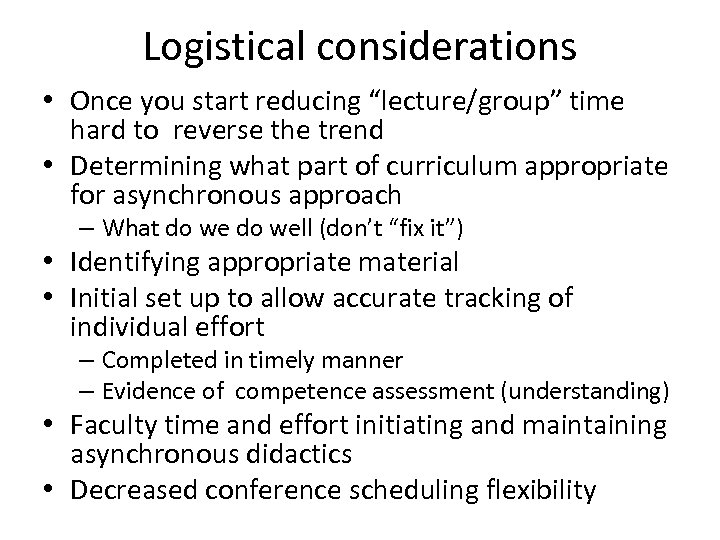 Logistical considerations • Once you start reducing “lecture/group” time hard to reverse the trend • Determining what part of curriculum appropriate for asynchronous approach – What do well (don’t “fix it”) • Identifying appropriate material • Initial set up to allow accurate tracking of individual effort – Completed in timely manner – Evidence of competence assessment (understanding) • Faculty time and effort initiating and maintaining asynchronous didactics • Decreased conference scheduling flexibility
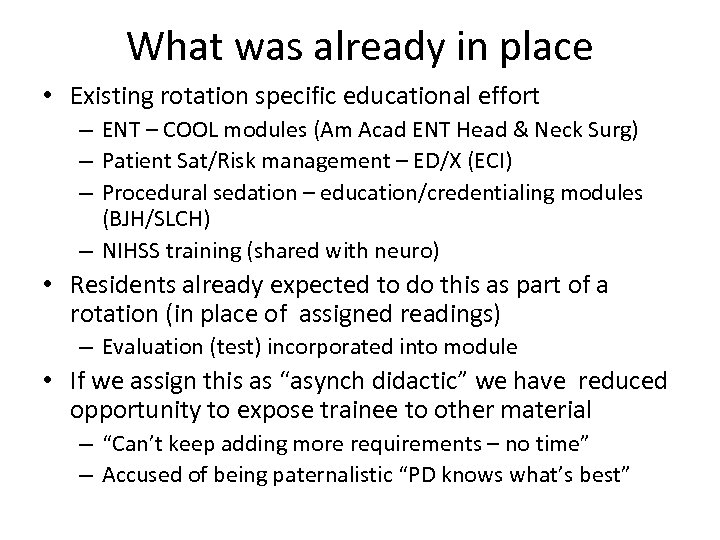 What was already in place • Existing rotation specific educational effort – ENT – COOL modules (Am Acad ENT Head & Neck Surg) – Patient Sat/Risk management – ED/X (ECI) – Procedural sedation – education/credentialing modules (BJH/SLCH) – NIHSS training (shared with neuro) • Residents already expected to do this as part of a rotation (in place of assigned readings) – Evaluation (test) incorporated into module • If we assign this as “asynch didactic” we have reduced opportunity to expose trainee to other material – “Can’t keep adding more requirements – no time” – Accused of being paternalistic “PD knows what’s best”
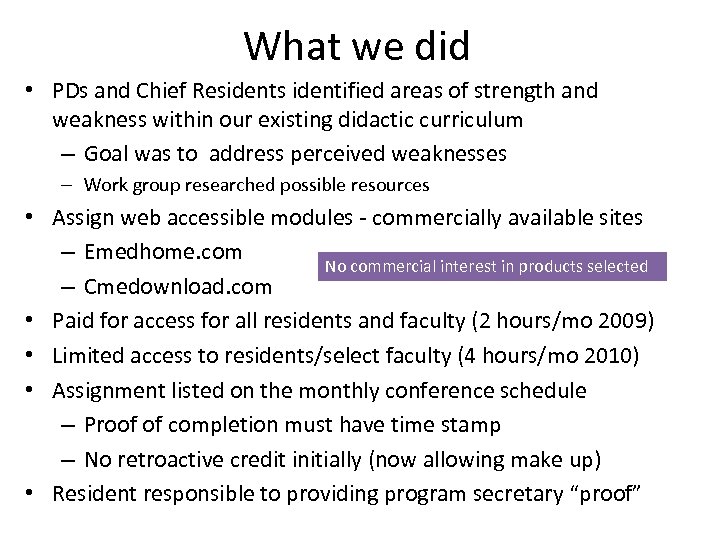 What we did • PDs and Chief Residents identified areas of strength and weakness within our existing didactic curriculum – Goal was to address perceived weaknesses – Work group researched possible resources • Assign web accessible modules - commercially available sites – Emedhome. com No commercial interest in products selected – Cmedownload. com • Paid for access for all residents and faculty (2 hours/mo 2009) • Limited access to residents/select faculty (4 hours/mo 2010) • Assignment listed on the monthly conference schedule – Proof of completion must have time stamp – No retroactive credit initially (now allowing make up) • Resident responsible to providing program secretary “proof”
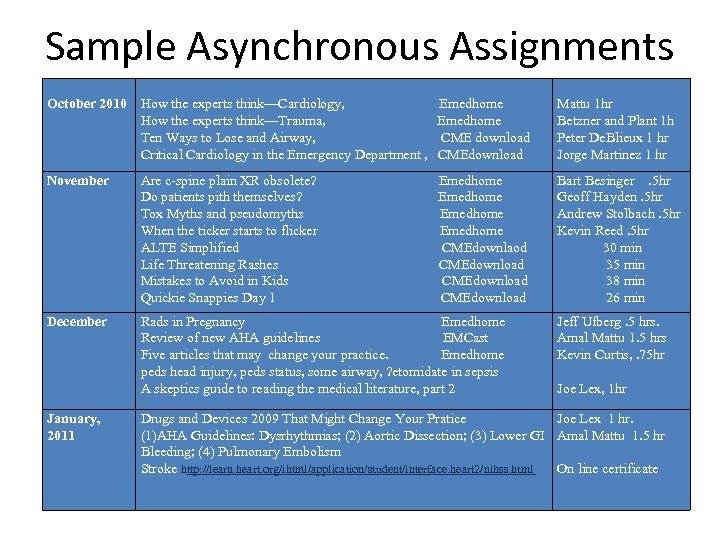 Sample Asynchronous Assignments October 2010 How the experts think—Cardiology, Emedhome How the experts think—Trauma, Emedhome Ten Ways to Lose and Airway, CME download Critical Cardiology in the Emergency Department , CMEdownload Mattu 1 hr Betzner and Plant 1 h Peter De. Blieux 1 hr Jorge Martinez 1 hr November Are c-spine plain XR obsolete? Emedhome Do patients pith themselves? Emedhome Tox Myths and pseudomyths Emedhome When the ticker starts to flicker Emedhome ALTE Simplified CMEdownlaod Life Threatening Rashes CMEdownload Mistakes to Avoid in Kids CMEdownload Quickie Snappies Day 1 CMEdownload Bart Besinger . 5 hr Geoff Hayden. 5 hr Andrew Stolbach. 5 hr Kevin Reed. 5 hr 30 min 35 min 38 min 26 min December Rads in Pregnancy Emedhome Review of new AHA guidelines EMCast Five articles that may change your practice. Emedhome peds head injury, peds status, some airway, ? etomidate in sepsis A skeptics guide to reading the medical literature, part 2 Jeff Ufberg. 5 hrs. Amal Mattu 1. 5 hrs Kevin Curtis, . 75 hr January, 2011 Joe Lex, 1 hr Drugs and Devices 2009 That Might Change Your Pratice Joe Lex 1 hr. (1)AHA Guidelines: Dysrhythmias; (2) Aortic Dissection; (3) Lower GI Amal Mattu 1. 5 hr Bleeding; (4) Pulmonary Embolism Stroke http: //learn. heart. org/ihtml/application/student/interface. heart 2/nihss. html On line certificate
 How it’s going • Residents enthusiastic in the beginning – Some now see this as one more hoop – don’t appreciate that it’s less confernece time (they never experienced that) – Those who have a hard time making conf – have a hard time completing online assignments • Material assigned last year may no longer be available online as the site makes revisions, updates – Not all material within a site of the same caliber and value – If we assign this year will it be available 2 years from now • Cost $$$ ($200/resident per year) • Little faculty involvement in this – they don’t know what residents do regarding these topics – Coordinating faculty spending more time searching for “good stuff” than anticipated • How do I know this is better than the old way?
 Where we hope to go • Need to get away from one size fit’s all – Everyone doing the same online modules every month – How to individualize without tracking nightmare • Pull material from specific rotation reassign as asynchronous education – Activity will be specific for a given rotation – Be aware of adding to the curriculum without measuring it’s impact on compliance, “learning” • Start to develop “Scholar Track” specific activities for upper level trainees (GPY 3 -4) – This will allow more individualization of curriculum and match interest with effort • Requires program better define core curriculum – This can’t be a fad, need to consider long-term impact – Faculty time, teaching expectations
 Questions?
 Landscape • 3 year program with multiple training sites • 8 residents per year • 48 conference days a year – 4 hours of weekly conference – 1 hour of asynchronous learning
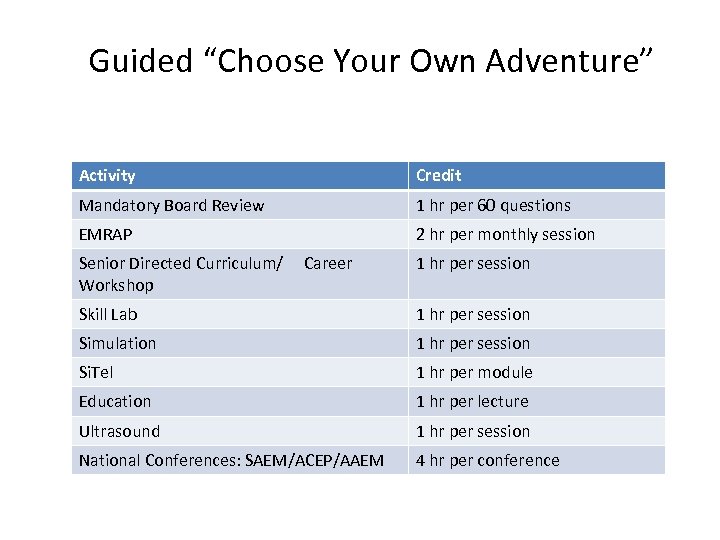 Guided “Choose Your Own Adventure” Activity Credit Mandatory Board Review 1 hr per 60 questions EMRAP 2 hr per monthly session Senior Directed Curriculum/ Workshop Career 1 hr per session Skill Lab 1 hr per session Simulation 1 hr per session Si. Tel 1 hr per module Education 1 hr per lecture Ultrasound 1 hr per session National Conferences: SAEM/ACEP/AAEM 4 hr per conference
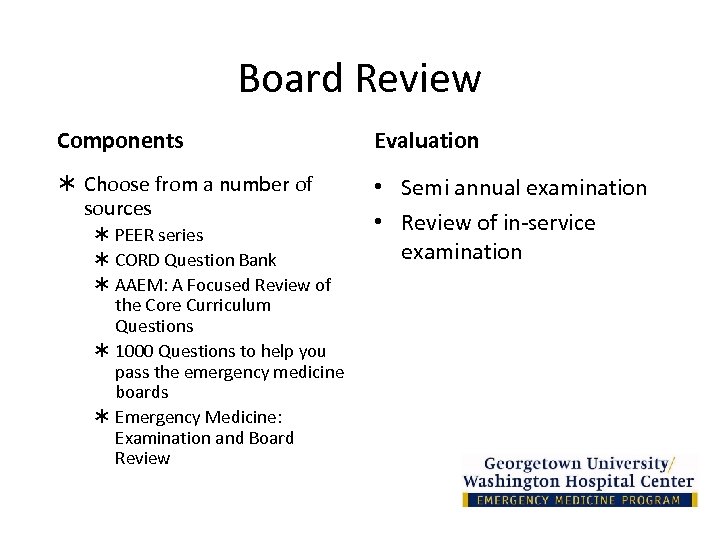 Board Review Components Evaluation Ü Choose from a number of sources • Semi annual examination • Review of in-service examination Ü PEER series Ü CORD Question Bank Ü AAEM: A Focused Review of the Core Curriculum Questions Ü 1000 Questions to help you pass the emergency medicine boards Ü Emergency Medicine: Examination and Board Review
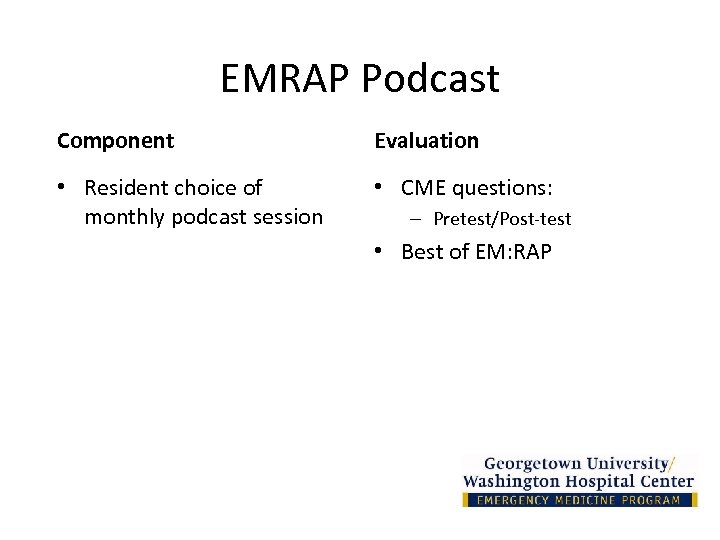 EMRAP Podcast Component Evaluation • Resident choice of monthly podcast session • CME questions: – Pretest/Post-test • Best of EM: RAP
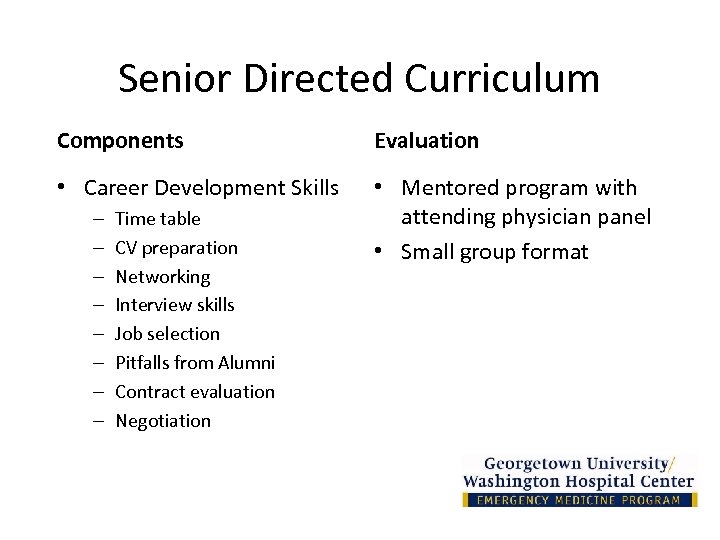 Senior Directed Curriculum Components Evaluation • Career Development Skills • Mentored program with attending physician panel • Small group format – – – – Time table CV preparation Networking Interview skills Job selection Pitfalls from Alumni Contract evaluation Negotiation
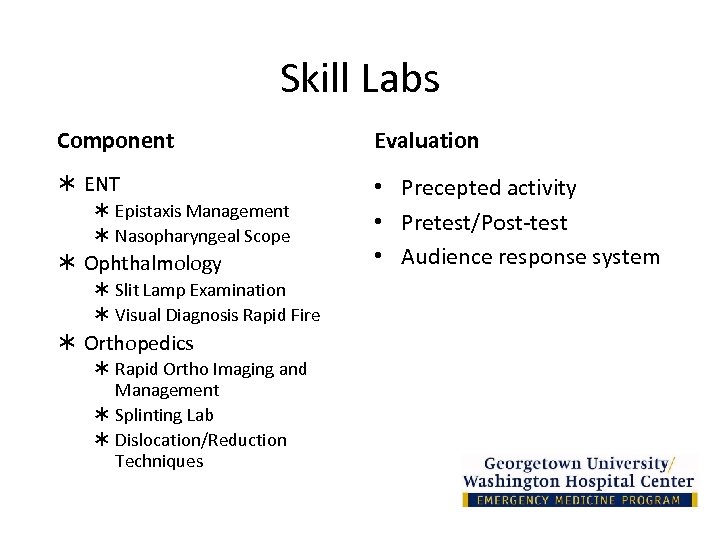 Skill Labs Component Evaluation Ü ENT • Precepted activity • Pretest/Post-test • Audience response system Ü Epistaxis Management Ü Nasopharyngeal Scope Ü Ophthalmology Ü Slit Lamp Examination Ü Visual Diagnosis Rapid Fire Ü Orthopedics Ü Rapid Ortho Imaging and Management Ü Splinting Lab Ü Dislocation/Reduction Techniques
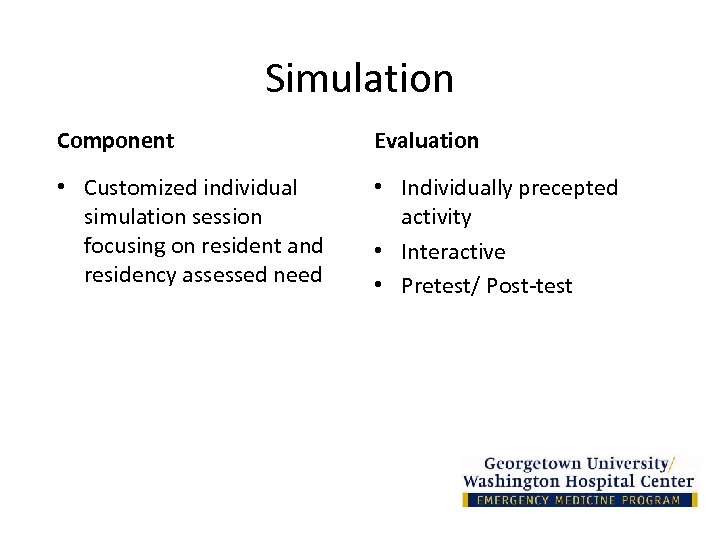 Simulation Component Evaluation • Customized individual simulation session focusing on resident and residency assessed need • Individually precepted activity • Interactive • Pretest/ Post-test
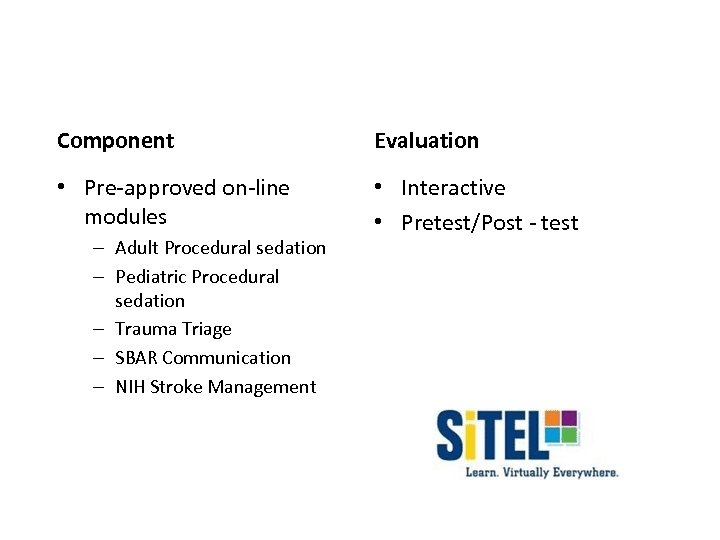 Component Evaluation • Pre-approved on-line modules • Interactive • Pretest/Post - test – Adult Procedural sedation – Pediatric Procedural sedation – Trauma Triage – SBAR Communication – NIH Stroke Management
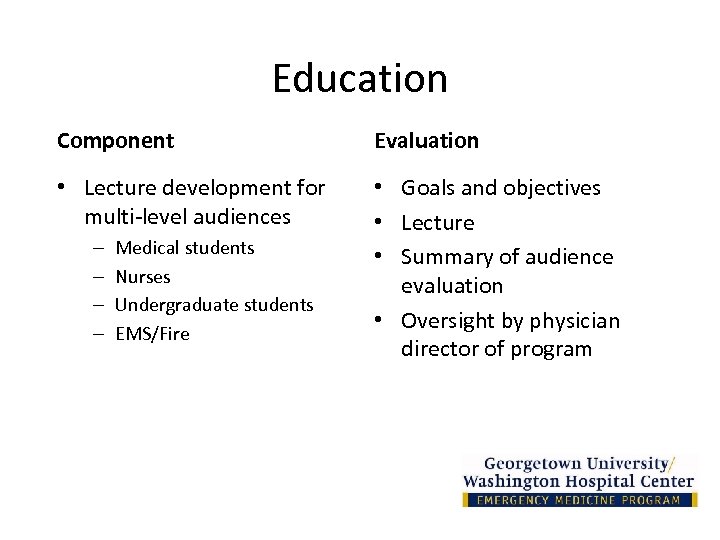 Education Component Evaluation • Lecture development for multi-level audiences • Goals and objectives • Lecture • Summary of audience evaluation • Oversight by physician director of program – – Medical students Nurses Undergraduate students EMS/Fire
 Ultrasound/Review Component Evaluation • Hands on practical application • Weekly ultrasound review • Precepted Activities • Interactive – Indication for ultrasound – Pertinent medical/clinical considerations – Quality of images – Suggestions for improvement
 Approved Asynchronous Learning Component Evaluation • National Conference • Pediatric Anesthesia/Sedation • Oral surgery clinic • Varies depending on activity
 Asynchronous Learning Monitoring and Oversight ÜResidents ÜLog activities on a Googledoc spreadsheet monthly ÜReview approved activities/preceptor quarterly via survey monkey and P&C Committee ÜResidency ÜApproves activities that meet RRC requirements and have a proven educational benefit ÜReviews the log quarterly ÜReviews the log in semi-annual evaluations and sets future educational goals
 Questions?
 Simulation Wednesdays An Experiment in Asymmetric Learning William Fales, MD Associate Professor of Emergency Medicine David Overton MD, MBA Professor of Emergency Medicine Michigan State University Kalamazoo Center for Medical Studies
 History / Background • EM Program: 1 -3 format with 20 residents/year • Traditional 5 -hour weekly didactic conferences • Institutional Simulation Center x 10 years – Administered by Emergency Medicine • Modest in size (2, 250 square feet) – 1 -bed “Trauma/ICU Room” + 4 -bed “ED Ward” – Central control room with AV system monitors – Multi-purpose Bioskills Lab / Classroom – Two, 20 -foot , single bed mobile labs – Historically light on simulation
 The Challenge: • Residents and faculty viewed simulation as: – Educationally valuable – Underutilized • The Challenge: – How to expand use of simulation – While preserving core didactic instruction
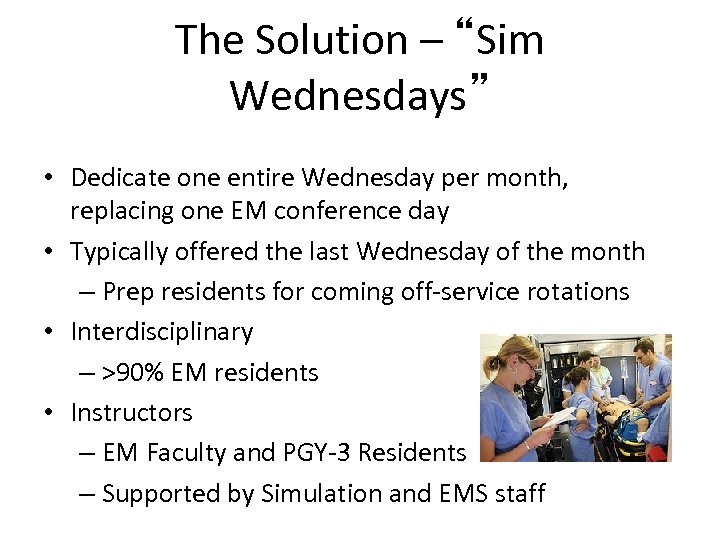 The Solution – “Sim Wednesdays” • Dedicate one entire Wednesday per month, replacing one EM conference day • Typically offered the last Wednesday of the month – Prep residents for coming off-service rotations • Interdisciplinary – >90% EM residents • Instructors – EM Faculty and PGY-3 Residents – Supported by Simulation and EMS staff
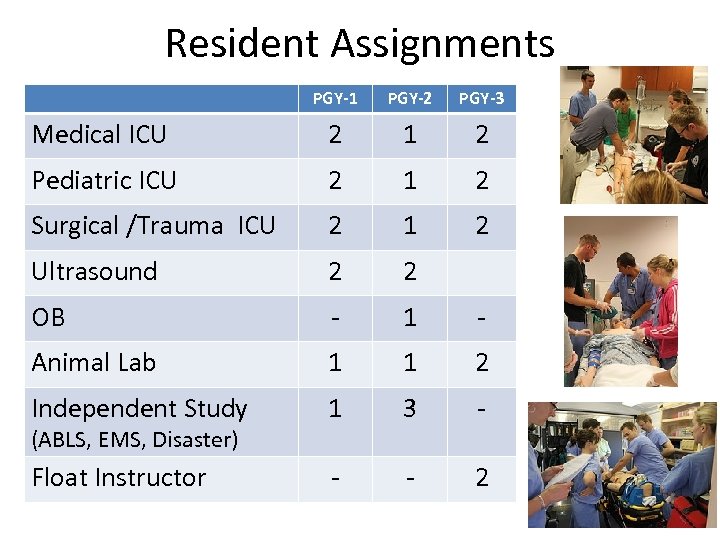 Resident Assignments PGY-1 PGY-2 PGY-3 Medical ICU 2 1 2 Pediatric ICU 2 1 2 Surgical /Trauma ICU 2 1 2 Ultrasound 2 2 OB - 1 - Animal Lab 1 1 2 Independent Study 1 3 - Float Instructor - - 2 (ABLS, EMS, Disaster)
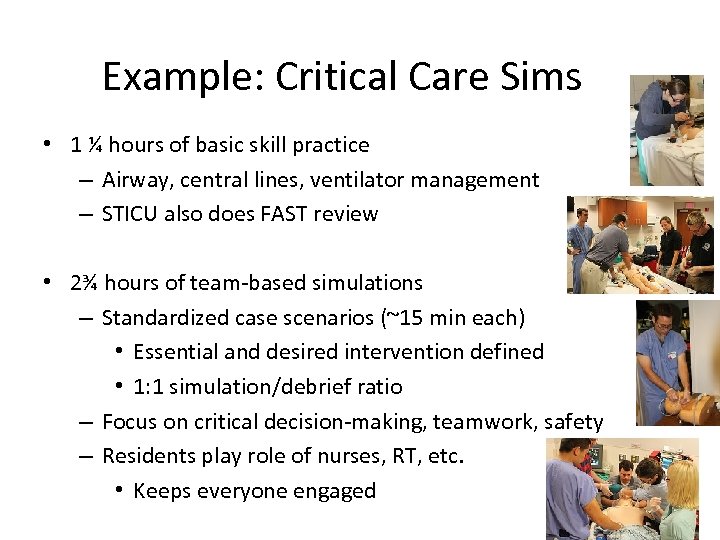 Example: Critical Care Sims • 1 ¼ hours of basic skill practice – Airway, central lines, ventilator management – STICU also does FAST review • 2¾ hours of team-based simulations – Standardized case scenarios (~15 min each) • Essential and desired intervention defined • 1: 1 simulation/debrief ratio – Focus on critical decision-making, teamwork, safety – Residents play role of nurses, RT, etc. • Keeps everyone engaged
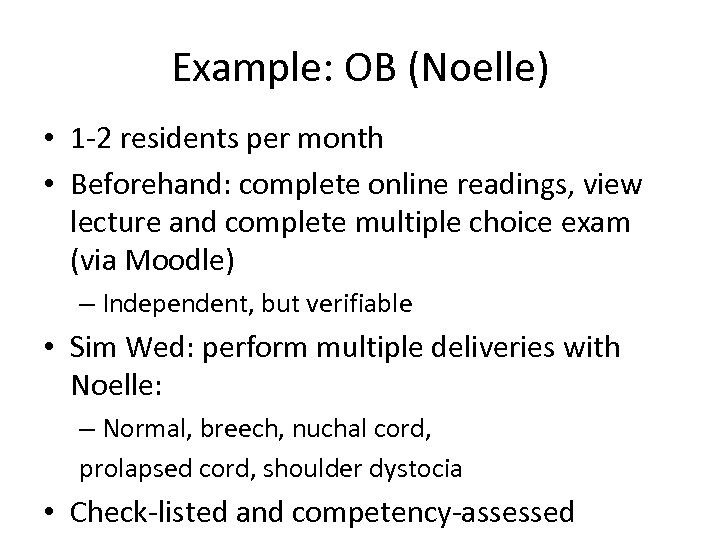 Example: OB (Noelle) • 1 -2 residents per month • Beforehand: complete online readings, view lecture and complete multiple choice exam (via Moodle) – Independent, but verifiable • Sim Wed: perform multiple deliveries with Noelle: – Normal, breech, nuchal cord, prolapsed cord, shoulder dystocia • Check-listed and competency-assessed
 Advantages, Disadvantages & Considerations • We have a large residency (20 residents/year) • Thus, we need a large Simulation Lab – To fit all the people – To have the capability to run enough stations simultaneously – Keep everyone busy without making the groups too large
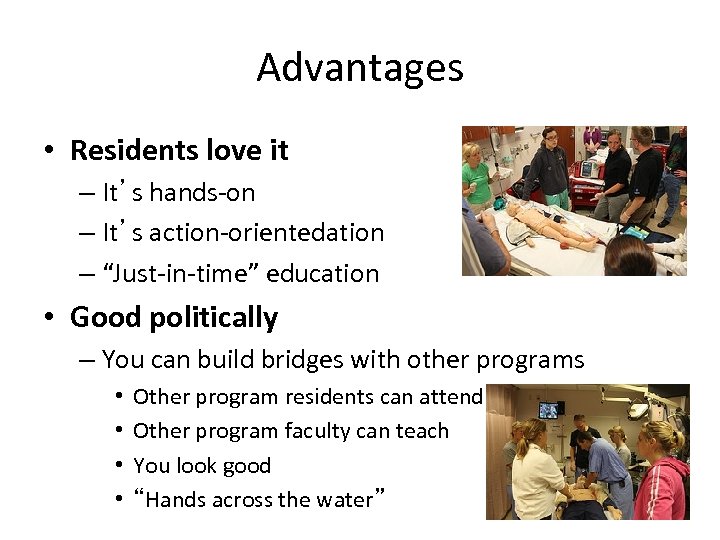 Advantages • Residents love it – It’s hands-on – It’s action-orientedation – “Just-in-time” education • Good politically – You can build bridges with other programs • • Other program residents can attend Other program faculty can teach You look good “Hands across the water”
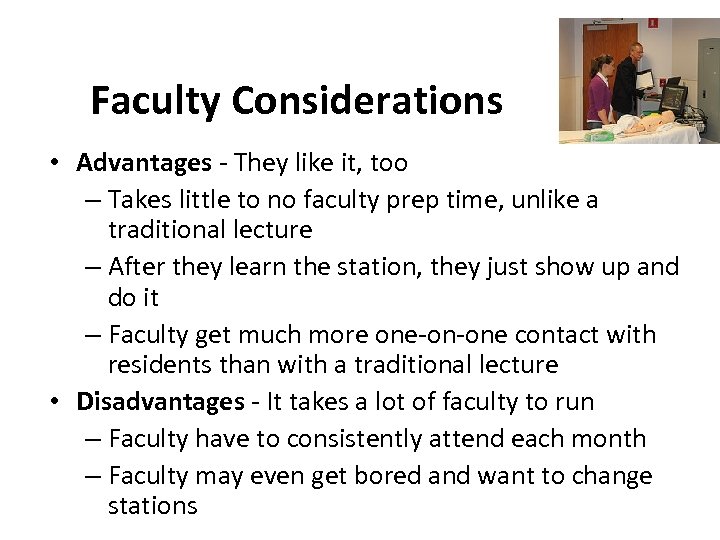 Faculty Considerations • Advantages - They like it, too – Takes little to no faculty prep time, unlike a traditional lecture – After they learn the station, they just show up and do it – Faculty get much more one-on-one contact with residents than with a traditional lecture • Disadvantages - It takes a lot of faculty to run – Faculty have to consistently attend each month – Faculty may even get bored and want to change stations
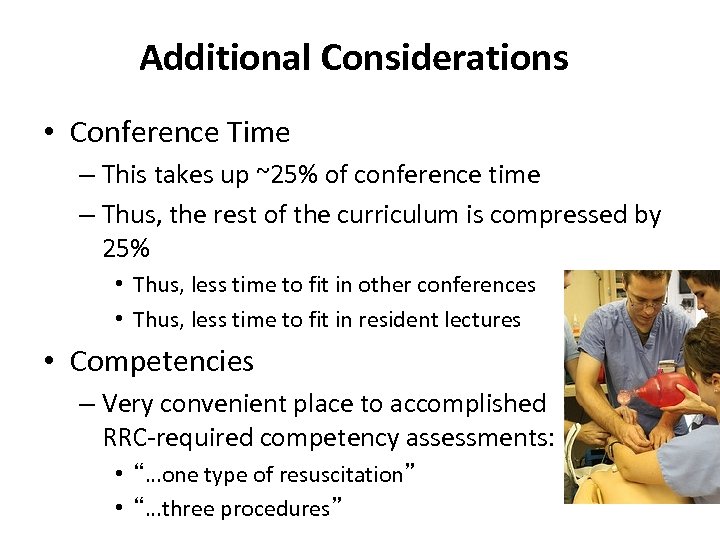 Additional Considerations • Conference Time – This takes up ~25% of conference time – Thus, the rest of the curriculum is compressed by 25% • Thus, less time to fit in other conferences • Thus, less time to fit in resident lectures • Competencies – Very convenient place to accomplished RRC-required competency assessments: • “…one type of resuscitation” • “…three procedures”
 Questions?
 Results of 2010 Asynchronous Learning Survey CORD Scientific Assembly 2011 San Diego, CA Matthew Waxman, MD Tess Klaristenfeld, MD, MPH Scott Votey, MD UCLA/Olive View-UCLA Emergency Medicine Residency Program
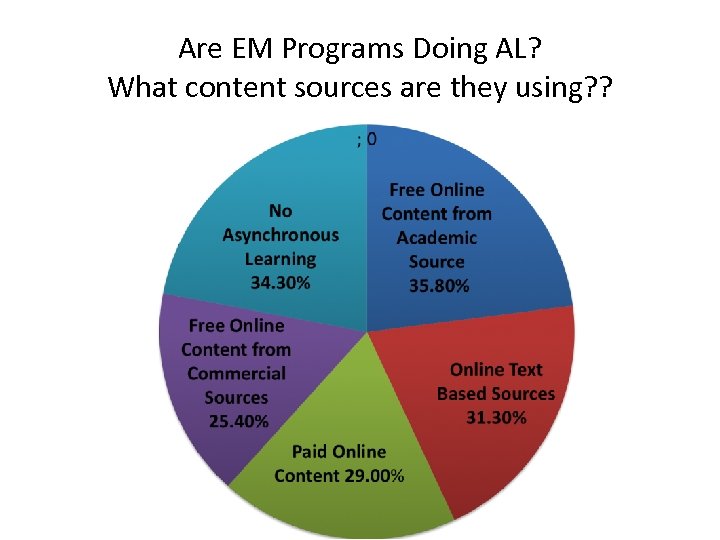
 Background • “research is needed to clearly define those educational activities that benefit from one type of of learning over another” – Conference Attendance Work Group 2008 CORD Scientific Assembly • What is the state of affairs (2010) for Asynchronous Learning(AL) in EM? • What are programs out there actually doing with AL? • What are the sources of content being used in AL? • Is Asynchronous Learning Meeting the Educational Goals of our Residents?
 Methods
 Are EM Programs Doing AL? What content sources are they using? ?
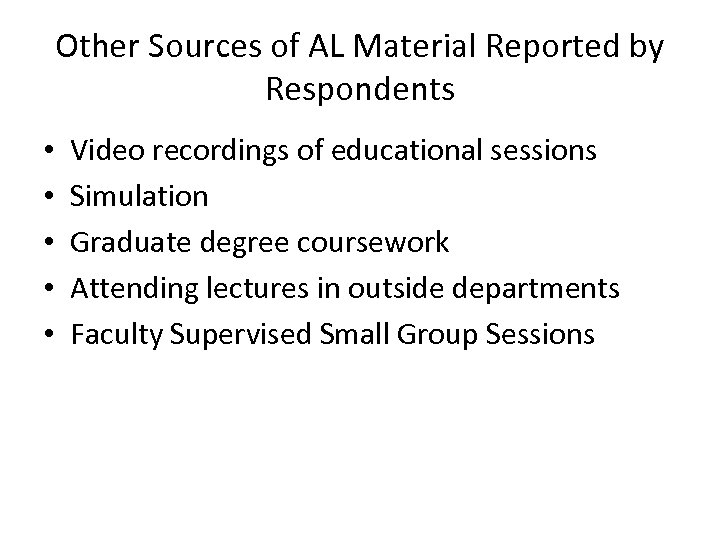 Other Sources of AL Material Reported by Respondents • • • Video recordings of educational sessions Simulation Graduate degree coursework Attending lectures in outside departments Faculty Supervised Small Group Sessions
 Why Programs are not using AL?
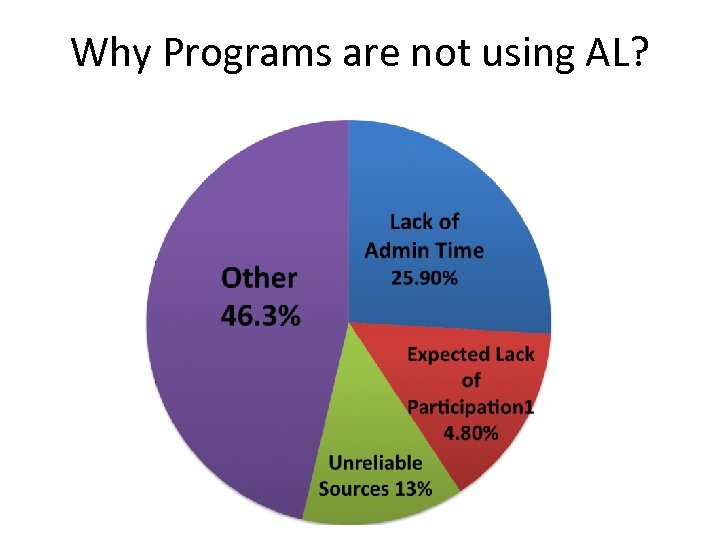
 Other Reasons by Respondents for not Using AL • Uncertainty of RRC/ACGME regulations • Perception of Cost • Technical issues in developing or maintaining sites for AL • “Have not drunk the Cool. Aid”
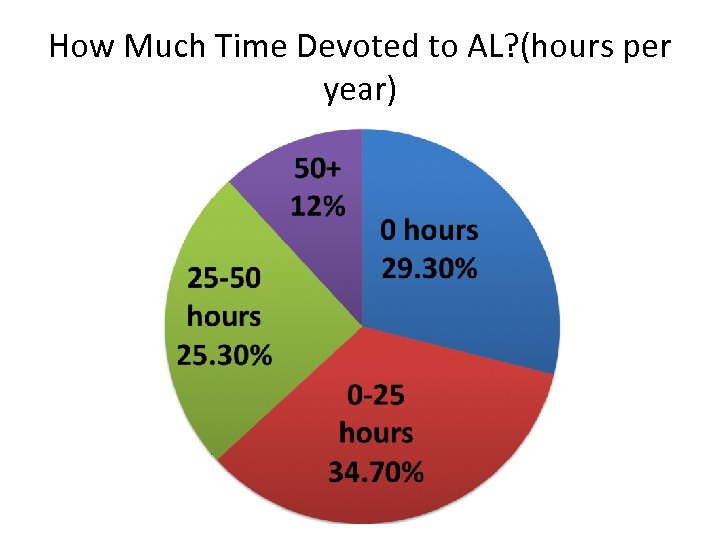 How Much Time Devoted to AL? (hours per year)
 Use of AL in Fulfilling Program Requirements • (48/85) 56% respondents stated they are using AL for conference credit • Variation between: Optional vs. Mandatory Mechanism for Remediation Unsatisfactory Conference Attendance
 Other Results • 92% of respondents interested in participating in online clearinghouse of asynchronous resources • 27 respondents (30%) are measuring resident learner satisfaction with AL – Measured in written evaluations of AL activities – Retreat feedback – Evaluations with PDs
 Limitation of Survey and Future Direction • Multiple PDs from each program may have responded • Did not survey each program • How should be measure success of AL • Is AL really an educational activity or is it getting residents out of conference? • Standardizing an EM Curriculum divided up amongst participating programs • Incorporation into ACGME language of “milestones in training”
 Our Favorite Asynchronous Sites • Gorgas School of Tropical Medicine Clinical Cases http: //gorgas. dom. uab. edu/ • Feinberg School of Medicine EM Radiology Teaching http: //www. feinberg. northwestern. edu/emer gencymed/residency/orthoteaching/index. html • UCSD Toxicology Teaching Modules