


 Скачать презентацию ASTR 100 Spring 2008 Introduction to Astronomy Properties
03e2f01f8e703c608eedb996ce970324.ppt
- Количество слайдов: 51
 ASTR 100 (Spring 2008) Introduction to Astronomy Properties of Light and Matter Prof. D. C. Richardson Sections 0101 -0106
 Summary So Far… n n Light is an electromagnetic wave. Visible light is tiny part of EM spectrum. Matter is made of atoms, which are made of protons, electrons, & neutrons. Matter and light interact: emission, absorption, transmission, reflection.
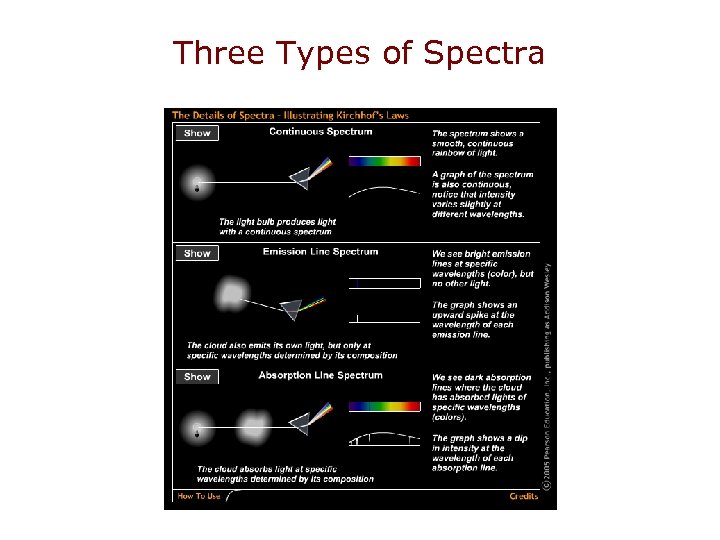 Three Types of Spectra
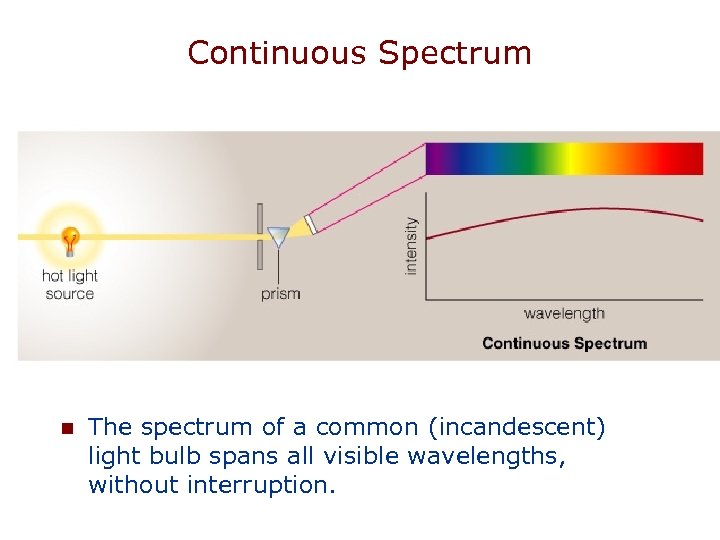 Continuous Spectrum n The spectrum of a common (incandescent) light bulb spans all visible wavelengths, without interruption.
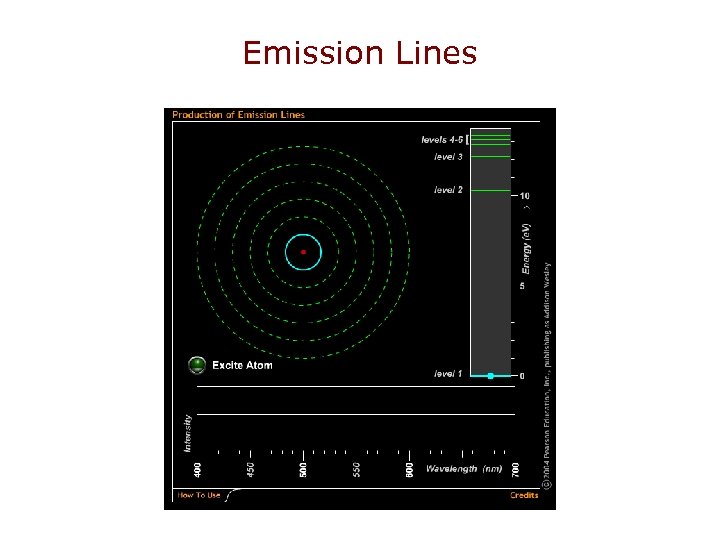
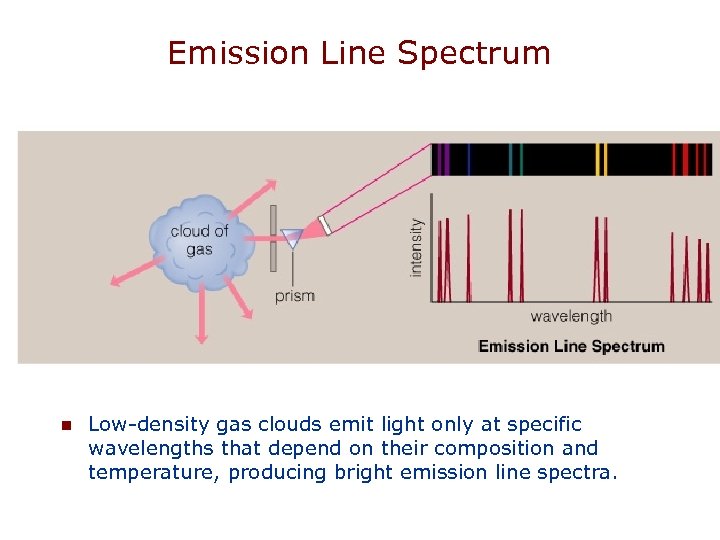 Emission Line Spectrum n Low-density gas clouds emit light only at specific wavelengths that depend on their composition and temperature, producing bright emission line spectra.
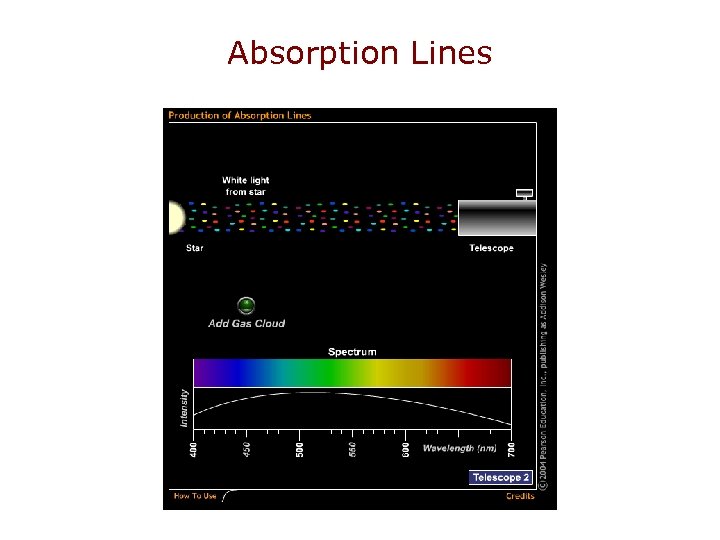
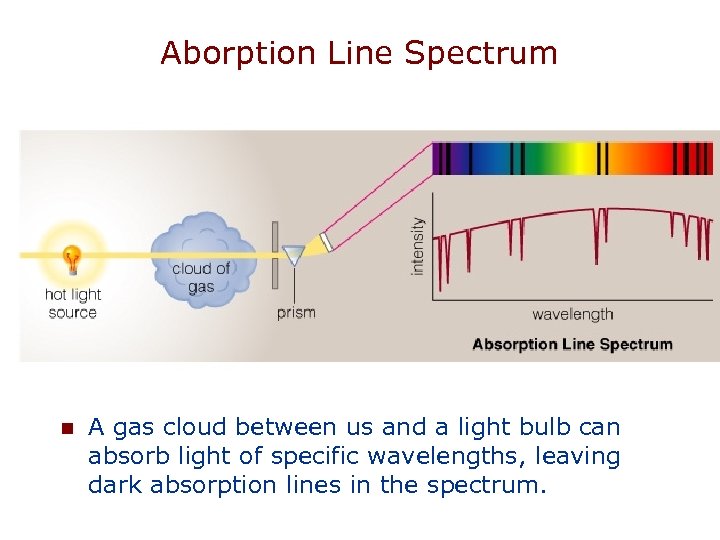 Aborption Line Spectrum n A gas cloud between us and a light bulb can absorb light of specific wavelengths, leaving dark absorption lines in the spectrum.
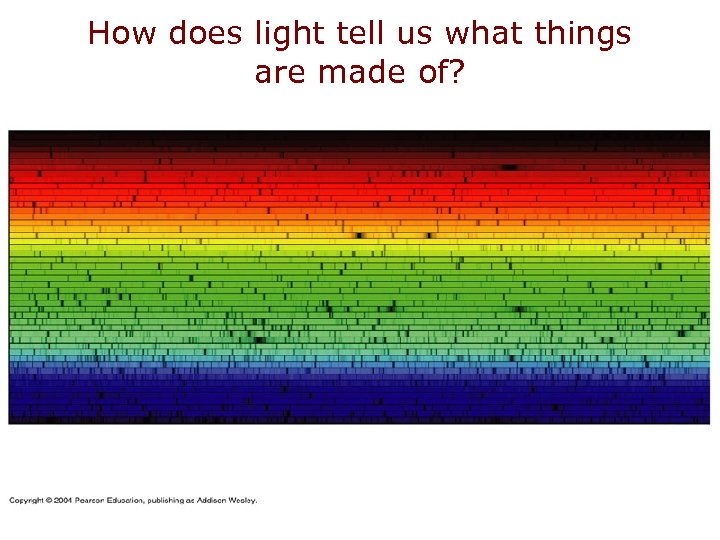 How does light tell us what things are made of?
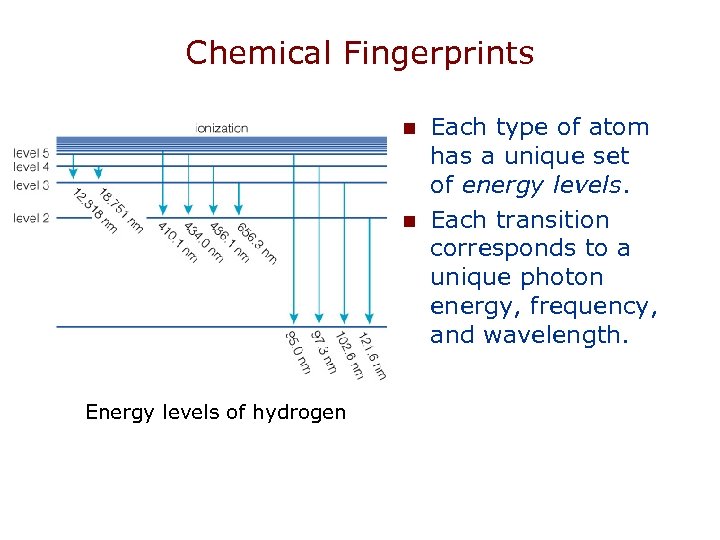 Chemical Fingerprints n n Energy levels of hydrogen Each type of atom has a unique set of energy levels. Each transition corresponds to a unique photon energy, frequency, and wavelength.
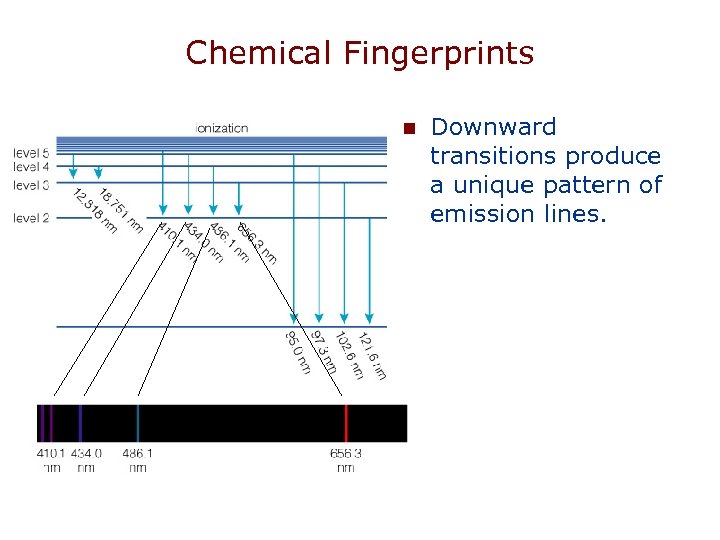 Chemical Fingerprints n Downward transitions produce a unique pattern of emission lines.
 Emission Lines
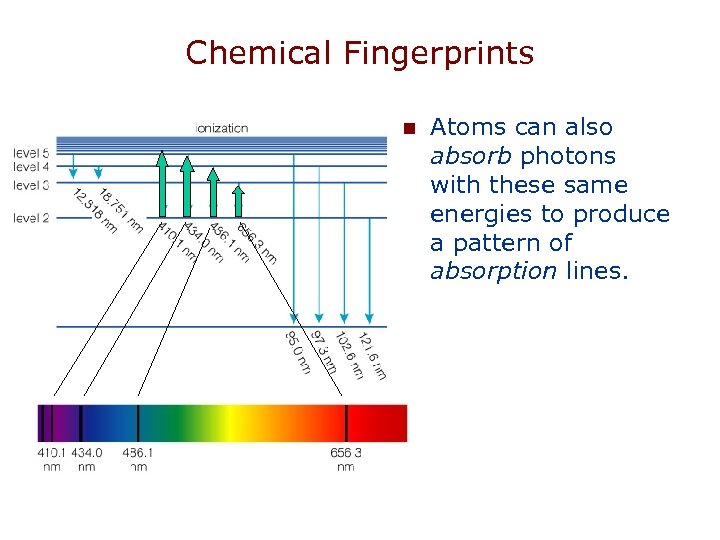 Chemical Fingerprints n Atoms can also absorb photons with these same energies to produce a pattern of absorption lines.
 Absorption Lines
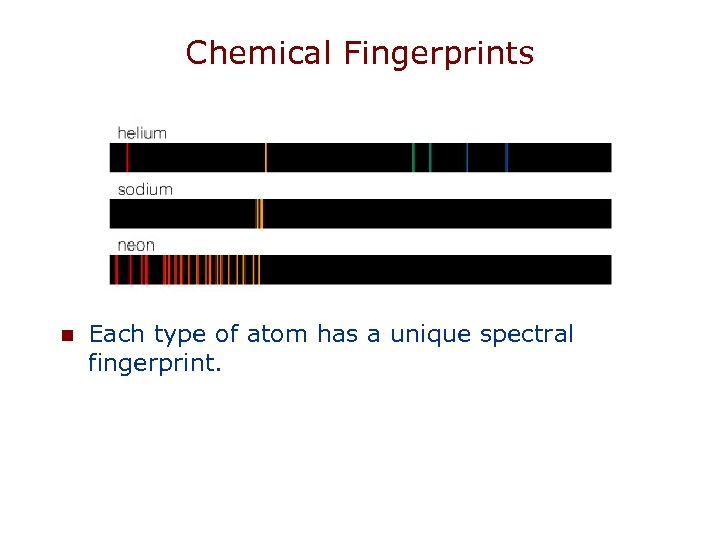 Chemical Fingerprints n Each type of atom has a unique spectral fingerprint.
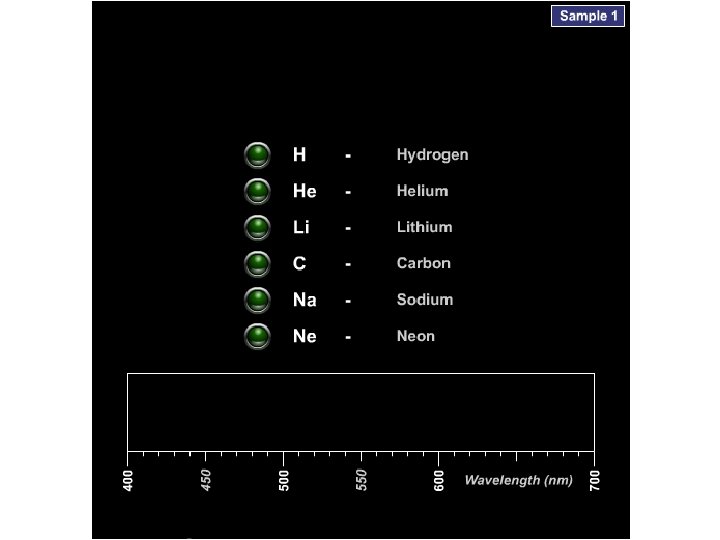
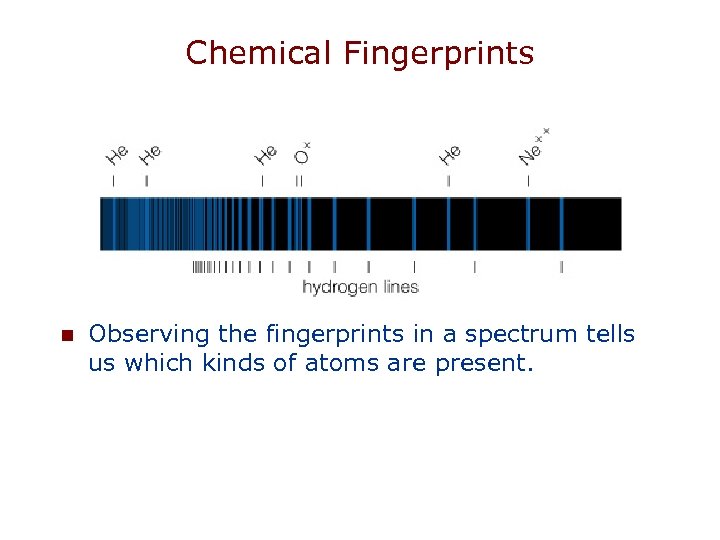 Chemical Fingerprints n Observing the fingerprints in a spectrum tells us which kinds of atoms are present.
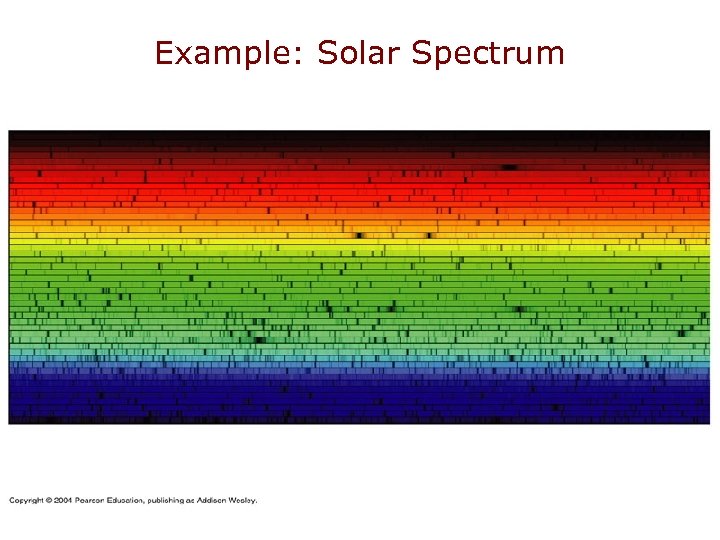 Example: Solar Spectrum
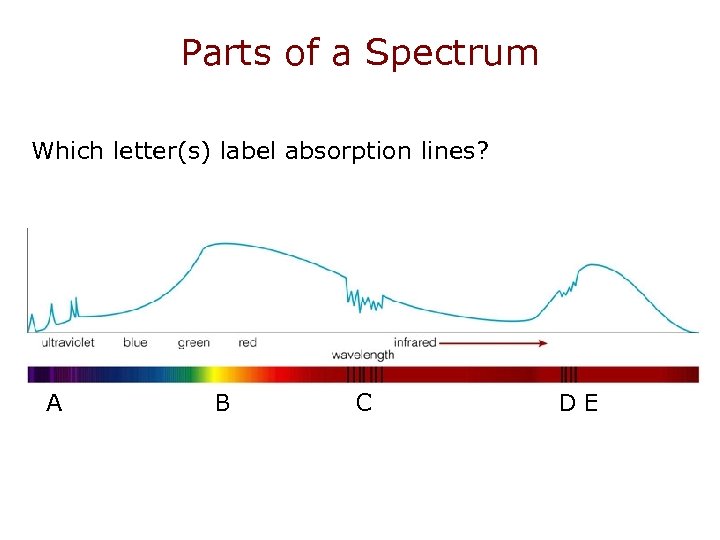 Parts of a Spectrum Which letter(s) label absorption lines? A B C DE
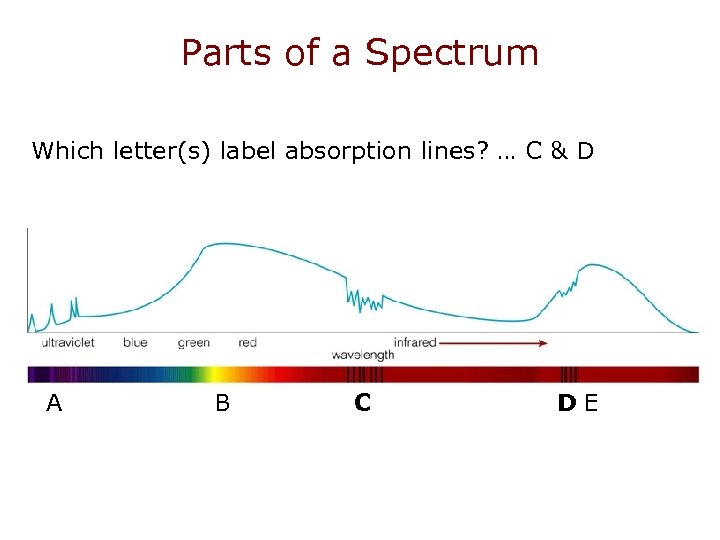 Parts of a Spectrum Which letter(s) label absorption lines? … C & D A B C DE
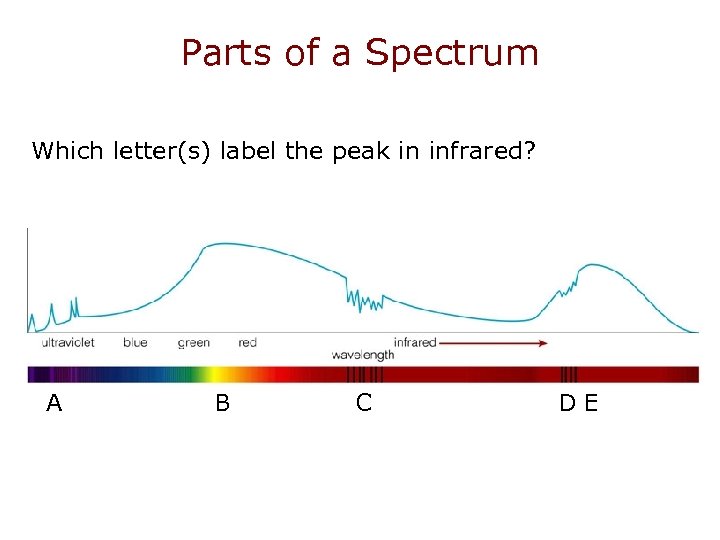 Parts of a Spectrum Which letter(s) label the peak in infrared? A B C DE
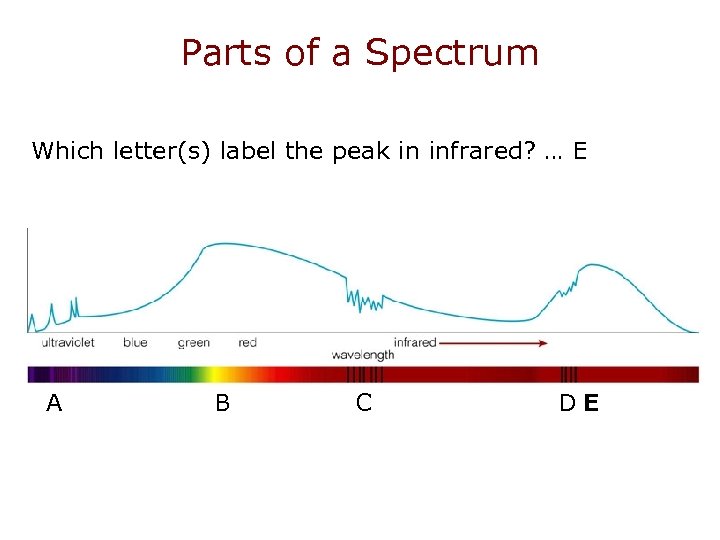 Parts of a Spectrum Which letter(s) label the peak in infrared? … E A B C DE
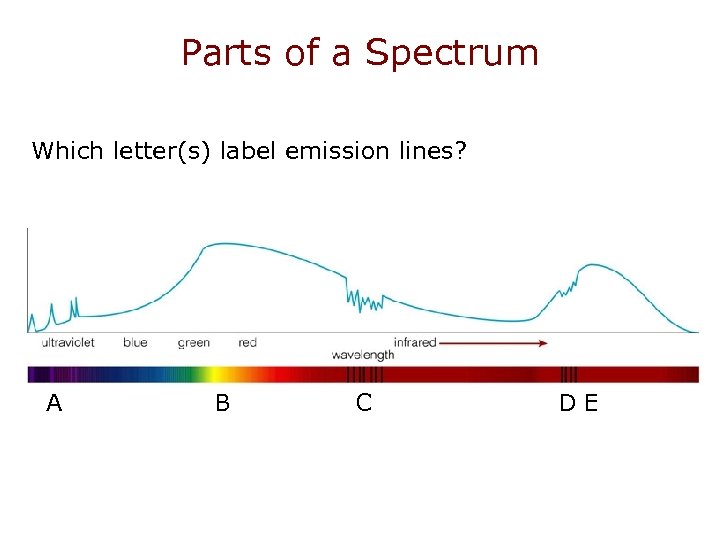 Parts of a Spectrum Which letter(s) label emission lines? A B C DE
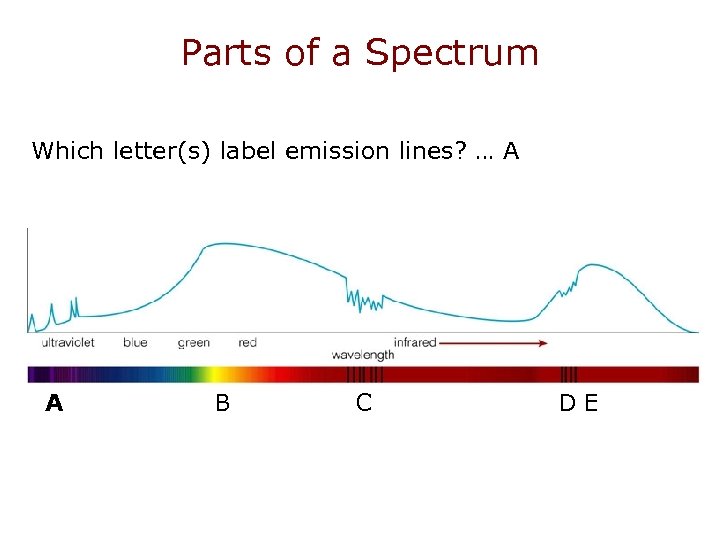 Parts of a Spectrum Which letter(s) label emission lines? … A A B C DE
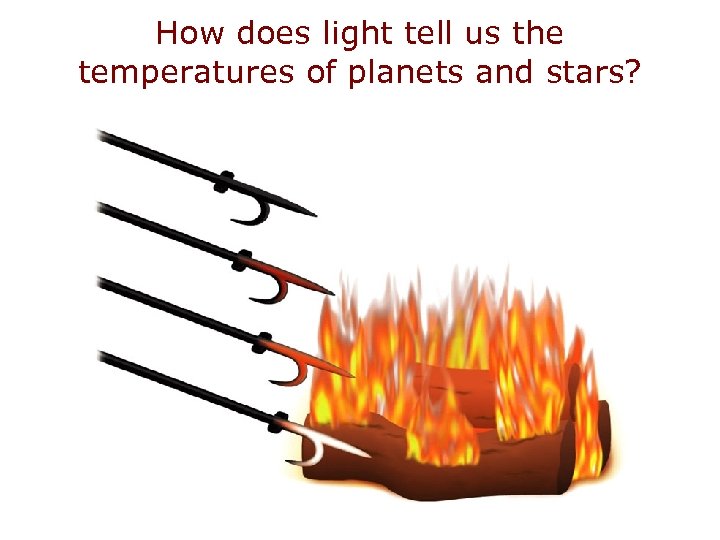 How does light tell us the temperatures of planets and stars?
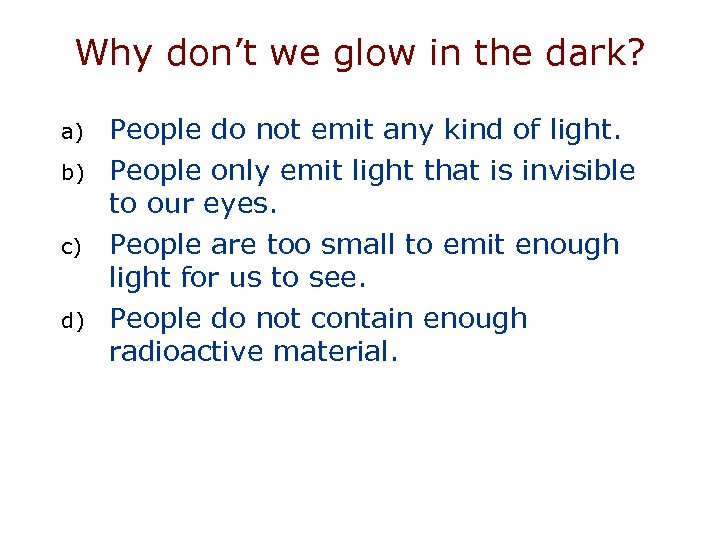
 Thermal Radiation n n Nearly all large or dense objects emit thermal radiation, including stars, planets, people… An object’s thermal radiation spectrum depends on only one property: its temperature.
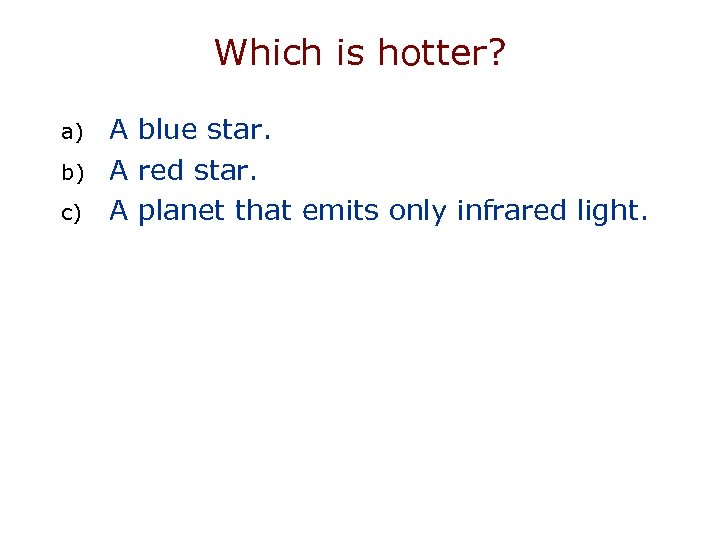
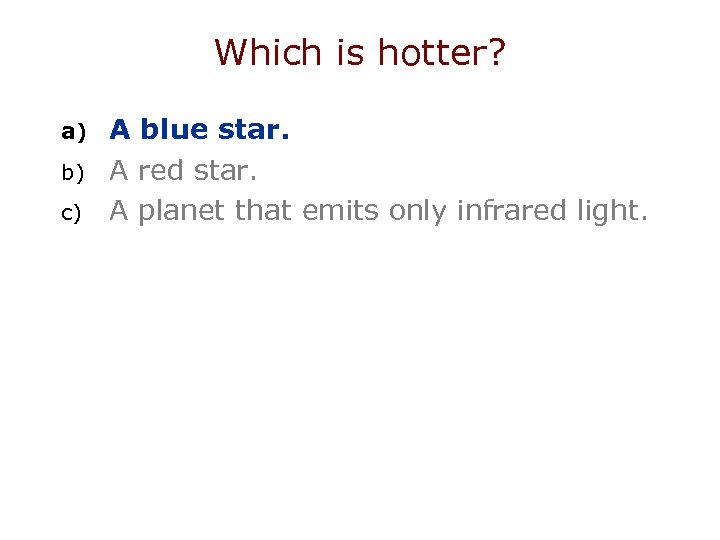
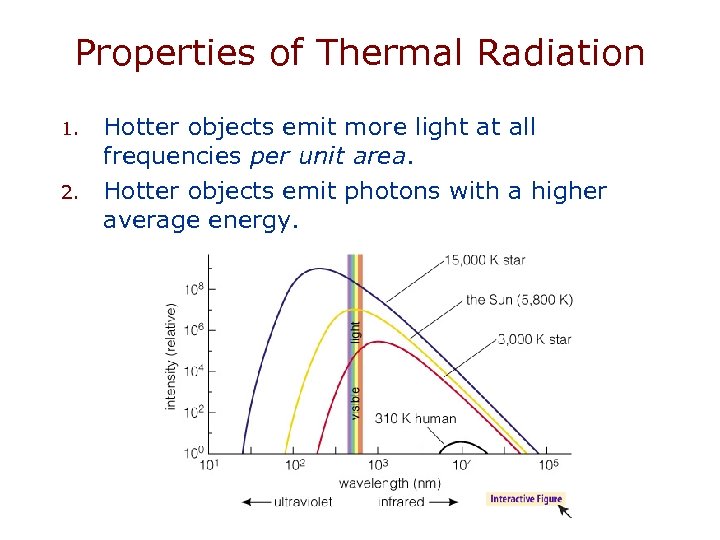 Properties of Thermal Radiation 1. 2. Hotter objects emit more light at all frequencies per unit area. Hotter objects emit photons with a higher average energy.
 Which is hotter? a) b) c) A blue star. A red star. A planet that emits only infrared light.
 Which is hotter? a) b) c) A blue star. A red star. A planet that emits only infrared light.
 Why don’t we glow in the dark? a) b) c) d) People do not emit any kind of light. People only emit light that is invisible to our eyes. People are too small to emit enough light for us to see. People do not contain enough radioactive material.
 Why don’t we glow in the dark? a) b) c) d) People do not emit any kind of light. People only emit light that is invisible to our eyes. People are too small to emit enough light for us to see. People do not contain enough radioactive material.
 How does light tell us the speed of a distant object? n n The Doppler Effect! Recall for sound waves: l l Approaching sound emitter has higher pitch (shorter wavelength). Receding sound emitter has lower pitch (longer wavelength).
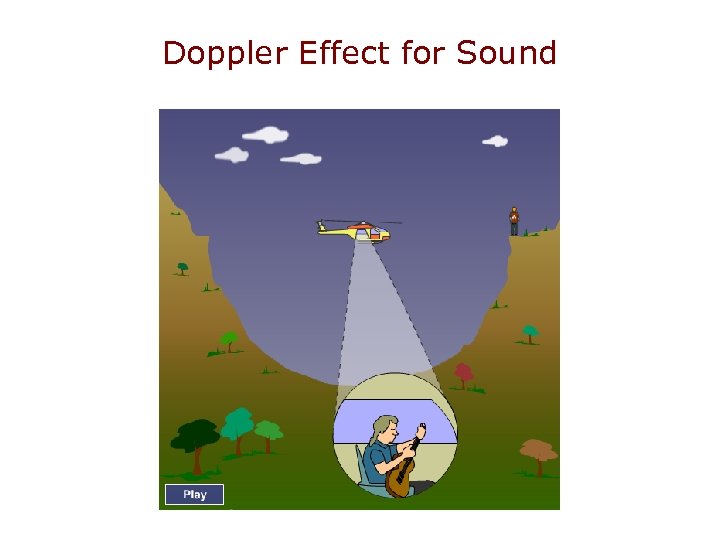 Doppler Effect for Sound
 How does light tell us the speed of a distant object? n n The Doppler Effect! Recall for sound waves: l l n Approaching sound emitter has higher pitch (shorter wavelength). Receding sound emitter has lower pitch (longer wavelength). Same thing for light! l l Approaching light emitter looks bluer (shorter wavelength). Receding light emitter looks redder (longer wavelength).
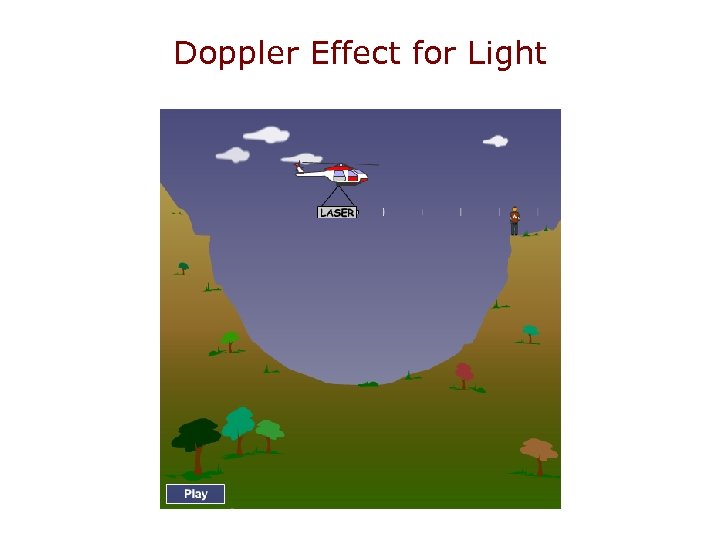 Doppler Effect for Light
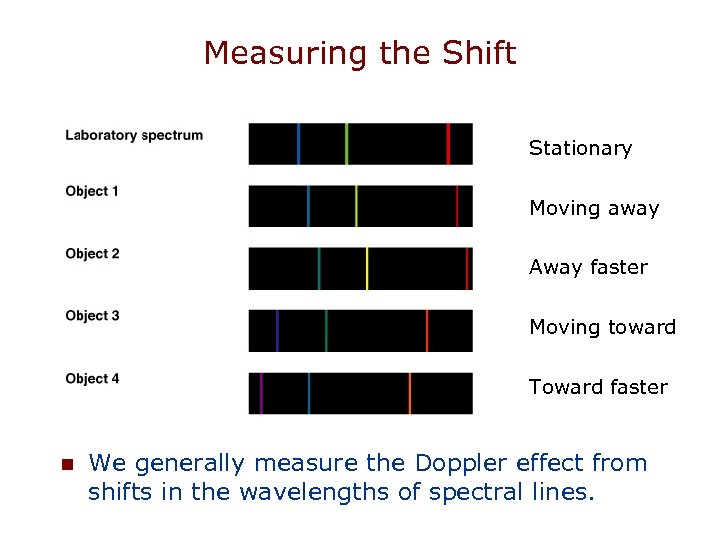 Measuring the Shift Stationary Moving away Away faster Moving toward Toward faster n We generally measure the Doppler effect from shifts in the wavelengths of spectral lines.
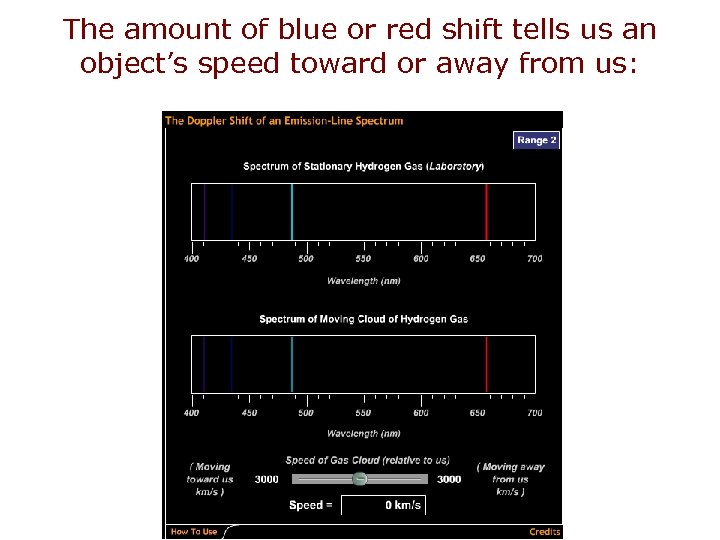 The amount of blue or red shift tells us an object’s speed toward or away from us:
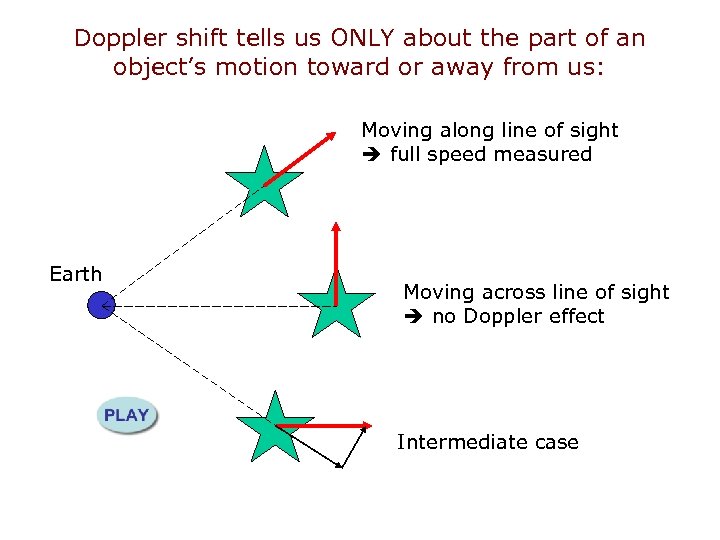 Doppler shift tells us ONLY about the part of an object’s motion toward or away from us: Moving along line of sight full speed measured Earth Moving across line of sight no Doppler effect Intermediate case
 Thought Question n n I measure a line in the lab at 500. 7 nm. The same line in a star has wavelength 502. 8 nm. What can I say about this star? A. B. C. It is moving away from me. It is moving towards me. It has unusually long spectral lines.
 Thought Question n n I measure a line in the lab at 500. 7 nm. The same line in a star has wavelength 502. 8 nm. What can I say about this star? A. B. C. It is moving away from me. It is moving towards me. It has unusually long spectral lines.
 ASTR 100 (Spring 2008) Introduction to Astronomy Collecting Light with Telescopes Prof. D. C. Richardson Sections 0101 -0106
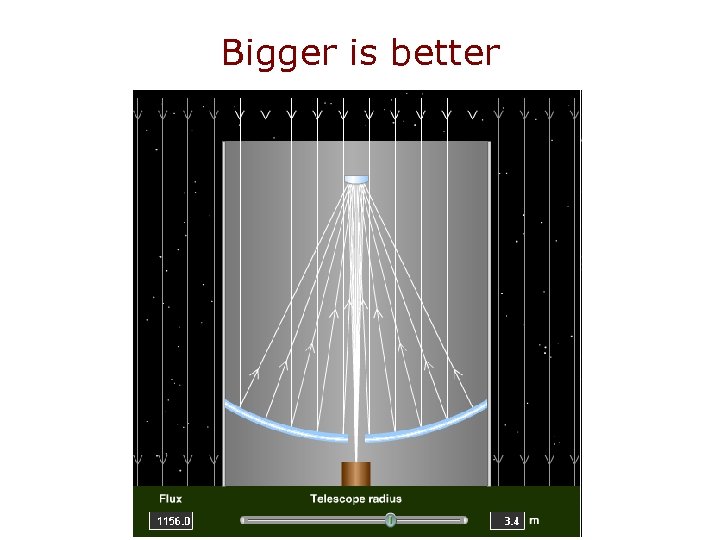
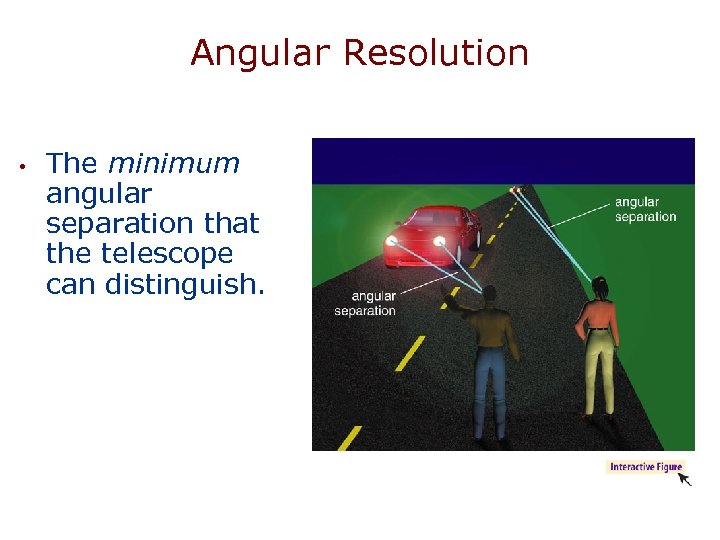
 How do telescopes help us learn about the universe? n n n Telescopes collect more light than our eyes light-collecting area. Telescopes can see more detail than our eyes angular resolution. Telescopes/instruments can detect light that is invisible to our eyes (e. g. , infrared, UV).
 Bigger is better 1. Larger light-collecting area. 2. Better angular resolution.
 Bigger is better
 Angular Resolution • The minimum angular separation that the telescope can distinguish.
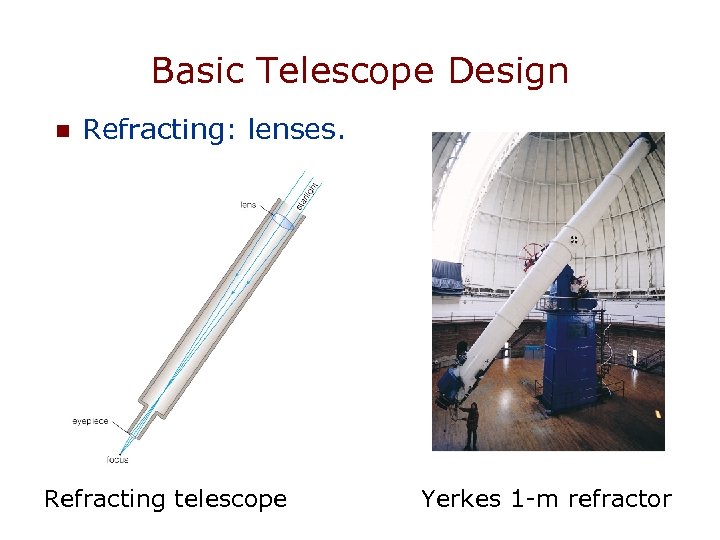 Basic Telescope Design n Refracting: lenses. Refracting telescope Yerkes 1 -m refractor
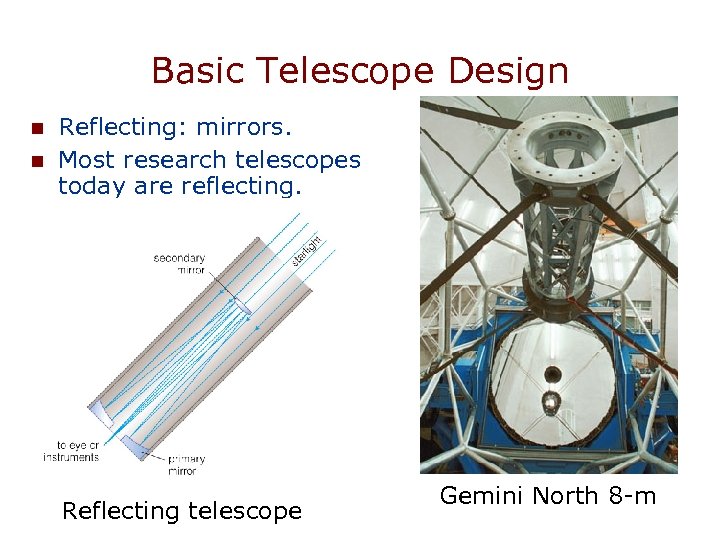 Basic Telescope Design n n Reflecting: mirrors. Most research telescopes today are reflecting. Reflecting telescope Gemini North 8 -m
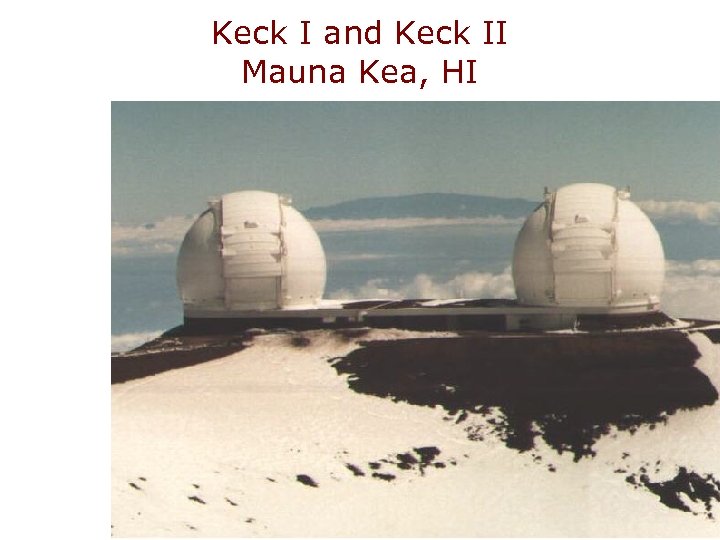 Keck I and Keck II Mauna Kea, HI
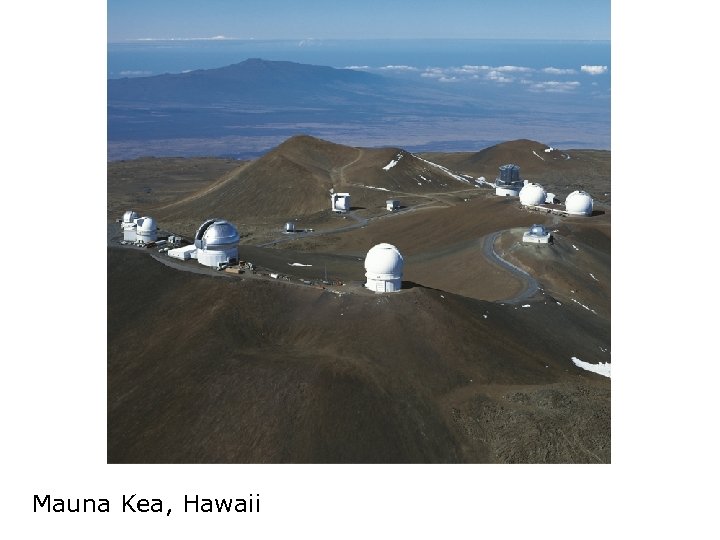 Mauna Kea, Hawaii
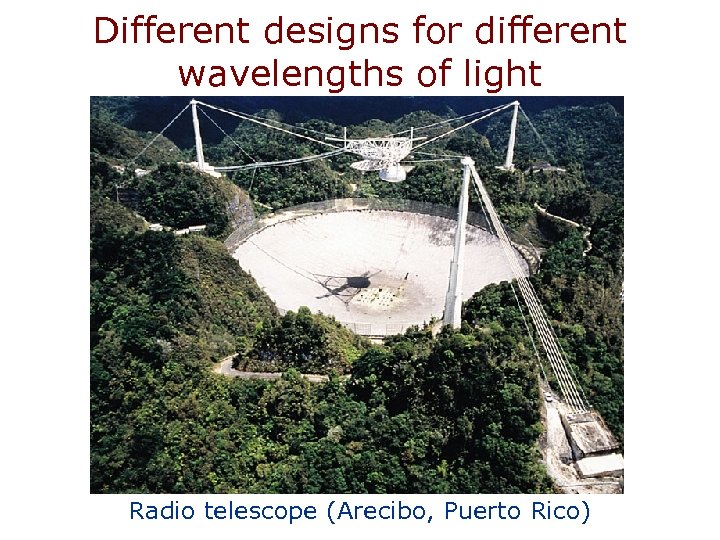 Different designs for different wavelengths of light Radio telescope (Arecibo, Puerto Rico)
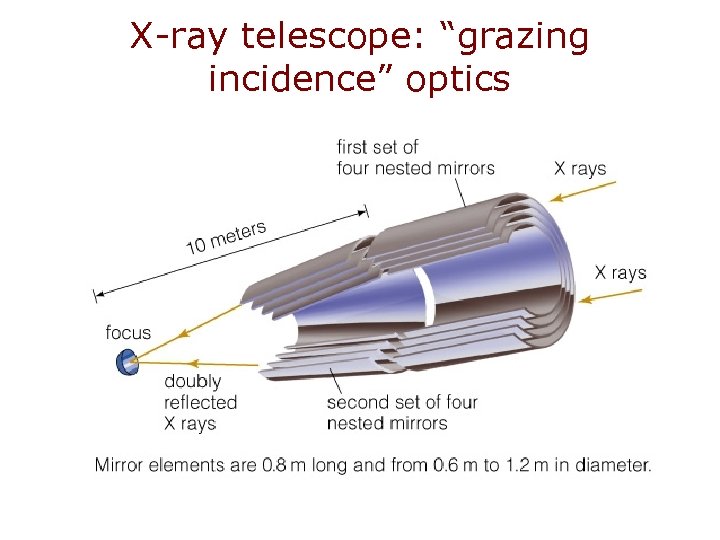 X-ray telescope: “grazing incidence” optics
 Want to buy your own telescope? n n Buy binoculars first (e. g. , 7 x 35) – you get much more for the same money. Ignore magnification (sales pitch!). Notice: aperture size, optical quality, portability. Consumer research: Astronomy, Sky & Telescope, Mercury; astronomy clubs.