


 Скачать презентацию Association Rules Repoussis Panagiotis Overview Association
378183c8e83ac91995ea7df4d276fe0c.ppt
- Количество слайдов: 27
 Association Rules Repoussis Panagiotis
 Overview • Association Rule Problem • Applications • The Apriori Algorithm • Discovering Association Rules • Techniques to Improve Efficiency of Association Rule Mining • Measures for Association Rules
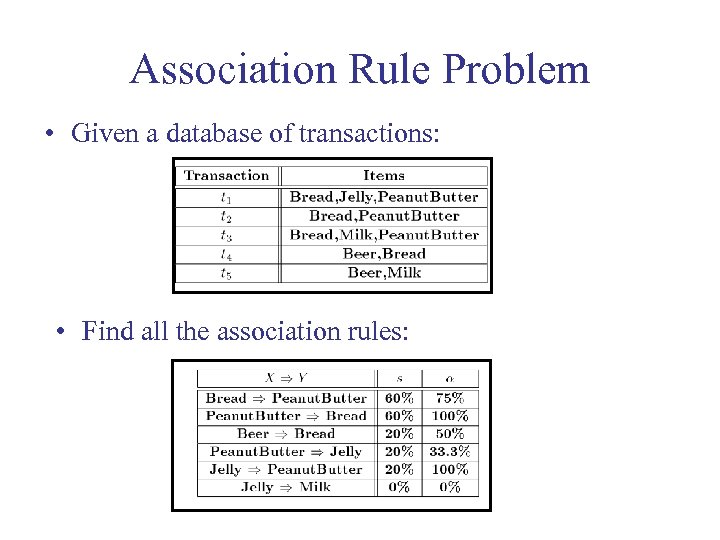 Association Rule Problem • Given a database of transactions: • Find all the association rules:
 Applications • Market Basket Analysis: given a database of customer transactions, where each transaction is a set of items the goal is to find groups of items which are frequently purchased together. • Telecommunication (each customer is a transaction containing the set of phone calls) • Credit Cards/ Banking Services (each card/account is a transaction containing the set of customer’s payments) • Medical Treatments (each patient is represented as a transaction containing the ordered set of diseases) • Basketball-Game Analysis (each game is represented as a transaction containing the ordered set of ball passes)
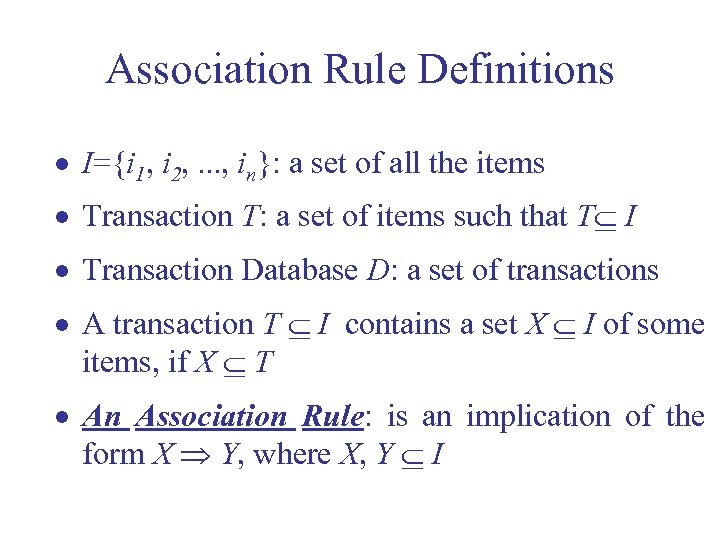 Association Rule Definitions · I={i 1, i 2, . . . , in}: a set of all the items · Transaction T: a set of items such that T I · Transaction Database D: a set of transactions · A transaction T I contains a set X I of some items, if X T · An Association Rule: is an implication of the form X Y, where X, Y I
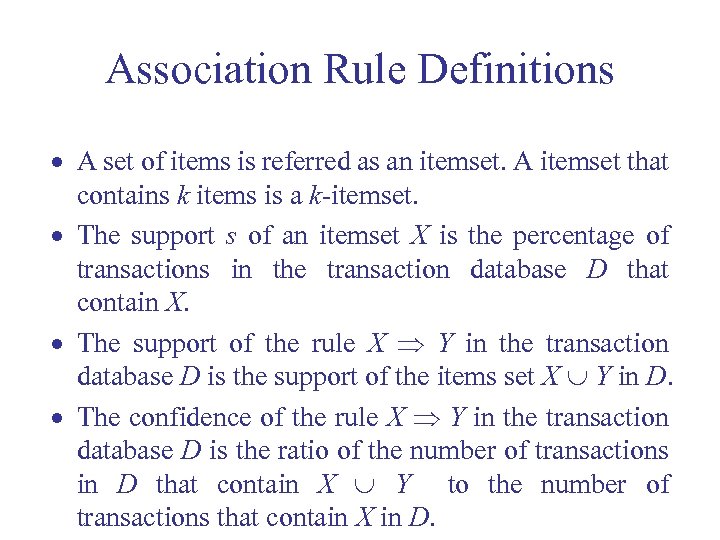 Association Rule Definitions · A set of items is referred as an itemset. A itemset that contains k items is a k-itemset. · The support s of an itemset X is the percentage of transactions in the transaction database D that contain X. · The support of the rule X Y in the transaction database D is the support of the items set X Y in D. · The confidence of the rule X Y in the transaction database D is the ratio of the number of transactions in D that contain X Y to the number of transactions that contain X in D.
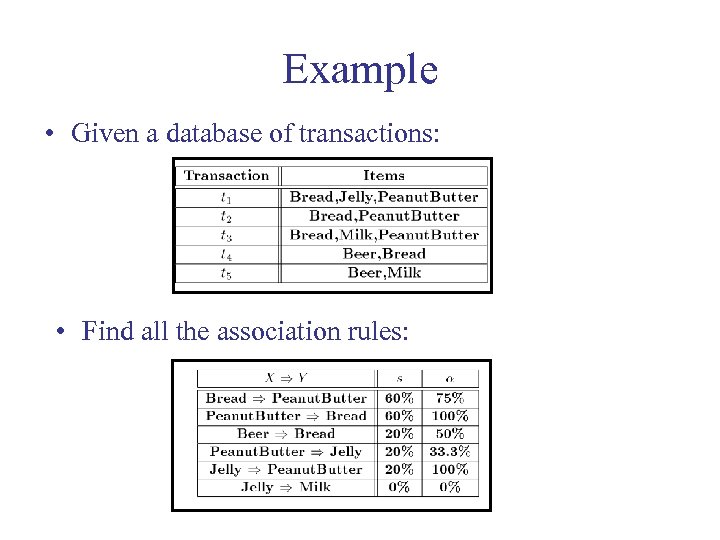 Example • Given a database of transactions: • Find all the association rules:
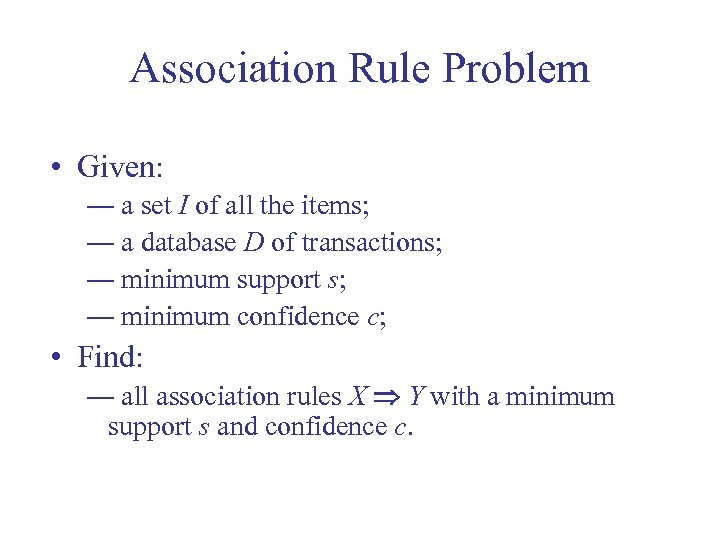 Association Rule Problem • Given: ― a set I of all the items; ― a database D of transactions; ― minimum support s; ― minimum confidence c; • Find: ― all association rules X Y with a minimum support s and confidence c.
 Problem Decomposition 1. Find all sets of items that have minimum support (frequent itemsets) 2. Use the frequent itemsets to generate the desired rules
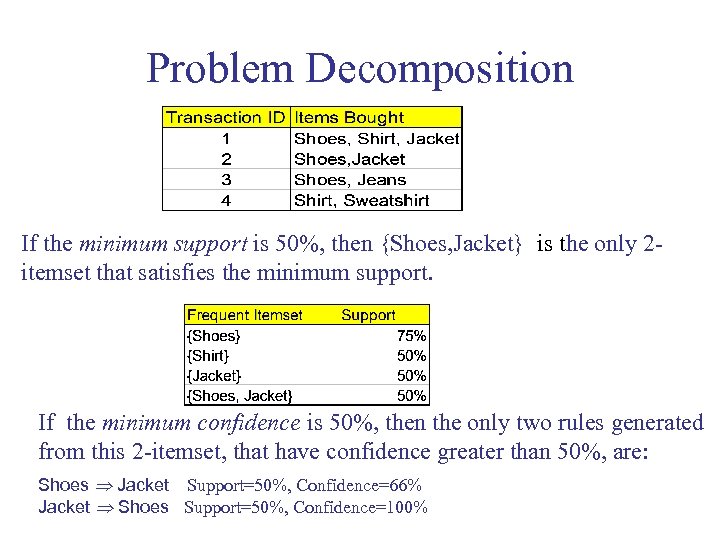 Problem Decomposition If the minimum support is 50%, then {Shoes, Jacket} is the only 2 itemset that satisfies the minimum support. If the minimum confidence is 50%, then the only two rules generated from this 2 -itemset, that have confidence greater than 50%, are: Shoes Jacket Support=50%, Confidence=66% Jacket Shoes Support=50%, Confidence=100%
 The Apriori Algorithm • Frequent Itemset Property: Any subset of a frequent itemset is frequent. • Contrapositive: If an itemset is not frequent, none of its supersets are frequent.
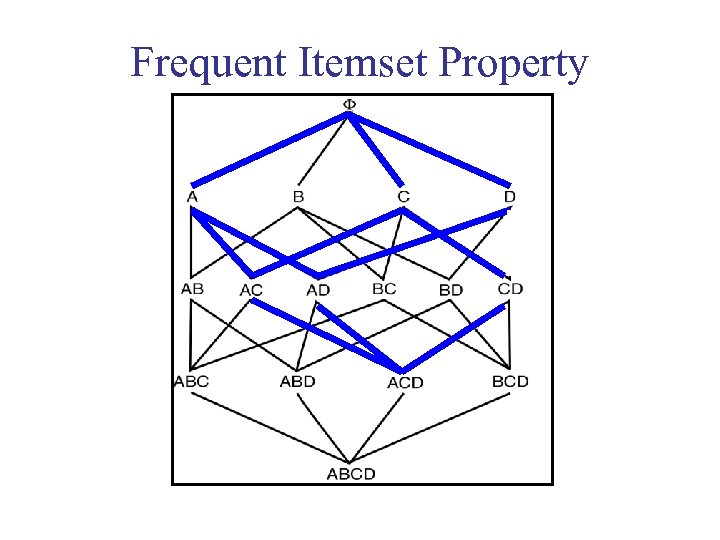 Frequent Itemset Property
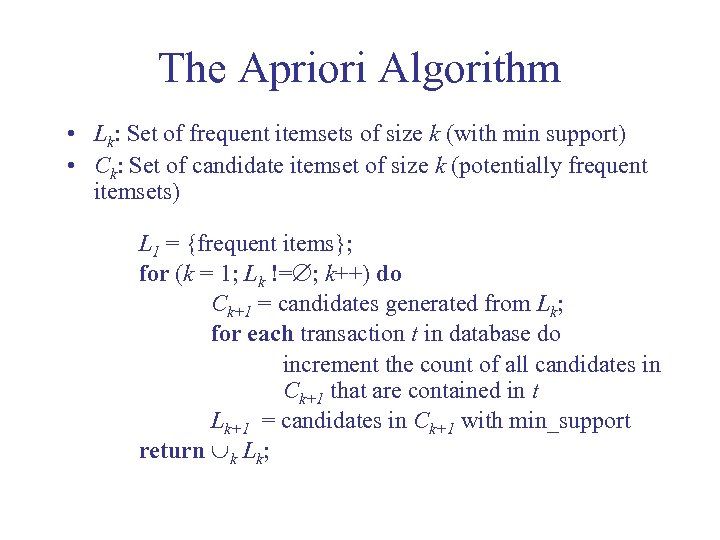 The Apriori Algorithm • Lk: Set of frequent itemsets of size k (with min support) • Ck: Set of candidate itemset of size k (potentially frequent itemsets) L 1 = {frequent items}; for (k = 1; Lk != ; k++) do Ck+1 = candidates generated from Lk; for each transaction t in database do increment the count of all candidates in Ck+1 that are contained in t Lk+1 = candidates in Ck+1 with min_support return k Lk;
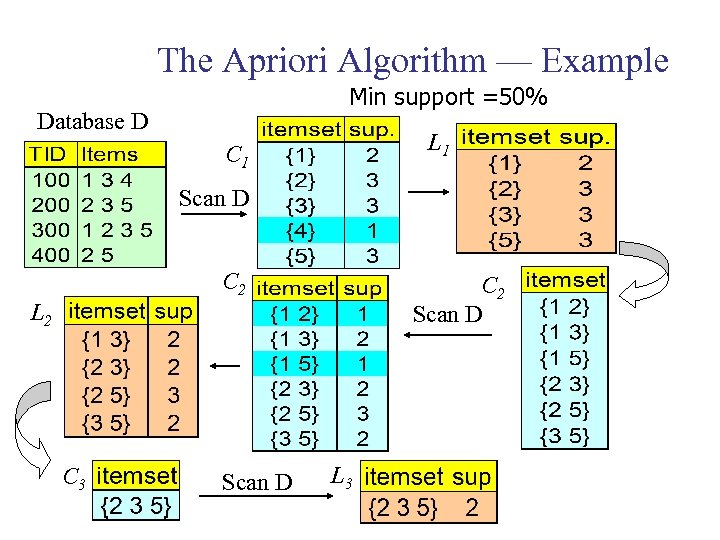 The Apriori Algorithm — Example Min support =50% Database D L 1 C 1 Scan D C 2 Scan D L 2 C 3 Scan D L 3
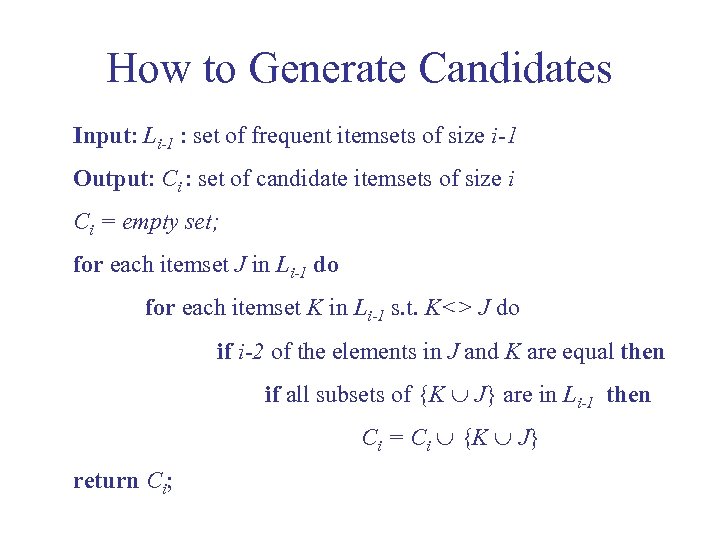 How to Generate Candidates Input: Li-1 : set of frequent itemsets of size i-1 Output: Ci : set of candidate itemsets of size i Ci = empty set; for each itemset J in Li-1 do for each itemset K in Li-1 s. t. K<> J do if i-2 of the elements in J and K are equal then if all subsets of {K J} are in Li-1 then Ci = Ci {K J} return Ci;
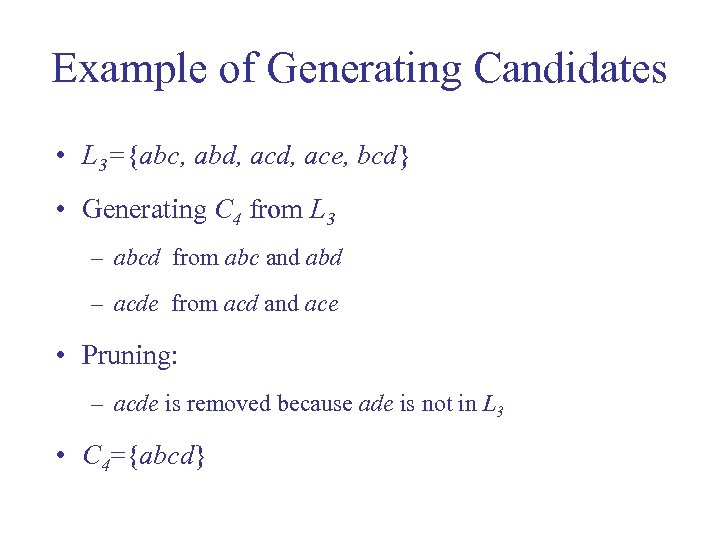 Example of Generating Candidates • L 3={abc, abd, ace, bcd} • Generating C 4 from L 3 – abcd from abc and abd – acde from acd and ace • Pruning: – acde is removed because ade is not in L 3 • C 4={abcd}
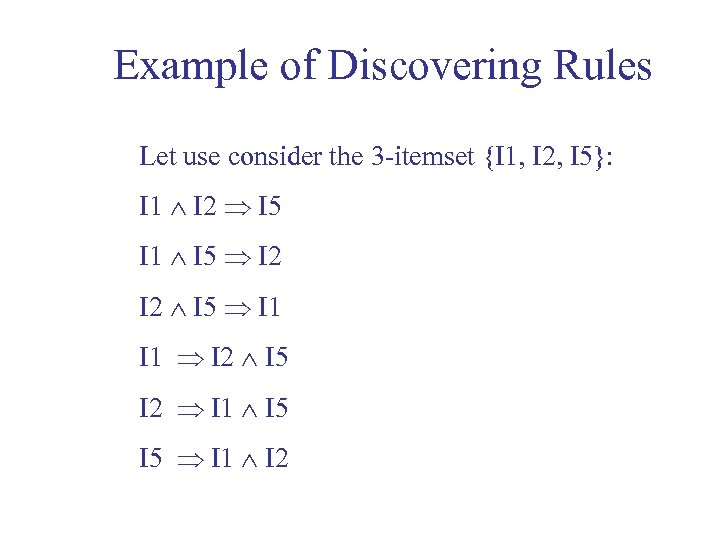 Example of Discovering Rules Let use consider the 3 -itemset {I 1, I 2, I 5}: I 1 I 2 I 5 I 1 I 5 I 2 I 5 I 1 I 2 I 5 I 2 I 1 I 5 I 1 I 2
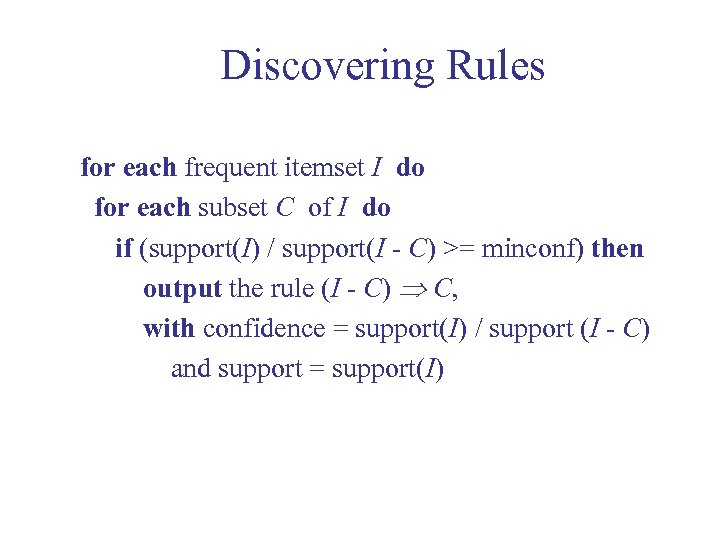 Discovering Rules for each frequent itemset I do for each subset C of I do if (support(I) / support(I - C) >= minconf) then output the rule (I - C) C, with confidence = support(I) / support (I - C) and support = support(I)
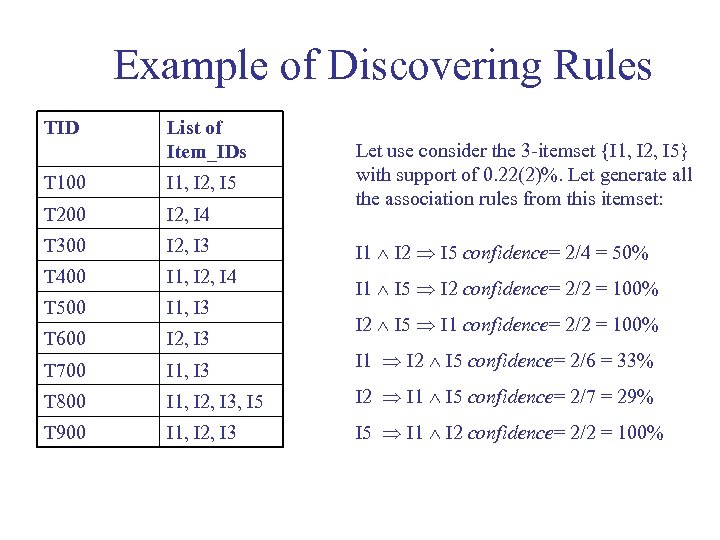 Example of Discovering Rules TID List of Item_IDs Let use consider the 3 -itemset {I 1, I 2, I 5} with support of 0. 22(2)%. Let generate all the association rules from this itemset: T 100 I 1, I 2, I 5 T 200 I 2, I 4 T 300 I 2, I 3 I 1 I 2 I 5 confidence= 2/4 = 50% T 400 I 1, I 2, I 4 T 500 I 1, I 3 I 1 I 5 I 2 confidence= 2/2 = 100% T 600 I 2, I 3 T 700 I 1, I 3 I 1 I 2 I 5 confidence= 2/6 = 33% T 800 I 1, I 2, I 3, I 5 I 2 I 1 I 5 confidence= 2/7 = 29% T 900 I 1, I 2, I 3 I 5 I 1 I 2 confidence= 2/2 = 100% I 2 I 5 I 1 confidence= 2/2 = 100%
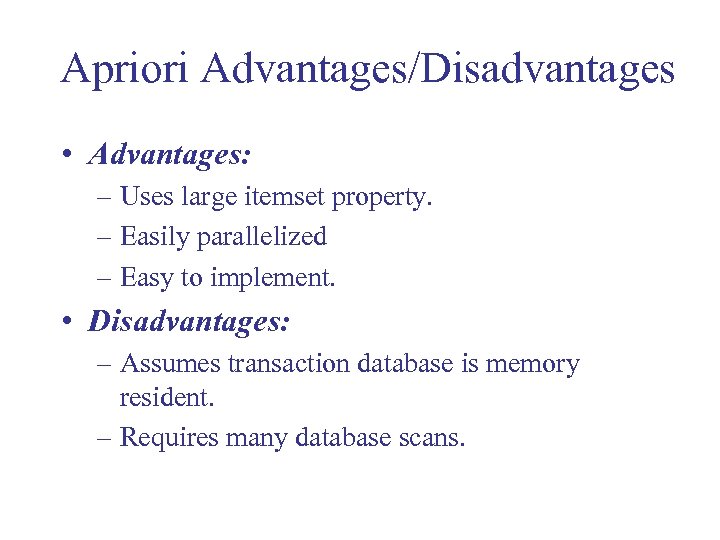 Apriori Advantages/Disadvantages • Advantages: – Uses large itemset property. – Easily parallelized – Easy to implement. • Disadvantages: – Assumes transaction database is memory resident. – Requires many database scans.
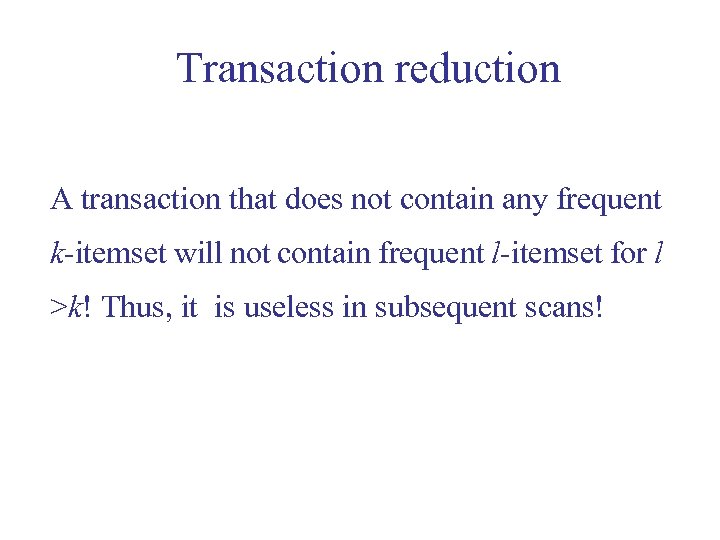 Transaction reduction A transaction that does not contain any frequent k-itemset will not contain frequent l-itemset for l >k! Thus, it is useless in subsequent scans!
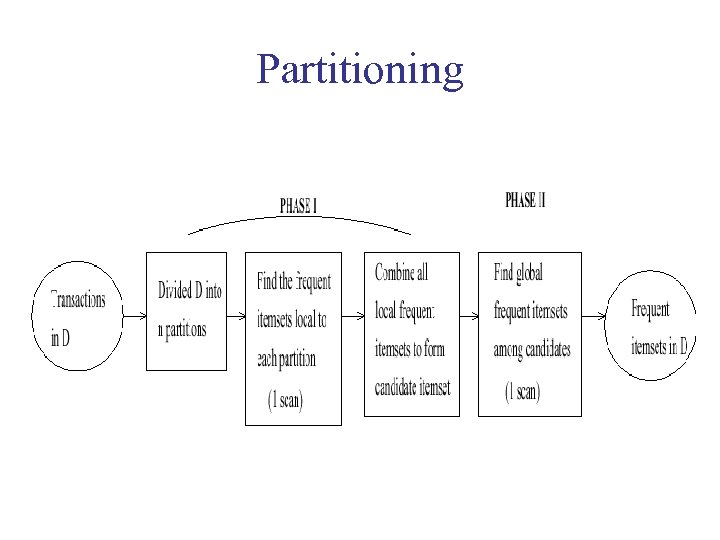 Partitioning
 Sampling Mining on a subset of given data, lower support threshold + a method to determine the completeness
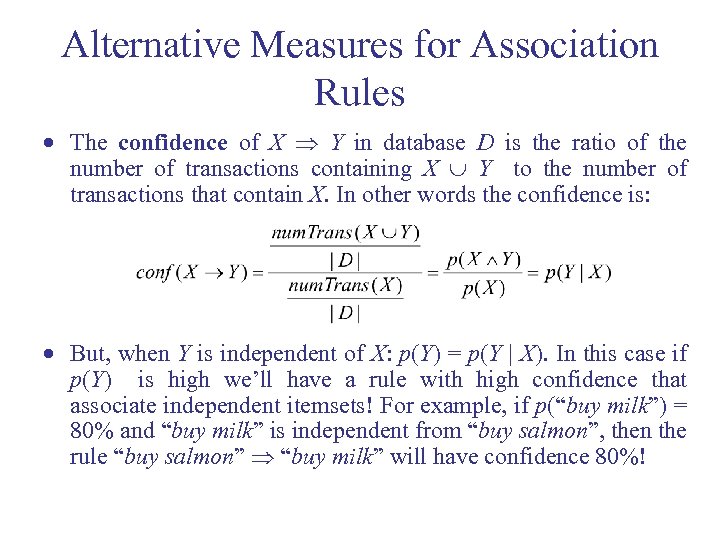 Alternative Measures for Association Rules · The confidence of X Y in database D is the ratio of the number of transactions containing X Y to the number of transactions that contain X. In other words the confidence is: · But, when Y is independent of X: p(Y) = p(Y | X). In this case if p(Y) is high we’ll have a rule with high confidence that associate independent itemsets! For example, if p(“buy milk”) = 80% and “buy milk” is independent from “buy salmon”, then the rule “buy salmon” “buy milk” will have confidence 80%!
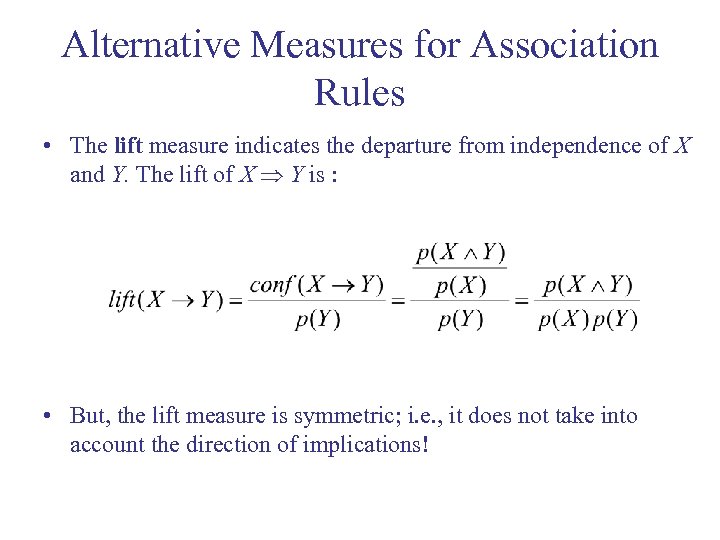 Alternative Measures for Association Rules • The lift measure indicates the departure from independence of X and Y. The lift of X Y is : • But, the lift measure is symmetric; i. e. , it does not take into account the direction of implications!
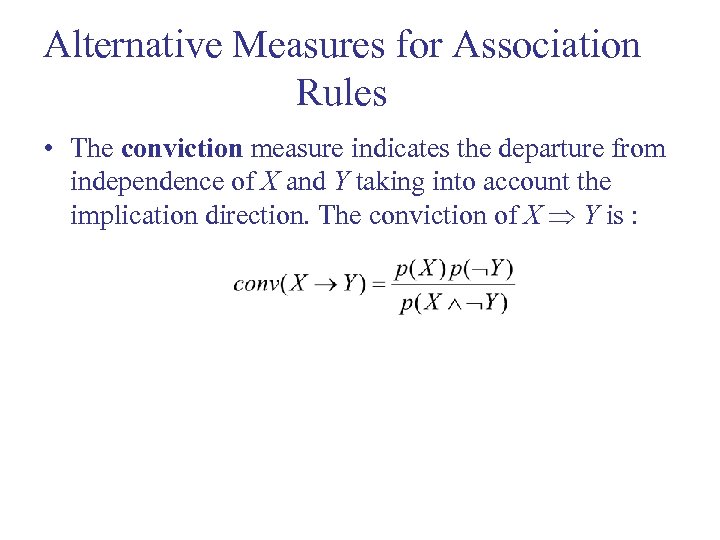 Alternative Measures for Association Rules • The conviction measure indicates the departure from independence of X and Y taking into account the implication direction. The conviction of X Y is :
 Summary 1. Association Rules form an very applied data mining approach. 2. Association Rules are derived from frequent itemsets. 3. The Apriori algorithm is an efficient algorithm for finding all frequent itemsets. 4. The Apriori algorithm implements level-wise search using frequent irem property. 5. The Apriori algorithm can be additionally optimised. 6. There are many measures for association rules.