


 Скачать презентацию Association Rules Outline Goal Provide an overview of
12b65d3aa7f5144bc996962641163ff2.ppt
- Количество слайдов: 82
 Association Rules Outline Goal: Provide an overview of basic Association Rule mining techniques • Association Rules Problem Overview – Large itemsets • Association Rules Algorithms – Apriori – Eclat
 Example: Market Basket Data • Items frequently purchased together: Bread Peanut. Butter • Uses: – Placement – Advertising – Sales – Coupons • Objective: increase sales and reduce costs
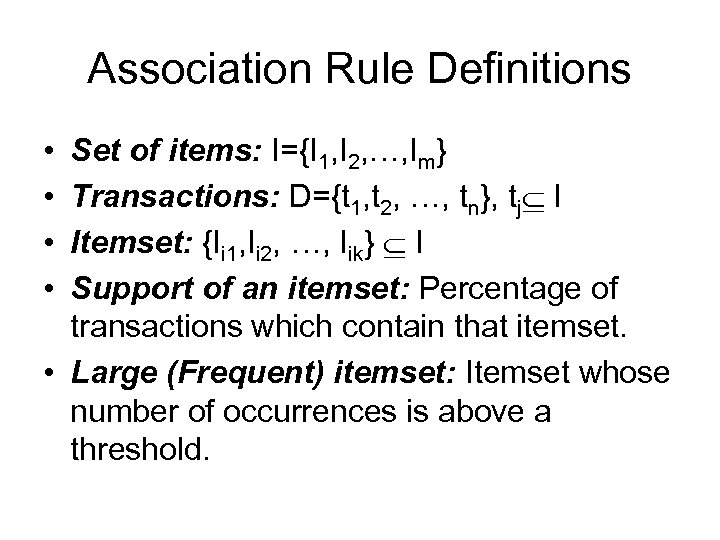 Association Rule Definitions • • Set of items: I={I 1, I 2, …, Im} Transactions: D={t 1, t 2, …, tn}, tj I Itemset: {Ii 1, Ii 2, …, Iik} I Support of an itemset: Percentage of transactions which contain that itemset. • Large (Frequent) itemset: Itemset whose number of occurrences is above a threshold.
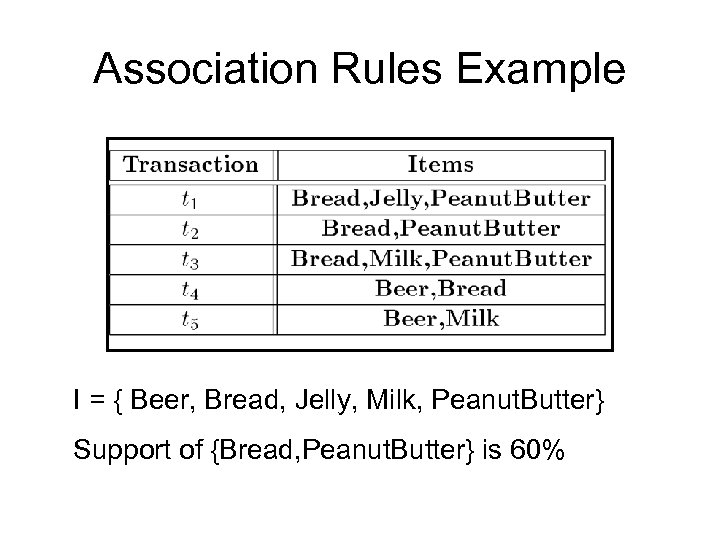 Association Rules Example I = { Beer, Bread, Jelly, Milk, Peanut. Butter} Support of {Bread, Peanut. Butter} is 60%
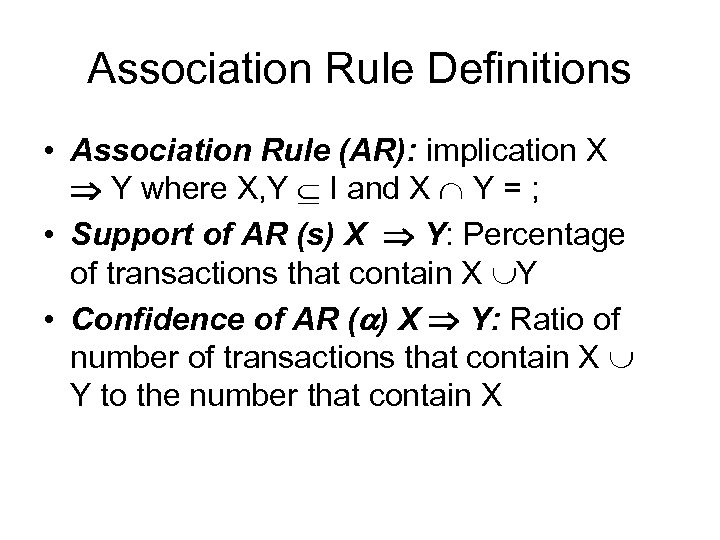 Association Rule Definitions • Association Rule (AR): implication X Y where X, Y I and X Y = ; • Support of AR (s) X Y: Percentage of transactions that contain X Y • Confidence of AR (a) X Y: Ratio of number of transactions that contain X Y to the number that contain X
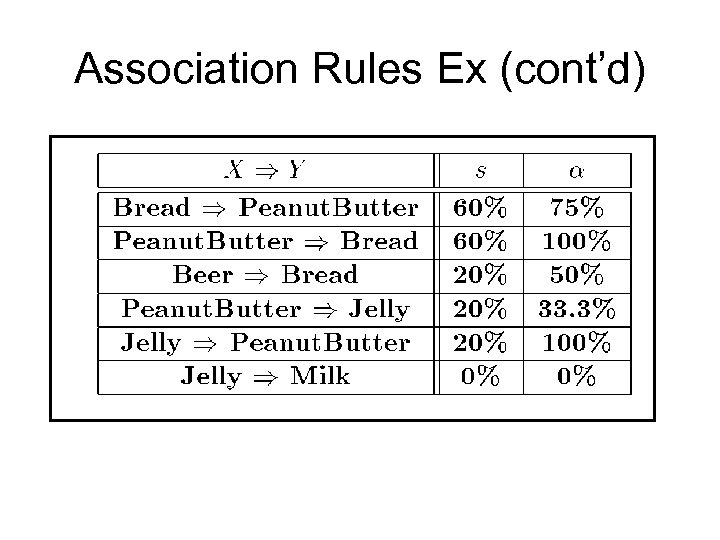 Association Rules Ex (cont’d)
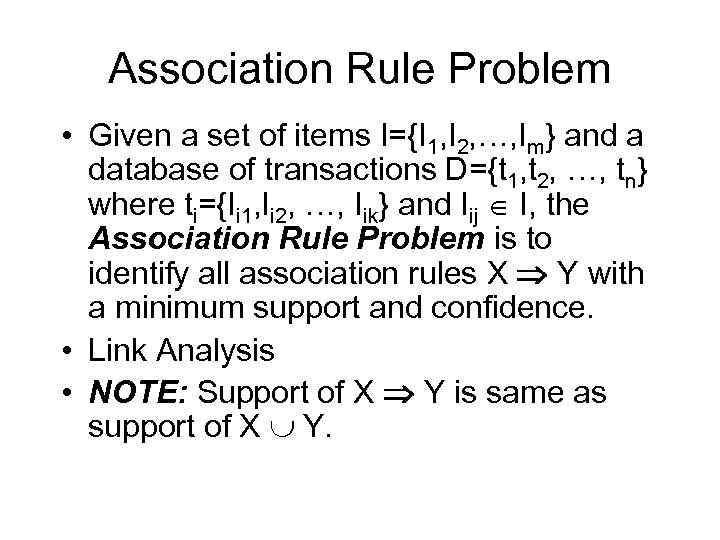 Association Rule Problem • Given a set of items I={I 1, I 2, …, Im} and a database of transactions D={t 1, t 2, …, tn} where ti={Ii 1, Ii 2, …, Iik} and Iij I, the Association Rule Problem is to identify all association rules X Y with a minimum support and confidence. • Link Analysis • NOTE: Support of X Y is same as support of X Y.
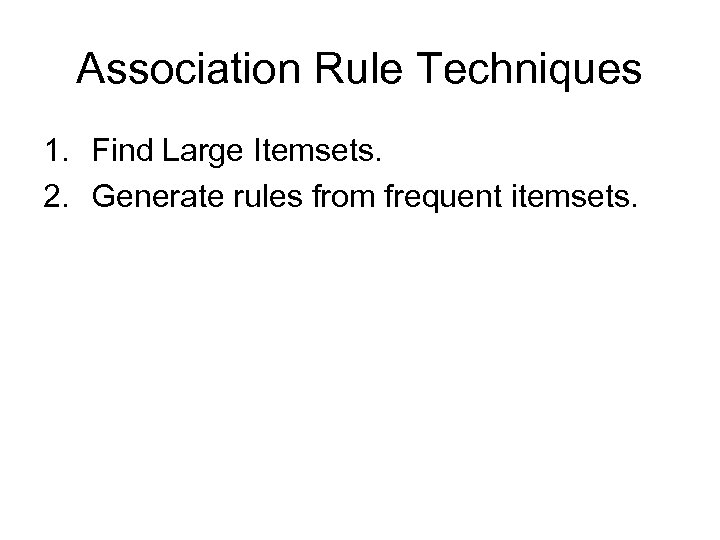 Association Rule Techniques 1. Find Large Itemsets. 2. Generate rules from frequent itemsets.
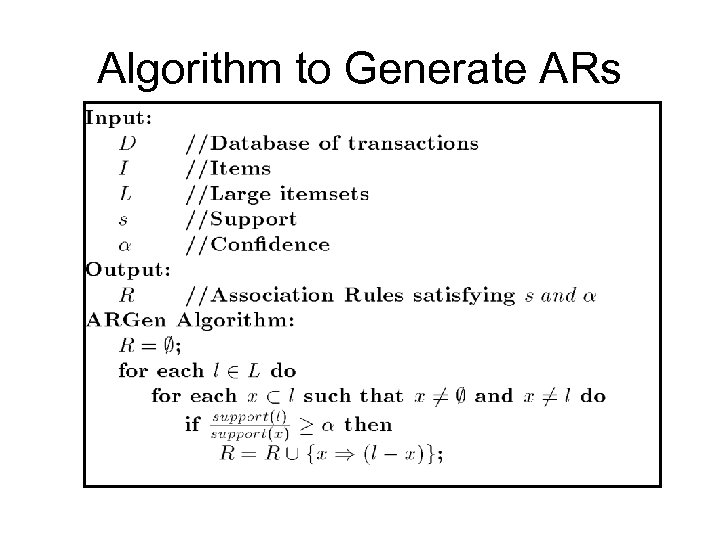 Algorithm to Generate ARs
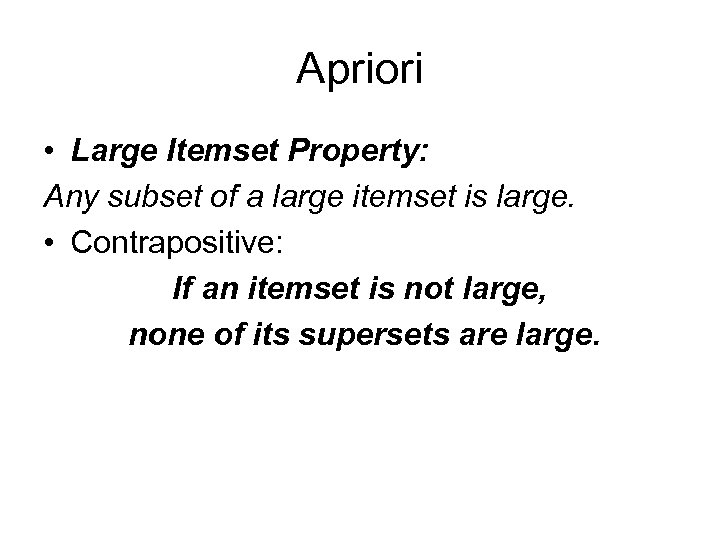 Apriori • Large Itemset Property: Any subset of a large itemset is large. • Contrapositive: If an itemset is not large, none of its supersets are large.
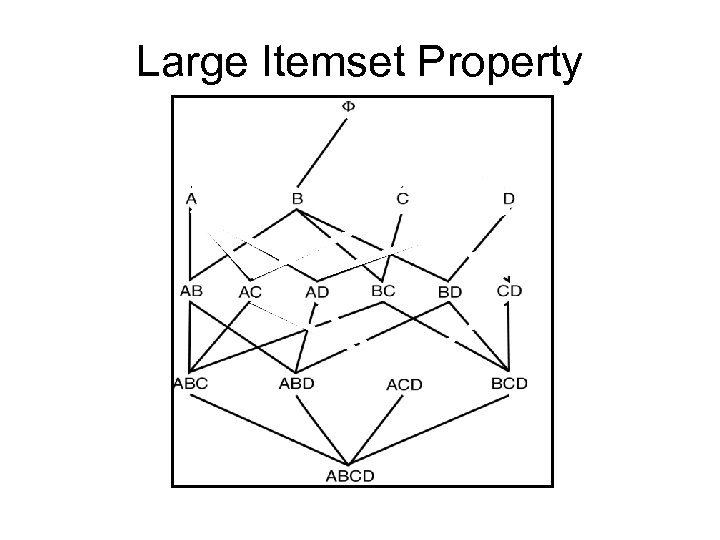 Large Itemset Property
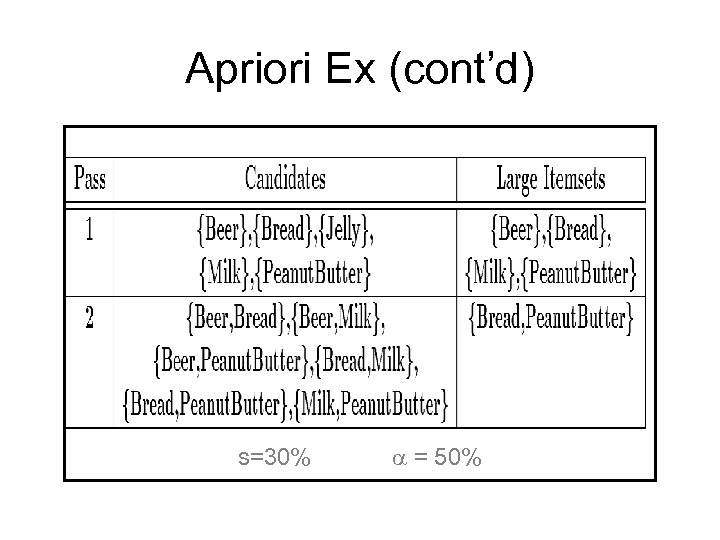 Apriori Ex (cont’d) s=30% a = 50%
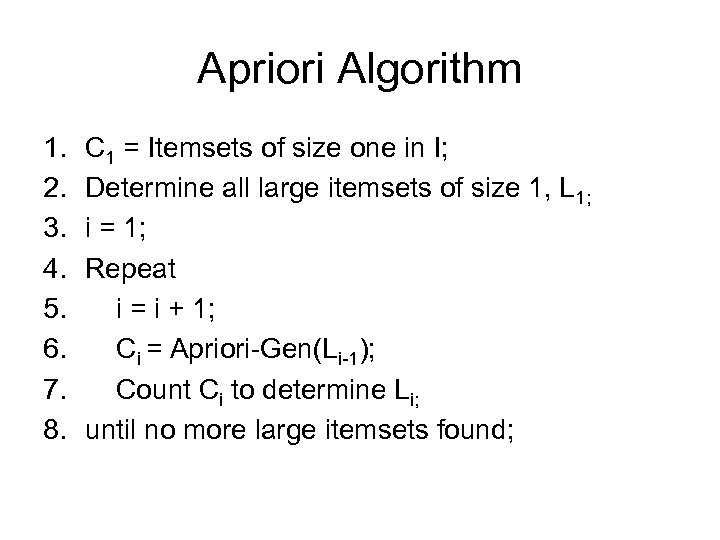 Apriori Algorithm 1. 2. 3. 4. 5. 6. 7. 8. C 1 = Itemsets of size one in I; Determine all large itemsets of size 1, L 1; i = 1; Repeat i = i + 1; Ci = Apriori-Gen(Li-1); Count Ci to determine Li; until no more large itemsets found;
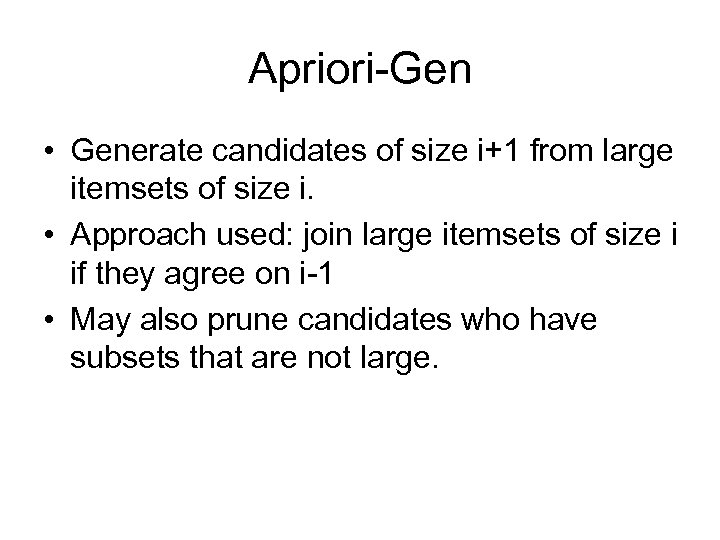 Apriori-Gen • Generate candidates of size i+1 from large itemsets of size i. • Approach used: join large itemsets of size i if they agree on i-1 • May also prune candidates who have subsets that are not large.
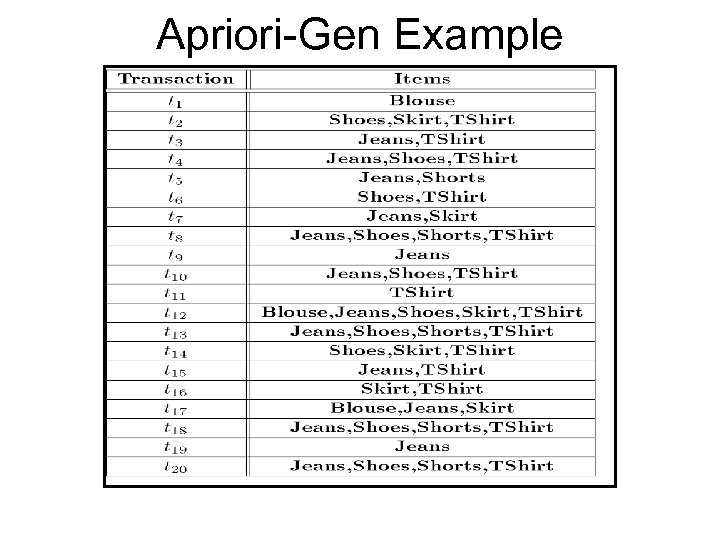 Apriori-Gen Example
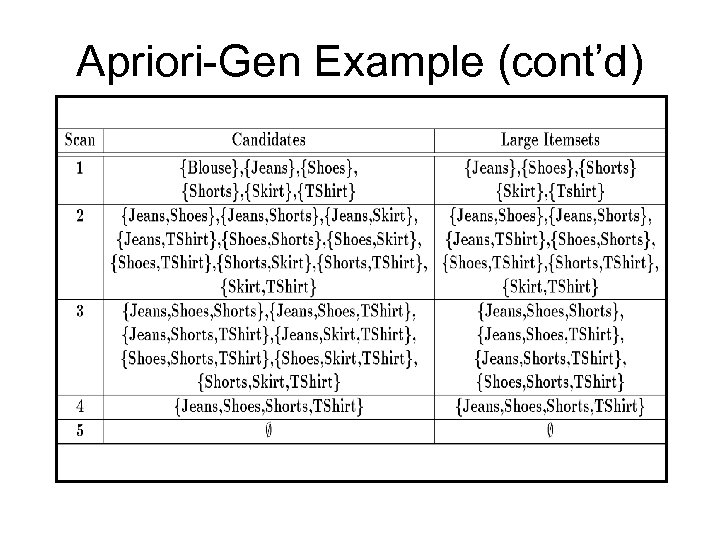 Apriori-Gen Example (cont’d)
 Apriori Adv/Disadv • Advantages: – Uses large itemset property. – Easily parallelized – Easy to implement. • Disadvantages: – Assumes transaction database is memory resident. – Requires up to m database scans.
 Classification based on Association Rules (CBA) • Why? – Can effectively uncover the correlation structure in data – AR are typically quite scalable in practice – Rules are often very intuitive • Hence classifier built on intuitive rules is easier to interpret • When to use? – On large dynamic datasets where class labels are available and the correlation structure is unknown. – Multi-class categorization problems – E. g. Web/Text Categorization, Network Intrusion Detection
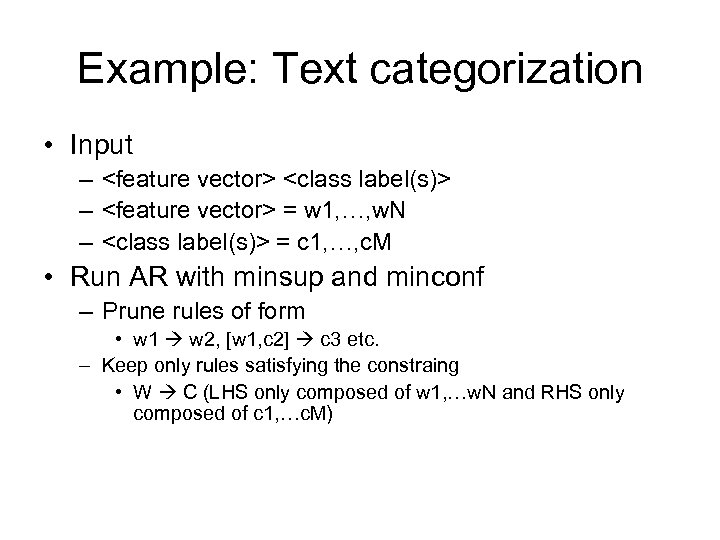 Example: Text categorization • Input –
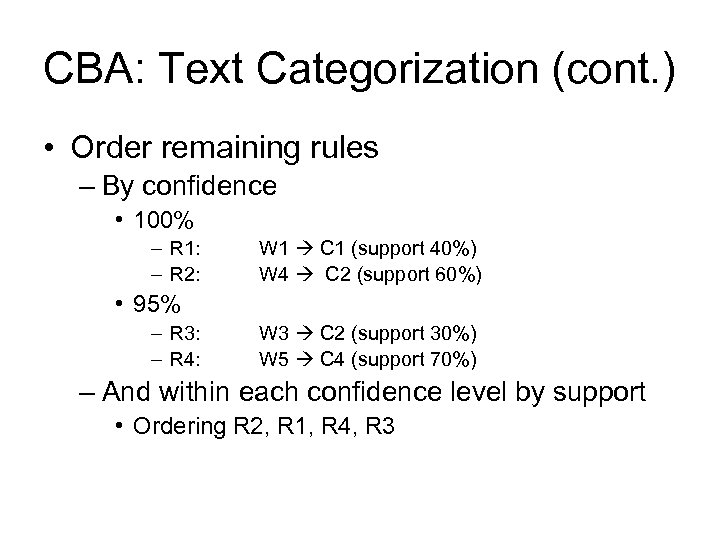 CBA: Text Categorization (cont. ) • Order remaining rules – By confidence • 100% – R 1: – R 2: W 1 C 1 (support 40%) W 4 C 2 (support 60%) • 95% – R 3: – R 4: W 3 C 2 (support 30%) W 5 C 4 (support 70%) – And within each confidence level by support • Ordering R 2, R 1, R 4, R 3
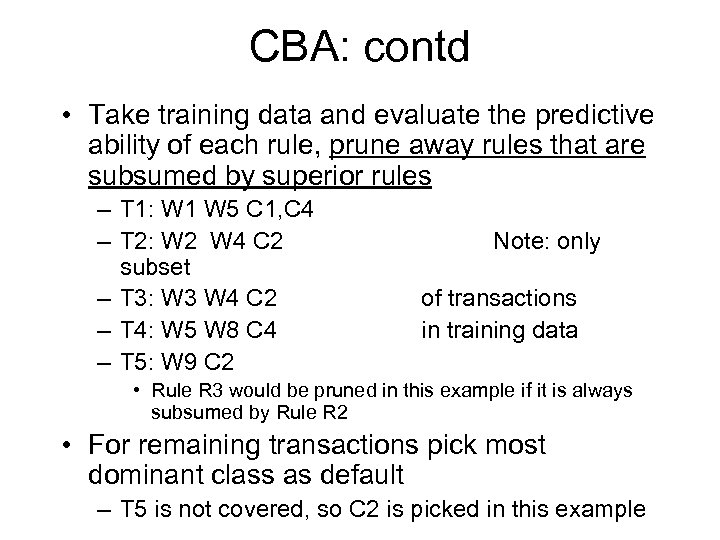 CBA: contd • Take training data and evaluate the predictive ability of each rule, prune away rules that are subsumed by superior rules – T 1: W 1 W 5 C 1, C 4 – T 2: W 2 W 4 C 2 subset – T 3: W 3 W 4 C 2 – T 4: W 5 W 8 C 4 – T 5: W 9 C 2 Note: only of transactions in training data • Rule R 3 would be pruned in this example if it is always subsumed by Rule R 2 • For remaining transactions pick most dominant class as default – T 5 is not covered, so C 2 is picked in this example
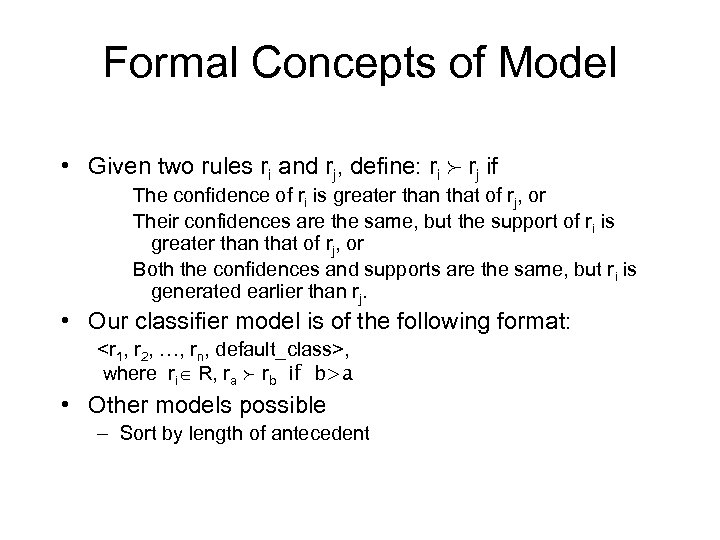 Formal Concepts of Model • Given two rules ri and rj, define: ri rj if The confidence of ri is greater than that of rj, or Their confidences are the same, but the support of ri is greater than that of rj, or Both the confidences and supports are the same, but ri is generated earlier than rj. • Our classifier model is of the following format:
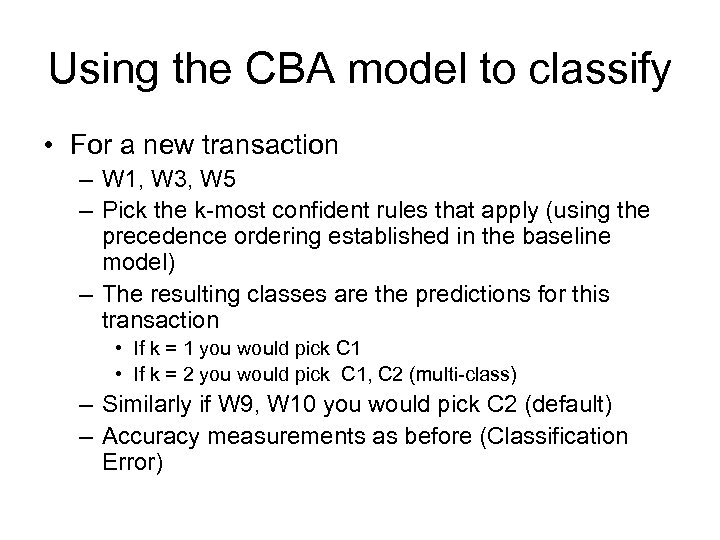 Using the CBA model to classify • For a new transaction – W 1, W 3, W 5 – Pick the k-most confident rules that apply (using the precedence ordering established in the baseline model) – The resulting classes are the predictions for this transaction • If k = 1 you would pick C 1 • If k = 2 you would pick C 1, C 2 (multi-class) – Similarly if W 9, W 10 you would pick C 2 (default) – Accuracy measurements as before (Classification Error)
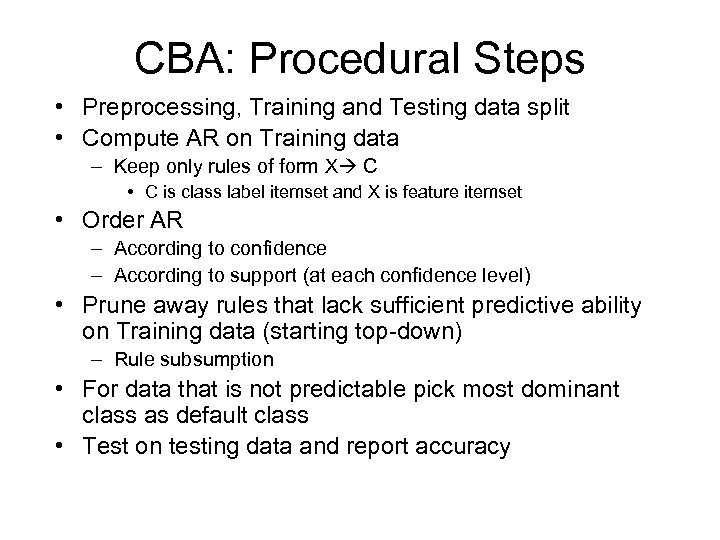 CBA: Procedural Steps • Preprocessing, Training and Testing data split • Compute AR on Training data – Keep only rules of form X C • C is class label itemset and X is feature itemset • Order AR – According to confidence – According to support (at each confidence level) • Prune away rules that lack sufficient predictive ability on Training data (starting top-down) – Rule subsumption • For data that is not predictable pick most dominant class as default class • Test on testing data and report accuracy
 Association Rules: Advanced Topics
 Apriori Adv/Disadv • Advantages: – Uses large itemset property. – Easily parallelized – Easy to implement. • Disadvantages: – Assumes transaction database is memory resident. – Requires up to m database scans.
 Vertical Layout • Rather than have – Transaction ID – list of items (Transactional) • We have – Item – List of transactions (TID-list) • Now to count itemset AB – Intersect TID-list of item. A with TID-list of item. B • All data for a particular item is available
 Eclat Algorithm • Dynamically process each transaction online maintaining 2 -itemset counts. • Transform – Partition L 2 using 1 -item prefix • Equivalence classes - {AB, AC, AD}, {BC, BD}, {CD} – Transform database to vertical form • Asynchronous Phase – For each equivalence class E • Compute frequent (E)
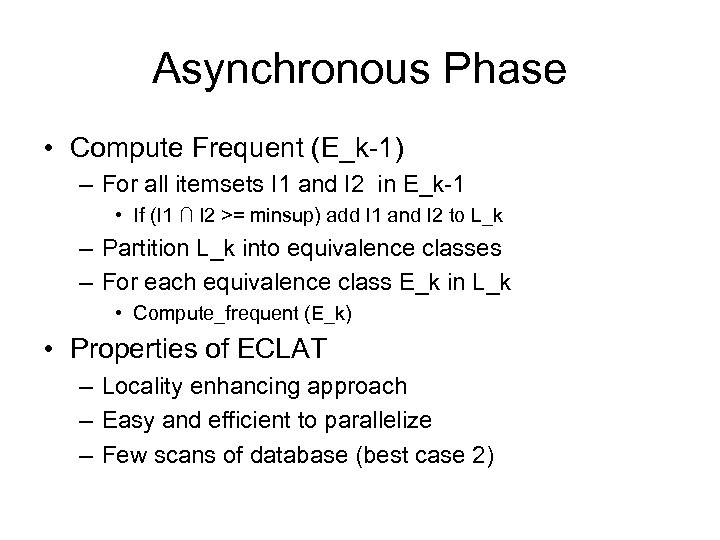 Asynchronous Phase • Compute Frequent (E_k-1) – For all itemsets I 1 and I 2 in E_k-1 • If (I 1 ∩ I 2 >= minsup) add I 1 and I 2 to L_k – Partition L_k into equivalence classes – For each equivalence class E_k in L_k • Compute_frequent (E_k) • Properties of ECLAT – Locality enhancing approach – Easy and efficient to parallelize – Few scans of database (best case 2)
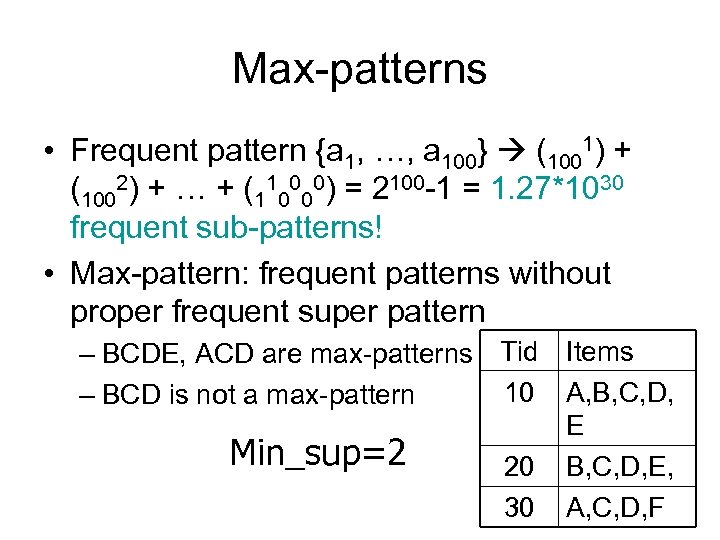 Max-patterns • Frequent pattern {a 1, …, a 100} (1001) + (1002) + … + (110000) = 2100 -1 = 1. 27*1030 frequent sub-patterns! • Max-pattern: frequent patterns without proper frequent super pattern – BCDE, ACD are max-patterns Tid Items 10 A, B, C, D, – BCD is not a max-pattern E Min_sup=2 20 B, C, D, E, 30 A, C, D, F
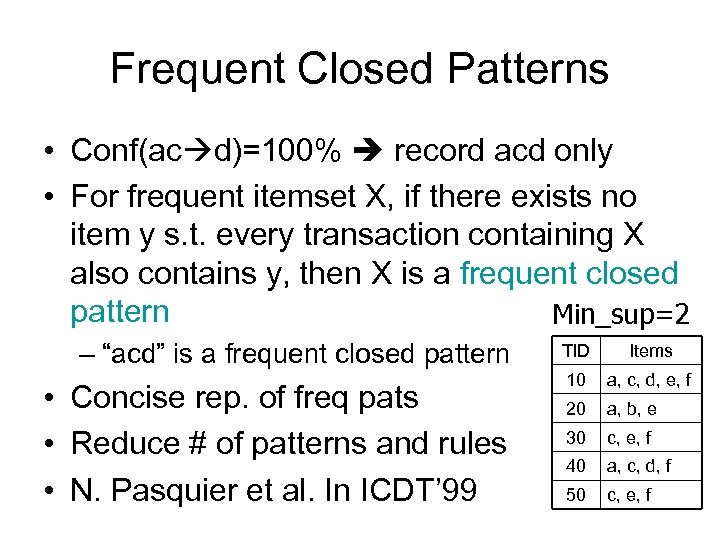 Frequent Closed Patterns • Conf(ac d)=100% record acd only • For frequent itemset X, if there exists no item y s. t. every transaction containing X also contains y, then X is a frequent closed pattern Min_sup=2 – “acd” is a frequent closed pattern • Concise rep. of freq pats • Reduce # of patterns and rules • N. Pasquier et al. In ICDT’ 99 TID Items 10 a, c, d, e, f 20 a, b, e 30 c, e, f 40 a, c, d, f 50 c, e, f
 Mining Various Kinds of Rules or Regularities • Multi-level, quantitative association rules, correlation and causality, ratio rules, sequential patterns, emerging patterns, temporal associations, partial periodicity • Classification, clustering, iceberg cubes, etc.
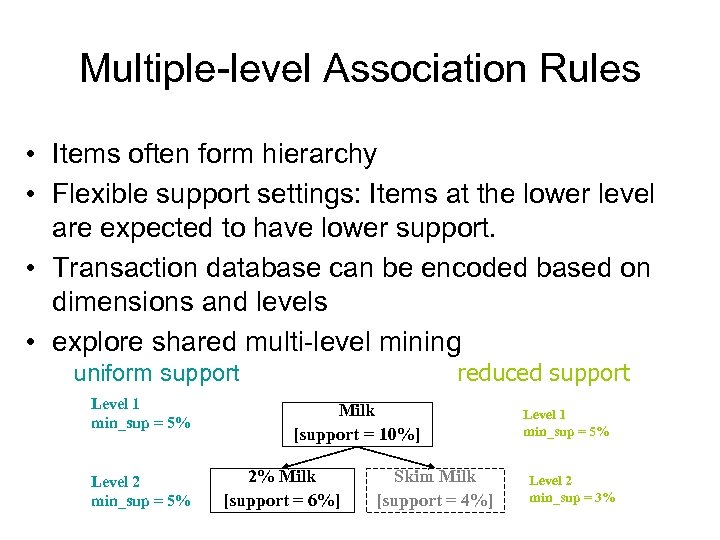 Multiple-level Association Rules • Items often form hierarchy • Flexible support settings: Items at the lower level are expected to have lower support. • Transaction database can be encoded based on dimensions and levels • explore shared multi-level mining reduced support uniform support Level 1 min_sup = 5% Level 2 min_sup = 5% Milk [support = 10%] 2% Milk [support = 6%] Skim Milk [support = 4%] Level 1 min_sup = 5% Level 2 min_sup = 3%
 ML/MD Associations with Flexible Support Constraints • Why flexible support constraints? – Real life occurrence frequencies vary greatly • Diamond, watch, pens in a shopping basket – Uniform support may not be an interesting model • A flexible model – The lower-level, the more dimension combination, and the long pattern length, usually the smaller support – General rules should be easy to specify and understand – Special items and special group of items may be specified individually and have higher priority
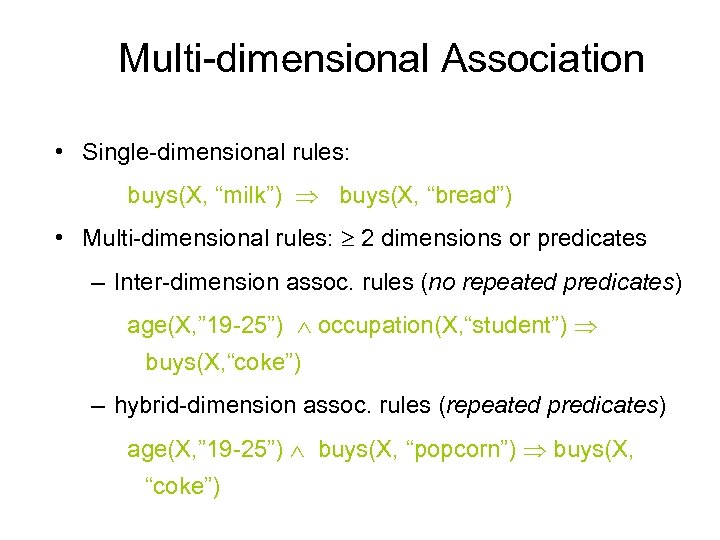 Multi-dimensional Association • Single-dimensional rules: buys(X, “milk”) buys(X, “bread”) • Multi-dimensional rules: 2 dimensions or predicates – Inter-dimension assoc. rules (no repeated predicates) age(X, ” 19 -25”) occupation(X, “student”) buys(X, “coke”) – hybrid-dimension assoc. rules (repeated predicates) age(X, ” 19 -25”) buys(X, “popcorn”) buys(X, “coke”)
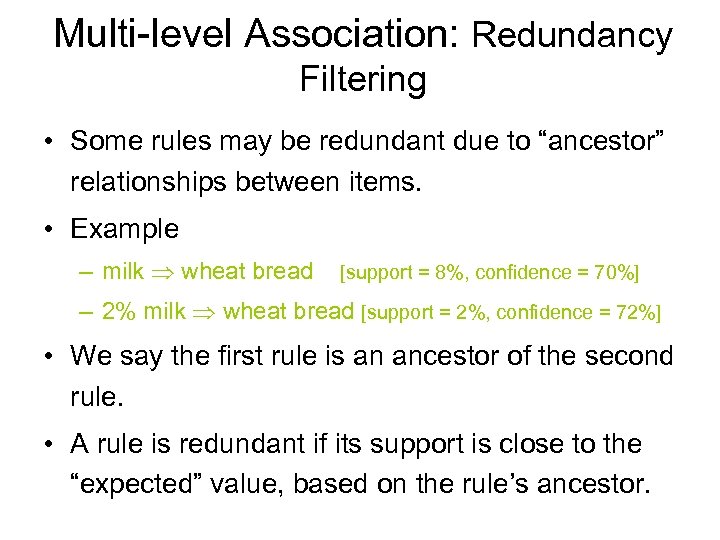 Multi-level Association: Redundancy Filtering • Some rules may be redundant due to “ancestor” relationships between items. • Example – milk wheat bread [support = 8%, confidence = 70%] – 2% milk wheat bread [support = 2%, confidence = 72%] • We say the first rule is an ancestor of the second rule. • A rule is redundant if its support is close to the “expected” value, based on the rule’s ancestor.
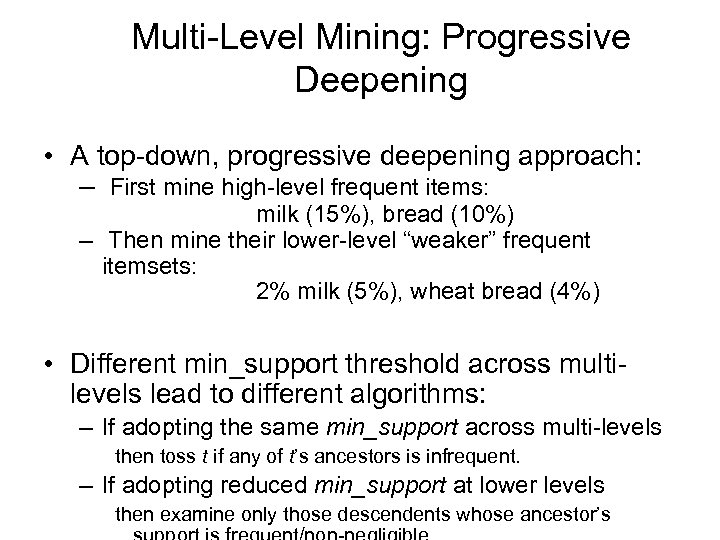 Multi-Level Mining: Progressive Deepening • A top-down, progressive deepening approach: – First mine high-level frequent items: milk (15%), bread (10%) – Then mine their lower-level “weaker” frequent itemsets: 2% milk (5%), wheat bread (4%) • Different min_support threshold across multilevels lead to different algorithms: – If adopting the same min_support across multi-levels then toss t if any of t’s ancestors is infrequent. – If adopting reduced min_support at lower levels then examine only those descendents whose ancestor’s
![Interestingness Measure: Correlations (Lift) • play basketball eat cereal [40%, 66. 7%] is misleading](https://present5.com/presentation/12b65d3aa7f5144bc996962641163ff2/image-38.jpg "Interestingness Measure: Correlations (Lift) • play basketball eat cereal [40%, 66. 7%] is misleading") Interestingness Measure: Correlations (Lift) • play basketball eat cereal [40%, 66. 7%] is misleading – The overall percentage of students eating cereal is 75% which is higher than 66. 7%. • play basketball not eat cereal [20%, 33. 3%] is more accurate, although with lower support and confidence • Measure of dependent/correlated events: lift Basketbal Not basketball l Sum (row) Cereal 2000 1750 3750 Not cereal 1000 250 1250 Sum(col. ) 3000 2000 5000
Interestingness Measure: Correlations (Lift) • play basketball eat cereal [40%, 66. 7%] is misleading – The overall percentage of students eating cereal is 75% which is higher than 66. 7%. • play basketball not eat cereal [20%, 33. 3%] is more accurate, although with lower support and confidence • Measure of dependent/correlated events: lift Basketbal Not basketball l Sum (row) Cereal 2000 1750 3750 Not cereal 1000 250 1250 Sum(col. ) 3000 2000 5000
 Constraint-based Data Mining • Finding all the patterns in a database autonomously? — unrealistic! – The patterns could be too many but not focused! • Data mining should be an interactive process – User directs what to be mined using a data mining query language (or a graphical user interface) • Constraint-based mining – User flexibility: provides constraints on what to be mined – System optimization: explores such constraints for efficient mining—constraint-based mining
 Constrained Frequent Pattern Mining: A Mining Query Optimization Problem • Given a frequent pattern mining query with a set of constraints C, the algorithm should be – sound: it only finds frequent sets that satisfy the given constraints C – complete: all frequent sets satisfying the given constraints C are found • A naïve solution – First find all frequent sets, and then test them for constraint satisfaction • More efficient approaches: – Analyze the properties of constraints comprehensively – Push them as deeply as possible inside the frequent pattern computation.
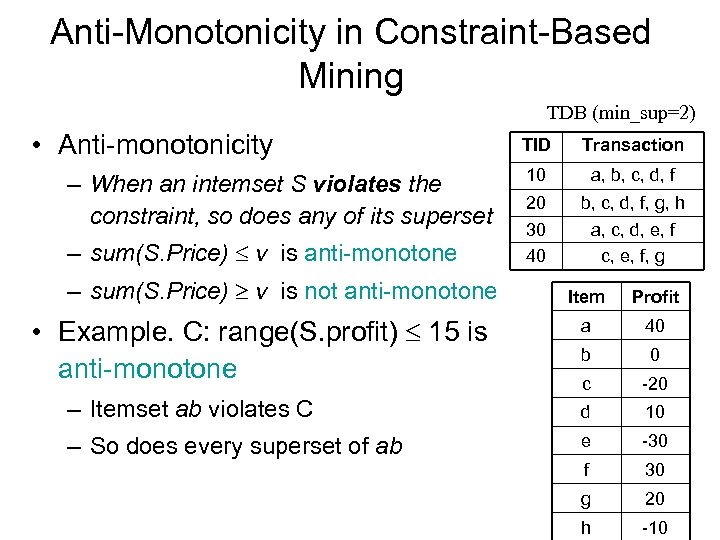 Anti-Monotonicity in Constraint-Based Mining TDB (min_sup=2) • Anti-monotonicity – When an intemset S violates the constraint, so does any of its superset – sum(S. Price) v is anti-monotone – sum(S. Price) v is not anti-monotone TID Transaction 10 a, b, c, d, f 20 30 40 b, c, d, f, g, h a, c, d, e, f c, e, f, g Item Profit a 40 b 0 c -20 – Itemset ab violates C d 10 – So does every superset of ab e -30 f 30 g 20 h -10 • Example. C: range(S. profit) 15 is anti-monotone
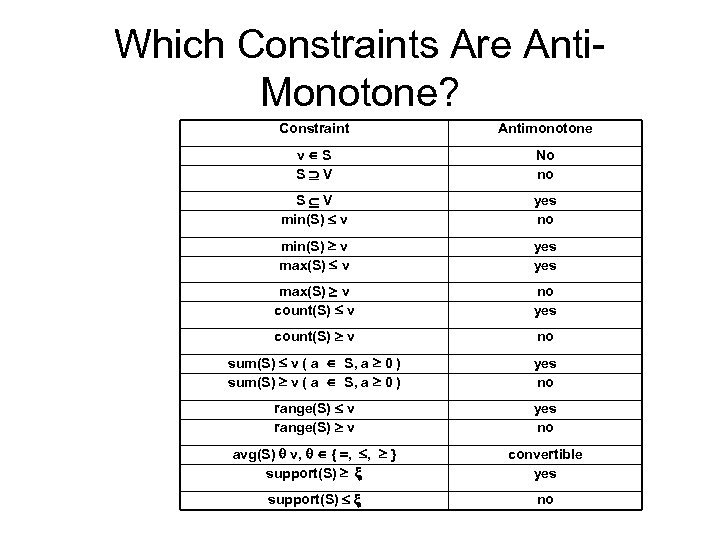 Which Constraints Are Anti. Monotone? Constraint Antimonotone v S S V No no S V min(S) v yes no min(S) v max(S) v yes max(S) v count(S) v no yes count(S) v no sum(S) v ( a S, a 0 ) yes no range(S) v yes no avg(S) v, { , , } support(S) convertible yes support(S) no
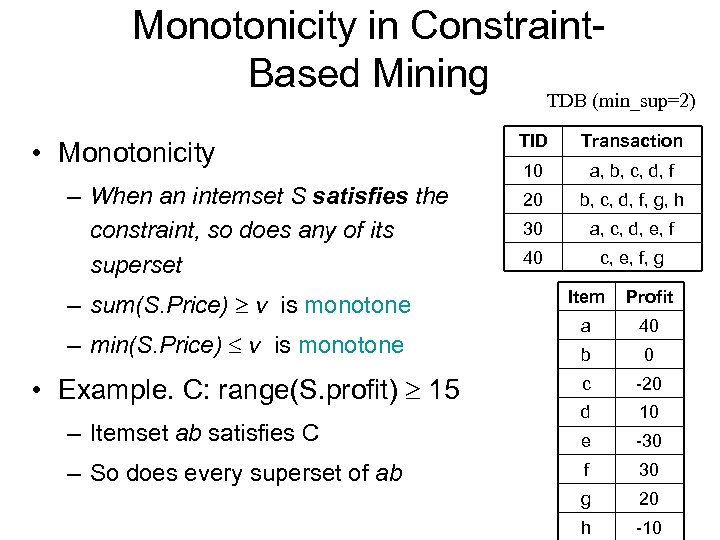 Monotonicity in Constraint. Based Mining TDB (min_sup=2) • Monotonicity – When an intemset S satisfies the constraint, so does any of its superset – sum(S. Price) v is monotone – min(S. Price) v is monotone • Example. C: range(S. profit) 15 – Itemset ab satisfies C – So does every superset of ab TID Transaction 10 a, b, c, d, f 20 b, c, d, f, g, h 30 a, c, d, e, f 40 c, e, f, g Item Profit a 40 b 0 c -20 d 10 e -30 f 30 g 20 h -10
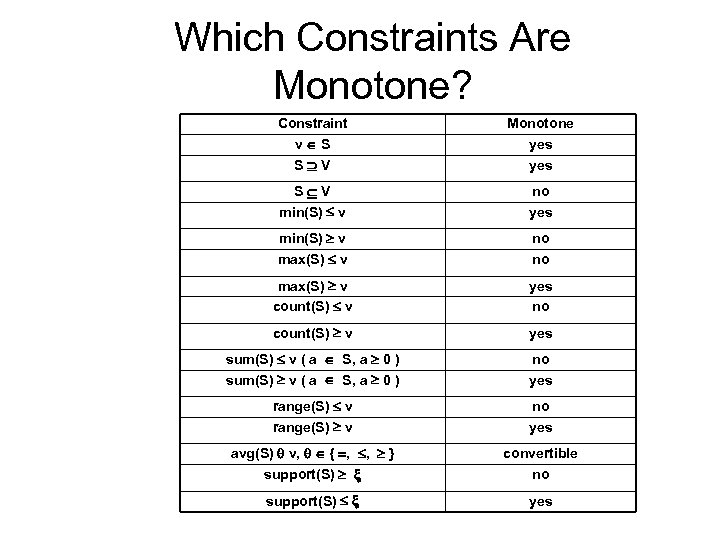 Which Constraints Are Monotone? Constraint v S S V Monotone yes S V min(S) v no yes min(S) v max(S) v no no max(S) v count(S) v yes no count(S) v yes sum(S) v ( a S, a 0 ) no yes range(S) v no yes avg(S) v, { , , } support(S) convertible no support(S) yes
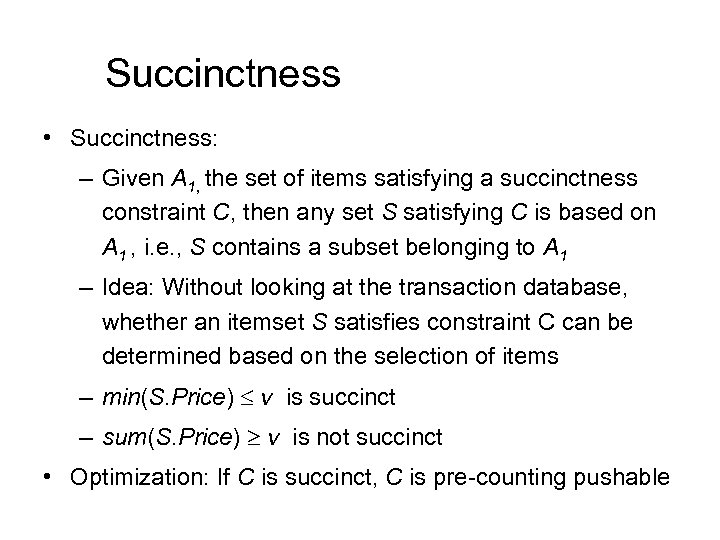 Succinctness • Succinctness: – Given A 1, the set of items satisfying a succinctness constraint C, then any set S satisfying C is based on A 1 , i. e. , S contains a subset belonging to A 1 – Idea: Without looking at the transaction database, whether an itemset S satisfies constraint C can be determined based on the selection of items – min(S. Price) v is succinct – sum(S. Price) v is not succinct • Optimization: If C is succinct, C is pre-counting pushable
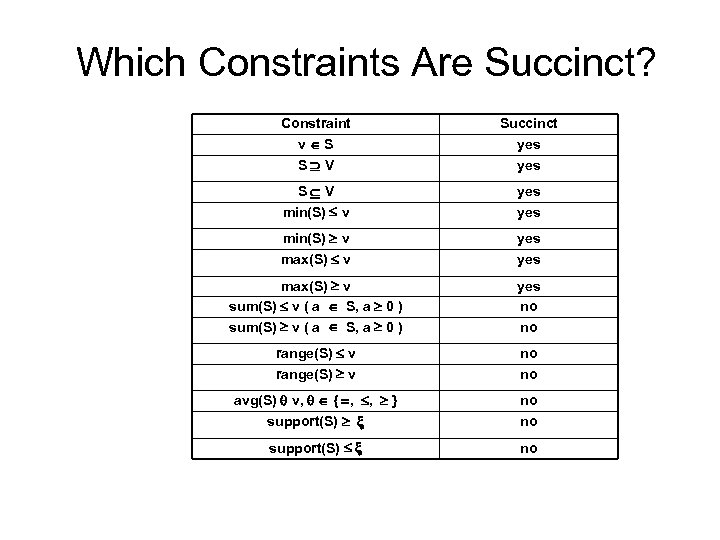 Which Constraints Are Succinct? Constraint v S S V Succinct yes S V min(S) v yes min(S) v max(S) v yes max(S) v sum(S) v ( a S, a 0 ) yes no no range(S) v no no avg(S) v, { , , } support(S) no no support(S) no
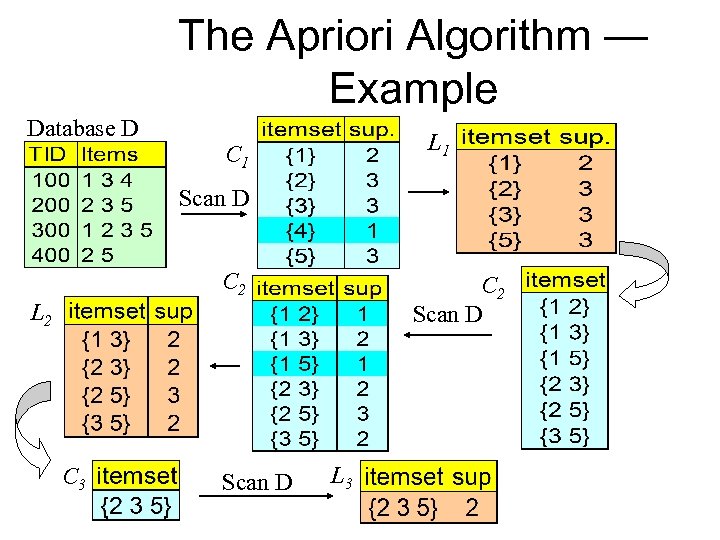 The Apriori Algorithm — Example Database D L 1 C 1 Scan D C 2 Scan D L 2 C 3 Scan D L 3
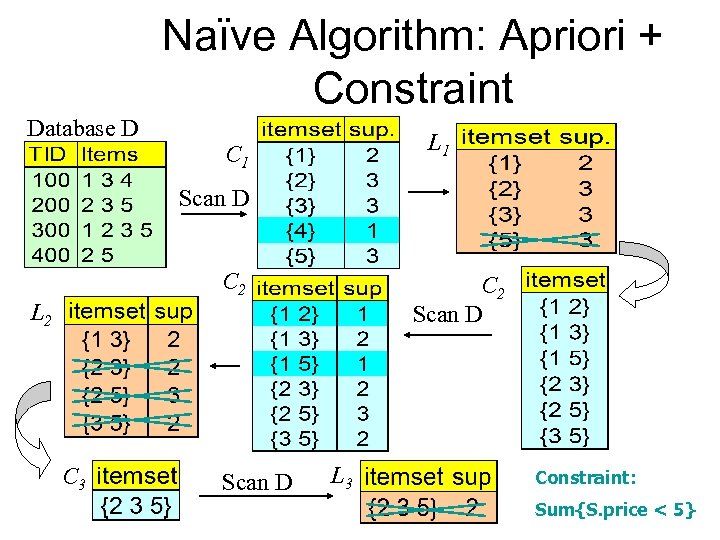 Naïve Algorithm: Apriori + Constraint Database D L 1 C 1 Scan D C 2 Scan D L 2 C 3 Scan D L 3 Constraint: Sum{S. price < 5}
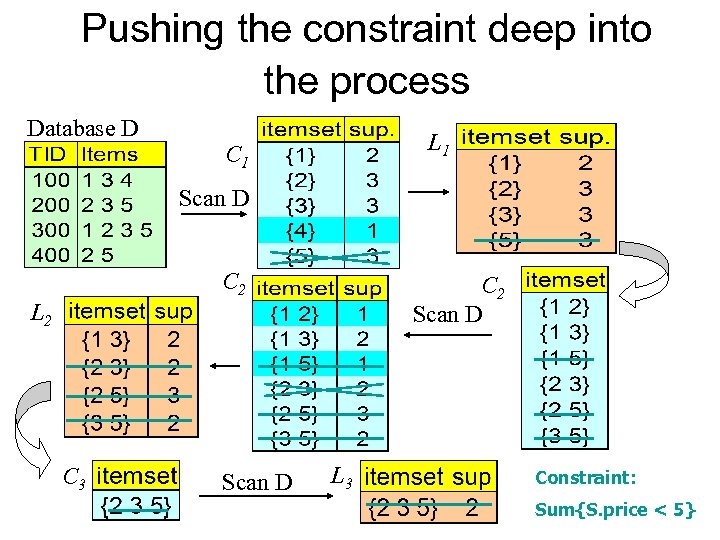 Pushing the constraint deep into the process Database D L 1 C 1 Scan D C 2 Scan D L 2 C 3 Scan D L 3 Constraint: Sum{S. price < 5}
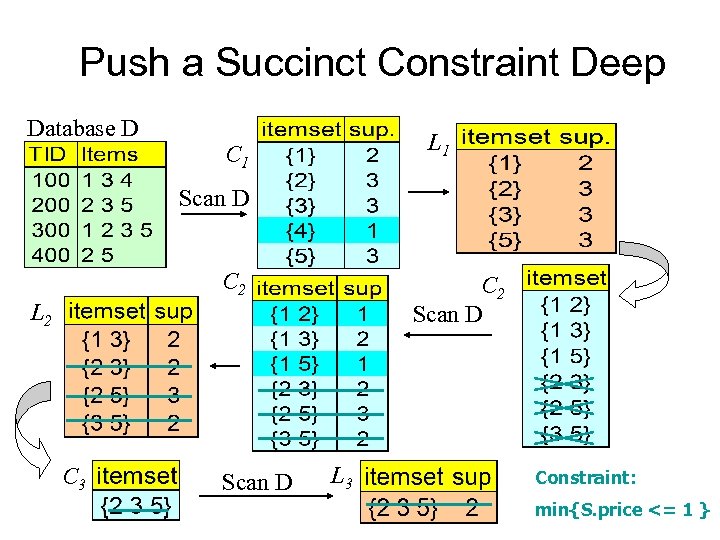 Push a Succinct Constraint Deep Database D L 1 C 1 Scan D C 2 Scan D L 2 C 3 Scan D L 3 Constraint: min{S. price <= 1 }
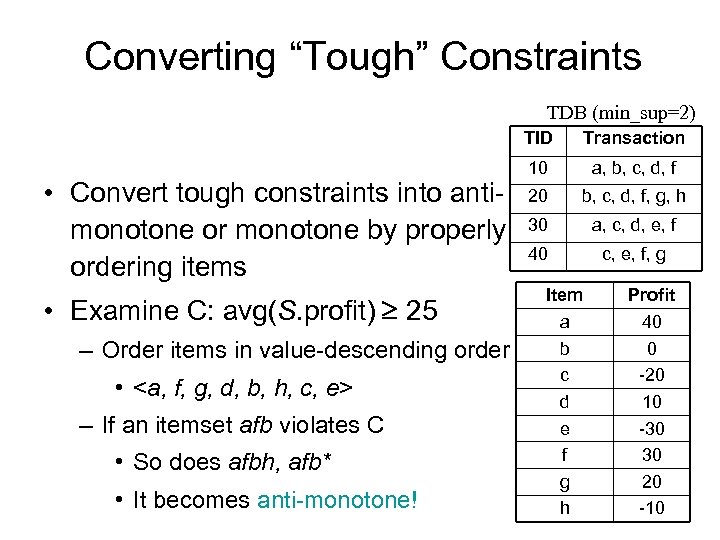 Converting “Tough” Constraints TDB (min_sup=2) TID • Convert tough constraints into antimonotone or monotone by properly ordering items • Examine C: avg(S. profit) 25 – Order items in value-descending order •
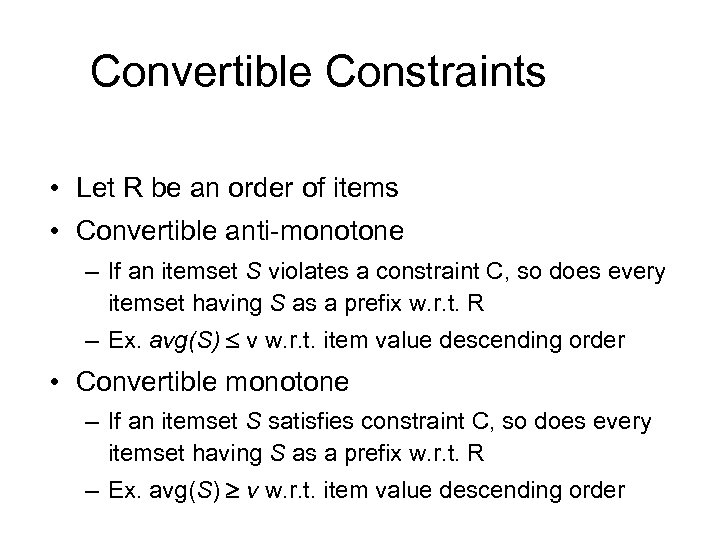 Convertible Constraints • Let R be an order of items • Convertible anti-monotone – If an itemset S violates a constraint C, so does every itemset having S as a prefix w. r. t. R – Ex. avg(S) v w. r. t. item value descending order • Convertible monotone – If an itemset S satisfies constraint C, so does every itemset having S as a prefix w. r. t. R – Ex. avg(S) v w. r. t. item value descending order
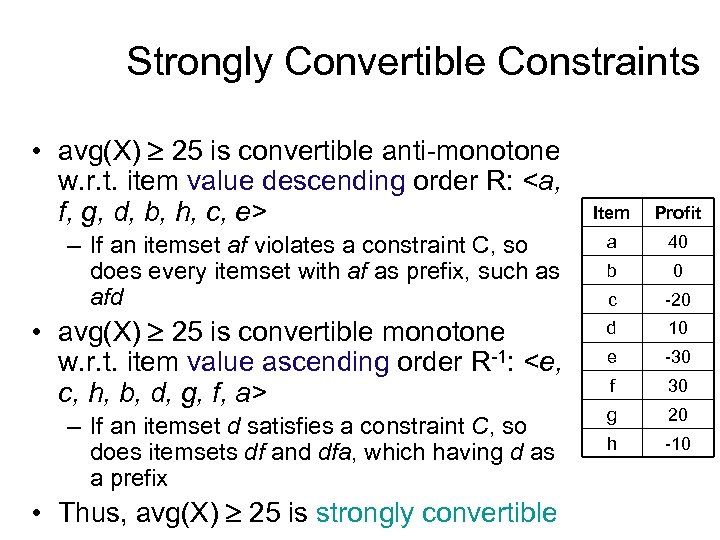 Strongly Convertible Constraints • avg(X) 25 is convertible anti-monotone w. r. t. item value descending order R:
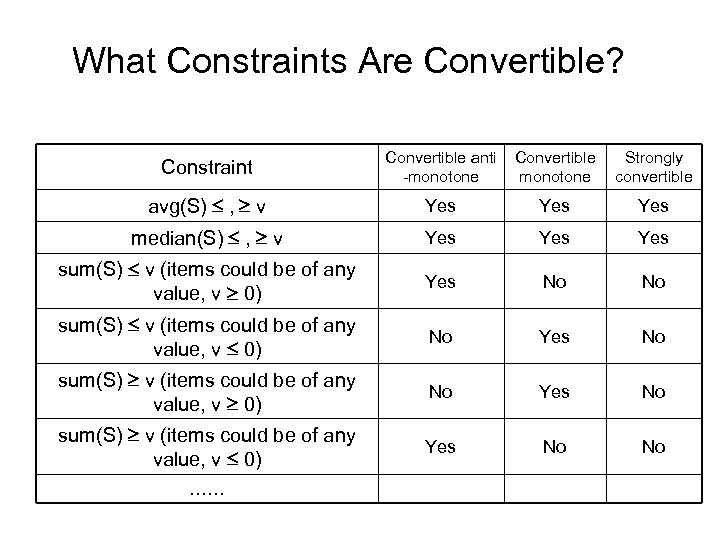 What Constraints Are Convertible? Constraint Convertible anti -monotone Convertible monotone Strongly convertible avg(S) , v Yes Yes median(S) , v Yes Yes sum(S) v (items could be of any value, v 0) Yes No No sum(S) v (items could be of any value, v 0) No Yes No sum(S) v (items could be of any value, v 0) Yes No No ……
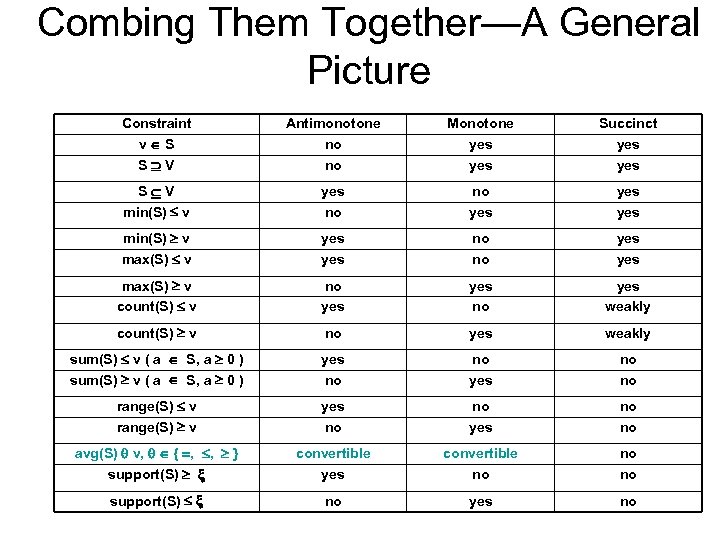 Combing Them Together—A General Picture Constraint v S S V Antimonotone no no Monotone yes Succinct yes S V min(S) v yes no no yes yes min(S) v max(S) v yes no no yes max(S) v count(S) v no yes weakly count(S) v no yes weakly sum(S) v ( a S, a 0 ) yes no no range(S) v yes no no avg(S) v, { , , } support(S) convertible yes convertible no no no support(S) no yes no
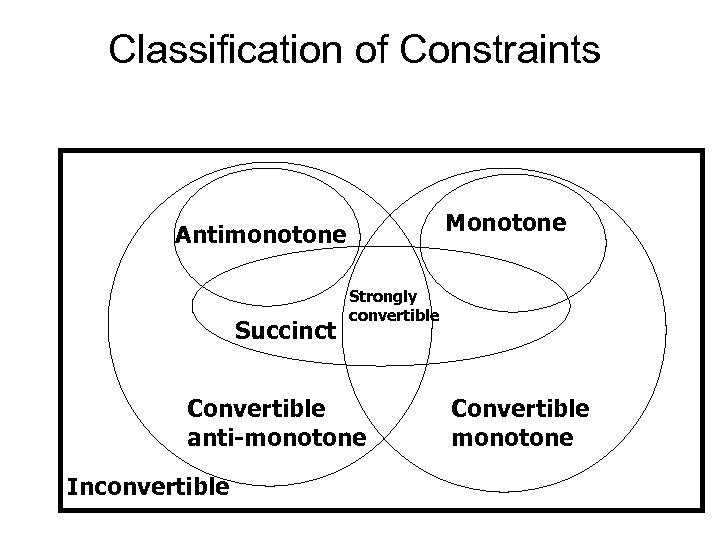 Classification of Constraints Monotone Antimonotone Succinct Strongly convertible Convertible anti-monotone Inconvertible Convertible monotone
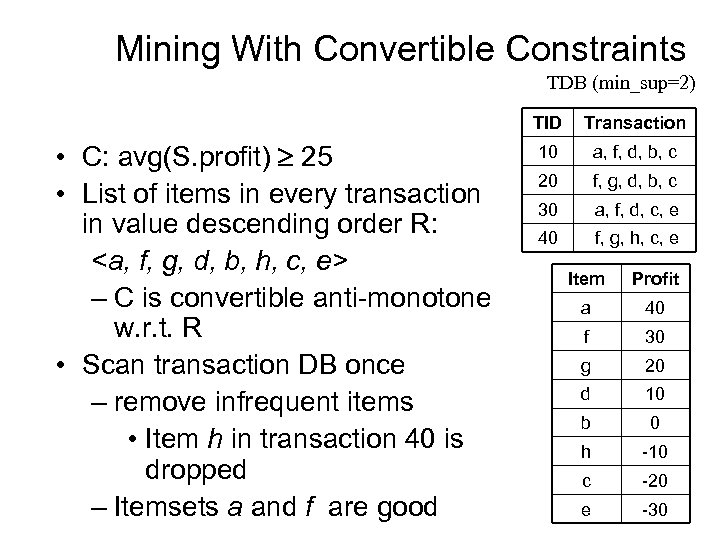 Mining With Convertible Constraints TDB (min_sup=2) TID • C: avg(S. profit) 25 • List of items in every transaction in value descending order R:
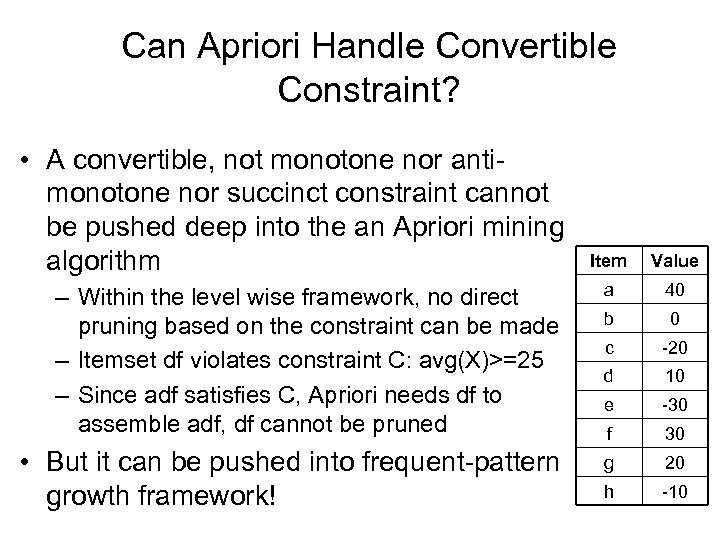 Can Apriori Handle Convertible Constraint? • A convertible, not monotone nor antimonotone nor succinct constraint cannot be pushed deep into the an Apriori mining algorithm Item Value – Within the level wise framework, no direct pruning based on the constraint can be made – Itemset df violates constraint C: avg(X)>=25 – Since adf satisfies C, Apriori needs df to assemble adf, df cannot be pruned a 40 b 0 c -20 d 10 e -30 f 30 • But it can be pushed into frequent-pattern growth framework! g 20 h -10
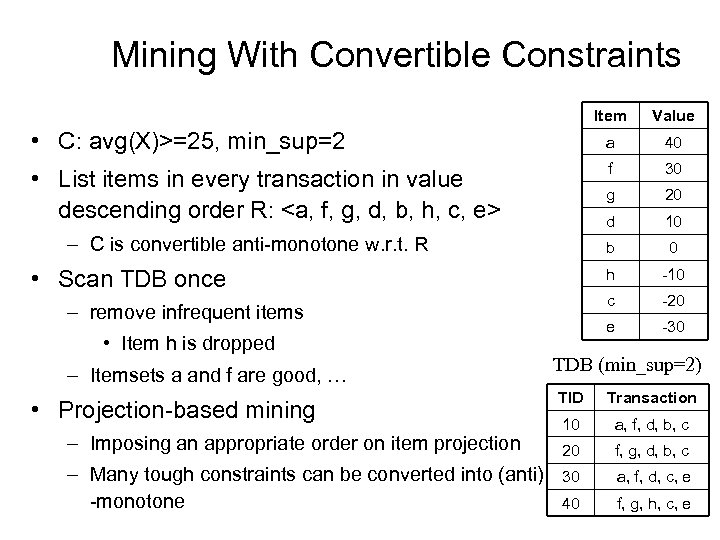 Mining With Convertible Constraints Item Value • C: avg(X)>=25, min_sup=2 a 40 • List items in every transaction in value descending order R:
 Handling Multiple Constraints • Different constraints may require different or even conflicting item-ordering • If there exists an order R s. t. both C 1 and C 2 are convertible w. r. t. R, then there is no conflict between the two convertible constraints • If there exists conflict on order of items – Try to satisfy one constraint first – Then using the order for the other constraint to
 Sequence Mining
 Sequence Databases and Sequential Pattern Analysis • Transaction databases, time-series databases vs. sequence databases • Frequent patterns vs. (frequent) sequential patterns • Applications of sequential pattern mining – Customer shopping sequences: • First buy computer, then CD-ROM, and then digital camera, within 3 months. – Medical treatment, natural disasters (e. g. , earthquakes), science & engineering processes, stocks and markets, etc. – Telephone calling patterns, Weblog click streams – DNA sequences and gene structures
 Sequence Mining: Description • Input – A database D of sequences called datasequences, in which: • I={i 1, i 2, …, in} is the set of items • each sequence is a list of transactions ordered by transaction-time • each transaction consists of fields: sequence-id, transaction-time and a set of items. • Problem – To discover all the sequential patterns with a user-specified minimum support
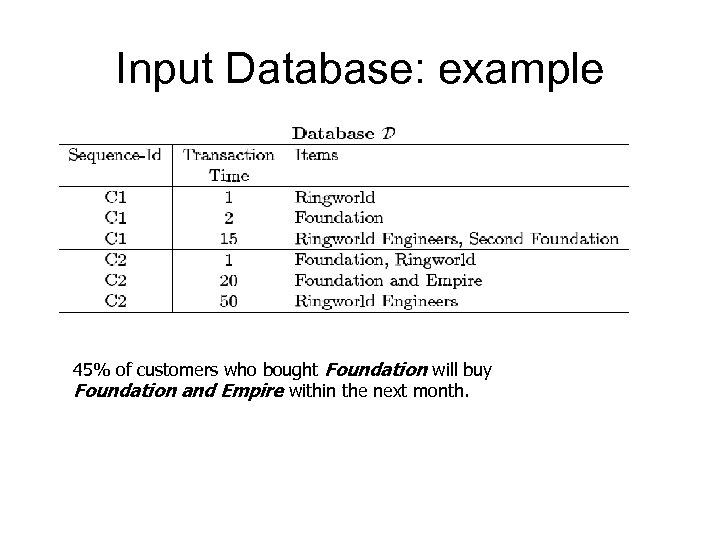 Input Database: example 45% of customers who bought Foundation will buy Foundation and Empire within the next month.
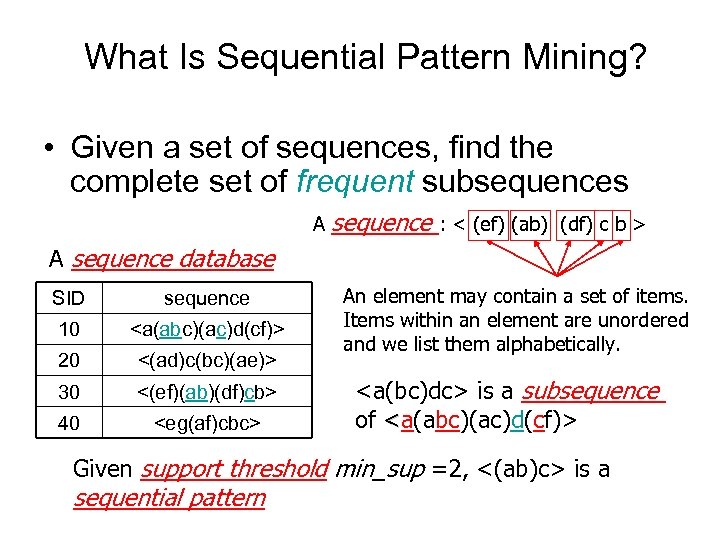 What Is Sequential Pattern Mining? • Given a set of sequences, find the complete set of frequent subsequences A sequence : < (ef) (ab) (df) c b > A sequence database SID sequence 10
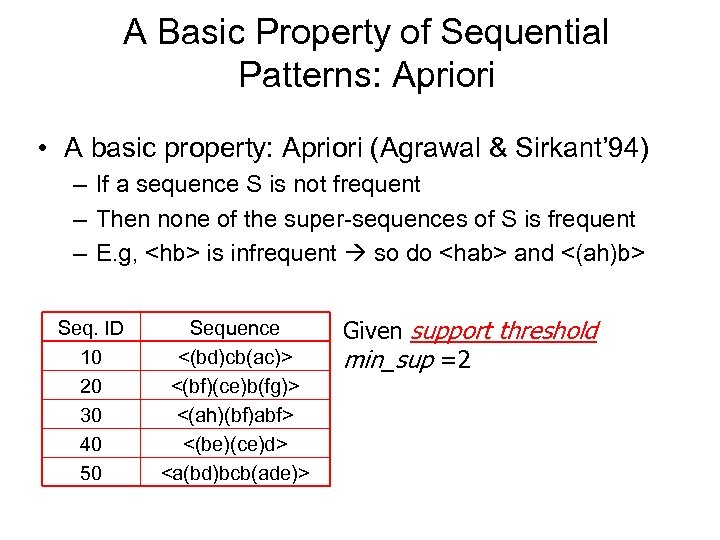 A Basic Property of Sequential Patterns: Apriori • A basic property: Apriori (Agrawal & Sirkant’ 94) – If a sequence S is not frequent – Then none of the super-sequences of S is frequent – E. g,
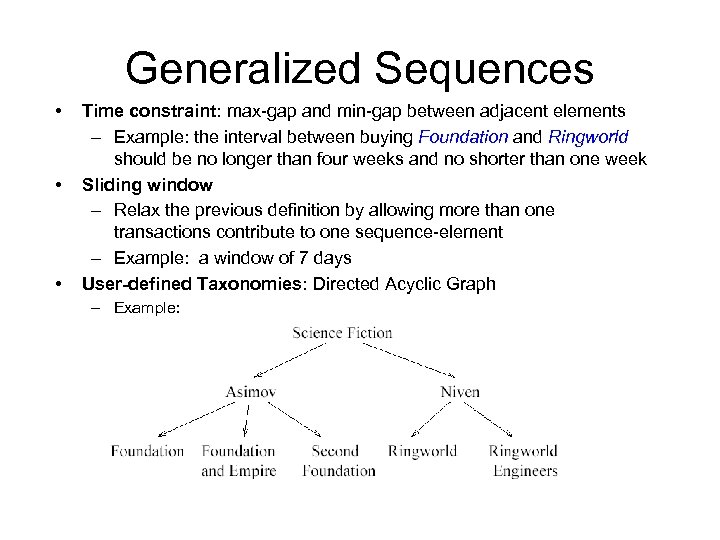 Generalized Sequences • • • Time constraint: max-gap and min-gap between adjacent elements – Example: the interval between buying Foundation and Ringworld should be no longer than four weeks and no shorter than one week Sliding window – Relax the previous definition by allowing more than one transactions contribute to one sequence-element – Example: a window of 7 days User-defined Taxonomies: Directed Acyclic Graph – Example:
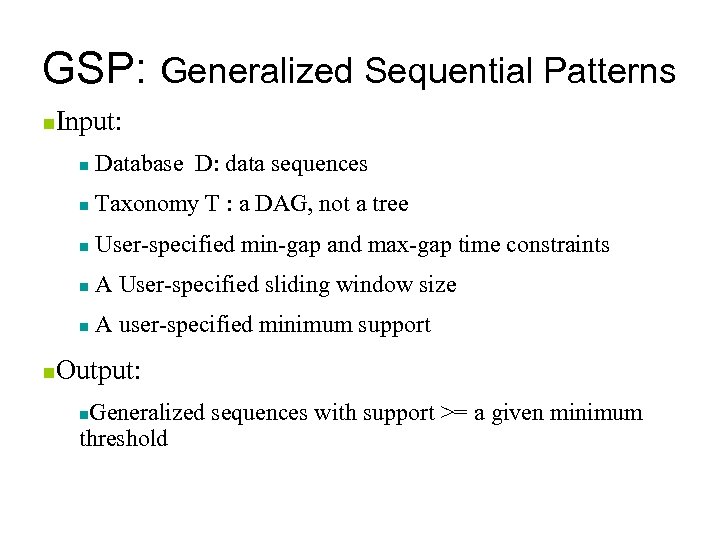 GSP: Generalized Sequential Patterns n Input: n n Taxonomy T : a DAG, not a tree n User-specified min-gap and max-gap time constraints n A User-specified sliding window size n n Database D: data sequences A user-specified minimum support Output: Generalized sequences with support >= a given minimum threshold n
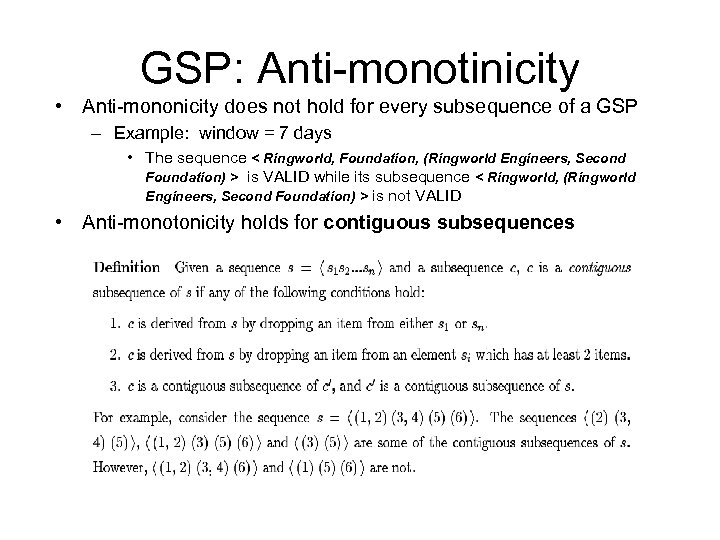 GSP: Anti-monotinicity • Anti-mononicity does not hold for every subsequence of a GSP – Example: window = 7 days • The sequence < Ringworld, Foundation, (Ringworld Engineers, Second Foundation) > is VALID while its subsequence < Ringworld, (Ringworld Engineers, Second Foundation) > is not VALID • Anti-monotonicity holds for contiguous subsequences
 GSP: Algorithm • Phase 1: – Scan over the database to identify all the frequent items, i. e. , 1 -element sequences • Phase 2: – Iteratively scan over the database to discover all frequent sequences. Each iteration discovers all the sequences with the same length. – In the iteration to generate all k-sequences • Generate the set of all candidate k-sequences, Ck, by joining two (k-1)-sequences if only their first and last items are different • Prune the candidate sequence if any of its k-1 contiguous subsequence is not frequent • Scan over the database to determine the support of the remaining candidate sequences – Terminate when no more frequent sequences can be found
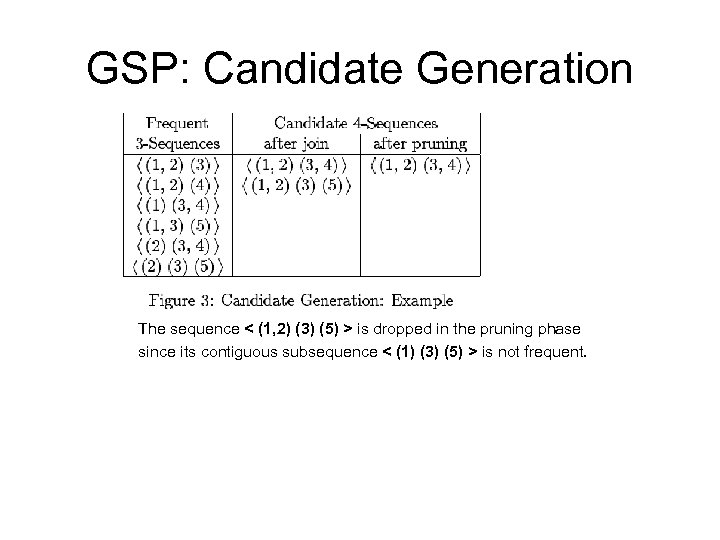 GSP: Candidate Generation The sequence < (1, 2) (3) (5) > is dropped in the pruning phase since its contiguous subsequence < (1) (3) (5) > is not frequent.
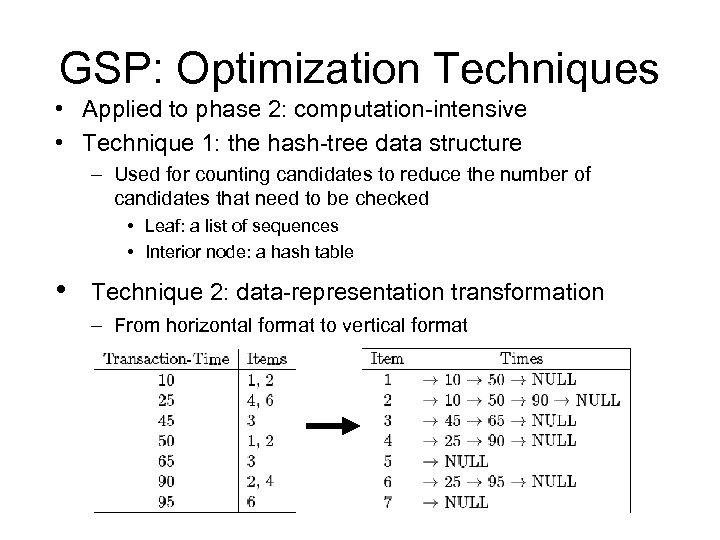 GSP: Optimization Techniques • Applied to phase 2: computation-intensive • Technique 1: the hash-tree data structure – Used for counting candidates to reduce the number of candidates that need to be checked • Leaf: a list of sequences • Interior node: a hash table • Technique 2: data-representation transformation – From horizontal format to vertical format
 GSP: plus taxonomies • Naïve method: post-processing • Extended data-sequences – Insert all the ancestors of an item to the original transaction – Apply GSP • Redundant sequences – A sequence is redundant if its actual support is close to its expected support
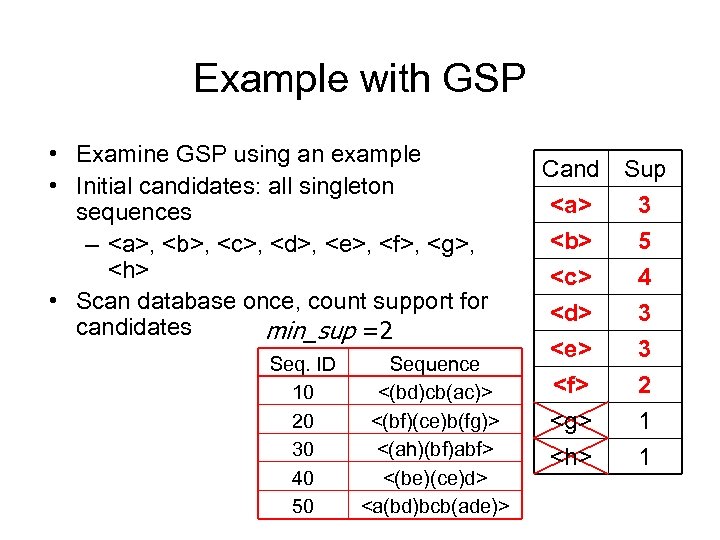 Example with GSP • Examine GSP using an example • Initial candidates: all singleton sequences – , ,
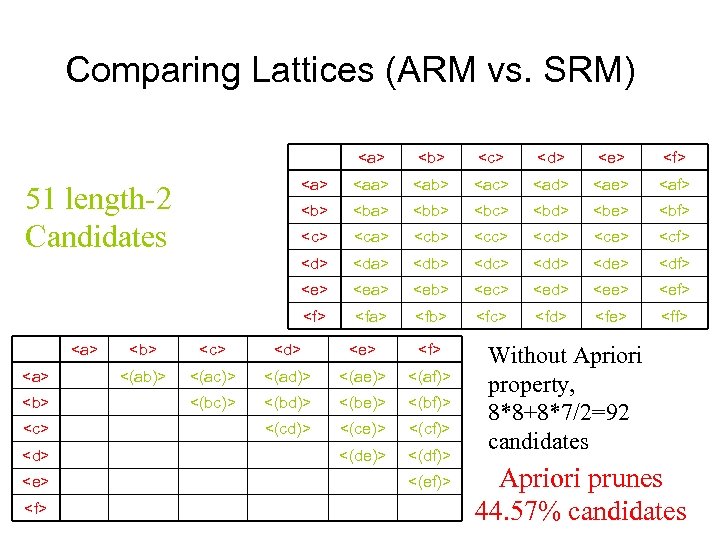 Comparing Lattices (ARM vs. SRM)
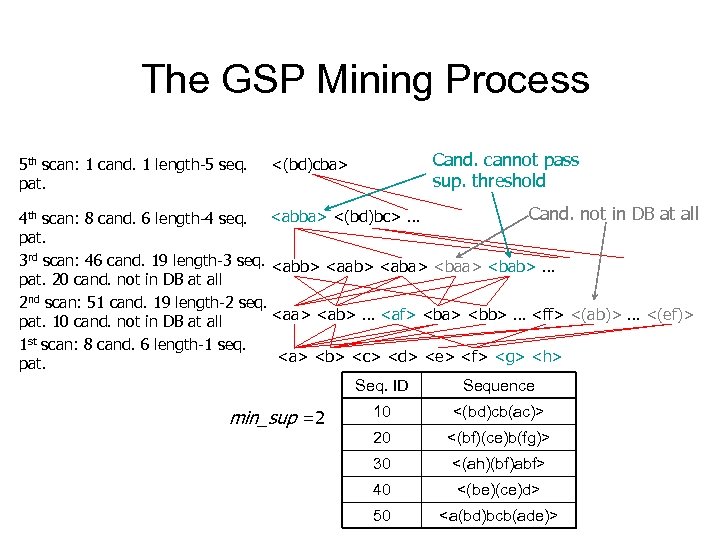 The GSP Mining Process 5 th scan: 1 cand. 1 length-5 seq. pat. Cand. cannot pass sup. threshold <(bd)cba> Cand. not in DB at all 4 th scan: 8 cand. 6 length-4 seq.
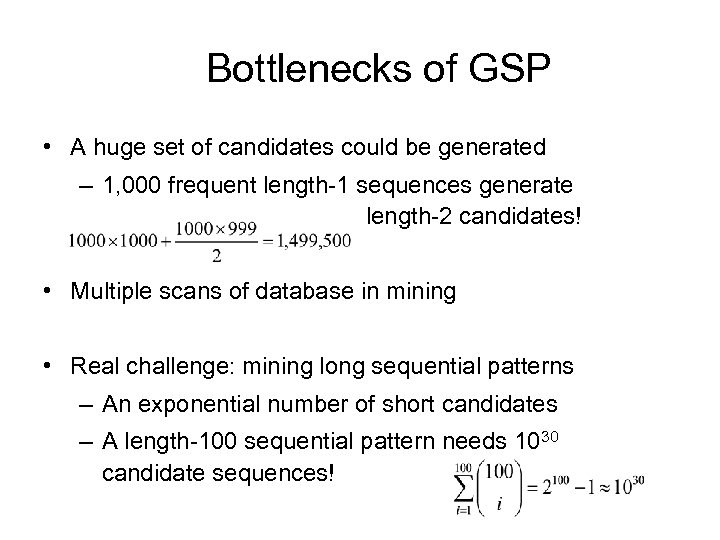 Bottlenecks of GSP • A huge set of candidates could be generated – 1, 000 frequent length-1 sequences generate length-2 candidates! • Multiple scans of database in mining • Real challenge: mining long sequential patterns – An exponential number of short candidates – A length-100 sequential pattern needs 1030 candidate sequences!
 SPADE • Problems in the GSP Algorithm – Multiple database scans – Complex hash structures with poor locality – Scale up linearly as the size of dataset increases • SPADE: Sequential PAttern Discovery using Equivalence classes – Use a vertical id-list database – Prefix-based equivalence classes – Frequent sequences enumerated through simple temporal joins – Lattice-theoretic approach to decompose search space • Advantages of SPADE – 3 scans over the database – Potential for in-memory computation and parallelization
 Recent studies: Mining Constrained Sequential patterns • Naïve method: constraints as a postprocessing filter – Inefficient: still has to find all patterns • How to push various constraints into the mining systematically?
 Examples of Constraints • Item constraint – Find web log patterns only about online-bookstores • Length constraint – Find patterns having at least 20 items • Super pattern constraint – Find super patterns of “PC digital camera” • Aggregate constraint – Find patterns that the average price of items is over $100
 Characterizations of Constraints • SOUND FAMILIAR ? • Anti-monotonic constraint – If a sequence satisfies C so does its non-empty subsequences – Examples: support of an itemset >= 5% • Monotonic constraint – If a sequence satisfies C so does its super sequences – Examples: len(s) >= 10 • Succinct constraint – Patterns satisfying the constraint can be constructed systematically according to some rules • Others: the most challenging!!
 Covered in Class Notes (not available in slide form Scalable extensions to FPM algorithms – Partition I/O – Distributed (Parallel) Partition I/O – Sampling-based ARM