 Скачать презентацию Association of Old Crows International Symposium and Exhibition
cb2b3b8d8a3ac703f2ceb4ac75e37364.ppt
- Количество слайдов: 34



Association of Old Crows International Symposium and Exhibition 2006 13 February 2006 Commercialising Defence R&D Why? And Why Not? Gregor Ferguson Ph. D Student, Education Centre for Innovation & Commercialisation, University of Adelaide
Defence R&D in Australia • Very little research into Australian R&D • Surprising - ADF depends on high technology to offset lack of numbers • ADF uses high-tech equipment very proficiently. For its size it is a potent force.
Defence R&D in Australia • ADF, DSTO and Australian industry generally understand high-tech defence equipment: how it works and how best to use it • But despite this skill and knowledge base, most of the ADF’s defence equipment is imported
Defence R&D in Australia • ADF adoption of Australian defence equipment is low • ADF depends on Australian industry for integration, support and upgrades • Australia’s defence industry policy does not encourage product development • Australia’s defence industry is a SERVICE industry rather than a MANUFACTURING industry • This automatically excludes much of Australian industry from export markets
Defence R&D in Australia • Australia spends significant amounts on defence R&D, or S&T. This is generally of a high quality • So why doesn’t Australia have a better track record for commercialising this IP and developing new products and processes?
Factors affecting the commercialisation of defence-related Intellectual Property Ph. D Program - Education Centre for Innovation & Commercialisation University of Adelaide
Purpose of the research - 1 Five Key Research Questions: 1. What is Australia’s total public and private sector investment in defence R&D? And what is the commercial return derived from this? 2. Is Australia’s public and private sector investment in defence R&D commensurate with the anticipated future demand from the ADF, Australian industry, export customers and the non-defence market for products, services and expertise derived from that R&D?
Purpose of the research - 2 3. What is the opportunity cost to the Australian economy of failing to invest sufficiently in defence R&D and commercialising the resulting IP? 4. What are the strategic, technological and market-related factors which enable or inhibit the commercialisation of IP developed as a result of defence-related R&D in Australia?
Purpose of the research - 3 5. Is it possible to define a model, or at least a more general set of preconditions, which is likely to result in successful commercialisation of defence-related IP?
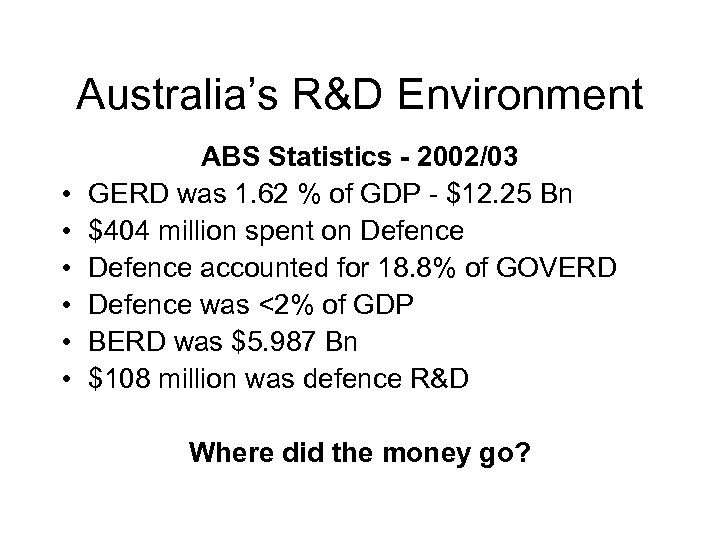
Australia’s R&D Environment • • • ABS Statistics - 2002/03 GERD was 1. 62 % of GDP - $12. 25 Bn $404 million spent on Defence accounted for 18. 8% of GOVERD Defence was <2% of GDP BERD was $5. 987 Bn $108 million was defence R&D Where did the money go?
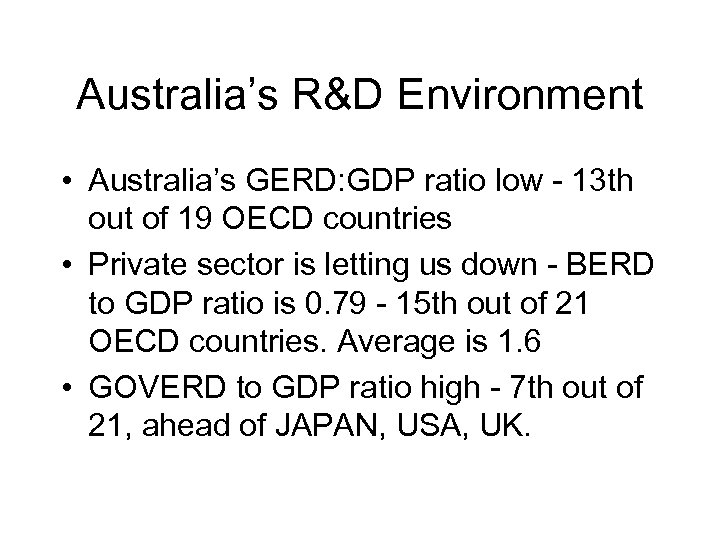
Australia’s R&D Environment • Australia’s GERD: GDP ratio low - 13 th out of 19 OECD countries • Private sector is letting us down - BERD to GDP ratio is 0. 79 - 15 th out of 21 OECD countries. Average is 1. 6 • GOVERD to GDP ratio high - 7 th out of 21, ahead of JAPAN, USA, UK.
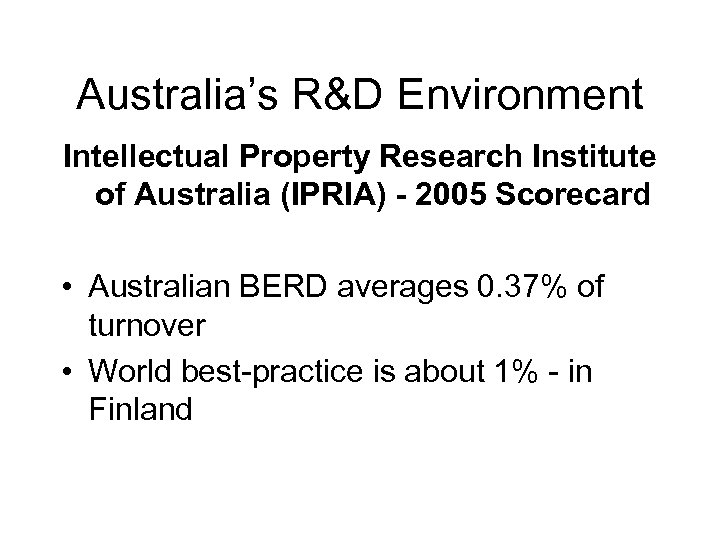
Australia’s R&D Environment Intellectual Property Research Institute of Australia (IPRIA) - 2005 Scorecard • Australian BERD averages 0. 37% of turnover • World best-practice is about 1% - in Finland
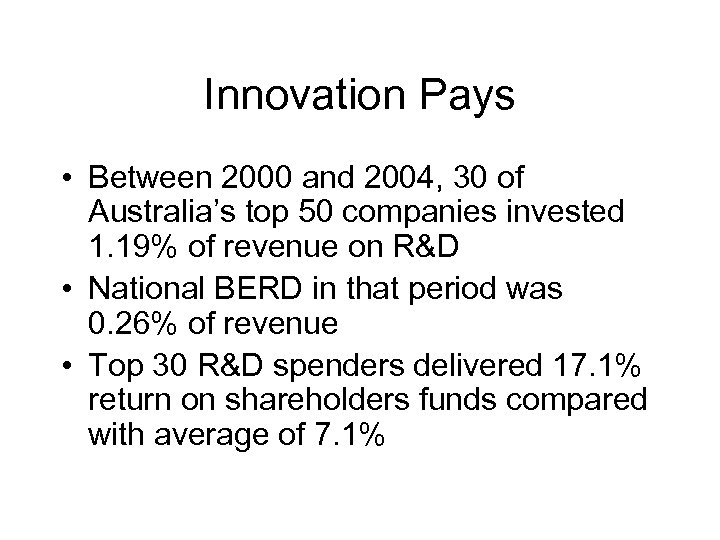
Innovation Pays • Between 2000 and 2004, 30 of Australia’s top 50 companies invested 1. 19% of revenue on R&D • National BERD in that period was 0. 26% of revenue • Top 30 R&D spenders delivered 17. 1% return on shareholders funds compared with average of 7. 1%
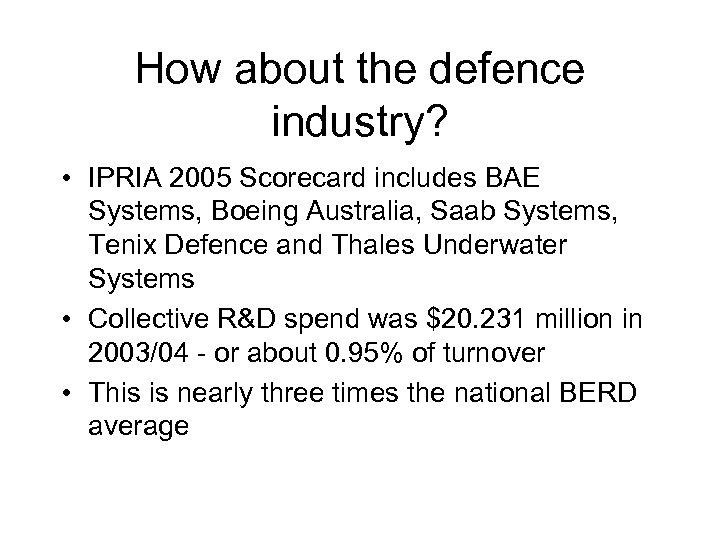
How about the defence industry? • IPRIA 2005 Scorecard includes BAE Systems, Boeing Australia, Saab Systems, Tenix Defence and Thales Underwater Systems • Collective R&D spend was $20. 231 million in 2003/04 - or about 0. 95% of turnover • This is nearly three times the national BERD average
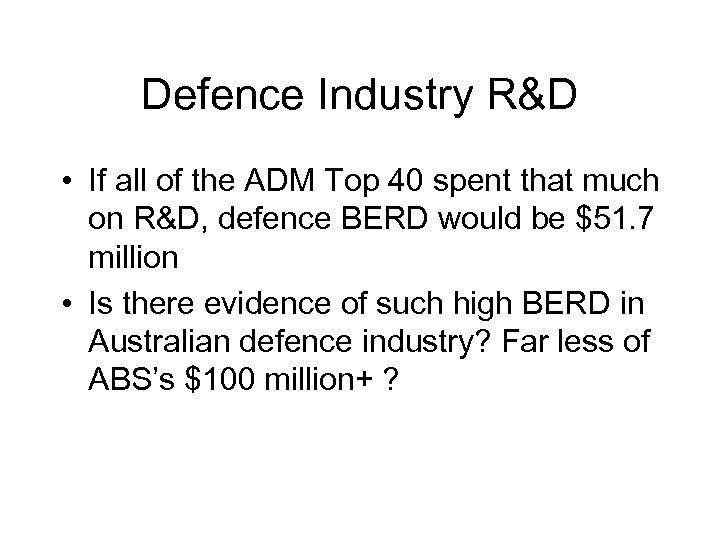
Defence Industry R&D • If all of the ADM Top 40 spent that much on R&D, defence BERD would be $51. 7 million • Is there evidence of such high BERD in Australian defence industry? Far less of ABS’s $100 million+ ?
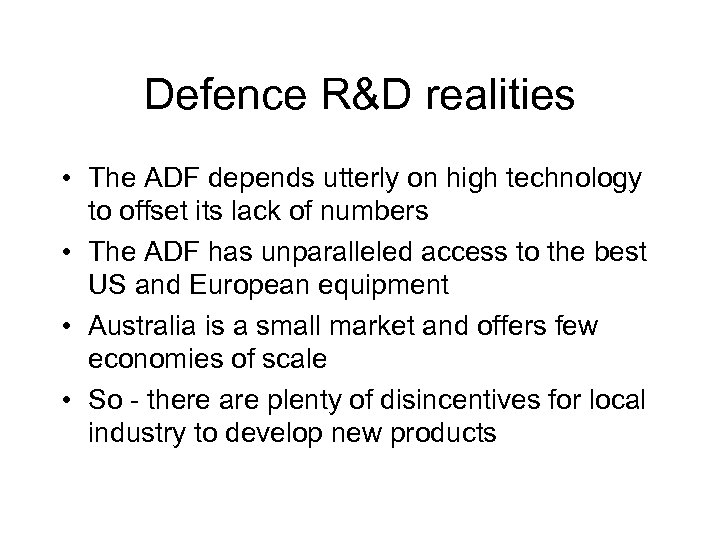
Defence R&D realities • The ADF depends utterly on high technology to offset its lack of numbers • The ADF has unparalleled access to the best US and European equipment • Australia is a small market and offers few economies of scale • So - there are plenty of disincentives for local industry to develop new products
Australia’s Defence R&D Needs • ADF’s principal need is for S&T advice on what to buy and how to use it • DSTO provides mainly policy, smart buyer and smart user advice to the ADF. So it does S&T rather than R&D • But Australia still produces world-class defence products
Three Questions This paper is based on three questions: • Is there a problem? Does Australia do enough defence R&D? • What’s the market? • What’s the cost of not getting it right?
Brab’s Guidelines for DSTO R&D “Most important scientific need in Defence is to know how best to use the technologies developed by others. ” INVEST IN R&D ONLY: • Where Australia’s needs are too different • Where even close allies won’t share secrets • Where we can’t share secrets with anybody else • Where the idea is just too good to ignore
Brab’s Guidelines - 2 • The guidelines represent prudent stewardship of public funds • Consistent with Defence’s stated needs of Australian industry • But private sector should not feel itself bound by them
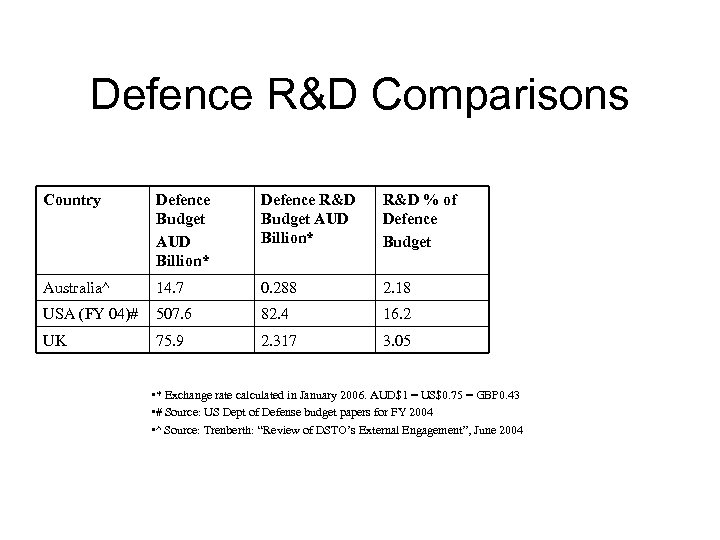
Defence R&D Comparisons Country Defence Budget AUD Billion* Defence R&D Budget AUD Billion* R&D % of Defence Budget Australia^ 14. 7 0. 288 2. 18 USA (FY 04)# 507. 6 82. 4 16. 2 UK 75. 9 2. 317 3. 05 • * Exchange rate calculated in January 2006. AUD$1 = US$0. 75 = GBP 0. 43 • # Source: US Dept of Defense budget papers for FY 2004 • ^ Source: Trenberth: “Review of DSTO’s External Engagement”, June 2004
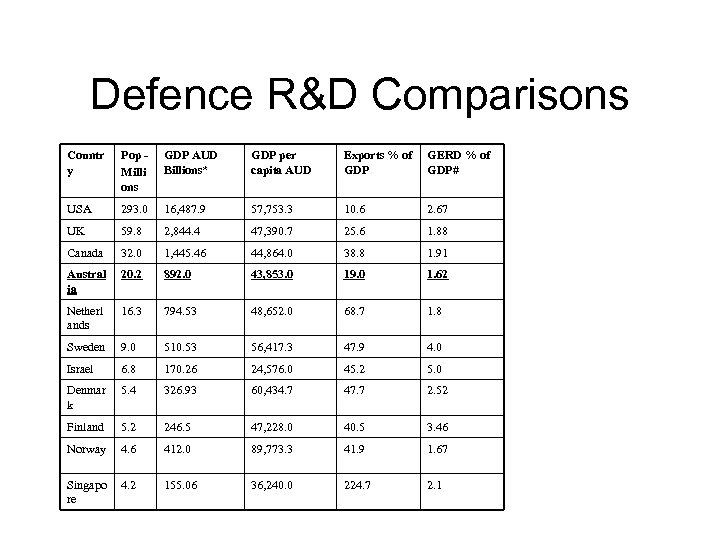
Defence R&D Comparisons Countr y Pop Milli ons GDP AUD Billions* GDP per capita AUD Exports % of GDP GERD % of GDP# USA 293. 0 16, 487. 9 57, 753. 3 10. 6 2. 67 UK 59. 8 2, 844. 4 47, 390. 7 25. 6 1. 88 Canada 32. 0 1, 445. 46 44, 864. 0 38. 8 1. 91 Austral ia 20. 2 892. 0 43, 853. 0 19. 0 1. 62 Netherl ands 16. 3 794. 53 48, 652. 0 68. 7 1. 8 Sweden 9. 0 510. 53 56, 417. 3 47. 9 4. 0 Israel 6. 8 170. 26 24, 576. 0 45. 2 5. 0 Denmar k 5. 4 326. 93 60, 434. 7 47. 7 2. 52 Finland 5. 2 246. 5 47, 228. 0 40. 5 3. 46 Norway 4. 6 412. 0 89, 773. 3 41. 9 1. 67 Singapo re 4. 2 155. 06 36, 240. 0 224. 7 2. 1
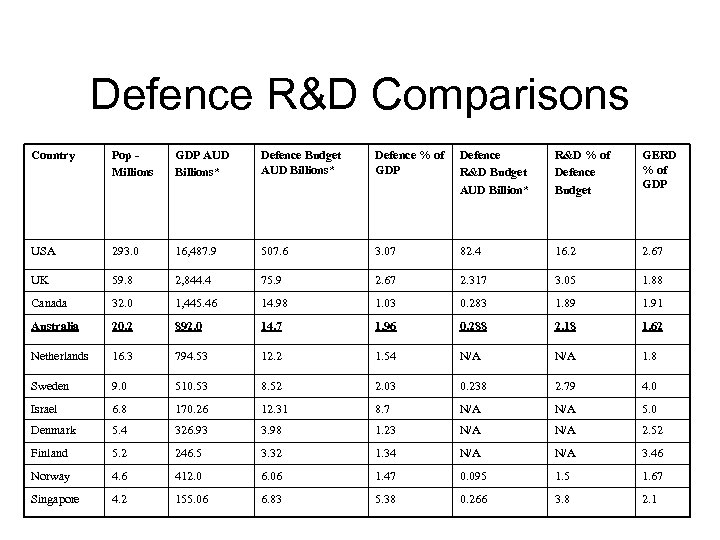
Defence R&D Comparisons Country Pop Millions GDP AUD Billions* Defence Budget AUD Billions* Defence % of GDP Defence R&D Budget AUD Billion* R&D % of Defence Budget GERD % of GDP USA 293. 0 16, 487. 9 507. 6 3. 07 82. 4 16. 2 2. 67 UK 59. 8 2, 844. 4 75. 9 2. 67 2. 317 3. 05 1. 88 Canada 32. 0 1, 445. 46 14. 98 1. 03 0. 283 1. 89 1. 91 Australia 20. 2 892. 0 14. 7 1. 96 0. 288 2. 18 1. 62 Netherlands 16. 3 794. 53 12. 2 1. 54 N/A 1. 8 Sweden 9. 0 510. 53 8. 52 2. 03 0. 238 2. 79 4. 0 Israel 6. 8 170. 26 12. 31 8. 7 N/A 5. 0 Denmark 5. 4 326. 93 3. 98 1. 23 N/A 2. 52 Finland 5. 2 246. 5 3. 32 1. 34 N/A 3. 46 Norway 4. 6 412. 0 6. 06 1. 47 0. 095 1. 67 Singapore 4. 2 155. 06 6. 83 5. 38 0. 266 3. 8 2. 1
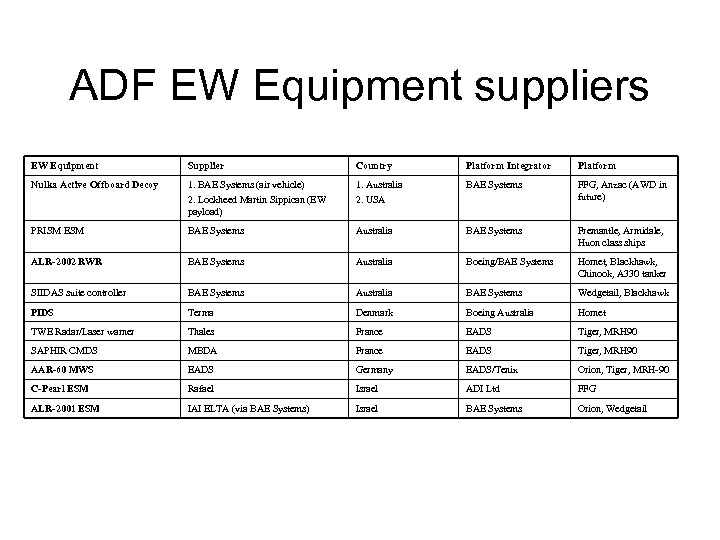
ADF EW Equipment suppliers EW Equipment Supplier Country Platform Integrator Platform Nulka Active Offboard Decoy 1. BAE Systems (air vehicle) 2. Lockheed Martin Sippican (EW payload) 1. Australia 2. USA BAE Systems FFG, Anzac (AWD in future) PRISM ESM BAE Systems Australia BAE Systems Fremantle, Armidale, Huon class ships ALR-2002 RWR BAE Systems Australia Boeing/BAE Systems Hornet, Blackhawk, Chinook, A 330 tanker SIIDAS suite controller BAE Systems Australia BAE Systems Wedgetail, Blackhawk PIDS Terma Denmark Boeing Australia Hornet TWE Radar/Laser warner Thales France EADS Tiger, MRH 90 SAPHIR CMDS MBDA France EADS Tiger, MRH 90 AAR-60 MWS EADS Germany EADS/Tenix Orion, Tiger, MRH-90 C-Pearl ESM Rafael Israel ADI Ltd FFG ALR-2001 ESM IAI ELTA (via BAE Systems) Israel BAE Systems Orion, Wedgetail
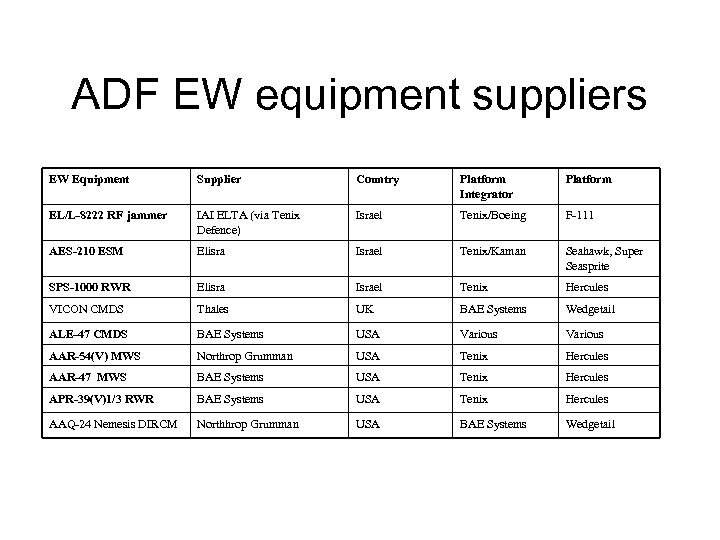
ADF EW equipment suppliers EW Equipment Supplier Country Platform Integrator Platform EL/L-8222 RF jammer IAI ELTA (via Tenix Defence) Israel Tenix/Boeing F-111 AES-210 ESM Elisra Israel Tenix/Kaman Seahawk, Super Seasprite SPS-1000 RWR Elisra Israel Tenix Hercules VICON CMDS Thales UK BAE Systems Wedgetail ALE-47 CMDS BAE Systems USA Various AAR-54(V) MWS Northrop Grumman USA Tenix Hercules AAR-47 MWS BAE Systems USA Tenix Hercules APR-39(V)1/3 RWR BAE Systems USA Tenix Hercules AAQ-24 Nemesis DIRCM Northhrop Grumman USA BAE Systems Wedgetail
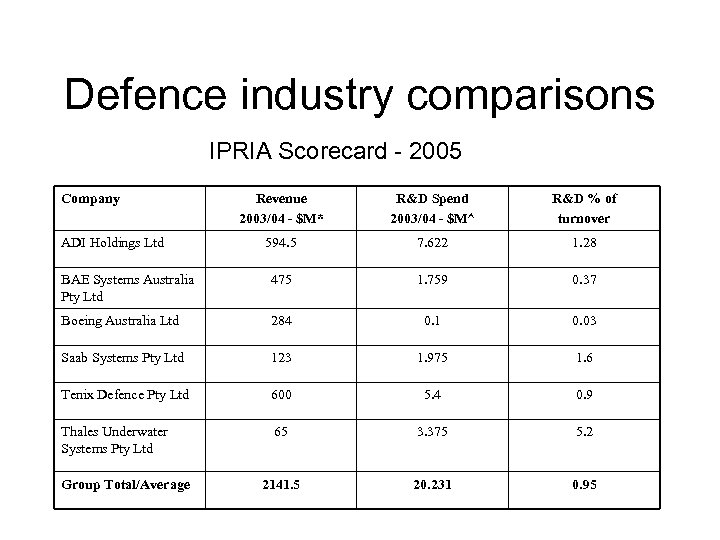
Defence industry comparisons IPRIA Scorecard - 2005 Company Revenue 2003/04 - $M* R&D Spend 2003/04 - $M^ R&D % of turnover 594. 5 7. 622 1. 28 BAE Systems Australia Pty Ltd 475 1. 759 0. 37 Boeing Australia Ltd 284 0. 1 0. 03 Saab Systems Pty Ltd 123 1. 975 1. 6 Tenix Defence Pty Ltd 600 5. 4 0. 9 Thales Underwater Systems Pty Ltd 65 3. 375 5. 2 2141. 5 20. 231 0. 95 ADI Holdings Ltd Group Total/Average
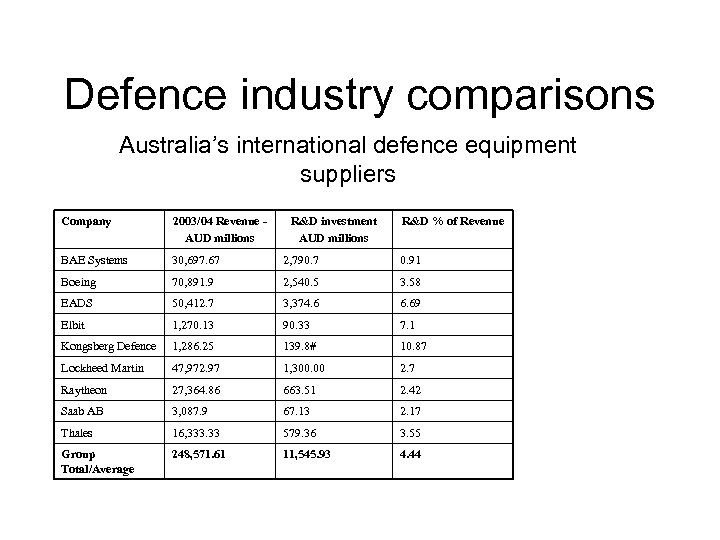
Defence industry comparisons Australia’s international defence equipment suppliers Company 2003/04 Revenue AUD millions R&D investment AUD millions R&D % of Revenue BAE Systems 30, 697. 67 2, 790. 7 0. 91 Boeing 70, 891. 9 2, 540. 5 3. 58 EADS 50, 412. 7 3, 374. 6 6. 69 Elbit 1, 270. 13 90. 33 7. 1 Kongsberg Defence 1, 286. 25 139. 8# 10. 87 Lockheed Martin 47, 972. 97 1, 300. 00 2. 7 Raytheon 27, 364. 86 663. 51 2. 42 Saab AB 3, 087. 9 67. 13 2. 17 Thales 16, 333. 33 579. 36 3. 55 Group Total/Average 248, 571. 61 11, 545. 93 4. 44
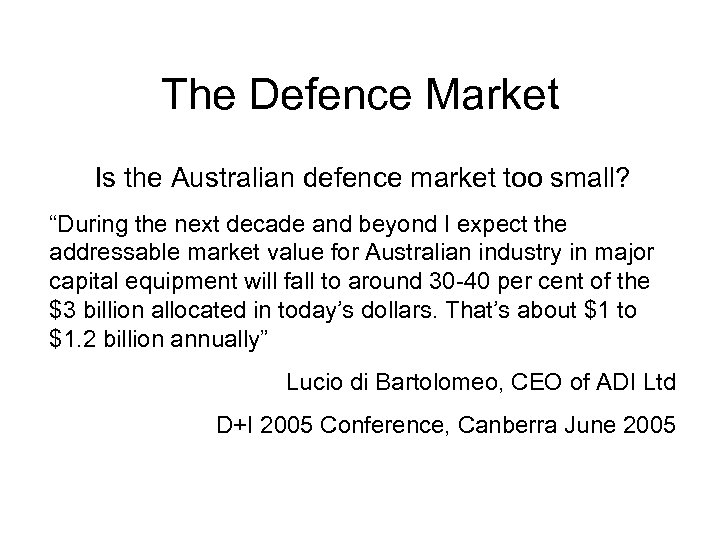
The Defence Market Is the Australian defence market too small? “During the next decade and beyond I expect the addressable market value for Australian industry in major capital equipment will fall to around 30 -40 per cent of the $3 billion allocated in today’s dollars. That’s about $1 to $1. 2 billion annually” Lucio di Bartolomeo, CEO of ADI Ltd D+I 2005 Conference, Canberra June 2005
EXPORTS The export market is overwhelmingly product based. Breaking into the export market means changing the defence industry’s model from that of a service industry to a manufacturing industry investing realistic amounts of R&D in new products and manufacturing capabilities.
Export market issues • Some Australian technologies or products may be too sensitive to receive Australian Federal government export approval • Some products and technologies developed jointly with allies such as the United States may be subject to those allies’ export controls • Access to and success in an export market are to a considerable extent determined by political and strategic factors outside the control of most private sector exporters • It is the accepted rule throughout the global defence industry that to have any chance of winning an export sale to a foreign government the product or service in question must first have been sold successfully to the exporter’s own government.
What’s the cost of NOT doing defence R&D and commercialisation? “We end up beholden to the market with no control over the price we pay for equipment and the capability we receive. Local production (based on local R&D) leaves us options and some leverage in the market place. The advice that DSTO provides Defence in policy/buyer/user areas is backed by its R&D, so defence R&D is an essential component of defence capability. The long-term consequences of bad decisions can be unexpected and persistent, so good advice is essential. ”
Conclusion - 1 Research hasn’t answered big questions yet, but has identified important issues which will help answer the big questions: • Does Australia do enough defence R&D? • Have DSTO’s S&T/R&D investment priorities changed significantly, and if so has industry made up any shortfalls? • Is the ratio of defence GOVERD to BERD significant? • Is the ratio of S&T to R&D significant? • How does Australia’s defence GOVERD to BERD ratio compare with other countries? • How does Australia’s BERD to defence budget ratio compare with other countries? • How does Australian industry’s defence R&D investment compare with the defence industries of other countries?
Conclusion - 2 • Does Australian industry invest sufficiently in its own R&D or in commercialising the IP developed by DSTO and other agencies? • Given its generally higher R&D investment, does Australia’s defence industry perform better than the non-defence sector? • How do DSTO’s IP commercialisation policy and mechanism compare with those of its peers overseas? • What are the factors (real or perceived) in the Australian defence market which inhibit private sector defence R&D? • For example, do Defence’s stated needs of Australian industry inhibit or actively discourage investment in new products? Is the market simply too small to sustain an industry base with the skills the ADF needs to support it?
Conclusion - 3 Identifying the specific factors that enable or inhibit successful commercialisation of Australian defence IP will be a long-term project. But Australia's defence community needs hard data and a systematic approach to gathering it in order to identify clearly what needs to be done to enable the industry to remain relevant and to grow through the first half of this century. I’ll be approaching many of you in the future for help in gathering that data. Thank you.
Скачать презентацию Association of Old Crows International Symposium and Exhibition
cb2b3b8d8a3ac703f2ceb4ac75e37364.ppt