 Скачать презентацию Association Analysis Data Engineering Type of attributes
7f2591f2f17a1920e5fb7f8242b4a676.ppt
- Количество слайдов: 17



Association Analysis (Data Engineering)
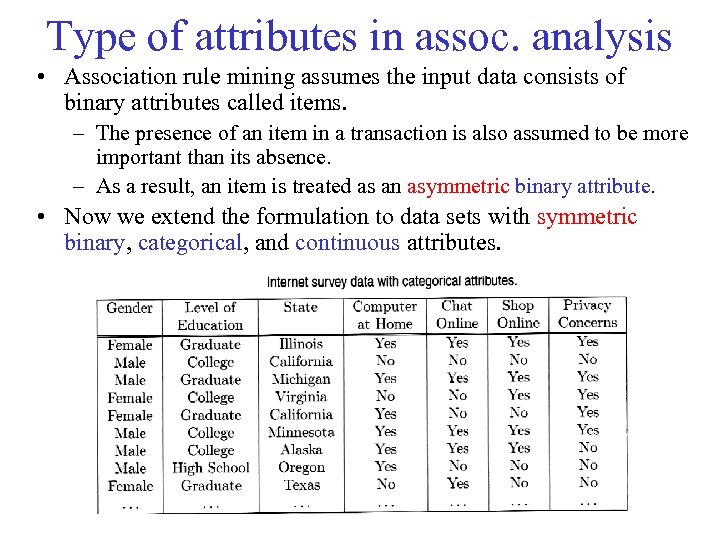
Type of attributes in assoc. analysis • Association rule mining assumes the input data consists of binary attributes called items. – The presence of an item in a transaction is also assumed to be more important than its absence. – As a result, an item is treated as an asymmetric binary attribute. • Now we extend the formulation to data sets with symmetric binary, categorical, and continuous attributes.
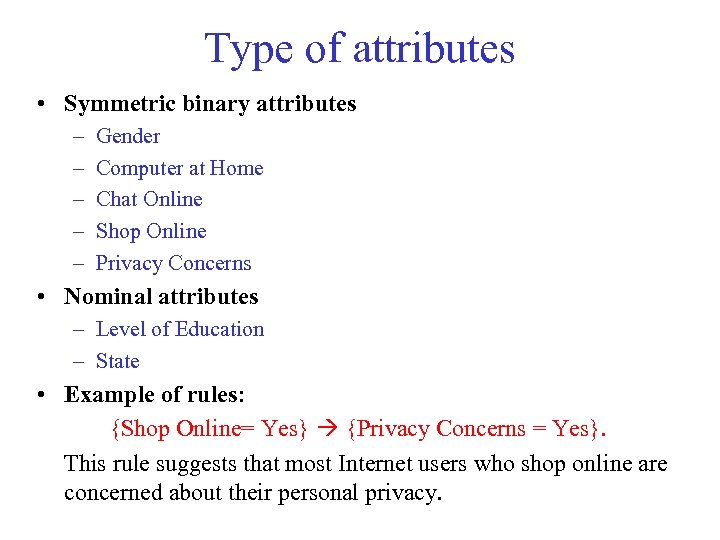
Type of attributes • Symmetric binary attributes – – – Gender Computer at Home Chat Online Shop Online Privacy Concerns • Nominal attributes – Level of Education – State • Example of rules: {Shop Online= Yes} {Privacy Concerns = Yes}. This rule suggests that most Internet users who shop online are concerned about their personal privacy.
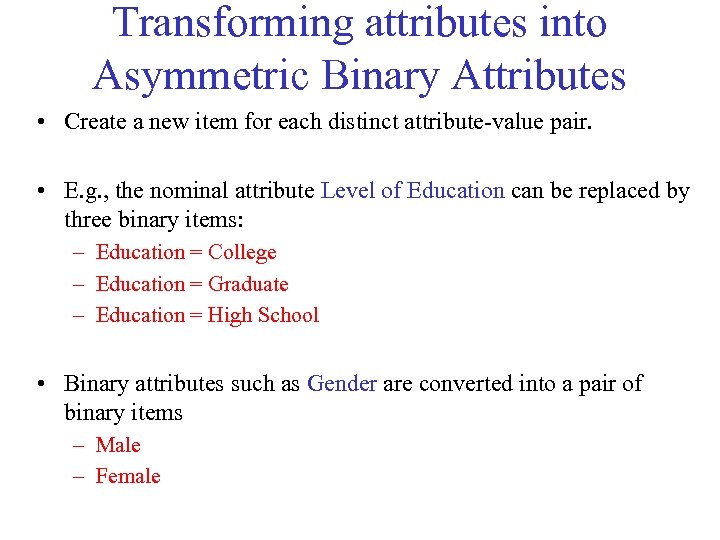
Transforming attributes into Asymmetric Binary Attributes • Create a new item for each distinct attribute-value pair. • E. g. , the nominal attribute Level of Education can be replaced by three binary items: – Education = College – Education = Graduate – Education = High School • Binary attributes such as Gender are converted into a pair of binary items – Male – Female
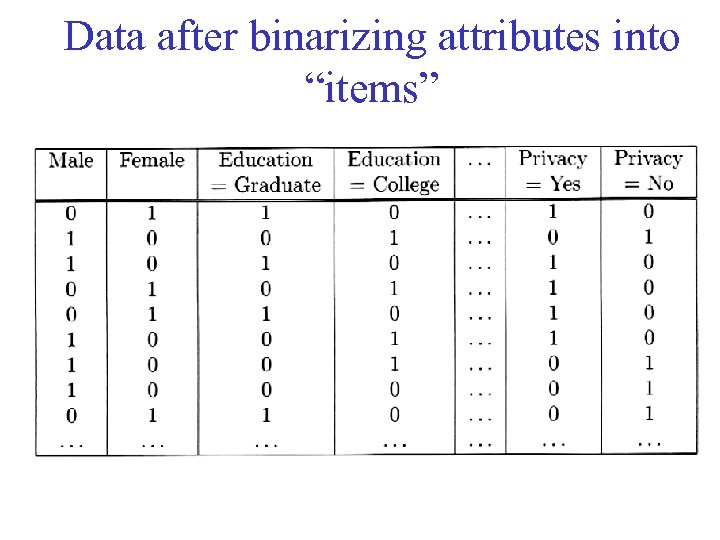
Data after binarizing attributes into “items”
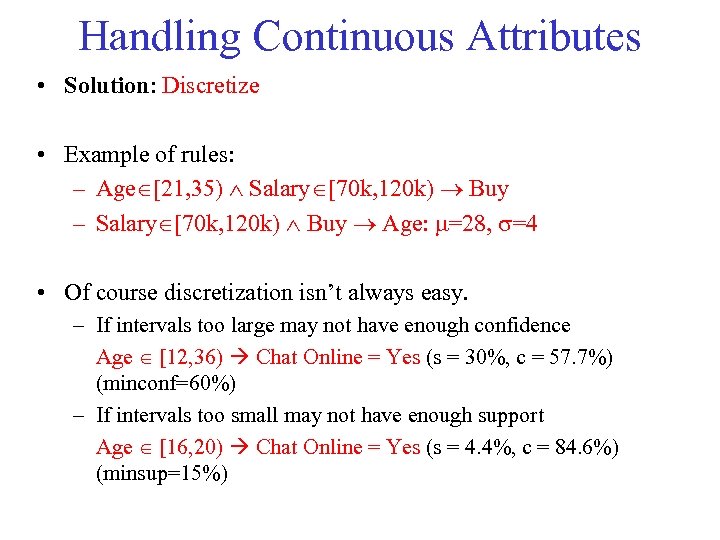
Handling Continuous Attributes • Solution: Discretize • Example of rules: – Age [21, 35) Salary [70 k, 120 k) Buy – Salary [70 k, 120 k) Buy Age: =28, =4 • Of course discretization isn’t always easy. – If intervals too large may not have enough confidence Age [12, 36) Chat Online = Yes (s = 30%, c = 57. 7%) (minconf=60%) – If intervals too small may not have enough support Age [16, 20) Chat Online = Yes (s = 4. 4%, c = 84. 6%) (minsup=15%)
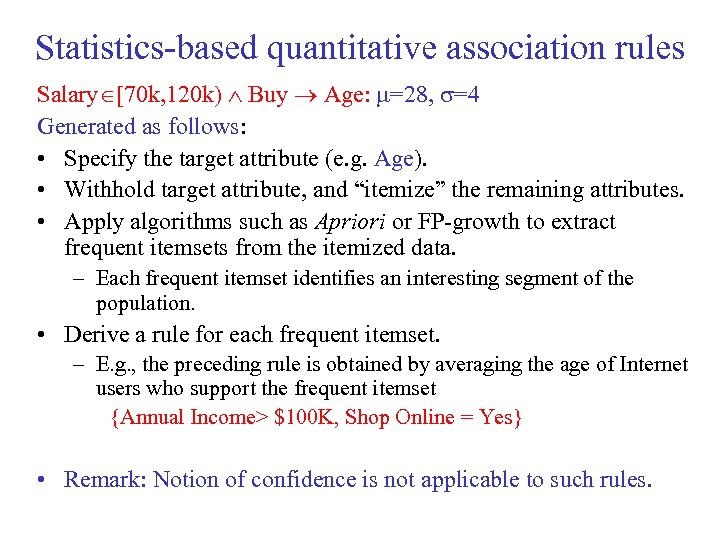
Statistics-based quantitative association rules Salary [70 k, 120 k) Buy Age: =28, =4 Generated as follows: • Specify the target attribute (e. g. Age). • Withhold target attribute, and “itemize” the remaining attributes. • Apply algorithms such as Apriori or FP-growth to extract frequent itemsets from the itemized data. – Each frequent itemset identifies an interesting segment of the population. • Derive a rule for each frequent itemset. – E. g. , the preceding rule is obtained by averaging the age of Internet users who support the frequent itemset {Annual Income> $100 K, Shop Online = Yes} • Remark: Notion of confidence is not applicable to such rules.
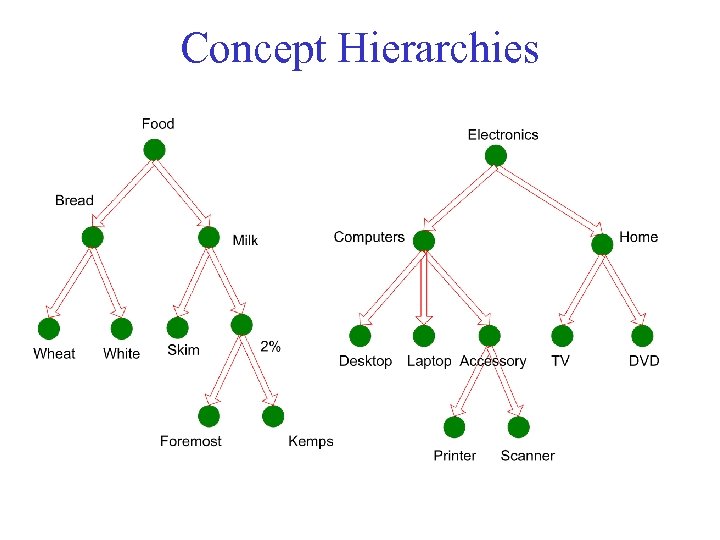
Concept Hierarchies
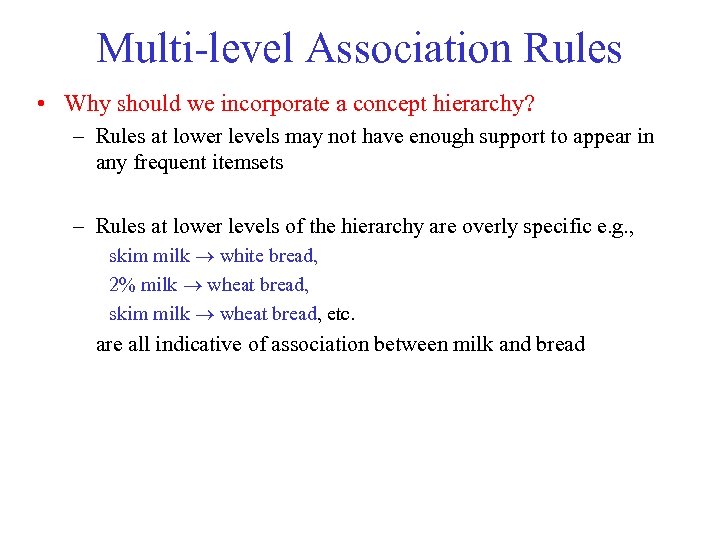
Multi-level Association Rules • Why should we incorporate a concept hierarchy? – Rules at lower levels may not have enough support to appear in any frequent itemsets – Rules at lower levels of the hierarchy are overly specific e. g. , skim milk white bread, 2% milk wheat bread, skim milk wheat bread, etc. are all indicative of association between milk and bread
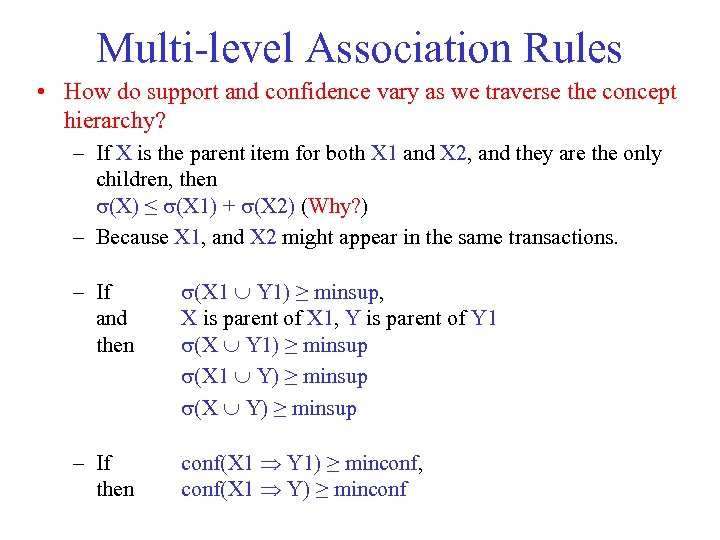
Multi-level Association Rules • How do support and confidence vary as we traverse the concept hierarchy? – If X is the parent item for both X 1 and X 2, and they are the only children, then (X) ≤ (X 1) + (X 2) (Why? ) – Because X 1, and X 2 might appear in the same transactions. – If and then (X 1 Y 1) ≥ minsup, X is parent of X 1, Y is parent of Y 1 (X Y 1) ≥ minsup (X 1 Y) ≥ minsup (X Y) ≥ minsup – If then conf(X 1 Y 1) ≥ minconf, conf(X 1 Y) ≥ minconf
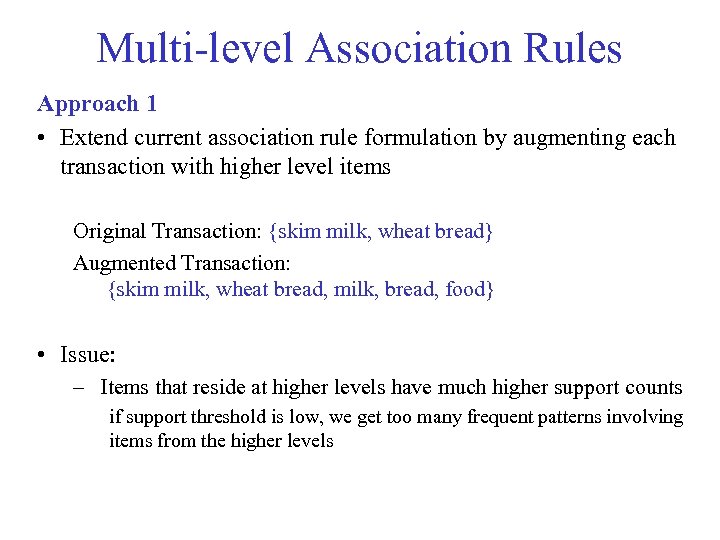
Multi-level Association Rules Approach 1 • Extend current association rule formulation by augmenting each transaction with higher level items Original Transaction: {skim milk, wheat bread} Augmented Transaction: {skim milk, wheat bread, milk, bread, food} • Issue: – Items that reside at higher levels have much higher support counts if support threshold is low, we get too many frequent patterns involving items from the higher levels
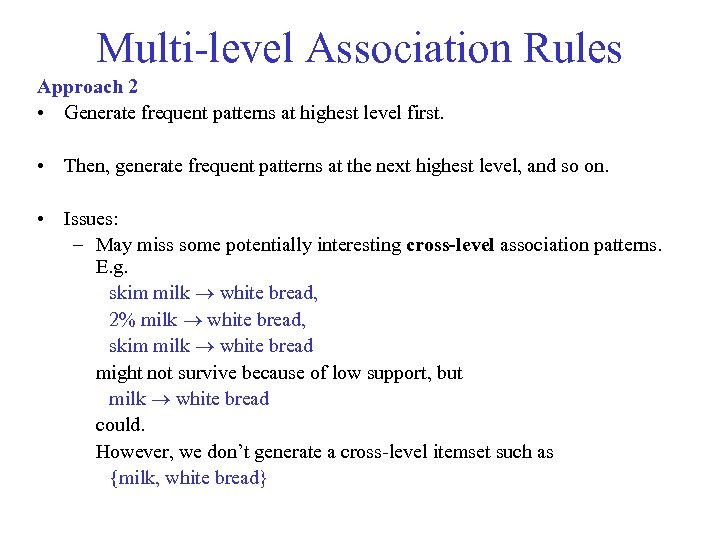
Multi-level Association Rules Approach 2 • Generate frequent patterns at highest level first. • Then, generate frequent patterns at the next highest level, and so on. • Issues: – May miss some potentially interesting cross-level association patterns. E. g. skim milk white bread, 2% milk white bread, skim milk white bread might not survive because of low support, but milk white bread could. However, we don’t generate a cross-level itemset such as {milk, white bread}
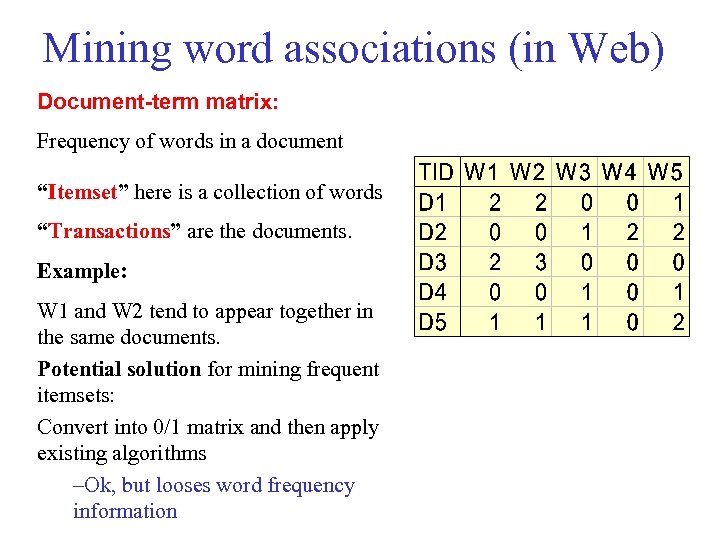
Mining word associations (in Web) Document-term matrix: Frequency of words in a document “Itemset” here is a collection of words “Transactions” are the documents. Example: W 1 and W 2 tend to appear together in the same documents. Potential solution for mining frequent itemsets: Convert into 0/1 matrix and then apply existing algorithms –Ok, but looses word frequency information
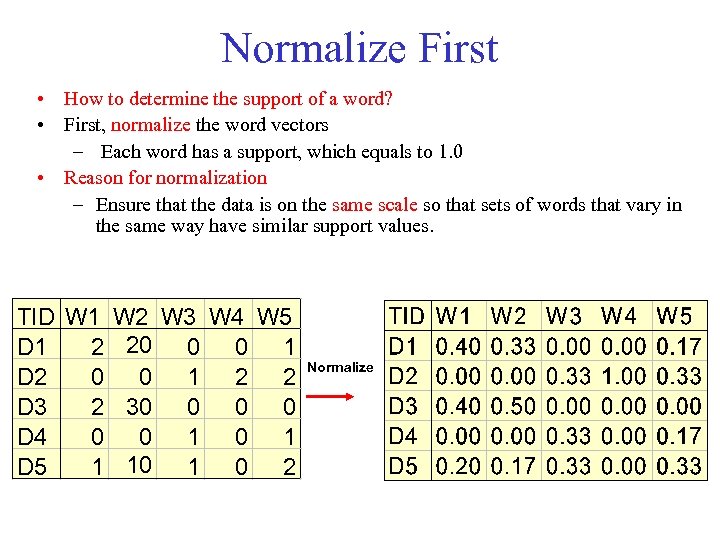
Normalize First • How to determine the support of a word? • First, normalize the word vectors – Each word has a support, which equals to 1. 0 • Reason for normalization – Ensure that the data is on the same scale so that sets of words that vary in the same way have similar support values. TID W 1 D 1 2 D 2 0 D 3 2 D 4 0 D 5 1 W 2 W 3 W 4 W 5 20 0 0 1 2 2 30 0 0 1 10 1 0 2 Normalize
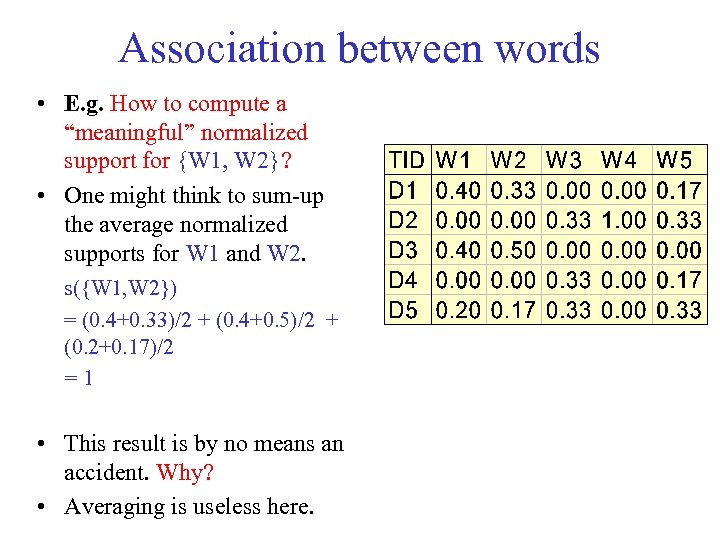
Association between words • E. g. How to compute a “meaningful” normalized support for {W 1, W 2}? • One might think to sum-up the average normalized supports for W 1 and W 2. s({W 1, W 2}) = (0. 4+0. 33)/2 + (0. 4+0. 5)/2 + (0. 2+0. 17)/2 =1 • This result is by no means an accident. Why? • Averaging is useless here.
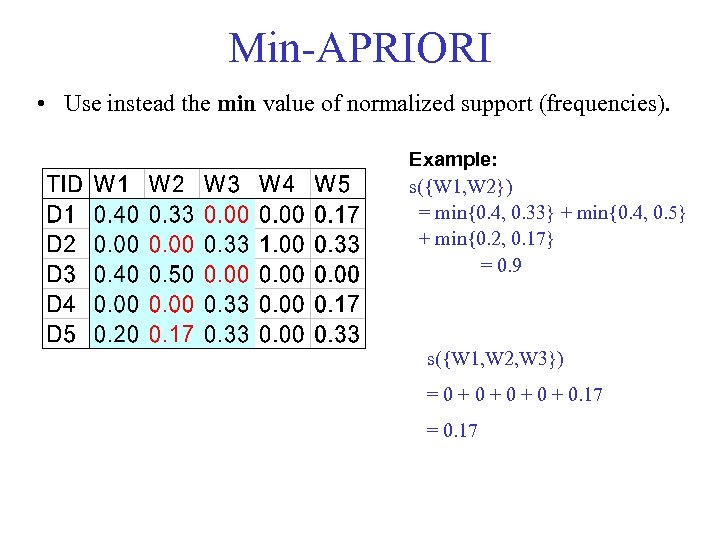
Min-APRIORI • Use instead the min value of normalized support (frequencies). Example: s({W 1, W 2}) = min{0. 4, 0. 33} + min{0. 4, 0. 5} + min{0. 2, 0. 17} = 0. 9 s({W 1, W 2, W 3}) = 0 + 0 + 0. 17 = 0. 17
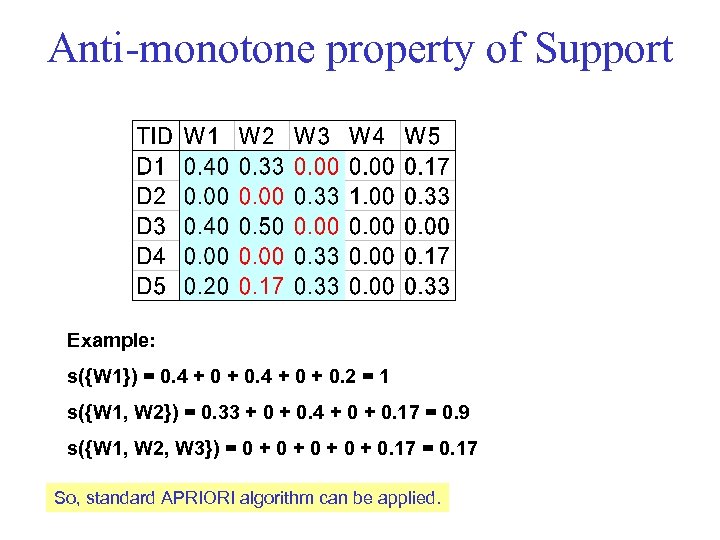
Anti-monotone property of Support Example: s({W 1}) = 0. 4 + 0 + 0. 2 = 1 s({W 1, W 2}) = 0. 33 + 0. 4 + 0. 17 = 0. 9 s({W 1, W 2, W 3}) = 0 + 0 + 0. 17 = 0. 17 So, standard APRIORI algorithm can be applied.
Скачать презентацию Association Analysis Data Engineering Type of attributes
7f2591f2f17a1920e5fb7f8242b4a676.ppt