


 Скачать презентацию Associated Charm Production in neutrino interactions M Güler
ed6f6f20756ce799c155a52f15327470.ppt
- Количество слайдов: 21
 Associated Charm Production in neutrino interactions M. Güler (METU, Ankara) for Collaboration Belgium (Brussels, Louvain-la-Neuve), CERN, Germany (Berlin, Münster), Israel (Haifa), Italy (Bari, Cagliari, Ferrara, Naples, Rome, Salerno), Japan (Toho, Kinki, Aichi, Kobe, Nagoya, Osaka, Utsunomiya) , Korea (Gyeongsang), The Netherlands (Amsterdam), Russia (Moscow), Turkey (Adana, Ankara) 1 HEP 2007 July 19 -25, 2007 Manchester, England
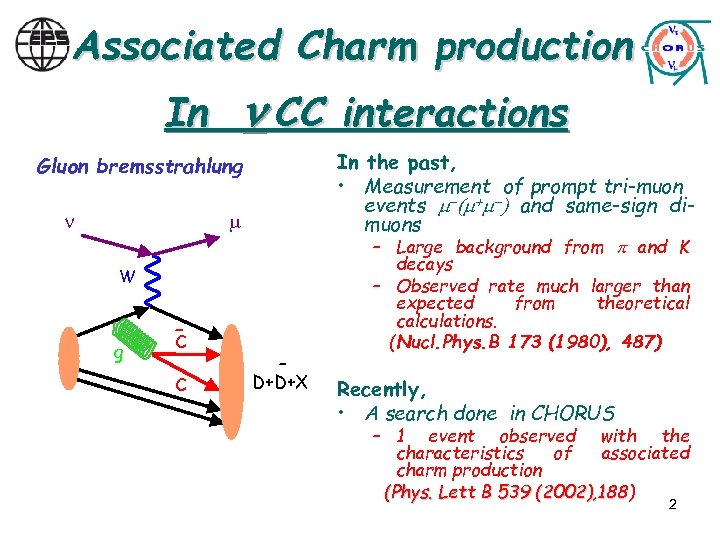 Associated Charm production In n CC interactions In the past, • Measurement of prompt tri-muon events m-(m+m-) and same-sign dimuons – Large background from p and K Gluon bremsstrahlung m W g – c c – D+D+X decays – Observed rate much larger than expected from theoretical calculations. (Nucl. Phys. B 173 (1980), 487) Recently, • A search done in CHORUS – 1 event observed with the characteristics of associated charm production (Phys. Lett B 539 (2002), 188) 2
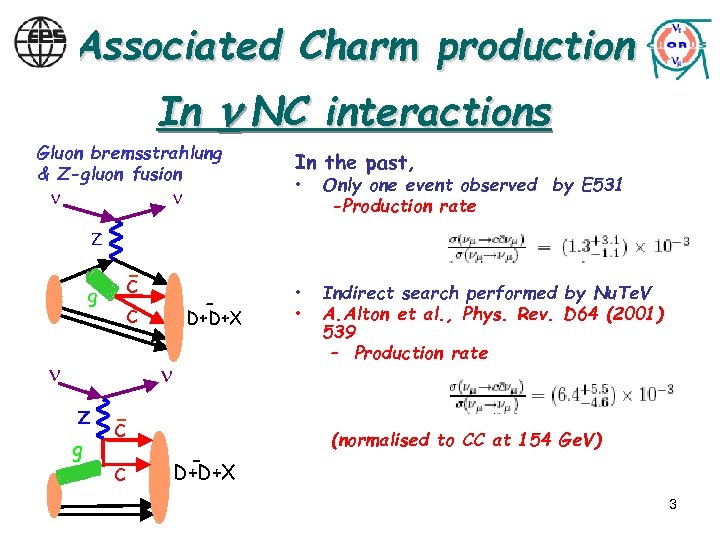 Associated Charm production In n NC interactions Gluon bremsstrahlung & Z-gluon fusion In the past, • Only one event observed by E 531 -Production rate • • Indirect search performed by Nu. Te. V A. Alton et al. , Phys. Rev. D 64 (2001) 539 – Production rate Z g c c – D+D+X (normalised to CC at 154 Ge. V) 3
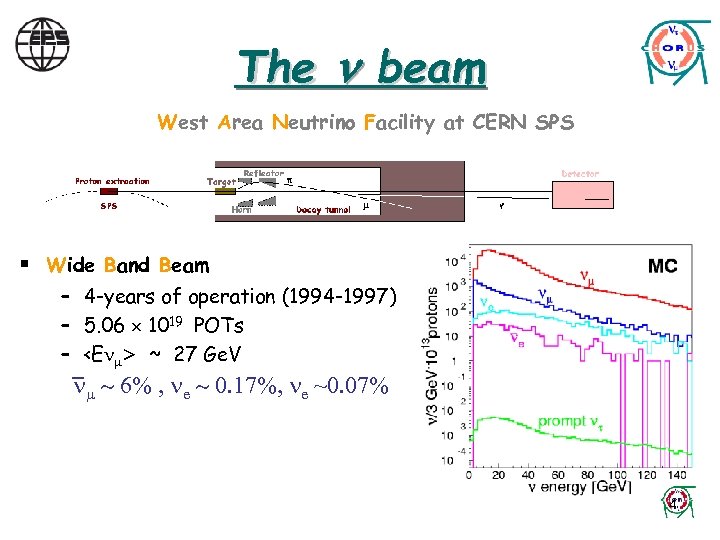 The n beam West Area Neutrino Facility at CERN SPS § Wide Band Beam – 4 -years of operation (1994 -1997) – 5. 06 1019 POTs –
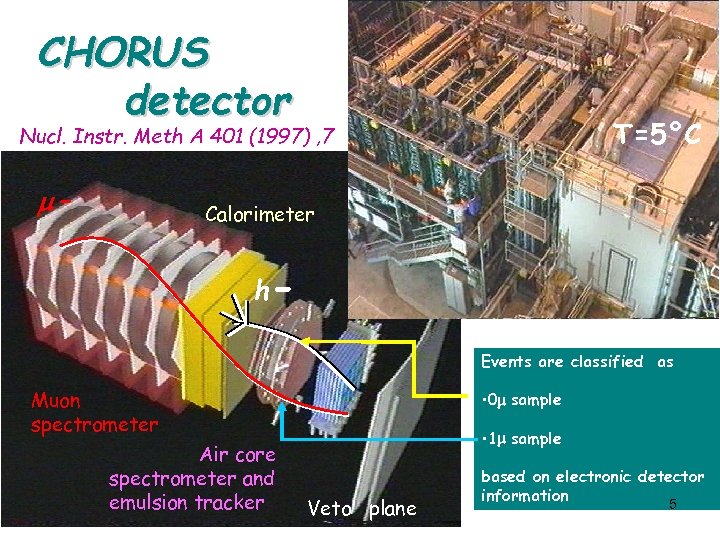 CHORUS detector T=5°C Nucl. Instr. Meth A 401 (1997) , 7 - Calorimeter h. Events are classified as Muon spectrometer Air core spectrometer and emulsion tracker • 0 sample • 1 sample Veto plane based on electronic detector information 5
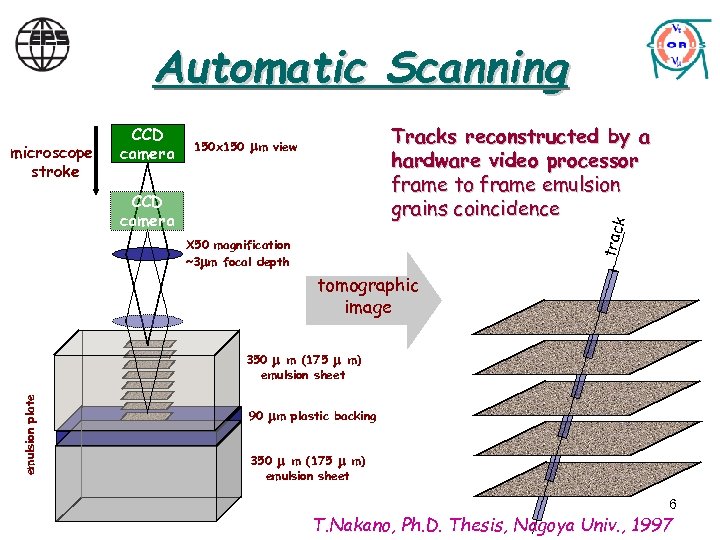 Automatic Scanning microscope stroke CCD camera Tracks reconstructed by a hardware video processor frame to frame emulsion grains coincidence 150 x 150 m view trac k CCD camera X 50 magnification ~3 m focal depth tomographic image emulsion plate 350 m (175 m) emulsion sheet 90 m plastic backing 350 m (175 m) emulsion sheet 6 T. Nakano, Ph. D. Thesis, Nagoya Univ. , 1997
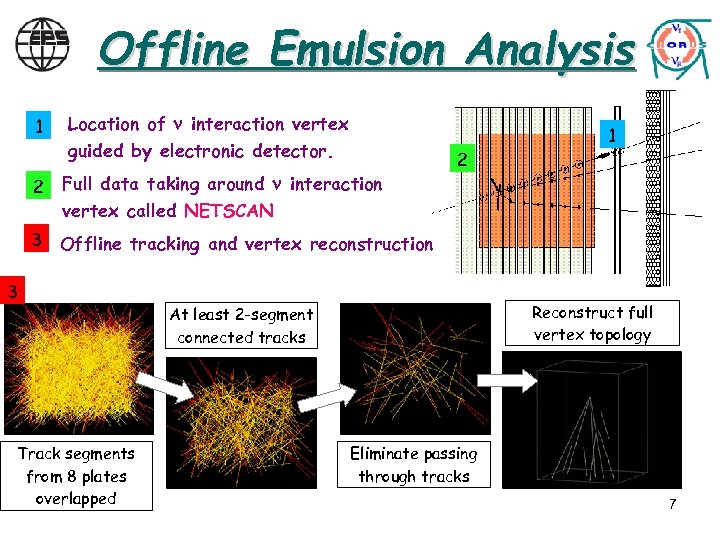 Offline Emulsion Analysis 1 Location of n interaction vertex guided by electronic detector. 2 Full data taking around n interaction 3 2 1 Offline tracking and vertex reconstruction vertex called NETSCAN 3 Track segments from 8 plates overlapped Reconstruct full vertex topology At least 2 -segment connected tracks Eliminate passing through tracks 7
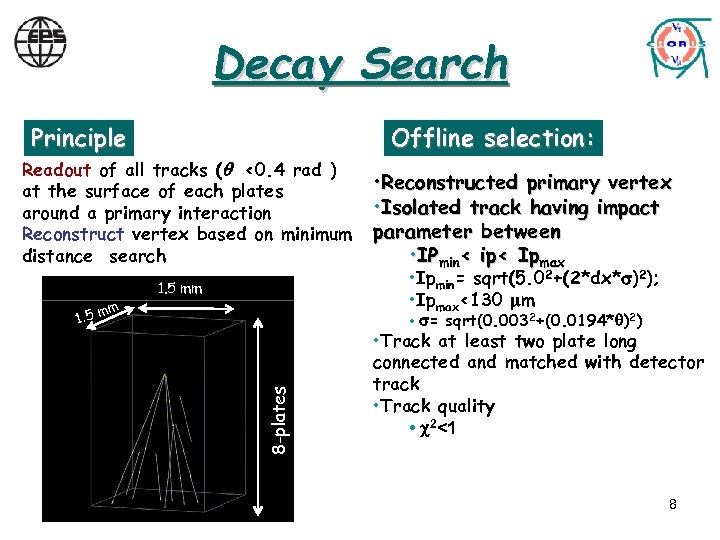 Decay Search Principle Offline selection: Readout of all tracks (q <0. 4 rad ) at the surface of each plates around a primary interaction Reconstruct vertex based on minimum distance search 1. 5 mm mm • Ipmin= sqrt(5. 02+(2*dx*s)2); • Ipmax<130 m • s= sqrt(0. 0032+(0. 0194*q)2) 8 -plates 1. 5 • Reconstructed primary vertex • Isolated track having impact parameter between • IPmin< ip< Ipmax • Track at least two plate long connected and matched with detector track • Track quality • c 2<1 8
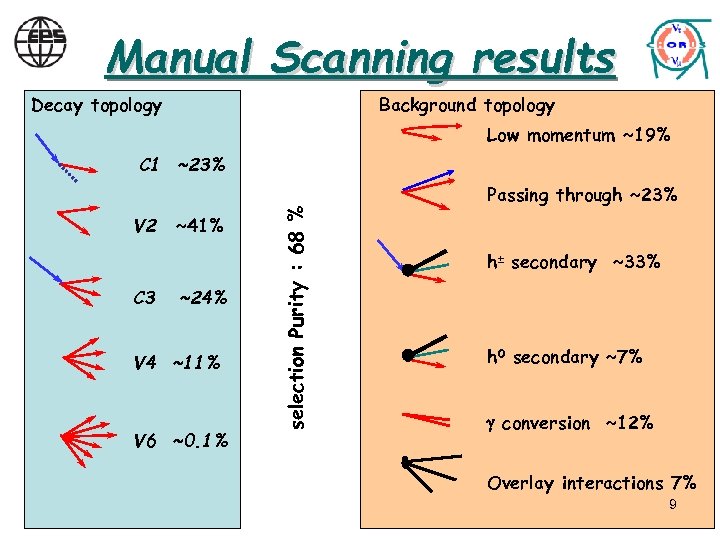 Manual Scanning results Decay topology Background topology Low momentum ~19% V 2 C 3 ~41% ~24% V 4 ~11% V 6 ~0. 1% selection Purity : 68 % C 1 ~23% Passing through ~23% h± secondary ~33% h 0 secondary ~7% g conversion ~12% Overlay interactions 7% 9
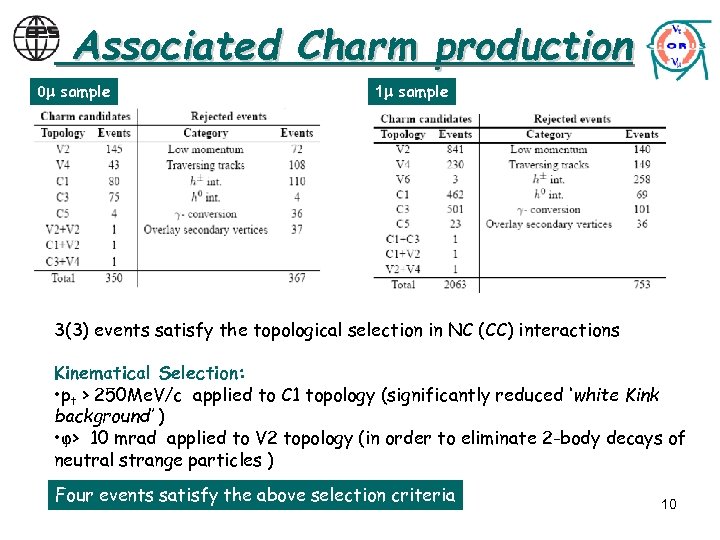 Associated Charm production 0 sample 1 sample 3(3) events satisfy the topological selection in NC (CC) interactions Kinematical Selection: • pt > 250 Me. V/c applied to C 1 topology (significantly reduced ‘white Kink background’ ) • φ> 10 mrad applied to V 2 topology (in order to eliminate 2 -body decays of neutral strange particles ) Four events satisfy the above selection criteria 10
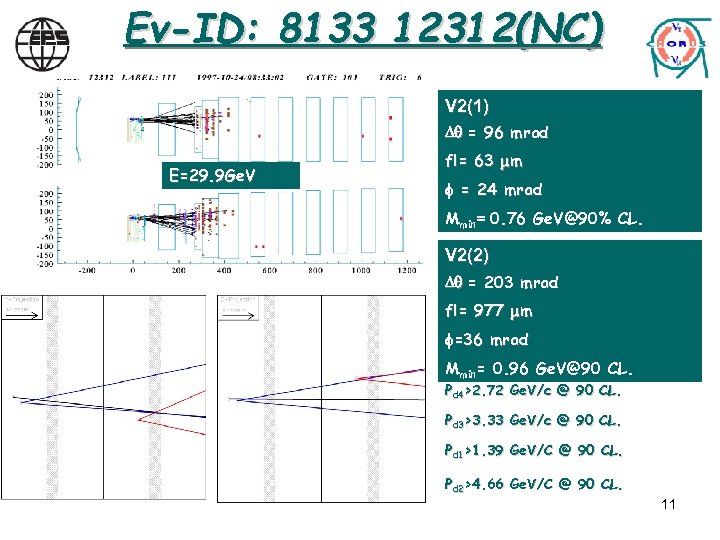 Ev-ID: 8133 12312(NC) V 2(1) Dq = 96 mrad E=29. 9 Ge. V fl= 63 m = 24 mrad Mmin= 0. 76 Ge. V@90% CL. V 2(2) Dq = 203 mrad fl= 977 m =36 mrad Mmin= 0. 96 Ge. V@90 CL. Pd 4>2. 72 Ge. V/c @ 90 CL. Pd 3>3. 33 Ge. V/c @ 90 CL. Pd 1>1. 39 Ge. V/C @ 90 CL. Pd 2>4. 66 Ge. V/C @ 90 CL. 11
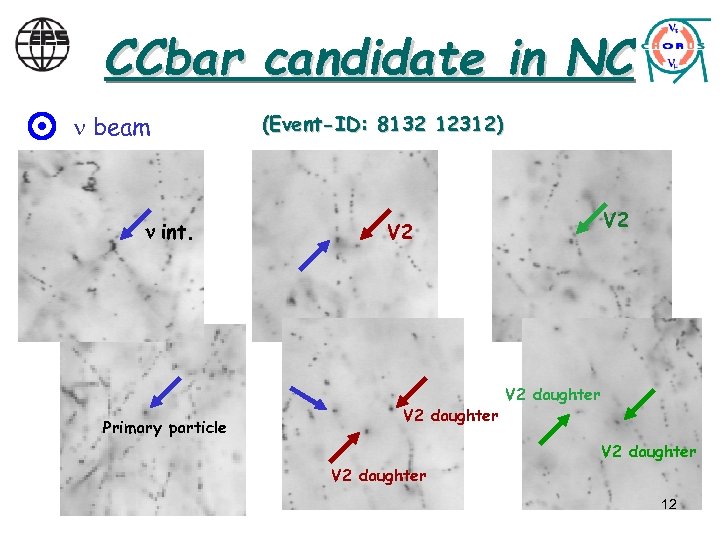 CCbar candidate in NC beam n int. Primary particle (Event-ID: 8132 12312) V 2 V 2 daughter 12
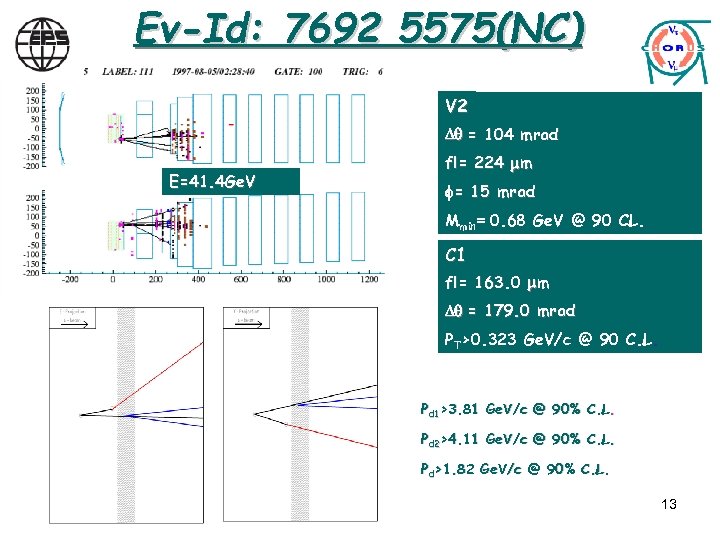 Ev-Id: 7692 5575(NC) V 2 Dq = 104 mrad E=41. 4 Ge. V fl= 224 m = 15 mrad Mmin= 0. 68 Ge. V @ 90 CL. C 1 fl= 163. 0 m Dq = 179. 0 mrad PT>0. 323 Ge. V/c @ 90 C. L. Pd 1>3. 81 Ge. V/c @ 90% C. L. Pd 2>4. 11 Ge. V/c @ 90% C. L. Pd>1. 82 Ge. V/c @ 90% C. L. 13
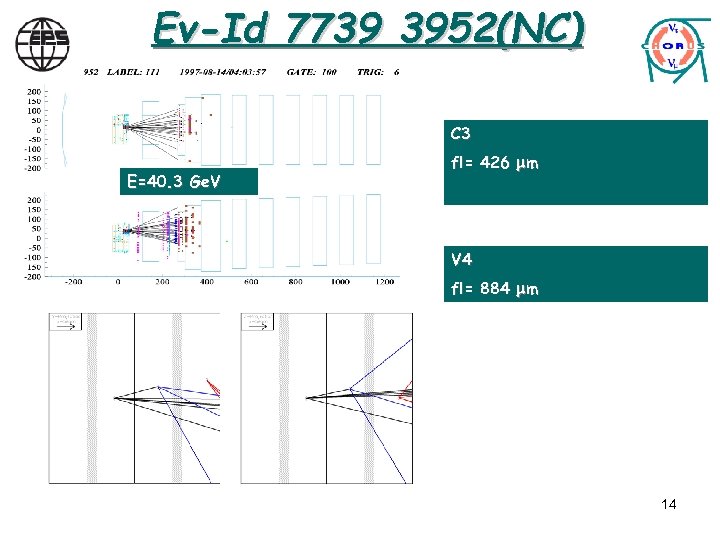 Ev-Id 7739 3952(NC) C 3 E=40. 3 Ge. V fl= 426 m V 4 fl= 884 m 14
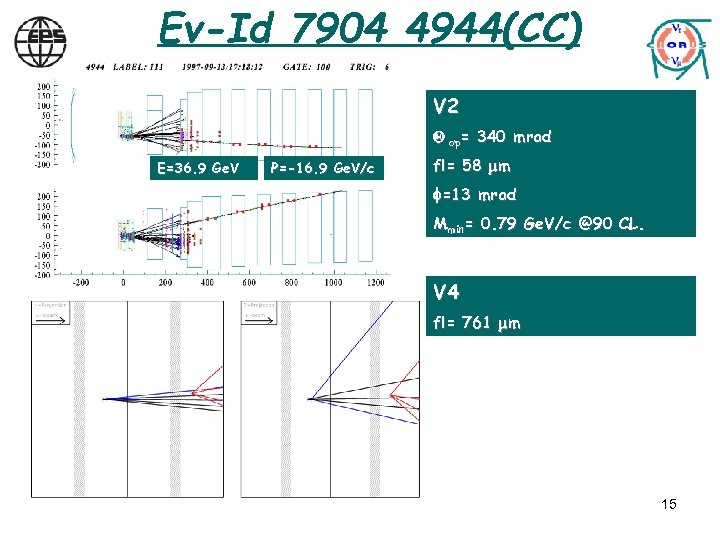 Ev-Id 7904 4944(CC) V 2 Q op= 340 mrad E=36. 9 Ge. V P=-16. 9 Ge. V/c fl= 58 m =13 mrad Mmin= 0. 79 Ge. V/c @90 CL. V 4 fl= 761 m 15
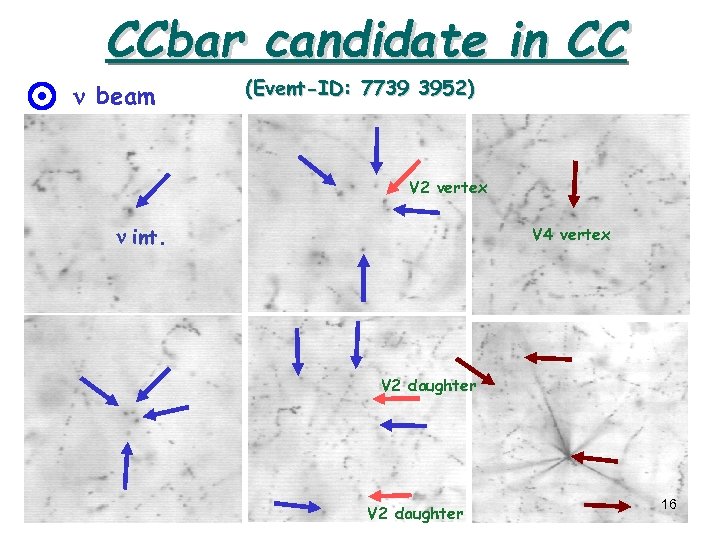 CCbar candidate in CC n beam (Event-ID: 7739 3952) V 2 vertex n int. V 4 vertex V 2 daughter 16
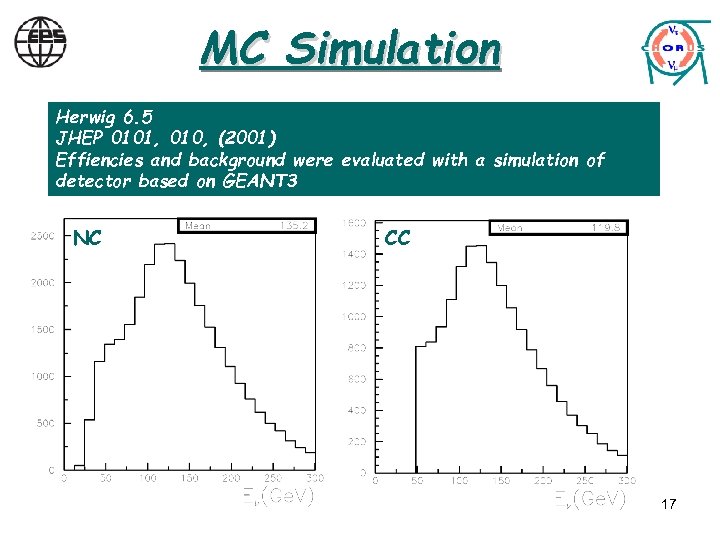 MC Simulation Herwig 6. 5 JHEP 0101, 010, (2001) Effiencies and background were evaluated with a simulation of detector based on GEANT 3 NC CC 17
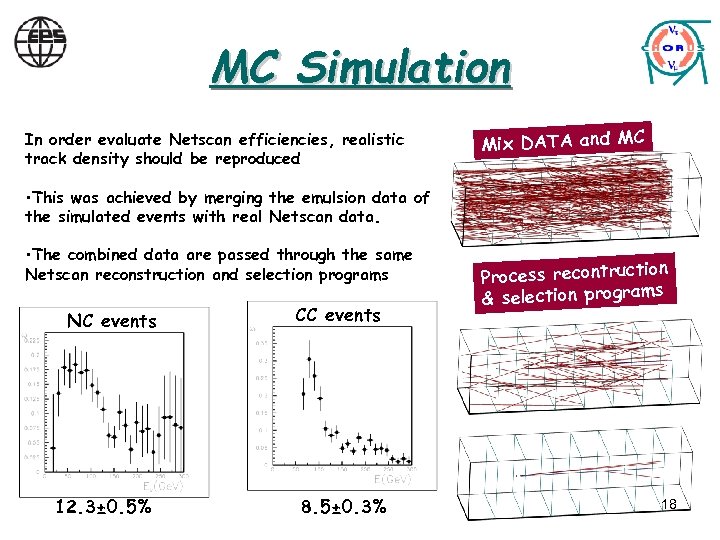 MC Simulation In order evaluate Netscan efficiencies, realistic track density should be reproduced Mix DATA and MC • This was achieved by merging the emulsion data of the simulated events with real Netscan data. • The combined data are passed through the same Netscan reconstruction and selection programs NC events 12. 3± 0. 5% CC events 8. 5± 0. 3% n Process recontructio s & selection program 18
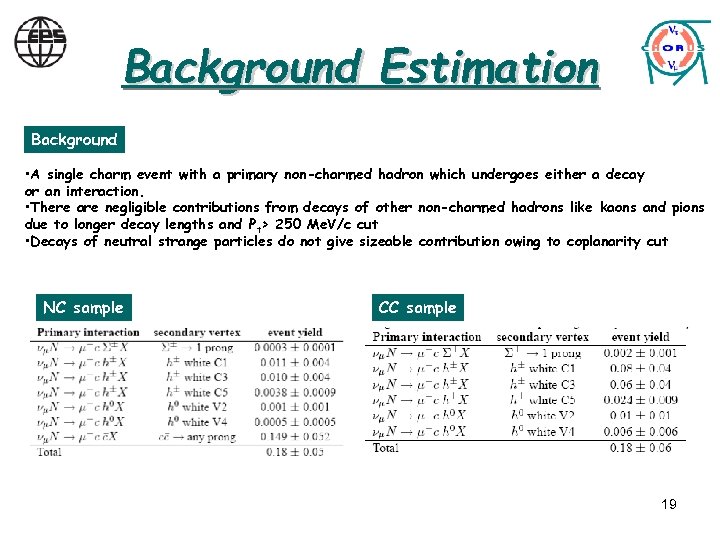 Background Estimation Background • A single charm event with a primary non-charmed hadron which undergoes either a decay or an interaction. • There are negligible contributions from decays of other non-charmed hadrons like kaons and pions due to longer decay lengths and Pt> 250 Me. V/c cut • Decays of neutral strange particles do not give sizeable contribution owing to coplanarity cut NC sample CC sample 19
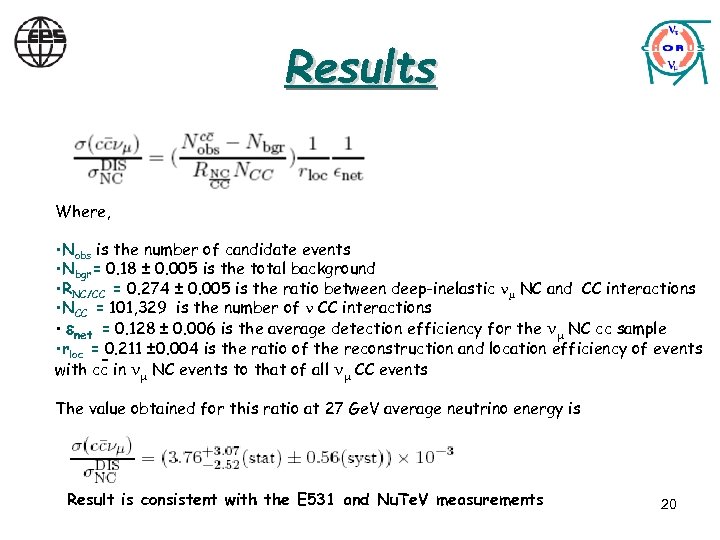 Results Where, • Nobs is the number of candidate events • Nbgr= 0. 18 ± 0. 005 is the total background • RNC/CC = 0. 274 ± 0. 005 is the ratio between deep-inelastic m NC and CC interactions • NCC = 101, 329 is the number of CC interactions • enet = 0. 128 ± 0. 006 is the average detection efficiency for the m NC cc sample • rloc = 0. 211 ± 0. 004 is the ratio of the reconstruction and location efficiency of events with cc in m NC events to that of all m CC events The value obtained for this ratio at 27 Ge. V average neutrino energy is Result is consistent with the E 531 and Nu. Te. V measurements 20
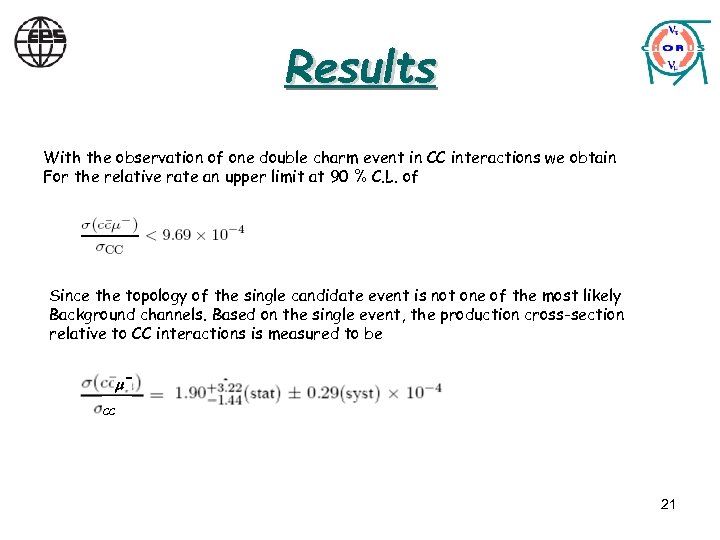 Results With the observation of one double charm event in CC interactions we obtain For the relative rate an upper limit at 90 % C. L. of Since the topology of the single candidate event is not one of the most likely Background channels. Based on the single event, the production cross-section relative to CC interactions is measured to be CC 21