


 Скачать презентацию ASSOCHAM Workshop on Drafting and Management of Commercial
cb6bb2afaec22627426287360b280bb3.ppt
- Количество слайдов: 79
 ASSOCHAM Workshop on Drafting and Management of Commercial Contracts & Agreements 11 th January 2008, ASSOCHAM HOUSE, New Delhi Karnika Seth Managing Partner SETH ASSOCIATES ADVOCATES AND LEGAL CONSULTANTS 1 © 2008 Seth Associates. All Rights Reserved.
 Commercial Agreements –An insight Manufacture & Supply Agreements n Distribution, Agency & Franchise Agreements n Business Purchase n Asset Purchase n Brand Acquisition n 2
 Objectives of the workshop n n n n Highlight important ingredient clauses in commercial agreements concentrate on drafting the necessary clauses and analysis of relevant precedents. draw your attention to pitfalls, commonly made mistakes guidance on some of the most commonly used clauses –boilerplate clauses competition and compliance issues. Achieving clarity and precision in drafting Find out how to avoid over-complex sentences and structures 3
 Key issues covered n n n n n Contract Nature specific ingredient clauses Delivery and pricing, payment Intellectual property rights Confidentiality Warranties, guarantees and indemnities Exclusion clauses Boilerplate clauses Disputes and conflicts of laws Commencement and Termination Clauses 4
 The Structure of a Contract- An overview n Looking at key elements, terms, phrases and structures – – – Preamble Recitals Specific purposes (definitions, terms and conditions, etc. ) – Performance related clauses (force majeure, liquidates damages, governing law, etc. ) – Boilerplate or standard clauses (amendment, assignment, severability, etc. ) 5
 Boilerplate clauses n n n n Service of notices — Means of communication — Alternative provisions Whole agreement and variation clauses Retention of title clauses Miscellaneous clauses — Agency partnership or joint venture excluded 6
 Boilerplate clauses n n n n n -Assignment — Costs, stamp duty and VAT — Counterparts — Export control regulations — Further assurance — Guarantees of and undertakings to procure performance — Supervening illegality and severance — Time to be of the essence — Waiver 7
 Boilerplate clauses n n n n n Disputes and conflicts of laws Proper law and the jurisdiction of the courts Arbitration Experts Amiable composition Governing language Payment of interest Specific performance Set-off Cumulative remedies 8
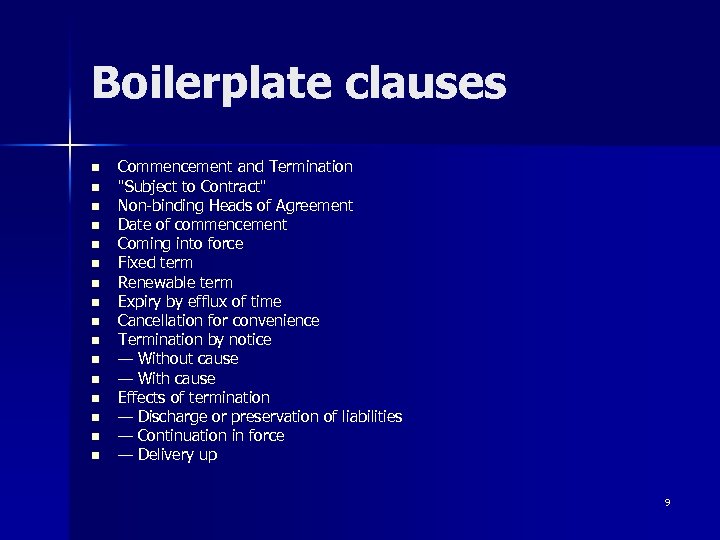 Boilerplate clauses n n n n Commencement and Termination "Subject to Contract" Non-binding Heads of Agreement Date of commencement Coming into force Fixed term Renewable term Expiry by efflux of time Cancellation for convenience Termination by notice — Without cause — With cause Effects of termination — Discharge or preservation of liabilities — Continuation in force — Delivery up 9
 Boilerplate clauses Best and reasonable endeavours n Entire agreement n Force majeure n Interpretation n Third party rights n 10
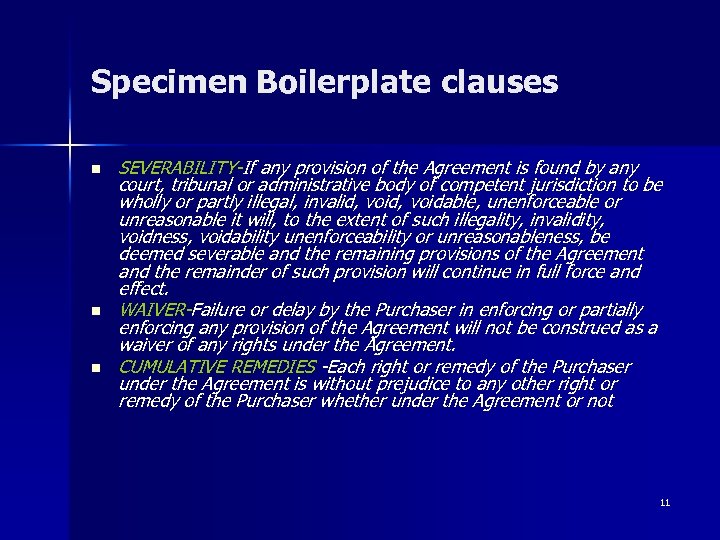 Specimen Boilerplate clauses n n n SEVERABILITY-If any provision of the Agreement is found by any court, tribunal or administrative body of competent jurisdiction to be wholly or partly illegal, invalid, voidable, unenforceable or unreasonable it will, to the extent of such illegality, invalidity, voidness, voidability unenforceability or unreasonableness, be deemed severable and the remaining provisions of the Agreement and the remainder of such provision will continue in full force and effect. WAIVER-Failure or delay by the Purchaser in enforcing or partially enforcing any provision of the Agreement will not be construed as a waiver of any rights under the Agreement. CUMULATIVE REMEDIES -Each right or remedy of the Purchaser under the Agreement is without prejudice to any other right or remedy of the Purchaser whether under the Agreement or not 11
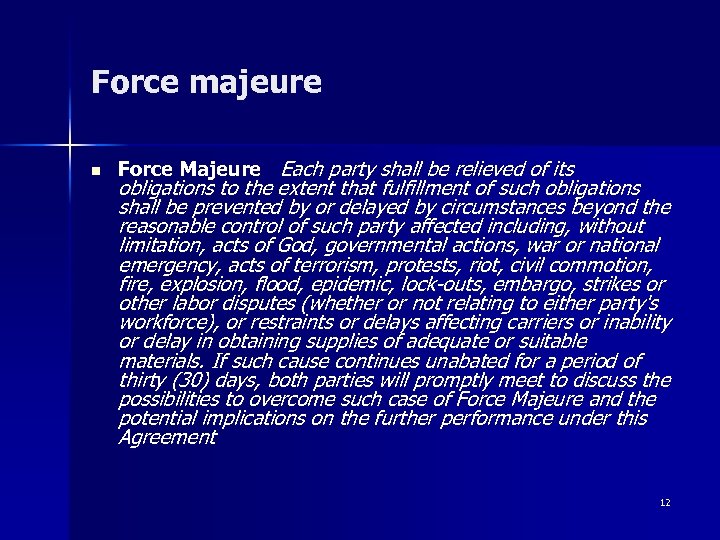 Force majeure n Force Majeure Each party shall be relieved of its obligations to the extent that fulfillment of such obligations shall be prevented by or delayed by circumstances beyond the reasonable control of such party affected including, without limitation, acts of God, governmental actions, war or national emergency, acts of terrorism, protests, riot, civil commotion, fire, explosion, flood, epidemic, lock-outs, embargo, strikes or other labor disputes (whether or not relating to either party's workforce), or restraints or delays affecting carriers or inability or delay in obtaining supplies of adequate or suitable materials. If such cause continues unabated for a period of thirty (30) days, both parties will promptly meet to discuss the possibilities to overcome such case of Force Majeure and the potential implications on the further performance under this Agreement 12
 Dispute resolution clause n The formation, existence, construction, performance, validity and all aspects of the Agreement will be governed by English law and incase any dispute arises between parties arising out of or in relation to this Agreement, parties shall refer its disputes for adjudication to an Arbitration panel of 3 arbitrators, wherein one arbitrator is appointed by each party and the two nominated arbitrators appoint the third arbitrator. The venue of arbitration shall be Singapore 13
 Manufacture & Supply Agreements n This agreement is for use by a company selling goods that requires a manufacturer to make those goods or, perhaps components to be included in the company's goods 14
 Some important considerations. M&S n n It is very important that a manufacturing agreement be established between the client and contract manufacturer prior to beginning work. This ensures that mutual expectations are clear and mechanisms are in place for continued improvement Typical negotiable elements include product and service pricing, nature and frequency of cost and price reviews, IP licensing issues etc 15
 How to draft M&S contracts n n n The agreement should define all terms and clearly state the rights and duties of each party. Although some terms may be common in the industry, such as good manufacturing practices, they should be defined within the confines of the agreement. The agreement should also clarify which products are included within the terms of the agreement (even products not yet in existence). Companies entering into the agreement with existing technology should anticipate that the other party may develop complementary devices and should ensure that marketing and licensing rights for such new devices are stated within the agreement. Other items to consider include the duties and benefits of any IP rights associated with the goods, whether the agreement is exclusive, and its financial terms. If one party wants IP rights, such as patents or trademarks, then the parties should discuss who will apply for, pay for, and maintain those rights, including enforcement through litigation or arbitration. Parties should clearly state what information exchanged between them should remain confidential, which may mean that only specified employees may access confidential information after signing covenants not to compete 16
 How to draft M&S contracts n n Conditions should be specified that provide liquidated damages in the event that a party breaches the agreement. The agreement also should state what would happen if a dispute arises between the contracting companies. It is particularly important in the global market that the parties make prior arrangement as to what laws will govern in the event of a dispute and whether arbitration can be pursued Finally, the parties should also stipulate when the agreement will end 17
 Case Study#1 - Manufacture & Supply of sports goods. Specimen Sample clauses--1. USE OF TRADEMARKS_ – “The Supplier has no rights to use or deal in the Trade Marks beyond the right to manufacture the Products and affixing the Trademarks of Purchaser on Products solely for and in accordance with the Orders placed by the Purchaser from time to time. ” “Any unauthorised use of the Trade Marks by the Supplier or any of its Affiliates will, at the sole discretion of Purchaser, result in the immediate termination of this Agreement and render the Supplier liable for trade mark infringement and any other cause of action available to the Purchaser. ” 18
 Case Study# 1 -M&S- Manufacture & Supply of sports goods Limited license of IPR n “Upon expiration or sooner termination, the Intellectual property rights licensed to Supplier to manufacture the Products in accordance with the terms of this Agreement shall cease. Supplier will return to Purchaser all right title and interest in all Intellectual Property in and to all materials, products, documents, drawings, tools and Products which bear the Trade Marks or are used in relation to the Trade Marks or are used to create the Trade Marks (for example by mould or print) which are made or created by or for Supplier during the term of this Agreement or otherwise on request by Purchaser save and except those items that are purchased by the Supplier in accordance with clause 11 and listed in detail in Schedule 3 to this Agreement. . It is mutual understanding of the Parties that as and when Supplier intimates that the old cavities have worn out during the operation of this Agreement, the Purchaser shall supply new copyrighted cavities along with ejector pins at its own cost to enable the Supplier to manufacture Products for the Purchaser. As and when the new cavities and ejector pins are received, the Supplier shall duly return the old copyrighted cavities and ejector pins to the Purchaser. “ 19
 Case Study# 1 -M&S- Manufacture & Supply of sports goods Order Commitments “The Purchaser will order from the Supplier a maximum volume of 100 k dozen units of Products per month till the time the additional capacity is achieved ( “Maximum Volume for existing capacity”). Upon successful commissioning of the additional capacity the Purchaser will order from the Supplier a minimum Guaranteed volume of 250, 000 dozen unit of Product and maximum volume shall be agreed by mutual consent of the parties. (“Minimum Guaranteed Volume for enhanced capacity”). The Targeted offtake Volume By the Purchaser from Supplier is 3 -3. 5 Million Dzns per annum. The Parties have agreed that the Purchaser shall be placing confirmed orders w. e. f. commencement of this Agreement for every 3 months and simultaneously inform the Supplier of the Order Projections and forecast for the next 4 th and 5 th Month at all times during the operation of this Agreement. “ 20
 Case Study# 1 -M&S- Manufacture & Supply of sports goods- Supply Terms – – – Each Order for Products placed by the Purchaser on the Supplier will be deemed to be an order by the Purchaser to buy Products subject to this Agreement. Each Order placed on the Supplier by the Purchaser shall be irrevocable. No terms or conditions endorsed upon, delivered with or contained in the Supplier’s quotation, acknowledgement or acceptance of order, specification or similar document will form part of the Agreement and the Supplier waives any right which it otherwise might have to rely on such terms and conditions. These conditions apply to all the Purchaser’s purchases under this Agreement and any variation to these conditions will have no effect unless expressly agreed in writing and signed by an authorised signatory of the Purchaser. 21
 Case Study #1 -M&S- Manufacture & Supply of sports goods- Supply Terms Supplier will not sell or otherwise dispose of the Products to any third parties other than to Purchaser, unless expressly provided otherwise in this Agreement or agreed by the Purchaser in writing, and in particular will not sell or otherwise dispose off Seconds, Irregulars or Overruns. Any Products designated as Seconds, Irregulars or Overruns must be notified to Purchaser and Purchaser will instruct the method of disposal of Seconds, Irregulars and Overruns and the Supplier will comply with such instructions. 22
 Case Study #1 -M&S- Manufacture & Supply of sports goods- Quality and defects At any time prior to delivery of the Products to the Purchaser, the Purchaser will have the right to inspect and test the Products at all reasonable times. n If the results of such inspection or testing cause the Purchaser to be of the opinion that the Products do not conform or are unlikely to conform with the Order or to any specifications and/or patterns supplied or notified by the Purchaser to the Supplier, the Purchaser will inform the Supplier and the Supplier will immediately take such action as is necessary to ensure conformity and in addition the Purchaser will have the right to require further testing and inspection 23
 Case Study# 1 -M&S- Manufacture & Supply of sports goods- Delivery terms – – The Products will be delivered by the Supplier FOB Ex works (Incoterms 2000) and the Purchaser shall be responsible for making arrangements and pay for expenses incurred towards their inland transportation to loading port , all loading port expenses, ocean freight, Insurance and all other ancillary costs and expenses incurred during transportation and delivery products to the Purchasers designated destination shall also be borne by the Purchaser. The date for delivery will be specified in the Order, or if no such date is specified then delivery FOB ex-works will take place within 45 days from the receipt of the Order. However, the Purchaser agrees that in each Order placed, at least 45 days shall be given to the Supplier to process the Order and supply the ordered Products. 24
 Case Study# 1 -M&S- Manufacture & Supply of sports goods- Price clauses – – – The agreed maximum prices of the Products for the term of this Agreement will be as described in Schedule 2 to this Agreement. The agreed prices are on FOB Ex-works basis excluding any costs for Packaging except that the price includes any labour costs incurred to pack the Products. The cost of packaging shall be intimated by the Supplier to the Purchaser on order to order and item to item basis and shall be added to the price of the Product so as to arrive at the total price at which the Product is to be invoiced. The price is to be reviewed twice annually for adjustments based on market conditions and other internal/external factors. In the event of raw material cost variations within a range of +/-10% of the base price at the date of execution of this agreement, the parties will negotiate in good faith the cost structure of the Products and use reasonable endeavours to agree an appropriate variation to the cost structure. Any resulting variations to the cost structure must be agreed in writing between the parties. 25
 Case Study #1 -M&S- Manufacture & Supply of sports goods- Confidentiality The Parties hereto agree that they shall keep in strict confidence all technical or commercial know-how, specifications, inventions, processes or initiatives which are of a confidential nature and have been disclosed to each other itself or through its agents, affiliates and any other confidential information concerning their respective business or its products which they may obtain from each other and they shall be responsible for restricting disclosure of such confidential material to such of its employees, agents or sub-contractors as need to know the same for the purpose of discharging their respective obligations and will ensure that their employees, agents or sub-contractors are subject to like obligations of confidentiality that are binding on parties herein. 26
 Ingredient clauses-M&SChecklist/Referencer n An agreement of 14 clauses where a company in the business of selling products appoints a manufacturer to produce certain products to meet the specification supplied by the company and on the basis of orders issued by the company to the manufacturer. The agreement contains 14 comprehensive clauses covering manufacturer’s obligations, ordering, delivery, warranties, pricing & payment, intellectual property, etc n CLAUSE 1: the full name of the Company and Manufacturer should be inserted and, in the case of a limited company, its registered office or other official address. 27
 M & S-Clause 2, 3, 4 n n Clause 2 - Specifies the initial term of the agreement It is expressly stated that the Company is free to contract with other manufacturers in respect of similar products. Clause 3 - Deals with the procedures for placing and confirming orders and makes it clear that each order is governed by the Agreement unless the parties agree otherwise. In order to ensure that there is clarity and certainty each Order is treated as a separate contract requiring an express confirmation or acceptance by the Manufacturer Clause 4 - Sets out the obligations of Manufacturer including both "generic" obligations (such as compliance with orders, fitness for purpose and adherence to legal/regulatory requirements) and "specific" obligations such as a requirement to deliver within a set time scale and the maintenance of product liability insurance 28
 M&S Clause 5 , 6 and 7 n n n Clause 5 - Reserves a right for Company to inspect Manufacturer's works Clause 6 - provisions relating to delivery: packaging, delivery and liability for the condition of the Product is the responsibility of Manufacturer and Company's acceptance of delivery does not constitute acceptance of the products (see clause 7). If the Manufacturer does not accept responsibility for delivery, the clause will need to be altered and some wording inserted that the Products are to be collected by Company from Manufacturer's works Clause 7 -Allows for Company, within an agreed timescale, to inspect delivered Products and to formally reject or require replacement (again within an agreed timescale) of Products that are not in accordance with either the Agreement or the specific order. Manufacturer is liable for Company's wasted costs/losses arising from rejection/replacement. The timescales will need careful commercial consideration and will largely depend upon the type and complexity of the Product. Manufacturer may insist upon either a capped liability per delivery or cover specified types of loss only. 29
 M&S Clause 8, 9 n n Clause 8 -Provides for a 12 month warranty in Company's favour in respect of delivered Products and a rather widely drawn indemnity in favour of Company should expect some detailed negotiation in respect of the indemnity: Although an indemnity does not widen the scope of legal liability, it does make it much easier for a party claiming loss to recover that loss. Clause 9 - Gives details of what is included in the Product price, review of prices and time for payment. There is also provision for payment of interest on late payments that were properly due. . 30
 M&S Clause 10, 11 n n n Clause 10 - Deals in some detail with procedures relating to variations of Orders requested by Company. It is essential for both parties to work within a set timescale and for Company's final decision to be made only after any cost/late delivery implications are made expressly clear. Clause 11 - Protects Company's Intellectual Property Rights from possible misuse by Manufacturer and incorporates a widely drawn indemnity in Company's favour in relation to any losses attributable to Manufacturer's breach. Liability-perpetuity 31
 M&S Clause 12, 13 and 14 n n n Clause 12 - Sets out a fairly standard protection of confidentiality Survive expiry/termination of agreement Clause 13 - Deals with the matters that entitle either Party to terminate the agreement earlier than by giving 1 month's notice to take effect at the end of each 6 month period (see clause 2): material breach and insolvency. The respective obligations of the parties are also set out: orders to be completed, outstanding monies to be paid an option for Company to buy Manufacturer's Products and raw materials held in stock at cost price Clause 14 -prohibition on assignment/appointment of sub-contractors. Other boilerplate clauses 32
 Franchise Agreements n n n Franchising There is no legal definition of franchising but a franchise is a contractual relationship where the franchisor: allows a franchisee to use its trade name, marks and brands exercises continuing control over a franchisee is obliged to provide training and assistance to a franchisee requires a franchisee to make an initial and continuing payments to the franchisor 33
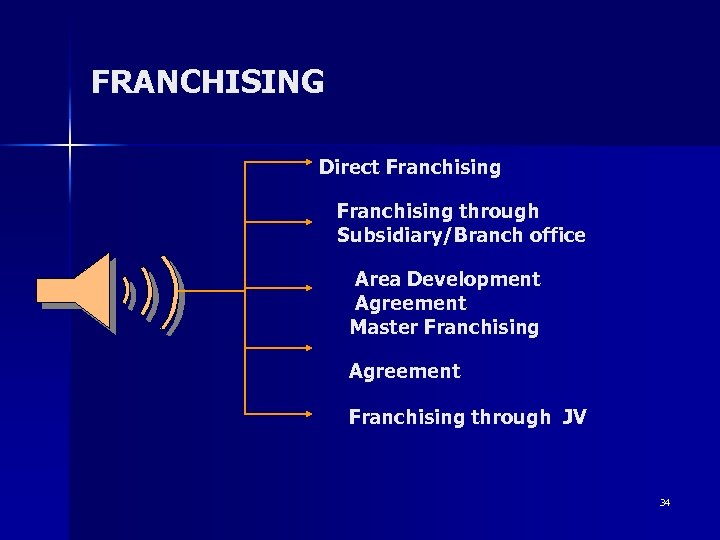 FRANCHISING Direct Franchising through Subsidiary/Branch office Area Development Agreement Master Franchising Agreement Franchising through JV 34
 Branches of law relevant to Franchising There is no specific statutory enactment dealing with franchise in India at the moment n n n General Contact Law Agency Law and law regulating other distribution contacts Leasing and Security interests Financial Investments Intellectual Property Competition Law n n n n Fair Trade Practices Law Corporate Law Taxation Property Law Consumer Protection and Product Liability Insurance Law Labour Law 35
 What a prospective franchisee needs to examine n n n n the franchisor and the directors of the enterprise; the history of the enterprise; the legal constitution of the enterprise; the intellectual property concerned; the financial situation, with audited financial statements for the two or three preceding years; the other franchisees in the network; information on the franchise agreement, such as the duration of the agreement, conditions of renewal, termination and assignment of the agreement; as well as information on any exclusivities. 36
 Franchisee’s Obligations n n n Refurbish and equip the Premises as required by the Franchisor. Only use stationery, invoices, and products which are supplied by the Franchisor. Operate the Business in accordance with the Operations Manual. Use only signs and packaging in connection with the Business as have been approved by the Franchisor. Use his best endeavours to promote and extend the Business. 37
 Case Study#2 -Franchise Agreement- network of medical services in India n n TRADEMARK LICENCE In consideration of Annual Membership fee which shall be paid by Franchisee in the manner set out in this Agreement and in further consideration of observance and performance of undertakings on the part of Franchisee under this Agreement , Franchiser grants a non exclusive licence to the Franchisee to use its trademark “ABC” ( logo and word mark ) in the existing premises ( “Premises”) only in respect of XYZ health services rendered by the Franchisee, namely XYZ and distribution of products ( “Products”). 38
 Case Study# 2 -Franchise Agreement- network of medical services in India n The Franchisee covenants and agrees with the Franchiser that the Franchisee shall assume sole and entire responsibility for and indemnify and save harmless the Franchiser from any and all claims, liabilities, losses, expenses, responsibility and damages by reason of any claim, proceedings action, liability or injury arising out of the Franchisee’s conduct of the Project whether arising out of negligence or misconduct on the part of any of its employees, staff, agents or servants or as a result of the Franchisee’s relations with his customers and other third parties or because of any default or failure of Franchisee in discharging its obligations under this Agreement or as a result of any breach of this Agreement by the Franchisee 39
 Case Study#2 -Franchise Agreement- network of medical services in India n n n Franchisee shall abide by the instructions and guidelines given by the Franchiser from time to time and strictly follow all quality control protocols and procedures laid down by Franchiser. . The Franchisee shall abide by all rules and regulations of the Franchiser applicable to the Franchisee. The Franchisee shall make itself available for the quality audits that will be conducted by the Franchiser from time to time. The improvements suggested in these audits will be binding on the franchisee and in the event of non compliance, the Franchiser shall be entitled to terminate this Agreement forthwith. The Franchisee is expected to have a professional indemnity insurance. The Franchisee shall be solely responsible for any acts or omissions of the Franchisee that constitute medical negligence or deficiency in services or and the Franchiser shall not be liable in any manner whatsoever for any acts/omissions of the Franchisee that give rise to any claim , action , liability for loss , damages , criminal or otherwise by any affected party instituted before any legal or administrative forum 40
 Distribution Agreement n n Concept of Distribution A manufacturer or a supplier of goods appoints an independent third party – the distributor – to market its goods. The independent third party purchases the goods on his own account and trades under his own name as an authorised distributor. His business name will usually have no connection with the name of the supplier of the goods nor will the supplier regulate the way in which the distributor operates his business other than, perhaps, to oblige the distributor to reach minimum turnover levels, to maintain advertising and PR material, to maintain minimum stocks both of goods and spare parts and to employ experienced servicing representatives. The obligations on a distributor should be compared to the much more extensive restrictions which a franchisor seeks to impose on its franchisees. Furthermore, no royalties are payable to the supplier by the distributor. The supplier’s profit arises from the difference between the price at which he manufactures or which he pays for the goods and the price at which he is able to sell the goods to the distributor. 41
 Distribution agreementsn A company seeking to expand worldwide might consider entering into a marketing agreement with others who have experience selling and distributing such goods internationally. Negotiations should specify which company would seek regulatory approval for the goods. 42
 CASE STUDY #3 Distribution agreement-Foreign Company & Indian distributor -Product: Beverage n n The parties hereby agree that the terms and conditions of the UNITED NATIONS CONVENTION ON CONTRACTS FOR THE INTERNATIONAL SALE OF GOODS (1980) (“Convention”) shall be applicable to this Agreement. In case of conflict with this Agreement, the provisions of this Agreement shall prevail. 1. The Parties to the Agreement have mutually agreed that 1) the Convention and 2) Incoterms (latest version) are applicable to this Agreement. The provisions of the Convention and Incoterms are an integrated part of the Agreement and are hereby considered to be inserted in the text of the Agreement. 2. In case of conflict between any of the clauses of the Agreement, the Convention and/or Incoterms, the Agreement shall supersede the Convention and Incoterms and the Convention shall supersede Incoterms. 3. Any other terms – except mandatory rules of law - are not applicable to the Agreement. 43
 CASE STUDY #3 Distribution agreement-Foreign Company & Indian distributor-Product: Beverage n Limitation on Handling Competitive Products Distributor shall not engage, directly or indirectly through a third person with whom or in which it has any interest, in the manufacturing, distribution, promotion, advertising, sale or solicitation of purchases or in any other way handling any non-alcoholic beverage goods competitive with the Products, including, but not limited to bottled, canned or otherwise packed soft drinks, teas and juices, other than the Co-existing products and Third Party Products – if any - sold by Distributor as per the Effective Date as set forth in Exhibit __. 44
 CASE STUDY #3 Distribution agreement-Foreign Company & Indian distributor-Product: Beverage n n n Marketing The Distributor and Company shall agree a detailed annual plan (“ Annual Plan”) for the Term and any Extended Term for the Products (and other brands shall be the subject of a general plan, agreed between the parties at the same time) to be attached to the Agreement as Exhibit 3. This Annual Plan has incorporated a statement of the quantified objectives for the marketing, promotion distribution and sales of each of the Products and a statement of strategies designed to attain such objectives and of anticipated results and shall include, among other matters, the following: (a) Annual sales value and volume forecasts (“Budget Volume”) by Product, showing type and capacity of container, flavour, and channels of distribution, including the introduction dates and forecast sales of any new Products and new types and capacities of container to be introduced; (b) Annual Minimum Sales for such year; Proposed changes in packaging and distribution methods; Marketing plans, marketing expenditure and promotions analysed by trade channels and geographically by advertising medium; by consumer segments; and by the nature, type and quantities of advertising material; 45
 CASE STUDY #3 Distribution agreement-Foreign Company & Indian distributor-Product: Beverage n n Annual minimum sales The Distributor agrees to purchase and sell the annual minimum quantities of Products (“Annual Minimum Sales”) as set out in the Annual Plan. In the event of failure in any year to achieve Annual Minimum Sales irrespective the reason thereof, Company shall be entitled to treat such failure as a breach of this Agreement incapable of remedy and therefore shall have the option by 3 months written notice to the distributor to terminate the Agreement. 46
 CASE STUDY #3 Distribution agreement-Foreign Company & Indian distributor-Product: Beverage n Distributor shall at all times abide by the Company’s policies and plans (as the same will be or has been provided by and may be modified by the Company from time to time and at any time) concerning the Products, including without limitation, those relating to marketing and marketing costs, advertising, warranties, packaging, and use of the Trade Marks, brand names and quality control (including but not limited to handling, storage, shelf-live, product recalls and disposal of outdated or spoiled Product). From time to time during the Term hereof, Distributor will grant the Company reasonable access to its facilities during regular business hours for the purpose of observing Distributor’s performance hereunder 47
 Agency Agreement n n Agency Agents do not purchase products in their own name. All contracts are made either directly by the supplier and the ultimate customer or by the agent on behalf of the supplier. A supplier imposes relatively few restrictions on his agents and these normally relate to: what the agent can say about the supplier’s products the price at which the products are sold the terms and conditions of sale. 48
 Case study#4 -Agency -manufacturer of automobile components and parts in India appointing agent in a foreign country. n This MOU is made on mutually exclusive basis, where, the First Party would supply its Products manufactured as per the technical specifications and samples provided by the Second Party only to the Second Party or directly to a Third Party Buyer on the instructions and written approval of the Second Party. In case of supply to a Third Party Buyer, the Second Party will act as an agent of the First Party on commission basis on mutually agreed amount/percentage of commission to be paid by the First Party to the Second Party for such orders. The First Party also undertakes not to deal with or not to do business any time directly with a Third Party Buyer brought /introduced by the Second Party without the involvement and written consent of the Second Party. The First Party will always pay the agreed amount of commission to the Second Party for the direct business done with the Third Party Buyers brought / introduced by the Second Party. Similarly the Second Party shall source all its requirements of Products (which can be made by the First Party and the First Party is willing to supply) exclusively from the First Party on mutually agreed terms for the OEM/replacement market segment of the Territory. 49
 Case study#4 -Agency -manufacturer of automobile components and parts in India appointing agent in a foreign country n The First Party shall provide most competitive prices, timely deliveries and excellent product quality meeting the technical specifications provided to the First Party by the Second Party or the Third Party Buyer as the case may be. The First Party will endeavour to maintain consistency in quality, quantity and workmanship of the Products and timely supply for the entire ordered quantity of the Products. Upon receiving an enquiry for a product to be developed/manufactured by the First Party for supply, the Second Party will intimate the First Party of the same through phone or mail. Samples/drawings of such parts for development will be procured and shipped to First Party in India by the Second Party upon receiving such request from the First Party for the purpose 50
 Agency, Franchise & Distribution Arrangements- Some important considerationsn n n n n Exclusive rights and agreements Nature of Agreement Specifies whether it's an exclusive distributorship, licence arrangement or agency agreement. Territory Defines the territory covered by the agreement Defines the period over which the agreement will run and also any review options (e. g. agreement to run for five years with a review after one year). Remuneration In an agency agreement this clause defines how commission will be calculated and how and when it will be paid. Exceptions In an exclusive distributorship or agency agreement, this clause details any exceptional circumstances when the exporter may deal directly with importers in the market. 51
 Agency, Franchise & Distribution Arrangements- Some important considerationsn n n Warranties and Repairs Provides details of the warranties which the supplier offers to the distributor and which the distributor may in turn offer to the end user. It also details the after sales service available in the market place. Promotional Expenditure Determines who will pay for advertising and sales promotional material including samples. It should also define the limit of expenditure which can be incurred by the agent without authorisation from the principal. Dispute Resolution Determines which legal or arbitration system will apply in the event of a dispute that cannot be resolved by the parties themselves. Performance Level Defines the minimum level of sales to be achieved in a given period. If this level is not achieved the agreement may be reviewed. Rights Defines the parties' rights to use brand names, trade marks etc. Negotiating the terms and conditions The final terms and conditions of such agreements are negotiated between principal and agent, seller and buyer etc. 52
 A typical franchise agreement will cover six main areas: n Term and Renewal/Performance criteria n Territory Whether or not you have exclusive rights and how the borders of franchise territories are covered. n Fees These come in many forms and are usually broken down into an initial fee, royalties on sales and a regular management fee. Depending on the franchise you may also have other costs to pay. Joint marketing is a common one. 53
 Franchise Agreement- Quintessential clauses n Support n Restrictions Minimum stock and staffing levels are common, as are where you purchase your stock and how much you can sell you product or service for. n Accounting and records n n Advertising and Insurance Exit n Other items which need to be considered include how "goodwill" is treated, insurance cover, and intellectual property rights n LEASING AND SECURITY INTERESTS n n Equipment and premises might be leased and security interests might be involved. This is particularly the case where specific equipment is needed for the franchise and where the franchisor provides that equipment Taxation regulation 54
 Franchise Agreement- Quintessential clauses n n Legislation on consumer protection and product liability INDUSTRY SPECIFIC LAWS OR REGULATIONS Any laws or regulations specific to the trade sector involved (for example health regulations for food franchises) need to be carefully considered in each particular case Franchisee shall pay a Management Charge of _% of gross turnover on monthly sales. The Management Charge is to be paid within two weeks of the end of every month with interest of 15% per annum on late payments 55
 Business Acquisition agreement n n n Terms of the transaction - identification of the assets or stock to be transferred, consideration to be paid, and mechanics of the transaction Provisions of the terms - specific conditions placed on the terms of the transaction, such as employment contracts Stock provisions - if stock or other securities are used as payment, terms relating to registration Representations and warranties of the seller - this includes assurances of good title, profitability, etc. Representations and warranties of the purchaser - this includes assurances of prompt payment Covenants of the seller - in other words, promises to do or not to do something before closing 56
 Business Acquisition agreement n n n Conditions to the purchaser's obligation to close - events that must happen for the purchaser to be bound to buy from the seller Conditions to the seller's obligation to close - events that must happen for the seller to be bound to sell to the purchaser Closing and termination provisions - these are mostly last minute assurances by seller to comfort the purchaser's fears Indemnification clauses - amount of money that can be claimed if something is wrong with the deal Other clauses - these include finders' fees, expenses, and common trade agreements 57
 Sale of the assets of a business on a going concern basis n n n Clauses dealing with such matters as the assets to be transferred, the consideration to be paid (and the valuation of stock), the arrangements on completion, transfer of contracts, apportionment of outgoings and other payments between the seller and the buyer, warranties of the seller it is the assets of the business that are being sold - not only physical stock and equipment but intangibles such as goodwill and the existing contracts with suppliers and customers, customer lists etc. Business premises and the employees may also be included, there is a list of the assets being sold and the assets excluded from the sale will be identified. Eg-money owed by debtors of the business before the business is transferred will be collected by the seller and that he will also pay all the creditors 58
 Case Study#5 -business purchase of Music recording company-India n n producing and marketing Audio Cassettes, Audio CDs, Video CDs, DVDs, Books That, from the Effective date the second party shall be the absolute owner of the all the business of ABC (including, without limitation, all properties, assets and/or rights and liabilities , all information, know-how and techniques (whether or not confidential and in whatever form held) including , intellectual property, business records, contracts, customer lists, sales, marketing and promotional information; business plans and forecasts; and technical or other expertise relating to the Business; and the First party, or its legal heirs, representatives or assignees will deliver to the Second Party entire business records of ABC in its possession , remaining assets to be delivered, if any and comply with all necessary formalities to effectuate the transfer of business. of ABC to the Second party. Where a Third Party Consent is required to the assignment of the benefit of any of the Contracts to the Second Party, the First Party shall be responsible (both before and after Closing date and at its own expense) for obtaining, and shall use all reasonable endeavours to obtain, any such Third Party Consent. 59
 Case Study#5 -business purchase – Music recording company-India n The Balance Sheet of the `ABC’ shall be drawn as on the closing date of transfer, i. e. , ……………. “ hereinafter refereed to as the “Closing date”) for settlement of accounts and all the assets, including WIP and liabilities as on the Effective date shall be transferred as a going concern to the Second party. Except as otherwise provided in this agreement, the Second party undertakes to the First Party that, with effect from Effective date, it will properly perform, assume and pay and discharge when due, and indemnify the First party against, all Assumed Obligations 60
 Case Study#5 -business purchase – Music recording company-India n All current assets viz inventories, sundry debtors, cash and bank balances, loans and advances, etc shall be transferred to the Second Party as on the Effective date. All the contracts under negotiation by and between First party and any other third party as of the Effective date shall be negotiated and executed by and between the Second party and the third party 61
 Case study#6 -Business purchase lighting business of GE by a manufacturer of lighting equipment n The Seller shall sell and Buyer shall purchase the Lighting Business more fully described in Appendix A (including, without limitation, all properties, assets and/or rights in the manufacturing, warehousing, sale and distribution operations relating to the Lighting Business) at the purchase price (the “Purchase Price”) set forth in Paragraph 1. 2. Excluded from the transaction shall be the Exclusions and the Remaining Business. The parties will evaluate the appropriate deal structure for the proposed transaction. 62
 SPECIFIC CLAUSES-Business Acquisition agreement n n Clause 1 -DEFINITIONS Clause 2 -SALE AND PURCHASE Clause 2. 1 sets out the different categories of assets, which are being sold, and it should be noted that in the following clause 3 the sale price is divided amongst these categories. Clause 2. 2 contains a list of assets which are excluded from the sale. 63
 Clause 3 -CONSIDERATION n n Clause 3. 1 specifies the price payable for the assets which are being sold. Clause 3. 2 divides the price amongst the different assets. There are important tax considerations here which need to be discussed with an accountant when the agreement is being negotiated. The rest of clause 3 deals with the valuation of stock. There will be a physical stocktake on the date that the sale is completed and if there is no agreement on the valuation 3. 5 provides for an independent valuer to be brought in, whose decision will be final. Depending on how the parties want to deal with this valuation , there is likely to be payment for stock on completion and that figure may be adjusted once the stock valuation on the Transfer date has been finalised. 64
 Clause 4 -CONDUCT OF BUSINESS BEFORE COMPLETION n Clause 4. 1 gives the Buyer the right to examine the books and records of the Business and 4. 2 requires the Seller to carry on business in the normal way until completion. There is also an optional provision, which gives the Buyer the right to veto any abnormal contract 65
 Clause 5 -COMPLETION n n n The completion of a sale involving the transfer of assets can be a fairly complex activity with a lot of documents and records being handed over as well as formal assignments of existing contracts, deeds transferring property, etc. Clause 5. 3 deals with the obligations of the Buyer, which are primarily to pay the agreed price. It is clearly essential that this is done by means of a bank draft or a bank transfer. The final part of Clause 5 deals with the possibility that some important item is not dealt with satisfactorily at the completion date. The party which is not at fault, has the right either to defer completion or carry on with completion so far as it can or, if the problem is sufficiently serious, he can terminate the agreement. 66
 Clause 6 -ACTION AFTER COMPLETION n n n Once the Business has been transferred the Seller undertakes in 6. 1 not to continue to use the business name, etc. The next two clauses deal with practical aspects of notifying customers and suppliers of the change of ownership as well as the employees The remainder of the clause covers more general aspects of liaison, which might be needed at a later date while clause 6. 5 contains a restriction on the seller preventing him from competing with the Business after completion. 67
 Clause 7 - DEBTS & LIABILITIES n the amounts owing to the Business remain with the Seller; this clause confirms that position and contains wording which deals with the possibility of a debtor paying the Buyer rather than the Seller. 68
 Clause 8 - CONTRACTS n n This deals with the transfer of the existing contracts of the business to the Buyer. Under this clause, the buyer takes over responsibility for performing the contract, and gives an indemnity to the Seller - i. e. the Buyer will bear all the costs if any claim is made against the Seller by the other party to one of those contracts All existing contracts should be formally assigned by the Seller to the Buyer. This will usually require the consent of the other party to the contract and there may be a formal agreement which needs to be signed on completion 69
 Clause-9 APPORTIONMENTS n n n Outgoings such as rent, water rates, telephone, etc, need to be apportioned at the Transfer Date between the Seller and the Buyer. The clause deals with this matter and provides for a statement to be prepared by the Seller setting out the various adjustments which are needed. The Buyer will then either agree a statement or else the final adjustment will be decided by an independent party under 9. 3 Since the apportionments will only be finalised after completion, either the Seller or the Buyer will have to pay the appropriate adjustment to the other. The final sub clause provides for interest on late payment. 70
 Clause 10 - DISCLOSURE LETTER n n Since almost every business has a few surprises, the agreement contains provisions for a Disclosure Letter to be prepared. This is a letter from the Seller to the Buyer informing the Buyer of specific matters which, if they were not disclosed, might affect the price which the Buyer is prepared to pay for the Business. The Disclosure Letter will therefore contain, for example, details of any legal proceedings, insurance claims, informal arrangements with a third party concerning the occupation of premises belonging to the Business and, any difficulties with customers or suppliers etc. There are sometimes limitations on the liability of the Seller for any breach of warranty. For example, the clause could contain a statement that the maximum aggregate liability of the Seller for breaches of warranty will not exceed £[ ] thousand 71
 Clauses 11 -14 11. CONFIDENTIALITY It is usual for both parties to be subject to confidentiality undertakings with regard to information which they obtain from each other and this clause sets this out. 12. GENERAL PROVISIONS This clause contains a number of so-called "boilerplate" clauses. . 13. NOTICES It is usual for any agreement of this type to have a clause, which specifies in some detail how a formal notice is to be communicated by one party to the other. 14. LAW AND JURISDICTION specify law governs this agreement, and the courts have jurisdiction over all disputes. 72
 Comparison of Asset Purchase and business Purchase Agreement n n Buyer of assets does not assume liabilities associated with the acquired company. when the shares are acquired buyer acquires the whole company, including the liabilities Due diligence in asset purchase is confined to details of assets and whether any liens, encumbrances, mortgages exist. Acquisition of shares is effected by execution and delivery of transfer deeds. Stamp duty on transfer of immovable properties varies depending upon State where property is situated In transfer of assets, income tax, capital gains tax is payable by seller, in transfer of shares it is paid by individuals holding shares to be transferred 73
 Case Study#7 - Asset purchase Agreement-Purchase of machinery n n Seller shall sell and Purchaser shall purchase, free and clear of all liens, encumbrances and liabilities, those assets of Seller's business, commonly known as ________ consisting of __________ and equipment, all of which are more fully described and enumerated in Schedule A which is attached and by this reference made a part hereof. All equipment included in the sale shall be in good working condition at the time of sale. Purchaser shall accept the assets "as is" without warranty as to their condition and operation 74
 Case Study#7 - Asset purchase Agreement-Purchase of machinery He is the owner of and has good and marketable title to all of the assets enumerated in the attached Exhibit A, free from all encumbrances, except …. n Seller hereby assumes all risk of loss, damage or destruction resulting from fire or other casualty to the time of transfer of assets and Closing. n 75
 Brand Acquisition Agreements Assignment of Trademark and goodwill of business n Lumpsum amount paid /royalty basis n Brand acquisition for certain goods/services –ancilliary in nature/core activity n Territory specific assignment n Recordal of Change in ownership n 76
 Case Study#8 -Brand Acquisition-by Lighting business in India n It is clarified that upon transfer of ownership of the “XYZ” brand to Buyer, Buyer shall have right to use the XYZ brand in India on any and all lighting products. This transfer is also subject to the approval and such restrictions as may be required or established by the GE Licensing Operation of General Electric Company 77
 Latest Reference Books. Drafting Commercial Agreements 3 rd edition Author Richard Christou Publisher Sweet & Maxwell , Drafting Commercial Agreements 3 rd edition n Commercial Agreements: A Lawyer's Guide to Drafting and Negotiating By: - Peter Siviglia n Drafting Corporate & Commercial Agreements Author: Rodney D Ryder , Universal law publishing Co. n E-resources---Findlaw, chamberspractice, etc n 78
 SETH ASSOCIATES ADVOCATES AND LEGAL CONSULTANTS New Delhi Law Office: C-1/16, Daryaganj, New Delhi-110002, India Tel: +91 (11) 65352272, +91 9868119137 Corporate Law Office: B-10, Sector 40, NOIDA-201301, N. C. R , India Tel: +91 (120) 4352846, +91 9810155766 Fax: +91 (120) 4331304 E-mail: mail@sethassociates. com © 2008 Copyright of Seth Associates. All rights reserved 79