


 Скачать презентацию Assimilation of satellite data at ECMWF Prospects for
f30916975953c4c51cc48283f365519f.ppt
- Количество слайдов: 29
 Assimilation of satellite data at ECMWF Prospects for use of radio-occultation measurements Jean-Noël Thépaut ECMWF thanks to: Tony Mc. Nally, Graeme Kelly, Antje Dethof and Niels Bormann GRAS SAF Workshop, 12 June 2003
 Outline • Importance of current satellite observations at ECMWF and performances of the NWP system • Needs for and challenges with high vertical resolution soundings • AIRS • MIPAS • Priorities for the future: Scope for using GPS radiooccultation measurements • CAL/VAL and monitoring capabilities • Acquisition of limb sounding expertise • Solve the vertical resolution requirements? GRAS SAF Workshop, 12 June 2003
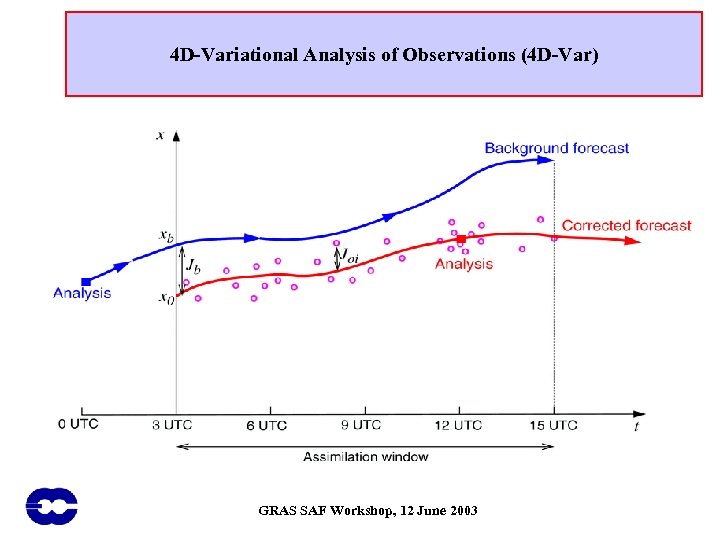
 Importance of current satellite observations in the ECMWF system • Satellite data have progressively become an essential part of the observing system used at ECMWF • Satellite data represent by far the largest volume of data (and associated computing cost) used in the ECMWF data assimilation system • Satellite data have recently caught up radiosondes in terms of forecast skill impact over NH • 4 D-Var is particularly appropriate to assimilate high time frequency data GRAS SAF Workshop, 12 June 2003
 4 D-Variational Analysis of Observations (4 D-Var) GRAS SAF Workshop, 12 June 2003
 Satellite data actively used in the current ECMWF DA system GRAS SAF Workshop, 12 June 2003
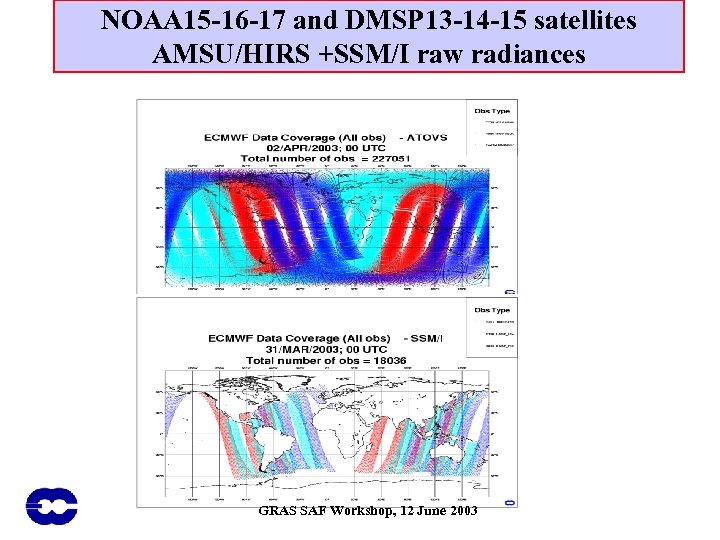 NOAA 15 -16 -17 and DMSP 13 -14 -15 satellites AMSU/HIRS +SSM/I raw radiances GRAS SAF Workshop, 12 June 2003
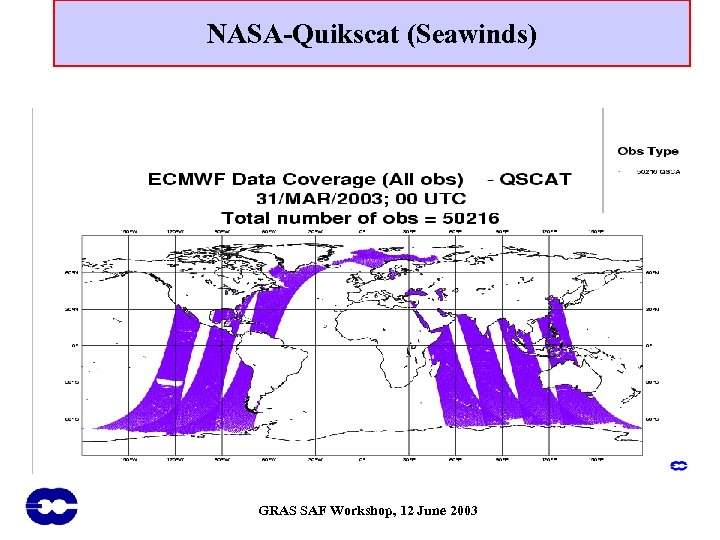 NASA-Quikscat (Seawinds) GRAS SAF Workshop, 12 June 2003
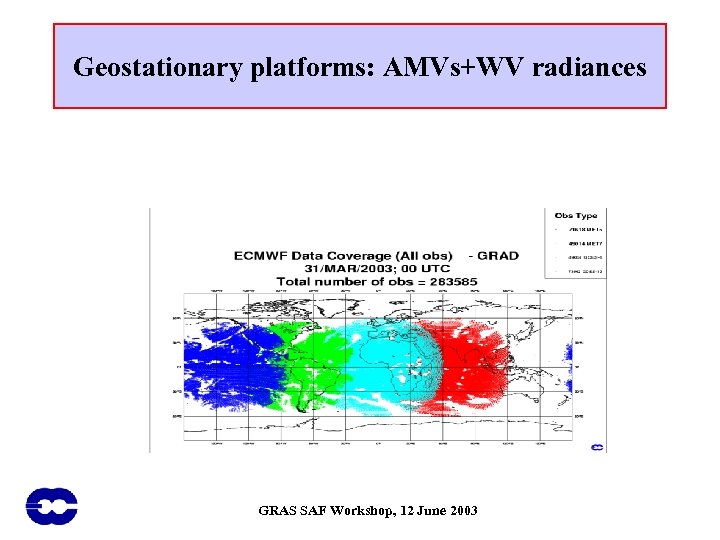 Geostationary platforms: AMVs+WV radiances GRAS SAF Workshop, 12 June 2003
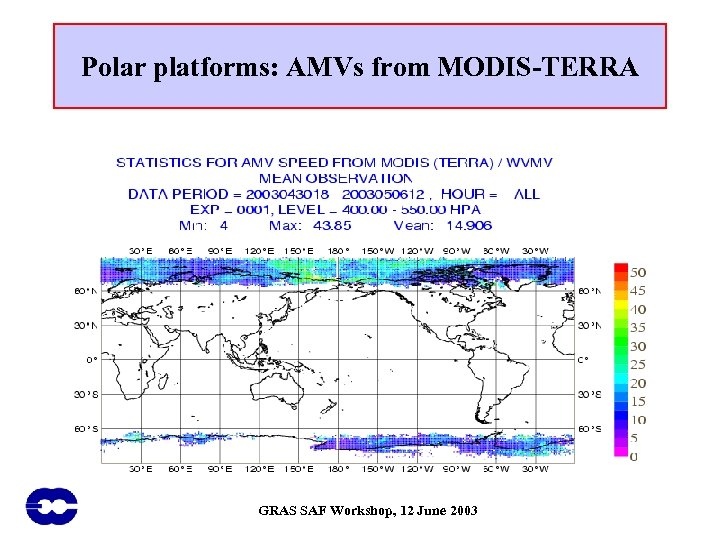 Polar platforms: AMVs from MODIS-TERRA GRAS SAF Workshop, 12 June 2003
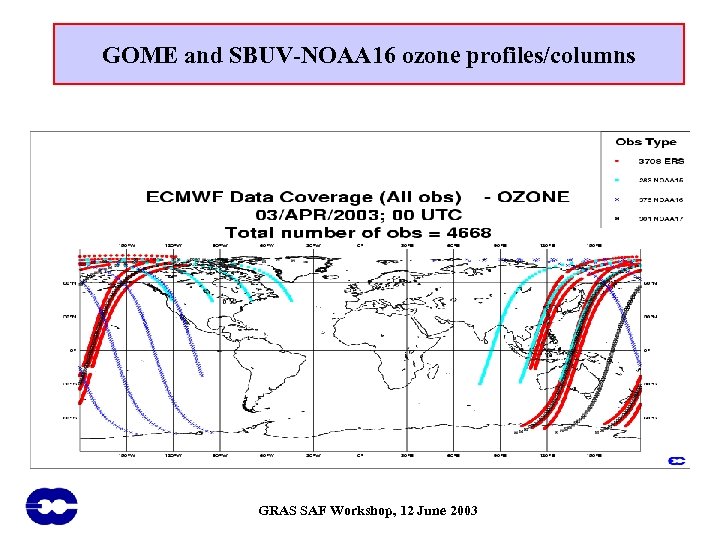 GOME and SBUV-NOAA 16 ozone profiles/columns GRAS SAF Workshop, 12 June 2003
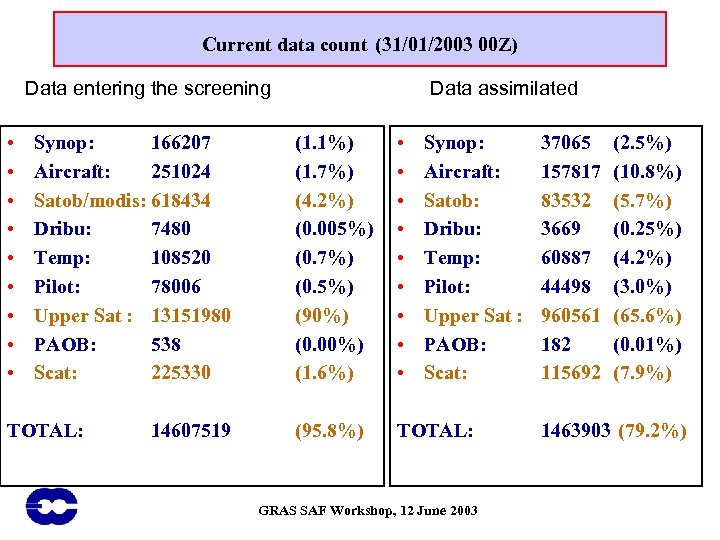 Current data count (31/01/2003 00 Z) Data entering the screening • • • Synop: 166207 Aircraft: 251024 Satob/modis: 618434 Dribu: 7480 Temp: 108520 Pilot: 78006 Upper Sat : 13151980 PAOB: 538 Scat: 225330 TOTAL: 14607519 Data assimilated (1. 1%) (1. 7%) (4. 2%) (0. 005%) (0. 7%) (0. 5%) (90%) (0. 00%) (1. 6%) • • • (95. 8%) TOTAL: Synop: Aircraft: Satob: Dribu: Temp: Pilot: Upper Sat : PAOB: Scat: GRAS SAF Workshop, 12 June 2003 37065 157817 83532 3669 60887 44498 960561 182 115692 (2. 5%) (10. 8%) (5. 7%) (0. 25%) (4. 2%) (3. 0%) (65. 6%) (0. 01%) (7. 9%) 1463903 (79. 2%)
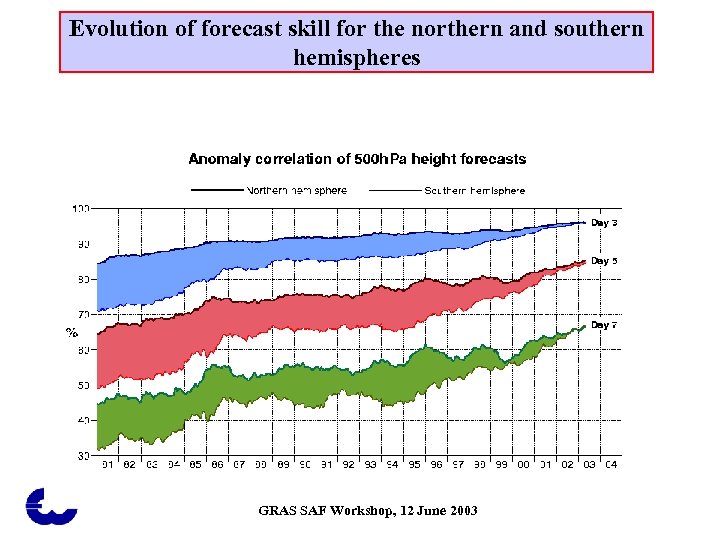 Evolution of forecast skill for the northern and southern hemispheres GRAS SAF Workshop, 12 June 2003
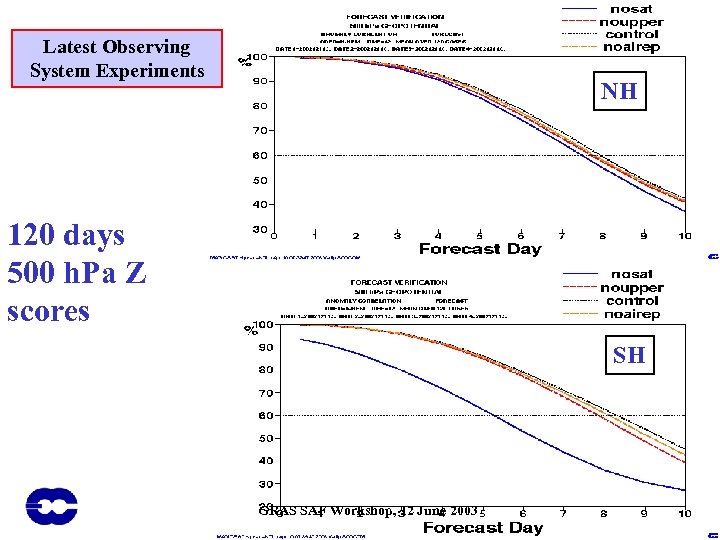 Latest Observing System Experiments NH 120 days 500 h. Pa Z scores SH GRAS SAF Workshop, 12 June 2003
 Partial conclusions • Our current data assimilation system is heavily constrained by nearly 2 millions of observations (mostly satellite data) every 12 hours • (500 radiosondes a day have ½ the impact of satellite data in the Northern Hemisphere) • We have to be realistic in terms of expectation from new Observing Systems • the metric for evaluation may be more related to fixing a number of forecast busts than improving scores on average • Our current requirements concern high vertical resolution (in all weather including below clouds) for temperature/humidity/wind GRAS SAF Workshop, 12 June 2003
 What will future satellite systems offer? • Advanced IR sounders will improve vertical resolutions (but still not resolve the humidity of boundary layer top and the tropopause) • further limitations due to vertical structure functions in the NWP model • further limitations due to the presence of clouds • Limb data (passive and active/GPS) will provide very high vertical resolution • but difficult assimilation problem in the horizontal (ray tracing) • problem of accuracy in the BL • It is hoped that Global NWP assimilation system is perfectly placed to exploit the synergy between the two GRAS SAF Workshop, 12 June 2003
 AIRS/IASI: Progress towards an assimilation strategy at ECMWF • By measuring radiation in thousands of different spectral channels, the Atmospheric Infra. Red Sounder AIRS can provide temperature and humidity information at a much higher vertical resolution that from current sounders • To fully exploit the potential of AIRS, several issues have to be tackled • Handle the data volume from advanced sounders efficiently • Technically absorb a substantial increase of data count in the system • Scientifically extract the maximum information content from the full spectrum • Design an efficient cloud detection scheme • clouds can severely limit the information from advanced infrared sounders (probably in the most crucial areas) • Design an effective monitoring system able to cope with multichannel information • Learning exercise for IASI/CRIS GRAS SAF Workshop, 12 June 2003
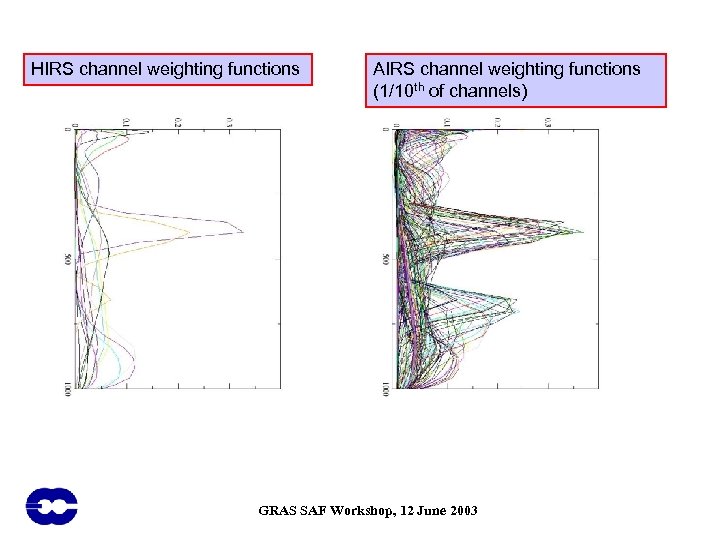 HIRS channel weighting functions AIRS channel weighting functions (1/10 th of channels) GRAS SAF Workshop, 12 June 2003
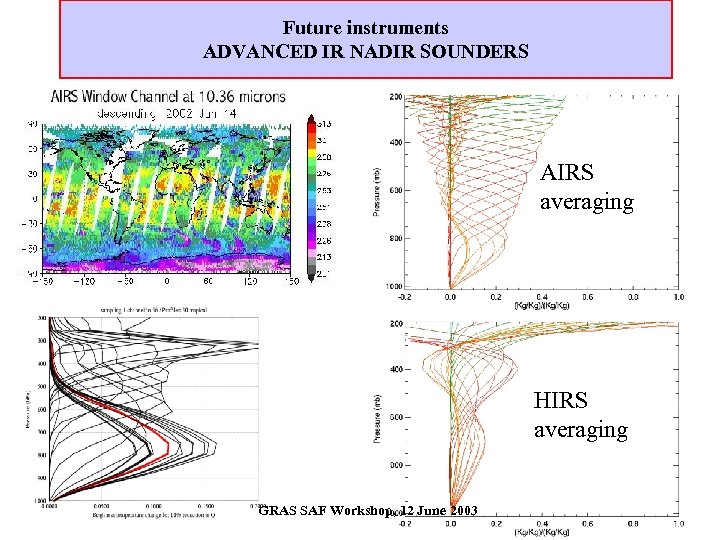 Future instruments ADVANCED IR NADIR SOUNDERS AIRS averaging HIRS averaging GRAS SAF Workshop, 12 June 2003
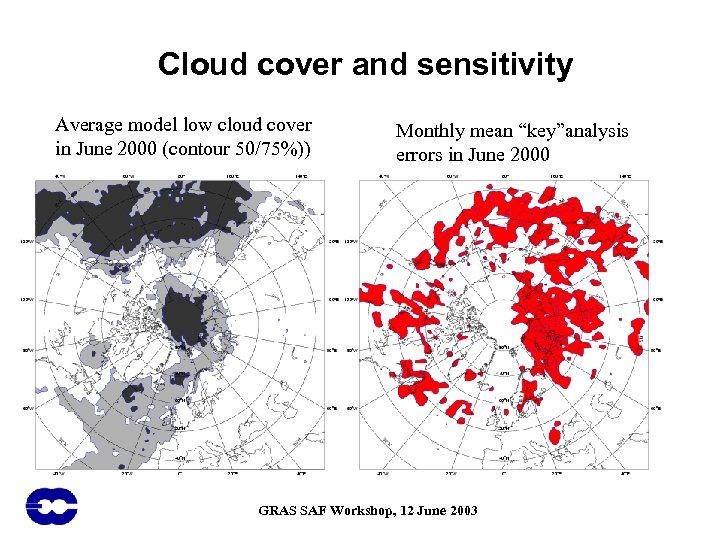 Cloud cover and sensitivity Average model low cloud cover in June 2000 (contour 50/75%)) Monthly mean “key”analysis errors in June 2000 GRAS SAF Workshop, 12 June 2003
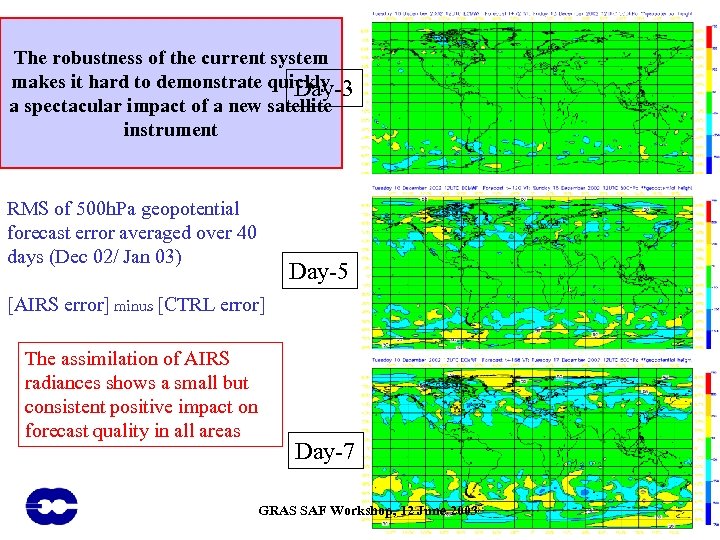 The robustness of the current system makes it hard to demonstrate quickly Day-3 a spectacular impact of a new satellite instrument RMS of 500 h. Pa geopotential forecast error averaged over 40 days (Dec 02/ Jan 03) Day-5 [AIRS error] minus [CTRL error] The assimilation of AIRS radiances shows a small but consistent positive impact on forecast quality in all areas Day-7 GRAS SAF Workshop, 12 June 2003
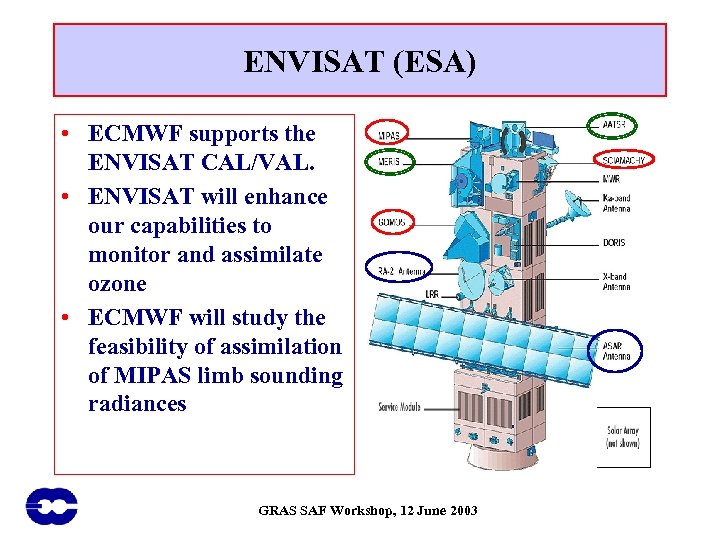 ENVISAT (ESA) • ECMWF supports the ENVISAT CAL/VAL. • ENVISAT will enhance our capabilities to monitor and assimilate ozone • ECMWF will study the feasibility of assimilation of MIPAS limb sounding radiances GRAS SAF Workshop, 12 June 2003
 ASSET AT ECMWF: Assimilation of MIPAS IR limb radiances Idea: • Use radiances as observations, rather than retrieved profiles of temperature, humidity, ozone, … Why? • Very successful at ECMWF for nadir sounders; flexibility • Estimation of observation error and bias characteristics easier for radiances than for retrievals • Avoids having to account for the use of a priori information in the retrievals Some challenges: • Limb geometry, ray-tracing • Channel/data selection out of about 60, 000 points per sweep • Fast radiative transfer model • Error characteristics (background & observations) GRAS SAF Workshop, 12 June 2003
 Priorities for the future: Scope for using GPS radio-occultation measurements • Impact of the background error covariance to propagate information from observations in the vertical (how to best formulate B and how to make it evolve while high vertical resolution data become available)? • Is there a standard accurate enough to allow the detection and correction of radiance biases? • Can radio-occultation measurements help for the calibration? • do we need active sensors? • How best develop expertise in limb sounding? • Progressive approach GRAS SAF Workshop, 12 June 2003
 ECMWF could offer monitoring and cal/val capabilities for this new type of observations • Passive assimilation: Data are not assimilated actively, but go through the assimilation system and statistics (e. g. first-guess departures) are calculated (offers Near Real Time quality control). Not too complicated observation operator required! • Use assimilation system to evaluate data quality, biases, instrument and algorithm stability (can also show model problems) • Output statistics: • - Number of data • - Mean • - Stdev of • - time series Observations Departures (first-guess, analysis) GRAS SAF Workshop, 12 June 2003
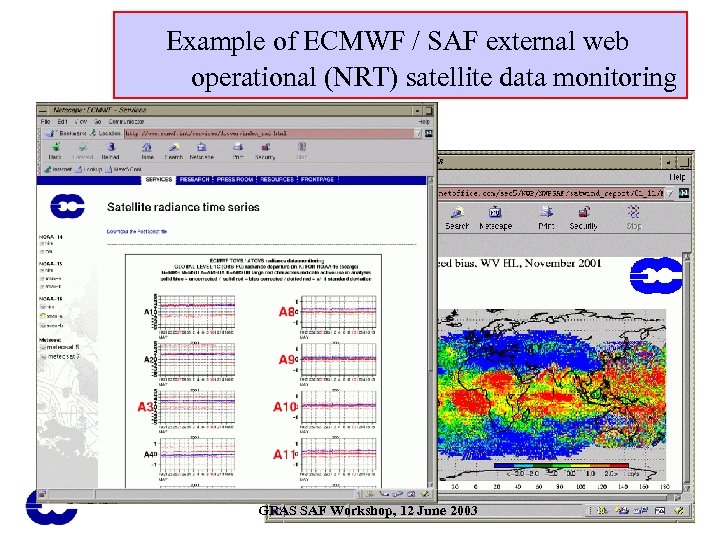 Example of ECMWF / SAF external web operational (NRT) satellite data monitoring GRAS SAF Workshop, 12 June 2003
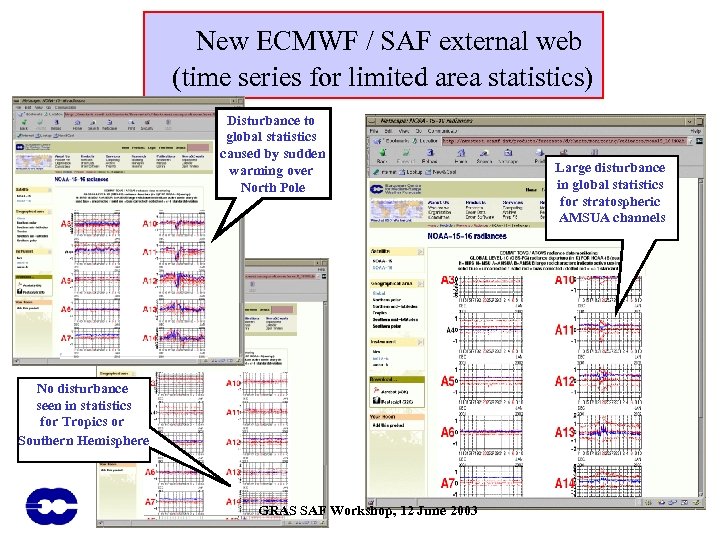 New ECMWF / SAF external web (time series for limited area statistics) Disturbance to global statistics caused by sudden warming over North Pole No disturbance seen in statistics for Tropics or Southern Hemisphere GRAS SAF Workshop, 12 June 2003 Large disturbance in global statistics for stratospheric AMSUA channels
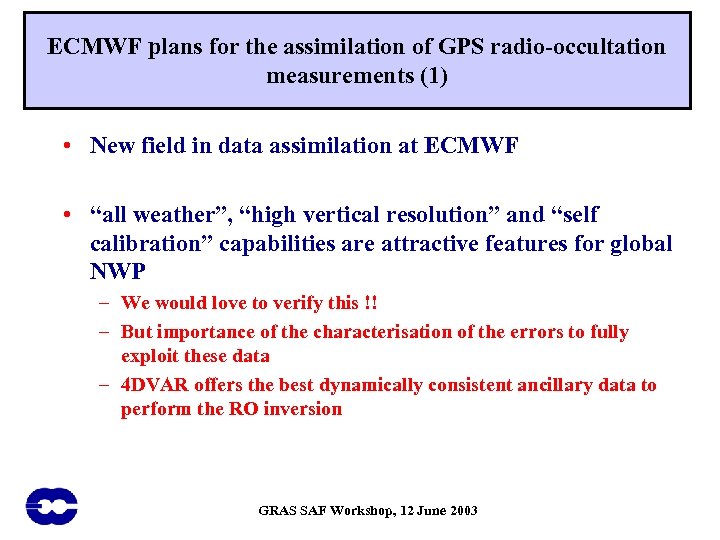 ECMWF plans for the assimilation of GPS radio-occultation measurements (1) • New field in data assimilation at ECMWF • “all weather”, “high vertical resolution” and “self calibration” capabilities are attractive features for global NWP – We would love to verify this !! – But importance of the characterisation of the errors to fully exploit these data – 4 DVAR offers the best dynamically consistent ancillary data to perform the RO inversion GRAS SAF Workshop, 12 June 2003
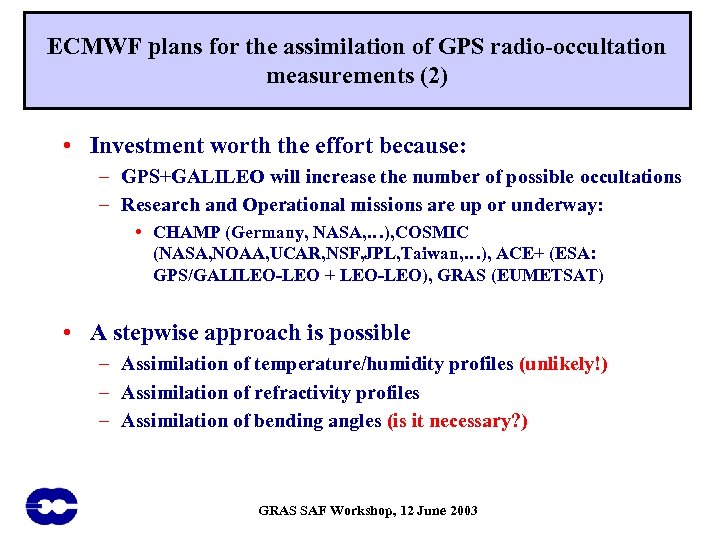 ECMWF plans for the assimilation of GPS radio-occultation measurements (2) • Investment worth the effort because: – GPS+GALILEO will increase the number of possible occultations – Research and Operational missions are up or underway: • CHAMP (Germany, NASA, …), COSMIC (NASA, NOAA, UCAR, NSF, JPL, Taiwan, …), ACE+ (ESA: GPS/GALILEO-LEO + LEO-LEO), GRAS (EUMETSAT) • A stepwise approach is possible – Assimilation of temperature/humidity profiles (unlikely!) – Assimilation of refractivity profiles – Assimilation of bending angles (is it necessary? ) GRAS SAF Workshop, 12 June 2003
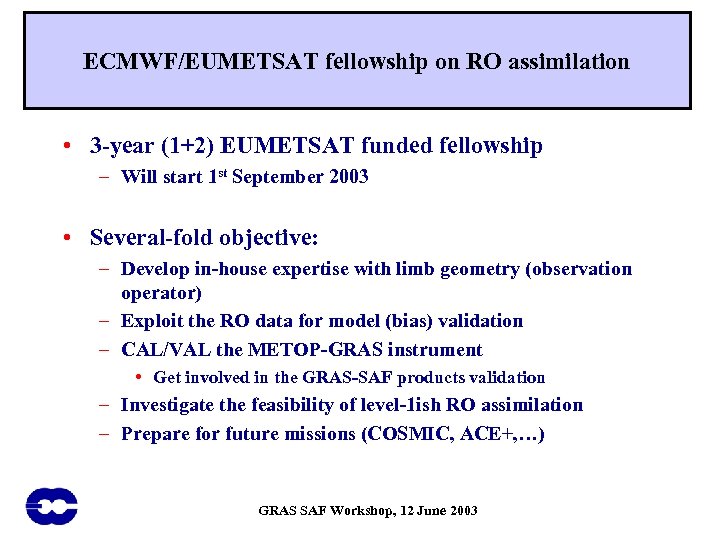 ECMWF/EUMETSAT fellowship on RO assimilation • 3 -year (1+2) EUMETSAT funded fellowship – Will start 1 st September 2003 • Several-fold objective: – Develop in-house expertise with limb geometry (observation operator) – Exploit the RO data for model (bias) validation – CAL/VAL the METOP-GRAS instrument • Get involved in the GRAS-SAF products validation – Investigate the feasibility of level-1 ish RO assimilation – Prepare for future missions (COSMIC, ACE+, …) GRAS SAF Workshop, 12 June 2003