


 Скачать презентацию Asset Pricing Zhenlong 1 Price change cash flow
996ef42ef9d1e005b73a11d9978720bd.ppt
- Количество слайдов: 39
 Asset Pricing Zhenlong 1 Price change: cash flow or discount rate? *
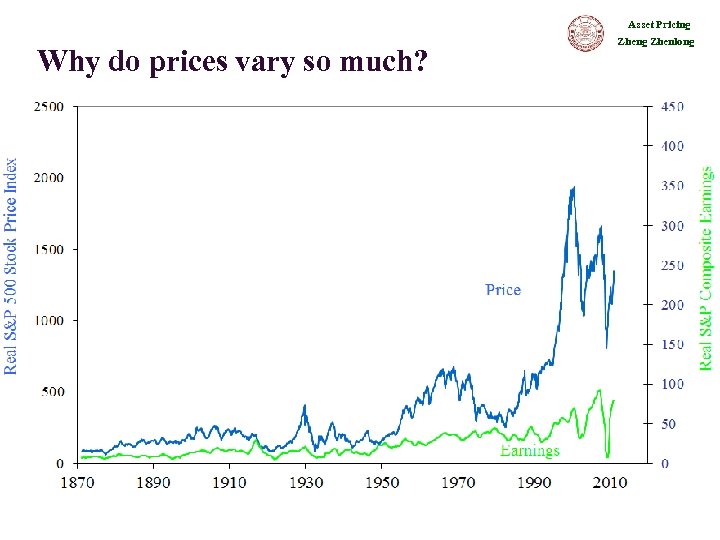 Asset Pricing Why do prices vary so much? Zheng Zhenlong
 Asset Pricing Zhenlong
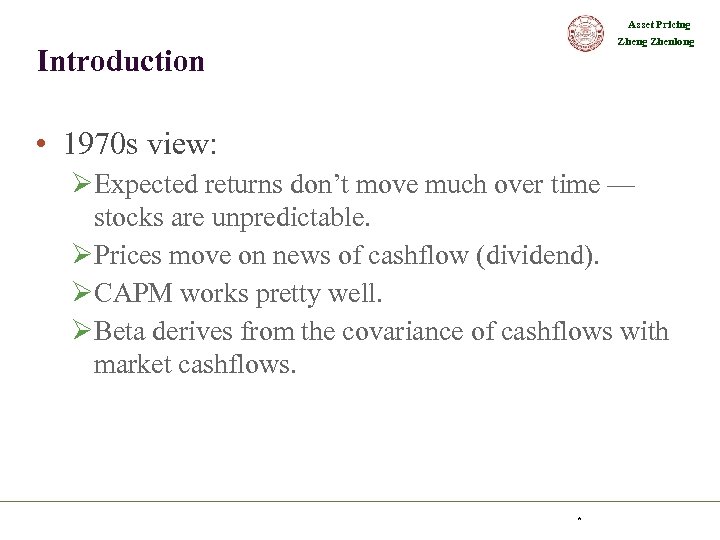 Asset Pricing Zhenlong Introduction • 1970 s view: ØExpected returns don’t move much over time — stocks are unpredictable. ØPrices move on news of cashflow (dividend). ØCAPM works pretty well. ØBeta derives from the covariance of cashflows with market cashflows. *
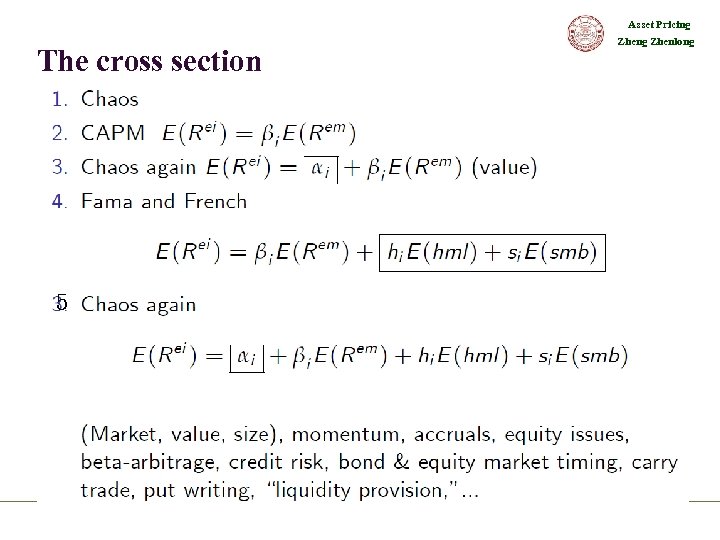
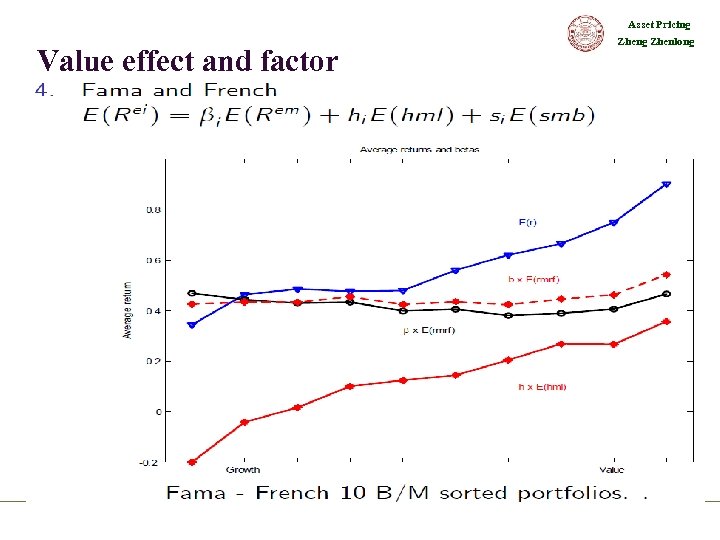
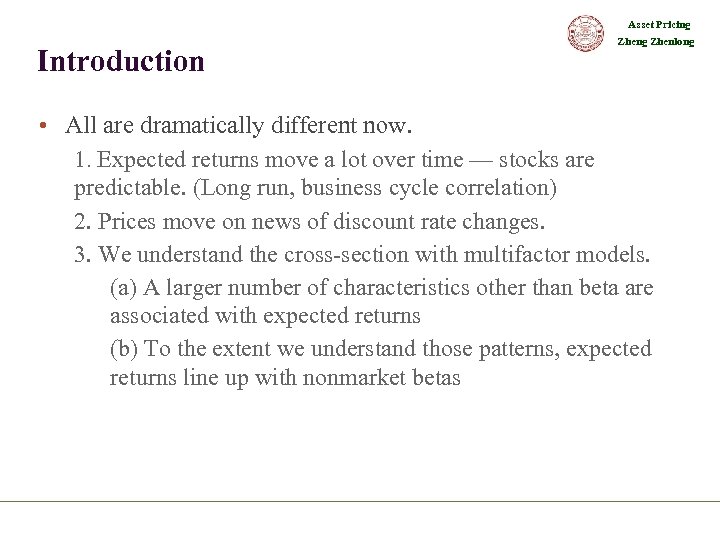 Asset Pricing Introduction Zheng Zhenlong • All are dramatically different now. 1. Expected returns move a lot over time — stocks are predictable. (Long run, business cycle correlation) 2. Prices move on news of discount rate changes. 3. We understand the cross-section with multifactor models. (a) A larger number of characteristics other than beta are associated with expected returns (b) To the extent we understand those patterns, expected returns line up with nonmarket betas
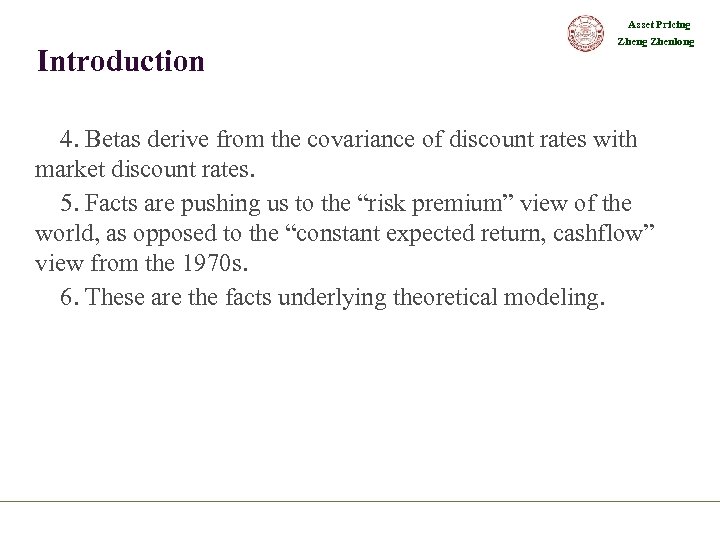 Asset Pricing Introduction Zheng Zhenlong 4. Betas derive from the covariance of discount rates with market discount rates. 5. Facts are pushing us to the “risk premium” view of the world, as opposed to the “constant expected return, cashflow” view from the 1970 s. 6. These are the facts underlying theoretical modeling.
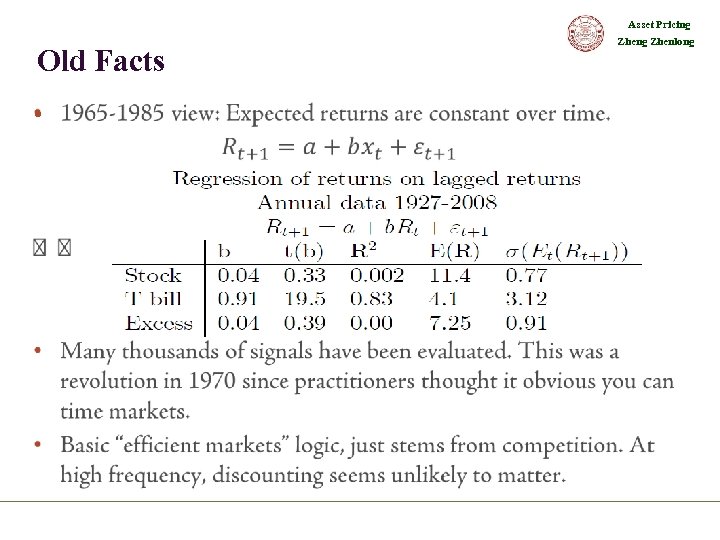 Asset Pricing Old Facts • Zheng Zhenlong
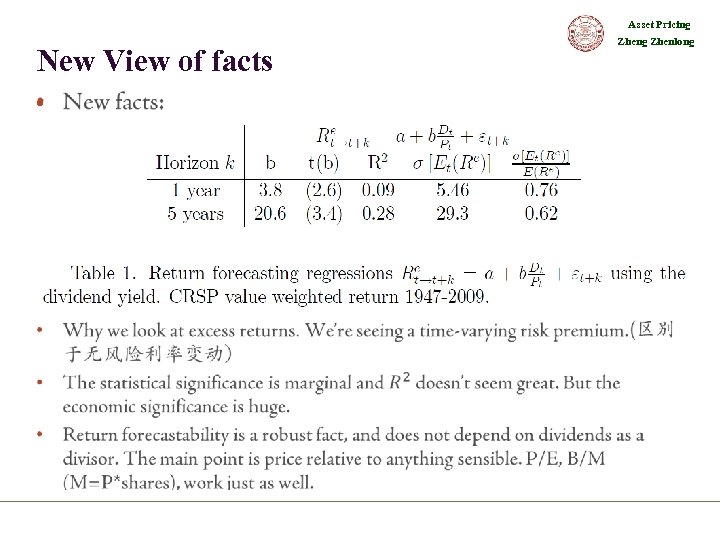 Asset Pricing New View of facts • Zheng Zhenlong
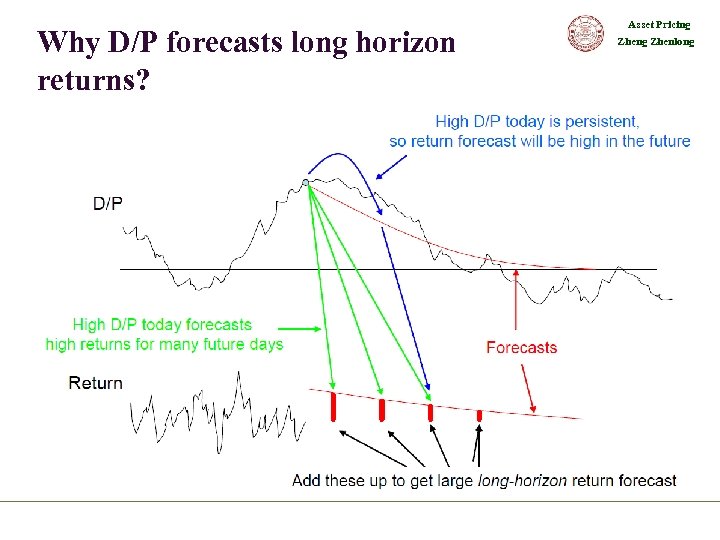 Why D/P forecasts long horizon returns? Asset Pricing Zhenlong
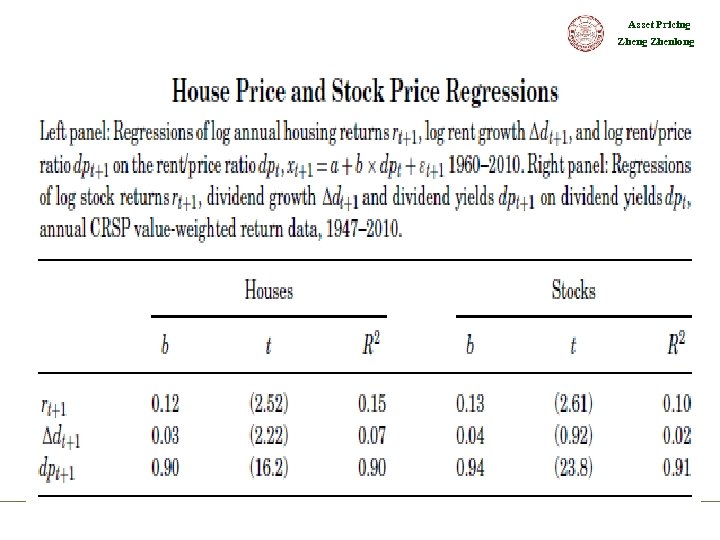
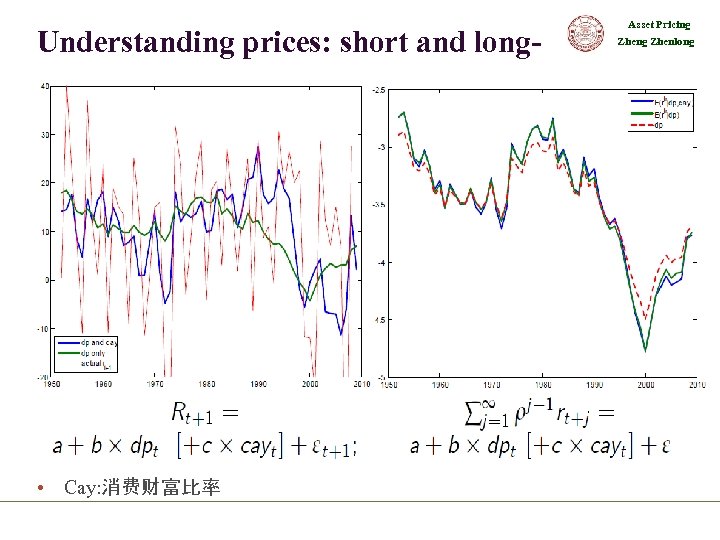
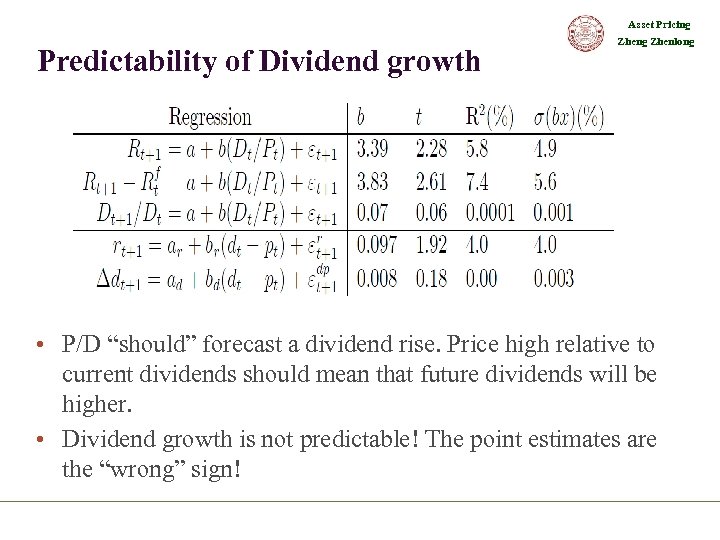 Asset Pricing Predictability of Dividend growth Zheng Zhenlong • P/D “should” forecast a dividend rise. Price high relative to current dividends should mean that future dividends will be higher. • Dividend growth is not predictable! The point estimates are the “wrong” sign!
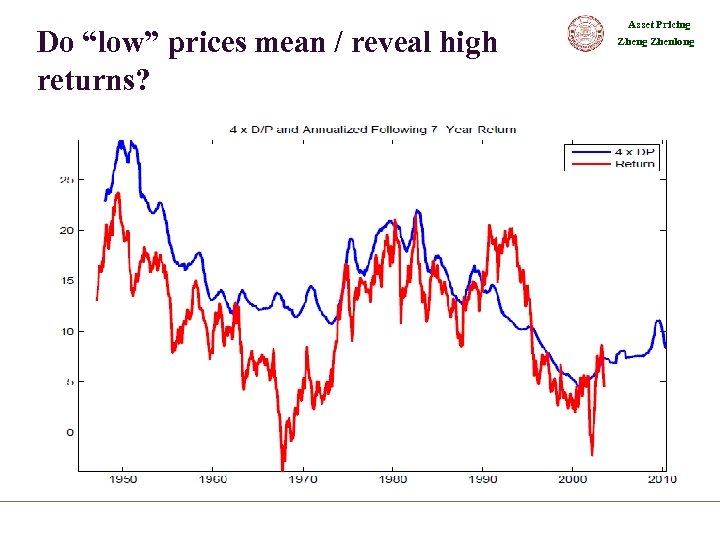 Do “low” prices mean / reveal high returns? Asset Pricing Zhenlong
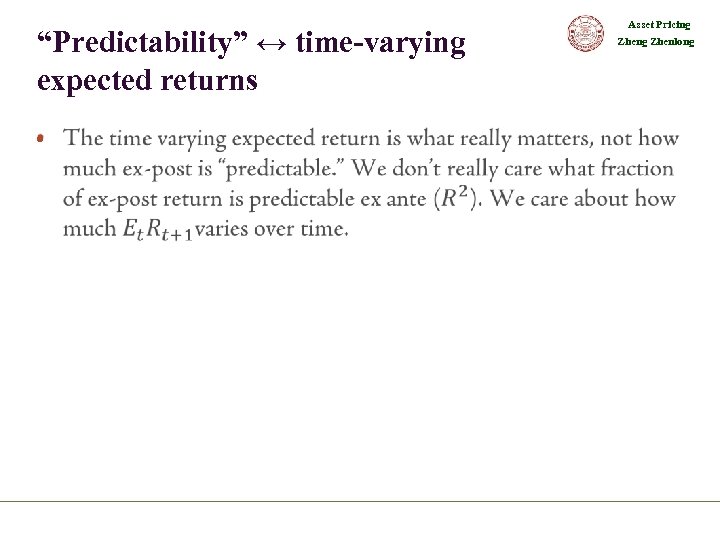 “Predictability” ↔ time-varying expected returns • Asset Pricing Zhenlong
 Asset Pricing Inefficiency? Zheng Zhenlong • Does this mean markets are “inefficient”? Is this an invitation to “buy low and sell high? ” • Not necessarily. Time varying risk premia are possible. • Are expected returns higher in good times or in bad times? (Bad, why? ) business-cycle related time-varying risk premium is certainly possible.
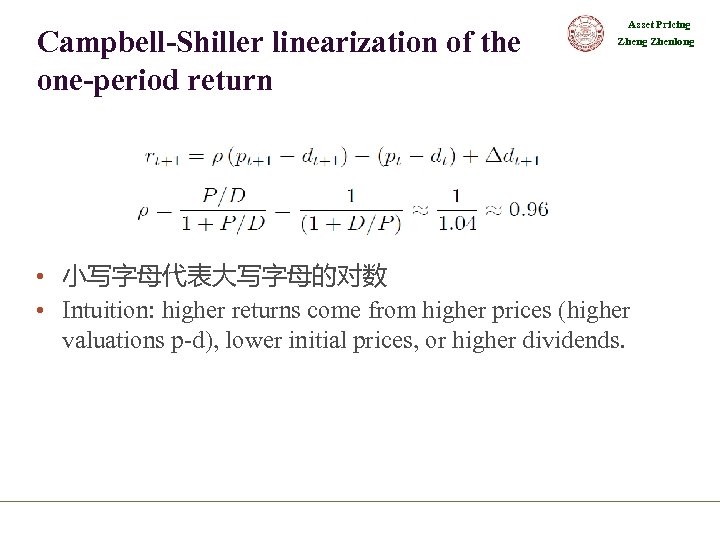 Campbell-Shiller linearization of the one-period return Asset Pricing Zhenlong • 小写字母代表大写字母的对数 • Intuition: higher returns come from higher prices (higher valuations p-d), lower initial prices, or higher dividends.
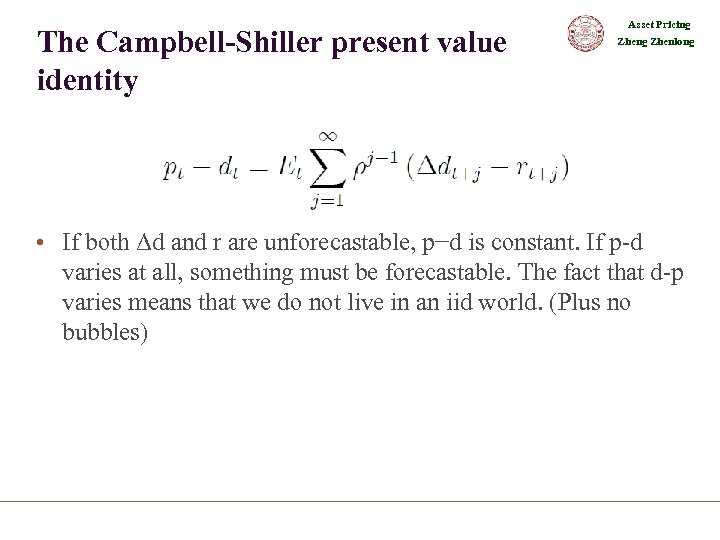 The Campbell-Shiller present value identity Asset Pricing Zhenlong • If both Δd and r are unforecastable, p−d is constant. If p-d varies at all, something must be forecastable. The fact that d-p varies means that we do not live in an iid world. (Plus no bubbles)
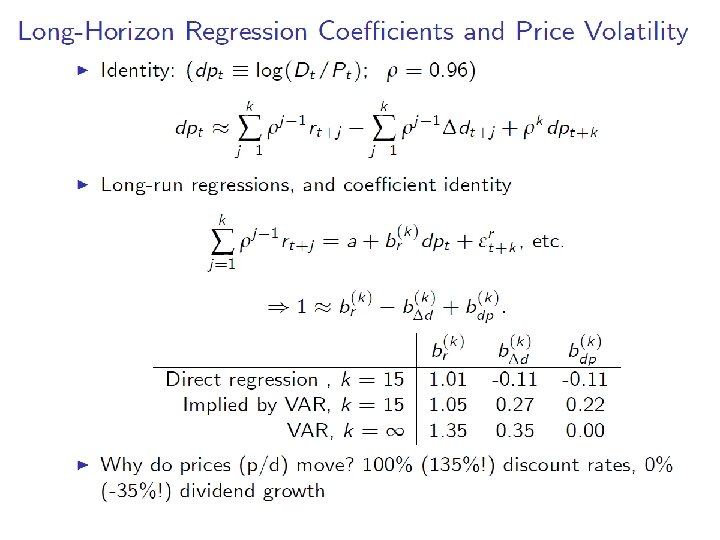 Asset Pricing Zhenlong
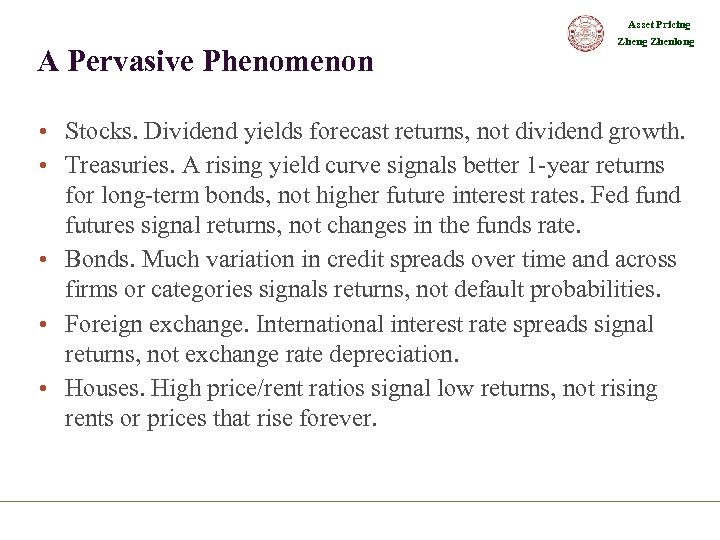 Asset Pricing A Pervasive Phenomenon Zheng Zhenlong • Stocks. Dividend yields forecast returns, not dividend growth. • Treasuries. A rising yield curve signals better 1 -year returns for long-term bonds, not higher future interest rates. Fed fund futures signal returns, not changes in the funds rate. • Bonds. Much variation in credit spreads over time and across firms or categories signals returns, not default probabilities. • Foreign exchange. International interest rate spreads signal returns, not exchange rate depreciation. • Houses. High price/rent ratios signal low returns, not rising rents or prices that rise forever.
 Asset Pricing Zhenlong
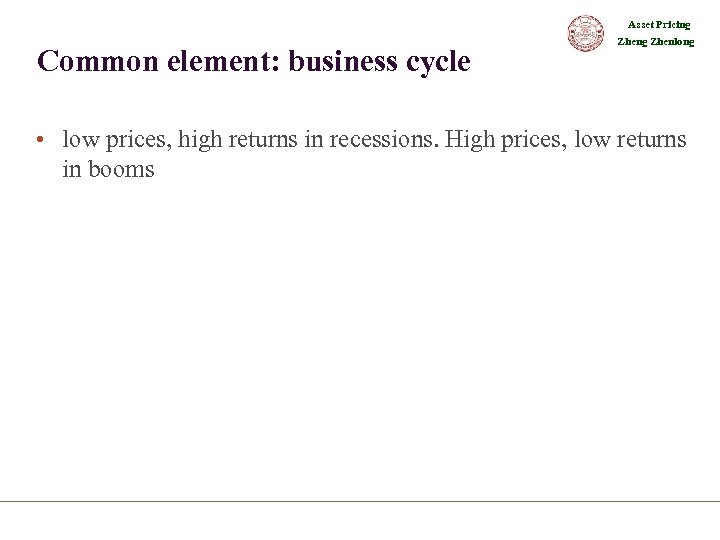 Asset Pricing Common element: business cycle Zheng Zhenlong • low prices, high returns in recessions. High prices, low returns in booms
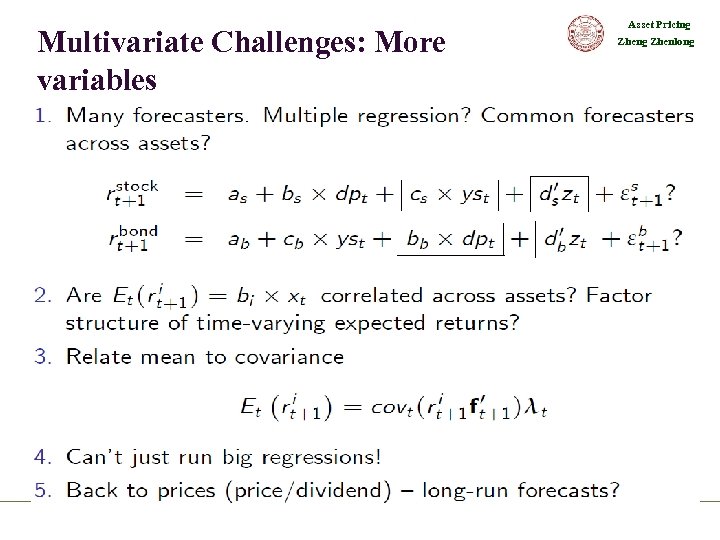 Multivariate Challenges: More variables Asset Pricing Zhenlong
 Understanding prices: short and longrun forecasts • Cay: 消费财富比率 Asset Pricing Zhenlong
 Asset Pricing The cross section 5 Zheng Zhenlong
 Asset Pricing Value effect and factor Zheng Zhenlong
 Asset Pricing Value (size, and bond factors) Zheng Zhenlong
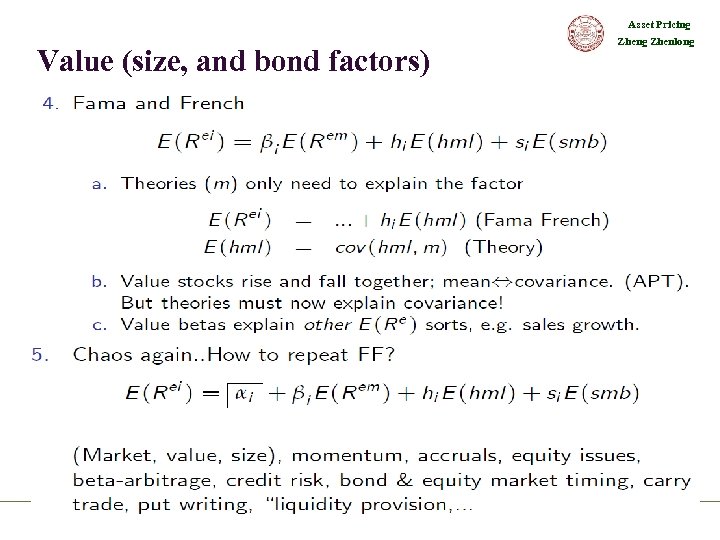
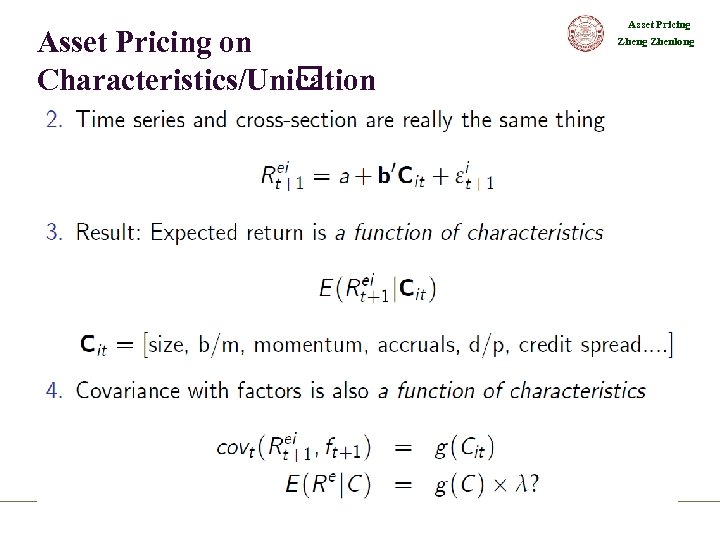
 Asset Pricing The Multidimensional Challenge Zheng Zhenlong Ø (Market, value, size), momentum, accruals, equity issues, beta -arbitrage, credit risk, bond & equity market timing, carry trade, put writing, liquidity provision, . . . 1. Which of these are independently important for E(Re )? ( multiple regression ) 2. Does E(Re ) spread correspond to new factors? 3. Do we need all the new factors? Or again, fewer factors than E(Re ) characteristics? 4. Why do prices move? Long run. Ø How to approach such a highly multidimensional problem?
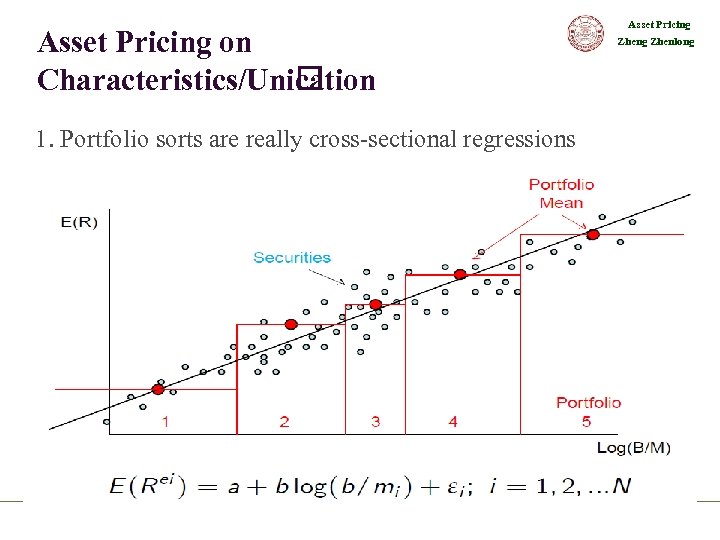 Asset Pricing on Characteristics/Uni cation 1. Portfolio sorts are really cross-sectional regressions Asset Pricing Zhenlong
 Asset Pricing on Characteristics/Uni cation Asset Pricing Zhenlong
 Theory classifi cation • Asset Pricing Zhenlong
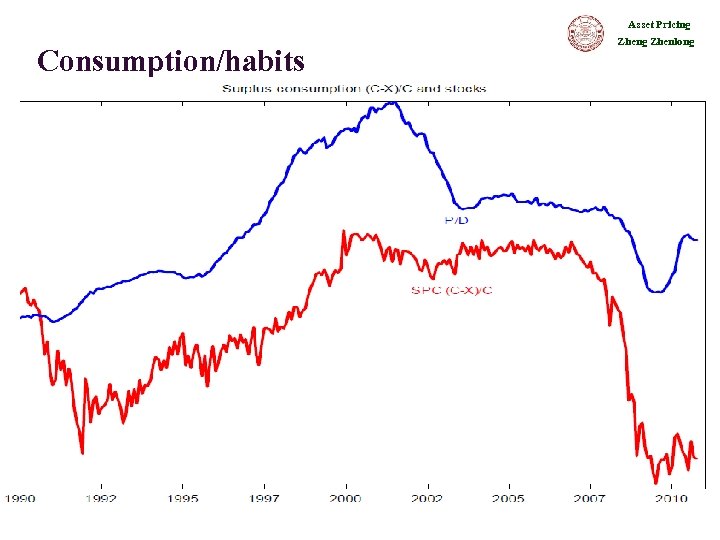 Asset Pricing Consumption/habits Zheng Zhenlong
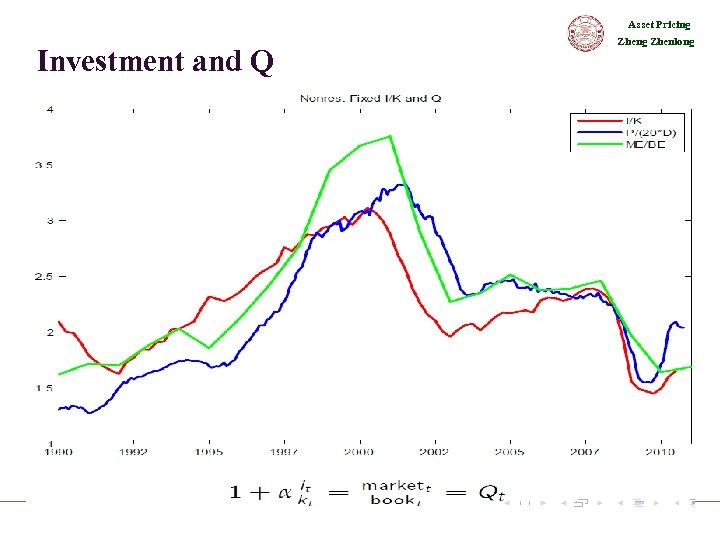 Asset Pricing Investment and Q Zheng Zhenlong
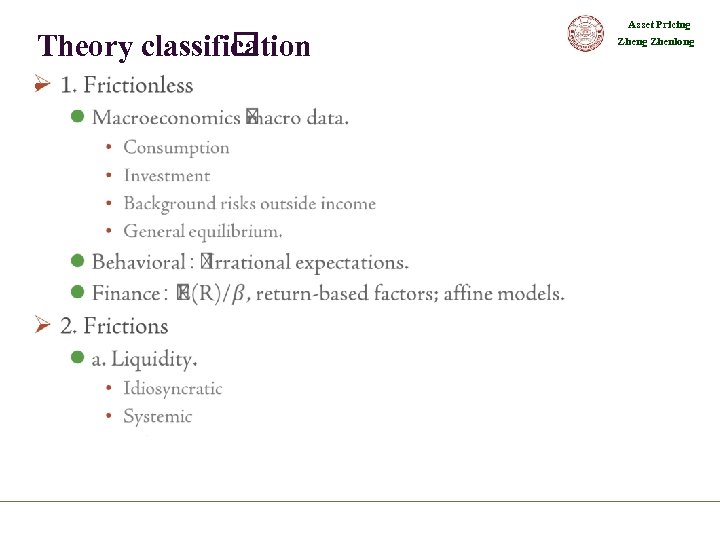
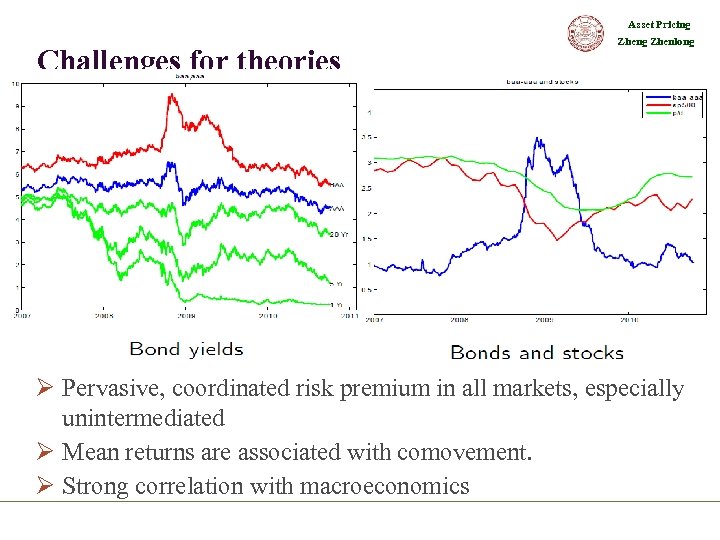 Asset Pricing Challenges for theories Zheng Zhenlong Ø Pervasive, coordinated risk premium in all markets, especially unintermediated Ø Mean returns are associated with comovement. Ø Strong correlation with macroeconomics
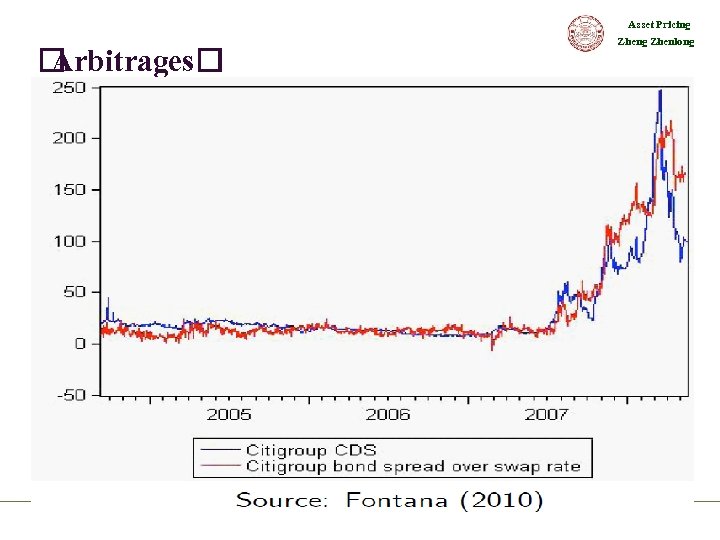 Asset Pricing Arbitrages Zheng Zhenlong
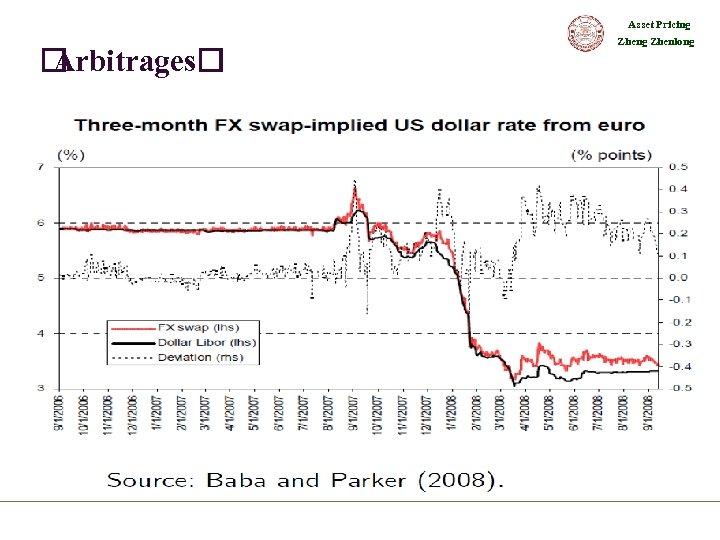 Asset Pricing Arbitrages Zheng Zhenlong
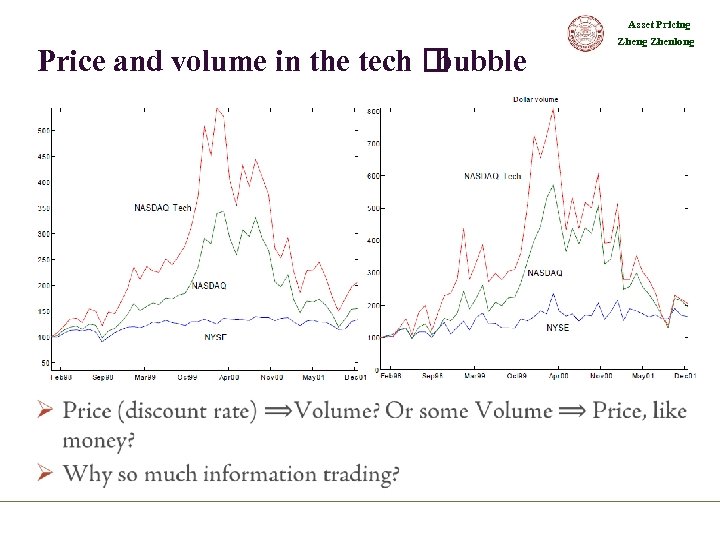 Asset Pricing Price and volume in the tech bubble • Zheng Zhenlong
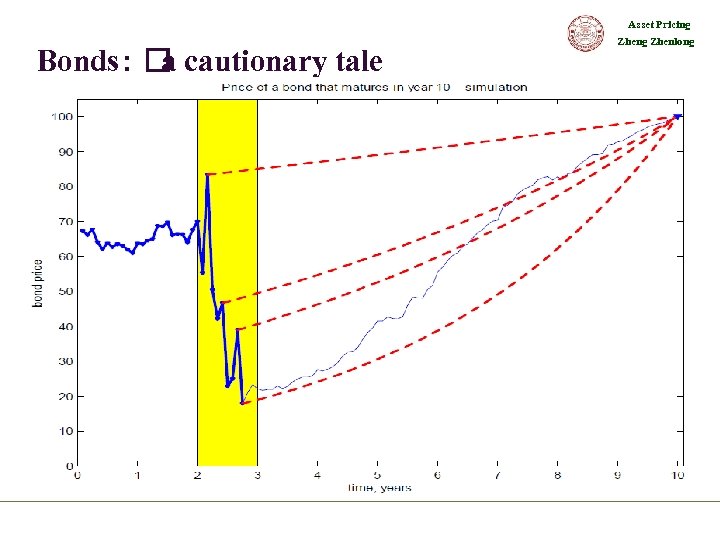 Asset Pricing Bonds: cautionary tale a Zheng Zhenlong
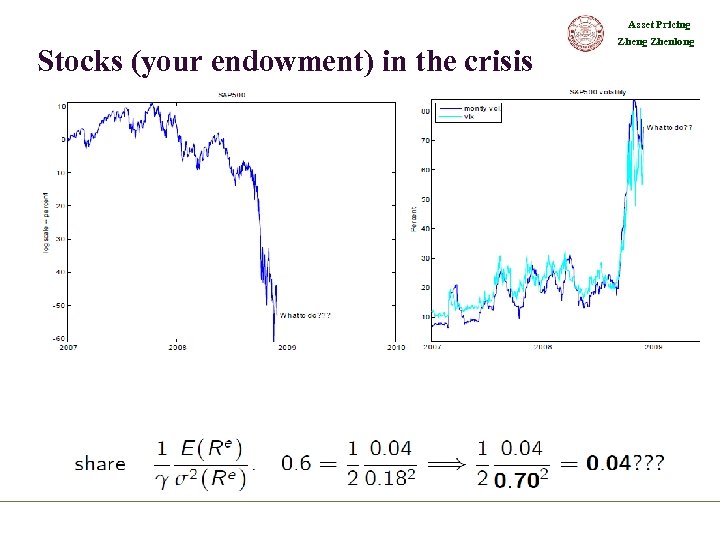 Asset Pricing Stocks (your endowment) in the crisis Zheng Zhenlong
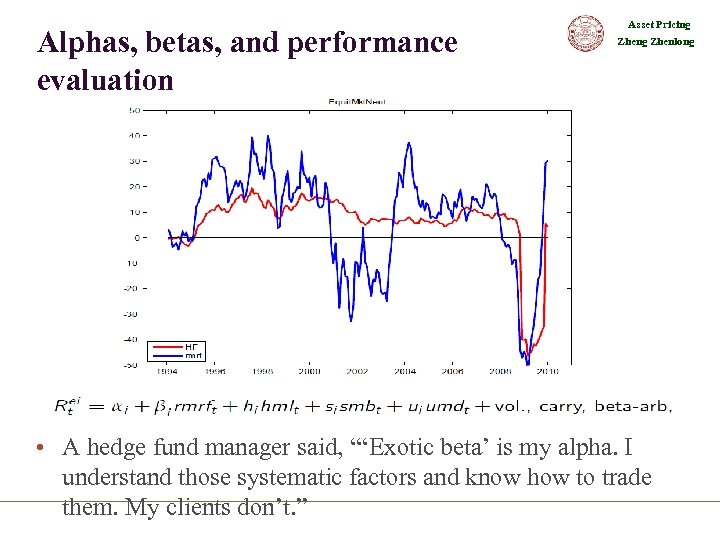 Alphas, betas, and performance evaluation Asset Pricing Zhenlong • A hedge fund manager said, “‘Exotic beta’ is my alpha. I understand those systematic factors and know how to trade them. My clients don’t. ”
 Asset Pricing Conclusion Zheng Zhenlong Ø Discount rates vary over time and across assets a lot more than you thought Ø Empirical: how. Theoretical: why. Applications: at all. Ø We ’ve only started Ø How do you ask the right question?
 Asset Pricing Zhenlong