 Скачать презентацию Asset Management Leadership Orientation February 12 2007 —
b4eb8f3018329d0ac4e7f2a32b048b55.ppt
- Количество слайдов: 83



Asset Management Leadership Orientation February 12, 2007 - DRAFT
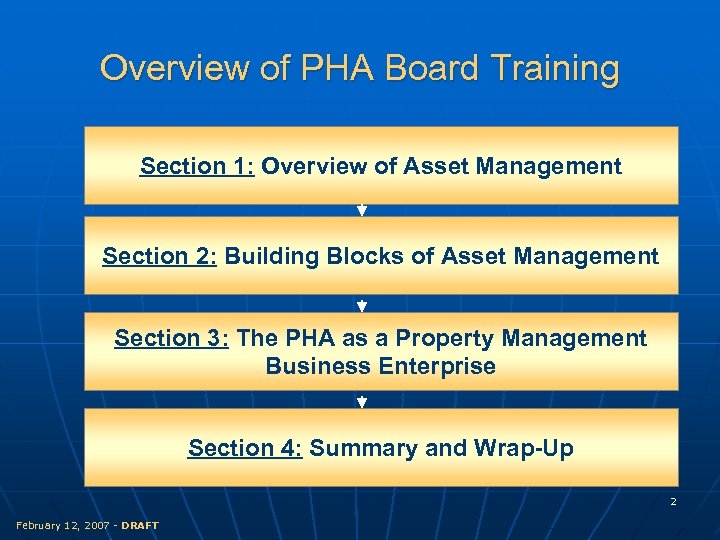
Overview of PHA Board Training Section 1: Overview of Asset Management Section 2: Building Blocks of Asset Management Section 3: The PHA as a Property Management Business Enterprise Section 4: Summary and Wrap-Up 2 February 12, 2007 - DRAFT
Section 1: Overview of Asset Management February 12, 2007 - DRAFT
Overview of Asset Management Learning Objectives n n n Explain “What is asset management? ” Explain the difference between the existing agency focus and an asset management focus List the benefits of asset management from the board’s perspective Identify key dates associated with the transition to asset management Describe key roles and responsibilities under asset management Explain the PHA Board’s role as owner 4 February 12, 2007 - DRAFT

Orlando J. Cabrera Assistant Secretary for Public and Indian Housing (PIH) at HUD 5 February 12, 2007 - DRAFT
“PHAs shall manage their properties according to an asset management model, consistent with the management norms in the broader multi-family management industry. PHAs shall also implement project-based management, project-based budgeting, and project-based accounting, which are essential components of asset management. ” Revisions to the Public Housing Operating Fund Program; Final Rule HUD, September 19, 2005 6 February 12, 2007 - DRAFT
What is Asset Management? A process of making investment decisions for a collection (portfolio) of assets, based on the mission, goals, and objectives of the owner, lender, sponsor, or regulatory body. 7 February 12, 2007 - DRAFT
Asset Management at HUD Background n n n 1999: Congress directs that HUD contract with Harvard Graduate School of Design to conduct a study on costs incurred in operating well-run public housing 2003: Final cost study completed and released 2005: Based on cost study, revisions are made to PH Operating Fund Program and the new rule (24 CFR Part 990) is issued • Provides a new formula for distributing operating subsidy to PHAs • Establishes requirements for PHAs to convert to asset management 8 February 12, 2007 - DRAFT
PHA Operating Fund Final Rule: Small PHA Exception n PHAs with fewer than 250 units are not required to convert to asset management Small PHAs may choose to implement asset management and follow the key business rules like any larger PHA Asset management is ultimately about maximizing financial, physical, and management performance 9 February 12, 2007 - DRAFT
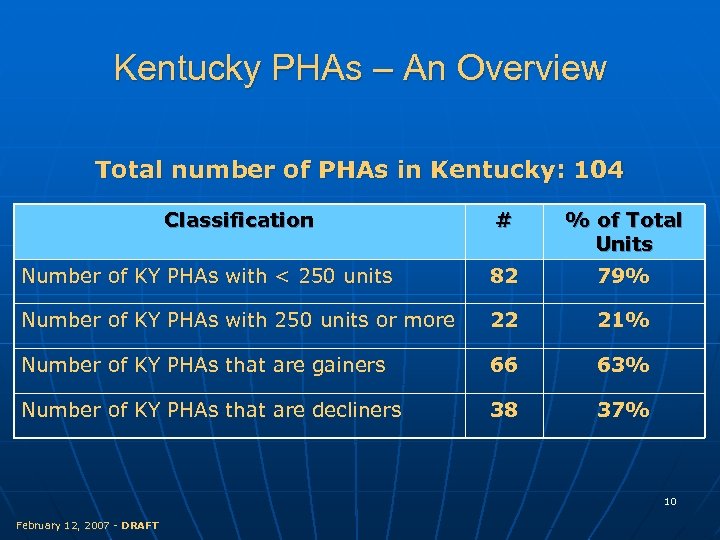
Kentucky PHAs – An Overview Total number of PHAs in Kentucky: 104 Classification # % of Total Units Number of KY PHAs with < 250 units 82 79% Number of KY PHAs with 250 units or more 22 21% Number of KY PHAs that are gainers 66 63% Number of KY PHAs that are decliners 38 37% 10 February 12, 2007 - DRAFT
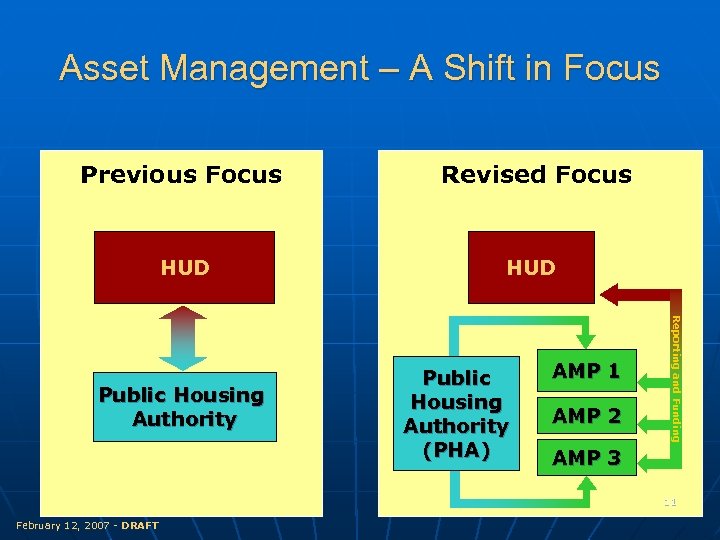
Asset Management – A Shift in Focus Previous Focus Revised Focus HUD AMP 1 AMP 2 Reporting and Funding Public Housing Authority (PHA) AMP 3 11 February 12, 2007 - DRAFT
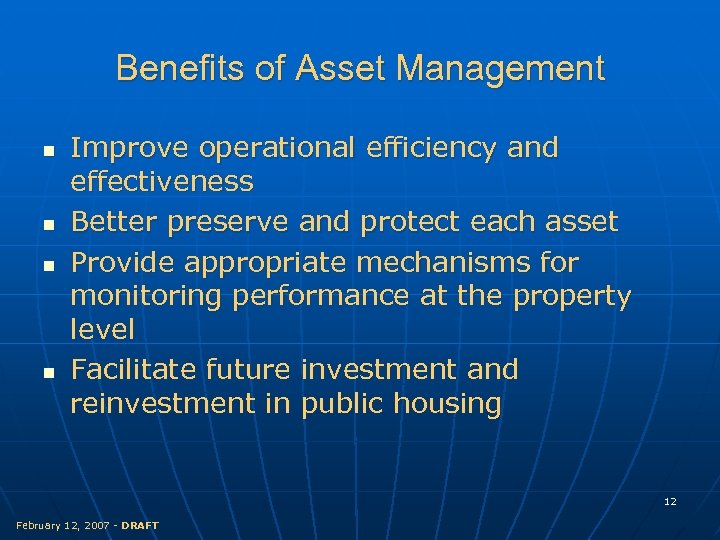
Benefits of Asset Management n n Improve operational efficiency and effectiveness Better preserve and protect each asset Provide appropriate mechanisms for monitoring performance at the property level Facilitate future investment and reinvestment in public housing 12 February 12, 2007 - DRAFT
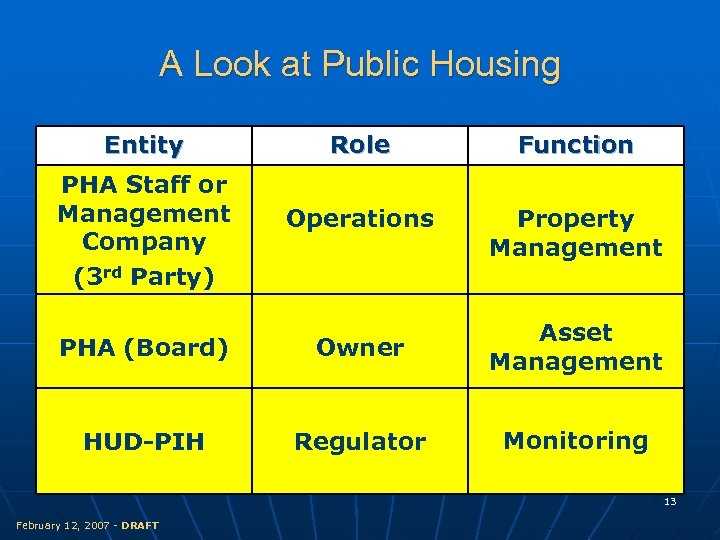
A Look at Public Housing Entity Role Function PHA Staff or Management Company (3 rd Party) Operations Property Management PHA (Board) Owner Asset Management HUD-PIH Regulator Monitoring 13 February 12, 2007 - DRAFT
PHA Mission and Goal Drivers n n n Who to serve Quality of housing Standard of affordability Social goals Operational efficiencies Investment decisions should be dictated by the mission, not the reverse. 14 February 12, 2007 - DRAFT
PHA Board: Owner Role n n n Review activities for conformance with missions and goals Evaluate progress and recommend corrective action Monitor performance Stay up to date on industry information Foster relationships with key stakeholders 15 February 12, 2007 - DRAFT
Workshop 1. 1: Owner Assessment n n What ownership responsibilities are we doing really well? On which ownership responsibilities can we better focus? How? In groups, please work to discuss and provide answers to the questions above. 16 February 12, 2007 - DRAFT
End of Section 1 February 12, 2007 - DRAFT
Section 2: Building Blocks of Asset Management February 12, 2007 - DRAFT
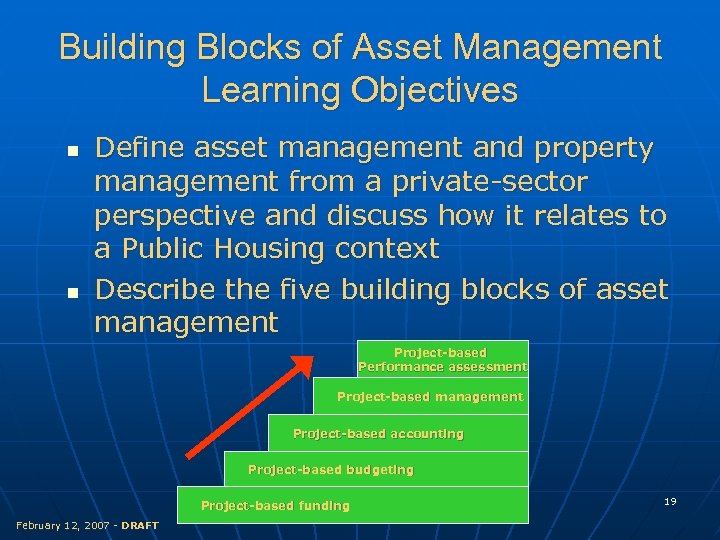
Building Blocks of Asset Management Learning Objectives n n Define asset management and property management from a private-sector perspective and discuss how it relates to a Public Housing context Describe the five building blocks of asset management Project-based Performance assessment Project-based management Project-based accounting Project-based budgeting Project-based funding February 12, 2007 - DRAFT 19
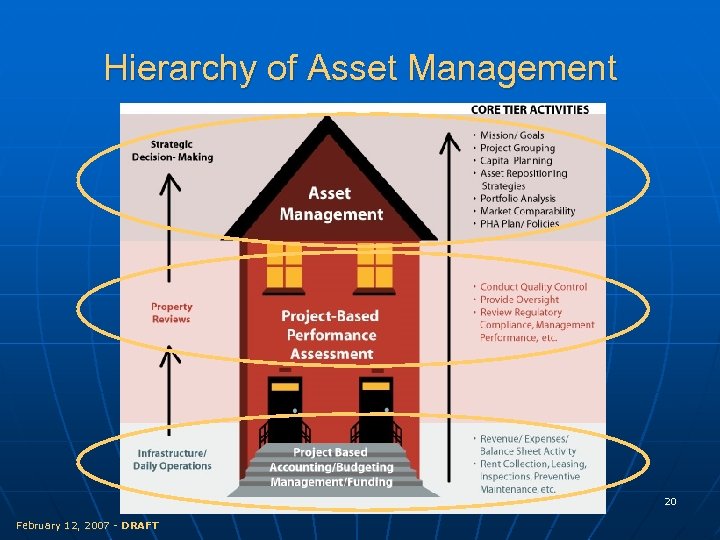
Hierarchy of Asset Management 20 February 12, 2007 - DRAFT
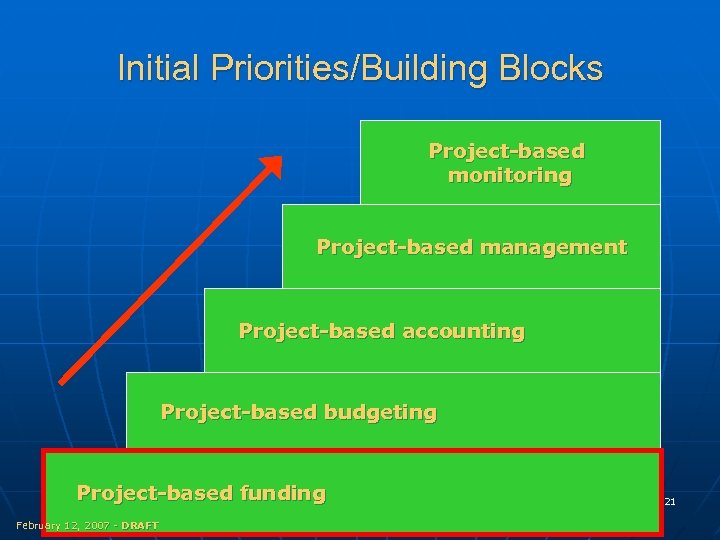
Initial Priorities/Building Blocks Project-based monitoring Project-based management Project-based accounting Project-based budgeting Project-based funding February 12, 2007 - DRAFT 21
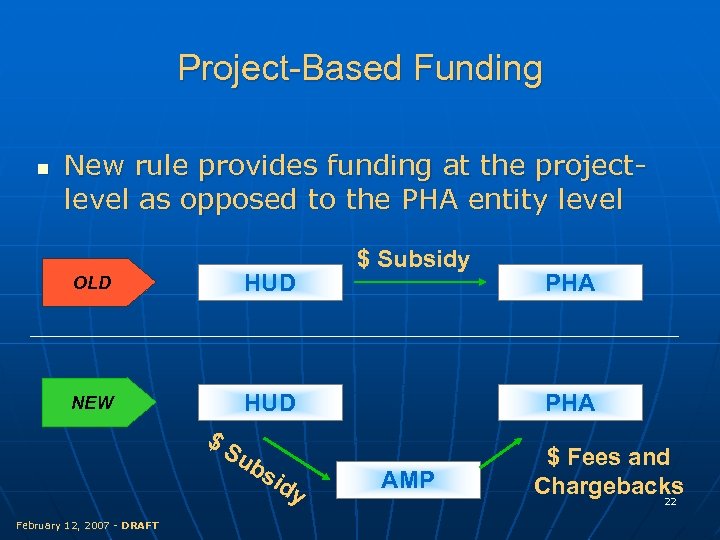
Project-Based Funding n New rule provides funding at the projectlevel as opposed to the PHA entity level OLD HUD NEW $ Subsidy HUD $S ub sid y February 12, 2007 - DRAFT PHA AMP $ Fees and Chargebacks 22
Project-Based Funding n n n Separate subsidy form for each AMP Project Expense Level (PEL) is a major component Ensures appropriate resources are allocated to each AMP 23 February 12, 2007 - DRAFT
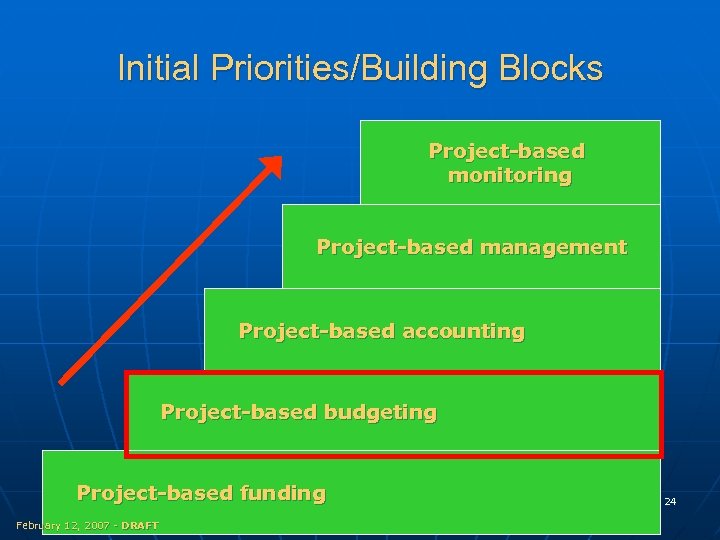
Initial Priorities/Building Blocks Project-based monitoring Project-based management Project-based accounting Project-based budgeting Project-based funding February 12, 2007 - DRAFT 24
Project-Based Budgeting n n n New rule requires PHAs to prepare projectbased budgets Budgeted amounts shall readily reconcile to FDS Must be approved by PHA Board HUD plays advisory role Used for PHA planning purposes 25 February 12, 2007 - DRAFT
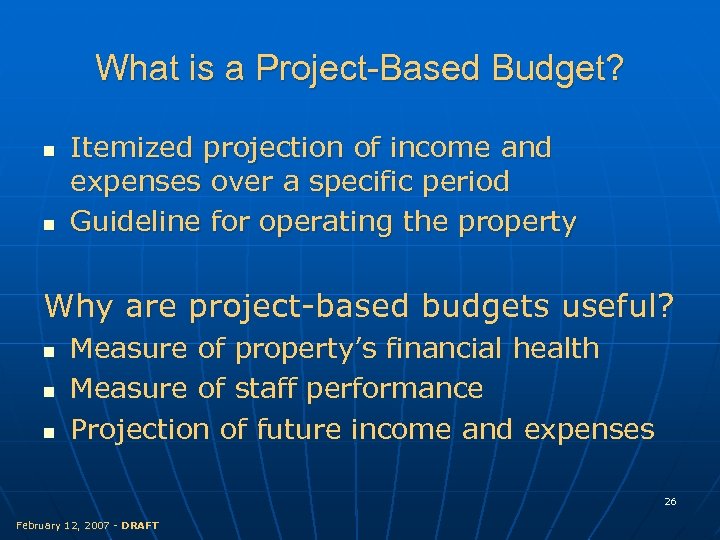
What is a Project-Based Budget? n n Itemized projection of income and expenses over a specific period Guideline for operating the property Why are project-based budgets useful? n n n Measure of property’s financial health Measure of staff performance Projection of future income and expenses 26 February 12, 2007 - DRAFT
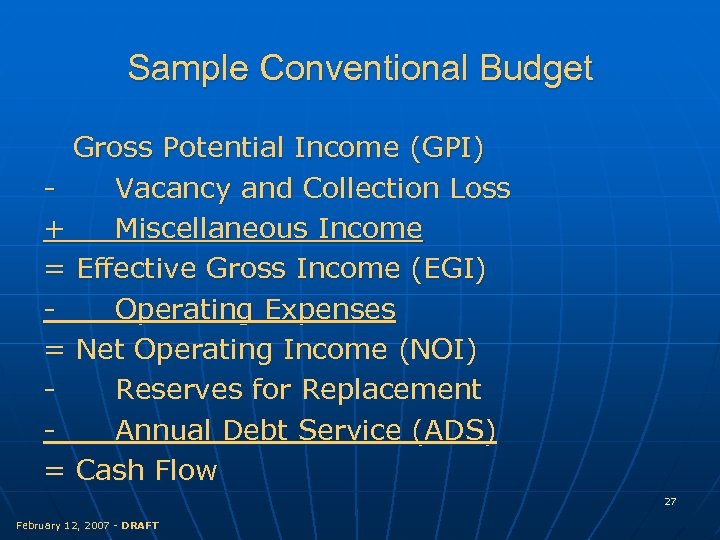
Sample Conventional Budget Gross Potential Income (GPI) Vacancy and Collection Loss + Miscellaneous Income = Effective Gross Income (EGI) Operating Expenses = Net Operating Income (NOI) Reserves for Replacement Annual Debt Service (ADS) = Cash Flow 27 February 12, 2007 - DRAFT
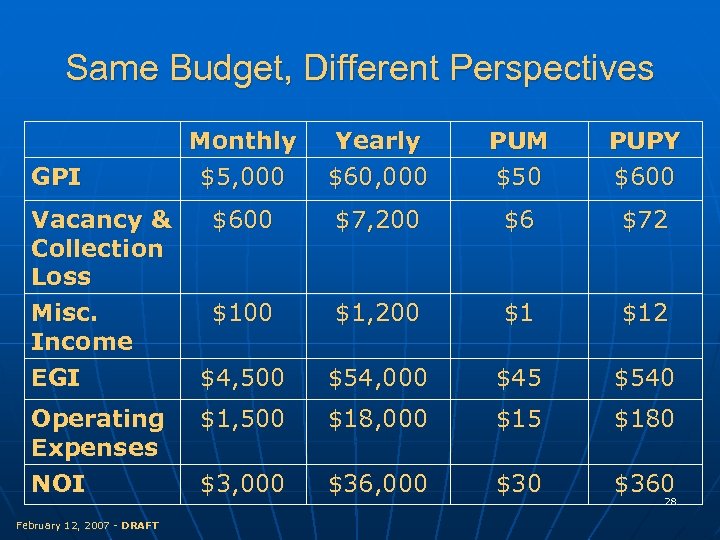
Same Budget, Different Perspectives GPI Vacancy & Collection Loss Misc. Income EGI Operating Expenses NOI February 12, 2007 - DRAFT Monthly $5, 000 Yearly $60, 000 PUM $50 PUPY $600 $7, 200 $6 $72 $100 $1, 200 $1 $12 $4, 500 $54, 000 $45 $540 $1, 500 $18, 000 $15 $180 $3, 000 $36, 000 $360 28
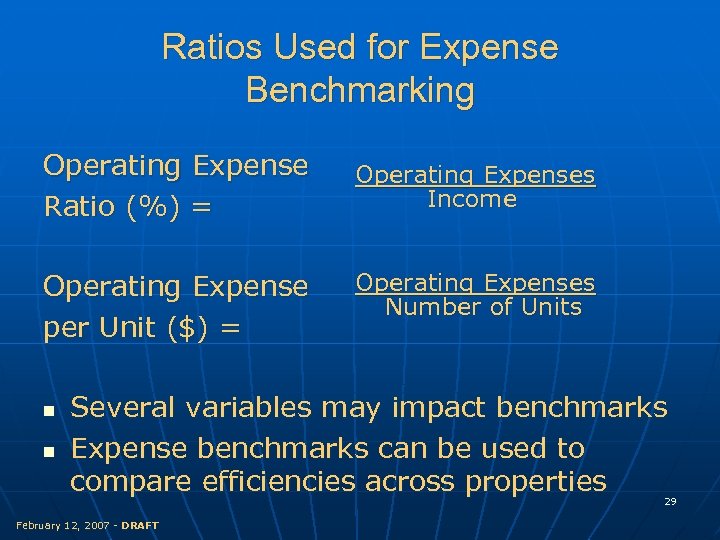
Ratios Used for Expense Benchmarking Operating Expense Ratio (%) = Operating Expenses Income Operating Expense per Unit ($) = Operating Expenses Number of Units n n Several variables may impact benchmarks Expense benchmarks can be used to compare efficiencies across properties 29 February 12, 2007 - DRAFT
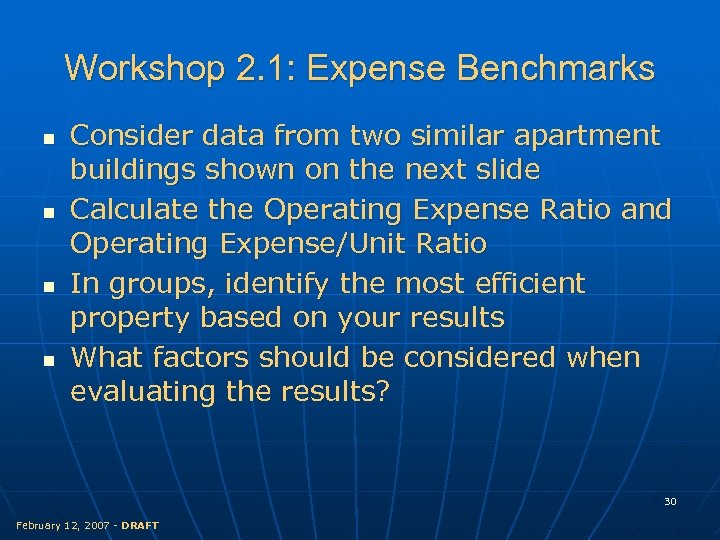
Workshop 2. 1: Expense Benchmarks n n Consider data from two similar apartment buildings shown on the next slide Calculate the Operating Expense Ratio and Operating Expense/Unit Ratio In groups, identify the most efficient property based on your results What factors should be considered when evaluating the results? 30 February 12, 2007 - DRAFT
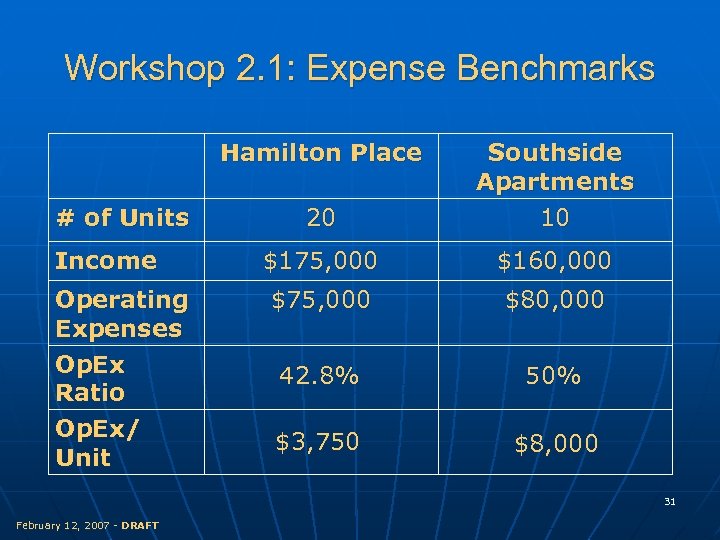
Workshop 2. 1: Expense Benchmarks Hamilton Place # of Units Income Operating Expenses Op. Ex Ratio Op. Ex/ Unit 20 Southside Apartments 10 $175, 000 $160, 000 $75, 000 $80, 000 42. 8% 50% $3, 750 $8, 000 31 February 12, 2007 - DRAFT
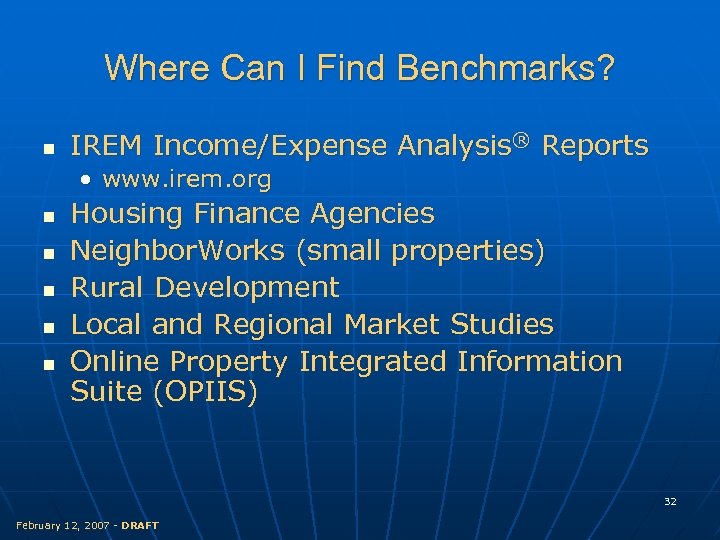
Where Can I Find Benchmarks? n IREM Income/Expense Analysis® Reports • www. irem. org n n n Housing Finance Agencies Neighbor. Works (small properties) Rural Development Local and Regional Market Studies Online Property Integrated Information Suite (OPIIS) 32 February 12, 2007 - DRAFT
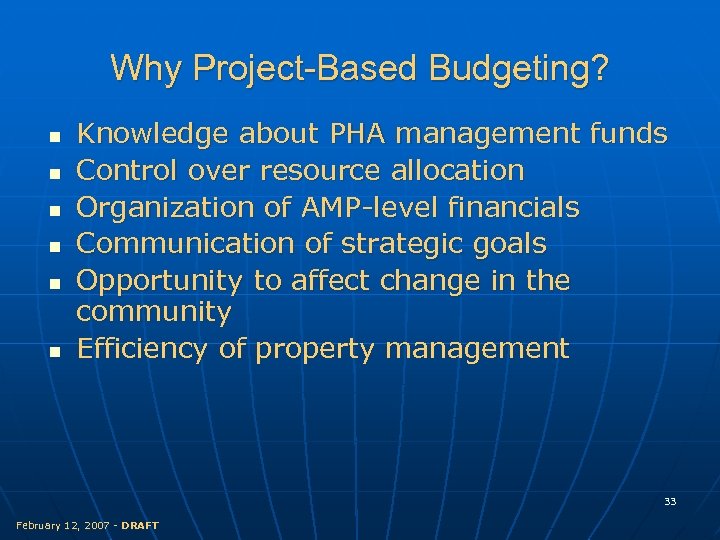
Why Project-Based Budgeting? n n n Knowledge about PHA management funds Control over resource allocation Organization of AMP-level financials Communication of strategic goals Opportunity to affect change in the community Efficiency of property management 33 February 12, 2007 - DRAFT
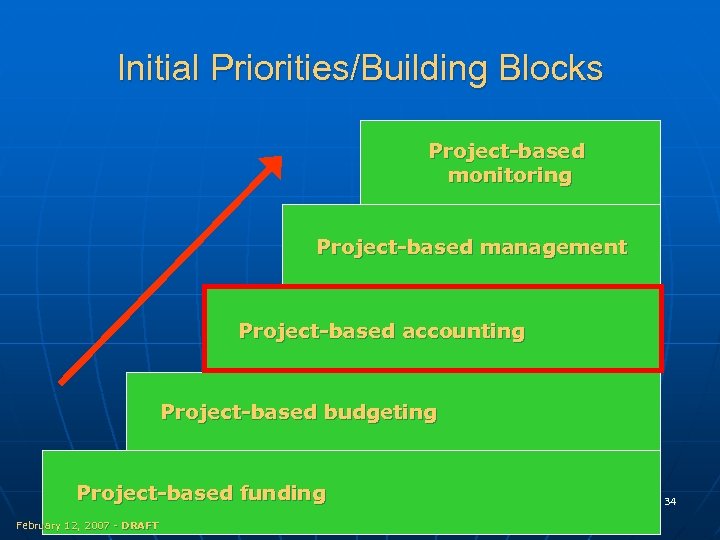
Initial Priorities/Building Blocks Project-based monitoring Project-based management Project-based accounting Project-based budgeting Project-based funding February 12, 2007 - DRAFT 34
Project-Based Accounting n n n Year-end AMP statements submitted to HUD Can only charge AMPs for services actually received Fees must be considered reasonable Provides necessary information to make decisions in the best interest of the AMP PHA Board members will review AMP-level financial statements 35 February 12, 2007 - DRAFT
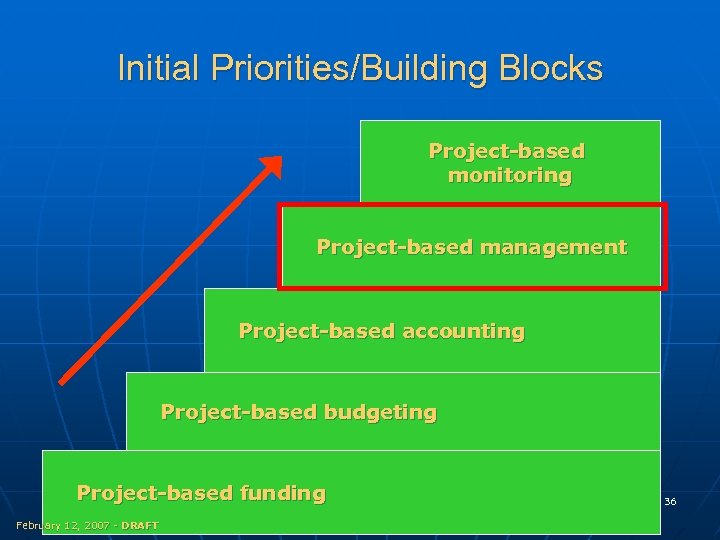
Initial Priorities/Building Blocks Project-based monitoring Project-based management Project-based accounting Project-based budgeting Project-based funding February 12, 2007 - DRAFT 36
Project-Based Management (PBM) n n Arrange AMP management services in the best interest of the AMP Assign management personnel to each AMP 37 February 12, 2007 - DRAFT
Project-Based Management (PBM) The provision of property management services that are tailored to the unique needs of each AMP, given the resources available to that AMP. Under PBM, these property management services are arranged, coordinated, or overseen by management personnel who have been assigned responsibility for the day-to-day operation of that AMP and who are charged with direct oversight of operations of that AMP. 38 February 12, 2007 - DRAFT
Project-Based Management Example You own a group of restaurants. n Would you have a budget for each restaurant? n Would you hire a manager for each restaurant? n What roles would you assign to on-site staff vs. central staff? 39 February 12, 2007 - DRAFT
Common Characteristics of PBM n n n Each AMP has an operating budget to be approved by the owner The AMP is assigned dedicated management and maintenance personnel who frequently work on-site If an AMP is too small to afford full-time staff, the AMP may have part-time or shared staff 40 February 12, 2007 - DRAFT
Common Characteristics of PBM (Continued) n n Site personnel have significant authority and responsibility over the day-to-day operations Most property management tasks are handled or coordinated by the on-site staff Procurement is done by on-site management and reviewed by supervisor The person primarily in charge of the AMP on a day-to-day basis, including maintenance, is the housing manager 41 February 12, 2007 - DRAFT
Why Practice PBM? n n n Maximizes performance at all levels Local staff are closer to market changes and community issues On-site staff can “keep an eye on things” Response to resident issues is faster and more personal Management company can keep a smaller central staff and thus reduce fees for the AMPs 42 February 12, 2007 - DRAFT
Workshop 2. 2: Common Tasks n n The table on the following slide list tasks commonly associated with managing Public Housing. As a class, determine whether each task should be performed on-site or by the management company under project-based management. 43 February 12, 2007 - DRAFT
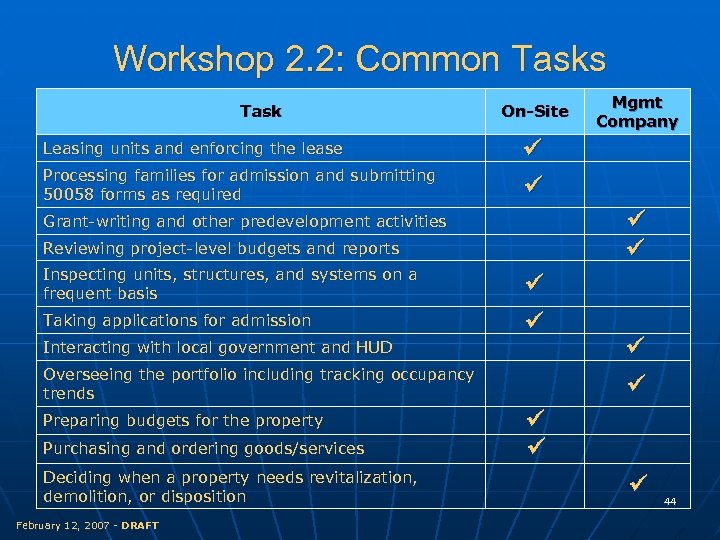
Workshop 2. 2: Common Tasks Task On-Site Leasing units and enforcing the lease Processing families for admission and submitting 50058 forms as required Mgmt Company Grant-writing and other predevelopment activities Reviewing project-level budgets and reports Inspecting units, structures, and systems on a frequent basis Taking applications for admission Interacting with local government and HUD Overseeing the portfolio including tracking occupancy trends Preparing budgets for the property Purchasing and ordering goods/services Deciding when a property needs revitalization, demolition, or disposition February 12, 2007 - DRAFT 44
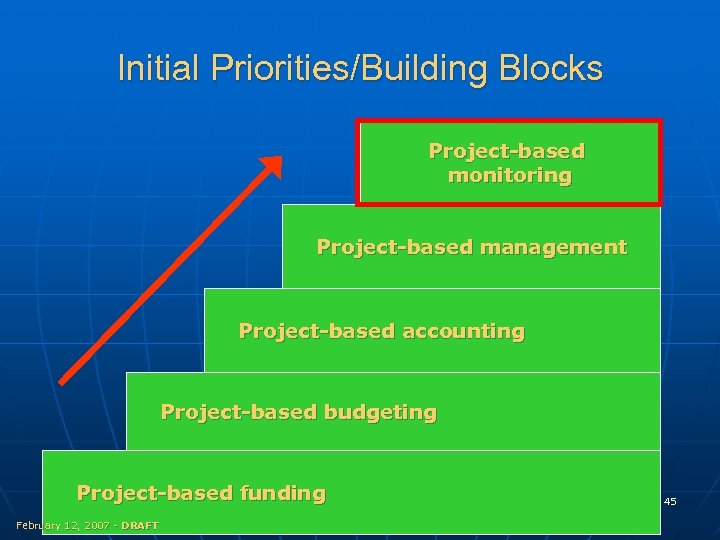
Initial Priorities/Building Blocks Project-based monitoring Project-based management Project-based accounting Project-based budgeting Project-based funding February 12, 2007 - DRAFT 45
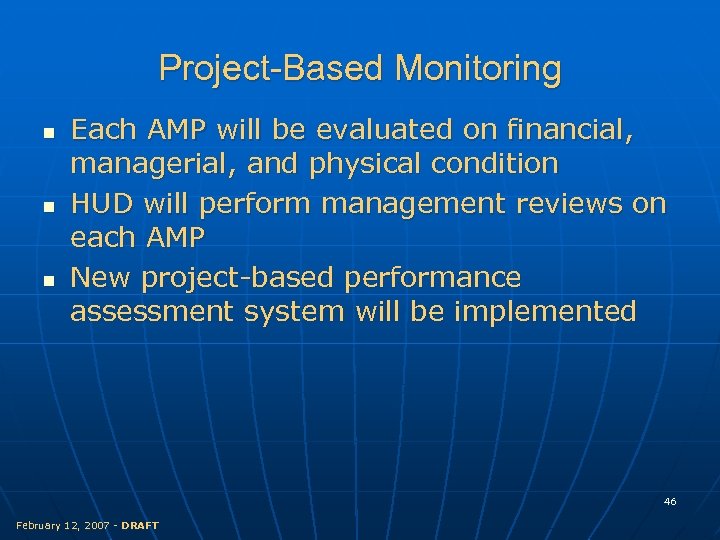
Project-Based Monitoring n n n Each AMP will be evaluated on financial, managerial, and physical condition HUD will perform management reviews on each AMP New project-based performance assessment system will be implemented 46 February 12, 2007 - DRAFT
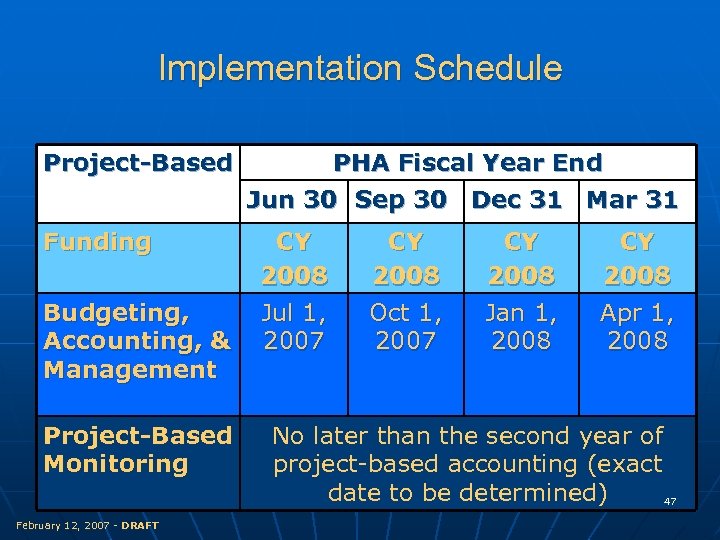
Implementation Schedule Project-Based Funding Budgeting, Accounting, & Management Project-Based Monitoring February 12, 2007 - DRAFT PHA Fiscal Year End Jun 30 Sep 30 Dec 31 Mar 31 CY 2008 Jul 1, 2007 CY 2008 Oct 1, 2007 CY 2008 Jan 1, 2008 CY 2008 Apr 1, 2008 No later than the second year of project-based accounting (exact date to be determined) 47
End of Section 2 February 12, 2007 - DRAFT
Section 3: The PHA as a Property Management Business Enterprise February 12, 2007 - DRAFT
The PHA as a Property Management Business Enterprise: Learning Objectives n n n Discuss the concept of a management company and how the PHA will be functioning like a management company Explain how management companies are organized Discuss possible organizational models for the PHA Explain the concept and requirements of the Central Office Cost Center (COCC) under the new rules Describe how property management fees and asset management fees flow into the PHA Discuss the potential for PHA income generation 50 through these fees February 12, 2007 - DRAFT
The Conventional Management Company n n n Organization that specializes in the management of properties for others Can be an internal function or done via external, third-party fee management May have other lines of business 51 February 12, 2007 - DRAFT
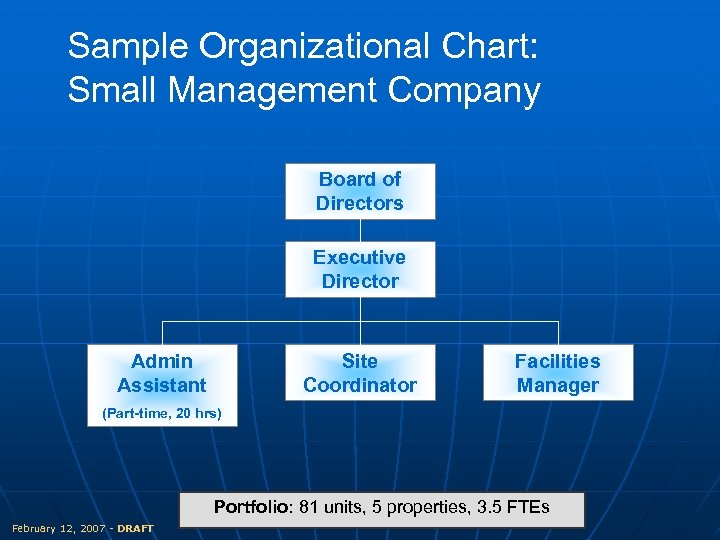
Sample Organizational Chart: Small Management Company Board of Directors Executive Director Admin Assistant Site Coordinator Facilities Manager (Part-time, 20 hrs) Portfolio: 81 units, 5 properties, 3. 5 FTEs February 12, 2007 - DRAFT
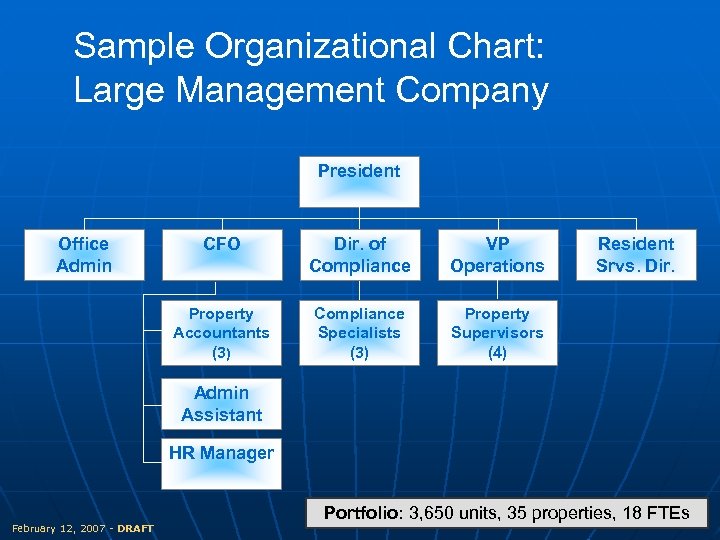
Sample Organizational Chart: Large Management Company President Office Admin CFO Dir. of Compliance VP Operations Property Accountants (3) Compliance Specialists (3) Resident Srvs. Dir. Property Supervisors (4) Admin Assistant HR Manager February 12, 2007 - DRAFT Portfolio: 3, 650 units, 35 properties, 18 FTEs
The Conventional Management Company: Roles n n n President/CEO of real estate management firm Director of property management Regional property manager(s) Human Resource Staff Accounting and Bookkeeping Staff Administrative Staff 54 February 12, 2007 - DRAFT
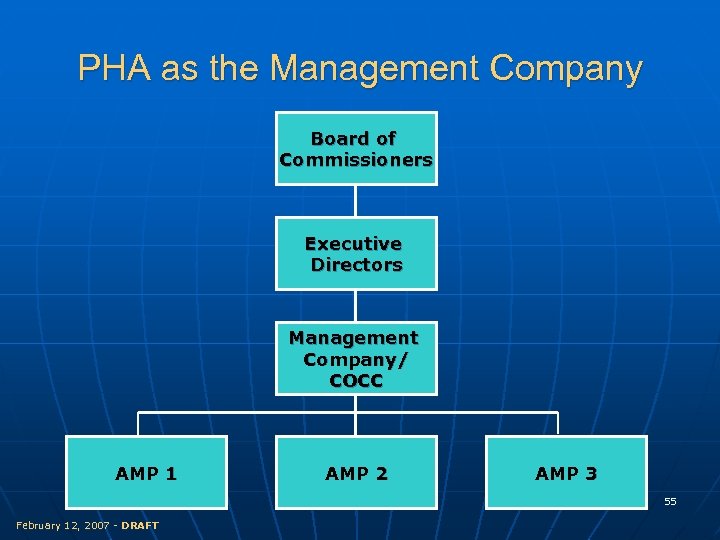
PHA as the Management Company Board of Commissioners Executive Directors Management Company/ COCC AMP 1 AMP 2 AMP 3 55 February 12, 2007 - DRAFT
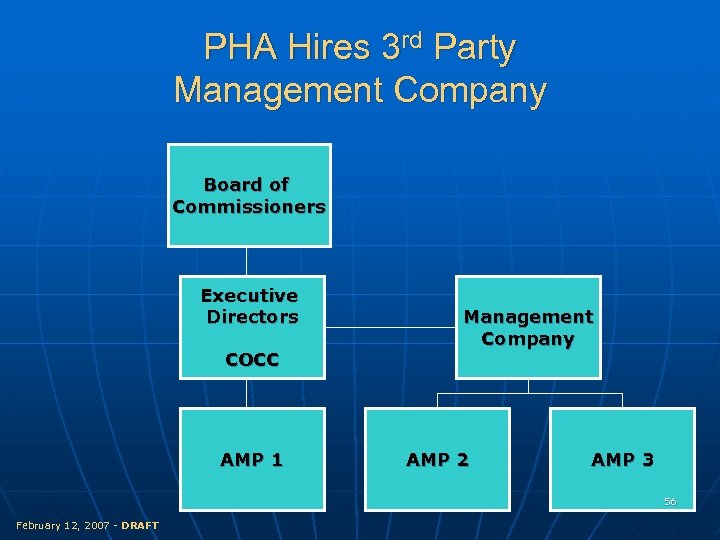
PHA Hires 3 rd Party Management Company Board of Commissioners Executive Directors COCC AMP 1 Management Company AMP 2 AMP 3 56 February 12, 2007 - DRAFT
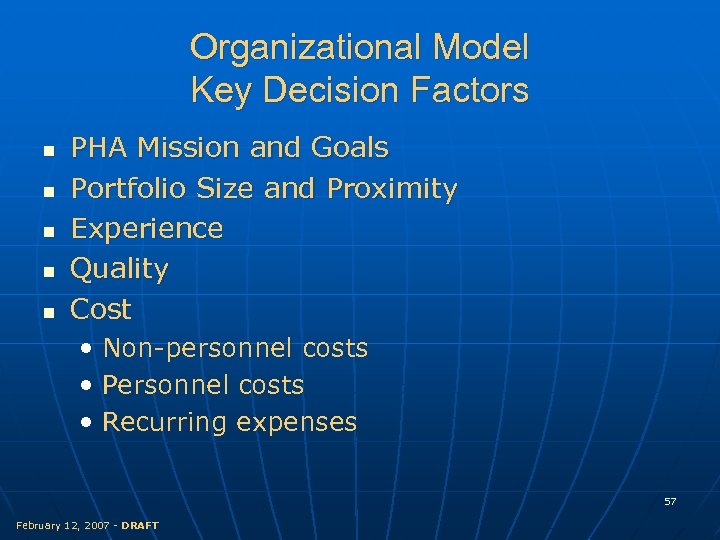
Organizational Model Key Decision Factors n n n PHA Mission and Goals Portfolio Size and Proximity Experience Quality Cost • Non-personnel costs • Personnel costs • Recurring expenses 57 February 12, 2007 - DRAFT
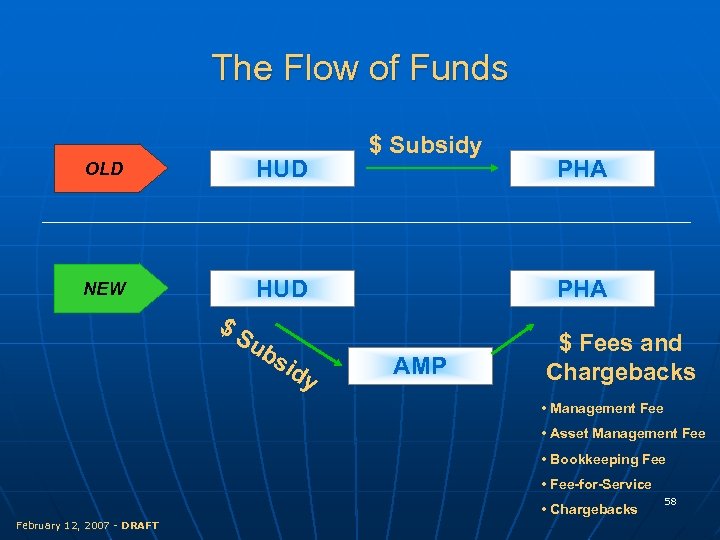
The Flow of Funds OLD HUD NEW $ Subsidy HUD $S ub sid y PHA AMP $ Fees and Chargebacks • Management Fee • Asset Management Fee • Bookkeeping Fee • Fee-for-Service • Chargebacks February 12, 2007 - DRAFT 58
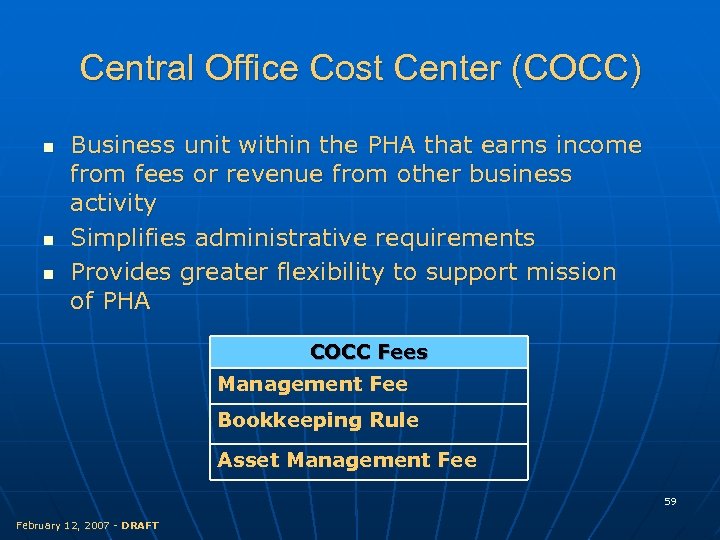
Central Office Cost Center (COCC) n n n Business unit within the PHA that earns income from fees or revenue from other business activity Simplifies administrative requirements Provides greater flexibility to support mission of PHA COCC Fees Management Fee Bookkeeping Rule Asset Management Fee 59 February 12, 2007 - DRAFT
Management Fee n n n PHAs are required to charge each project a “reasonable” management fee to fund the operation of the central office Replaces traditional PHA overhead allocations Average management fee in HUD’s multifamily housing programs was $35 PUM (2004) 60 February 12, 2007 - DRAFT
Bookkeeping Fee n n Fee charged to AMPs for project accounting function provided by COCC ($7. 50 PUM) Average bookkeeping fee in HUD’s multifamily housing programs was approximately $3. 50 PUM (2004) 61 February 12, 2007 - DRAFT
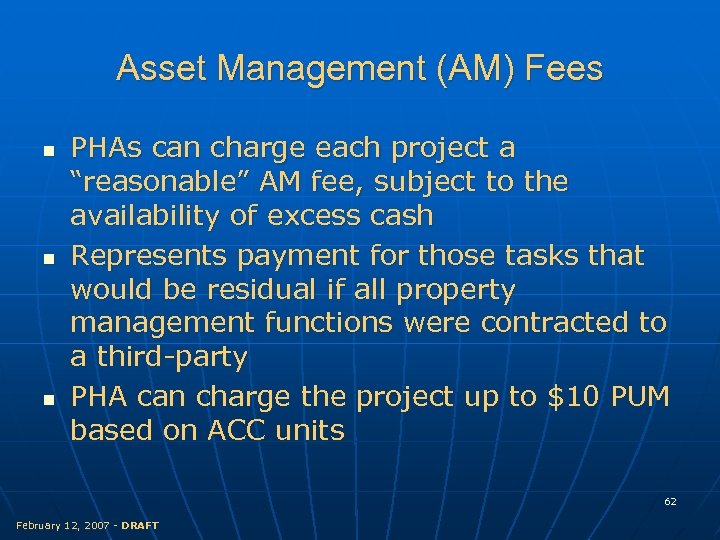
Asset Management (AM) Fees n n n PHAs can charge each project a “reasonable” AM fee, subject to the availability of excess cash Represents payment for those tasks that would be residual if all property management functions were contracted to a third-party PHA can charge the project up to $10 PUM based on ACC units 62 February 12, 2007 - DRAFT
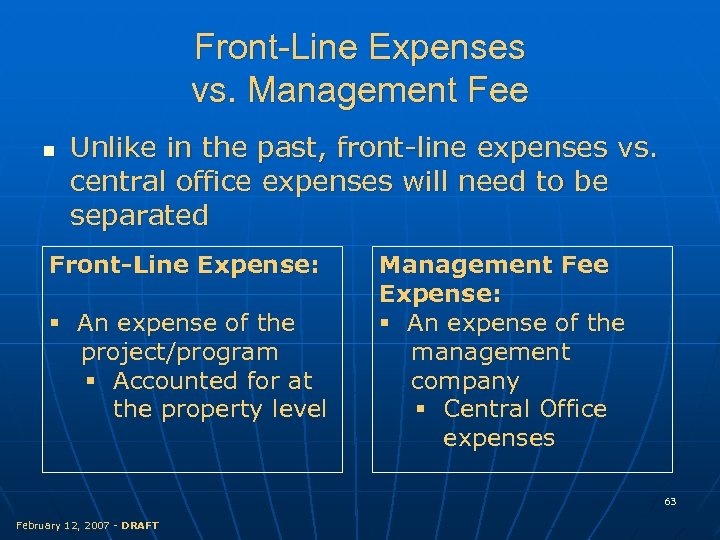
Front-Line Expenses vs. Management Fee n Unlike in the past, front-line expenses vs. central office expenses will need to be separated Front-Line Expense: § An expense of the project/program § Accounted for at the property level Management Fee Expense: § An expense of the management company § Central Office expenses 63 February 12, 2007 - DRAFT
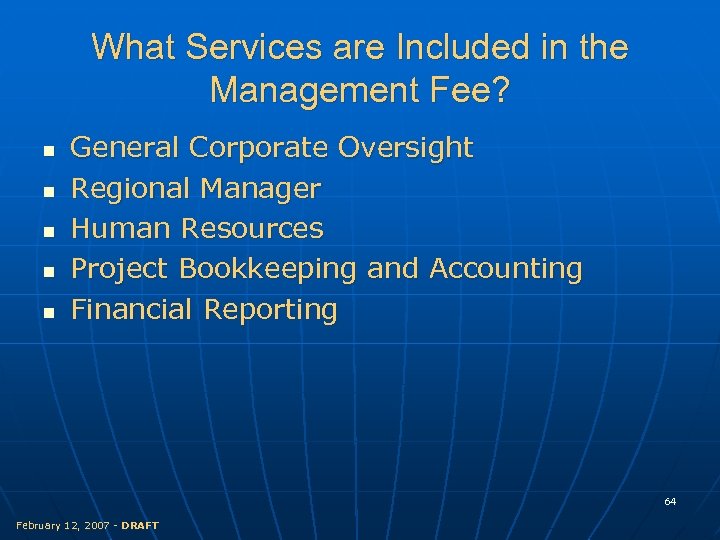
What Services are Included in the Management Fee? n n n General Corporate Oversight Regional Manager Human Resources Project Bookkeeping and Accounting Financial Reporting 64 February 12, 2007 - DRAFT
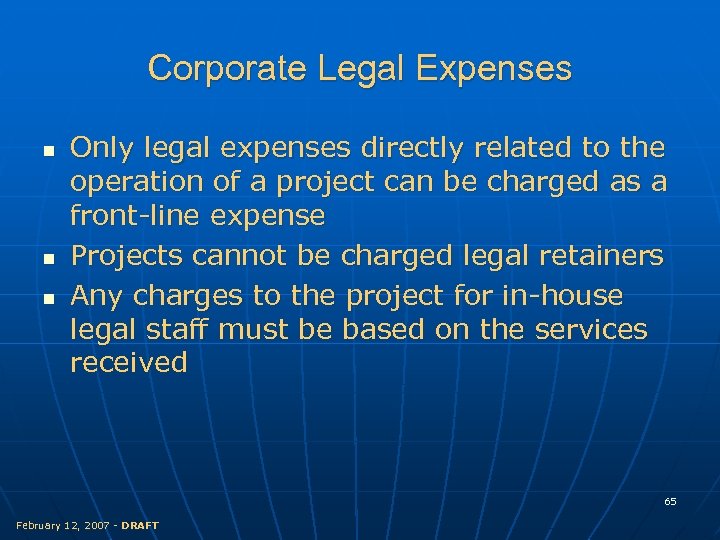
Corporate Legal Expenses n n n Only legal expenses directly related to the operation of a project can be charged as a front-line expense Projects cannot be charged legal retainers Any charges to the project for in-house legal staff must be based on the services received 65 February 12, 2007 - DRAFT
Central Warehouses n n With prior HUD approval, the costs of a central warehouse can be charged as a front-line cost PHA must demonstrate that the costs are less than what the project would otherwise incur if the goods were obtained by on-site staff 66 February 12, 2007 - DRAFT
Centralized Wait List and Leasing n n n PHAs have only recently been permitted to establish site-based waiting lists PHAs that maintain centralized waiting lists may pro-rate the costs to each project based on average turnover, or some other reasonable method In all instances, the costs must be reasonable and necessary 67 February 12, 2007 - DRAFT
Centralized Maintenance Services n n n When a PHA is the most responsible lowbidder, they can charge the bid price When a PHA provides a specialized service centrally, they may charge the market price, based on actual costs When a PHA has centrally-provided routine maintenance services, they may only charge the direct cost of the employee with no mark-up 68 February 12, 2007 - DRAFT
Workshop 3. 1: Management Fee vs. Front-Line Expenses n n The tables on the following slide list various activities and expenses associated with managing public housing. In groups, determine whether each activity should be considered a management or front -line expense. 69 February 12, 2007 - DRAFT
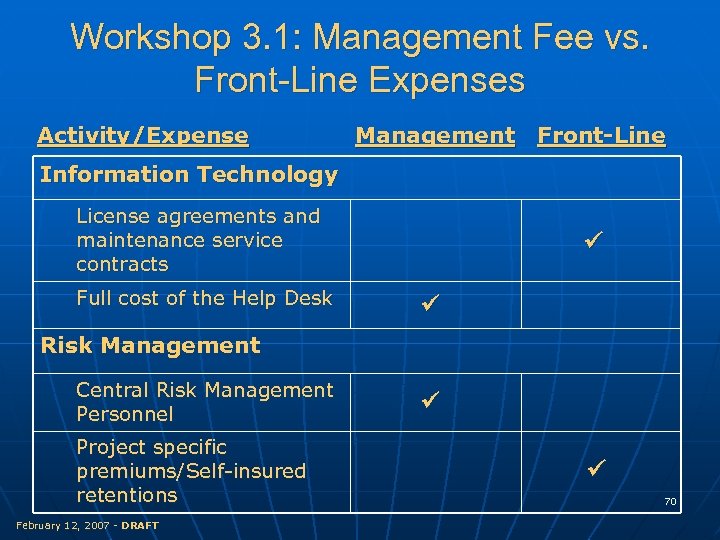
Workshop 3. 1: Management Fee vs. Front-Line Expenses Activity/Expense Management Front-Line Information Technology License agreements and maintenance service contracts Full cost of the Help Desk Risk Management Central Risk Management Personnel Project specific premiums/Self-insured retentions February 12, 2007 - DRAFT 70
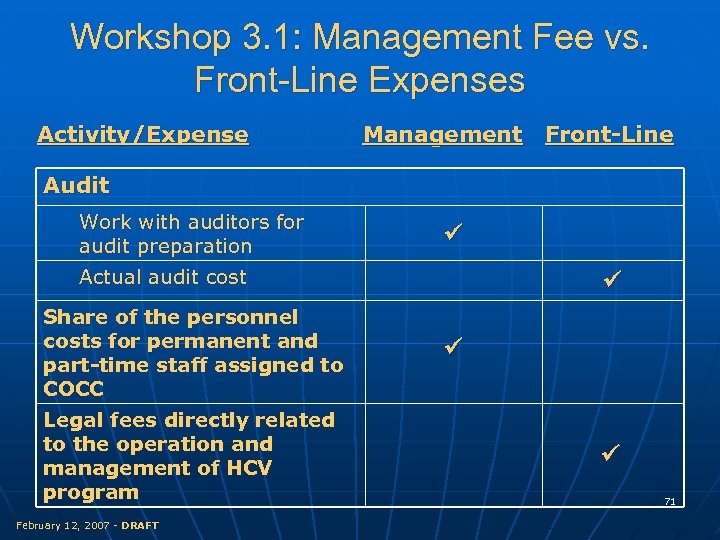
Workshop 3. 1: Management Fee vs. Front-Line Expenses Activity/Expense Management Front-Line Audit Work with auditors for audit preparation Actual audit cost Share of the personnel costs for permanent and part-time staff assigned to COCC Legal fees directly related to the operation and management of HCV program February 12, 2007 - DRAFT 71
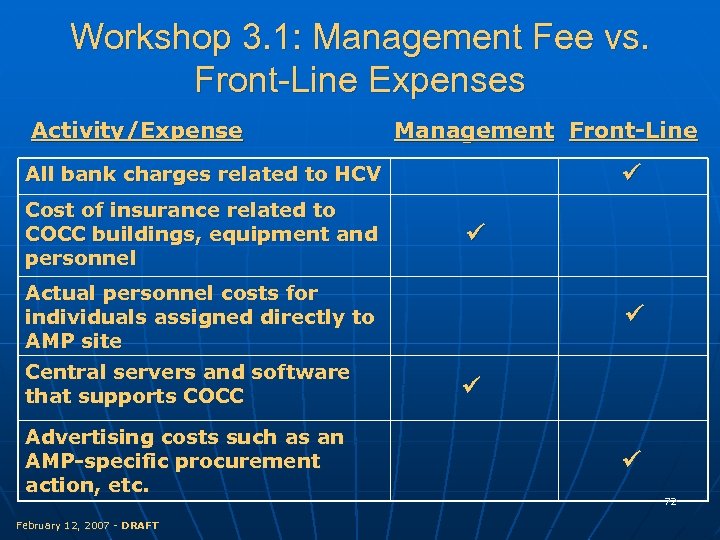
Workshop 3. 1: Management Fee vs. Front-Line Expenses Activity/Expense Management Front-Line All bank charges related to HCV Cost of insurance related to COCC buildings, equipment and personnel Actual personnel costs for individuals assigned directly to AMP site Central servers and software that supports COCC Advertising costs such as an AMP-specific procurement action, etc. February 12, 2007 - DRAFT 72
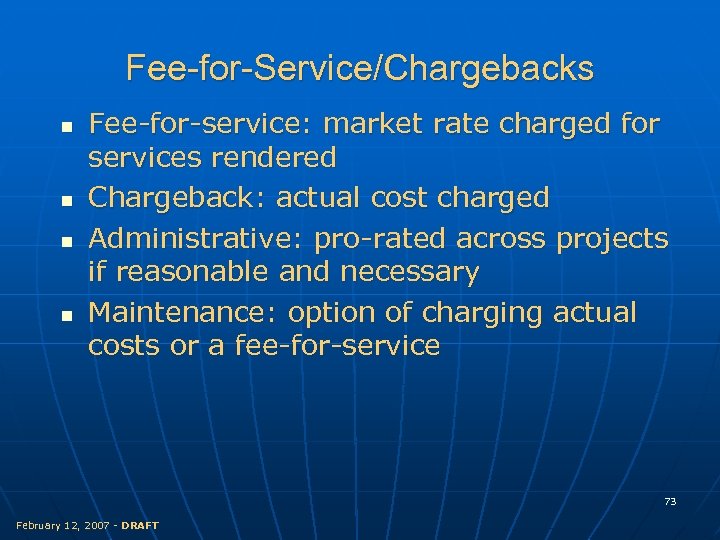
Fee-for-Service/Chargebacks n n Fee-for-service: market rate charged for services rendered Chargeback: actual cost charged Administrative: pro-rated across projects if reasonable and necessary Maintenance: option of charging actual costs or a fee-for-service 73 February 12, 2007 - DRAFT
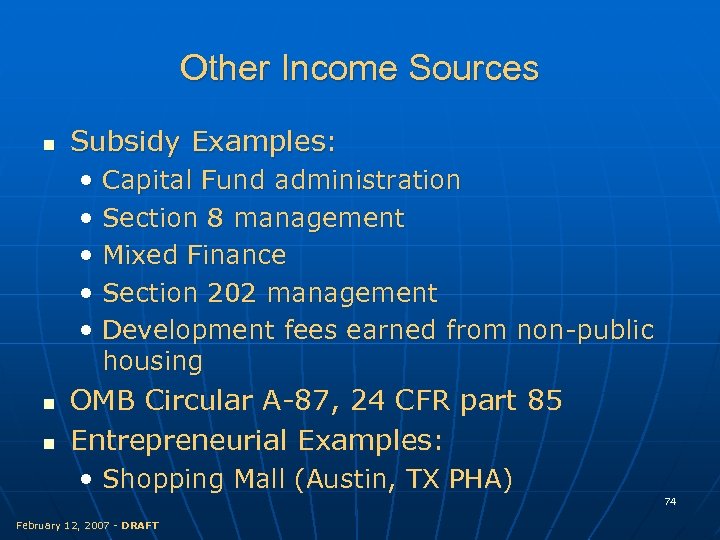
Other Income Sources n Subsidy Examples: • Capital Fund administration • Section 8 management • Mixed Finance • Section 202 management • Development fees earned from non-public housing n n OMB Circular A-87, 24 CFR part 85 Entrepreneurial Examples: • Shopping Mall (Austin, TX PHA) 74 February 12, 2007 - DRAFT
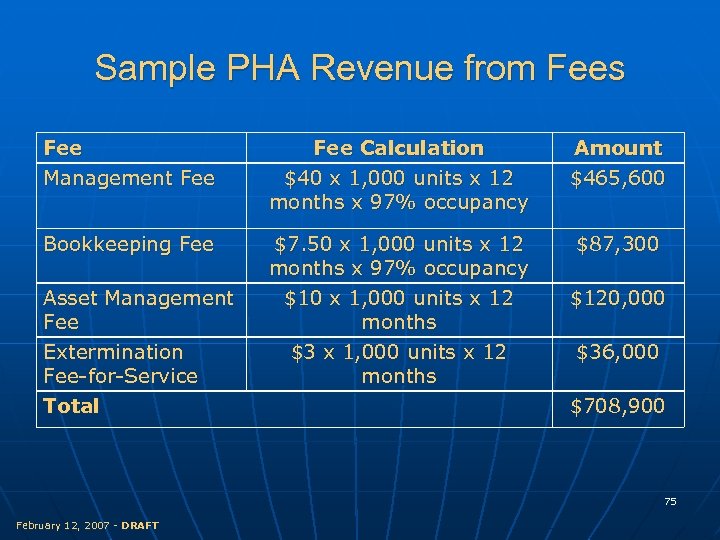
Sample PHA Revenue from Fees Fee Management Fee Calculation $40 x 1, 000 units x 12 months x 97% occupancy Amount $465, 600 Bookkeeping Fee $7. 50 x 1, 000 units x 12 months x 97% occupancy $10 x 1, 000 units x 12 months $3 x 1, 000 units x 12 months $87, 300 Asset Management Fee Extermination Fee-for-Service Total $120, 000 $36, 000 $708, 900 75 February 12, 2007 - DRAFT
End of Section 3 February 12, 2007 - DRAFT
Section 4: Summary and Wrap-Up February 12, 2007 - DRAFT
Summary and Wrap-Up Learning Objectives n n Identify revisions to PHAs and Board actions as a result of the transition to asset management Provide suggestions for follow-up activities to conduct with PHA and other board members 78 February 12, 2007 - DRAFT
PHA Enhancements n n Services Provided Organization Structure Staff Knowledge System Enhancements 79 February 12, 2007 - DRAFT
Follow-Up Activities q Determine organizational form that PBM will take at your PHA q Develop staffing plan under PBM q Examine current overhead costs q Construct preliminary project budgets q Determine new accounting, IT, and other support q Develop an implementation schedule 80 February 12, 2007 - DRAFT
Asset Management Resources n Asset Management Website: n Asset Management e-Newsletter: http: //www. hud. gov/offices/pih/programs/ph/am If you haven’t received this already, you can access it via the Asset Management Website, or you can contact your Field Office counterpart and ask that they send it to you n Asset Management Help Desk: Coming Soon! 81 February 12, 2007 - DRAFT
Asset Management Reference Material n n n 24 CFR Part 990 - Final Rule Preparing for Asset Management Under the New Public Housing Operating Fund Rule (24 CFR 990): A Planning Document Demonstration of a Successful Conversion to Asset Management (Stop-Loss) Submission Kit Demonstrating Successful Conversion to Asset Management: A Site Visit to the Charlotte Housing Authority Supplement to HUD Handbook 7475. 1 REV. , CHG -1, Financial Management Handbook 82 February 12, 2007 - DRAFT
End of Section 4 February 12, 2007 - DRAFT
Скачать презентацию Asset Management Leadership Orientation February 12 2007 —
b4eb8f3018329d0ac4e7f2a32b048b55.ppt