 Скачать презентацию Assessment survey of TB drug management in Cambodia
0700fc0c0bd0d32f4c8a0d05f41108be.ppt
- Количество слайдов: 12



Assessment survey of TB drug management in Cambodia Uchiyama Y, Chay S, Kousoum M, Leng C, Kien S, Nou C, Chhom C CENAT/JICA National TB Control Project, Cambodia
Drug supply management system in Cambodia Selection/Procurement § National Essential Drug List § Public procurement (centralized system) - Yearly drug requests from ODs/NHs to MOH - Quantity adjustment, pricing & open tender by MOH Distribution § Flow of drug delivery & requests - CMS ⇔ ODs/NHs: quarterly - ODs ⇔ RHs/HCs: monthly § Inventory & store management, following MOH guidelines Use § Management is various among national programmes
NTP TBDM Selection § Criteria: National/WHO Model List & authorized TB guides Procurement (source other than NB) § Donation of GDF-standard TB drugs from Japan through the JICA’s Grant Program (2004 -2006) Distribution § Safety stocks (ODs/NHs: 3 M, RHs/HCs: 1 M) Use § 8 M treatment regimen (C 1: 2 RHZE/6 EH, C 2: 2 RHZES/1 RHZE/5 RHE, C 3: 2 RHZ/6 EH) § DOTS approach: hospitalization, ambulatory & home delivery § DOTS expansion to HCs: 780/942 HCs (March 2004) § Two TB staff in each health facility with TB service
Examples of findings obtained from the National Workshop on TBDM Selection/Procurement § Qty. of TB drugs per bottle delivered ≠ qty. indicated on the label § Shelf life of TB drugs delivered is not long enough to use up Distribution § Stock records ≠ physical counts § Poor quality of loose tablets (color change, moisture) § No measure to verify the validity of TB drug consumption Use § TB patients’ poor adherence to TB treatment & poor knowledge of TB/TB treatment among TB staff Management support § TBDM has not been a priority for supervision Policy and legal framework § Private practitioners do not follow the TB treatment guidelines § TB drugs are available in pvt. pharmacies without prescription
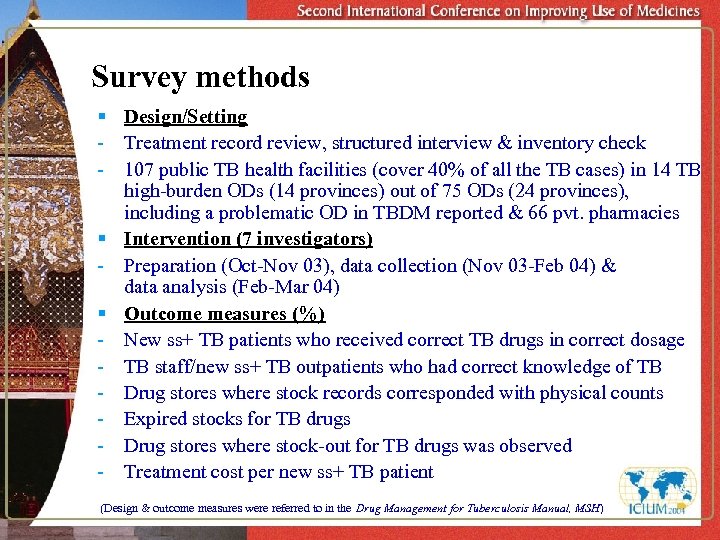
Survey methods § Design/Setting - Treatment record review, structured interview & inventory check - 107 public TB health facilities (cover 40% of all the TB cases) in 14 TB high-burden ODs (14 provinces) out of 75 ODs (24 provinces), including a problematic OD in TBDM reported & 66 pvt. pharmacies § Intervention (7 investigators) - Preparation (Oct-Nov 03), data collection (Nov 03 -Feb 04) & data analysis (Feb-Mar 04) § Outcome measures (%) - New ss+ TB patients who received correct TB drugs in correct dosage - TB staff/new ss+ TB outpatients who had correct knowledge of TB - Drug stores where stock records corresponded with physical counts - Expired stocks for TB drugs - Drug stores where stock-out for TB drugs was observed - Treatment cost per new ss+ TB patient (Design & outcome measures were referred to in the Drug Management for Tuberculosis Manual, MSH)
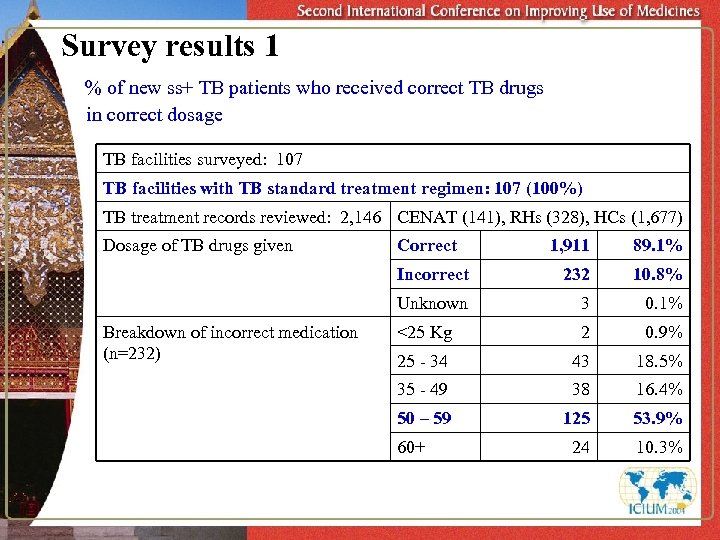
Survey results 1 % of new ss+ TB patients who received correct TB drugs in correct dosage TB facilities surveyed: 107 TB facilities with TB standard treatment regimen: 107 (100%) TB treatment records reviewed: 2, 146 CENAT (141), RHs (328), HCs (1, 677) Dosage of TB drugs given 89. 1% 232 10. 8% Unknown 3 0. 1% <25 Kg 2 0. 9% 25 - 34 43 18. 5% 35 - 49 38 16. 4% 50 – 59 1, 911 Incorrect Breakdown of incorrect medication (n=232) Correct 125 53. 9% 24 10. 3% 60+
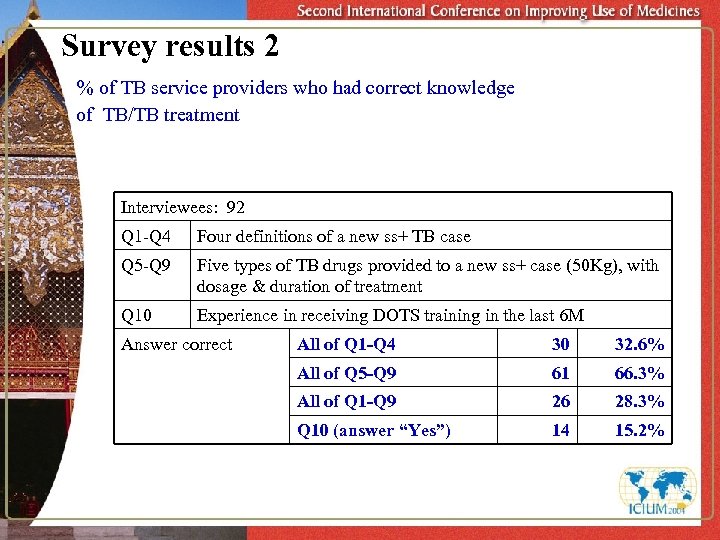
Survey results 2 % of TB service providers who had correct knowledge of TB/TB treatment Interviewees: 92 Q 1 -Q 4 Four definitions of a new ss+ TB case Q 5 -Q 9 Five types of TB drugs provided to a new ss+ case (50 Kg), with dosage & duration of treatment Q 10 Experience in receiving DOTS training in the last 6 M Answer correct 30 32. 6% All of Q 5 -Q 9 61 66. 3% All of Q 1 -Q 9 All of Q 1 -Q 4 26 28. 3% Q 10 (answer “Yes”) 14 15. 2%
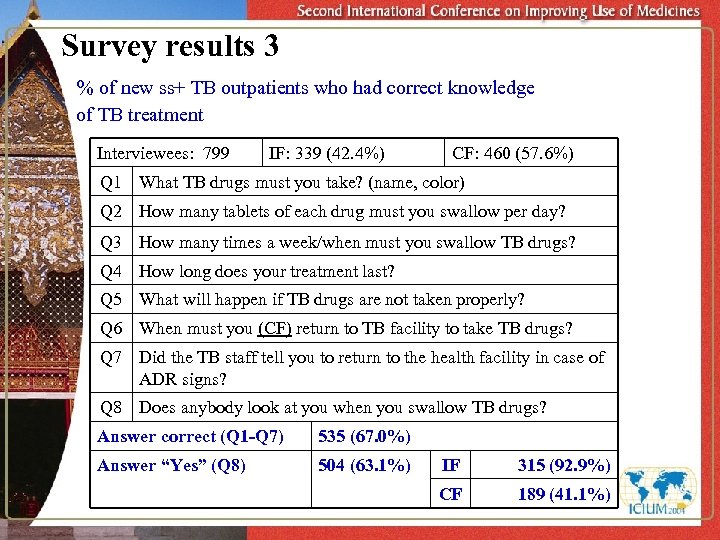
Survey results 3 % of new ss+ TB outpatients who had correct knowledge of TB treatment Interviewees: 799 IF: 339 (42. 4%) CF: 460 (57. 6%) Q 1 What TB drugs must you take? (name, color) Q 2 How many tablets of each drug must you swallow per day? Q 3 How many times a week/when must you swallow TB drugs? Q 4 How long does your treatment last? Q 5 What will happen if TB drugs are not taken properly? Q 6 When must you (CF) return to TB facility to take TB drugs? Q 7 Did the TB staff tell you to return to the health facility in case of ADR signs? Q 8 Does anybody look at you when you swallow TB drugs? Answer correct (Q 1 -Q 7) 535 (67. 0%) Answer “Yes” (Q 8) 504 (63. 1%) IF 315 (92. 9%) CF 189 (41. 1%)
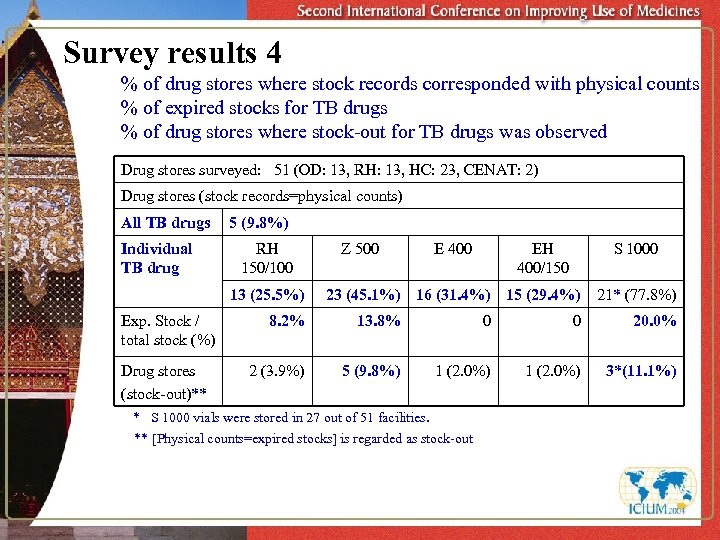
Survey results 4 % of drug stores where stock records corresponded with physical counts % of expired stocks for TB drugs % of drug stores where stock-out for TB drugs was observed Drug stores surveyed: 51 (OD: 13, RH: 13, HC: 23, CENAT: 2) Drug stores (stock records=physical counts) All TB drugs Individual TB drug 5 (9. 8%) RH 150/100 13 (25. 5%) Exp. Stock / total stock (%) Drug stores (stock-out)** Z 500 E 400 EH 400/150 S 1000 23 (45. 1%) 16 (31. 4%) 15 (29. 4%) 21* (77. 8%) 8. 2% 13. 8% 0 0 20. 0% 2 (3. 9%) 5 (9. 8%) 1 (2. 0%) 3*(11. 1%) * S 1000 vials were stored in 27 out of 51 facilities. ** [Physical counts=expired stocks] is regarded as stock-out
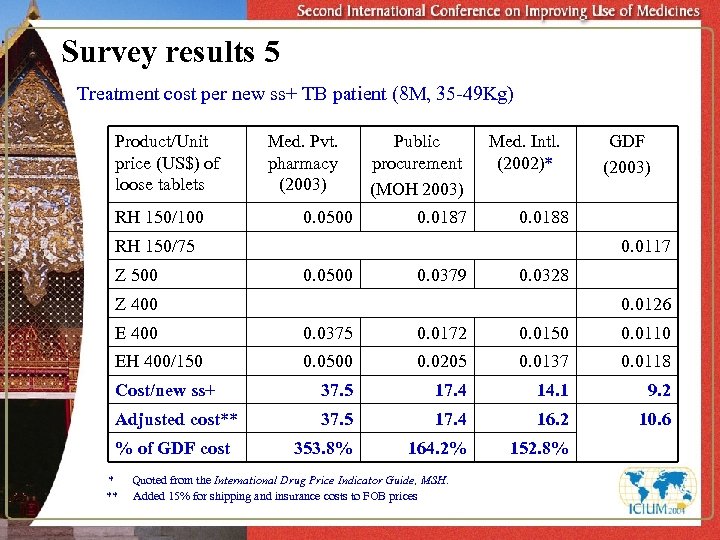
Survey results 5 Treatment cost per new ss+ TB patient (8 M, 35 -49 Kg) Product/Unit price (US$) of loose tablets RH 150/100 Med. Pvt. pharmacy (2003) 0. 0500 Public procurement (MOH 2003) 0. 0187 Med. Intl. (2002)* 0. 0188 RH 150/75 Z 500 GDF (2003) 0. 0117 0. 0500 0. 0379 0. 0328 Z 400 0. 0126 E 400 0. 0375 0. 0172 0. 0150 0. 0110 EH 400/150 0. 0500 0. 0205 0. 0137 0. 0118 Cost/new ss+ 37. 5 17. 4 14. 1 9. 2 Adjusted cost** 37. 5 17. 4 16. 2 10. 6 353. 8% 164. 2% 152. 8% % of GDF cost * ** Quoted from the International Drug Price Indicator Guide, MSH. Added 15% for shipping and insurance costs to FOB prices
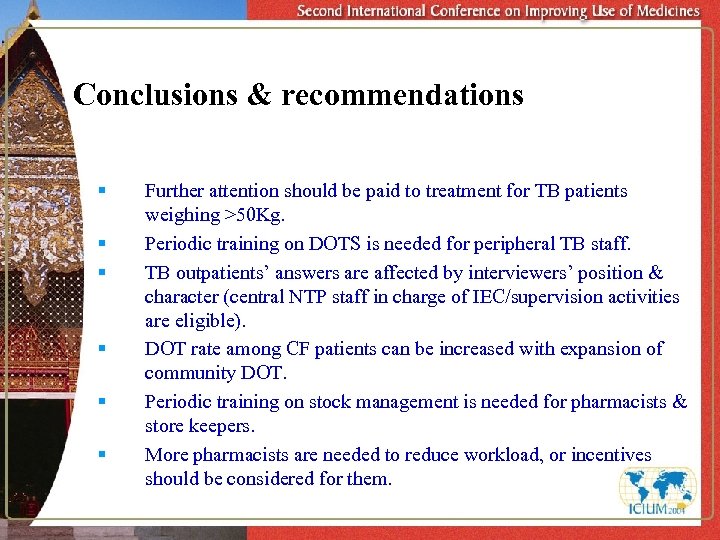
Conclusions & recommendations § § § Further attention should be paid to treatment for TB patients weighing >50 Kg. Periodic training on DOTS is needed for peripheral TB staff. TB outpatients’ answers are affected by interviewers’ position & character (central NTP staff in charge of IEC/supervision activities are eligible). DOT rate among CF patients can be increased with expansion of community DOT. Periodic training on stock management is needed for pharmacists & store keepers. More pharmacists are needed to reduce workload, or incentives should be considered for them.
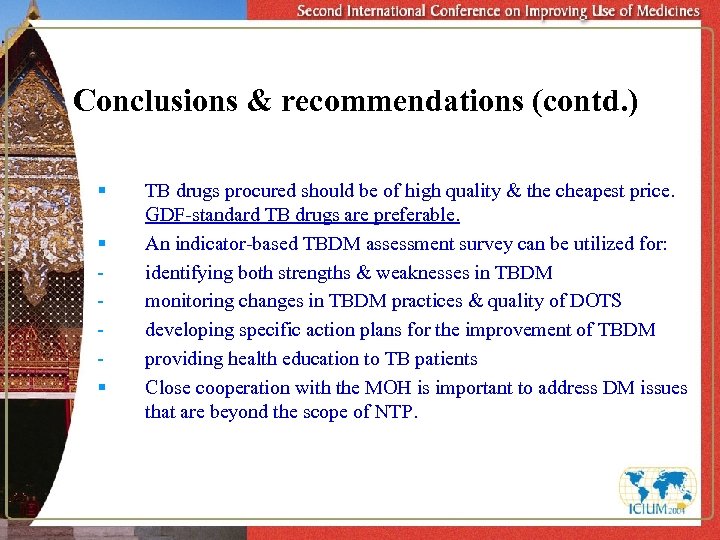
Conclusions & recommendations (contd. ) § § § TB drugs procured should be of high quality & the cheapest price. GDF-standard TB drugs are preferable. An indicator-based TBDM assessment survey can be utilized for: identifying both strengths & weaknesses in TBDM monitoring changes in TBDM practices & quality of DOTS developing specific action plans for the improvement of TBDM providing health education to TB patients Close cooperation with the MOH is important to address DM issues that are beyond the scope of NTP.
Скачать презентацию Assessment survey of TB drug management in Cambodia
0700fc0c0bd0d32f4c8a0d05f41108be.ppt