


 Скачать презентацию Assessment of TEM PEM Approaches Mapping Simulation of
bbe892d600903d63958b60096058ef76.ppt
- Количество слайдов: 33
 Assessment of TEM/PEM Approaches: Mapping & Simulation of Heterogeneous Ecosystems Larry Band, University of North Carolina Slide #1
 Presentation Outline • Overview and assessment of TEM/PEM initiative: – – Business plan drivers Current spatial data models Need for integrated assessment tools Comparison with similar/related initiatives • Presentation of Hierarchical GIS/Ecosystem Models – Terrain analytic and remote sensing components – Integrated ecosystem, hydrology, climate modeling approach • Knowledge based, continuous inference schemes • Summary statements, recommendations for extending, implementing PEM initiative Slide #2
 Propositions to Consider • Drivers for PEM business case may be dynamic, at least in terms of priorities – paradigm shifts in natural resource management • Measurement and spatial analytical technologies are developing very rapidly – remote sensing, wireless monitoring, spatial information and modelling systems, knowledge acquisition and representation • Require flexible framework: extensible, interoperable with existing and developing IM technologies, needs • PEM is a model: subject to uncertainty of input data, processing - represent uncertainty in results Slide #3
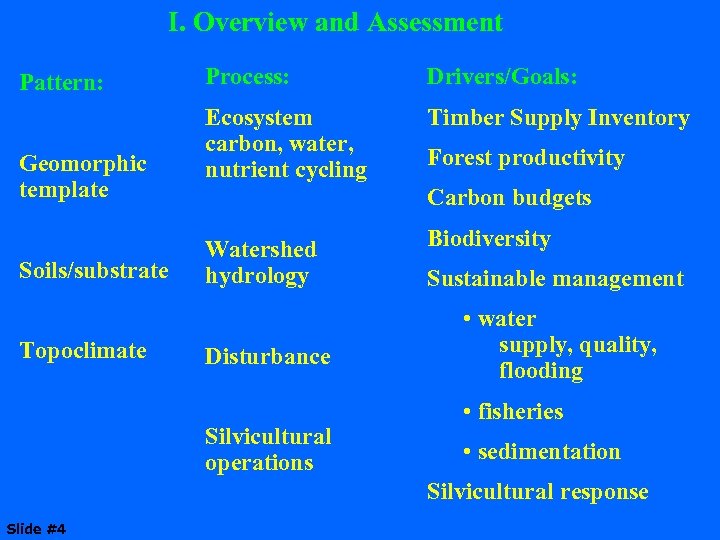 I. Overview and Assessment Pattern: Geomorphic template Soils/substrate Topoclimate Process: Drivers/Goals: Ecosystem carbon, water, nutrient cycling Timber Supply Inventory Forest productivity Carbon budgets Watershed hydrology Disturbance Silvicultural operations Biodiversity Sustainable management • water supply, quality, flooding • fisheries • sedimentation Silvicultural response Slide #4
 Assessment of TEM Initiative • BC Biogeoclimatic classification system an excellent knowledge base for ecosystem mapping and ecoregionalization – most critical asset (ecosystem-landscape relations) well developed one of the best (possibly THE BEST) operational knowledge base available in the world • Data Model of TEM built on hierarchical cartographic framework of nested scale/minimum mapping area – Point-line-area (node-arc-polygon) model: discrete variation, hard boundaries – Manual TEM production time consuming, may lack reproducibility Slide #5
 Assessment of PEM Initiative • PEM provides reproducibility, greater production efficiency by automating/formalizing landscape model – opportunity to standardize automated, self documenting BEC implementation • Currently designed to reproduce TEM data model – produces discrete regions as polygons or raster connected components • Ecosystem gradients represented as boundaries or sequence of polygons with minimum mappable areas – evaluate alternative data models (e. g. continuous) available with more recent developments in GIS, information capture, inference Slide #6
 Current and potential PEM goals/functions • Paradigm shift in forest resource management • need to provide more integrated ecosystem basis for resource inventory • Opportunity to extend beyond inventory to incorporate integrated modelling of critical environmental processes • forest ecosystem productivity - including timber production • biodiversity, carbon, nutrient cycling and export • water supply, sediment delivery • Develop integrated assessment and modeling of alternative forest resource/watershed management schemes Slide #7
 Issues to Consider for PEM/TEM Alternatives Data Models: Continuous vs. discrete landscape paradigms • boolean or fuzzy logic/spatial representation • matching resolution to dramatically improved information base and storage/retrieval technology • Layer-based vs. entity (object) based Top-down vs. bottom up approaches to ecosystem mapping, ecoregionalization, ecosystem modeling • Region splitting or region aggregation • Representation of internal (sub-entity) heterogeneity (in form and function) Slide #8
 II. Hierarchical integration of GIS/ecosystem models: top-down and bottom-up approaches • Landscape level: Forest ecosystem patterns conditioned by slope, aspect, elevation, substrate, hydrologic flowpaths effects on carbon processes, disturbance regime, regeneration - amenable to bottom-up (aggregation) approach as well as incorporation of system dynamics • Regional level: Synoptic climate and physiographic province level controls on large scale forest ecosystem patterns - amenable to top-down (disaggregation) approach Slide #9
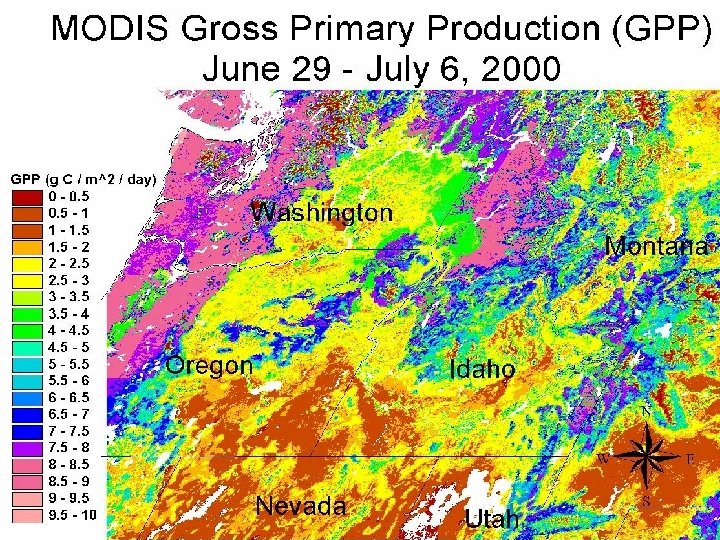
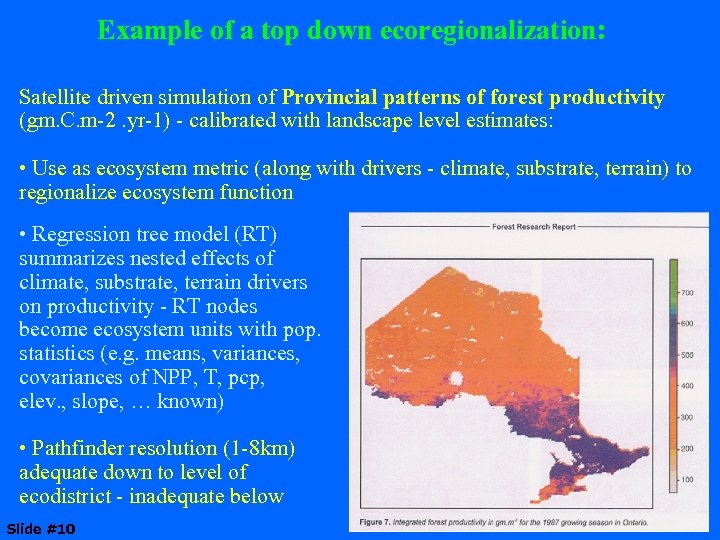 Example of a top down ecoregionalization: Satellite driven simulation of Provincial patterns of forest productivity (gm. C. m-2. yr-1) - calibrated with landscape level estimates: • Use as ecosystem metric (along with drivers - climate, substrate, terrain) to regionalize ecosystem function • Regression tree model (RT) summarizes nested effects of climate, substrate, terrain drivers on productivity - RT nodes become ecosystem units with pop. statistics (e. g. means, variances, covariances of NPP, T, pcp, elev. , slope, … known) • Pathfinder resolution (1 -8 km) adequate down to level of ecodistrict - inadequate below Slide #10
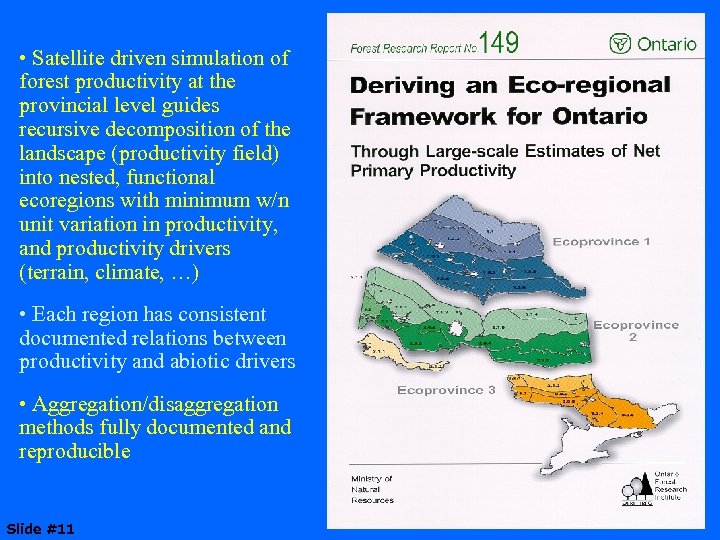 • Satellite driven simulation of forest productivity at the provincial level guides recursive decomposition of the landscape (productivity field) into nested, functional ecoregions with minimum w/n unit variation in productivity, and productivity drivers (terrain, climate, …) • Each region has consistent documented relations between productivity and abiotic drivers • Aggregation/disaggregation methods fully documented and reproducible Slide #11
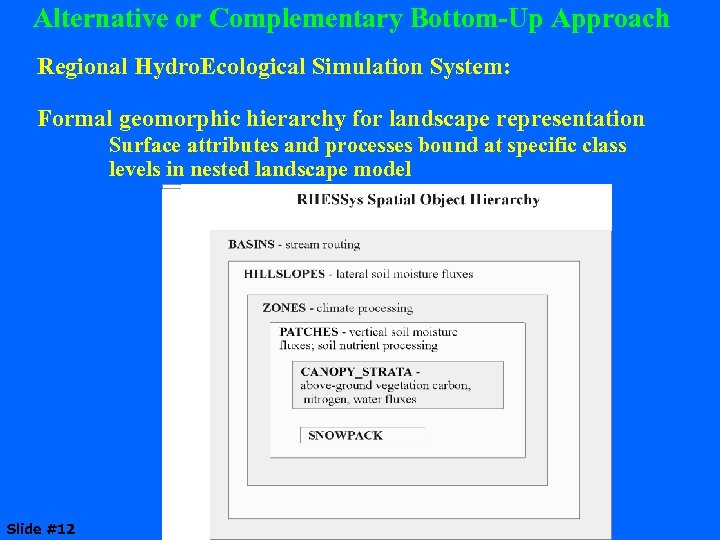 Alternative or Complementary Bottom-Up Approach Regional Hydro. Ecological Simulation System: Formal geomorphic hierarchy for landscape representation Surface attributes and processes bound at specific class levels in nested landscape model Slide #12
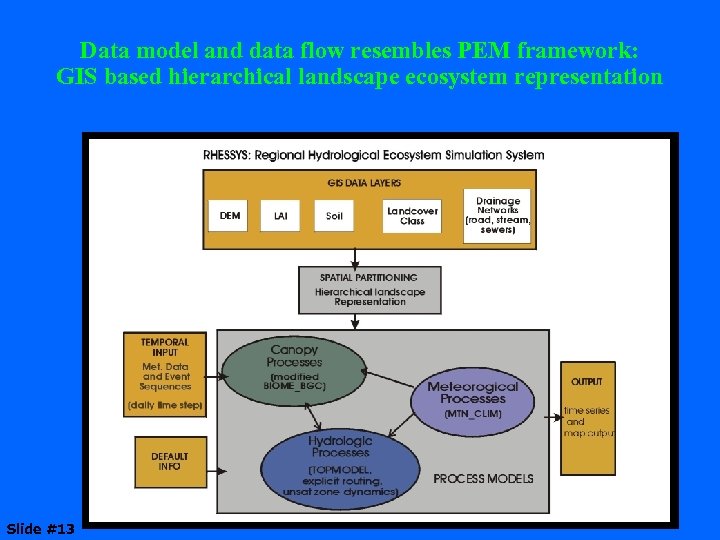 Data model and data flow resembles PEM framework: GIS based hierarchical landscape ecosystem representation Slide #13
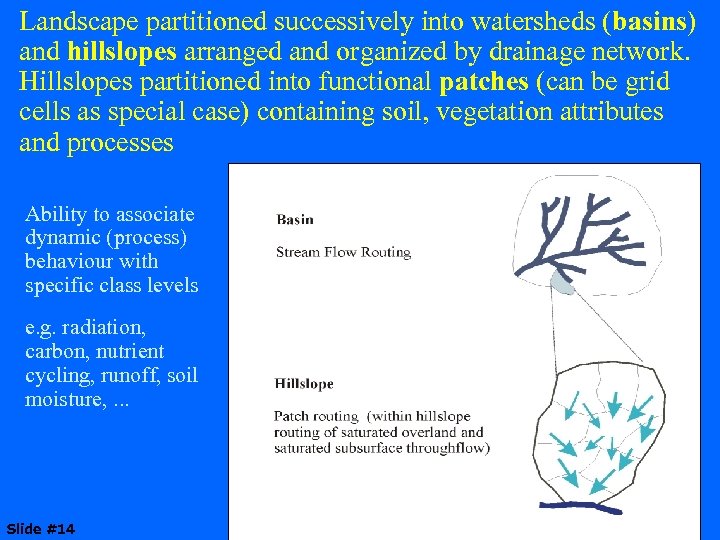 Landscape partitioned successively into watersheds (basins) and hillslopes arranged and organized by drainage network. Hillslopes partitioned into functional patches (can be grid cells as special case) containing soil, vegetation attributes and processes Ability to associate dynamic (process) behaviour with specific class levels e. g. radiation, carbon, nutrient cycling, runoff, soil moisture, . . . Slide #14
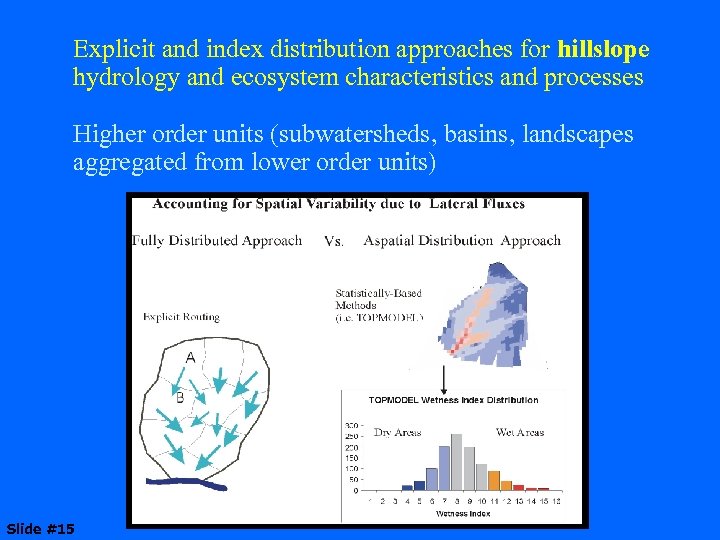 Explicit and index distribution approaches for hillslope hydrology and ecosystem characteristics and processes Higher order units (subwatersheds, basins, landscapes aggregated from lower order units) Slide #15
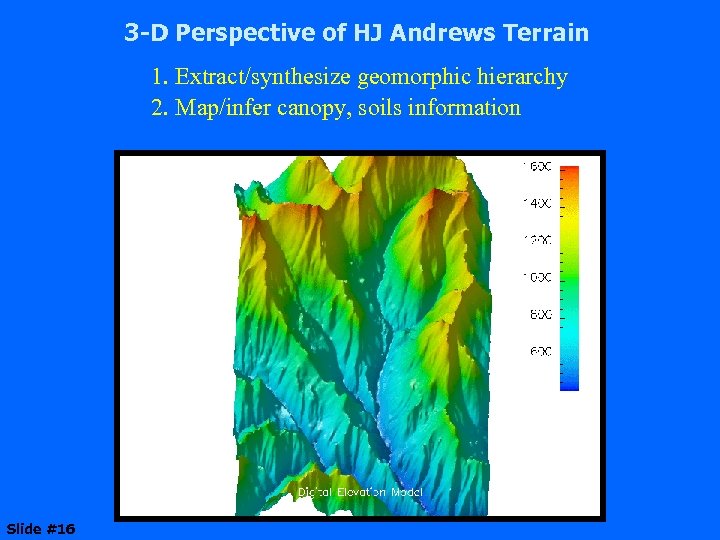 3 -D Perspective of HJ Andrews Terrain 1. Extract/synthesize geomorphic hierarchy 2. Map/infer canopy, soils information Slide #16
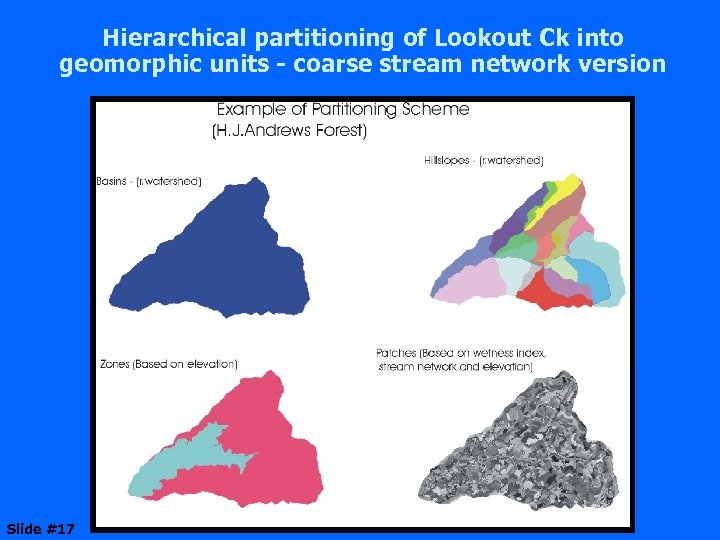 Hierarchical partitioning of Lookout Ck into geomorphic units - coarse stream network version Slide #17
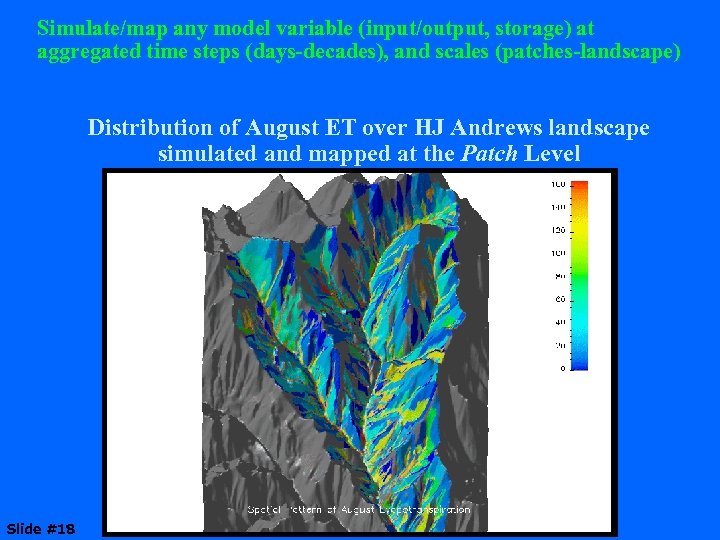 Simulate/map any model variable (input/output, storage) at aggregated time steps (days-decades), and scales (patches-landscape) Distribution of August ET over HJ Andrews landscape simulated and mapped at the Patch Level Slide #18
 Slide #19
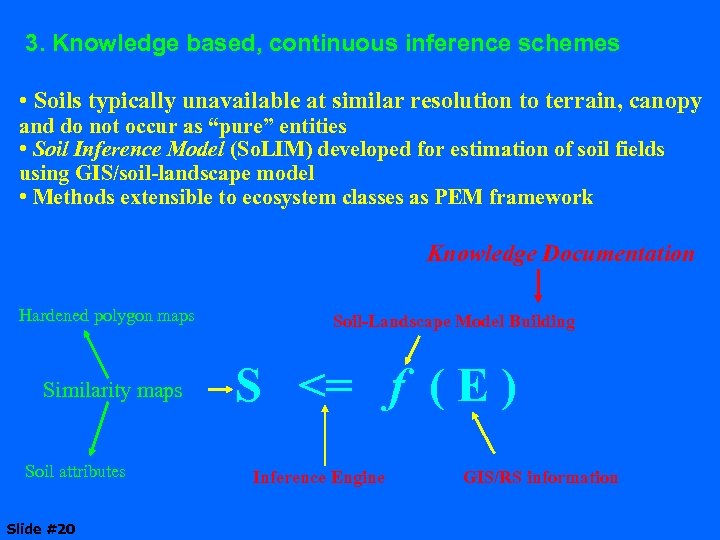 3. Knowledge based, continuous inference schemes • Soils typically unavailable at similar resolution to terrain, canopy and do not occur as “pure” entities • Soil Inference Model (So. LIM) developed for estimation of soil fields using GIS/soil-landscape model • Methods extensible to ecosystem classes as PEM framework Knowledge Documentation Hardened polygon maps Similarity maps Soil attributes Slide #20 Soil-Landscape Model Building S <= f ( E ) Inference Engine GIS/RS information
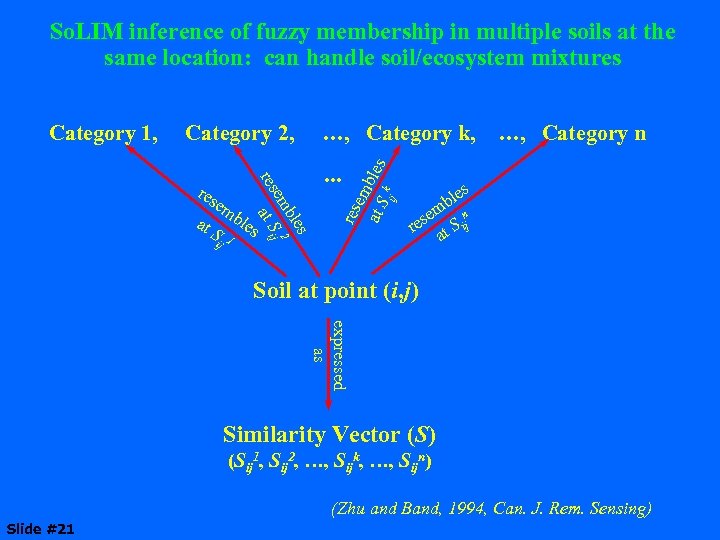 So. LIM inference of fuzzy membership in multiple soils at the same location: can handle soil/ecosystem mixtures Category 2, j ij k s ble em S 2 j i at em at bles Si 1 . . . res …, Category k, res em at S bles Category 1, …, Category n les b m n ese t S ij r a Soil at point (i, j) expressed as Similarity Vector (S) (Sij 1, Sij 2, …, Sijk, …, Sijn) (Zhu and Band, 1994, Can. J. Rem. Sensing) Slide #21
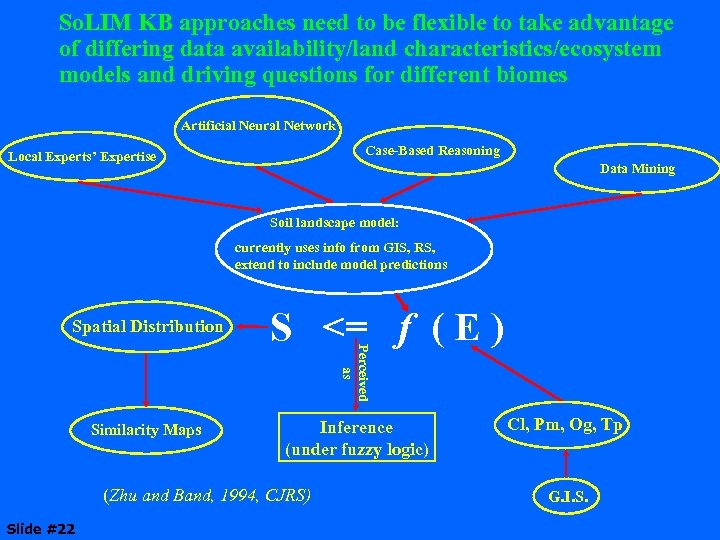 So. LIM KB approaches need to be flexible to take advantage of differing data availability/land characteristics/ecosystem models and driving questions for different biomes Artificial Neural Network Case-Based Reasoning Local Experts’ Expertise Data Mining Soil landscape model: currently uses info from GIS, RS, extend to include model predictions Spatial Distribution Perceived as S <= f ( E ) Similarity Maps Inference (under fuzzy logic) (Zhu and Band, 1994, CJRS) Slide #22 Cl, Pm, Og, Tp G. I. S.
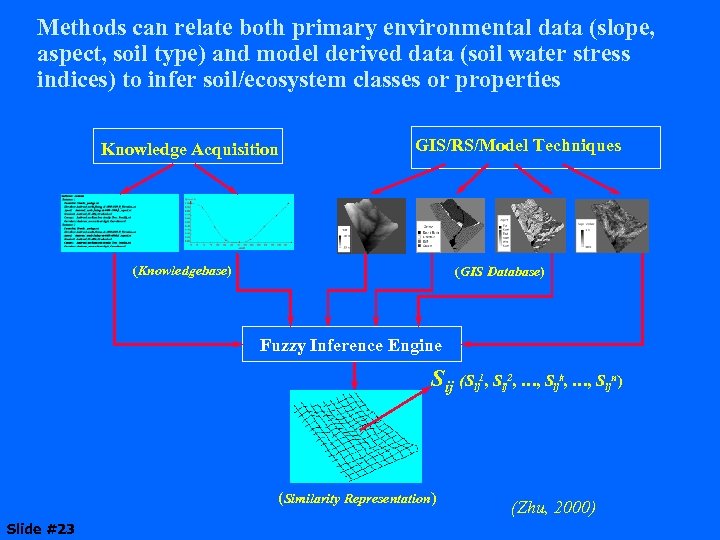 Methods can relate both primary environmental data (slope, aspect, soil type) and model derived data (soil water stress indices) to infer soil/ecosystem classes or properties Knowledge Acquisition GIS/RS/Model Techniques (Knowledgebase) (GIS Database) Fuzzy Inference Engine Sij (Sij 1, Sij 2, …, Sijk, …, Sijn) (Similarity Representation) Slide #23 (Zhu, 2000)
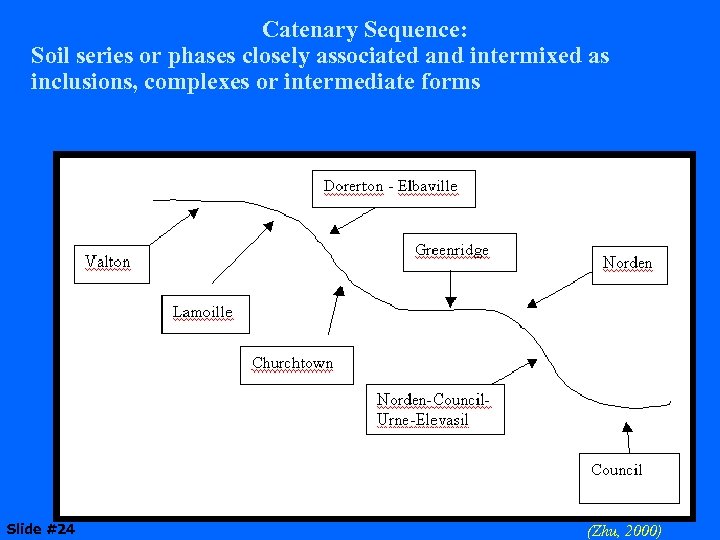 Catenary Sequence: Soil series or phases closely associated and intermixed as inclusions, complexes or intermediate forms Slide #24 (Zhu, 2000)
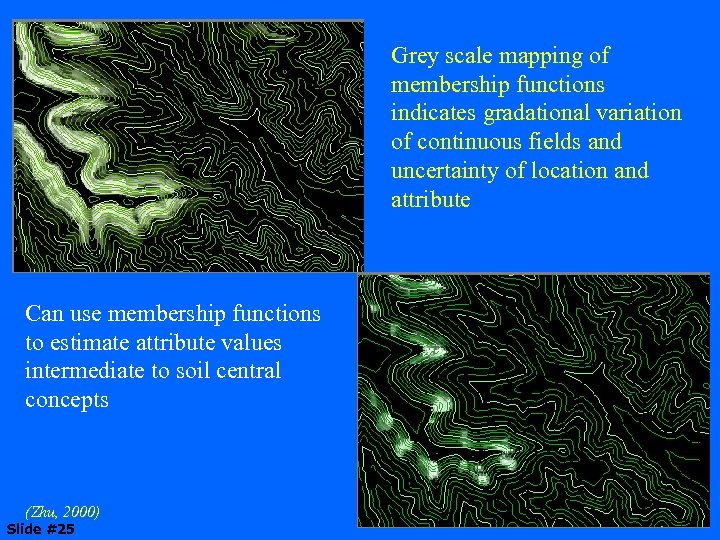 Grey scale mapping of membership functions indicates gradational variation of continuous fields and uncertainty of location and attribute Can use membership functions to estimate attribute values intermediate to soil central concepts (Zhu, 2000) Slide #25
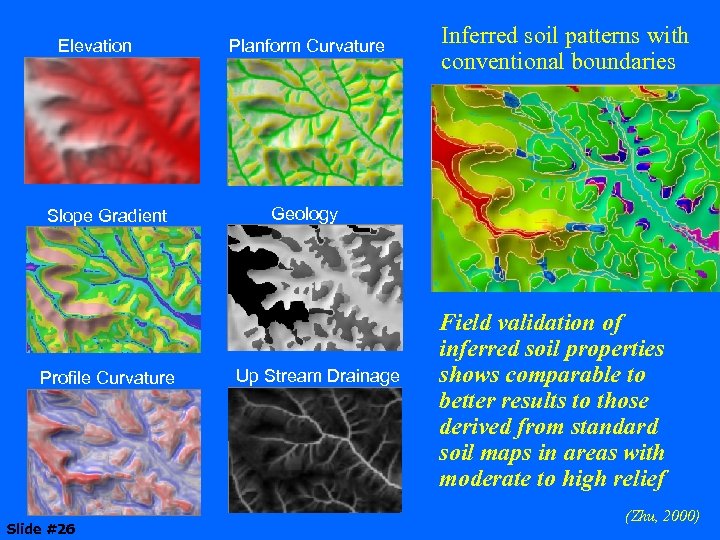 Elevation Slope Gradient Profile Curvature Slide #26 Planform Curvature Inferred soil patterns with conventional boundaries Geology Up Stream Drainage Field validation of inferred soil properties shows comparable to better results to those derived from standard soil maps in areas with moderate to high relief (Zhu, 2000)
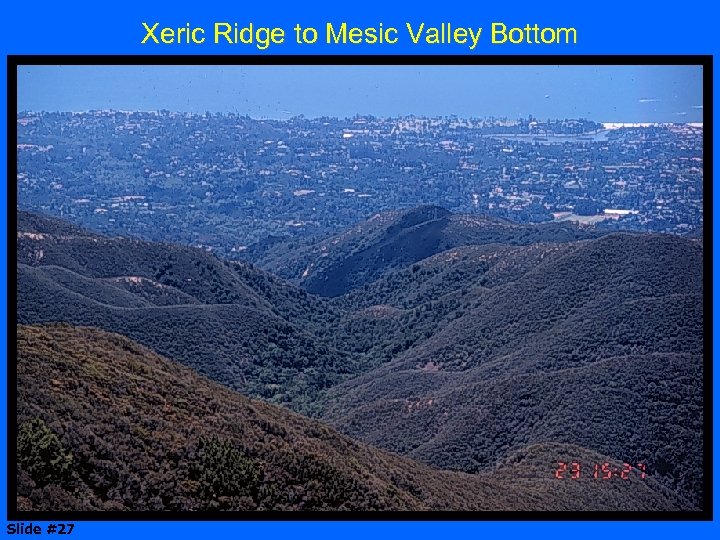 Xeric Ridge to Mesic Valley Bottom Slide #27
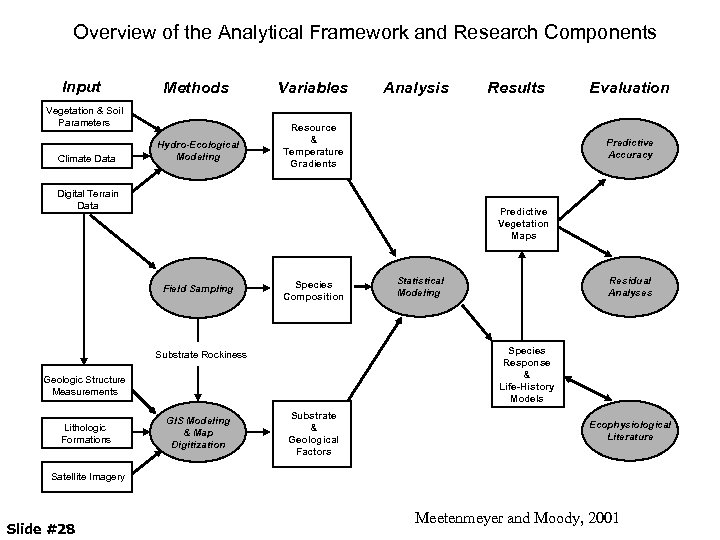 Overview of the Analytical Framework and Research Components Input Methods Variables Hydro-Ecological Modeling Resource & Temperature Gradients Vegetation & Soil Parameters Climate Data Analysis Evaluation Predictive Accuracy Digital Terrain Data Predictive Vegetation Maps Field Sampling Species Composition Geologic Structure Measurements GIS Modeling & Map Digitization Statistical Modeling Residual Analyses Species Response & Life-History Models Substrate Rockiness Lithologic Formations Results Substrate & Geological Factors Ecophysiological Literature Satellite Imagery Slide #28 Meetenmeyer and Moody, 2001
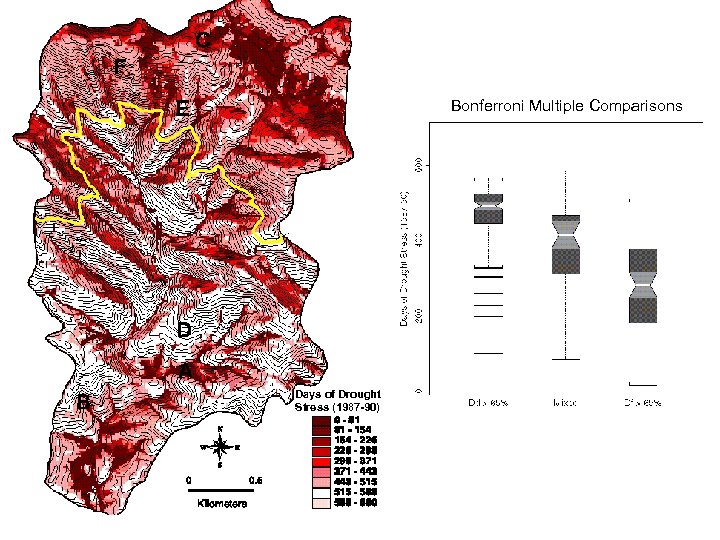 Bonferroni Multiple Comparisons Days of Drought Stress (1987 -90) Slide #29
 IV. Comments and Recommendations • British Columbia’s Biogeoclimatic Ecosystem Classification provides a state-of-the-art knowledge base for supporting TEM/PEM initiatives • Initial work in different regions is impressive and reflects driving questions and technology available - both of which change very rapidly • Forest management paradigm shift requires more integrated, flexible tools that can address ‘multiple use-multiple impact’ • Development of continuous classification systems and integrated landscape ecohydrological models provide opportunities for building on and extending PEM/TEM initiative Slide #30
 • Similar to PEM: accuracy and robustness of So. LIMlike approach highly dependent on knowledge base and implementation • A limitation of relying on primary GIS variables (e. g. elevation, slope, aspect) is the production of multiple instances of the same entity (same soil series or forest ecosystem on south and north facing slope, different elevations) - concept of ecological equivalence • More direct variables (temperature, pcp, radiation load), or direct physiologic limitations on NPP, NEP could be derived from distributed hydroecological model Slide #31
 Need to develop menu of standardized techniques for knowledge capture, representation and inference methods to deal with range of ecosystems, available data, practitioners and driving questions • • Choice of KB development dependent on availability of local data and expertise • Methods of assessing and representing data and inference method uncertainty • Software system needs to be extensible and built for interoperability to incorporate existing and developing models appropriate for range of ecosystems and issues Slide #32
 • Fuzzy inference methodology should be easily extensible to ecosystem entities: • Fuzzy PEM (or similar approach) would support representation of spatial and attribute uncertainty, take advantage of existing state-of-the-art forest ecosystems knowledge base to produce continuous classifications • Make use of derived direct biophysical (e. g. climate, soil water) and physiological fields (for reference canopy) to gain more insight into what are the direct controls on ecosystem form and function • Use enhanced attribute fields of forest ecosystem patterns to couple with dynamic models of critical environmental processes - extend ecosystem modelling to include greater treatment of ecosystem dynamics Slide #33