 Скачать презентацию Assessment of Key Competences Dublin 19 -20 March
113213d55b5680a544bb6bb43267c1d0.ppt
- Количество слайдов: 28



Assessment of Key Competences Dublin 19 -20 March 2013 Tapio Säävälä European Commission – DG Education and Culture Date: in 12 pts
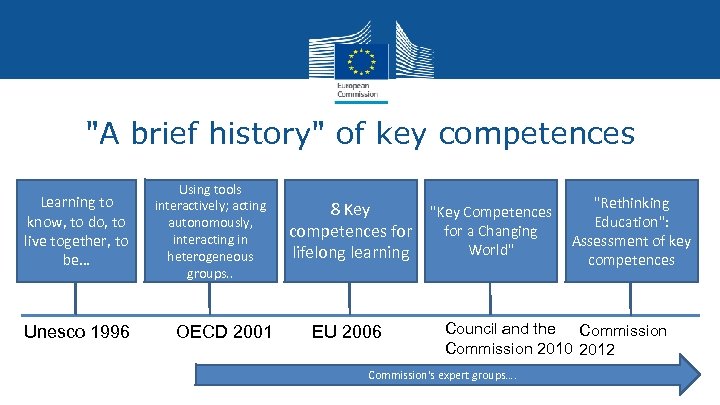
"A brief history" of key competences Learning to know, to do, to live together, to be… Unesco 1996 Using tools interactively; acting autonomously, interacting in heterogeneous groups. . OECD 2001 8 Key "Key Competences for a Changing competences for World" lifelong learning EU 2006 "Rethinking Education": Assessment of key competences Council and the Commission 2010 2012 Commission's expert groups….
Key competences represent a transferable, multifunctional package of knowledge, skills and attitudes that all individuals need for personal fulfilment and development, inclusion and employment. These should have been developed by the end of initial education and training, and should act as a foundation for further learning as part of lifelong learning.
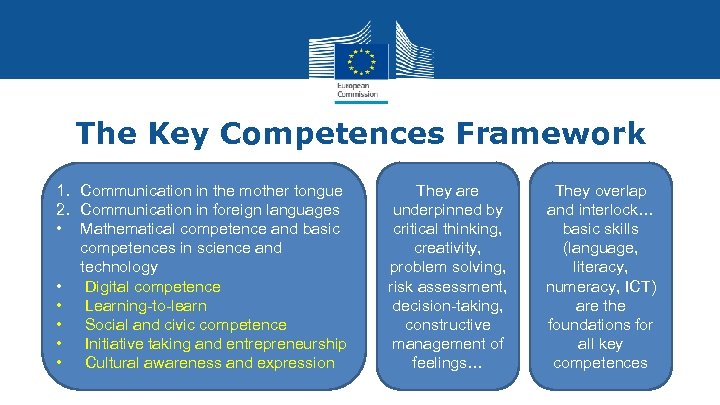
The Key Competences Framework 1. Communication in the mother tongue 2. Communication in foreign languages • Mathematical competence and basic competences in science and technology • Digital competence • Learning-to-learn • Social and civic competence • Initiative taking and entrepreneurship • Cultural awareness and expression They are underpinned by critical thinking, creativity, problem solving, risk assessment, decision-taking, constructive management of feelings… They overlap and interlock… basic skills (language, literacy, numeracy, ICT) are the foundations for all key competences
Some comments from users… • A young lady from Denmark: Democratic competence? • A young man from the Netherlands: Environmental competence? • A young man from Germany: Now I know how to… fill in my CV…. • Reform of the ECEC curricula…
"Key Competences for the Changing World" – 2010 Joint report of the Council and the Commission • A lot of reforms: "based on"; "orientated towards"; "inspired by"… (some started earlier) • Traditional subjects to cover more skills and positive attitudes, real life situations… • Transversal KCs have a more prominent role in curricula; and in initial teacher education; • But: assessment "emerging"…
Key competences in curricula Roles and responsibilities Within subjects Within learning areas Across the whole curriculum Individual teachers Holistic understanding of How to agree, work with, evaluate with colleagues the KCs with the team(s) Clear role, responsibility, contribution to overall goals and the learning environment Teams of teachers Awareness of the content and Understanding & implementing KCs in cooperation with others A clear vision on how teams contribute and work together for KCs curricula; how to embed the relevant KCs into subject and assess them etc, goals of colleagues work. School leaders Identification of professional development needs, professional interaction, vision building, self-evaluation, use of other results… school as a learning environment.
Why work assessment? • Signals priorities for teaching and learning; and what we value as learning outcomes; • Provides feedback of progress- both for the learner, teachers and beyond; • Influences one's self-esteem, motivation, learning skills, future careers; • How assessment is recorded; certified and communicated impacts one's life chances; • Often controversial as purposes, scope, methods, or use of results unspecified… • What we can measure is important, but so are the areas we cannot
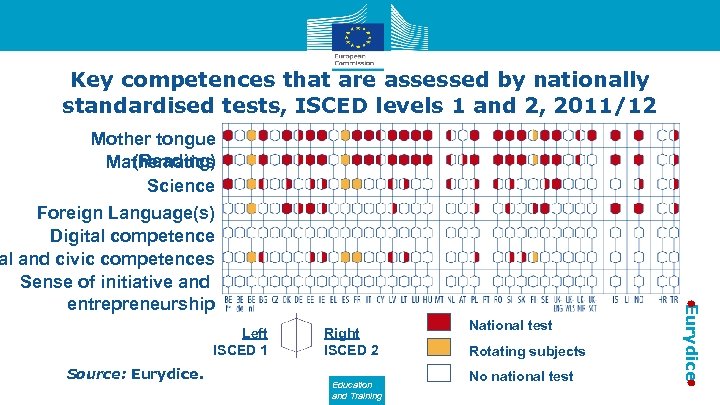
Key competences that are assessed by nationally standardised tests, ISCED levels 1 and 2, 2011/12 Left ISCED 1 Source: Eurydice. Right ISCED 2 Education and Training National test Rotating subjects No national test Eurydice Mother tongue (Reading) Mathematics Science Foreign Language(s) Digital competence al and civic competences Sense of initiative and entrepreneurship Date: in 12 pts
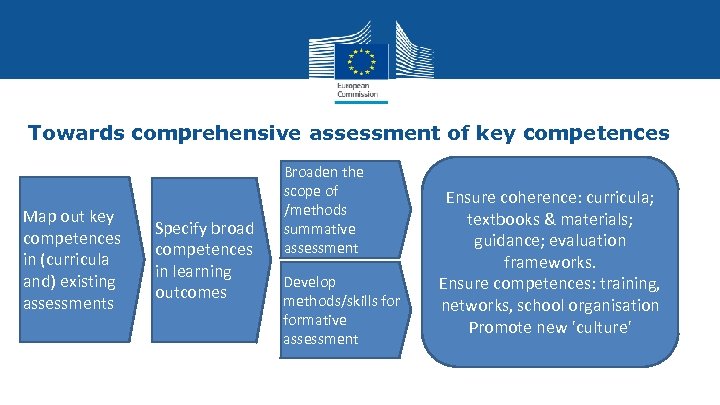
Towards comprehensive assessment of key competences Map out key competences in (curricula and) existing assessments Specify broad competences in learning outcomes Broaden the scope of /methods summative assessment Develop methods/skills formative assessment Ensure coherence: curricula; textbooks & materials; guidance; evaluation frameworks. Ensure competences: training, networks, school organisation Promote new 'culture'
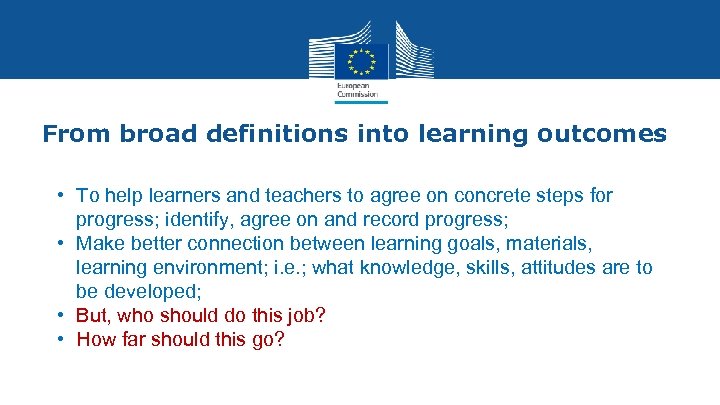
From broad definitions into learning outcomes • To help learners and teachers to agree on concrete steps for progress; identify, agree on and record progress; • Make better connection between learning goals, materials, learning environment; i. e. ; what knowledge, skills, attitudes are to be developed; • But, who should do this job? • How far should this go?
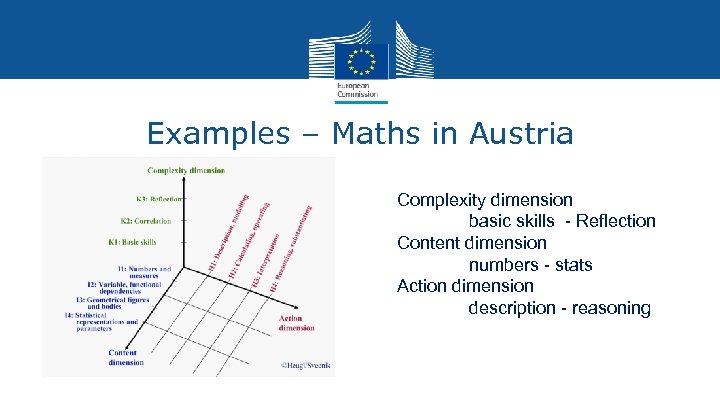
Examples – Maths in Austria Complexity dimension basic skills - Reflection Content dimension numbers - stats Action dimension description - reasoning
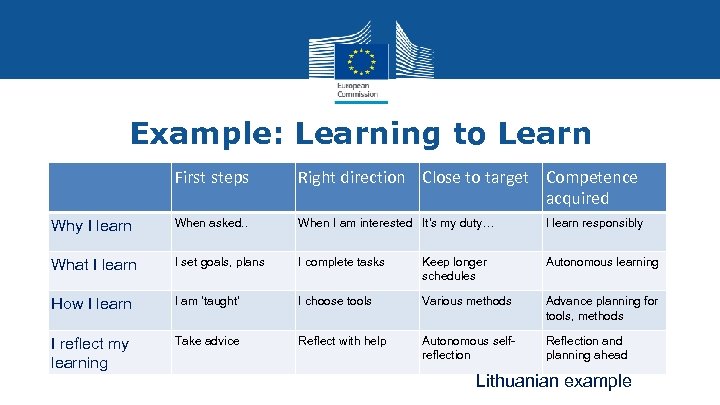
Example: Learning to Learn First steps Right direction Close to target Competence acquired Why I learn When asked. . When I am interested It's my duty… I learn responsibly What I learn I set goals, plans I complete tasks Keep longer schedules Autonomous learning How I learn I am 'taught' I choose tools Various methods Advance planning for tools, methods I reflect my learning Take advice Reflect with help Autonomous selfreflection Reflection and planning ahead Lithuanian example
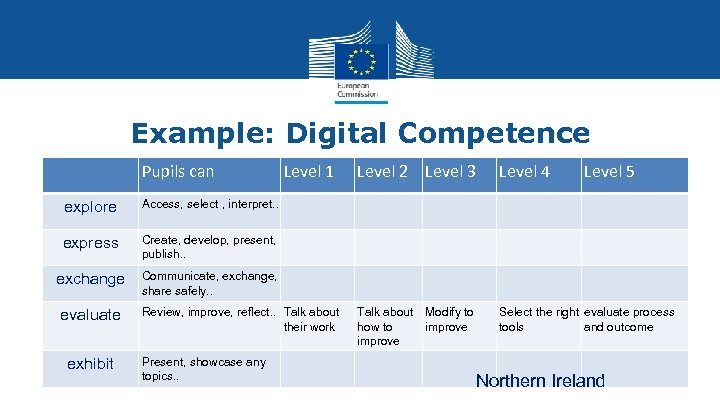
Example: Digital Competence Pupils can explore Level 4 Level 5 Talk about how to improve Select the right evaluate process tools and outcome Create, develop, present, publish. . exchange Level 2 Level 3 Access, select , interpret. . express Level 1 Communicate, exchange, share safely. . evaluate exhibit Review, improve, reflect. . Talk about their work Present, showcase any topics. . Modify to improve Northern Ireland
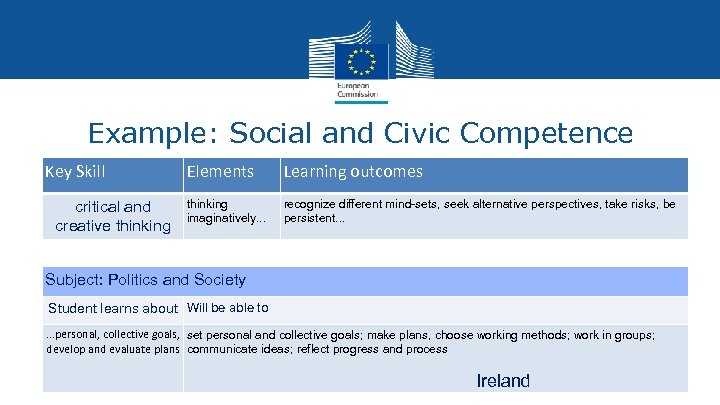
Example: Social and Civic Competence Key Skill critical and creative thinking Elements Learning outcomes thinking imaginatively. . . recognize different mind-sets, seek alternative perspectives, take risks, be persistent. . . Subject: Politics and Society Student learns about Will be able to. . . personal, collective goals, set personal and collective goals; make plans, choose working methods; work in groups; develop and evaluate plans communicate ideas; reflect progress and process Ireland
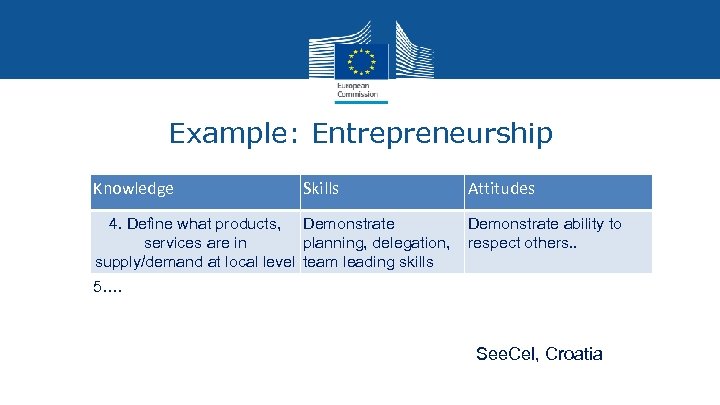
Example: Entrepreneurship Knowledge Skills 4. Define what products, Demonstrate services are in planning, delegation, supply/demand at local level team leading skills Attitudes Demonstrate ability to respect others. . 5…. See. Cel, Croatia
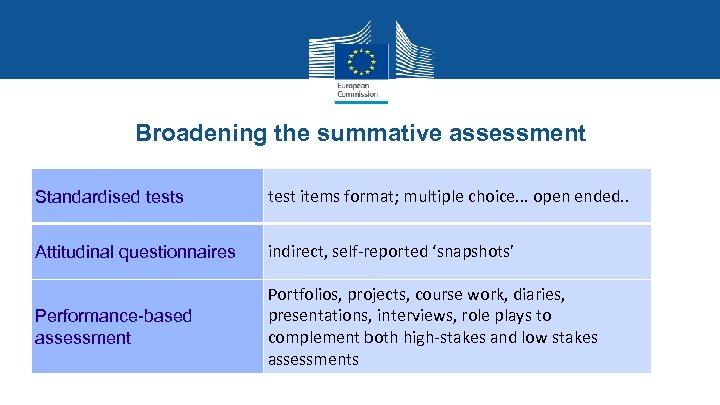
Broadening the summative assessment Standardised tests test items format; multiple choice. . . open ended. . Attitudinal questionnaires indirect, self-reported ‘snapshots’ Performance-based assessment Portfolios, projects, course work, diaries, presentations, interviews, role plays to complement both high-stakes and low stakes assessments
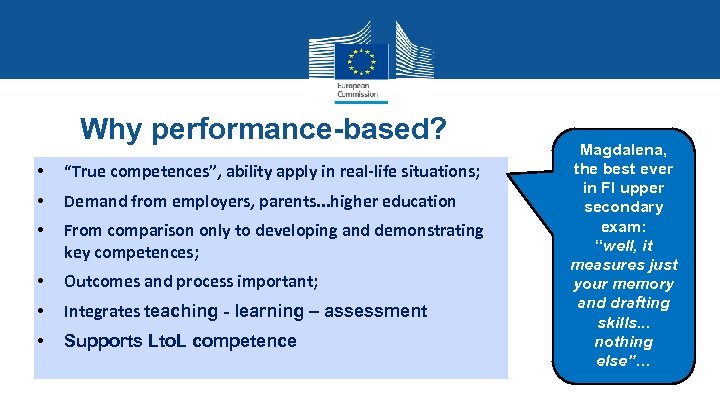
Why performance-based? • “True competences”, ability apply in real-life situations; • Demand from employers, parents. . . higher education • From comparison only to developing and demonstrating key competences; • Outcomes and process important; • Integrates teaching - learning – assessment • Supports Lto. L competence Magdalena, the best ever in FI upper secondary exam: “well, it measures just your memory and drafting skills. . . nothing else”…
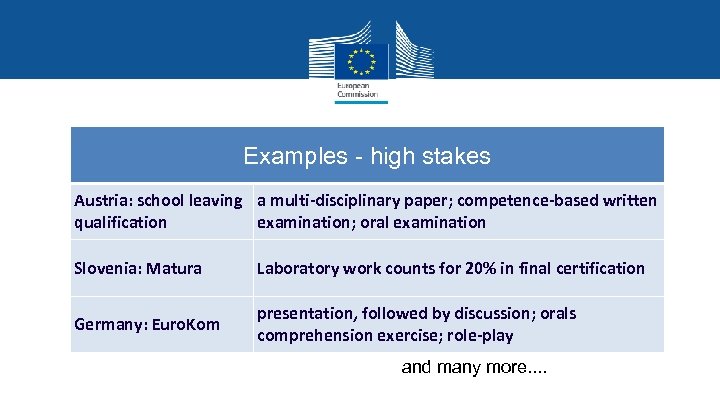
Examples - high stakes Austria: school leaving a multi-disciplinary paper; competence-based written qualification examination; oral examination Slovenia: Matura Laboratory work counts for 20% in final certification Germany: Euro. Kom presentation, followed by discussion; orals comprehension exercise; role-play and many more. .
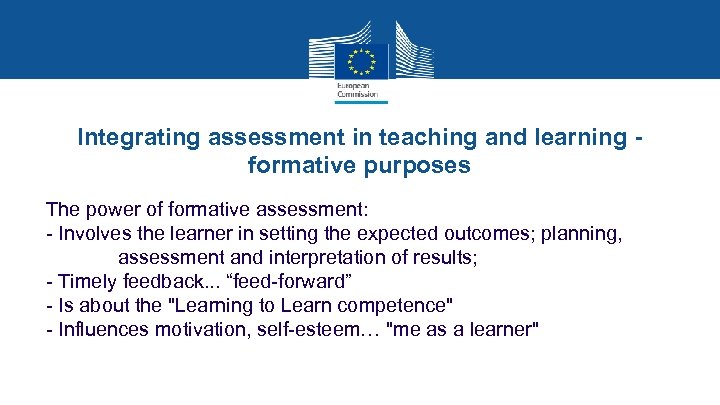
Integrating assessment in teaching and learning formative purposes The power of formative assessment: - Involves the learner in setting the expected outcomes; planning, assessment and interpretation of results; - Timely feedback. . . “feed-forward” - Is about the "Learning to Learn competence" - Influences motivation, self-esteem… "me as a learner"
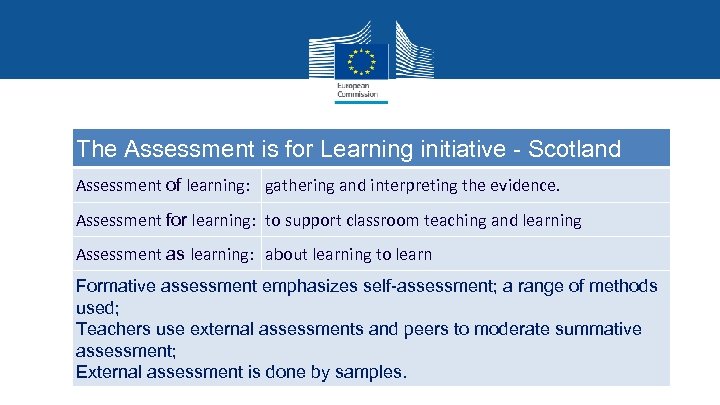
The Assessment is for Learning initiative - Scotland Assessment of learning: gathering and interpreting the evidence. Assessment for learning: to support classroom teaching and learning Assessment as learning: about learning to learn Formative assessment emphasizes self-assessment; a range of methods used; Teachers use external assessments and peers to moderate summative assessment; External assessment is done by samples.
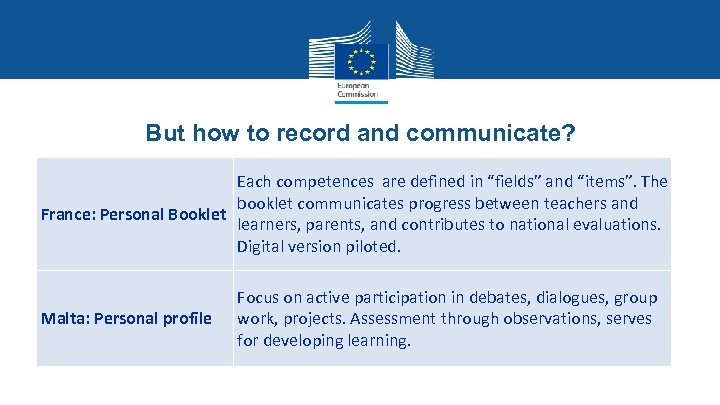
But how to record and communicate? Each competences are defined in “fields” and “items”. The booklet communicates progress between teachers and France: Personal Booklet learners, parents, and contributes to national evaluations. Digital version piloted. Malta: Personal profile Focus on active participation in debates, dialogues, group work, projects. Assessment through observations, serves for developing learning.
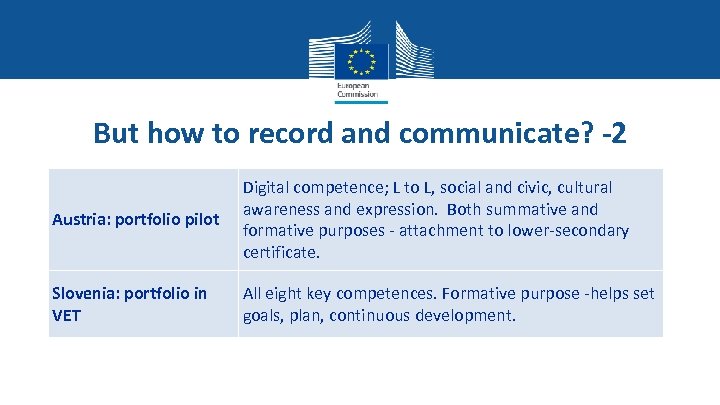
But how to record and communicate? -2 Austria: portfolio pilot Digital competence; L to L, social and civic, cultural awareness and expression. Both summative and formative purposes - attachment to lower-secondary certificate. Slovenia: portfolio in VET All eight key competences. Formative purpose -helps set goals, plan, continuous development.
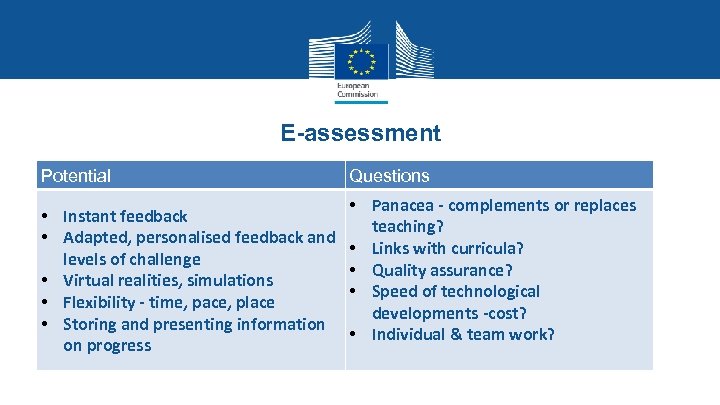
E-assessment Potential • Instant feedback • Adapted, personalised feedback and levels of challenge • Virtual realities, simulations • Flexibility - time, pace, place • Storing and presenting information on progress Questions • Panacea - complements or replaces teaching? • Links with curricula? • Quality assurance? • Speed of technological developments -cost? • Individual & team work?
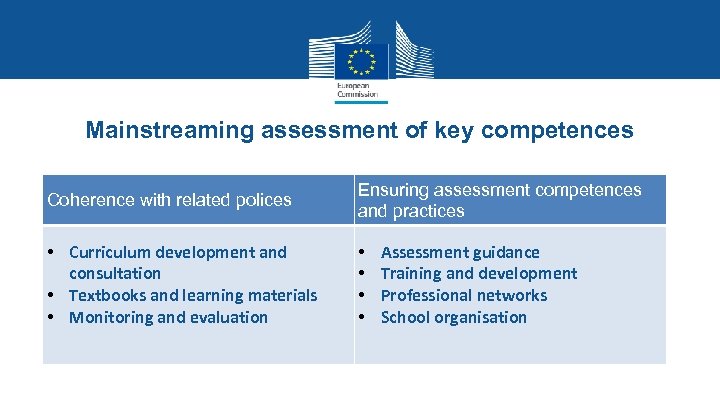
Mainstreaming assessment of key competences Coherence with related polices Ensuring assessment competences and practices • Curriculum development and consultation • Textbooks and learning materials • Monitoring and evaluation • • Assessment guidance Training and development Professional networks School organisation
"Key competences" for effective assessment • Translating curricular goals into learning outcomes; • Gathering, generating assessment information by using multiple methods; • Interpreting & using assessment information; • Assessing in cooperation with others; • Communicating results clearly & constructively; • Contributing to schools self-evaluation/development
Summary • • • The power of assessment is well recognised; A number of examples on 'translating key competences' into learning outcomes; Growing trend to involve the learner in the process and to contextualise student assessment with wider policies; E-assessment – still to be fully harnessed; Chancing assessment requires attention to teachers competences and 'culture' Systemic approach essential – both at school and beyond

Thank you! http: //ec. europa. eu/education
Скачать презентацию Assessment of Key Competences Dublin 19 -20 March
113213d55b5680a544bb6bb43267c1d0.ppt