


 Скачать презентацию Assessment and teaching of 21 century skills Patrick
moscow 2015 Insitute of ed.pptx
- Количество слайдов: 68
 Assessment and teaching of 21 century skills Patrick Griffin
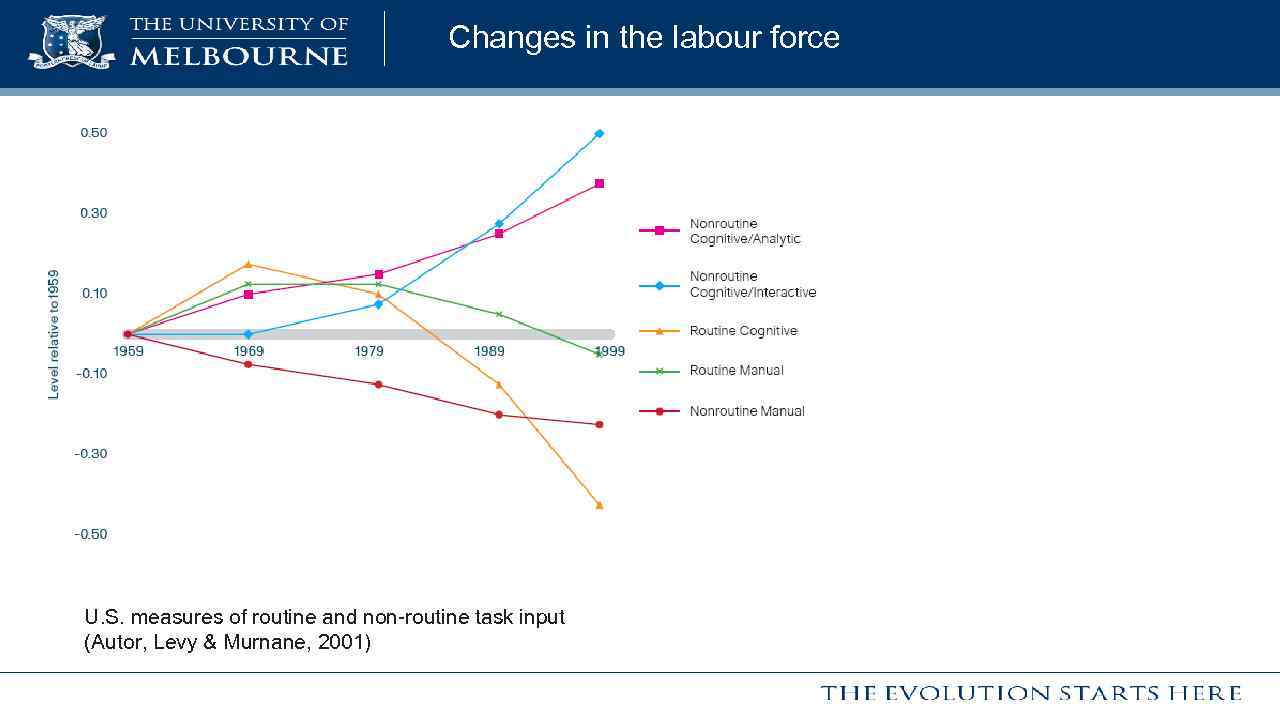 Changes in the labour force U. S. measures of routine and non-routine task input (Autor, Levy & Murnane, 2001)
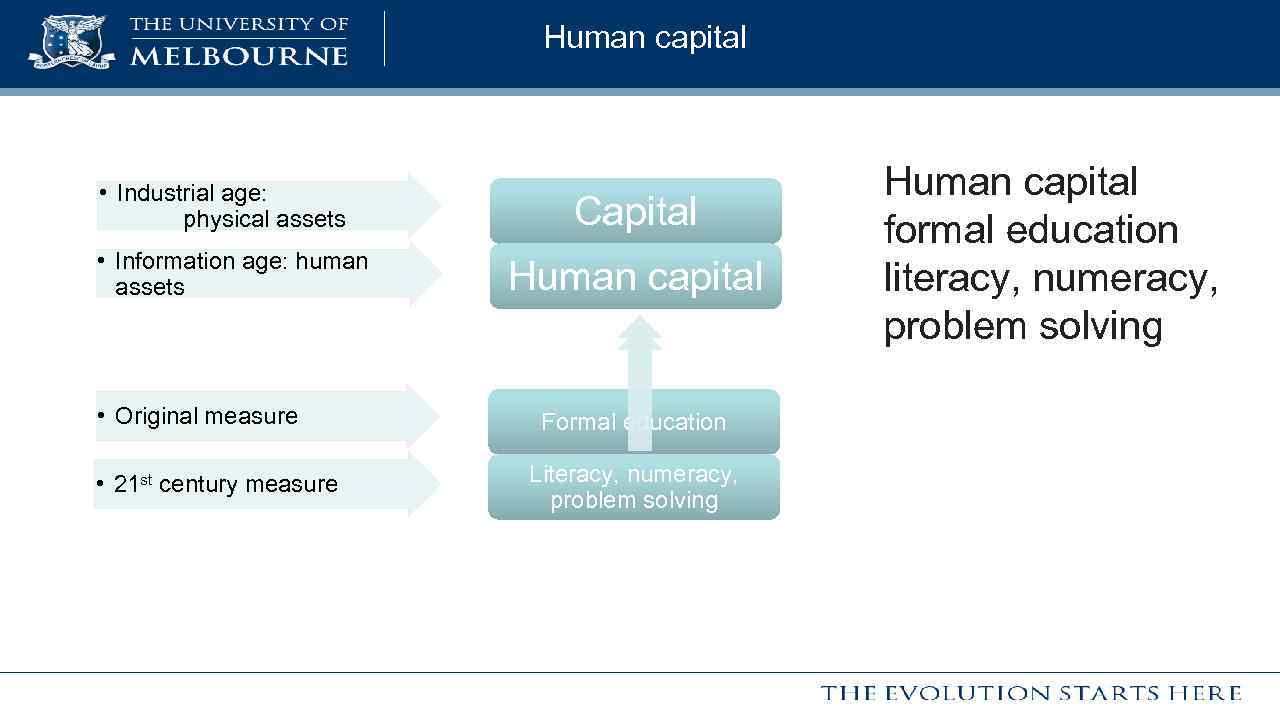 Human capital • Industrial age: physical assets • Information age: human assets • Original measure • 21 st century measure Capital Human capital Formal education Literacy, numeracy, problem solving Human capital formal education literacy, numeracy, problem solving
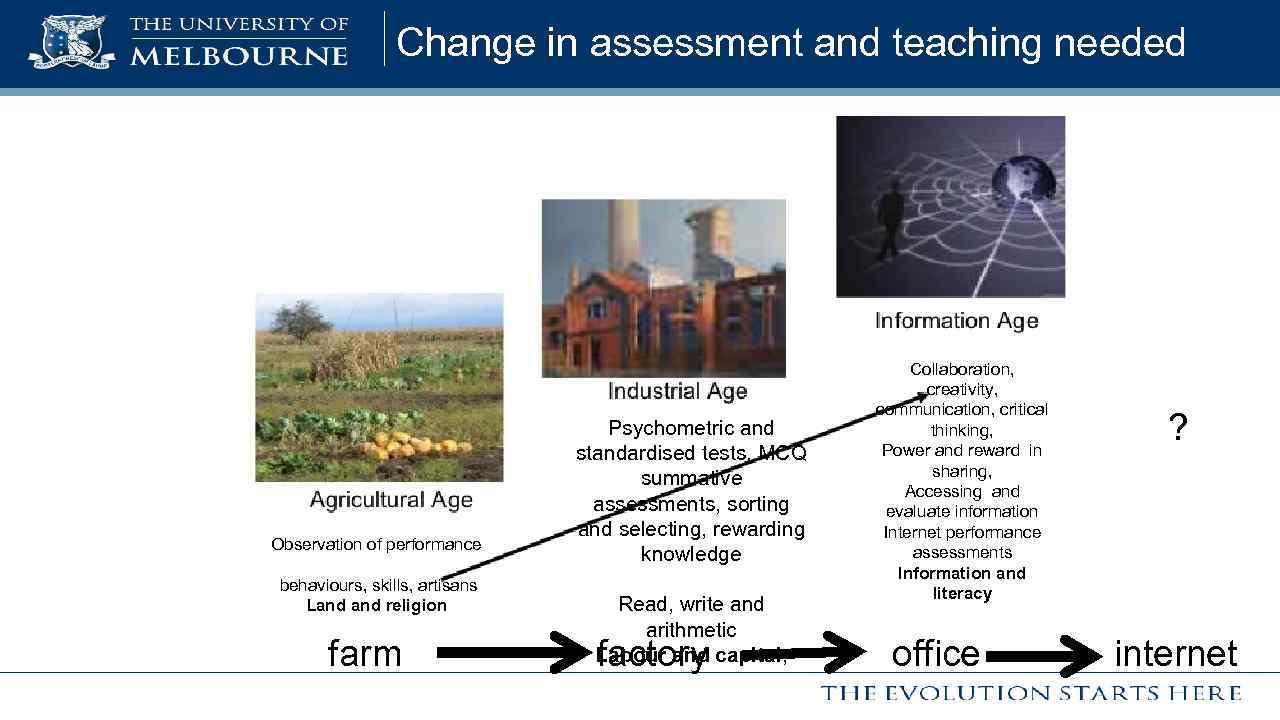 Change in assessment and teaching needed Observation of performance behaviours, skills, artisans Land religion Psychometric and standardised tests, MCQ summative assessments, sorting and selecting, rewarding knowledge Read, write and arithmetic Labour and capital; Collaboration, creativity, communication, critical thinking, Power and reward in sharing, Accessing and evaluate information Internet performance assessments Information and literacy ? farm factory office internet
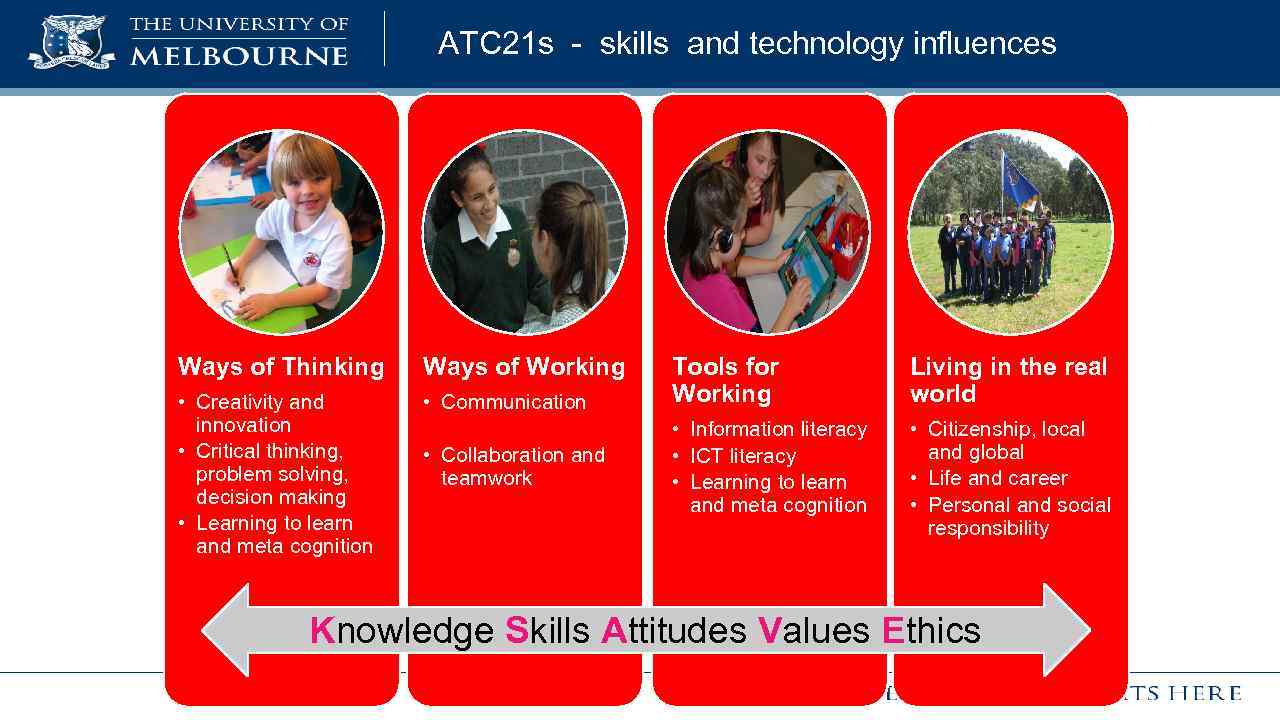 ATC 21 s - skills and technology influences Ways of Thinking Ways of Working • Creativity and innovation • Critical thinking, problem solving, decision making • Learning to learn and meta cognition • Communication • Collaboration and teamwork Tools for Working Living in the real world • Information literacy • ICT literacy • Learning to learn and meta cognition • Citizenship, local and global • Life and career • Personal and social responsibility Knowledge Skills Attitudes Values Ethics
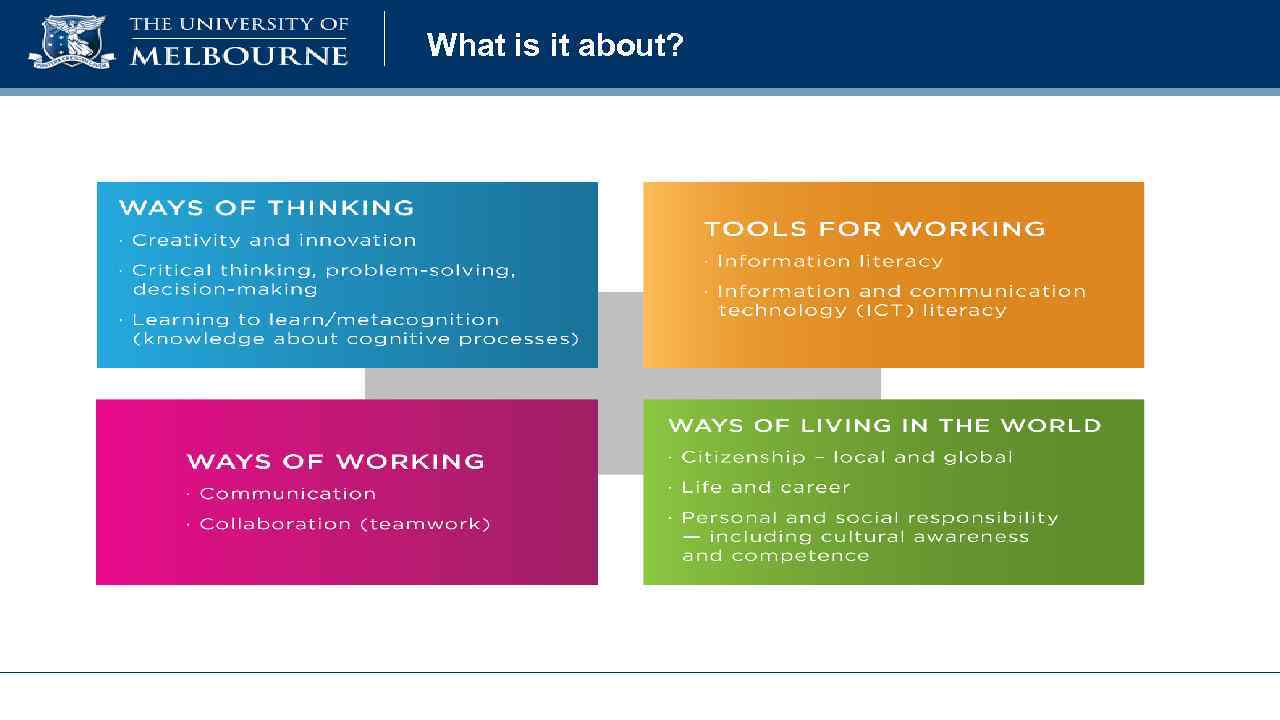 What is it about?
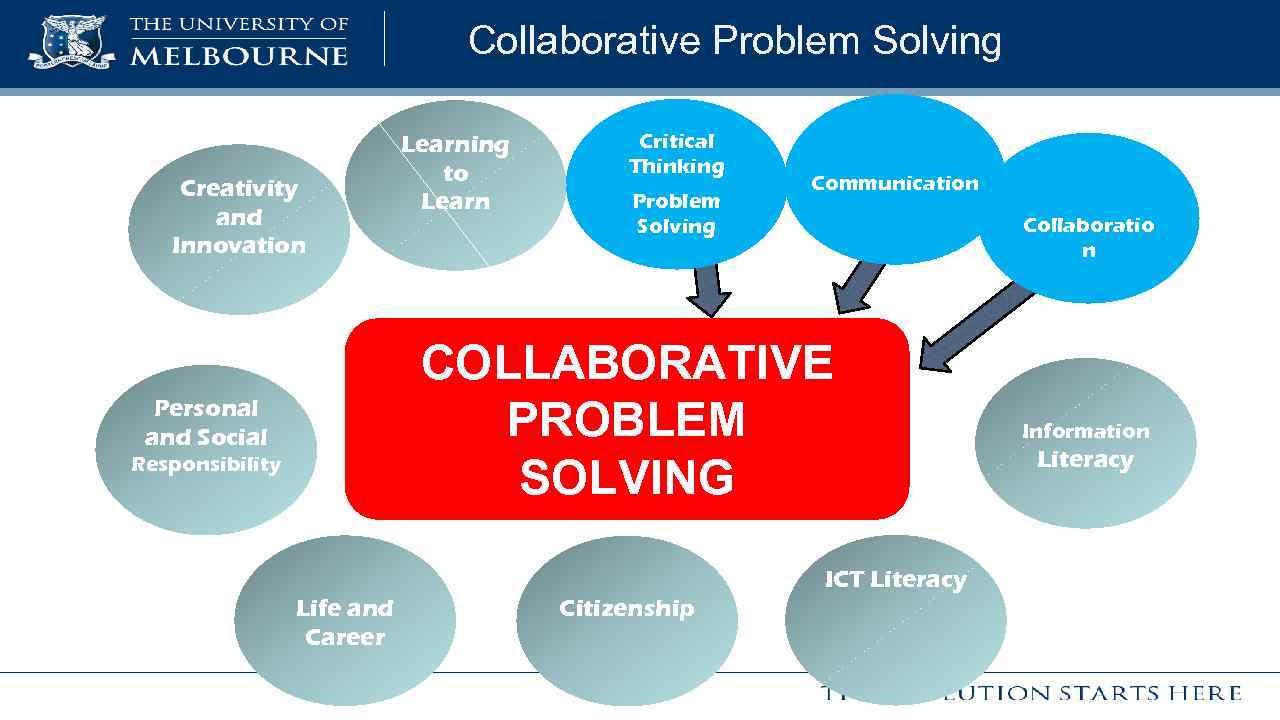 Collaborative Problem Solving Creativity and Innovation Learning to Learn Critical Thinking Problem Solving Communication Collaboratio n COLLABORATIVE PROBLEM SOLVING Personal and Social Responsibility ICT Literacy Life and Career Citizenship Information Literacy
 New skills for new workplace The quality and excellence challenge Education needs to prepare students… … to deal with more rapid change than ever before… … for jobs that have not yet been created… … using technologies that have not yet been invented… … to solve problems that we don’t yet know will arise
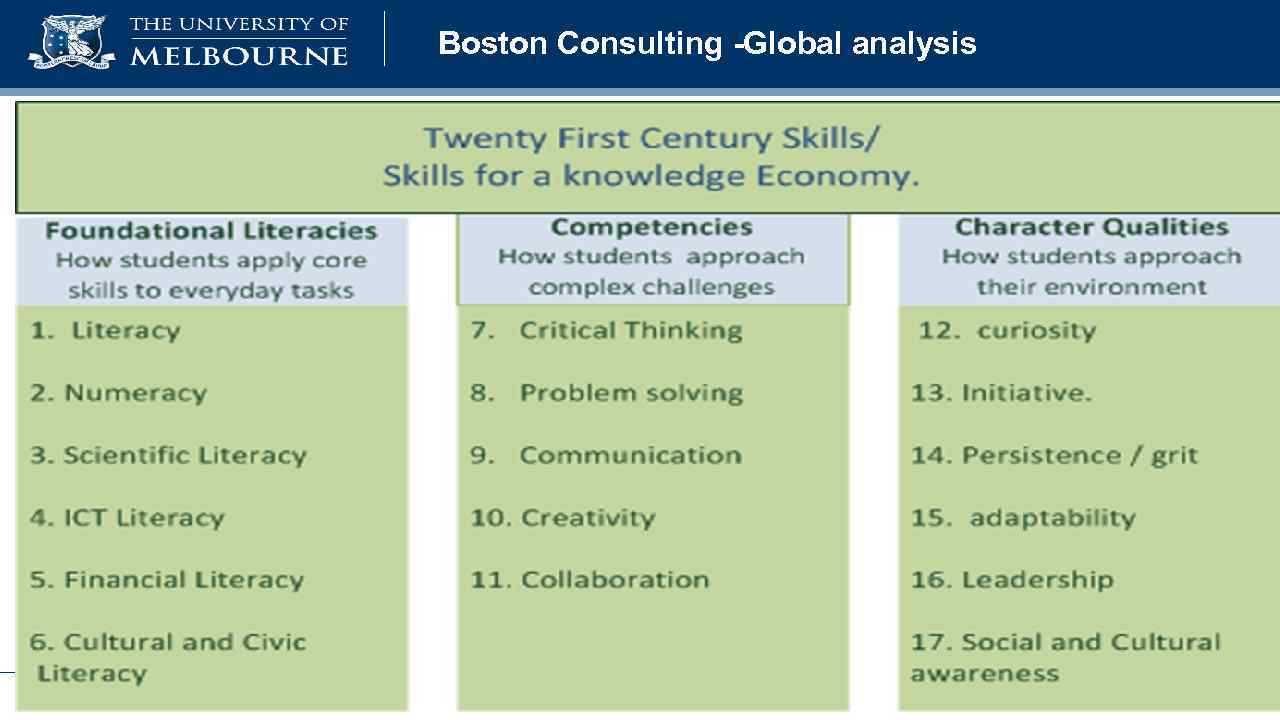 Boston Consulting -Global analysis
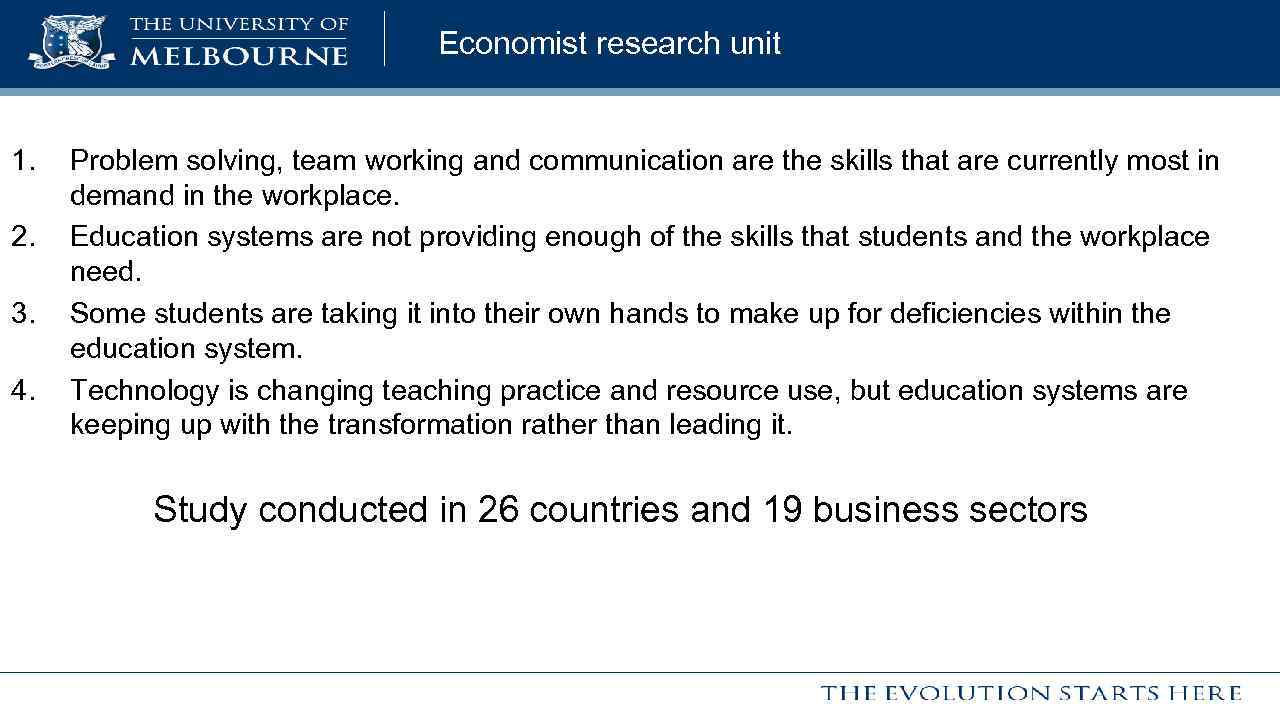 Economist research unit 1. 2. 3. 4. Problem solving, team working and communication are the skills that are currently most in demand in the workplace. Education systems are not providing enough of the skills that students and the workplace need. Some students are taking it into their own hands to make up for deficiencies within the education system. Technology is changing teaching practice and resource use, but education systems are keeping up with the transformation rather than leading it. Study conducted in 26 countries and 19 business sectors
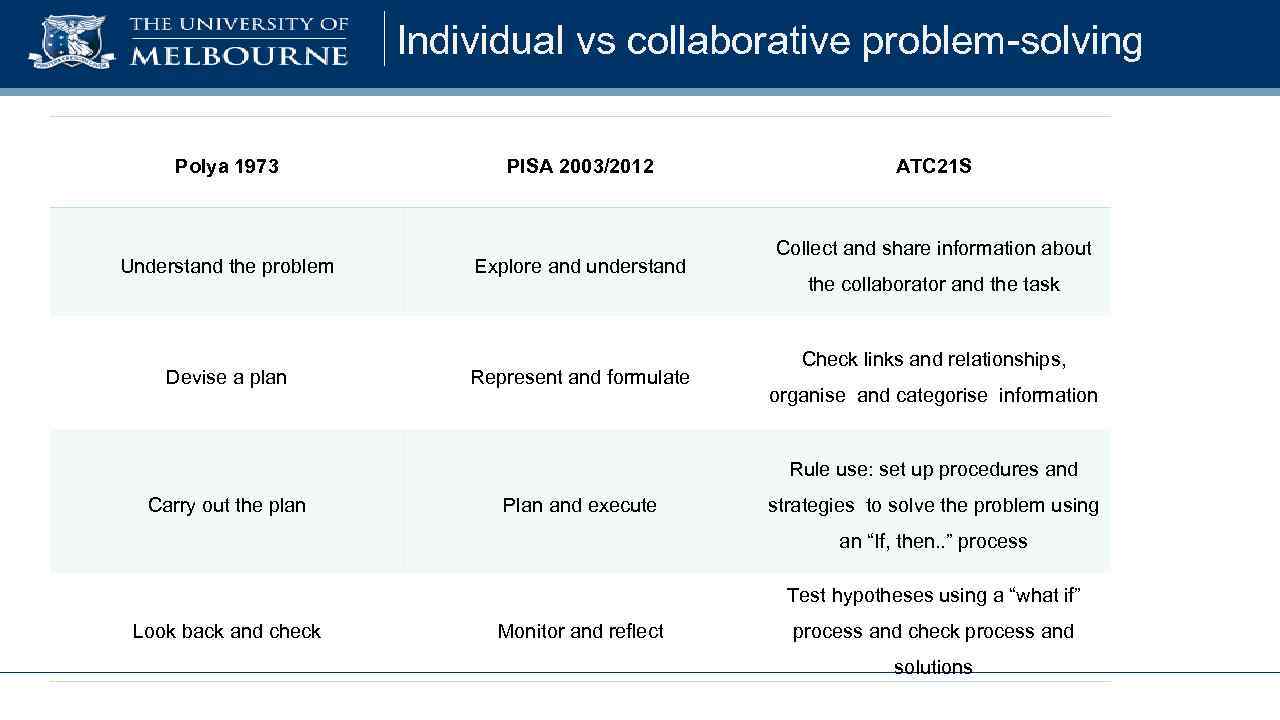 Individual vs collaborative problem-solving Polya 1973 Understand the problem Devise a plan PISA 2003/2012 Explore and understand Represent and formulate ATC 21 S Collect and share information about the collaborator and the task Check links and relationships, organise and categorise information Rule use: set up procedures and Carry out the plan Plan and execute strategies to solve the problem using an “If, then. . ” process Test hypotheses using a “what if” Look back and check Monitor and reflect process and check process and solutions
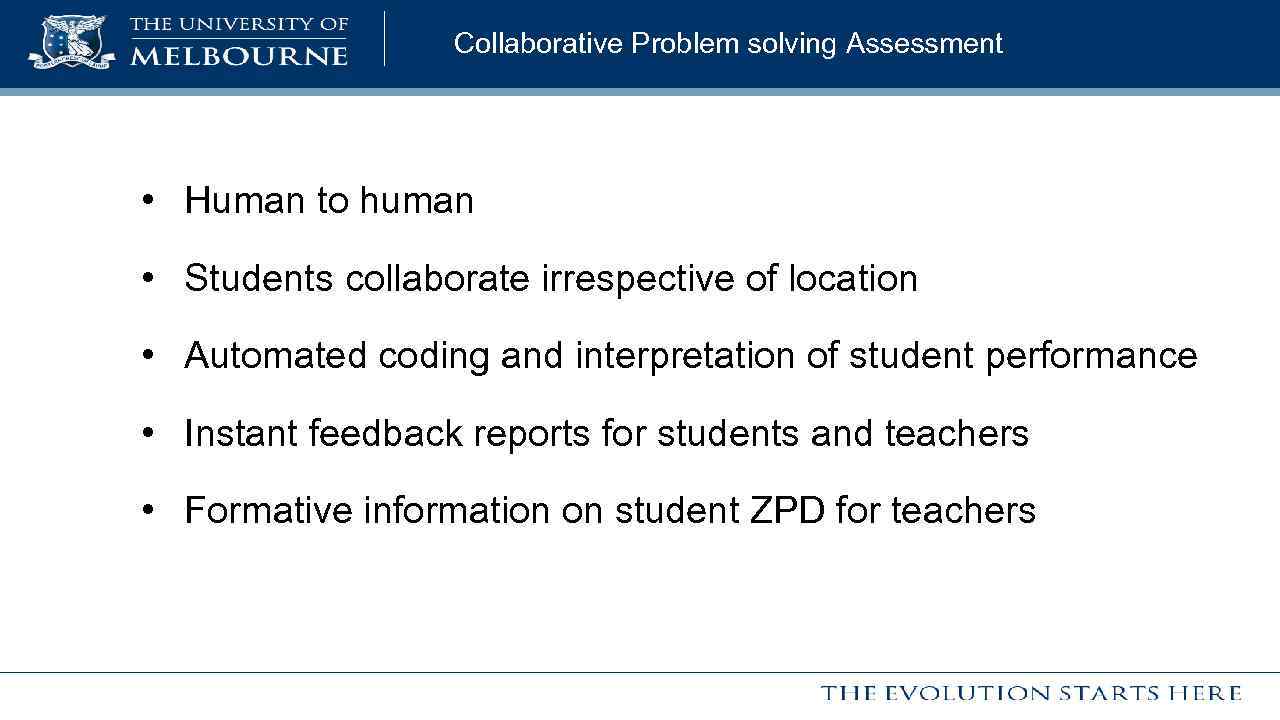 Collaborative Problem solving Assessment • Human to human • Students collaborate irrespective of location • Automated coding and interpretation of student performance • Instant feedback reports for students and teachers • Formative information on student ZPD for teachers
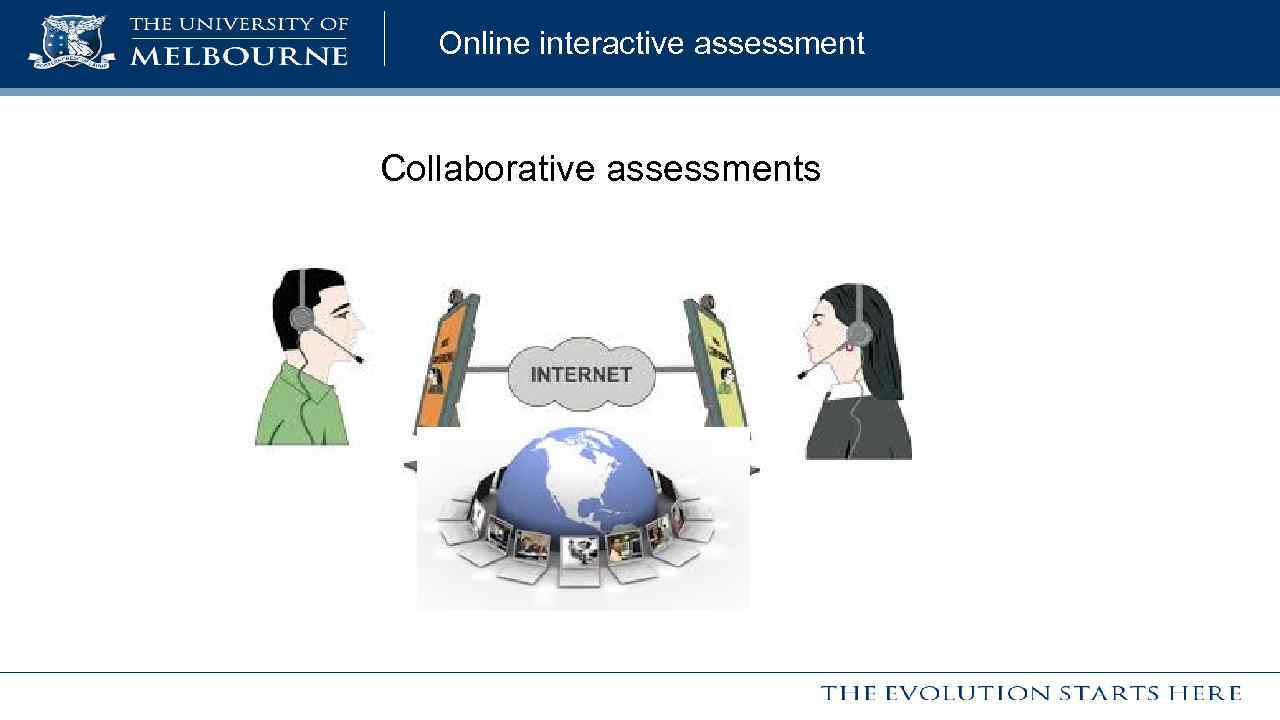 Online interactive assessment Collaborative assessments
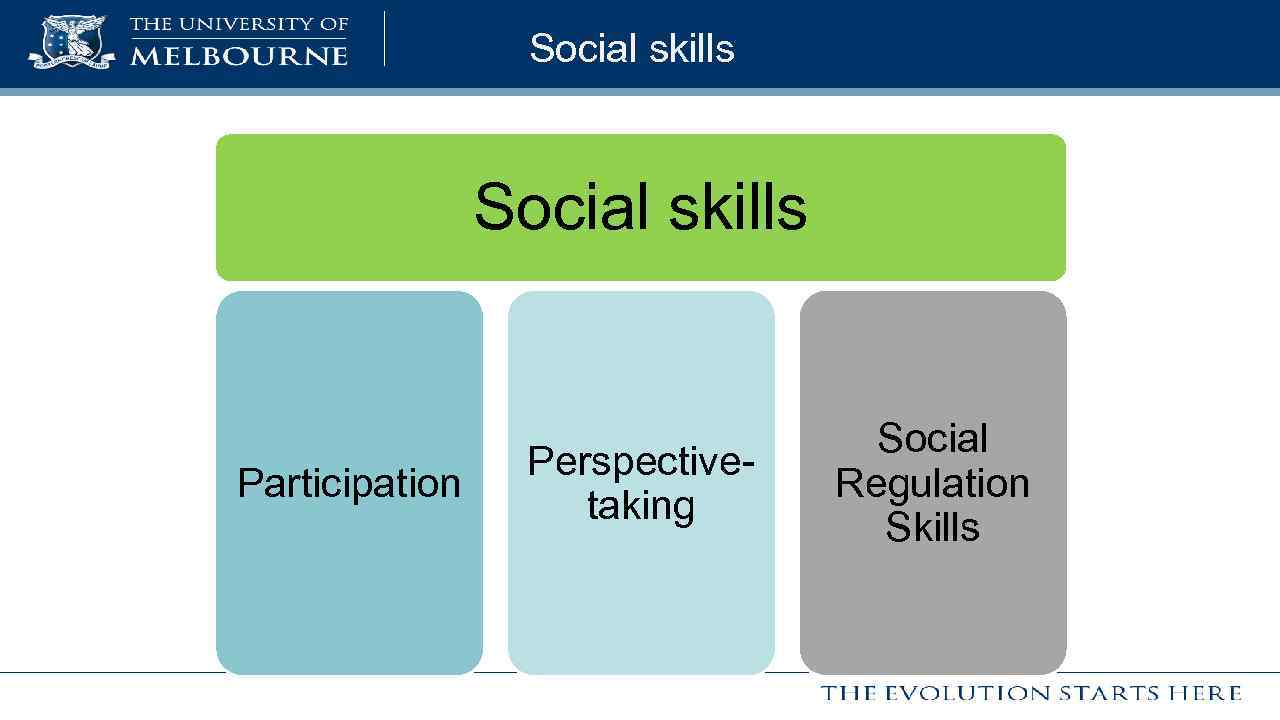 Social skills Participation Perspectivetaking Social Regulation Skills
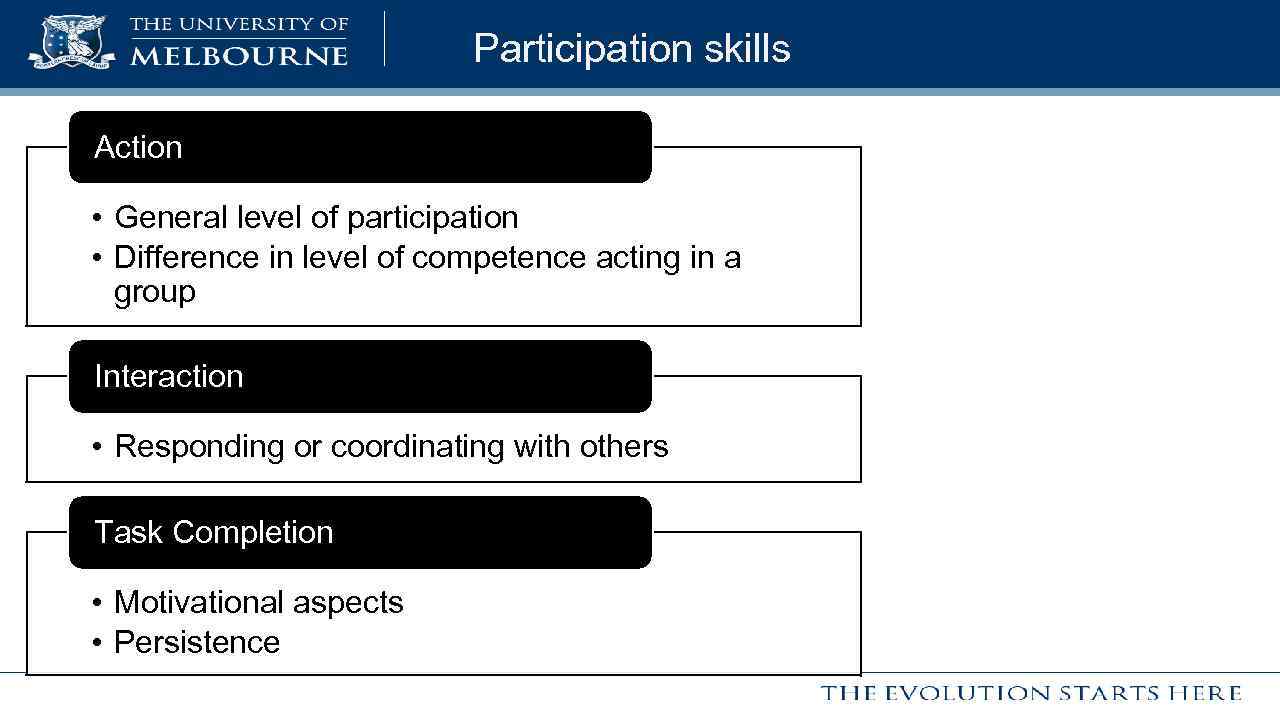 Participation skills Action • General level of participation • Difference in level of competence acting in a group Interaction • Responding or coordinating with others Task Completion • Motivational aspects • Persistence
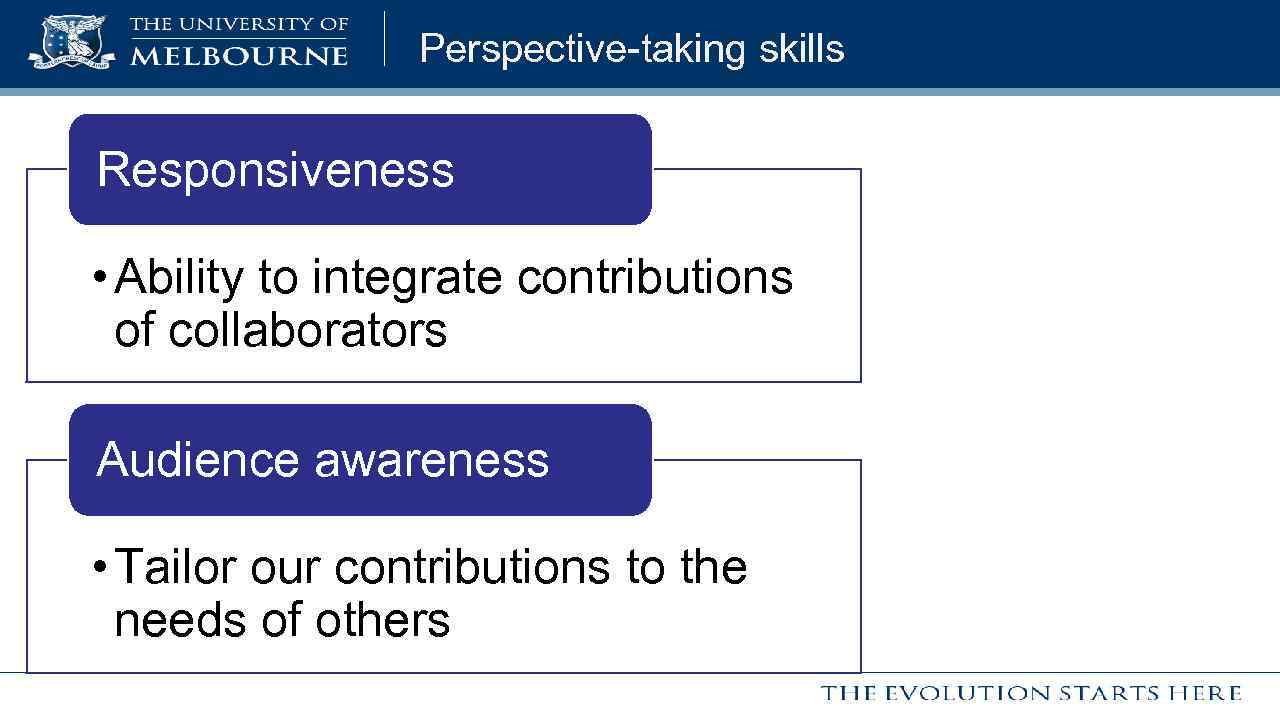 Perspective-taking skills Responsiveness • Ability to integrate contributions of collaborators Audience awareness • Tailor our contributions to the needs of others
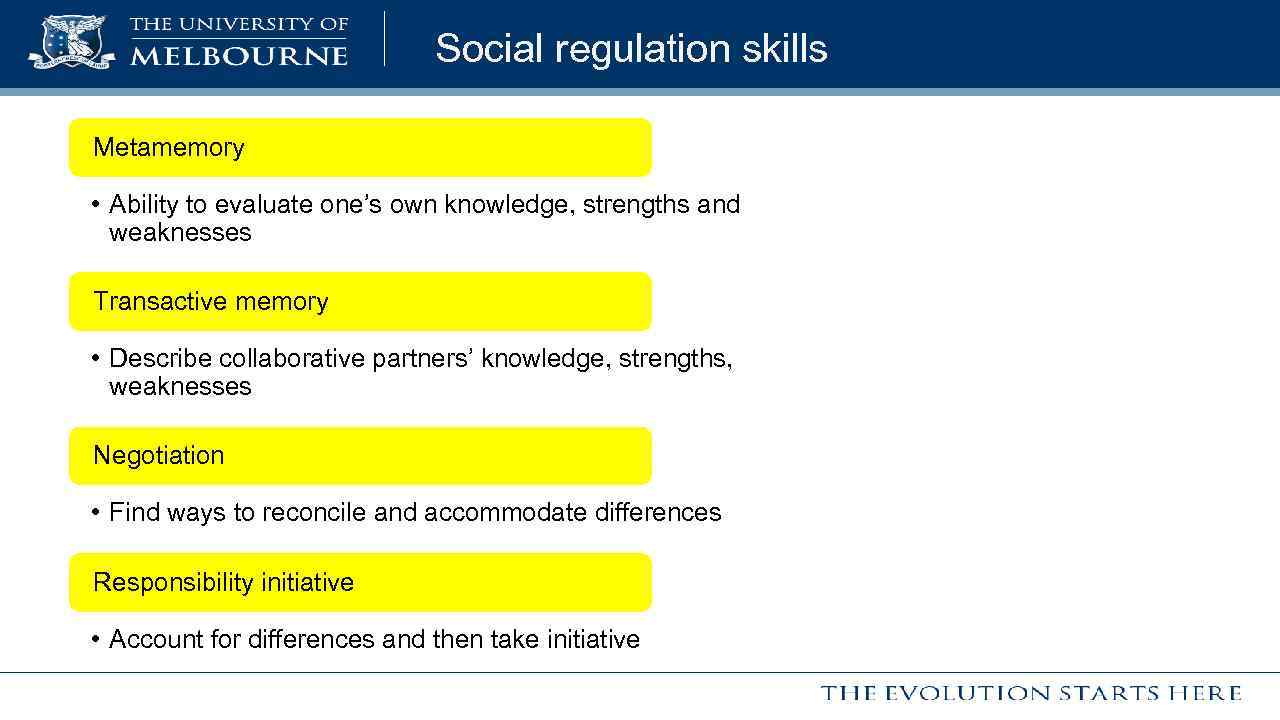 Social regulation skills Metamemory • Ability to evaluate one’s own knowledge, strengths and weaknesses Transactive memory • Describe collaborative partners’ knowledge, strengths, weaknesses Negotiation • Find ways to reconcile and accommodate differences Responsibility initiative • Account for differences and then take initiative
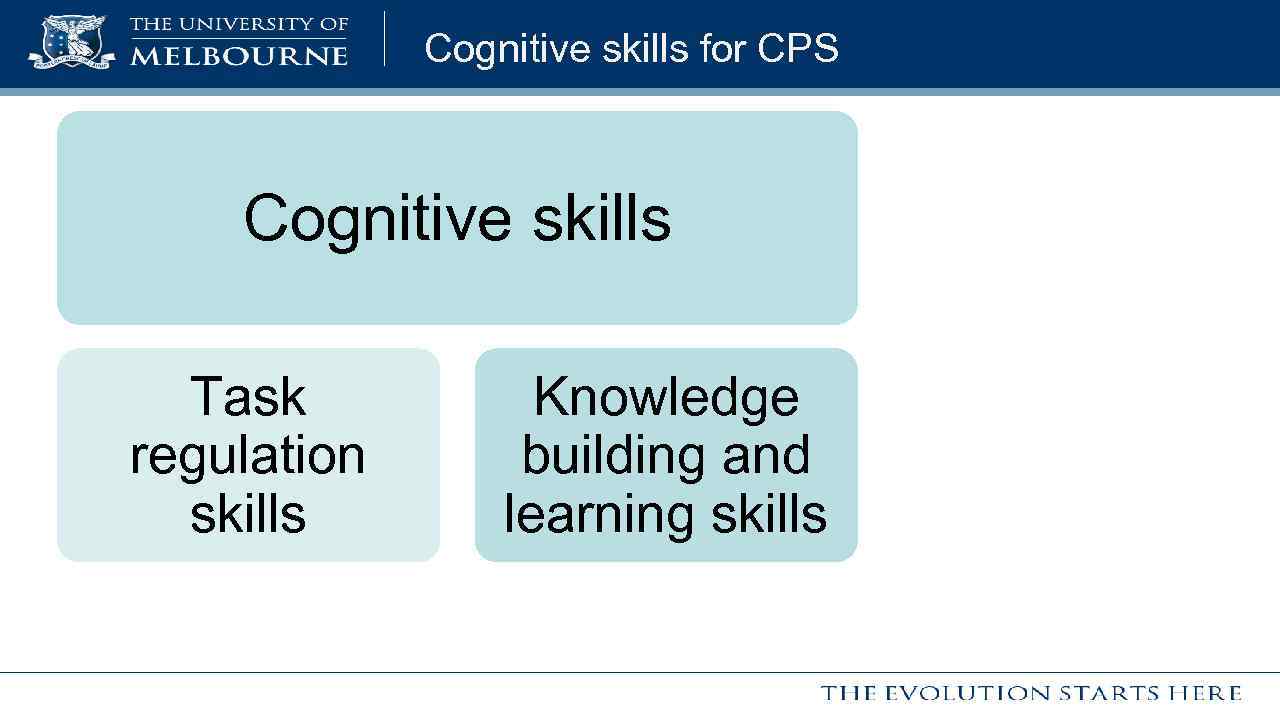 Cognitive skills for CPS Cognitive skills Task regulation skills Knowledge building and learning skills
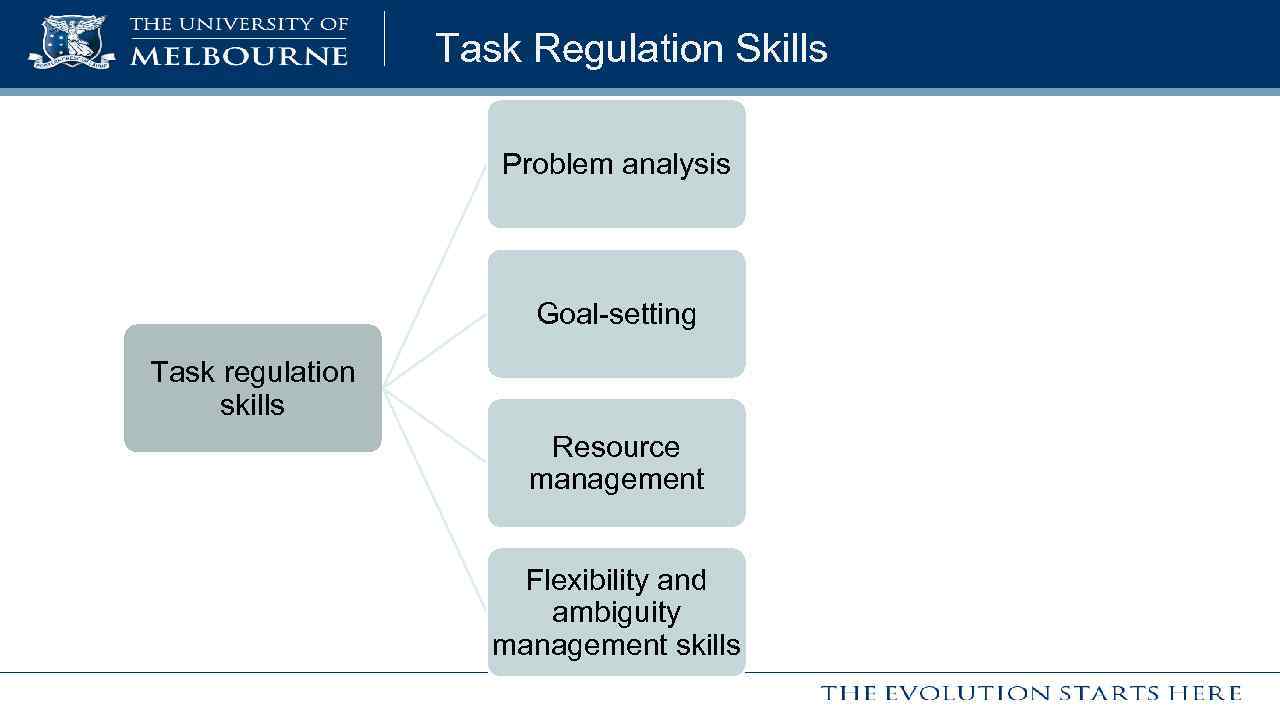 Task Regulation Skills Problem analysis Goal-setting Task regulation skills Resource management Flexibility and ambiguity management skills
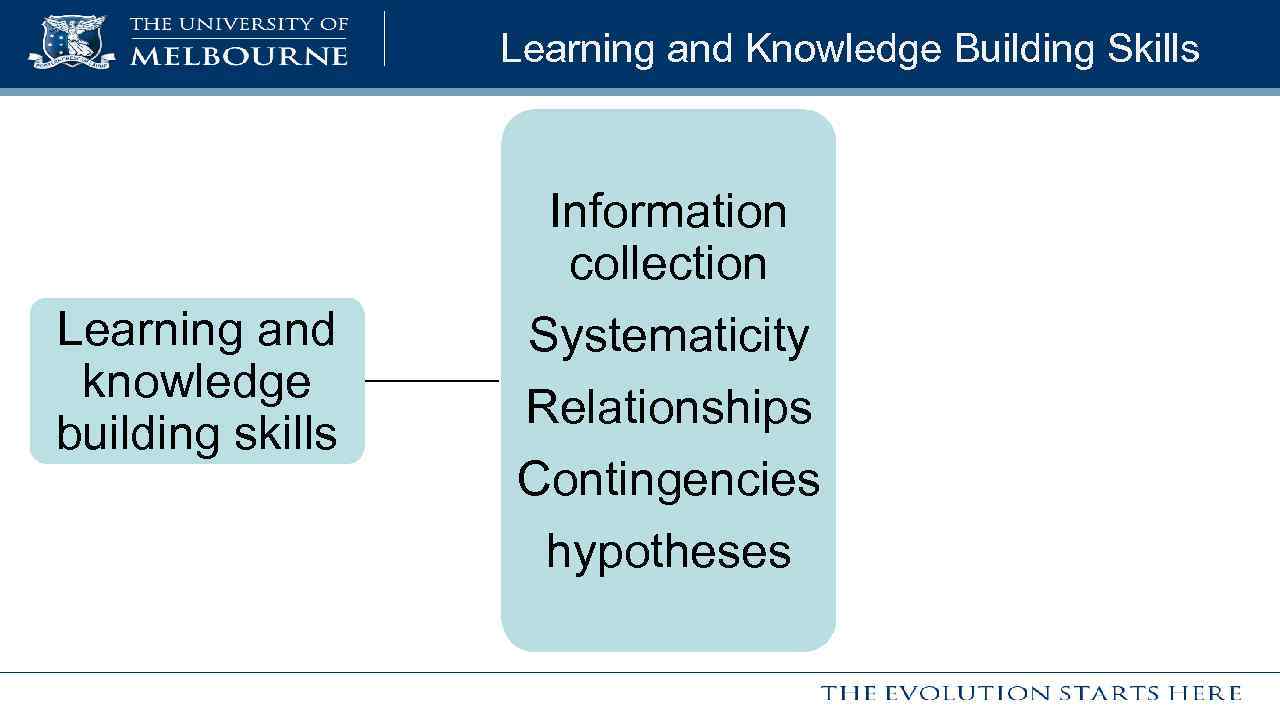 Learning and Knowledge Building Skills Learning and knowledge building skills Information collection Systematicity Relationships Contingencies hypotheses
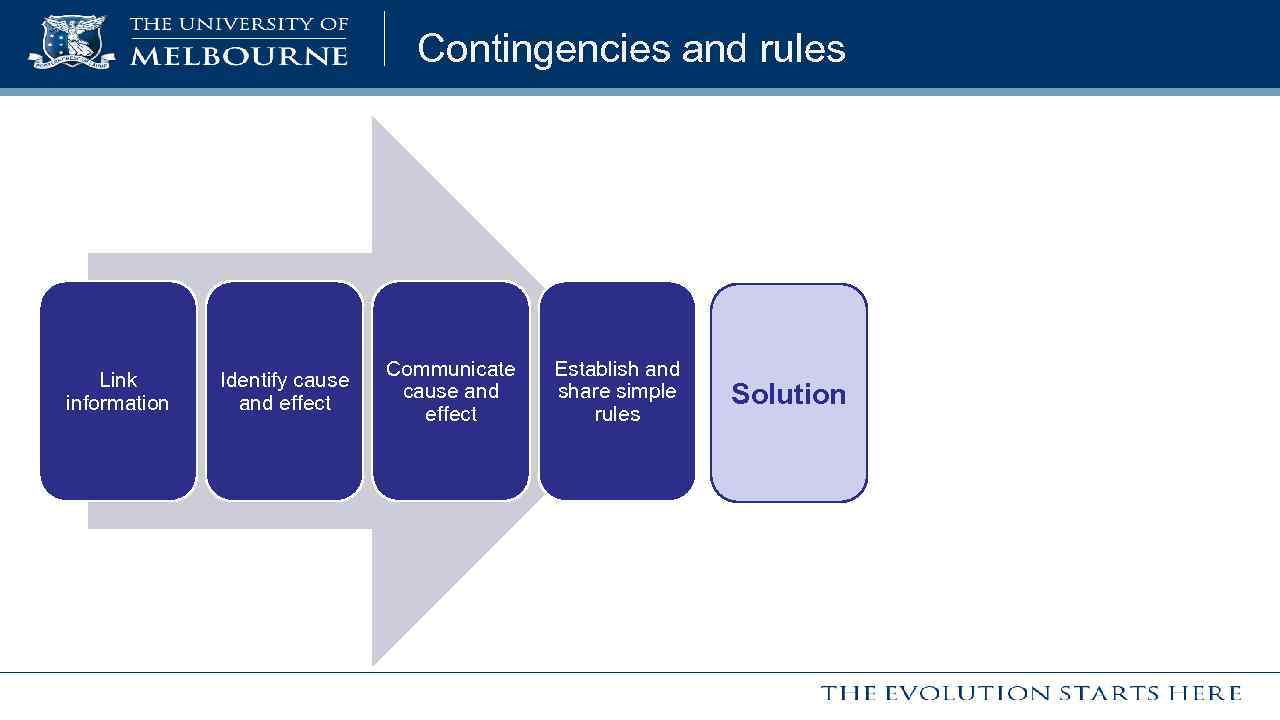 Contingencies and rules Link information Identify cause and effect Communicate cause and effect Establish and share simple rules Solution
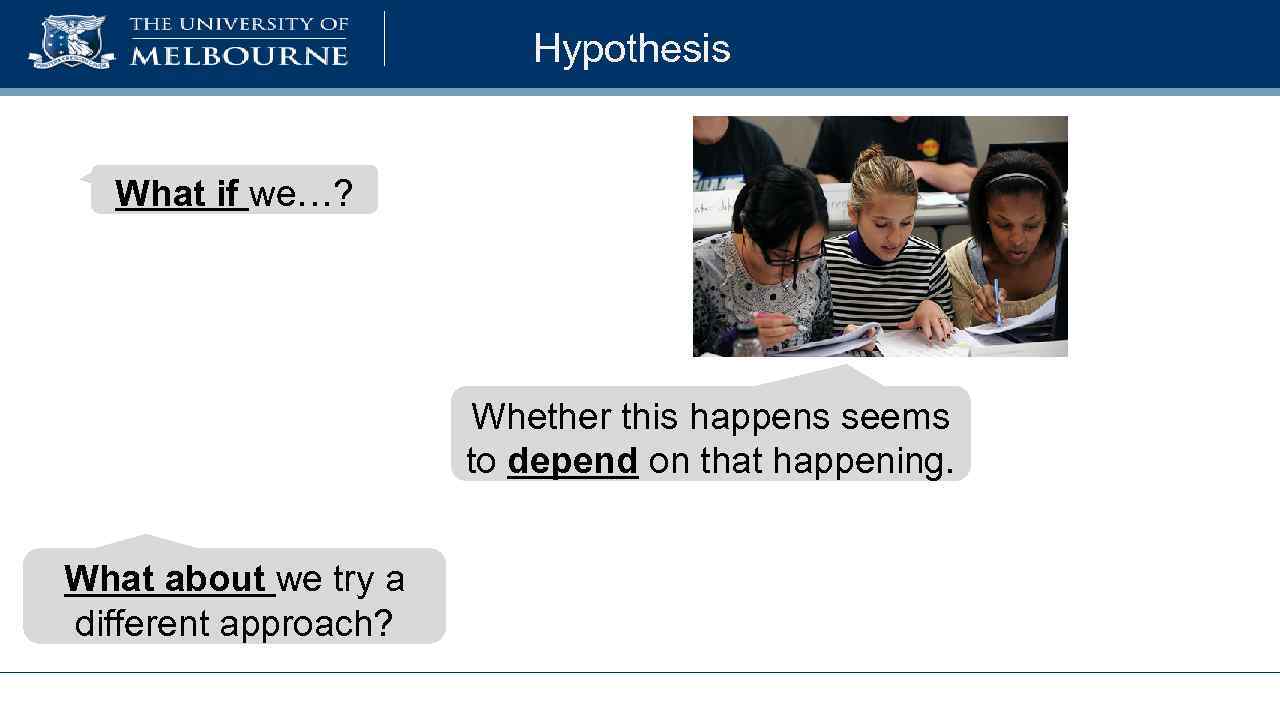 Hypothesis What if we…? Whether this happens seems to depend on that happening. What about we try a different approach?
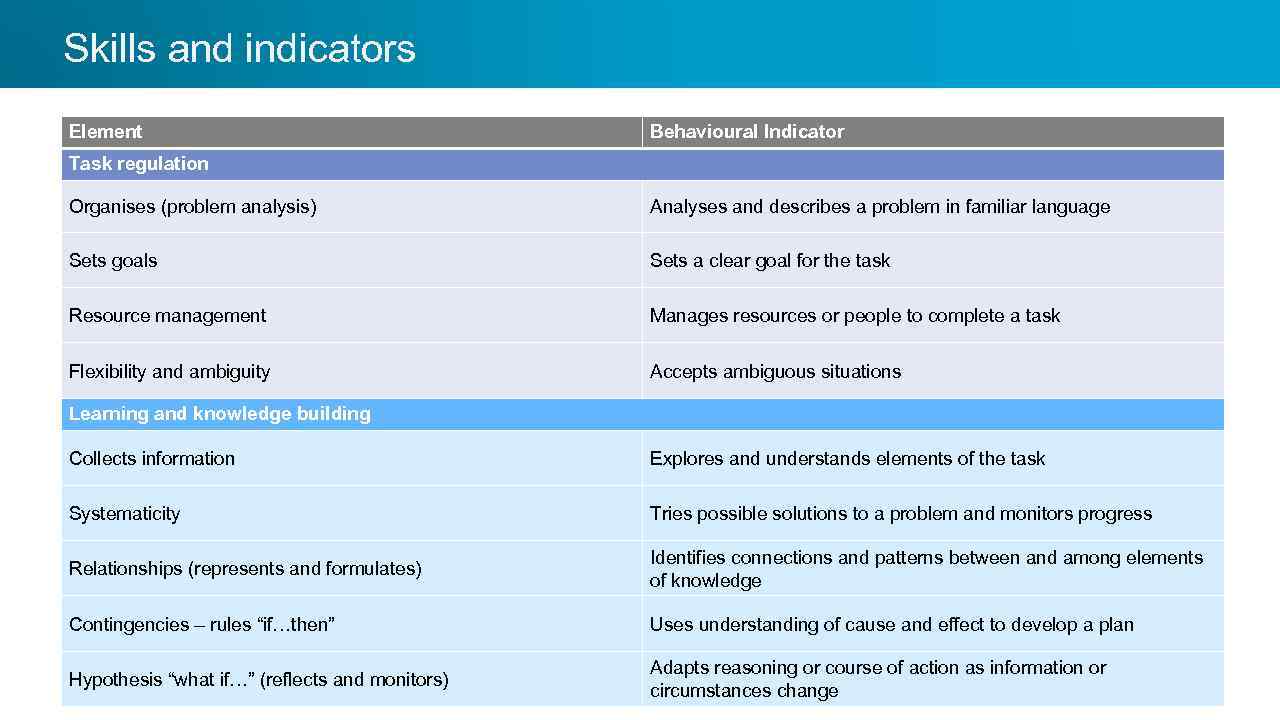 Skills and indicators Element Behavioural Indicator Task regulation Organises (problem analysis) Analyses and describes a problem in familiar language Sets goals Sets a clear goal for the task Resource management Manages resources or people to complete a task Flexibility and ambiguity Accepts ambiguous situations Learning and knowledge building Collects information Explores and understands elements of the task Systematicity Tries possible solutions to a problem and monitors progress Relationships (represents and formulates) Identifies connections and patterns between and among elements of knowledge Contingencies – rules “if…then” Uses understanding of cause and effect to develop a plan Hypothesis “what if…” (reflects and monitors) Adapts reasoning or course of action as information or circumstances change
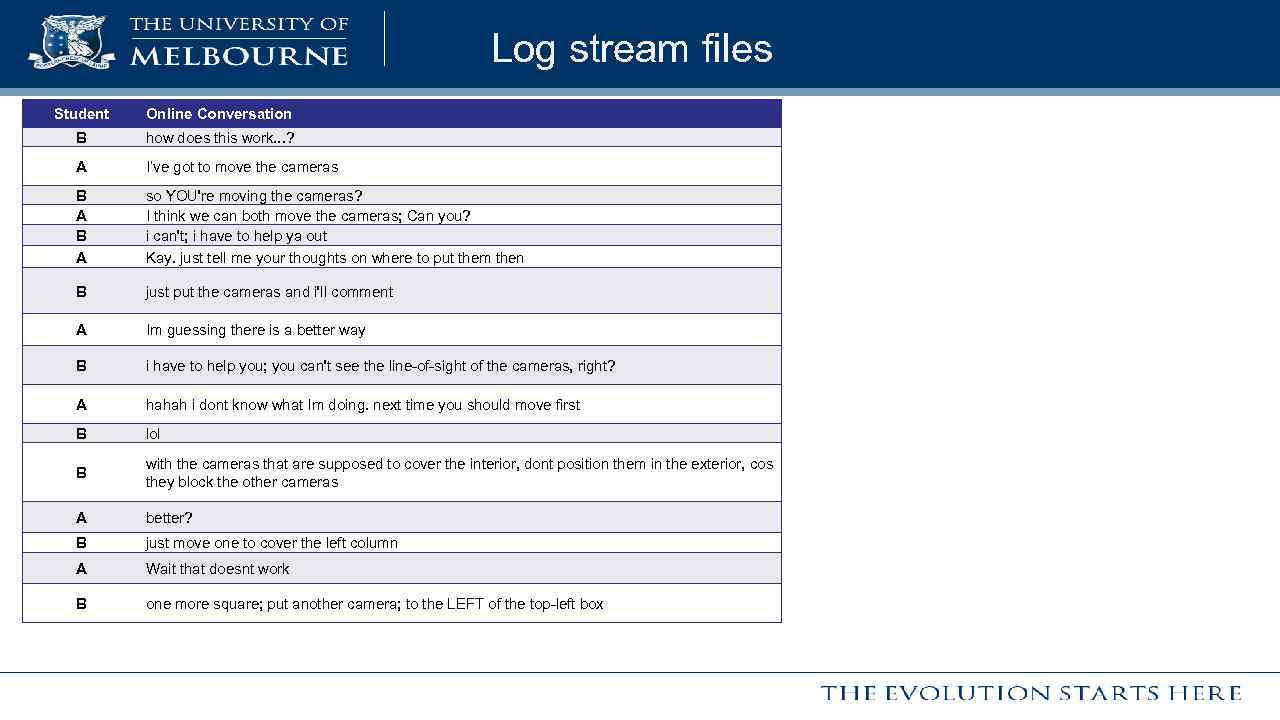 Log stream files Student Online Conversation B how does this work. . . ? A I’ve got to move the cameras B A so YOU're moving the cameras? I think we can both move the cameras; Can you? i can't; i have to help ya out Kay. just tell me your thoughts on where to put them then B just put the cameras and i'll comment A Im guessing there is a better way B i have to help you; you can't see the line-of-sight of the cameras, right? A hahah i dont know what Im doing. next time you should move first B lol B with the cameras that are supposed to cover the interior, dont position them in the exterior, cos they block the other cameras A better? B just move one to cover the left column A Wait that doesnt work B one more square; put another camera; to the LEFT of the top-left box
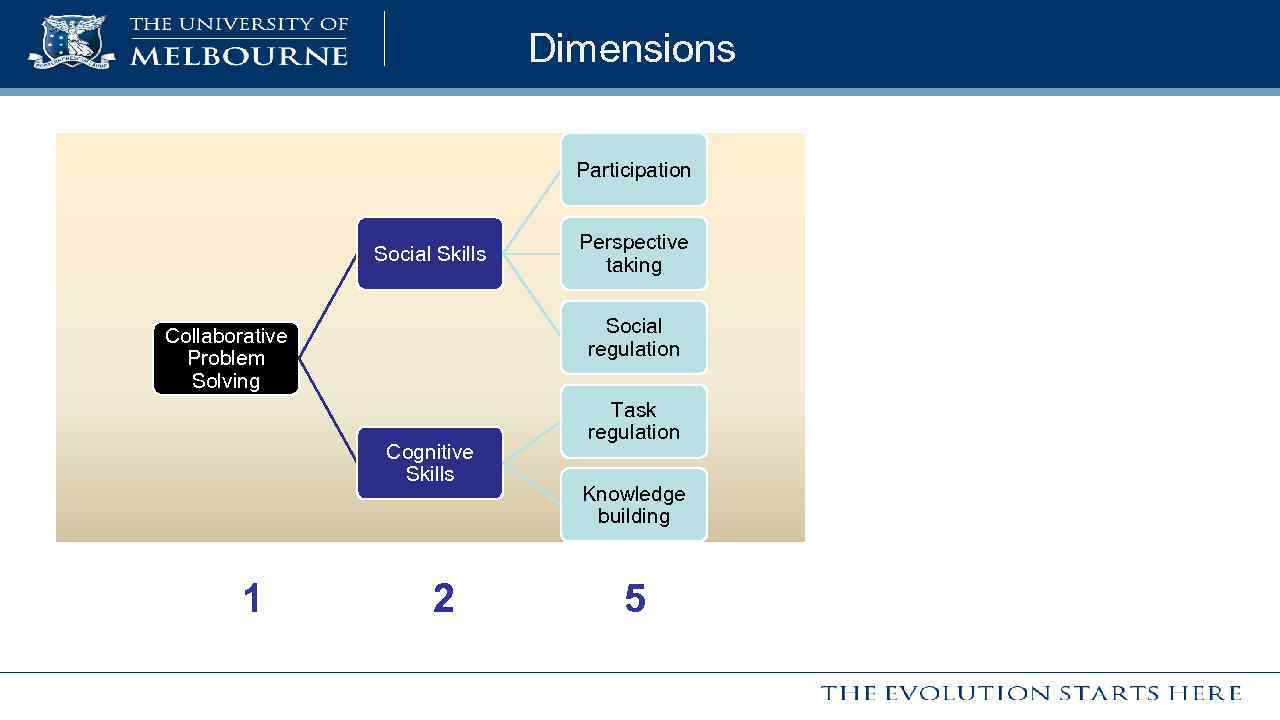 Dimensions Participation Social Skills Social regulation Collaborative Problem Solving Cognitive Skills 1 Perspective taking 2 Task regulation Knowledge building 5
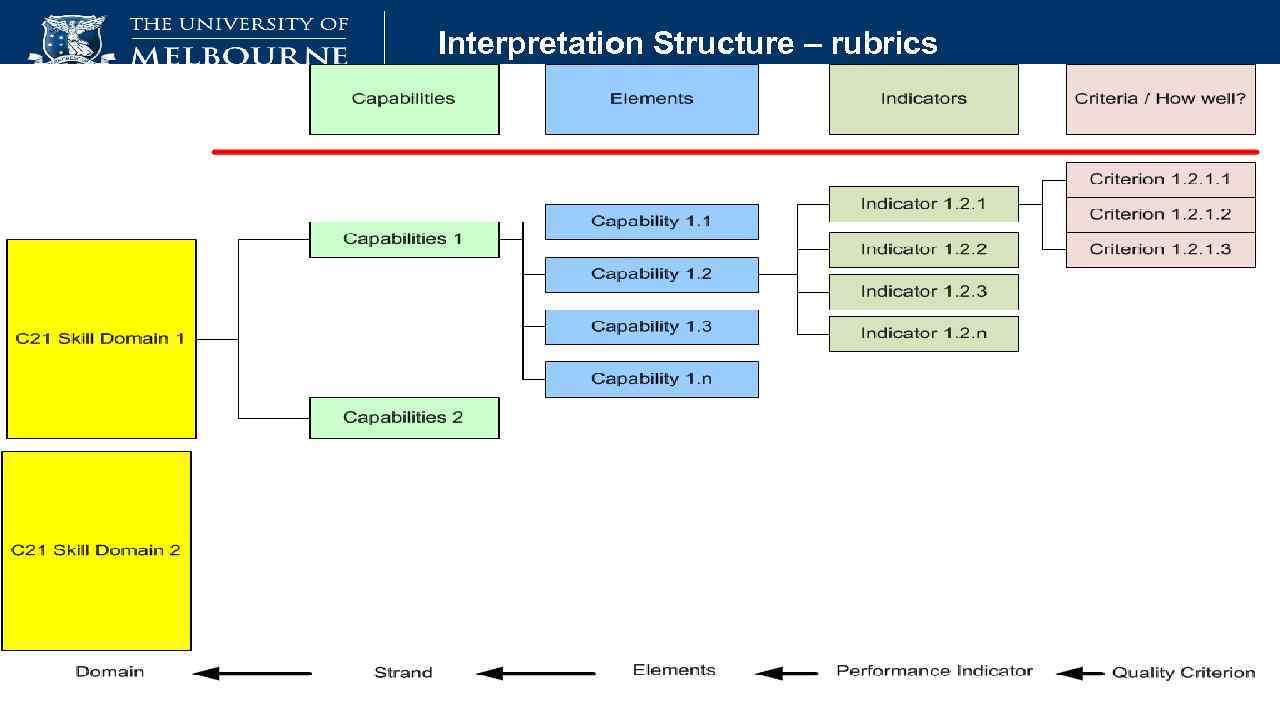 Interpretation Structure – rubrics
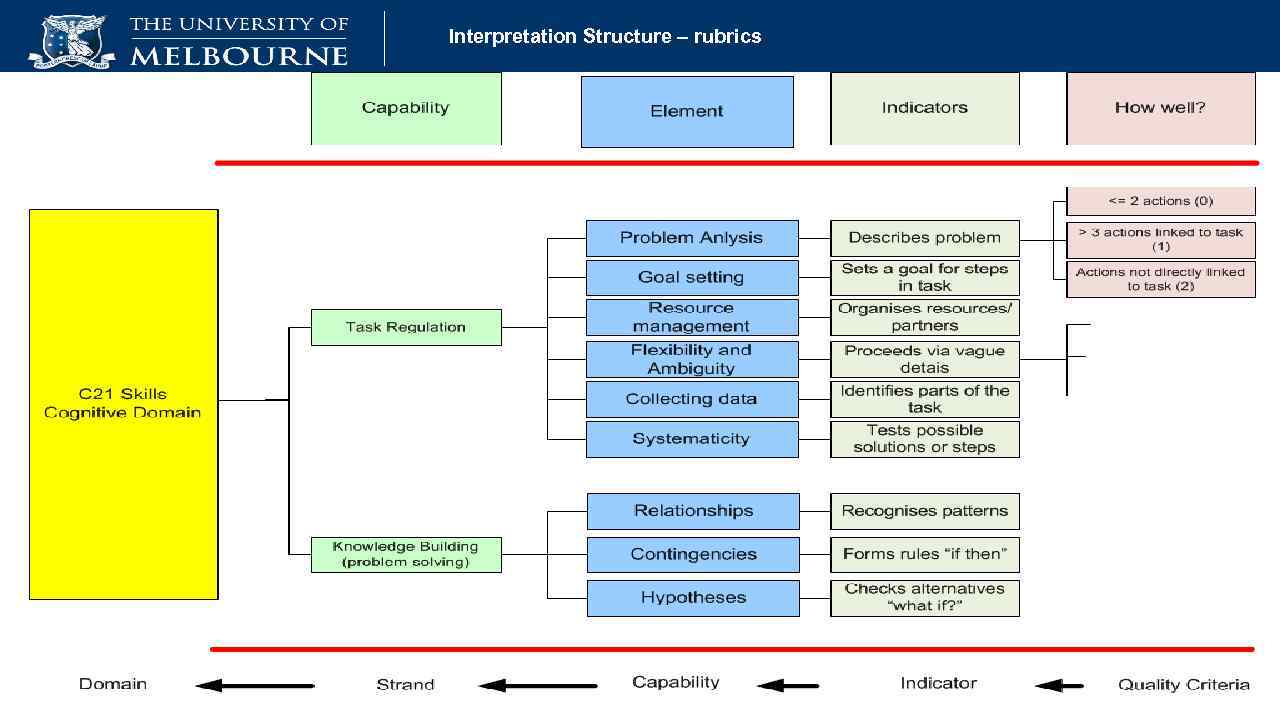 Interpretation Structure – rubrics
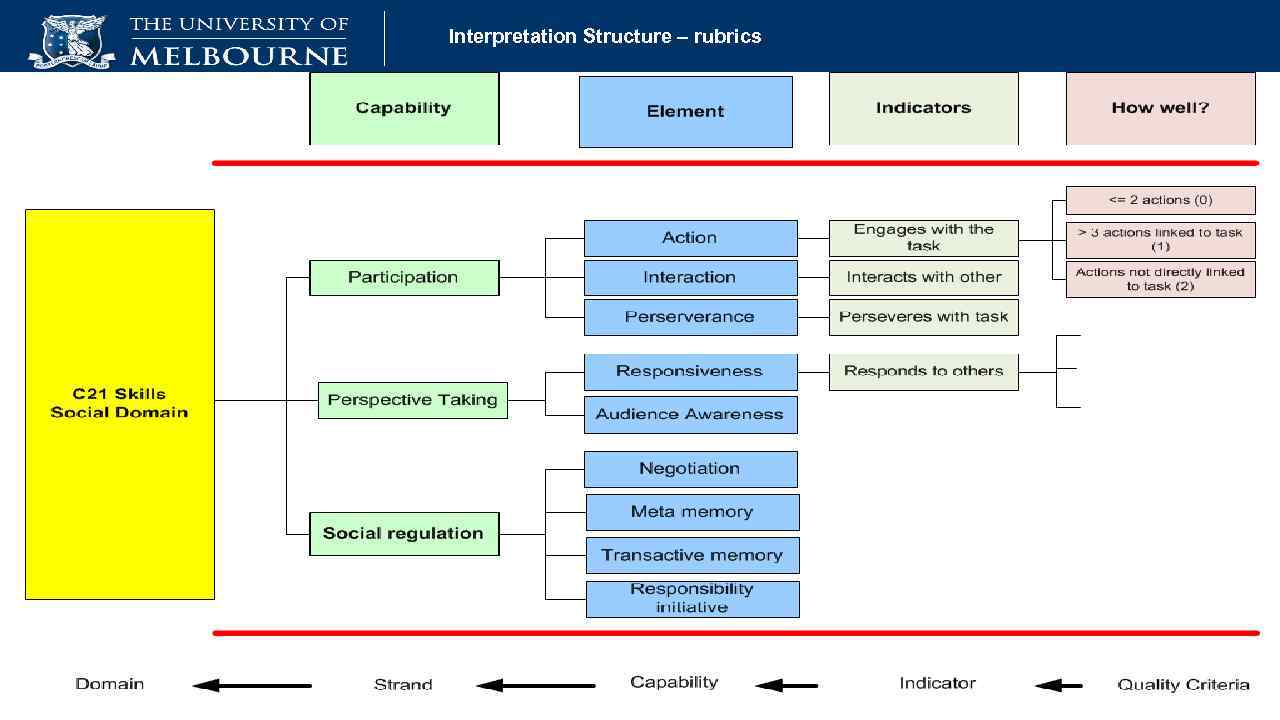 Interpretation Structure – rubrics
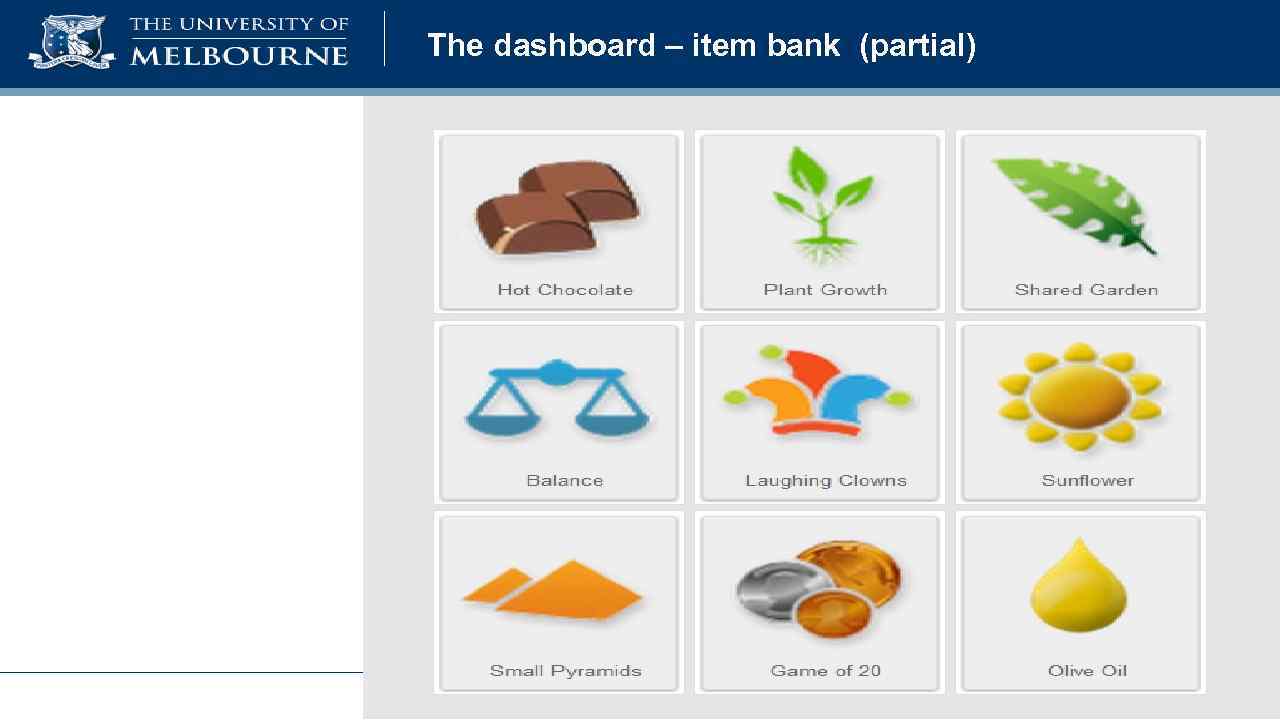 The dashboard – item bank (partial)
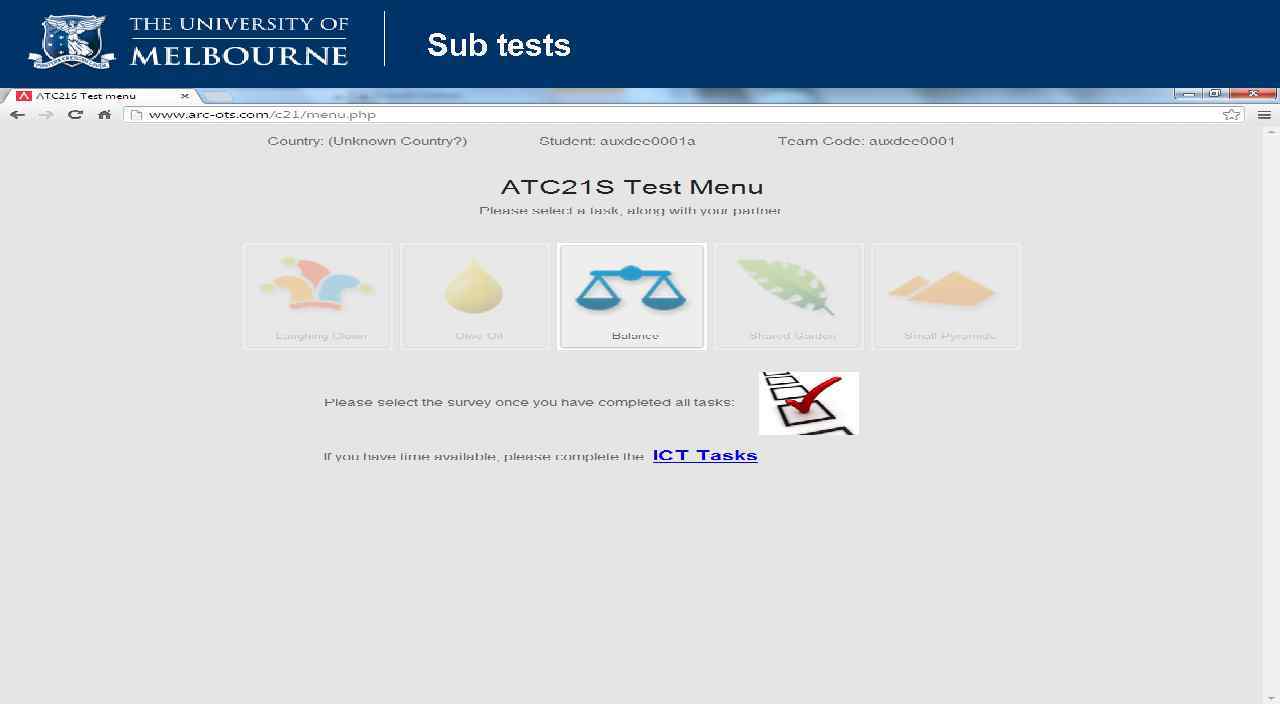 Sub tests
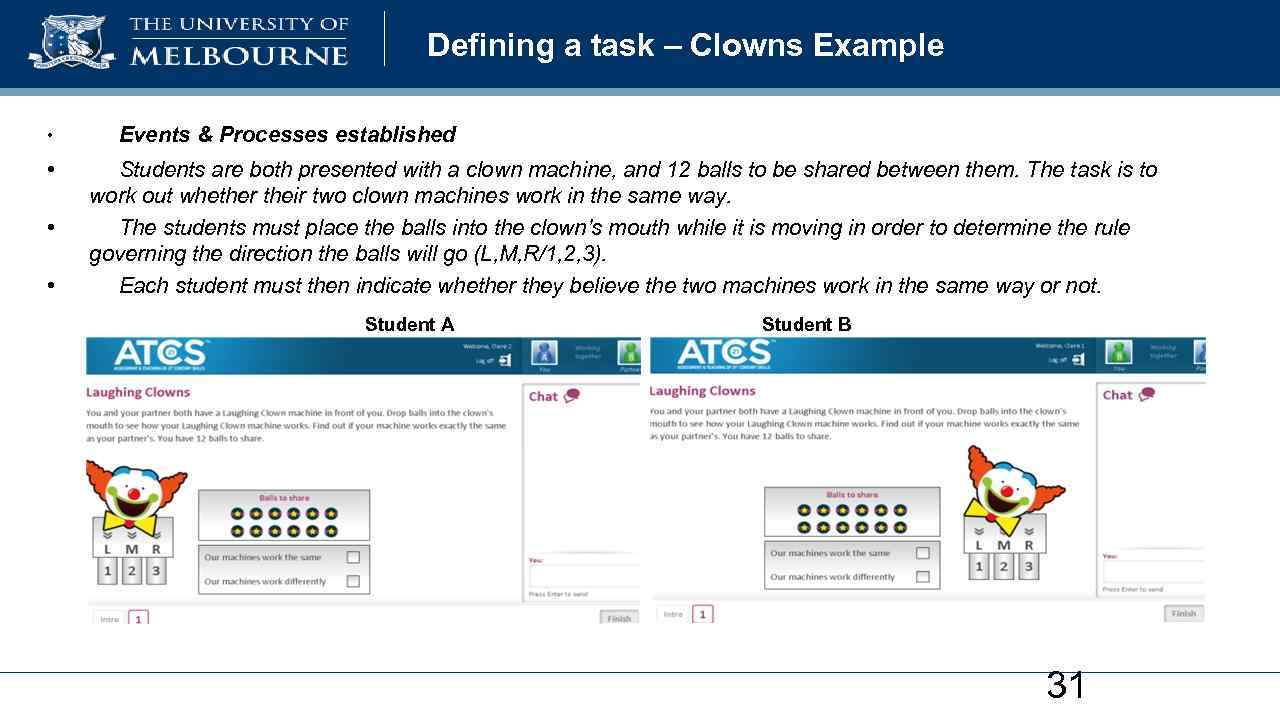 Defining a task – Clowns Example • • Events & Processes established Students are both presented with a clown machine, and 12 balls to be shared between them. The task is to work out whether their two clown machines work in the same way. The students must place the balls into the clown’s mouth while it is moving in order to determine the rule governing the direction the balls will go (L, M, R/1, 2, 3). Each student must then indicate whether they believe the two machines work in the same way or not. Student A Student B 31
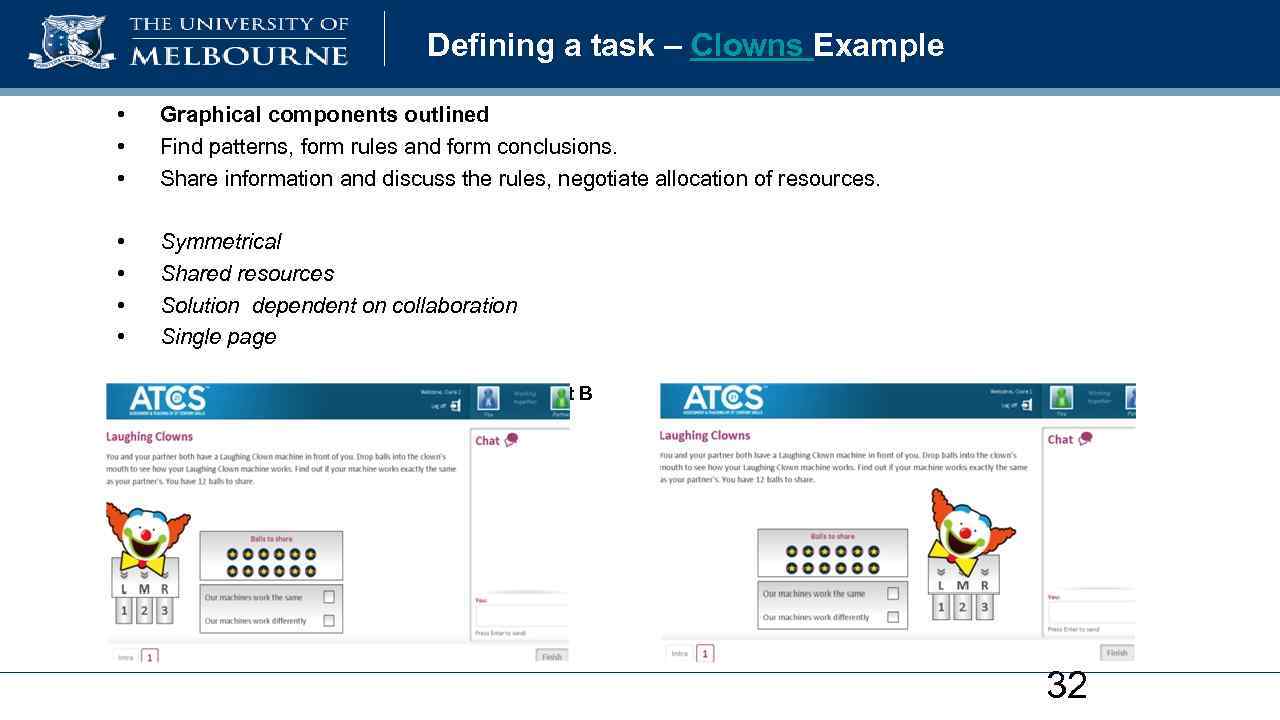 Defining a task – Clowns Example • • • Graphical components outlined Find patterns, form rules and form conclusions. Share information and discuss the rules, negotiate allocation of resources. • • Symmetrical Shared resources Solution dependent on collaboration Single page • Student A Student B • Student B 32
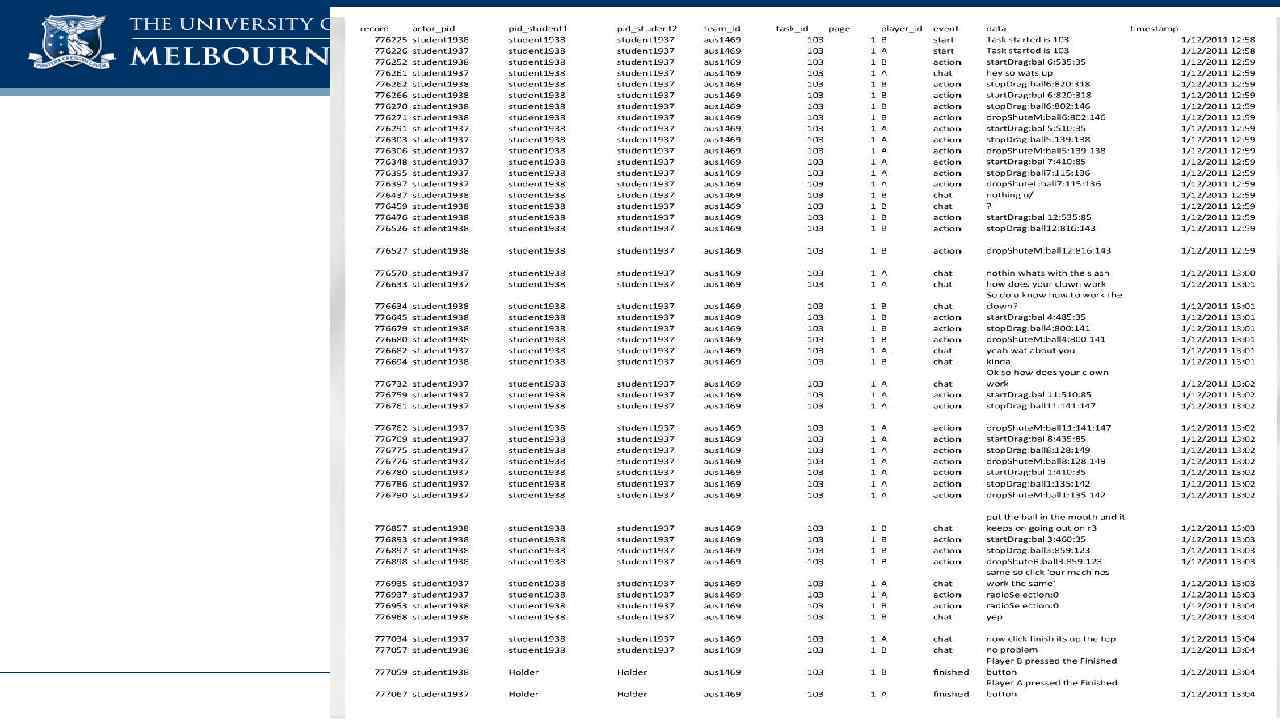
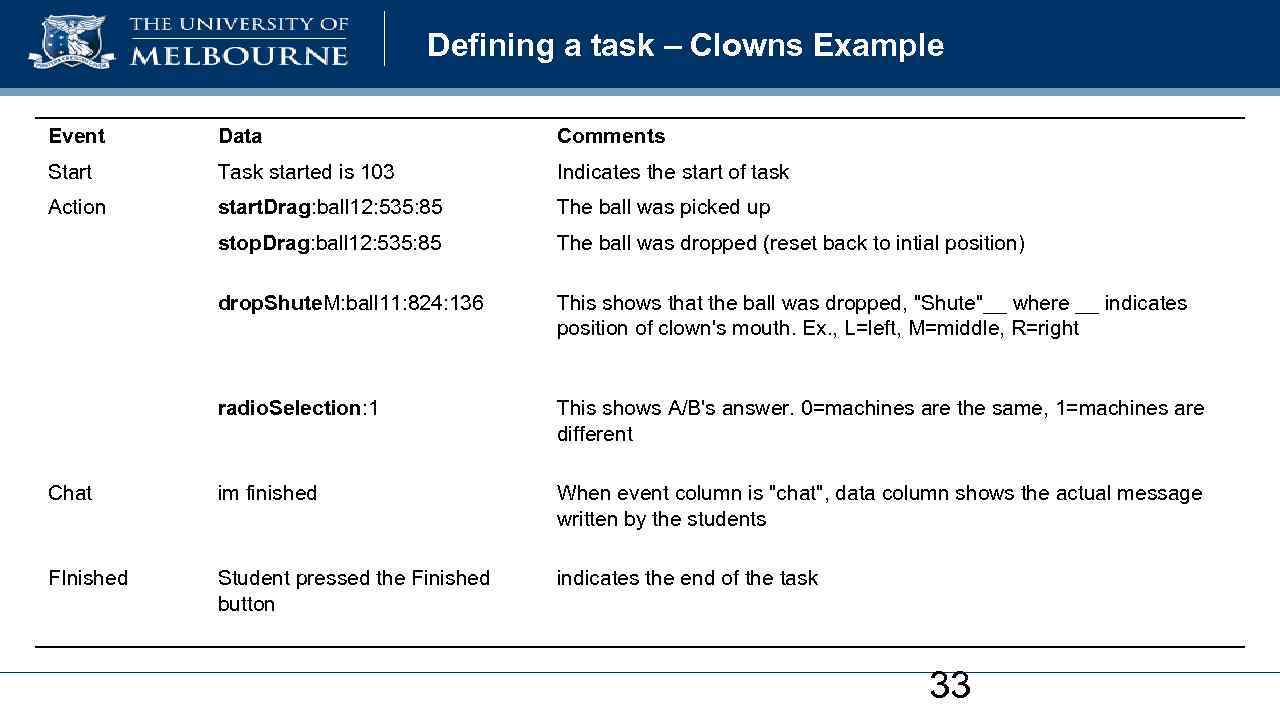 Defining a task – Clowns Example Event Data Comments Start Task started is 103 Indicates the start of task Action start. Drag: ball 12: 535: 85 The ball was picked up stop. Drag: ball 12: 535: 85 The ball was dropped (reset back to intial position) drop. Shute. M: ball 11: 824: 136 This shows that the ball was dropped, "Shute"__ where __ indicates position of clown's mouth. Ex. , L=left, M=middle, R=right radio. Selection: 1 This shows A/B's answer. 0=machines are the same, 1=machines are different Chat im finished When event column is "chat", data column shows the actual message written by the students FInished Student pressed the Finished button indicates the end of the task 33
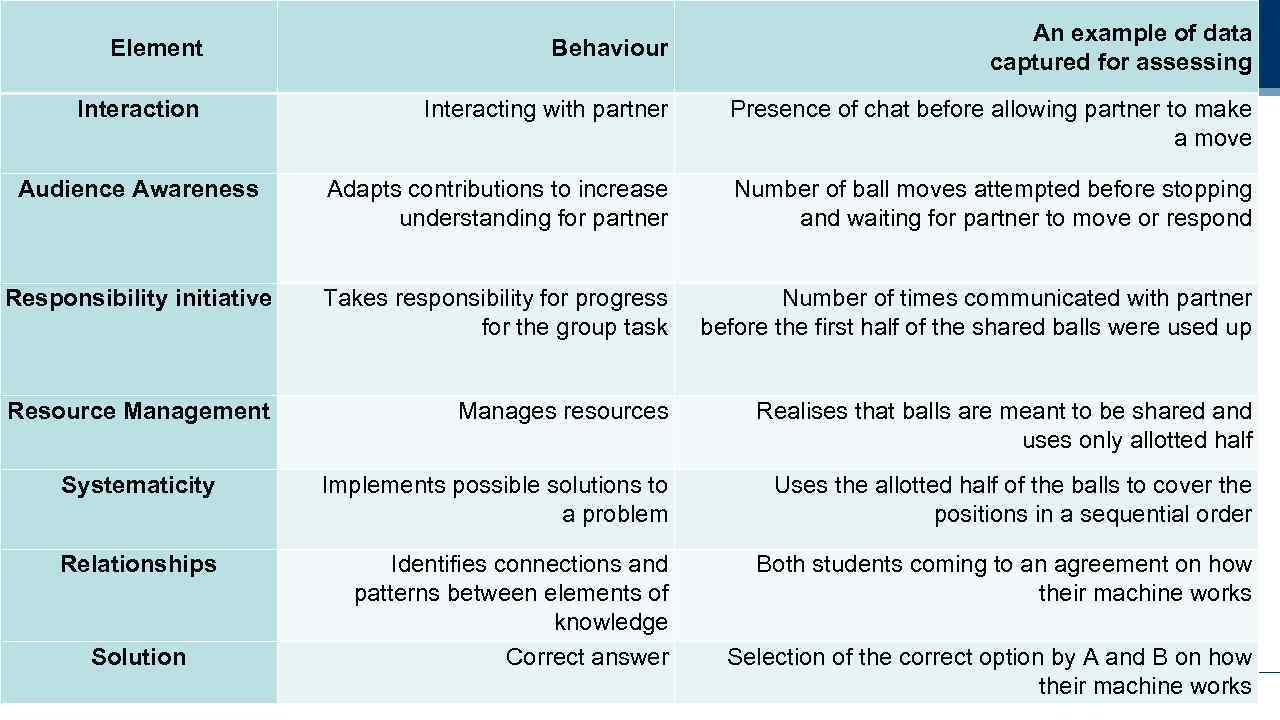 An example of data captured for assessing Element Behaviour Interaction Interacting with partner Presence of chat before allowing partner to make a move Audience Awareness Adapts contributions to increase understanding for partner Number of ball moves attempted before stopping and waiting for partner to move or respond Responsibility initiative Takes responsibility for progress for the group task Number of times communicated with partner before the first half of the shared balls were used up Resource Management Manages resources Realises that balls are meant to be shared and uses only allotted half Systematicity Implements possible solutions to a problem Uses the allotted half of the balls to cover the positions in a sequential order Relationships Identifies connections and patterns between elements of knowledge Correct answer Both students coming to an agreement on how their machine works Solution Selection of the correct option by A and B on how their machine works
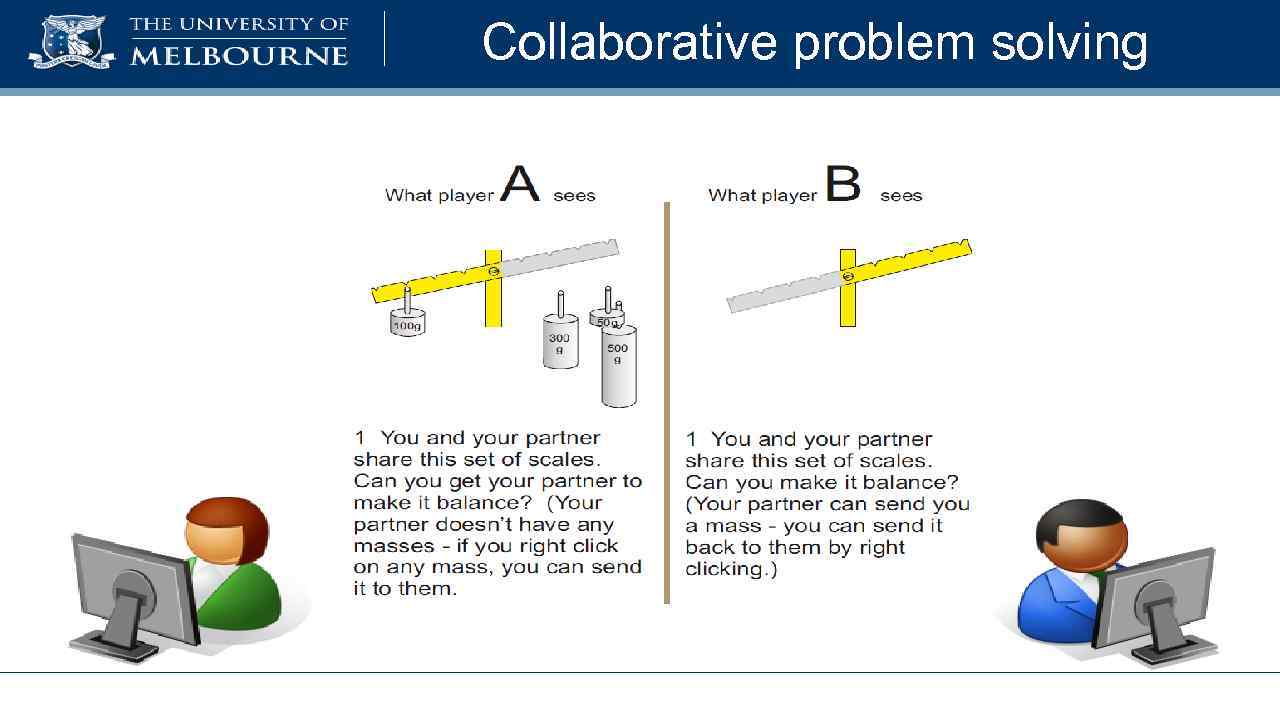 Collaborative problem solving
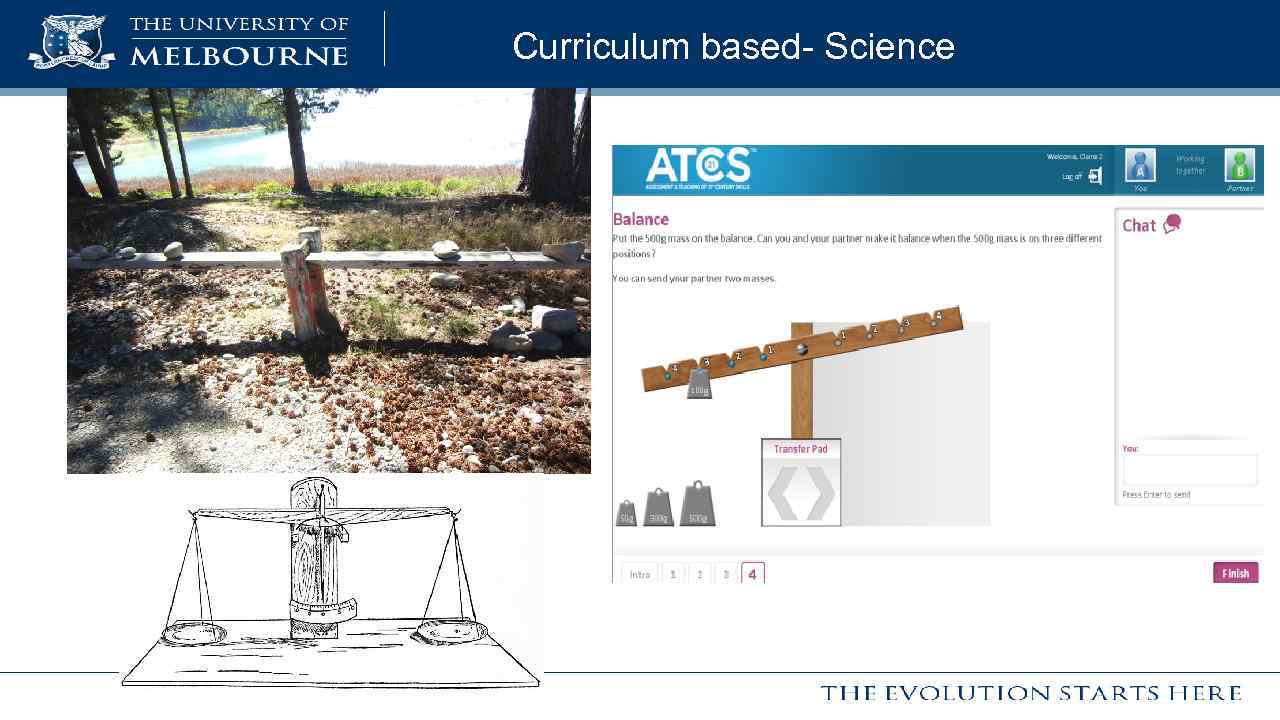 Curriculum based- Science
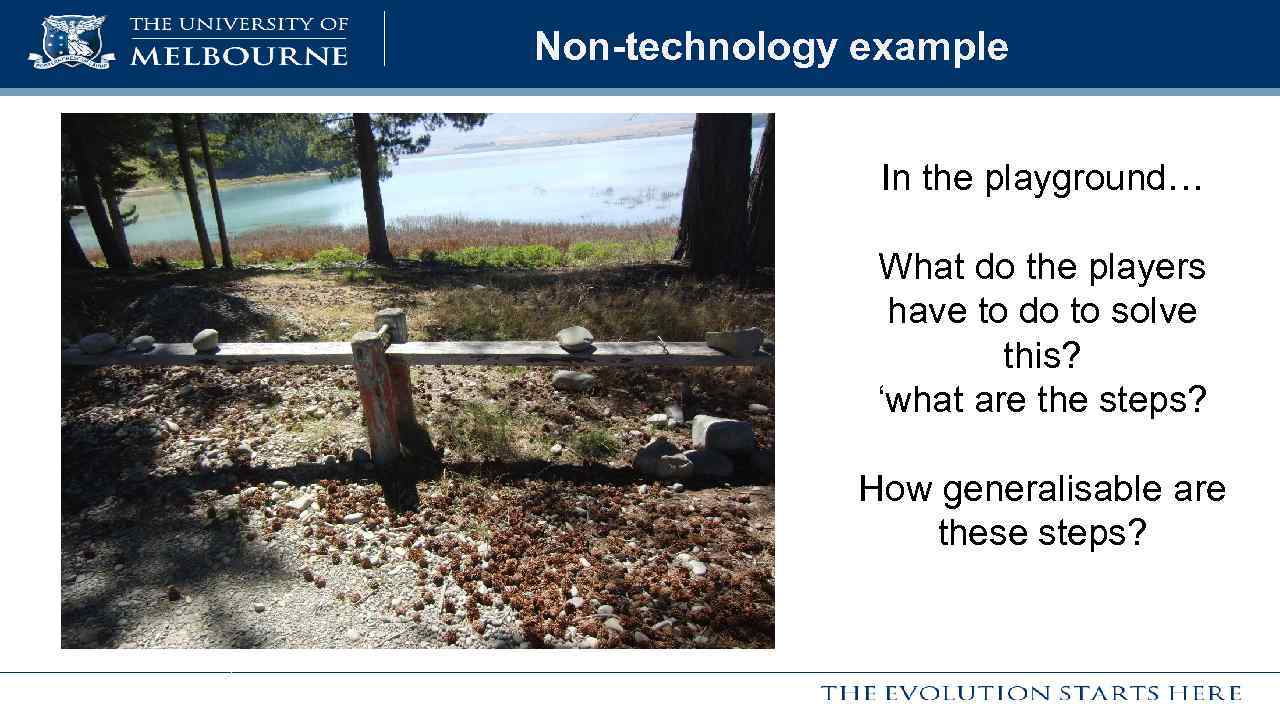 Non-technology example Part Content In the playground… What do the players have to do to solve this? ‘what are the steps? How generalisable are these steps?
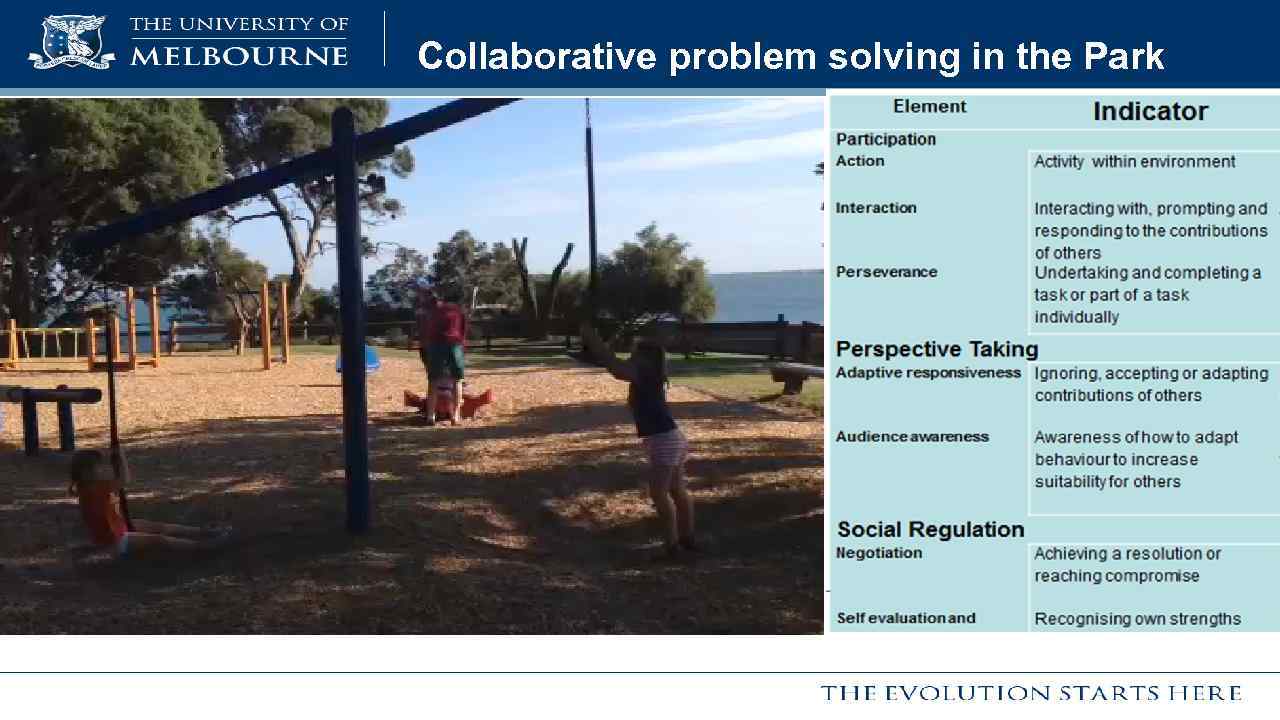 Collaborative problem solving in the Park
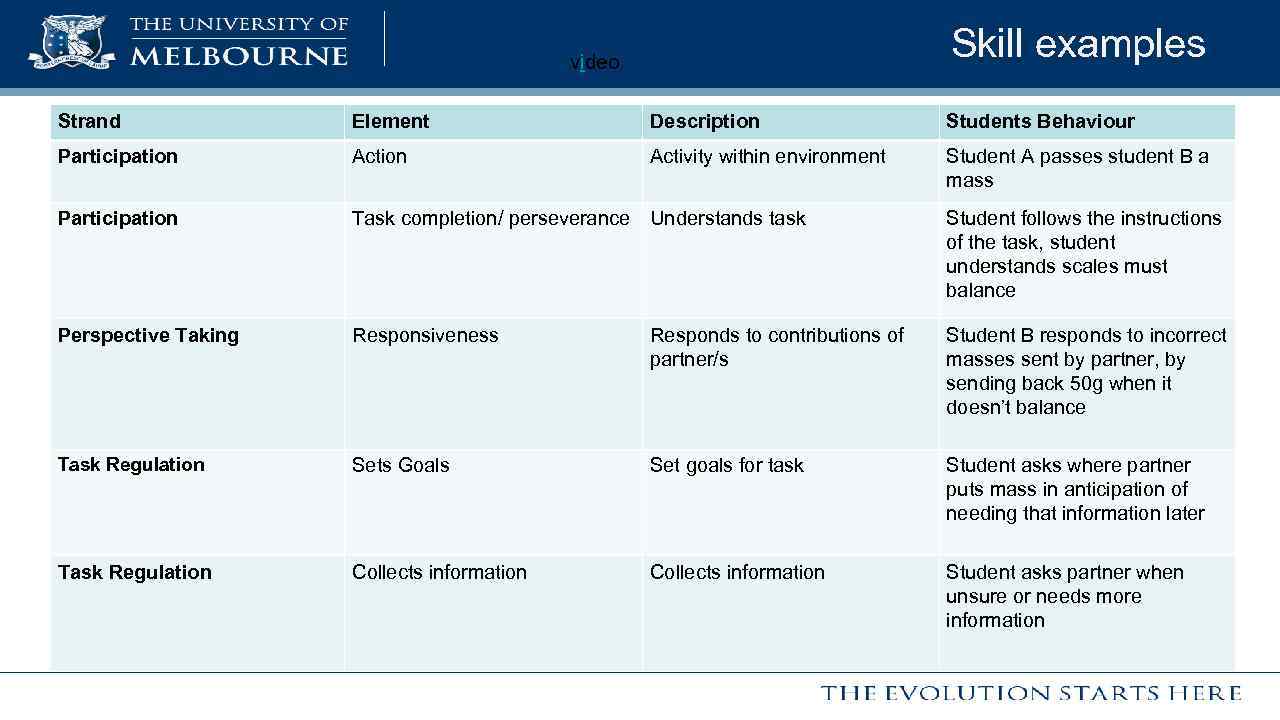 Skill examples video Strand Element Description Students Behaviour Participation Activity within environment Student A passes student B a mass Participation Task completion/ perseverance Understands task Student follows the instructions of the task, student understands scales must balance Perspective Taking Responsiveness Responds to contributions of partner/s Student B responds to incorrect masses sent by partner, by sending back 50 g when it doesn’t balance Task Regulation Sets Goals Set goals for task Student asks where partner puts mass in anticipation of needing that information later Task Regulation Collects information Student asks partner when unsure or needs more information
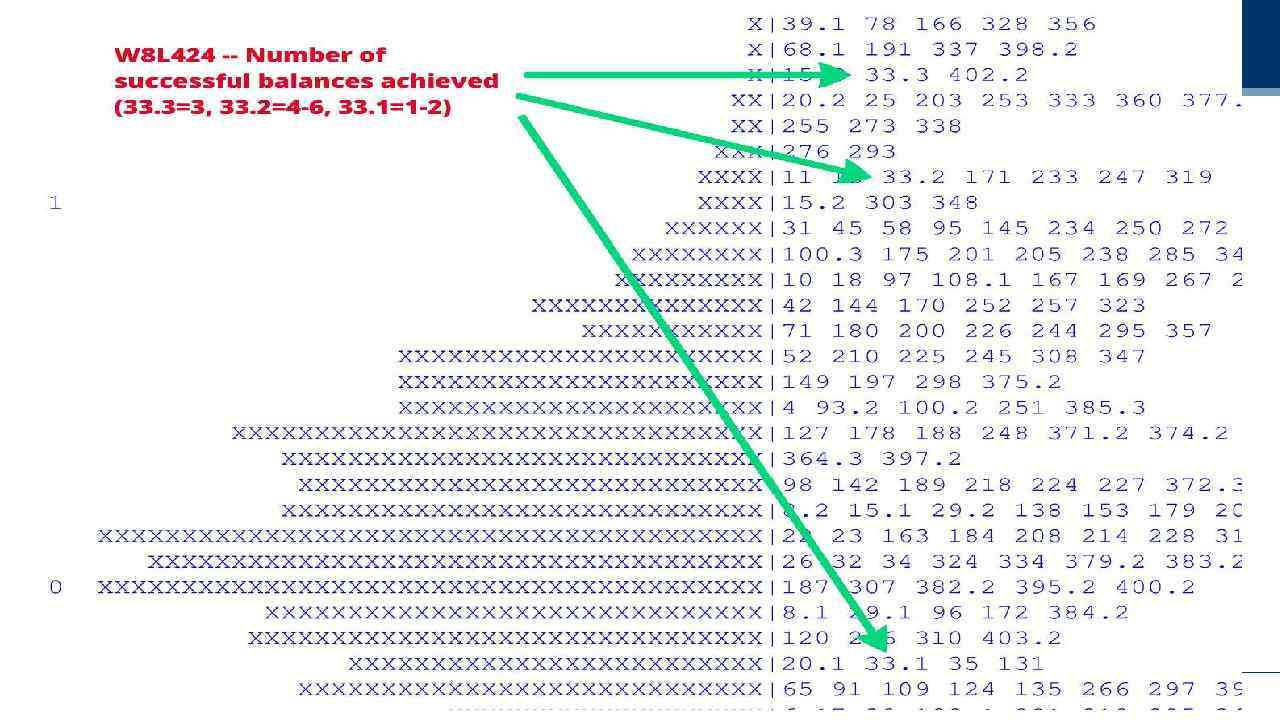
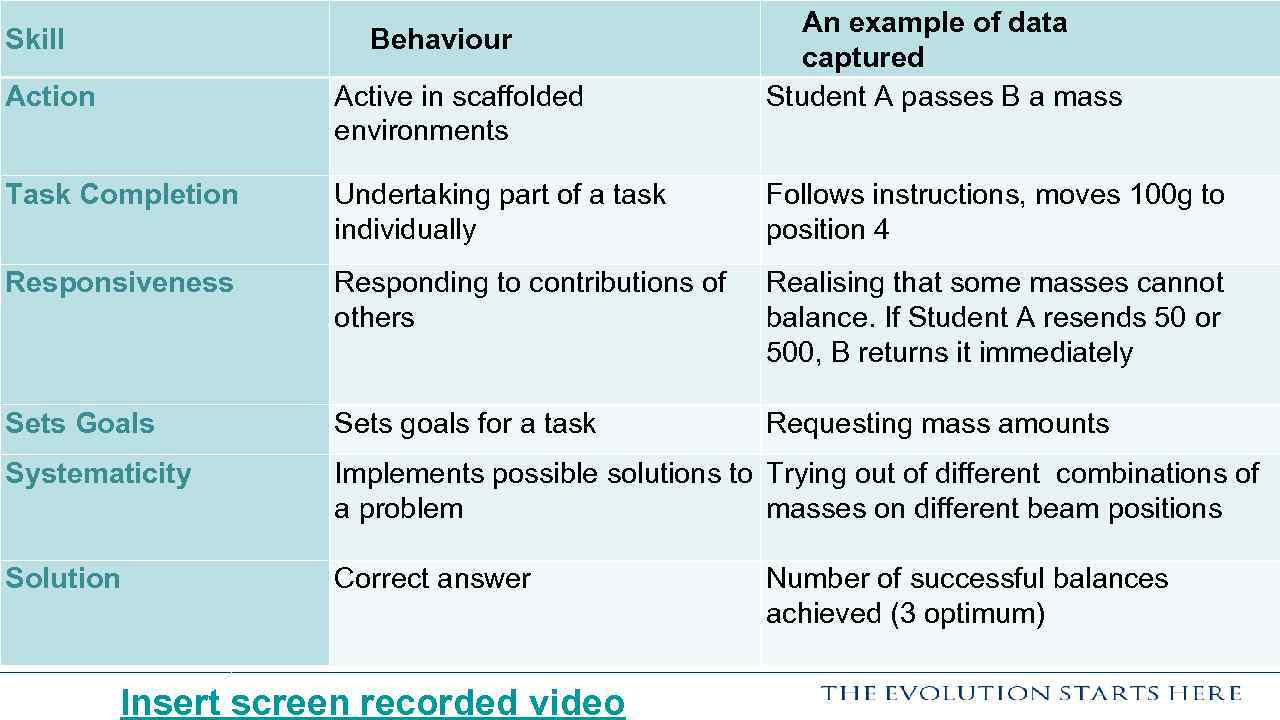 Skill Behaviour An example of data Balance Beam captured Student A passes B a mass Action Active in scaffolded environments Task Completion Undertaking part of a task individually Follows instructions, moves 100 g to position 4 Responsiveness Responding to contributions of others Realising that some masses cannot balance. If Student A resends 50 or 500, B returns it immediately Sets Goals Sets goals for a task Requesting mass amounts Systematicity Implements possible solutions to Trying out of different combinations of a problem masses on different beam positions Solution Correct answer Insert screen recorded video Number of successful balances achieved (3 optimum)
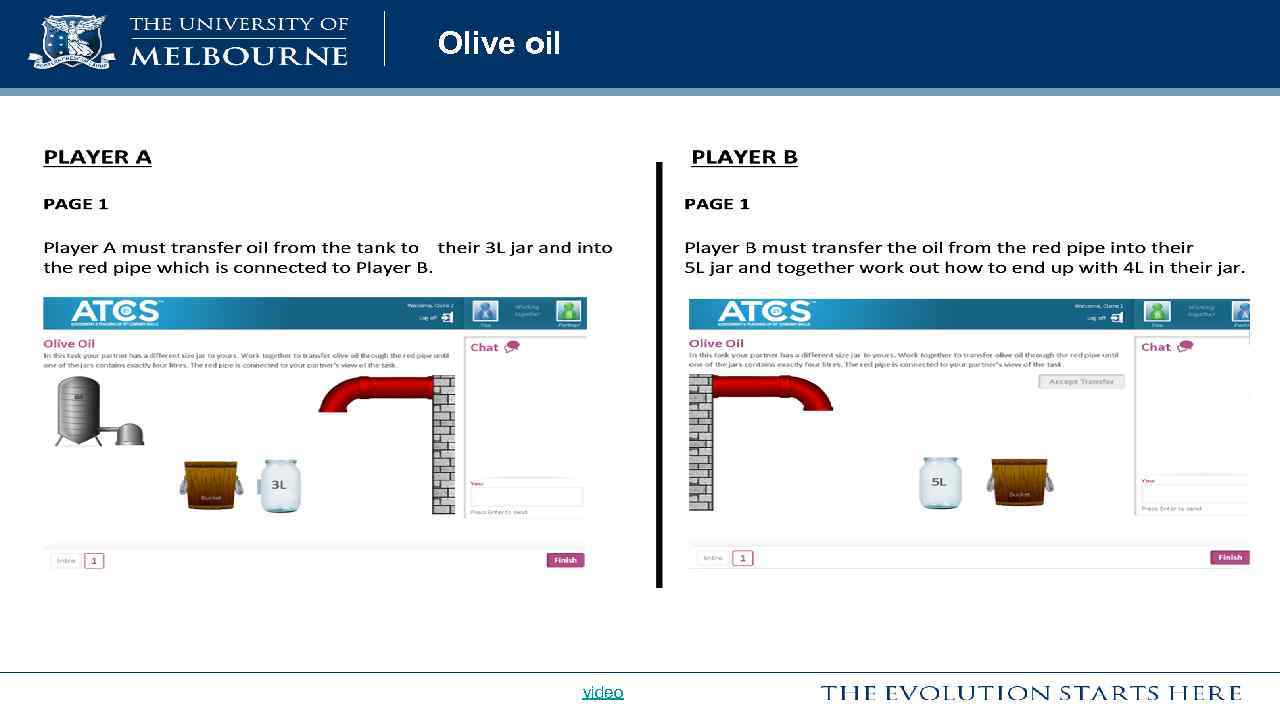 Olive oil video
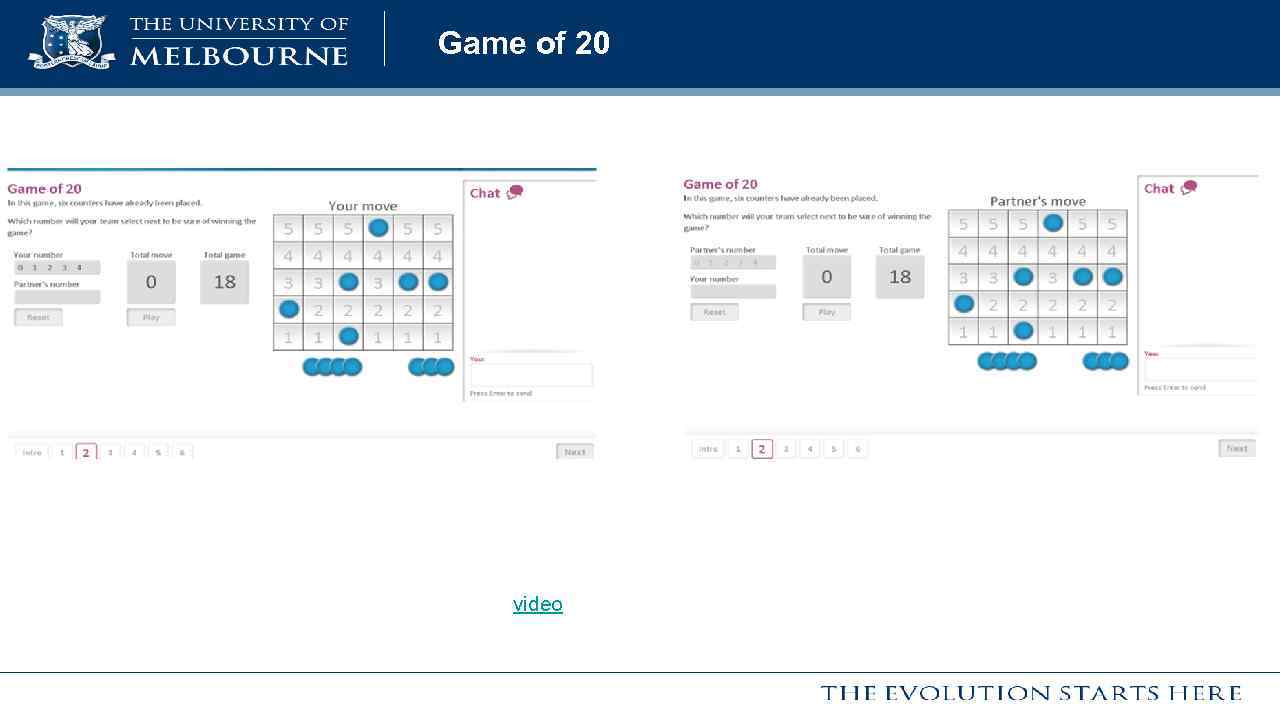 Game of 20 video
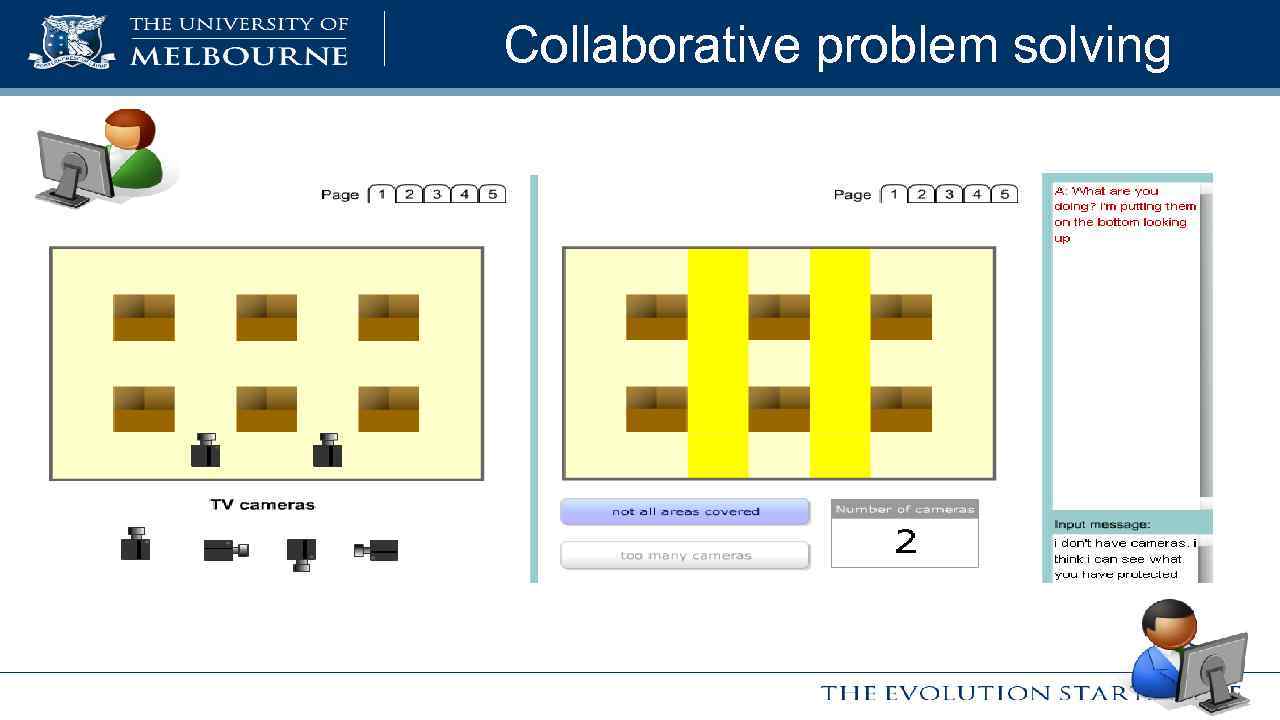 Collaborative problem solving
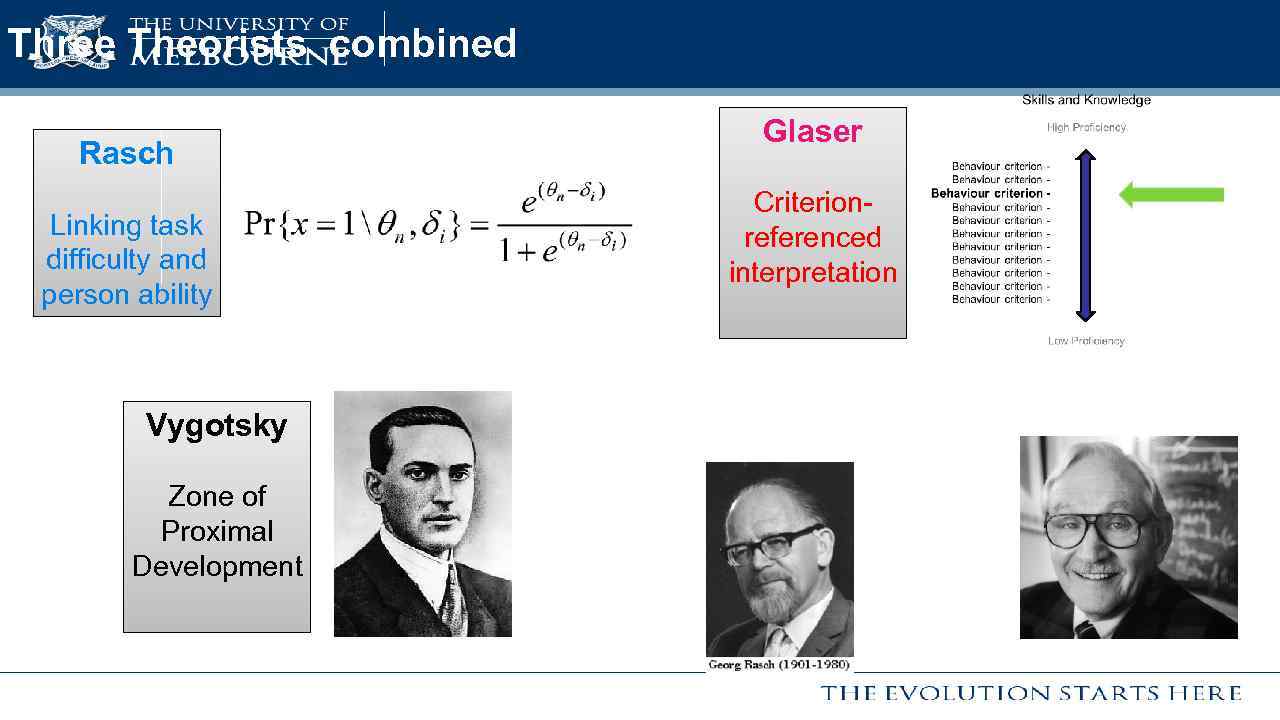 Three Theorists combined Rasch Linking task difficulty and person ability Vygotsky Zone of Proximal Development Glaser Criterionreferenced interpretation
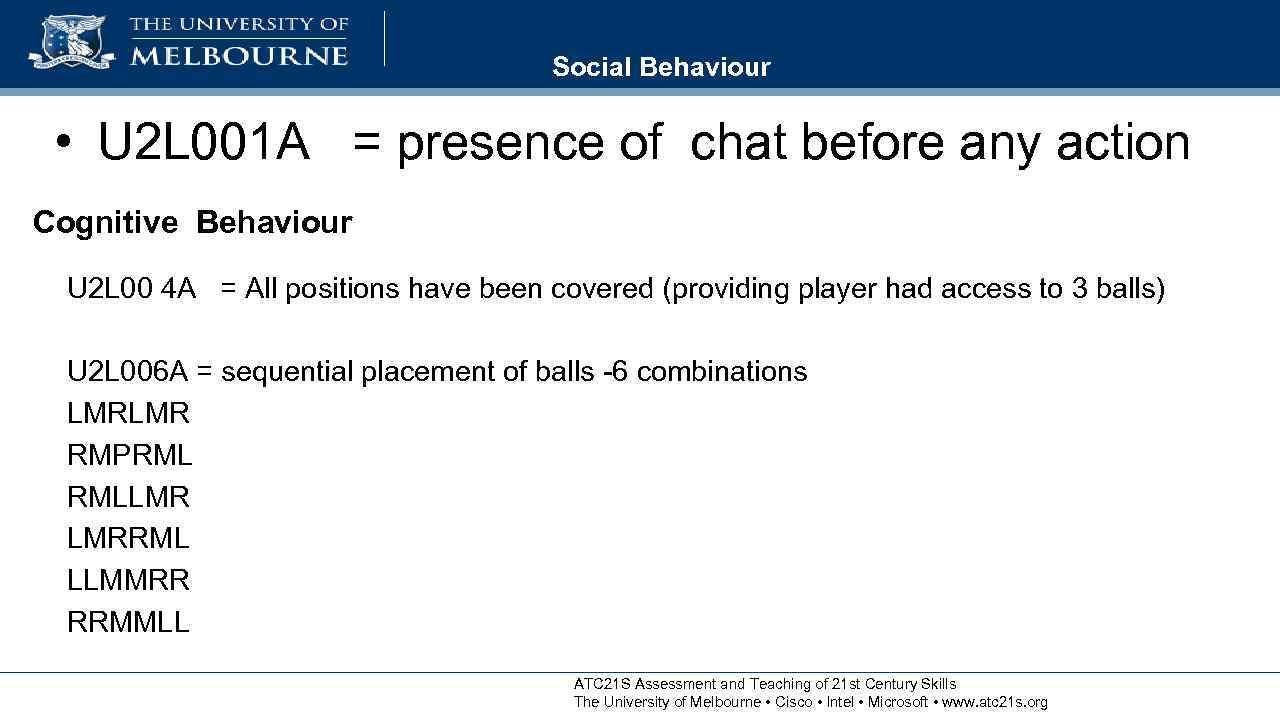 Social Behaviour • U 2 L 001 A = presence of chat before any action Cognitive Behaviour U 2 L 00 4 A = All positions have been covered (providing player had access to 3 balls) U 2 L 006 A = sequential placement of balls -6 combinations LMRLMR RMPRML RMLLMR LMRRML LLMMRR RRMMLL ATC 21 S Assessment and Teaching of 21 st Century Skills The University of Melbourne • Cisco • Intel • Microsoft • www. atc 21 s. org
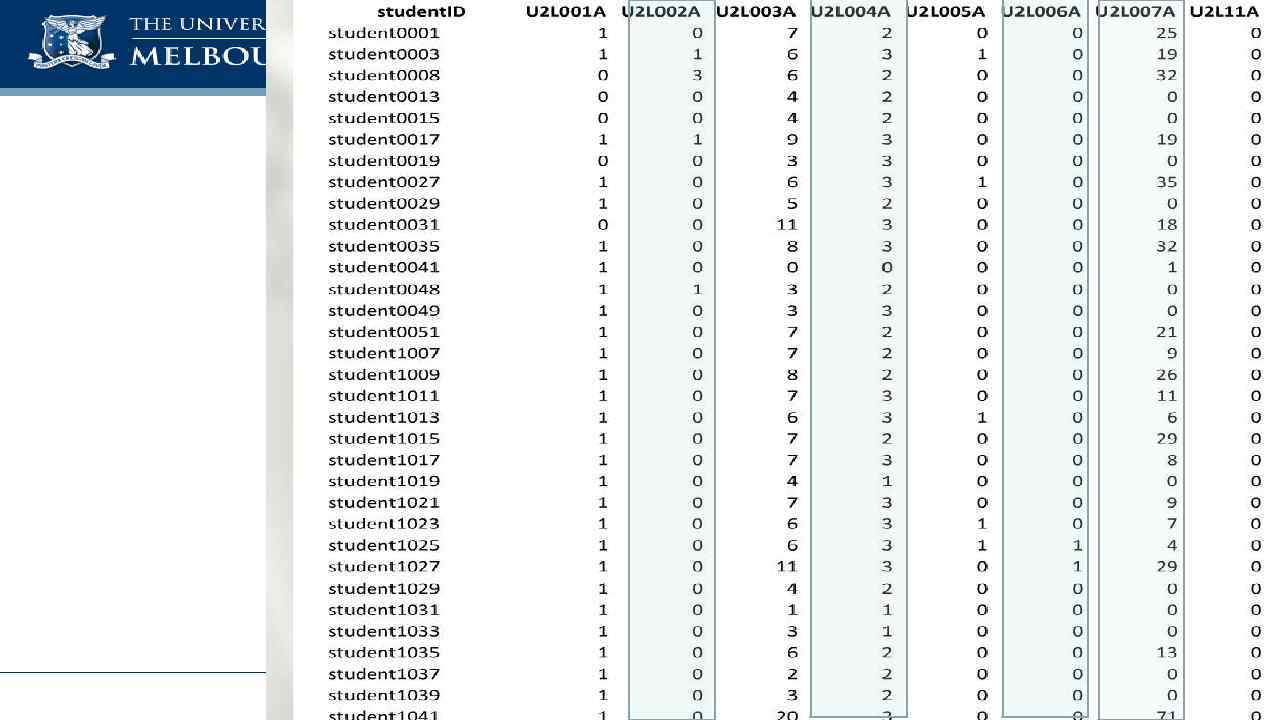
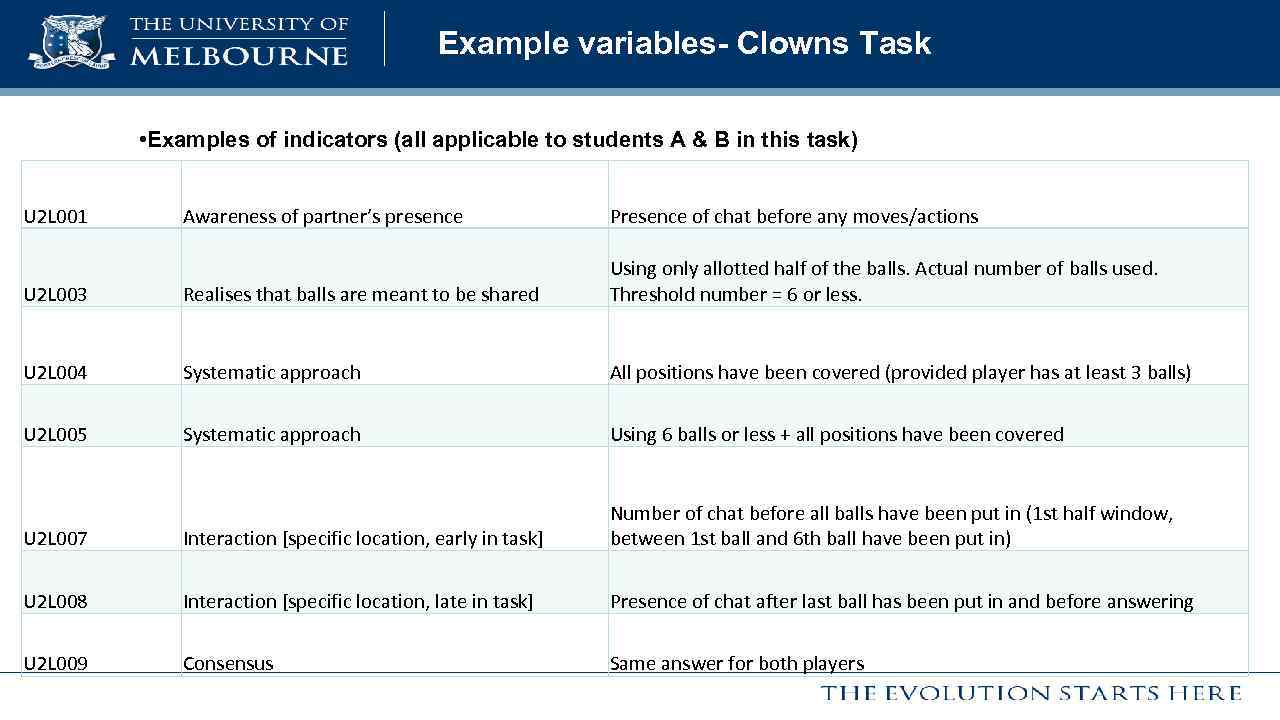 Example variables- Clowns Task • Examples of indicators (all applicable to students A & B in this task) U 2 L 001 Awareness of partner’s presence Presence of chat before any moves/actions U 2 L 003 Realises that balls are meant to be shared Using only allotted half of the balls. Actual number of balls used. Threshold number = 6 or less. U 2 L 004 Systematic approach All positions have been covered (provided player has at least 3 balls) U 2 L 005 Systematic approach Using 6 balls or less + all positions have been covered U 2 L 007 Interaction [specific location, early in task] Number of chat before all balls have been put in (1 st half window, between 1 st ball and 6 th ball have been put in) U 2 L 008 Interaction [specific location, late in task] Presence of chat after last ball has been put in and before answering U 2 L 009 Consensus Same answer for both players
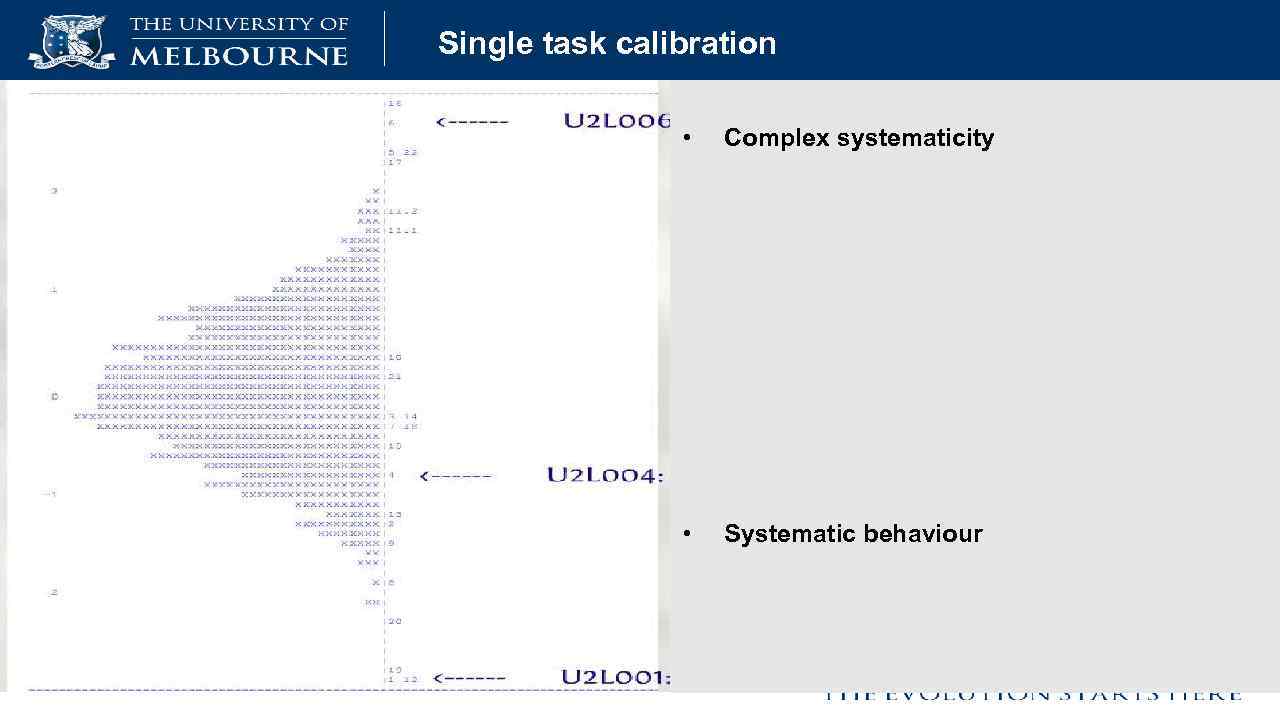 Single task calibration • Complex systematicity • Systematic behaviour
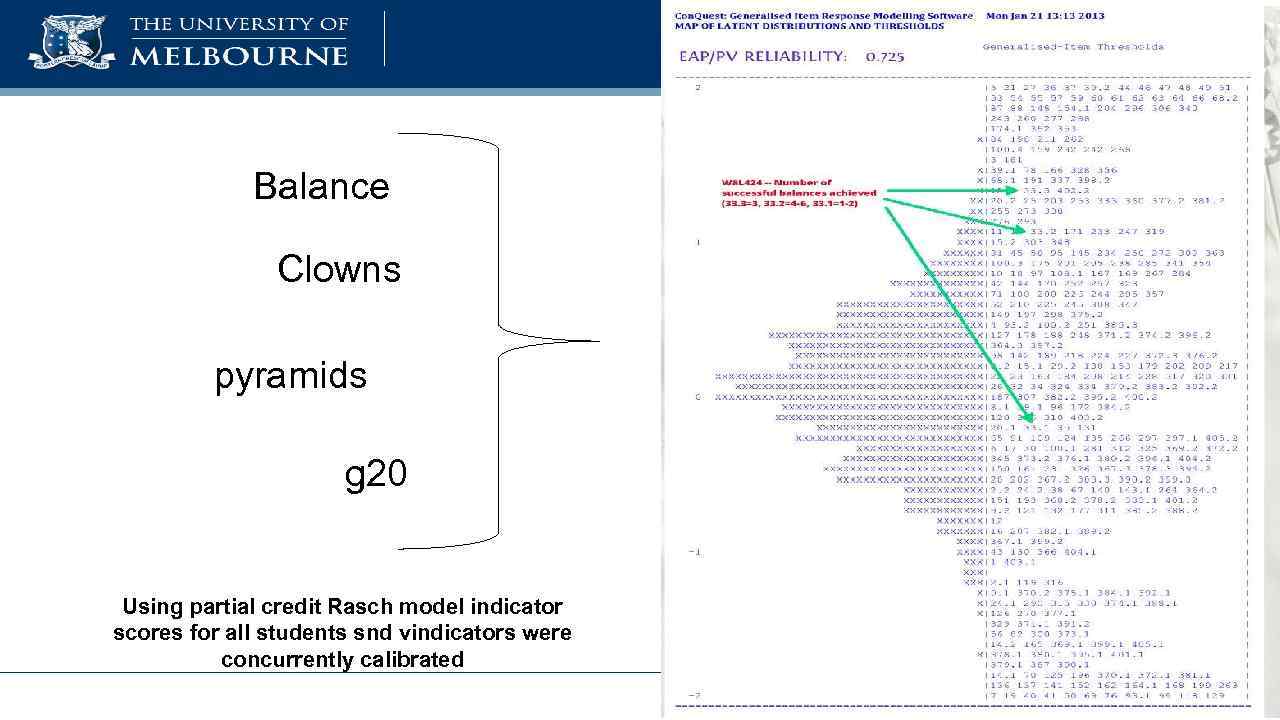 Balance Clowns pyramids g 20 Using partial credit Rasch model indicator scores for all students snd vindicators were concurrently calibrated
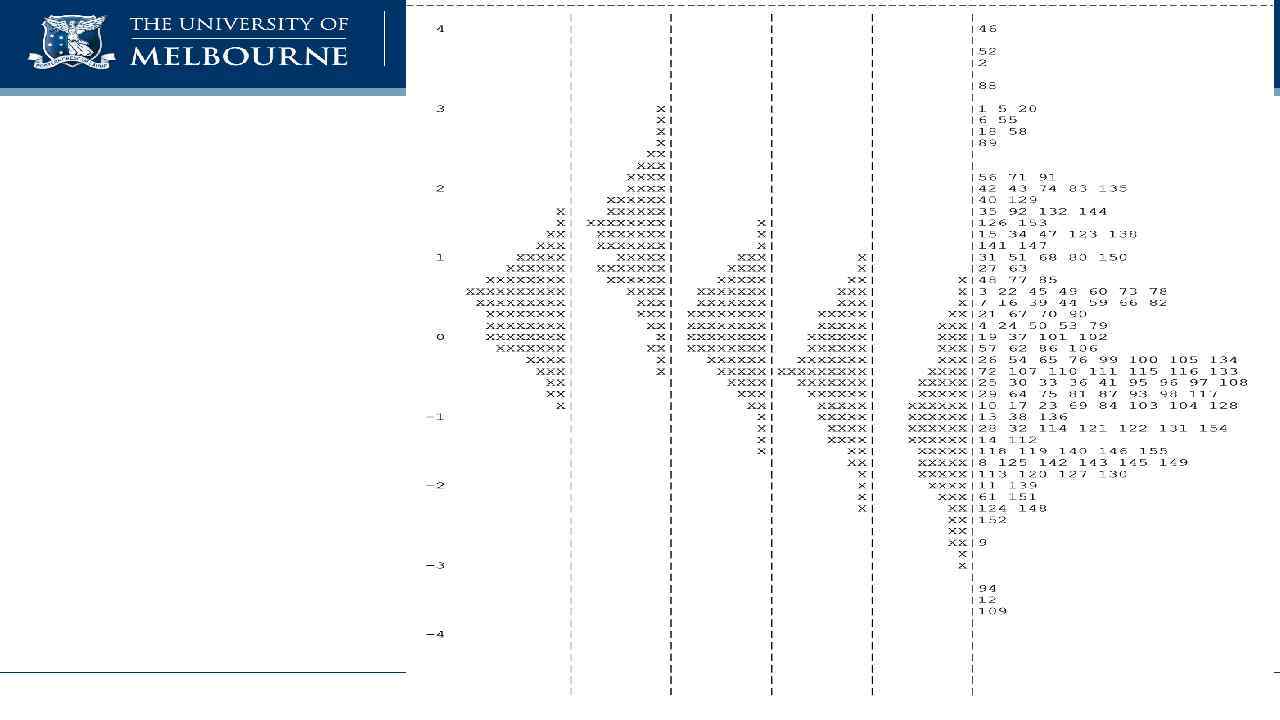
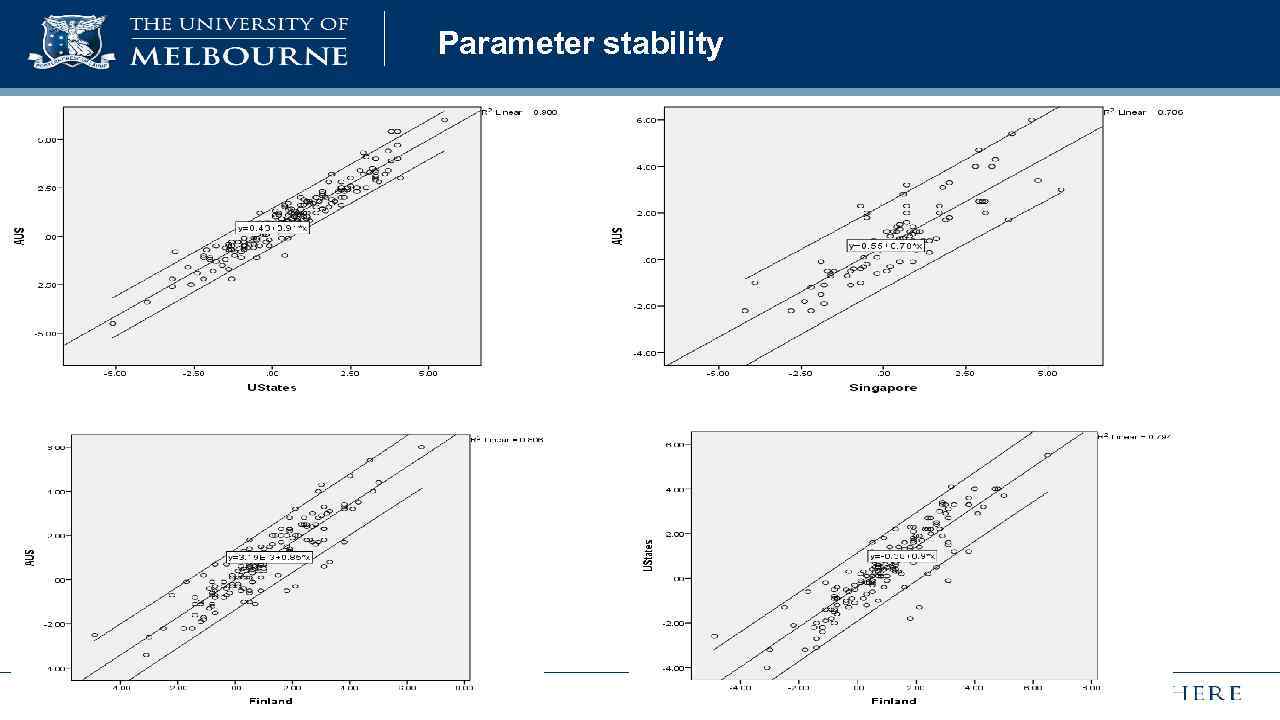 Parameter stability
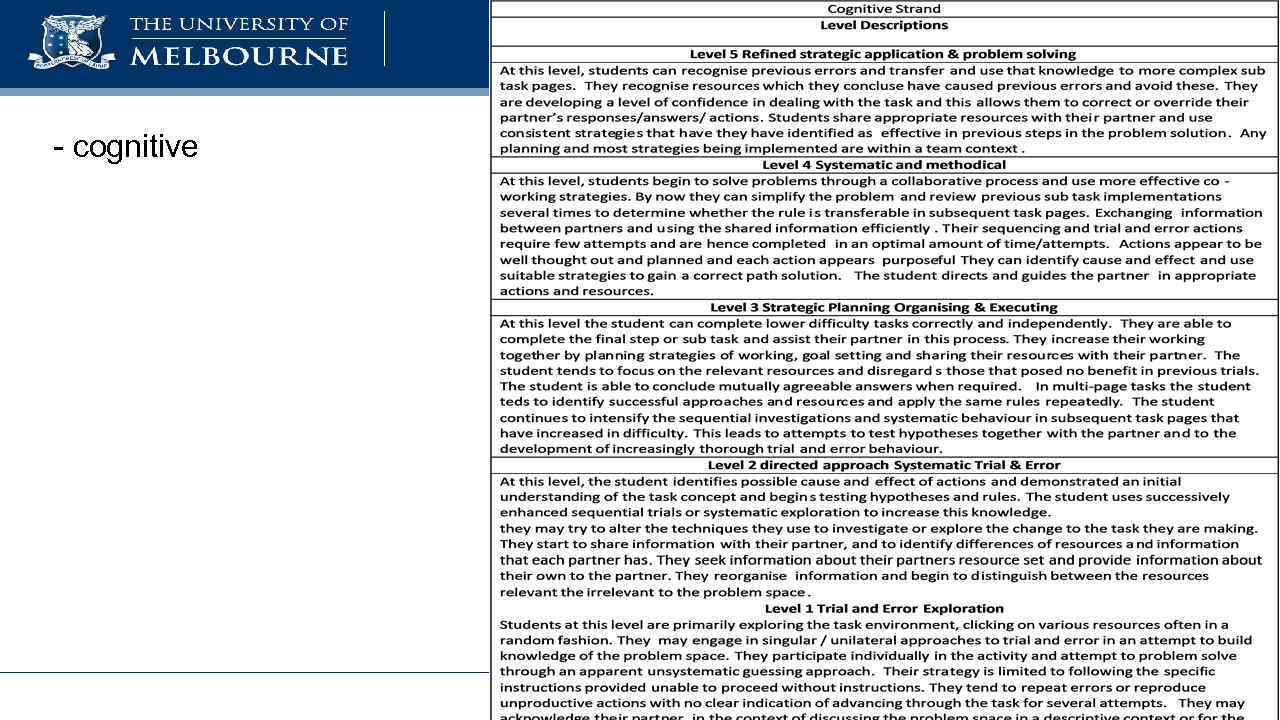 - cognitive
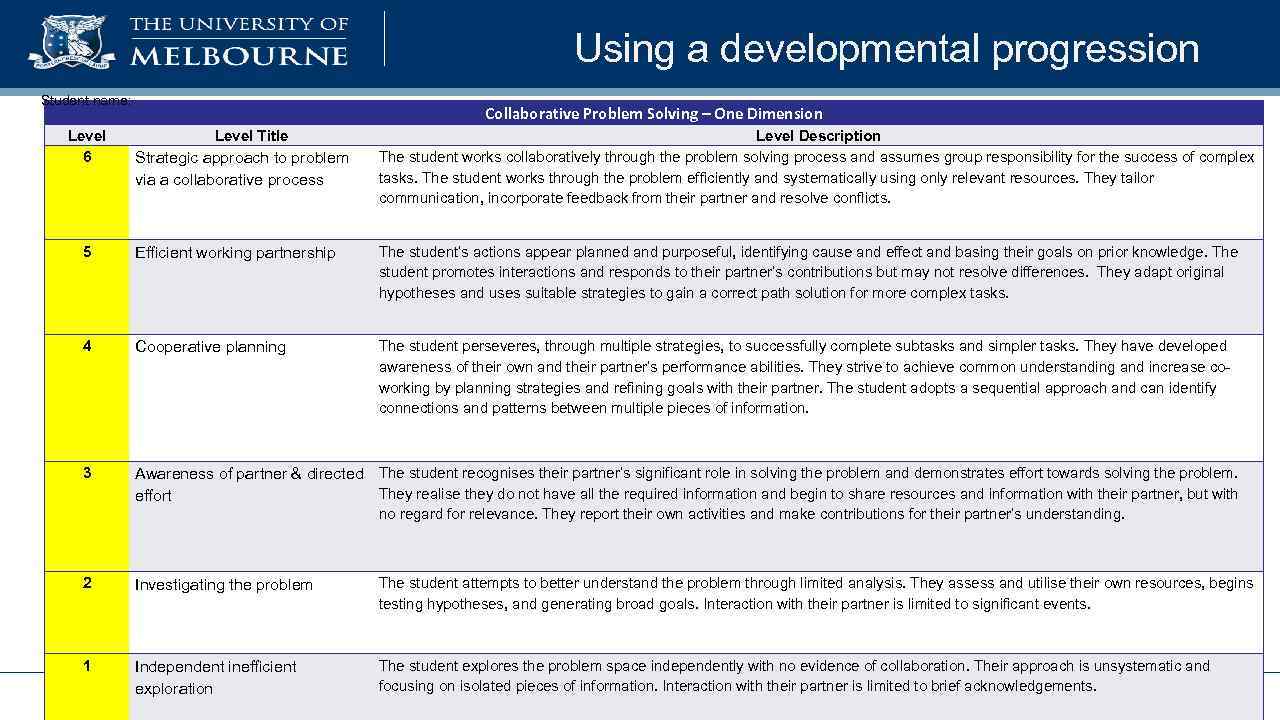 Using a developmental progression Student name: Level 6 5 Collaborative Problem Solving – One Dimension Level Title Strategic approach to problem via a collaborative process Efficient working partnership 4 Cooperative planning 3 Investigating the problem 1 The student’s actions appear planned and purposeful, identifying cause and effect and basing their goals on prior knowledge. The student promotes interactions and responds to their partner’s contributions but may not resolve differences. They adapt original hypotheses and uses suitable strategies to gain a correct path solution for more complex tasks. The student perseveres, through multiple strategies, to successfully complete subtasks and simpler tasks. They have developed awareness of their own and their partner’s performance abilities. They strive to achieve common understanding and increase coworking by planning strategies and refining goals with their partner. The student adopts a sequential approach and can identify connections and patterns between multiple pieces of information. Awareness of partner & directed The student recognises their partner’s significant role in solving the problem and demonstrates effort towards solving the problem. They realise they do not have all the required information and begin to share resources and information with their partner, but with effort 2 Level Description The student works collaboratively through the problem solving process and assumes group responsibility for the success of complex tasks. The student works through the problem efficiently and systematically using only relevant resources. They tailor communication, incorporate feedback from their partner and resolve conflicts. Independent inefficient exploration no regard for relevance. They report their own activities and make contributions for their partner’s understanding. The student attempts to better understand the problem through limited analysis. They assess and utilise their own resources, begins testing hypotheses, and generating broad goals. Interaction with their partner is limited to significant events. The student explores the problem space independently with no evidence of collaboration. Their approach is unsystematic and focusing on isolated pieces of information. Interaction with their partner is limited to brief acknowledgements.
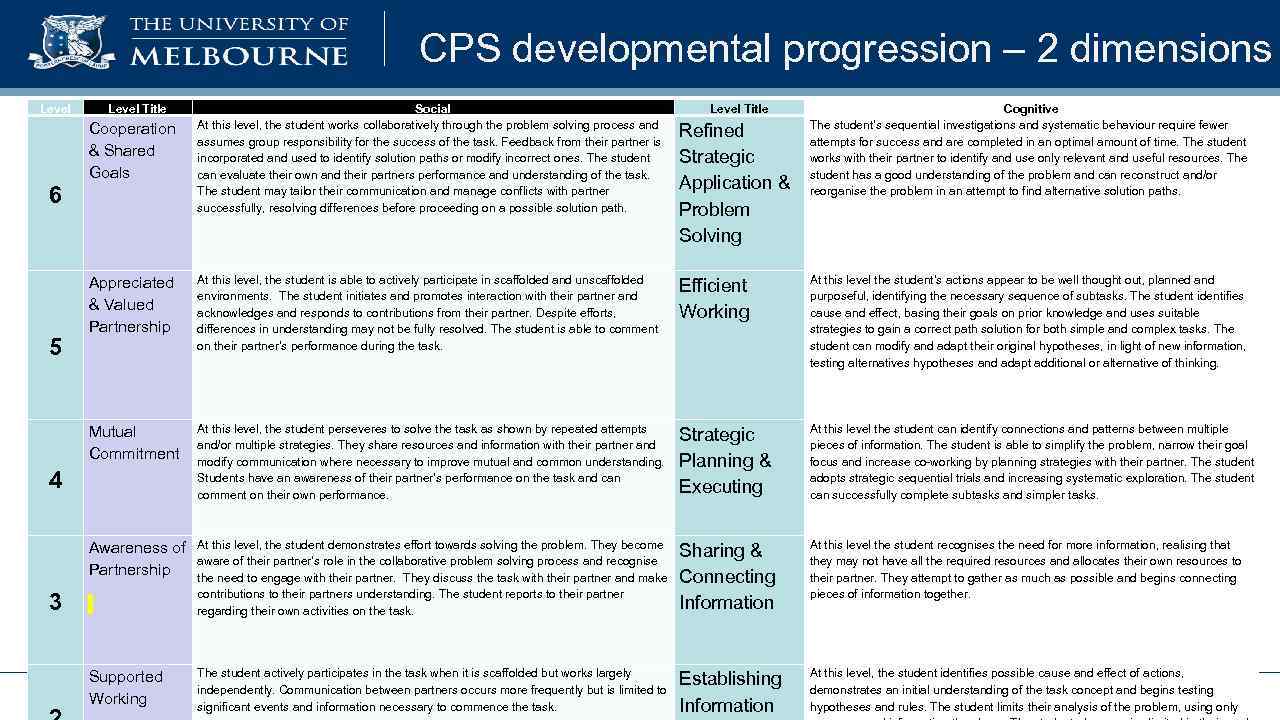 CPS developmental progression – 2 dimensions Level Title Cooperation & Shared Goals 6 5 Refined Strategic Application & Problem Solving Cognitive The student’s sequential investigations and systematic behaviour require fewer attempts for success and are completed in an optimal amount of time. The student works with their partner to identify and use only relevant and useful resources. The student has a good understanding of the problem and can reconstruct and/or reorganise the problem in an attempt to find alternative solution paths. Efficient Working At this level the student’s actions appear to be well thought out, planned and purposeful, identifying the necessary sequence of subtasks. The student identifies cause and effect, basing their goals on prior knowledge and uses suitable strategies to gain a correct path solution for both simple and complex tasks. The student can modify and adapt their original hypotheses, in light of new information, testing alternatives hypotheses and adapt additional or alternative of thinking. At this level, the student perseveres to solve the task as shown by repeated attempts and/or multiple strategies. They share resources and information with their partner and modify communication where necessary to improve mutual and common understanding. Students have an awareness of their partner’s performance on the task and can comment on their own performance. Strategic Planning & Executing At this level the student can identify connections and patterns between multiple pieces of information. The student is able to simplify the problem, narrow their goal focus and increase co-working by planning strategies with their partner. The student adopts strategic sequential trials and increasing systematic exploration. The student can successfully complete subtasks and simpler tasks. At this level, the student demonstrates effort towards solving the problem. They become aware of their partner’s role in the collaborative problem solving process and recognise the need to engage with their partner. They discuss the task with their partner and make contributions to their partners understanding. The student reports to their partner regarding their own activities on the task. Sharing & Connecting Information At this level the student recognises the need for more information, realising that they may not have all the required resources and allocates their own resources to their partner. They attempt to gather as much as possible and begins connecting pieces of information together. Supported Working The student actively participates in the task when it is scaffolded but works largely independently. Communication between partners occurs more frequently but is limited to significant events and information necessary to commence the task. Establishing Information At this level, the student identifies possible cause and effect of actions, demonstrates an initial understanding of the task concept and begins testing hypotheses and rules. The student limits their analysis of the problem, using only Awareness of Partnership 3 Level Title At this level, the student is able to actively participate in scaffolded and unscaffolded environments. The student initiates and promotes interaction with their partner and acknowledges and responds to contributions from their partner. Despite efforts, differences in understanding may not be fully resolved. The student is able to comment on their partner’s performance during the task. Appreciated & Valued Partnership Mutual Commitment 4 Social At this level, the student works collaboratively through the problem solving process and assumes group responsibility for the success of the task. Feedback from their partner is incorporated and used to identify solution paths or modify incorrect ones. The student can evaluate their own and their partners performance and understanding of the task. The student may tailor their communication and manage conflicts with partner successfully, resolving differences before proceeding on a possible solution path.
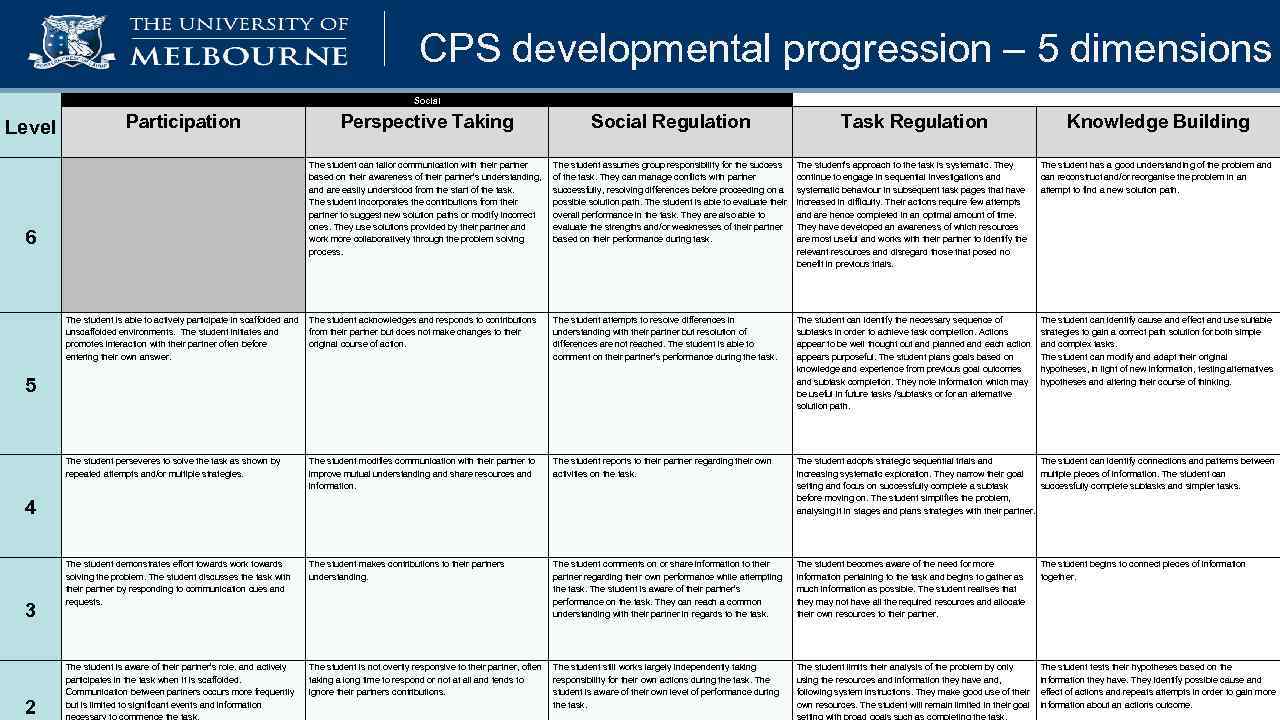 CPS developmental progression – 5 dimensions Social Participation Cognitive Perspective Taking Social Regulation Task Regulation Knowledge Building The student can tailor communication with their partner based on their awareness of their partner’s understanding, and are easily understood from the start of the task. The student incorporates the contributions from their partner to suggest new solution paths or modify incorrect ones. They use solutions provided by their partner and work more collaboratively through the problem solving process. The student assumes group responsibility for the success of the task. They can manage conflicts with partner successfully, resolving differences before proceeding on a possible solution path. The student is able to evaluate their overall performance in the task. They are also able to evaluate the strengths and/or weaknesses of their partner based on their performance during task. The student’s approach to the task is systematic. They continue to engage in sequential investigations and systematic behaviour in subsequent task pages that have increased in difficulty. Their actions require few attempts and are hence completed in an optimal amount of time. They have developed an awareness of which resources are most useful and works with their partner to identify the relevant resources and disregard those that posed no benefit in previous trials. The student has a good understanding of the problem and can reconstruct and/or reorganise the problem in an attempt to find a new solution path. The student is able to actively participate in scaffolded and unscaffolded environments. The student initiates and promotes interaction with their partner often before entering their own answer. The student acknowledges and responds to contributions from their partner but does not make changes to their original course of action. The student attempts to resolve differences in understanding with their partner but resolution of differences are not reached. The student is able to comment on their partner’s performance during the task. The student can identify the necessary sequence of subtasks in order to achieve task completion. Actions appear to be well thought out and planned and each action appears purposeful. The student plans goals based on knowledge and experience from previous goal outcomes and subtask completion. They note information which may be useful in future tasks /subtasks or for an alternative solution path. The student can identify cause and effect and use suitable strategies to gain a correct path solution for both simple and complex tasks. The student can modify and adapt their original hypotheses, in light of new information, testing alternatives hypotheses and altering their course of thinking. The student perseveres to solve the task as shown by repeated attempts and/or multiple strategies. The student modifies communication with their partner to improve mutual understanding and share resources and information. The student reports to their partner regarding their own activities on the task. The student adopts strategic sequential trials and increasing systematic exploration. They narrow their goal setting and focus on successfully complete a subtask before moving on. The student simplifies the problem, analysing it in stages and plans strategies with their partner. The student can identify connections and patterns between multiple pieces of information. The student can successfully complete subtasks and simpler tasks. The student demonstrates effort towards work towards solving the problem. The student discusses the task with their partner by responding to communication cues and requests. The student makes contributions to their partners understanding. The student comments on or share information to their partner regarding their own performance while attempting the task. The student is aware of their partner’s performance on the task. They can reach a common understanding with their partner in regards to the task. The student becomes aware of the need for more information pertaining to the task and begins to gather as much information as possible. The student realises that they may not have all the required resources and allocate their own resources to their partner. The student begins to connect pieces of information together. The student is aware of their partner’s role. and actively participates in the task when it is scaffolded. Communication between partners occurs more frequently but is limited to significant events and information necessary to commence the task. The student is not overtly responsive to their partner, often taking a long time to respond or not at all and tends to ignore their partners contributions. The student still works largely independently taking responsibility for their own actions during the task. The student is aware of their own level of performance during the task. The student limits their analysis of the problem by only using the resources and information they have and, following system instructions. They make good use of their own resources. The student will remain limited in their goal setting with broad goals such as completing the task. The student tests their hypotheses based on the information they have. They identify possible cause and effect of actions and repeats attempts in order to gain more information about an actions outcome. Level 6 5 4 3 2
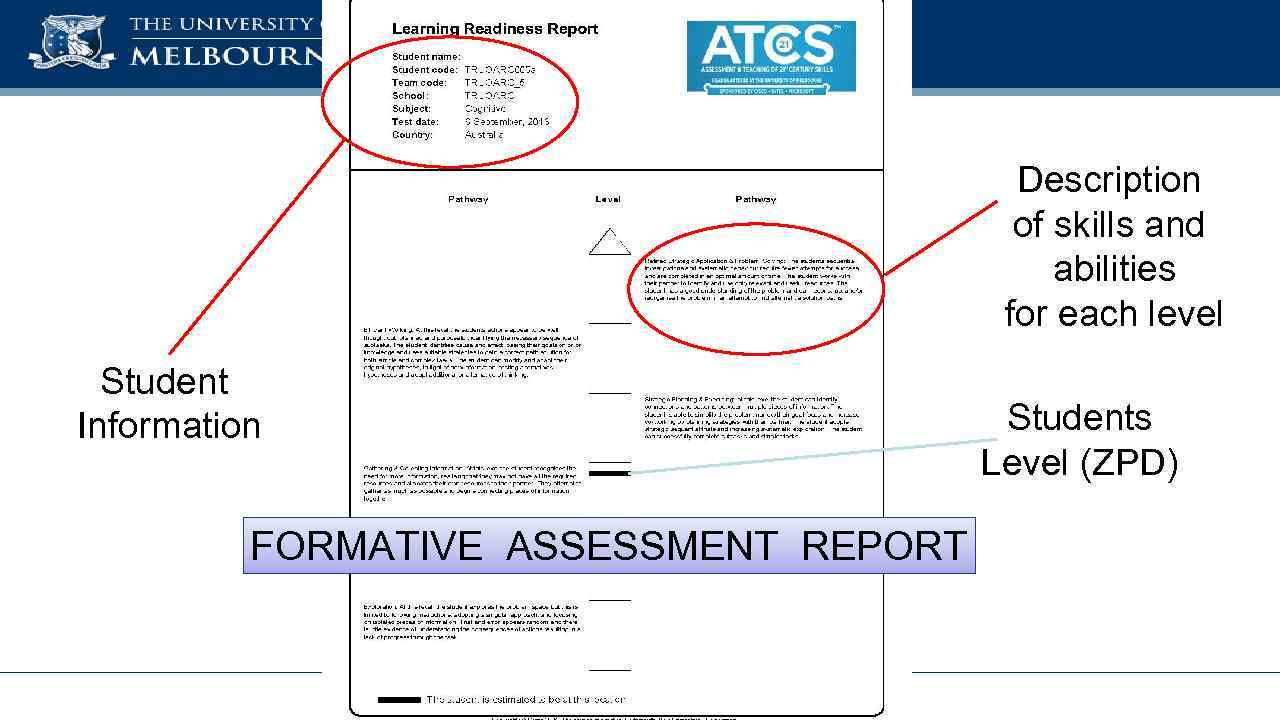 Description of skills and abilities for each level Student Information FORMATIVE ASSESSMENT REPORT Students Level (ZPD)
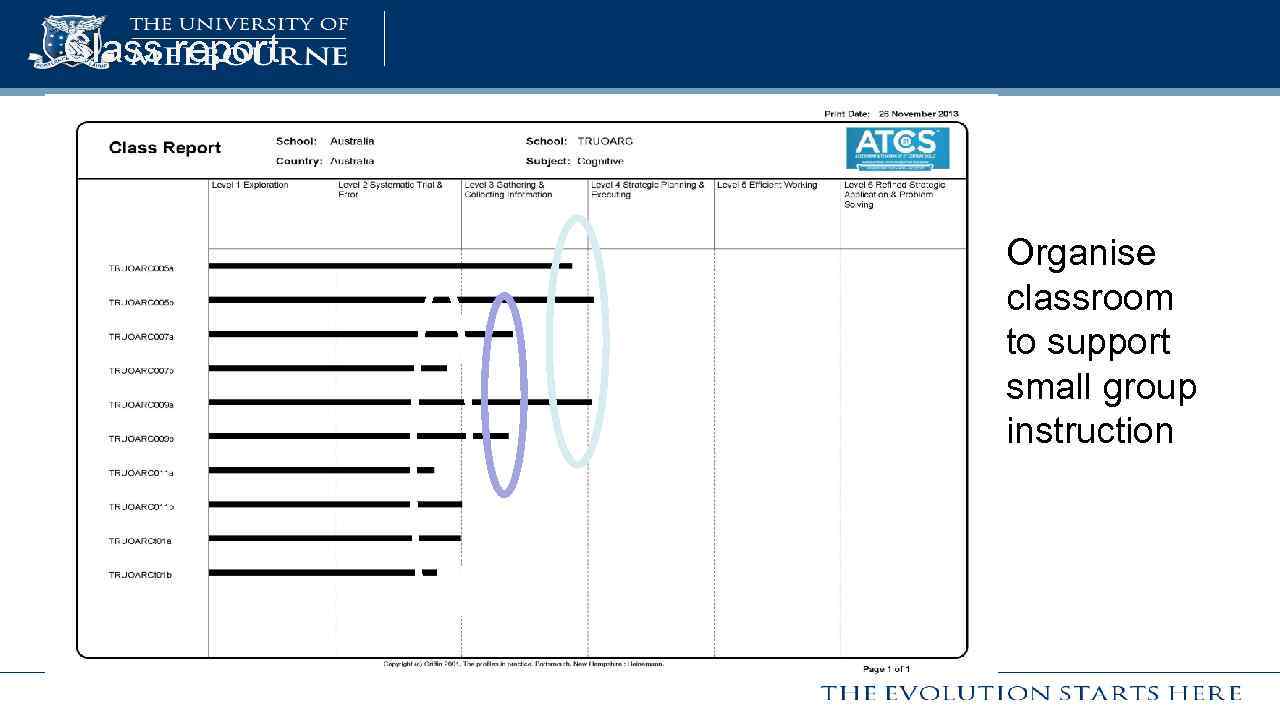 Class report Organise classroom to support small group instruction
 Professional development modules 1. 2. 3. 4. 5. Defining and Assessing 21 st Century Skills Using a Developmental Model ATC 21 S Assessments: Getting Started Interpreting Reports Teaching and Learning 21 st Century Skills
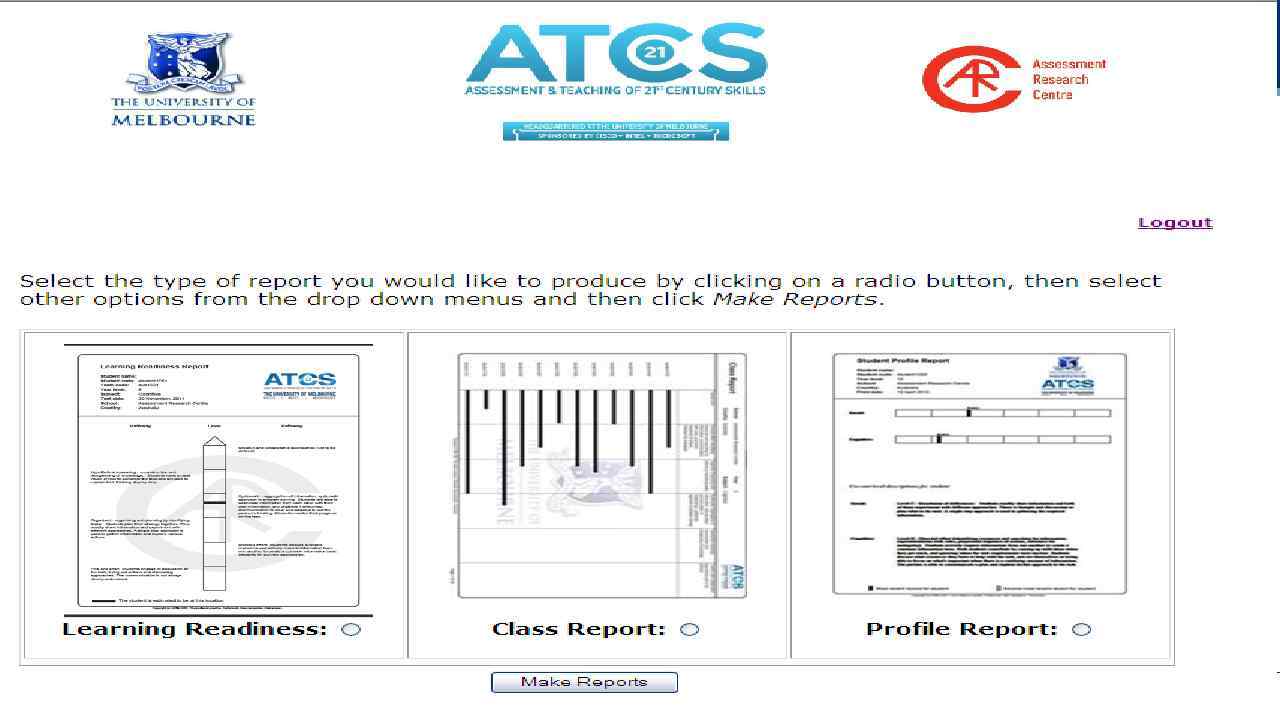 Reports
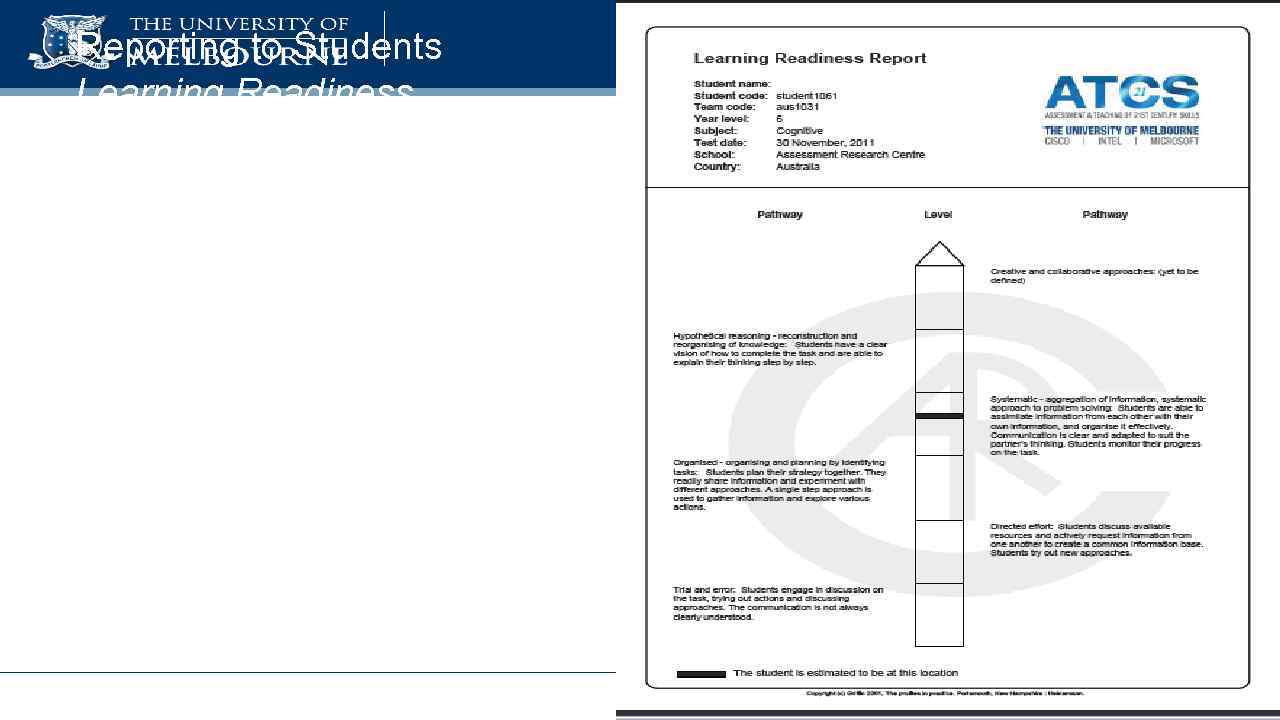 Reporting to Students Learning Readiness Real time reports will be available, based on empirically developed learning progressions. They will identify a point of readiness to learn for each student. This type of report will be linked to teaching interventions associated
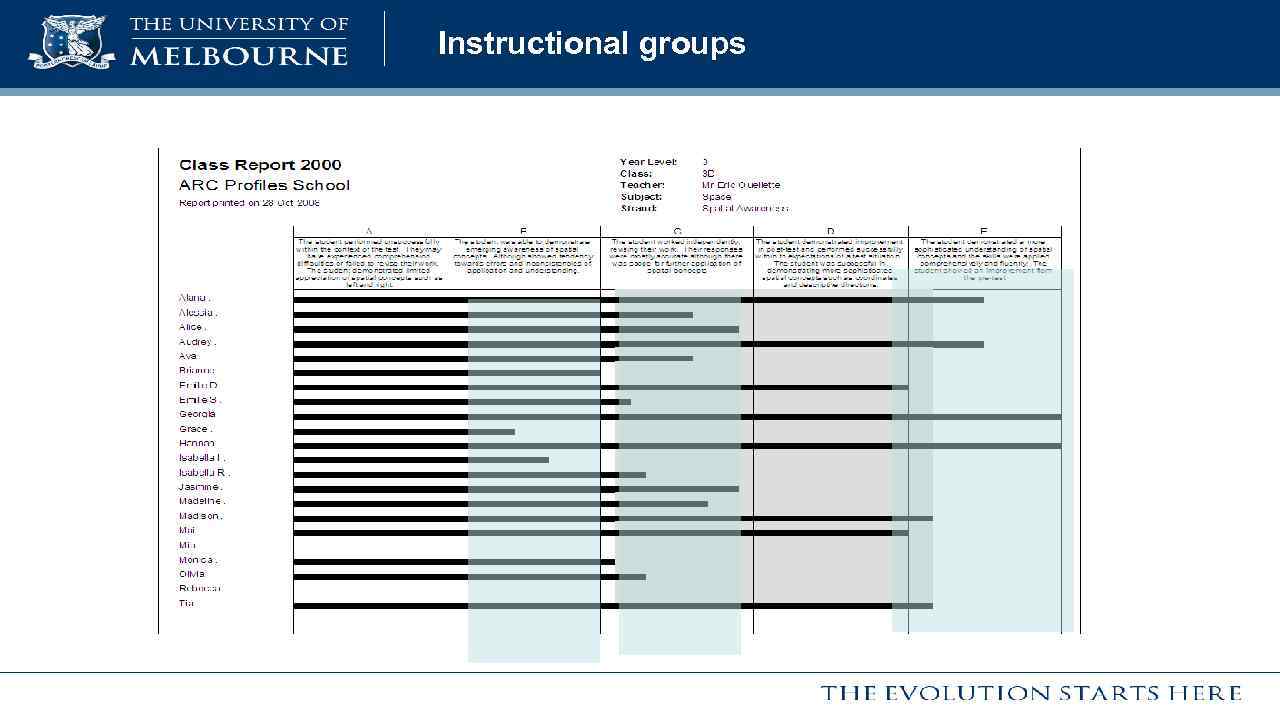 Instructional groups
 The System An integrated system – Developmental progressions – standards referenced – Assessment tasks with automatic scoring – Teaching intervention and professional development – Reports for students, teachers and systems Next steps Access and Use Validation studies Expanded resources – mainstream curriculum Other 21 st century skills ATC 21 S Assessment and Teaching of 21 st Century Skills The University of Melbourne • Cisco • Intel • Microsoft • www. atc 21 s. org
 Transfer and Utility • To what degree will 21 st century skills such as collaborative problem solving or ICT Literacy in Learning Networks facilitate student learning? – Are these skills teachable and learnable? – Will the skills enhance learning in the classroom? • To what degree might enhanced 21 st century skills contribute to adaptiveness of graduate students to the workforce?
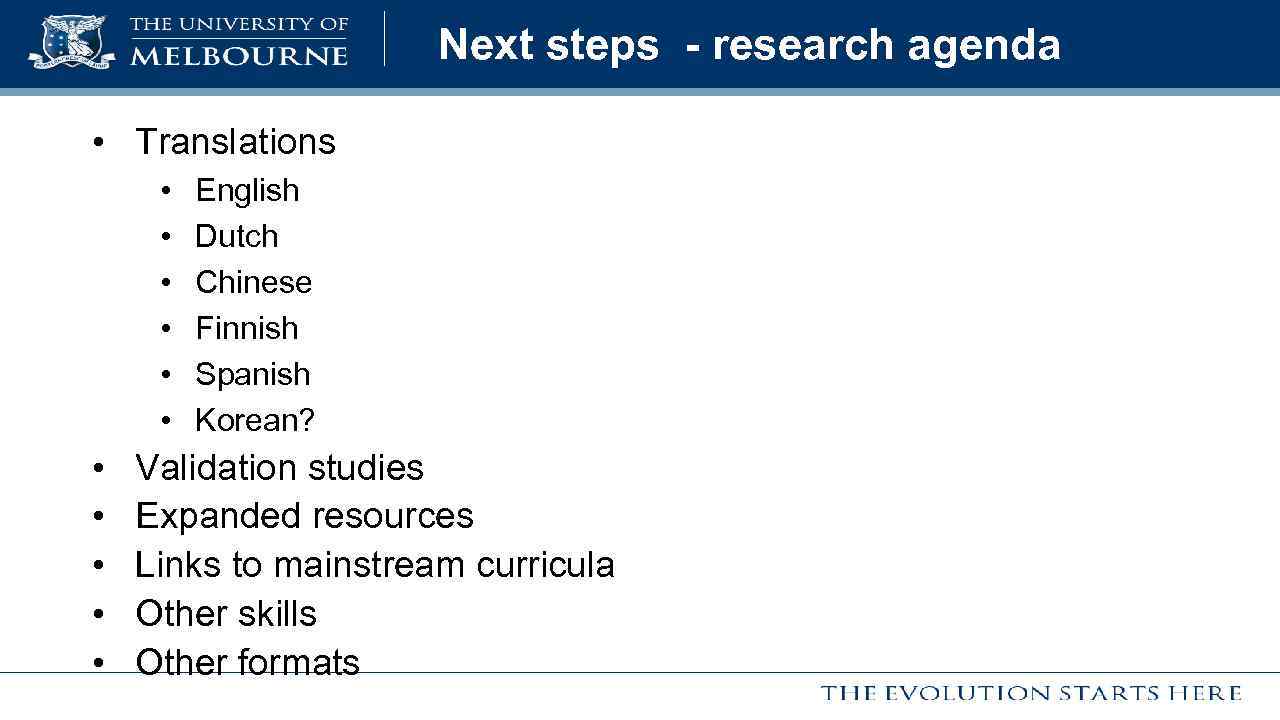 Next steps - research agenda • Translations • • • English Dutch Chinese Finnish Spanish Korean? Validation studies Expanded resources Links to mainstream curricula Other skills Other formats
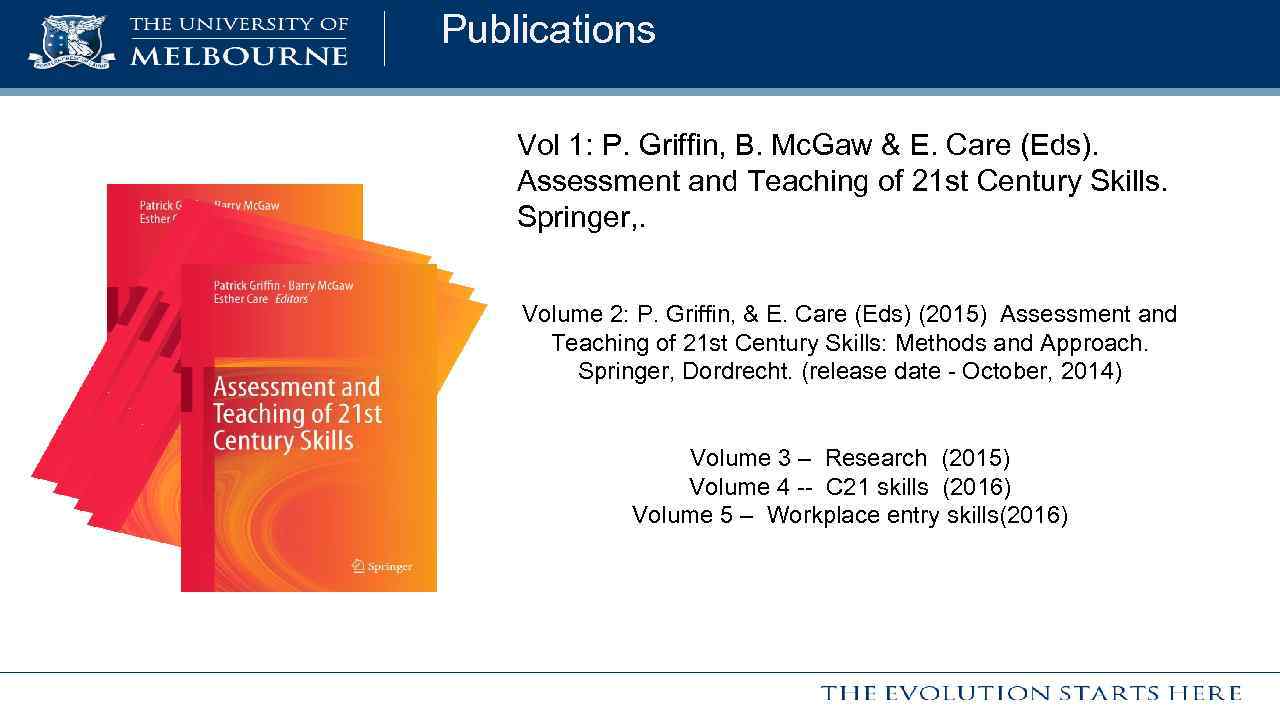 Publications Vol 1: P. Griffin, B. Mc. Gaw & E. Care (Eds). Assessment and Teaching of 21 st Century Skills. Springer, . Volume 2: P. Griffin, & E. Care (Eds) (2015) Assessment and Teaching of 21 st Century Skills: Methods and Approach. Springer, Dordrecht. (release date - October, 2014) Volume 3 – Research (2015) Volume 4 -- C 21 skills (2016) Volume 5 – Workplace entry skills(2016)
 Thank you 68