 Скачать презентацию Assessment and Pharmacological Treatment of Tobacco Dependence Jill
3de734cfd887439497f37810858110c4.ppt
- Количество слайдов: 37



Assessment and Pharmacological Treatment of Tobacco Dependence Jill Williams, M. D. Associate Professor of Psychiatry UMDNJ-Robert Wood Johnson Medical School, UMDNJ-School of Public Health Copyright Alcohol Medical Scholars Program 1
Smoking = Big Health Problem #1 preventable cause morbidity/ mortality 1 in 5 deaths in US But…. Treatment Improves Outcomes ~50% of smokers try to quit/ year Advice from MD ↑ quitting Double success with treatment Copyright Alcohol Medical Scholars Program 2
This Lecture will Cover Epidemiology /consequences Nicotine pharmacology Assessment Pharmacological treatments Copyright Alcohol Medical Scholars Program 3
Epidemiology of Tobacco Use Cigarettes > 95% of all tobacco use >1 billion tobacco users worldwide Stable or ↓ in US/ developed nations Increasing in developing countries Higher rates in ↓ SES Copyright Alcohol Medical Scholars Program 4
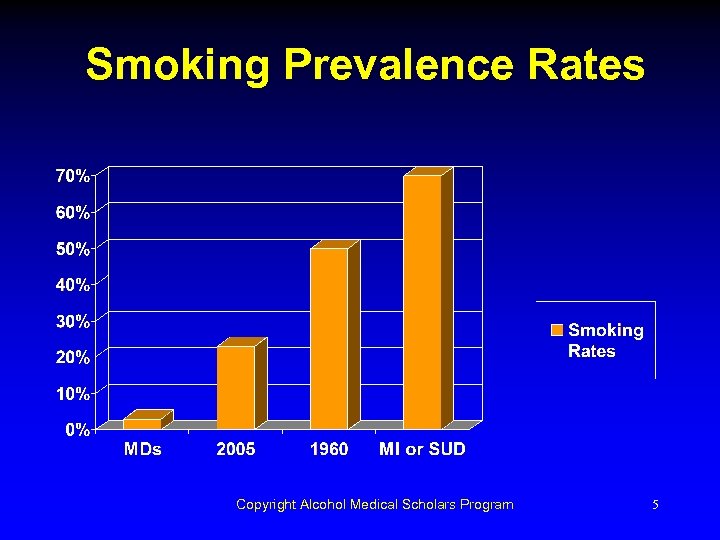
Smoking Prevalence Rates Copyright Alcohol Medical Scholars Program 5
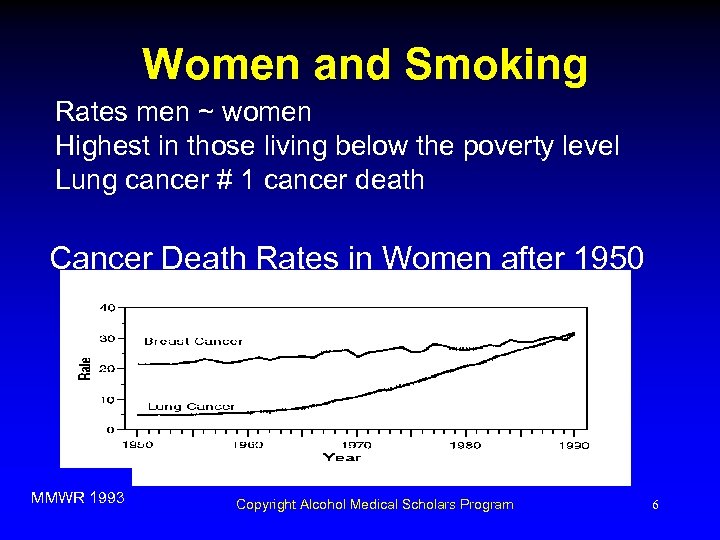
Women and Smoking Rates men ~ women Highest in those living below the poverty level Lung cancer # 1 cancer death Cancer Death Rates in Women after 1950 MMWR 1993 Copyright Alcohol Medical Scholars Program 6
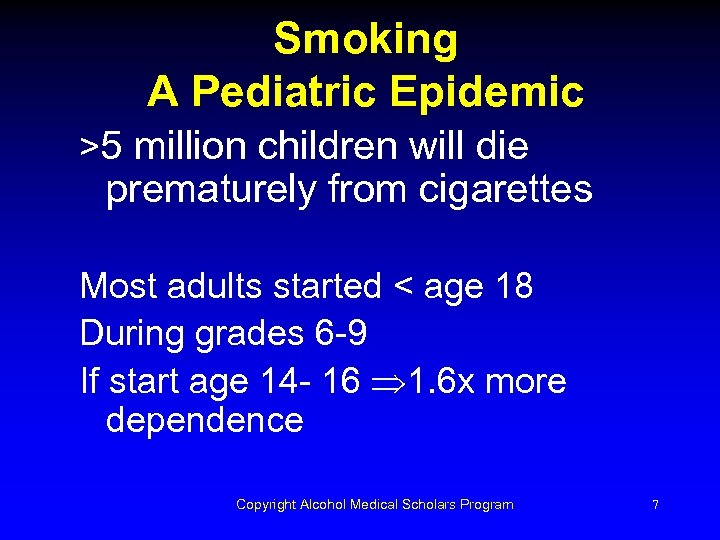
Smoking A Pediatric Epidemic >5 million children will die prematurely from cigarettes Most adults started < age 18 During grades 6 -9 If start age 14 - 16 1. 6 x more dependence Copyright Alcohol Medical Scholars Program 7
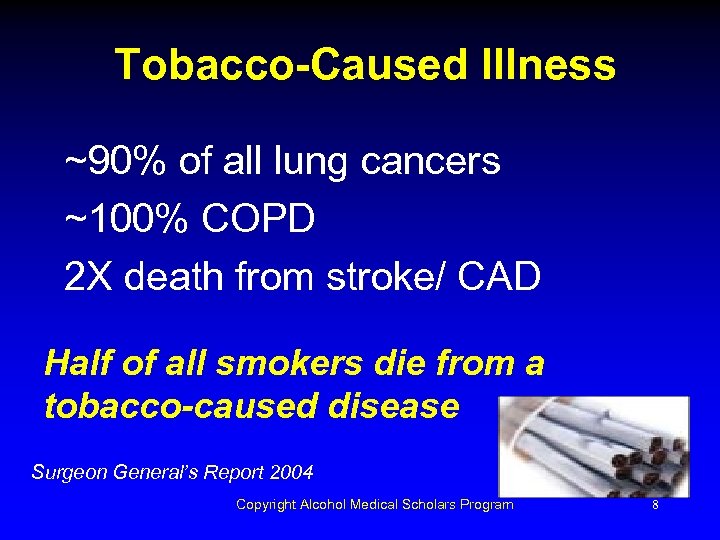
Tobacco-Caused Illness ~90% of all lung cancers ~100% COPD 2 X death from stroke/ CAD Half of all smokers die from a tobacco-caused disease Surgeon General’s Report 2004 Copyright Alcohol Medical Scholars Program 8
Other Consequences Other Cancers Oral Esophagus (cigars/ chew) Cervix Bladder Pancreas (cigars) Costs > $100 billion annually Primary cause of fatal house fires Copyright Alcohol Medical Scholars Program 9
It’s the Smoke that Kills Cigarette smoke > 4000 compounds Acetone, Cyanide, Carbon Monoxide, Formaldehyde > 60 Carcinogens Benzene, Nitrosamines (CDC Copyright Alcohol Medical Scholars Program 2003) 10
Environmental Tobacco Smoke ETS is a known human carcinogen (Class 1 A), in the same class as asbestos 50, 000 additional deaths/ year in non -smokers ~3000 from lung cancer Copyright Alcohol Medical Scholars Program 11
This Lecture will Cover Epidemiology /consequences Nicotine pharmacology Assessment Pharmacological treatments Copyright Alcohol Medical Scholars Program 12
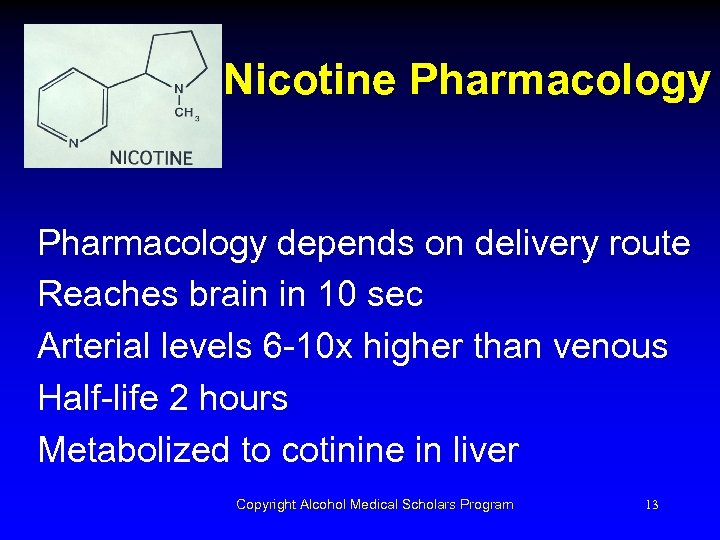
Nicotine Pharmacology depends on delivery route Reaches brain in 10 sec Arterial levels 6 -10 x higher than venous Half-life 2 hours Metabolized to cotinine in liver Copyright Alcohol Medical Scholars Program 13
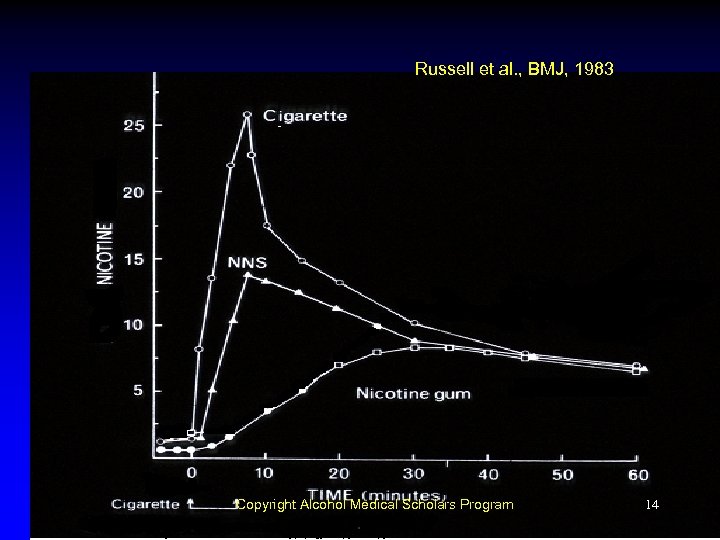
Russell et al. , BMJ, 1983 Copyright Alcohol Medical Scholars Program 14
Nicotine Possible therapeutic effects: Alzheimer's Attention deficit disorder Autism Schizophrenia Ulcerative colitis Copyright Alcohol Medical Scholars Program 15
Nicotine Safety Smokers misinformed about safety/efficacy of nicotine ü ü Not a carcinogen Not a significant risk factor for cardiovascular events Risk-benefit ratio supports nicotine medications over using tobacco Copyright Alcohol Medical Scholars Program 16
This Lecture will Cover Epidemiology /consequences Nicotine pharmacology Assessment Pharmacological treatments Copyright Alcohol Medical Scholars Program 17
Nicotine Dependence ≥ 90% smokers meet dependence criteria – withdrawal – tolerance – desire or efforts to cut down/ control use – great time spent in obtaining/using – reduced occupational, recreational activities – use despite problems – larger amounts consumed than intended Copyright Alcohol Medical Scholars Program 18
Nicotine Withdrawal Depressed mood Insomnia Irritability, frustration or anger Anxiety Difficulty concentrating Restlessness Decreased heart rate Increased appetite or weight gain Copyright Alcohol Medical Scholars Program 19
Heaviness of Smoking Index= Measure of Dependence Number of cigarettes per day (cpd) AM Time to first cigarette (TTFC) ≤ 30 minutes = moderate ≤ 5 minutes = severe (Heatherton 1989) Copyright Alcohol Medical Scholars Program 20
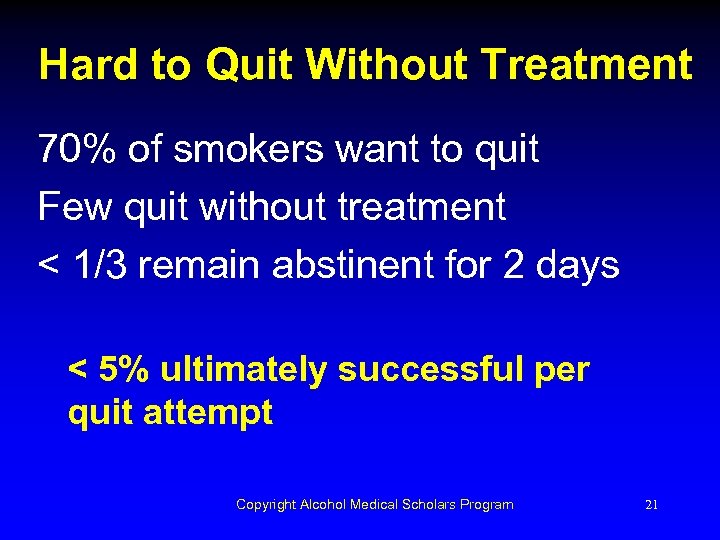
Hard to Quit Without Treatment 70% of smokers want to quit Few quit without treatment < 1/3 remain abstinent for 2 days < 5% ultimately successful per quit attempt Copyright Alcohol Medical Scholars Program 21
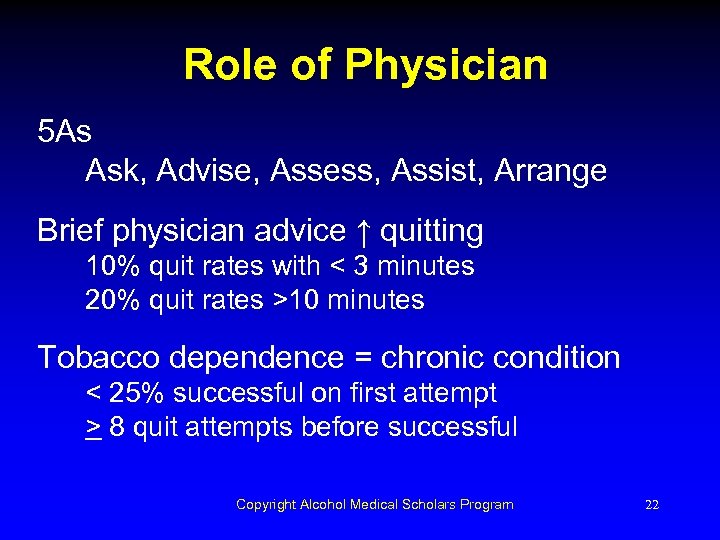
Role of Physician 5 As Ask, Advise, Assess, Assist, Arrange Brief physician advice ↑ quitting 10% quit rates with < 3 minutes 20% quit rates >10 minutes Tobacco dependence = chronic condition < 25% successful on first attempt > 8 quit attempts before successful Copyright Alcohol Medical Scholars Program 22
This Lecture will Cover Epidemiology /consequences Nicotine pharmacology Assessment Pharmacological treatments Copyright Alcohol Medical Scholars Program 23
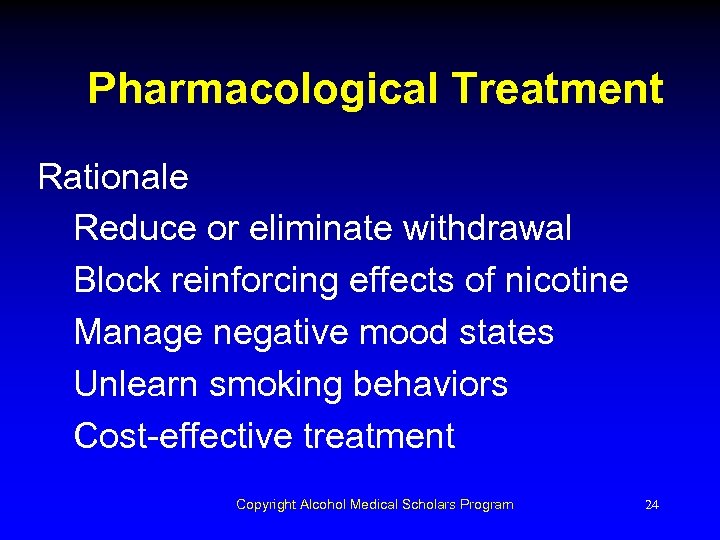
Pharmacological Treatment Rationale Reduce or eliminate withdrawal Block reinforcing effects of nicotine Manage negative mood states Unlearn smoking behaviors Cost-effective treatment Copyright Alcohol Medical Scholars Program 24
Pharmacological Treatment Nicotine Replacement Patch Gum Lozenge Inhaler Nasal Spray Bupropion Varenicline Copyright Alcohol Medical Scholars Program 25
Nicotine Replacement Therapy (NRT) Nicotine absorption poorer than cigs Lower dose delivered Poorly orally absorbed; ↑ first pass metabolism Less rewarding than smoking Under dosing common Worsened by poor compliance Copyright Alcohol Medical Scholars Program 26
Few Contraindications to NRT With caution if: Recent MI Smokes < 10 cpd Pregnant/breastfeeding Adolescents (Not FDA approved) Mild side effects Mostly local Systemic, less common Copyright Alcohol Medical Scholars Program 27
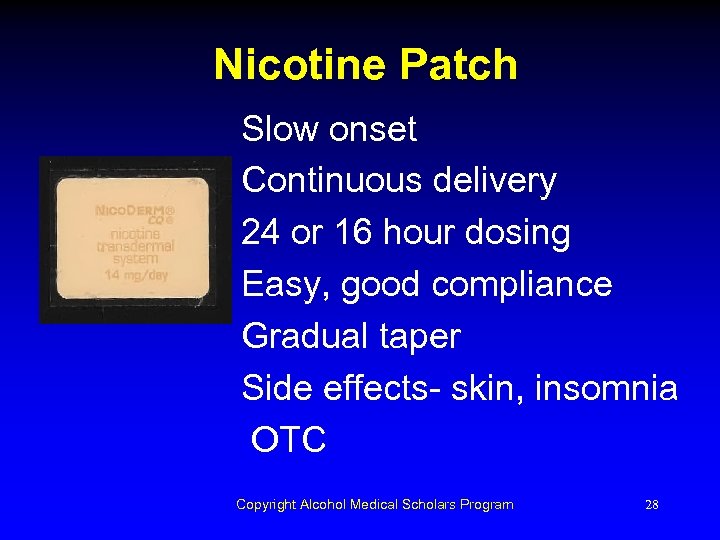
Nicotine Patch Slow onset Continuous delivery 24 or 16 hour dosing Easy, good compliance Gradual taper Side effects- skin, insomnia OTC Copyright Alcohol Medical Scholars Program 28
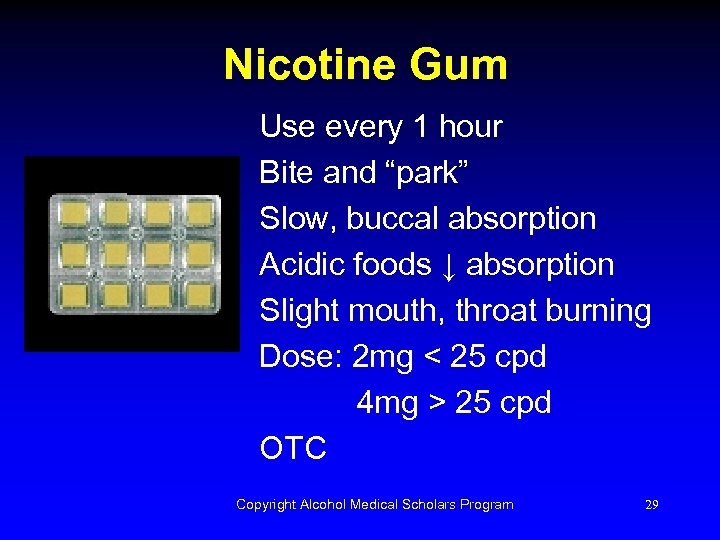
Nicotine Gum Use every 1 hour Bite and “park” Slow, buccal absorption Acidic foods ↓ absorption Slight mouth, throat burning Dose: 2 mg < 25 cpd 4 mg > 25 cpd OTC Copyright Alcohol Medical Scholars Program 29
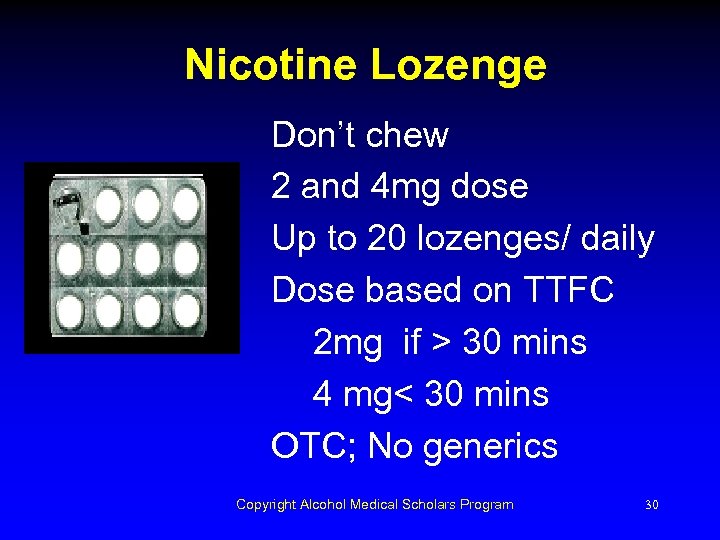
Nicotine Lozenge Don’t chew 2 and 4 mg dose Up to 20 lozenges/ daily Dose based on TTFC 2 mg if > 30 mins 4 mg< 30 mins OTC; No generics Copyright Alcohol Medical Scholars Program 30
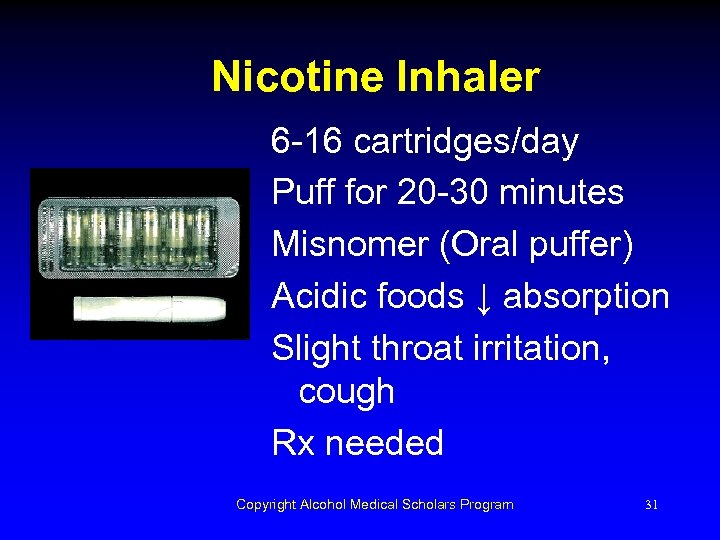
Nicotine Inhaler 6 -16 cartridges/day Puff for 20 -30 minutes Misnomer (Oral puffer) Acidic foods ↓ absorption Slight throat irritation, cough Rx needed Copyright Alcohol Medical Scholars Program 31
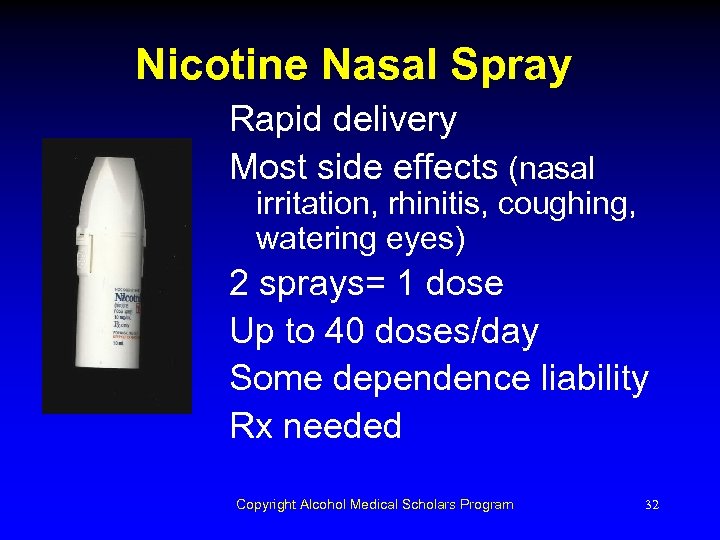
Nicotine Nasal Spray Rapid delivery Most side effects (nasal irritation, rhinitis, coughing, watering eyes) 2 sprays= 1 dose Up to 40 doses/day Some dependence liability Rx needed Copyright Alcohol Medical Scholars Program 32
Bupropion SR Nonsedating/ activating Affects NE and DA, nicotine receptor Side effects- headache, insomnia Don’t use: seizures/ eating disorder Start 10 -14 days prior to quit date 300 mg dose has least weight gain Rx needed Copyright Alcohol Medical Scholars Program 33
Efficacy of Medications NRT 2 x success vs. placebo 25 -30% Efficacy NRT ≃ bupropion Patient preference, cost, tolerability Combinations Improve Outcomes Copyright Alcohol Medical Scholars Program 34
Varenicline • Nicotinic partial agonist • 1 mg BID dose superior to placebo or bupropion in 12 week trials • Additional 12 weeks prevented relapse • Nausea, headache, insomnia and abnormal dreams- most common side effects • Discontinuation rate similar to placebo Gonzales et al. , 2006; Tonstad et al. , 2006; Jorenby et al. , 2006 Copyright Alcohol Medical Scholars Program 35
Conclusions It’s the smoke that kills – not the nicotine All practitioners should treat tobacco Treatments ↑success Six FDA approved treatments: effective and well tolerated Copyright Alcohol Medical Scholars Program 36
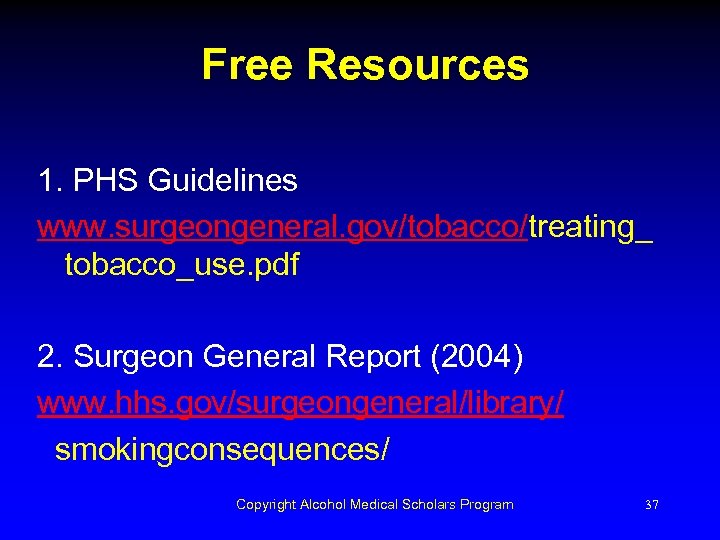
Free Resources 1. PHS Guidelines www. surgeongeneral. gov/tobacco/treating_ tobacco_use. pdf 2. Surgeon General Report (2004) www. hhs. gov/surgeongeneral/library/ smokingconsequences/ Copyright Alcohol Medical Scholars Program 37
Скачать презентацию Assessment and Pharmacological Treatment of Tobacco Dependence Jill
3de734cfd887439497f37810858110c4.ppt