Скачать презентацию Assessment and Communication of Chemical Risks IGOR LINKOV
1fce53adeaf587c1b3bfab461ce13da4.ppt
- Количество слайдов: 32
 Assessment and Communication of Chemical Risks IGOR LINKOV ICF Consulting, Inc. , U. S. A Ilinkov@icfconsulting. com NATO 27 March 2002
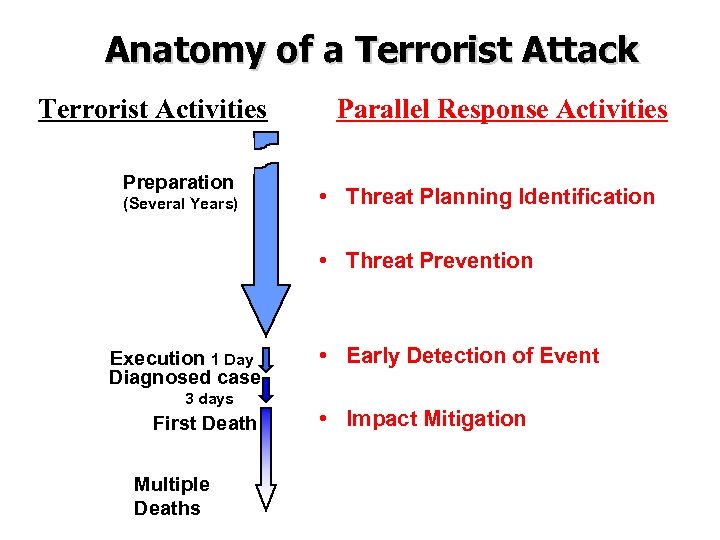 Anatomy of a Terrorist Attack Terrorist Activities Preparation (Several Years) Parallel Response Activities • Threat Planning Identification • Threat Prevention Execution 1 Day Diagnosed case 3 days First Death Multiple Deaths • Early Detection of Event • Impact Mitigation
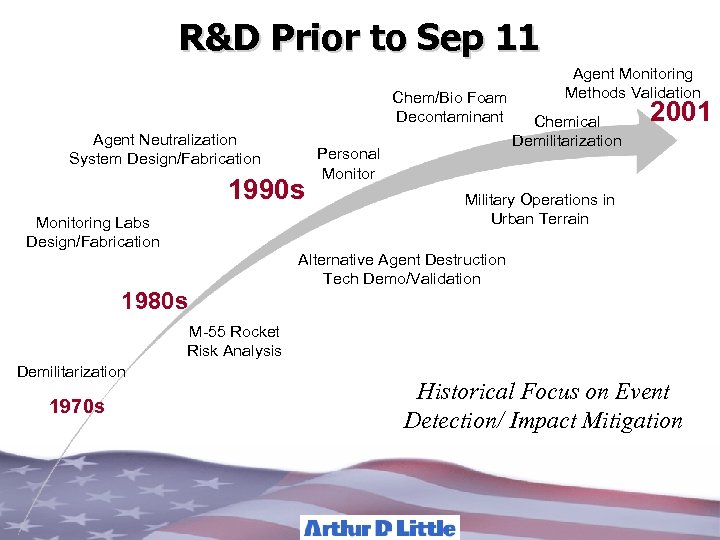 R&D Prior to Sep 11 Chem/Bio Foam Decontaminant Agent Neutralization System Design/Fabrication 1990 s Personal Monitor Chemical Demilitarization 2001 Military Operations in Urban Terrain Monitoring Labs Design/Fabrication 1980 s Agent Monitoring Methods Validation Alternative Agent Destruction Tech Demo/Validation M-55 Rocket Risk Analysis Demilitarization 1970 s Historical Focus on Event Detection/ Impact Mitigation Proprietary Information
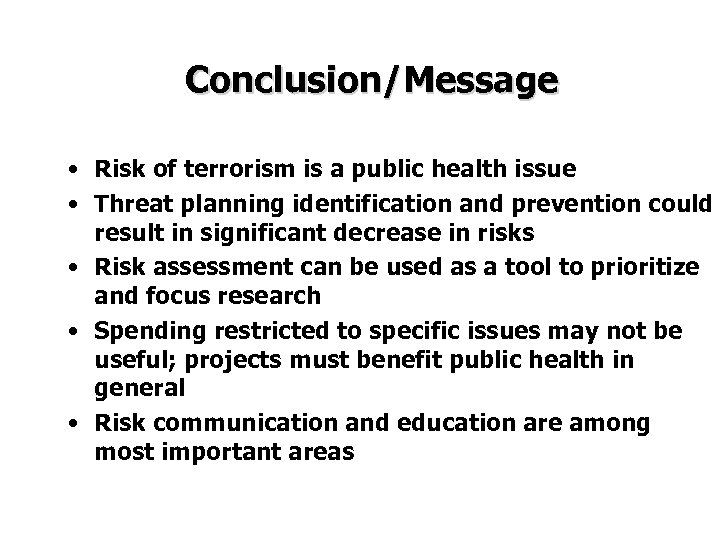 Conclusion/Message • Risk of terrorism is a public health issue • Threat planning identification and prevention could result in significant decrease in risks • Risk assessment can be used as a tool to prioritize and focus research • Spending restricted to specific issues may not be useful; projects must benefit public health in general • Risk communication and education are among most important areas
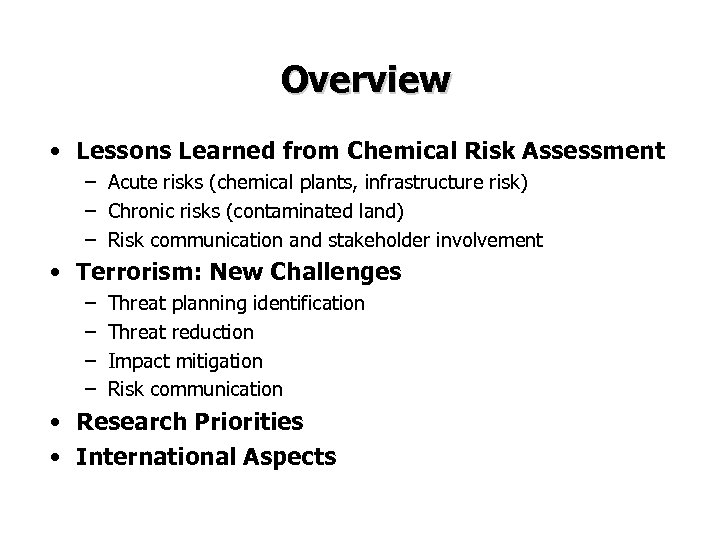 Overview • Lessons Learned from Chemical Risk Assessment – Acute risks (chemical plants, infrastructure risk) – Chronic risks (contaminated land) – Risk communication and stakeholder involvement • Terrorism: New Challenges – – Threat planning identification Threat reduction Impact mitigation Risk communication • Research Priorities • International Aspects
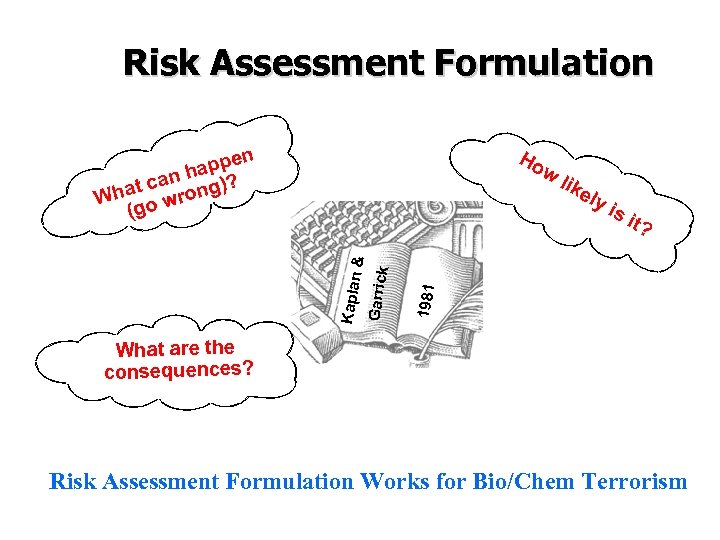 Risk Assessment Formulation n appe h can ng)? t Wha o wro (g w lik ely is it? 1981 k Garric Kaplan & Ho What are the consequences? Risk Assessment Formulation Works for Bio/Chem Terrorism
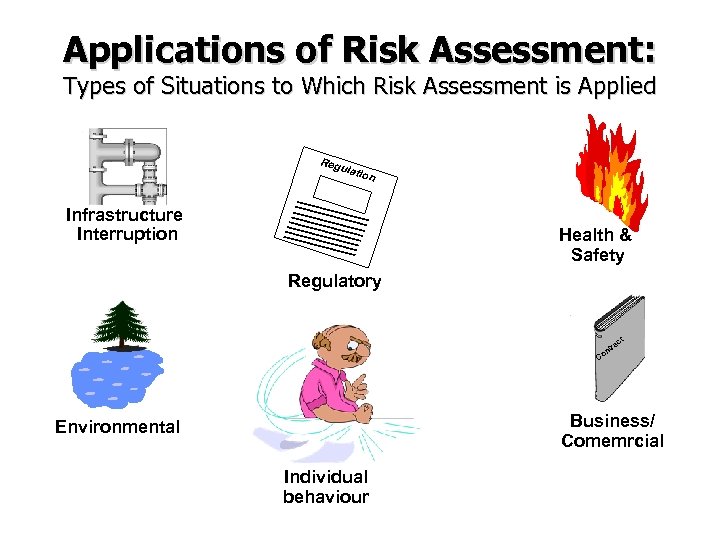 Applications of Risk Assessment: Types of Situations to Which Risk Assessment is Applied Reg ulat ion Infrastructure Interruption Health & Safety Regulatory ct ra C t on Business/ Comemrcial Environmental Individual behaviour
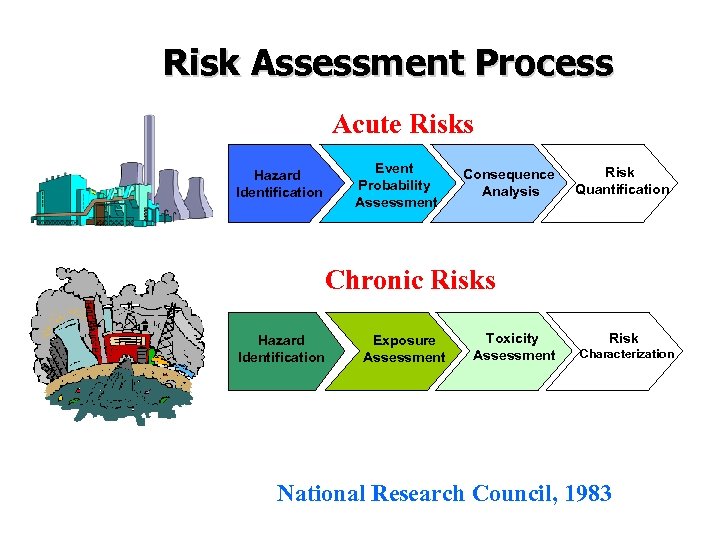 Risk Assessment Process Acute Risks Hazard Identification Event Probability Assessment Consequence Analysis Risk Quantification Chronic Risks Hazard Identification Exposure Assessment Toxicity Assessment Risk Characterization National Research Council, 1983
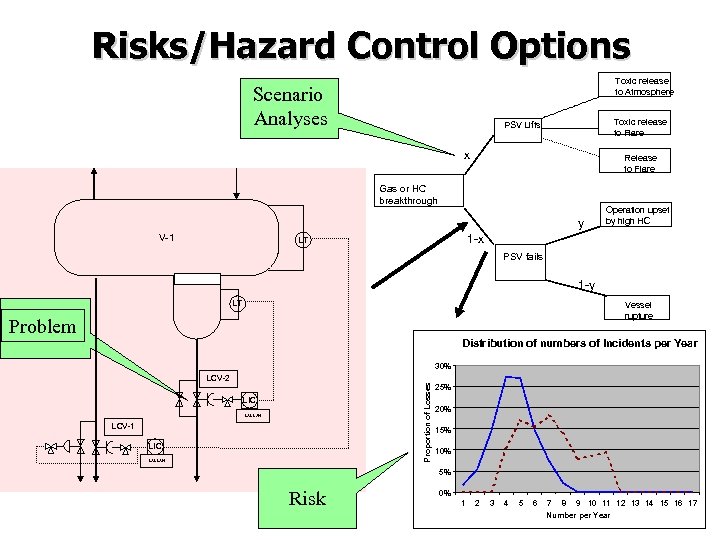 Risks/Hazard Control Options Toxic release to Atmosphere Scenario Analyses Toxic release to Flare PSV Lifts x Release to Flare Gas or HC breakthrough y V-1 Operation upset by high HC 1 -x LT PSV fails 1 -y LT Vessel rupture Problem Distribution of numbers of Incidents per Year 30% Proportion of Losses LCV-2 LIC LAL LAH LCV-1 LIC LAL LAH 25% 20% 15% 10% 5% Risk 0% 1 2 3 4 5 6 7 8 9 10 11 12 13 14 15 16 17 Number per Year
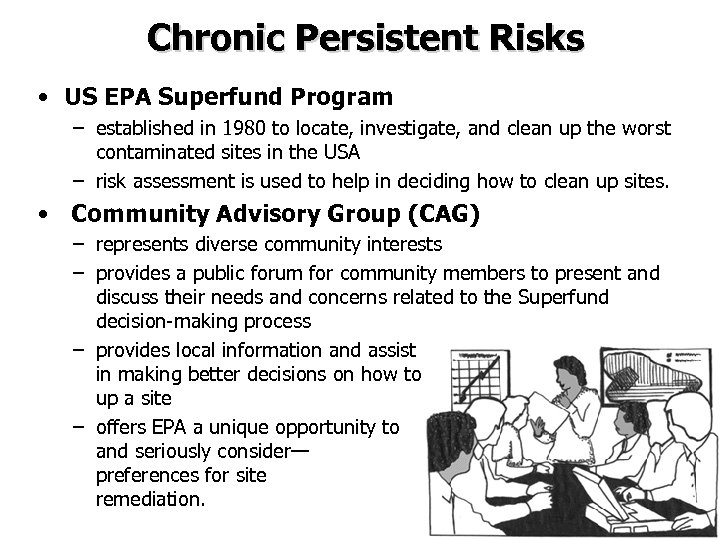 Chronic Persistent Risks • US EPA Superfund Program – established in 1980 to locate, investigate, and clean up the worst contaminated sites in the USA – risk assessment is used to help in deciding how to clean up sites. • Community Advisory Group (CAG) – represents diverse community interests – provides a public forum for community members to present and discuss their needs and concerns related to the Superfund decision-making process – provides local information and assist in making better decisions on how to clean up a site – offers EPA a unique opportunity to hear— and seriously consider— community preferences for site cleanup and remediation.
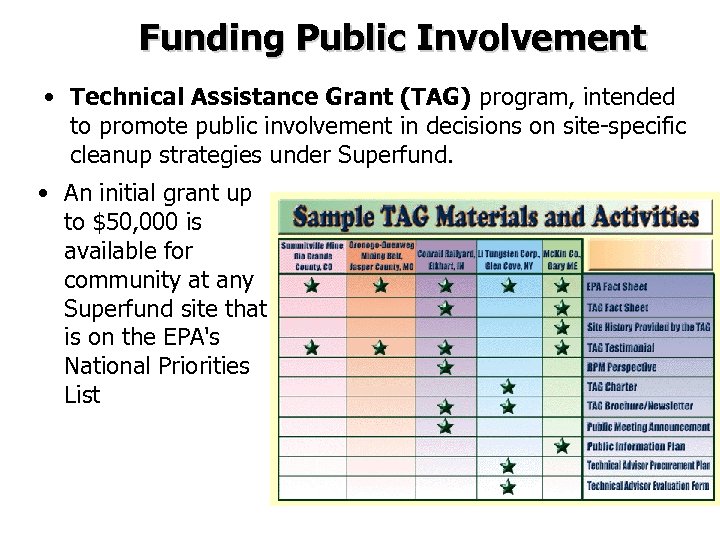 Funding Public Involvement • Technical Assistance Grant (TAG) program, intended to promote public involvement in decisions on site-specific cleanup strategies under Superfund. • An initial grant up to $50, 000 is available for community at any Superfund site that is on the EPA's National Priorities List
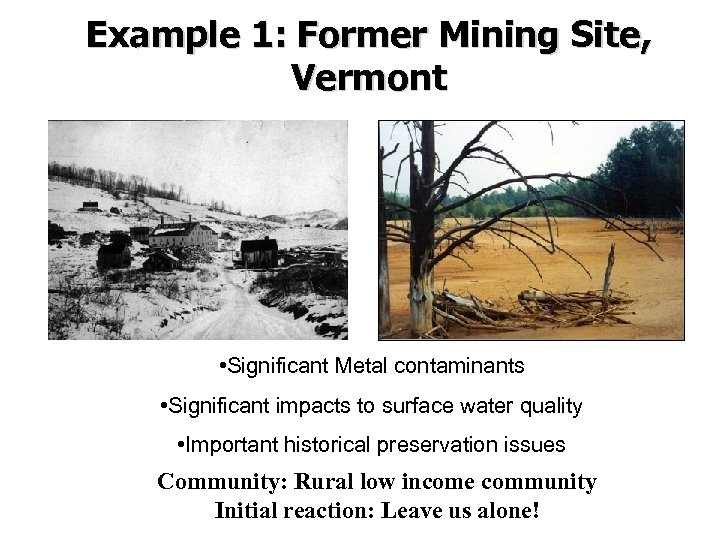 Example 1: Former Mining Site, Vermont • Significant Metal contaminants • Significant impacts to surface water quality • Important historical preservation issues Community: Rural low income community Initial reaction: Leave us alone!
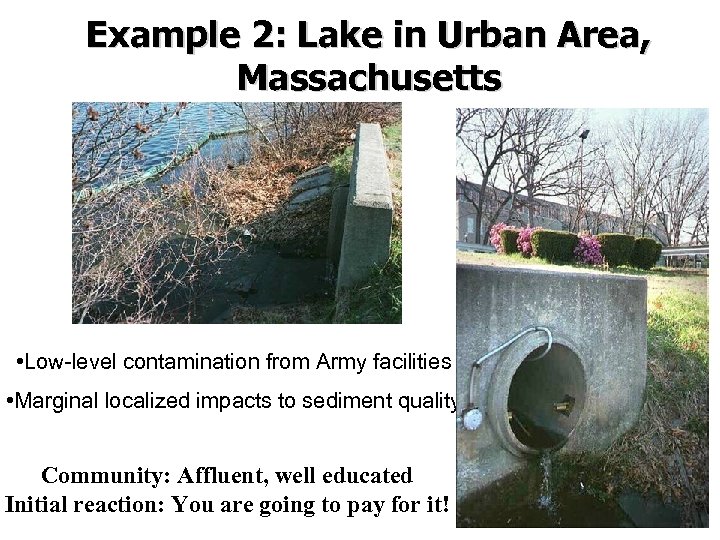 Example 2: Lake in Urban Area, Massachusetts • Low-level contamination from Army facilities • Marginal localized impacts to sediment quality Community: Affluent, well educated Initial reaction: You are going to pay for it!
 Communicating Chronic Risks • Approach to risk communication: – Monthly community meetings – Quarterly newsletters – Annual environmental open house • Results – Developed trust with community – Community acceptance of remedial actions at Site 1 – Advanced risk assessment (including probabilistic assessment) at Site 2 • Conclusion: Risk communication requires time and patience! – Risk education is very important – Involvement of technical experts and broad community representatives
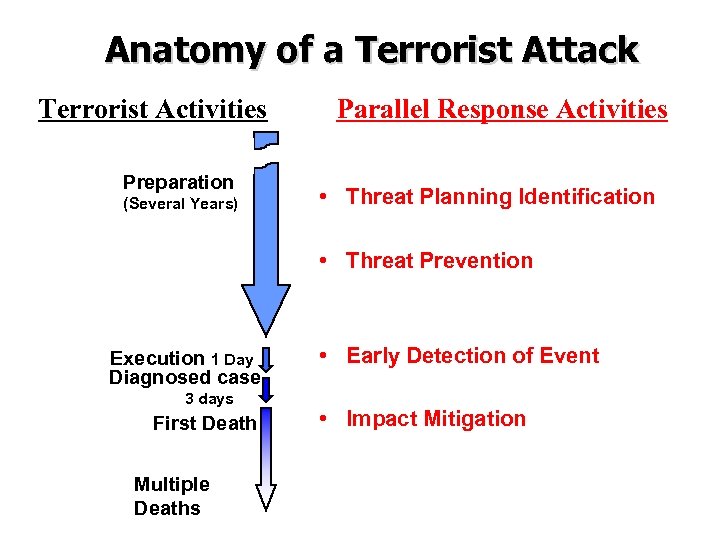 Anatomy of a Terrorist Attack Terrorist Activities Preparation (Several Years) Parallel Response Activities • Threat Planning Identification • Threat Prevention Execution 1 Day Diagnosed case 3 days First Death Multiple Deaths • Early Detection of Event • Impact Mitigation
 Threat Planning Identification • Homeland Municipal Defense Network – pilot study to link existing environmental monitoring network (soil, air, water) with public health/medical networks in a single grid
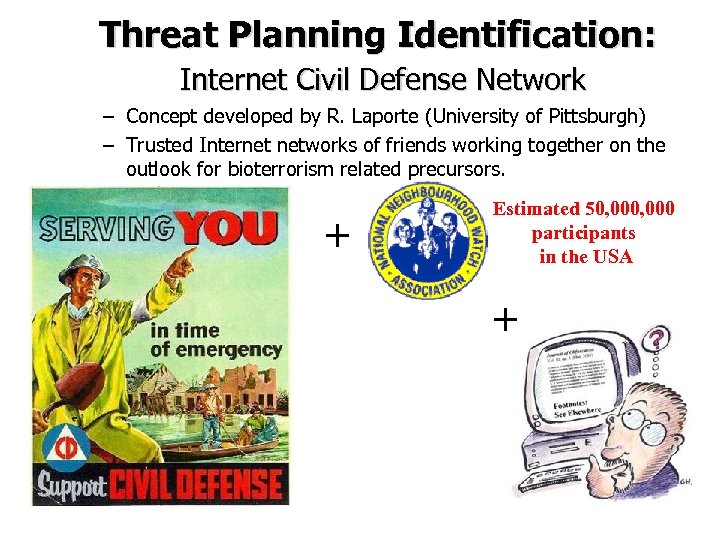 Threat Planning Identification: Internet Civil Defense Network – Concept developed by R. Laporte (University of Pittsburgh) – Trusted Internet networks of friends working together on the outlook for bioterrorism related precursors. + Estimated 50, 000 participants in the USA + +
 Threat Planning Identification • Research Need: Simulation of the System Design – – What is the level of background noise? What is the lowest detectable signal? How to implement Geospatial analyses and time dynamics? How to optimize network design to reduce false-positive detection rates?
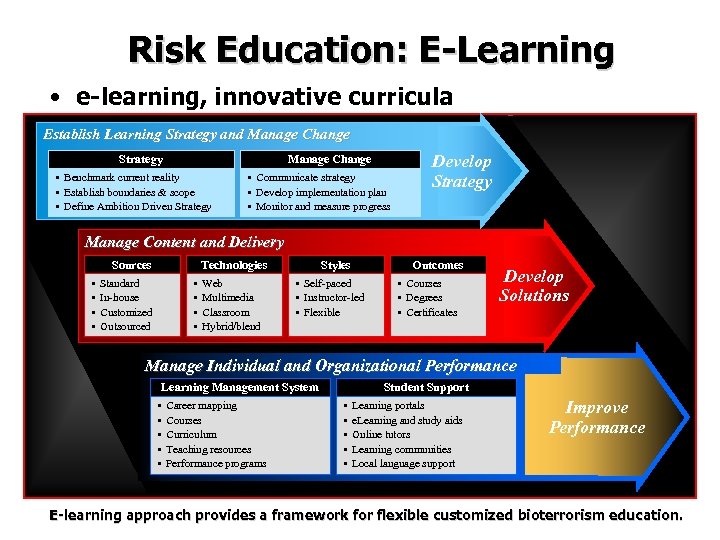 Risk Education: E-Learning • e-learning, innovative curricula Establish Learning Strategy and Manage Change Strategy Manage Change • Benchmark current reality • Establish boundaries & scope • Define Ambition Driven Strategy • Communicate strategy • Develop implementation plan • Monitor and measure progress Develop Strategy Manage Content and Delivery Sources • • Technologies • • Standard In-house Customized Outsourced Web Multimedia Classroom Hybrid/blend Styles Outcomes • Self-paced • Instructor-led • Flexible • Courses • Degrees • Certificates Develop Solutions Manage Individual and Organizational Performance Learning Management System • • • Career mapping Courses Curriculum Teaching resources Performance programs Student Support • • • Learning portals e. Learning and study aids Online tutors Learning communities Local language support Improve Performance E-learning approach provides a framework for flexible customized bioterrorism education.
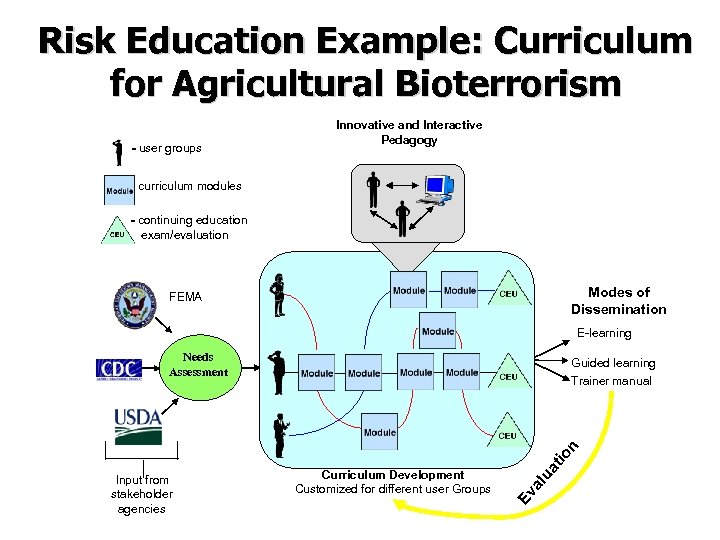 Risk Education Example: Curriculum for Agricultural Bioterrorism = user groups = curriculum Innovative and Interactive Pedagogy modules = continuing education exam/evaluation Modes of Dissemination FEMA E-learning Needs Assessment al Curriculum Development Customized for different user Groups Ev Input from stakeholder agencies ua tio n Guided learning Trainer manual
 Threat Prevention (Making it Harder to Implement) • Increased training – helps First Responders to recognize and respond to possible chemical and biological agent attacks. • Tighter control of potential chemical and biological threat materials – both material precursors and active agents are being put in place to reduce availability to potential terrorists. • Change in U. S. medical infrastructure – monitoring, reporting and treatment is being expanded and tested to ensure readiness in preparation for possible future bioterrorism events.
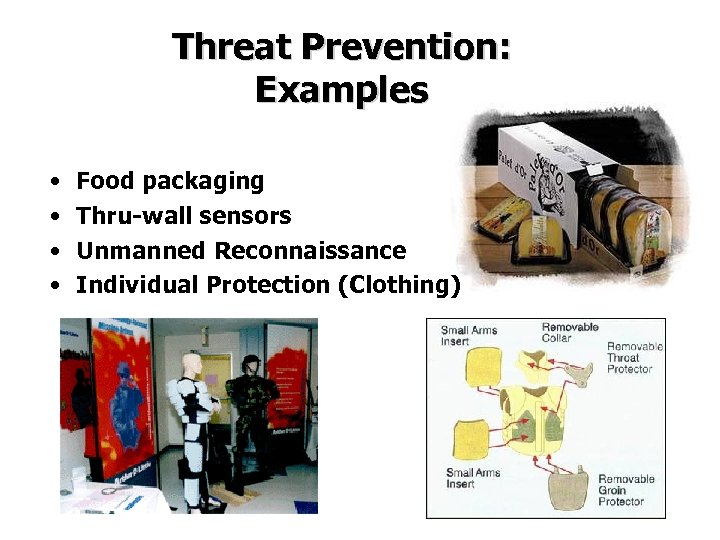 Threat Prevention: Examples • • Food packaging Thru-wall sensors Unmanned Reconnaissance Individual Protection (Clothing)
 Early Detection of Event • Detection Technologies originally developed for the U. S. military are being adapted to civilian applications – CBW Detection in the Washington D. C. subway system – Handheld chemical agent detectors are available to first responders • Near-time Biological Detection is rapidly advancing, but is focusing on “Detect to Treat” scenarios, not “Detect to Warn”, due to the delayed impact of the treats. – The first indication of anthrax in the U. S. Senate letters was the medical consequences.
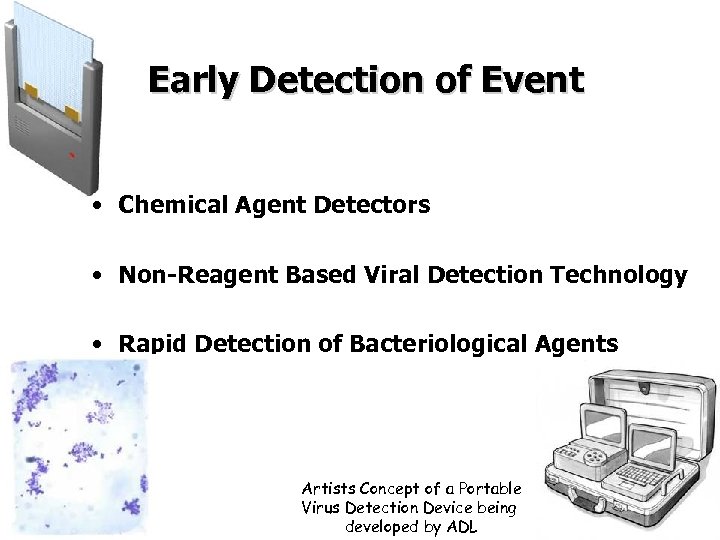 Early Detection of Event • Chemical Agent Detectors • Non-Reagent Based Viral Detection Technology • Rapid Detection of Bacteriological Agents Artists Concept of a Portable Virus Detection Device being developed by ADL
 Impact mitigation • Technologies originally developed to contain Improvised Explosive Devices are being expanded to counter Chemical and Biological dispersion threats • Vaccines to counter potential biological threats are being fast-tracked to ensure a timely response capability • Several decontaminant products are under development to counter civilian chemical and biological warfare agent attacks – ADL CB decontaminant foam – Sandia decontaminant foam
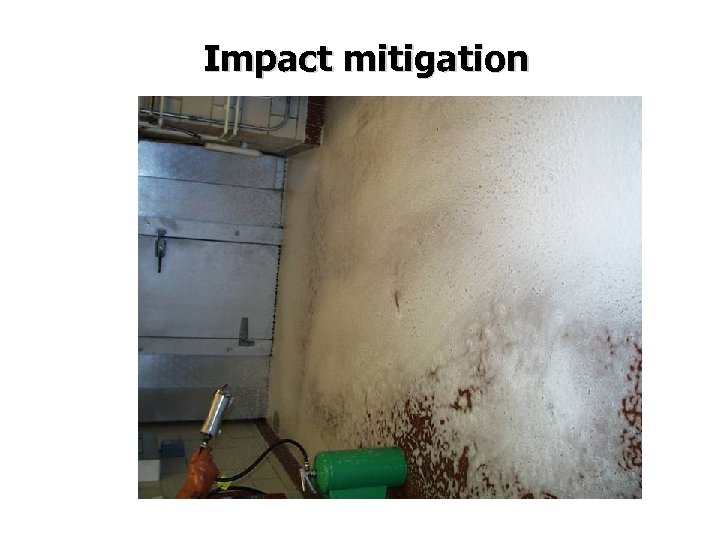 Impact mitigation – foam
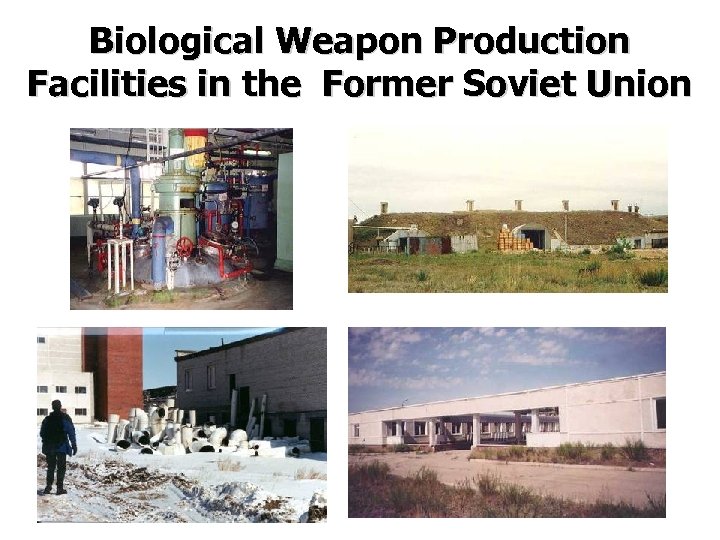 Biological Weapon Production Facilities in the Former Soviet Union
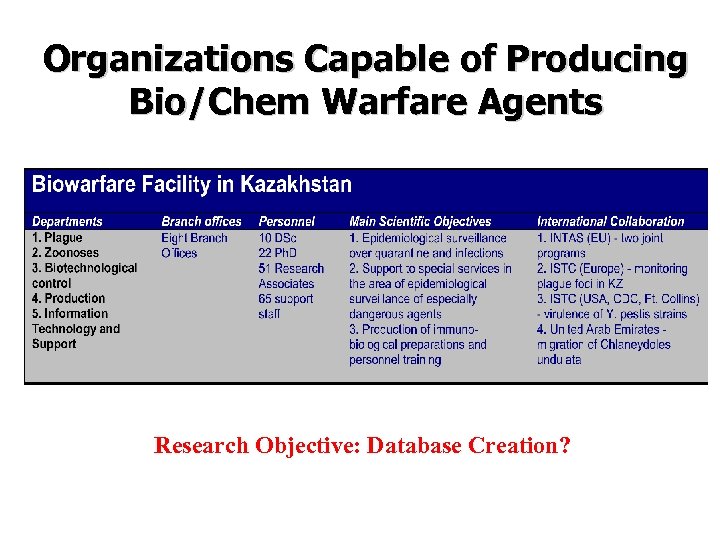 Organizations Capable of Producing Bio/Chem Warfare Agents Research Objective: Database Creation?
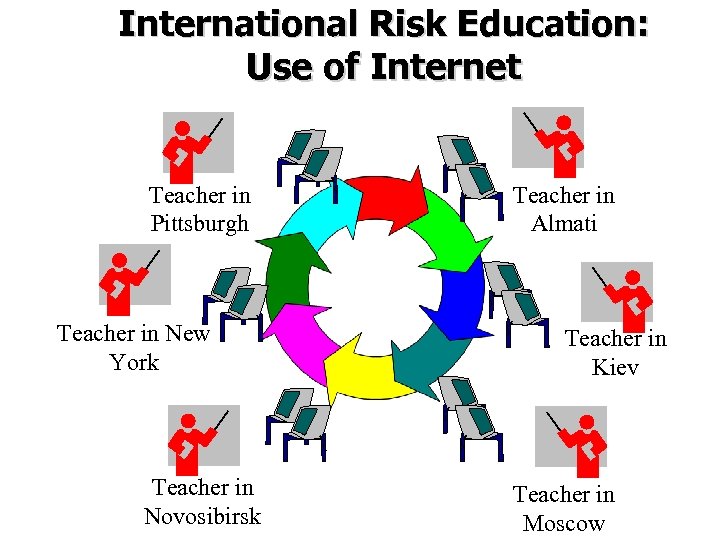 International Risk Education: Use of Internet Teacher in Pittsburgh Teacher in New York Teacher in Novosibirsk Teacher in Almati Teacher in Kiev Teacher in Moscow
 International Risk Education Example: Supercourse • SUPERCOURSE-collection of lectures on prevention, shared for free by the best faculty in the world. Developed by Dr. La. Porte and the Supercourse team (University of Pittsburgh) URL: www. pitt. edu/~super 1 • RUSSIAN SUPERCOURSE, collection of lectures in Russian, designed to target audience in Russia and other countries of former Soviet Union • Current Status – 620 lectures – 5000 faculty members from 120 countries SUPERCOURSE on Terrorism?
 Conclusion/Message • Risk of terrorism is a public health issue • Threat planning identification and prevention could result in significant decrease in risks • Risk assessment can be used as a tool to prioritize and focus research • Spending restricted to specific issues may not be useful; projects must benefit public health in general • Risk communication and education are among most important areas