 Скачать презентацию Assessing Watershed Scale Responses to BMP Implementation —
dd7ece1cfbc12f73cf32ac4f9151a327.ppt
- Количество слайдов: 32



Assessing Watershed Scale Responses to BMP Implementation - Fairfax County, VA John Jastram Hydrologist USGS Virginia Water Science Center U. S. Department of the Interior U. S. Geological Survey
Topics § § § § Objectives and Introduction Study Approach Site Selection and Watershed Characteristics Instrumentation and Methods Anticipated Products Preliminary Data Additional Related Research
Study Objectives 1. § § § Generate long-term monitoring data to describe: Current water-quality (sediment and nutrients) and quantity conditions, Trends in water-quality and quantity, Nutrient and Sediment Loads and Yields. 2. Evaluate relations between observed conditions/trends and BMP implementation. 3. Transfer the understanding gained to other lessintensively monitored watersheds.
Introduction: The Challenge BMP induced changes are difficult to quantify at the watershed scale: § Environmental factors cause great variability – need to separate signal from noise, § Lag times may be considerable, § Numerous samples at multiple sites over extended periods of time.
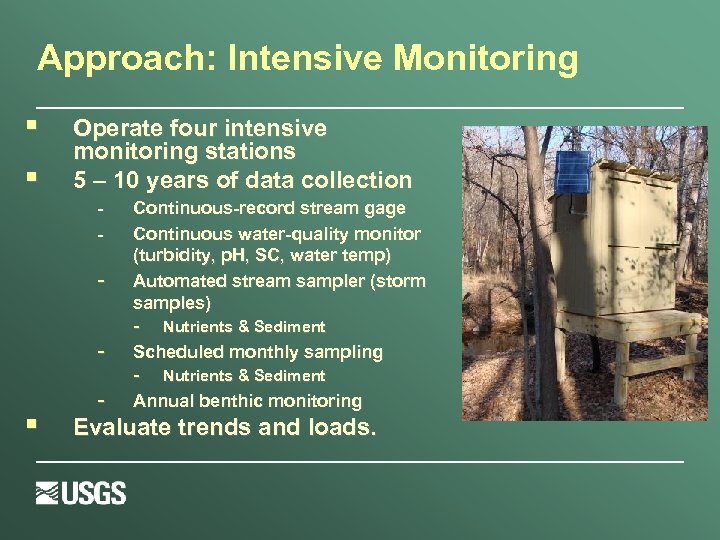
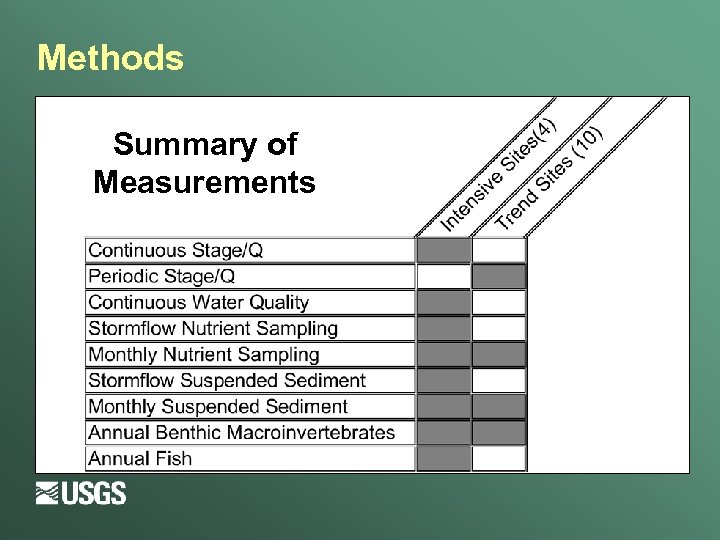
Approach: Intensive Monitoring § § Operate four intensive monitoring stations 5 – 10 years of data collection - - § Continuous-record stream gage Continuous water-quality monitor (turbidity, p. H, SC, water temp) Automated stream sampler (storm samples) - Nutrients & Sediment Scheduled monthly sampling - Nutrients & Sediment - Annual benthic monitoring Evaluate trends and loads.
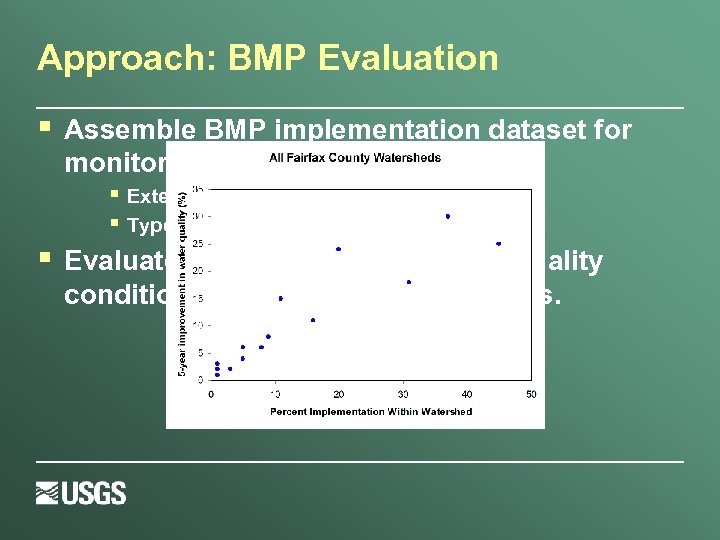
Approach: BMP Evaluation § Assemble BMP implementation dataset for monitored watersheds. § Extent of BMP implementation. § Types of BMPs installed. § Evaluate relations between water-quality conditions/trends and BMP activities.
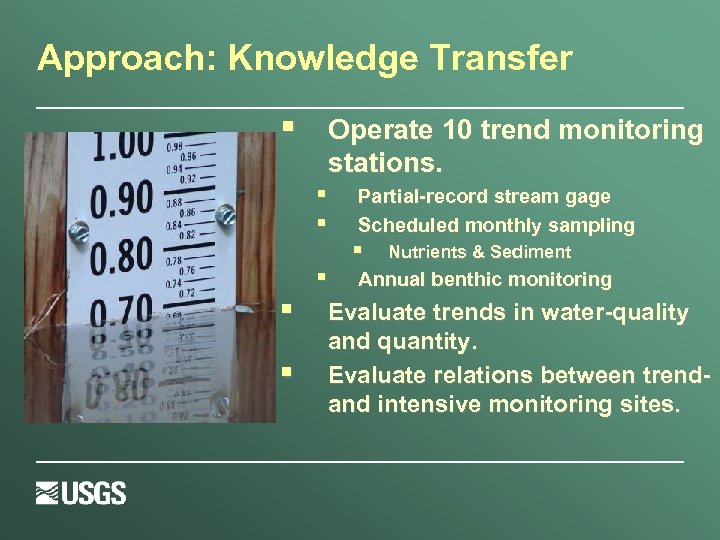
Approach: Knowledge Transfer § Operate 10 trend monitoring stations. § § § Partial-record stream gage Scheduled monthly sampling § Nutrients & Sediment Annual benthic monitoring Evaluate trends in water-quality and quantity. Evaluate relations between trendand intensive monitoring sites.
Status Intensive Sites § Streamgages & Water-Quality Monitors installed and fully operational § Real-time data on web (http: //va. water. usgs. gov) § Sampling underway § Surrogate regressions under development Partial Record - Trend Sites § Staff plates and Crest Stage Gages installed § Monthly sampling underway
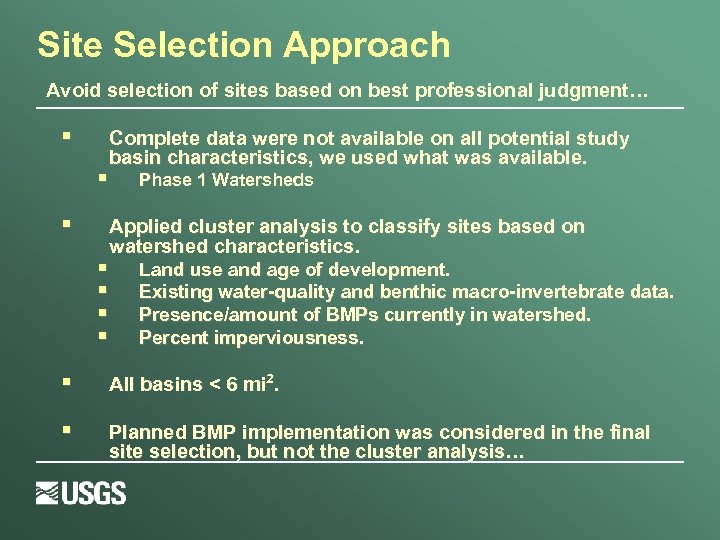
Site Selection Approach Avoid selection of sites based on best professional judgment… § § § Complete data were not available on all potential study basin characteristics, we used what was available. Phase 1 Watersheds Applied cluster analysis to classify sites based on watershed characteristics. § § Land use and age of development. Existing water-quality and benthic macro-invertebrate data. Presence/amount of BMPs currently in watershed. Percent imperviousness. § All basins < 6 mi 2. § Planned BMP implementation was considered in the final site selection, but not the cluster analysis…
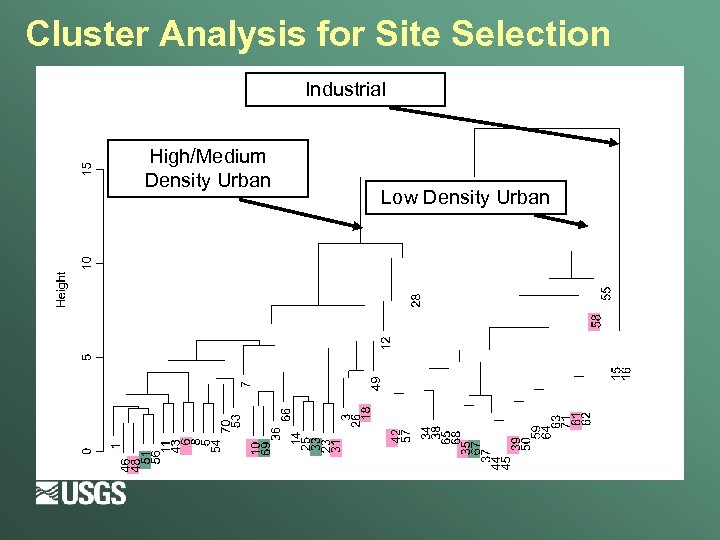
Cluster Analysis for Site Selection Industrial High/Medium Density Urban Low Density Urban
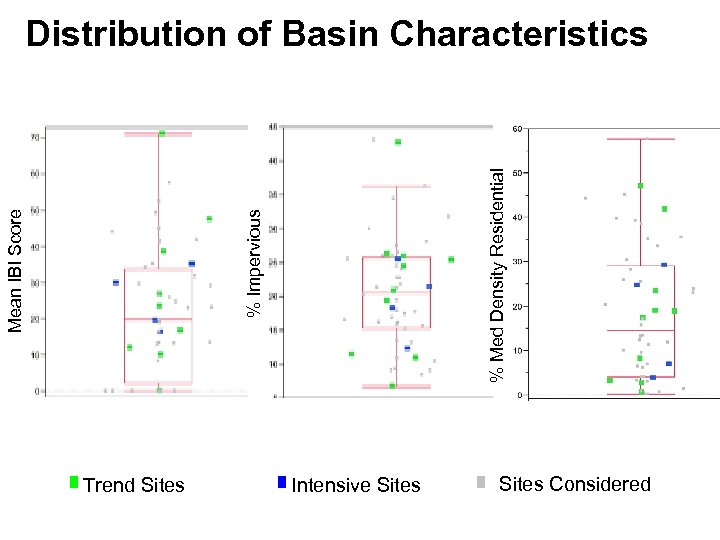
% Med Density Residential % Impervious Mean IBI Score Distribution of Basin Characteristics Trend Sites Intensive Sites Considered
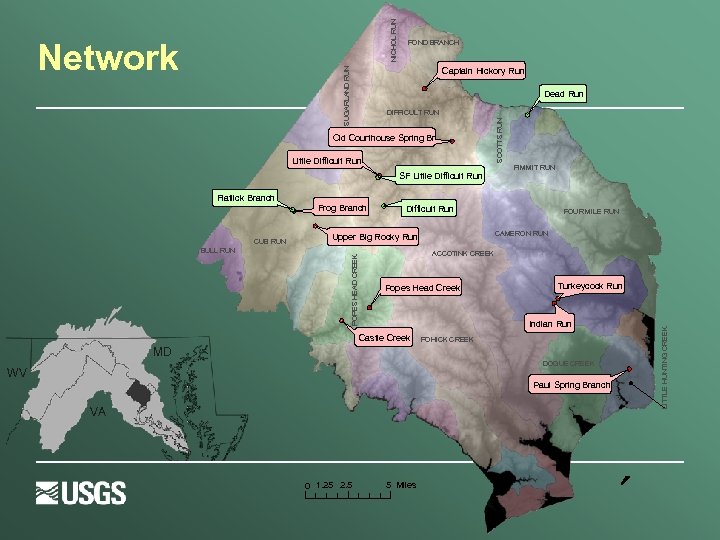
NICHOL RUN SUGARLAND RUN Captain Hickory Run Dead Run DIFFICULT RUN Old Courthouse Spring Br Little Difficult Run SF Little Difficult Run BULL RUN PIMMIT RUN Difficult Run FOUR MILE RUN CAMERON RUN Upper Big Rocky Run ACCOTINK CREEK Popes Head Creek Turkeycock Run Indian Run Castle Creek LITTLE HUNTING CREEK CUB RUN Frog Branch POPES HEAD CREEK Flatlick Branch SCOTTS RUN Network POND BRANCH POHICK CREEK MD DOGUE CREEK WV Paul Spring Branch VA 0 1. 25 2. 5 5 Miles ´
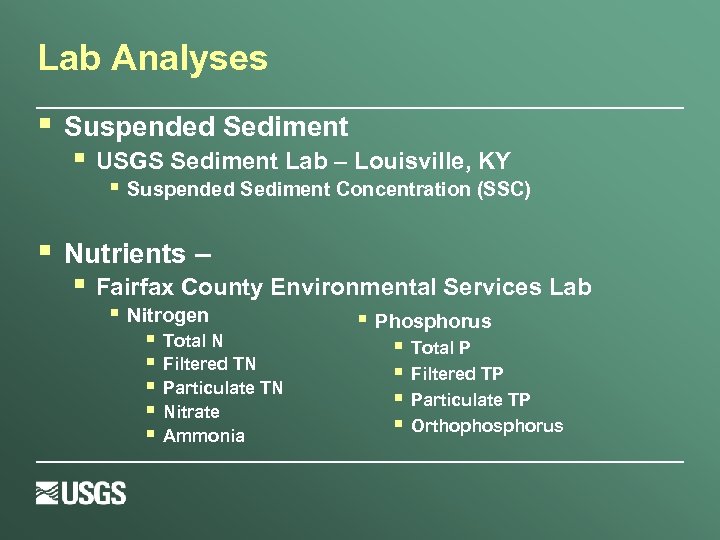
Lab Analyses § Suspended Sediment § USGS Sediment Lab – Louisville, KY § Suspended Sediment Concentration (SSC) § Nutrients – § Fairfax County Environmental Services Lab § Nitrogen § § § Total N Filtered TN Particulate TN Nitrate Ammonia § Phosphorus § § Total P Filtered TP Particulate TP Orthophosphorus
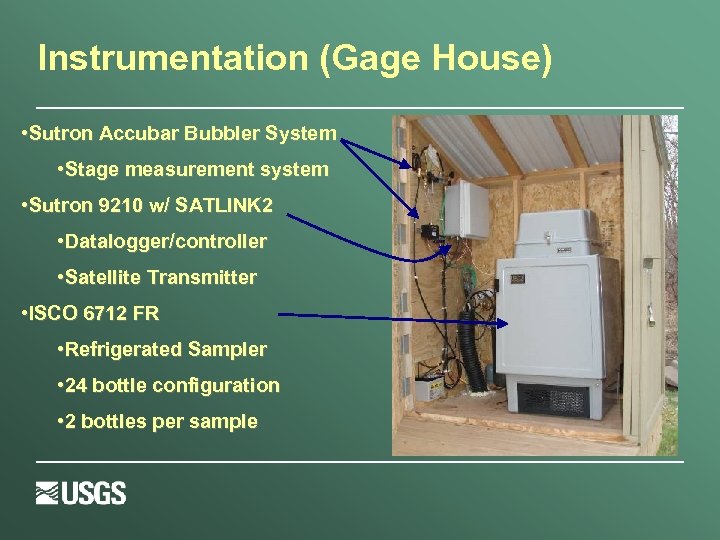
Instrumentation (Gage House) • Sutron Accubar Bubbler System • Stage measurement system • Sutron 9210 w/ SATLINK 2 • Datalogger/controller • Satellite Transmitter • ISCO 6712 FR • Refrigerated Sampler • 24 bottle configuration • 2 bottles per sample
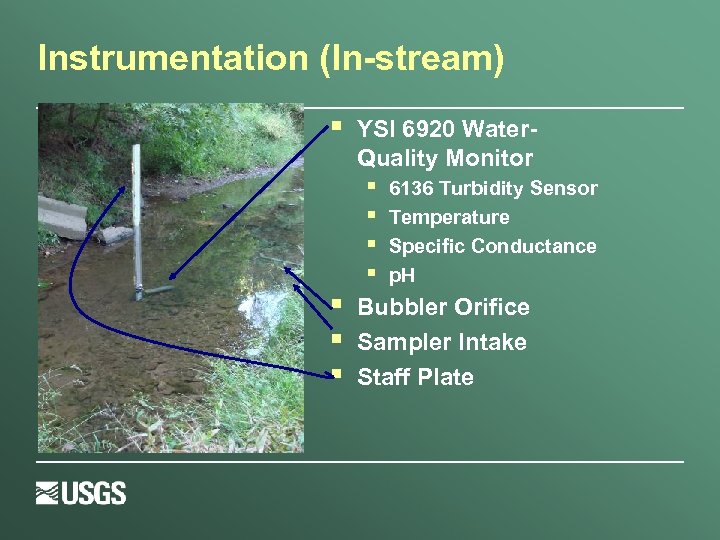
Instrumentation (In-stream) § YSI 6920 Water. Quality Monitor § § § § 6136 Turbidity Sensor Temperature Specific Conductance p. H Bubbler Orifice Sampler Intake Staff Plate
Field Methods § Sampling § § Continuous Water-Quality Monitoring § § National Field Manual for the Collection of Water Quality Data (USGS TWRI Book 9) Guidelines and Standard Procedures for Continuous Water. Quality Monitors: Station Operation, Record Computation, and Data Reporting: USGS TWRI 1 -D 3 Streamgaging § USGS TWRI Book 3
Value of Continuous Water Quality Data • Richness of continuous and real-time data allows broad application. • Typically, few discrete samples (20 per year) are collected and used to develop water quality interpretations. • Detailed understanding of the system is almost never developed if discrete sampling is used. • Delay between sample collection and lab analysis may be critical. • Time and costs associated with manual sampling are significant. • Sampling designs for loading studies conflict with sampling designs for trend analysis. • Estimating non-monitored constituents typically involves regressions to discharge. - Use water-quality data to estimate water-quality data! •
Surrogate Methods • Continuously measure (15 min. interval) parameters related to constituent of interest (Turbidity, SC, etc. ) • Manually collect discrete samples of constituent to be estimated (sediment, dissolved solids, nutrients, etc. ) • Develop regression to estimate constituent concentrations/loads during non-sampled periods This approach provides the ability to generate a timeseries of constituent concentrations – improving load estimations.
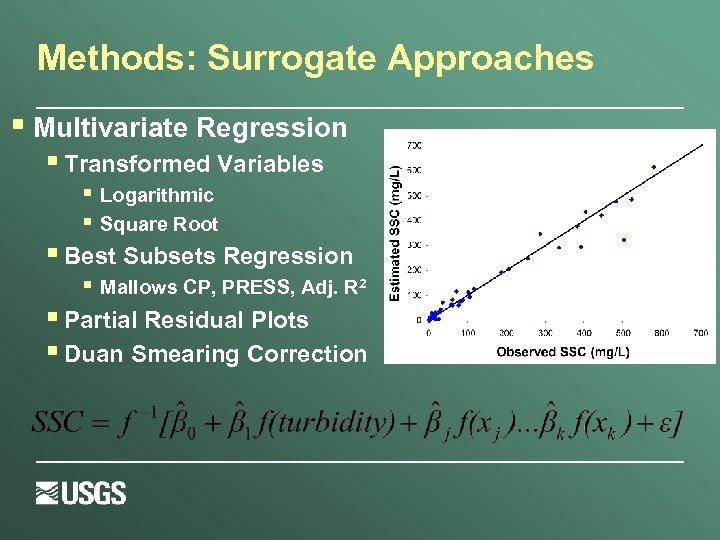
Methods: Surrogate Approaches § Multivariate Regression § Transformed Variables § Logarithmic § Square Root § Best Subsets Regression § Mallows CP, PRESS, Adj. R 2 § Partial Residual Plots § Duan Smearing Correction
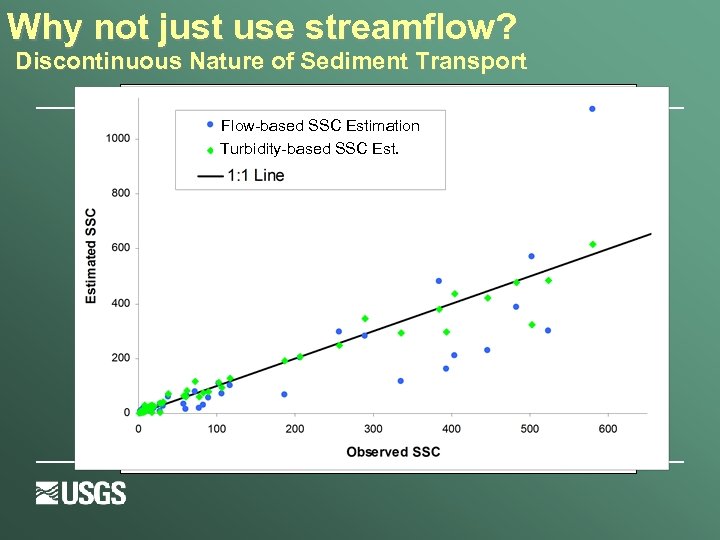
Why not just use streamflow? Discontinuous Nature of Sediment Transport 300 fnu 450 mg/L Flow-based SSC Estimation Turbidity-based SSC Est. 22, 000 cfs 235 fnu 236 350 mg/l
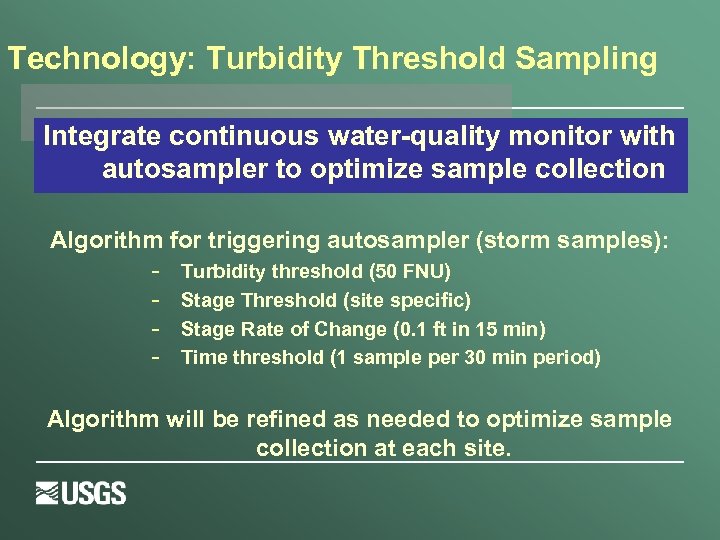
Technology: Turbidity Threshold Sampling Integrate continuous water-quality monitor with autosampler to optimize sample collection Algorithm for triggering autosampler (storm samples): - Turbidity threshold (50 FNU) Stage Threshold (site specific) Stage Rate of Change (0. 1 ft in 15 min) Time threshold (1 sample per 30 min period) Algorithm will be refined as needed to optimize sample collection at each site.
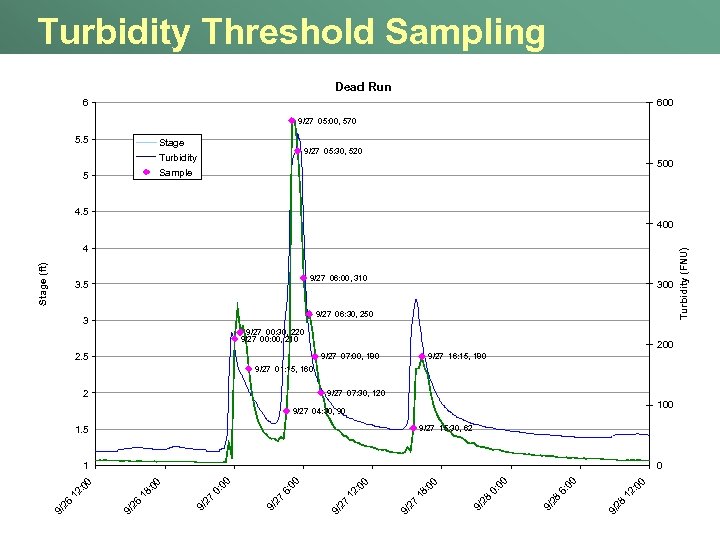
Turbidity Threshold Sampling Dead Run 6 600 9/27 05: 00, 570 5. 5 Stage Turbidity Sample 5 9/27 05: 30, 520 500 4. 5 Stage (ft) 4 9/27 06: 00, 310 3. 5 300 9/27 06: 30, 250 3 9/27 00: 30, 220 9/27 00: 00, 210 2. 5 200 9/27 07: 00, 180 9/27 16: 15, 180 9/27 01: 15, 160 2 9/27 07: 30, 120 100 9/27 04: 30, 90 9/27 15: 30, 62 1. 5 0 12 : 0 9/ 28 6: 00 9/ 28 0 0: 0 9/ 28 0 18 : 0 9/ 27 12 : 00 0 6: 0 9/ 27 0 0: 0 9/ 27 18 : 0 0 0 9/ 26 12 : 0 0 1 Turbidity (FNU) 400
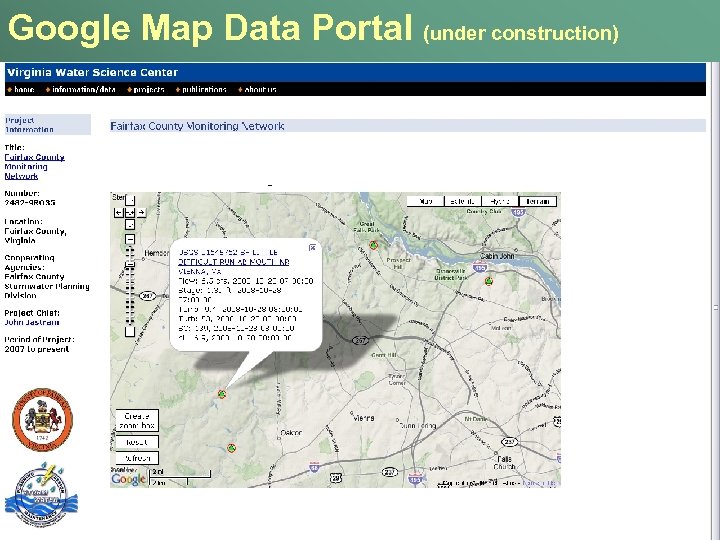
Google Map Data Portal (under construction)
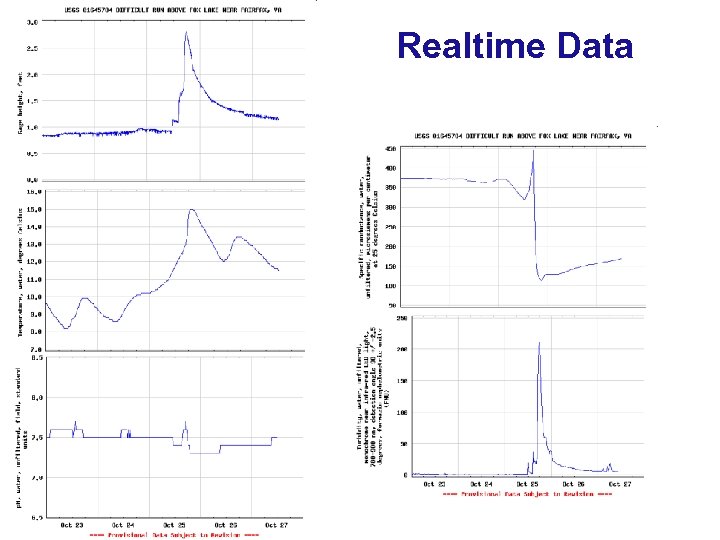
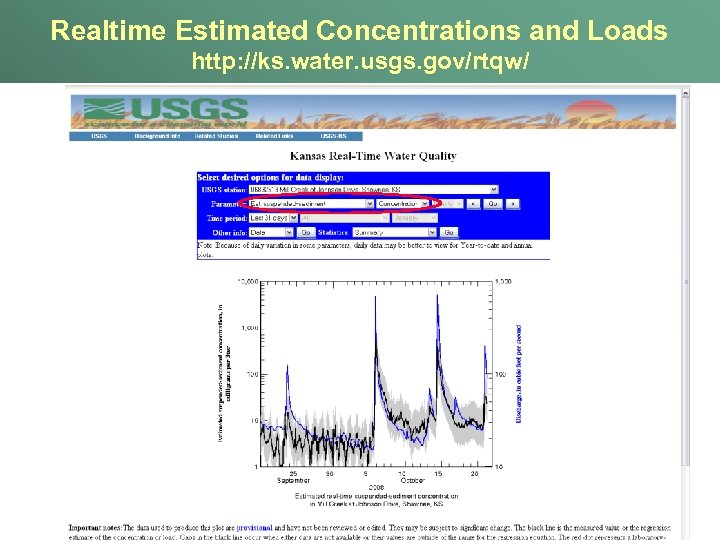
Realtime Data
Methods Summary of Measurements
Realtime Data Products § We have realtime water-quality data, § We are generating regressions for sediment and nutrient estimations, § We will be able to generate realtime estimates of constituent concentrations and loads! § Examples from USGS Kansas WSC…
Realtime Estimated Concentrations and Loads http: //ks. water. usgs. gov/rtqw/
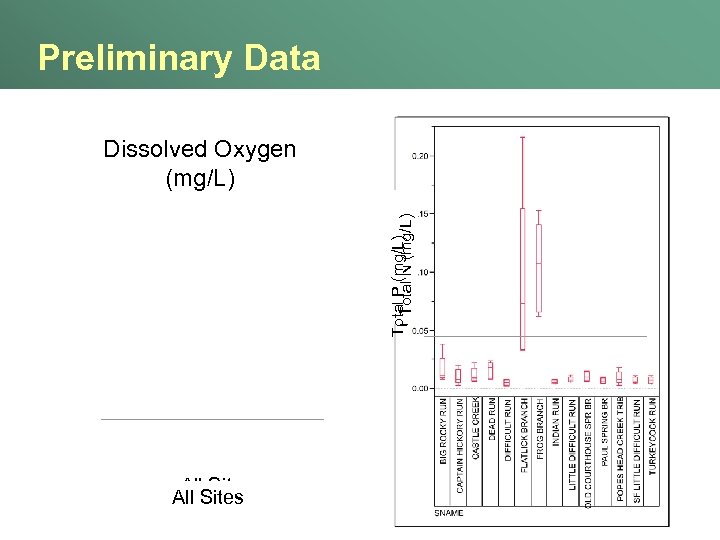
Preliminary Data Monthly. PSampling Results Ortho. P (mg/L) Total (mg/L) Specific Conductance Nitrate Oxygen Dissolved (mg/L) Total Nitrogen (mg/L) § April(us/cm) September 2008 through (mg/L) Total P P (mg/L) Ortho (mg/L) Total N (mg/L) § All Sites All Sites
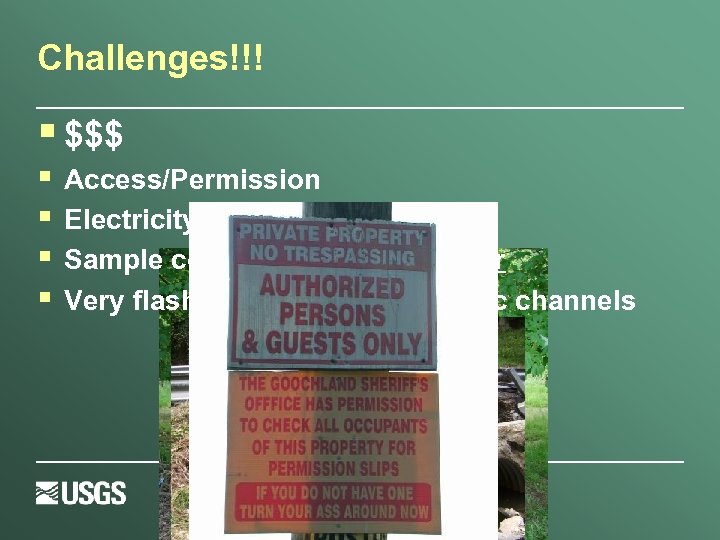
Challenges!!! § $$$ § § Access/Permission Electricity Sample collection – 500+ per year Very flashy streams and dynamic channels
Additional Research in Difficult Run - USGS National Research Program Goal: Characterize sediment and nutrient retention functions of floodplains in a developed watershed. § Floodplain sediment deposition and erosion, § Floodplain topographic change, § Floodplain nutrient deposition and processes, § Floodplain and stream sediment geochemistry, § Floodplain and suspended sediment source tracking, § Streambank erosion, §…
In Summary… § Fairfax County and USGS have initiated a long-term study of watershed-scale waterquality responses to BMP implementation. § Multiple technologies are being used to generate dense datasets in 14 watersheds. § Process level research on sediment/nutrient transport has been added in Difficult Run.

John Jastram 804 -261 -2648 jdjastra@usgs. gov Shannon Curtis 703 -324 -5211 Shannon. Curtis@fairfaxcounty. gov U. S. Department of the Interior U. S. Geological Survey http: //va. water. usgs. gov/projects/ffx_co_monitoring. htm
Скачать презентацию Assessing Watershed Scale Responses to BMP Implementation —
dd7ece1cfbc12f73cf32ac4f9151a327.ppt