


 Скачать презентацию Assessing the Impact of Maneuver Training on NPS
9ce512470e6f1b21b808fea75597de52.ppt
- Количество слайдов: 41
 Assessing the Impact of Maneuver Training on NPS Pollution and Water Quality PROJECT NUMBER: CP-1339 Principal Investigator: James Steichen PI’s Organization: Kansas State University In-Progress Review Meeting April 7, 2005 1
 TECHNICAL OBJECTIVES Identify sources of NPS pollution resulting from military activities and assess the impact of this pollution on surface water quality: 1. 2. 3. 4. 5. 6. 7. Identify military activities at Fort Riley that may contribute to NPS pollution. Evaluate the effectiveness of riparian buffers. Assess the effectiveness of low water stream crossings (LWSC). Evaluate and modify a comprehensive riparian ecosystem model. Evaluate the most effective means of crossing streams during maneuvers. Model the contribution of NPS pollution on a representative watershed. Develop improved field-portable sediment characterization sensor. 2
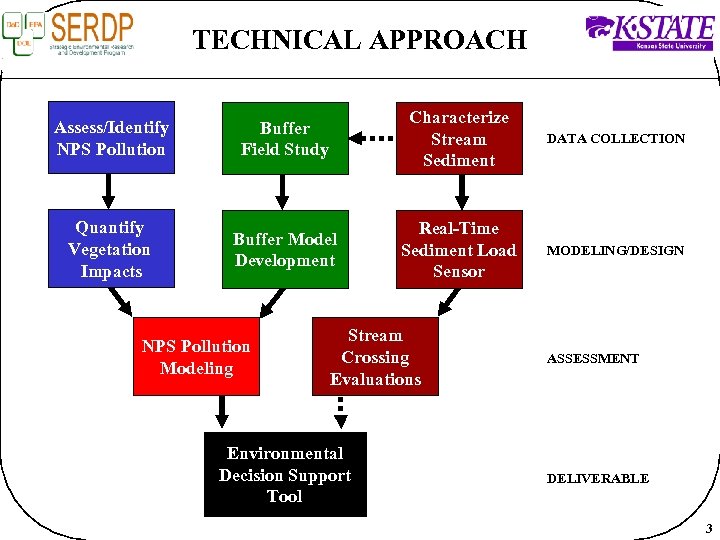 TECHNICAL APPROACH Assess/Identify NPS Pollution Buffer Field Study Characterize Stream Sediment DATA COLLECTION Quantify Vegetation Impacts Buffer Model Development Real-Time Sediment Load Sensor MODELING/DESIGN NPS Pollution Modeling Stream Crossing Evaluations Environmental Decision Support Tool ASSESSMENT DELIVERABLE 3
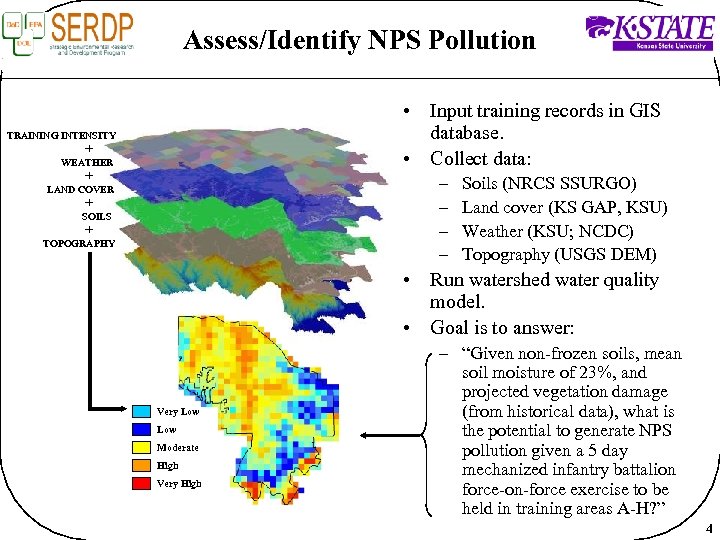 Assess/Identify NPS Pollution • Input training records in GIS database. • Collect data: TRAINING INTENSITY + WEATHER + – – LAND COVER + SOILS + TOPOGRAPHY Soils (NRCS SSURGO) Land cover (KS GAP, KSU) Weather (KSU; NCDC) Topography (USGS DEM) • Run watershed water quality model. • Goal is to answer: Very Low Moderate High Very High – “Given non-frozen soils, mean soil moisture of 23%, and projected vegetation damage (from historical data), what is the potential to generate NPS pollution given a 5 day mechanized infantry battalion force-on-force exercise to be held in training areas A-H? ” 4
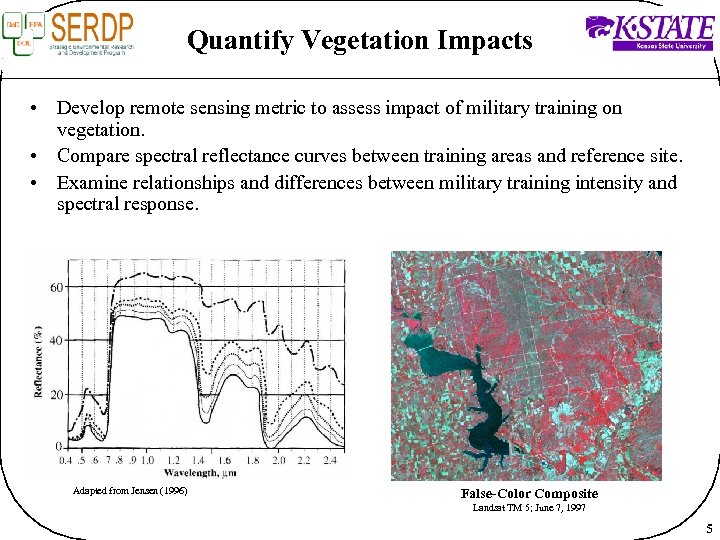 Quantify Vegetation Impacts • Develop remote sensing metric to assess impact of military training on vegetation. • Compare spectral reflectance curves between training areas and reference site. • Examine relationships and differences between military training intensity and spectral response. Adapted from Jensen (1996) False-Color Composite Landsat TM 5; June 7, 1997 5
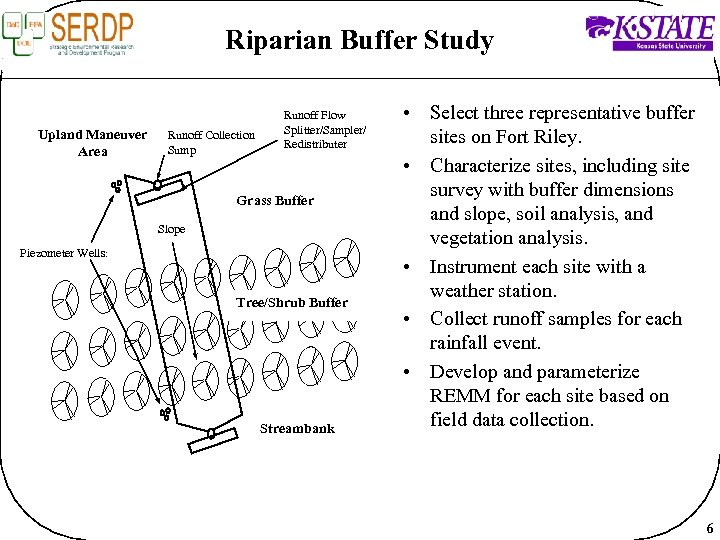 Riparian Buffer Study Upland Maneuver Area Runoff Collection Sump Runoff Flow Splitter/Sampler/ Redistributer Grass Buffer Slope Piezometer Wells: Tree/Shrub Buffer Streambank • Select three representative buffer sites on Fort Riley. • Characterize sites, including site survey with buffer dimensions and slope, soil analysis, and vegetation analysis. • Instrument each site with a weather station. • Collect runoff samples for each rainfall event. • Develop and parameterize REMM for each site based on field data collection. 6
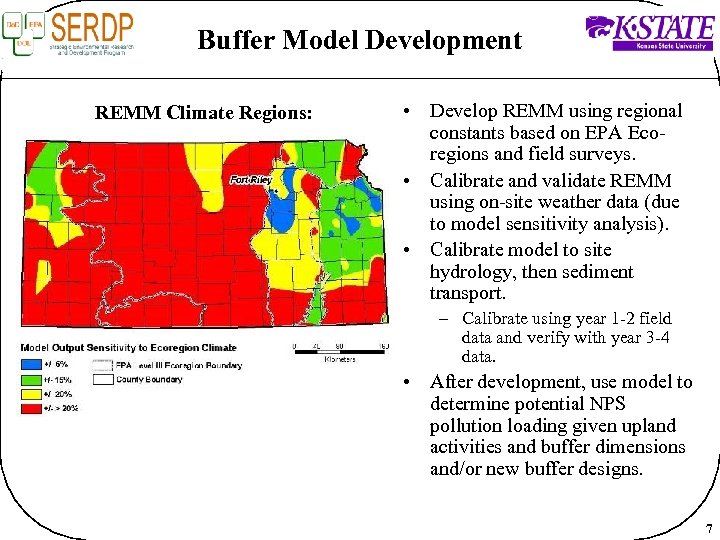 Buffer Model Development REMM Climate Regions: • Develop REMM using regional constants based on EPA Ecoregions and field surveys. • Calibrate and validate REMM using on-site weather data (due to model sensitivity analysis). • Calibrate model to site hydrology, then sediment transport. – Calibrate using year 1 -2 field data and verify with year 3 -4 data. • After development, use model to determine potential NPS pollution loading given upland activities and buffer dimensions and/or new buffer designs. 7
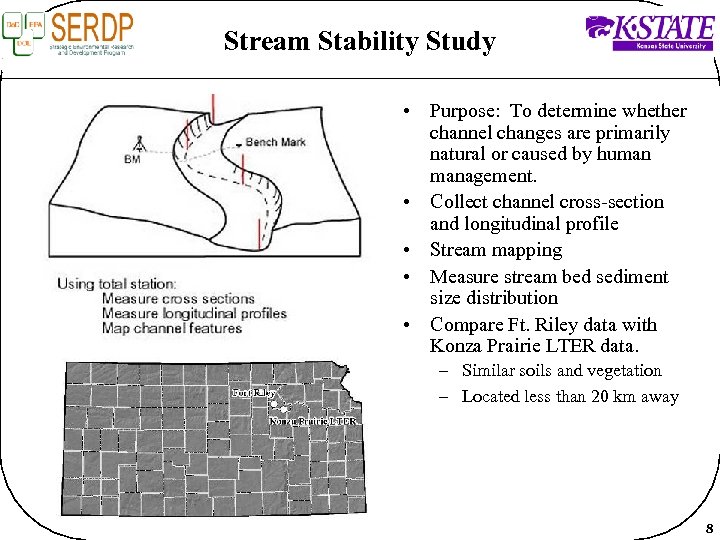 Stream Stability Study • Purpose: To determine whether channel changes are primarily natural or caused by human management. • Collect channel cross-section and longitudinal profile • Stream mapping • Measure stream bed sediment size distribution • Compare Ft. Riley data with Konza Prairie LTER data. – Similar soils and vegetation – Located less than 20 km away 8
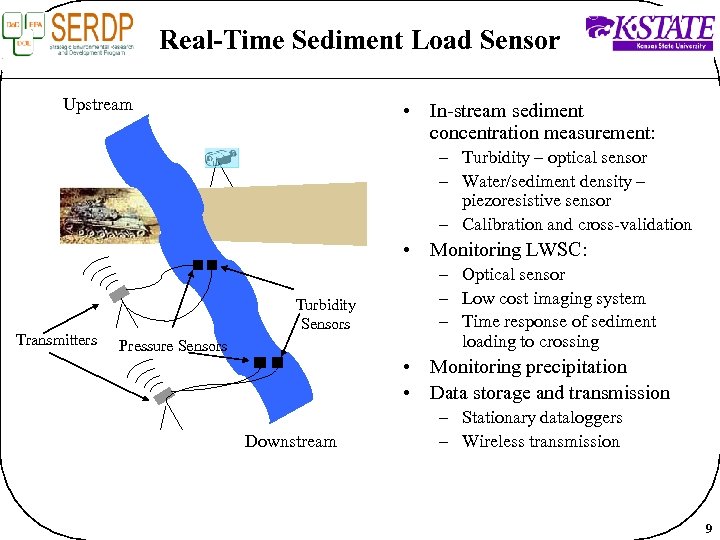 Real-Time Sediment Load Sensor Upstream • In-stream sediment concentration measurement: – Turbidity – optical sensor – Water/sediment density – piezoresistive sensor – Calibration and cross-validation • Monitoring LWSC: Transmitters Turbidity Sensors Pressure Sensors – Optical sensor – Low cost imaging system – Time response of sediment loading to crossing • Monitoring precipitation • Data storage and transmission Downstream – Stationary dataloggers – Wireless transmission 9
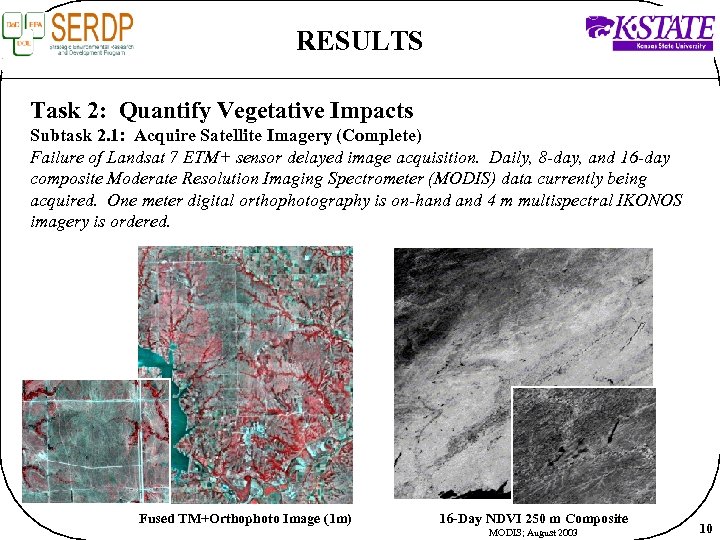 RESULTS Task 2: Quantify Vegetative Impacts Subtask 2. 1: Acquire Satellite Imagery (Complete) Failure of Landsat 7 ETM+ sensor delayed image acquisition. Daily, 8 -day, and 16 -day composite Moderate Resolution Imaging Spectrometer (MODIS) data currently being acquired. One meter digital orthophotography is on-hand 4 m multispectral IKONOS imagery is ordered. Fused TM+Orthophoto Image (1 m) 16 -Day NDVI 250 m Composite MODIS; August 2003 10
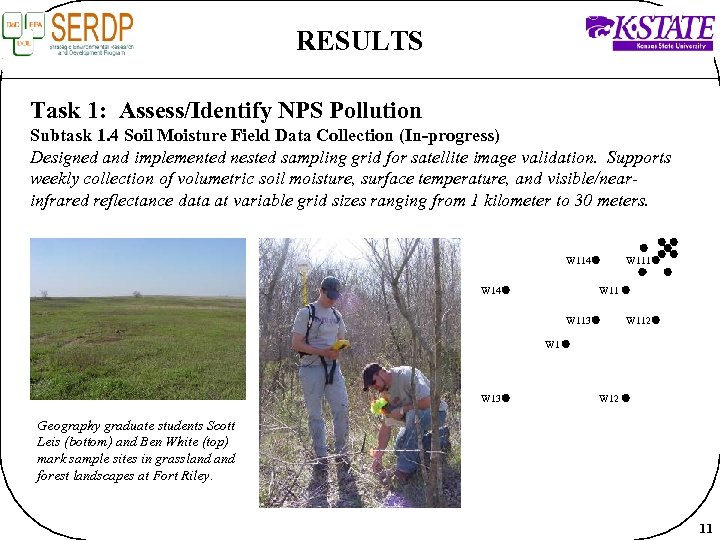 RESULTS Task 1: Assess/Identify NPS Pollution Subtask 1. 4 Soil Moisture Field Data Collection (In-progress) Designed and implemented nested sampling grid for satellite image validation. Supports weekly collection of volumetric soil moisture, surface temperature, and visible/nearinfrared reflectance data at variable grid sizes ranging from 1 kilometer to 30 meters. W 114 W 111 W 113 W 112 W 13 W 12 Geography graduate students Scott Leis (bottom) and Ben White (top) mark sample sites in grassland forest landscapes at Fort Riley. 11
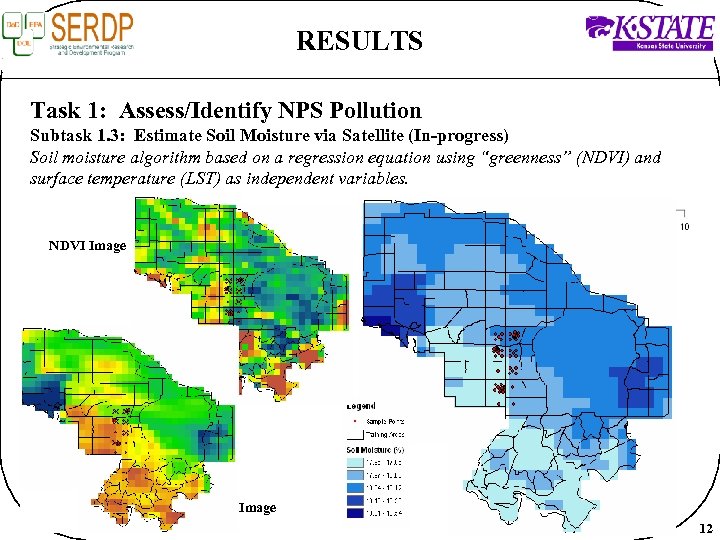 RESULTS Task 1: Assess/Identify NPS Pollution Subtask 1. 3: Estimate Soil Moisture via Satellite (In-progress) Soil moisture algorithm based on a regression equation using “greenness” (NDVI) and surface temperature (LST) as independent variables. NDVI Image LST Image 12
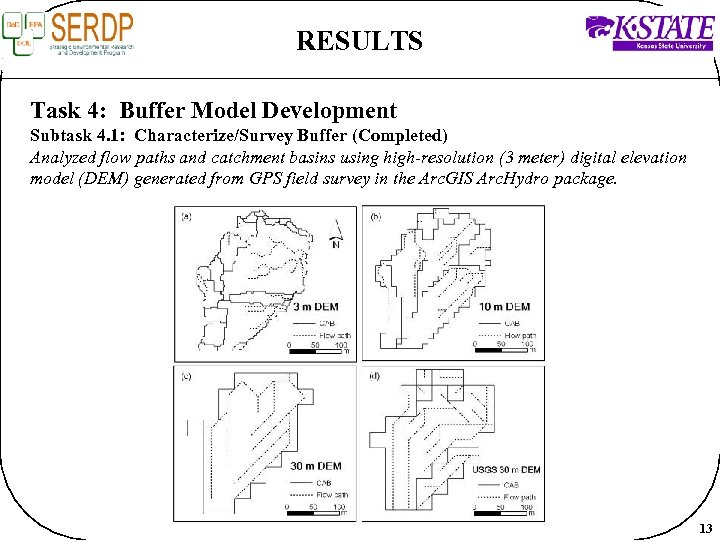 RESULTS Task 4: Buffer Model Development Subtask 4. 1: Characterize/Survey Buffer (Completed) Analyzed flow paths and catchment basins using high-resolution (3 meter) digital elevation model (DEM) generated from GPS field survey in the Arc. GIS Arc. Hydro package. 13
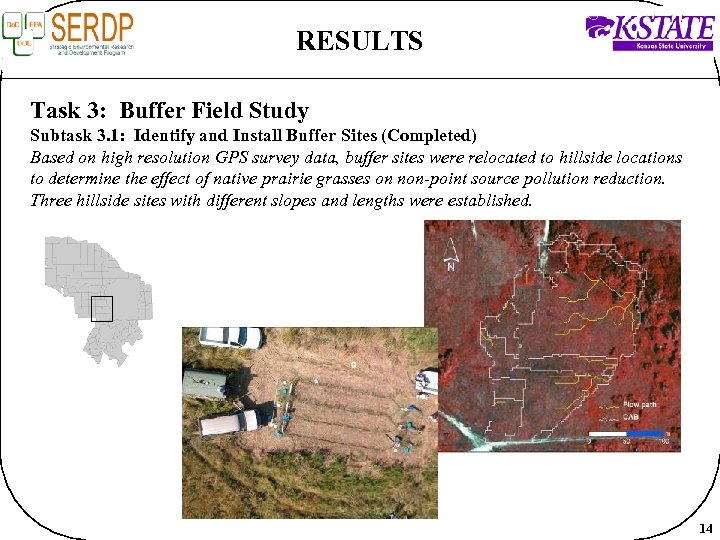 RESULTS Task 3: Buffer Field Study Subtask 3. 1: Identify and Install Buffer Sites (Completed) Based on high resolution GPS survey data, buffer sites were relocated to hillside locations to determine the effect of native prairie grasses on non-point source pollution reduction. Three hillside sites with different slopes and lengths were established. 14
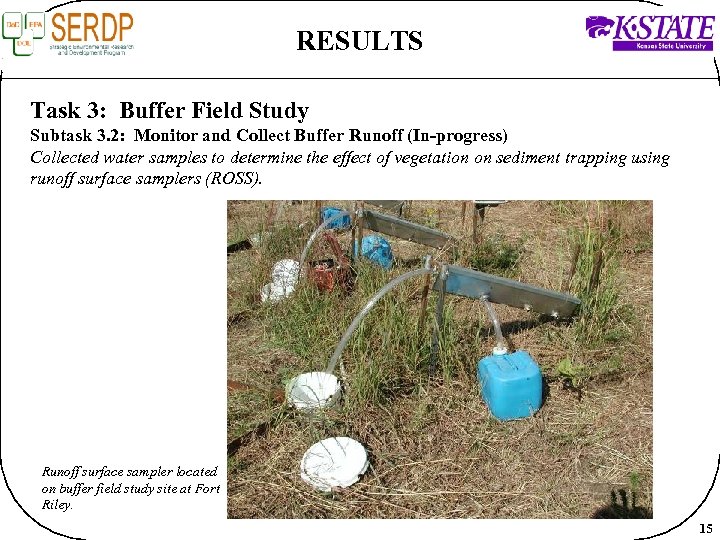 RESULTS Task 3: Buffer Field Study Subtask 3. 2: Monitor and Collect Buffer Runoff (In-progress) Collected water samples to determine the effect of vegetation on sediment trapping using runoff surface samplers (ROSS). Runoff surface sampler located on buffer field study site at Fort Riley. 15
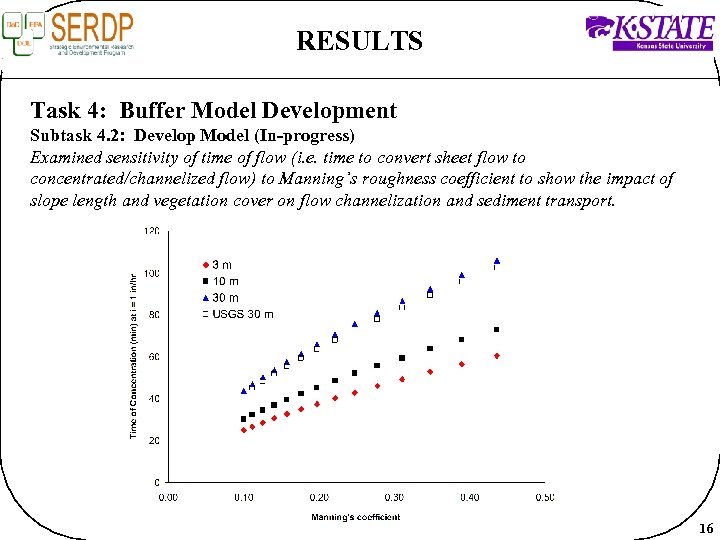 RESULTS Task 4: Buffer Model Development Subtask 4. 2: Develop Model (In-progress) Examined sensitivity of time of flow (i. e. time to convert sheet flow to concentrated/channelized flow) to Manning’s roughness coefficient to show the impact of slope length and vegetation cover on flow channelization and sediment transport. 16
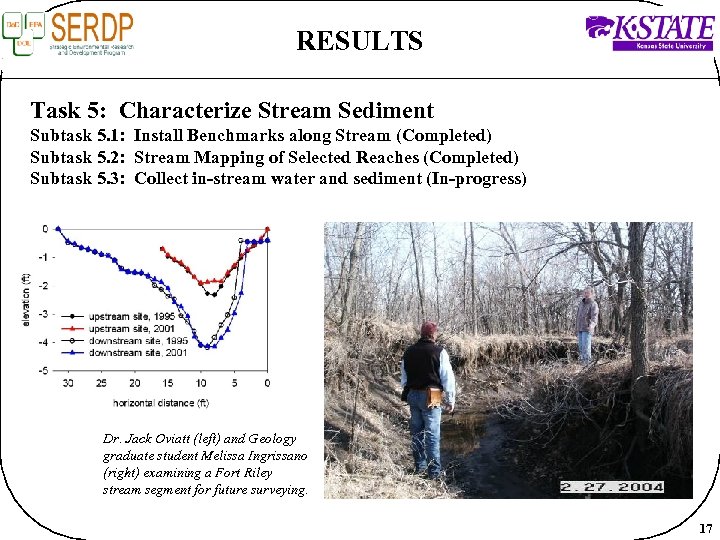 RESULTS Task 5: Characterize Stream Sediment Subtask 5. 1: Install Benchmarks along Stream (Completed) Subtask 5. 2: Stream Mapping of Selected Reaches (Completed) Subtask 5. 3: Collect in-stream water and sediment (In-progress) Dr. Jack Oviatt (left) and Geology graduate student Melissa Ingrissano (right) examining a Fort Riley stream segment for future surveying. 17
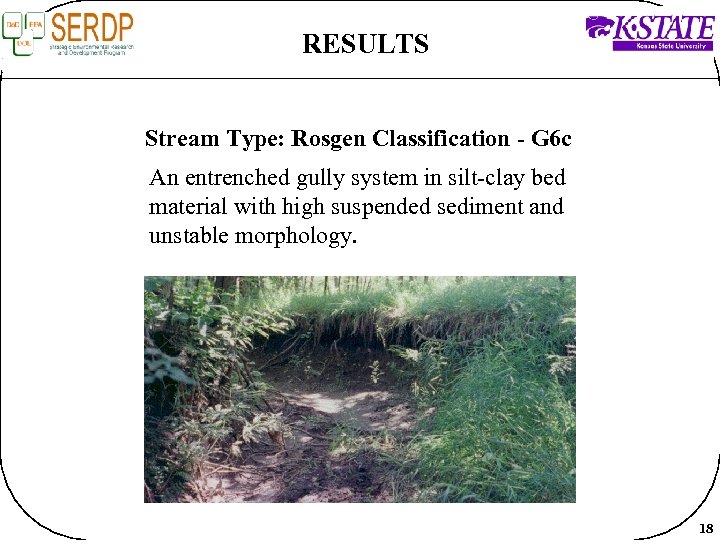 RESULTS Stream Type: Rosgen Classification - G 6 c An entrenched gully system in silt-clay bed material with high suspended sediment and unstable morphology. 18
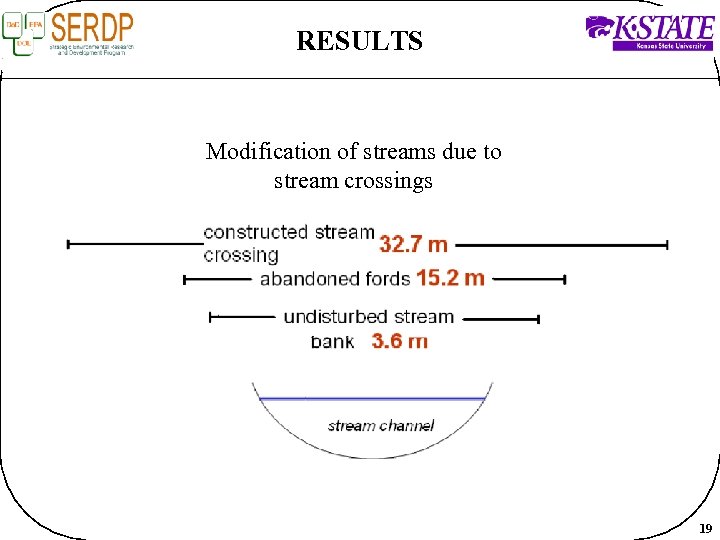 RESULTS Modification of streams due to stream crossings 19
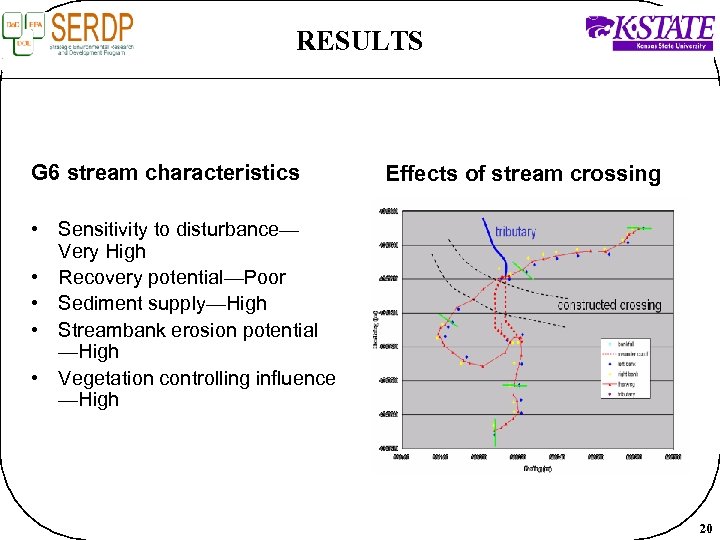 RESULTS G 6 stream characteristics Effects of stream crossing • Sensitivity to disturbance— Very High • Recovery potential—Poor • Sediment supply—High • Streambank erosion potential —High • Vegetation controlling influence —High 20
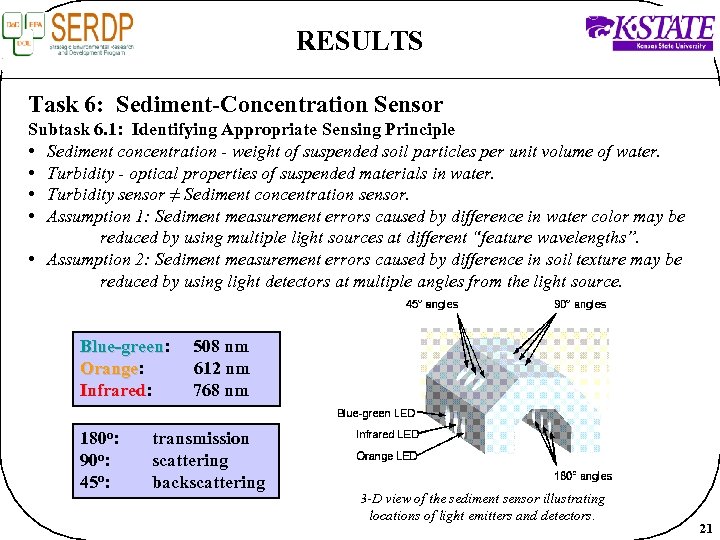 RESULTS Task 6: Sediment-Concentration Sensor Subtask 6. 1: Identifying Appropriate Sensing Principle • Sediment concentration - weight of suspended soil particles per unit volume of water. • Turbidity - optical properties of suspended materials in water. • Turbidity sensor ≠ Sediment concentration sensor. • Assumption 1: Sediment measurement errors caused by difference in water color may be reduced by using multiple light sources at different “feature wavelengths”. • Assumption 2: Sediment measurement errors caused by difference in soil texture may be reduced by using light detectors at multiple angles from the light source. Blue-green: Blue-green Orange: Orange Infrared: Infrared 180 o: 90 o: 45 o: 508 nm 612 nm 768 nm transmission scattering backscattering 3 -D view of the sediment sensor illustrating locations of light emitters and detectors. 21
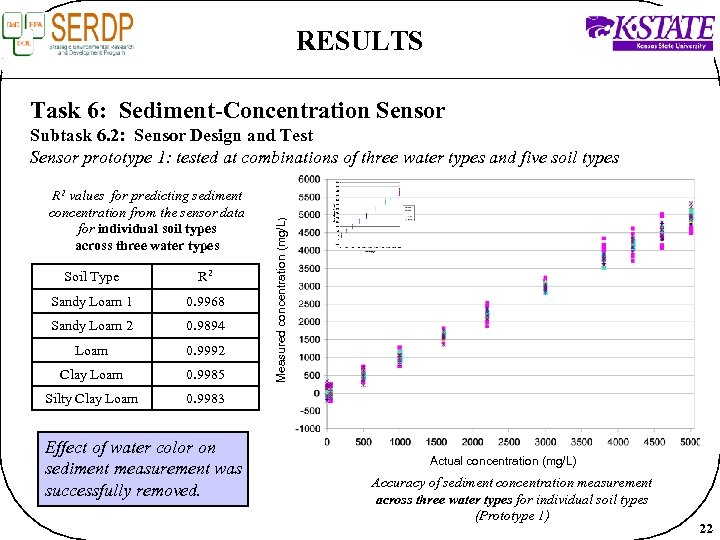 RESULTS Task 6: Sediment-Concentration Sensor R 2 values for predicting sediment concentration from the sensor data for individual soil types across three water types Soil Type R 2 Sandy Loam 1 0. 9968 Sandy Loam 2 0. 9894 Loam 0. 9992 Clay Loam 0. 9985 Silty Clay Loam Measured concentration (mg/L) Subtask 6. 2: Sensor Design and Test Sensor prototype 1: tested at combinations of three water types and five soil types 0. 9983 Effect of water color on sediment measurement was successfully removed. Actual concentration (mg/L) Accuracy of sediment concentration measurement across three water types for individual soil types (Prototype 1) 22
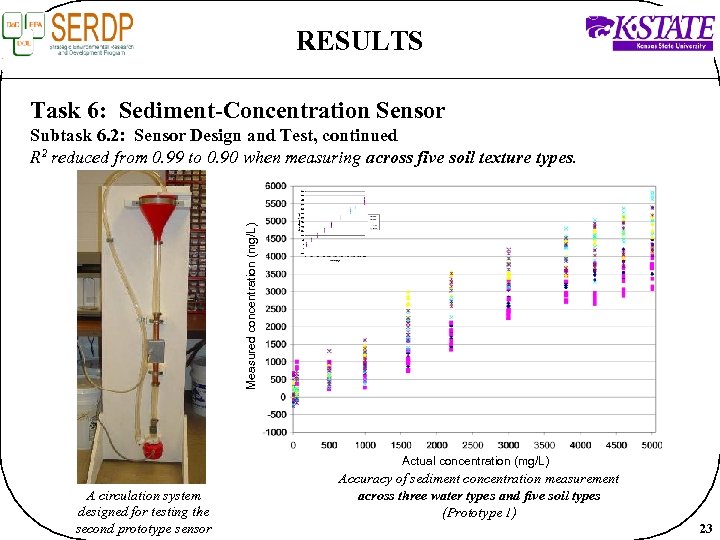 RESULTS Task 6: Sediment-Concentration Sensor Measured concentration (mg/L) Subtask 6. 2: Sensor Design and Test, continued R 2 reduced from 0. 99 to 0. 90 when measuring across five soil texture types. Actual concentration (mg/L) A circulation system designed for testing the second prototype sensor Accuracy of sediment concentration measurement across three water types and five soil types (Prototype 1) 23
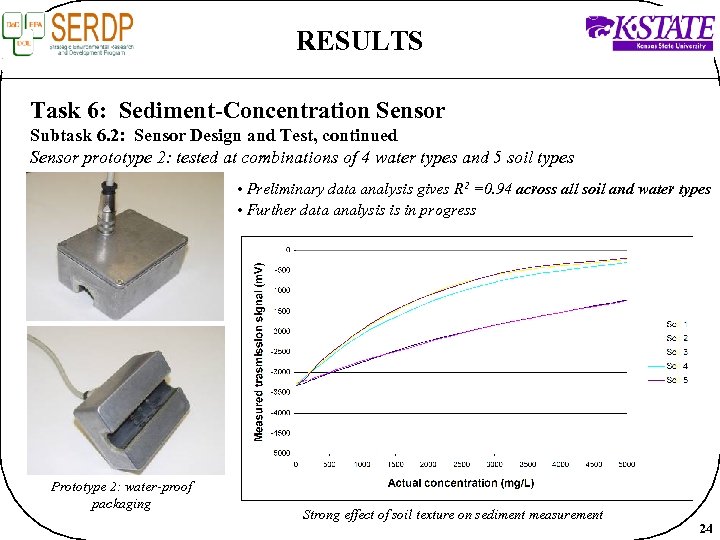 RESULTS Task 6: Sediment-Concentration Sensor Subtask 6. 2: Sensor Design and Test, continued Sensor prototype 2: tested at combinations of 4 water types and 5 soil types • Preliminary data analysis gives R 2 =0. 94 across all soil and water types • Further data analysis is in progress Prototype 2: water-proof packaging Strong effect of soil texture on sediment measurement 24
 ACTION ITEMS • No action items. 25
 TRANSITION PLAN Research Community: • • Journals (e. g. , JAWRA, IJRS) Professional Conferences: ASAE, SWCS, AGU, AWRA, AAG, ASPRS. Military User Community: • • • Presentations at Do. D sponsored workshops: ITAM Workshop (field trips, specialty workshops). Project to be featured at 2006 ITAM Workshop at Fort Riley. Results of SERDP project incorporated into Fort Riley ITAM strategy. General Use Community: • • Magazine articles for trade journals (Erosion Control, Stormwater, Land & Water, Resources). Create and maintain a public website: http: //www. k-state. edu/serdp 26
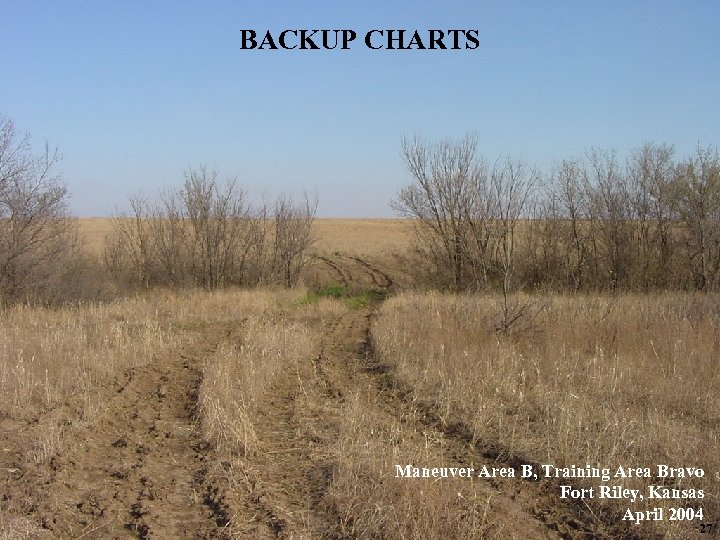 BACKUP CHARTS Maneuver Area B, Training Area Bravo Fort Riley, Kansas April 2004 27
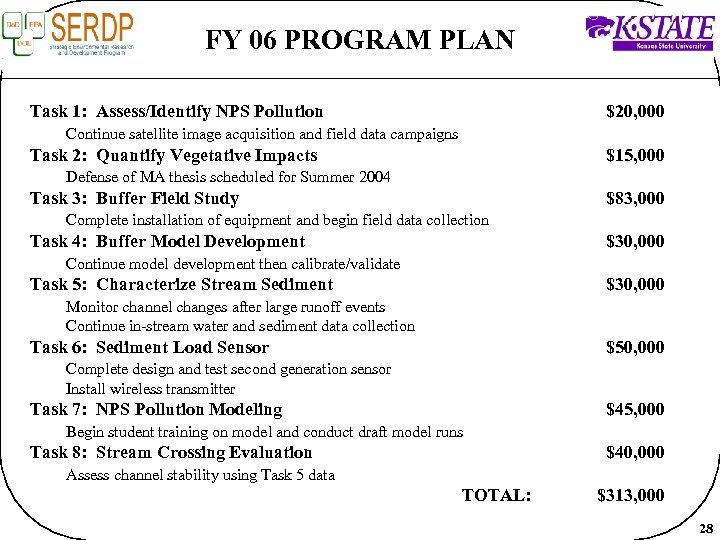 FY 06 PROGRAM PLAN Task 1: Assess/Identify NPS Pollution $20, 000 Continue satellite image acquisition and field data campaigns Task 2: Quantify Vegetative Impacts $15, 000 Defense of MA thesis scheduled for Summer 2004 Task 3: Buffer Field Study $83, 000 Complete installation of equipment and begin field data collection Task 4: Buffer Model Development $30, 000 Continue model development then calibrate/validate Task 5: Characterize Stream Sediment $30, 000 Monitor channel changes after large runoff events Continue in-stream water and sediment data collection Task 6: Sediment Load Sensor $50, 000 Complete design and test second generation sensor Install wireless transmitter Task 7: NPS Pollution Modeling $45, 000 Begin student training on model and conduct draft model runs Task 8: Stream Crossing Evaluation $40, 000 Assess channel stability using Task 5 data TOTAL: $313, 000 28
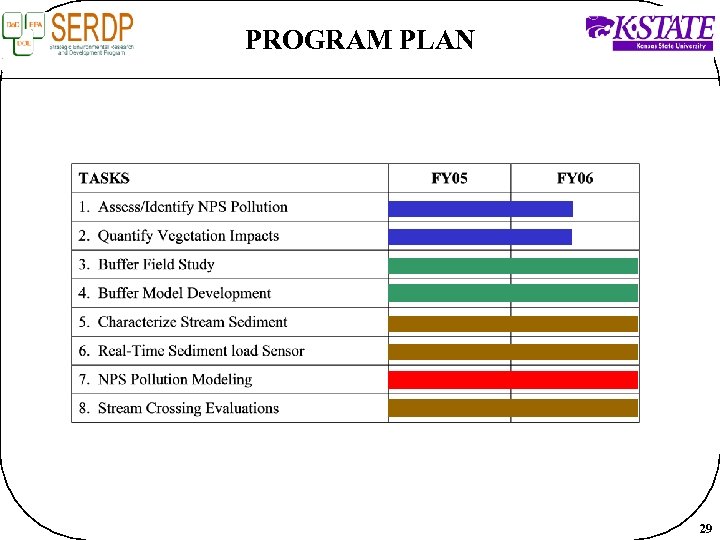 PROGRAM PLAN 29
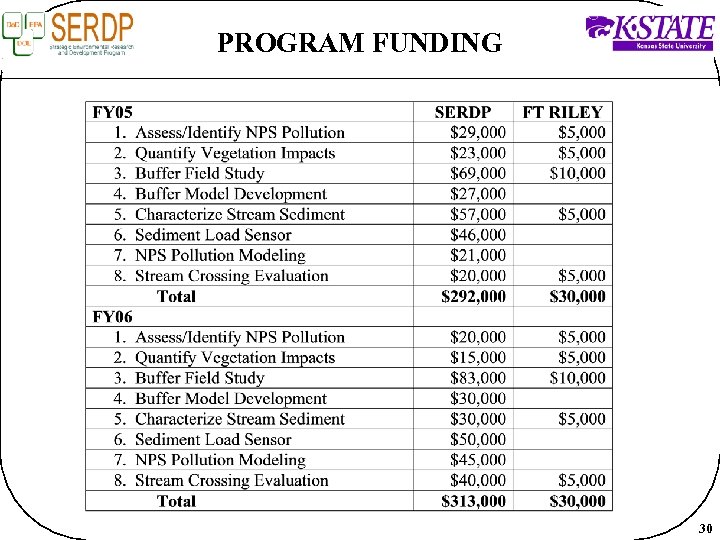 PROGRAM FUNDING 30
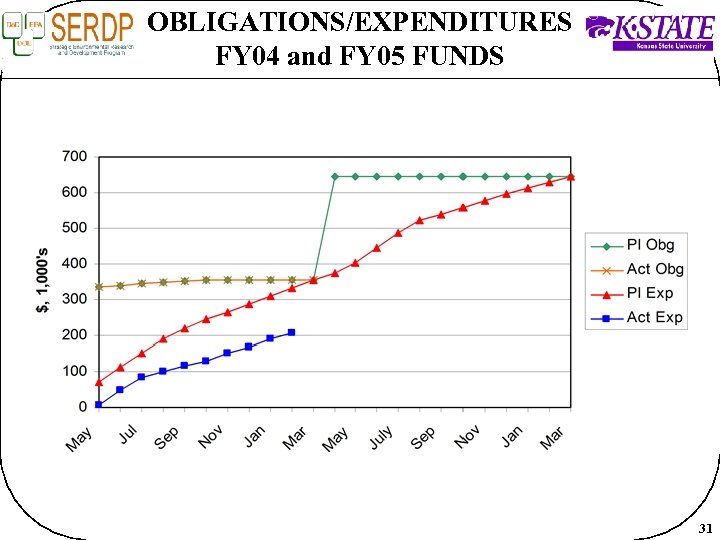 OBLIGATIONS/EXPENDITURES FY 04 and FY 05 FUNDS 31
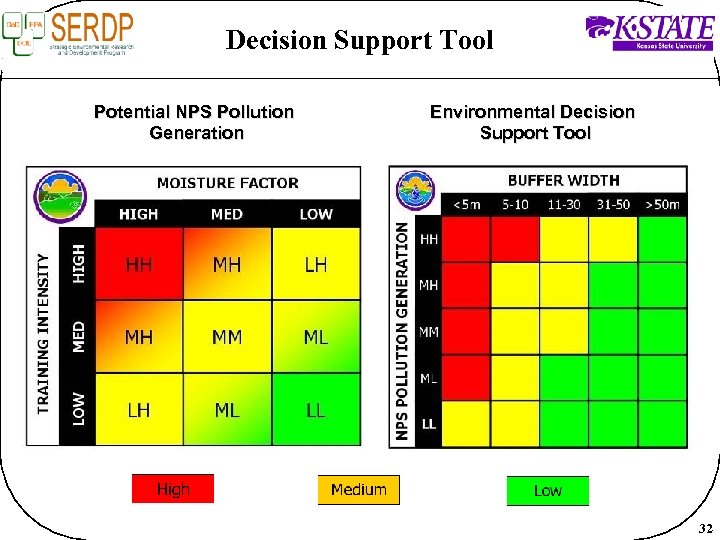 Decision Support Tool Potential NPS Pollution Generation Environmental Decision Support Tool 32
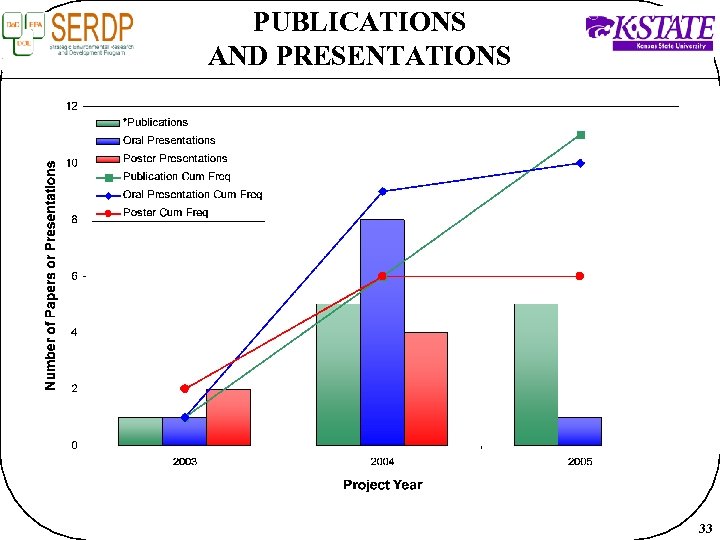 PUBLICATIONS AND PRESENTATIONS 33
 PUBLICATIONS Publications (students in blue): 1. 2. 3. 4. Brown, T. L. , J. M. S. Hutchinson, J. A. Harrington, Jr. , and M. Lu. 2003. Classification of natural characteristics and anthropogenic stressors in Kansas watersheds. Papers and Proceedings of the Applied Geography Conference 26: 416 -423. Goodin, D. G. , J. Gao, J. M. S. Hutchinson. 2004. Seasonal, topographic, and burn frequency effects on biophysical/spectral reflectance relationships in tallgrass prairie. International Journal of Remote Sensing 25(23): 5429 -5445. Hutchinson, J. M. S. , J. A. Harrington, Jr. , and L. J. Marzen. 2004. Geospatial Contributions to Watershed-Scale Surface Water Quality Modeling. In D. G. Janelle, B. Warf, and K. Hanson, eds. World Minds: Geographical Perspectives on 100 Problems, 556 -570. Dordrecht, The Netherlands: Kluwer Academic Publishers. Stoll, Q. 2004. Design of a real-time optical sediment concentration sensor. M. S. Thesis, Department of Biological and Agricultural Engineering, Kansas State University. 34
 PUBLICATIONS Publications (students in blue): 1. 2. Hutchinson, S. L. , P. Barnes, J. M. S. Hutchinson, C. Oviatt, J. Steichen, and P. B. Woodford 2004. Erosion Control Research on Military and Non-Agricultural Lands. Paper No. 042003 presented at the 2004 ASAE/CSAE Joint Annual International Meeting, Ottawa, ON, Canada. ASAE, 2950 Niles Rd. , St. Joseph, MI 49085 -9659. Stoll, Q. , N. Zhang, Y. Zhang, S. L. Hutchinson, and J. Steichen. 2004. Real-time optical sediment concentration sensor. ASAE Paper No. 043130 presented at the 2004 ASAE/CSAE Joint Annual International Meeting, Ottawa, ON, Canada. ASAE, 2950 Niles Rd. , St. Joseph, MI 49085 -9659. 35
 PUBLICATIONS Publications under Review (students in blue): 5. 6. 7. Hutchinson, J. M. S. , B. Hammerschmidt, and S. L. Hutchinson. 2005. Assessing the Impact of Military Training on Nonpoint Source Pollution and Water Quality. Resource Magazine. Kim, I. J. , S. L. Hutchinson, C. B. Young, and J. M. S. Hutchinson. 2005. Riparian Ecosystem Management Model (REMM): Sensitivity to soil, vegetation, and weather input parameters. Journal of the American Water Resources Association. Hutchinson, J. M. S. , I. J. Kim, and S. L. Hutchinson 2005. Mapping Model Sensitivity: Are Regional Weather Inputs Appropriate for REMM? Journal of the American Water Resources Association. 36
 PUBLICATIONS In-Progress Publications (students in blue): 8. 9. Hammerschmidt, B. and J. M. S. Hutchinson. 2005. Derivation of the RUSLE RFactor for Fort Riley, Kansas Academy of Sciences. Davis, T. L. 2005. Estimating Soil Erosion using a R-USLE Modified for Military Training Lands. M. A. Thesis, Department of Geography, Kansas State University. 37
 PRESENTATIONS Oral Presentations (students in blue): 1. 2. 3. 4. 5. Watershed Modeling and Geographic Information Systems. April 2003. Kansas Water Environment Association Annual Conference; Topeka, KS (co-authors: J. M. S. Hutchinson, S. L. Hutchinson) Assessing the Impact of Maneuver Training on NPS Pollution and Water Quality. March 2004. 21 st Annual Water and the Future of Kansas Conference; Lawrence, KS (co-authors: S. L. Hutchinson, J. M. S. Hutchinson, J. Steichen, P. Barnes, C. Oviatt, and N. Zhang). Using GIS and Remote Sensing in Biophysical Research – Recent Examples. March 2004. Department of Geology Seminar Series, Kansas State University (author: J. M. S. Hutchinson). Erosion Control Research on Military and Non-Agricultural Lands. August 2004 Annual Meeting of the American Society for Agricultural Engineering (coauthors: S. L. Hutchinson, P. Barnes, J. M. S. Hutchinson, C. Oviatt, J. Steichen, and P. Woodford). Soil Moisture Estimates using MODIS Land Surface Temperature and NDVI. August 2004 Annual Meeting of the American Society for Agricultural Engineering (coauthors: J. M. S. Hutchinson, S. L. Hutchinson, and S. Leis). 38
 PRESENTATIONS Oral Presentations (students in blue): 6. Spatial and Temporal Analysis of Soil Moisture using MODIS NDVI and LST Products. October 2004. Applied Geography Conference; St. Louis, MO (co-authors: J. M. S. Hutchinson, T. Vought, and S. L. Hutchinson). 7. Using GIS and Remote Sensing in Biophysical Research. October 15, 2004. Joint Sino-American Agricultural Engineering Seminar; Henan University, Zhengzhou, China (author: J. M. S. Hutchinson). 8. Remote Sensing of Soil Moisture. October 18, 2004. Joint Sino-American Agricultural Engineering Seminar; South China Agricultural University, Guangzhou, China (author: J. M. S. Hutchinson). 9. Evaluation of Overland Flow Paths Generated from Multiresolution Digital Elevation Models. April 2005 Annual Meeting of the Association of American Geographers (co-authors: J. M. S. Hutchinson, S. L. Hutchinson, and I. J. Kim). 10. Ingrisano, M. A. , C. G. Oviatt, and J. M. Steichen. 2004. Geomorphic differences between similar streams with contrasting anthropogenic influence in the Kansas Flint Hills. 2004 Meeting of the Geological Society of America. 39
 PRESENTATIONS Poster Presentations (students in blue): 1. 2. 3. 4. Climatology of Fort Riley, Kansas and Vicinity. November 2003. Applied Geography Conference; Colorado Springs, CO (co-authors: B. Hammerschmidt, J. M. S. Hutchinson, and N. L. Leathers). Assessing the Impact of Maneuver Training on NPS Pollution and Water Quality. December 2003. Partners in Environmental Technology Symposium and Workshop; Washington, D. C. (co-authors: J. Steichen, P. Barnes, J. M. S. Hutchinson, S. L. Hutchinson, C. Oviatt, N. Zhang, and P. Woodford). Designing Riparian Buffers to Control Military NPS Pollution. June 2004. Riparian Ecosystems and Buffers: Multi-scale Structure, Function, and Management; Olympic Valley, CA (co-authors: S. L. Hutchinson, P. L. Barnes, J. M. S. Hutchinson, C. G. Oviatt, J. Steichen, P. Woodford, and N. Zhang). Protecting Surface Water from Military Activity with Riparian Buffers and Low Water Stream Crossings. September 2004. ASAE Specialty Conference Self-Sustaining Solutions for Streams, Wetlands and Watersheds; St. Paul, MN (co-authors: S. L. Hutchinson, P. L. Barnes, J. M. S. Hutchinson, C. G. Oviatt, J. Steichen, and N. Zhang). 40
 PRESENTATIONS Poster Presentations (students in blue): 5. 6. Spatial Soil Moisture Estimates for Fort Riley, Kansas using MODIS Land Surface Temperature and Vegetation Index Products. November 2004. Partners in Environmental Technology Symposium and Workshop; Washington, D. C. (co-authors J. M. S. Hutchinson, S. L. Hutchinson and T. Vought). Geomorphic differences between similar streams with contrasting anthropogenic influence in the Kansas Flint Hills. November 2004. Partners in Environmental Technology Symposium and Workshop; Washington, D. C. (co-authors Ingrisano, Melissa A. , Charles G. Oviatt, James M. Steichen, S. L. Hutchinson, and Philip Woodford. ) 41