


 Скачать презентацию Assessing the Employment Implications of the 2006 Repeal
e1768c14889a051289704b7d194030a7.ppt
- Количество слайдов: 19
 Assessing the Employment Implications of the 2006 Repeal of the Public Utility Holding Company Act (PUHCA) Presented by: Jim Voye Director of Research and Corporate Affairs International Brotherhood of Electrical Workers Steve Rayburn Labor Relations Director Pacific Gas & Electric Company January 2008 Tom Schneider President Restructuring Associates, Inc.
 PUHCA – Background • • Regulated parent or “holding” companies of electric and natural gas utilities so that rates could not be raised by charging high fees to utilities for services from affiliates. • Parent or “holding” companies could not speculate in riskier businesses with ratepayer’s money – such speculation harms utilities’ credit and raises their cost of borrowing money, thereby, raising customers’ utility bills. • Utility parent companies required to incorporate in the same state where the utility operates so state can regulate them, or to be regulated by the Securities and Exchange Commission (SEC) if they operate in several states. • Non-utilities, such as oil companies or investment banks, not allowed to own utilities. • 2 Federal consumer protection law passed in 1935. SEC to approve any merger or utility acquisition by a holding company to prevent the reappearance of the huge electric and natural gas cartels of the 1920’s that abused their customers and went bankrupt in large numbers because of Enron-like speculation and accounting scams. 2
 PUHCA – Background • • Energy Policy Act of 2005 passed both houses of Congress and signed into law on August 8, 2005, repealing PUHCA, despite consumer, environmental, union and credit rating agency objections. • 3 Utility industry and would-be owners of utilities lobbied Congress heavily to repeal PUHCA, claiming it was outdated. Repeal became effective February 8, 2006. 3
 Repeal of PUHCA – Impact • Facilitates mergers and acquisitions (M&A) in the electric utility industry – Strong European companies and nontraditional investors may purchase or invest in U. S. utilities. – The U. S. SEC’s traditional role in reviewing M&A proposals eliminated. – Utility combinations to be contiguous or interconnected eliminated. – State approval for M&A’s still required. – States and Federal Energy Regulatory commission (FERC) granted additional authority to review utilities’ books and to ensure financial integrity and non-abuse of market power. 4 4
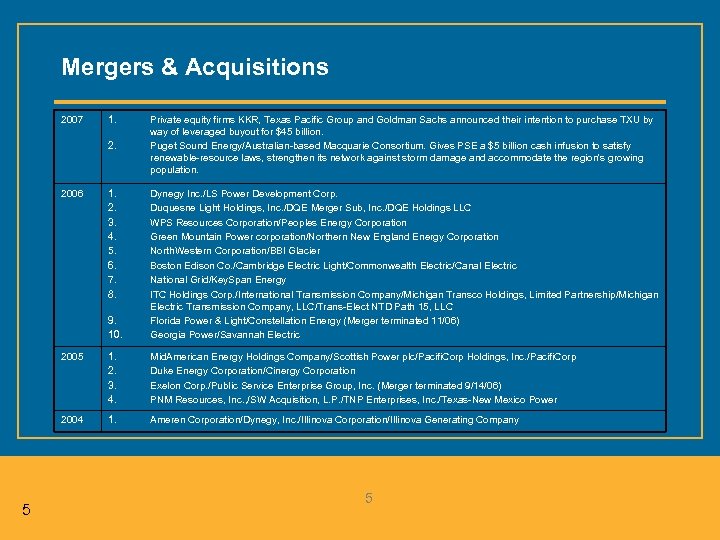 Mergers & Acquisitions 2007 1. 2. 2006 1. 2. 3. 4. 5. 6. 7. 8. Private equity firms KKR, Texas Pacific Group and Goldman Sachs announced their intention to purchase TXU by way of leveraged buyout for $45 billion. Puget Sound Energy/Australian-based Macquarie Consortium. Gives PSE a $5 billion cash infusion to satisfy renewable-resource laws, strengthen its network against storm damage and accommodate the region's growing population. 9. 10. 2005 1. 2. 3. 4. Mid. American Energy Holdings Company/Scottish Power plc/Pacifi. Corp Holdings, Inc. /Pacifi. Corp Duke Energy Corporation/Cinergy Corporation Exelon Corp. /Public Service Enterprise Group, Inc. (Merger terminated 9/14/06) PNM Resources, Inc. , /SW Acquisition, L. P. /TNP Enterprises, Inc. /Texas-New Mexico Power 2004 5 Dynegy Inc. /LS Power Development Corp. Duquesne Light Holdings, Inc. /DQE Merger Sub, Inc. /DQE Holdings LLC WPS Resources Corporation/Peoples Energy Corporation Green Mountain Power corporation/Northern New England Energy Corporation North. Western Corporation/BBI Glacier Boston Edison Co. /Cambridge Electric Light/Commonwealth Electric/Canal Electric National Grid/Key. Span Energy ITC Holdings Corp. /International Transmission Company/Michigan Transco Holdings, Limited Partnership/Michigan Electric Transmission Company, LLC/Trans-Elect NTD Path 15, LLC Florida Power & Light/Constellation Energy (Merger terminated 11/06) Georgia Power/Savannah Electric 1. Ameren Corporation/Dynegy, Inc. /Illinova Corporation/Illinova Generating Company 5
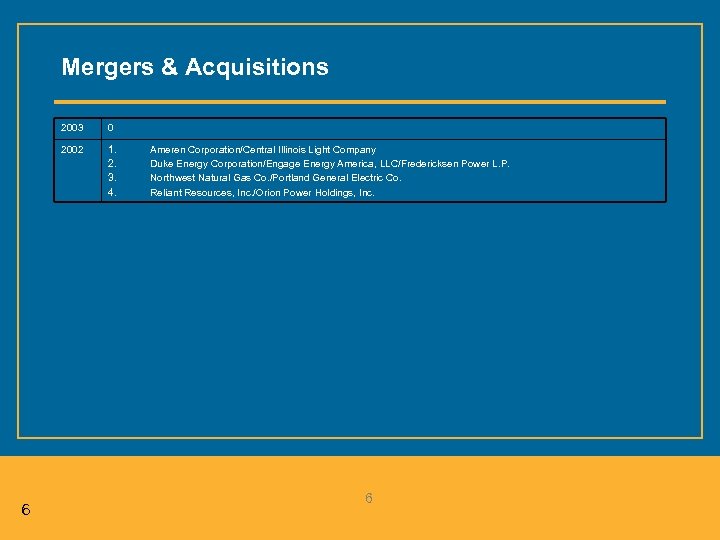 Mergers & Acquisitions 2003 2002 6 0 1. 2. 3. 4. Ameren Corporation/Central Illinois Light Company Duke Energy Corporation/Engage Energy America, LLC/Fredericksen Power L. P. Northwest Natural Gas Co. /Portland General Electric Co. Reliant Resources, Inc. /Orion Power Holdings, Inc. 6
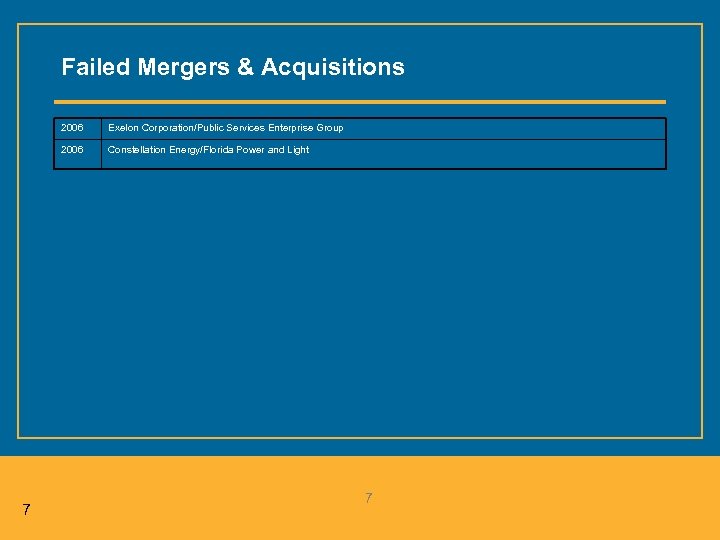 Failed Mergers & Acquisitions 2006 7 Exelon Corporation/Public Services Enterprise Group Constellation Energy/Florida Power and Light 7
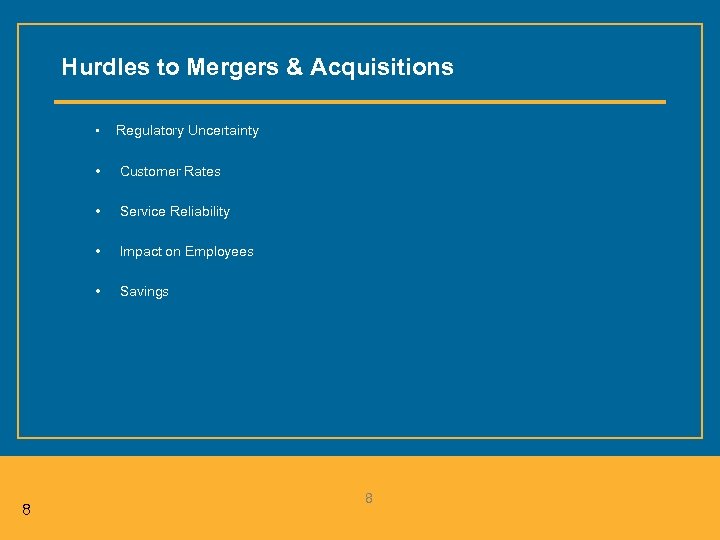 Hurdles to Mergers & Acquisitions • • Customer Rates • Service Reliability • Impact on Employees • 8 Regulatory Uncertainty Savings 8
 Why Change Is Occurring • • Adapt to the global marketplace and keep pace with the industry • Competitive Threats • Deregulation / Municipalization • Customer Expectations have increased – efficiency, cost-conscious, environmental concerns • Investment needed in existing infrastructure and new tools • 9 Increasing mergers and acquisitions. Employees need better tools, resources and business processes 9
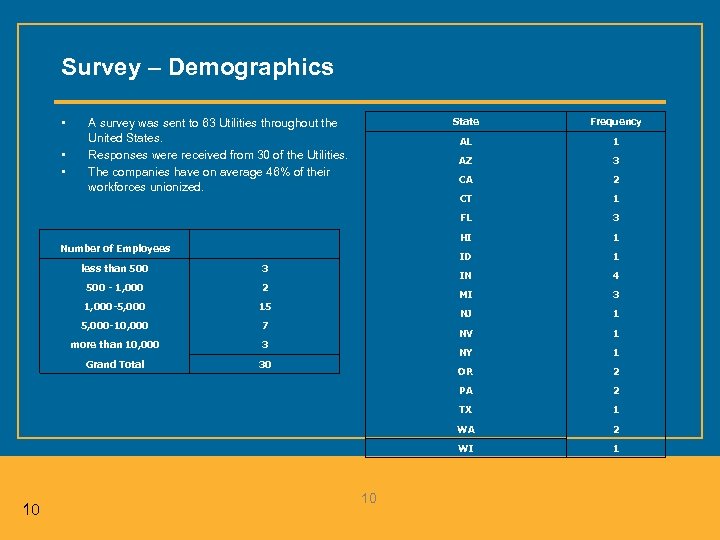 Survey – Demographics AZ CT 1, 000 -5, 000 -10, 000 more than 10, 000 Grand Total 1 NY 1 OR 10 1 NV 30 3 NJ 3 4 MI 7 1 IN 15 1 ID 2 3 2 2 1 2 WI 500 - 1, 000 1 HI 3 2 WA less than 500 3 CA 1 TX Number of Employees 10 AL A survey was sent to 63 Utilities throughout the United States. Responses were received from 30 of the Utilities. The companies have on average 46% of their workforces unionized. Frequency PA • • State FL • 1
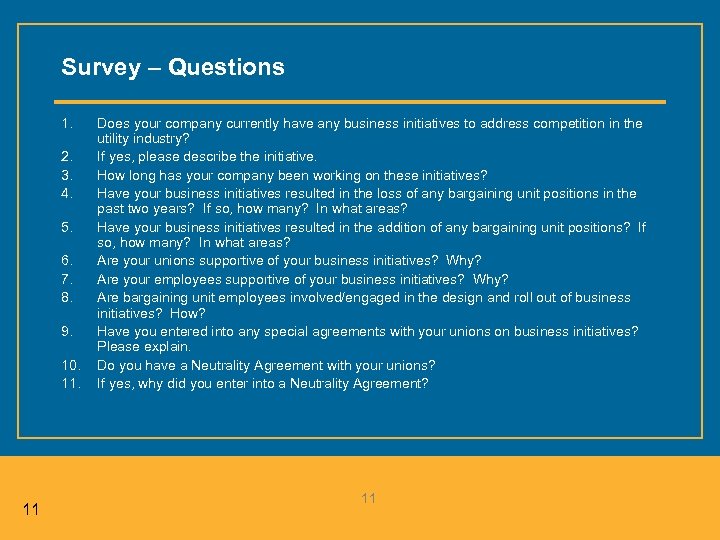 Survey – Questions 1. 2. 3. 4. 5. 6. 7. 8. 9. 10. 11. 11 Does your company currently have any business initiatives to address competition in the utility industry? If yes, please describe the initiative. How long has your company been working on these initiatives? Have your business initiatives resulted in the loss of any bargaining unit positions in the past two years? If so, how many? In what areas? Have your business initiatives resulted in the addition of any bargaining unit positions? If so, how many? In what areas? Are your unions supportive of your business initiatives? Why? Are your employees supportive of your business initiatives? Why? Are bargaining unit employees involved/engaged in the design and roll out of business initiatives? How? Have you entered into any special agreements with your unions on business initiatives? Please explain. Do you have a Neutrality Agreement with your unions? If yes, why did you enter into a Neutrality Agreement? 11
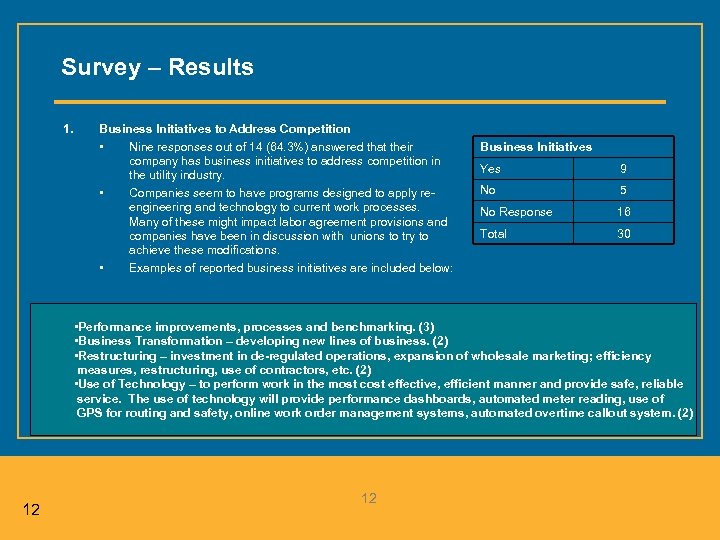 Survey – Results 1. Business Initiatives to Address Competition • Nine responses out of 14 (64. 3%) answered that their company has business initiatives to address competition in the utility industry. • Companies seem to have programs designed to apply reengineering and technology to current work processes. Many of these might impact labor agreement provisions and companies have been in discussion with unions to try to achieve these modifications. • Examples of reported business initiatives are included below: Business Initiatives Yes 9 No 5 No Response 16 Total 30 • Performance improvements, processes and benchmarking. (3) • Business Transformation – developing new lines of business. (2) • Restructuring – investment in de-regulated operations, expansion of wholesale marketing; efficiency measures, restructuring, use of contractors, etc. (2) • Use of Technology – to perform work in the most cost effective, efficient manner and provide safe, reliable service. The use of technology will provide performance dashboards, automated meter reading, use of GPS for routing and safety, online work order management systems, automated overtime callout system. (2) 12 12
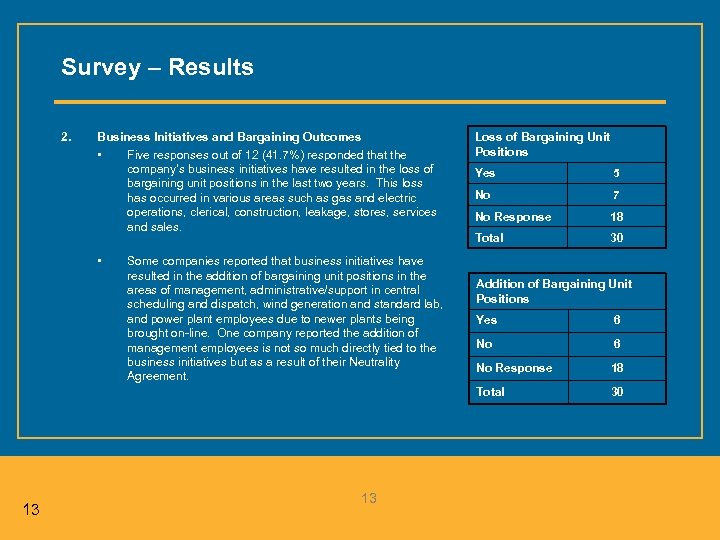 Survey – Results 2. Business Initiatives and Bargaining Outcomes • Five responses out of 12 (41. 7%) responded that the company’s business initiatives have resulted in the loss of bargaining unit positions in the last two years. This loss has occurred in various areas such as gas and electric operations, clerical, construction, leakage, stores, services and sales. • Some companies reported that business initiatives have resulted in the addition of bargaining unit positions in the areas of management, administrative/support in central scheduling and dispatch, wind generation and standard lab, and power plant employees due to newer plants being brought on-line. One company reported the addition of management employees is not so much directly tied to the business initiatives but as a result of their Neutrality Agreement. Loss of Bargaining Unit Positions Yes 5 No 7 No Response 18 Total 30 Addition of Bargaining Unit Positions 13 6 No Response 18 Total 13 Yes 30
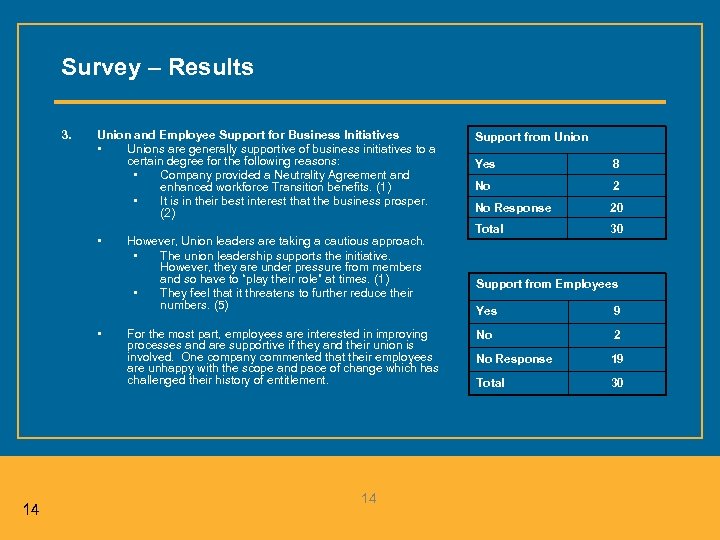 Survey – Results 3. Union and Employee Support for Business Initiatives • Unions are generally supportive of business initiatives to a certain degree for the following reasons: • Company provided a Neutrality Agreement and enhanced workforce Transition benefits. (1) • It is in their best interest that the business prosper. (2) • • 14 However, Union leaders are taking a cautious approach. • The union leadership supports the initiative. However, they are under pressure from members and so have to “play their role” at times. (1) • They feel that it threatens to further reduce their numbers. (5) For the most part, employees are interested in improving processes and are supportive if they and their union is involved. One company commented that their employees are unhappy with the scope and pace of change which has challenged their history of entitlement. 14 Support from Union Yes 8 No 2 No Response 20 Total 30 Support from Employees Yes 9 No 2 No Response 19 Total 30
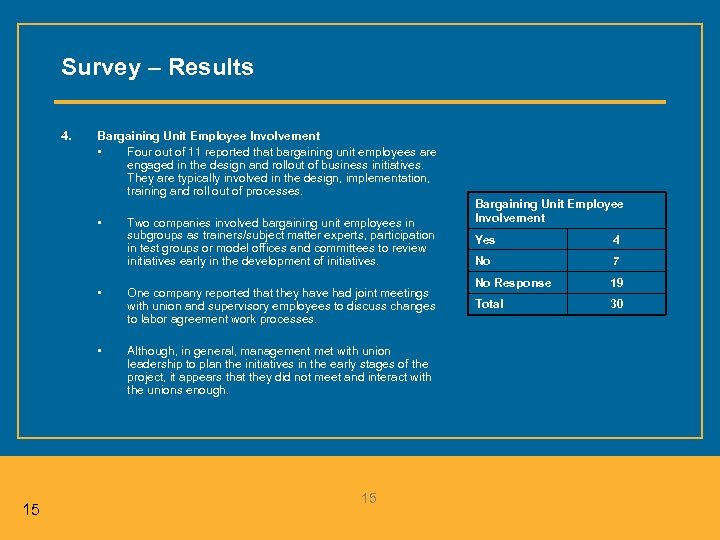 Survey – Results 4. Bargaining Unit Employee Involvement • Four out of 11 reported that bargaining unit employees are engaged in the design and rollout of business initiatives. They are typically involved in the design, implementation, training and roll out of processes. • Two companies involved bargaining unit employees in subgroups as trainers/subject matter experts, participation in test groups or model offices and committees to review initiatives early in the development of initiatives. • • 15 One company reported that they have had joint meetings with union and supervisory employees to discuss changes to labor agreement work processes. Although, in general, management met with union leadership to plan the initiatives in the early stages of the project, it appears that they did not meet and interact with the unions enough. 15 Bargaining Unit Employee Involvement Yes 4 No 7 No Response 19 Total 30
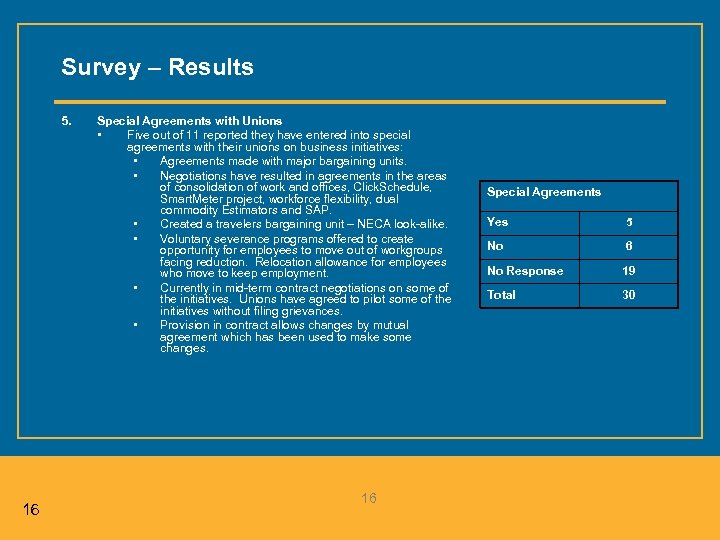 Survey – Results 5. 16 Special Agreements with Unions • Five out of 11 reported they have entered into special agreements with their unions on business initiatives: • Agreements made with major bargaining units. • Negotiations have resulted in agreements in the areas of consolidation of work and offices, Click. Schedule, Smart. Meter project, workforce flexibility, dual commodity Estimators and SAP. • Created a travelers bargaining unit – NECA look-alike. • Voluntary severance programs offered to create opportunity for employees to move out of workgroups facing reduction. Relocation allowance for employees who move to keep employment. • Currently in mid-term contract negotiations on some of the initiatives. Unions have agreed to pilot some of the initiatives without filing grievances. • Provision in contract allows changes by mutual agreement which has been used to make some changes. 16 Special Agreements Yes 5 No 6 No Response 19 Total 30
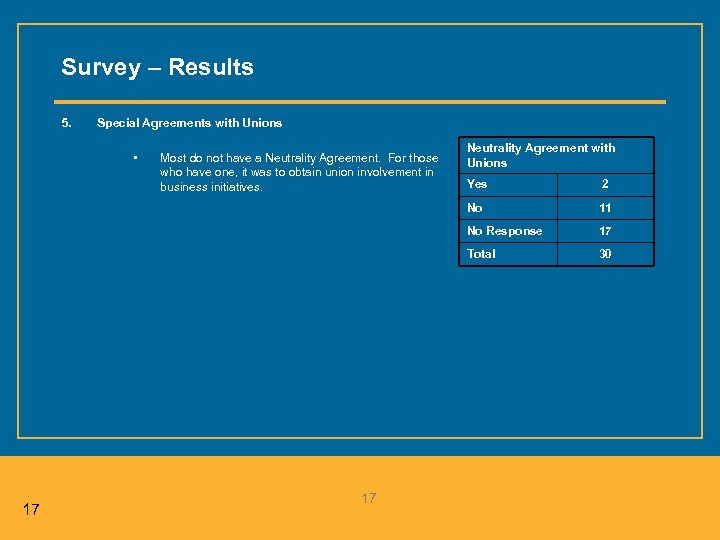 Survey – Results 5. Special Agreements with Unions • Most do not have a Neutrality Agreement. For those who have one, it was to obtain union involvement in business initiatives. Neutrality Agreement with Unions 11 No Response 17 Total 17 2 No 17 Yes 30
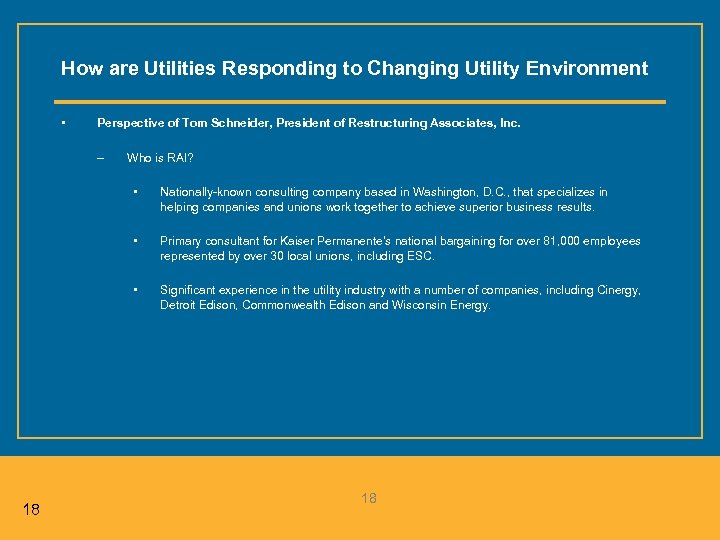 How are Utilities Responding to Changing Utility Environment • Perspective of Tom Schneider, President of Restructuring Associates, Inc. – Who is RAI? • • Primary consultant for Kaiser Permanente’s national bargaining for over 81, 000 employees represented by over 30 local unions, including ESC. • 18 Nationally-known consulting company based in Washington, D. C. , that specializes in helping companies and unions work together to achieve superior business results. Significant experience in the utility industry with a number of companies, including Cinergy, Detroit Edison, Commonwealth Edison and Wisconsin Energy. 18
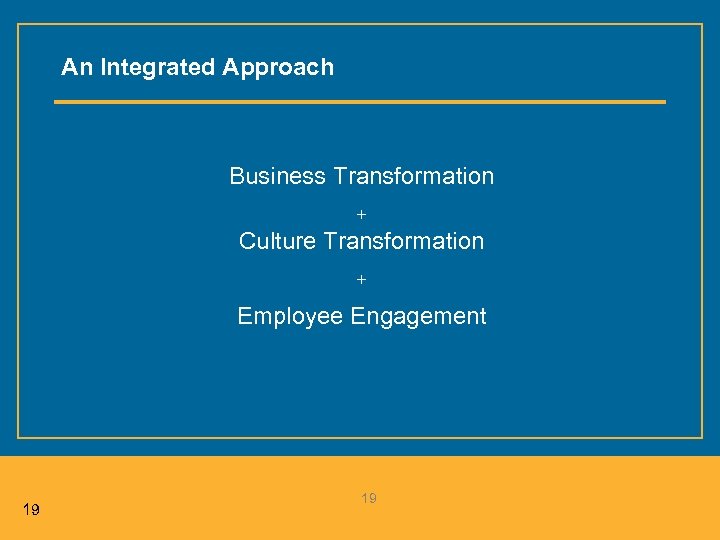 An Integrated Approach Business Transformation + Culture Transformation + Employee Engagement 19 19