 Скачать презентацию ASSESSING LISTENING purposes and techniques Prepared by Svetlana
M1U5 Lecture.ppt
- Количество слайдов: 35



ASSESSING LISTENING: purposes and techniques Prepared by Svetlana Sannikova, Vera Novikova and Olga Mironova Based on material by John Field 1
The Wise Owl There was an old owl who lived in an oak, The more he heard, the less he spoke The less he spoke, the more he heard Oh, if men were all like that wise bird! (Ogden Nash)
What is listening Listening is often seen as a two-stage process involving, in the first instance, the extraction of basic information followed by the use of that language for a communicative purpose. (Buck, 2001 p. 51)
Features of listening § Active: The listener has to remake the speaker’s intended meaning. § Time-constrained: The input is not under the control of the listener § Transitory: No text to refer back to. The listener has to carry forward a recall of what has been said in his/her mind. § Oral: The input contains features which reflect the way speech is produced
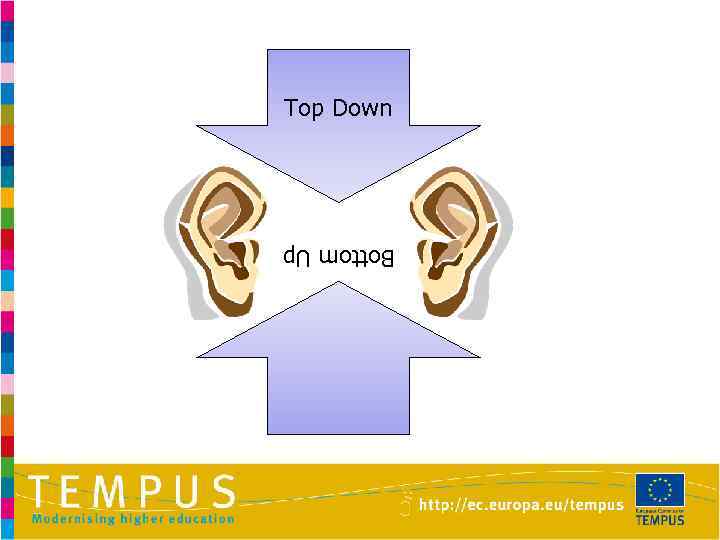
Bottom Up Top Down
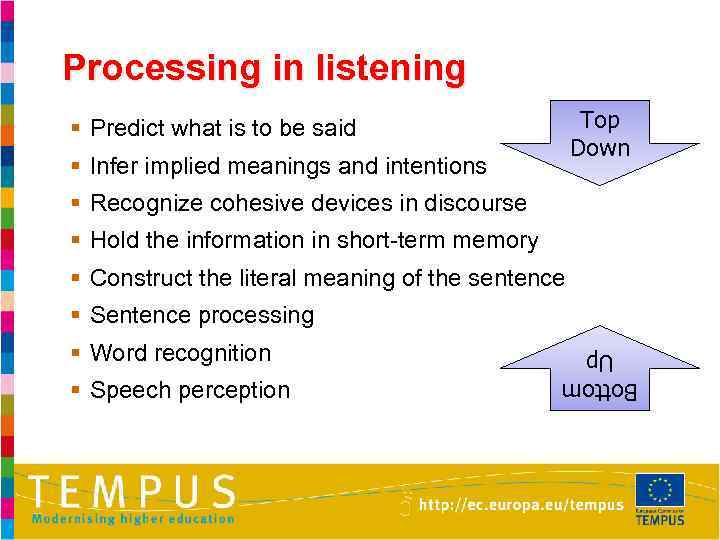
Processing in listening Top Down § Predict what is to be said § Infer implied meanings and intentions § Recognize cohesive devices in discourse § Hold the information in short-term memory § Construct the literal meaning of the sentence § Sentence processing § Speech perception Bottom Up § Word recognition
Bottom-up approach to listening Comprehension as a matter of listeners… 1. Decoding smallest elements of what they hear – the sounds. 2. Sounds combined and individual words decoded. 3. Words combined into sentences: listener works out meaning. 4. Add recognition of features such as intonation and so on… 5. Finally reach non-linguistic content. (Rumelhart and Ortony, 1977)
Top-down approach You hear: Mc. Kenzy brought me another present today. It was too late to save it so I buried it in the garden. I think I’m going to have to put a bell round his neck. . (from eltnotebook. blogspot. co. uk) What is the relationship between the speaker and Mc. Kenzy?
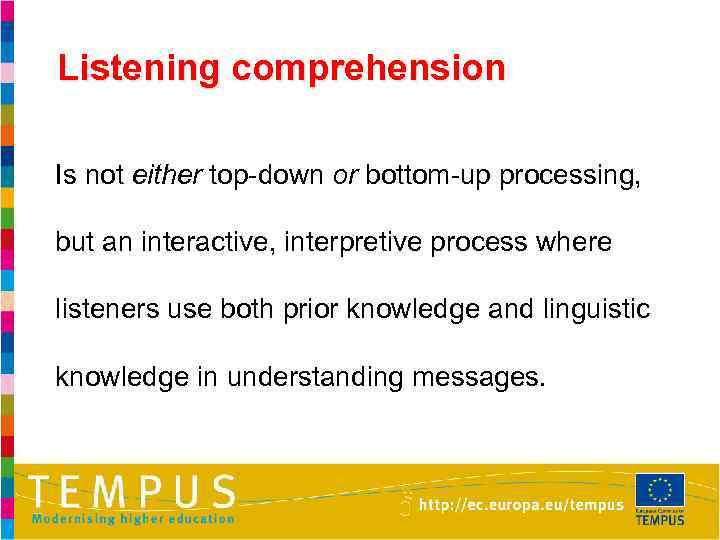
Listening comprehension Is not either top-down or bottom-up processing, but an interactive, interpretive process where listeners use both prior knowledge and linguistic knowledge in understanding messages.
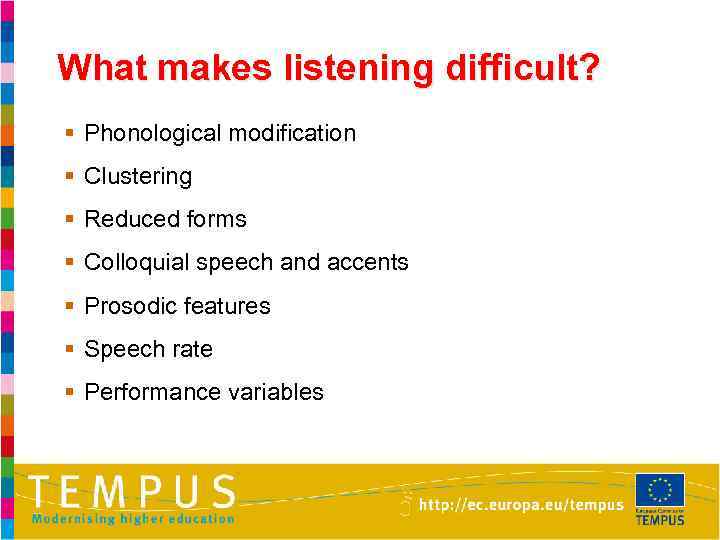
What makes listening difficult? § Phonological modification § Clustering § Reduced forms § Colloquial speech and accents § Prosodic features § Speech rate § Performance variables
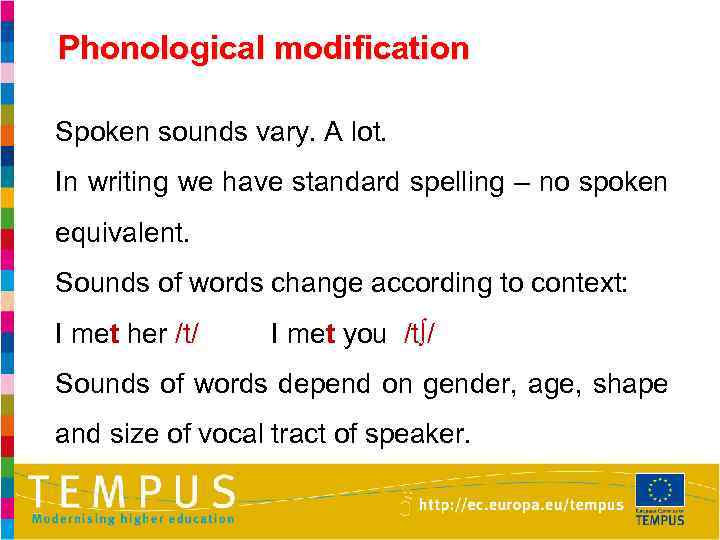
Phonological modification Spoken sounds vary. A lot. In writing we have standard spelling – no spoken equivalent. Sounds of words change according to context: I met her /t/ I met you /t∫/ Sounds of words depend on gender, age, shape and size of vocal tract of speaker.
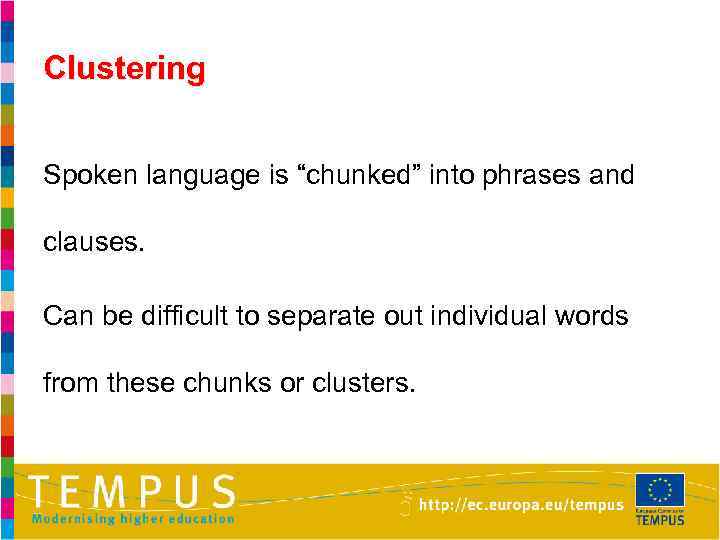
Clustering Spoken language is “chunked” into phrases and clauses. Can be difficult to separate out individual words from these chunks or clusters.
Reduced forms More reduced forms in speech than in writing. I am going to win = I’m gonna win In speech a lot of information comes from context and is not put into words: Not that one. On top!
Colloquial speech and accents § Local colloquial expressions and culturally specific patterns § Accents – Standard British/ American /Australian/ New Zealand etc. – Non-standard – L 2 accent
Prosodic features Rhythm, stress, and intonation of speech. Prosody varies according to… § Emotional state of speaker § Form of utterance (statement, question, or command) § Irony, sarcasm, emphasis, contrast How many different meanings can you express with just the word ‘No’? Can you make a conversation with three turns?
Speech rate § Fast speech is harder for learners to follow. § Those familiar with text book speech are often unable to keep up with a natural pace of speech.
Performance variables § Hesitations § False starts § Pauses § Corrections
Assessing listening is similar to reading § Both are receptive skills; § Can use many of the same types of items often with the same issues; § Need a reason for listening / reading; § Items can be marked objectively or subjectively; § Discrete point or integrative; § Both include bottom-up, top-down and interactive processing;
Assessing listening is different from reading § Real-time processing -> requires automaticity; § Specifications need to include information about speed of delivery wpm or sps (Hughes, 2003: 163) § ‘Mental gymnastics’ (backtracking) is more difficult; § Environment is more important (acoustics, quality of recording, quietness of location) (Hughes, 2003: 163) >construct –irrelevant variance (Messick, 1993) § Live delivery: must have equal input/speed/intonation/empgasis in delivery (between speakers and for the same speaker)
Types of classroom listening skills (Brown 2001, p. 273 ff. ) § Reactive (listen and repeat) § Intensive (listen for specific sounds, discourse markers, intonation patterns, etc. ) § Responsive (listen and respond – briefly) § Selective (listen for particular items in a longer stretch of discourse) § Extensive (listen for global comprehension) § Interactive (authentic communication listening as part of discussion, conversation, debate, etc. )
Purposes of assessing listening comprehension § Listening is found in most general proficiency tests, academic tests, tests of language for business purposes § In achievement tests it is used to assess achievement and to encourage students to practise listening § Listening is widely used in placement testing to identify the level of class a student should enter.
Which kind of language should learners be able to understand at different levels? OVERALL LISTENING COMPREHENSION (Common European Framework of Reference for Languages)
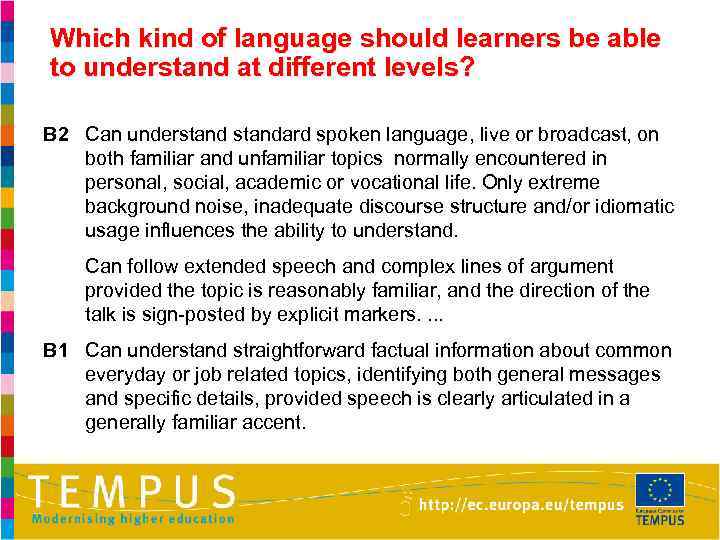
Which kind of language should learners be able to understand at different levels? B 2 Can understandard spoken language, live or broadcast, on both familiar and unfamiliar topics normally encountered in personal, social, academic or vocational life. Only extreme background noise, inadequate discourse structure and/or idiomatic usage influences the ability to understand. Can follow extended speech and complex lines of argument provided the topic is reasonably familiar, and the direction of the talk is sign-posted by explicit markers. . B 1 Can understand straightforward factual information about common everyday or job related topics, identifying both general messages and specific details, provided speech is clearly articulated in a generally familiar accent.
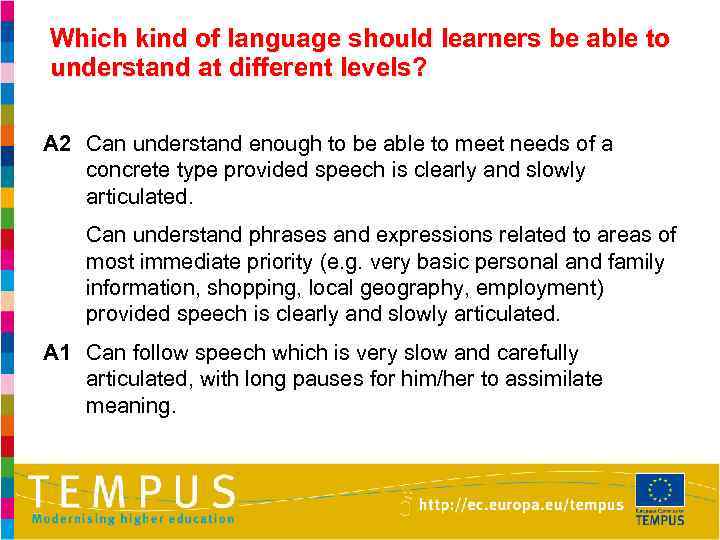
Which kind of language should learners be able to understand at different levels? A 2 Can understand enough to be able to meet needs of a concrete type provided speech is clearly and slowly articulated. Can understand phrases and expressions related to areas of most immediate priority (e. g. very basic personal and family information, shopping, local geography, employment) provided speech is clearly and slowly articulated. A 1 Can follow speech which is very slow and carefully articulated, with long pauses for him/her to assimilate meaning.
Measurement principles of assessing listening § Reliability § Validity § Fairness
Cognitive validity Do the cognitive processes in which test-takers engage during a test of language skills correspond to those which expert users of the L 2 would employ in the real-world events the test is intended to predict?
‘Authenticity’ § Recordings should be as close as possible to natural everyday speech. § ‘Authentic’ material not necessarily informal. Some formal listening conditions provide useful test material: job interviews, discussions, lectures. – Key consideration: What kind of speech will test takers be exposed to: informal everyday – broadcast – professional/academic? § Especially important in some tests is naturalness of delivery. Are there: natural planning pauses – hesitations – relatively short utterances - lexical chunks etc. ? University of Bedfordshire 11/02/2018 27
Number of participants (Hughes A. 2003) § Monologue § Dialogue § Polylogue/ Multiparticipant Conversation.
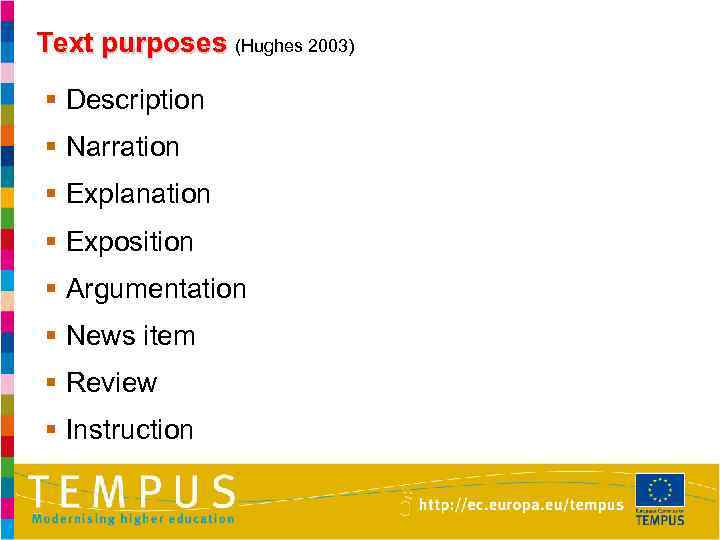
Text purposes (Hughes 2003) § Description § Narration § Explanation § Exposition § Argumentation § News item § Review § Instruction
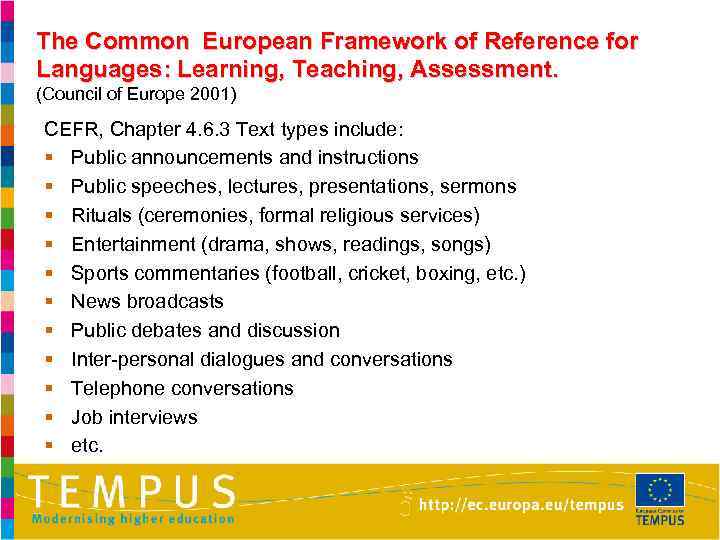
The Common European Framework of Reference for Languages: Learning, Teaching, Assessment. (Council of Europe 2001) CEFR, Chapter 4. 6. 3 Text types include: § Public announcements and instructions § Public speeches, lectures, presentations, sermons § Rituals (ceremonies, formal religious services) § Entertainment (drama, shows, readings, songs) § Sports commentaries (football, cricket, boxing, etc. ) § News broadcasts § Public debates and discussion § Inter-personal dialogues and conversations § Telephone conversations § Job interviews § etc.
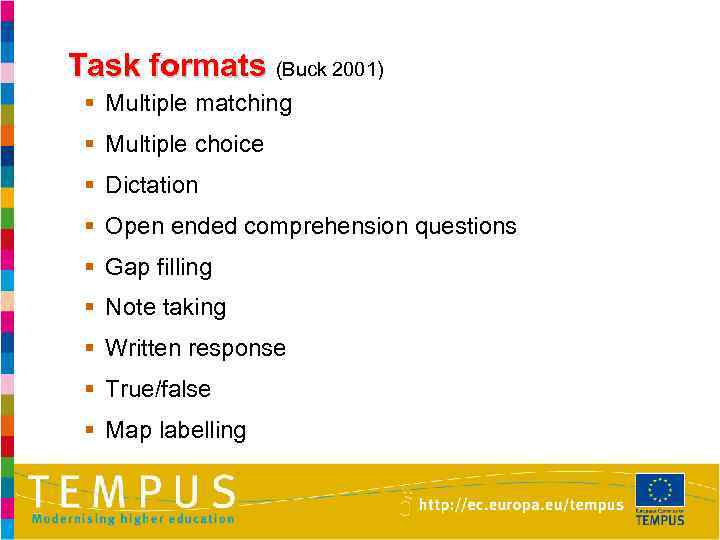
Task formats (Buck 2001) § Multiple matching § Multiple choice § Dictation § Open ended comprehension questions § Gap filling § Note taking § Written response § True/false § Map labelling
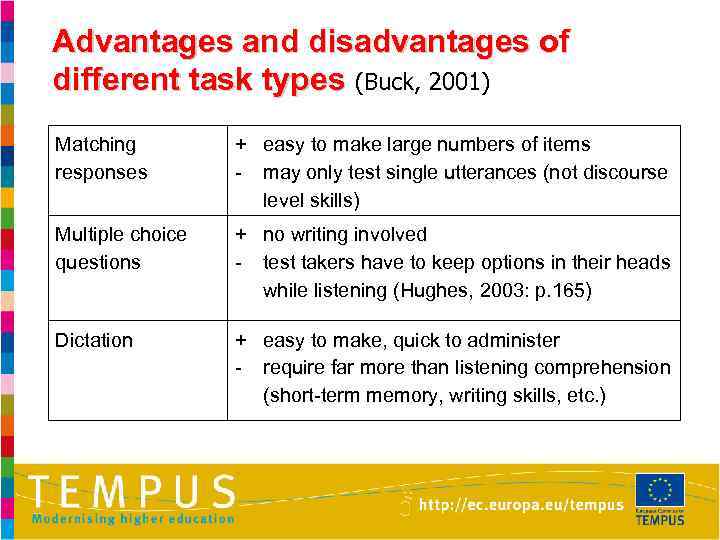
Advantages and disadvantages of different task types (Buck, 2001) Matching responses + easy to make large numbers of items - may only test single utterances (not discourse level skills) Multiple choice questions + no writing involved - test takers have to keep options in their heads while listening (Hughes, 2003: p. 165) Dictation + easy to make, quick to administer - require far more than listening comprehension (short-term memory, writing skills, etc. )
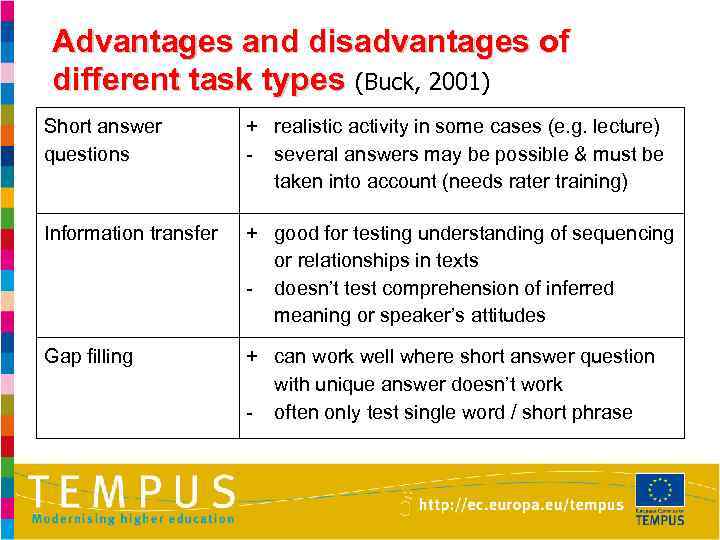
Advantages and disadvantages of different task types (Buck, 2001) Short answer questions + realistic activity in some cases (e. g. lecture) - several answers may be possible & must be taken into account (needs rater training) Information transfer + good for testing understanding of sequencing or relationships in texts - doesn’t test comprehension of inferred meaning or speaker’s attitudes Gap filling + can work well where short answer question with unique answer doesn’t work - often only test single word / short phrase
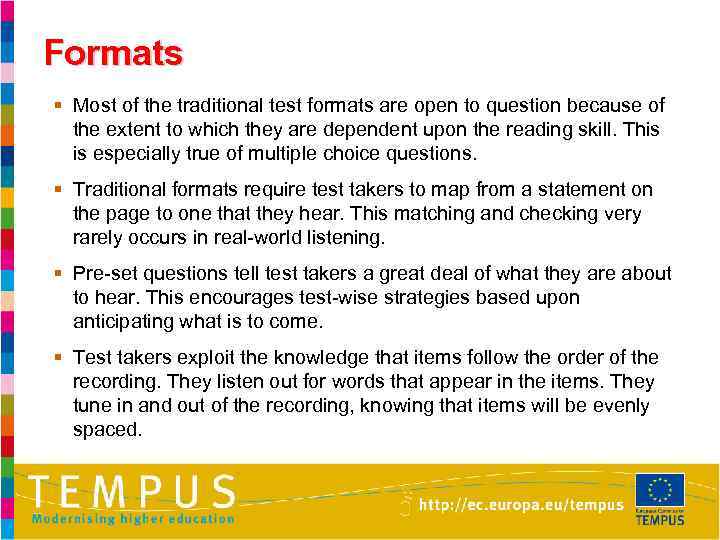
Formats § Most of the traditional test formats are open to question because of the extent to which they are dependent upon the reading skill. This is especially true of multiple choice questions. § Traditional formats require test takers to map from a statement on the page to one that they hear. This matching and checking very rarely occurs in real-world listening. § Pre-set questions tell test takers a great deal of what they are about to hear. This encourages test-wise strategies based upon anticipating what is to come. § Test takers exploit the knowledge that items follow the order of the recording. They listen out for words that appear in the items. They tune in and out of the recording, knowing that items will be evenly spaced.
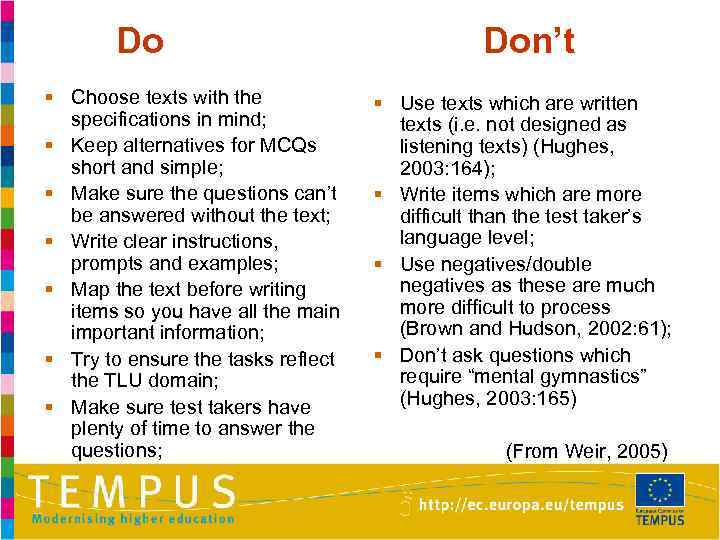
Do § Choose texts with the specifications in mind; § Keep alternatives for MCQs short and simple; § Make sure the questions can’t be answered without the text; § Write clear instructions, prompts and examples; § Map the text before writing items so you have all the main important information; § Try to ensure the tasks reflect the TLU domain; § Make sure test takers have plenty of time to answer the questions; Don’t § Use texts which are written texts (i. e. not designed as listening texts) (Hughes, 2003: 164); § Write items which are more difficult than the test taker’s language level; § Use negatives/double negatives as these are much more difficult to process (Brown and Hudson, 2002: 61); § Don’t ask questions which require “mental gymnastics” (Hughes, 2003: 165) (From Weir, 2005)
Скачать презентацию ASSESSING LISTENING purposes and techniques Prepared by Svetlana
M1U5 Lecture.ppt