


 Скачать презентацию ASSESSING INVESTMENT FINANCIAL FLOWS FOR ADAPTATION IN
6018a1f9ebbdd6df828a5d5a0f24fc20.ppt
- Количество слайдов: 28
 ASSESSING INVESTMENT & FINANCIAL FLOWS FOR ADAPTATION IN THE COASTAL ZONES SECTOR UNDP I&FF Methodology Guidebook: Adaptation
 Definition coastal zones …: p… p REGIONAL CENTRE: PLEASE INSERT A DEFINITION THAT MATCHES THE CONTEXT OF THE COUNTRY
 Climate change impacts on the coastal zones sector Biophysical effects: p Increased floodfrequency p Erosion p Inundation p Rising water tables p Saltwater intrusion p Biological effects Sea-level rise: socio-economic effects: p Loss of economic, ecological, cultural & subsistence values through loss of land, infrastructure & coastal habitats p Increased flood risk to people, land & infrastructure p Changes in water management, salinity & biological activity, loss of tourism, coastal habitats & effects on agriculture/aquaculture
 1. Establish key parameters of the assessment p p Define scope for the assessment Define the institutional framework Specify the time horizon for the analysis: 20052030 recommended, base year 2005 recommended Build on existing model for the sector where possible
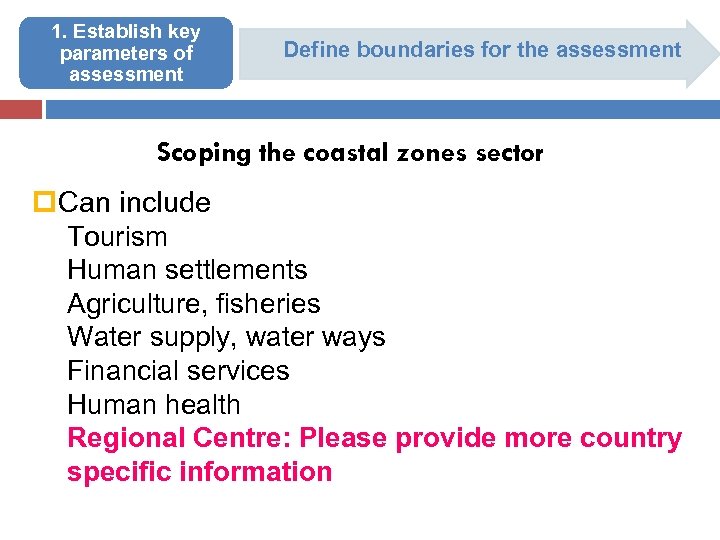 1. Establish key parameters of assessment Define boundaries for the assessment Scoping the coastal zones sector p. Can include Tourism Human settlements Agriculture, fisheries Water supply, water ways Financial services Human health Regional Centre: Please provide more country specific information
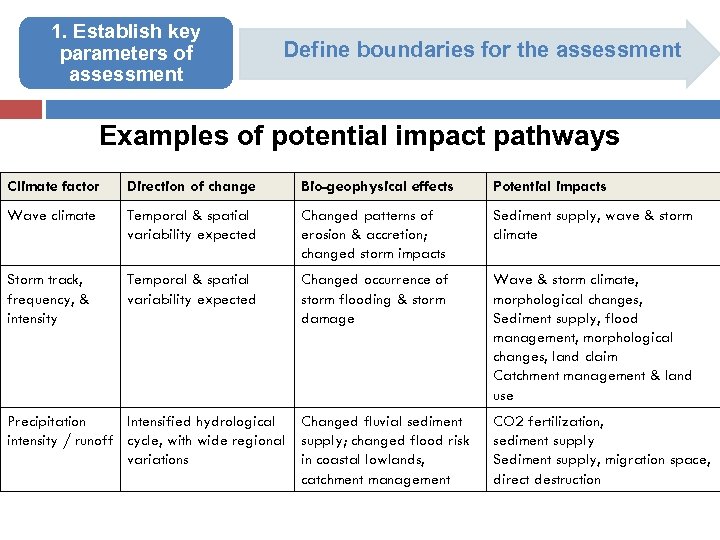 1. Establish key parameters of assessment Define boundaries for the assessment Examples of potential impact pathways Climate factor Direction of change Bio-geophysical effects Potential impacts Wave climate Temporal & spatial variability expected Changed patterns of erosion & accretion; changed storm impacts Sediment supply, wave & storm climate Storm track, frequency, & intensity Temporal & spatial variability expected Changed occurrence of storm flooding & storm damage Wave & storm climate, morphological changes, Sediment supply, flood management, morphological changes, land claim Catchment management & land use Changed fluvial sediment supply; changed flood risk in coastal lowlands, catchment management CO 2 fertilization, sediment supply Sediment supply, migration space, direct destruction Precipitation Intensified hydrological intensity / runoff cycle, with wide regional variations
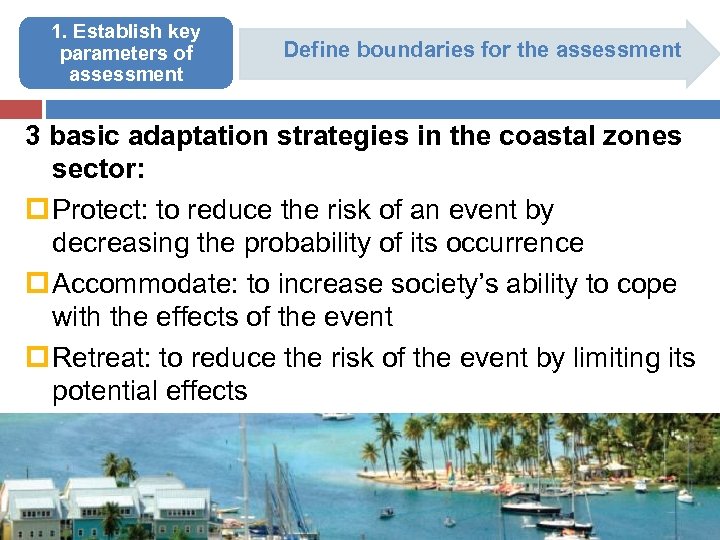 1. Establish key parameters of assessment Define boundaries for the assessment 3 basic adaptation strategies in the coastal zones sector: p Protect: to reduce the risk of an event by decreasing the probability of its occurrence p Accommodate: to increase society’s ability to cope with the effects of the event p Retreat: to reduce the risk of the event by limiting its potential effects
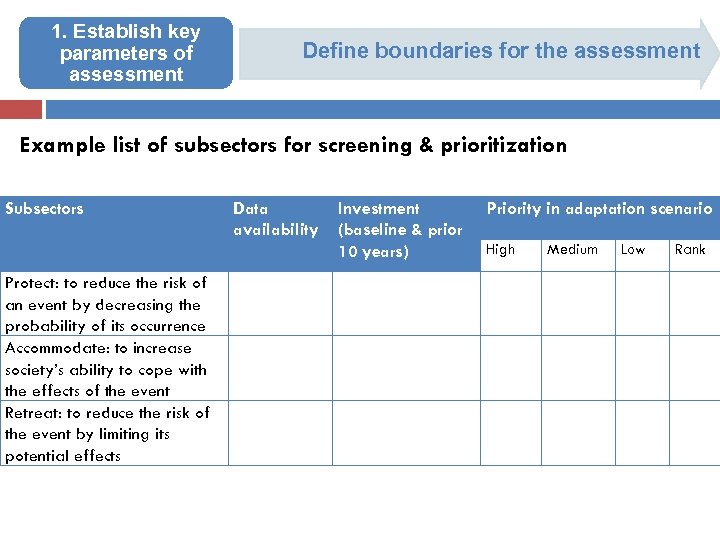 1. Establish key parameters of assessment Define boundaries for the assessment Example list of subsectors for screening & prioritization Subsectors Protect: to reduce the risk of an event by decreasing the probability of its occurrence Accommodate: to increase society’s ability to cope with the effects of the event Retreat: to reduce the risk of the event by limiting its potential effects Data availability Investment (baseline & prior 10 years) Priority in adaptation scenario High Medium Low Rank
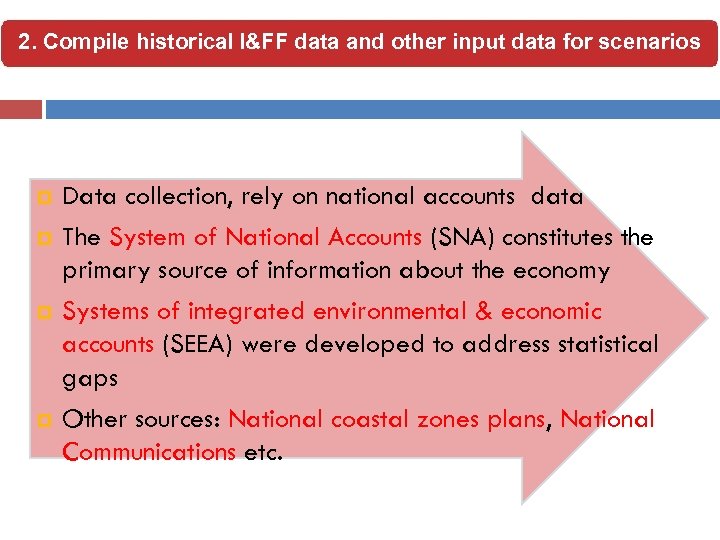 2. Compile historical I&FF data and other input data for scenarios p p Data collection, rely on national accounts data The System of National Accounts (SNA) constitutes the primary source of information about the economy Systems of integrated environmental & economic accounts (SEEA) were developed to address statistical gaps Other sources: National coastal zones plans, National Communications etc.
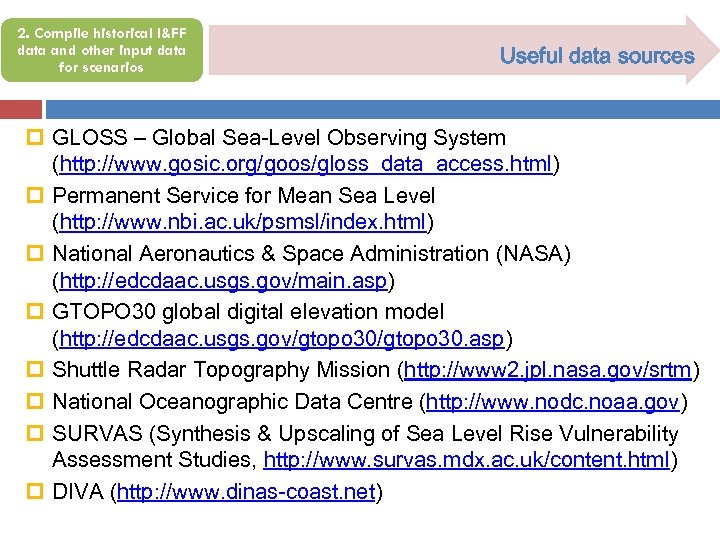 2. Compile historical I&FF data and other input data for scenarios Useful data sources p GLOSS – Global Sea-Level Observing System (http: //www. gosic. org/goos/gloss_data_access. html) p Permanent Service for Mean Sea Level (http: //www. nbi. ac. uk/psmsl/index. html) p National Aeronautics & Space Administration (NASA) (http: //edcdaac. usgs. gov/main. asp) p GTOPO 30 global digital elevation model (http: //edcdaac. usgs. gov/gtopo 30. asp) p Shuttle Radar Topography Mission (http: //www 2. jpl. nasa. gov/srtm) p National Oceanographic Data Centre (http: //www. nodc. noaa. gov) p SURVAS (Synthesis & Upscaling of Sea Level Rise Vulnerability Assessment Studies, http: //www. survas. mdx. ac. uk/content. html) p DIVA (http: //www. dinas-coast. net)
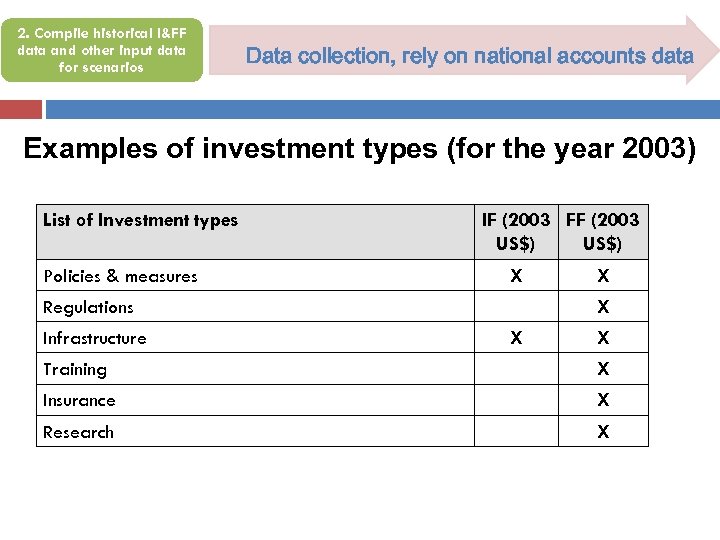 2. Compile historical I&FF data and other input data for scenarios Data collection, rely on national accounts data Examples of investment types (for the year 2003) List of Investment types Policies & measures IF (2003 FF (2003 US$) X Regulations Infrastructure X X Training X Insurance X Research X
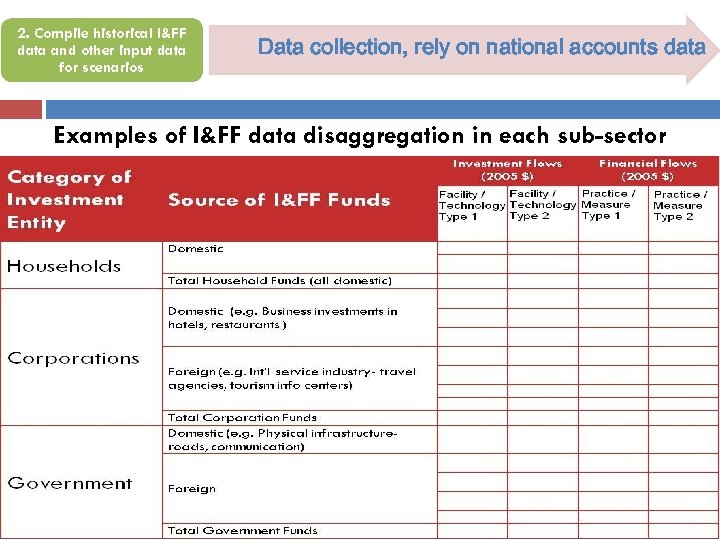 2. Compile historical I&FF data and other input data for scenarios Data collection, rely on national accounts data Examples of I&FF data disaggregation in each sub-sector
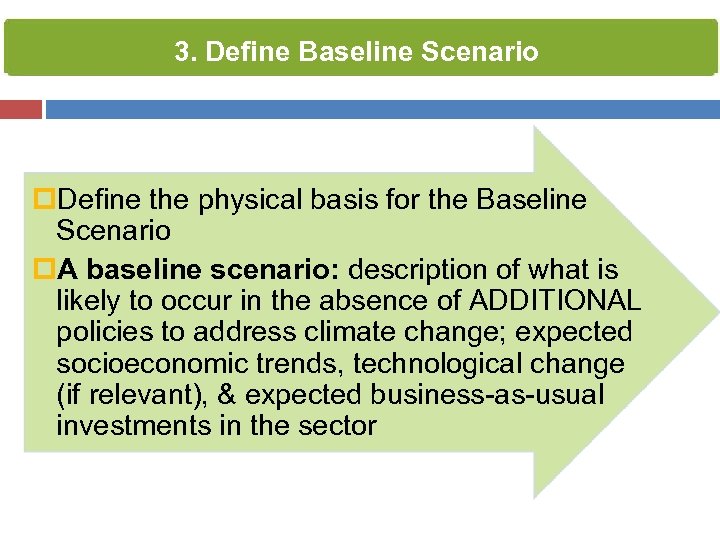 3. Define Baseline Scenario p. Define the physical basis for the Baseline Scenario p. A baseline scenario: description of what is likely to occur in the absence of ADDITIONAL policies to address climate change; expected socioeconomic trends, technological change (if relevant), & expected business-as-usual investments in the sector
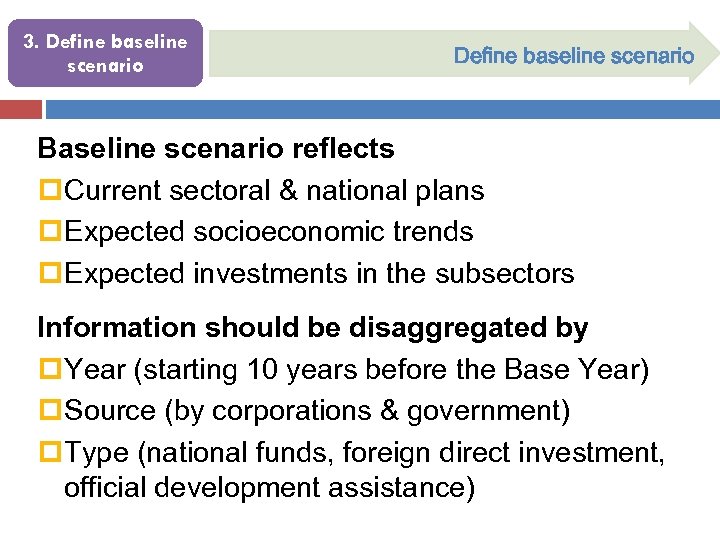 3. Define baseline scenario Baseline scenario reflects p. Current sectoral & national plans p. Expected socioeconomic trends p. Expected investments in the subsectors Information should be disaggregated by p. Year (starting 10 years before the Base Year) p. Source (by corporations & government) p. Type (national funds, foreign direct investment, official development assistance)
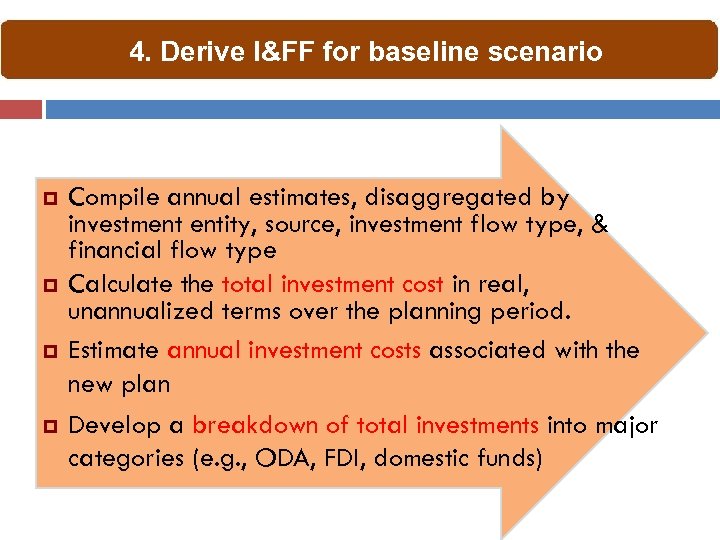 4. Derive I&FF for baseline scenario p p Compile annual estimates, disaggregated by investment entity, source, investment flow type, & financial flow type Calculate the total investment cost in real, unannualized terms over the planning period. Estimate annual investment costs associated with the new plan Develop a breakdown of total investments into major categories (e. g. , ODA, FDI, domestic funds)
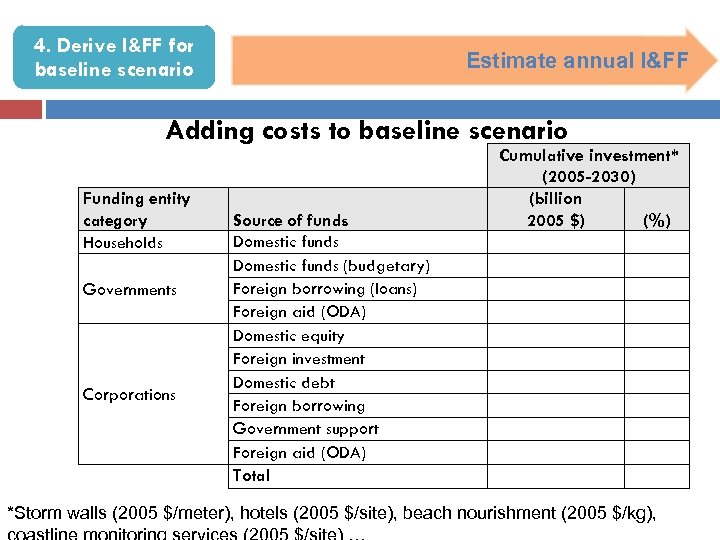 4. Derive I&FF for baseline scenario Estimate annual I&FF Adding costs to baseline scenario Funding entity category Households Governments Corporations Source of funds Domestic funds (budgetary) Foreign borrowing (loans) Foreign aid (ODA) Domestic equity Foreign investment Domestic debt Foreign borrowing Government support Foreign aid (ODA) Total Cumulative investment* (2005 -2030) (billion 2005 $) (%) *Storm walls (2005 $/meter), hotels (2005 $/site), beach nourishment (2005 $/kg),
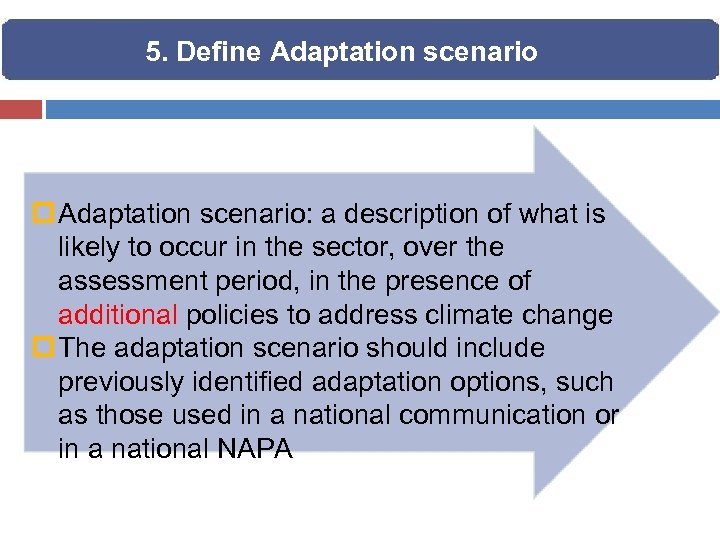 5. Define Adaptation scenario p Adaptation scenario: a description of what is likely to occur in the sector, over the assessment period, in the presence of additional policies to address climate change p The adaptation scenario should include previously identified adaptation options, such as those used in a national communication or in a national NAPA
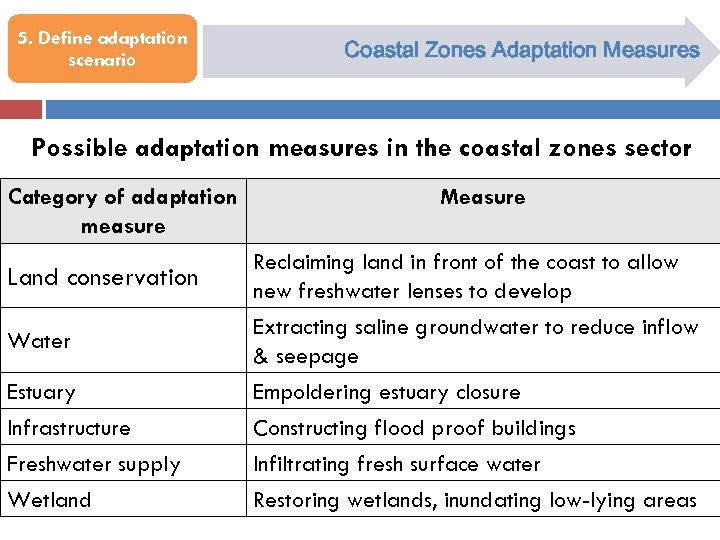 5. Define adaptation scenario Coastal Zones Adaptation Measures Possible adaptation measures in the coastal zones sector Category of adaptation measure Land conservation Measure Reclaiming land in front of the coast to allow new freshwater lenses to develop Estuary Infrastructure Extracting saline groundwater to reduce inflow & seepage Empoldering estuary closure Constructing flood proof buildings Freshwater supply Wetland Infiltrating fresh surface water Restoring wetlands, inundating low-lying areas Water
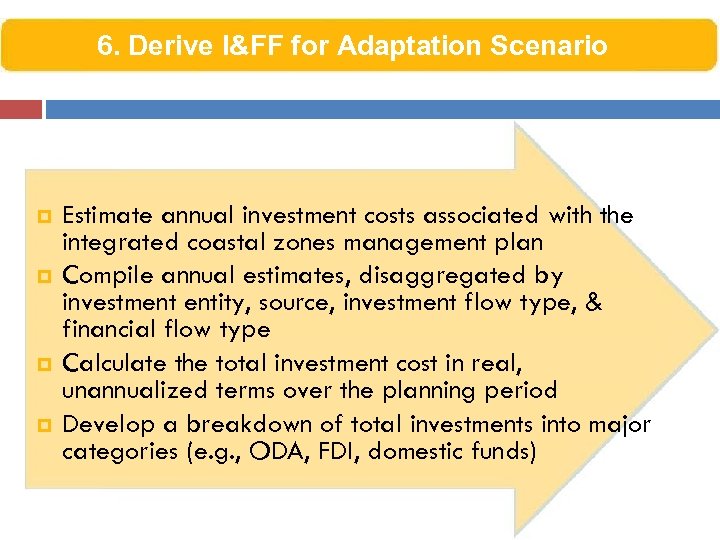 6. Derive I&FF for Adaptation Scenario p p Estimate annual investment costs associated with the integrated coastal zones management plan Compile annual estimates, disaggregated by investment entity, source, investment flow type, & financial flow type Calculate the total investment cost in real, unannualized terms over the planning period Develop a breakdown of total investments into major categories (e. g. , ODA, FDI, domestic funds)
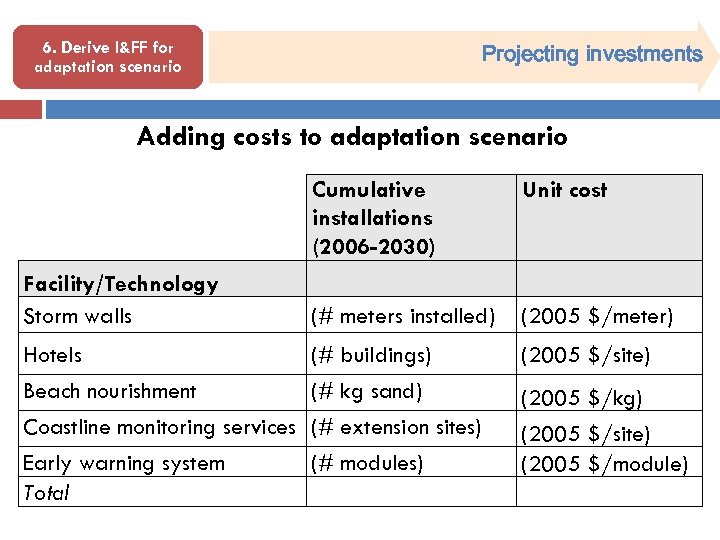 6. Derive I&FF for adaptation scenario Projecting investments Adding costs to adaptation scenario Cumulative installations (2006 -2030) Facility/Technology Storm walls (# meters installed) (2005 $/meter) Hotels (# buildings) Beach nourishment (# kg sand) Coastline monitoring services (# extension sites) Early warning system Total Unit cost (# modules) (2005 $/site) (2005 $/kg) (2005 $/site) (2005 $/module)
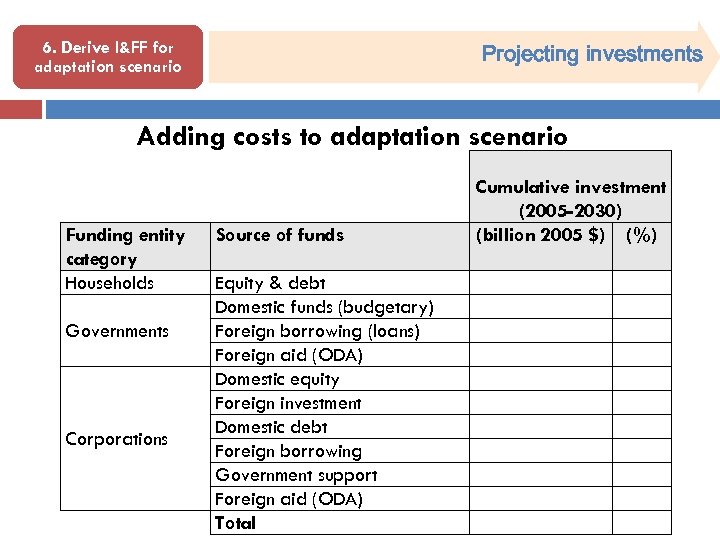 6. Derive I&FF for adaptation scenario Projecting investments Adding costs to adaptation scenario Funding entity category Households Governments Corporations Source of funds Cumulative investment (2005 -2030) (billion 2005 $) (%) Equity & debt Domestic funds (budgetary) Foreign borrowing (loans) Foreign aid (ODA) Domestic equity Foreign investment Domestic debt Foreign borrowing Government support Foreign aid (ODA) Total
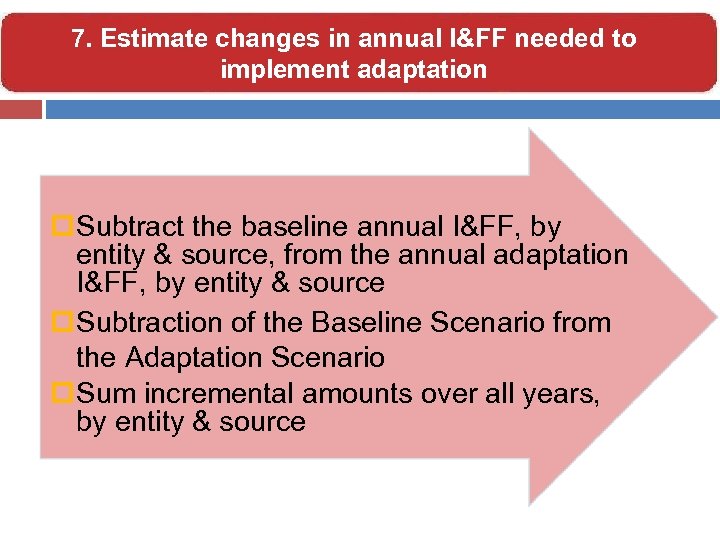 7. Estimate changes in annual I&FF needed to implement adaptation p. Subtract the baseline annual I&FF, by entity & source, from the annual adaptation I&FF, by entity & source p. Subtraction of the Baseline Scenario from the Adaptation Scenario p. Sum incremental amounts over all years, by entity & source
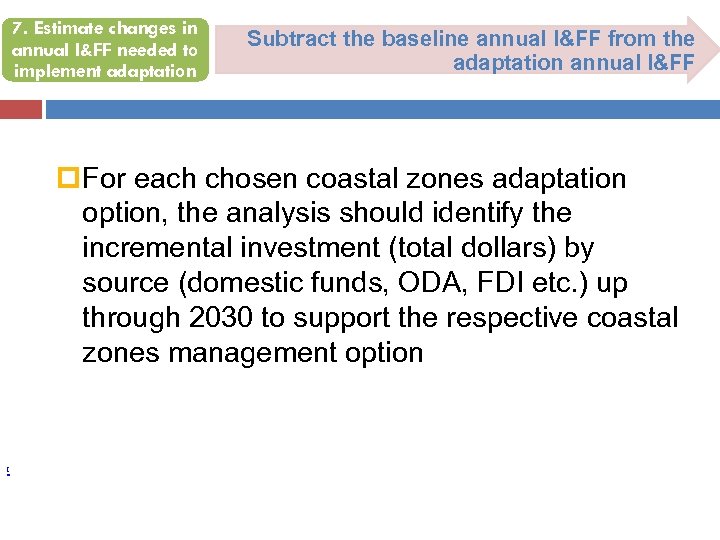 7. Estimate changes in annual I&FF needed to implement adaptation Subtract the baseline annual I&FF from the adaptation annual I&FF p. For each chosen coastal zones adaptation option, the analysis should identify the incremental investment (total dollars) by source (domestic funds, ODA, FDI etc. ) up through 2030 to support the respective coastal zones management option [
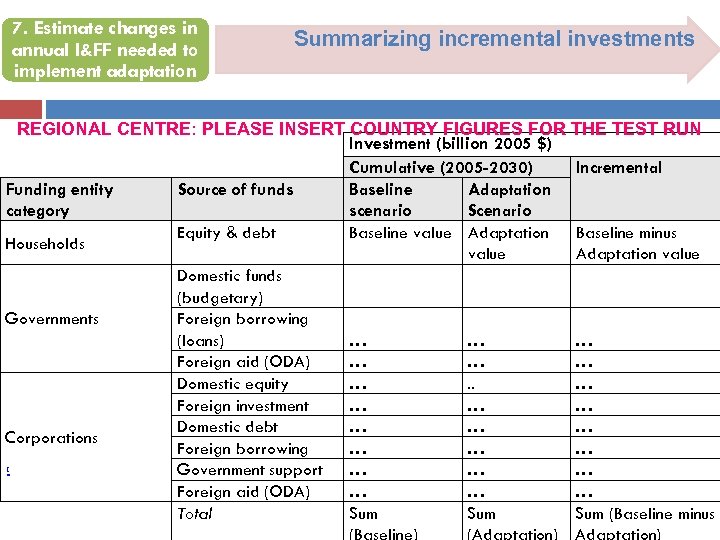 7. Estimate changes in annual I&FF needed to implement adaptation Summarizing incremental investments REGIONAL CENTRE: PLEASE INSERT COUNTRY FIGURES FOR THE TEST RUN Investment (billion 2005 $) Cumulative (2005 -2030) Incremental Funding entity Source of funds Baseline Adaptation category scenario Scenario Equity & debt Baseline value Adaptation Baseline minus Households value Adaptation value Domestic funds (budgetary) Governments Foreign borrowing (loans) … … … Foreign aid (ODA) … … … Domestic equity …. . … Foreign investment … … … Domestic debt … … … Corporations Foreign borrowing … … … Government support … … … Foreign aid (ODA) … … … Total Sum Sum (Baseline minus [
 8. Evaluate policy implications p p Identify the entities that are responsible for the significant incremental changes in I&FF Determine the predominant sources of their funds, particularly important to distinguish between public & private sources of finance Determine policy instruments & measures to encourage changes in I&FF Coastal zones sector policies are needed to induce the relevant entities to implement the proposed measures
 8. Evaluate policy implications Assess policy options and summarize the projected I&FF for the key sector ¨ Coastal zones sector policies are likely to be needed to induce the relevant entities to implement the proposed measures • Adaptation can occur quickly in some sectors, but is slower in sectors with long-lived infrastructure • These characteristics suggest a mix of adaptation policies
 9. Synthesize results and complete report p For more information on synthesizing results, documentation & the completion of the report, please refer to the Reporting Guidelines
 ? Q&A CLARIFICATIONS ? ? ?